What Happened To The Truth Movement?

Over the years many aspects of the “truth movement” have devolved into an insufferable dumpster fire. But we can still salvage it.

By Benny Wills

Source: The Free Thought Project

From 2004 – 2016, I felt like I was a part of something special. I was participating in an “awakening.” The world was changing. Consciousness was shifting. The hidden hand was being exposed and all secrets were being revealed!

Right?

Or maybe it was wishful thinking.

9/11 happened. And for the next decade and a half, people all over the world began to question the events of that day. Then, major events in general. It was the beginning of an uprising. A revolution!

Right…?

Something else emerged during that time. Social media.

Social media has its upsides and downsides. Mostly upsides. But the downsides have serious ramifications. Specifically on communication.

Social media brings us together and tears us apart.

2001: A Truth Odyssey

By 2001, almost everyone was online and connected to the internet. But it was still in its infancy.

The iPhone didn’t exist. There was no YouTube, Facebook, Instagram, or Twitter. Even MySpace wasn’t around yet.

We had access to the internet, but we had no idea what we were in store for.

As the internet expanded, so did our ability to share information.

Alternative perspectives, counter-narratives, and “conspiracy theories” became more accessible. For the first time (possibly) in history, “official stories” were being challenged in real time. With evidence to support claims.

I was dubious about 9/11 as it was happening. Not because of the internet. Not because I was a conspiracy theorist. But because I hated George Bush. As a born and raised Democrat, I didn’t trust him. I was staunchly anti-war (and still am), and I knew America’s response to the attacks was going to be insane.

A few years later, someone shared a documentary with me called Loose Change. A film deconstructing the 9/11 narrative. My mind was blown, and it was off to the races.

Down, Down, Down The Rabbit Hole.

YouTube hit the scene in 2005. I used it strictly for conspiracy-related research.

Conspiracy content blew up online. A truth movement had begun. The masses were on the verge of waking up, well, en masse.

Right?!?!

Divide & Conquer

Fast forward to 2024. I have good news and bad news.

The good news is that more people are questioning things than ever. Distrust in anything mainstream is at an all time high.

The bad news:

Societal division is worse than it’s ever been. In my lifetime anyway. It’s hard to even call it division because division implies splitting into two halves.

This is a direct result of thumb-typed communication. (Generation Text.)

These days, most people prefer texting, emailing, or commenting over direct engagement. We yearn for human connection, but we’ve patterned ourselves to avoid it as much as possible. (I’m speaking generally, of course.)

Confronting someone is uncomfortable. But confrontation is a necessary part of human interaction. It’s a key component in solving conflict or avoiding it altogether. But since it can be terrifying, people today have the easy-out of typing instead of speaking.

Typed communication lacks empathy. It’s indirect. Impersonal. It’s both a barrier and a shield.

So people say things to each other online that they would never say out loud. They rip each other apart over the slightest differences of opinion. Many (especially YouTube commenters) hide behind avatars and pseudonyms to say whatever they want with no accountability.

Basically, everyone has free rein to be an asshole with zero repercussions.

Worst of all, no one is listening to each other anymore.

We haven’t just been divided; we’ve been fractalized into smithereens.

Awake Vs. Woke

The “awake” crowd is as insufferable as the “woke” one. Change my mind.

Mean-spirited mudslinging and public shaming are the online norm.

Checking the timeline on Facebook, for instance, is a disheartening experience.

It’s a daily mélange of proselytizing, bickering, and judging others. The sentiment is “my way or the highway.”

“I’m right, and you’re wrong. And not only are you wrong, you’re also a stupid idiot.”

Many on the alternative or “conspiracy” side of things have fallen into the same trap as the “sheep” they condemn.

Arrogant allegiance to ideas, beliefs, and opinions.

Critical Thinking

At the height of the truth movement in the 2010s, there was an emphasis on critical thinking. The Trivium was making a comeback.

Grammar, logic, and rhetoric

In that order. 
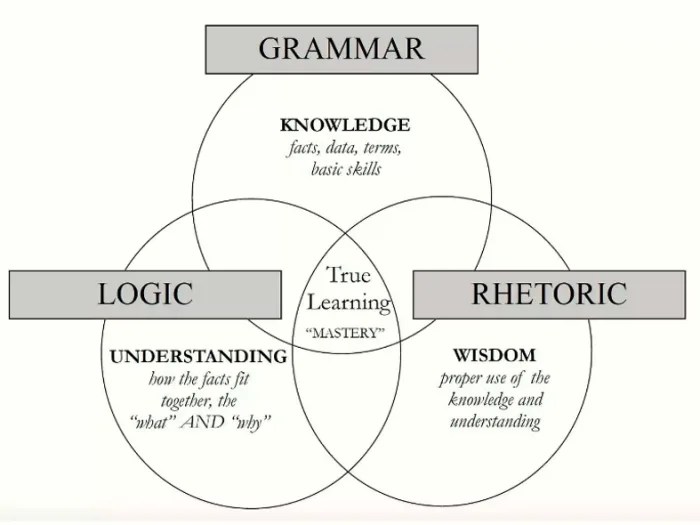
More often than not, online communication is rhetoric without grammar and logic to back it up.

Sweeping generalizations abound.

  • Accusations
  • Declarations
  • Proclamations
  • & Polarizing opinions disguised as facts

But opinions are not facts. (And you are not your opinions.)

“A great many people think they are thinking when they are merely rearranging their prejudices.” – William James

Social media algorithms are designed to keep you in a feedback loop.

A lot of people use their (typed) voice online to “speak the truth.” But they’re preaching to the choir in an echo chamber.

There’s camaraderie to be found in this. Which is good. But the likelihood of their rantings reaching those who (they feel) need to hear them is small.

The aggression that comes through many posts is ugly and derogatory.

Anger

Anger is a powerful emotion. But it’s like fire. It can warm your house or burn it down.

“Heat not a furnace for your foe so hot that it do singe yourself.” – William Shakespeare

Many people lean on anger to convey their conviction about a topic. They use it to stress the importance of something. But more often than not, it’s ineffective.

Anger is best utilized when it’s the seed preceding something more interesting.

In other words, anger alone is a weak emotion for personal expression.

When anger sparks an idea, and that idea is built upon with clarity and care, the expression of that idea has the power to shift someone’s perspective.

Many of my poems and JoyCamp videos came from an angry place. But anger is nowhere to be found in the final product.

Some think I’m too soft in my approach. Well, they’re welcome to think whatever they want. I’ve learned through trial and error that bluntly and angrily stating “the truth” is a fool’s errand. People don’t want to hear it, no matter how right or passionate you are.

Use anger like clay and sculpt it.

I tried anger in my 20s, and it got me nowhere. If anything, it only made situations worse. Speaking loudly and angrily puts more distance between your conversation partner and the point you want them to understand.

I’m committed to the truth and helping others discover it for themselves. Over the course of 15 years, I developed a nuanced approach to communication that actually works. One that I’ve taught to hundreds of people in my Parrhesia program (now called Free Your Speech).

If you didn’t pull the trigger on Parrhesia when I was offering it live, you can still purchase the course itself.

>>Free Your Speech: The Art of Communication

I’ve dropped the price to $149. It’s an election year. It’s probably worth your while.

Logic

It’s agonizing to witness your friends, family, and society at large fall into what you perceive as traps.

What’s painfully obvious to you is beyond absurd or ridiculous to them. And no matter how much you try to convince them otherwise, they double down on their commitment to the trap.

People are not logical. They’re emotional and motivated by fear, comfort, and ego.

“No one can possibly behave above his own level of understanding. Don’t expect people to do any better than they are compelled to do at their present level. Your problem is assuming that they should and could behave better. Understand this and annoyance disappears. As you gradually awaken you will feel the urge to share your discovery with others. Because you will find others in various stages of receptivity, remember this: Never give more than others can understand and appreciate in the moment. This is cosmic law. To try and give what others cannot receive is like tossing a ball against a brick wall—it bounces back to strike you. Jesus explained this law by saying that we should not cast our pearls before swine; that is, before those whose comprehension of truth makes them indifferent or hostile about it.” – François Fénelon

This is the cornerstone of my communication philosophy and approach.

The Real Awakening

There is no truth movement. There never was. There is only your journey to discovering what the truth is.

Pick your lane and choose your battles wisely.

Worry less about the world and other people’s opinions.

Concern yourself with what you’re capable of. Challenge your comfort zone. And focus your efforts on how you can help.

The most exciting rabbit hole is YOU.

Until next time.

Much love,

Benny

PS- Build Bridges
How the U.S. Regime Carries Out Its Oppression

By Eric Zuesse

Source: The Duran

The U.S. regime carries out its oppression by coercion, and by delay and outright suppression of news-reporting about the key facts of the case. It does this both in domestic matters and in international ones, as will here be exemplified first by the example of an innocent man who was framed by the U.S. regime and given a life sentence in a murder-case, and then by the example of the deeply corrupted Ukrainian nation which was grabbed by the U.S. regime in a February 2014 U.S. coup that the U.S. regime hid behind popular 2013-2014 anti-corruption demonstrations on the Maidan square in Kiev and so turned that nation into a battering-ram against the U.S. regime’s top target for conquest, which is Russia right next door to Ukraine.

In both examples — both domestic and foreign — the U.S. regime’s motivation was to increase and to intensify the power of its owners, whom it serves and who are never satisfied with the immense power that they already have but always crave to acquire yet more.

HOW IT DOES DOMESTIC OPPRESSION

On 4 May 2020, Jordan Smith headlined “MISSOURI’S ATTORNEY GENERAL IS FIGHTING FOR THE RIGHT TO KEEP AN INNOCENT MAN IN PRISON: Despite ample evidence that Lamar Johnson was wrongfully convicted, Eric Schmitt is sparing no effort to keep him locked up as the coronavirus spreads”, and reported that:

The police had nothing concrete to go on. But by the time they finally interviewed Elking, they had already latched onto a suspect: 20-year-old Lamar Johnson.

Johnson would soon be arrested and tried for the October 1994 murder on thin and troubling evidence. …

In 1995, Johnson was sentenced to life in prison without the possibility of parole. Still, he has long maintained his innocence — and now has a powerful ally in his corner: Circuit Attorney Kim Gardner, chief prosecutor for the city of St. Louis.

Gardner ran on a reform agenda and in 2016 became the first black elected prosecutor in the city’s history. She won federal funding to start a conviction integrity unit and in 2018, at the behest of the Midwest Innocence Project, began investigating Johnson’s case. A year later, she concluded that he was innocent.

In July 2019, Gardner filed a motion with Circuit Court Judge Elizabeth Hogan conceding that Johnson was wrongfully convicted. She asked the judge to grant a hearing on the matter and, ultimately, a new trial for Johnson. “When a prosecutor becomes aware of clear and convincing evidence establishing that a defendant in the prosecutor’s jurisdiction was convicted of a crime that the defendant did not commit — the position in which the circuit attorney now finds herself — the prosecutor is obligated to seek to remedy the conviction,” Gardner wrote in the court filing.

But [Judge] Hogan balked, questioning whether Gardner had the power to challenge the conviction. She called in Missouri Attorney General Eric Schmitt to see what he had to say about it. Schmitt argued that not only did Gardner lack that authority, but the court couldn’t even entertain the matter. Hogan aligned herself with Schmitt and dismissed the case without considering the evidence Gardner had uncovered.

Hogan’s decision sparked a unique legal battle that, on April 14, culminated in a video conference hearing before the Missouri Supreme Court. The question before the judges, who are working remotely amid the coronavirus crisis, is whether a prosecutor has any power to right a wrongful conviction. …

Gardner’s yearlong inquiry revealed that Johnson’s conviction had been marred by extensive police and prosecutorial misconduct. She found that police had fabricated witness statements in an effort to frame Johnson (the witnesses said they’d never told police the things that had been attributed to them) and had pressured Elking into making an identification after he’d repeatedly told them he did not know who had attacked Boyd that night. Elking said that a detective told him who to pick out of the lineup.

Elking said that a detective told him who to pick out of the lineup.

Gardner learned that Elking had been paid more than $4,000 in exchange for his testimony and that prosecutors had also fixed a string of traffic tickets for him. None of this information was turned over to Johnson’s defense. … The state also failed to tell the defense that the jailhouse informant, Mock, had an epic criminal history (some 200 pages long) and a history of testifying for the state. … There was also the fact that Johnson had an alibi: He was with his girlfriend, child, and two friends several miles away at the time of the shooting.. … On top of it all, Gardner learned that not long after Johnson was convicted, two men, Phillip Campbell and James Howard, had each separately confessed to killing [Markus] Boyd. Both insisted that Johnson had nothing to do with it. … Given the breadth of the misconduct, Gardner felt she had to find a way to make things right — after all, it was her office that was responsible for Johnson’s conviction.  …

Not everyone agrees with that position. Schmitt’s office has since doubled down in opposition to Gardner with a mind-numbing array of arguments. …

No prosecutor in the state of Missouri has the power to undo a wrongful conviction, says the attorney general. … Schmitt says that Johnson can vindicate his rights by following regular post-conviction procedure: File a challenge based on the evidence Gardner has supplied and let the legal system work its ordinary, slogging magic. …

Even if Johnson’s appeal were to survive a procedural challenge, the process would only draw out his already wrongful incarceration. …

Unless the Missouri Supreme Court steps in, prosecutors in the state may remain hobbled, which is essentially what Schmitt is advocating: Keep the power to vet these claims in his hands and dismiss from the process elected prosecutors like Gardner, who vowed on the campaign trail to work toward a more equitable criminal justice system. …

Reform prosecutors across the country have faced varying degrees of backlash from the entrenched power structures they’ve challenged, and they’ve repeatedly had their discretion questioned as they’ve sought changes that upset the old guard. …

On 15 February 2023, the St. Louis Post-Dispatch bannered “Judge frees Lamar Johnson after 28 years in prison: Original murder case was ‘suspect at best’”, and reported:

Lamar Johnson walked out of the downtown courthouse Tuesday afternoon, a free man for the first time in decades.

Just hours earlier, a St. Louis Circuit judge vacated Johnson’s murder conviction, ruling he was wrongly imprisoned nearly 30 years ago and that there is clear and convincing evidence of his innocence.

The ruling by 22nd Circuit Court Judge David Mason comes roughly two months after a weeklong hearing in December during which another man confessed to the 1994 killing of Marcus Boyd — the crime that sent Johnson to prison with a life sentence.

Cheers erupted in the courtroom as Mason read his decision. …

The ruling ends Johnson’s decadeslong fight to prove his innocence. After years of being turned down on appeals and habeas corpus petitions, Johnson’s case attracted national attention in 2019 when Circuit Attorney Kim Gardner’s Conviction Integrity Unit reported misconduct by the investigation’s lead detective and other constitutional errors in the 1995 trial. …

Much of Mason’s decision centered on the main witness in Johnson’s 1995 trial, Greg Elking, who said at the December hearing that police coerced his original identification of Johnson as the man who wore a ski mask and shot Boyd. Mason described that identification as “suspect at best.”

”All Elking witnessed was the assailant’s eye, giving a new meaning to the phrase ‘eye witness,’” Mason said, describing it as “yet another serious weakness in the case against Johnson.”

Without Elking’s identification, there was no case. …

Photos: Wrongfully convicted inmate Lamar Johnson set free after serving 28 years for murder he did not commit. …

Once Lamar Johnson was freed, the national press reported the case, as being an example showing that though ‘mistakes’ can happen in American ‘justice’, they can be rectified: in this ‘democracy’, such mistakes can be rectified — the Government isn’t set up so as to produce these ‘mistakes’; it’s not set up that way so as to produce the world’s highest percentage of its population (almost all of which are poor people) being in prisons. It’s only mistakes. So, the public don’t know that it’s NOT mistakes — that it’s the way ‘our’ Government functions.

On 8 November 2022, Eric Schmitt won Missouri’s election to the U.S. Senate, and became appointed to the Senate Armed Services Committee, where he joins the other key Senators that represent the interests of U.S. armaments contractors (America’s most profitable industry), such as Boeing Corporation, which is the largest manufacturer in the state and is seeking tax-breaks from people such as Schmitt.

HOW IT DOES FOREIGN OPPRESSION

Ukraine was neutral between Russia and America until Obama’s brilliantly executed Ukrainian coup, which his Administration started planning by no later than June 2011, culminated successfully in February 2014 and promptly appointed a rabid anti-Russian to impose in regions that rejected the new anti-Russian U.S.-controlled government an “Anti-Terrorist Operation” to kill protesters, and, ultimately, to terrorize the residents in those regions in order to kill as many of them as possible and to force the others to flee into Russia so that when elections would be held, pro-Russian voters would no longer be in the electorate.

The war in Ukraine started in 2014, as both NATO’s Stoltenberg and Ukraine’s Zelensky have said; but Russia responded militarily on 24 February 2022 in order to prevent Ukraine from allowing the U.S. to place a missile there a mere 317 miles or five minutes of missile-flying-time away from The Kremlin and thus too brief for Russia to respond before its central command would already become beheaded by America’s nuclear strike.

However, even after at least $360 billion in support to Ukraine’s war against Russia after Russia’s invasion, from the U.S. and its colonies and their IMF, Ukraine’s prospects of winning against Russia have been declining not increasing throughout the course of the war and are now close to nil.

So: how did the U.S. regime carry out this oppression of the Ukrainian people? It was done by the same means as it had been done in the Lamar Johnson case: coercion, including coercion against the mind, which is deceit, and including coercion against public officials who might otherwise try to do the right thing in order to serve the public instead of to serve their masters who have been funding their political careers.

On 17 June 2015, I headlined “THE WHO’S WHO AT THE TOP OF THE COUP” in Ukraine, and focused upon Dmitriy Yarosh, whom Obama’s Victoria Nuland chose to run the Maidan demonstration in Kiev that provided cover for the Obama-Nuland-organized February 2014 coup in Ukraine; and, on 1 February 2015, I headlined “The Ideology of the New Ukraine”, and focused upon Andrei Biletsky (or Beletsky), who organized and ran the openly nazi Ukrainiani Azov Battalion and, unlike Yarosh, Biletsky didn’t equivocate about his being a Ukrainian Social Nationalist or (National Socialist) in the Hitler vein, but he aimed “to create a Third Empire [a Ukrainian Third Reich],” instead of Hitler’s German “Third Reich.” Then, on 20 March 2022, I headlined “How The Western Press Handles The Ukrainian Government’s Nazism” and presented a universally hidden-in-The-West photo of Biletsky leading his men in salute to what had been Nazi Germany’s Wolfsangel insignia.

On 27 May 2019, the OBOZREVATEL online Ukrainian news site headlined (as translated into English) “Yarosh: if Zelensky betrays Ukraine, he will lose not his position, but his life” , the transcript of their interview with Yarosh, right after Zelensky had won the Presidential election against Poroshenko, and, in that interview, Yarosh made unambiguously clear that if as President, Zelensky were to negotiate seriously with Russia, “he will lose not his position, but his life.” Yarosh — the agent of the regime in Washington DC — was sending the new Ukrainian President the very clear message, that even if the U.S. wouldn’t get rid of such a Ukrainian President, Ukraine’s nazis would. So: Zelensky (like Poroshenko before him) was being controlled not only from above, the empire’s imperial regime in Washington, but also from below, the U.S.-empowered nazis whom the U.S. regime had used in order to take over Ukraine during February 2014.

CONCLUSION

The U.S. Establishment (called “neocons” in foreign policy, and “neoliberals” or “libertarians” in domestic policy, but, in any case, America’s under-1,000 billionaires and their numerous employees and other agents) work via threats, not only against heads-of-state abroad such as Zelensky, but ALSO  against domestic public officials such as the Missouri Attorney General Eric Schmitt, to turn the screws upon those down below (such as in plea-bargains to lie in court cases) in order to keep those billionaires on top, and everyone else down below; and this is the empire’s social and political and even international, “rules-based order.” Whereas Lamar Johnson, as an extremely lucky exception to the rule (or “rules-based order”) managed finally to get free in 2023 after entering prison in 1995 for a frame-up against him by the regime that he and other Americans are forced to fund with their taxes, few others are and will be so lucky, but America’s ‘news’-media won’t and don’t report this fact. For example: there is nothing to indicate that Lamar Johnson sees what happened to him as being a frame-up by the regime instead of just a bunch of tragic mistakes that the U.S. Government had made. Even the victims usually remain ignorant of the reality. — the ‘news’-media cover it up. But the whole operation — like that of any other empire — is based ultimately upon requiring the public officials to impose by raw coercion if necessary, their masters’ rule, in this “rules-based order.” It’s the way that any empire functions. And, in the world of today, the only empire that remains is the U.S. and its colonies (‘allies’).

—————

Investigative historian Eric Zuesse’s latest book, AMERICA’S EMPIRE OF EVIL: Hitler’s Posthumous Victory, and Why the Social Sciences Need to Change, is about how America took over the world after World War II in order to enslave it to U.S.-and-allied billionaires. Their cartels extract the world’s wealth by control of not only their ‘news’ media but the social ‘sciences’ — duping the public.

War Propaganda Intensifies as US Mainstream Media Calls for War on Iran to Stop the “Axis of Resistance”

By Timothy Alexander Guzman

Source: Silent Crow News

Remember when the mainstream media especially FOX News was calling for an attack on Iraq because Saddam Hussein and the Bath Party was developing Weapons of Mass Destruction (WMDs)?  FOX News was the main cheerleader for the US and its European allies to invade Iraq and take out Saddam Hussein.  To be fair, CNN and MSNBC and other news outlets were also cheerleading for war, but FOX News was clearly, the loudest voice.  Today, FOX News is at it again with other right-wing media networks who have been also calling for the US and its allies to bomb Iran to stop the Axis of Resistance that includes Hezbollah in Southern Lebanon, Syria, Iraqi resistance groups and now Yemen, with the Houthi rebels who have been launching missile attacks against Israeli and Western commercial ships in the Red Sea in support of Gaza. 

Fox News senior strategic analyst, who a former General with the US Army, Jack Keane, a war hawk who served as an advisor to manage the US occupation of Iraq and a member of the Defense Policy Board Advisory Committee.  Keane is also chairman of AM General, a heavy vehicle and automotive manufacturer that produces military Humvees for civilian and military use.  Recently, Keane spoke on FOX News regarding the 60 + strikes conducted by US and British fighter aircraft on Yemen.  The main points he made on the FOX network was that US and its British allies already had their targets pinpointed due to Centcom, the US central command, “they were likely tracking the Houthis were trying to hide some of this capability for the last few days.  But we got excellent surveillance there, and likely we will, we are able to determine whether they are moving a lot of this, they will finish the assessment, believe me, I think if there is capability there, that is still significant, we should reattack and then we got to remind ourselves what’s really happening here.” 

Keane went on to say that Iran is “the center of gravity”, therefore it must be attacked to stop its proxies in the region:

The center of gravity for the aggression in the Middle East that we’re experiencing is Iran. We have said this time and time and time again, and to deter the proxies themselves by hitting them will not be sufficient.  We have got to go after Iran themselves by hitting them will not be sufficient.  We have got to go after Iran, they are, as I mentioned, the center of gravity, Centcom has a table of targets that they have provided to the administration in how to go about doing that comprehensively to shut down their support for these proxies that has got to be high on our list.  And what that really means Brian, we have got to re-set the strategy in dealing with Iran in the region and admit the fact that this thing has failed.  When they came in, they removed the Trump sanctions.  Iran’s flush with oil money now, as a result of it, they went after the nuclear deal.  That failed    

Keane is not the only psychopath who wants World War III, another frequent quest on FOX News, Lindsey Graham who is South Carolina’s Republican Senator and a Pro-Israel activist was quoted in a FOX News article, ‘Lindsey Graham calls for warning Iran of retaliation if Hamas escalates, tells ‘Squad’ to ‘shut the hell up’ reported that the “South Carolina Republican Sen. Lindsey Graham castigated the far left’s “appeasement” of Iran’s regime, which he said has not prevented attacks by Hamas against Israel, telling the Palestinian-friendly “Squad” contingent in Congress to “shut the hell up.”  On America Reports, a show produced by FOX News, Graham said that “The only way you’re going to keep this war from escalating is to hold Iran accountable. How much more death and destruction do we have to take from the Iranian regime? I am confident this was planned and funded by the Iranians.”

Sounding like a far-right Israeli politician, Graham also said that “Hamas is a bunch of animals who deserve to be treated like animals” he added that “Israeli forces should use this opportunity to invade Palestinian territory and “dismantle” the militant group.”  Graham used the Hitler comparison to the Hamas’ resistance as “an effort to kill Jewish people on par with that of former German Chancellor Adolf Hitler in the 1930s.” 

In 2005, a few years after Iraq was already invaded and destroyed, Pew Research found that FOX News was more biased in reporting on the war in Iraq than CNN and MSNBC, “measurably more one-sided than the other networks, and Fox journalists were more opinionated on the air” and that “the news channel was also decidedly more positive in its coverage of the war in Iraq, while the others were largely neutral. At the same time, the story segments on the Fox programs studied did have more sources and shared more about them with audiences.”  This does not mean CNN and MSNBC is innocent nor any better on the lead-up to the war on Iraq, but FOX News is surely on the frontline when it comes to war propaganda. 

Iran is the ultimate prize for the neocons in Washington and Israel.  Israel wants to get the US military into another war but this time to attack Iran.  They are using the mainstream media that they control to gain support from the US population who are clueless about what is happening in the Middle East.  FOX News is a major part of the propaganda machine, so they will continue to call for another major war to appease their Zionist masters in Israel. 

In an article published in 2003 by The Guardian that was correctly titled, ‘Their Master’s Voice’ on Rupert Murdoch, the owner of FOX News said that “you have got to admit that Rupert Murdoch is one canny press tycoon because he has an unerring ability to choose editors across the world who think just like him.”   It goes on to say how much influence Rupert Murdoch, who is a neocon at heart, has in his media empire:

Murdoch is chairman and chief executive of News Corp which owns more than 175 titles on three continents, publishes 40 million papers a week and dominates the newspaper markets in Britain, Australia, and New Zealand. His television reach is greater still, but broadcasting – even when less regulated than in Britain – is not so plainly partisan. It is newspapers which set the agenda

What was Murdoch’s agenda during the war in Iraq? In an interview in the Sydney Daily Telegraph, one of the newspapers that Murdoch owns, said that “We can’t back down now, where you hand over the whole of the Middle East to Saddam…I think Bush is acting very morally, very correctly, and I think he is going to go on with it.” He was also asked about another war criminal-at-large and former British Prime Minister, Tony Blair:

I think Tony is being extraordinarily courageous and strong… It’s not easy to do that living in a party which is largely composed of people who have a knee-jerk anti-Americanism and are sort of pacifist. But he’s shown great guts as he did, I think, in Kosovo and various problems in the old Yugoslavia”

Fox News is cheerleading for another war but this time against Iran who is not Iraq.  Iran has the capabilities to hit every US base in the Middle East especially those in Iraq and Syria. It has a formidable military that is ready to defend their territorial integrity. If the US and their Israeli counterparts decide to attack Iran, rest assured, the entire Middle East would erupt and they would support Iran and that will be the end of all US bases in the region and possibly, the end of a 75-year-old occupation of Palestine.      

FOX News has supported every war, it has supported every assassination of foreign military and political leaders, and it has supported every regime change operation on all corners of the globe.  There is nothing “Fair and Balanced” with FOX News and their paid propagandists who basically work for Military arms manufacturers, major corporations, the right-wing part of the American and European political establishment and of course, Israel. 

This is dangerous war propaganda all over again, we can call it, Iraq 2.0., but this is much worse because this coming war will involve many countries and resistance groups, especially those in the Middle East.   

Fake Intellectuals Working For Think Tanks Funded By the Arms Industry Are Driving Support For War After War After War

By Jeremy Kuzmarov

Source: Covert Action

A few days after the October 7 attacks in northern Israel, The Atlantic Council ran an inflammatory article on its website by Jonathan Panikoff, a former deputy national intelligence officer, entitled “It doesn’t matter whether Iran planned the Hamas attack—Tehran is still to blame.”[1]

The article referenced a Wall Street Journal article that claimed unfoundedly that Iran was responsible for planning the attacks, and expressed belief that even if Iran didn’t directly plan it, Iran was still responsible because it had supported Hamas in the past.

The article went on to support an aggressive military response by the U.S. and Israel that could potentially entail bombing Iran. The latter was a long-held dream of neoconservatives who have wanted to overthrow the regime of the Ayatollahs since it took over from the Shah, a U.S. and Israeli client, in a 1979 revolution.

Glenn Diesen, The Think Tank Racket: Managing the Information War With Russia (Clarity Press, 2023) looks at the influence of think tanks like The Atlantic Council in driving gargantuan U.S. military budgets and endless wars that have no end in sight.

The Atlantic Council has been particularly hawkish with regards to Russia, helping to fuel a proxy war between the U.S. and Russia in Ukraine that has decimated a generation of Ukrainian and Russian youth and left us on the threshold of World War III.

Diesen is an associate professor at the University of Southeast Norway and an associate editor of the journal Russia in Global Affairs.

His book emphasizes the undue influence that think tank pseudo-intellectuals play because of their ubiquitous presence in the mainstream media as well as academia and because of their authorship of policy reports that often guide government policy.

Rather than being even-handed or in any way objective in their analysis, the think tank fellows follow a preordained narrative.

According to Diesen, their job is to manufacture consent for the goals of their paymasters—weapons manufacturers and oil companies who profit off of war along with foreign governments courting more U.S. military aid.

Diesen writes that “think-tanks have become a symptom of hyper-capitalism in which all aspects of society have become an appendage to the market. Even political influence is regulated by the free-market, in which think tanks are an important component.”

Diesen notes that a brilliant achievement of propaganda has been to convince the population that propaganda is only an instrument of authoritarian states—that the U.S. is supposedly combating—and not liberal democracies.

The think tanks help condition the public to fear foreign threats and support wars of aggression under the veneer of providing independent expert analysis.

Paul Craig Roberts, the Assistant Secretary of the Treasury for Economic Policy under Ronald Reagan, has called The Atlantic Council the “marketing arm of the military-security complex,” while Diesen calls it “NATO’s Propaganda Wing.”

The Atlantic Council’s financial report from 2019/2020 reveals that it received over $1 million from the United Arab Emirates (UAE), according to Diesen. It also received major contributions from the British Foreign and Commonwealth Office, Facebook, Goldman Sachs, The Rockefeller Foundation, the National Endowment for Democracy (NED), U.S. State Department, a Saudi oil billionaire (Bahaa Hariri), Ukrainian oligarch Viktor Pinchuk, Crescent Petroleum, and Burisma, an energy company owned by Ukrainian oligarchs which appointed Hunter Biden to its board along with former CIA counter-terrorism director Cofer Black.

The Atlantic Council’s close ties to the CIA were further evident when its former executive vice-president, Damon Wilson, was appointed CEO of the NED, a CIA offshoot that promotes propaganda and supports dissidents in countries whose governments have been targeted by the U.S. for regime change.

Former CIA Director James R. Woolsey is listed as a lifetime director of the Atlantic Council, while former CIA Directors Leon Panetta, Robert Gates and David Petraeus are listed on its Board, along with such war criminals as Henry Kissinger, and Condeleezza Rice.

Over the past decade, the Atlantic Council has published countless reports on Russia’s kleptocracy and disinformation being spread allegedly by Vladimir Putin, and has hosted anti-Russian dissidents and Belarusian opposition figures such as Svetlana Tikhanovskaya, who called for more aggressive intervention by the U.S. in Belarusian politics

One of The Atlantic Council’s fellows, Michael Weiss, spreads his anti-Russia invective as an editor at the popular online media outlet, The Daily Beast. He helps run a neo-McCarthyite website, PropOrNot that promotes the worst kind of fear mongering imaginable, attacking independent media outlets, including the Ron Paul Institute, for allegedly advancing Russian propaganda.

In 2015, the Atlantic Council helped prepare a proposal for arming the Ukrainian military with offensive weaponry like Javelin anti-tank missiles—the same year that it presented its Distinguished Leadership Award to Marillyn Adams Hewson, then the CEO of Lockheed Martin, which produces Javelin missiles and many other lethal weapons.

Since the commencement of Russia’s special military operation in Ukraine, The Atlantic Council has doubled down on its long-standing Russophobia, calling for bombing Russia and starting World War III.

Last February, Matthew Kroenig, the Deputy Director of the Atlantic Council’s Scowcroft Center for Strategy and Security, argued for consideration of the U.S. preemptive use of ’tactical’ nuclear weapons.[2] This would not only kill thousands of people directly but likely cause what scientists characterize as a “nuclear winter” by injecting so much smoke and debris into the air that it will block sunlight and cause a precipitous drop in global temperatures, affecting food production across the globe.

Triggering New Cold and Hot Wars

The Atlantic Council’s support for war with Russia is characteristic of think tanks which played a crucial role in pushing the decision to expand NATO after the Cold War.

George F. Kennan and other foreign policy experts had warned against this because NATO was perceived as a hostile military alliance by Russia and it would undermine new European security initiatives involving Russia. Vietnam War architect Robert S. McNamara at the time also called for a new “peace dividend” by which the U.S. would reduce its military budget and address social needs with taxpayer dollars.

The overriding imperative of the weapons industry, however, was to revitalize cold war thinking to ensure continuously high military budgets and the expansion of NATO and the think-tanks were enlisted to fulfill that end.

Diesen points out that the Brookings Institute, one of the oldest American think tanks, played an instrumental role in the Russia Gate hoax, which greatly contributed to the spread of Russophobia underlying the U.S. proxy war against Russia in Ukraine.

A primary researcher and contributor to the Steele dossier, the seminal document in Russia Gate which spread false information about Donald Trump being blackmailed because of an alleged encounter with Russian prostitutes, was an employee of the Brookings Institute named Igor Danchenko, who was indicted by Special Counsel John Durham for lying to the FBI.

Working under Fiona Hill, a senior fellow at the Brookings Institute and renowned anti-Russian hawk, Danchenko claimed to have accrued incriminating information against Trump from a meeting with Russian-American Chamber of Commerce President Sergey Millian, who said that this meeting never actually took place.[3]

The Atlantic Council was another false purveyor of Russia Gate whose revenues increased tenfold from 2006-2016 when it began demonizing Vladimir Putin and smearing politicians like Tulsi Gabbard who advocated for cooperative diplomacy between the U.S. and Russia.

Leaving out the fact that Putin revitalized Russia’s economy after the failed privatization and shock therapy initiatives of the 1990s, The Atlantic Council made people believe that Putin invaded Ukraine on a whim and would destabilize all of Europe if he was not stopped.

This kind of analysis obscures the true origins of the conflict in Ukraine and the Western role in supporting NATO expansion and a 2014 coup against Ukraine’s legally elected government led by Viktor Yanukovych, which led to the outbreak of civil war.

The Atlantic Council continues today along with other think-tanks to whitewash Ukrainian war crimes, corruption and close ties with the far-right and neo-Nazis.

Michael McFaul of the Hoover Institute even celebrates Ukrainian President Volodymyr Zelensky’s crackdown on opposition politicians and media, while hypocritically framing the struggle against Russia as one of authoritarianism versus democracy.

McFaul and others have made clear that a primary U.S. foreign policy goal is to try and delink Ukraine and the rest of Europe from Russia while expanding U.S. natural gas sales in Europe.

In 2019, the RAND Corporation, the think tank of the intelligence agencies, issued a report calling for threatening NATO expansion and the arming of Ukraine in order to draw Russia into a conflict that would facilitate its overextension militarily and economically and cause the Russian government to lose domestic and international support.

The same report advocated for intensifying the ideological and information war against Russia to weaken the legitimacy and stability of its government, and voiced support for the anti-corruption crusade of opposition leader Alexei Navalny, whom Diesen identifies as a British intelligence asset supportive of policies designed to weaken the Russian Federation.

RAND earlier had advocated for provoking civil war within Syria through covert action and informational warfare and by capitalizing on the sustained Shia-Sunni conflict in order to undermine the nationalist Assad regime and draw Russia into the conflict there.

RAND also advocated for the destabilization of the Caucuses in order to cause a fissure between Russia and its traditional ally, Armenia, hence weakening Russia.

This latter goal was achieved when Armenia’s Prime Minister Nikol Pashinyan expressed no-confidence in Russia’s ability to protect it after Azerbaijan—heavily armed by the U.S. and Israel—invaded the Armenian enclave of Nagorno-Karabakh.

RAND had also issued policy recommendations for reducing Russian influence in Moldova and undercutting Russian trade with Central Asia and promoted regime change in Belarus to destabilize a Russian ally and alter the country’s orientation westward.

Following this prescription, the NED and other U.S. agencies provoked an uprising in 2020 against Belarus’ socialist leader Alexander Lukashenko, who was demonized in western media though he helped curb inequality and poverty considerably while resisting the rapid privatization initiatives carried out by other post-Soviet leaders.

CNAS and Team Biden

One of the most influential think tanks today is the Center For a New American Security (CNAS), which received huge sums from oil companies like Chevron and BP, financial giants like Bank of America, and J.P. Morgan Chase, and Amazon and Google from Big Tech.

CNAS’s former CEO, Victoria Nuland, was a former adviser to Dick Cheney and a key architect behind the 2014 coup in Ukraine.[4]

CNAS’ founder, Michèle Flournoy, was a board member of the defense contractor Booz Allen Hamilton who as the Under Secretary of Defense for Policy helped develop counterinsurgency policy for Afghanistan and contributed to convincing Barack Obama to invade Libya. More recently, she has advocated for an aggressive military buildup in the South China Sea to counter a rising China.

When Joe Biden became president, at least 16 CNAS alumni were selected for foreign policy positions. CNAS had pushed heavily for making Kamala Harris Vice President as her foreign policy team consisted of an army of CNAS think-tankers—including Flournoy.

The appointment of CNAS alumni to prestigious positions and their lobbying influence epitomizes the so-called revolving door in which high level White House and Pentagon officials who serve corporate-military interests while in power are rewarded with lucrative paying jobs in which they continue to serve the same underlying interests.

Diesen emphasizes at the end of his book that think tanks in the modern U.S. have helped to subvert democracy and obstruct U.S. foreign policy in the interests of wealthy corporations that profit from endless wars. He sees as a solution more public disclosures about the sources of think tank funding and public pressures that could help reduce their influence.

Another more radical solution is a socialist revolution that would result in the nationalization of the weapons industry, taking profit out of war, and reorganizing research, development and production toward fulfilling human needs.


  1. Panikoff is the Atlantic Council’s Director of the Scowcroft Middle East Security Initiative. 
  2. In John Bellamy Foster, John Ross, and Deborah Veneziale, Washington’s New Cold War: A Socialist Perspective (New York: Monthly Review Press, 2023), 42. 
  3. The New Knowledge think-tank fabricated a story of Russian interference in the 2017 Alabama state election with the intent of causing the defeat of Republican candidate Roy Moore. 
  4. Nuland was also a fellow at the Brookings Institute. 

In Gaza genocide, US defends Israel’s ‘aura of power’

As South Africa accuses Israel of genocide, the Biden administration endorses Israel’s bid to sow “fear” in Gaza’s defenseless civilians.

By Aaron Maté

Source: Aaron Maté Substack

Days after South Africa filed a motion to the International Court of Justice accusing Israel of genocide against the Palestinians of Gaza, the Biden administration responded with indignation. The allegation, White House spokesperson John Kirby declared, is “meritless, counterproductive, and completely without any basis in fact whatsoever.”

South Africa’s 84-page submission is in fact exhaustive in its documentation of Israel’s mass murder campaign in Gaza and Israeli leaders’ open intention to carry it out. By contrast to this detailed intervention, Israel’s chief sponsor in Washington openly admits that it still refuses even minimal scrutiny of the extermination campaign that it is funding and arming.

Nearly three months into an Israeli assault that has relied on billions of dollars in US weaponry, the Biden administration has still “conducted no formal assessment of whether Israel is violating international humanitarian law,” Politico reports. While going out of its way to avoid this assessment, the Biden administration has gone around Congressional review to transfer $147.5 million in artillery shells and other gear to Israel – the second time it has invoked emergency powers to do so.

A senior administration official insists to Politico that there is nothing to worry about: “If you just look at what Israel is doing, they aren’t systematically targeting civilians.” Even if that were true, which it clearly is not, what is indisputable is that Israel is systematically killing civilians. As even President Biden blurted out last month, Israel is carrying out “indiscriminate bombing,” an unambiguous war crime. For this reason, the New York Times reports, when Biden offered that “not… scripted comment,” his blunder “sent aides scrambling to explain.”

How the White House is now scrambling to explain its view that Israel is not committing genocide or even violations of humanitarian law is even more revealing. According to Politico: “The U.S. came to that conclusion in part after looking at press reports and conversations with Israeli officials about their military operations.” Absent from the Biden administration’s list of source material is its own intelligence, which recently found that almost half of the munitions that Israel has dropped on Gaza have been indiscriminate “dumb” bombs that have predictably murdered countless civilians in their homes and shelters.

Instead, the US is only relying on “press reports” – but clearly not those documented in South Africa’s ICJ submission, which collects Israeli leaders’ genocidal rhetoric in nine pages of chilling detail (p. 59-67). That leaves “conversations with Israeli officials” – who, unsurprisingly, are not keen to admit that they are the 21st century’s worst war criminals.

Israel’s bombing campaign is accompanied by an unprecedented blockade that deprives Gaza of vital aid. According to Arif Husain, the chief economist at the United Nations World Food Program, “80% of the people [globally], or four out of five people, in famine or a catastrophic type of hunger are in Gaza right now.”

At the White House podium, Kirby said that he is “not aware of any kind of formal assessment being done by the United States government to analyze the compliance with international law by our partner Israel.” And given that Kirby has previously stated that the White House has “no red lines” when it comes to Israel’s conduct, that will remain the case. “We have not seen anything that would convince us that we need to take a different approach in terms of trying to help Israel defend itself,” he said.

But just as the US is fully aware that its partner Israel is committing genocide, the US is also aware that Israel’s professed “right to self-defense” against occupied territory has nothing to do with self-defense. Biden administration officials have admitted as much to one of their most reliable media mouthpiece since Oct. 7th, the New York Times. “The Americans say Israel’s forceful response… reflects the importance that it places on re-establishing deterrence against attacks from adversaries in the region,” the Times reported in November. “The Israeli military’s aura of power was shaken by the Oct. 7 attack, the officials say.”

To restore Israel’s shaken “aura of power,” therefore, the empathetic Americans have given Israel a free pass to slaughter more than 22,000 defenseless civilians, all while pushing the two million survivors into famine and desperation.

This imperative of “deterrence” – establishing a monopoly on violence against occupied Palestinians and regional neighbors – has guided Israeli strategy since its inception.

As a divisional military commander in 1967, future Israeli Prime Minister Ariel Sharon voiced concern that Israel was losing its “deterrence capability,” which he defined as “our main weapon – the fear of us.”

In 1988, one month into the first Intifada, Defense Minister Yitzhak Rabin boasted that his policy of brutalizing demonstrating Palestinians was successfully employing Israel’s main weapon of fear. “The use of force, including beatings, undoubtedly has brought about the impact we wanted—strengthening the population’s fear of the Israel Defense Forces,” Rabin said.

When Israel launched Operation Cast Lead in December 2008, a three-week long assault that killed 1,400 Palestinians, including more than 300 children, in the Gaza Strip, Israel wielded the same weapon. According the New York Times, Israeli officials were guided by a “larger concern”: that their “enemies are less afraid of it than they once were or should be.” Therefore, the Times reported, “Israeli leaders are calculating that a display of power in Gaza could fix that,” using slain Palestinians civilians to “re-establish Israeli deterrence.”

The same imperative applies to Israel’s current extermination campaign in Gaza. In calling for “a war of unprecedented magnitude” on Gaza, former Israeli Prime Minister Naftali Bennett explained in October that “Israel’s future depends not on pity from the world, but on fear in the hearts of our enemies.”

In a new account of the Biden administration’s dealings with Israel, the New York Times again confirms that Israel seeks to preserve its monopoly on state terror. In Gaza, the Times explains, “strategically, Israel does not mind too much if the rest of the world thinks it is willing to go overboard with overwhelming force.” After all, Israel has spent more than a “half century… fostering the image of invincibility, an image shattered on Oct. 7. Israeli leaders want to reestablish the deterrence that was lost.”

Israel indeed need not mind that the world opposes its genocidal campaign when the world’s top superpower gives it free rein to “go overboard with overwhelming force” – the Times’ artful euphemism for state terror.

The White House continues to make this endorsement clear, even as it occasionally feigns concern about the civilian toll. According to the Times, “there is no serious discussion within the Biden administration about cutting Israel off or putting conditions on security aid.” The only “real debate” concerns “the language to use and how hard to push,” on marginal tactical issues. But no matter how many more civilians die, “no one inside is really pressing for a dramatic policy shift like suspending weapons supplies to Israel — if for no other reason than they understand the president is not willing to do so.”

Israel undoubtedly appreciates Biden’s unwillingness to stop the genocide. As Israel’s former US ambassador Michael Oren explains, Israel was “dependent on the United States,” after Oct. 7th. “And that meant they have a say in things.” The White House’s main contribution, Oren adds, is that “Biden has not used the two most obvious tools available to him to force Israel’s hand, namely the flow of U.S. arms to Israel and the U.S. veto at the U.N. Security Council that protects Israel from international sanctions.” According to White House insiders, while Biden and Netanyahu “are not truly friends,” both “understand each other’s politics and their mutual dependence at this point.”

Biden and Netanyahu’s mutual dependence only means that Israel must occasionally temper its savagery to meet US public relations needs. According to Times, Netanyahu “agreed to let humanitarian aid into Gaza as a condition for Mr. Biden visiting” Israel after Oct. 7th. In other words, Netanyahu let a trickle of humanitarian aid into the besieged Gaza death camp solely for the political benefit that a Biden visit could offer him. The Times offers this revelation in passing without further comment. In the view of the Times and its Biden administration sources, it is perfectly reasonable for Israel to block vital supplies to Gaza just to extract a gesture of US political support for its extermination campaign there.

In a recent opinion article for The Wall Street Journal, Netanyahu described his “three prerequisites for peace between Israel and its Palestinian neighbors in Gaza” as follows: “Hamas must be destroyed, Gaza must be demilitarized, and Palestinian society must be deradicalized.”

But Netanyahu’s vision of “peace” is predicated on exterminating his Palestinian neighbors in Gaza. Along with its bombing campaign and starvation siege, Israeli officials have openly called for ethnic cleansing. “What needs to be done in the Gaza Strip is to encourage emigration,” Israeli finance minister Bezalel Smotrich recently told Israeli Army Radio. “If there are 100,000 or 200,000 Arabs in Gaza and not 2 million Arabs, the entire discussion on the day after will be totally different.” According to The Times of Israel, Netanyahu has informed cabinet members that: “Our problem is [finding] countries that are willing to absorb Gazans, and we are working on it.”

Any serious “prerequisite for peace” therefore requires the inverse of Netanyahu’s strategy: the Israeli government must be demilitarized and Israeli society must be deradicalized. The same applies for the Biden administration, which is so radicalized that it openly flaunts its support for what South Africa calls “the physical destruction of Palestinians in Gaza,” all to help defend Israel’s “aura of power.”

News That the U.S. Regime Blocks From the Public

By Eric Zuesse

Source: The Duran

First of all, the U.S. regime blocks from the public the scientifically proven fact that America IS a regime — a dictatorship — instead of a democracy (just click onto the link there in order to get to the evidence on that fact).

Of course, all of the evidence that there was a U.S. coup in February 2014 in Ukraine, and that Ukraine has been controlled by the U.S. regime ever since, is likewise hidden from the public.

For example, there is no mention of this fact in an 18 December 2023 Washington Post ‘news’-report that headlined “Listening devices found in office of Ukraine’s top general, Valery Zaluzhny”, though the fact that a power-struggle is now taking place within that U.S. colony (‘ally’) is crucially important to understanding what’s happening there; and, so, that WP ‘news’-story blocks truthful understanding of what is going on. (That ‘news’-story even fails to mention, or even hint, that what is going on is a power-struggle within Ukraine’s government; and, then, it is even so bold as to speculate that this spying upon Ukraine’s General Zaluzhny was done “possibly by Russian special services,” and the WP provided zero evidence for that extremely unlikely alternative explanation.)

Here is a 26-minute-long video discussion of these events which comes from a non-regime news-source and provides the necessary context in order to understand what’s actually happening to Ukraine’s government now — and it makes clear that a ferocious power-struggle is now going on within the government of Ukraine. Here is a different presentation — an article instead of a video — that likewise is from a non-Establishment news-site that’s not censored. Both the video and the article offer facts that the billionaires want the public not to know: that Ukraine’s government is now falling apart.

Similarly, the fact that (as I documented on 17 December 2023) “Polls Show Americans Wildly Deceived About Gaza War” is blocked from the public, by the U.S. regime (which censorship actually explains WHY “Polls Show Americans Wildly Deceived About Gaza War”).

What happens when a public are so extremely deceived, as this? How is it even POSSIBLE for such a nation to BE a democracy? IS it possible?

Americans were blatantly lied-to by our Government and by its ‘news’-media (both Republican and Democratic) in the lead-up to our invasion and destruction of Iraq in 2003, which ‘news’ not only failed to expose and contradict the regime’s lies about “Saddam’s WMD” which were provably lies even at the time they were being reported; and, yet, despite the Government’s and media’s having lied in order to produce popular support to perpetrate that atrocity, Americans continue, even to this day, to subscribe to these same lying ‘news’-media, a full twenty years after the fact. First, the lies were reported as-if they were instead truths; then when the falsehoods could no longer be denied to have been falsehoods, ‘intelligence errors’ were said to have caused the falsehoods; but never was the truth published: that both the Government and its ‘news’-media had intentionally deceived their public in order to carry-out the U.S. empire’s program as being the result of a ‘democracy’ — not as it actually was: the result of a dictatorship. It is a dictatorship by and for an ‘elite’ who consist of the richest 1% (and mainly by the richest 0.1%) of the richest 1% of the American public, an aristocracy of extreme wealth.

America’s aristocrats do not themselves and directly do the censoring-out of the key facts, but, instead, their corporations carefully hire (and, when dissatisfied, demote or fire) the employees and agents who do this dirty-work of deceiving the public, on their behalf. This is the way that the empire — and ANY empire — functions.

It has become not merely the norm but the rule within the U.S. empire, and it is yet another historical example of the solidly established fact that censorship is essential to any dictatorship and toxic to any democracy.

Why is the media ignoring evidence of Israel’s own actions on 7 October?

The BBC and others keep revisiting Hamas crimes that day, but fail to report on growing evidence that Israel killed its own citizens, often in grotesque fashion

By Jonathan Cook

Source: Jonathan Cook Blog

Barely a day has passed since the 7 October attack by Hamas when the western media has not revisited those events, often to reveal what it claims are new details of astonishing atrocities carried out by the Palestinian group.

These disclosures have served to sustain public indignation in the West, and kept Palestinian solidarity activists on the back foot. 

In turn, the outrage has smoothed Israel’s path as it has levelled vast swaths of Gaza; killed more than 18,700 Palestinians, most of them women and children; and denied the enclave’s population of 2.3 million access to food, water and fuel. 

Critically, it has also made it far easier for western governments to throw their weight behind Israel – and arm it – even as Israeli leaders have repeatedly engaged in genocidal talk and carried out ethnic cleansing operations.

Israel’s intense bombing campaigns have herded nearly two million Palestinians into a small section of Gaza, pressed up against its short border with Egypt, while starvation and fatal disease start to take their toll.

Many of the claims about 7 October have been shocking beyond belief, such as stories that Hamas beheaded 40 babies, baked another in an oven, carried out mass, systematic rapes, and cut a foetus from its mother’s womb.

US Secretary of State Antony Blinken even described in graphic detail – and wholly falsely – a Hamas attack on an Israeli family: “The father’s eye gouged out in front of his kids. The mother’s breast cut off, the girl’s foot amputated, the boy’s fingers cut off before they were executed.”

Little evidence

Atrocities were undoubtedly committed that day by Hamas and other gunmen in Israel, as groups like Human Rights Watch have been documenting.

They have continued to occur in Gaza every day since, not least through Israel’s continuing and relentless bombing of civilians, and through Hamas’ refusal to free the remaining Israeli hostages without an exchange of Palestinians held in Israeli prisons. 

But in respect of the more shocking allegations against Hamas promoted by the western media – which have bolstered the case for Israel’s two-month rampage in Gaza – often little or no evidence has been forthcoming beyond claims made by Israeli officials and highly partisan and unreliable first responders.

Last week the BBC and others led again with stories of systematic Hamas mass rapes on 7 October. Efforts by the United Nations to investigate these claims are being obstructed by Israel.

Nonetheless, once more, coverage of the growing devastation in Gaza was sidelined. 

Media readiness to re-examine 7 October long after those events took place has operated within strict limits, however. Only claims that support Israel’s narrative about what happened that day are being aired. 

A growing body of evidence suggesting a far more complex reality, one that paints Israel’s own actions in a far more troubling light, is being ignored or suppressed.

This deeply dishonest approach from the western media indicates that they are not, as they declare, fearlessly pursuing the truth. Rather, they are regurgitating talking points being fed to them by Israel. 

That is not only unconscionable – particularly given Israel’s long track record of promoting lies, both small and large – but it violates all basic journalistic codes.

What did Hamas have to gain from expending so much energy and ammunition on horror-show theatrics rather than its plan to seize hostages?

For many western leaders and journalists, it appears no rational answer is needed. Hamas – and possibly all Palestinians – are simply barbarians for whom murdering Israelis, Jews or maybe all non-Muslims comes as second nature.

But for those whose minds are less bent by racist assumptions, an alternative picture of events has been steadily cohering, prompted by the testimonies of Israeli survivors and officials, as well as reporting from the Israeli media. Much of the evidence has been collected by the independent journalist Max Blumenthal and the Electronic Intifada website.

Because they contradict Israel’s official story, these testimonies have been studiously ignored by the western media. 

Burned alive

Surprisingly, the person whose statements have most confounded the official narrative is Mark Regev, the spokesman for Israeli Prime Minister Benjamin Netanyahu.

In an interview on MSNBC on 16 November, Regev noted that Israel had reduced the official death toll by 200 after its investigations had shown that the charred remains it had counted included not just Israelis but Hamas fighters too. The fighters, burned alive, had been too disfigured to easily identify.

Regev told MSNBC host Mehdi Hasan: “There were actually bodies that were so badly burned we thought they were ours. In the end, apparently, they were Hamas terrorists.”

There was an obvious problem with Regev’s disclosure that went unchallenged by the MSNBC interviewer, and has been ignored by the media since. How did so many Hamas fighters end up burned – and in exactly the same locations as Israelis, meaning their remains could not be identified separately for many weeks?

Did Hamas fighters carry out some strange ritual, self-immolating in cars and homes alongside their hostages? And if so, why?

There is a likely explanation, confirmed by an Israeli survivor of the 7 October events, as well as by a security guard, and a variety of military personnel. But these accounts starkly undermine the official narrative.

Shelled by Israel

Yasmin Porat, who fled the Nova festival and ended up hiding in Be’eri, was one of the few to survive that day. Her partner, Tal Katz, was killed. 

She has repeatedly explained to the Israeli media what happened. 

According to Porat’s account to Kan radio on 15 November, the Hamas fighters in Be’eri barricaded themselves into a house with a group of a dozen or so Israeli hostages – either planning to use them as human shields or as bargaining chips for an exit.

The Israeli military, however, was in no mood for bargaining. Porat escaped only because one of the Hamas fighters vacated the house early on, using her as a human shield, before giving himself up. 

Porat describes Israeli soldiers engaging in a four-hour firefight with the Hamas gunmen, despite the presence of Israeli civilians. But not all of the hostages were killed in the crossfire. Israel ended the clash with an Israeli tank firing two shells into the house. 

In Porat’s account, when she asked why this had been done, “they explained to me that it was to break the walls, in order to help purify the house”.

The only other survivor, Hadas Dagan, who was lying face down on the lawn in front of the house during the firefight, reported to Porat what happened after the two shells hit the house. Dagan saw both of their partners lying near her, killed by shrapnel from the explosions. 

A 12-year-old girl, Liel Hatsroni, who had been screaming inside the house throughout the firefight, also fell silent. 

Hatsroni and her aunt, Ayalan, were both incinerated. It took weeks to identify their bodies.

Notably, Liel Hatsroni’s charred remains have been one of the emotive pieces of evidence cited by Israel for accusing Hamas of killing and burning Israelis.

In reporting the deaths of Liel, her aunt, her twin brother and her grandfather, the Israeli news website Ynet stated that Hamas fighters “murdered them all. Afterwards, they set the house alight”.

Confused pilots

Porat’s testimony is far from the only source showing that Israel is likely to have been responsible for a significant proportion of the civilian deaths that day – and for the burned bodies. 

The security coordinator at Be’eri, Tuval Escapa, effectively confirmed Porat’s account to the Haaretz newspaper. He said: “Commanders in the field made difficult decisions – including shelling houses on their occupants in order to eliminate the terrorists along with the hostages.”

The burnt-out cars at the Nova festival and their occupants appear to have suffered a similar fate. Worried that Hamas gunmen were fleeing the area with hostages in cars, it seems, helicopter pilots were told to open fire, incinerating the cars and all the occupants.

There is a likely explanation for this. The Israeli army has long had a secret protocol – known as the Hannibal directive – in which soldiers are instructed to kill any captured comrades to avoid their being taken hostage. It is less clear how this directive applies to Israeli civilians, though it appears to have been used in the past

The goal is to prevent Israel from facing demands to release prisoners.

In at least one case, an Israeli military official, Col Nof Erez, has stated that “the Hannibal directive was apparently applied”. He called the Israeli air strikes on 7 October “a mass Hannibal”.

Haaretz has reported that police investigators concluded that “an IDF combat helicopter that arrived at the scene and fired at terrorists there apparently also hit some festival participants”.

In a video released by the Israeli military, Apache helicopters are shown randomly firing missiles at cars leaving the area, presumably on the assumption that they contained Hamas fighters trying to smuggle hostages back into Gaza.

The Ynet news website cited an Israeli air force assessment of its two dozen attack helicopters in the skies above the Nova festival: “It was very difficult to distinguish between terrorists and [Israeli] soldiers or civilians.” Nonetheless, pilots were instructed “to shoot at everything they see in the area of the fence” with Gaza.

“Only at a certain point did the pilots begin to slow their attacks and carefully choose the targets,” the outlet reported.

Another Israeli publication, Mako, noted that “there was almost no intelligence to assist in making fateful decisions”, adding that the pilots “emptied the ‘belly of the helicopter’ in minutes, flew to re-arm and returned to the air, again and again”.

In another Mako report, the commander of an Apache unit is quoted stating: “Shooting at people in our territory – this is something I never thought I would do.” Another pilot recalled of the attack: “I find myself in a dilemma as to what to shoot at.” 

Secrets to the grave

Quite extraordinarily, in reporting the devastation of ravaged houses and burnt and crumpled cars, reporters have completely ignored the visual evidence staring them in the face, and simply amplified the official Israeli narrative.

There are plenty of more-than-obvious questions no one is asking – and for which no answers are ever likely to be forthcoming.

How did Hamas wreak such widescale and intense devastation when its fighters’ own videos show them mostly bearing light arms? 

Were those carrying basic RPGs capable of accurately tracking and hitting hundreds of fast-moving vehicles fleeing the festival – and doing so from ground level? 

Video footage from Hamas body-cams shows cars leaving the Nova festival with both gunmen and hostages inside. Why would Hamas risk incinerating its own people?

Given Hamas’ keenness to film its triumphs, why is there no footage of such actions? And why would Hamas waste its most prized ammunition on random attacks on cars rather than save it for the far more difficult task of attacking Israeli military bases?

Israel appears not to be interested in investigating the burnt-out cars and wrecked homes, possibly because it already knows the answers and fears that others may one day find out the truth too.

With religious organisations demanding that the cars be hurriedly buried to preserve the sanctity of the dead, the metal skeletons will take their secrets to the grave.

Grotesque fables

What seems certain from this growing body of evidence – and from the trail of visual clues – is that on 7 October many Israeli civilians were killed either in the crossfire of gun battles between Israel and Hamas or by Israeli military directives to stop Hamas fighters returning to Gaza and taking hostages with them. 

This week, an Israeli commentator in the Haaretz newspaper called the testimonies “earth-shattering”, and added: “Was the Hannibal directive applied to civilians? An investigation and public debate need to happen now, no matter how difficult they are.” 

But as the army has made clear, it has no intention to investigate when its whole genocidal campaign against Gaza is premised on lurid claims that appear to bear a limited relationship to reality. 

None of that justifies Hamas’ atrocities, especially the killing and taking hostage of civilians. But it does paint a very different picture of that day’s events.

Remember, Israel and its supporters have sought to compare the Hamas attack on 7 October with the Nazi Holocaust. They have concocted grotesque fables to present Palestinians as bloodthirsty savages deserving of any fate that befalls them. 

And those fables have served as the basis for western indulgence and sympathy for Israel as it has carried out ethnic cleansing and genocide in Gaza. 

The truth is it would have been much harder for western governments to sell Israel’s rampage in Gaza to their publics had Hamas’ crimes been seen, sadly, as all too typical of modern militarised confrontations in which civilians become collateral damage. 

What western governments and institutions should have done is demand an independent investigation to clarify the extent of Hamas atrocities that day rather than echo Israeli officials who wanted an excuse to trash Gaza and drive its inhabitants into neighbouring Sinai.

The western media’s performance has been even more dismal – and dangerous. It professes to be a watchdog on power. But it has repeatedly amplified the Israeli occupier’s evidence-free claims, peddled libels against Palestinians with little or no scrutiny, and actively suppressed evidence challenging Israel’s official narrative.

For that reason alone, western journalists are entirely complicit in the crimes against humanity currently being perpetrated in Gaza – crimes being committed right now, not two months ago.

27 Premises

Silent Assumptions to Drive Systemic Thinking

By J Circio

Source: Modern Mythology

When you derive a conclusion, how do you get there? As you gather facts and pieces of narratives and figure out the picture that the puzzle should be configured into, what assumptions are you making — do you need to make for the sake of expediency, if nothing else — to get there without spending the better part of a lifetime so you no longer require a shortcut?

These are intrinsically generalizations, since they seem to arise from experience such as — if you find blue seashells every time you go to a particular sea shore, you might derive that sea shells are often blue and so come to conclude that is a general rather than local effect.

The following list each contain a brief explanation, and then a few additional comments. More on this in the upcoming Newsletter! (December 2023)

Talk with a GPT instructed to follow these 27 Premises, aka Narrative Machine-139.

1. Simpler is not necessarily more correct; Complicated is not necessarily more correct.

This principle challenges the idea that the truth or correctness of an idea, theory, or system can be judged based on its simplicity or complexity alone. It’s a rebuttal to both any rigid application of Occam’s Razor, which suggests that simpler explanations are generally better, and to the assumption that more complex theories are inherently more sophisticated or accurate simply on account of their complexity.

“Correctness” is question and context dependent, not innate.

2. Simplicity often obscures inner complications… and the inverse is also often true.

This principle underscores the notion that both simplicity and complexity can be misleading in their own ways. A simple explanation might overlook critical nuances, while a complex one might overcomplicate what is fundamentally straightforward.

An important corollary is that looking at a problem with the mindset of optimal complexity, or optimal simplicity, each will bring out some dynamics and minimize or remove others. Ideally, both frames need to be considered, although not always equally weighted.

3. Anything true is likely propped up by unspoken falsehoods. The inverse is sometimes but not always true.

This suggests that truths are often supported by assumptions or beliefs that may not be accurate. It underscores the importance of scrutinizing the underlying assumptions of any ‘truth,’ as well as the extreme difficulty of actually doing so. The inverse — that falsehoods can support truths — is acknowledged as a less common but possible scenario.

Logical relationship is based on assumptions about likeness, mimesis, and consistency with specified rules. In generalized form, it is tautological. This was a major fin de siecle fixation (before WW1), and in many ways historically and culturally, the devastation of that particular apocalypse was a form of answer to the question, in terms of some of the potential outcomes of “applied reason.”

Of that which goes beyond such tautological relationships, to quote Wittgenstein, “we cannot speak.” As he would also later come to recognize, that includes a significant portion of life.

4. Everything is relatively dependent on context; everything is in some sense connected, but not equivalently.

Context is critical in understanding any concept, idea, or system, as the environment in which anything might come to be. This principle aligns with systems theory, where the meaning and function of a component can only be fully understood in relation to the whole system. It also touches on existentialist ideas about individual perception being shaped by one’s unique context, however the emphasis is on the distributed interconnections of systems that actually operate within the world.

Everything is relatively dependent/contingent, and the range of possibilities that exist within those overlapping contexts in a given place and time, which is another way of saying that everything is connected but not equivalent. Your mileage may vary based on the local neighborhood you’re living in, whether that means solar system or city block. The same is likely true regarding time.

5. Time has various senses, such as that which is measured versus that which allows for experience.

This principle integrates ideas from physics and phenomenology. While time has measurable physical properties, our experience of time is subjective and varies based on individual perception and context.

Time can be measured through the entropy in a system, and it can be distorted by mass (4d curvature), but as a field that allows for experience to occur, our experience of time is just another socio-biological construct of our nervous system.

6. There are no first causes. Look instead for drivers of outcomes.

In line with complex systems theory, this principle rejects the notion of an original, singular cause of events, suggesting that causes are themselves effects of prior conditions, forming an interconnected web of causality.

The billiard ball model is oftentimes less salient than the idea of ‘entanglement.’ Attempting to chase that train to its point of origin will invariably lead you back to the big bang, although that neither means that it necessarily started there, or that it was ‘caused’ by it. Rather, if that had not happened, its antecedents would similarly not exist. That is to say the chain is one of contingency and continuity rather than discrete causality.

7. Nothing happens for a “reason”. (Causal syncretism).

This principle challenges the notion of a singular, directed purpose in events, instead favoring a view of causality where events are contingent on preceding conditions, always “reasons” plural. This aligns with complex systems theory, where outcomes are often the result of numerous interacting variables rather than a linear cause-effect relationship.

“It was meant to be.” Only in the sense that everything happens because many other things did or didn’t happen. What can we actually make of this contingency?

8. Meaning is something we project on the world, not the other way around.

This principle reflects the existentialist and constructivist view that meaning is not an inherent property of the world but is either constructed or imagined by individuals through their interactions, experiences, and interpretations.

Meaning is dependent on action and intent. What is the meaning of a rock? What is the meaning of a flower? What is the meaning of that letter you sent to me? Only one of these makes sense. Even the Buddha’s “flower sermon” only makes sense because of the intention behind holding up the flower, even if its specific meaning is enigmatic.

9. Conversely, and yet equally, our meaning is shaped by our being in the world.

Expanding on the previous as a corollary and yet seemingly contradictory point, this principle suggests that our personal meaning is contingent on our interactions with the world around us. There is in fact no contradiction here. This is a phenomenological view, recognizing that our consciousness and perception shape our understanding and meaning-making processes.

Our meaning is shaped by our own being in the world. We are not in any way inseparable from the worlds in which we have been. “Nothing exists within a void.” That also has dual meaning.

10. No point of view, model, or experience can singularly encompass the truth; they can only model it well or poorly, which is to say, be more or less pertinent to the needs of a specific situation.

This aligns with the philosophical understanding that absolute objectivity is unattainable, and in fact incoherent. All perspectives and models are inherently limited by virtue of their very existence, and can only approximate truth within specific contexts.

Those “needs” might be broad or narrow. Relating back to the first Premise, this is a determinative factor when it comes to how to model a situation, how many variables are necessary to track, and how they should be evaluated.

11. Correlation isn’t causation except when it is.

This principle addresses a fundamental concept in statistics and scientific reasoning, emphasizing the distinction between correlation (when two variables are related) and causation (when one variable directly affects another). While correlation does not inherently imply causation, there are instances where a causal relationship does exist, emphasizing the need for careful analysis in understanding relationships between variables.

This impetus to look for the exception to the rule holds true for many other things as well: e.g. The human mind isn’t like a computer… except in the ways it is.

12. Cause is often both partial and plural.

This principle suggests that in many situations, causes are not singular or absolute but are instead multiple and interconnected, each contributing partially to the outcome. It emphasizes a more nuanced understanding of causality that acknowledges the complexity and interdependence of factors in various contexts.

13. Beware false binaries, such as Free Will/Determinism.

This principle emphasizes the importance of recognizing and challenging oversimplified dichotomies, like the free will versus determinism debate. It suggests that such binary oppositions often fail to capture the complexity and nuance of philosophical, scientific, and ethical concepts.

Outcomes are determined within the context of systems, and in that sense nothing exists “outside” of the system including our own volition. We are free to the extent that our available range of choices allow us to be, although those actions are similarly conditioned (and so on down the chain). All parts affect all other parts, if not universally in the same type or measure.

14. Emergent complexity makes determinism problematic, and randomness or order may appear to emerge at certain levels of complexity or scale.

This principle addresses the challenges determinism faces in the context of complex systems, where emergent properties and behaviors can arise unpredictably. It suggests that at different levels of complexity, what may seem random or orderly may be a product of the system’s own inherent complexity. The unpredictability and non-linearity inherent in complex systems, where larger patterns and behaviors emerge from the interactions of simpler components, render deterministic models less applicable or even irrelevant in certain contexts.

Emergent complexity makes determinism not just epistemologically problematic, but also it doesn’t seem to hold between different scales. For example, things may appear more random at certain levels of complexity or scale, and deterministic at others.

15. Taxonomic categories are descriptive, not prescriptive.

This principle suggests that the classifications and categories we use in various disciplines are tools for describing the world, not inherent truths that dictate how the world must be. It aligns with contemporary understandings in linguistics, biology, and social sciences, challenging essentialist and fixed views of categorization.

We cannot learn all we need to know about an entity from its descriptive taxonomy. Language conceals as it reveals. This has cross-domain salience.

16. Fixed reality is always off limits.

This principle suggests that reality is not knowable without introducing some form of extension or abstraction based on our own prior assumptions, our experiences, and is similarly contingent upon the types of experience we can have. This aligns with post-structuralist ideas about the fluidity of meaning and reality.

We are required to look around corners to derive anything about the world we live in. This is at the root of the “problem of language” and representation in western philosophy.

17. Consciousness as we so far know it on earth is an embodied phenomenon.

This principle posits that consciousness may be a fundamentally embodied experience, emerging from the interactions between a living organism and its environment. It suggests that consciousness is not an abstract or detached entity but is intimately connected to the physical and experiential realities of organisms, operating within an environment.

More on this in upcoming notes.

18. Complexity and emergence on their own don’t simply result in capacity for experience.

This principle posits that consciousness arises not merely as a byproduct of complexity, but from a confluence of various factors within a system, leading to emergent phenomena that cannot be predicted solely from the properties of individual components. It emphasizes the role of emergence in the development of consciousness and warns against simplistic, reductionist views.

19. Consciousness may have a plurality of forms.

This principle recognizes the diversity and continuum of consciousness across different life forms, challenging the notion of a singular, universal model of consciousness. It posits that consciousness manifests in various forms, each unique to its bearer’s biological and ecological makeup.

20. The form of embodiment appears to determine cognitive shaping.

This principle acknowledges the significant role of the body in shaping cognition and consciousness, challenging the traditional dichotomy between the self and the external world. It suggests that the form of embodiment — how an entity exists within an existing ecosystem — plays a crucial role in the development and nature of its consciousness.

21. Self is sustained by narrative.

This is influenced by both existentialism and narrative psychology. It posits that our sense of self is constructed through the stories we tell about ourselves and our experiences, highlighting the importance of narrative in identity formation.

In this specific sense, we don’t exist save as a figment of our collective imagination, and the universe is just another such narrative construction, even if what it represents is obviously quite ‘real’ in a sense that none of our stories are. (Real, but singularly unknowable.)

22. Stories collectivize experience.

This aligns with the role of narrative in forming collective identities and shared understandings, a concept central to folklore and myth studies. Stories serve a crucial role in shaping collective understanding, identity, and social cohesion, but they also have the power to enforce and sustain hierarchies, manipulate public opinion, and solidify power structures.

This dual aspect of storytelling reflects its significant influence in societies, capable of both unifying and dividing through the central lie that the signifier is an entity akin to the signified.

23. A group, when regarded as a single entity, is a kind of mental fiction.

This principle acknowledges that while we often conceptualize groups as singular entities, this is a cognitive simplification. Each member of a group retains individuality as actually existing entities, whereas the group identity is an abstract construct.

The singular entities described by a group are not a mental fiction, nor are they usually strictly limited by that definition.

24. Entities are replicated within other minds by way of narrative methods.

This principle reflects the idea that our understanding of others and the world is mediated through the stories we construct and share, highlighting the role of narrative in shaping our understanding and internal representation of entities, whether they are individuals, groups, concepts, or events. It suggests that our mental models of these entities are largely formed and communicated through storytelling and narrative frameworks.

Our experience is direct, certain, and present to ourselves, and to no one else. Language is one of the primary ways that humans attempt to bridge that gap, to maintain the illusion of a society when living in groups far larger than actual kinship groups.

25. Ideology is a form of fashion.

This principle suggests that aesthetics, beyond mere surface beauty, play a significant role in forming ideologies, cultural hierarchies, and power dynamics. It emphasizes that our understanding and interpretation of the world are profoundly influenced by aesthetic values and preferences.

“Aesthetics” as based in the “image”, a field of idealized possibilities and desires that run through the whole of our daily lives, composed among other things of what we want to see and how we want to be seen. Much of our ethics might amount to the attempt to make that idealized vision a reality.

26. Performance is a fundamental aspect of social life.

This principle, drawing from Judith Butler’s concept of performativity and the ideas presented in the excerpt, suggests that performance and performativity are fundamental aspects of social life, shaping and reifying social relations, structures, and ethics. It highlights the dual nature of performance as both a real act in the world and a constructed representation that can distort reality.

This might seem a path through which ethics can be materialized from art — as if by a single work you might write a new Gospel through the act of speaking or writing. There is a danger, however, in misunderstanding the function of performativity.

It is not a process that lends inherent truth to the concepts it conveys, but rather, it creates a semblance of reality, often masking their inherently subjective and contingent nature.

27. Interpretation is in part an act of projection.

This principle reflects the postmodernist view that multiple interpretations of any text or artwork are valid. It acknowledges the intersubjective / co-creative nature of understanding and interpretation.

There is no singularly correct reading of a book, movie, album, meme, piece of street theater. This includes the creator’s reading of their own work. Some are however nearer or further from the mark. (Determined by who or what? There’s the rub).

There’s a deeper level to it. Mythic symbols — like a god such as Dionysus — tend to bear a great deal of resemblance on the people investing attention (manna) into that image. This is true whether that reflection is a positive or negative one. As an embodiment of libidinally repressed “homicidal fury” (in Rene Girdard’s words), to Freud, Dionysus was a threat. To Nietzsche, he came to represent the allure of a kind of revolution of the spirit. To Jung, the potential of casting off restriction seemed most salient. And so on.

It might even seem as if we only see the psychology of the person speaking writ large in their symbols and the stories they make of them. And yet it is not quite so. The fact that they aren’t just a simple mirror is the greater mystery, as there’s a character hiding out there within or perhaps beyond the symbol, or at least a bias or tendency, which exists outside our influence, on the other side of the mirror.

Reading List Recommendations

For more explication in the following, begin with the following list:

Philosophy and Systems Theory:

  • “The Structure of Scientific Revolutions” by Thomas Kuhn — Explores how scientific theories and paradigms evolve and are influenced by historical and social contexts.
  • “The Logic of Scientific Discovery” by Karl Popper — A critical analysis of the philosophy of science, emphasizing the importance of falsifiability in scientific theories.

Complexity Theory and Biology:

  • “Complexity: A Guided Tour” by Melanie Mitchell — Offers an accessible introduction to complexity theory and its applications in various disciplines, including biology and computer science.
  • “The Web of Life: A New Scientific Understanding of Living Systems” by Fritjof Capra — This book delves into the principles of living systems and their relevance to understanding complex biological and ecological networks.

Semiotics and Phenomenology:

  • “Course in General Linguistics” by Ferdinand de Saussure — A foundational text in the study of semiotics, exploring the nature of linguistic signs and their meaning.
  • “Being and Time” by Martin Heidegger — A seminal work in phenomenology, discussing concepts of being, time, and existence.

Existentialism:

  • “Existentialism is a Humanism” by Jean-Paul Sartre — A concise introduction to existentialist philosophy, emphasizing human freedom and responsibility.
  • “On Truth and Lie in a Non-moral Sense” by Friedrich Nietzsche — Examination of several cogent concepts.

Narrative Psychology and Myth Studies:

  • “The Hero with a Thousand Faces” by Joseph Campbell — Examines the common patterns in global myths, highlighting the significance of storytelling in human culture. The monomyth reduces differences and conflates similarities, which poses both a conceptual tool and a potential cognitive risk, if unexamined.
  • “Acts of Meaning” by Jerome Bruner — Explores the role of narrative in shaping human perception, cognition, and culture.

Folklore and Myth Studies:

  • “Mythologies” by Roland Barthes — A collection of essays analyzing modern myths and the semiotics of popular culture.
  • “The Power of Myth” by Joseph Campbell and Bill Moyers — A dialogue exploring the enduring power of myth in human society.

Manuel DeLanda:

  • “A Thousand Years of Nonlinear History” — DeLanda applies the concepts of nonlinearity and self-organization to interpret the course of history, offering a unique perspective on social and biological systems.
  • “Intensive Science and Virtual Philosophy” — This book tackles the topic of virtuality and its relation to reality, emphasizing the role of topological thinking in understanding complex systems.

Jean Baudrillard:

  • “Simulacra and Simulation” — Baudrillard’s exploration of the nature of reality, simulation, and the hyperreal offers critical insights into the impact of media and technology on society.
  • “The Consumer Society: Myths and Structures” — An analysis of consumer culture, exploring themes of consumption, social stratification, and the creation of modern myths.

Peter Godfrey-Smith:

  • “Other Minds: The Octopus, the Sea, and the Deep Origins of Consciousness” — An intriguing exploration of consciousness through the lens of cephalopod intelligence, blending philosophy, biology, and the study of the mind.
  • “Metazoa” — extends this exploration into the history of evolution beyond cephalopods.
  • “Theory and Reality: An Introduction to the Philosophy of Science” — This book provides an accessible introduction to the main themes in the philosophy of science, from logical positivism to scientific realism and antirealism.

John Gray:

  • “Straw Dogs: Thoughts on Humans and Other Animals” — Gray challenges the commonly held beliefs about what it means to be human, questioning humanism and our perceptions of human progress.
  • “The Silence of Animals: On Progress and Other Modern Myths” — A contemplative work that critiques the idea of human progress and explores the value of contemplating the world beyond human-centric narratives.

Additional Recommendations:

  • “Narrative Machines: Modern Myth, Revolution & Propaganda” by James Curcio — This work examines the role of narrative and myth in shaping cultural and political realities.
  • “Nonzero: The Logic of Human Destiny” by Robert Wright — An exploration of cultural evolution, arguing that human history is marked by a trend toward increased complexity and cooperation.
  • “Chaos: Making a New Science” by James Gleick — A seminal work on chaos theory, illustrating how the principles of chaos are evident in various scientific disciplines.
  • “The Postmodern Condition: A Report on Knowledge” by Jean-François Lyotard — This book examines the status of knowledge in the computerized societies of the West and the legitimization of knowledge in the postmodern era.
  • “The Spell of the Sensuous: Perception and Language in a More-Than-Human World” by David Abram — An examination of the relationship between human perception, language, and the natural world, advocating for a more ecologically attuned way of living.
  • “The Society of the Spectacle” by Guy Debord — A critical theory of media and consumer culture, examining the ways in which reality is constructed and consumed.
  • “Finite and Infinite Games” by James P. Carse — Explores the concept of life as a series of games, each with different rules and outcomes, influencing our perception of identity and reality.