The Fourth Turn, Turn, Turn

By Charles Hugh Smith

Source: Of Two Minds

The cycles of The Fourth Turning, Fischer and Turchin are all in alignment at this point in history..

The 1997 book The Fourth Turning: An American Prophecy proposed a cyclical pattern of four 20-year generations which culminate in a national crisis every 80 years. The book identifies these dates as Fourth Turnings: 1781 (Revolutionary War), 1861 (Civil War) and 1941 (global war). add 80 years and voila, 2021.

I use the term Fourth Turning generically to describe an existential crisis that decisively changes the course of national identity and history.

In other words, we don’t have to accept the book’s theory of generational dynamics to accept an 80-year cycle. There are other causal dynamics in play that also tend to cycle: the credit (Kondratieff) cycle, for example.

While each of the previous existential crises were resolved positively, positive outcomes are not guaranteed: dissolution and collapse are also potential outcomes.

David Hackett Fischer’s book The Great Wave: Price Revolutions and the Rhythm of History proposes another cycle: humans expand their numbers and consumption until they’ve exploited and depleted all available resources.

As resources become scarce, societies and economies unravel as humans do not respond well to rising prices generated by scarcities.

The unraveling continues until consumption is realigned with the resources available. In the past this meant either a mass die-off that drastically reduced human numbers and consumption (for example, The Black Plague), a decline in fertility that slowly reduced population to fit resources, mass migration to locales with more resources or the discovery and exploitation of a new scalable energy source that enabled a new cycle of rising consumption.

The 14th century Black Death reduce Europe’s population by roughly 40%, enabling depleted forests to regrow and depleted agricultural land to restore fertility.

Once the human population regained its numbers and consumption in the 17th century, wood was once again under pressure as the key source of energy, shipbuilding, housing, etc.

The development of steam power and the technologies of mining enabled the exploitation of coal, which soon replaced wood as the primary energy source.

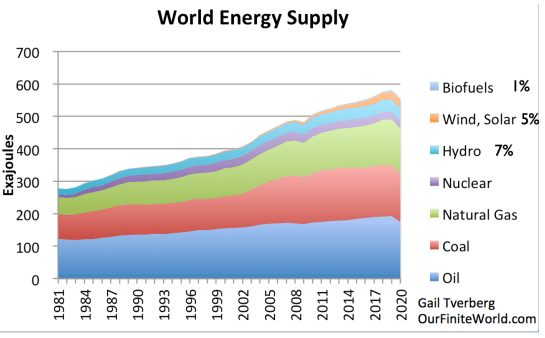
Oil and natural gas added to the energy humans could tap, followed (at a much more modest level) by nuclear power. Despite gargantuan investments, the recent push to develop solar and wind energy has yielded very modest results, as globally these sources provide about 5% of total energy consumption. (See chart below)

It’s self-evident that despite breezy claims of endless expansion of consumption, the global human population has now exceeded the resources available for practical extraction. Energy, fresh water, wild fisheries and fertile soils have all been exploited and the easy/cheap-to-extract resources have been depleted.

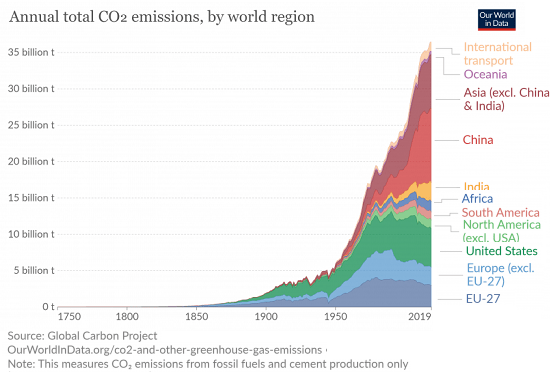
(The chart below of global CO2 emissions is a proxy for energy / resource consumption.)

So once again it’s crunch-time: either we proactively reduce consumption to align with available resources, or Nature will do it for us via scarcities.

Peter Turchin proposed another socio-economic cycle of 50 years in his book Ages of Discord: in the integrative stage, people find reasons to cooperate. In the disintegrative stage at the end of the cycle, people no longer find much common ground or reasons to cooperate. Political, social and financial extremes proliferate, culminating in a rolling crisis.

In Turchin’s analysis, the previous 50-year age of discord began around 1970, and the current era of discord began in 2020. Those who lived through the domestic terrorism, urban decay, stagflation and political/social/legal crises of the 1970s recall how inter-related crises dominated the decade.

In my analysis, the last period of discord in the 1970s was “saved” by the supergiant oil fields discovered in the 60s coming online in the late 1970s and early 1980s. That oil enabled a 40-year boom which is now ending, with no new scalable source of energy available to replace oil, much less enable an expansion of consumption.

In other words, the cycles of The Fourth Turning, Fischer and Turchin are all in alignment at this point in history. We have proliferating political, social and financial extremes and a forced transition to lower consumption to align with declining energy.

Turn, turn, turn. Right when we need to cooperate on transforming a high-consumption, bubble-dependent “waste is growth” Landfill Economy to declining consumption / Degrowth, we’re beset by discord and demographic pressures, as the promises made to the elderly back when it was expected that there would always be 5 workers per retiree cannot possibly be kept now that the worker-retiree ratio is 2-to-1 and there are no limits on healthcare spending for the elderly.

Humans are happy to expand their numbers and consumption and much less happy to consume less. They tend to start revolutions and wars in vain attempts to secure enough resources to maintain their profligate consumption and expansion.

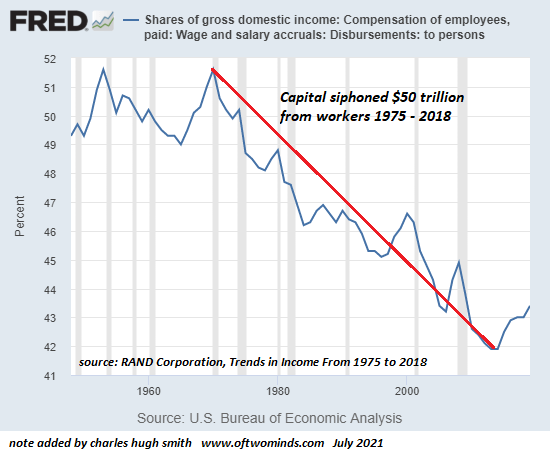
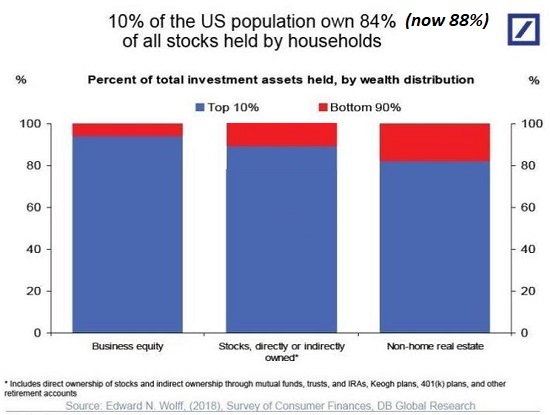
Today’s extremes of wealth and income inequality are optimized to spark political discord and revolts. The wealthiest 20% will be able to pay higher prices, but the bottom 40% will not. The middle 40% will find their disposable income, i.e. their income left over after paying for essentials, will drop to near-zero.

When 80% of the populace are crunched financially, revolutions and the overthrow of governments follow.

As I’ve outlined in previous posts, global inequalities are widening as the Core exploits its built-in advantages at the expense of the vulnerable Periphery.

Core nations will be much better able to maintain their consumption at the expense of the Periphery nations, which will experience sharp declines in purchasing power and consumption.

Previous Fourth Turnings have been resolved one way or another within 5 to 7 years. If this Turning began in 2020, we can expect resolution by 2025 – 2027.

As I explained in my book Global Crisis, National Renewal, those nations that embrace Degrowth will manage the transition, while those that cling to the endless-expansion, bubble-dependent Waste Is Growth model will fail.

This is why I keep talking about making Plans A, B and C to preserve optionality and reduce financial commitments and consumption now rather than passively await crises over which we will have little direct control.

As I’ve endeavored to explain, those anticipating decades of time to adjust are overlooking the systemic fragilities of the current global financial/supply systems. Tightly bound systems of interconnected dependency chains have been optimized to work perfectly in an era of expansion. They’re not optimized to gradually adjust to contraction; they’re optimized to break and trigger domino-like breakdowns in interconnected chains.

We don’t control these macro-trends, we only control our response.
THE ELITES WHO ARE JUST SO OVER HUMANITY

The depth of anti-humanist sentiment related by Douglas Rushkoff in his latest book, Survival of the Richest, is harrowing and illuminating.

By Chris Barsanti

Source: PopMatters

Some things can be horrifying even if unsurprising. One such moment is the opening anecdote in Douglas Rushkoff’s Survival of the Richest: Escape Fantasies of the Tech Billionaires. In 2017, Rushkoff was paid an exorbitant fee to travel to a remote high-end resort where (he thought) he would do his usual thing: Talk about the future to investment bankers looking for a way to game the next trend.

What happened was far stranger. Rather than give a speech, Rushkoff sat at a conference room table with five fantastically rich guys from “the upper echelon of the tech investing and hedge fund world” and tried to answer their questions about how they could survive the impending apocalypse.

The scene is comical, in a Dr. Strangelove way. Assuming the world is racing toward an inevitable societal collapse they called “the Event”, the men thought it best to talk survival tactics with a self-described “Marxist media theorist” and professor at Queens/CUNY. Rather than acting like masters of the universe, they were nervous about being caught out when the Event came. They worried whether New Zealand or Alaska was the right location for their doomsday bunker; could their security guards keep the hungry mobs at bay; if an all-robot staff could be better. Rushkoff explains what seemed to lie behind these unnamed One Percenter preppers’ anxieties:

Taking their cue from Tesla founder Elon Musk colonizing Mars, Palantir’s Peter Thiel reversing the aging process, or artificial intelligence developers Sam Altman and Ray Kurzweil uploading their minds into supercomputers, they were preparing for a digital future that had less to do with making the world a better place than it did with transcending the human condition altogether. Their extreme wealth and privilege served only to make them obsessed with insulating themselves from the very real and present danger of climate change, rising sea levels, mass migrations, global pandemics, nativist panic, and resource depletion. For them, the future of technology is about only one thing: escape from the rest of us.– Douglass Rushkoff

Rushkoff calls this thinking “the Mindset”. He defines it as an “atheistic and materialistic scientism” that launders a desire for control and conquest through quasi-religious adherence to digital code and the power of the market. Expanding on his original article from 2018 (Medium)—which ironically led to his being swamped by requests from disaster-related industries to get in touch with the anonymous five they thought needed their services—Rushkoff spends the rest of Survival of the Richest explaining where the Mindset came from, how dangerous it is, and what he thinks should replace it.

Nothing that Rushkoff writes in this clipped, angry book should surprise most readers. Nobody who has spent any time tracking the pronouncements and feuds of the more futurist-minded tech elites would think many had a high opinion of or interest in improving the daily lot of carbon-based life forms. Though predictable and at times a bit too broadly defined, the depth of anti-humanist sentiment related by Rushkoff is still harrowing and illuminating.

The phenomenon of powerful men thinking themselves separate from the great unwashed and unbound by common morality is as old as human history. Although this of-the-moment book contains little context dating back more than three decades, Rushkoff does not try to claim everything about the Mindset is new. He points instead to how illogical power fantasies have merged with an Ayn Randian cult of the solitary hero and been nurtured by the Web’s seductive capacity for self-aggrandizing mythmaking. Given how much he may have contributed to those seductions, he is the right messenger.

Among the first public intellectuals to grapple seriously with the digital revolution as it washed over society in the 1990s, Rushkoff remains a go-to expert for Internet prognostication. Unlike many tech evangelizers, though, he later had second thoughts. Some of the more revealing sections in Survival of the Richest come from when the author turns his focus on himself.

Readers of a mindset will likely feel a certain wistfulness as Rushkoff writes about the early punk years of cyberspace. Just as underground music was bursting into the mainstream and indie bands were making real money, outlaw hackers were suddenly at the forefront of a technological revolution. In 1994, Rushkoff published two books: The GenX Reader, a heady anthology of alt-cultural tropes (part of the Slacker screenplay, Dan Clowes and Peter Bagge comics) that could already see the commodification of generational rebellion to come; and Cyberia, a quasi-utopian paean about the psychedelia-inspired confluence of programmers, Deadheads, libertarians, Wiccans, and ravers who seemed to be leading the nascent Web towards a consciousness- and freedom-expanding future. The 1996 “Declaration of Independence of Cyberspace,” announced ironically enough at the first ever World Economic Forum in Davos, proclaimed a borderless world where governments had no sovereignty.

Rushkoff looks back now with clearer eyes:

Deregulation sounded good at the time. We were just ravers and cyberpunks, paranoid about the government arresting us for drugs … We didn’t realize that banishing the government from the internet would create a free zone for corporate colonization. We hadn’t yet discovered that government and business balance each other out—a bit like fungus and bacteria. Get rid of one, and the other runs rampant.

In Rushkoff’s cultural history, the experimental tribal ethos of the Web’s heady early days was co-opted by business interests who saw a new frontier to monetize; less Mondo 2000, more AOL CD-ROMs. Online libertarianism seemed to evolve from a confederacy of rule-breaking rebels and pioneers to anger-prone grumps so dissatisfied with their fellow man that they started planning unintentionally funny “seasteading” ocean communities, taking their toys and leaving. Wealthy futurists imagine uploading themselves onto a cloud server, revealing a depressingly simplistic view of human consciousness and a grand view of themselves as transcendent immortals. As technology and behavioral science became more finely tooled at predicting consumer behavior, it also exacerbates hate and loneliness, assisting the all-too-easy COVID-19 pandemic pivot to increasingly tech-mediated relationships.

For the Mindset’s “tech titans and billionaire inventors”, per Rushkoff, there is no problem that technology cannot solve. And the problems are often human in form. Suppose that were true, and the world was spiraling towards a collapse (which the online tools superpowered by elites could be accelerating). In that case, the believers might wonder, why not use technology to scarper off to their Bond villain bunkers?

Rushkoff’s critique expands from what he calls this amoral “sociopathic” attitude toward the state of capitalism. Combining the digital-communitarian ethos of Cory Doctorow with the acerbic skepticism of Naomi Klein, Rushkoff does not trust that a more enlightened kind of capitalism can save the world. His argument against eternal economic growth has merit. But Rushkoff is on firmer ground when defining technological-sociological phenomena like the Mindset. That is not to say there is no case for a more sustainable economy, but Rushkoff breezes too quickly past the challenges resulting from that massive transition. Being necessary does not make a thing easy.

As with many jeremiads of this kind, Survival of the Richest loses some of its impact when delivering suggestions for how to push back (don’t give in to the inevitability of doom, buy local, fight for anti-monopoly laws). That is partly because it is difficult for them to seem equal to the magnitude of the problem. But for Rushkoff, the smallness of the solutions is part of the point: “We can still be individuals; we just need to define our sense of self a bit differently than the algorithms do.”

Powerful New Evidence that U.S. Is A Dictatorship

By Eric Zuesse

Source: The Duran

Because the U.S. Government flaunts itself as being a democracy instead of a dictatorship and it coups and invades and overthrows and replaces (“regime changes”) Governments that it declares to be dictatorships instead of democracies (the “New Cold War” isn’t about “capitalism versus communism,” but about “democracy versus dictatorship”), a crucial question now in all international political discussions is: Is the U.S. Government ACTUALLY a democracy, or does it instead only pretend to be one? In other words: Is the U.S. Government’s position in “the New Cold War” fraudulent?

The June 2022 issue of the peer-reviewed academic journal, Structural Change and Economic Dynamics, contained an article that answers this question with empirical data which has definitively crushed all of the U.S. Government’s references to itself as being a “democracy.” It is therefore significant not only because it proves that the U.S. Government is a dictatorship, but also because it proves that the U.S. position in “the New Cold War is fraudulent. The article is therefore of significance not just to Americans, but globally.

The article, which was specifically about and addressed to America, closed by saying: “We think it is time that social scientists stop pushing the equivalent of the Ptolemaic solar system. They need to recognize what almost everyone else does: that we live in a money-driven political system. No one is going to make progress by adding epicycles to voting models.” In other words: political ‘scientists’ and ‘historians’ who continue to perpetuate the U.S. regime’s claim to being a democracy (one-person-one-vote instead of one-dollar-one-vote) are now archaic: they are equivalent to the physical philosophers who had preceded the first physical scientist or “physicist” Galileo’s empirical demonstrations and the resulting first scientific theory (and subsequently Darwin doing the same thing in the biological sciences), that the Bible is not a book of history but instead a book of mythology mixing lies with truths in order to perpetuate and expand a particular clergy. But, now, the issue isn’t about control of the State by the clergy, but instead it’s about control of the State by the aristocracy — the nation’s super-rich. That’s what’s at issue in today’s America. Science is finally now extending outward, from its existing base, first in physics, and then in biology, to demonstrate such powerful empirical political realities as this in society — encroaching now upon the U.S. regime’s fraudulent dogma that the U.S. Government is a “democracy” instead of a “dictatorship” (a dictatorship such as it invades abroad and tries to overthrow and replace, by a ‘democracy’, some foreign nation’s Government — to add a new vassal-nation to the American empire’s ‘allies’ or actual colonies). This Emperor has no clothes, is what this academic article displays. But this particular “Emperor” represents not the clergy (such as in the time of Galileo and of Darwin), but instead the aristocracy — the super-rich (the imperialists, in the “New Cold War”). 

The article’s title is: “How money drives US congressional elections: Linear models of money and outcomes”. Its “Abstract” or summary says that “the relations between money and votes cast for major parties in elections for the U.S. Senate and House of Representatives from 1980 to 2018 are well approximated by straight lines.” In other words: Billionaires and other super-rich individuals can and do purchase electoral outcomes with their enormous political donations in America. It’s a “straight-line” relationship between money and winning: the candidate who is backed by the most money has the biggest (a huge) likelihood of winning; the candidate who is backed by the least money has the least (a minuscule) likelihood, and most of that money to the winning candidates comes from the few super-rich. The way to be politically successful in today’s America is, now clearly, to be more corrupt than your competitor — to be offering the Government for sale to the highest bidders (and to deliver on the promises that the politician makes to these individuals, so as to be able to remain in public office and continue to serve those masters). (And, then, after public office, come the biggest private benefits, to those former office-holders.) America is an aristocracy, not a democracy; it is one-dollar-one-vote, not one-person-one-vote. That’s what the article demonstrates.

Even more crushing is the same three authors’ (Thomas Ferguson, Paul Jorgenson, and Jie Chen) further analysis from these same data, their article “Big Money — Not Political Tribalism — Drives US Elections”, which exposes the fraudulence of the two American political Parties’ supposed ‘ethnic’ or ‘racial’ appeals, as being instead actually the aristocracy’s distractive political theater pumping those divides, as being, in reality, instead — at the structurally deeper level — between Republican versus Democratic Party billionaires, with Republican billionaires financing White-power appeals, and Democratic billionaires financing Black and other minority (and feminist) power appeals, all so that the nation’s population-at-large won’t be fighting instead against the aristocracy itself, which is the sole real beneficiary of this system of exploitation of the masses (exploitation of workers and consumers). Thus, the aristocracy’s victims — the public, the consumers and workers, the people who are NOT in the aristocracy — look elsewhere than at the aristocracy, to see their enemy. This latter paper isn’t behind a paywall, and it shows the same straight-line graphs relating money to power that the first-mentioned one here (which IS paywalled) did. So, one can readily see visually, here, how profoundly corrupt America’s Government actually is. (Those graphs are stunning, because the data are.)

I have previously posted articles summarizing, and linking to, a vast range of other empirical evidences, of many different types, all likewise pointing very strongly toward America’s being an aristocracy instead of a democracy, and these are some of them:

“How America’s dictatorship works”

“America Is One-Dollar-One-Vote, Not Really One-Person-One Vote.”

“Jimmy Carter Is Correct That the U.S. Is No Longer a Democracy”

“Politicians Don’t Actually Care What Voters Want”

“Is the U.S. actually a ‘police state’?”

“How the U.S. Government is controlled by its armaments firms”

“How the Billionaires Control American Elections”

“The Evilness of America’s Ruling Class”

All of those data should be compared to the opposite view, the U.S.-regime-imposed view, which is expressed by America’s political ‘scientists’ and ‘historians’, who continue to perpetuate the U.S. regime’s claim to being a democracy (one-person-one-vote, instead of one-dollar-one-vote — which is America’s reality). Not only politicians, but also scholars, are beneficiaries of billionaires’ donations — the donations funding professorial chairs, college endowments, and ‘non’-profit foundations and ‘charities’. Such private interests thus control the public interests, to produce a deeply corrupt (privatized) body-politic. 

On which side of this debate, about the aristocracy and the public, do you stand, and why? And what do you think should be done about it? Do you favor the aristocrats, or the public? This is not a political question, but a meta-political one. It transcends existing political Parties, and all existing political prejudices. It requires authentically scientific thinking about public policies. Above all, such questions concern the existing one-dollar-one-vote (aristocracy), versus the possibility of one-person-one-vote (democracy) emerging (or re-emerging). But can dictatorship ever transform into democracy? If so, how? Of course, history provides answers, and it shows that, at least for a while, the American Revolution did transform an aristocracy here into a democracy (albeit, a limited one): it conquered Britain’s aristocracy on its land. Unfortunately (or fortunately, if one prefers aristocracy to democracy), an American aristocracy has recently risen here. America now has its own aristocracy. In science, only history provides answers. There have also, in some other countries, been revolutions overthrowing the local nation’s own aristocracy. All evidences in science are historical facts — nothing else than that. And the articles which are linked-to here are scientific: they are analyses which are based only on the relevant historical facts, displaying what history (not myth) shows. One thing that all of human history shows is that every aristocracy is based on myths. America’s aristocracy is no different. Social science is now puncturing that myth — exposing that fraud. This is significant globally, not merely locally.

—————

Investigative historian Eric Zuesse’s new book, AMERICA’S EMPIRE OF EVIL: Hitler’s Posthumous Victory, and Why the Social Sciences Need to Change, is about how America took over the world after World War II in order to enslave it to U.S.-and-allied billionaires. Their cartels extract the world’s wealth by control of not only their ‘news’ media but the social ‘sciences’ — duping the public.

The United States Does Not Have an Economy

By Paul Craig Roberts

Source: PaulCraigRoberts.org

The US financial sector has long looted other countries.  A number of participants have described the process.  First a country is enticed with bribes to the leaders to take out loans that cannot be serviced or repaid.  Then in comes the IMF. Austerity is imposed on the population.  Public services and employment are cut to free resources for debt service, and public assets are sold to repay the loan.  Living standards fall, and US corporations take over the country’s economy.

As foreign governments, having experienced or witnessed the economic carnage and fearing accountability, are less willing to be bribed into indebting their countries, American finance is now applying this technique to Americans. Contrary to the narrative in the financial press, the Federal Reserve is not raising interest rates in order to fight inflation.  It is ludicrous to think that a three-quarters of one percent rise in a very low interest rate is going to have any impact on a 9.1% rate of consumer inflation or that speculation that the Federal Reserve has in mind another three-quarters of one percent possibly followed by one half of one percent comprise an anti-inflation policy.  If all these increases occur, it still leaves the interest rate below the inflation rate.

Moreover, as I have previously explained, the inflation is not monetary.  The higher prices are the result of supply disruptions caused by Washington’s Covid lockdowns and Russian sanctions.  Production was stopped and supply chains are broken.  

The Federal Reserve’s rise in interest rates is just a continuation of its policy of concentrating income and wealth in the hands of the One Percent.  Quantitative Easing was the cloak for the Federal Reserve to print $8.2 trillion in new money which was directed or found its way into the prices of stocks and bonds, thus enriching the small number who own most of these financial instruments.  Having maxed out this avenue of wealth concentration, the Federal Reserve is now raising interest rates in order to drive up mortgage costs to aspiring home owners.  The Federal Reserve is driving individuals out of the housing market in order to free up properties for “private equity” firms to purchase homes for their rental values.  That private equity firms see rental income from the existing stock of houses as the best investment opportunity tells us that the US economy has played out.  When investment goes into existing assets, not into producing new assets, the economy ceases to grow.

The Obama regimes policy of bailing out the financial fraudsters responsible for the 2008 crash while foreclosing on their victims, reduced American homeownership from 70% to 63 percent. The Urban Institute predicts further declines. Today homeowners’ equity has declined from 85% after World War II to one-third, leaving two-thirds of homeowner equity in the hands of creditors.  This makes it completely clear that a financialized economy indebts the people for the sake of rentier income to the One Percent.  Indeed, the financialized economy created by the Federal Reserve has reimposed a class system akin to the landed British aristocracy that was overthrown.  Indeed, we have an economically far worst class system.  The landed British aristocrats produced food that fed the nation.  The American class system produces interest and fees for the financial system.

As Michael Hudson has shown us, a no-growth economy is the end result of a financialized economy.  A financialized economy is one in which consumer income is diverted by debt expansion away from the purchase of new goods and services into debt service and fees–interest on mortgages, car loans, credit card debt, student loan debt.  With such a large share of household income spent on debt service, little is left for driving the economy forward.

If American economists were capable of escaping from their neoliberal junk economics, they would realize that “the world’s largest economy” they attribute to the United States is total fiction.  The fact is that the United States does not have an economy.  Corporations driven by Wall Street located American manufacturing in Asia so that the One Percent could benefit from higher profits from lower labor costs, while the deserted city and states had to sell their income streams, such as Chicago’s parking meter revenues for 75 years, to foreigners for one lump sum payment to solve one year’s budget crisis.  

The offshoring of American production, carried out under the cloak of “globalism,” destroyed the American economy and the tax bases of cities and states.  While the real economy declines, the Democrat Party, seeking permanent power, has imposed a policy of open borders for immigrant-invaders.  How are these millions of peoples to support themselves in an economy whose manufacturing has been moved abroad?  How can a population, deserted by American corporations, that is experiencing debt deflation absorb the costs of support and social infrastructure for tens of millions of third world immigrant-invaders?

You will never hear it from the whores in the financial press, but the United States is on the precipice of economic and social collapse.  And what are the fools in Washington doing?  The idiots are ginning up wars with Russia, China, and Iran.  

What Was Covid Really About? Triggering A Multi-Trillion Dollar Global Debt Crisis. “Ramping up an Imperialist Strategy”?

Covid, Capitalism, Friedrich Engels and Boris Johnson

By Colin Todhunter

Source: Global Research

“And thus it renders more and more evident the great central fact that the cause of the miserable condition of the working class is to be sought, not in these minor grievances, but in the capitalistic system itself.” Friedrich Engels, The Condition of the Working Class in England (1845) (preface to the English Edition, p.36)  

The IMF and World Bank have for decades pushed a policy agenda based on cuts to public services, increases in taxes paid by the poorest and moves to undermine labour rights and protections.

IMF ‘structural adjustment’ policies have resulted in 52% of Africans lacking access to healthcare and 83% having no safety nets to fall back on if they lose their job or become sick. Even the IMF has shown that neoliberal policies fuel poverty and inequality.

In 2021, an Oxfam review of IMF COVID-19 loans showed that 33 African countries were encouraged to pursue austerity policies. The world’s poorest countries are due to pay $43 billion in debt repayments in 2022, which could otherwise cover the costs of their food imports.

Oxfam and Development Finance International (DFI) have also revealed that 43 out of 55 African Union member states face public expenditure cuts totalling $183 billion over the next five years.

According to Prof Michel Chossudovsky of the Centre for Research on Globalization, the closure of the world economy (March 11, 2020 Lockdown imposed on more than 190 countries) has triggered an unprecedented process of global indebtedness. Governments are now under the control of global creditors in the post-COVID era.

What we are seeing is a de facto privatisation of the state as governments capitulate to the needs of Western financial institutions.

Moreover, these debts are largely dollar-denominated, helping to strengthen the US dollar and US leverage over countries.

It raises the question: what was COVID really about?

Millions have been asking that question since lockdowns and restrictions began in early 2020. If it was indeed about public health, why close down the bulk of health services and the global economy knowing full well what the massive health, economic and debt implications would be?

Why mount a military-style propaganda campaign to censor world-renowned scientists and terrorise entire populations and use the full force and brutality of the police to ensure compliance?

These actions were wholly disproportionate to any risk posed to public health, especially when considering the way ‘COVID death’ definitions and data were often massaged and how PCR tests were misused to scare populations into submission.

Prof Fabio Vighi of Cardiff University implies we should have been suspicious from the start when the usually “unscrupulous ruling elites” froze the global economy in the face of a pathogen that targets almost exclusively the unproductive (the over 80s).

COVID was a crisis of capitalism masquerading as a public health emergency.

Capitalism  

Capitalism needs to keep expanding into or creating new markets to ensure the accumulation of capital to offset the tendency for the general rate of profit to fall. The capitalist needs to accumulate capital (wealth) to be able to reinvest it and make further profits. By placing downward pressure on workers’ wages, the capitalist extracts sufficient surplus value to be able to do this.

But when the capitalist is unable to sufficiently reinvest (due to declining demand for commodities, a lack of investment opportunities and markets, etc), wealth (capital) over accumulates, devalues and the system goes into crisis. To avoid crisis, capitalism requires constant growth, markets and sufficient demand.

According to writer Ted Reese, the capitalist rate of profit has trended downwards from an estimated 43% in the 1870s to 17% in the 2000s. Although wages and corporate taxes have been slashed, the exploitability of labour was increasingly insufficient to meet the demands of capital accumulation.

By late 2019, many companies could not generate sufficient profit. Falling turnover, limited cashflows and highly leveraged balance sheets were prevalent.

Economic growth was weakening in the run up to the massive stock market crash in February 2020, which saw trillions more pumped into the system in the guise of ‘COVID relief’.

To stave off crisis up until that point, various tactics had been employed.

Credit markets were expanded and personal debt increased to maintain consumer demand as workers’ wages were squeezed. Financial deregulation occurred and speculative capital was allowed to exploit new areas and investment opportunities. At the same time, stock buy backs, the student debt economy, quantitative easing and massive bail outs and subsidies and an expansion of militarism helped to maintain economic growth.

There was also a ramping up of an imperialist strategy that has seen indigenous systems of production abroad being displaced by global corporations and states pressurised to withdraw from areas of economic activity, leaving transnational players to occupy the space left open.

While these strategies produced speculative bubbles and led to an overevaluation of assets and increased both personal and government debt, they helped to continue to secure viable profits and returns on investment.

But come 2019, former governor of the Bank of England Mervyn King warned that the world was sleepwalking towards a fresh economic and financial crisis that would have devastating consequences. He argued that the global economy was stuck in a low growth trap and recovery from the crisis of 2008 was weaker than that after the Great Depression.

King concluded that it was time for the Federal Reserve and other central banks to begin talks behind closed doors with politicians.

That is precisely what happened as key players, including BlackRock, the world’s most powerful investment fund, got together to work out a strategy going forward. This took place in the lead up to COVID.

Aside from deepening the dependency of poorer countries on Western capital, Fabio Vighi says lockdowns and the global suspension of economic transactions allowed the US Fed to flood the ailing financial markets (under the guise of COVID) with freshly printed money while shutting down the real economy to avoid hyperinflation. Lockdowns suspended business transactions, which drained the demand for credit and stopped the contagion.

COVID provided cover for a multi-trillion-dollar bailout for the capitalist economy that was in meltdown prior to COVID. Despite a decade or more of ‘quantitative easing’, this new bailout came in the form of trillions of dollars pumped into financial markets by the US Fed (in the months prior to March 2020) and subsequent ‘COVID relief’.

The IMF, World bank and global leaders knew full well what the impact on the world’s poor would be of closing down the world economy through COVID-related lockdowns.

Yet they sanctioned it and there is now the prospect that in excess of a quarter of a billion more people worldwide will fall into extreme levels of poverty in 2022 alone.

In April 2020, the Wall Street Journal stated the IMF and World Bank faced a deluge of aid requests from scores of poorer countries seeking bailouts and loans from financial institutions with $1.2 trillion to lend.

In addition to helping to reboot the financial system, closing down the global economy deliberately deepened poorer countries’ dependency on Western global conglomerates and financial interests.

Lockdowns also helped accelerate the restructuring of capitalism that involves smaller enterprises being driven to bankruptcy or bought up by monopolies and global chains, thereby ensuring continued viable profits for Big Tech, the digital payments giants and global online corporations like Meta and Amazon and the eradication of millions of jobs.

Although the effects of the conflict in Ukraine cannot be dismissed, with the global economy now open again, inflation is rising and causing a ‘cost of living’ crisis. With a debt-ridden economy, there is limited scope for rising interest rates to control inflation.

But this crisis is not inevitable: current inflation is not only induced by the liquidity injected into the financial system but also being fuelled by speculation in food commodity markets and corporate greed as energy and food corporations continue to rake in vast profits at the expense of ordinary people.

Resistance  

However, resistance is fertile.

Aside from the many anti-restriction/pro-freedom rallies during COVID, we are now seeing a more strident trade unionism coming to the fore – in Britain at least – led by media savvy leaders like Mick Lynch, general secretary of the National Union of Rail, Maritime and Transport Workers (RMT), who know how to appeal to the public and tap into widely held resentment against soaring cost of living rises.

Teachers, health workers and others could follow the RMT into taking strike action.

Lynch says that millions of people in Britain face lower living standards and the stripping out of occupational pensions. He adds:

“COVID has been a smokescreen for the rich and powerful in this country to drive down wages as far as they can.”

Just like a decade of imposed ‘austerity’ was used to achieve similar results in the lead up to COVID.

The trade union movement should now be taking a leading role in resisting the attack on living standards and further attempts to run-down state-provided welfare and privatise what remains.

The strategy to wholly dismantle and privatise health and welfare services seems increasingly likely given the need to rein in (COVID-related) public debt and the trend towards AI, workplace automisation and worklessness.

This is a real concern because, following the logic of capitalism, work is a condition for the existence of the labouring classes. So, if a mass labour force is no longer deemed necessary, there is no need for mass education, welfare and healthcare provision and systems that have traditionally served to reproduce and maintain labour that capitalist economic activity has required.

In 2019, Philip Alston, the UN rapporteur on extreme poverty, accused British government ministers of the “systematic immiseration of a significant part of the British population” in the decade following the 2008 financial crash.

Alston stated:

“As Thomas Hobbes observed long ago, such an approach condemns the least well off to lives that are ‘solitary, poor, nasty, brutish, and short’. As the British social contract slowly evaporates, Hobbes’ prediction risks becoming the new reality.”

Post-COVID, Alston’s words carry even more weight.

As this article draws to a close, news is breaking that Boris Johnson has resigned as prime minister. A remarkable PM if only for his criminality, lack of moral foundation and double standards – also applicable to many of his cronies in government.

With this in mind, let’s finish where we began.

“I have never seen a class so deeply demoralised, so incurably debased by selfishness, so corroded within, so incapable of progress, as the English bourgeoisie…

For it nothing exists in this world, except for the sake of money, itself not excluded. It knows no bliss save that of rapid gain, no pain save that of losing gold.

In the presence of this avarice and lust of gain, it is not possible for a single human sentiment or opinion to remain untainted.” Friedrich EngelsThe Condition of the Working Class in England (1845), p.275

The Age of Discord

By Charles Hugh Smith

Source: Of Two Minds

It’s very difficult to find common ground that supports cooperation in the disintegrative stage of scarcities, rising prices, catastrophically centralized power and social discord.

Today’s topic echoes Peter Turchin’s 2016 book, Ages of Discord, which I have often referenced in blog posts.

I’ll also discuss two other books I’ve often referenced, Global Crisis: War, Climate Change and Catastrophe in the Seventeenth Century by Geoffrey Parker and The Great Wave: Price Revolutions and the Rhythm of History by David Hackett Fischer.

Turchin proposes repeating cycles of history of social integration (people finding reasons to cooperate) and disintegration (people finding reasons to not cooperate).

Clearly, we’re in a disintegrative stage.

Fischer proposed a repeating cycle of history in which humans expand their numbers and economy to consume all available resources.

Once all the low-hanging fruit has been consumed, scarcities arise, pushing prices above what commoners can afford, and the result is economic stagnation and social/political revolution.

Either humans exploit a new energy source at scale to provide for the larger population and higher consumption per person, or the population and consumption decline to fit available resources.

Parker covers the mutually reinforcing climate, political, social and economic crises of the 17th century. A long cycle of cold, wet summers reduced crop yields, leading to hunger and strife.

Parker also identifies another cause of the tumultuous, war-plagued 1600s: political leaders had consolidated too much power, enabling them to pursue disastrous wars without any restraint from competing domestic social-political interests.

Clearly, we’re in Fischer’s stage of overshoot and resource scarcity and Parker’s extremes of centralized power free to pursue catastrophic wars of choice.

In the 1600s, those launching wars reckoned a clean, decisive victory was within easy reach. In every case, the wars dragged on inconclusively or generated even wider conflicts.

In the end, all the wars were settled diplomatically, not by military victory. The military gains were nil while the destruction was widespread and devastating.

Fischer details how poorly humans respond to scarcity and higher prices, also known as inflation or more. accurately, as the decline in purchasing power of money and labor. As scarcities and higher prices take their toll, society unravels: crime and social disorder accelerate.

What we’re seeing in real time is a “circle the wagons” mentality of weeding out everyone but the True Believers in every movement. Litmus tests are handy for this test: answer wrong on any question and you’re cast out: heretic!

It’s not enough to tick one “progressive” or “conservative” box; you have to tick them all or you’re a heretic who cannot be trusted. If you leave one box unticked, you might untick a few more in the days ahead.

This puts pressure on everyone to declare their loyalty to the “party” even if the loyalty is just for show. This dishonesty pleases those demanding every box be ticked but this forced loyalty creates an illusion of solidarity that unravels under pressure.

Officials vie to offer pledges of loyalty to Chinese President Xi Jinping ahead of 20th Party Congress

Exacerbating this is social media, which rewards those promoting the most extreme and divisive positions and deranges the populace by substituting recognition online, which encourages disintegration, for real-world engagement, which encourages moderation and cooperation.

Online, it’s easy to be all-or-nothing: there should be no restrictions on social media, or we should just pull the plug and shut the whole mess down.

In the real world, these are knotty, nuanced problems. The Founding Fathers would not have tolerated sedition under the guise of free speech. The social order can only be maintained if every participant adheres to standards of civility and the common good.

When put under stress, humans harden their positions as a defensive measure. They become more argumentative and less tolerant, more strident in insisting that the One True Thing is the answer to our problems.

This leads to magical thinking, for example, that we can replace hydrocarbons with fusion or wind and solar. When the physical and cost limits of minerals are presented as impassable obstacles, people respond with denial: there must be a way to keep everything the same.

Humans have an easy time expanding their population and consumption per person and a hard time consuming less.

It’s very difficult to find common ground that supports cooperation in the disintegrative stage of scarcities, rising prices, catastrophically centralized power and social discord.

This requires accepting that we can cooperate with people on one issue even though all the other boxes of our group/party/movement are left unticked.

History suggests the disintegrative stage will run its course and consumption will realign with available resources one way or another, and the best we can do is preserve our own sanity, community and willingness to nurture small patches of common ground that support productive cooperation.

The Engineered Stagflationary Collapse Has Arrived – Here’s What Happens Next

By Brandon Smith

Source: Alt-Market.us

In my 16 years as an alternative economist and political writer I have spent around half that time warning that the ultimate outcome of the Federal Reserve’s stimulus model would be a stagflationary collapse. Not a deflationary collapse, or an inflationary collapse, but a stagflationary collapse. The reasons for this were very specific – Mass debt creation was being countered with MORE debt creation while many central banks have been simultaneously devaluing their currencies through QE measures. On top of that, the US is in the unique position of relying on the world reserve status of the dollar and that status is diminishing.

It was only a matter of time before the to forces of deflation and inflation met in the middle to create stagflation. In my article ‘Infrastructure Bills Do Not Lead To Recovery, Only Increased Federal Control’, published in April of 2021, I stated that:

Production of fiat money is not the same as real production within the economy… Trillions of dollars in public works programs might create more jobs, but it will also inflate prices as the dollar goes into decline. So, unless wages are adjusted constantly according to price increases, people will have jobs, but still won’t be able to afford a comfortable standard of living. This leads to stagflation, in which prices continue to rise while wages and consumption stagnate.

Another Catch-22 to consider is that if inflation becomes rampant, the Federal Reserve may be compelled (or claim they are compelled) to raise interest rates significantly in a short span of time. This means an immediate slowdown in the flow of overnight loans to major banks, an immediate slowdown in loans to large and small businesses, an immediate crash in credit options for consumers, and an overall crash in consumer spending. You might recognize this as the recipe that created the 1981-1982 recession, the third-worst in the 20th century.

In other words, the choice is stagflation, or deflationary depression.”

It’s clear today what the Fed has chosen. It’s important to remember that throughout 2020 and 2021 the mainstream media, the central bank and most government officials were telling the public that inflation was “transitory.” Suddenly in the past few months this has changed and now even Janet Yellen has admitted that she was “wrong” on inflation. This is a misdirection, however, because the Fed knows exactly what it is doing and always has. Yellen denied reality, but she knew she was denying reality. In other words, she was not mistaken about the economic crisis, she lied about it.

As I outlined last December in my article ‘The Fed’s Catch-22 Taper Is A Weapon, Not A Policy Error’:

‘First and foremost, no, the Fed is not motivated by profits, at least not primarily. The Fed is able to print wealth at will, they don’t care about profits – They care about power and centralization. Would they sacrifice “the golden goose” of US markets in order to gain more power and full bore globalism? Absolutely. Would central bankers sacrifice the dollar and blow up the Fed as an institution in order to force a global currency system on the masses? There is no doubt; they’ve put the US economy at risk in the past in order to get more centralization.’

The Fed has known for years that the current path would lead to inflation and then market destruction, and here’s the proof – Fed Chairman Jerome Powell actually warned about this exact outcome in October of 2012:

“I have concerns about more purchases. As others have pointed out, the dealer community is now assuming close to a $4 trillion balance sheet and purchases through the first quarter of 2014. I admit that is a much stronger reaction than I anticipated, and I am uncomfortable with it for a couple of reasons.First, the question, why stop at $4 trillion? The market in most cases will cheer us for doing more. It will never be enough for the market. Our models will always tell us that we are helping the economy, and I will probably always feel that those benefits are overestimated. And we will be able to tell ourselves that market function is not impaired and that inflation expectations are under control. What is to stop us, other than much faster economic growth, which it is probably not in our power to produce?

When it is time for us to sell, or even to stop buying, the response could be quite strong; there is every reason to expect a strong response. So there are a couple of ways to look at it. It is about $1.2 trillion in sales; you take 60 months, you get about $20 billion a month. That is a very doable thing, it sounds like, in a market where the norm by the middle of next year is $80 billion a month. Another way to look at it, though, is that it’s not so much the sale, the duration; it’s also unloading our short volatility position.”

As we all now know, the Fed waited until their balance sheet was far larger and until the economy was MUCH weaker than it was in 2012 to unleash tightening measures. They KNEW the whole time exactly what was going to happen.

It is no coincidence that the culmination of the Fed’s stimulus bonanza has arrived right after the incredible damage done to the economy and the global supply chain by the covid lockdowns. It is no coincidence that these two events work together to create the perfect stagflationary scenario. And, it’s no coincidence that the only people who benefit from these conditions are proponents of the “Great Reset” ideology at the World Economic Forum and other globalist institutions. This is an engineered collapse that has been in the works for many years.

The goal is to “reset” the world, to erase what’s left of free market systems, and to establish what they call the “Shared Economy” system. This system is one in which the people who survive the crash will be made utterly dependent on government through Universal Basic Income and one that will restrict all resource usage in the name of “carbon reduction.” According to the WEF, you will own nothing and you will like it.

The collapse is engineered to create crisis conditions so frightening that they expect the majority of the public to submit to a collectivist hive mind lifestyle with greatly reduced standards. This would be accomplished through UBI, digital currency models, carbon taxation, population reduction, rationing of all commodities and a social credit system. The goal, in other words, is complete control through technocratic authoritarianism.

All of this is dependent on the exploitation of crisis events to create fear in the population. Now that economic destabilization has arrived, what happens next? Here are my predictions…

The Fed Will Hike Interest Rates More Than Expected, But Not Enough To Stop Inflation

Today, we are witnessing the poisonous fruits of a decade-plus of massive fiat money creation and we are now at the stage where the Fed will reveal its true plan. Hiking interest rates fast, or hiking them slow. Fast hikes will mean an almost immediate crash in markets (beyond what we have already seen), slow hikes will mean a drawn out process of price inflation and general uncertainty.

I believe the Fed will hike more than expected, but not enough to actually slow inflation in necessities. There will be an overall decline in luxury items, recreation commerce and non-essentials, but most other goods will continue to climb in cost. It is to the advantage of globalists to keep the inflation train running for another year or longer.

In the end, though, the central bank WILL declare that the pace of interest rates is not enough to stop inflation and they will revert to a Volcker-like strategy, pushing rates up so high that the economy simply stops functioning altogether.

Markets Will Crash And Unemployment Will Abruptly Spike

Stock markets are utterly dependent on Fed stimulus and easy money through low interest rate loans – This is a fact. Without low rates and QE, corporations cannot engage in stock buybacks. Meaning, the tools for artificially inflating equities are disappearing. We are already seeing the effects of this now with markets dropping 20% or more.

The Fed will not capitulate. They will continue to hike regardless of the market reaction.

As far as jobs are concerned, Biden and many mainstream economists constantly applaud the low unemployment rate as proof that the American economy is “strong,” but this is an illusion. Covid stimulus measures temporarily created a dynamic in which businesses needed increased staff to deal with excess retail spending. Now, the covid checks have stopped and Americans have maxed out their credit cards. There is nothing left to keep the system afloat.

Businesses will start making large job cuts throughout the last half of 2022.

Price Controls

I have no doubt that Joe Biden and Democrats will seek to enforce price controls on many goods as inflation continues, and there will be a handful of Republicans that will support the tactic. Price controls actually lead to a reduction in supply because they remove all profits and thus all incentive for manufacturers to keep producing goods. What usually happens at that point is government steps in to nationalize manufacturing, but this will be substandard production and at a much lower yield.

In the end, supplies are reduced even further and prices go even higher on the black market because no one can get their hands on most goods anyway.

Rationing

Yes, rationing at the manufacturing and distribution level is going to happen, so be sure to buy what you need now before it does. Rationing occurs in the wake of price controls or supply chain disruptions, and usually this coincides with a government propaganda campaign against “hoarders.”

They will hold up a few exaggerated examples of people who buy truckloads of merchandise to scalp prices on the black market. Then, not long after, they will accuse preppers and anyone who bought goods BEFORE the crisis of “hoarding” simply because they planned ahead.

Rationing is not only about controlling the supply of necessities and thus controlling the population by proxy; it is also about creating an atmosphere of blame and suspicion within the public and getting them to snitch on or attack anyone that is prepared. Prepared people represent a threat to the establishment, so expect to be demonized in the media and organize with other prepared people to protect yourself.

Be Ready, It Only Gets Worse From Here On

It might sound like I am predicting success of the Great Reset program, but I actually believe the globalists will fail in the end. That’s not going to stop them from making the attempt. Also, the above scenarios are only predictions for the near term (within the next couple of years). There will be many other problems that stem from these situations.

Naturally, food riots and other mob actions will become more commonplace, perhaps not this year, but by the end of 2023 they will definitely be a problem. This will coincide with the return of political unrest in the US as leftist factions, encouraged by globalist foundations, demand more government intervention in poverty. At the same time, conservatives will demand less government interference and less tyranny.

At bottom, the people who are prepared might be called a lot of mean names, but as long as we organize and work together, we will survive. Many unprepared people will NOT survive. Understand that the economic conditions ahead of us are historically destructive; there is no way that serious consequences can be avoided for a large part of the population, if only because they refuse to listen and to take proper steps to protect themselves.

The denial is over. The crash is here. Time to take action if you have not done so already.

The REAL agenda behind the created food crisis

The created food crisis, whether real or a smoke-and-mirrors psy-op, is all about tearing down the global food system and “building back better” – a new dystopian food system built by corporate monoliths and rigidly controlled in the name of the greater good.

By Kit Knightly

Source: Off-Guardian

We’re in the early stages of a food crisis.

The press has been predicting this for years, but  up until now it always appeared to be nothing more than fearmongering, designed to worry or distract people, but the signs are there that this time, to quote Joe Biden, it “is going to be real”.

Nobody knows how bad it could get, except the people who are creating it.

Because the evidence is pretty clear, it is being deliberately & cold-bloodedly created. We’ve been documenting it for months.

We have Russia’s “special operation” in Ukraine driving up the price of staple foods, wheat and sunflower oil, as well as fertiliser.

We have the sudden “bird flu outbreak” driving up the price of poultry and eggs.

The soaring price of oil is driving up the cost of food distribution.

The inflation caused by huge influxes of fiat currency means families are spending more money on less food.

And as all this is happening, the US and UK (and maybe others, we don’t know) are literally paying farmers not to farm.

It’s pretty clear this is The Great Reset: Food Edition. The lockdown melody with slightly different lyrics. A process of breaking down the structures already in place so we can “build back better” with a more controlled and more corporatised food system

Just as the Covid “pandemic” was said to highlight “weaknesses in the multilateral system”, so this food crisis will show that our “unstable food systems are in need of reform” and we need to ensure our “food security”…or a thousand variations on that theme.

That’s not supposition. They already started, over a year ago.

The Journal of Agriculture, Food Systems & Community Developments published a paper in February 2021 titled:

Dismantling and rebuilding the food system after COVID-19: Ten principles for redistribution and regeneration

In an interview from July last year, Ruth Richardson the Executive Director of the NGO Global Alliance for the Future of Food literally said:

Our Dominant Food System Needs to Be Dismantled and Rebuilt”

Later, in September 2021, the UN convened the first-ever “Food Systems Summit”, whose mission statement included the line:

Rebuilding the food systems of the world will also enable us to answer the UN Secretary-General’s call to “build back better” from COVID-19.

Writing in the Guardian two weeks ago, George Monbiot, weathervane for every deep state agenda, states with his trademark lack of subtlety:

The banks collapsed in 2008 – and our food system is about to do the same…The system has to change.

But what does “change” and “rebuilt” actually mean in this context?

Well, that’s no mystery, they’ve been talking it up for years.

Almost all of these are stories from just the past month or so, many of them talking points at the World Economic Forum’s Davos Conference.

As is almost always the case, the problem to which they’re currently “reacting” already has a series of pre-ordained solutions.

Just as we saw lockdowns break the economy to pieces whilst the billionaire class land record profits whilst corporate megaliths expanded their monopolies, so too will any proposed food security policies end up benefiting the already mega-rich or installing infrastructure for corporate control.

They just announced the building of the largest “cultured meat factory” in the world. Fake meat, of course, can’t be raised at home and is subject to patented processes of creation. Genetically edited or modified plants and animals are likewise subject to patents.

Supranational companies, with profits larger than the budget of some nations, are developing carbon footprint tracker apps which reward people for making the “right decisions”. That could easily be applied to food.

Bill Gates has quietly become the largest owner of agricultural land in the United States. Land on which he can grow new Frankencrops, or which the US government will pay him not to use.

The play is clear: Right now they’re getting ready to tear all our old food systems down, with the stated aim of building them back better.

But better for them, not us.