
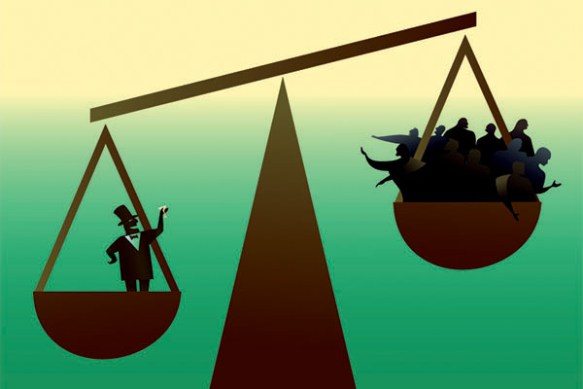
National (In)Security In the United States of Inequality

By Rajan Menon

Source: Unz Review

So effectively has the Beltway establishment captured the concept of national security that, for most of us, it automatically conjures up images of terrorist groups, cyber warriors, or “rogue states.” To ward off such foes, the United States maintains a historically unprecedented constellation of military bases abroad and, since 9/11, has waged wars in Afghanistan, Iraq, Syria, Libya, and elsewhere that have gobbled up nearly $4.8 trillion. The 2018 Pentagon budget already totals $647 billion — four times what China, second in global military spending, shells out and more than the next 12 countries combined, seven of them American allies. For good measure, Donald Trump has added an additional $200 billion to projected defense expenditures through 2019.

Yet to hear the hawks tell it, the United States has never been less secure. So much for bang for the buck.

For millions of Americans, however, the greatest threat to their day-to-day security isn’t terrorism or North Korea, Iran, Russia, or China. It’s internal — and economic. That’s particularly true for the 12.7% of Americans (43.1 million of them) classified as poor by the government’s criteria: an income below $12,140 for a one-person household, $16,460 for a family of two, and so on… until you get to the princely sum of $42,380 for a family of eight.

Savings aren’t much help either: a third of Americans have no savings at all and another third have less than $1,000 in the bank. Little wonder that families struggling to cover the cost of food alone increased from 11% (36 million) in 2007 to 14% (48 million) in 2014.

The Working Poor

Unemployment can certainly contribute to being poor, but millions of Americans endure poverty when they have full-time jobs or even hold down more than one job. The latest figures from the Bureau of Labor Statistics show that there are 8.6 million“working poor,” defined by the government as people who live below the poverty line despite being employed at least 27 weeks a year. Their economic insecurity doesn’t register in our society, partly because working and being poor don’t seem to go together in the minds of many Americans — and unemployment has fallen reasonably steadily. After approaching 10% in 2009, it’s now at only 4%.

Help from the government? Bill Clinton’s 1996 welfare “reform” program concocted in partnership with congressional Republicans, imposed time limits on government assistance, while tightening eligibility criteria for it. So, as Kathryn Edin and Luke Shaefer show in their disturbing book, $2.00 a Day: Living on Almost Nothing in America, many who desperately need help don’t even bother to apply. And things will only get worse in the age of Trump. His 2019 budget includes deep cuts in a raftof anti-poverty programs.

Anyone seeking a visceral sense of the hardships such Americans endure should read Barbara Ehrenreich’s 2001 book Nickel and Dimed: On (Not) Getting By in America. It’s a gripping account of what she learned when, posing as a “homemaker” with no special skills, she worked for two years in various low-wage jobs, relying solely on her earnings to support herself. The book brims with stories about people who had jobs but, out of necessity, slept in rent-by-the-week fleabag motels, flophouses, or even in their cars, subsisting on vending machine snacks for lunch, hot dogs and instant noodles for dinner , and forgoing basic dental care or health checkups. Those who managed to get permanent housing would choose poor, low-rent neighborhoods close to work because they often couldn’t afford a car. To maintain even such a barebones lifestyle, many worked more than one job.

Though politicians prattle on about how times have changed for the better, Ehrenreich’s book still provides a remarkably accurate picture of America’s working poor. Over the past decade the proportion of people who exhausted their monthly paychecks just to pay for life’s essentials actually increased from 31% to 38%. In 2013, 71% of the families that had children and used food pantries run by Feeding America, the largest private organization helping the hungry, included at least one person who had worked during the previous year. And in America’s big cities, chiefly because of a widening gap between rent and wages, thousands of working poor remain homeless, sleeping in shelters, on the streets, or in their vehicles, sometimes along with their families. In New York City, no outlier when it comes to homelessness among the working poor, in a third of the families with children that use homeless shelters at least one adult held a job.

The Wages of Poverty

The working poor cluster in certain occupations. They are salespeople in retail stores, servers or preparers of fast food, custodial staff, hotel workers, and caregivers for children or the elderly. Many make less than $10 an hour and lack any leverage, union or otherwise, to press for raises. In fact, the percentage of unionized workers in such jobs remains in the single digits — and in retail and food preparation, it’s under 4.5%. That’s hardly surprising, given that private sector union membership has fallen by 50% since 1983 to only 6.7% of the workforce.

Low-wage employers like it that way and — Walmart being the poster child for this — work diligently to make it ever harder for employees to join unions. As a result, they rarely find themselves under any real pressure to increase wages, which, adjusted for inflation, have stood still or even decreased since the late 1970s. When employment is “at-will,” workers may be fired or the terms of their work amended on the whim of a company and without the slightest explanation. Walmart announced this year that it would hike its hourly wage to $11 and that’s welcome news. But this had nothing to do with collective bargaining; it was a response to the drop in the unemployment rate, cash flows from the Trump tax cut for corporations (which saved Walmart as much as $2 billion), an increase in minimum wages in a number of states, and pay increases by an arch competitor, Target. It was also accompanied by the shutdown of 63 of Walmart’s Sam’s Club stores, which meant layoffs for 10,000 workers. In short, the balance of power almost always favors the employer, seldom the employee.

As a result, though the United States has a per-capita income of $59,500 and is among the wealthiest countries in the world, 12.7% of Americans (that’s 43.1 million people), officially are impoverished. And that’s generally considered a significant undercount. The Census Bureau establishes the poverty rate by figuring out an annual no-frills family food budget, multiplying it by three, adjusting it for household size, and pegging it to the Consumer Price Index. That, many economists believe, is a woefully inadequate way of estimating poverty. Food prices haven’t risen dramatically over the past 20 years, but the cost of other necessities like medical care (especially if you lack insurance) and housing have: 10.5% and 11.8% respectively between 2013 and 2017 compared to an only 5.5% increase for food.

Include housing and medical expenses in the equation and you get the Supplementary Poverty Measure (SPM), published by the Census Bureau since 2011. It reveals that a larger number of Americans are poor: 14% or 45 million in 2016.

Dismal Data

For a fuller picture of American (in)security, however, it’s necessary to delve deeper into the relevant data, starting with hourly wages, which are the way more than 58%of adult workers are paid. The good news: only 1.8 million, or 2.3% of them, subsist at or below minimum wage. The not-so-good news: one-third of all workers earn less than $12 an hour and 42% earn less than $15. That’s $24,960 and $31,200 a year. Imagine raising a family on such incomes, figuring in the cost of food, rent, childcare, car payments (since a car is often a necessity simply to get to a job in a country with inadequate public transportation), and medical costs.

The problem facing the working poor isn’t just low wages, but the widening gap between wages and rising prices. The government has increased the hourly federal minimum wage more than 20 times since it was set at 25 cents under the 1938 Fair Labor Standards Act. Between 2007 and 2009 it rose to $7.25, but over the past decade that sum lost nearly 10% of its purchasing power to inflation, which means that, in 2018, someone would have to work 41 additional days to make the equivalent of the 2009 minimum wage.

Workers in the lowest 20% have lost the most ground, their inflation-adjusted wages falling by nearly 1% between 1979 and 2016, compared to a 24.7% increase for the top 20%. This can’t be explained by lackluster productivity since, between 1985 and 2015, it outstripped pay raises, often substantially, in every economic sector except mining.

Yes, states can mandate higher minimum wages and 29 have, but 21 have not, leaving many low-wage workers struggling to cover the costs of two essentials in particular: health care and housing.

Even when it comes to jobs that offer health insurance, employers have been shifting ever more of its cost onto their workers through higher deductibles and out-of-pocket expenses, as well as by requiring them to cover more of the premiums. The percentage of workers who paid at least 10% of their earnings to cover such costs — not counting premiums — doubled between 2003 and 2014.

This helps explain why, according to the Bureau of Labor Statistics, only 11% of workers in the bottom 10% of wage earners even enrolled in workplace healthcare plans in 2016 (compared to 72% in the top 10%). As a restaurant server who makes $2.13 an hour before tips — and whose husband earns $9 an hour at Walmart — put it, after paying the rent, “it’s either put food in the house or buy insurance.”

The Affordable Care Act, or ACA (aka Obamacare), provided subsidies to help people with low incomes cover the cost of insurance premiums, but workers with employer-supplied healthcare, no matter how low their wages, weren’t covered by it. Now, of course, President Trump, congressional Republicans, and a Supreme Court in which right-wing justices are going to be even more influential will be intent on poleaxing the ACA.

It’s housing, though, that takes the biggest bite out of the paychecks of low-wage workers. The majority of them are renters. Ownership remains for many a pipe dream. According to a Harvard study, between 2001 and 2016, renters who made $30,000-$50,000 a year and paid more than a third of their earnings to landlords (the threshold for qualifying as “rent burdened”) increased from 37% to 50%. For those making only $15,000, that figure rose to 83%.

In other words, in an ever more unequal America, the number of low-income workers struggling to pay their rent has surged. As the Harvard analysis shows, this is, in part, because the number of affluent renters (with incomes of $100,000 or more) has leapt and, in city after city, they’re driving the demand for, and building of, new rental units. As a result, the high-end share of new rental construction soared from a third to nearly two-thirds of all units between 2001 and 2016. Not surprisingly, new low-income rental units dropped from two-fifths to one-fifth of the total and, as the pressure on renters rose, so did rents for even those modest dwellings. On top of that, in places like New York City, where demand from the wealthy shapes the housing market, landlords have found ways — some within the law, others not — to get rid of low-income tenants.

Public housing and housing vouchers are supposed to make housing affordable to low-income households, but the supply of public housing hasn’t remotely matched demand. Consequently, waiting lists are long and people in need languish for years before getting a shot — if they ever do. Only a quarter of those who qualify for such assistance receive it. As for those vouchers, getting them is hard to begin with because of the massive mismatch between available funding for the program and the demand for the help it provides. And then come the other challenges: finding landlords willing to accept vouchers or rentals that are reasonably close to work and not in neighborhoods euphemistically labelled “distressed.”

The bottom line: more than 75% of “at-risk” renters (those for whom the cost of rent exceeds 30% or more of their earnings) do not receive assistance from the government. The real “risk” for them is becoming homeless, which means relying on shelters or family and friends willing to take them in.

President Trump’s proposed budget cuts will make life even harder for low-income workers seeking affordable housing. His 2019 budget proposal slashes $6.8 billion(14.2%) from the resources of the Department of Housing and Urban Development’s (HUD) by, among other things, scrapping housing vouchers and assistance to low-income families struggling to pay heating bills. The president also seeks to slash funds for the upkeep of public housing by nearly 50%. In addition, the deficits that his rich-come-first tax “reform” bill is virtually guaranteed to produce will undoubtedly set the stage for yet more cuts in the future. In other words, in what’s becoming the United States of Inequality, the very phrases “low-income workers” and “affordable housing” have ceased to go together.

None of this seems to have troubled HUD Secretary Ben Carson who happily ordered a $31,000 dining room set for his office suite at the taxpayers’ expense, even as he visited new public housing units to make sure that they weren’t too comfortable (lest the poor settle in for long stays). Carson has declared that it’s time to stop believing the problems of this society can be fixed merely by having the government throw extra money at them — unless, apparently, the dining room accoutrements of superbureaucrats aren’t up to snuff.

Money Talks

The levels of poverty and economic inequality that prevail in America are not intrinsic to either capitalism or globalization. Most other wealthy market economies in the 36-nation Organization for Economic Cooperation and Development (OECD) have done far better than the United States in reducing them without sacrificing innovation or creating government-run economies.

Take the poverty gap, which the OECD defines as the difference between a country’s official poverty line and the average income of those who fall below it. The United States has the second largest poverty gap among wealthy countries; only Italy does worse.

Child poverty? In the World Economic Forum’s ranking of 41 countries — from best to worst — the U.S. placed 35th. Child poverty has declined in the United States since 2010, but a Columbia University report estimates that 19% of American kids (13.7 million) nevertheless lived in families with incomes below the official poverty line in 2016. If you add in the number of kids in low-income households, that number increases to 41%.

As for infant mortality, according to the government’s own Centers for Disease Control, the U.S., with 6.1 deaths per 1,000 live births, has the absolute worst record among wealthy countries. (Finland and Japan do best with 2.3.)

And when it comes to the distribution of wealth, among the OECD countries only Turkey, Chile, and Mexico do worse than the U.S.

It’s time to rethink the American national security state with its annual trillion-dollar budget. For tens of millions of Americans, the source of deep workaday insecurity isn’t the standard roster of foreign enemies, but an ever-more entrenched system of inequality, still growing, that stacks the political deck against the least well-off Americans. They lack the bucks to hire big-time lobbyists. They can’t write lavish checks to candidates running for public office or fund PACs. They have no way of manipulating the myriad influence-generating networks that the elite uses to shape taxation and spending policies. They are up against a system in which money truly does talk — and that’s the voice they don’t have. Welcome to the United States of Inequality.


Rajan Menon, a TomDispatch regular, is the Anne and Bernard Spitzer Professor of International Relations at the Powell School, City College of New York, and Senior Research Fellow at Columbia University’s Saltzman Institute of War and Peace Studies. He is the author, most recently, of The Conceit of Humanitarian Intervention 

Why America is the World’s First Poor Rich Country

Or, How American Collapse is Made of a New Kind of Poverty

By Umair Haque

Source: Eudaimonia

Consider the following statistics. The average American can’t scrape together $500 for an emergency. A third of Americans can’t afford food, shelter, and healthcare. Healthcare for a family now costs $28k — about half of median income, which is $60k.

By themselves, of course, statistics say little. But together these facts speak volumes. The story they are beginning to tell is this.

America, it seems, is becoming something like the world’s first poor rich country. And that is the elephant in the room we aren’t quite grasping. After all, authoritarianism and extremism don’t arise in prosperous societies — but in troubled ones, which are growing impoverished, like America is today. What do I mean by all that?

Let’s begin with what I don’t mean. I don’t mean absolute poverty. Americans are not living on a few dollars a day, by and large, like people in, for example, Somalia or Bangladesh. America’s median income is still that of a rich country, around $50k, depending on how it’s counted. Nor do I really mean relative poverty — people living below median income. While that’s a growing problem in America, because the middle class is imploding, that is not really the true problem these numbers hint at, either.

America appears to be pioneering a new kind of poverty altogether. One for which we do not yet have a name. It is something like living at the knife’s edge, constantly being on the brink of ruin, one small step away from catastrophe and disaster, ever at the risk of falling through the cracks. It has two components — massive inflation for the basics of life, coupled with crushing, asymmetrical risk. I’ll come to what those mean shortly.

The average American has a relatively high income, that of a person in a nominally rich country. Only his income does not go very far. Most of it is eaten up by attempting to afford the basics of life. We’ve already seen how steep healthcare costs are. But then there is education. There is transport. There is interest and rent. There is media and communications. There is childcare and elderly care. All these things reduce the average American to constantly living right at the edge of ruin — one paycheck away from penury, one emergency away from losing it all.

But this isn’t true for America’s peers. In Europe, Canada, and even Australia, society invests in all these things — and the costs of basic necessities societies don’t provide are regulated. For example, I pay $50 dollars for broadband and TV in London — but $200 for the same thing in New York — yet in London, I get vastly more and better media for my money (even including, yes, American junk like Ancient Aliens). That’s regulation at work. And when basic goods like healthcare or elderly care or education are provided and managed at a social scale, that is when they are cheapest, and often of the best quality, too. Hence, healthcare costs far less in London, Paris, or Geneva — and life expectancy is longer, too.

So if you are earning $50k in America, it is a very different thing than earning $50k in France, Germany, or Sweden — in America, you must pay steeply for the basics of life, for basic necessities. Thus, incomes stretch much further in other countries, which enjoy a vastly higher quality of life, even though people there earn roughly the same amount, because they pay vastly less for basic necessities. Americans are rich, but only nominally — their money doesn’t buy nearly as much as their peers does, where it matters and counts most, for the basics of life.

What happens when societies don’t understand all the above? Well, a strange thing has happened to the American economy. While it’s true that things like TVs and Playstations have gotten cheaper, the costs of the basics of life have skyrocketed. All the things that really elevate people’s quality of life — healthcare, finance, education, transport, housing, and so on — have come to consume such a large share of the average household’s income that they have little left to save, invest, or spend on anything else. And what’s worse, while the basics of life have seen massive inflation, wages and incomes (not to mention savings and benefits and safety nets and opportunities) for most have stagnated. The result is an economy — and a society — that’s collapsing.

Yet all that is the straightforward effect of giving, for example, hedge funds control over drugs, or speculators control over housing, healthcare, and education — they will of course maximize profits, whereas investing in these things socially, or at least regulating them, minimizes real costs, and maximizes accessibility, affordability, and quality.

So the average American, who is left high and dry, must borrow, borrow, borrow, just to maintain a decent quality of life — because handing capitalism control of the basics of life has caused massive, skyrocketing inflation in necessities, while flatlining his income. Healthcare didn’t used to cost half of median income even a decade ago, after all — but now it does. So what happens when, in a decade or two, healthcare costs all of median income? How can an economy — let alone a society — function that way?

Well, what happens if the average American steps over the line? Misses a mortgage payment, gets ill and is unable to pay a few bills on time, can’t pay the costs of healthcare? Then they are punished severely and mercilessly. Their “credit rating” (note how banks and hedge funds don’t have them) is ruined. They can easily find themselves out on the street, without finance, without a second chance, without access to any kind of redress or support . And then they are rejected, shunned, and ostracized. They might not have an address anymore — so who will hire them? They are no longer a part of society — they have fallen through the cracks, and finding one’s way back is often next to impossible. Asymmetrical risk — corporations and lobbies and banks bear no risk at all, precisely because the average American bears them all now.

So Americans aren’t just absolutely or relatively poor, but poor in a new way entirely. First, the basics of life exploded in price, to the point that they are now unaffordable for many, maybe most, households. Second, Americans bear the risks of paying those unaffordable costs to an extreme degree, bearing the risks that institutions should, and so those risks are now ruinously high. A bank or hedge fund or corporation might go bankrupt, and liquidate its assets, and its owners stay rich — but if an American’s credit rating is ruined, loses his job, cannot pay his bills, or even if he declares bankruptcy, he falls through the cracks, hounded, embattled, institutionally black-marked. He finds himself outside society, with little way to get back in. Little wonder then that Americans work so much harder than anywhere else — they are always one step away from losing it all, from genuine ruin, but their peers in truly rich countries aren’t.

Marx probably would have called this immiseration. Neo-Marxist theorists call it precarity. And while there’s truth in both those ideas and perspectives, I think they miss three vital points.

We don’t see America as a poor country, but we should begin to. Americans live fairly abysmal lives — short, lonely, unhappy, full of work and stress and despair, compared to their peers. That is because they cannot afford better ones — predatory capitalism coupled with total economic mismanagement of social investments has made the basics of life ruinously unaffordable. In this way, it’s effectively a poor country — yes, there’s a tiny number of ultra-rich, but they are outliers now, off the map of the normal. Because it’s not just any kind of poverty, yesterday’s poverty, or even poverty as we are used to thinking about it.

America is pioneering a new kind of poverty. The kind of poverty that’s developed in America isn’t just bizarre and gruesome — it’s novel and unseen. It isn’t something that we understand well, economists, intellectuals, thinkers, because we have no good framework to think about it. It’s not absolute poverty like Somalia, and it’s not just relative poverty, like in gilded banana republics. It’s a uniquely American creation. It’s extreme capitalism meets Social Darwinism by way of rugged self-reliance crossed with puritanical cruelty.

The kind of poverty America’s pioneering today isn’t absolute, or even relative , but something more like perfectly tuned poverty, strategic poverty, basic poverty— nominally well-off people whose money doesn’t go far enough to make them actually live well, constantly living at the edge of ruin, and thus forced to choke down their bitter anger and serve the very systems which oppress and subjugate with more and more indignity and fear and servility by the year.

America’s still an innovator today. Unfortunately, what it’s innovating now is a new kind of poverty. Yet poverty is poverty. What happens in societies where poverty is growing? Authoritarianism rises, as people lose faith in democracy, which can’t seem to offer them working social contracts. Authoritarian soon enough becomes fascism — “this country, this land, its harvest — it is only for the true volk!”, the cry goes up, when there is not enough to go around. And the rest of the dark and grim story of the fall into the abyss you should know well enough by now. It ends in words we do not say.

Still, history, laughing, has told this tale to us many times. And it is telling it to tomorrow, again, in the tale of American collapse.

America is Disneyland

By Chris Kanthan

Source: Activist Post

Disneyland is the Happiest Place on Earth! Millions of families visit the theme park every year to enjoy the magical place of rides, spectacular shows and cheerful cartoon figures. Everything is clean, perfect and joyful. Unless … you realize that Cinderella might actually be homeless. That’s right, 10% of Disneyland’s employees are actually homeless, many more are on food stamps, and 75% struggle to make ends meet.

Does this ring familiar? Think of America. Behind the façade of being the greatest country on Earth with the largest GDP and the wealthiest billionaires, there are tens of millions of Americans who are left behind just like Disney’s employees.

This neo-feudalistic model isn’t isolated to Disney or Walmart, it’s systemic. For example, the bus driver at Apple – which has $280 billion in cash – is forced to sleep in a van because he can’t afford the Silicon Valley rent; Facebook’s cafeteria workers live in a garage; and thousands of American Airlines’ employees are forced to depend on food stamps.

America is being eaten alive by corporate greed; and Disneyland has been taken over by Scrooge.

Let’s look at some Disney Inc. statistics.

Total profit per year: $9 billion

Total employees: 200,000

Notice that the profit reflects what’s left after all the expenses, including the salaries, have been paid. So, in a utopian world, the Disney management will do the math ($9 billion / 200,000 = $45,000) and send a check for $45K to every employee, Mickey included. That kind of profit-sharing would really make Disneyland the happiest place on Earth. Does that happen? No way!

Does Cinderella get a check for perhaps $20K, $10K, $5K or even $1K? Nope, nope, nope, nope. Cinderella gets nada, zero, zilch. She should be content with the $12/hour salary and must smile happily for the kids.

In Disneyland, Cinderella never gets to meet her prince.

Disney’s CEO gets paid $46 million a year, which translates to $23,000 an hour. Imagine Disney’s CEO coming to work on Jan 2nd. He wishes a few people “happy new year,” orders coffee, sits on his desk, makes a few phone calls … and he has already made more money than what Ariel would make during the rest of the year.

Of course, the CEO should get paid more, but does he deserve a salary that’s equivalent to 2,000 Disney employees? If the CEO doesn’t show up for work for a day, Disneyland will continue running. If 2,000 employees take a day off, the park would be shut down.

In the 1960s, the CEO-to-worker salary ratio was 25. Today it’s often 600 or more, sometimes even more than 1000 (for example, at Walmart). Much of the executive compensation comes in the form of stock options and bonuses based on stock performance. In a rational and unrigged world, the CEOs would increase their revenues and profits to get bonuses. Not anymore.

Now, the CEOs simply use a no-brainer solution to boost the stock prices – it’s called stock buybacks or share repurchases. This involves a firm using corporate profits (or even borrowed money) to buy its own stocks. BTW, this used to be illegal until the 1980s.

Since 2007, US corporations have spent trillions of dollars on stock buybacks. In 2018 alone, they will spend $800 billion on this financial engineering tool (which has also led to a massive stock market bubble). They won’t use the billions to hire Americans, boost wages or innovate new products. Instead, the CEOs will buy yachts and tell you that Chinese or Mexicans stole your jobs.

Do the low-wage employees of Disneyland get any shares or stock options? A silly question, indeed.

Thus we have a situation where American employers ruthlessly exploit American workers. This isn’t a good model for a country. China and Mexico don’t make us poor; predatory capitalism does.

Paying good wages to hardworking employees is not socialism or communism. Henry Ford understood this when he more than doubled the wages of his workers in 1914.

However, hundred years later, maximizing profit has become a fundamentalist dogma. You can imagine a conversation among the factory-farming executives:

Guy #1: Why the heck are these chickens roaming out in the farms? We would save so much money if we lock them up in cages.

Guy #2: Brilliant idea! Let’s lock up five chickens in a cage. We will save more. More is always better.

Guy #3: I really don’t understand why we feed them expensive salads and healthy stuff. Let’s feed them cheap GMO corn and GMO soy from my friends at Monsanto.

Guy #4: Experts tell me that if we give them caffeine and anti-depressants, the chickens will stay awake longer, eat more, and get fatter.

Guy #5: And when they get sick, load them up with antibiotics and steroids.

Guy #5: These stupid chickens are also so small. Let’s drug them with some growth hormones. I am getting a lot of pressure from the private equity funds about profits per chicken.

Apart from being inhumane and psychopathic, this system forgets or ignores the fact that we have to eat these chickens. Sick chicken = sick people. Call it Karma or “revenge of the chickens.”

Similarly, poor workers = poor country. And you can imagine a similar conversation among corporate executives regarding workers – “cut their wages and benefits”, “make them work overtime”, “hire part-time employees rather than full-time” and so on.

You can’t grow the economy if American workers don’t get paid enough, especially by profitable multi-billion dollar corporations. 2/3rd of our GDP is based on consumer spending. It’s no wonder that in the last ten years, the US economy cumulatively grew only by a dismal 35%. Compare that to China, which grew by an astounding 200% during that same period.

And it’s not a coincidence that China’s average wages have more than doubled in the same period:

The solution for low wages primarily lies in the hands of corporate elites. Labor unions are almost non-existent in the private sector these days; and the government doesn’t have much control over corporate America – in fact, corporations control the U.S. political system. Free market doesn’t have to translate to cancerous greed and extreme exploitation. Free market also means that corporations are free to share their profits with their employees. Finally, free market can and must also incorporate patriotism, responsibility to the society and strategies for sustainable prosperity.


Chris Kanthan is the author of a new book, Deconstructing the Syrian War. Chris lives in the San Francisco Bay Area, has traveled to 35 countries, and writes about world affairs, politics, economy and health. His other book is Deconstructing Monsanto. Follow him on Twitter: @GMOChannel


Convenient Tales About Riches Within Reach

By Sam Pizzigati

Source: OpEdNews.com

The world at large knew virtually nada about Sylvia Bloom for 96 years. Then she died in 2016. Now, just a little too late, Sylvia Bloom is getting her belated — yet richly deserved — 15 minutes of worldwide fame.

The New York Times has just published a heart-warming story of the caring, upright life Sylvia Bloom lived, and the remarkable — and hidden — fortune she quietly accumulated over the course of her 67-year career as a Manhattan legal secretary.

That fortune totaled, in the end, over $9 million. The bulk of that wealth, the Times account reveals, is going — per Bloom’s wishes — to help students from poor families advance their educations.

None of Bloom’s surviving relatives or law firm colleagues or fellow volunteers at the Henry Street Settlement, the social services agency set to get $6.24 million from her bequest, had any idea that their unassuming loved one and friend had saved anything remotely close to multiple millions.

Counting Pennies

Bloom lived frugally all her life in Brooklyn and commuted, by subway, to her job. The “high life” never interested her in the least. She led a simple existence. She counted her pennies. In the end, she put them all to good use.

Stories like Bloom’s have been popping up regularly over recent years. Leonard Gigowski, a Wisconsin shopkeeper, died three years ago at age 90, and left behind a “secret $13 million fortune” that’s currently funding scholarships. Grace Groner passed away in 2010 at age 100. She spent most of her life in a one-bedroom Illinois home, shopped at thrift stores, and left $9 million for her alma mater.

Convenient Tales

Our popular culture can’t seem to get enough of these life-affirming tales of modest multi-millionaire seniors. These stories make us feel good. They also, unfortunately, reinforce a message that our society’s richest — and their cheerleaders — find enormously convenient.

You don’t have to be money-hungry, commit vile acts or have remarkable talents to become wealthy, the tellers of all these stories of hidden millions suggest. You just have to be frugal; almost anybody, in other words, can become rich.

And if you don’t happen to become rich, the media coverage of these stories not so subtly hints, just look in the mirror for the reason why. You, too, could have resisted temptation and counted your pennies.

You, too, could have built a huge personal fortune. Shame on you. You chose not to.

The Millionaire Next Door

A couple of decades ago, two academic researchers — Thomas Stanley and William Danko — made themselves not insignificant personal fortunes by wrapping up that same theme in reams of statistics. Their 1996 book, The Millionaire Next Door, has so far sold over 4 million copies.

That thrifty fellow down the block with a six-year-old Ford, The Millionaire Next Door related, could well be worth millions. And those millions, the book stressed, all begin with frugality.

Conservative pundits have always loved this basic frugality-pays thesis. Stanley and Danko, the argument goes, have served up the ultimate secret to getting rich. “Hardly any” of the self-made rich the pair profiled in The Millionaire Next Door, as one commentator noted a few years ago, “had expensive tastes.” Instead, these millionaires avoided “new homes and expensive clothes” and “often invested 15 to 20 percent of their net income.”

Any of us could follow that lead, this analyst would add, so long as we understand “that building wealth takes discipline, sacrifice, and hard work.”

Reaping Rewards

But if “discipline, sacrifice, and hard work” build wealth, why do so many millions of disciplined, sacrificing, and hard-working Americans today have so little of it? Why is the “millionaire next door” — especially for our millennial generation — becoming a vanishing species?

Sylvia Bloom’s life offers some clues. Yes, Bloom lived frugally, sacrificed, and worked hard. But she also matured in a society — mid-20th century America — that endeavored to help disciplined, sacrificing, and hard-working people.

That help came in many different forms. Sylvia Bloom attended Hunter College, part of a system of free public higher education in New York City. She and her husband, a firefighter and later teacher, lived in a rent-controlled apartment. She commuted, for just a few dimes per day, on the world’s most extensive public transit system.

Sylvia Bloom’s young adult counterparts today? They confront a totally different reality. The sky-high costs of attending college have turned 21st-century young adults into life-long debtors. To find an affordable place to live, they squeeze into tiny apartments close to their jobs or plop themselves in distant exurbs, fighting traffic jams all the way to work — if not paying big bucks daily for scarce transit options.

Austerity Trumps Frugality

These millennials aren’t living the frugal life. They’re living the austere life — and not by choice. Our elected leaders have thrust this austerity upon them, with decades of public policies that have rewarded the rich with tax cuts at every turn and whittled away public services at every opportunity.

If Sylvia Bloom had been born a millennial, she’d be pinching pennies today to pay off her college debts. She’d be looking forward to years of hard work and sacrifice, with no hope of ever saving up enough to become a significant invester.

In her actual life, Sylvia Bloom had the good fortune to live her early adult years in a society much more caring than ours. She cared back — and chose to devote her own financial good fortune to helping others to the same support that so helped her.

Sylvia Bloom’s life does indeed offer up inspiration. Let’s not let our rich turn that life into a rationalization for their riches.

Big Pharma, Big Oil and Big Banks Meet the Definition of Terrorists

Common threads persist throughout definitions of terrorism: violence, injury or death, intimidation, intentionality, multiple targets and political motivation. Big pharma, big oil and big banks meet them all.

By Paul Buchheit

Source: Mint Press News

Various definitions of terrorism have been proposed in recent years, by organizations such as the FBI, the State DepartmentHomeland Security, and the ACLU. Some common threads persist throughout the definitions: violence, injury or death, intimidation, intentionality, multiple targets, political motivation. All the criteria are met by pharmaceutical and oil and financial companies. They have all injured and intimidated the American public, and caused people to die, with intentionality shown by their refusal to acknowledge evidence of their misdeeds, and political motives clear in their lobbying efforts, where among all U.S. industries Big Pharma is #1, Big Oil is #5, and Securities/Investment #8.

The terror inflicted on Americans is real, and is documented by the facts to follow.

Big Pharma: Qualifying for Trump’s Call for Capital Punishment for Drug Dealers

In a Time Magazine article a young man named Chad Colwell says “I got prescribed painkillers, Percocet and Oxycontin, and then it just kind of took off from there.” Time adds: “Prescriptions gave way to cheaper, stronger alternatives. Why scrounge for a $50 pill of Percocet when a tab of heroin can be had for $5?” About 75% of heroin addicts used prescription opioids before turning to heroin.

Any questions about Big Pharma’s role in violence and death in America have been answered by the Centers for Disease Control and the American Journal of Public Health. Any doubts about Big Pharma’s intentions to intimidate the public have been put to rest by the many occasions of outrageous price gouging. And any uncertainty about political pressure is removed by its #1 lobbying ranking.

As for malicious intentions, Bernie Sanders noted, “We know that pharmaceutical companies lied about the addictive impacts of opioids they manufactured.” Purdue Pharma knew all about the devastating addictive effects of its painkiller Oxycontin, and even pleaded guilty in 2007 to misleading regulators, doctors, and patients about the drug’s risk. Now Purdue and other drug companies are facing a lawsuitfor “deceptively marketing opioids” and ignoring the misuse of their drugs.

No jail for the opioid pushers, though, just slap-on-the-wrist fines that can be made up with a few price increases. But partly as a result of Pharma-related violence, Americans are suffering “deaths of despair”— death by drugs, alcohol and suicide. Suicide is at its highest level in 30 years.

Big Oil: Decades of Terror

Any doubts about the ecological terror caused by fossil fuel companies have been dispelled by the World Health Organization, the American Lung Association, the United Nations, the Pentagon, cooperating governments, and independent research groups, all of whom agree that human-induced climate change is killing people.

The oil industry’s intentionality and political motives have been demonstrated by their refusal to admit the known truth, starting with Exxon, which has covered up its own climate research for 40 years, and continuing through multi-million dollar lobbying efforts by Amoco, the US Chamber of Commerce, General Motors, Koch Industries, and other corporations in their effort to dismantle the Kyoto Protocol against global warming.

Big Banks: Leaving Suicidal Former Homeowners Behind

Any doubts about the violence stemming from the 2008 mortgage crisis have been resolved by studies of recession-caused suicides. Both the British Journal of Psychiatry and the National Institutes of Healthfound definite links between the recession and the rate of suicides.

As with Big Pharma and Big Oil, intentionality and political motives are evident in the banking industry’s lobbying efforts on behalf of deregulation — leading to the same conditions that threatened American homeowners in 2008. There has also been a surge in the number of non-bank lenders, who are less subject to regulation.

Making it all worse are private developers, who make most of their profits by building fancy homes for the rich. And by avoiding affordable housing. Since the recession, Blackstone and other private equity firms — with government subsidies — have been buying up foreclosed houses, holding them till prices appreciate, and in the interim renting them back at exorbitant prices.

This is leaving more and more Americans out in the cold — literally. A head of household in the U.S. needs to make $21.21 an hour to afford a two-bedroom apartment at HUD standards, much more than the $16.38 they actually earn. Since the recession, the situation has continually worsened. From 2010 to 2016 the number of housing units priced for very low-income families plummeted 60 percent.

Here’s the big picture: Since the 1980s there’s been a massive redistribution of wealth from middle-class housing to the investment portfolios of people with an average net worth of $75 million. It’s not hard to understand the “deaths of despair” caused by the terror inflicted on people losing their homes.


“If poor people knew how rich rich people are, there would be riots in the streets”

By Staff, Anticap.wordpress.com

Source: Popular Resistance

Chris Rock may be right. Still, Americans are well aware that economic inequality in their country is obscene, even though they often underestimate the growing gap between the poor and the rich.

But it’s Frank Rich, who conducted the interview with the American comedian, who made the more perceptive observation:

For all the current conversation about income inequality, class is still sort of the elephant in the room.

All the experts agree—from Thomas Piketty and the other members of the World Inequality Lab team to John C. Weicher of the conservative Hudson Institute—that inequality in the United States, especially the unequal distribution of wealth, has been worsening for decades now. Both before and after the crash of 2007-08. And there’s no sign that things are going to get better anytime soon, unless radical changes are made.

But, as it turns out, even the experts underestimate the degree of inequality in the United States. The usual numbers that are produced and disseminated indicate that, in 2014 (the last year for which data are available), the top 1 percent of Americans owned one third (35 percent) of total household wealth while the bottom 90 percent had less than half (45.3 percent) of the wealth.

According to my calculations, illustrated in the chart at the top of the post, the situation in the United States is much worse. In 2014, the top 1 percent (red line) owned almost two thirds of the financial or business wealth, while the bottom 90 percent (blue line) had only six percent. That represents an enormous change from the already-unequal situation in 1978, when the shares were much closer (28.6 percent for the top 1 percent and 23.2 percent for the bottom 90 percent).

Why the large difference between my numbers and theirs? It all depends on how wealth is defined. Both the World Inequality Lab and the Federal Reserve (in the Survey of Consumer Finances) include housing and retirement pensions in household wealth—and those two categories comprise most of the so-called wealth of most Americans. They just don’t own much in the way of financial or business wealth. They live in their houses and they retire based on contributions from their wages and salaries over the course of their work lives. They produce but don’t take home any of the surplus; therefore, they just don’t have the ability to amass any real wealth.

For the small group at the top, things are quite different. They do get a cut of the surplus, which they use, not only to purchase housing and put aside in their pensions, but to accumulate real wealth, for themselves and their families. If we take out housing and pensions and calculate just the shares of financial or business wealth—and, thus, equities, fixed-income claims, and business assets—the degree of inequality is much, much worse.

Yes, rich people in the United States are very rich—even more than either regular Americans or the experts believe.

But that’s not the real elephant in the room. The big issue that everyone is aware of, but nobody wants to talk about, is class. And that’s the reason there should be, if not riots, at least a sustained political movement to transform the existing economic and social structures in the United States.

It’s time to call the housing crisis what it really is: the largest transfer of wealth in living memory

By Laurie Macfarlane

Source: OpenDemocracy.net

One of the basic claims of capitalism is that people are rewarded in line with their effort and productivity. Another is that the economy is not a zero sum game. The beauty of a capitalist economy, we are told, is that people who work hard can get rich without making others poorer.

But how does this stack up in modern Britain, the birthplace of capitalism and many of its early theorists? Last week, the Office for National Statistics (ONS) released new data tracking how wealth has evolved over time. On paper, the UK has indeed become much wealthier in recent decades. Net wealth has more than tripled since 1995, increasing by over £7 trillion. This is equivalent to an average increase of nearly £100,000 per person. Impressive stuff. But where has all this wealth come from, and who has it benefitted?

Just over £5 trillion, or three quarters of the total increase, is accounted for by increase in the value of dwellings – another name for the UK housing stock. The Office for National Statistics explains that this is “largely due to increases in house prices rather than a change in the volume of dwellings.” This alone is not particularly surprising. We are forever told about the importance of ‘getting a foot on the property ladder’. The housing market has long been viewed as a perennial source of wealth.

But the price of a property is made up of two distinct components: the price of the building itself, and the price of the land that the structure is built upon. This year the ONS has separated out these two components for the first time, and the results are quite astounding.

In just two decades the market value of land has quadrupled, increasing recorded wealth by over £4 trillion. The driving force behind rising house prices — and the UK’s growing wealth — has been rapidly escalating land prices.

For those who own property, this has provided enormous benefits. According to the Resolution Foundation, homeowners born in the 1940s and 1950s gained an unearned windfall of £80,000 between 1993 and 2014 alone. In the early 2000s, house price growth was so great that 17% of working-age adults earned more from their house than from their job.

Last week The Times reported that during the past three months alone, baby boomers converted £850 million of housing wealth into cash using equity release products – the highest number since records began. A third used the money to buy cars, while more than a quarter used it to fund holidays. Others are choosing to buy more property: the Chartered Institute of Housing has described how the buy-to-let market is being fuelled by older households using their housing wealth to buy more property, renting it out to those who are unable to get a foot on the property ladder. And it is here that we find the dark side of the housing boom.

As house prices have continued to increase and the gap between house prices and earnings has grown larger, the cost of homeownership has become increasingly prohibitive. Whereas in the mid-1990s low and middle income households could afford a first time buyer deposit after saving for around 3 years, today it takes the same households 20 years to save for a deposit. Many have increasingly found themselves with little choice but to rent privately. For those stuck in the private rental market, the proportion of income spent on housing costs has risen from around 10% in 1980 to 36% today. Unlike homeowners, there is no asset wealth to draw on to fund new cars or holidays.

In Britain, we have yet to confront the truth about the trillions of pounds of wealth amassed through the housing market in recent decades: this wealth has come straight out of the pockets of those who don’t own property.

When the value of a house goes up, the total productive capacity of the economy is unchanged because nothing new has been produced: it merely constitutes an increase in the value of the land underneath. We have known since the days of Adam Smith and David Ricardo that land is not a source of wealth but of economic rent — a means of extracting wealth from others. Or as Joseph Stiglitz puts it “getting a larger share of the pie rather than increasing the size of the pie”. The truth is that much of the wealth accumulated in recent decades has been gained at the expense of those who will see more of their incomes eaten up by higher rents and larger mortgage payments. This wealth hasn’t been ‘created’ – it has been stolen from future generations.

House prices are now on average nearly eight times that of incomes, more than double the figure of 20 years ago. It’s unlikely that house prices will be able to outpace incomes at the same rate for the next 20 years. The past few decades have spawned a one-off transfer of wealth that is unlikely to be repeated. While the main beneficiaries of this have been the older generations, eventually this will be passed on to the next generation via inheritance or transfer. Already the ‘Bank of Mum and Dad’ has become the ninth biggest mortgage lender. The ultimate result is not just a growing intergenerational divide, but an entrenched class divide between those who own property (or have a claim to it), and those who do not.

Misleading accounting and irresponsible economics have provided cover for this heist. The government’s national accounts record house price growth as new wealth, ignoring the cost it imposes on others in society – particularly young people and those yet to be born. Economists still hail house price inflation as a sign of economic strength.

The result is a world which is rather different to that described in economics textbooks. Most of today’s ‘wealth’ isn’t the result of entrepreneurialism and hard work – it has been accumulated by being idle and unproductive. Far from the positive sum game capitalism is supposed to be, we have a system where most wealth is gained at the expense of others. As John Stuart Mill wrote back in 1848:

“If some of us grow rich in our sleep, where do we think this wealth is coming from?  It doesn’t materialise out of thin air. It doesn’t come without costing someone, another human being. It comes from the fruits of others’ labours, which they don’t receive.”

Britain’s housing crisis is complicated mess. Fixing it requires a long-term plan and a bold new approach to policy. But in the meantime let’s start calling it what it really is: the largest transfer of wealth in living memory.