Prisons Without Walls: We’re All Inmates in the American Police State

they-live

By John W. Whitehead

Source: The Rutherford Institute

“It is perfectly possible for a man to be out of prison and yet not free—to be under no physical constraint and yet be a psychological captive, compelled to think, feel and act as the representatives of the national state, or of some private interest within the nation wants him to think, feel and act. . . . To him the walls of his prison are invisible and he believes himself to be free.”—Aldous Huxley, A Brave New World Revisited

Free worlders” is prison slang for those who are not incarcerated behind prison walls.  Supposedly, those fortunate souls live in the “free world.” However, appearances can be deceiving.

“As I got closer to retiring from the Federal Bureau of Prisons,” writes former prison employee Marlon Brock, “it began to dawn on me that the security practices we used in the prison system were being implemented outside those walls.” In fact, if Brock is right, then we “free worlders” do live in a prison—albeit, one without visible walls.

In federal prisons, cameras are everywhere in order to maintain “security” and keep track of the prisoners. Likewise, the “free world” is populated with video surveillance and tracking devices. From surveillance cameras in stores and street corners to license plate readers (with the ability to log some 1,800 license plates per hour) on police cars, our movements are being tracked virtually everywhere. With this increasing use of iris scanners and facial recognition software—which drones are equipped with—there would seem to be nowhere to hide.

Detection and confiscation of weapons (or whatever the warden deems “dangerous”) in prison is routine. The inmates must be disarmed. Pat downs, checkpoints, and random searches are second nature in ferreting out contraband.

Sound familiar?

Metal detectors are now in virtually all government buildings. There are the TSA scanning devices and metal detectors we all have to go through in airports. Police road blocks and checkpoints are used to perform warrantless searches for contraband. Those searched at road blocks can be searched for contraband regardless of their objections—just like in prison. And there are federal road blocks on American roads in the southwestern United States. Many of them are permanent and located up to 100 miles from the border.

Stop and frisk searches are taking place daily across the country. Some of them even involve anal and/or vaginal searches. In fact, the U.S. Supreme Court has approved strip searches even if you are arrested for a misdemeanor—such as a traffic stop. Just like a prison inmate.

Prison officials open, search and read every piece of mail sent to inmates. This is true of those who reside outside prison walls, as well. In fact, “the United States Postal Service uses a ‘Mail Isolation Control and Tracking Program’ to create a permanent record of who is corresponding with each other via snail mail.” Believe it or not, each piece of physical mail received by the Postal Service is photographed and stored in a database. Approximately 160 billion pieces of mail sent out by average Americans are recorded each year and the police and other government agents have access to this information.

Prison officials also monitor outgoing phone calls made by inmates. This is similar to what the NSA, the telecommunication corporation, and various government agencies do continually to American citizens. The NSA also downloads our text messages, emails, Facebook posts, and so on while watching everything we do.

Then there are the crowd control tactics: helmets, face shields, batons, knee guards, tear gas, wedge formations, half steps, full steps, pinning tactics, armored vehicles, and assault weapons. Most of these phrases are associated with prison crowd control because they were perfected by prisons.

Finally, when a prison has its daily operations disturbed, often times it results in a lockdown. What we saw with the “free world” lockdowns following the 2013 Boston Marathon bombing and the melees in Ferguson, Missouri and Baltimore, Maryland, mirror a federal prison lockdown.

These are just some of the similarities between the worlds inhabited by locked-up inmates and those of us who roam about in the so-called “free world.”

Is there any real difference?

To those of us who see the prison that’s being erected around us, it’s a bit easier to realize what’s coming up ahead, and it’s not pretty. However, and this must be emphasized, what most Americans perceive as life in the United States of America is a far cry from reality. Real agendas and real power are always hidden.

As Author Frantz Fanon notes, “Sometimes people hold a core belief that is very strong. When they are presented with evidence that works against that belief, the new evidence cannot be accepted. It would create a feeling that is extremely uncomfortable, called cognitive dissonance. And because it is so important to protect the core belief, they will rationalize, ignore and even deny anything that doesn’t fit in with the core belief.”

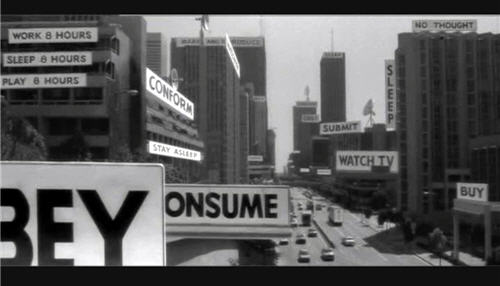
This state of denial and rejection of reality is the essential plot of John Carpenter’s 1988 film They Live, where a group of down-and-out homeless men discover that people have been, in effect, so hypnotized by media distractions that they do not see their prison environment and the real nature of those who control them—that is, an oligarchic elite.

Caught up in subliminal messages such as “obey” and “conform,” among others, beamed out of television and various electronic devices, billboards, and the like, people are unaware of the elite controlling their lives. As such, they exist, as media analyst Marshall McLuhan once wrote, in “prisons without walls.” And of course, any resistance is met with police aggression.

A key moment in the film occurs when John Nada, a homeless drifter, notices something strange about people hanging about a church near the homeless settlement where he lives. Nada decides to investigate. Entering the church, he sees graffiti on a door: They live, We sleep. Nada overhears two men, obviously resisters, talking about “robbing banks” and “manufacturing Hoffman lenses until we’re blue in the face.” Moments later, one of the resisters catches Nada fumbling in the church and tells him “it’s the revolution.” When Nada nervously backs off, the resister assures him, “You’ll be back.”

Rummaging through a box, Nada discovers a handful of cheap-looking sunglasses, referred to earlier as Hoffman lenses. Grabbing a pair and exiting the church, he starts walking down a busy urban street.

Sliding the sunglasses on his face, Nada is shocked to see a society bombarded and controlled on every side by subliminal messages beamed at them from every direction. Billboards are transformed into authoritative messages: a bikini-clad woman in one ad is replaced with the words “MARRY AND REPRODUCE.” Magazine racks scream “CONSUME” and “OBEY.” A wad of dollar bills in a vendor’s hand proclaims, “THIS IS YOUR GOD.”

What’s even more disturbing than the hidden messages, however, are the ghoulish-looking creatures—the elite—who appear human until viewed them through the lens of truth.

This is the subtle message of They Live, an apt analogy of our own distorted vision of life in the American police state. These things are in plain sight, but from the time we are born until the time we die, we are indoctrinated into believing that those who rule us do it for our good. The truth, far different, is that those who rule us don’t really see us as human beings with dignity and worth. They see us as if “we’re livestock.”

It’s only once Nada’s eyes have been opened that he is able to see the truth: “Maybe they’ve always been with us,” he says. “Maybe they love it—seeing us hate each other, watching us kill each other, feeding on our own cold f**in’ hearts.” Nada, disillusioned and fed up with the lies and distortions, is finally ready to fight back. “I got news for them. Gonna be hell to pay. Cause I ain’t daddy’s little boy no more.”

What about you?

As I point out in my book Battlefield America: The War on the American People, the warning signs have been cautioning us for decades. Oblivious to what lies ahead, most have ignored the obvious. We’ve been manipulated into believing that if we continue to consume, obey, and have faith, things will work out. But that’s never been true of emerging regimes. And by the time we feel the hammer coming down upon us, it will be too late.

As Rod Serling warned:

All the Dachaus must remain standing. The Dachaus, the Belsens, the Buchenwalds, the Auschwitzes—all of them. They must remain standing because they are a monument to a moment in time when some men decided to turn the earth into a graveyard, into it they shoveled all of their reason, their logic, their knowledge, but worst of all their conscience. And the moment we forget this, the moment we cease to be haunted by its remembrance. Then we become the grave diggers.

The message: stay alert.

Take the warning signs seriously. And take action because the paths to destruction are well disguised by those in control.

This is the lesson of history.

The Rise of “Criminal Capitalism”

corporate-crime-525

By James Petras

Source: Dissident Voice

About 75% of US employees work 40 hours or longer, the second longest among all OECD countries, exceeded only by Poland and tied with South Korea. In contrast, only 10% of Danish workers, 15% of Norwegian, 30% of French, 43% of UK and 50% of German workers work 40 or more hours. With the longest work day, US workers score lower on the ‘living well’ scale than most western European workers. Moreover, despite those long workdays US employees receive the shortest paid holidays or vacation time (one to two weeks compared to the average of five weeks in Western Europe). US employees pay for the costliest health plans and their children face the highest university fees among the 34 countries in the Organization for Economic Cooperation and Development (OECD).

In class terms, US employees face the greatest jump in income inequalities over the past decade, the longest period of wage and salary decline or stagnation (1970 to 2014) and the greatest collapse of private sector union membership, from 30% in 1950 down to 8% in 2014.

On the other hand, profits, as a percentage of national income, have increased significantly. The share of income and profits going to the financial sector, especially the banks and investment houses, has increased at a faster rate than any other sector of the US economy.

There are two polar opposite trends: Employees working longer hours, with costlier services and declining living standards while finance capitalists enjoy rapidly rising profits and incomes.

Paradoxically, these trends are not directly based on greater ‘workplace exploitation’ in the US.

The historic employee-finance capitalist polarization is the direct result of the grand success of the trillion dollar financial swindles, the tax payer-funded trillion dollar Federal bailouts of the crooked bankers, and the illegal bank manipulation of interest rates. These uncorrected and unpunished crimes have driven up the costs of living and producing for employees and their employers.

Financial ‘rents’ (the bankers and brokers are ‘rentiers’ in this economy) drive up the costs of production for non-financial capital (manufacturing). Non-financial capitalists resort to reducing wages, cutting benefits and extending working hours for their employees, in order to maintain their own profits.

In other words, pervasive, enduring and systematic large-scale financial criminality is a major reason why US employees are working longer and receiving less – the ‘trickle down’ effect of mega-swindles committed by finance capital.

Mega-Swindles, Leading Banks and Complicit State Regulators

Mega-swindles, involving trillions of dollars, are routine practices involving the top fifty banks, trading houses, currency speculators, management fund firms and foreign exchange traders.

These ‘white collar’ crimes have hurt hundreds of millions of investors and credit-card holders, millions of mortgage debtors, thousands of pension funds and most industrial and service firms that depend on bank credit to meet payrolls, to finance capital expansion and technological upgrades and raw materials.

Big banks, which have been ‘convicted and fined’ for mega-swindles, include Citi Bank, Bank of America, HSBC, UBS, JP Morgan, Barclay, Goldman Sachs, Royal Bank of Scotland, Deutsche Bank and forty other ‘leading’ financial institutions.

The mega-swindlers have repeatedly engaged in a great variety of misdeeds, including accounting fraud, insider trading, fraudulent issue of mortgage based securities and the laundering of hundreds of billions of illegal dollars for Colombian, Mexican, African and Asian drug and human traffickers.

They have rigged the London Interbank Official Rate (LIBOR), which serves as the global interest benchmark to which hundreds of trillions of dollars of financial contracts are tied. By raising LIBOR, the financial swindlers have defrauded hundreds of millions of mortgage and credit-card holders, student loan recipients and pensions.

Bloomberg News (5/20/2015) reported on an ongoing swindle involving the manipulation of the multi-trillion-dollar International Swaps and Derivatives Association (ISDA) fix, a global interest rate benchmark used by banks, corporate treasurers and money managers to determine borrowing costs and to value much of the $381 trillion of outstanding interest rate swaps.

The Financial Times (5/23/15, p. 10) reported how the top seven banks engaged in manipulating fraudulent information to their clients, practiced illegal insider trading to profit in the foreign exchange market (forex), whose daily average turnover volume for 2013 exceeded $5 trillion dollars.

These seven convicted banks ended up paying less than $10 billion in fines, which is less than 0.05% of their daily turnover. No banker or high executive ever went to jail, despite undermining the security of millions of retail investors, pensioners and thousands of companies.

The Direct Impact of Financial Swindles on Declining Living Standards

Each and every major financial swindle has had a perverse ripple effect throughout the entire economy. This is especially the case where the negative consequences have spread downward through local banks, local manufacturing and service industries to employees, students and the self-employed.

The most obvious example of the downward ripple effect was the so-called ‘sub-prime mortgage’ swindle. Big banks deliberately sold worthless, fraudulent mortgage-backed securities (MBS) and collateralized debt obligation (CDO) to smaller banks, pension funds and local investors, which eventually foreclosed on overpriced houses causing low income mortgage holders to lose their down payments (amounting to most of their savings).

While the effects of the swindle spread outward and downward, the US Treasury propped up the mega-swindlers with a trillion-dollar bailout in working people’s tax money. They anointed their mega-give-away as the bail out for ‘banks that are just too big to fail”! They transferred funds from the public treasury for social services to the swindlers.

In effect, the banks profited from their widely exposed crimes while US employees lost their jobs, homes, savings and social services. As the US Treasury pumped trillions of dollars into the coffers of the criminal banks (especially on Wall Street), the builders, major construction companies and manufacturers faced an unprecedented credit squeeze and laid off millions of workers, and reduced wages and increased the hours of un-paid work.

Service employees in consumer industries were hit hard as wages and salaries declined or remained frozen. The costs of the FOREX, LIBOR and ISDA fix swindles’ fell heavily on big business, which passed the pain onto labor: cutting pension and health coverage, hiring millions of ‘contingent or temp’ workers at minimum wages with no benefits.

The bank bailouts forced the Treasury to shift funds from ‘job-creating’ social programs and national infrastructure investment to the FIRE (finance, insurance and real estate) sector with its highly concentrated income structure.

As a result of the increasing concentration of wealth among the financial swindlers, inequalities in income grew; wages and salaries were frozen or reduced and manufacturers outsourced production, resulting in declines in production.

Employees, suffering from the loss of income brought on by the mega-swindles, found that they were working longer hours for less pay and fewer benefits. Productivity suffered. With the total breakdown of the ‘capitalist rules of the game’, investors lost confidence and trust in the system. Mega-swindles eroded ‘confidence’ between investors and traders, and made a mockery of any link between performance at work and rewards. This severed the nexus between highly motivated workers, engaged in ‘hard work, long hours’ and rising living standards, and between investment and productivity.

As a result, profits in the finance sector grew while the domestic economy floundered and living standards stagnated.

Financial Impunity: Regulatees Controlling the Regulators

Despite the proliferation of mega-swindles and their pervasive ripple effects throughout the economy and society, none of the dozens of federal or state regulatory agencies intervened to stop the swindle before it undermined the domestic economy. No CEO or banker was ever arrested for their part in the swindle of trillions. The regulators only reacted after trillions had ‘disappeared’ and swindles were ‘a done deal’. The impunity of the swindlers in planning and executing the pillage of hundreds of millions of employees, taxpayers and mortgage holders was because the federal and state regulatory agencies are populated by ‘regulatory administrators’ who came from or aspired to join the financial sector they were tasked with ‘regulating’.

Most of the high officials appointed to lead the regulatory agencies had been selected by the ‘Lords of Wall Street, Frankfurt, the City of London or Zurich.’ Appointees are chosen on the basis of their willingness to enable financial swindles. It therefore came as no surprise on May 28 2015 when US President Obama approved the appointment of Andrew Donahue, Managing Director and Associate General Council for the repeatedly felonious, mega-swindling banking house of Goldman Sachs to be the ‘Chief of Staff’ of the Security and Exchange Commission. His career has been typical of the Washington-Wall Street ‘Revolving Door’.

Only after fraud and swindles evoked the nationwide public fury of mortgage holders, investors and finance companies did the regulators ‘investigate’ the crimes and even then not a single major banker was jailed, not a single major bank was closed down.

There were a few low-level bond traders and bank employees who were fired or jailed as scapegoats. The banks paid puny (for them) fines, which they passed on to their customers. Despite pledges to ‘mend their ways’ the bankers concocted new schemes with their windfalls of billions of Federal ‘bailout’ money while the regulators looked on or polished their CV’s for the next pass through the ‘revolving door’.

Every top official in Treasury, Commerce and Trade, and every regulator in the Security Exchange Commission (SEC) who ‘retired to the private sector’ has ended up working for the same mega-criminal banks and finance houses they had investigated, regulated and ‘slapped on the wrist’.

As one banker, who insists on anonymity, told me: ‘The most successful swindlers are those who investigated financial transgressions’.

Conclusion

Mega-swindles define the nature of contemporary capitalism. The profits and power of financial capital is not the outcome of ‘market forces’. They are the result of a system of criminal behavior that pillages the Treasury, exploits the producers and consumers, evicts homeowners and robs taxpayers.

The mega swindlers represent much less than 1% of the class structure. Yet they hold over 40% of personal wealth in this country and control over 80% of capital liquidity.

They grow inexorably rich and richer, even as the rest of the economy wallows in crisis and stagnation. Their swindles send powerful ripples across the national economy, which ultimately freeze or reduce the income of the skilled (middle class) employees and undermine the living conditions for poor working-class whites, and especially under and unemployed Afro-American and Latino American young workers.

Efforts to ‘moralize’ capital have failed repeatedly since the regulators are controlled by those they claim to ‘regulate’.

The rare arrest and prosecution of any among the current tribe of mega-swindlers would only results in their being replaced by new swindlers. The problem is systemic and requires deep structural changes.

The only answer is to build a political movement independent of the two party system, willing to nationalize the banks and to pass legislation outlawing derivatives, forex trading and other unnatural parasitic speculative activities.

James Petras is author of Extractive Imperialism in the Americas: Capitalism’s New Frontier (with Henry Veltmeyer) and The Politics of Empire: The US, Israel and the Middle East. Read other articles by James, or visit James’s website.

Catching Up With the Unabomber. When Does the End Justify the Means?

220px-Unabomberforpresident

By Brian Whitney

Source: Disinfo.com

The Unabomber, known as Ted Kaczynski, was not a fan of technology. To expose the world to his anti-technology philosophy, from the years 1978 to 1995, Kaczynski sent 16 bombs to universities and airlines, killing three people and injuring 23, before he was eventually caught and sent to prison. He remains there today. At one time, he was possibly the most famous criminal in the world.

He said of technology’s role:

The system does not and cannot exist to satisfy human needs. Instead, it is human behavior that has to be modified to fit the needs of the system. It is the fault of technology, because the system is guided not by ideology but by technical necessity.

In his essay Industrial Society and Its Future, Kaczynski argued that while his bombings were “a bit” extreme, they were quite necessary to attract attention to the loss of human freedom caused by modern technology. His book Technological Slavery: The Collected Writings of Theodore J. Kaczynski, a.k.a. “The Unabomber” breaks all of his philosophies down for those of us that just know him through corporate news stations.

Was the Unabomber crazy, or just so sane he was blowing our minds?

I talked to David Skrbina, confidant of Kaczynski, and philosophy professor at the University of Michigan. Skrbina wrote the intro to Technological Slavery.

Can you tell me a bit about how you and Kaczynski began to communicate? Are you still in touch with him today?

Back in 2003, I began work on a new course at the University of Michigan: Philosophy of Technology. Surprisingly, such a course had never been offered before, at any of our campuses. I wanted to remedy that deficiency.

I then began to pull together recent and relevant material for the course, focusing on critical approaches to technology. These, to me, were more insightful and more interesting, and were notably under-analyzed among current philosophers of technology. Most of them are either neutral toward modern technology, or positively embrace it, or accept its presence resignedly. As I found out, very few philosophers of the past four decades adopted anything like a critical stance. This, for me, was highly revealing.

Anyway, I was well aware of Kaczynski’s manifesto, “Industrial society and its future,” which was published in late 1995 at the height of the Unabomber mania. I was very impressed with its analysis, even though most of the ideas were not new to me (many were reiterations of arguments by Jacques Ellul, for example—see his 1964 book The Technological Society). But the manifesto was clear and concise, and made a compelling argument.

After Kaczynski was arrested in 1996, and after a year-long trial process, he was stashed away in a super-max prison in Colorado. The media then decided that, in essence, the story was over. Case closed. No need to cover Kaczynski or his troubling ideas ever again.

By 2003, I suspected he was still actively researching and writing, but I had heard nothing of substance about him in years. So I decided to write to him personally, hoping to get some follow-up material that might be useful in my new course. Fortunately, he replied. That began a long string of letters, all on the problem of technology. To date, I’ve received something over 100 letters from him.

Most of the letters occurred in the few years prior to, and just after, the publication of Technological Slavery. Several of his more important and detailed replies to me were included in that book—about 100 pages worth.

We’ve had less occasion to communicate in the past couple years. My most recent letter from him was in late 2014.

You have said that his ideas “threaten to undermine the power structure of our technological order. And since the system’s defenders are unable to defeat the ideas, they choose to attack the man who wrote them.” Can you expand on that?

The present military and economic power of the US government, and governments everywhere, rests on advanced technology. Governments, by their very nature, function to manipulate and coerce people—both their own citizens, and any other non-citizens whom they declare to be of interest. Governments have a monopoly on force, and this force is manifest through technological structures and systems.

Therefore, all governments—and in fact anyone who would seek to exert power in the world—must embrace modern technology. American government, at all levels, is deeply pro-tech. So too are our corporations, universities, and other organized institutions. Technology is literally their life-blood. They couldn’t oppose it in any substantial way without committing virtual suicide.

So when a Ted Kaczynski comes along and reminds everyone of the inherent and potentially catastrophic problems involved with modern technology, “the system” doesn’t want you to hear it. It will do everything possible to distort or censor such discussion. As you may recall, during the final years of the Unabomber episode, there was very little—astonishingly little—discussion of the actual ideas of the manifesto. Now and then, little passages would be quoted in the newspapers, but that was it; no follow-up, no discussion, no analysis.

Basically, the system’s defenders had no counterarguments. The data, empirical observation, and common sense all were on the side of Kaczynski. There was no rational case to be made against him.

The only option for the defenders was an ad hominem attack: to portray Kaczynski as a sick murderer, a crazed loner, and so on. That was the only way to ‘discredit’ his ideas. Of course, as we know, the ad hominem tactic is a logical fallacy. Kaczynski’s personal situation, his mental state, or even his extreme actions, have precisely zero bearing on the strength of his arguments.

The system’s biggest fear was—and still is—that people will believe that he was right. People might begin, in ways small or large, to withdraw from, or to undermine, the technological basis of society. This cuts to the heart of the system. It poses a fundamental threat, to which the system has few options, apart from on-going propaganda efforts, or brute force.

What do you think of the fact that when our government, or any figure in authority such as a police officer, kills in the name of the established belief system, it is thought of as just. But when a guy like Kaczynski kills in the name of his belief system, he is thought of as a deranged psychopath?

As I mentioned, governmental authorities have a monopoly on force. Whenever they use it, it is, almost by definition, ‘right.’ Granted, police can be convicted of ‘excessive force.’ But such cases, as we know, are very rare. And militaries can never be so convicted.

At best, if the public is truly appalled by some lethal action of our police or military, they may vote in a more ‘pacifist’ administration. But even that rarely works. People were disgusted by the war-monger George W. Bush, and so they voted in the “anti-war” Obama. Ironically, he continued on with much the same killing. And through foreign aid and UN votes, Obama continues to support and defend murderous regimes around the world. So much for pacifism.

Let’s keep in mind: Kaczynski killed three people. This was tragic and regrettable, but still, it was just three people. American police kill that many citizens every other day, on average. The same with Obama’s drone operators. Technology kills many times that number, every day—even every hour. Let’s keep things in perspective.

Kaczynski killed in order to gain the notoriety necessary to get the manifesto into the public eye. And it worked. When it was published, the Washington Post sold something like 1.2 million copies that day—still a record. He devised a plan, executed it, and thereby caused millions of people to contemplate the problem of technology in a way they never had before.

Does the end justify the means? It’s too early to tell. If Kaczynski’s actions ultimately have some effect on averting technological disaster, there will be no doubt: his actions were justified. They may yet save millions of lives, not to mention much of the natural world. Time will tell.

You recently wrote a book, The Metaphysics of Technology. Can you tell us a little about that?

Sure. In thinking about the problem of technology, it struck me that there was very little philosophical analysis about what, exactly, technology is. We’ve had many action plans, ranging from tepid and mild (think Sherry Turkle), to Bill Joy’s thesis of “relinquishment” of key technologies, to Kaczynski’s total revolution. But if we don’t really understand what we’re dealing with, our actions are likely to be misguided and ineffectual. In short, we need a true metaphysics of technology.

On my view, technology advances with a tremendous, autonomous power. Humans are the implementers of this power, but we can’t really guide it and we certainly can’t stop it. In effect, it functions as a law of nature. It advances with an evolutionary force, and that’s why we are heading toward disaster.

I see technology much as the ancient Greeks did—as a combination of two potent entities, Technê and Logos (hence ‘techno-logy’). For them, these were quasi-divine forces. Logos was the guiding intelligence behind all order in the universe. Technê was the process by which all things—manmade and otherwise—came into being. These were not mere mythology; they were rational conclusions regarding the operation of the cosmos.

Like the Greeks, I argue that technê is a universal process. All order in the universe is a form of technê. Hence my coining of the term ‘Pantechnikon’—the universe as an orderly construction, manifesting a kind of intelligence, or Logos. Our modern, human technology is on a continuum with all order in the universe. (Harvard astrophysicist Eric Chaisson has argued for precisely the same point, incidentally; see his 2006 book Epic of Evolution.)

The net effect of all this is not good news for us. Technology is like a wave moving through the Earth, and the universe. For a long while, we were at the peak of that wave. Now we’re on the downside. Technology is rapidly heading toward true autonomy. Our opportunity to slow or redirect it is rapidly vanishing. If technology achieves true autonomy—we can take Kurzweil’s singularity date of 2045 as a rough guide—then it’s game over for us. We will likely either become more or less enslaved, or else wiped out. And then technology will continue on its merry way without us.

This is not mere speculation on my part, incidentally. Within the past year, Stephen Hawking, Elon Musk, and Bill Gates have all come out with related concerns. They don’t understand the metaphysics behind it, but they’re seeing the same trend.

How has your experience communicating with Kaczynski changed you as a person and as a philosopher?

As a philosopher, not that much. Kaczynski generally avoids philosophy and metaphysics, preferring practical issues. In a sense, we are operating on different planes, even as we are working on the same problem.

As a person, I have a greater understanding of the basis for the ‘extreme’ actions that he took. It’s not often in life that you get a chance to communicate with someone with such a total commitment to their cause. It’s impressive.

Also, the media treatment of his whole case has been enlightening. When his book, Technological Slavery, came out in 2010, I expected that there would be at least some media coverage. But there was none. The most famous “American terrorist” publishes a complete book from a super-max prison—and it’s not news? Seriously? Compare this topic to the garbage shown on our national evening news programs, and it’s a joke. NPR, 60 Minutes, Wired magazine, etc.—all decided it wasn’t newsworthy. Very telling.

One last thing: Expect to hear from Kaczynski again soon. His second book is nearing completion. The provisional title is “Anti-Tech Revolution: Why and How.” But don’t look for it on your evening news.

Things are not as simplistic as you think.


Buy Technological Slavery, by Ted Kaczynski, and The Metaphysics of Technology by David Skrbina. Kaczynski does not profit from his book.

Brian Whitney’s latest book is Raping the Gods.

Related articles: Ted and the CIA Part 1 & 2 by David Kaczynski

http://blog.timesunion.com/kaczynski/ted-and-the-cia-part-1/271/

http://blog.timesunion.com/kaczynski/ted-and-the-cia-part-2/285/

Saturday Matinee: The Fuck-It Point

THE-FUCK-IT-POINT

Synopsis by Savage Revival:

A film about civilization, why we should bring it down and why most civilized people don’t.

[THE FUCK-IT POINT]
‘When you have had enough. When you decide to take matters into your own hands and don’t care what’s going to happen to you. When you know that from now on you will resist with whatever tactic you think is most effective.’

Obama Accuses Russia of Going After America’s “Good Guy Terrorists”

obama_on_isis_10-1-2015_8-50-53_am

By Prof Michel Chossudovsky

Source: Global Research

Amply documented but rarely mentioned in news reports, the ISIS is a creation of US intelligence, recruited, trained and financed by the US and its allies including Britain, France, Saudi Arabia, Qatar, Turkey, Israel and Jordan.  

Until recently, the ISIS was known as Al Qaeda in Iraq (AQI). In 2014, it was renamed the Islamic State (Islamic State of Iraq and Syria, Islamic State of Iraq and the Levant).

Russia is Now Involved in the War on Terrorism

A major turning point in the dynamics of the Syria-Iraq war is unfolding. Russia is now directly involved in the counter-terrorism campaign in coordination with the Syrian and Iraqi governments.

While Washington has acknowledged Moscow’s resolve, Obama is now complaining that the Russians are targeting the “good guy terrorists” who are supported by Washington.

From the Horse’s Mouth

According to the Wall Street Journal:

Russian Airstrike in Syria Targeted CIA-Backed Rebels, U.S. Officials Say

One area hit was location primarily held by rebels receiving funding, arms, training from CIA and allies

One important piece of unspoken information conveyed in this WSJ report is that the CIA is supporting terrorists as a means to triggering “regime change” in Syria, implying the conduct of covert intelligence operations within Syrian territory:

“The U.S. spy agency has been arming and training rebels in Syria since 2013 to fight the Assad regime  (WSJ, September 30, 2015 emphasis added, author’s note: covert support to the terrorists was provided from the outset of the war in March 2011)

The above statement is something which is known and documented but which has barely been acknowledged by the mainstream media.

Al Nusra: “Good Guy Terrorists”

While the Pentagon now candidly acknowledges that the CIA is supporting Al Qaeda affiliated groups inside Syria, including Al Nusra, it nonetheless deplores the fact that Russia is allegedly targeting the “good guy terrorists”, who are supported by Washington:

One of the [Russian] airstrikes hit an area primarily held by rebels backed by the Central Intelligence Agency and allied spy services, U.S. officials said, …

Among seven areas that Syrian state media listed as targets of Russian strikes, only one—an area east of the town of Salamiyah in Hama province—has a known presence of Islamic State fighters. The other areas listed are largely dominated by moderate rebel factions or Islamist groups such as Ahrar al-Sham and the al Qaeda-affiliated Nusra Front.  (WSJ, September 30, 2015 emphasis added)

Affiliated to Al Qaeda, Al Nusra is a US sponsored  ”jihadist” terrorist organization which has been responsible for countless atrocities. Since 2012, AQI and Al Nusra — both supported by US intelligence– have been working hand in glove in various terrorist undertakings within Syria.

In recent developments, the Syrian government has identified its own priority areas for the Russian counter-terrorism air campaign, which consists essentially in targeting Al Nusra.  Al Nusra is described as the terrorist arm of the Free Syrian Army (FSA).

While Washington has categorized Al Nusra as a terrorist organization (early 2012), it nonetheless provides support to both Al Nusra and it’s so-called “moderate rebels” in the form of weapons, training, logistical support, recruitment, etc. This support is channeled by America’s Persian Gulf allies, including Qatar and Saudi Arabia as well as through Turkey and Israel.

Ironically, The UN Security Council in a May 2012 decision “blacklisted Syria’s al-Nusra Front as an alias of al-Qaeda in Iraq”, namely the ISIL:

a decision that will subject the group to sanctions including an arms embargo, travel ban and assets freeze, diplomats said.

The US mission to the United Nations said none of the 15 council members objected to adding al-Nusra as an alias of al-Qaeda in Iraq on Thursday.

Al-Nusra, one of the most effective forces fighting President Bashar al-Assad, last month pledged allegiance to al-Qaeda leader Ayman al-Zawahri. (Al Jazeera, May 2012)

And now Russia is being blamed for targeting a terrorist entity which is not only on the UN Security Council blacklist but which has ties to the Islamic State (ISIS).

What is the significance of these accusations?

While the media narrative acknowledges that Russia has endorsed the counter-terrorism campaign, in practice Russia is (indirectly) fighting the US-NATO coalition  by supporting the Syrian government against the terrorists, who happen to be the foot soldiers of the Western military alliance, with Western mercenaries and military advisers within their ranks. In practice, what Russia is doing is fighting terrorists who are supported by the US.

The forbidden truth is that by providing military aid to both Syria and Iraq, Russia is (indirectly) confronting America. 

Moscow will be supporting both countries in their proxy war against the ISIL which is supported by the US and its allies.

Having Their Cake and Eating Ours Too

bill-gates

By Chris Lehmann

Source: The Baffler

What are billionaires for? It’s time we sussed out a plausible answer to this question, as their numbers ratchet upward across the globe, impervious to the economic setbacks suffered by mere mortals, and their “good works” ooze across the fair land. The most recent count from Forbes reports a record 1,826 of these ten-figure, market-cornering Croesuses, with familiar North American brands holding down the top three spots: Bill Gates, Carlos Slim, and Warren Buffett. Esteemed newcomers to the list include Uber kingpin Travis Kalanick, boasting $5.3 billion in net worth; gay-baiting, evangelical artery-hardeners Dan and Bubba Cathy, of Chick-fil-A fame ($3.2 billion); and Russ Weiner, impresario of the antifreeze-by-another-name energy drink Rockstar ($2.1 billion). For the first time, too, Mark Zuckerberg has cracked the elite Top 20 of global wealth; in fact, fellow Californians, most following Zuckerberg’s savvy footsteps into digital rentiership, account for 23 of the planet’s new billionaires and 131 of the total number—more than supplied by any nation apart from China and the Golden State’s host country, a quaint former republic known as the United States.

What becomes of the not-inconsiderable surplus that your average mogul kicks up in his rush to market conquest? In most cases, he (and in the vast majority of cases, it is still a “he”) parks his boodle in inflation-boosted goods like art and real estate, which neatly double as venerable monuments to his own vanity or taste.

But what happens when the super-rich turn their clever minds toward challenges beyond getting up on the right side of their well-feathered beds? Specifically, what are the likely dividends of their decisions to “give back to the community,” as the charitable mantra of the moment has it? Once upon a time, the Old World ideal of noblesse oblige might have directed their natural stirrings of conscience toward the principles of mutuality and reciprocity. But this is precisely where the new millennial model of capital-hoarding falls apart. The notion that the most materially fortunate among us actually owe the rest of us anything from their storehouses of pelf is now as unlikely as a communard plot twist in an Ayn Rand novel.

Look around at the charitable causes favored among today’s info-elite, and you’ll see the public good packaged as one continual study in billionaire self-portraiture. The Bill and Melinda Gates Foundation, endowed by a celebrated prep-school graduate and Harvard dropout, devotes the bulk of its endowment and nearly all of its intellectual firepower to laying waste to the nation’s teachers’ unions. The Eli and Edythe Broad Foundation is but the Gates operation on steroids, unleashing a shakedown syndicate of overcapitalized and chronically underperforming charter schools in the beleaguered urban centers where the democratic ideal of the common school once flourished. The Clinton Global Initiative, when it’s not furnishing vaguely agreeable alibis for Bill Clinton’s louche traveling companions, is consumed by neoliberal delusions of revolutionary moral self-improvement via the most unlikely of means—the proliferation of the very same sort of dubious financial instruments that touched off the 2008 economic meltdown. In this best of all possible investors’ worlds, swashbuckling info-moralists will teach international sex workers about the folly of their life choices by setting them up with a laptop and an extended tutorial on the genius of microloans.

This recent spike in elite self-infatuation, in other words, bespeaks a distressing new impulse among the fabulously well-to-do. While past campaigns of top-down charity focused on inculcating habits of bourgeois self-control among the lesser-born, today’s philanthro-capitalist seigneurs are seeking to replicate the conditions of their own success amid the singularly unpromising social world of the propertyless, unskilled, less educated denizens of the Global South. It’s less a matter of philanthro-capitalism than one of philanthro-imperialism. Where once the gospel of industrial success held sway among the donor class, we are witnessing the gospel of the just-in-time app, the crowdsourced startup, and the crisply leveraged microloan. This means, among other things, that the objects of mogul charity are regarded less and less as moral agents in their own right and more and more as obliging bit players in a passion play exclusively devoted to dramatizing the all-powerful, disruptive genius of our info-elite. They aren’t “giving back” so much as peering into the lower depths of the global social order and demanding, in the ever-righteous voice of privilege, “Who’s the fairest of them all?”

Noblesse Sans Oblige

There was plenty to deride in the Old World model of noblesse oblige; it dates back to the bad old days of feudal monarchy, when legacy-royal layabouts not only abjured productive labor entirely, but felt justified in the notion that they owned the souls of the peasants tethered to their sprawling estates. It’s no accident, therefore, that the idea of the rich being in receipt of any reciprocal obligation to the main body of the social order failed to make it onto the American scene. The sturdy mythology of the American self-made man didn’t really permit an arriviste material adventurer to look back to his roots at all, save to assure those within earshot that he’d definitively risen above them by the sheer force of an indomitable will-to-succeed.

But the relevant defining trait is the oblige part: the notion that the wealthy not only could elect to “give back” when it might suit their fancy, but that they had to positively let certain social goods alone—and assertively fund others—by virtue of their privileged station. Traditions such as the English commons stemmed from the idea that certain public institutions were inviolate, so far as the enfeoffing prerogatives of the landowning class went. The state church is another, altogether more problematic, legacy of this ancien régime; in addition to owning feudal souls outright, the higher orders of old had to evince some institutional concern for their ultimate destiny. There was exploitation and corruption galore woven into this social contract, of course, but for the more incendiary figures who dared to take its spiritual precepts seriously, there were also strong speculative grounds for envisioning another sort of world entirely, one in which the radical notion of spiritual equality took hold. As the Puritan Leveller John Lilburne—a noble by birth—put it in 1646, in the midst of the English Civil War:

All and every particular and individual man and woman, that ever breathed in the world . . . are by nature all equal and alike in their power, dignity, authority, and majesty, none of them having (by nature) any authority, dominion, or magisterial power, one over or above another.

Of course, the Levellers clearly were not on the winning side of British history, but this militant Puritan spirit migrated to the American colonies to supply the seedbed of our own communitarian ideal, expounded most famously in John Winthrop’s social-gospel oration “A Model of Christian Charity” aboard the Arbella in 1630. Throughout his sermon, Winthrop repeatedly exhorted his immigrant parishioners to practice extreme liberality in charity. “He that gives to the poor, lends to the Lord,” Winthrop declared in an appeal to philanthropic mutuality far less widely quoted than his fabled simile of the colonial settlement of New England as a city on a hill. “And he will repay him even in this life an hundredfold to him or his.” Citing a litany of biblical precedent, Winthrop went on to remind his mostly well-to-do Puritan flock that “the Scripture gives no caution to restrain any from being over liberal this way.” Indeed, he drove home the point much more forcefully as he highlighted the all-too-urgent imperative for these colonial adventurers to hand over the entirety of their substance for fellow settlers in material distress. “The care of the public must oversway all private respects,” Winthrop thundered—and then, sounding every bit the proto-socialist that his countryman Lilburne was: “It is a true rule that particular estates cannot subsist in the ruin of the public.”

The Accumulator As Paragon

The story of how Winthrop’s model of Christian charity degenerated into the neoliberal shibboleths of the Gates and Zuckerberg age is largely the saga of American monopoly capitalism, and far too epic to dally with here. But there is a key transitional figure in this shift: the enormously wealthy, self-made, and terminally self-serious steel-titan-cum-social reformer Andrew Carnegie. Born in rural Scotland in 1835 to an erratically employed artisan weaver, Carnegie grew up on the Chartist slogans that, amid the more secular social unrest of the industrial revolution, came to supplant the Levellers’ democratic visions of a world turned upside down. When he rose from an apprenticeship in a Pittsburgh telegraph office to true mogul status in the railroad, iron, and steel industries, Carnegie continued to cleave to the pleasing reverie that he was a worker’s kind of robber baron. Thanks to his own class background, he intoned, he had unique insight into the plight of the workmen seeking to hew their livings out of the harsh conditions of a new industrial capitalist social order. “Labor is all that the working man has to sell,” Carnegie pronounced just ahead of a series of wage cuts at his Pittsburgh works in 1883. “And he cannot be expected to take kindly to reductions of wages. . . . I think the wages paid at the seaboard of the United States are about as low as men can be expected to take.”

It was vital to Carnegie’s moral vanity to keep maintaining this self-image as the benevolent industrial noble, and he did so well past the point where his actually existing business interests dictated (as he saw it) the systematic beggaring of his workers. When the managers of Carnegie-owned firms would sell their workers short, lock them out, or bust their unions, Carnegie would typically blame the workers for not obtaining better contracts at rival iron, steel, and railroad concerns. While he might sympathize with their generally weak bargaining position, Carnegie well understood that he couldn’t have his competitors undercutting his own bottom line with cheaper labor costs—and with cheaper goods to market to Carnegie’s customers.

Carnegie’s patrician moral sentiments were genuine; throughout his career, he erected an elaborate philosophical defense of philanthropy as the only proper path for the disposition of riches, and famously spent his last years furiously trying to disperse as much of his fortune as possible to pay for charitable foundations, libraries, church organs, and the like. As he saw it, the mogul receives a sacred charge from the larger historical forces that conspire in the creation of his wealth: the rich man must act as a “trustee” for the needier members of the community.

Because the millionaire had proved his mettle as an accumulator of material rewards in the battle for business dominion, it followed that he had also been selected to be the most beneficent, and judicious, dispenser of charitable support for the lower orders as well. In Carnegie’s irenic vision of ever-advancing moral progress, all social forces were tending toward “an ideal state, in which the surplus wealth of the few will become, in the best sense, the property of the many, because administered for the common good,” as he preached in his famous 1889 essay “The Gospel of Wealth.” “And this wealth, passing through the hands of the few, can be made a much more potent force for the elevation of our race than if it had been distributed in small sums to the people themselves.” The accomplished mogul was, in Carnegie’s fanciful telling, nothing less than a dispassionate expert in the optimal disbursal of resources downward: “The man of wealth,” he wrote, became “the mere agent and trustee for his poorer brethren, bringing to their service his superior wisdom, experience, and ability to administer, doing for them better than they would or could do for themselves.”

Such blissfully un-self-aware flourishes of elite condescension—and the intolerable contradictions that called them into being—point at the tensions lurking just beneath Carnegie’s placid, controlling social muse. For as his own career as a market-cornering industrialist made painfully clear, precisely none of Carnegie’s fortune stemmed from serving out a benevolent trusteeship in the interests of the poor and working masses. Indeed, something far more perverse and unsightly impelled the business model for Carnegie’s commercial and charitable pursuits, as his biographer David Nasaw notes: Carnegie used the alibi of his own enlightened, philanthropic genius as the primary justification for denying collective bargaining rights to his workers.

Since he was clearly foreordained to serve the best interests of these workers better than they could, it was ultimately to everyone’s benefit to transform Carnegie’s business holdings into the most profitable enterprises on the planet—all the better to sluice more of the mogul’s ruthlessly extracted wealth back into the hands of a grateful hoi polloi, once it was rationalized and sanctified by the great man’s “superior wisdom, experience, and ability to administer.” In the sanctum of his New York study, where he spent the bulk of his days once his wealth disencumbered him of direct managerial duties at his Pittsburgh holdings, Carnegie found thrilling confirmation of his enlightened moral standing in the writings of social Darwinist Herbert Spencer. Yes, the wholesale of workers, widows, and orphans might seem “harsh,” Spencer preached to his ardent business readership. But when viewed from the proper vantage—the end point toward which all of humanity’s evolutionary struggles were ineluctably trending—this remorseless process of deskilling, displacement, and death was actually a sacred mandate, not to be tampered with: “When regarded not separately, but in connection with the interests of universal humanity, these harsh fatalities are seen to be of the highest beneficence.”

And so, indeed, it came to pass, albeit a bit too vividly for Carnegie’s own moral preference. At the center of the Carnegie firms’ labor-bleeding business model was a landmark tragedy in American labor relations: the 1892 strike at Carnegie’s Homestead works. Carnegie’s lieutenant, Henry Clay Frick, locked out the facility’s workforce after the Amalgamated Association of Iron and Steel Workers pressed management to suspend threatened wage cuts and pare back punishing twelve-hour shifts for steel workers. Frick clumsily tried to ferry in Pinkerton forces on the Monongahela River to take control of the plant; Homestead workers, backed by their families and local business owners, fought to repel the Pinkerton thugs. Gunfire was exchanged on both sides, killing two Pinkertons and nine workers. Eventually, Frick got the state militia to disperse the crowds of workers and their supporters; with his field of action cleared, the plant’s manager proceeded to starve out the strikers, breaking the strike five months after it began. The Amalgamated Union collapsed into oblivion the following year. No union would ever again darken the door of a Carnegie-owned business, no matter what sort of lip service he continued to pay to the dignity of the workingman in public.

Homestead was a bitter rebuke to Carnegie’s self-image as the workers’ expert missionizing advocate—but tellingly, it didn’t do any lasting damage to the larger edifice of his charitable pretension. Partly, this was a function of Carnegie’s genuine generosity. More fundamentally, though, the steel mogul’s outsized moral self-regard endured in its prim, unmolested state thanks to the larger American public consensus on the proper Olympian status of men of wealth, especially when gauged against the demoralizing spectacle of industrial conflict.

Strings, Attached

The desperate intellectual acrobatics of the self-made Carnegie were never viewed as pathological, for the simple reason that they mirrored the logic by which American business interests at large pursued public favor. In this scheme of things, the lords of commerce were always to be the unquestioned possessors of a magisterial historical prerogative, and the base, petty interests of a self-organized labor movement were always the retrograde obstacle to true progress. What else could it mean, after all, for the owners of capital to always and forever be acting “in connection with the interests of universal humanity”? Following the broad contours of Carnegie’s founding efforts in this sphere, a long succession of American business leaders would proceed to claim for themselves the mantle of enlightened market despotism, from GM CEO Charlie “Engine” Wilson’s breezy midcentury conflation of his corporation’s grand good fortune with that of its host nation to the confident prognostications of today’s tech lords that we are about to efface global poverty in the swipe of a few well-designed apps.

So how does the philanthropic debauching of the public sphere unfold today, now that Carnegie’s bifurcated model of exploitation for charity’s sake has receded into the dimly remembered newsreel footage of the industrial age? Well, for one thing, it’s become a lot less genteel. Trusteeship isn’t the model any longer; it’s annexation.

Take one especially revealing case involving our own age’s pet mogul crusade of school reform. Just five years ago, Mark Zuckerberg made a splashy, Oprah-choreographed gift of $100 million to the chronically low-performing Newark public school district—an announcement also timed to coincide with the national release of the union-baiting school reform documentary Waiting for “Superman.” The idea was to enlist the Facebook wizard’s fellow philanthro-capitalists in a matching donor drive, so that the city’s schools, already staked to a $1 billion state-administered budget, would also pick up $200 million of private-sector foundation dosh, to be spent on charter schools and other totems of managerial faux-excellence. With this dramatic infusion of money from our lead innovation industries, it would be largely a formality to “turn Newark into a symbol of educational excellence for the whole nation,” as Zuckerberg told a cheerleading Oprah.

And sure enough, all the usual deep-pocketed benefactors turned out in force to meet the Zuckerberg challenge: Eli Broad, the Gates Foundation, the Walton Foundation, and even Zuckerberg’s chief operation officer, Sheryl “Lean In” Sandberg, all kicked into the kitty. At the public forums rolling out the initiative—organized for a cool $1.3 million by Tusk Strategies, a consultancy concern affiliated with erstwhile New York mayor Michael Bloomberg’s own school-privatizing fiefdom—Newark parents more concerned with securing basic protections for their kids in local schools, such as freedom from gang violence and drug trafficking, exhorted the newly parachuted reform class to focus on the mundane prerequisites of infrastructure support and student safety. But try as they might, they found their voices continually drowned out by a rising chorus of vacuous reform-speak. “It’s destiny that we become the first city in America that makes its whole district a system of excellence,” then-mayor Cory Booker burbled at one such gathering. “We want to go from islands of excellence to a hemisphere of hope.”

But for all these stirring reprises of the Spencerian catechism on “the interests of universal humanity,” the actual state of schooling in Newark was not measurably improving. The leaders of the reform effort (which was, of course, entitled “Startup:Education”) couldn’t answer the most basic questions about how the rapidly deployed battery of excellence-incubating Newark charter schools would coexist beside the shambolic wrecks of the city’s merely public schools, where a majority of Newark kids would still be enrolled—or even how parents of charter kids would get their kids to and from school, since these wise, reforming souls neglected to allot due funding for bus transportation. Not surprisingly, the new plan’s leaders were also cagey about explaining how all the individual school budgets, charter and public alike, were to be brought into line.

So in short order, the magic Zuckerberg seed money, together with the additional $100 million in matching grants, had all vanished. More than $20 million of that went to pay PR and consultancy outfits like Tusk Strategies, according to New Yorker writer Dale Russakoff, who notes that “the going rate for individual consultants in Newark was a thousand dollars a day.” Another $30 million went to pad teachers’ salaries with back pay to buy off workers’ good will—and far more important, to gain the necessary leverage to dismiss or reassign union-protected teachers who didn’t project as the privatizing Superman type. The most enduring legacy of Startup:Education appears to be a wholly unintended political one: disenchanted Newark citizens rallied behind the mayoral candidacy of Ras Baraka, former principal of Newark’s Central High School and son of the late radical poet Amiri Baraka, who was elected last year on a platform of returning Newark educational policy to the control of the community.

With all due allowances for the dramatically disparate character of the underlying social order, and the shift from an Industrial Age economy to a service-driven information one, it’s nonetheless striking to note just how little about the purblind conduct of overclass charity has changed since Carnegie’s time. Just as Carnegie’s own sentimental and imaginary identification with the workers in his employ supplied him with the indispensable rhetorical cover for beggaring said workers of their livelihoods and rights to self-determination in the workplace, so did the leaders of Startup:Education evince just enough peremptory interest in the actual living conditions of Newark school families to net optimal Oprah coverage. And once the Klieg lights dimmed, the real business plan kicked into gear: a sustained feeding frenzy for the neoliberal symbolic analysts professionally devoted to stage-managing the appearance of far-seeing school reform. These high-priced hirelings were of course less brutal and bloodthirsty than the Pinkertons Frick had unleashed on the Homestead workers, but their realpolitik charge was, at bottom, equally stark: to discredit teachers’ unions and community activists while delivering control of a vital social good into the hands of a remote investing and owning class. If the parents and kids grew restive in their appointed role as stage props for the pleasing display of patrician largess, why, they could just hire Uber drivers to dispatch themselves to the new model charter schools, or maybe scare off local gang members by assembling an artillery of firearms generated via their 3-D printers.

In truth, no magic-bullet privatization plan could begin to address the core conditions that sent the Newark schools spiraling into systemic decay: rampant white flight after the 1967 riots, which in turn drained the city of the property-tax revenues needed to sustain a quality educational system, combined with corruption within the city’s political establishment and (yes) among the leadership of its teachers’ unions. To make local education districts respond meaningfully to the needs of the communities they serve, reformers would have to begin at the very opposite end of the class divide from where Startup:Education set up shop—by giving power to the members of said communities, not their self-appointed neoliberal overseers. In other words, common schools should rightly be understood as a commons, not as playthings for bored digital barons or as little success engines, managed like startups in the pejorative sense, left to stall out indefinitely in beta-testing mode until all the money’s gone.

Andrew Carnegie, at least, had the depth of character to recognize when his vision of his world-conquering destiny had gone badly off the rails. In the last years of his life, his infatuation with the stolid charms of mere libraries and church organs seemed to fade, so he adopted a quixotic quest to recalibrate human character entirely. Starting with an ardent—and quite worthy—campaign to stem the worst excesses of American imperialism in the wake of the Spanish-American War, Carnegie then turned to the seemingly insoluble challenge of stamping out altogether the human propensity to make war. When this latter crusade ran afoul of the colossal carnage unleashed in the Great War, he became an uncharacteristically depressed, isolated, and retiring figure, barely reemerging in public life before his death in 1919.

In today’s America, however, no one learns from our mogul class’s leadership mistakes and moral disasters—we just proceed to copy them faster. So when New York’s neoliberal governor Andrew Cuomo tore a page from the Zuckerberg playbook and launched a system of lavish tax breaks for tech firms affiliated with colleges and universities—surely these educational outposts would be model incubators of just-in-time prosperity—nemesis once again beckoned. Indeed, when Cuomo’s economic savants unleashed tech money to do its own bidding in the notional public sphere, the end results proved to be no different than they had been in the Zuckerberg-funded mogul playground of Newark charter schools. Cuomo’s ballyhooed, billion-dollar, five-year plan for way-new digital job creation—called, you guessed it, “Startup New York”—yielded just seventy-six jobs in 2014, according to a report from the state’s Committee on Economic Development. This isn’t a multiplier effect so much as a subtraction one; it’s hard to see how Cuomo could have netted a less impressive return on investment if he had simply left a billion dollars lying out on the street.

Just as Newark vouchsafed us a vision of educational excellence without the messy parents, neighborhood social ills, and union-backed teachers who louse the works up, so has Cuomo choreographed a seamless model of tax breaks operating in a near-complete economic vacuum. Say what you will about the abuses of Old World wealth; a little noblesse oblige might go a long way in these absurdly predatory times.

 

Pillage and Class Polarization: The Rise of “Criminal Capitalism”

wealth

By Prof. James Petras

Source: GlobalResearch.ca

About 75% of US employees work 40 hours or longer, the second longest among all OECD countries, exceeded only by Poland and tied with South Korea.  In contrast, only 10% of Danish workers, 15% of Norwegian, 30% of French, 43% of UK and 50% of German workers work 40 or more hours.  With the longest work day, US workers score lower on the ‘living well’ scale than most western European workers. 

Moreover, despite those long workdays US employees receive the shortest paid holidays or vacation time (one to two weeks compared to the average of five weeks in Western Europe).  US employees pay for the costliest health plans and their children face the highest university fees among the 34 countries in the Organization for Economic Cooperation and Development (OECD).

In class terms, US employees face the greatest jump in income inequalities over the past decade, the longest period of wage and salary decline or stagnation (1970 to 2014) and the greatest collapse of private sector union membership, from 30% in 1950 down to 8% in 2014.

On the other hand, profits, as a percentage of national income, have increased significantly.  The share of income and profits going to the financial sector, especially the banks and investment houses, has increased at a faster rate than any other sector of the US economy.

There are two polar opposite trends: Employees working longer hours, with costlier services and declining living standards  while finance capitalists enjoy rapidly rising profits and incomes.

Paradoxically, these trends are not directly based on greater ‘workplace exploitation’ in the US.

The historic employee-finance capitalist polarization is the direct result of the grand success of the trillion dollar financial swindles, the tax payer-funded trillion dollar Federal bailouts of thecrooked bankers, and the illegal bank manipulation of interest rates.  These uncorrected and unpunished crimes have driven up the costs of living and producing for employees and their employers.

Financial ‘rents’ (the bankers and brokers are ‘rentiers’ in this economy) drive up the costs of production for non-financial capital (manufacturing).   Non-financial capitalists resort to reducing wages, cutting benefits and extending working hours for their employees, in order to maintain their own profits.

In other words, pervasive, enduring and systematic large-scale financial criminality is a major reason why US employees are working longer and receiving less – the ‘trickle down’ effect of mega-swindles committed by finance capital.

Mega-Swindles, Leading Banks and Complicit State Regulators

Mega-swindles, involving trillions of dollars, are routine practices involving the top fifty banks, trading houses, currency speculators, management fund firms and foreign exchange traders.

These ‘white collar’ crimes have hurt hundreds of millionsof investors and credit-card holders, millions of mortgage debtors, thousands of pension funds and most industrial and service firms that depend on bank credit to meet payrolls, to finance capital expansion and  technological upgrades and raw materials.

Big banks, which have been ‘convicted and fined’ for mega-swindles, include Citi Bank, Bank of America, HSBC, UBS, JP Morgan, Barclay, Goldman Sachs, Royal Bank of Scotland, Deutsch Bank and forty other ‘leading’ financial institutions.

The mega-swindlers have repeatedly engaged in a great variety of misdeeds, including accounting fraud, insider trading, fraudulent issue of mortgage based securities and the laundering of hundreds of billions of illegal dollars for Colombian, Mexican, African and Asian drug  and human traffickers.

They have rigged the London Interbank Official Rate (LIBOR), which serves as the global interest benchmark to which hundreds of trillions of dollars of financial contracts are tied.  By raising LIBOR, the financial swindlers have defrauded hundreds of millions of mortgage and credit-card holders, student loan recipients and pensions.

Bloomberg News (5/20/2015) reported on an ongoing swindle involving the manipulation of the multi-trillion-dollar International Swaps and Derivatives Association (ISDA) fix, a global interest rate benchmark used by banks, corporate treasurers and money managers to determine borrowing costs and to value much of the $381 trillion of outstanding interest rate swaps.

The Financial Times (5/23/15, p. 10)   reported how the top seven banks engaged in manipulating fraudulent information to their clients, practiced illegal insider trading to profit in the foreign exchange market (forex), whose daily average turnover volume for 2013 exceeded $5 trillion dollars.

These seven convicted banks ended up paying less than $10 billion in fines, which is less than 0.05% of their daily turnover.  No banker or high executive ever went to jail, despite undermining the security of millions of retail investors, pensioners and thousands of companies.

The Direct Impact of Financial Swindles on Declining Living Standards

Each and every major financial swindle has had a perverse ripple effect throughout the entire economy.  This is especially the case where the negative consequences have spread downward through local banks, local manufacturing and service industries to employees, students and the self-employed.

The most obvious example of the downward ripple effect was the so-called ‘sub-prime mortgage’ swindle.  Big banks deliberately sold worthless, fraudulent mortgage-backed securities(MBS) and collateralized debt obligation (CDO)  to smaller banks, pension funds and local investors, which eventually foreclosed on overpriced houses causing low income mortgage holders to lose their down payments (amounting to most of their savings).

While the effects of the swindle spread outward and downward, the US Treasury propped up the mega-swindlers with a trillion-dollar bailout in working people’s tax money.  They anointed their mega-give-away as the bail out for ‘banks that are just too big to fail”!  They transferred funds from the public treasury for social services to the swindlers.

In effect, the banks profited from their widely exposed crimes while US employees lost their jobs, homes, savings and social services.  As the US Treasury pumped trillions of dollars into the coffers of the criminal banks (especially on Wall Street), the builders, major construction companies and manufacturers faced an unprecedented credit squeeze and laid off millions of workers, and  reduced wages and increased the hours of un-paid work.

Service employees in consumer industries were hit hard as wages and salaries declined or remained frozen.  The costs of theFOREX, LIBOR and ISDA fix swindles’ fell heavily on big  business, which passed the pain onto labor: cutting pension and health coverage, hiring millions of ‘contingent or temp’ workers at minimum wages with no benefits.

The bank bailouts forced the Treasury to shift funds from ‘job-creating’ social programs and national infrastructure investment to the FIRE (finance, insurance and real estate) sector with its highly concentrated income structure.

As a result of the increasing concentration of wealth among the financial swindlers, inequalities in income grew; wages and salaries were frozen or reduced and manufacturers outsourced production, resulting in declines in production.

Employees, suffering from the loss of income brought on by the mega-swindles, found that they were working longer hours for less pay and fewer benefits.  Productivity suffered.  With the total breakdown of the ‘capitalist rules of the game’, investors lost confidence and trust in the system.  Mega-swindles eroded ‘confidence’ between investors and traders, and made a mockery of any link between performance at work and rewards.  This severed the nexus between highly motivated workers, engaged in ‘hard work, long hours’ and rising living standards, and between investment and productivity.

As a result, profits in the finance sector grew while the domestic economy floundered and living standards stagnated.

Financial Impunity:  Regulatees Controlling the Regulators

Despite the proliferation of mega-swindles and their pervasive ripple effects throughout the economy and society, none of the dozens of federal or state regulatory agencies intervened to stop the swindle before it undermined the domestic economy.  No CEO or banker was ever arrested for their part in the swindle of trillions.  The regulators only reacted after trillions had ‘disappeared’ and swindles were ‘a done deal’.  The impunity of the swindlers in planning and executing the pillage of hundreds of millions of employees, taxpayers and mortgage holders was because the federal and state regulatory agencies are populated by ‘regulatory administrators’ who came from or aspired to join the financial sector they were tasked with ‘regulating’.

Most of the high officials appointed to lead the regulatory agencies had been selected by the ‘Lords of Wall Street, Frankfurt, the City of London or Zurich.’  Appointees are chosen on the basis of their willingness to enable financial swindles.  It therefore came as no surprise on May 28 2015 when US President Obama approved the appointment of Andrew Donahue, Managing Director and Associate General Council for the repeatedly felonious, mega-swindling banking house of Goldman Sachs to be the ‘Chief of Staff’ of the Security and Exchange Commission. His career has been typical of the Washington-Wall Street ‘Revolving Door’.

Only after fraud and swindles evoked the nationwide public fury of mortgage holders, investors and finance companies did the regulators ‘investigate’ the crimes and even then not a single major banker was jailed, not a single major bank was closed down.

There were a few low-level bond traders and bank employees who were fired or jailed as scapegoats.  The banks paid puny (for them) fines, which they passed on to their customers.  Despite pledges to ‘mend their ways’ the bankers concocted new schemes with their windfalls of billions of  Federal ‘bailout’ money while the  regulators looked on or polished their CV’s for the next pass through the ‘revolving door’.

Every top official in Treasury, Commerce and Trade, and every regulator in the Security Exchange Commission (SEC) who ‘retired to the private sector’ has ended up working for the same mega-criminal banks and finance houses they had investigated, regulated and ‘slapped on the wrist’.

As one banker, who insists on anonymity, told me: ‘The most successful swindlers are those who investigated financial transgressions’.

Conclusion

Mega-swindles define the nature of contemporary capitalism.  The profits and power of financial capital is not the outcome of ‘market forces’.  They are the result of a system of criminal behavior that pillages the Treasury, exploits the producers and consumers, evicts homeowners and robs taxpayers.

The mega swindlers represent much less than 1% of the class structure.  Yet they hold over 40% of personal wealth in this country and control over 80% of capital liquidity.

They grow inexorably rich and richer, even as the rest of the economy wallows in crisis and stagnation.  Their swindles send powerful ripples across the national economy, which ultimately freeze or reduce the income of the skilled (middle class) employees and undermine the living conditions for poor working-class whites,   and especially under and unemployed Afro-American and Latino American young workers.

Efforts to ‘moralize’ capital have failed repeatedly since the regulators are controlled by those they claim to ‘regulate’.

The rare arrest and prosecution of any among the current tribe of mega-swindlers would only results in their being replaced by new swindlers.  The problem is systemic and requires deep structural changes.

The only answer is to build a political movement independent of the two party system, willing to nationalize the banks and to pass legislation outlawing derivatives, forex trading and other unnatural parasitic speculative activities.

Putin’s Blitz Leaves Washington Rankled and Confused

putin-obama-620x350

By Mike Whitney

Source: Counterpunch

On Monday, Russian President Vladimir Putin delivered a blistering critique of US foreign policy to the UN General Assembly.

On Tuesday, Barack Obama shoved a knife in Putin’s back. This is from Reuters:

“France will discuss with its partners in the coming days a proposal by Turkey and members of the Syrian opposition for a no-fly zone in northern Syria, French President Francois Hollande said on Monday…

French Foreign Minister Laurent Fabius “in the coming days will look at what the demarcation would be, how this zone could be secured and what our partners think,” Hollande told reporters on the sidelines of the annual United Nations General Assembly…

Hollande said such a proposal could eventually be rubber-stamped with a U.N. Security Council resolution that “would give international legitimacy to what’s happening in this zone.”…(France, partners to discuss northern Syria ‘safe zone’: Hollande, Reuters)

Hollande is a liar and a puppet. He knows the Security Council will never approve a no-fly zone. Russia and China have already said so. And they’ve explained why they are opposed to it, too. It’s because they don’t want another failed state on their hands like Libya, which is what happened last time the US and NATO imposed a no-fly zone.

But that’s beside the point. The real reason the no-fly zone issue has resurfaced is because it was one of the concessions Obama made to Turkish President Recep Tayyip Erdogan for the use of Incirlik airbase.  Washington has kept the terms of that deal secret, but Hollande has let the cat out of the bag.

So who put sock-puppet Hollande up to this no-fly zone nonsense?

Why the Obama administration, of course. Does anyone seriously believe that Hollande is conducting his own independent policy in Syria?  Of course not.  Hollande is just doing what he’s been told to do, just like he did when he was told to scotch the Mistral deal that cost France a whopping $1.2 billion. Washington and NATO didn’t like the idea that France was selling state-of-the-art helicopter carriers to arch-rival Putin, so they ordered Hollande to put the kibosh on the deal. Which he did, because that’s what puppets do; they obey their masters.  Now he’s providing cover for Obama so the real details of the Incirlik agreement remain off the public’s radar. That’s why we say,  Obama shoved a knife in Putin’s back, because, ultimately, the no-fly zone damages Russia’s interests in Syria.

The significance of the Reuters article cannot be overstated. It suggests that there was a quid pro quo for the use of Incirlik, and that Turkey’s demands were accepted. Why is that important?

Because Turkey had three demands:

1–Safe zones in north Syria (which means that Turkey would basically annex a good portion of Syrian sovereign territory.)
2–A no-fly zone (which would allow either Turkish troops, US Special Forces or US-backed jihadi militants to conduct their military operations with the support of US air cover.)
3–A commitment from the US that it will help Turkey remove Assad.

Did Obama agree to all three of these demands before Erdogan agreed to let the USAF use Incirlik?

Yes, at least I think he did, which is why I think we are at the beginning of Phase 2 of the US aggression against Syria. Incirlik changes everything. US bombers, drones and fighters can enter Syrian airspace in just 15 minutes instead of 3 to 4 hours from Bahrain. That means more sorties, more surveillance drones, and more air-cover for US-backed militias and Special Forces on the ground.  It means the US can impose a de facto no-fly zone over most of Syria that will expose and weaken Syrian forces tipping the odds decisively in favor of Obama’s jihadi army. Incirlik is a game-changer, the cornerstone of US policy in Syria.  With access to Incirlik, victory is within Washington’s reach. That’s how important Incirlik is.

And that’s why the normally-cautious Putin decided to deploy his warplanes, troops and weaponry so soon after the Incirlik deal was signed. He could see the handwriting on the wall. He knew he had to either act fast and turn the tide or accept the fact that the US and Turkey were going to topple Assad sometime after Turkey’s snap elections on November 1. That was his timeline for action. So he did the right thing and joined the fighting.

But what does Putin do now?

On Wednesday, just two days after Putin announced to the UN General Assembly:  “We can no longer tolerate the current state of affairs in the world,” Putin ordered the bombing of targets in Homs, an ISIS stronghold in West Syria. The attacks, which were unanimously approved by the Russian parliament earlier in the day, and which are entirely legal under international law (Putin was invited by Syria’s sitting president, Assad, to carry out the airstrikes), have put US policy in a tailspin. While the Russian military is maintaining an open channel to the Pentagon and reporting when-and-where it is carrying out its airstrikes, U.S. State Department spokesman John Kirby said that the US plans to “continue to fly missions over Iraq and Syria” increasing the possibility of an unintended clash that could lead to a confrontation between the US and Russia.

Is that what Washington wants, a violent incident that pits one nuclear-armed adversary against the other?

Let’s consider one probable scenario: Let’s say an F-16 is shot down over Syria while providing air cover for Obama’s militants on the ground. Now that Russia is conducting air raids over Syria, there’s a good chance that Putin would be blamed for the incident like he was when the Malaysian airliner was downed over East Ukraine.

So what happens next?

Judging by similar incidents in the past,  the media would swing into full-propaganda mode exhorting the administration to launch retaliatory attacks on Russian military sites while calling for a broader US-NATO mobilization. That, in turn, would force Putin to either fight back and up-the-ante or back-down and face disgrace.  Either way, Putin loses and the US gets one step closer to its objective of toppling Bashar al Assad.

Putin knows all this. He understands the risks of military involvement which is why he has only reluctantly committed to the present campaign. That said; we should expect him to act in much the same way as he did when Georgian troops invaded South Ossetia in 2007. Putin immediately deployed the tanks to push the invading troops back over the border into Georgia and then quickly ended the hostilities. He was lambasted by critics on the right for not invading Georgia and removing their leader, Mikheil Saakashvili, in the Capital. But as it turned out, Putin’s restraint spared Russia the unnecessary hardship of occupation which can drain resources and erode public support. Putin was right and his critics were wrong.

Will his actions in Syria mirror those in South Ossetia?

It’s hard to say, but it’s clear that the Obama crew is thunderstruck by the speed of the intervention. Check this out from the UK Guardian:  “Back at the White House, spokesperson Josh Earnest suggests that Vladimir Putin did not give Barack Obama warning about his intentions to begin air strikes in Syria.

“We have long said we would welcome constructive Russian coordination,” Earnest says, before qualifying that the talks between US and Russian militaries will be purely tactical: “to ensure that our military activities and the military activities of coalition partners would be safely conducted.” (The Guardian)

What does Earnest’s statement mean?  It means the entire US political class was caught off-guard by Putin’s  blitz and has not yet settled on an appropriate response. They know that Putin is undoing years of work by rolling up proxy-units that were supposed to achieve US objectives, but there is no agreement among ruling elites about what should be done. And making a decision of that magnitude could take time, which means that Putin should be able to obliterate a fair number of the terrorist hideouts and restore control of large parts of the country to Assad before the US ever agrees to a strategy. In fact, if he moves fast, he might even be able to force the US and their Gulf allies to the bargaining table where a political solution could be reached.

It’s a long-shot, but it’s a much better option then waiting around for the US to impose a no-fly zone that would collapse the central government and reduce Syria to Libya-type anarchy. There’s no future in that at all.

MIKE WHITNEY lives in Washington state. He is a contributor to Hopeless: Barack Obama and the Politics of Illusion (AK Press). Hopeless is also available in a Kindle edition. He can be reached at fergiewhitney@msn.com.

isis_russia_10-1-2015_8-21-13_am