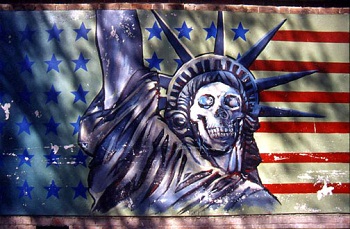
Why the Drug War Has Been a Forty-Year Lynching

nixon-war-on-drugs-quote

By Bob Fitrakis and Harvey Wasserman

Source: FreePress.org

The Drug War has been a forty-year lynching….
…the corporate/GOP response to the peace and civil rights movements.

It’s used the Drug Enforcement Administration and other policing operations as a high-tech Ku Klux Klan, meant to gut America’s communities of youth and color.

It has never been about suppressing drugs. Quite the opposite.

And now that it may be winding down, the focus on suppressing minority votes will shift even stronger to electronic election theft.

The Drug War was officially born June 17, 1971, (http://www.drugpolicy.org/new-solutions-drug-policy/brief-history-drug-war) when Richard Nixon pronounced drugs to be “Public Enemy Number One.” In a nation wracked by poverty, racial tension, injustice, civil strife, ecological disaster, corporate domination, a hated Vietnam War and much more, drugs seemed an odd choice.
In fact, the Drug War’s primary target was black and young voters.

It was the second, secret leg of Nixon’s “Southern Strategy” meant to bring the former Confederacy into the Republican Party.

Part One was about the white vote.

America’s original party of race and slavery (https://zinnedproject.org/materials/a-peoples-history-of-the-united-states-updated-and-expanded-edition/)was Andrew Jackson’s Democrats (born 1828).

After the Civil War the Party’s terror wing, the KKK, made sure former slaves and their descendants “stayed in their place.”

A century of lynchings (at least 3200 of them) (http://www.yale.edu/ynhti/curriculum/units/1979/2/79.02.04.x.html)efficiently suppressed the southern black community.

In the 1930s Franklin Roosevelt’s New Deal social programs began to attract black voters to the Democratic Party. John Kennedy and Lyndon Johnson’s support for civil and voting rights legislation, plus the 24th Amendment ending the poll tax, sealed the deal. Today blacks, who once largely supported the Party of Lincoln,  vote 90% or more Democrat (http://blackdemographics.com/culture/black-politics/).

But the Democrats’ lean to civil rights angered southern whites. Though overt racist language was no longer acceptable in the 1970s, Nixon’s Republicans clearly signaled an open door to the former Confederacy (https://www.thenation.com/article/why-todays-gop-crackup-is-the-final-unraveling-of-nixons-southern-strategy/).

But recruiting angry southern whites would not be enough for the Republicans to take the south. In many southern states more than 40% of potential voters were black. If they were allowed to vote, and if their votes were actually counted, all the reconstructed Democrat Party would need to hold the south would be a sliver of moderate white support.

That’s where the Drug War came in.

Reliable exact national arrest numbers from 1970 through 1979 are hard to come by.

But according to Michelle Alexander’s superb, transformative The New Jim Crow, and according to research by Marc Mauer and Ryan King of the Sentencing Project, more than 31,000,000 Americans were arrested for drugs between 1980 and 2007 (http://newjimcrow.com).

Further federal uniform crime report statistics compiled by www.freepress.org indicate that, between 2008 and 2014, another 9,166,000 were arrested for drug possession.
Taken together, than means well over 40,000,000 American citizens have been arrested for drugs in the four decades since Nixon’s announcement.
It is a staggering number: more than 10% of the entire United States, nearly four times the current population of Ohio, far in excess of more than 100 countries worldwide.
A number that has gutted the African-American community.  A national terror campaign far beyond the reach of even the old KKK.
Justice Department statistics indicate than half of those arrests have been for simple possession of marijuana.
According to US Bureau of Justice statistics, between 1980 and 2013, while blacks were 12% of the population, blacks constituted 30% of those arrested for drug law violations and nearly 40% of those incarcerated in all U.S. prisons.  Thus some 20,000,000 African-American men have been sent to prison for non-violent “crimes” in the past forty years.
If the Hispanic population is added in, as much as 60% of drug arrests are of racial or ethnic minorities.
On the 40th anniversary of the Drug War in 2010, the Associated Press used public records to calculate that the taxpayer cost of arresting and imprisoning all these human beings has been in excess of $1,000,000,000.
Sending them all to college would have been far cheaper.  It also would have allowed them to enhance and transform their communities.
Instead, they were taken from their families.  Their children were robbed of their parents.  They were assaulted by the prison culture, stripped of their right to vote and stopped from leading the kind of lives that might have moved the nation in a very different direction.
Nixon also hated hippies and the peace movement. So in addition to disenfranchising 20,000,000 African-Americans, the Drug War has imprisoned additional millions of young white and Hispanic pot smokers.
Thus the DEA has been the ultra-violent vanguard of the corporate culture war.
In 1983 Ronald Reagan took the Drug War to a new level.  Using profits from his illegal arms sales to Iran, he illegally funded the Contra thugs who were fighting Nicaragua’s duly elected Sandinista government.
The Contras were drug dealers who shipped large quantities of cocaine into the US—-primarily in the Los Angeles area—-where it was mostly converted to crack.
That served a double function for the GOP.
First, it decimated the inner city.
Then Reagan’s “Just Say No” assault—-based on the drugs his Contra allies were injecting into our body politic—-imposed penalties on crack far more severe than those aimed at the powdered cocaine used in the white community.
In 1970 the US prison population was roughly 300,000 people.  Today it’s more than 2.2 million, the largest in world history by both absolute number and percentage of the general population.  There are more people in prison in the US than in China, which has five times the population (http://www.bjs.gov/index.cfm?ty=tp&tid=11).

According to the Sentencing Project, one in seventeen white males has been incarcerated, one in six Latinos, and one in three blacks.
By all accounts the Drug War has had little impact on drug consumption in the US, except to make it more profitable for drug dealers (http://www.bjs.gov/index.cfm?ty=tp&tid=11).  It’s spawned a multi-billion-dollar industry in prison construction, policing, prison guards, lawyers, judges and more, all of them invested in prolonging the drug war despite its negative impacts on public health.

For them, the stream of ruined lives of non-violent offenders is just another form of cash flow.
Like the Klan since the Civil War, the Drug War has accomplished its primary political goal of suppressing the black vote and assaulting the African-American community.
It’s shifted control of the South from the Democrats back to the Republican Party. By slashing voter eligibility and suppressing black turnout, the Drug War crusade has helped the GOP take full control of both houses of the US Congress and a majority of state governments across the US.
But the repressive impacts hit everyone, and ultimately enhance the power of the corporate state.
Toward that end, the southern corporate Democrat Bill Clinton’s two terms as a Drug Warrior further broadened the official attack on grassroots America. Clinton was determined to make sure nobody appeared tougher on “crime.”  He escalated the decimation of our democracy far beyond mere party politics, deepening the assault on the black community, and the basic rights of all Americans for the benefit of his Wall Street funders.  Obama has been barely marginally better.
In political terms, the Nixon-Reagan GOP remains the Drug War’s prime beneficiary. Today’s Republicans are poised to continue dominating our electoral process through the use of rigged electronic registration rolls and voting machines. That’s a core reality we all must face.
But no matter which party controls the White House or Congress, by prosecuting a behavior engaged in by tens of millions of Americans, the Drug War lets the corporate state arrest (and seize assets from) virtually anyone it wants at any time. It has empowered a de facto corporate police state beyond public control.

Regardless of race, we all suffer from the fear, repression and random assaults of a drug-fueled repressive police force with no real accountability.
In the interim, the Drug War is not now and never has been about drugs.
Legalizing pot is just the beginning of our recovery process.
Until we end the Drug War as a whole, America will never know democracy, peace or justice.
____________________
THE SIXTH JIM CROW: ELECTRONIC ELECTION THEFT & THE 2016 SELECTION will be released by Bob Fitrakis & Harvey Wasserman by January, 2016. Their CITIZEN KASICH will follow soon thereafter. Bob’s FITRAKIS FILES are at www.freepress.org; Harvey’s ORGANIC SPIRAL OF US HISTORY will appear in 2016.

Related video:

Glenn Greenwald Stands by the Official Narrative

2014_09_Screen-Shot-2014-09-12-at-12.35.03-PM

By William A. Blunden

Source: Dissident Voice

Glenn Greenwald has written an op-ed piece for the Los Angeles Times. In this editorial he asserts that American spies are motivated primarily by the desire to thwart terrorist plots. Such that their inability to do so (i.e., the attacks in Paris) coupled with the associated embarrassment motivates a public relations campaign against Ed Snowden. Greenwald further concludes that recent events are being opportunistically leveraged by spy masters to pressure tech companies into installing back doors in their products. Over the course of this article what emerges is a worldview which demonstrates a remarkable tendency to accept events at face value, a stance that’s largely at odds with Snowden’s own documents and statements.

For example, Greenwald states that American spies have a single overriding goal, to “find and stop people who are plotting terrorist attacks.” To a degree this concurs with the official posture of the intelligence community. Specifically, the Office of the Director of National Intelligence specifies four topical missions in its National Intelligence Strategy: Cyber Intelligence, Counterterrorism, Counterproliferation, and Counterintelligence.

Yet Snowden himself dispels this notion. In an open letter to Brazil he explained that “these [mass surveillance] programs were never about terrorism: they’re about economic spying, social control, and diplomatic manipulation. They’re about power.”

And the public record tends to support Snowden’s observation. If the NSA is truly focused on combatting terrorism it has an odd habit of spying on oil companies in Brazil and Venezuela. In addition anyone who does their homework understands that the CIA has a long history of overthrowing governments. This has absolutely nothing to do with stopping terrorism and much more to do with catering to powerful business interests in places like Iran (British Petroleum), Guatemala (United Fruit), and Chile (ITT Corporation). The late Michael Ruppert characterized the historical links between spies and the moneyed elite as follows: “The CIA is Wall Street, and Wall Street is the CIA.”1

The fact that Greenwald appears to accept the whole “stopping terrorism” rationale is extraordinary all by itself. But things get even more interesting…

Near the end of his article Greenwald notes that the underlying motivation behind the recent uproar of spy masters “is to depict Silicon Valley as terrorist-helpers for the crime of offering privacy protections to Internet users, in order to force those companies to give the U.S. government ‘backdoor’ access into everyone’s communications.”

But if history shows anything, it’s that the perception of an adversarial relationship between government spies and corporate executives has often concealed secret cooperation. Has Greenwald never heard of Crypto AG, or RSA, or even Google? These are companies who at the time of their complicity marketed themselves as protecting user privacy. In light of these clandestine arrangements Cryptome’s John Young comments that it’s “hard to believe anything crypto advocates have to say due to the far greater number of crypto sleazeball hominids reaping rewards of aiding governments than crypto hominid honorables aiding one another.”

It’s as if Greenwald presumes that the denizens of Silicon Valley, many of whose origins are deeply entrenched in government programs, have magically turned over a new leaf. As though the litany of past betrayals can conveniently be overlooked because things are different. Now tech vendors are here to defend our privacy. Or at least that’s what they’d like us to believe. In the aftermath of the PRISM scandal, which was disclosed by none other than Greenwald and Snowden, the big tech of Silicon Valley is desperate to portray itself as a victim of big government.

You see, the envoys of the Bay Area’s new economy have formulated a convincing argument. That’s what they get paid to do. The representatives of Silicon Valley explain in measured tones that tech companies have stopped working with spies because it’s bad for their bottom line. Thus aligning the interests of private capital with user privacy. But the record shows that spies often serve private capital. To help open up markets and provide access to resources in foreign countries. And make no mistake there’s big money to be made helping spies. Both groups do each other a lot of favors.

And so a question for Glenn Greenwald: what pray tell is there to prevent certain CEOs in Silicon Valley from betraying us yet again, secretly via covert backdoors, while engaged in a reassuring Kabuki Theater with government officials about overt backdoors? Giving voice to public outrage while making deals behind closed doors. It’s not like that hasn’t happened before during an earlier debate about allegedly strong cryptography. Subtle zero-day flaws are, after all, plausibly deniable.

How can the self-professed advocate of adversarial journalism be so credulous? How could a company like Apple, despite its bold public rhetoric, resist overtures from spy masters any more than Mohammad Mosaddegh, Jacobo Árbenz, or Salvador Allende? Doesn’t adversarial journalism mean scrutinizing corporate power as well as government power?

Glenn? Hello?

Methinks Mr. Greenwald has some explaining to do. Whether he actually responds with anything other than casual dismissal has yet to be seen.

  1. Michael C. Ruppert, Crossing the Rubicon: The Decline of the American Empire at the End of the Age of Oil, New Society Publishers, 2004, Chapter 3, page 53.

Bill Blunden is an independent investigator whose current areas of inquiry include information security, anti-forensics, and institutional analysis. He is the author of several books, including The Rootkit Arsenal and Behold a Pale Farce: Cyberwar, Threat Inflation, and the Malware-Industrial Complex. He is the lead investigator at Below Gotham Labs. 

Israelis – Not Muslims – Cheered in Jersey City on 9/11

threeoffivedancingisraelis

In debunking Donald Trump’s big lie about Jersey City Muslims celebrating the destruction of the World Trade Center, the corporate media have told an even bigger lie of omission. There was, indeed, shameless cheering on the banks of the Hudson River on 9/11. But it was by young Israelis, as was widely reported at the time. Fourteen years later, corporate media are covering up for Israel – which makes them even bigger liars than Trump.

By Glen Ford

Source: Black Agenda Report

“By making only a partial correction of Donald Trump’s prevarication, the corporate media were telling their own lie about what happened on 9/11.”

The corporate media don’t like Donald Trump. They used to like him a lot; in fact, Big Business Media are responsible for making this minor multi-millionaire into a household name. But Trump is on their hit list, nowadays, because the Republican presidential candidate insists on telling his own lies, rather than sticking to the list of official lies parroted by corporate media every minute of every day.

Donald Trump told a really “HUGE” – as he would put it – lie when he claimed to have watched thousands of Muslims cheering in Jersey City, New Jersey, as the World Trade Center came down on 9/11. Every corporate news outlet in the country rushed to debunk Trump’s fictitious account. The Washington Post offered psychological theories for why Trump gets away with telling fantastic lies. The New York Times said there was no evidence that Jersey City Muslims cheered the destruction on 9/11. CNN said it never happened. And, they were right.

However, by making only a partial correction of Donald Trump’s prevarication, the corporate media were telling their own lie about what happened on 9/11. There was, in fact, celebration in Jersey City on that fateful morning, and the incident did, briefly, make a major news splash. But the people doing the cheering weren’t Muslims: they were five young Israelis in a white moving van, who were observed in Liberty Park ecstatically taking pictures of themselves framed against the smoking ruins of the Twin Towers. As ABC News reported, the five were later arrested at gunpoint near the New Jersey Giants football stadium. Most U.S. intelligence sources believed the men were Israeli spies, and that their “moving company” was an Israeli intelligence cover. They were detained for a while, and then deported.

“Who is the biggest liar?”

In the year before 9/11 scores of young Israelis posing as “art students” were arrested after penetrating U.S. Defense Department and other classified sites. Both stories made national news. The corporate media could not have avoided running across articles on the “cheering Israelis” when they set about debunking Donald Trump’s “cheering Muslims” account. But, not one of them dare to mention that, yes, some people were seen celebrating 9/11 at Liberty State Park in Jersey City.

I was in a different part of the park on 9/11 morning, alone except for two young Israelis with very expensive cameras, carrying phony New Jersey press credentials, who claimed to be Polish but spoke Hebrew to each other. The two young men were giddy with joy at the destruction that the three of us were observing across the Hudson River.

Later that day, I learned from local and national news outlets about the five Israelis who were dancing with delight about a mile upriver from me and the two other Israelis. Articles about Israelis celebrating 9/11 would have come up in any search to correct Donald Trump’s tall tale – but the corporate media kept that part of the story from the public. They censored their own correction of Donald Trump. So, who is the biggest liar? Trump, who lies to advance his own personal interests, or the U.S. corporate media, who lie to the people on behalf of the State of Israel, and Zionism.


BAR executive editor Glen Ford can be contacted at Glen.Ford@BlackAgendaReport.com.

Related Article: The Five Dancing IsraelisArrested On 9-11

Little Murders in Retrospect

LittleMurders_blood2

By John R. Hall

Source: Dissident Voice

After their wildly successful anti-war classic Mash, actors Elliott Gould and Donald Sutherland ventured out on a very weak limb and made a film version of a hit and miss Broadway production.  Alan Arkin directed the film and played the part of mentally disturbed Lieutenant Practice of the NYPD.  The year was 1971.  My beautiful baby daughter had just entered the world.  I’d recently been convicted of twice refusing induction into the U.S. Army, and was awaiting my court date for sentencing.  Somehow, amid the mix of joy, sadness, and confusion, my wife and I managed to slip out and take in a movie.  Little Murders would haunt me for the rest of my life.

If you’re like virtually everyone I’ve ever quizzed about Little Murders, you not only missed seeing it, you’ve never even heard of it.  It is also likely that, if you happen to be among the few who actually saw it, you’d really like to forget it.  But, of course, you can’t.  44 years later I don’t remember all the gory details of the flick, but I do remember apathetic Alfred Chamberlain (Elliott Gould), focusing his camera on a newly deposited bowel movement in a toilet, and on a steaming pile of dog crap in a park.  He was a photographer and poop was his forte.  His subject matter of choice also reflected his world view.  If Alfred could have possibly cared less about anything, he would have.  Alfred’s world was shit.

Then one day while he was being beaten to a bloody pulp by street thugs, and not even bothering to defend himself, Alfred was saved by feisty, optimistic Patsy Newquist (Marcia Rodd).  Apathist that he was, Alfred tried to walk away without even thanking his heroine.  But Patsy fell for him, and decided to show him that the world wasn’t such a bad place after all.  It was no easy task, but she eventually married Alfred, put a hesitant smile on his glum face, taught him to fight for himself,  and convinced him that life was worth living.  Then she took a random bullet, splattering her husband with blood, and dying.

Little Murders took place in a somewhat exaggerated version of New York City, or Anytown, U.S.A.  Civil society had spiraled out of control and degenerated into a cesspool of fear, loathing, and random violence.  In spite of the raging nightmare of The Vietnam War, few Americans in 1971 would have believed that their country 44 years later would become such an accurate replica of the social wasteland of “Little Murders”.  But that is exactly where we are today, and then some; living in a world so violent and cold that there is nothing left which can shock us.  Mass murders, school shootings, infanticide, beheadings, immolation, cops run amok, manufactured terrorism, the Airport Gestapo, black sites and torture, endless wars for corporate profit, daily specter of nuclear annihilation.

But here in the U.S.A. we like to look on the bright side.  No sense in focusing on the negative when there’s so much positive energy in the world.  We’ve got Kim Kardashian’s ass to obsess about.  A spectacular spectators’ array of gladiator sports:  NFL, NBA, MLB, NHL, NCAA FB, Cage Fighting, NASCAR, Pro golf & tennis.  Black Friday deals on electronics, reality television, celebrity weddings, divorces, and sex changes, Dancing with the Stars, The Voice.  The upcoming Presidential Coronation Circus and Candy Crush.  Did I mention Kim Kardashian’s ass?  Thank God for Pollyanna’s Glad Game.  If not for such an array of inane, petty distractions, Americans would all end up like apathetic Alfred Chamberlain, or worse yet like angry, infuriated me.

Any American with his head screwed on straight should have suffered an extended and incurable case of righteous indignation by now.  While the National Rifle Association has succeeded in enshrining The Second Amendment alongside mom, home, and apple pie, little murders on the domestic front have been on the rise to the point that they’re as common as bedbugs in cheap motels.  But my countrymen do love their portable WMDs, apparently more than life itself.  It’s not just gun violence defining the nightmare which is America.  What has finally emerged is a complete lack of respect.  Respect for self and others, for all life forms, for Mother Earth itself.  Anyone paying attention can see it in their actions.  They litter the streets with their garbage, litter their skin with ill-conceived epidermal etchings, litter their bodies with poisonous food-like substances and soul-killing drugs, litter maternity wards with litters of unwanted children.  Alfred Chamberlain’s world has grown to fruition.

Of course, Americans have had plenty of inspiration as they’ve sacrificed their souls upon the alter of American Exceptionalism.  Their government has waged a nearly non-stop series of wars for corporate profit since Vietnam, Laos, and Cambodia.  Anyone paying a lick of attention knows that every one of these wars were waged for the benefit of Ronald McDonald and Mickey Mouse, and that official government explanations are only believed by fools.  At least our heroes in the White House, the Halls of Congress, and the Pentagon learned something during the Vietnam fiasco:  The new definition of winning a war is that you slaughter as many civilians as possible, bomb cities, destroy infrastructure, burn crops, and create enough chaos that the U.S. Military is forced to open permanent bases and swing wide the doors for corporate plunder.  Conveniently under armed protection.

This is exactly what happened in Afghanistan and Iraq, what went on in Libya recently, and what is now happening in Syria and elsewhere.  The American agenda is being rammed down the throats of unwilling participants wherever there are valuable resources to be plundered by Wall Street pirates.  Migrations of refugees from U.S. bombings seek asylum elsewhere, while foolish, careless Americans pay little heed.  A few hoorays for the red, white, and blue, thanks to our brave fighting men for slaughtering innocent foreigners, and back to watching Kim Kardashian’s ass over a can of Coca-Cola.  Things go better with Coke.

In 1971, I was shocked by the last scene of Little Murders, in which Alfred (still wearing his shirt splattered with his wife’s blood), and the father and brother of his recently deceased bride finally have a few moments of sheer joy.  Taking turns with a loaded rifle, they join in with their fellow New York citizens, becoming snipers from their apartment window,  Finding fun and laughter with each kill.  I’d no longer be shocked by the scene.  Now I get it.  It’s what species do in the final death throes of extinction.


Related Articles

“One of Those Little Things You Learn to Live with”:  On the Politics of Violence in Jules Feiffer’s Little Murders

Saturday Matinee: Little Murders

Turkey-NATO Crisis Sets The Scene For New European ‘EU Army’

nato-1

By Patrick Henningsen

Source: 21st Century Wire

They say there are no coincidences in politics and foreign affairs.

Less than 72 hours after Turkey shot down a Russian fighter inside of Syrian airspace, moves are already afoot to increase the role of Europe in Syria.

Germany has now joined the party this week by revealing its intention to deploy ground troops in the fight against ISIS. Angela Merkel’s government announced its plan to send 100 Bundeswehr Special Forces into Northern Iraq to support of the Kurdish Peshmerga forces.

Britain is not far behind either, as David Cameron intensifies his lobbying efforts to get his country into the war in Syria.

Is this part of a defacto NATO action now, or NATO by fiat? If only it were that simple…

There is much more going on here than meets the eye. With Germany now entering the fray, this brings a total of at least FIVE major NATO member states who are either actively involved in the fight, or about to enter the combat theater. The most important point here is that each and every one of these countries is in the conflict in clear violation of international law. Neither has the backing of the UN Security Council, or has an invitation from the legal and internationally recognized (including by the UN) government in Damascus. In addition, none of these actors is acting under NATO Article 5, in other words, none has been attacked by another internationally recognized nation-state of entity (although it’s curious why the western governments have insisted on referring to a brutal terrorist group as a “State”, unless of course, they recognize it as such, which somehow gives them the color of law in Article 5).

For all intents and purposes, NATO is already in. Here are the FIVE major NATO members, all of whom appear to be operating under highly dubious mandates in and around Syria:

France

Following the Paris Attacks on Friday the 13th, and still without any real evidence presented to the public that ISIS itself was responsible for the Paris Attacks – almost immediately, France deployed the full-force of its military supposedly to hit ISIS targets in the alleged Islamic State “stronghold” of Raqqa, Syria. Coincidentally, even mainstream reports questioned what the objective of France’s airstrikes were (all target data was supplied by the US), with some claiming that the French move was purely for show and that they could not confirm any actual ISIS militants were killed. Note that France had already been caught announcing its move of the aircraft carrier Charles de Gaulle to Syria on Nov 5th – a full week before the Paris attacks. Of course, no mention of this in the media.

Aside from giving the state license to unleash a new level of domestic Police State at home, more importantly, the Paris Attacks gave France an immediate “official” entry into the Syria War. Undoubtedly, this was a huge game-changer.

United States

When the ‘Islamic State Caliphate’ crisis public relations campaign was officially launched by the US-UK Government-Media Complex in June 2014 (before that, there was scant if little mention of this branded terror organization by western politicians and media outlets), it took some time before the US announced its grand ‘Anti-ISIS Coalition’. Perhaps ISIS needed more time to get organized, and to release a series of shocking internet videos of which the western media fed off – – and which were mostly proven as fakes and digital forgeries. Something was not right about the ISIS Crisis by US media outlets who were so enthralled with the sensational propaganda videos that no one dared question the lack of authenticity of what was eventually exposed as fake ISIS beheading video productions (the CIA has previously admitted staging such videos) or the ISIS narrative itself. Oddly, the western media treated anything coming out of ISIS HQ as sacred and unimpeachable in media terms. It wasn’t until Iranian and Hezbollah ground forces entered the fight against ISIS that US President Barack Obama finally decided it was time to move in August 2014 by waging airstrikes in Northern Iraq. Over the next few months, the US began assembling its ‘Anti-ISIS (ISIL) Coalition’, although it was hard to spot anyone else in the ‘Coalition’ other than the US.

It should be noted that on the first day of US airstrikes inside Syria (Sept 23, 2014), it was pretty clear that the US had actually bombed a series of empty buildings in Raqqa, Syria (somehow ISIS was tipped off before hand, weeks in advance, in fact). Not a good start to the “big push”. At that point, our suspicions were confirmed – that the US had no intention of actually rooting out ISIS, and that secretly Washington was actually hoping that ISIS and other terrorist brigades on the ground could do what their previous proxy ground force, the Free Syria Army, could not do – which was to overthrow the government in Damascus, which Washington and its allies refer to (just in like Iraq in 2003) the ‘Assad regime’.

Great Britain

It’s no surprise that the British Tory government has been chomping at the bit to get into the Syrian War. In August 2013, they nearly got their mandate, but lost in a Parliamentary vote. Some Tory ministers had public temper tantrums. As it turns out, the pretext for their entire push for war, ‘WMDs’, aka chemical weapons (Sarin) allegedly deployed by Syrian government forces – was exposed as a false flag attack and the US-UK’s attempt to blame Syrian President Bashar al Assad was a media fiction (just in like Iraq in 2003), a chemical attack launched by the US-led Coalition’s ‘Moderate Rebels” in order to blame the government of Syria and trigger a western intervention. The plan was a complete failure, so bad in fact, it caused the US to back off their own war vote a month later in September 2013.

It seems that the Paris Attacks have also given David Cameron some wind in his war sails too, and yesterday we discovered that the French government is now lobbying for Britain’s Royal Air Force to join in the scrum, with London stating that it, “will soon be working side by side with their French counterparts” in taking military action in Syria. In order to help sell this new leg of the war, the French were provided the use of famed ‘liberal’ British newspaper  The Guardian to openly lobby for British involvement by claiming it would “put additional and extreme pressure on the ISIS terror network”. The article goes on to describe the work Britain is already doing as part of the ‘Coalition’:

“The RAF has significant capabilities for precision airstrikes, aerial reconnaissance and air-to-air refuelling support,” he says. “On a daily basis, its Tornado aircrafts and unmanned drones are causing very severe damage to Isis in Iraq. The use of these capabilities over Syria would put additional and extreme pressure on the Isis terror network.”

So what’s Cameron’s rush to get deeper into the Syrian side of the conflict? It appears as if the Paris Attacks have given Cameron a new life-line on the Syria War vote, one he’s long been pursuing. The shock and horror of Paris will certainly help his case pass muster with public opinion in accepting his long-term agenda to deploy British military assets in Syria. One reason is to showcase British hardware to the world’s lucrative arms sales market, something Cameron is no stranger to after performing the role as sales closer for BAE Systems and other firms landing billion dollar contracts in the Gulf in recent years. Currently, Cameron is desperate to rescue those contracts which threaten to be scrapped over an ‘inconvenient’ human rights row between Westminster’s political left and the Kingdom over Saudi’s plan to behead and crucify a 17 old boy – the son of a Shia activist. Covering Saudi Arabia’s ghastly human rights record in favor of turning a few quid (tens of billions for 100 Typhoon jets and a prison contract) has always been an obsession of Westminster. Coupled with the Syria issue, this last row has prompted some of most amazing double speak and spin ever seen coming out of the Foreign Office, as evidenced by this humdinger about “The World’s Most Misunderstood Feudal Kingdom: Saudi Arabia”, seemingly straight out of the Office of Information Dispersal:

“One well-placed Whitehall source said: “It appears that the Saudis believe that they are being treated like a political football and had enough. It was only after the personal intervention of the Prime Minister that the situation has temporarily cooled but the Saudis want assurances.”

It gets worse, as Westminster is trying to sell the idea that somehow Saudi Arabia has ‘absolutely nothing to do’ with ISIS. Seriously…

“In the week that Andrew Parker, the head of MI5, warned that Britain is facing mass casualty attacks from Isil terrorists, Number 10 is desperate to ensure that it maintains good relations with Saudi Arabia, its most important ally in the Middle East. There were fears that the increased tensions between the two countries might result in the Saudis scaling down their vital intelligence-sharing arrangement with British intelligence, as well as jeopardising future lucrative arms deals with British firms such as BAE Systems.”

And we wonder why the public is mostly clueless as to what’s happening in Syria. They hardly stand a chance against such a relentless propaganda oracle.

Germany

This week, German Defense Minister Ursula von der Leyen, Foreign Minister Frank-Walter Steinmeier, Interior Minister Thomas de Maizière and Justice Minister Heiko Maas, drafted a plan for military intervention and held a secret meeting on Thursday – to discuss exactly how this would be managed in terms of public relations, Bild newspaper reported. There are some historic considerations regarding Germany in this story, too. RT adds here:

“The cabinet is set to discuss the bill that may raise the question of a constitutional change on December 17. German Basic Law has strict limits on military involvement since the end of World War II, originally destined to prevent a revival of Nazi crimes.”

Considering how Turkey’s recent dangerous provocation ‘stunt’ was no accident, and how NATO members are beginning to back away from Turkey slightly (albeit temporarily, at least), the international focus is finally shifting towards Turkey’s obvious and direct role in facilitating and even supporting the rise of ISIS and al Nusra (al Qaeda in Syria), and many other Islamic militant fighting groups active in Syria.

Turkey

Turkey is guilty on potentially two international war crimes according to the Geneva Conventions – shooting down an aircraft in Syrian airspace (it’s becoming clearer from multiple reports that the Turkish F16 air-to-air missile may have fired in Turkish airspace, but the missile hit the Russian fighter in Syrian airspace, a clear war crime), and also the fact that Turkey is providing direct support to the same jihadi Turkmen insurgents who then shot and killed a Russian pilot while he was parachuting in the air, another war crime. In fact, one of the NATO-backed ‘moderate’ terrorists who boasted of killing the downed pilot is actually a Turkish citizen with links to both elected officials and a ultra-nationalist group, the Grey Wolves, based in Turkey.

This is only the beginning of Turkey’s problems. President Recep Tayyip Erdogan has been accused of harboring a Sultan Complex – hoping to lead Turkey’s restoration to its former seat at the head of the Islamic world, in an Ottoman Caliphate redux. Add to this fresh allegations of his son Bilal’s business links to ISIS, and we can see how this mafia state may have too many crimes to answer for when it’s all said and done. If Turkey becomes an international pariah for its increasingly obvious collusion with ISIS and the wider terrorist conclave gallivanting freely through Syria and Turkey – then there could be calls for NATO to dump the rogue state and bad actor in the Syrian conflict.

Consider the Hegelian Dialectic as in, problem, reaction, solution. Problem: Turkey has ‘gone rogue’. Reaction: Turkey must leave NATO. Solution: the formation of a new, well-funded European-based multilateral military organization.What would that look like? Perhaps something like this…

‘New Model Army’ For Europe

If a major NATO player like Turkey is dumped from NATO, then this means that western central planners no longer have a multilateral ‘beach head’ positioned at the historic crossroads of Europe, Middle East and Asia.

Back in March 2015, 21WIRE reported something which many may have missed at the time, but what we thought was significant. European Commission President Jean-Claude Juncker announced that the European Union (EU) now needs a new standing army, or an “EU Army” – supposedly to “defend its values” from the sudden existential threats. He was not referring to ISIS, but to Russia. Two months later, Junker called for it again while saying, “Such an army would also help us to form common foreign and security policies and allow Europe to take on responsibility in the world.” Clearly this is no fluke, and it’s been brewing under our noses for a few years now. Back in Dec 2013, during a “heated” summit debate, Speaker of the European Parliament Martin Schulz called for the creation of a EU Army. The Telegraph reported:

“If we wish to defend our values and interests, if we wish to maintain the security of our citizens, then a majority of MEPs consider that we need a headquarters for civil and military missions in Brussels and deployable troops.” Geoffrey Van Orden MEP, the Conservative spokesman on European defence, said that the prime minister had “turned the tide on an EU army”. “It’s been a long haul to get to this position,” he said.

On the surface, one might read that NATO would be unhappy with a call from Brussels for a new EU Army, but Jucker’s call was only an opening salvo in a larger transatlantic political shift taking place right now. To prove our point, we can show our readers that right on cue this week, we see mainstream media propaganda being ramped-up to make the public used to the idea of an EU Army. Holding the baton on this story is ‘liberal’ newspaper The Independent:

“The British public is broadly supportive of the creation of a standing army for the European Union, a new poll suggests. The YouGov survey found that 36 per cent actively supported a permanent multi-national  force drawn from all the bloc’s nations, compared to only 29 per cent who opposed such a move.”

Anyone who has actually been paying attention to the declining state of the British military will know that it’s almost down to a level where it cannot possibly function autonomously. Soon, all that will remain are a few shiny set-pieces like the Trident nuclear submarine fleet, but more importantly – the key remaining component: a rapid reaction, special forces capability which will slot into the new EU Army matrix. Anything which is not fulfilling a role within the larger infrastructure will be scrapped.

Not convinced? Consider this little known fact, revealed in early 2011 in an investigation by the UK Column into David Cameron’s 50 year ‘Defence Pact’ with France – plan that was hatched behind closed doors through the front organization called the Franco British Council, a charity supposedly set up to foster good relations between Britain and France. This was one of many quiet moves engineered to nudge Britain’s military into an eventual EU Army.

For any remaining doubters that an EU Army is not only in the cards, but is in its final stages of planning between Germany, France and Britain and others, note how just two months ago, Angela Merkel was seen openly ‘horse trading’ with David Cameron – asking him to drop his (public) opposition to an EU Army… in exchange for Germany supporting Britain’s “renegotiation” of EU membership, presumably on issues of welfare spending and immigration. The Telegraph states:

“The German chancellor will ask Britain to stand aside as she promotes an ambitious blueprint to integrate continental Europe’s armed forces.”

“While there is no expectation or obligation for Britain to take part in steeper integration, the creation of an EU army could marginalise Britain within Nato and result in the United States downgrading the special relationship with Britain in favour of Paris and Berlin, experts warn.”

“The Telegraph has seen an unpublished position paper drawn up by Europe and Defence policy committees of Mrs Merkel’s party, the CDU, that sets out a detailed 10-point plan for military co-operation in Europe. It is understood to closely reflect her thinking, and calls for a permanent EU military HQ, combined weapons procurement and a shared military doctrine.”

“The paper says it is “urgent” to integrate armed forces “in the face of multifaceted crises”.

In other words, it’s more or less a done deal.

So regarding Syria, Turkey, Russia and NATO, as the elite adage goes, “Never let a good crisis go to waste”. There are 5 main points to consider right now:

1. Eurozone Crisis. The Greek economic meltdown, followed by Spain, Portugal, Cyprus and Ireland’s economic struggles means that the European Union’s Eurozone economic integrity is under threat – and by extension, so is their physical shape should any member state eventually want to leave the European Super State. US-led economic sanctions against Russia over the downing of MH17 in 2014 (a likely false flag event of  which the US accused Russia of being ‘responsible’.)

2. EU Crisis. Add to this the recent ‘Migrant Crisis’, and you have a public perception that European borders are under threat, too. In addition, Great Britain has seen a loud clamor to “leave the EU”, led recently by the ruling Tory Party, even though David Cameron has remained a committed Europhile his entire career. Many people viewed the Tory ‘Exit’ Campaign as mere play acting to win-over some available UKIP nationalist votes in the last general election. Ditto with Spain, who was recently blackmailed by Brussels over the prospect of a newly independent Catalonia. No surprise that Spain is set to play a key role in a new EU Army.

3. Migrant Crisis. The current ‘Migrant Crisis’ provides a perfect pretext to call for a new centralized, ‘federal’ EU Border Control Agency. This is a perfect fit with the EU Army. Funny how the entire Migrant Crisis has been unmasked as one of the most engineered and stage-managed crisis events in recent history. A perfect example of how a crisis is used to strengthen an EU Federal State framework. Then comes the killer: in October, Brussels offers Turkey its first step towards ‘normalization with Europe’, or soft membership into the EU. Brussels offered cash and visas to Turkey if it would ‘promise’ to help stop the flow of migrants into the EU. The terms of this latest deal were almost unbelievable. With most of the new ISIS recruits now coming from Turkey,  this new plan will give legal access into Europe for many Syria and Turkey-based ISIS and al Nusra Front terrorists. So Turkey could be out of NATO, but into the EU? Wow.

4. Terrorism Crisis. The Paris Attacks were important in order to join together the Syrian Conflict, the Migrant Crisis and the War on Terror (rebranded now to the ‘War on Radicalization’). From this one event grew a raft of emergency policies, decrees and military actions. For the security state – it was a grand slam. The Paris Attacks also triggered calls for a new EU ‘FBI’ agency to “help combat terror”. Add to this, other calls for an EU ‘CIA’ too. That’s right, all the trappings of a Federal Super State. Still, no one bothered to question the premise of the grand slam, in this case, a planted, fake Syrian passport which magically appeared at the scene of the alleged ISIS suicide bomb attack in Paris on Nov 13th. Forensically speaking, there is no actual proof that ISIS carried out the Paris Attacks. Still, everyone it seems, is assuming it’s ISIS and that it’s connected to Syria. Again, more power flowing to an EU Federal State framework.

4. NATO Crisis. The reality is that the North Atlantic Treaty Organization (NATO) is a Cold War relic that’s way outside the bounds of its original mandate, and has no real practical application in the 21st century. NATO used to have some air of moral mandate around the world but that’s fading quickly. By encircling Russia with missile batteries, signing-up Russia’s neighbors, NATO has become more of an offensive entity, rather than a defensive one. The real dirt on NATO’s hands comes with its dark partnership with NeoNazi factions to help achieve its military objectives in the Ukraine. We also learned this week how NATO has opened up a new proxy war front in Crimea, as western-backed NeoNazis carried out terrorist attacks against Crimean infrastructure, and perhaps the most disturbing report we’ve seen here – what looks like CIA support of Islamic Chechen militants brought into east Ukraine.

There’s another fundamental problem with NATO: funding. The US supplies NATO with approximately 75% of its funding which guarantees that NATO is always under Washington’s control, but the US needs to have real stakeholders in order to have a real ‘alliance’. Few have paid attention to NATO’s ongoing weakening of its military assets, mostly due to a lack of spending by the majority of its member states. Every NATO member state is expected to spend at least 2% of its annual GDP on defense spending. That’s not happening anymore, and there is absolutely nothing the Brussels HQ can do about it outside of the US giving money away to those in financial need. Weapons Welfare? That’s not happening either.

NATO’s days are numbered. All the tea leaves point to its schedule for decommissioning. All NATO needs is a good crisis to hasten that inevitability. Maybe Turkey has delivered the pretext Brussels needs. This does not necessarily mean that NATO would be winded-down, but that it would give way to another military structure – like an EU Army.

You’d expect Washington to be averse to a NATO downgrade, down to a second tier international organization. After all, the US has used NATO as a multilateral trojan horse of sorts – an alternative flag it could fly in order to bypass any due process or Constitutional restrictions in waging war around the globe. In other words, Washington has used NATO to cheat its own laws, and expand its geopolitical hegemony, and to drag along its European partners where possible to help make it look like a ‘team effort’, and a unilateral action. The truth is, regarding international affairs, the US has long-since replaced its NATO widget with the “Coalition” widget, and will wage war as and when. At home, it has replaced the near redundant Constitutional Declaration of War with the more fluid and flexible ‘Authorization of Military Force‘ (AUMF), and the National Defense Authorization Act (NDAA) – which essentially means that, on paper at least (through color of law, and not actual law), that the US is always under emergency war footing.

There is visible US-EU split, one which became evident during the planning of Washington’s coup d’etat in the Ukraine in 2013-2014, when the US Sate Department’s assistant secretary for European affairs, Victoria Nuland was caught on tape telling her colleague Ambassador Geoffrey Pyatt to, “F*ck the EU!”, as they argued over which US-backed puppet leader would be installed in Kiev.

What Washington really wants (and needs) now is a big Coalition partner, preferable one which is not directly governed by a local representative democracy, but governed by a remote, mostly unelected bureaucratic system. In this context, a new European multinational force would be the perfect ‘Coalition’ partner for Washington.

This is where this complex confluence of events is taking us – from Brussels, Paris, Syria, Ukraine, and Russia, all roads lead to an EU Army.

Counterculture: The Rebel Commodity

Screen-Shot-2013-09-23-at-2.48.39-PM

By James Curcio

Source: Rebel News

Let’s talk about being a rebel.

Everyone seems to want to be one. But it’s not entirely clear what it means. Does it take camo- pants? A Che T-shirt? A guitar? Is it just doing the opposite of whatever your parents did? “Be an individual, a rebel, innovate,” so many advertisements whisper. They’d have us believe that True Revolutionaries think different. They use Apple, or drink Coke. We signal our dissent to one another with the music we listen to and the cars we drive.

There’s something very peculiar going on here, something elusive and deeply contentious.

In the 1997 book, Commodify Your Dissent, Thomas Frank laid out a thesis that may appear common sense to those that have watched or lived in the commodified subcultures of the 90s, 00s, and beyond. A New York Times review comments,

… business culture and the counterculture today are essentially one and the same thing. Corporations cleverly employ the slogans and imagery of rebellion to market their products, thereby (a) seizing a language that ever connotes “new” and “different,” two key words in marketing, and (b) coaxing the young effortlessly into the capitalist order, where they will be so content with the stylishly packaged and annually updated goods signifying nonconformity they’ll never so much as consider real dissent — dissent against what Frank sees as the concentrated economic power of the “Culture Trust,” those telecommunications and entertainment giants who, he believes, “fabricate the materials with which the world thinks.” To have suffered the calculated pseudo-transgressions of Madonna or Calvin Klein, to have winced at the Nike commercial in which the Beatles’ “Revolution” serves as a jingle, is to sense Frank is on to something. (After reading Frank, in fact, you’ll have a hard time using words like “revolution” or “rebel” ever again, at least without quotation marks.)

The urge to rebel fuels the same system they ostensibly oppose. Whether it’s in arms trade, or far less ominously, manners of dress and behavior, there are dollars to be made fighting “The Man.” And maybe making money isn’t always an altogether bad thing. But it is certainly a complication, especially for those espousing neo-Marxists ideals.

As Guy Debord observed, “revolutionary theory is now the enemy of all revolutionary ideology and knows it.” Rebel movements are a counterculture, regardless of what they call themselves.

Rebellion is Cool

We’ll begin with a quintessential icon of the branded, shiny counterculture. The Matrix. We’ve probably all seen it. Even as an example it’s a cliché, and that’s part of the point. Here’s a framed sketch of the first movie, for those that haven’t: when it first ran, it was a slick take on the alienation most suburban American youth feel, packaged within the context of the epistemological skepticism Descartes wrestled with in the 17th century. Taken out of the cubicle and into the underworld, we witness the protagonist “keeping it real” by eating mush, donning co-opted fetish fashion, and fighting an army of identical men in business suits in slow motion. The movie superimposes the oligarchic and imperialist powers-that-be atop Neo’s quest of adolescent self-mastery. A successful piece of marketing — you can be sure no one collecting profits or licensing deals let their misgivings about “the Man” keep them from paying the rent.

This is not to point an accusatory finger, but rather to show the essential dependence of the counterculture upon the mainstream, because counter-cultures are not self-sustaining, and every culture produces a counter-culture in its shadow, just as every self produces an other. Any counterculture. Punk, mod, beatnik, romantic, hippy, psychedelic, straight edge, or occult. Even the early adopters of Internet culture started a group of outsiders that shared a collective vision,

The computer enthusiasts who could only dream of an open, global network in 1990 would go on to staff the dot-coms of the next decade. The closed networks that once guarded forbidden knowledge quickly fell by the wayside, and curiosity about computers could no longer be imagined a crime.

Our cyberspace today has its share of problems, but it is no dystopia — and for that, we must acknowledge the key part played by the messy collision of table-top games, computer hacking, law enforcement overreach and cyberpunk science fiction in 1990.

This article explores the strange history of Peter Jackson games, TSR, and the FBI. But it wasn’t the only one. Shadow Run, another popular cyberpunk RPGs of the 1990s, presented one of the more seemingly-improbable of cyberpunk futures, where you could play a freelancing mutant scrambling to survive in an ecosystem of headless corporations connected through cyberspace. Sound familiar? The Matrix just represented the final translation of these and similar fringe narratives into the mainstream.

Future vision has some effect on future reality, both in the identities we imagine for ourselves and the technologies we choose to explore. They almost always have unexpected consequences. Now we carry the networked planet in our palms, granting near instant communication with anyone, anywhere and anytime, and your intended subject isn’t always the only one listening.

We shouldn’t be surprised by this feedback loop. Without laying the material, mythic, and social groundwork for a new society, counterculture cannot be a bridge; it almost invariably leads back to the mainstream, though not necessarily without first making its mark and pushing some new envelope.

This even presents something of a false dichotomy — that old models of business can’t themselves be co-opted by countercultural myths. Yesterday’s counterculture is today’s mainstream. What better way to understand the so-called revolution of iPads or social media?

Our cultural symbols and signifiers are never static. Psychedelic and straight edge can share the same rack in a store if the store owner can co-brand the fashions, and people can brand themselves “green” through their purchasing power without ever leaving those boxes or worrying about the big picture. AdBuster’s Buy Nothing Day still capitalizes on the “rebel dollar.”

Rebellion is cool.  “Cool” is what customers pay a premium for, along with the comfort of a world with easy definitions and pre-packaged cultural rebellions. This process itself isn’t new. The rebel or nonconformist is probably a constitutive feature of the American imagination: original colonies were religious non-conformist, the country was founded by rebellion, the frontier, the civil war, the swinging 20s, Jazz, James Dean, John Wayne, Elvis, the list goes on. The non-conformist imagination is as paradoxically and problematically American as cowboys and indians, apple pie and racism.

The territory between aesthetic, ideals, and social movement is blurry at best. But the most well-known expression of this trend in recent history is the now somewhat idealized 1960s, a clear view of which has been obscured through a haze of pot-smoke and partisan politics. Though this revolution certainly didn’t start in the 1960s, there we have one of the clearest instances of what good bed-fellows mass advertising and manufacturing make when branded under the zeitgeist of the counterculture.

When people bought those hip clothes to make a statement, whose pockets were they lining? It’s a revolving door of product tie-ins, and it all feeds on the needs of the individual, embodied in a sub-culture. The moment that psychedelic culture gained a certain momentum, Madison Avenue chewed it up and spit it back out in 7up ads. That interpretation of what it meant to be a hippie, a revolutionary, became an influence on the next generation. The rise of Rolling Stone magazine could also be seen as an example of this — a counterculture upstart turned mainstream institution.

While advertising and counterculture get along just fine, authenticity and profit often make strange bedfellows. But they aren’t necessarily diametric opposites, either. As movements gain momentum, they present a market, and markets are essentially agnostic when it comes to ideals.

There are many examples of how troubled that relationship can be. The Grunge movement in the 90s, before it was discovered, was just a bunch of poor ass kids playing broken ass instruments in the Pacific Northwest. This was the very reason it struck disenfranchised youth — the relationship between those acts and the aging record industry in many ways seemed to reflect the relationship of adolescent Gen Xers with their Boomer parents. They retained the desire to “drop out,” as Timothy Leary had preached to the previous counterculture generation of Laguna Beach and Haight Ashbury, but without the mystical optimism of “tuning in.” Hunter S Thompson maybe presaged this transition in the quotation from Fear and Loathing In Las Vegas that’s now rendered famous to the kids of 90s thanks to Terry Gilliam’s film adaptation,

We are all wired into a survival trip now. No more of the speed that fueled that 60’s. That was the fatal flaw in Tim Leary’s trip. He crashed around America selling “consciousness expansion” without ever giving a thought to the grim meat-hook realities that were lying in wait for all the people who took him seriously… All those pathetically eager acid freaks who thought they could buy Peace and Understanding for three bucks a hit. But their loss and failure is ours too. What Leary took down with him was the central illusion of a whole life-style that he helped create… a generation of permanent cripples, failed seekers, who never understood the essential old-mystic fallacy of the Acid Culture: the desperate assumption that somebody… or at least some force – is tending the light at the end of the tunnel.

I don’t think it’s a great stretch to imagine the suddenly-famous bands of the Grunge era as a part of this same legacy. Alice In Chains or Nirvana songs about dying drugged out and alone weren’t oracular prophecy, they were journal entry. And it became part of the allure, because it too was “authentic.” The greatest irony of all was that the tragic meltdowns and burn outs that followed on fame’s heels became part of the commodity. (Not that this vulture economy is new to tabloids).

Our narratives about authentic moments of aesthetic expression or innovation often depict them like volcanic eruptions: they build up and acquire force in subterranean and occluded environments, before erupting in a momentary and spectacular public display of creativity. It is telling that this quote from On The Road has become so popular, very likely cited in the papers and journals of more rebellion-minded American teens than any other from that book, “… The only people for me are the mad ones, the ones who are mad to live, mad to talk, mad to be saved, desirous of everything at the same time, the ones who never yawn or say a commonplace thing, but burn, burn, burn like fabulous yellow roman candles exploding like spiders across the stars.”

Hendrix, Joplin, Morrison, Cobain… the 27 Club is big. And quite a few more could be added if it was “the 20-something club.” Are the public self destructions of so many young, creative minds informed by this myth, or do they create it?

Maybe a bit of both. The Spectacle, in the sense Guy Debord uses it, disseminates its sensibilities, styles — a version of the truth. The particular moves ever toward the general, as facts gradually turn to legend and, eventually, myth. Mainstream appropriation is the process in which aesthetic movements affect broader society and culture. The ideals need a pulpit to reach the people, even if invariably it is fitted with guillotines for the early adopters once that message has been heard.

YOUR FATASS DIRTY DOLLAR

A message is a commodity, or it is obscure. Capitalism survives so well, in part, because it adapts to any message. If we instead think counterculture is an ideal that exists somehow apart from plebeian needs like making money, then countercultures will forever hobble itself. It doesn’t matter that these ideologies have little in common. It is the fashion or mystique that gets sold. Anti-corporate ideology sells as well as pro-. When all an ideology really boils down to is an easy to replicate aesthetic, how could they not?

Where do we draw the line between idealism and profit? The question is how individuals utilize or leverage the potential energy represented by that currency, and what ends it is applied to. Hard nosed books on business by the old guard, such as Drucker’s Management: Tasks, Responsibilities, Practices say exactly the same thing, in a less epigrammatic, Yoda-like way: profit is not a motive, it is a means. This much, at least, doesn’t change with the changing of the (sub)cultural tides. Within our present economic paradigm, without profit, nothing happens. Game over.

Those who position themselves as extreme radicals within the counterculture framework just  disenfranchise themselves through an act of inept transference, finding anything with a dollar sign on it questionable. To this view, anyone that’s made a red cent off of their work is somehow morally bankrupt. This mentality generally ends one way: howling after the piece of meat on the end of someone else’s string, working by day for a major corporation, covering their self-loathing at night in tattoos, and body-modifications they can hide. That is, unless they lock themselves in a cave or try to start an agrarian commune. None of this posturing is in any way necessary, since business rhetoric itself has long since co-opted the countercultural message. For instance, this passage from Commodify your Dissent,

Dropping Naked Lunch and picking up Thriving on Chaos, the groundbreaking 1987 management text by Tom Peters, the most popular business writer of the past decade, one finds more philosophical similarities than one would expect from two manifestos of, respectively, dissident culture and business culture. If anything, Peters’ celebration of disorder is, by virtue of its hard statistics, bleaker and more nightmarish than Burroughs’. For this popular lecturer on such once-blithe topics as competitiveness and pop psychology there is nothing, absolutely nothing, that is certain. His world is one in which the corporate wisdom of the past is meaningless, established customs are ridiculous, and “rules” are some sort of curse, a remnant of the foolish fifties that exist to be defied, not obeyed. We live in what Peters calls “A World Turned Upside Down,” in which whirl is king and, in order to survive, businesses must eventually embrace Peters’ universal solution: “Revolution!”

“To meet the demands of the fast-changing competitive scene,” he counsels, “we must simply learn to love change as much as we have hated it in the past.” He advises businessmen to become Robespierres of routine, to demand of their underlings, “‘What have you changed lately?’ ‘How fast are you changing?’ and ‘Are you pursuing bold enough change goals?’” “Revolution,” of course, means for Peters the same thing it did to Burroughs and Ginsberg, Presley and the Stones in their heyday: breaking rules, pissing off the suits, shocking the bean-counters: “Actively and publicly hail defiance of the rules, many of which you doubtless labored mightily to construct in the first place.”

Growth on its own is never a clear indicator that the underlying ideals of a movement will remain preserved. If history has shown anything, it is that successful movements spread until core message becomes an empty, parroted aesthetic, as with most musical scenes and their transition from content to fashion; or that core is otherwise so emphasized that the meaning within is lost through literalism, as we can see in the history of the world’s major religions. One version of early Christian Gnostic history — of “love thy neighbor,” “all is one,” and scurrilous rumors of agape orgies — were replaced by the Roman Orthodoxy and the authority provided through the ultimate union of State and Religion. The hippies traded in their sandals and beat up VWs for SUVs and overpriced Birkenstocks. The relationship between ideology and act is far to complicated to enter into here, but the counter-history of Communism when viewed against the backdrop of Marxist ideals is perhaps equally insightful.

Enantiodromia, the tendency of things to turn into their opposites, is as much social observation as psychological. It oftentimes seems that succeeding too well can be the greatest curse to befall a movement. When the pendulum swings far in one direction, it often turns into its opposite without having the common decency to wait to swing back the other way.

As we’ve seen, this was part of the supposed downfall of counterculture in capitalism: “suits” decided they could deconstruct an organic process and manufacture it. They could own it from the ground up.

But this isn’t necessarily so. The branding of Cirque Du Soleil points toward a third option — arts movements will be dissected in the jargon of marketing, and they must succeed on those grounds to be taken seriously or accomplish anything.

Burning Man isn’t suddenly opening its gates to the wealthy. Yacht Communism has been a part of that movement ever since it gained some mainstream appeal, likely before. Seen as an arts and cultural movement, it has been vastly successful. Seen as an example of how to create a true egalitarian society, it would be an utter failure. But that was never the point.

Two weeks at Burning Man might be fun, even transformative, but spend two years there and you’d find out what hell is like.

Neoliberalism, Austerity, and Authoritarianism

pnac-criminals-2-1

By Riad Azar

Source: New Politics

Ask anyone what neoliberalism means and they’ll tell you it’s an economic system that corresponds to a particular economic philosophy. But any real-world economic system has a corresponding political system to promote and sustain it. Milton Friedman, who has become known as the father of neoliberal thinking, claims in his text Capitalism and Freedom that “the role of the government … is t o do something that the market cannot do for itself, namely, to determine, arbitrate, and enforce the rules of the game.”* While neoliberalism’s advocates like to claim that the political system that corresponds to their economic preference is a democratic, minimal state, in practice, the neoliberal state has demonstrated quite the opposite tendency.

This essay will begin by sketching out the core tenets of neoliberal theory, tracing its history from the classical liberal tradition of the Enlightenment. I will then present some hypotheses on how relations between the neoliberal state and society operate, contrasting the state theories of Ralph Miliband and Nicos Poulantzas to create a framework that shows how the neoliberal state is a product and enforcer of anti-democratic practices. I will argue that the implementation of neoliberal economic policy, and the subsequent evolution of the neoliberal state, has historically been completed through anti-democratic methods. Further, in an effort to produce social relations that are more favorable to the accumulation of capital, austerity is employed as a tool to move further toward a market society, creating a larger, more interventionist state and promoting authoritarianism.

Neoliberalism in Theory

The term neoliberal is often convoluted, confused, and misinterpreted, especially in the American context where the center-left Democratic Party has traditionally held the title of liberal. The original liberals, or classical liberals as they are usually called, were those Enlightenment-era thinkers of Western European origin who desired to limit the authority of the feudal state and defended individual rights by restricting the power of the state, the crown, the nobility, and the church. The “neo” prefix serves as a romantic symbol, an attempt at establishing a (sometimes forced) common ground with historical figures like Adam Smith and the classical liberals, who challenged the tendencies of the monarchy to interfere in the economy for its own gain, producing inefficiency. Neoliberal economic thinkers are famously known for deriding government intervention in the economy, precisely because they trace their foundation to a period when markets were seen not just as a source of better economic outcomes, but as a weapon to challenge concentrated political power.

This revamping of liberalism appeared in the twentieth century at a time when its proponents believed they were facing a similar struggle against the expanded state apparatuses of Europe—communist, social-democratic, and fascist. Friedrich Hayek, whose text The Road to Serfdom, published in 1944, is arguably the most celebrated of the neoliberal canon, sought to show how government interference in the economy forms the basis of fascist and other totalitarian regimes, contrary to the then widely accepted notion that it was capitalist crisis that had produced fascism in Europe. For Hayek, the strong state, whether in the form of fascism, Soviet communism, or the creeping socialism of the British Labour Party, was to be eschewed.

If neoliberalism springs from a desire to combat the growing power and influence of the state, how is it that neoliberalism has produced not only a very robust state apparatus, but, as I will argue, an authoritarian one? The answer is that neoliberalism in practice has been quite different from its theory.

The Necessities of the State
in Neoliberal Theory

As David Harvey points out in A Brief History of Neoliberalism, the neoliberals’ economic ideals suffer from inevitable contradictions that require a state structure to regulate them. The first of these contradictions revolves around the role of law to ensure the individual’s superiority over the collective in the form of private ownership rights and intellectual property rights (patents and copyrights). A judicial system is necessary to designate and regulate the interaction between private actors on the market. While intimations of the regulatory state can be seen in this formulation, it is hardly anything controversial. Only the most extreme of laissez-faire economic thinkers would not acknowledge the requirement of a state structure that creates the space for and regulates contracts.

The second contradiction derives from the elites’ historical ambivalence regarding democracy and mass participation. If the people were free to make decisions about their lives democratically, surely the first thing they would do is interfere with the property rights of the elite, posing an existential threat to the neoliberal experiment. Whether these popular aspirations take the form of drives towards unionization, progressive taxation, or pushing for social policies that require the redistribution of resources, the minimal state cannot be so minimal that it is unable to respond to and crush the democratic demands of citizens. After all, as pointed out in the first contradiction, the neoliberal state exists in theory to guarantee the rights of the individual over the demands of a majority. Therefore, a system must be put in place that protects against the “wrong” decisions of a public that is supposed to buy, sell, act, and choose freely.

Two Levels of Authoritarianism

Any method that seeks to subvert the democratic demands of citizens, whether through force, coercion, or social engineering, is authoritarian. I argue here that the neoliberal state is authoritarian in two distinct but related forms. First, the historical imposition of neoliberalism on nation-states is the result of anti-democratic forces. Second, the maintenance of neoliberalism requires a market society achieved through a transformation in civil society. For this transformation to take place, welfare states must be slimmed down by austerity policies in order to turn over to the market potentially lucrative sectors of the social economy (in health care, education, social security, and so on). Public resources must become privatized; the public good must be produced by private initiative. Neoliberal economic policy can only function with a state that encourages its growth by actively shaping society in its own image, and austerity is the tool to push for that transformation. While the subversion of democracy is clearly authoritarian, the drive towards a market society and the social engineering necessary to maintain that society are further expressions of the de facto authoritarianism of neoliberalism and the neoliberal state.

Austerity traditionally has been defined as the economic policies surrounding deficit cutting. When public debt runs too high, according to the theory, the accounts must be balanced by cutting spending and raising taxes. It is important to look past the theory to see the results of austerity in practice and understand austerity as a social-historical force. To do this, one must define austerity from the perspective of its victims. Pablo Iglesias, leader of the Podemos party in Spain, in his February 17 appearance on the Democracy Now! show, did just that by arguing that austerity is when people are forced out of their homes, when social services do not work, when public schools lack resources, when countries do not have sovereignty and become the colonies of financial powers. He closes by saying that austerity is the end of democracy, because without democratic control of the economy, there is no democracy.

The State and Society

The nature of how the state affects society has been a contentious topic within left traditions. Most notably, the debate between Ralph Miliband and Nicos Poulantzas that took place in the pages of the New Left Review in the early 1970s refreshed the study of the state. Miliband, in his The State in Capitalist Society, stressed an instrumentalist position, arguing that the reproduction of capitalism in society is due to the socialization of the ruling class in the tradition of capitalist dogma. As a large proportion of those who dominate the state and control its levers come from an elite education (he was writing from the perspective of British politics in the mid-twentieth century), it’s no surprise that they believe their theories to be correct and just, while the state they run serves the interests of capital. The writings of Poulantzas, in particular Political Power and Social Classes, argued a structuralist position strongly influenced by the thought of Louis Althusser. He claimed that the relation between the ruling class and the state was an objective relation, meaning that the coincidence of bourgeois ideology with the ideology of the state was a matter of how the system itself is organized. Their two state theories, the former arguing that the state is an instrument of the ruling class and the latter arguing that the state is the objective result of the capitalist system, shed light on the differences in conceptualizing not only the capitalist state, but how the state relates to and is legitimized by society. Is the market society a result of policies implemented by individuals in power who are trained in a particular neoliberal tradition, or an objective outcome of capitalist social relations that are the superstructural product of a system?

What could arguably be the genius of neoliberalism is the way in which it takes these two approaches to state theory and blends them. On the one hand, for Miliband, the neoliberal state is the extension of ruling-class free-market ideology, propagated by government bureaucrats, military officials, and technocrats who can speak no other language than that of the privileged status of capital and who hold the belief that they are serving the greater good. On the other hand, as Poulantzas suggested, neoliberalism needs to ensure its own survival by bending civil society, political institutions, and democracy to its will.

A state that so blatantly puts the rights and needs of one small class of citizens over others cannot be installed without a struggle. And further analysis shows us that once neoliberal regimes come into power, a certain degree of social engineering and coercion are necessary in order to guarantee the submission of the population and ensure the smooth accumulation of capital. In what follows, I would like to lay out how neoliberal austerity regimes were installed, and also draw on hypotheses of how they are maintained. However, as each socio-political system is unique in its history, culture, norms, and traditions, the manifestation and maintenance of the neoliberal state differs depending on whether we are talking about core countries or peripheral ones, to use the terminology of World Systems Theory. The common denominator is the empowering of elites over the masses with the assistance of international forces through military action or financial coercion—a globalized dialectic of ruling classes.

Peripheral Neoliberal States

In the periphery, those countries that have been dominated by colonial and neocolonial developed countries, economic and political trends beginning in the 1970s show that neoliberalism has been installed by the use of force. The Latin American experience demonstrates how neoliberalism was established through military operations and coups d’état. In Chile, the democratically elected president Salvador Allende was overthrown and the U.S.-backed dictatorship of Augusto Pinochet proceeded to crush labor unions and popular movements, privatizing a chunk of the public sector. When Pinochet stepped down, initiating a transition to democracy, he left behind the constitution that he had signed and put in place after the coup. Demands to chip away at this “constitution of the dictatorship,” as it is referred to in Chile, are present in Chilean social movements, most recently the student movements seeking to reform the deeply unequal private higher education system. The reforms that were the bedrock of a reactionary counter-revolution in the country were brought about through force, violence, and physical coercion as seen in the torture and systematic repression of the regime’s opponents.

The maintenance of such a regime could only be guaranteed through the dissolution of civil society to ensure that all avenues of dissent were illegal. Political representation in the National Congress was impossible because it was dissolved as civil liberties were proscribed. Organizations of a civil society, including unions, political parties, and groups set up by the Catholic Church to tend to the needs of the families of the disappeared, were treated as opposition organizations and were forbidden. It is estimated that tens of thousands of Chileans were tortured, while up to 200,000 were exiled, shocking the population into submission through fear. The laws regulating dissent were so strict that when the plebiscite was held to transition to democracy, special arrangements needed to be made to allow political groups the ability to organize and campaign, an attempt to reinvigorate a minimal civic culture in the country.

While Chile was the first and one of the main examples of the growth of neoliberalism, it has been far from unique. Economic “shock therapy” has become central to U.S. foreign policy, from Argentina in 1976 to the reintegration of post-communist states into the global capitalist economy. A quick comparison between countries listed as “not-free” by Freedom House and those that employ free-market neoliberal policies stresses this point. From Kazakhstan and Azerbaijan in Central Asia, to the crisis-ridden state of Mexico, and the neoliberal reforms of dictators in the Middle East and North Africa, the notion that capitalism and democracy form a symbiotic relationship and support each other has been debunked. The dissolution of civil society goes hand in hand with the imposition of a neoliberal state through violence, in order to ensure that threats to the state’s activities remain unchallenged.

Core Neoliberal States

In core countries, meanwhile, austerity and authoritarianism follow a different pattern. There, neoliberal political systems have been created through financial coercion and are held hostage by financial interests due to the economic “necessities” created by bankruptcies and budget deficits. The test in this case is New York City, where the consequences of the depression of 1974-75 run deep. Kim Moody, in From Welfare State to Real Estate, traces the political and economic alliance that took advantage of social pressures from deindustrialization, white flight, and global economic crisis to implement the reforms that would give rise to a complete transformation of the city’s social fabric. His analysis shows how a united business elite was able to thwart the democratic interests of the city’s working classes by using the budget, the deficit, and financial coercion to rein in what they saw as an unsustainable welfare state. A crisis regime was put in place representing a business class unified in its desire to reshape the social democratic polity of New York City, using the city government to achieve this transformation. What began as a move by bankers to shut the city out of the bond market evolved by 1975 into the establishment of the Emergency Financial Control Board, which set its sights on imposing tuition on the City University of New York system, increasing the fares for mass transit, and limiting welfare payments. It’s a story that has become all too familiar in the twenty-first century and a tactic that is being replayed in other cities, states, and nations.

Given the history of uninterrupted constitutional rule in the United States, the installation of neoliberalism requires the engineering of society through the transformation of institutions. By giving the market the freedom to determine when wages will be lowered, when jobs will be shed, and when communities will be destroyed, while simultaneously dismantling social welfare programs to increase the market’s authority, a social crisis is produced that requires a police force to maintain order. This relationship has inspired the work of sociologist Loïc Wacquant for two decades. Combining a Marxist materialist approach to observe the socio-economic conditions that have influenced the growth of the American penal system with a Durkheimian symbolic perspective, which stresses how the prison serves as a symbol of disciplining power, his work Punishing the Poor argues that the expansion of correctional facilities should be seen as correlated with the rise of the neoliberal state. He notes how “welfare reform” corresponded with the expansion of the imprisoned population, signaling a shift in how contemporary neoliberal society treats the most vulnerable among us. This means that not only do prisons and jails serve as the place to physically keep those who have been convicted of criminal behavior, but they also serve as an alternative source of labor-power harvesting. The Thirteenth Amendment to the U.S. Constitution explicitly allows penal labor, and while this has historically been organized by state-run corporations such as UNICOR, recent legislation allows the private sector to tap into the penal labor pool. Meant as an alternative to outsourcing, this practice is referred to as “smart-sourcing” (see http://www.unicor.gov/services/contact_helpdesk/).

The consequences of neoliberal reform and the penal society in the United States are related in more ways than one. While prisons are filled with those who have been affected by the welfare-to-workfare policies and war-on-drugs-era sentencing laws of the 1980s and 1990s, prisons are also an example of the process of privatizing government institutions and insuring that those institutions create profit for private investors, making the neoliberal state an agent in this wealth redistribution. The process of regulatory capture, where special interests are able to control the agencies that are supposed to be regulating them in the public interest, illustrates this point. While the market dictates the scope of what is possible for state institutions that are beholden to government funding, the market also creates the conditions, during periods of financial crisis, that lead to the bankrupting of state institutions through austerity measures and the privatization of these public assets.

Europe has also been subjected to the establishment of neoliberalism through financial coercion; however, the European case presents us with an instance of unprecedented democratic subversion on behalf of international capital. This is not to say that the establishment of neoliberalism has been imposed from the outside with no domestic encouragement, but rather that Europe presents us with a particular case of an alliance between the bourgeoisie of individual European nation-states and their counterparts in international institutions such as the European Union (EU) and the European Central Bank (ECB). The rise of the political party Syriza in Greece and the election of Alexis Tsipras as prime minister, while nurturing a cautious hope, has also shown the extent to which the democratic aspirations of the citizens of Greece are sabotaged for the benefit of financial interests represented by the European Commission, the ECB, and the International Monetary Fund. The sovereignty of European countries is being attacked by advocates of neoliberalism under the guise of EU and ECB policy. In Italy, the technocratic government of Mario Monti was appointed without an election following the resignation of Silvio Berlusconi. Meanwhile in Ireland, the ECB held the democratically elected government in a stranglehold by attaching a series of austerity conditions to any bailout agreement. In practice, democratic demands must be made within the tight parameters that have been established by bankers, making a mockery of democracy itself.

The manifestation and maintenance of neoliberalism in Europe can be understood through the changing notions of citizenship in European countries. While at one time the citizenry was the sole constituency, a new group has evolved that claims dominance over the nation-state: creditors. According to the German political economist Wolfgang Streeck, in his work Buying Time: The Crisis of Democratic Capitalism, the growth of creditors has placed a strain on the state, allowing unelected and anti-democratic authorities to regulate how the state handles its relations with its citizens, and defining the nature of state-society relations. The introduction of this “constituency” of opposing interests into the political equation holds the polity of Europe within a loop. On the one hand, the government is supposed to be representative of the people, while on the other, international forces are recognized as citizens and therefore claim a voice in how the government conducts its business. While the neoliberal state was imposed through financial coercion, it is maintained through the creation of new political constituencies.

Conclusion

By blending the state theories of Miliband and Poulantzas, we are able to see the neoliberal state in a multidimensional form. It is not solely the result of the decisions of those in power, but also a complex system that constructs its own acquiescence. The neoliberal state is a qualitatively distinct form of the capitalist state. Its authoritarianism is present not only in its unquestioned defense of the interests of capital, but also in the way that it actively seeks to shape society to be more favorable to its goals. Peripheral countries have borne the burden of this violence as their position within the world system is secondary and practically dispensable. Core countries require a much more skilled intervention through the introduction of reforms and the transformation of institutions to solidify obedience in the form of the market society. Austerity, understood as a social-historical force, is the tool of the neoliberal state to subvert democracy and promote authoritarianism.


To France from a Post-9/11 America: Lessons We Learned Too Late

us-imperialism-nepal-south-asia-revolution

By John W. Whitehead

Source: The Rutherford Institute

“They that can give up essential liberty to obtain a little temporary safety deserve neither liberty nor safety.” ― Benjamin Franklin

“Voice or no voice, the people can always be brought to the bidding of the leaders. All you have to do is tell them they are being attacked and denounce the pacifists for lack of patriotism and exposing the country to danger. It works the same in any country.”—Hermann Goering, German military commander and Hitler’s designated successor

For those who remember when the first towers fell on 9/11, there is an unnerving feeling of déjà vu about the Paris attacks.

Once again, there is that same sense of shock. The same shocking images of carnage and grief dominating the news. The same disbelief that anyone could be so hateful, so monstrous, so evil as to do this to another human being. The same outpourings of support and unity from around the world. The same shared fear that this could easily have happened to us or our loved ones.

Now the drums of war are sounding. French fighter jets have carried out a series of “symbolic” air strikes on Syrian targets. France’s borders have been closed, Paris has been locked down and military personnel are patrolling its streets.

What remains to be seen is whether France, standing where the United States did 14 years ago, will follow in America’s footsteps as she grapples with the best way to shore up her defenses, where to draw the delicate line in balancing security with liberty, and what it means to secure justice for those whose lives were taken.

Here are some of the lessons we in the United States learned too late about allowing our freedoms to be eviscerated in exchange for the phantom promise of security.

Beware of mammoth legislation that expands the government’s powers at the citizenry’s expense. Rushed through Congress a mere 45 days after the 9/11 attacks, the USA Patriot Act drove a stake through the heart of the Bill of Rights, undermined civil liberties, expanded the government’s powers and opened the door to far-reaching surveillance by the government on American citizens.

Pre-emptive strikes will only lead to further blowback. Not content to wage war against Afghanistan, which served as the base for Osama bin Laden, the U.S. embarked on a pre-emptive war against Iraq in order to “stop any adversary challenging America’s military superiority and adopt a strike-first policy against terrorist threats ‘before they’re fully formed.’” We are still suffering the consequences of this failed policy, which has resulted in lives lost, taxpayer dollars wasted, the fomenting of hatred against the U.S. and the further radicalization of terrorist cells.

War is costly. There are many reasons to go to war, but those who have advocated that the U.S. remain at war, year after year, are the very entities that have profited most from these endless military occupations and exercises. Thus far, the U.S. taxpayer has been made to shell out more than $1.6 trillion on “military operations, the training of security forces in Afghanistan and Iraq, weapons maintenance, base support, reconstruction, embassy maintenance, foreign aid, and veterans’ medical care, as well as war-related intelligence operations not tracked by the Pentagon” since 2001. Other estimates that account for war-related spending, veterans’ benefits and various promissory notes place that figure closer to $4.4 trillion. That also does not include the more than 210,000 civilians killed so far, or the 7.6 million refugees displaced from their homes as a result of the endless drone strikes and violence.

Advocating torture makes you no better than terrorists. The horrors that took place at Abu Ghraib, the American-run prison in Iraq, continue to shock those with any decency. Photographs leaked to the media depicted “US military personnel humiliating, hurting and abusing Iraqi prisoners in a myriad of perverse ways. While American servicemen and women smiled and gave thumbs up, naked men were threatened by dogs, or were hooded, forced into sexual positions, placed standing with wires attached to their bodies, or left bleeding on prison floors.” Adding to the descent into moral depravity, the United States government legalized the use of torture, including waterboarding, in violation of international law and continues to sanction human rights violations in the pursuit of national security. The ramifications have been far-reaching, with local police now employing similar torture tactics at secret locations such as Homan Square in Chicago.

Allowing the government to spy on the citizenry will not reduce acts of terrorism, but it will result in a watched, submissive, surveillance society. A byproduct of this post 9/11-age in which we live, whether you’re walking through a store, driving your car, checking email, or talking to friends and family on the phone, you can be sure that some government agency, whether the NSA or some other entity, is listening in and tracking your behavior. This doesn’t even begin to touch on the corporate trackers such as Google that monitor your purchases, web browsing, Facebook posts and other activities taking place in the cyber sphere. We are all becoming data collected in government files. The chilling effect of this endless surveillance is a more anxious and submissive citizenry.

Don’t become so distracted by the news cycle that you lose sight of what the government is doing. The average American has a hard time keeping up with and remembering all of the “events,” manufactured or otherwise, which occur like clockwork and keep us distracted, deluded, amused, and insulated from the reality of the American police state. Whether these events are critical or unimportant, when we’re being bombarded with wall-to-wall news coverage and news cycles that change every few days, it’s difficult to stay focused on one thing—namely, holding the government accountable to abiding by the rule of law—and the powers-that-be understand this. In this way, regularly scheduled trivia and/or distractions that keep the citizenry tuned into the various breaking news headlines and entertainment spectacles also keep them tuned out to the government’s steady encroachments on their freedoms.

If you stop holding the government accountable to the rule of law, the only laws it abides by will be the ones used to clamp down on the citizenry. Having failed to hold government officials accountable to abiding by the rule of law, the American people have found themselves saddled with a government that skirts, flouts and violates the Constitution with little consequence. Overcriminalization, asset forfeiture schemes, police brutality, profit-driven prisons, warrantless surveillance, SWAT team raids, indefinite detentions, covert agencies, and secret courts are just a few of the egregious practices carried out by a government that operates beyond the reach of the law.

Do not turn your country into a battlefield, your citizens into enemy combatants, and your law enforcement officers into extensions of the military. A standing army—something that propelled the early colonists into revolution—strips the citizenry of any vestige of freedom. How can there be any semblance of freedom when there are tanks in the streets, military encampments in cities, Blackhawk helicopters and armed drones patrolling overhead? It was for this reason that those who established America vested control of the military in a civilian government, with a civilian commander-in-chief. They did not want a military government, ruled by force. Rather, they opted for a republic bound by the rule of law: the U.S. Constitution. Unfortunately, we in America now find ourselves struggling to retain some semblance of freedom in the face of police and law enforcement agencies that look and act like the military and have just as little regard for the Fourth Amendment, laws such as the NDAA that allow the military to arrest and indefinitely detain American citizens, and military drills that acclimate the American people to the sight of armored tanks in the streets, military encampments in cities, and combat aircraft patrolling overhead.

As long as you remain fearful and distrustful of each other, you will be incapable of standing united against any threats posed by a power-hungry government. Early on, U.S. officials solved the problem of how to implement their authoritarian policies without incurring a citizen uprising: fear. The powers-that-be want us to feel threatened by forces beyond our control (terrorists, shooters, bombers). They want us afraid and dependent on the government and its militarized armies for our safety and well-being. Most of all, they want us distrustful of each other, divided by our prejudices, and at each other’s throats.

If you trade your freedom for security, the terrorists win. We’ve walked a strange and harrowing road since September 11, 2001, littered with the debris of our once-vaunted liberties. We have gone from a nation that took great pride in being a model of a representative democracy to being a model of how to persuade a freedom-loving people to march in lockstep with a police state. And in so doing, we have proven Osama Bin Laden right. He warned that “freedom and human rights in America are doomed. The U.S. government will lead the American people in — and the West in general — into an unbearable hell and a choking life.”

To sum things up, the destruction that began with the 9/11 terror attacks has expanded into an all-out campaign of terror, trauma, acclimation and indoctrination aimed at getting Americans used to life in the American Police State. The bogeyman’s names and faces change over time, but the end result remains the same: our unquestioning acquiescence to anything the government wants to do in exchange for the phantom promise of safety and security has transitioned us to life in a society where government agents routinely practice violence on the citizens while, in conjunction with the Corporate State, spying on the most intimate details of our personal lives.

The lesson learned, as I document in my book Battlefield America: The War on the American People, is simply this: once you start down the road towards a police state, it will be very difficult to turn back.