BREAKING: Benghazi Documents FINALLY Found – Hidden In Hillary’s Deleted Email File

Screen-Shot-2016-08-27-at-6.36.34-AM

By Melissa Davis

Source: US Herald

Democrat nominee Hillary Clinton may have thought she could breathe a sigh of relief when FBI Director James Comey did not recommend charges be filed against her in connection with her unprecedented secret server set-up, but she hadn’t counted on federal judges, who are not quite as forgiving.

U.S. District Court Judge William P. Dimitrouleas has ordered the State Department to search 14,900 newly found Clinton emails to determine if any are responsive to requests in a Judicial Watch Freedom of Information Act (FOIA) lawsuit filed last year.

The FOIA requests sought all communications between then-Secretary of State Hillary Clinton and the Obama White House related to the 2012 terror attack on the U.S. Consulate in Benghazi from the day it took place – the anniversary of 9/11 – through the following week.

This week, the State Department was forced to admit in court filings it had “received positive hits” for Benghazi-related documents among the nearly 15,000 Clinton emails uncovered by the FBI during its more than year-long investigation into Mrs. Clinton’s unauthorized use of a private server housed at her home during her tenure as President Obama’s first Secretary of State.

Judge Dimitrouleas gave the Department until September 13 to review the emails, in addition to other communications, and turn over responsive records, but Clinton’s former department claimed it cannot comply with the order by the deadline due to the large number of emails to be reviewed, estimating that it will take until well after the November 8 election.

In a potentially devastating development it was learned that not only did Clinton withhold emails from State when she left the position, contrary to federal law and regulation, but utilized software to degrade the digital data to the extent that it cannot be retrieved.

The use of “bleach bit” technology could, conceivably, lead to allegations of obstruction of justice and evidence of intent.

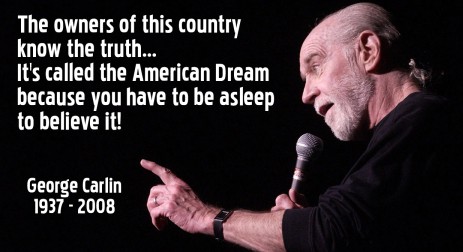
The American Dream is Dead

george-carlin-american-dream

By Dustin Meyer

Source: The Evolutionary Mind

To say the American Dream is Dead couldn’t be more true. The American people as a whole are ignorant. They grow up believing that there is a perfect lifestyle in which they will get once they get older and “pay their dues”. Unfortunately this is very far from wrong, the system is corrupt and is against anyone who thinks this way. Simply put, there is no American dream.

What is it? The American Dream, at least as I knew it was where you would live an ideal life, work a 9-5 job, have a house with a white picket fence, a yard, car, and a dog. More in a modern sense, it is getting rich and famous, owning a huge house, fancy car, having all the fanciest clothes and things. This is why it had been dying but not why it is dead. People are greedy, they want more and more, and forget to appreciate the simple life they have. Some people don’t even have their lives anymore, and yet so many people take theirs for granted.

Pop culture can be given much of the credit due to the skewing of the American dream. Since the people are influenced by anything and everything, they will believe any message conveyed to them. Music and film are the main mediums where this is, but a huge culprit is the news and daytime television. Also, unfortunately people are losing their individualism, which is leading to them falling more into this hole in which you cannot escape, you just aren’t you anymore once you’ve given in.

But a big question is why do I say it is dead? Well, the system in general is against us. The gap between rich and poor is expanding exponentially each and every day. The odds are not in the average person’s favor. People are working until they are 60+ years old and barely being able to retire, and with that work, most aren’t in executive type jobs. For the small business owner, you have huge corporations that are destroying your chances to even provide for your family. So why is it dead? Opening you eyes will show you.

People have to stand up, to realize that something is wrong. With this upcoming election (being quite possibly the worst election/selection of candidates’ ever.) we have to fight for the people. No matter who is in office no one will ever fight for you, unless you do. The people are for the people, we have a choice to change. The change must happen!

Evidence points to another Snowden at the NSA

NSA-CIA-Edward-Snowden

By James Bamford

Source: Reuters

In the summer of 1972, state-of-the-art campaign spying consisted of amateur burglars, armed with duct tape and microphones, penetrating the headquarters of the Democratic National Committee. Today, amateur burglars have been replaced by cyberspies, who penetrated the DNC armed with computers and sophisticated hacking tools.

Where the Watergate burglars came away empty-handed and in handcuffs, the modern- day cyber thieves walked away with tens of thousands of sensitive political documents and are still unidentified.

Now, in the latest twist, hacking tools themselves, likely stolen from the National Security Agency, are on the digital auction block. Once again, the usual suspects start with Russia – though there seems little evidence backing up the accusation.

In addition, if Russia had stolen the hacking tools, it would be senseless to publicize the theft, let alone put them up for sale. It would be like a safecracker stealing the combination to a bank vault and putting it on Facebook. Once revealed, companies and governments would patch their firewalls, just as the bank would change its combination.

A more logical explanation could also be insider theft. If that’s the case, it’s one more reason to question the usefulness of an agency that secretly collects private information on millions of Americans but can’t keep its most valuable data from being stolen, or as it appears in this case, being used against us.

In what appeared more like a Saturday Night Live skit than an act of cybercrime, a group calling itself the Shadow Brokers put up for bid on the Internet what it called a “full state-sponsored toolset” of “cyberweapons.” “!!! Attention government sponsors of cyberwarfare and those who profit from it !!!! How much would you pay for enemies cyberweapons?” said the announcement.

The group said it was releasing some NSA files for “free” and promised “better” ones to the highest bidder. However, those with loosing bids “Lose Lose,” it said, because they would not receive their money back. And should the total sum of the bids, in bitcoins, reach the equivalent of half a billion dollars, the group would make the whole lot public.

While the “auction” seemed tongue in cheek, more like hacktivists than Russian high command, the sample documents were almost certainly real. The draft of a top-secret NSA manual for implanting offensive malware, released by Edward Snowden, contains code for a program codenamed SECONDDATE. That same 16-character string of numbers and characters is in the code released by the Shadow Brokers. The details from the manual were first released by The Intercept last Friday.

The authenticity of the NSA hacking tools were also confirmed by several ex-NSA officials who spoke to the media, including former members of the agency’s Tailored Access Operations (TAO) unit, the home of hacking specialists.

“Without a doubt, they’re the keys to the kingdom,” one former TAO employee told the Washington Post. “The stuff you’re talking about would undermine the security of a lot of major government and corporate networks both here and abroad.” Another added, “From what I saw, there was no doubt in my mind that it was legitimate.”

Like a bank robber’s tool kit for breaking into a vault, cyber exploitation tools, with codenames like EPICBANANA and BUZZDIRECTION, are designed to break into computer systems and networks. Just as the bank robber hopes to find a crack in the vault that has never been discovered, hackers search for digital cracks, or “exploits,” in computer programs like Windows.

The most valuable are “zero day” exploits, meaning there have been zero days since Windows has discovered the “crack” in their programs. Through this crack, the hacker would be able to get into a system and exploit it, by stealing information, until the breach is eventually discovered and patched. According to the former NSA officials who viewed the Shadow Broker files, they contained a number of exploits, including zero-day exploits that the NSA often pays thousands of dollars for to private hacking groups.

The reasons given for laying the blame on Russia appear less convincing, however. “This is probably some Russian mind game, down to the bogus accent,” James A. Lewis, a computer expert at the Center for Strategic and International Studies, a Washington think tank, told the New York Times. Why the Russians would engage in such a mind game, he never explained.

Rather than the NSA hacking tools being snatched as a result of a sophisticated cyber operation by Russia or some other nation, it seems more likely that an employee stole them. Experts who have analyzed the files suspect that they date to October 2013, five months after Edward Snowden left his contractor position with the NSA and fled to Hong Kong carrying flash drives containing hundreds of thousands of pages of NSA documents.

So, if Snowden could not have stolen the hacking tools, there are indications that after he departed in May 2013, someone else did, possibly someone assigned to the agency’s highly sensitive Tailored Access Operations.

In December 2013, another highly secret NSA document quietly became public. It was a top secret TAO catalog of NSA hacking tools. Known as the Advanced Network Technology (ANT) catalog, it consisted of 50 pages of extensive pictures, diagrams and descriptions of tools for every kind of hack, mostly targeted at devices manufactured by U.S. companies, including Apple, Cisco, Dell and many others.

Like the hacking tools, the catalog used similar codenames. Among the tools targeting Apple was one codenamed DROPOUTJEEP, which gives NSA total control of iPhones. “A software implant for the Apple iPhone,” says the ANT catalog, “includes the ability to remotely push/pull files from the device. SMS retrieval, contact-list retrieval, voicemail, geolocation, hot mic, camera capture, cell-tower location, etc.”

Another, codenamed IRATEMONK, is, “Technology that can infiltrate the firmware of hard drives manufactured by Maxtor, Samsung, Seagate and Western Digital.”

In 2014, I spent three days in Moscow with Snowden for a magazine assignment and a PBS documentary. During our on-the-record conversations, he would not talk about the ANT catalog, perhaps not wanting to bring attention to another possible NSA whistleblower.

I was, however, given unrestricted access to his cache of documents. These included both the entire British, or GCHQ, files and the entire NSA files.

But going through this archive using a sophisticated digital search tool, I could not find a single reference to the ANT catalog. This confirmed for me that it had likely been released by a second leaker. And if that person could have downloaded and removed the catalog of hacking tools, it’s also likely he or she could have also downloaded and removed the digital tools now being leaked.

In fact, a number of the same hacking implants and tools released by the Shadow Brokers are also in the ANT catalog, including those with codenames BANANAGLEE and JETPLOW. These can be used to create “a persistent back-door capability” into widely used Cisco firewalls, says the catalog.

Consisting of about 300 megabytes of code, the tools could easily and quickly be transferred to a flash drive. But unlike the catalog, the tools themselves – thousands of ones and zeros – would have been useless if leaked to a publication. This could be one reason why they have not emerged until now.

Enter WikiLeaks. Just two days after the first Shadow Brokers message, Julian Assange, the founder of WikiLeaks, sent out a Twitter message. “We had already obtained the archive of NSA cyberweapons released earlier today,” Assange wrote, “and will release our own pristine copy in due course.”

The month before, Assange was responsible for releasing the tens of thousands of hacked DNC emails that led to the resignation of the four top committee officials.

There also seems to be a link between Assange and the leaker who stole the ANT catalog, and the possible hacking tools. Among Assange’s close associates is Jacob Appelbaum, a celebrated hacktivist and the only publicly known WikiLeaks staffer in the United States – until he moved to Berlin in 2013 in what he called a “political exile” because of what he said was repeated harassment by U.S. law enforcement personnel. In 2010, a Rolling Stone magazine profile labeled him “the most dangerous man in cyberspace.”

In December 2013, Appelbaum was the first person to reveal the existence of the ANT catalog, at a conference in Berlin, without identifying the source. That same month he said he suspected the U.S. government of breaking into his Berlin apartment. He also co-wrote an article about the catalog in Der Spiegel. But again, he never named a source, which led many to assume, mistakenly, that it was Snowden.

In addition to WikiLeaks, for years Appelbaum worked for Tor, an organization focused on providing its customers anonymity on the Internet. But last May, he stepped down as a result of “serious, public allegations of sexual mistreatment” made by unnamed victims, according to a statement put out by Tor. Appelbaum has denied the charges.

Shortly thereafter, he turned his attention to Hillary Clinton. At a screening of a documentary about Assange in Cannes, France, Appelbaum accused her of having a grudge against him and Assange, and that if she were elected president, she would make their lives difficult. “It’s a situation that will possibly get worse” if she is elected to the White House, he said, according to Yahoo News.

It was only a few months later that Assange released the 20,000 DNC emails. Intelligence agencies have again pointed the finger at Russia for hacking into these emails.

Yet there has been no explanation as to how Assange obtained them. He told NBC News, “There is no proof whatsoever” that he obtained the emails from Russian intelligence. Moscow has also denied involvement.

There are, of course, many sophisticated hackers in Russia, some with close government ties and some without. And planting false and misleading indicators in messages is an old trick. Now Assange has promised to release many more emails before the election, while apparently ignoring email involving Trump. (Trump opposition research was also stolen.)

In hacktivist style, and in what appears to be phony broken English, this new release of cyberweapons also seems to be targeting Clinton. It ends with a long and angry “final message” against “Wealthy Elites . . . breaking laws” but “Elites top friends announce, no law broken, no crime commit[ed]. . . Then Elites run for president. Why run for president when already control country like dictatorship?”

Then after what they call the “fun Cyber Weapons Auction” comes the real message, a serious threat. “We want make sure Wealthy Elite recognizes the danger [of] cyberweapons. Let us spell out for Elites. Your wealth and control depends on electronic data.” Now, they warned, they have control of the NSA’s cyber hacking tools that can take that wealth away. “You see attacks on banks and SWIFT [a worldwide network for financial services] in news. If electronic data go bye-bye where leave Wealthy Elites? Maybe with dumb cattle?”

Snowden’s leaks served a public good. He alerted Americans to illegal eavesdropping on their telephone records and other privacy violations, and Congress changed the law as a result. The DNC leaks exposed corrupt policies within the Democratic Party.

But we now have entered a period many have warned about, when NSA’s cyber weapons could be stolen like loose nukes and used against us. It opens the door to criminal hackers, cyber anarchists and hostile foreign governments that can use the tools to gain access to thousands of computers in order to steal data, plant malware and cause chaos.

It’s one more reason why NSA may prove to be one of Washington’s greatest liabilities rather than assets.


About the Author

James Bamford is the author of The Shadow Factory: The Ultra-Secret NSA From 9/11 to the Eavesdropping on America. He is a columnist for Foreign Policy magazine.


Why Americans Must Demolish the Political Duopoly and Create a New Progressive Alliance

the-evil-and-corrupt-duopoly

By Thomas Baldwin

Source: Dandelion Salad

A Call to Action!

“Insanity is doing the same thing over and over again and expecting different results.”– Albert Einstein

Duopoly: “preponderant influence or control by two political powers.”

Demolish: “to destroy by breaking apart; to put an end to.”

Corporate fascism (or Corporatism): “the complete merger of corporate and state entities to create a political entity.”

The United States is experiencing a serious crisis and most Americans know it. Our government and the Washington establishment is disintegrating at near breath taking speed. It could well be the most serious situation in at least a hundred years. For years now several authors have described our government in Washington as being “broken” or “dysfunctional”. But these words seem inadequate any longer.

It is much more like a “living” entity which is dying and is in a critical state; all vital signs are poor. Crises are generated in Washington from incompetence and corruption. Little or nothing gets done; few if any serious problems are addressed. Everything is addressed as “partisan.” But that is a delusion because as I will mention later there is really only one party with two different factions serving the corporate fascists. When the two factions finally agree on something, then it is called “bipartisan” because the two political parties appear to be constantly fighting over power and money. What, if anything, is to be done about this evil charade?

Read the full article at  Dandelion Salad.

Why Ajamu Baraka? Why Vice President? And Why the Green Party?

Ajamu-Baraka-final

What does the Green Party nomination of longtime Black Agenda Report contributing editor Ajamu Baraka for Vice President mean for the Green Party and the 2016 presidential election?  Is he just a black face on the ticket, or is it really time to begin organizing in black and brown communities outside the matrix of the bankrupt black and brown misleadership class?

By Bruce A. Dixon

Source: Black Agenda Report

In Houston on the first Saturday of August, the Green Party nominated Jill Stein, a Massachusetts physician, and Ajamu Baraka, a longtime human rights activists as its presidential and vice presidential candidates for 2016.  Stein’s nomination was a foregone conclusion, having been the Green candidate in 2012 and the only one of several aspirants to raise money, hire staff and campaign across the country full time for more than a year.

Ajamu Baraka followed a different road to the nomination, having been an interested observer but with no organizational connection to the Green Party till now.  Ajamu Baraka was the founding executive director of the US Human Rights Network, which still seeks to have the framework of internationally recognized human rights law applied to the victims of social and economic injustice in the US.  This is a truly radical concept because the supreme law in the US is the Constitution, which chiefly guarantees property rights and the rights of corporations but not necessarily the rights of human beings to a quality education, the vote, decent housing, health care, renumerative jobs and the right to organize, or to a safe and clean environment, none of which are mentioned.
Ajamu Baraka was among the first to demand, in the wake of the Katrina disaster, that the 300,000 or so persons uprooted, the majority of them African American, be classified as “internally displaced” under international law, a status which would have guaranteed them the right to return to the cities and towns from which they were displaced and dispersed to the four corners of the US.  Since the 1980s Baraka has been a consistent and principled critic of imperial US foreign policy over the years in Africa, Asia, Central and South America and the Middle East.  He’s served in and led fact-finding delegations to Central America, Cuba, Israel-Palestine, Colombia and other places.  In the wake of the 2010 hunger strike waged by Georgia prisoners, Baraka led an unprecedented civilian inspection team into two state prisons where they were able to interview staff and prisoners alike.

I should say here that I count both Jill and Ajamu as comrades and personal friends, that I was on Jill’s campaign staff for several months and that Ajamu Baraka has more than 50 articles published at Black Agenda Report.
So why Ajamu Baraka?

It’s not a simple matter of putting a black face on the ticket.  Greens have run black candidates in local and national races before without managing to make a significant dent in traditional black allegiances to the Democratic party.

Stein chose Baraka because one of her campaign’s objectives is to strengthen state and local Green parties.  As a result of his more than four decades of work in the movement, Baraka has longstanding personal ties with and has been mentor to many of the activists involved in the Black Lives Matter movement around the country.  If anyone can carry the message to these forces that now is the time for organizing alternative centers of struggle for political power, centers of struggle outside the two capitalist parties and outside the nonprofit industrial complex, that someone is Ajamu Baraka.

African American voters have long been the rock upon which the Democratic party’s voting coalition rests.  But since blacks vote Democratic mainly out of fear of the Republicans, they are a captive constituency whose votes are counted but whose demands are ignored.  Jill and the Greens know it will take more than running good black or brown candidates to make its black, Latin and working class captive constituencies climb out of the Democrats’ trunk.  Realistically that won’t much happen this election.  The candidacies of Greens like Joshua Harris in Baltimore and Ashley Flash Gordon in Travis County TX are signs that something new and unprecedented is peeking over the horizon, something that will challenge the vacuity and lack of vision of the black political class.  It’s not a challenge mature enough to accomplish a string of local electoral victories across the country.  But it’s real, it’s gaining ground, building experience and it’s not going away.

The present black political class and the leadership model that supports it have been in place pretty much since the days of Booker T. Washington twelve decades ago.  They won’t be displaced this election cycle, but their political bankruptcy is every bit as real and obvious as that of their white counterparts.

Why Vice President?

A frequently asked question is why Greens run candidates for president every year, but haven’t elected or even run candidates in many states for state reps and state senators, for county commissioners and members of congress.  The answer is really simple.

The two capitalist parties protect themselves against competitors with a briar patch, a minefield of provisions and conditions expressly designed to make it all but impossible for parties not financed by the one percent to appear on the ballot.  In many states, candidates who are not Democrats or Republicans are prohibited from appearing on the ballot until after their parties have scored one percent, two percent or five percent, depending on the state, in a statewide election.

This legal requirement in states like Georgia that Greens must score tens or hundreds of thousands of votes in statewide races before being allowed to run in local races is one more of the deliberate obstacles Democrats and Republicans have erected to competition from third parties at the ballot box.  And it’s why Ajamu Baraka is running for vice president and Jill Stein for president much of the country were Greens are not allowed to run for local office.

Why the Green Party?

For the last fifty years, Republicans have deliberately made themselves the party of white racists and nativists.  There’s simply in the Republican party or African Americans except a shorter line.  Democrats talk a different game, but are responsible to the same one percenters who fund Republicans, so once in office, Democrats govern pretty much like Republicans.  In fact Democratic presidents and governors frequently enact the oppressive policies we won’t allow Republicans to enact.

NAFTA came up twice during the first Bush presidency and failed.  It took a Democrat, a President Clinton to rally enough right wing Democrats to ally with Republicans to get it into law.  Ending public aid was also something no Republican could do, but Democrats only need  the support of the black and poor when they’re candidates, not so much when they’re governing.  The 2008 Bush bailout went before a Democratic Congress and it failed.  Barack Obama had to suspend his campaign for a week and come to DC and work the phones to flip the Congressional Black Caucus and enough other Democrats to pass the Bush bailout, which he quadrupled down on once in the White House.  Again it was a blow no Republican could have struck, though many wanted to.

Barack Obama used stimulus money to fund what he called “Race To The Top”, a drive to privatize public education that resulted in the closing and privatization of thousands of public schools, and pushed hundreds of thousands of qualified experienced public school educators out of the classroom.  This too was something no Republican could have accomplished, much as they wanted to.  There are many, many similar examples of Democrats accomplishing the right wing goals Republicans can only talk about on the state and local levels.
Republicans like Donald Trump talk about how they’d like to do mass deportations.  But our First Black President has deported two million people, more than any other three presidents combined, after promising Latino voters “a road to citizenship” in both his campaigns.

The only reason to vote for Democrats is our fear of Republicans, and as Jill Stein says, this politics of fear has delivered to us everything we were afraid of.  People voted Democratic to end the war in Iraq but we got more war in the Middle East and Africa.  People voted Democrat to raise the minimum wage and see millions of new jobs created.  But the minimum wage has barely risen and the only reason official unemployment figures are down is that his policies have pushed millions of people out of the formal workforce into increasingly precarious economic situations.

At the end of the reign of our first black president, a Democrat when blacks have been the rock and mainstay of Democratic voting coalitions for two generations, forty percent of black children are growing up in poverty.  Isn’t it time for some new questions?

Why must “progressives” ride to Hillary’s rescue if we don’t get progress?

Trump is a bumbling clown and a bogeyman.  He’s raising a fraction of the money Romney raised, four years ago.  Hillary Clinton has a billion dollars to campaign with and most of the corporate media. If she can’t beat this fool with all the resources available to her, why is it up to us?  Why?  Hillary ought to be, and ought to have been helping us, not the other way around.

I don’t expect the Greens to win the presidential election.  But the US system is almost 250 years old, one of the most elderly on the planet.  Its creaks and cracks are highly visible and aren’t going away.  Isn’t it time to start imagining and building what comes next, what comes after capitalism, what comes after genocide and ecocide, what comes after patriarchy and white supremacy?

Isn’t it time to start being the change we want to see?

That won’t happen inside the Democratic party.  It’s been tried again and again.  It’s time to build something different.  So why not the Green Party?
Bruce A. Dixon is managing editor at Black Agenda Report and a member of the state committee of the Georgia Green Party.  He lives and works near Marietta GA and can be reached via email at bruce.dixon(at)blackagendareport.com.


Finally: the Eruption of the Clinton Foundation Scandal

hillary-frustrated

By Gary Leupp

Source: CounterPunch

“It’s getting really hard to know where any lines were drawn.”

-CNN

I confess I’d been looking forward to this. My son, following the Judicial Watch website, has been saying for months that the big email scandal will involve the State Department-Clinton Foundation ties and Hillary’s use of her office to acquire contributions from Saudi and other donors. As someone opposed to World War III (beginning in Syria and/or Ukraine), I was hoping that they (and he) were right.

It might not be all that immediately clear to many why this is another big deal. After all, it follows Hillary’s ongoing private server email scandal, involving not just issues of the Secretary’s “judgment” and so-called “national security” but also revealing details about Clinton’s key role in the bloody destruction of Libya and her hawkish views in all circumstances.

CNN commentators assure us that the FBI investigation “went nowhere” because the FBI decided she’d committed no crime. (Just move on, folks; this was political all along.)

These new revelations come just after the scandal of the DNC rigging the primaries for Hillary, revealed by email leaks (from an unknown source) provided through Wikileaks. The content of these has been avoided like the plague by mainstream media, which is in Hillary’s camp and is generally protecting her. The focus instead is on alleged Russian efforts to influence the U.S. election, and the imagined Putin-Trump “bromance.” Respectable news agencies have been announcing, as fact, the idea that Wikileaks got the emails from Russia; and that Moscow is trying to swing the election towards Trump (because he’ll accept an invasion of Estonia, wreck NATO etc.). It’s (or it should be) obvious bullshit, an effort to change the subject while exploiting the McCarthyite paranoid sentiments of the most backward.

The headlines are so far cautious. “Emails renew questions about Clinton Foundation and State Department Overlap.” “Newly released Clinton emails shed light on relationship between State Dept. and Clinton Foundation.” They are not (yet) shrieking, “Sheik bought State Dept. favors from Clinton Foundation donation” but we shall see.

What do the emails show so far? Two examples have been highlighted by the conservative Judicial Watch, which requested the email transcripts through the FOIA. In the first, in 2009, Gilbert Chagoury, a Lebanese-born billionaire who has given the foundation up to five million dollars and used its assistance to build a project in Nigeria, and is one of the foundation’s top donors, contacted Doug Band, head of the foundation’s Clinton Global Initiative, asking to be put in touch with a high ranking State Department official connected to Lebanon.

Band emailed Hillary’s top aide Huma Abedin and advisor Cheryl Mills, expressing a need. He writes: “We need Gilbert Chagoury to speak to the substance person re Lebanon. As you know, he’s a key guy there and to us and is loved in Lebanon. Very imp.”

A key guy to us. To the Clinton Foundation? The U.S.A.? Abedin did not ask that question before responding, “It’s jeff feltman. I’m sure he knows him. I’ll talk to jeff.” Feltman had been U.S. ambassador to Lebanon from July 2004 to January 2008 but was apparently still seen as the go-to guy. So Hillary’s chief aide took it upon herself to contact the former ambassador to tell him Chagoury (whom she might mention is a major contributor to the Clintons) needed to talk with him.

Nothing illegal there, they will say. Why shouldn’t the State Department arrange contact between a billionaire Lebanese Clinton donor, loved in Lebanon, and the ex-ambassador, if it contributes to regional stability or U.S. national security? And the hard-core Hillary supporters will nod their heads, and maybe point out that Feltman has denied any “meeting.” (Maybe Huma just passed on his address and they chatted online.)

(CNN I notice is showing a video of Bill Clinton with Chagoury in Nigeria, inaugurating a multi-billion dollar waterfront development on the coastline established “under the umbrella of the Clinton Global Initiative.”)

The other instance of “overlap” central to the discussion so far is a request of Band to Abedin and Mills for “a favor.” Someone who had recently been on a Clinton Foundation trip to Haiti wanted a State Department job. He indicated that it was “important to take care of” this person. Abedin, apparently without questioning Band about why this person was important, got right back to him: “We all have him on our radar. Personnel has been sending him options.” So the head of the Clinton Foundation could snap his fingers, again stressing how “important” his demand was, and Hillary aides Huma and Cheryl paid by your tax dollars would snap into action.

A CNN report deplores “the intermingling of emails between State and Clinton Foundation and others, giving the overall effect that it’s getting really hard to know where any lines were drawn.”

Maybe nothing illegal here. But there is an ongoing FBI investigation, no longer about Hillary’s multiple phones and private server, nor about the content of the communications (revealing her hawkish savagery), but about the routine trade-off of foundation connections for political rewards.

Those transactions are mere corruption, not war crimes. But the U.S. mass media never targets politicians for their bloodiness, and they love the conventional corruption scandal. So let there be more leaks that will absorb the attention of the talking heads! Let’s see clearer pay-for-play evidence! And let’s see more details about how the DNC midwifed Hillary’s nomination, actively sabotaging a supposedly democratic process.

Let the American people see how thoroughly rotten both candidates are, and how thoroughly rotten the system that barfed them up.

Bernie in a fair process would be the Democratic nominee now. Clinton didn’t so much steal the election as buy it in advance, arranging the details through lackey Debbie Wasserman Schultz. Trump would not be the Republican nominee but for the editorial decisions of cable news producers to—from the very inception of his campaign—announce BREAKING NEWS and cover his nearly identical rants every time he held a rally.

This gratuitous coverage obviated the need for any (other) Trump advertising. Even as the anchors, commentators and other talking heads ridiculed, denounced and appeared puzzled about the Trump phenomenon, the networks made the viewers imbibe his vapid rants. They hooked the most reactionary elements of the population on this blowhard billionaire nut case.

In the Democrats’ case, Wall Street and Wasserman Schultz controlled the primaries. In the Republican case, the corporate news media (for its immediate profit motives) advertised a total dick who happened to be a billionaire and represent the One Percent every bit as much as Hillary.

So they’re now in our faces, day after day. Hideous people with their news-anchor supporters, and cable commentators so ready to dismiss serious issues, put the very best face on their candidate, and change the subject to attack the other candidate. In the end it comes down to: We have a two-party system. The parties made their choices. So you HAVE to choose one.

Julian Assange described the U.S. presidential race as a choice between cholera and gonorrhea. Why should the people of this great country of 310,000,000 people—many with great creativity, integrity and intelligence—be assigned this sick choice of Clinton or Trump by the One Percent that controls everything?

Why should any Bernie supporter so debase himself or herself as to say, “Okay, I know the primaries were fixed and that Bernie could not win because the cards were stacked against him. And despite the fact that I put passion and effort into an anti-Wall Street campaign, now I’ll support the Wall Street candidate, who’s also a liar, who’s going to flip-flop again on TPP and bomb Syria to produce regime change, and provoke Russia in Syria and Ukraine—because well anyway she’s better than Trump, and we all have to vote, don’t we”?

But why should anybody have to hold their nose while they vote? The whole process has been exposed as never before as a farce. Why participate at all in something so corrupt? Do you want to vote just to vote, to publicly display the fact that you believe in the system itself, like the North Koreans who routinely go to the polls patriotically to vote for the options available? (As you may know, in some elections in the DPRK you can vote for a candidate of the Workers’ Party of Korea, Chondoist Chogu Party, Korean Social Democratic Party or independent. There is the manicured appearance of multiparty democracy—just like here. And no doubt some people feel good after the voting, knowing they’ve done their civic duty in a system they believe in. But what if you’ve woken up and don’t believe in the system anymore?)

Why not think bigger, and beyond? Either Clinton or Trump will likely take office in January, as the most unpopular newly elected president of all time. Either will have been brought to power by a manifestly anti-democratic, corrupt process that, more than in past years, is well exposed this time. Either will be vulnerable to mass upheaval, in the wake of Mexico wall construction or the announcement of a Syrian no-fly zone. Appalled by the election choices and result, the majority could maybe consider targeting the rigged system itself.

Just a suggestion. Massive demonstrations in Washington on Inaugural Day by people who have come to reject its legitimacy itself, knowing that it’s run by the One Percent to whom black lives don’t matter, drone warfare is cool and global warming is a hoax. Posters and banners with the curt, easy-to-understand and undeniably true popular slogan: THE WHOLE SYSTEM IS RIGGED!

Imagine a huge rally Jan. 20 demanding its overthrow, or at least the immediate resignation of the system’s illegitimate new executive, even if we don’t know what comes next.  Imagine the admiration that would invite throughout the world, the hope it would inspire should the people of this country rise up to challenge not just a war, policy or person but the corrupt (capitalist and imperialist) system under which we live.

***

Now I read that the FBI, directed by James Comey (who recommended no charges for Clinton for her private cell phone use but left open the prospect of recommending criminal charges against Clinton for abusing her office to profit the Clinton Foundation) in fact has recommended charges against Hillary.

But the Department of Justice headed by Clinton loyalist Loretta Lynch rejected the recommendation. Because—don’t you see?—Hillary has to be the next president. To stop Trump, at all costs! And to stop Putin, that aggressive Putin. And to keep together the “Clinton Coalition.”

Good job, Loretta! But regardless of your effort, Hillary’s Pinocchio nose grows longer by the day, while the whole system is exposed as a cancer requiring the most aggressive treatment.

Gary Leupp is Professor of History at Tufts University, and holds a secondary appointment in the Department of Religion. He is the author of Servants, Shophands and Laborers in in the Cities of Tokugawa JapanMale Colors: The Construction of Homosexuality in Tokugawa Japan; and Interracial Intimacy in Japan: Western Men and Japanese Women, 1543-1900. He is a contributor to Hopeless: Barack Obama and the Politics of Illusion, (AK Press). He can be reached at: gleupp@tufts.edu

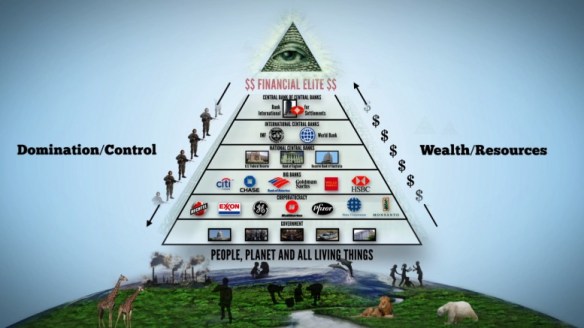
The Great Ponzi Scheme of the Global Economy

FollowTheMoney-Bank-Pyramid

By Michael Hudson and Chris Hedges

Source: CounterPunch

CHRIS HEDGES: We’re going to be discussing a great Ponzi scheme that not only defines not only the U.S. but the global economy, how we got there and where we’re going. And with me to discuss this issue is the economist Michael Hudson, author of Killing the Host: How Financial Parasites and Debt Destroy the Global Economy. A professor of economics who worked for many years on Wall Street, where you don’t succeed if you don’t grasp Marx’s dictum that capitalism is about exploitation. And he is also, I should mention, the godson of Leon Trotsky.

I want to open this discussion by reading a passage from your book, which I admire very much, which I think gets to the core of what you discuss. You write,

“Adam Smith long ago remarked that profits often are highest in nations going fastest to ruin. There are many ways to create economic suicide on a national level. The major way through history has been through indebting the economy. Debt always expands to reach a point where it cannot be paid by a large swathe of the economy. This is the point where austerity is imposed and ownership of wealth polarizes between the One Percent and the 99 Percent. Today is not the first time this has occurred in history. But it is the first time that running into debt has occurred deliberately.” Applauded. “As if most debtors can get rich by borrowing, not reduced to a condition of debt peonage.”

So let’s start with the classical economists, who certainly understood this. They were reacting of course to feudalism. And what happened to the study of economics so that it became gamed by ideologues?

HUDSON: The essence of classical economics was to reform industrial capitalism, to streamline it, and to free the European economies from the legacy of feudalism. The legacy of feudalism was landlords extracting land-rent, and living as a class that took income without producing anything. Also, banks that were not funding industry. The leading industrialists from James Watt, with his steam engine, to the railroads …

HEDGES: From your book you make the point that banks almost never funded industry.

HUDSON: That’s the point: They never have. By the time you got to Marx later in the 19th century, you had a discussion, largely in Germany, over how to make banks do something they did not do under feudalism. Right now we’re having the economic surplus being drained not by the landlords but also by banks and bondholders.

Adam Smith was very much against colonialism because that lead to wars, and wars led to public debt. He said the solution to prevent this financial class of bondholders burdening the economy by imposing more and more taxes on consumer goods every time they went to war was to finance wars on a pay-as-you-go basis. Instead of borrowing, you’d tax the people. Then, he thought, if everybody felt the burden of war in the form of paying taxes, they’d be against it. Well, it took all of the 19th century to fight for democracy and to extend the vote so that instead of landlords controlling Parliament and its law-making and tax system through the House of Lords, you’d extend the vote to labor, to women and everybody. The theory was that society as a whole would vote in its self-interest. It would vote for the 99 Percent, not for the One Percent.

By the time Marx wrote in the 1870s, he could see what was happening in Germany. German banks were trying to make money in conjunction with the government, by lending to heavy industry, largely to the military-industrial complex.

HEDGES: This was Bismarck’s kind of social – I don’t know what we’d call it. It was a form of capitalist socialism…

HUDSON: They called it State Capitalism. There was a long discussion by Engels, saying, wait a minute. We’re for Socialism. State Capitalism isn’t what we mean by socialism. There are two kinds of state-oriented–.

HEDGES: I’m going to interject that there was a kind of brilliance behind Bismarck’s policy because he created state pensions, he provided health benefits, and he directed banking toward industry, toward the industrialization of Germany which, as you point out, was very different in Britain and the United States.

HUDSON: German banking was so successful that by the time World War I broke out, there were discussions in English economic journals worrying that Germany and the Axis powers were going to win because their banks were more suited to fund industry. Without industry you can’t have really a military. But British banks only lent for foreign trade and for speculation. Their stock market was a hit-and-run operation. They wanted quick in-and-out profits, while German banks didn’t insist that their clients pay as much in dividends. German banks owned stocks as well as bonds, and there was much more of a mutual partnership.

That’s what most of the 19th century imagined was going to happen – that the world was on the way to socializing banking. And toward moving capitalism beyond the feudal level, getting rid of the landlord class, getting rid of the rent, getting rid of interest. It was going to be labor and capital, profits and wages, with profits being reinvested in more capital. You’d have an expansion of technology. By the early twentieth century most futurists imagined that we’d be living in a leisure economy by now.

HEDGES: Including Karl Marx.

HUDSON: That’s right. A ten-hour workweek. To Marx, socialism was to be an outgrowth of the reformed state of capitalism, as seemed likely at the time – if labor organized in its self-interest.

HEDGES: Isn’t what happened in large part because of the defeat of Germany in World War I? But also, because we took the understanding of economists like Adam Smith and maybe Keynes. I don’t know who you would blame for this, whether Ricardo or others, but we created a fictitious economic theory to praise a rentier or rent-derived, interest-derived capitalism that countered productive forces within the economy. Perhaps you can address that.

HUDSON: Here’s what happened. Marx traumatized classical economics by taking the concepts of Adam Smith and John Stuart Mill and others, and pushing them to their logical conclusion. Progressive capitalist advocates – Ricardian socialists such as John Stuart Mill – wanted to tax away the land or nationalize it. Marx wanted governments to take over heavy industry and build infrastructure to provide low-cost and ultimately free basic services. This was traumatizing the landlord class and the One Percent. And they fought back. They wanted to make everything part of “the market,” which functioned on credit supplied by them and paid rent to them.

None of the classical economists imagined how the feudal interests – these great vested interests that had all the land and money – actually would fight back and succeed. They thought that the future was going to belong to capital and labor. But by the late 19th century, certainly in America, people like John Bates Clark came out with a completely different theory, rejecting the classical economics of Adam Smith, the Physiocrats and John Stuart Mill.

HEDGES: Physiocrats are, you’ve tried to explain, the enlightened French economists.

HUDSON: The common denominator among all these classical economists was the distinction between earned income and unearned income. Unearned income was rent and interest. Earned incomes were wages and profits. But John Bates Clark came and said that there’s no such thing as unearned income. He said that the landlord actually earns his rent by taking the effort to provide a house and land to renters, while banks provide credit to earn their interest. Every kind of income is thus “earned,” and everybody earns their income. So everybody who accumulates wealth, by definition, according to his formulas, get rich by adding to what is now called Gross Domestic Product (GDP).

HEDGES: One of the points you make in Killing the Host which I liked was that in almost all cases, those who had the capacity to make money parasitically off interest and rent had either – if you go back to the origins – looted and seized the land by force, or inherited it.

HUDSON: That’s correct. In other words, their income is unearned. The result of this anti-classical revolution you had just before World War I was that today, almost all the economic growth in the last decade has gone to the One Percent. It’s gone to Wall Street, to real estate …

HEDGES: But you blame this on what you call Junk Economics.

HUDSON: Junk Economics is the anti-classical reaction.

HEDGES: Explain a little bit how, in essence, it’s a fictitious form of measuring the economy.

HUDSON: Well, some time ago I went to a bank, a block away from here – a Chase Manhattan bank – and I took out money from the teller. As I turned around and took a few steps, there were two pickpockets. One pushed me over and the other grabbed the money and ran out. The guard stood there and saw it. So I asked for the money back. I said, look, I was robbed in your bank, right inside. And they said, “Well, we don’t arm our guards because if they shot someone, the thief could sue us and we don’t want that.” They gave me an equivalent amount of money back.

Well, imagine if you count all this crime, all the money that’s taken, as an addition to GDP. Because now the crook has provided the service of not stabbing me. Or suppose somebody’s held up at an ATM machine and the robber says, “Your money or your life.” You say, “Okay, here’s my money.” The crook has given you the choice of your life. In a way that’s how the Gross National Product accounts are put up. It’s not so different from how Wall Street extracts money from the economy. Then also you have landlords extracting …

HEDGES: Let’s go back. They’re extracting money from the economy by debt peonage. By raising …

HUDSON: By not playing a productive role, basically.

HEDGES: Right. So it’s credit card interest, mortgage interest, car loans, student loans. That’s how they make their funds.

HUDSON: That’s right. Money is not a factor of production. But in order to have access to credit, in order to get money, in order to get an education, you have to pay the banks. At New York University here, for instance, they have Citibank. I think Citibank people were on the board of directors at NYU. You get the students, when they come here, to start at the local bank. And once you are in a bank and have monthly funds taken out of your account for electric utilities, or whatever, it’s very cumbersome to change.

So basically you have what the classical economists called the rentier class. The class that lives on economic rents. Landlords, monopolists charging more, and the banks. If you have a pharmaceutical company that raises the price of a drug from $12 a shot to $200 all of a sudden, their profits go up. Their increased price for the drug is counted in the national income accounts as if the economy is producing more. So all this presumed economic growth that has all been taken by the One Percent in the last ten years, and people say the economy is growing. But the economy isn’t growing …

HEDGES: Because it’s not reinvested.

HUDSON: That’s right. It’s not production, it’s not consumption. The wealth of the One Percent is obtained essentially by lending money to the 99 Percent and then charging interest on it, and recycling this interest at an exponentially growing rate.

HEDGES: And why is it important, as I think you point out in your book, that economic theory counts this rentier income as productive income? Explain why that’s important.

HUDSON: If you’re a rentier, you want to say that you earned your income by …

HEDGES: We’re talking about Goldman Sachs, by the way.

HUDSON: Yes, Goldman Sachs. The head of Goldman Sachs came out and said that Goldman Sachs workers are the most productive in the world. That’s why they’re paid what they are. The concept of productivity in America is income divided by labor. So if you’re Goldman Sachs and you pay yourself $20 million a year in salary and bonuses, you’re considered to have added $20 million to GDP, and that’s enormously productive. So we’re talking in a tautology. We’re talking with circular reasoning here.

So the issue is whether Goldman Sachs, Wall Street and predatory pharmaceutical firms, actually add “product” or whether they’re just exploiting other people. That’s why I used the word parasitism in my book’s title. People think of a parasite as simply taking money, taking blood out of a host or taking money out of the economy. But in nature it’s much more complicated. The parasite can’t simply come in and take something. First of all, it needs to numb the host. It has an enzyme so that the host doesn’t realize the parasite’s there. And then the parasites have another enzyme that takes over the host’s brain. It makes the host imagine that the parasite is part of its own body, actually part of itself and hence to be protected.

That’s basically what Wall Street has done. It depicts itself as part of the economy. Not as a wrapping around it, not as external to it, but actually the part that’s helping the body grow, and that actually is responsible for most of the growth. But in fact it’s the parasite that is taking over the growth.

The result is an inversion of classical economics. It turns Adam Smith upside down. It says what the classical economists said was unproductive – parasitism – actually is the real economy. And that the parasites are labor and industry that get in the way of what the parasite wants – which is to reproduce itself, not help the host, that is, labor and capital.

HEDGES: And then the classical economists like Adam Smith were quite clear that unless that rentier income, you know, the money made by things like hedge funds, was heavily taxed and put back into the economy, the economy would ultimately go into a kind of tailspin. And I think the example of that, which you point out in your book, is what’s happened in terms of large corporations with stock dividends and buybacks. And maybe you can explain that.

HUDSON: There’s an idea in superficial textbooks and the public media that if companies make a large profit, they make it by being productive. And with …

HEDGES: Which is still in textbooks, isn’t it?

HUDSON: Yes. And also that if a stock price goes up, you’re just capitalizing the profits – and the stock price reflects the productive role of the company. But that’s not what’s been happening in the last ten years. Just in the last two years, 92 percent of corporate profits in America have been spent either on buying back their own stock, or paid out as dividends to raise the price of the stock.

HEDGES: Explain why they do this.

HUDSON: About 15 years ago at Harvard, Professor Jensen said that the way to ensure that corporations are run most efficiently is to make the managers increase the price of the stock. So if you give the managers stock options, and you pay them not according to how much they’re producing or making the company bigger, or expanding production, but the price of the stock, then you’ll have the corporation run efficiently, financial style.

So the corporate managers find there are two ways that they can increase the price of the stock. The first thing is to cut back long-term investment, and use the money instead to buy back their own stock. But when you buy your own stock, that means you’re not putting the money into capital formation. You’re not building new factories. You’re not hiring more labor. You can actually increase the stock price by firing labor.

HEDGES: That strategy only works temporarily.

HUDSON: Temporarily. By using the income from past investments just to buy back stock, fire the labor force if you can, and work it more intensively. Pay it out as dividends. That basically is the corporate raider’s model. You use the money to pay off the junk bond holders at high interest. And of course, this gets the company in trouble after a while, because there is no new investment.

So markets shrink. You then go to the labor unions and say, gee, this company’s near bankruptcy, and we don’t want to have to fire you. The way that you can keep your job is if we downgrade your pensions. Instead of giving you what we promised, the defined benefit pension, we’ll turn it into a defined contribution plan. You know what you pay every month, but you don’t know what’s going to come out. Or, you wipe out the pension fund, push it on to the government’s Pension Benefit Guarantee Corporation, and use the money that you were going to pay for pensions to pay stock dividends. By then the whole economy is turning down. It’s hollowed out. It shrinks and collapses. But by that time the managers will have left the company. They will have taken their bonuses and salaries and run.

HEDGES: I want to read this quote from your book, written by David Harvey, in A Brief History of Neoliberalism, and have you comment on it.

“The main substantive achievement of neoliberalism has been to redistribute rather than to generate wealth and income. [By] ‘accumulation by dispossession’ I mean … the commodification and privatization of land, and the forceful expulsion of peasant populations; conversion of various forms of property rights (common collective state, etc.) into exclusive private property rights; suppression of rights to the commons; … colonial, neocolonial, and the imperial processes of appropriation of assets (including natural resources); … and usury, the national debt and, most devastating at all, the use of the credit system as a radical means of accumulation by dispossession. … To this list of mechanisms, we may now add a raft of techniques such as the extraction of rents from patents, and intellectual property rights (such as the diminution or erasure of various forms of common property rights, such as state pensions, paid vacations, and access to education, health care) one through a generation or more of class struggle. The proposal to privatize all state pension rights, pioneered in Chile under the dictatorship is, for example, one of the cherished objectives of the Republicans in the US.”

This explains the denouement. The final end result you speak about in your book is, in essence, allowing what you call the rentier or the speculative class to cannibalize the entire society until it collapses.

HUDSON: A property right is not a factor of production. Look at what happened in Chicago, the city where I grew up. Chicago didn’t want to raise taxes on real estate, especially on its expensive commercial real estate. So its budget ran a deficit. They needed money to pay the bondholders, so they sold off the parking rights to have meters – you know, along the curbs. The result is that they sold to Goldman Sachs 75 years of the right to put up parking meters. So now the cost of living and doing business in Chicago is raised by having to pay the parking meters. If Chicago is going to have a parade and block off traffic, it has to pay Goldman Sachs what the firm would have made if the streets wouldn’t have been closed off for a parade. All of a sudden it’s much more expensive to live in Chicago because of this.

But this added expense of having to pay parking rights to Goldman Sachs – to pay out interest to its bondholders – is counted as an increase in GDP, because you’ve created more product simply by charging more. If you sell off a road, a government or local road, and you put up a toll booth and make it into a toll road, all of a sudden GDP goes up.

If you go to war abroad, and you spend more money on the military-industrial complex, all this is counted as increased production. None of this is really part of the production system of the capital and labor building more factories and producing more things that people need to live and do business. All of this is overhead. But there’s no distinction between wealth and overhead.

Failing to draw that distinction means that the host doesn’t realize that there is a parasite there. The host economy, the industrial economy, doesn’t realize what the industrialists realized in the 19th century: If you want to be an efficient economy and be low-priced and under-sell competitors, you have to cut your prices by having the public sector provide roads freely. Medical care freely. Education freely.

If you charge for all of these, you get to the point that the U.S. economy is in today. What if American factory workers were to get all of their consumer goods for nothing. All their food, transportation, clothing, furniture, everything for nothing. They still couldn’t compete with Asians or other producers, because they have to pay up to 43% of their income for rent or mortgage interest, 10% or more of their income for student loans, credit card debt. 15% of their paycheck is automatic withholding to pay Social Security, to cut taxes on the rich or to pay for medical care.

So Americans built into the economy all this overhead. There’s no distinction between growth and overhead. It’s all made America so high-priced that we’re priced out of the market, regardless of what trade policy we have.

HEDGES: We should add that under this predatory form of economics, you game the system. So you privatize pension funds, you force them into the stock market, an overinflated stock market. But because of the way companies go public, it’s the hedge fund managers who profit. And it’s those citizens whose retirement savings are tied to the stock market who lose. Maybe we can just conclude by talking about how the system is fixed, not only in terms of burdening the citizen with debt peonage, but by forcing them into the market to fleece them again.

HUDSON: Well, we talk about an innovation economy as if that makes money. Suppose you have an innovation and a company goes public. They go to Goldman Sachs and other Wall Street investment banks to underwrite the stock to issue it at $40 a share. What’s considered a successful float is when, immediately, Goldman and the others will go to their insiders and tell them to buy this stock and make a quick killing. A “successful” flotation doubles the price in one day, so that at the end of the day the stock’s selling for $80.

HEDGES: They have the option to buy it before anyone else, knowing that by the end of the day it’ll be inflated, and then they sell it off.

HUDSON: That’s exactly right.

HEDGES: So the pension funds come in and buy it at an inflated price, and then it goes back down.

HUDSON: It may go back down, or it may be that the company just was shortchanged from the very beginning. The important thing is that the Wall Street underwriting firm, and the speculators it rounds up, get more in a single day than all the years it took to put the company together. The company gets $40. And the banks and their crony speculators also get $40.

So basically you have the financial sector ending up with much more of the gains. The name of the game if you’re on Wall Street isn’t profits. It’s capital gains. And that’s something that wasn’t even part of classical economics. They didn’t anticipate that the price of assets would go up for any other reason than earning more money and capitalizing on income. But what you have had in the last 50 years – really since World War II – has been asset-price inflation. Most middle-class families have gotten the wealth that they’ve got since 1945 not really by saving what they’ve earned by working, but by the price of their house going up. They’ve benefited by the price of the house. And they think that that’s made them rich and the whole economy rich.

The reason the price of housing has gone up is that a house is worth whatever a bank is going to lend against it. If banks made easier and easier credit, lower down payments, then you’re going to have a financial bubble. And now, you have real estate having gone up as high as it can. I don’t think it can take more than 43% of somebody’s income to buy it. But now, imagine if you’re joining the labor force. You’re not going to be able to buy a house at today’s prices, putting down a little bit of your money, and then somehow end up getting rich just on the house investment. All of this money you pay the bank is now going to be subtracted from the amount of money that you have available to spend on goods and services.

So we’ve turned the post-war economy that made America prosperous and rich inside out. Somehow most people believed they could get rich by going into debt to borrow assets that were going to rise in price. But you can’t get rich, ultimately, by going into debt. In the end the creditors always win. That’s why every society since Sumer and Babylonia have had to either cancel the debts, or you come to a society like Rome that didn’t cancel the debts, and then you have a dark age. Everything collapses.


Michael Hudson’s new book, Killing the Host is published in e-format by CounterPunch Books and in print by Islet. He can be reached via his website, mh@michael-hudson.com. Chris Hedges’s latest book is Days of Destruction, Days of Revolt, illustrated by Joe Sacco.