Billionaires are a Sign of Economic Failure

Inherited wealth and crony capitalism have created an aristocratic class that undermines social mobility and democracy

By Max Lawson

Source: Inequality.org

The New York Times published an editorial comment on its front page in January 2019, provocatively entitled “abolish billionaires.” The editorial raised a serious question: what if instead of being a sign of economic success, billionaires are a sign of economic failure?  In what ways can the boom in billionaires, and the dramatic increase in extreme wealth generally, be harmful?

To answer this question, we need to understand the origins of billionaire wealth, and to understand how that wealth is used once it is gained.  The answer to both these questions I think rightly casts doubt on the value of the super-rich in our society.

Approximately one third of billionaire wealth comes from inheritance. It is very hard to make the case for the economic utility of inherited wealth, and instead there is a strong case for the fact that it undermines social mobility and economic progress. It creates instead a new aristocracy who are rich simply because their parents were rich which is hard to see as a good thing.

Whether inherited or secured in other ways, extreme wealth takes on a momentum of its own.  The super-rich have the money to spend on the best investment advice, and billionaire wealth has increased since 2009 by an average of 11 percent a year, far higher than rates ordinary savers can obtain.

Bill Gates is worth nearly $100 billion dollars in 2019, almost twice what he was worth when he stepped down as head of Microsoft.  This is despite his admirable commitment to giving his money away.  As Thomas Piketty said in his book Capital in the 21st Century, “No matter how justified inequalities of wealth may be initially, fortunes can grow beyond any rational justification in terms of social utility.”

My Oxfam colleague Didier Jacobs calculated a few years ago that another third of billionaire wealth comes from crony connections to government and monopoly.  This could be for example when billionaires secure concessions to provide services exclusively from government, using crony connections and corruption.  The Economist has developed a similar measure of crony capitalism with similar findings. What is clear it seems to me is that corruption and crony connections to governments are behind a significant proportion of billionaire wealth.

Almost all sectors of our global economy are also now characterized by monopoly power, as is detailed by Nick Shaxson in his great new book, the Finance Curse. Whether food, pharmaceuticals, media, finance, or technology, each sector is characterized by a handful of huge corporations.

Decades of largely unquestioned mergers and acquisitions, where corporations have bought up competitors, have led to this.  Historically, and especially in the United States in the early part of the 20th century, monopoly power was rightly viewed as a serious threat to the economy and to society, and steps were taken to break up monopolies.  It was President Franklin Roosevelt who famously said that “government by organized money is just as dangerous as government by organized mob.” However, in recent decades, neoliberal economics has led a much more benign view of monopoly power, and very little action is now taken to dismantle them. I think this is a key distinction between neoliberalism and classical liberal economics.  These monopolies impose hidden monopoly taxes on every consumer, as it enables these companies, and their wealthy shareholders, to extract excessive profits from the market, directly fueling the growth in extreme wealth at the expense of ordinary citizens.

The actions of corporations, including the move towards monopoly, are driven by a relentless focus on ever-increasing returns to shareholders — shareholders who are primarily the very same extremely wealthy people.  Our new Oxfam paper on the “Seven Deadly Sins” of the G7, released this week, shows how returns to shareholders have increased dramatically whilst real wages have barely increased.

Behind corporate power and corporate actions is increasingly the power of super-rich shareholders.

Once billionaire wealth is accumulated, the way it is used also casts doubt on how useful it is to have billionaires.  The super-rich use their wealth to pay as little tax as possible, making active use of a secretive global network of tax havens, as revealed by the Panama Papers and other exposes.

One ground-breaking study that made use of this leaked information showed that the super-rich are paying as much as 30 percent less tax than they should, denying governments billions in lost tax revenue, that could have been spent on schools or on hospitals.  The super-rich are supported in this by the Society of Trust and Estate Practitioners (STEP), a secretive organization of over 20,000 wealth managers that actively pressures governments to reduce taxes on the richest.

Billions are not just used to ensure lower taxes. They can also be used to buy impunity from justice, to buy politicians, or to buy a pliant media.  The use of “dark” money to influence elections and public policy is a growing problem all over the world. The Koch brothers — Charles and the recently deceased David — two of the richest men in the world, have had a huge influence over conservative politics in the United States.

Another recent Oxfam study  showed the many ways in which politics has been captured by the very rich in Latin America.  Many of today’s new breed of nationalist, racist leaders have substantial financial backing.

This active political influencing by the super-rich directly drives greater inequality, by constructing reinforcing feedback loops, in which the winners of the game get even more resources to win even bigger next time.

For all these reasons, I think there is a strong case to be made that rather than being celebrated, as one U.S. commentator recently said, “every billionaire is a policy failure,” and that in particular if we are to end poverty and build fairer societies, we need to bring an end to extreme wealth.

Nuclear War: Just Another Day


By Colin Todhunter

Source: OffGuardian

Catastrophic events that send the world into turmoil happen on ‘just another day’. The atom bomb that exploded over Hiroshima took place while thousands of ordinary folk were just going about their everyday business on ‘just another day’.

A missile attack on a neighbourhood in Gaza or a drone attack on unsuspecting civilians in Afghanistan: death and destruction come like a bolt from the blue as people shop at the local market or take their kids to school on ‘just another day’.

Will it be ‘just another day’ when the next nuclear bomb is exploded in anger, an ordinary day when people are just going about their daily business? By then it might be too late to do anything, too late to act to try to prevent an unfolding global catastrophe on a scale never before witnessed by humans.

Yet so many appear too apathetic and wrapped up in a world of gadgets, technology, shopping malls, millionaire sports players and big-time sports events to think that such a thing could be imminent.

Are they so preoccupied with the machinations of their own lives in cotton-wool cocooned societies to think that what is happening in Syria or Iraq is just too boring to follow or that it doesn’t really concern them or it is ‘not my problem’?

Do they think they are untouchable, that only death, war and violence happens in faraway places?

Could any of us even contemplate that on some not-too-distant day a series of European cities could be laid waste within a matter of minutes? It isn’t worth thinking about. Or is it.

The US (and the West’s) foreign policy is being driven on the basis of fake morality and duplicity. Millions lie dead in Iraq, Afghanistan, Syria and Libya as a result of US-led imperialism, and nuclear-armed Russia is constantly demonised simply because it will not acquiesce to Washington and serve as a vassal state.

And now, as the US continues to stir up tensions with Iran and as China warns neighbouring countries about allowing US nuclear missiles aimed at it on their territories, much of the Western public and media remain oblivious to the dangers of conflict escalation and the biggest immediate threat to all life on Earth: nuclear war.

The threat of mass murder

Some fell to the ground and their stomachs already expanded full, burst and organs fell out. Others had skin falling off them and others still were carrying limbs. And one in particular was carrying their eyeballs in their hand.”

The above extract comes from an account by a Hiroshima survivor talking about the fate of her schoolmates. In 2016, it was read out in the British parliament by Scottish National Party MP Chris Law during a debate about Britain’s nuclear arsenal.

In response to a question from MP George Kereven, the then British PM Theresa May said without hesitation that, if necessary, she would authorise the use of a nuclear weapon that would kill hundreds of thousands of innocent men, women and children. May also implied that those wishing to scrap Britain’s nuclear weapons are siding with the nation’s enemies.

Politicians like May read from a script devised by elite interests. This transnational capitalist class dictates global economic policies and decides on who lives and who dies and which wars are fought and inflicted on which people.

The mainstream narrative tends to depict individuals who belong to this class as ‘wealth creators’. In reality, however, these ‘high flyers’ have stolen ordinary people’s wealth, stashed it away in tax havens, bankrupted economies and have imposed a form of globalisation that results in devastating destruction and war for those who attempt to remain independent or structurally adjusted violence via privatisation and economic neo-liberalism for millions in countries that have acquiesced.

While ordinary folk across the world have been subjected to policies that have resulted in oppression, poverty and conflict, this is all passed off by politicians and the mainstream media as the way things must be.

The agritech sector poisons our food and agriculture. Madelaine Albright says it was worth it to have killed half a million kids in Iraq to secure energy resources for rich corporations and extend the wider geopolitical goals of ‘corporate America’. The welfare state is dismantled and austerity is imposed on millions. The rich increase their already enormous wealth.

Powerful corporations corrupt government machinery and colonise every aspect of life for profit. Environmental destruction and ecological devastation continue apace.

And nuclear weapons hang over humanity like the sword of Damocles.

The public is supposed to back this status quo in support of what? Austerity, powerlessness, imperialism, propping up the US dollar and a moribund system. For whom? Occidental Petroleum, Soros, Murdoch, Rothschild, BP, JP Morgan, Boeing and the rest of the elite and their corporations whose policies are devised in think tanks and handed to politicians to sell to a largely ignorant public: those who swallow the lie about some ‘war on terror’ or Washington as the world’s policeman, protecting life and liberty.

Rejecting hegemonic thought

Many believe nuclear weapons are a necessary evil and fall into line with hegemonic thinking about humanity being inherently conflictual, competitive and war-like.

Such tendencies do of course exist, but they do not exist in a vacuum. They are fuelled by capitalism and imperialism and played upon by politicians, the media and elite interests who seek to scare the population into accepting a ‘necessary’ status quo.

Co-operation and equality are as much a part of any arbitrary aspect of ‘human nature’ as any other defined characteristic. These values are, however, sidelined by a system of capitalism that is inherently conflict-ridden and expansionist.

Much of humanity has been convinced to accept the potential for instant nuclear Armageddon hanging over its collective head as a given, as a ‘deterrent’. However, the reality is that these weapons exist to protect elite, imperialist interests or to pressure others to cave into their demands.

If the 20th century has shown us anything, it is these interests are adept at gathering the masses under notions of flag, god and country to justify their slaughter.

To prevent us all shuddering with the fear of the threat of instant nuclear destruction on a daily basis, it’s a case of don’t worry, be happy, forget about it and watch TV.

It was the late academic Rick Roderick who highlighted that modern society trivialises issues that are of ultimate importance: they eventually become banal or ‘matter of fact’ to the population.

People are spun the notion that nuclear-backed militarism and neoliberalism and its structural violence are necessary for securing peace, defeating terror, creating prosperity or promoting ‘growth’. The ultimate banality is to accept this pack of lies and to believe there is no alternative, to acquiesce or just switch off to it all.

Instead of acquiescing and accepting it as ‘normal’, we should listen to writer and campaigner Robert J Burrowes:

Many people evade responsibility, of course, simply by believing and acting as if someone else, perhaps even ‘the government’, is ‘properly’ responsible. Undoubtedly, however, the most widespread ways of evading responsibility are to deny any responsibility for military violence while paying the taxes to finance it, denying any responsibility for adverse environmental and climate impacts while making no effort to reduce consumption, denying any responsibility for the exploitation of other people while buying the cheap products produced by their exploited (and sometimes slave) labour, denying any responsibility for the exploitation of animals despite eating and/or otherwise consuming a range of animal products, and denying any part in inflicting violence, especially on children, without understanding the many forms this violence can take.”

Burrowes concludes by saying that ultimately, we evade responsibility by ignoring the existence of a problem. The evasion of responsibility, acquiescence and acceptance are, of course, part of the conditioning process.

The ‘problem’ encompasses not only ongoing militarism, but the structural violence of neoliberal capitalism, aided and abetted by the World Bank, IMF and the WTO. It’s a type of violence that is steady, lingering and a daily fact of life under globalised capitalism.

Of course, oppression and conflict have been a feature throughout history and have taken place under various economic and political systems. Indeed, in his various articles, Burrowes goes deep into the psychology and causes of violence.

But there is potentially a different path for humanity.

In 1990, the late British MP Tony Benn gave a speech in parliament (above) that indicated the kind of values that such a route might look like.

Benn spoke about having been on a crowded train, where people had been tapping away on calculators and not interacting or making eye contact with one another. It represented what Britain had apparently become under Thatcherism: excessively individualistic, materialistic, narcissistic and atomised.

The train broke down. As time went by, people began to talk with one another, offer snacks and share stories. Benn said it wasn’t too long before that train had been turned into a socialist train of self-help, communality and comradeship.

Despite the damaging policies and ideology of Thatcherism, these features had survived her tenure, were deeply embedded and never too far from the surface.

For Tony Benn, what had been witnessed aboard that train was an aspect of ‘human nature’ that is too often suppressed, devalued and, when used as a basis for political change, regarded as a threat to ruling interests.

It is an aspect that draws on notions of unity, solidarity, common purpose, self-help and finds its ultimate expression in the vibrancy of community, the collective ownership of productive resources and co-operation.

The type of values far removed from the destructive, divisive ones of imperialism and capitalism which key politicians and the corporate media protect and promote.


Rage Against the War Machine: An Interview with Peace Activist Cindy Sheehan

By Mnar Muhawesh

Source: Mint Press News

Some 2.7 billion dollars per day. That’s how much the U.S. government will spend next year to prop up the military and the more than 800 bases it maintains in over 70 countries. All in the name of national security. And despite that staggering figure, a majority of Americans feel that the wars in Iraq and Afghanistan were not even worth fighting, and they certainly have not made America safer.

That money is more than enough to pay for four years of college for every college student in this country, to fund food stamps and other social safety nets that help our most vulnerable, and to fund programs that would cut fossil-fuel emissions by 40 percent by 2035.

Despite this, there has been an utter failure by both the media and grassroots activists to address the growing waste and greed of the military-industrial complex.

An estimated 4 million people just took part in worldwide climate strikes that put the issue of climate breakdown at the forefront of the media conversation. Missing from this conversation, however, is an analysis of the role militarism and empire plays in driving the chaos. The U.S. military is the world’s largest polluter and emits more carbon dioxide than a hundred countries combined.

You see, America does not have a budget problem, it has a priorities problem; until we demand that our leaders prioritize our needs over those of corporations and those who profit off of war, our politicians will continue to pilfer taxpayer dollars by the trillions to fund forever wars that support building the largest empire history has seen.

Today, Donald Trump is the ugly face of the American Empire, and recently declared the country to be “locked and loaded” and ready to confront the Islamic Republic of Iran. And with conflicts in Iraq, Afghanistan and Syria (to mention only a few) ongoing, it feels like the cycle of war may never end.

The anti-war movement in the U.S., so strong under George W. Bush’s presidency, was effectively disarmed by his successor. Barack Obama put a friendly face on U.S. imperialism and, with the help of Hillary Clinton as his secretary of state, even managed to convince many so-called liberals and progressives to support devastating regime-change operations in Libya, Syria and Ukraine on humanitarian grounds. These interventions unleashed al-Qaeda and ISIS onto the Middle East and neo-Nazi rule on Russia’s borders. Obama expanded America’s wars, dropping over 25,000 bombs targeting seven different countries: Afghanistan, Iraq, Syria, Libya, Yemen, Somalia and Pakistan. He expanded drone wars, earning the nickname “Drone King,” and expanded U.S. bases across Africa under the guise of fighting the War on Terror.

While the Democratic Party and establishment-left mourned Obama’s exit from the White House, warning of a new era of fascism under President Trump, hundreds of thousands of outraged Americans took to the streets in protests against the new Republican president’s racism, misogyny, and xenophobia. This outrage gave birth to the Women’s March. But as these protests swelled, one couldn’t help wondering why there wasn’t any mobilization remotely on this scale in the previous eight years during Obama’s presidency?

This question crossed the mind of Cindy Sheehan, a longtime anti-war activist nicknamed “Peace Mom,” who contacted the organizers of the Women’s March — since one of the movement’s stated goals was to end violence against women — and asked them to make peace a central focus of the march.

But the response of a key organizer of the march showed just how little war and peace was a priority to establishment liberals: “I appreciate that war is your issue Cindy, but the Women’s March will never address the war issue as long as women aren’t free.”

Sheehan rejected the notion that women could be “free” without addressing war and empire. She countered the dismissive comment of the march organizer by stating that divorcing peace activism from women’s issues “ignored the voices of the [millions] of women of the world who are being bombed and oppressed by U.S. military occupation.”

It was clear that the anti-war movement needed to be reborn again, and who better than Sheehan herself could fit the bill?

Cindy grew up in California, where her father worked for the Lockheed corporation. A turning point in her life came in April 2004 after her son Casey was killed while on active service with the U.S. military in Iraq. She gained national attention after she staged an extended protest outside George W. Bush’s ranch in Crawford, Texas, demanding to meet him.

Since then she has tirelessly campaigned against war and violence abroad, being described as the “Rosa Parks of the peace movement.” Throughout her activism, she has taken a nonpartisan stance in speaking truth to power, calling out George W. Bush as the biggest terrorist in the world, but also traveling to Norway to protest Barack Obama’s Nobel Peace Prize. In 2012 she was the vice-presidential nominee of the Peace and Freedom Party.

Today, Cindy is the chief organizer of the upcoming Rage Against the War Machine protests in Washington, scheduled to take place on October 11.


Mnar Muhawesh is founder, CEO and editor in chief of MintPress News, and is also a regular speaker on responsible journalism, sexism, neoconservativism within the media and journalism start-ups.

How the CIA, Mossad and “the Epstein Network” are Exploiting Mass Shootings to Create an Orwellian Nightmare

Graphic by Claudio Cabrera

By Whitney Webb

Source: Mint Press News

Following the arrest and subsequent death in prison of alleged child sex trafficker Jeffrey Epstein, a little-known Israeli tech company began to receive increased publicity, but for all the wrong reasons. Not long after Epstein’s arrest, and his relationships and finances came under scrutiny, it was revealed that the Israeli company Carbyne911 had received substantial funding from Jeffrey Epstein as well as Epstein’s close associate and former Prime Minister of Israel Ehud Barak, and Silicon Valley venture capitalist and prominent Trump backer Peter Thiel.

Carbyne911, or simply Carbyne, develops call-handling and identification capabilities for emergency response services in countries around the world, including the United States, where it has already been implemented in several U.S. counties and has partnered with major U.S. tech companies like Google. It specifically markets its product as a way of mitigating mass shootings in the United States without having to change existing U.S. gun laws.

Yet, Carbyne is no ordinary tech company, as it is deeply connected to the elite Israeli military intelligence division, Unit 8200, whose “alumni” often go on to create tech companies — Carbyne among them — that frequently maintain their ties to Israeli intelligence and, according to Israeli media reports and former employees, often “blur the line” between their service to Israel’s defense/intelligence apparatus and their commercial activity. As this report will reveal, Carbyne is but one of several Israeli tech companies marketing themselves as a technological solution to mass shootings that has direct ties to Israeli intelligence agencies.

In each case, these companies’ products are built in such a way that they can easily be used to illegally surveil the governments, institutions and civilians that use them, a troubling fact given Unit 8200’s documented prowess in surveillance as a means of obtaining blackmail and Israel’s history of using tech companies to aggressively spy on the U.S. government. This is further compounded by the fact that Unit 8200-linked tech companies have previously received U.S. government contracts to place “backdoors” into the U.S.’ entire telecommunications system as well as into the popular products of major American tech companies including Google, Microsoft and Facebook, many of whose key managers and executives are now former Unit 8200 officers.

Israeli Prime Minister Benjamin Netanyahu has made it no secret that placing Unit 8200 members in top positions in multinational tech companies is a “deliberate policy” meant to ensure Israel’s role as the dominant global “cyber power”, while also combating non-violent boycott movements targeting Israel’s violations of international law and stifling the United Nations’ criticisms of Israeli government policy and military operations abroad.

As Jeffrey Epstein’s links to intelligence in both the United States and Israel — the subject of a recent four-part series exclusive to MintPress — began to be revealed in full, his financing of Carbyne came under scrutiny, particularly for the company’s deep ties to Israeli intelligence as well as to certain Americans with known connections to U.S. intelligence. Ehud Barak’s own role as both financier and chairman of Carbyne has also added to that concern, given his long history of involvement in covert intelligence operations for Israel and his long-standing ties to Israeli military intelligence.

Another funder of Carbyne, Peter Thiel, has his own company that, like Carbyne, is set to profit from the Trump administration’s proposed hi-tech solutions to mass shootings. Indeed, after the recent shooting in El Paso, Texas, President Trump — who received political donations from and has been advised by Thiel following his election — asked tech companies to “detect mass shooters before they strike,” a service already perfected by Thiel’s company Palantir, which has developed “pre-crime software” already in use throughout the country. Palantir is also a contractor for the U.S. intelligence community and also has a branch based in Israel.

Perhaps most disturbing of all, whatever technological solution is adopted by the Trump administration, it is set to use a controversial database first developed as part of a secretive U.S. government program that involved notorious Iran-Contra figures like Oliver North as a means of tracking and flagging potential American dissidents for increased surveillance and detention in the event of a vaguely defined “national emergency.”

As this report will reveal, this database — often referred to as “Main Core” — was created with the involvement of Israeli intelligence and Israel remained involved years after it was developed, and potentially to the present. It was also used by at least one former CIA official on President Reagan’s National Security Council to blackmail members of Congress, Congressional staffers and journalists, among others.

Given recent reports on the Trump administration’s plan to create a new government agency to use “advanced technology” to identify “neurobehavioral signs” of “someone headed toward a violent explosive act” using data collected by consumer electronic devices, the picture painted by the technology currently being promoted and implemented under the guise of “keeping Americans safe” is deeply Orwellian. In fact, it points directly to the genesis of a far-reaching surveillance state far more extensive than anything yet seen in American history and it is being jointly developed by individuals connected to both American and Israeli intelligence.


Demystifying Carbyne

Carbyne911, which will be referred to simply as Carbyne in this report, is an Israeli tech-startup that promises to revolutionize how calls are handled by emergency service providers, as well as by governments, corporations and educational institutions. Not long after it was founded in 2014 by veterans of Israeli military intelligence, Carbyne began to be specifically marketed as a solution to mass shootings in the United States that goes “beyond the gun debate” and improves the “intelligence that armed emergency responders receive before entering an armed shooter situation” by providing video-streaming and acoustic input from civilian smartphones and other devices connected to the Carbyne network.

Prior to Jeffrey Epstein’s arrest in July, Carbyne had been receiving high praise from U.S. and Israeli media, with Fox News hailing the company’s services as the answer to the U.S.’ “aging 911 systems” and the Jerusalem Post writing that the company’s platform offers “hi-tech protection to social workers and school principals.” Other reports claimed that Carbyne’s services result in “a 65% reduction in time-to-dispatch.”

Carbyne’s call-handling/crisis management platform has already been implemented in several U.S. counties and the company has offices not only in the U.S. but also in Mexico, Ukraine and Israel. Carbyne’s expansion to more emergency service provider networks in the U.S. is likely, given that federal legislation seeks to offer grants to upgrade 911 call centers throughout the country with the very technology of which Carbyne is the leading provider. One of the main lobby groups promoting this legislation, the National Emergency Number Association (NENA), has a “strong relationship” with Carbyne, according to Carbyne’s website. In addition, Carbyne has also begun marketing its platform for non-emergency calls to governments, educational institutions and corporations.

Yet, what seemed like the inevitability of Carbyne’s widespread adoption in the U.S. hit a snag following the recent arrest and subsequent death of sex trafficker and pedophile Jeffrey Epstein, who exploited underage girls for the purpose of obtaining “blackmail” on the rich and poweful, an operation that had clear ties to intelligence. Epstein, after his first arrest and light sentence for soliciting sex from a minor in 2007, was tapped by former Israeli Prime Minister and former head of Israeli military intelligence Ehud Barak, to become a key financial backer of Carbyne.

As a result of increased scrutiny of Epstein’s business activities and his ties to Israel, particularly to Barak, Epstein’s connection to Carbyne was revealed and extensively reported on by the independent media outlet Narativ, whose exposé on Carbyne revealed not only some of the key intelligence connections of the start-up company but also how the architecture of Carbyne’s product itself raises “serious privacy concerns.”

MintPress detailed many of Carbyne’s main intelligence connections in Part III of the investigative series “Inside the Jeffrey Epstein Scandal: Too Big to Fail.” In addition to Barak — former Israeli prime minister and former head of Israeli military intelligence — serving as Carbyne’s chairman and a key financer, the company’s executive team are all former members of Israeli intelligence, including the elite military intelligence unit, Unit 8200, which is often compared to the U.S. National Security Agency (NSA).

Carbyne’s current CEO, Amir Elichai, served in Unit 8200 and tapped former Unit 8200 commander and current board member of AIPAC Pinchas Buchris to serve as the company’s director and on its board. In addition to Elichai, another Carbyne co-founder, Lital Leshem, also served in Unit 8200 and later worked for Israeli private spy company Black Cube. The only Carbyne co-founder that didn’t serve in Unit 8200 is Alex Dizengof, who previously worked for Israel’s Prime Minister’s office.

As MintPress noted in a past report detailing Israeli military intelligence’s deep ties to American tech giant Microsoft, Unit 8200 is an elite unit of the Israeli Intelligence corps that is part of the IDF’s Directorate of Military Intelligence and is involved mainly in signal intelligence (i.e., surveillance), cyberwarfare and code decryption. It is frequently described as the Israeli equivalent of the NSA and Peter Roberts, senior research fellow at Britain’s Royal United Services Institute, characterized the unit in an interview with the Financial Times as “probably the foremost technical intelligence agency in the world and stand[ing] on a par with the NSA in everything except scale.”

Notably, the NSA and Unit 8200 have collaborated on numerous projects, most infamously on the Stuxnet virus as well as the Duqu malware. In addition, the NSA is known to work with veterans of Unit 8200 in the private sector, such as when the NSA hired two Israeli companies, to create backdoors into all the major U.S. telecommunications systems and major tech companies, including Facebook, Microsoft and Google. Both of those companies, Verint and Narus, have top executives with ties to Israeli intelligence and one of those companies, Verint (formerly Comverse Infosys), has a history of aggressively spying on U.S. government facilities. Unit 8200 is also known for spying on civilians in the occupied Palestinian territories for “coercion purposes” — i.e., gathering info for blackmail — and also for spying on Palestinian-Americans via an intelligence-sharing agreement with the NSA.

Unlike many other Unit 8200-linked start-ups, Carbyne also boasts several tie-ins to the Trump administration, including Palantir founder and Trump ally Peter Thiel — another investor in Carbyne. In addition, Carbyne’s board of advisers includes former Palantir employee Trae Stephens, who was a member of the Trump transition team, as well as former Secretary of Homeland Security Michael Chertoff. Trump donor and New York real-estate developer Eliot Tawill is also on Carbyne’s board, alongside Ehud Barak and Pinchas Buchris.

Yet, privacy concerns with Carbyne go beyond the company’s ties to Israeli intelligence and U.S. intelligence contractors like Peter Thiel. For instance, Carbyne’s smartphone app extracts the following information from the phones on which it is installed:

Device location, video live-streamed from the smartphone to the call center, text messages in a two-way chat window, any data from a user’s phone if they have the Carbyne app and ESInet, and any information that comes over a data link, which Carbyne opens in case the caller’s voice link drops out.” (emphasis added)

According to Carbyne’s website, this same information can also be obtained from any smartphone, even if it does not have Carbyne’s app installed, if that phone calls a 911 call center that uses Carbyne or merely any other number connected to Carbyne’s network.

Carbyne is a Next-Generation 9-11 (NG911) platform and the explicit goal of NG911 is for all 911 systems nationwide to become interconnected. Thus, even if Carbyne is not used by all 911 call centers using an NG911 platform, Carbyne will ostensibly have access to the data used by all emergency service providers and devices connected to those networks. This guiding principle of NG911 also makes it likely that one platform will be favored at the federal level to foster such interconnectivity and, given that it has already been adopted by several counties and has ties to the Trump administration, Carbyne is the logical choice.

Another cause for concern is how other countries have used platforms like Carbyne, which were first marketed as emergency response tools, for the purpose of mass surveillance. Narativ noted the following in its investigation of Carbyne:

In May, Human Rights Watch revealed Chinese authorities use a platform not unlike Carbyne to illegally surveil Uyghurs. China’s Integrated Joint Operations Platform brings in a much bigger data-set and sources of video, which includes an app on people’s phones. Like Carbyne, the platform was designed to report emergencies. Chinese authorities have turned it into a tool of mass surveillance.

Human Rights Watch reverse-engineered the app. The group discovered the app automatically profiles a user under 36 “person types” including “followers of Six Lines” which is the term used to identify Uyghurs. Another term refers to “Hajj,” the annual Islamic pilgrimage to Mecca. The app monitors every aspect of a user’s life, including personal conversations [and] power usage, and tracks a user’s movement.”

Such technology is currently used by Israeli military intelligence and Israel’s domestic intelligence agency Shin Bet to justify “pre-crime” detentions of Palestinians in the occupied West Bank. As will be noted in greater detail later in this report, Palestinians’ comments on social media are tracked by artificial intelligence algorithms that flag them for indefinite detention if they write social media posts that contain “tripwire” phrases such as “the sword of Allah.”

Carbyne’s platform has its own “pre-crime” elements, such as it’s c-Records component, which stores and analyzes information on past calls and events that pass through its network. This information “enables decision makers to accurately analyze the past and present behavior of their callers, react accordingly, and in time predict future patterns.” (emphasis added)

Concerns have recently been raised that “pre-crime” technology may soon become more widely adopted in the U.S., after President Trump stated that one of his planned solutions to mass shootings in the wake of the recent tragedy in El Paso was for big tech companies to detect potential shooters before they strike.


Israeli intelligence, Blackmail and Silicon Valley

Though many of the individuals involved in funding or managing Carbyne have proven ties to intelligence, a closer look into several of these players reveals even deeper connections to both Israeli and U.S. intelligence.

One of Carbyne’s clearest connections to Israeli intelligence is through its chairman and one of its funders, Ehud Barak. Though Barak is best known for being a former prime minister of Israel, he is also a former minister of defense and the former head of Israeli military intelligence. He oversaw Unit 8200’s operations, as well as other units of Israeli military intelligence, in all three of those positions. For most of his military and later political career, Barak has been closely associated with covert operations.

Prior to the public scrutiny of Barak’s relationship to Jeffrey Epstein, following the latter’s arrest this past July and subsequent death, Barak had come under fire for his ties to disgraced film mogul Harvey Weinstein. Indeed, it was Ehud Barak who put Weinstein in contact with the Israeli private intelligence outfit Black Cube, which employs former Mossad agents and Israeli military intelligence operatives, as Weinstein sought to intimidate the women who had accused him of sexual assault and sexual harassment. Former Mossad director Meir Dagan led Black Cube’s board until his death in 2016 and Carbyne co-founder Lital Leshem is Black Cube’s former director of marketing.

After Barak put him in contact with Black Cube’s leadership, Weinstein, according to The New Yorker, used the private spy firm to “‘target,’ or collect information on, dozens of individuals, and compile psychological profiles that sometimes focused on their personal or sexual histories.” In addition, The New Yorker noted that “Weinstein monitored the progress of the investigations personally” and “also enlisted former employees from his film enterprises to join in the effort, collecting names and placing calls that, according to some sources who received them, felt intimidating.”

Yet, more recently, it has been Barak’s close relationship to Epstein that has raised eyebrows and opened him up to political attacks from his rivals. Epstein and Barak were first introduced by former Israeli Prime Minister Shimon Peres in 2002, a time when Epstein’s pedophile blackmail and sex trafficking operation was in full swing.

Barak was a frequent visitor to Epstein’s residences in New York, so often that The Daily Beast reported that numerous residents of an apartment building linked to Epstein “had seen Barak in the building multiple times over the last few years, and nearly half a dozen more described running into his security detail,” adding that “the building is majority-owned by Epstein’s younger brother, Mark, and has been tied to the financier’s alleged New York trafficking ring.” Specifically, several apartments in the building were “being used to house underage girls from South America, Europe and the former Soviet Union,” according to a former bookkeeper employed by one of Epstein’s main procurers of underage girls, Jean Luc Brunel.

Barak is also known to have spent the night at one of Epstein’s residences at least once, was photographed leaving Epstein’s residence as recently as 2016, and has admitted to visiting Epstein’s island, which has sported nicknames including “Pedo Island,” “Lolita Island” and “Orgy Island.” In 2004, Barak received $2.5 million from Leslie Wexner’s Wexner Foundation, where Epstein was a trustee as well as one of the foundation’s top donors, officially for unspecified “consulting services” and “research” on the foundation’s behalf.

In 2015, Barak formed a limited partnership company in Israel for the explicit purpose of investing in Carbyne (then known as Reporty) and invested millions of dollars in the company, quickly becoming a major shareholder and subsequently the company’s public face and the chairman of its board. At least $1 million of the money invested in this Barak-created company that was later used to invest in Carbyne came from the Southern Trust Company, which was owned by Jeffrey Epstein.

In July, Bloomberg reported that Epstein’s Southern Trust Company is identified in U.S. Virgin Islands filings as “a DNA database and data mining” company. Given Carbyne’s clear potential for data-mining and civilian profiling, Epstein’s investment in Carbyne using this specific company suggests that Carbyne’s investors have long been aware of this little advertised aspect of Carbyne’s product.

In a statement to the Israeli newspaper Haaretz, Barak asserted:

I saw the business opportunity and registered a partnership in my control in Israel. A small number of people I know invest in it…Since these are private investments, it wouldn’t be proper or right for me to expose the investors’ details.”

However, Barak later admitted that Epstein had been one of the investors.

MintPress’ recent series on the Jeffrey Epstein scandal noted in detail Epstein’s ties to CIA/Mossad intelligence assets, such as Adnan Khashoggi; CIA front companies, such as Southern Air Transport; and organized crime, through his close association with Leslie Wexner. In addition, Epstein’s long-time “girlfriend” and alleged madam, Ghislaine Maxwell, has family links to Israeli intelligence through her father, Robert Maxwell. While it appears that Epstein may have been working for more than one intelligence agency, Zev Shalev, former executive producer for CBS News and journalist at Narativ, recently stated that he had independently confirmed with two unconnected sources “closely connected to the Epstein story and in a position to know” that Epstein had “worked for Israeli military intelligence.”

Notably, Epstein, who was known for his interest in obtaining blackmail through the sexual abuse of the underaged girls he exploited, also claimed to have “damaging information” on prominent figures in Silicon Valley. In a conversation last year with New York Times reporter James Stewart, Epstein claimed to have “potentially damaging or embarrassing” information on Silicon Valley’s elite and told Stewart that these top figures in the American tech industry “were hedonistic and regular users of recreational drugs.” Epstein also told Stewart that he had “witnessed prominent tech figures taking drugs and arranging for sex” and claimed to know “details about their supposed sexual proclivities.”

In the lead-up to his recent arrest, Jeffrey Epstein appeared to have been attempting to rebrand as a “tech investor,” as he had done interviews with several journalists including Stewart about technology investing in the months before he was hit with federal sex trafficking charges.

Jessica Lessin, editor-in-chief of The Information, told Business Insider that a journalist working for The Information had interviewed Epstein a month before his recent arrest because “he was believed to be an investor in venture capital funds.” However, Lessin claimed that the interview was not “newsworthy” and said the site had no plans to publish its contents. Business Insider claimed that the way the interviews with Epstein had been arranged “suggests that someone in Silicon Valley may have been trying to help Epstein connect with reporters.”

Though it is unknown exactly which Silicon Valley figures were most connected to Epstein and which tech executives were potentially being blackmailed by Epstein, it is known that Epstein associated with several prominent tech executives, including Google co-founder Sergey Brin, Facebook co-founder Mark Zuckerberg, Tesla CEO Elon Musk, Microsoft co-founder Bill Gates, and LinkedIn co-founder Reid Hoffman.

Last year, Epstein claimed to be advising Tesla and Elon Musk, who had been previously photographed with Epstein’s alleged madam Ghislaine Maxwell. A few years ago, Epstein also attended a dinner hosted by LinkedIn’s Reid Hoffman, where Musk had allegedly introduced Epstein to Mark Zuckerberg. Google’s Sergey Brin is known to have attended a dinner hosted by Epstein at his New York residence where Donald Trump was also in attendance.

Elon Musk with Epstein’s alleged madam Ghislaine Maxwell at an Oscars after-party on March 2, 2014. Kevin Mazur | VF14

These associations suggest that the person in Silicon Valley who was trying to boost Epstein’s image as a tech investor before his arrest may have been Peter Thiel, whose Founders Fund had also invested in Carbyne. Thiel was an early investor in Facebook and is still on its board, connecting him to Zuckerberg; he is also a funder of Elon Musk’s SpaceX and a former colleague of Musk’s through PayPal. In addition, Thiel has ties to Reid Hoffman and both Thiel and Hoffman are prominent backers of Facebook.

It is unknown whether Epstein’s “damaging information” and apparent blackmail on notable individuals in the American technology industry were used to advance the objectives of Carbyne, which recently partnered with tech giants Google and Cisco Systems — and, more broadly, the expansion of Israeli intelligence-linked tech companies into the American tech sector, particularly through the acquisition of Israeli tech start-ups linked to Unit 8200 by major U.S. tech companies.

The latter seems increasingly likely given that the father of Ghislaine Maxwell — one of Epstein’s chief co-conspirators in his intelligence-linked sexual blackmail operation involving minors — was a Mossad operative who helped sell software that had been bugged by Israeli intelligence to government agencies and sensitive facilities around the world, including in the United States.

As will be noted later in this report, Israel’s Prime Minister Benjamin Netanyahu — to whom all of Israel’s intelligence agencies answer by virtue of his position — has stated on more than one occasion that the acquisition of Israeli intelligence-linked start-ups by foreign tech giants, especially in Silicon Valley, is a current and “deliberate policy” of the state of Israel.


Carbyne’s ties to U.S. intelligence

While Epstein and Barak are the two financiers of Carbyne whose ties to intelligence are clearest, another funder of Carbyne, Peter Thiel, has ties to U.S. intelligence and a history of investing in other companies founded by former members of Unit 8200. Thiel co-founded and still owns a controlling stake in the company Palantir, which was initially funded with a $2 million investment from the CIA’s venture capital fund In-Q-Tel and quickly thereafter became a contractor for the CIA.

After the success of its contract with the CIA, Palantir became a contractor for a variety of federal agencies, including the FBI, the Defense Intelligence Agency (DIA), the National Security Agency (NSA), the Department of Homeland Security(DHS) and the military’s Special Operations Command, among others. Last year, it won a contract to create a new battlefield intelligence system for the U.S. Army. Palantir is also in demand for its “pre-crime technology,” which has been used by several U.S. police departments. According to the Guardian, “Palantir tracks everyone from potential terrorist suspects to corporate fraudsters, child traffickers and what they refer to as ‘subversives’… it is all done using prediction.”

Thiel has gained attention in recent years for his support of President Trump and for becoming an adviser to Trump following the 2016 election, when he was “a major force in the transition,” according to Politico, and “helped fill positions in the Trump administration with former staff.” One of those former staffers was Trae Stephens, who is also on Carbyne’s board of advisers. Thiel also has business ties to Trump’s son-in-law and influential adviser, Jared Kushner, as well as to Kushner’s brother Josh. A senior Trump campaign aide told Politico in 2017 that “Thiel is immensely powerful within the administration through his connection to Jared.”

Thiel has also backed some prominent Israeli tech start-ups connected to Unit 8200, such as BillGuard, which Thiel funded along with former Google CEO Eric Schmidt and other investors. BillGuard was founded by Raphael Ouzan, a former officer in Unit 8200, who serves on the board of directors of Start-Up Nation Central (SUNC) alongside neoconservative American hedge fund manager Paul Singer, neoconservative political operative and adviser Dan Senor, and Terry Kassel, who works for Singer at his hedge fund, Elliott Management.
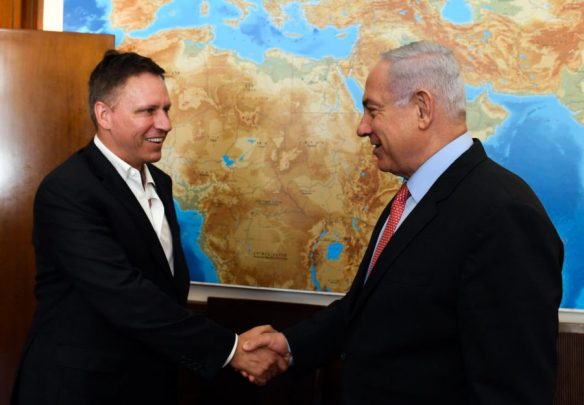
Peter Thiel Netanyahu
Peter Thiel greets Netanyahu during a 2017 meeting in Israel. Photo | Israel PM

SUNC is an organization founded by Paul Singer, who has donated heavily to both President Trump and Israeli Prime Minister Netanyahu. Since it was founded in 2012, SUNC has sought to integrate Unit 8200-connected Israeli tech start-ups into foreign companies, primarily American companies, and has helped oversee the shift of thousands of high-paying tech jobs from the U.S. to Israel.

Another Carbyne-connected individual worth noting is the former head of the Department of Homeland Security, Michael Chertoff, who serves on Carbyne’s board of advisers. In addition to Chertoff’s ties to DHS, Chertoff’s company, The Chertoff Group, employees several prominent former members of the U.S. intelligence community as principals, including Michael Hayden, former director of the CIA and former director of the NSA; and Charles Allen, former assistant director of Central Intelligence for Collection at the CIA, who worked at the agency for over 40 years.

The Chertoff Group has a long-standing and lucrative contract with the company OSI Systems, which produces full-body scanners and markets itself as a solution to mass shootings and crisis events, not unlike Carbyne. While Chertoff’s company was advising OSI Systems, Chertoff went on a media blitz to promote the widespread use of the machines produced by OSI Systems and even called on Congress to “fund a large-scale deployment of next-generation systems.” Chertoff did not disclose his conflict of interest while publicly promoting OSI’s full-body scanners.

Some have also alleged that Chertoff’s mother, Livia Eisen, had links to Israeli intelligence. According to her 1998 obituary, cited by both researcher/author Christopher Bollyn and journalist Jonathan Cook, Eisen participated in the Mossad operation code-named “Magic Carpet” while working for Israel’s El Al Airlines. Both Bollyn and Cook have suggested that Eisen’s participation in this covert Israeli intelligence operation strongly indicates that she had ties to the Mossad.


Melding into Silicon Valley

Beyond its troubling connections to Silicon Valley oligarchs, Israeli military intelligence and the U.S.-military industrial complex, Carbyne’s recent partnerships with two specific technology companies — Google and Cisco Systems — raise even more red flags.

Carbyne announced its partnership with Cisco Systems this past April, with the latter announcing that it would begin “aligning its unified call manager with Carbyne’s call-handling platform, allowing emergency call centers to collect data from both 911 callers and nearby government-owned IoT [Internet of Things] devices.” A report on the partnership published by Government Technology magazine stated that “Carbyne’s platform will be integrated into Cisco Kinetic for Cities, an IoT data platform that shares data across community infrastructure, smart city solutions, applications and connected devices.” The report also noted that “Carbyne will also be the only 911 solution in the Cisco Marketplace.”

As part of the partnership, Carbyne’s President of North American Operations Paul Tatro told Government Technology that the Carbyne platform would combine the data it obtains from smartphones and other Carbyne-connected devices with “what’s available through nearby Cisco-connected road cameras, roadside sensors, smart streetlamps, smart parking meters or other devices.” Tatro further asserted that “Carbyne can also analyze data that’s being collected by Cisco IoT devices … and alert 911 automatically, without any person making a phone call, if there appears to be a worthy problem,” and expressed his view that soon most emergency calls will not be made by human beings but “by smart cars, telematics or other smart city devices.”

A few months after partnering with Cisco Systems, Carbyne announced its partnership with Google on July 10, just three days after Carbyne funder Jeffrey Epstein was arrested in New York on federal sex trafficking charges. Carbyne’s press release of the partnership described how the company and Google would be teaming up in Mexico “to offer advanced mobile location to emergency communications centers (ECCs) throughout Mexico” following the conclusion of a successful four-week pilot program between Carbyne and Google in the Central American nation.

Netanyahu Eric Schmidt
Google Executive Chairman Eric Schmidt meets Netanyahu at his Jerusalem office. Israel PM | YouTube

The press release also stated:

Carbyne will provide Google’s Android ELS (Emergency Location Service) in real time from emergency calls made on AndroidTM devices. Deployment for any ECC in the country won’t require any integration, with Carbyne providing numerous options for connection to their secure ELS Gateway once an ECC is approved. The Carbyne automated platform, requiring no human interaction, has the potential to save thousands of lives each year throughout Mexico.”

The reason Carybne’s partnerships with Cisco Systems and Google are significant lies in the role that Cisco and former Google CEO Eric Schmidt have played in the creation of a controversial “incubator” for Israeli tech start-ups with deep ties to Israeli military intelligence, American neoconservative donor Paul Singer, and the U.S.’ National Security Agency (NSA).

This company, called Team8, is an Israeli company-creation platform whose CEO and co-founder is Nadav Zafrir, former commander of Unit 8200. Two of the company’s other three co-founders are also “alumni” of Unit 8200. Among Team8’s top investors is Schmidt, the former CEO of Google, who also joined Peter Thiel in funding the Unit 8200-linked BillGuard, as well as major tech companies including Cisco Systems and Microsoft.

Last year, Team8 controversially hired the former head of the NSA and U.S. Cyber Command, Retired Admiral Mike Rogers, and Zafrir stated that his interest in hiring Rogers was that Rogers would be “instrumental in helping strategize” Team8’s expansion in the United States. Jake Williams, a veteran of NSA’s Tailored Access Operations (TAO) hacking unit, told CyberScoop:

Rogers is not being brought into this role because of his technical experience. …It’s purely because of his knowledge of classified operations and his ability to influence many in the U.S. government and private-sector contractors.”

Team8 has also been heavily promoted by Start-Up Nation Central (SUNC). SUNC prominently features Team8 and Zafrir on the cybersecurity section of its website and also sponsored a talk by Zafrir and an Israeli government economist at the World Economic Forum, often referred to as “Davos,” that was attended personally by Paul Singer.

SUNC itself has deep ties to Israeli military intelligence, with former Unit 8200 officer Raphael Ouzan serving on its board of directors. Another example of SUNC-Unit 8200 ties can be seen with Inbal Arieli, who served as SUNC’s Vice President of Strategic Partnerships from 2014 to 2017 and continues to serve as a senior adviser to the organization. Arieli, a former lieutenant in Unit 8200, is the founder and head of the 8200 Entrepreneurship and Innovation Support Program (EISP), which was the first start-up accelerator in Israel aimed at harnessing “the vast network and entrepreneurial DNA of [Unit] 8200 alumni” and is currently one of the top company accelerators in Israel, alongside Team8. Arieli was the top executive at 8200 EISP while working at SUNC and several other top SUNC staffers are also connected to Israeli military intelligence.

Thus, Google and Cisco’s connections to Team8 suggests that their partnerships with another Israeli military intelligence-connected firm like Carbyne is a deepening of those two companies’ links to the growing bi-national security state that is uniting key players in the U.S. military-industrial complex and Israeli intelligence.


Mossad-backed Panic Buttons, coming to a school near you

Carbyne is hardly the only Israeli intelligence-linked tech company marketing itself in the United States as a solution to mass shootings. Another Israeli start-up, known as Gabriel, was founded in 2016 in response to a shooting in Tel Aviv and the Pulse Nightclub shooting in the United States, which took place just days apart.

Created by Israeli-American Yoni Sherizen and Israeli citizen Asaf Adler, Gabriel is similar to Carbyne in the sense that elements of its crisis response platform require installation on civilian smartphones as well as devices used by crisis responders. The main difference is that Gabriel also installs one or a series of physical “panic buttons,” depending on the size of the building to be secured, that also double as video and audio communication devices connected to the Gabriel network.

As with Carbyne, the ties between Gabriel and Israeli intelligence are obvious. Indeed, Gabriel’s four-person advisory board includes Ram Ben-Barak, former deputy director of the Mossad and former director-general of Israel’s intelligence ministry; Yohanan Danino, former chief of police for the state of Israel; and Kobi Mor, former director of overseas missions for the Israeli intelligence agency Shin Bet. The only American on the advisory board is Ryan Petty, the father of a Parkland shooting victim and friend of former Florida Governor Rick Scott.

Gabriel’s only disclosed funder is U.S.-based MassChallenge, a start-up accelerator non-profit. Gabriel is funded by MassChallenge’s Israel branch, which was opened six months prior to Gabriel’s creation and is partnered with the Israeli government and the Kraft Group. The Kraft Group is managed by Robert Kraft, who is currently embroiled in a prostitution scandal and is also a close friend of President Trump.

Notably, one of MassChallenge Israel’s featured experts is Wendy Singer, the executive director of SUNC, the organization created and funded by neoconservative Trump backer Paul Singer with the explicit purpose of promoting Israel’s tech start-ups and their integration into foreign, chiefly American, businesses. As was noted in a recent MintPress report on SUNC, Wendy Singer is the sister of neoconservative political operative Dan Senor, who founded the now-defunct Foreign Policy Initiative with Robert Kagan and Bill Kristol, and was previously the director of AIPAC’s Israel office for 16 years.

Gabriel’s founders have been quite upfront about the fact that the uptick in shootings in the U.S. has greatly aided their company’s growth and success. Last November, Sherizen told The Jerusalem Post that new mass shootings in the U.S. not only increased U.S. demand for his company’s product but also were opportunities to show the effectiveness of Gabriel’s approach:

Unfortunately every month there seems to be another high-profile event of this nature. After the Vegas shooting, we were able to show [that] our system would have managed to identify the location of the shooter much quicker.”

The Jerusalem Post noted that Gabriel is set to make considerable profits if concern over mass shootings continues to build in the U.S., writing:

With more than 475,000 soft targets across the US and amid increasing security fears, the potential market for Gabriel is huge. The company could gain revenues of almost $1 billion if only 10% of soft targets were to invest around $20,000 in its alert systems.”

Sherizen told the Jerusalem Post:

Our starter kit costs $10,000. Depending on the size and makeup of the community building, it would cost between $20-30,000 to fully outfit the location. We have made it very affordable. This is a game-changer for the lock-down and active shooter drills that are now a standard part of any child’s upbringing in the States.”


Much more than just a start-up

While it is certainly possible that numerous former officials and commanders of elite Israeli intelligence agencies may have no ulterior motive in advising or founding technology start-up companies, it is worth pointing out that top figures in Israel’s military intelligence agencies and the Mossad don’t see it that way.

Last March, Israeli media outlet Calcalist Tech published a report entitled “Israel Blurs the Line Between Defense Apparatus and Local Cybersecurity Hub,” which noted that “since 2012, cyber-related and intelligence projects that were previously carried out in-house in the Israeli military and Israel’s main intelligence arms are transferred to companies that in some cases were built for this exact purpose.” (emphasis added)

The article notes that beginning in 2012, Israel’s intelligence and military intelligence agencies began to outsource “activities that were previously managed in-house, with a focus on software and cyber technologies.” (emphasis added)

It continues:

In some cases, managers of development projects in the Israeli military and intelligence arms were encouraged to form their own companies, which then took over the project,’ an Israeli venture capitalist familiar with the matter told Calcalist Tech.”

Notably, Calcalist Tech states that the controversial company Black Cube was created this way and that Black Cube had been contracted, and is likely still contracted, by Israel’s Ministry of Defense. The private security agency Black Cube is known to have two separate divisions for corporations and governments. The firm was recently caught attempting to undermine the Iran nuclear deal — then also a top political objective of Israeli Prime Minister Benjamin Netanyahu — by attempting to obtain information on the “financial or sexual impropriety” (i.e., blackmail) of top U.S. officials involved in drafting the accord. NBC News noted last year that “Black Cube’s political work frequently intersects with Israel’s foreign policy priorities.” As previously mentioned, one of Carbyne’s co-founders — Lital Leshem, also a veteran of Unit 8200 — worked for Black Cube prior to starting Carbyne.

One of the main companies profiled in the Calcalist Tech report appeared to be a front for Israeli intelligence, as its registered owner was found not to exist: even high-level employees at the company had never heard of him; his registered addresses were for nonexistent locations in Israel’s capital of Tel Aviv; and the three people with that name in Tel Aviv denied any association with the business.

This company — which Calcalist Tech was unable to name after the Israeli military censor determined that doing so could negatively impact Israeli “national security” — was deliberately created to service the Israeli military and Israeli intelligence. It is also “focused on cyber technologies with expertise in research and development of advanced products and applications suitable for defense and commercial entities.” (emphases added) In addition, the company’s management consists largely of “veterans of Israeli military technology units.”

Notably, a former employee of this company told Calcalist Tech that “crossing the lines between military service and employment at the commercial outfit was ‘commonplace’ while he was working at the company.”

It’s not exactly clear why Israel’s military intelligence and other intelligence agencies decided to begin outsourcing its operations in 2012, though Calcalist Tech suggests the reasoning was related to the difference in wages between the private sector and the public sector, with pay being much higher in the former. However, it is notable that 2012 was also the year that Paul Singer — together with Netanyahu’s long-time economic adviser and former chair of the Israeli National Economic Council, Eugene Kandel — decided to create Start-Up Nation Central.

As MintPress noted earlier this year, SUNC was founded as part of a deliberate Israeli government effort to counter the nonviolent Boycott, Divest and Sanctions (BDS) movement and to make Israel the dominant global “cyber power.” This policy is aimed at increasing Israel’s diplomatic power and specifically undermining BDS as well as the United Nations, which has repeatedly condemned Israel’s government for war crimes and violations of international law in relation to the Palestinians.

Last year, Netanyahu was asked by Fox News host Mark Levin whether the large growth seen in recent years in Israel’s technology sector, specifically tech start-ups, was part of Netanyahu’s plan. Netanyahu responded, “That’s very much my plan … It’s a very deliberate policy.” He later added that “Israel had technology because the military, especially military intelligence, produced a lot of capabilities. These incredibly gifted young men and women who come out of the military or the Mossad, they want to start their start-ups.”

Netanyahu again outlined this policy at the 2019 Cybertech Conference in Tel Aviv, where he stated that Israel’s emergence as one of the top five “cyber powers” had “required allowing this combination of military intelligence, academia and industry to converge in one place” and that this further required allowing “our graduates of our military and intelligence units to merge into companies with local partners and foreign partners.”

The direct tie-ins of SUNC to Israel’s government and the successful effort led by SUNC and other companies and organizations to place former military intelligence and intelligence operatives in strategic positions in major multinational technology companies reveal that this “deliberate policy” has had a major and undeniable impact on the global tech industry, especially in Silicon Valley.


Mossad gets its own In-Q-Tel

This “deliberate policy” of Netanyahu’s also recently resulted in the creation of a Mossad-run venture capital fund that is specifically focused on financing Israeli tech start-ups. The venture capital fund, called Libertad, was first announced by Israel’s Prime Minister’s Office and was created with the explicit purpose of “increasing the Israeli intelligence agency’s knowledge base and fostering collaboration with Israel’s vibrant startup scene” It was modeled after the CIA’s venture capital fund In-Q-Tel, which invested in several Silicon Valley companies turned government and intelligence contractors — including Google and Palantir — with a similar goal in mind.

Libertad declines to reveal the recipients of its funding, but announced last December that it had chosen five companies in the fields of robotics, energy, encryption, web intelligence, and natural language processing and text analysis. In regard to its interest in web intelligence, a Mossad employee told the Jerusalem Post that the intelligence agency was specifically interested in “innovative technologies for [the] automatic identification of personality characteristics – personality profiling – based on online behavior and activity, using methods based on statistics, machine learning, and other areas.” (emphasis added)

According to Libertad’s website, in return for its investment, now set at NIS 2 million (~$580,000) per year per company, “the Mossad will receive access to the IP [initial product] developed during R&D [Research and Development] while under contract, and a non-commercial, non-exclusive license to use it. Libertad’s contract with the company will not provide it with any additional rights.” In an interview with Calcalist Tech, Mossad Director Yossi Cohen told the paper that the Mossad’s partnership with civilian companies in Israel is “excellent” and that the agency will continue to strengthen those ties.

Israeli intelligence has a documented history in placing “backdoors” into technology products for the purpose of surveillance, with one well-known case being Israel’s repurposing of the PROMIS software, discussed in Part III of MintPress’ series on Jeffrey Epstein. Furthermore, given that U.S. intelligence, specifically the NSA, had “backdoors” placed into the products of major Silicon Valley companies (a service performed by Israeli intelligence-linked tech companies no less), Mossad may very well plan on doing the same with the technology products of companies it backs through Libertad.

Tim Shorrock, investigative journalist and author of Spies For Hire: The Secret World of Intelligence Outsourcing, told MintPress that the Mossad’s continuation of such practices through Libertad was definitely plausible, especially given what Shorrock described as the “unusual” choice of Libertad choosing not to release the identities of the companies in which it invests.

“The Mossad is trying to hide what they are investing in,” Shorrock stated, adding that Libertad’s secrecy “raises a lot of questions” particularly given that it was modeled after the CIA’s In-Q-Tel. Shorrock noted that In-Q-Tel and other venture capital funds with ties to U.S. intelligence or the U.S. military rarely, if ever, hide the identities of the companies they finance.

However, Libertad is merely the latest and most public expression of the Mossad’s interest in Israeli tech start-ups, the lion’s share of which are created by veterans of Unit 8200 or other Israeli intelligence agencies. Indeed, former Mossad Director Tamir Pardo stated in 2017 that “everyone” in the Israeli cybertechnology sector is an “alumni” of either Israeli intelligence, like the Mossad, or Israeli military intelligence, like Unit 8200. Pardo even went as far as to say that the Mossad itself is “like a start-up.”

Pardo himself, after leaving his post as Mossad director in 2016, dove straight into the world of Israeli tech start-ups, becoming chairman of Sepio Systems, whose two CEOs are former Unit 8200 officers. Sepio Systems’ advisory board includes the former chief information security officer of the CIA, Robert Bigman; former member of the U.S. Military’s Joint Special Operations Command (JSOC), Geoff Hancock; and former head of the Israel National Cyber Bureau and veteran of Israeli military intelligence, Rami Efrati. Sepio Systems’ cybersecurity software has been adopted by several banks, telecom and insurance companies, including in the U.S. and Brazil.

Pardo is not the only prominent figure in Israel’s intelligence community to compare Israeli intelligence agencies to tech start-ups. Shin Bet Director Nadav Argaman described Israel’s domestic spy agency in similar terms. “The Shin Bet is like an evolving start-up, with unmatched strength,” Argaman stated in a June 2017 speech, as he extolled the agency’s use of “pre-crime” technology to detain Palestinians based on their social media activity.

Argaman, at the time, claimed that more than 2,000 Palestinians, whom he described as “potential lone-wolf terrorists,” had been arrested as a result of these “breakthrough technological advances” that use artificial-intelligence algorithms to monitor the social media accounts of Palestinians, especially younger Palestinians, for the use of “tripwire” phrases that have been used by Palestinians who later committed acts of violence. In the case of those who use such terms, “their phones are tracked to see if they meet other suspects, or leave their districts to move towards potential Israeli targets. In such cases, security forces detain the suspect,” according to a 2017 report on the practice by The Economist.


The road to fascism, paved by a corrupted PROMIS

Though Israeli intelligence’s interest in tech companies goes back several years, there is a well-documented history of Israeli intelligence using bugged software to surveil and gain “backdoor” access to government databases around the world, particularly in the United States.

As was mentioned in Part III of MintPress’ Epstein series, a sinister yet cunning plan was executed to place a backdoor for Israeli intelligence into the Prosecutor’s Management Information System (PROMIS) software, which was then being used by the U.S. Department of Justice and was the envy of government agencies, particularly intelligence agencies, around the world. This bugged version of PROMIS — born out of the collusion between Earl Brian, Ronald Reagan’s then-envoy to Iran, and Rafi Eitan, then-director of the now-defunct Israeli intelligence agency Lekem — was seeded around the world by Brian’s company Hadron as well as by Mossad-linked media mogul Robert Maxwell, father of Jeffrey Epstein’s long-time girlfriend and alleged madam, Ghislaine Maxwell.

After this first PROMIS “backdoor” was discovered, Israel would again gain access to sensitive U.S. government communications, as well as civilian communications, thanks to the collusion between Israeli intelligence and Israeli telecom and tech companies, especially Amdocs and Comverse Infosys (now Verint), that were operating throughout the United States. Today, Unit 8200-linked start-ups appear to have taken up the torch.

While the PROMIS software is perhaps best known for offering Israeli intelligence a backdoor into as many as 80 intelligence agencies and other sensitive locations around the world for nearly a decade, it was also used for a very different purpose by prominent officials linked to Iran-Contra.

One key Iran-Contra figure — Lt. Col. Oliver North, then serving on the National Security Council — decided to use PROMIS neither for espionage nor for foreign policy. Instead, North turned PROMIS’ power against Americans, particularly perceived dissidents, a fact that remained unknown for years.

Beginning in 1982, as part of the highly classified Continuity of Government (COG) program, North used the PROMIS software at a 6,100-square-foot “command center” in the Department of Justice, as well as at a smaller operations room at the White House, to compile a list of American dissidents and “potential troublemakers” if the COG protocol was ever invoked.

According to a senior government official with a high-ranking security clearance and service in five presidential administrations who spoke to Radar in 2008, this was:

A database of Americans, who, often for the slightest and most trivial reason, are considered unfriendly, and who, in a time of panic might be incarcerated. The database can identify and locate perceived ‘enemies of the state’ almost instantaneously.”

In 1993, Wired described North’s use of PROMIS in compiling this database as follows:

Using PROMIS, sources point out, North could have drawn up lists of anyone ever arrested for a political protest, for example, or anyone who had ever refused to pay their taxes. Compared to PROMIS, Richard Nixon’s enemies list or Sen. Joe McCarthy’s blacklist look downright crude.”

The COG program defined this “time of panic” as “a national crisis, such as nuclear war, violent and widespread internal dissent, or national opposition to a US military invasion abroad,” whereby the government would suspend the Constitution, declare martial law, and incarcerate perceived dissidents and other “unfriendlies” in order to prevent the government’s (or then-serving administration’s) overthrow.

This secretive database has often been referred to as “Main Core” by government insiders and, most troubling of all, it still exists today. Journalist Christ Ketcham, citing senior government officials, reported in 2008 that, at that time, Main Core was believed to contain the names of as many as 8 million Americans. Eleven years later, it is highly likely that the number of Americans included in the Main Core database has grown considerably.

Author and investigative journalist Tim Shorrock also covered other disturbing aspects of the evolution of Main Core back in 2008 for Salon. At the time, Shorrock reported that the George W. Bush administration was believed to have used Main Core to guide its domestic surveillance activities following the September 11 attacks.

Citing “several former U.S. government officials with extensive knowledge of intelligence operations,” Shorrock further noted that Main Core — as it was 11 years ago at the time his report was published — was said to contain “a vast amount of personal data on Americans, including NSA intercepts of bank and credit card transactions and the results of surveillance efforts by the FBI, the CIA and other agencies.”

Bill Hamilton, former NSA intelligence officer and the original creator of the PROMIS software, told Shorrock at the time that he believed that “U.S. intelligence uses PROMIS as the primary software for searching the Main Core database” and had been told as much by an intelligence official in 1992 and an NSA official in 1995. Dan Murphy, former deputy director at the CIA, had told Hamilton that the NSA’s use of PROMIS was “so seriously wrong that money alone cannot cure the problem.” “I believe in retrospect that Murphy was alluding to Main Core,” Hamilton had told Shorrock.

Though most reporting on Main Core, from the time its existence was first revealed to the present, has treated the database as something used by the U.S. government and U.S. intelligence for domestic purposes, MintPress has learned that Israeli intelligence was also involved with the creation of the Main Core database. According to a former U.S. intelligence official with direct knowledge of the U.S. intelligence community’s use of PROMIS and Main Core from the 1980s to 2000s, Israeli intelligence played a role in the U.S. government’s deployment of PROMIS as the software used for the Main Core domestic surveillance database system.

Israeli intelligence remained involved with Main Core at the time of the August 1991 death of journalist Danny Casolaro, who was investigating not only the government’s misuse of the stolen PROMIS software but also the Main Core database. This same official, who chose to remain anonymous, told MintPress that, shortly before his death, Casolaro had obtained copies of computer printouts from the PROMIS-based Main Core domestic surveillance database system from NSA whistleblower Alan Standorf, who was found murdered a few months before Casolaro’s lifeless body would be found in a West Virginia hotel room.

The source also stated that Main Core’s contents had been used for the political blackmail of members of Congress and their staff, journalists, and others by Walter Raymond, a senior CIA covert operator in psyops and disinformation who served on President Reagan’s National Security Council during and after Main Core’s creation. If used for this purpose by Raymond in the 1980s, Main Core has also likely been used by other individuals with access to the database for blackmailing purposes in the years since.

Given that Israeli intelligence was known to have placed a backdoor into the PROMIS software, before it was marketed and sold around the world by Earl Brian and Robert Maxwell, its role in the U.S. government’s decision to use PROMIS in the creation of Main Core suggests that Israeli intelligence likely advocated for the version of PROMIS containing this backdoor, thereby giving Israeli intelligence access to Main Core. Given that Reagan aides and officials colluded with Israeli “spymaster” Rafi Eitan in his efforts to create a backdoor into the software for Israeli military intelligence, the use of this version of PROMIS in the Main Core database is certainly plausible.

Furthermore, the fact that Israeli intelligence was known to be involved in Main Core nearly a decade after its creation suggests that Israeli intelligence may have played a role in certain aspects of the database, such as the criteria used to flag Americans as “unfriendly,” and — like Walter Raymond — may have used information in the database to blackmail Americans. In addition, the fact that the cooperation between U.S. and Israeli intelligence, particularly between Unit 8200 and the NSA, has only grown since 1991 further suggests that Israeli involvement in Main Core continues to the present.

While Main Core’s very existence is troubling for many reasons, the alleged involvement of a foreign intelligence service in the creation, expansion and maintenance of a database with personal details and potentially damaging information on millions of Americans targeted for detention or increased surveillance in times of crisis is chilling. It is especially so considering that the Trump administration’s latest proposals to prevent mass shootings before they occur are likely to use Main Core to flag certain Americans for increased surveillance or potentially detention, as was done by the George W. Bush administration following the September 11 attacks.

It appears that Main Core serves a dual purpose; first as a mass targeted surveillance system to crush dissent during times of “national crisis” — whether spontaneous or engineered — and, second, as a massive blackmail database used to keep every potential opponent in line during non-emergencies.


Peter Thiel’s Seeing Stone

As was mentioned earlier in this report, Palantir — the company co-founded by Peter Thiel — is set to profit handsomely from the Trump administration’s plans to use its “pre-crime” technology, which is already used by police departments throughout the country and also used to track Americans based on the company’s integrative data-mining approach. Palantir, named for the “seeing stones” in the Lord of the Rings novels, also markets software to foreign (and domestic) intelligence agencies that predicts the likelihood that an individual will commit an act of terrorism or violence.

Aside from its “pre-crime” products, Palantir has come under fire in recent years as a result of the company’s contracts with Immigration and Customs Enforcement (ICE), where it created an intelligence system known as Investigative Case Management (ICM). The IB Times described ICM as “a vast ‘ecosystem’ of data to help immigration officials in identifying targets and creating cases against them” and also “provides ICE agents with access to databases managed by other federal agencies.” ICM further gives ICE access to “targets’ personal and sensitive information, such as background on schooling, employment, family relationships, phone records, immigration history, biometrics data, criminal records as well as home and work addresses.” In other words, Palantir’s ICM is essentially a “Main Core” for immigrants.

Notably, part of Oliver North’s original intentions in “Main Core” was to track immigrants then coming from Central America as well as Americans who opposed Reagan era policy with respect to Central America. At that time, Main Core was believed to be controlled by the Federal Emergency Management Administration (FEMA), which is now part of the Department of Homeland Security (DHS).

VICE News reported in July that the Northern California Regional Intelligence Center, which is run by DHS, “serves around 300 communities in northern California and is what is known as a ‘fusion center,’ a Department of Homeland Security intelligence center that aggregates and investigates information from state, local, and federal agencies, as well as some private entities, into large databases that can be searched using software like Palantir. “ VICE further noted that this center alone used Palantir to surveil as many as 8 million Ameicans. There are many more such DHS “fusion centers” throughout the United States.

If the Trump administration moves forward with its proposal of employing technology to detect potential mass shooters before they strike, Palantir’s technology is set to be used, given that it has already been used by U.S. law enforcement and U.S. intelligence to determine which people run “the highest risk of being involved in gun violence,” according to an investigation of Palantir by The Verge. Furthermore, Palantir’s close ties to the Trump administration make the company’s role in a future nationwide “pre-crime” prevention system based on technology appear inevitable.
Apple CEO Tim Cook, right, and PayPal founder Peter Thiel, center, listen as President-elect Donald Trump speaks during a meeting with technology industry leaders at Trump Tower in New York, Wednesday, Dec. 14, 2016. (AP Photo/Evan Vucci)

Worse still is the apparent overlap between Palantir and Main Core. Palantir — which has obvious similarities to PROMIS — is already known to use its software to track potential terror threats, including domestic terror threats, and a category of people it refers to as “subversives.” Palantir’s tracking of these individuals “is all done using prediction.” Palantir’s close ties to the U.S. intelligence community suggest that Palantir may already have access to the Main Core database. Tim Shorrock told MintPress that Palantir’s use of Main Core is “certainly possible,” particularly in light of the company’s use of the term “subversive” to describe a category of people that its software tracks.

Palantir also has alleged ties to Israeli intelligence, as there have long been suspicions that Israeli intelligence has used Palantir as part of its AI “pre-crime” algorithms targeting Palestinians after Palantir opened a research and development (R&D) center in Israel in 2013. The current head of Palantir Israel, Hamultal Meridor, previously founded a brain-machine interface organization and was senior director of web intelligence at Verint (formerly Comverse Infosys), which has deep connections to Unit 8200, a history of espionage in the United States and was one of the two companies contracted by the NSA to insert a “backdoor” into the U.S. telecommunications system and popular products of major American tech companies.

Given the above, Peter Thiel’s 2018 decision to fund Carbyne, the Unit 8200-linked start-up that markets itself as a technological solution to mass shootings in the U.S., strongly suggests that Thiel has been anticipating for some time the now-public efforts of the Trump administration to employ “pre-crime” technology to track and target Americans who show signs of “mental illness” and “violent tendencies.”


A nightmare even Orwell could not have predicted

In early August, in the wake of the shooting at an El Paso Walmart, President Trump called on big tech companies to collaborate with the Justice Department in the creation of software that “stops mass murders before they start” by detecting potential mass shooters before they cnm act. Though Trump’s ideas were short on specifics, there is now a new proposal that would create a new government agency that will use data gathered from civilian electronic devices to identify “neurobehavioral” warning signs, thereby flagging “potential shooters” for increased surveillance and potentially detention.

This new agency, as proposed by the foundation led by former NBC Universal president and vice chairman of General Electric Robert Wright, would be known as the Health Advanced Research Projects Agency (HARPA) and would be modeled after the Defense Advanced Research Projects Agency (DARPA). Per the proposal, recently detailed by the Washington Post, the flagship program of HARPA would be “Safe Home” (Stopping Aberrant Fatal Events by Helping Overcome Mental Extremes), which would use “breakthrough technologies with high specificity and sensitivity for early diagnosis of neuropsychiatric violence,” specifically “advanced analytical tools based on artificial intelligence and machine learning.”

The program would cost an estimated $60 million over four years and would use data from “Apple Watches, Fitbits, Amazon Echo and Google Home” and other consumer electronic devices, as well as information provided by health-care providers to identify who may be a threat.

The Washington Post reported that President Trump has reacted “very positively” to the proposal and that he was “sold on the concept.” The Post also noted that Wright sees the president’s daughter, Ivanka, as “the most effective champion of the proposal and has previously briefed her on HARPA himself.” Ivanka has previously been cited as a driving force behind some of her father’s policy decisions, including his decision to bomb Syria after an alleged chemical weapons attack in 2017.

Liz Fed — president of the Susan Wright Foundation, which is led by Robert Wright and created the proposal for HARPA and “Safe Home” — told The Post that the proposal emulated DARPA because “DARPA is a brilliant model that works. They have developed the most transformational capabilities in the world for national security…We’re not leveraging the tools and technologies available to us to improve and save lives.” Fed further asserted that DARPA’s technological approach had yet to be applied to the field of healthcare.

For anyone familiar with DARPA, such claims should immediately sound loud alarm bells, especially since DARPA is already developing its own solution to “mental health” issues in the form of a “brain-machine interface” as part of its N3 program. That program, according to reports, involves “noninvasive and ‘minutely’ invasive neural interfaces to both read and write into the brain,” help distance soldiers “from the emotional guilt of warfare” by “clouding their perception” and “to program artificial memories of fear, desire, and experiences directly into the brain.” Though N3 is intended to improve the prowess of American soldiers, it is also set to be used as a means of pursuing DARPA’s Systems-Based Neurotechnology for Emerging Therapies (SUBNETS) project, which aims to “to develop a tiny, implanted chip in the skull to treat psychiatric disorders such as anxiety, PTSD and major depression.”

Given that HARPA’s lead scientific adviser is Dr. Geoffrey Ling, former director and founder of DARPA’s Biological Technologies Office (BTO), which “merges biology, engineering, and computer science to harness the power of natural systems for national security,” it seems likely that DARPA’s neurological-focused research programs, like SUBNETS and N3, would be folded into HARPA’s portfolio, making the proposed agency’s approach to mental health very questionable indeed.

Aside from the dystopian nature of both DARPA and potentially HARPA’s approach to mental health, there is grave cause for concern regarding the Trump administration’s moves to address U.S. mass shooting events by implementing pre-crime technology based on artificial intelligence, data-mining and mass surveillance, technologies already laying in wait thanks to companies like Palantir and numerous Israeli tech start-ups led by former Unit 8200 officers.

With companies like Carbyne — with its ties to both the Trump administration and to Israeli intelligence — and the Mossad-linked Gabriel also marketing themselves as “technological” solutions to mass shootings while also doubling as covert tools for mass data collection and extraction, the end result is a massive surveillance system so complete and so dystopian that even George Orwell himself could not have predicted it.

Following another catastrophic mass shooting or crisis event, aggressive efforts will likely follow to foist these “solutions” on a frightened American public by the very network connected, not only to Jeffrey Epstein, but to a litany of crimes and a frightening history of plans to crush internal dissent and would-be dissenters in the United States.

Feature photo | Graphic by Claudio Cabrera

Whitney Webb is a MintPress News journalist based in Chile. She has contributed to several independent media outlets including Global Research, EcoWatch, the Ron Paul Institute and 21st Century Wire, among others. She has made several radio and television appearances and is the 2019 winner of the Serena Shim Award for Uncompromised Integrity in Journalism.


 

War Profiteers and the Demise of the US Military-Industrial Complex

By Dmitry Orlov

Source: Club Orlov

Within the vast bureaucratic sprawl of the Pentagon there is a group in charge of monitoring the general state of the military-industrial complex and its continued ability to fulfill the requirements of the national defense strategy. Office for acquisition and sustainment and office for industrial policy spends some $100,000 a year producing an Annual Report to Congress. It is available to the general public. It is even available to the general public in Russia, and Russian experts had a really good time poring over it.

In fact, it filled them with optimism. You see, Russia wants peace but the US seems to want war and keeps making threatening gestures against a longish list of countries that refuse to do its bidding or simply don’t share its “universal values.” But now it turns out that threats (and the increasingly toothless economic sanctions) are pretty much all that the US is still capable of dishing out—this in spite of absolutely astronomical levels of defense spending. Let’s see what the US military-industrial complex looks like through a Russian lens.

It is important to note that the report’s authors were not aiming to force legislators to finance some specific project. This makes it more valuable than numerous other sources, whose authors’ main objective was to belly up to the federal feeding trough, and which therefore tend to be light on facts and heavy on hype. No doubt, politics still played a part in how various details are portrayed, but there seems to be a limit to the number of problems its authors can airbrush out of the picture and still do a reasonable job in analyzing the situation and in formulating their recommendations.

What knocked Russian analysis over with a feather is the fact that these INDPOL experts (who, like the rest of the US DOD, love acronyms) evaluate the US military-industrial complex from a… market-based perspective! You see, the Russian military-industrial complex is fully owned by the Russian government and works exclusively in its interests; anything else would be considered treason. But the US military-industrial complex is evaluated based on its… profitability! According to INDPOL, it must not only produce products for the military but also acquire market share in the global weapons trade and, perhaps most importantly, maximize profitability for private investors. By this standard, it is doing well: for 2017 the gross margin (EBITDA) for US defense contractors ranged from 15 to 17%, and some subcontractors—Transdigm, for example—managed to deliver no less than 42-45%. “Ah!” cry the Russian experts, “We’ve found the problem! The Americans have legalized war profiteering!” (This, by the way, is but one of many instances of something called systemic corruption, which is rife in the US.)

It would be one thing if each defense contractor simply took its cut off the top, but instead there is an entire food chain of defense contractors, all of which are legally required, no less, to maximize profits for their shareholders. More than 28,000 companies are involved, but the actual first-tier defense contractors with which the Pentagon places 2/3 of all defense contracts are just the Big Six: Lockheed Martin, Northrop Grumman, Raytheon, General Dynmics, BAE Systems and Boeing. All the other companies are organized into a pyramid of subcontractors with five levels of hierarchy, and at each level they do their best to milk the tier above them.

The insistence on market-based methods and the requirement of maximizing profitability turns out to be incompatible with defense spending on a very basic level: defense spending is intermittent and cyclical, with long fallow intervals between major orders. This has forced even the Big Six to make cuts to their defense-directed departments in favor of expanding civilian production. Also, in spite of the huge size of the US defense budget, it is of finite size (there being just one planet to blow up), as is the global weapons market. Since, in a market economy, every company faces the choice of grow or get bought out, this has precipitated scores of mergers and acquisitions, resulting in a highly consolidated marketplace with a few major players in each space.

As a result, in most spaces, of which the report’s authors discuss 17, including the Navy, land forces, air force, electronics, nuclear weapons, space technology and so on, at least a third of the time the Pentagon has a choice of exactly one contractor for any given contract, causing quality and timeliness to suffer and driving up prices.

In a number of cases, in spite of its industrial and financial might, the Pentagon has encountered insoluble problems. Specifically, it turns out that the US has only one shipyard left that is capable of building nuclear aircraft carriers (at all, that is; the USS Gerald Ford is not exactly a success). That is Northrop Grumman Newport News Shipbuilding in Newport, Virginia. In theory, it could work on three ships in parallel, but two of the slips are permanently occupied by existing aircraft carriers that require maintenance. This is not a unique case: the number of shipyards capable of building nuclear submarines, destroyers and other types of vessels is also exactly one. Thus, in case of a protracted conflict with a serious adversary in which a significant portion of the US Navy has been sunk, ships will be impossible to replace within any reasonable amount of time.

The situation is somewhat better with regard to aircraft manufacturing. The plants that exist can produce 40 planes a month and could produce 130 a month if pressed. On the other hand, the situation with tanks and artillery is absolutely dismal. According to this report, the US has completely lost the competency for building the new generation of tanks. It is no longer even a question of missing plant and equipment; in the US, a second generation of engineers who have never designed a tank is currently going into retirement. Their replacements have no one to learn from and only know about modern tanks from movies and video games. As far as artillery, there is just one remaining production line in the US that can produce barrels larger than 40mm; it is fully booked up and would be unable to ramp up production in case of war. The contractor is unwilling to expand production without the Pentagon guaranteeing at least 45% utilization, since that would be unprofitable.

The situation is similar for the entire list of areas; it is better for dual-use technologies that can be sourced from civilian companies and significantly worse for highly specialized ones. Unit cost for every type of military equipment goes up year after year while the volumes being acquired continuously trend lower—sometimes all the way to zero. Over the past 15 years the US hasn’t acquired a single new tank. They keep modernizing the old ones, but at a rate that’s no higher than 100 a year.

Because of all these tendencies and trends, the defense industry continues to lose not only qualified personnel but also the very ability to perform the work. INDPOL experts estimate that the deficit in machine tools has reached 27%. Over the past quarter-century the US has stopped manufacturing a wide variety of manufacturing equipment. Only half of these tools can be imported from allies or friendly nations; for the rest, there is just one source: China. They analyzed the supply chains for 600 of the most important types of weapons and found that a third of them have breaks in them while another third have completely broken down. In the Pentagon’s five-tier subcontractor pyramid, component manufacturers are almost always relegated to the bottommost tier, and the notices they issue when they terminate production or shut down completely tend to drown in the Pentagon’s bureaucratic swamp.

The end result of all this is that theoretically the Pentagon is still capable of doing small production runs of weapons to compensate for ongoing losses in localized, low-intensity conflicts during a general time of peace, but even today this is at the extreme end of its capabilities. In case of a serious conflict with any well-armed nation, all it will be able to rely on is the existing stockpile of ordnance and spare parts, which will be quickly depleted.

A similar situation prevails in the area of rare earth elements and other materials for producing electronics. At the moment, the accumulated stockpile of these supplies needed for producing missiles and space technology—most importantly, satellites—is sufficient for five years at the current rate of use.

The report specifically calls out the dire situation in the area of strategic nuclear weapons. Almost all the technology for communications, targeting, trajectory calculations and arming of the ICBM warheads was developed in the 1960s and 70s. To this day, data is loaded from 5-inch floppy diskettes, which were last mass-produced 15 years ago. There are no replacements for them and the people who designed them are busy pushing up daisies. The choice is between buying tiny production runs of all the consumables at an extravagant expense and developing from scratch the entire land-based strategic triad component at the cost of three annual Pentagon budgets.

There are lots of specific problems in each area described in the report, but the main one is loss of competence among technical and engineering staff caused by a low level of orders for replacements or for new product development. The situation is such that promising new theoretical developments coming out of research centers such as DARPA cannot be realized given the present set of technical competencies. For a number of key specializations there are fewer than three dozen trained, experienced specialists.

This situation is expected to continue to deteriorate, with the number of personnel employed in the defense sector declining 11-16% over the next decade, mainly due to a shortage of young candidates qualified to replace those who are retiring. A specific example: development work on the F-35 is nearing completion and there won’t be a need to develop a new jet fighter until 2035-2040; in the meantime, the personnel who were involved in its development will be idled and their level of competence will deteriorate.

Although at the moment the US still leads the world in defense spending ($610 billion of $1.7 trillion in 2017, which is roughly 36% of all the military spending on the planet) the US economy is no longer able to support the entire technology pyramid even in a time of relative peace and prosperity. On paper the US still looks like a leader in military technology, but the foundations of its military supremacy have eroded. Results of this are plainly visible:

• The US threatened North Korea with military action but was then forced to back off because it has no ability to fight a war against it.

• The US threatened Iran with military action but was then forced to back off because it has no ability to fight a war against it.

• The US lost the war in Afghanistan to the Taliban, and once the longest military conflict in US history is finally over the political situation there will return to status quo ante with the Taliban in charge and Islamic terrorist training camps back in operation.

• US proxies (Saudi Arabia, mostly) fighting in Yemen have produced a humanitarian disaster but have been unable to prevail militarily.

• US actions in Syria have led to a consolidation of power and territory by the Syrian government and newly dominant regional position for Russia, Iran and Turkey.

• The second-largest NATO power Turkey has purchased Russian S-400 air defense systems. The US alternative is the Patriot system, which is twice as expensive and doesn’t really work.

All of this points to the fact that the US is no longer much a military power at all. This is good news for at least the following four reasons.

First, the US is by far the most belligerent country on Earth, having invaded scores of nations and continuing to occupy many of them. The fact that it can’t fight any more means that opportunities for peace are bound to increase.

Second, once the news sinks in that the Pentagon is nothing more than a flush toilet for public funds its funding will be cut off and the population of the US might see the money that is currently fattening up war profiteers being spent on some roads and bridges, although it’s looking far more likely that it will all go into paying interest expense on federal debt (while supplies last).

Third, US politicians will lose the ability to keep the populace in a state of permanent anxiety about “national security.” In fact, the US has “natural security”—two oceans—and doesn’t need much national defense at all (provided it keeps to itself and doesn’t try to make trouble for others). The Canadians aren’t going to invade, and while the southern border does need some guarding, that can be taken care of at the state/county level by some good ol’ boys using weapons and ammo they already happen to have on hand. Once this $1.7 trillion “national defense” monkey is off their backs, ordinary American citizens will be able to work less, play more and feel less aggressive, anxious, depressed and paranoid.

Last but not least, it will be wonderful to see the war profiteers reduced to scraping under sofa cushions for loose change. All that the US military has been able to produce for a long time now is misery, the technical term for which is “humanitarian disaster.” Look at the aftermath of US military involvement in Serbia/Kosovo, Afghanistan, Iraq, Libya, Syria and Yemen, and what do you see? You see misery—both for the locals and for US citizens who lost their family members, had their limbs blown off, or are now suffering from PTSD or brain injury. It would be only fair if that misery were to circle back to those who had profited from it.

The Struggle for Peace in Afghanistan: Is Community Engagement the Key?

By Robert J. Burrowes

I have just read a superb book by Mark Isaacs, an Australian who has documented several years of effort by a group of incredibly committed young people in Afghanistan to build peace in that war-torn country the only way it can be built: by learning, living and sharing peace.

The book, titled The Kabul Peace House: How a Group of Young Afghans are Daring to Dream in a Land of War, records in considerable detail the struggle, both internal and external, to generate a peaceful future in Afghanistan. Some might consider this vision naive, others courageous, but few would doubt the simple reality: it is slow, daunting, incredibly difficult, often saddening, frightening, infuriating or painful, sometimes uplifting or hilarious and, just occasionally, utterly rewarding.

This is a human story written by a person who knows how to listen and to observe. And because the subject is about a group of ordinary Afghans and their mentor doing their best in the struggle to end one of the longest wars in human history, it is a story that is well worth reading.

This story is embedded in a combination of (brief) historical background on Afghanistan’s longstanding and central role in imperial geopolitics (including during ‘The Great Game’ of the 19th century) and more recent history on the progressive modernity of Afghanistan prior to the Soviet invasion in 1979 which was followed by an ongoing and multifaceted war in which the United States has played the most damaging role since its invasion of the country in 2001. But the background also includes a description of the ethnic diversity throughout the country, the role of religion and gender relations (and the challenges these social parameters present), as well as commentary on the social, economic and political regression as a result of the war’s many adverse impacts. So the book weaves a lot of strands into a compelling story of nonviolent resistance and regeneration against almost overwhelming odds.

However, that is not all. Given that all of the Afghans in this visionary community have each been traumatized by their unique experience of war, the book doesn’t shy away from describing the challenges this presents both to them personally and to the community, including its mentor and even some of the community’s many international visitors.

Most of the community members – whether Pashtun, Hazara, Uzbek, Turkmen, Tajik, Sayyid, Pashai… – have suffered serious loss during the war, especially those members who have had family and other relatives killed, or worse. Worse? you might ask. What is worse than death? Well, after reading this book, you will better understand that the context and the manner of death mean a great deal psychologically. None of the victims of this war died peacefully in their sleep after long and meaningful lives and this is just one part of the psychological trauma suffered by so many in this particular community but also in wider Afghan society.

So what does this community in Kabul do? Well, throughout its evolution and many manifestations, the community has done many things including run a variety of projects intended to foster understanding, cooperation and learning: nurture mutual respect among the diversity of people that constitute its membership, teach some of its members to read and write and facilitate learning opportunities in other contexts, teach the meaning and practice of nonviolence, give street kids the chance to learn skills that will make them employable, make duvets to give to people who go cold in Afghanistan’s freezing winters, teach and practice permaculture, organize protests against the war (including by flying kites instead of drones), and generally working to create a world that is green, equal and nonviolent.

If you think this sounds all good and straightforward, given slowly spreading acceptance of such ideas elsewhere (in some circles at least), then you might have underestimated their radical nature in a society in which ideas about nonviolence, equality and sustainability have, for the most part, not been previously encountered and have certainly not taken root. Isaacs records the observations of the group’s mentor on these subjects: ‘Over the years I have seen how the volunteers have changed within their personal lives, even if it means distancing themselves from the traditions of their own family…. But on a public level it’s much slower.’

This is understandable. As Isaacs notes, even in ordinary conversation and group discussions, ‘the weight of resistance, the taboos and the self-censorship’ made an impact on him. In a culture in which, in 2015, a woman in her twenties was stoned, her body run over by a car and then dumped in a river and set on fire because a mullah falsely accused her of burning the Quran, there is a long way to go.

One of the things that I found most compelling about the book is the occasional ‘biography’ of one of the community’s main characters. Given pseudonyms to avoid possible adverse repercussions, these stories provide real insight into the lives of certain community members and their struggle to leave home (in some cases), to join the community, to find their place within it and gain acceptance by the other members.

Some, like Hojar, are more outspoken and this, for a woman, is unusual in itself. Hojar is deeply aware of the gender inequality and violence against women in Afghanistan and will talk about it. This inspires other women, like Tara, who have not experienced this outspokenness before.

But Hojar’s life had started differently, in the mountains where, as a teenager, she was getting up at 3am to start baking bread for her four snoring brothers before milking the goats and sheep. ‘I am not a woman’, she thought, ‘I am a slave’. Fortunately and unusually, Hojar’s parents supported her desire to not marry at 13 or 15, but to continue her education and follow her dreams. It’s a long, painful, terrifying and fascinating journey but Hojar ended up in this novel community experiment in Kabul where her now college-educated talent was highly valued and put to wonderful use. She has my utmost admiration.

Unlike Hojar, other community members, like Horse, originally a shepherd in the mountains, are more circumspect on gender equality and other issues. But this doesn’t mean that Horse is not active, at times playing roles in the networking team, the accounts team and, particularly, as coordinator of the food cooperative which provided monthly gifts of food to the impoverished families of one hundred children who studied at the community’s street kids school. If you think raising donations to pay for this food was easy, particularly given the community decision to avoid the international aid sector to try to encourage Afghans to help their fellow Afghans, when more than half of the population lived below the poverty line and unemployment was at 40%, you will find it compelling to read how the teenaged Horse struggled with the monumental range of challenges he faced in that particular role. He has my admiration too.

Insaan, a doctor who mentors the community, provides a compelling story as well. Originally from another country, in 2002 a consultation with a patient at his successful medical practice inspired him to depart some time later. After spending more than two years in Pakistan, working with refugees from Afghanistan, he went to Afghanistan in 2004 to work for an international NGO in public health education in its central mountainous region.

His ongoing experience in this role, however, taught him that every problem the villagers faced had its origins in the war. And this underpinned his gradual transformation from health professional to peace activist. He discovered Thoreau, Gandhi and King, among others, and ‘became convinced of the power of love’. By 2008, Insaan had initiated his first multi-ethnic live-in community (although he did not live in it himself) in the mountains but in 2011, when his house was deliberately burned down, he departed for Kabul determined to restart the peace work he had begun in the mountains.

Starting with three young people who accompanied him from the mountains, the first manifestation of a live-in peace community in Kabul was soon underway. Endlessly paying attention, trying to provide guidance, reconcile those in conflict, and even withstanding threats of violence, Insaan’s love has undoubtedly been the glue that has held the growing and evolving community together. But not without cost. At times, Insaan has struggled, emotionally and otherwise, to survive in this perpetual war zone as the key figure holding this loving experiment together. He is a truly remarkable human being.

And it is because of the trauma that he and each of the other community members has suffered, that I hope that, in future, they can somehow dedicate time to their own personal, emotional healing. See ‘Putting Feelings First’ and ‘Nisteling: The Art of Deep Listening’. There is no better investment for any human being than to spend time consciously focusing on feeling the fear, pain, anger and sadness that we are taught and terrorized into suppressing during childhood (so that we become the obedient slaves that our society wants). Given the extraordinary violence that the people of Afghanistan have suffered and are still suffering, the value of making this investment would be even greater.

Anyway, if you want to read an account of the deeply personal human costs of war, and what one community is doing about it, read this book. It isn’t all pretty but, somehow, this remarkable community, through all of its manifestations over many years, its successes and failures, manages to inspire one with the sense that while those insane humans who spend their time planning, justifying, fighting and profiting from wars against people in other countries, those people on the receiving end of their violence are capable of visioning a better tomorrow and working to achieve it. No matter how difficult or how long it takes. Moreover, we can help too. See Nonviolent Campaign Strategy.

So allow yourself to be inspired by a group of young people, each of whom has lived their entire life in a country at war both with itself and with foreign countries, but has refused to submit to the predominant delusion that violence is the way out.


Biodata: Robert J. Burrowes has a lifetime commitment to understanding and ending human violence. He has done extensive research since 1966 in an effort to understand why human beings are violent and has been a nonviolent activist since 1981. He is the author of Why Violence? His email address is flametree@riseup.net and his website is here.

EMPIRES ARE A SECRET UNTIL THEY START FALLING

By Margaret Flowers and Kevin Zeese

Source: Popular Resistance

In the past, we have written about the 2020s as a decade when the United States Empire will end. This is based on Alfred McCoy’s predictions (listen to our interview with him on Clearing the FOG). Sociologist and peace scholar John Galtung believes US Empire will fall much faster, losing world dominance by 2020. Much of what he predicted when he said this in 2016 is happening now. In particular, there is a rise in “reactionary fascism” or a desire to go back to the “good old days,” the cost of maintaining the empire is taking an increasing economic toll and other countries are starting to rebuke the US, both its requests for military assistance and its unfair economic demands.

What this means for people in the United States and around the world depends on whether we can build a mass popular movement with the clarity of vision, skills, and solidarity necessary to navigate what is and will surely be a turbulent period. There are no guarantees as to the outcome. Failure to act could result in a disastrous scenario – at best, that the US will continue to try to hold onto power by waging economic and military warfare abroad weakening the economy at home and undermining necessities such as housing, healthcare, education and the transition to a Green economy. At worst, as Galtung describes, there could be “an inevitable and final war” involving nuclear weapons.

When Empire Is In Decline

Alfred McCoy says that it is only when empires are in decline that people begin to recognize they live in an empire and start to talk about it. While discussion of empire hasn’t broken into the corporate media, it is certainly happening in the independent media. A concerted effort by a popular movement could bring it to the fore, just as Occupy changed the political dialogue about wealth inequality and the power of money. People in the US need to face some stark realities when it comes to declining US global power.

For starters, the United States does not currently have the capacity to wage a “Great Power Conflict” even though that is the goal of the national security strategy. The loss of its manufacturing base and lack of access to minerals necessary for producing weapons and electronics means the US does not have the resources to fight a great war. Much of the US’ manufacturing has been outsourced to other countries, including those targeted by US foreign policy. Resources necessary for weapons and electronics are in China, Afghanistan, the Democratic Republic of the Congo and Venezuela. It’s no surprise that the US is maintaining a military presence in Afghanistan, has increased its presence in Africa through AFRICOM and is struggling to wrest control of Venezuela.

Despite these attempts, the US is not having success. There is no military solution for the US in Afghanistan. As Moon of Alabama explains, the Taliban has taken control of more territory than it has had since the US started the war and has no reason to negotiate with the US. He advises, “The U.S. should just leave as long as it can. There will come a point when the only way out will be by helicopter from the embassy roof.”

Alexander Rubinstein writes the failures in Afghanistan can be attributed to Zalmay Khalilzad, currently the US Special Representative for Afghanistan Reconciliation. Khalilzad has led US foreign policy in Afganistan and Iraq since the presidency of George W. Bush, and before that worked with Carter’s National Security Advisor Zbigniew Brzezinski, who provided crucial support for the Mujahideen to draw the Soviet Union into a quagmire. The writing is on the wall that the US must leave Afghanistan, but that is unlikely to happen as long as people such as Khalilzad and Elliott Abrams, who has a similar ideology, are in charge.

As the US-led coup in Venezuela continues to fail due to a lack of support for it within the country, resilience to the effects of the unilateral coercive economic measures (sanctions) and exposure of attempts to create chaos and terror by paramilitary mercenaries, the US grows increasingly desperate in its tactics. There has already been a failed assassination attempt against President Maduro, a US freight company tied to the CIA has been caught smuggling weapons and the US and its Puppet Guaido have been implicated in a terrorist plot as the failed coup enters a more dangerous phase. This week, the Organization of American States voted to invoke a treaty, the Inter-American Treaty of Reciprocal Assistance (TIAR), which would allow military intervention. Mexico strongly opposed that possibility. This comes as Venezuela has strengthened troops at the Colombian border after discovering terrorist training camps on the Colombian side. With allies such as Russia and China, an attack on Venezuela would not only hurt the region but could go global.

Despite the Asian Pivot under President Obama during his first administration and Secretary of Defense Mark Esper’s comment this week that the US is directing a lot of energy toward China, analysts predict the US will fail to achieve dominance in the Asia-Pacific. China is purchasing weapons from Russia that are superior to US systems, is strengthening its military coordination with Russia through drills and is expanding its global ties through the Belt and Road Initiative. Matthew Ehret writes in Strategic Culture, “Those American military officials promoting the obsolete doctrine of Full Spectrum dominance are dancing to the tune of a song that stopped playing some time ago. Both Russia and China have changed the rules of the game on a multitude of levels….”

Protests in Hong Kong, as we described in a recent newsletter, are being used to stoke greater anti-China sentiment in the US. As often occurs, the sophisticated propaganda arm of US-backed color revolutions excites leftist activists, but each day it becomes clearer just how deep the US’ influence is. K. J. Noh provides a helpful guide – a list of seven signs a protest is not a popular progressive uprising. One sign is Hong Kong protesters are supporting a bill in the US Congress, the so-called “Hong Kong Human Rights and Democracy Act.” The bill would allow the United States to sanction Hong Kong officials.

Andre Vltchek attended a recent protest and interviewed some of the participants. He found the democracy protesters have little grasp on the oppression Hong Kongers faced under British colonization, they attack anyone who disagrees with them and they are destroying public infrastructure. One of the protest leaders, Joshua Wong, is openly meeting with figures connected to US regime change efforts, and NED-backed organizations are planning an anti-China protest in Washington, DC on September 29. Their new propaganda symbol is a Chinese flag with a Swastika on it. No surprise that was evident at the protests in Hong Kong this weekend.

The US is already at war with China with battlefronts on trade and the Asian Pacific. The propaganda around Hong Kong showing prejudice against China is part of manufacturing consent for the conflict between the US and China, which will define the 21st Century. US militarism is also escalating to involve space. This week, the US conducted its first space war game and Putin warned of a space arms race.

Our Tasks as Activists

It was good news this past week that President Trump asked John Bolton, a white supremacist neocon who disrupted any attempts at negotiation, to resign from his position as National Security Adviser. Glen Ford of Black Agenda Report writes, “Every sane person on the planet should be glad to see Bolton go.” But, even with Bolton gone, the US War Machine will rage on with bi-partisan support. Whether Trump starts to live up to his campaign rhetoric of non-intervention remains to be seen. The appointment of Michael Kozak as the new US envoy to Latin America is a bad sign.

Almost two centuries of Manifest Destiny that went beyond North America to spread US Empire across the globe will not end overnight. It will take a concerted effort to build a national consensus against the dominant ideologies of white supremacy and US exceptionalism to change the course of US foreign policy. Fundamental tasks of that effort include education, organizing and mobilizing. Below are some examples of each.

Education:

The Palestinian Great March of Return, a weekly nonviolent protest in Gaza demanding the right of return granted by the United Nations, continues and each week Israelis injure and murder unarmed Palestinians. Abby Martin and Mike Prysner of The Empire Files produced an excellent documentary about it, “Gaza Fights For Freedom,” and are touring the country to raise awareness. Listen to our interview with Abby Martin on Clearing the FOG. Find a showing near you or organize one.

The United States uses unilateral coercive measures (sanctions) that are illegal under international law to wage war on other countries. The Treasury Department currently lists 20 countries sanctioned by the US, but the US also uses threats of sanctions to wield power. Sanctions are warfare, even though they are not commonly viewed that way. They result in the suffering and death of mostly civilians. Kevin Cashman and Cavan Kharrazian explain how sanctions work, why they violate international law and how they threaten global stability.

Organizing:

Alison Bodine and Ali Yerevani encourage activists to avoid the organizing pitfall of getting caught up in debates about the internal politics of countries targeted by US imperialism. Our tasks, as citizens of imperialist countries, are to stop our governments from intervening in the affairs of other countries and demand they respect international law. We also have a task of building solidarity with civilians of other countries. It will require a global mass movement to address major issues such as the climate crisis, wealth inequality, colonization, and violence.

Citizen to citizen diplomacy is critical in building this mass movement and solidarity. Ann Wright, retired from the military and State Department, writes about the challenges of citizen to citizen diplomacy as she tours Russia. Ajamu Baraka, national organizer of Black Alliance for Peace, reminds us that war and militarism are class issues in his address to an international meeting of trade unions held in Syria.

We are strong believers in breaking out of the confines of the narrative presented by corporate media about countries outside the US. Our trips to Iran and Venezuela this year were invaluable learning experiences. We hope to visit more targeted countries. An effort that came out of these trips is the new Global Appeal for Peace, first steps toward creating an international network to complement the more than 120 non-aligned movement countries that are resolved to respect international law and sovereignty and take action to create peace and prevent the catastrophic climate crisis. Sign on to this effort at GlobalAppeal4Peace.net.

Mobilizing:

The People’s Mobilization to Stop the US War Machine and Save the Planet starts next weekend. On Saturday night, Black Alliance for Peace is sponsoring a discussion, “Race, Militarism and Black Resistance in the ‘Americas’” in the Bronx. On Sunday we will rally and march to the UN with Embassy Protectors, Roger Waters and many more. On Monday night, we have a special solidarity night at Community Church of New York. Registration is required as there will be high-level representatives of impacted countries speaking about the challenges they face. Click here to register.

Rage Against the US War Machine will take place October 11 and 12 in Washington, DC. This is the second annual event organized by March on the Pentagon. Click here for details.

We also ask you to join the Embassy Protectors Defense Committee. Sign the petition to drop the Trump administration’s charges against us for protecting the Venezuelan Embassy this spring. We are facing up to a year in prison and exorbitant fines even though it was the US State Department that violated the Vienna Convention by raiding the embassy in May. We will tour Northern California in October and are planning more tours to raise awareness that the struggle to end the US  coup and interventions in Venezuela continues.

John Galtung predicts that the fall of the US Empire could have a devastating impact on domestic cohesion in the United States. As the US loses its position of global supremacy, we have an opportunity to fundamentally reshape what we as a nation represent. We can become cooperative global citizens in a world free of oppression, violence, and poverty if we do the work of joining in international solidarity for these goals.

Comparative Political Leadership: Gandhi vs. Contemporary Leaders

By Robert J. Burrowes

On 2 October 2019, it will be the 150th anniversary of the birth of Mohandas K. Gandhi in Gujarat, India. I would like to reflect on the visionary leadership that Gandhi offered the world, briefly comparing it with some national leaders of today, and to invite you to emulate Gandhi’s leadership.

While Gandhi is best remembered for being the mastermind and leader of the decades-long nonviolent struggle to liberate colonial India from British occupation, his extraordinary political, economic, social, ecological, religious and moral leadership are virtually unknown, despite the enormous legacy he left subsequent generations who choose to learn from what he taught. This legacy is available online in the 98-volume Collected Works of Mahatma Gandhi.

While touching on Gandhi’s legacy in each of these regards, I would particularly like to highlight Gandhi’s staggering legacy in four of these fields by briefly comparing his approach to politics, economics, society and the environment with the approach of contemporary political leaders such as Jair Bolsonaro (Brazil), Xi Jinping (China), Emmanuel Macron (France), Viktor Orbán (Hungary), Narendra Modi (India), Binjamin Netanyahu (Israel), Shinzo Abe (Japan), Vladimir Putin (Russia), Mohammad bin Salman (Saudi Arabia), Boris Johnson (UK) and Donald Trump (USA).

Before doing so, let me offer a little basic background on Gandhi so that the foundational framework he was using to guide his thinking and behaviour is clear.

Gandhi in Brief

In order to develop his understanding of the human individual and human society, as well as his approach to conflict, Gandhi engaged in ongoing research throughout his life. He read avidly and widely, as well as keenly observing the behaviour of those around him in many social contexts in three different countries (India, England and South Africa). Shaped also by the influence of his mother and his Hindu religion, this led to Gandhi’s unique understanding of the human individual and his approach to the world at large.

For a fuller elaboration of the points about Gandhi discussed below and the precise references, see relevant chapters and sections on Gandhi in The Strategy of Nonviolent Defense: A Gandhian Approach.

Gandhi’s conception of the human individual and human nature

In order to understand Gandhi generally, it is imperative to comprehend his conceptions of the human individual and human nature simply because these are the foundation of his entire philosophy.

Gandhi attached enormous importance to individual responsibility. He also had a very positive view of human nature. Gandhi believed that humans could respond to ‘the call of the spirit’ and rise above selfishness and violence. Moreover, this was necessary in their quest for self-realization. Self-realization, as the Gandhian scholar Professor Arne Naess explains it, ‘involves realizing oneself as an autonomous, fully responsible person’.

In Gandhi’s view, this quest is an individual one that relies on nonviolence, self-reliance, and the search for truth. ‘To find Truth completely is to realize oneself and one’s destiny.’ But what should guide this search? According to Gandhi, it can only be the individual conscience: The ‘inner voice’ must always be ‘the final arbiter when there is a conflict of duty’. And in his view, ‘the voice of God, of Conscience, of Truth or the Inner Voice or “the still small Voice” mean one and the same thing.’

This point is centrally important, because the usual descriptions of Gandhian nonviolence stress its morality, humility and sacrifice while neglecting the fundamental norm ‘that you should follow your inner voice whatever the consequences’ and ‘even at the risk of being misunderstood’.

The point, of course, is that creation of the nonviolent society which Gandhi envisioned required the reconstruction of the personal, social, economic and political life of each individual. ‘We shall get nothing by asking; we shall have to take what we want, and we need the requisite strength for the effort.’ Consequently, the individual required increased power-from-within through the development of personal identity, self-reliance and fearlessness.

So what is fearlessness? For Gandhi, it means freedom from all external fear, including the fear of dispossession, ridicule, disease, bodily injury and death. In his view, progress toward the goal of fearlessness requires ‘determined and constant endeavour’. But why is fearlessness so important? Because a person who is fearless is unbowed by the punitive power of others and that makes them powerful agents of change.

Gandhi’s approach to society and political economy

Gandhi’s conception of society is based on a rejection of both capitalism and socialism.

In relation to capitalism, he rejected the competitive market and private property, with their emphasis on individual competitiveness and material progress and their consequent greed and exploitation of the weak. He also rejected the major institutions of capitalism, including its parliamentary system of democracy (which denied sovereignty to the people), its judicial system (which exacerbated conflict and perpetuated elite power), and its educational system (which divorced education from life and work).

In relation to socialism, he rejected its conception of conflict in terms of class war, its claim that state ownership and centralization are conducive to the common welfare, its emphasis on material progress, and its reliance on violent means.

The Gandhian vision of future society is based on a decentralized network of self-reliant and self-governing communities using property held in trust, with a weak central apparatus to perform residual functions. His vision stresses the importance of individuals being able to satisfy their personal needs through their own efforts – including ‘bread labor’ – in cooperation with others and in harmony with nature.

For Gandhi, this horizontal framework is necessary in order to liberate the exploiter and exploited alike from the shackles of exploitative structures. This is vitally important because, in his view, ‘exploitation is the essence of violence.’ Self-reliance and interdependence must be built into the structure in order to enhance the capacity for self-regeneration and self defense and to eliminate the potential for structural violence inherent in any dependency relationship.

This social vision was clearly evident in Gandhi’s ‘constructive program’, which was intended to restructure the moral, political, social and economic life of those participating in it. The constructive program was designed to satisfy the needs of each individual member of society and was centrally concerned with the needs for self-esteem, security, and justice. The program entailed many elements, some of which are outlined below in order to illustrate this point.

A crucial feature of the constructive program was the campaign for communal unity. This was intended to encourage reciprocal recognition of the identity of Hindus, Muslims, Christians, Jews and those of other religions. According to Gandhi, all people should have the same regard for other faiths as they have for their own.

The campaign to liberate women was intended to secure self esteem, security, and justice for those most systematically oppressed by India’s patriarchal society. ‘Woman has been suppressed under custom and law for which man was responsible… In a plan of life based on nonviolence, woman has as much right to shape her own destiny as man.’

The campaign for the removal of untouchability was meant to restore self-esteem, dignity, and justice to the Harijans (Gandhi’s term for those without caste) in Hindu society. Similarly, the constructive program was concerned with recognizing the needs of indigenous peoples and lepers throughout India. ‘Our country is so vast… one realizes how difficult it is to make good our claim to be one nation, unless every unit has a living consciousness of being one with every other.’

The khadi (handspun/handwoven cloth) and village industries programs were intended to make the villages largely self-reliant and Indians proud of their identity after centuries of oppression and exploitation under British imperial rule. Khadi, Gandhi argued, ‘is the symbol of unity of Indian humanity, of its economic freedom and equality.’ The struggle for economic equality was aimed at securing distributive justice for all. It meant ‘leveling down’ the rich, who owned the bulk of the nation’s wealth, while raising the living standards of ‘the semi-starved’ peasant millions.

Thus, Gandhi stressed the centrality of the individual and the importance of creating a society that satisfied individual human needs. ‘The individual is the one supreme consideration’; individuals are superior to the system they propound. In fact: ‘If the individual ceases to count, what is left of society?… No society can possibly be built on a denial of individual freedom.’

According to Gandhi then, the foundation of this nonviolent society can only be the nonviolent individual: No one need wait for anyone else before adopting the nonviolent way of life. Hesitating to act because the whole vision might not be achieved, or because others do not yet share it, is an attitude that only hinders progress.

So how is this nonviolent society to come into being? For Gandhi, the aim is not to destroy the old society now with the hope of building the new one later. In his view, it requires a complete and ongoing restructuring of the existing social order using nonviolent means. And while it might not be possible to achieve it, ‘we must bear it in mind and work unceasingly to near it’.

The political means for achieving this societal outcome entailed three essential elements: personal nonviolence as a way of life, constructive work to create new sets of political, social, economic and ecological relationships, and nonviolent resistance to direct and structural violence.

Gandhi the nonviolent conflict strategist

So what did nonviolence mean to Gandhi?

According to Gandhi: ‘Ahimsa [nonviolence] means not to hurt any living creature by thought, word or deed.’ The individual, humanity, and other life forms are one: ‘I believe in the essential unity of [humanity] and for that matter of all that lives.’

Given Gandhi’s understanding that conflict is built into structures and not into people, and that violence could not resolve conflict (although it could destroy the people in conflict and/or the issues at stake) his religious/moral belief in the sanctity of all life compelled him to seek a way to address conflict without the use of violence. Moreover, despite his original training as a lawyer in England and his subsequent practice as a lawyer in South Africa, Gandhi soon rejected the law as a means of dealing with conflict too, preferring to mediate between conflicting parties in search of a mutually acceptable outcome.

According to Gandhi, British imperialism and the Indian caste system were both examples of structures that were perpetuated, in large part, as a result of people performing particular roles within them. The essence of Gandhi’s approach was to identify approaches to conflict that preserved the people while systematically demolishing the evil structure. Moreover, because he saw conflict as a perennial condition, his discussions about future society are particularly concerned with how to manage conflict and how to create new social arrangements free of structural violence.

More importantly, according to Gandhi conflict is both positive and desirable. It is an important means to greater human unity. Professor Johan Galtung explains this point: ‘far from separating two parties, a conflict should unite them, precisely because they have their incompatibility in common.’ More fundamentally, Gandhi believed that conflict should remind antagonists of the deeper, perhaps transcendental, unity of life, because in his view humans are related by a bond that is deeper and more profound than the bonds of social relationship.

So how is conflict to be resolved? In essence, the Gandhian approach to conflict recognizes the importance of resolving all three corners of what Galtung calls the ‘conflict triangle’: the attitude, the behavior, and the goal incompatibility itself. The Gandhian method of conflict resolution is called ‘satyagraha’, which means ‘a relentless search for truth and a determination to reach truth’, it is somewhat simplistically but more widely known (and practiced) in English as ‘nonviolent action’ (or equivalent names). While the perpetrator of violence assumes knowledge of the truth and makes a life-or-death judgment on that basis, satyagraha, according to Gandhi, excludes the use of violence precisely because no one is capable of knowing the absolute truth. Satyagraha, then, was Gandhi’s attempt to evolve a theory of politics and conflict resolution that could accommodate his moral system.

It is for this reason then that ‘Satyagraha is not a set of techniques’. This is because the actions cannot be detached from the norms of nonviolence that govern attitudes and behavior. Therefore, an action or campaign that avoids the use of physical violence but that ignores the attitudinal and behavioral norms characteristic of satyagraha cannot be classified as Gandhian nonviolence. Moreover, the lack of success of many actions and campaigns is often directly attributable to a failure to apply these fundamental norms to their practice of ‘nonviolent action’ (by whatever name it is given locally). To reiterate: ‘Satyagraha is not a set of techniques’.

But Gandhi was not just committed to nonviolence; he was committed to strategy as well. Because he was a shrewd political analyst and not naive enough to believe that such qualities as truth, conviction and courage, nor factors such as numbers mobilized, would yield the necessary outcomes in conflict, he knew that strategy, too, was imperative.

Consequently, for example, he set out to develop a framework for applying nonviolence in such a way that desirable outcomes were built into the means of struggle. ‘They say “Means are after all means”. I would say “means are after all everything”. As the means so the end.’

Gandhi the ecologist

According to Karl Marx, the crisis of civilization was created by the production relations of capitalism; for Gandhi, it was created by the process of industrialization itself. This process both stimulated and was fueled by the unrestrained growth of individual wants. The remedy, according to Gandhi, lay in individuals transforming themselves and, through this transformation, founding a just social order.

He argued that social transformation, no matter how profound, would be neither adequate nor lasting if individuals themselves were not transformed. A part of this strategy was ‘the deliberate and voluntary reduction of wants’. Gandhi did not begrudge people a reasonable degree of physical well-being, but he made a clear distinction between needs and wants. ‘Earth provides enough to satisfy every [person’s] need but not for every [person’s] greed.’

But, as with everything else in Gandhi’s worldview, he did not just advocate this simple material lifestyle; he lived it, making and wearing his own khadi, and progressively reducing his personal possessions.

Contemporary Political Leaders

While contemporary national leaders obviously display a wide variety of styles, it is immediately evident that individuals such as Jair Bolsonaro (Brazil), Xi Jinping (China), Emmanuel Macron (France), Viktor Orbán (Hungary), Narendra Modi (India), Binjamin Netanyahu (Israel), Shinzo Abe (Japan), Vladimir Putin (Russia), Mohammad bin Salman (Saudi Arabia), Boris Johnson (UK) and Donald Trump (USA) might be readily identified as representative of virtually all of them.

And whatever one might say about each of these leaders, it is clear from both their words and behaviour that none of them regards the human individual and their conscience as the foundation on which their national societies or even global society should be built. On the contrary, individuals are destroyed, one way or another, so that society is not inconvenienced more than minimally by any semblance of ‘individuality’ or individual conscience.

Moreover, while in some countries there are clearly articulated doctrines about reducing inequality and, in a few cases, some effort to achieve this, there is little or no concerted effort to restructure their national societies and economies so that inequality is eliminated; on the contrary, the wealth of the few is celebrated and defended by law. None of these leaders wears a local equivalent of khadi to express their solidarity with those less privileged and model a lifestyle that all can (sustainably) share.

The oppression of certain social groups, such as women, indigenous peoples, racial and religious minorities, particular castes or classes, those of particular sexual and identity orientations or with disabilities, remains widespread, if not endemic, in each of these societies with considerably less than full effort put into redressing these forms of discrimination.

Not one of these leaders could profess an ecological worldview (and national policies that reflected a deep commitment to environmental sustainability) or the simplicity of material lifestyle that Gandhi lived (and invited others to emulate).

And not one of them could pretend that killing fellow human beings was abhorrent to them with each of these countries and their leaders content to spend vast national resources on military violence rather than even explore the possibility of adopting the strategically superior (when properly understood and implemented) strategy of nonviolent defense that Gandhi advocated. ‘I have always advised and insisted on nonviolent defence. But I recognize that it has to be learnt like violent defence. It requires a different training.’ See The Strategy of Nonviolent Defense: A Gandhian Approach or, more simply, Nonviolent Defense/Liberation Strategy.

For just a taste of the discriminatory, destructive and violent policies of contemporary political leaders, see ‘Equality Reserved: Saudi Arabia and the Convention to End All Discrimination against Women’, ‘156 Fourth World Nations suffered Genocide since 1945: The Indigenous Uyghurs Case’, ‘Weaponizing Space Is the New Bad Idea Coming From Washington D.C.’ and ‘Report Shows Corporations and Bolsonaro Teaming Up to Destroy the Amazon’. But for further evidence of the support of contemporary political leaders for violence and exploitation in all of their forms, just consult any progressive news outlet.

As an aside, it is important to acknowledge that the world has had or still does have some national leaders with at least some of Gandhi’s credentials. It also has many community leaders who display at least some of these credentials too, which is why there are so many social movements working to end violence, inequality, exploitation and ecological destruction in their many forms.

Was Gandhi realistic? Was he right?

But even if you concede that Gandhi was a visionary, you might still ask ‘Was Gandhi realistic?’ Surely it is asking too much for modern political leaders to live simply and nurture ecological sustainability, to work energetically against all forms of inequality and discrimination, and to deal with conflicts without violence, for example. Especially in a world where corporations are so powerful and drive so much of the inequality, violence and ecological destruction that takes place.

Of course, ‘Was Gandhi realistic?’ is the wrong question. With human beings now on the brink of precipitating our own extinction – see ‘Human Extinction by 2026? A Last Ditch Strategy to Fight for Human Survival’ – the more appropriate question is ‘Was Gandhi right?’

And if he was, then we should be attempting to emulate him, however imperfect our attempts may be. Moreover, we should be endeavouring to improve on his efforts because no-one could credibly suggest that Gandhi’s legacy has had the impact that India, or the world, needs.

Can we improve on Gandhi?

Of course we can. As Gandhi himself would want us to do: ‘If we are to make progress, we must not repeat history but make new history. We must add to the inheritance left by our ancestors.’

One key area in which I would improve on Gandhi is an outcome of doing decades of research to understand the fundamental cause of violence in human society: the dysfunctional parenting and teaching models we are using which inflict virtually endless ‘visible’, ‘invisible’ and ‘utterly invisible’ violence on children and adolescents. See Why Violence?’, Fearless Psychology and Fearful Psychology: Principles and Practice and ‘Do We Want School or Education?’

This cause must be addressed if we are to have any chance of eliminating the staggering and unending violence, in all of its forms, from our families, communities and societies while empowering all individuals to deal fearlessly and nonviolently with conflict.

Hence, I would encourage people to consider making ‘My Promise to Children’ which will require them to learn the art of nisteling. See ‘Nisteling: The Art of Deep Listening’.

For those who need to heal emotionally themselves in order to be able to engage with children in this way, see ‘Putting Feelings First’.

There are several vitally important reasons why a radical reorientation of our parenting and teaching models is necessary as part of any strategy to end human violence. One reason is that the emotional damage inflicted on children leaves them unconsciously terrified and virtually powerless to deal with reality; that is, to respond powerfully to (rather than retreat into delusion about) political, military, economic, social and ecological circumstances. As casual observation confirms, most individuals in industrialized societies become little more than mindlessly obedient consumers under the existing parenting and teaching models. See ‘Love Denied: The Psychology of Materialism, Violence and War’. This is as far as it can get from Gandhi’s aspiration to generate individuals who are fearless.

Moreover, at their worst, these parenting and teaching models generate vast numbers of people who are literally insane: an accurate description of most of the political leaders mentioned earlier but particularly those who pull the strings of these leaders. See ‘The Global Elite is Insane Revisited’.

Another reason that a radical reorientation of our parenting and teaching models is necessary is so that we produce a far greater number of people of conscience who can think, plan and act strategically in response to our interrelated existential crises. Too few people have these capacities. See, for example, ‘Why Activists Fail’ and ‘Nonviolent Action: Why and How it Works’. Consequently, most activism, and certainly that activism on issues vital to human survival, lacks the necessary strategic orientation, which is explained in Nonviolent Campaign Strategy.

A fourth reason that transformed parenting and teaching approaches are necessary is that it will open up a corner of the ‘conflict square’ that Gandhi (and Galtung) do not discuss: the feelings, particularly fear, that shape all conflicts (that is, the other three corners of the ‘conflict square’: attitude, behaviour and goal incompatibility) and then hold them in place. Fear and other suppressed feelings are central to any conflict and these must be heard if conflict is to be resolved completely. But, more fundamentally, conflict is much less likely to emerge (and then become ‘frozen’) if fear and other feelings are not present at the beginning. Imagine how much easier it would be to deal with any situation or conflict if the various parties involved just weren’t scared (whether of the process and/or certain possible outcomes). See ‘Challenges for Resolving Complex Conflicts’.

Anyway, separately from the above, if you share Gandhi’s understanding that the Earth cannot sustain the massive overconsumption that is now destroying our biosphere, consider participating in a project that he inspired: The Flame Tree Project to Save Life on Earth.

And consider signing the online pledge of The Peoples Charter to Create a Nonviolent World.

Or, if none of the above options appeal or they seem too complicated, consider committing to:

The Earth Pledge

Out of love for the Earth and all of its creatures, and my respect for their needs, from this day onwards I pledge that:

  1. I will listen deeply to children (see explanation above)
  2. I will not travel by plane
  3. I will not travel by car
  4. I will not eat meat and fish
  5. I will only eat organically/biodynamically grown food
  6. I will minimize the amount of fresh water I use, including by minimizing my ownership and use of electronic devices
  7. I will not buy rainforest timber
  8. I will not buy or use single-use plastic, such as bags, bottles, containers, cups and straws
  9. I will not use banks, superannuation (pension) funds or insurance companies that provide any service to corporations involved in fossil fuels, nuclear power and/or weapons
  10. I will not accept employment from, or invest in, any organization that supports or participates in the exploitation of fellow human beings or profits from killing and/or destruction of the biosphere
  11. I will not get news from the corporate media (mainstream newspapers, television, radio, Google, Facebook, Twitter…)
  12. I will make the effort to learn a skill, such as food gardening or sewing, that makes me more self-reliant
  13. I will gently encourage my family and friends to consider signing this pledge.

Despite the now overwhelming odds against human survival, can we get humanity back on track? Gandhi would still be optimistic: ‘A small body of determined spirits fired by an unquenchable faith in their mission can alter the course of history.’

Are you one of those ‘determined spirits’?


Biodata: Robert J. Burrowes has a lifetime commitment to understanding and ending human violence. He has done extensive research since 1966 in an effort to understand why human beings are violent and has been a nonviolent activist since 1981. He is the author of Why Violence? His email address is flametree@riseup.net and his website is here.