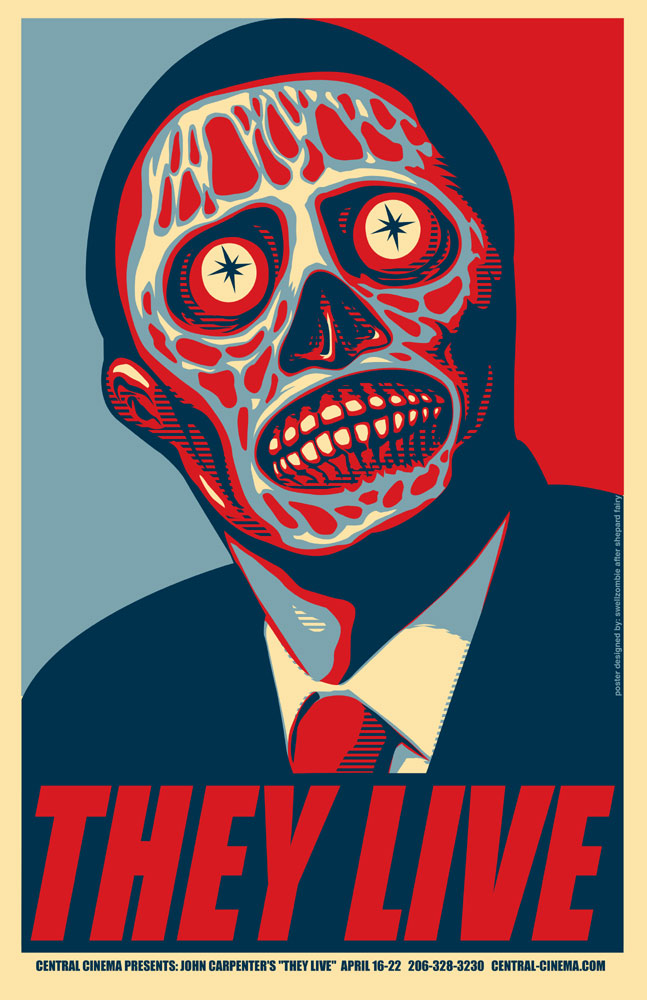
A Public Service Announcement From Adbusters

There will be blowback

Even in the seconds before their heads were about to roll away form their bodies underneath the blade of the guillotine, it still puzzled the opulent Paris elite how this could be happening.

Just months before the storming of the Bastille in 1789, everything was peachy. The social order ran smooth. The poor paid their dues. The middle class kept their mouth shut. The aristocracy parties like it was 1999.

One day they were handing out orders and advice to adoring insiders like a mall Santa dispenses candy canes, and the next day they were being dragged through the streets by their frilly collars like common thieves. Surely they wept like babies, but by then it was too late to apologize.

It always follow the same pattern. The rich and privileged overstep their mark and trigger an almighty backlash of feeding-frenzy-like-violence and cruelty.

After the Russian Revolution, the Bolshevik’s looted the royal palace and executed the entire family even the children. During the Cultural Revolution in China, the intellectual elites were publicly humiliated and carted off to camps where they were forced to work like peasants. In the 1970s, Pol Pot and the Khmer Rouge had child soldiers kill every privileged Cambodian, even those with eye glasses.

Today we are living through another one of those moments, though this time it’s not the royalty, not the land owners nor the intellectual elite … but the financial 1% running around making money off money off money off the backs of the 99% and being very arrogant and remorseless about it.

For the masses, when honest work no longer pays, the more sinister side of survival begins to take hold.

So here’s some advice to the Lloyd Blankfeins, Rex Tillersons, Jamie Dimons, Donald Trumps and Hugh Grants … Watch out! … you might be triggering something that will engulf you.

Editor’s note: While I wouldn’t hold my breath waiting for an organized revolutionary movement in this country, it’s a reminder that massive social upheaval can occur relatively quickly in a variety of different political contexts. In the U.S. I think we’re more likely to see an implosion due to top-down corruption, dysfunction and an irremediable economic situation. But the end result may be the same: systemic collapse and a vengeful backlash against those perceived as being the cause of the problems.

Corporate Child Abuse: The Unseen Global Epidemic

Corporate Child Abuse:  The Unseen Global Epidemic

By Prof. John McMurtry

Originally published at GlobalResearch.ca

“There can be no keener revelation of a society’s soul”, Nelson Mandela says, “than the way in which it treats its children”.

Who would disagree?

Yet today children may be assaulted, diseased, or killed by pervasive corporate drugs, junk-foods and beverages, perverted by mindless violence in multiple modes, deployed as dead-end labour with no benefits, and then dumped into a corporate future of debt enslavement and meaningless work. How could this increasing systematic abuse be publicly licensed at every level? What kind of society could turn a blind eye to its dominant institutions laying waste the lives of the young and humanity’s future itself?

The abuse is built into the system. All rights of child care-givers themselves – from parent workers to social life support systems – are written out of corporate ‘trade’ treaties which override legislatures to guarantee “investor profits” as their sole ruling goal.  Children are at the bottom, and most dispossessed by the life-blind global system. The excuse of “more competitive conditions” means, in fact, a race to the bottom of wages and benefits for families, social security, debt-free higher education, and protections against toxic environments to which the young are most vulnerable. At the same time, escalating sales of junk foods, malnutrition, and cultural debasement propel the sole growth achieved – ever more money demand at the top.

The mechanisms of abuse are not tempered by reforms as in the past, but deepened and widened.  Omnibus Harper budgets stripping even scientific and social fact-finding bodies and transnational foreign corporate rights dictated in the name of “Trans-Pacific Partnership” and “Canada-Europe Trade Agreement” advance the Great Dispossession further. An unasked question joins the dots, but is taboo to pose. What war, ecological or social collapse is not now propelled by rapidly creeping corporate rights to loot and pollute societies, ecosystems and – least considered – the young?

I explain the entire system in the expanded second edition of the Cancer Stage of Capitalism. Omnivorous money sequences of the corporate rich multiply through their life hosts overriding social life defences at every level and silencing critics. None are bound to serve any life support function but only to maximize profits. They surround, they intimidate, they bribe and threaten with corporate lobby armies to overrun legislatures and launch attack ads and wars with the mass media as their propaganda vehicles. All the classical properties of bullying abuse are there – pervasive one-way demands, ganging up, threats of force, false pretexts, weaker opponents picked on and exploited, and brutal attack of what resists. Yet bullies are seen only among the young themselves, while government in the interest of children’s well-being is increasingly sacrificed to the fanatic doctrine that the market God’s “invisible hand” is Providence and all commodities are “goods”.

How Corporate Abuse Moves to the Insides of Children 

Recall General Electric frontman and U.S. president Ronald Reagan broadcasting the post-1980 war against  unions, peace activists, environmentalists, and any community not subservient to U.S. corporate rights. Tiny and starving Nicaragua which had arisen against U.S.-backed tyranny by bringing public education and health benefits to poverty-stricken children was singled out for example. “All they have to do is say ‘Uncle’, Reagan smirked to the press when questioned on what Nicaragua could do to stop the U.S. attacks. They did not and the U.S. mined their central harbour and financed Contras with drug money for weapons to attack and burn the schools and clinics. The Reagan government and the media then ignored the six-billion dollar judgement of the International Court of Justice against the war crimes and the false claim of “self defense”. Abusers always continue if not named and children are always the primary victims.

With now the bank-engineered collapse of social-democratic Europe, oil-rich opponents cleared for corporate looting across the Middle East, and the Earth’s primary life support systems in slow motion collapse, we are apt to overlook the direct corporate invasion of the minds and bodies of children. As elsewhere, “giving them what they want” is the justification. And all the buttons are pushed to hook the young to addictive corporate products – child and adolescent fear of being left out, addictive desires for more sugar, salt and fat, primeval fascination with images of violence and destruction, craving for attention in stereotype forms, inertial boredom with no life function, the loss of social play areas by the great defunding, restless compulsion to distraction, and black hole ego doubts. All the enticements to addictive and unhealthy products form a common pattern of child abuse, and it is far more life disabling than any in the past. Beneath detection, a pathogenenic epidemic grows.

In response to commodity diseases from skyrocketing obesity and unfitness to unprecedented youth depression and psychic numbing to violence, almost no public life standards of what is pushed to the young are allowed into the super-lucrative market. Even while children’s growing consumption of multiplying junk foods, pharma drugs, and life-destructive entertainments addict them to what may in the end ruin their lives, preventative life standards are furiously lobbied against. As Joel Bakan’s Childhood Under Siege/ How Big Business Targets Your Children shows, the systemic abuse is ignored, denied and blocked against public regulation. Even with deadly diabetes by junk foods and beverages and hormonal disruption and body poisoning by the countless untested chemicals, materials and drugs fed into their lives, the young find no protection from this systematic and growing corporate abuse, not even mandatory package information to prevent their still rising profitable disorders of body and mind.

Understanding Corporate Child Abuse  as System Pathology

Bakan’s classic film and book, The Corporation, has revealed step by step the “corporation as psychopath”. Professor of law as well as parent, he recalls the “overarching idea” of modern civilization which has been aggressively pushed aside: “that children and childhood need the kind of public protection  and support that only society could offer” (p. 164). Now he observes, the big corporations are “free to – – pitch unhealthy ideas and products- – to pressure scientists and physicians to boost sales of their psychotropic drugs – – – to turn children’s environments – indeed their very bodies – into toxic stews – – and to profit from school systems increasingly geared to big business” (p. 164). Horrendous hours and hazards of child labour are what has long attracted attention, and Bakan reports that these are returning today (e.g., pp. 129-38).

R.D. Laing’s classic Massey lecture, The Politics of the Family goes deeper than issues of child labour by arguing that the young are made to live inside a dramatic play whose roles are mapped from one generation to the next. They are “good” or “bad” as they follow or resist the roles imposed on them.  The sea-change today is that the stage and script are dictated by the pervasive marketing of big-business corporations (pp. 3-5 and passim). They set the stages and the props of youth activities and dreams across domains of sport, peer play and relations, identity formation, eating and drinking, creative expression, clinical care, increasingly schooling, and even sleeping. Their ads condition children from the crib onwards and hard-push harmful addicting substances. This is why, for example, “only 1% of all ads for food are for healthy nourishment” (p. 210). Selling unhealthy desires through every window of impressionable minds has multiplied so that almost no region of life including schools is free from the total agenda.

All the while corporately-controlled governments abdicate an ultimate obligation of modern government – enabling protection of the young’s lives and humanity’s healthy future. On pervasive corporate violence products, for example, the American Medical Association reports: “Aggressive and violent thought and behaviour are systematically induced in virtually all children by corporate games” (p. 201). The occupation of childhood and youth has now reached 9 to11 hours daily for ages 8-to-18-year-olds who are glued to multi-media orchestrated by commercial corporations (p. 207).   Children are motivated by unneeded desires and adaptation to a surrounding culture which has a “panopticon marketing system” to hook into their “deep emotions” (pp. 17-27). Non-stop repetition of slogans and false images substitute for reason and life care, and the logic of ads is that you are defective without the product. In essence, addictive dependency to junk commodities of every kind drives the growth of corporate sales and disablement of children’s life capacities follows. What greater abuse of children could there be?

Bakan reports copious findings on Big Pharma buying doctors with favours, planting articles in name journals, inventing child illnesses to prescribe medications to, and drugging the young from infancy on with the unsafe substances they push (pp. 65-114). Along with the corporate invasion of children’s healthcare goes the invasion of public education (pp. 139-71, 245-56). Administrators with now corporate executive salaries for no educational function collaborate with the agenda, and mechanical testing devices closed to independent academic examination  are the Trojan horse for a mass lock-step of miseducation (pp. 140-62).  Bakan is aware that the whole trend of corporatization of the classroom and educational institutions “undermines the role of education in promoting critical thought and intelligent reflection” (p. 47). Indeed it wars against them in principle. For reasoning and critical research require learners to address problems independently of corporate profits and to penetrate behind market-conditioned beliefs. Big-business demands the opposite. It maximizes money returns as its first and final principle of thought and judgement, and selects against any truth or knowledge conflicting with this goal.

Corporate child abuse, in short, far surpasses all other forms of child abuse put together. But in a world where both parents are at work to survive and big money always wins elections, the life interests of children are bullied out of view. “Corporations [are] large, powerful and dominating institutions”, Bakan summarizes, “deliberately programmed to exploit and neglect others in pursuit of wealth for themselves” (p. 175).

 So what is the resolution? Bakan emphasizes the pre-cautionary principle and laws against clear harms to the young.  He emphasizes “values” and “teaching what is good for them and what is not” (pp. 49-50). Yet we have no principled criterion of either.  They are self-evident once seen. The good for children is whatever enables life capacities to coherently grow, and the bad is whatever disables them.  Corporate dominion goes the opposite direction. Thus unfitness, obesity, depression, egoic fantasies, aggressive violence, and aimlessness increase the more its profitable child abuse runs out of  control.  This is the heart of our disorder. Public regulation of corporations by tested life-capacity standards is the solution.

 John McMurtry is an elected Fellow of the Royal Society of Canada and author of What is Good? What is Bad? The Value of All Values Across Time, Place and Theories UNESCO Encyclopedia of Life Support Systems (EOLSS). His expanded second edition of The Cancer Stage of Capitalism: From Crisis to Cure has just been released across continents.

On Ourselves in the Othernets

52-psychedelic-art-300x289

Though a month old, this piece by Chris Arkenberg of URBEINGRECORDED was one I found to be nonetheless thought provoking (I’ve added my own commentary in italics following the original paragraphs):

Ourselves in the Othernets

So dig: in about 20 years we went from knowing rather little about the world beyond what we directly experienced and what we gleaned through books and pictures and the occasional documentary or foreign movie, to having immediate on-demand insight into any facet of the globe you could imagine.

True, though I miss the sense of community and unique curation of some of the old physical media brick and mortar establishments.

And many you couldn’t imagine. The sheer amount of visibility into humanity is simply astonishing. And it’s this informational shift, this too-much-bloody-perspective that is really amplifying the change and disruption and anxiety through which we grapple with the unfolding narrative of our species.

I would argue that the disruption is amplified not just from too many perspectives, but from the cognitive dissonance caused by conflicting data and the struggle to discern which has a closer correlation to reality.

You see, humans are still basically tribal animals. We like what we know and we fear what we do not. Geography, bloodlines, race, and class are among the sociocultural elements that bind us when we share them and separate us from those who fall onto a different end of the spectrum. We cast the differences and the things we do not understand into the Other. The Other becomes the boogeyman, the shadow, the unknown that is presumed to be a threat (because it’s safest to first assume that things are threats and then let information persuade us otherwise).

Good description of unfortunate xenophobic and threat response tendencies that are all too easy for manipulative leaders to exploit.

This innate fear of the Other makes it easier to wage economics and wars on those folks over the mountain or beyond the sea. You can much more easily demonize or dehumanize people who have no discernible face, casting them into the Other without further regard. They’re different from us. They don’t like the things we do or worship the same gods. It’s our right as better, more civilized beings to have their oil/water/food/women/etc. In general, this made it easier to get down to business without the impediment of worrying about our impact on the savages. [Insert any relevant aside about colonialism or how the prosperity of the West has been built on the backs of cheap resources and labor in the Third World.]

At the same time, fear of the Other can blind us from seeing psychopaths and sociopaths who may look no different from ourselves. In fact, since they tend to be more adept at blending in, manipulating others, and seeking personal gain at expense of others, it’s no surprise many such people end up in positions of power.

And then the steady march of trade made it incrementally easier and easier to see bits of the Other. Radio emerged, then the telephone and television. But even those were mostly local or regional. Globalization reinforced shipping lanes and supply chains and people started engaging the overseas Other to figure out how Toyota managed to bust the asses of US automakers or how the Chinese could subsidize western luxury with cheaper manufacturing. And meanwhile, creeping along the copper lines, the internet was starting to form.

Depictions of the Other in media doesn’t necessarily help when society is exposed to predominantly negative images of certain groups. And early forms of globalization have been around at least since the colonial era previously mentioned and the global slave trade of the 17th century. It seems government and big business have always welcomed the Other…as cheap labor.

The early adopters really started to engage the web around 1993-1995. A few years later you could buy a cell phone that wasn’t the size of a brick but still a lot of folks who needed mobile connectivity just used a more affordable pager – a one-way ping that sent you running for a pay phone to respond. But by 2000 a lot of people were online and within another 5 years many of them had cell phones. Apple landed the smart phone revolutions and now, as of 2013, it’s not hyperbole to say that *most* people in the world have cell phones and sms. Many of them have internet access – at least enough to fill add hubs to regions still mostly lacking. And this penetration of digital eyes is especially high amongst the western nations so adept at justifying imperialism by demonizing and dehumanizing the Other. Ahem.

It’s amazing how fast these changes occurred. Penetration of “digital eyes” may be high among imperialist nations yet demonization of the Other continues largely thanks to corporate/government influence of mass media. Fortunately independent/foreign news and media offer a counterbalance to increasing audiences as corporate media declines.

Any analysis of the contemporary context we live in must therefore consider this fundamental reframing of such a core psychological construct. [IMHO.] The Other is collapsing into the known. We now see so much of the people, cultures, and races and interests and classes and… and basically the Other looks a lot like us, doesn’t it? Consider for a moment what it means for borders and national identity when our affinities are inherently borderless; when we make Facebook friends with people scattered all across the globe; when the streets of Bagdad (pre-post-Saddam) surprisingly looked a lot like the streets of Northridge or Minneapolis; and when the art and music and writings and media blend more and more across frictionless digital channels, reconfiguring to speak about the shared lives of humanity more than any isms or schisms. Well, call me a global-mind liberal tree-hugging old softy but it actually makes me feel better to see the barriers of culture and nationalism crumble a bit under the weight of the innate human need to connect and share and collaborate and remix. We’re still tribal, sure, and culture is valuable but the tribes are getting bigger and more distributed, and at the same time there are more and more niches in the Long Tail waking up to assert their *own* culture, however deep it may be in the sub-genre taxonomy.

From my perspective it’s a little simplistic to say the Other looks like us. In some cases they may, but the internet can also expose the extremes of different cultures and subcultures as well. It’s often a positive trend to be able to relate more with the Other, but it’s also important to acknowledge differences. And even though the Other may look like us, they may not think like us. Case in point are political/economic elites and the top 1%, who more people used to identify more with. Whether because they’re more corrupt than ever because of greater political/economic power or because of greater awareness of their harmful policies revealed mostly through the internet and independent media, they’re increasingly recognized as a new type of Other.

The impact of this shift and the crazy pace at which it’s happened has injected a tremendous amount of instability into the global system. And it’s all been carried along the sudden Cambrian explosion of computation and connectivity spreading into every nook and cranny it can find, wiring it all up and transforming the layers above. The sense of rapid change and the exponentiation of technological progress is probably not going to be a temporary or transitional event. It’s looking more likely that we’re steaming up a steep curve that’s elevating change from a passage to a condition. It’s the new normal within which we live our lives.

Can’t argue with that.

This is why I’m a bit sanguine on fears of NSA totalitarianism or rumors of grand conspiracies slowly wrapping us all up for the impending boot on our necks. I don’t believe in monoliths. There’s too much instability in the system for any one controller to reign it all in. Instead we live in a world of too many competitors – governments, transnationals, corporate multinationals, NGO’s, ideological blocks, cartels, super-empowered individuals. Even within organizations it’s all Game of Thrones and balkanized silos. They’re all vying for control but the outcome will not be any single winner. It will be a dynamic patchwork of power structures that, like any good ecosystem, will mostly keep each other in check. Mostly. Sometimes some of them align around a goal, other times they break apart and fragment.

This is where I do disagree. The scenario described would be an improvement over our current situation and may be where we end up eventually, but we’re not there yet. There might seem to be many conflicting factions but a closer examination reveals them to be different cards held by a relatively small number of players, and why wouldn’t these players cheat or conspire to retain their positions of power? A couple years ago a study from the Swiss Federal Institute of Technology in Zurich did a comprehensive analysis of 37 million companies, 43,060 transnational corporations and share ownerships linking them. They discovered that global corporate control has a dominant core of 147 firms with interlocking stakes. Together they control 40% of the wealth in the network. A total of 737 control 80% of it all.

The dystopic (realist?) balance to this sanguinity moves among the machines and the algorithmic mycelium wending its way through our networks and our devices and more and more of our lives. The opportunities for embedded governance when we all have a chip and an IP and a personal node on the net are indeed considerable. A geofenced life is a fenced life nevertheless, even if the prison is invisible. We humans may overcome our prejudices just in time to unite against the emerging Other of machine intelligence. There may yet be a Matrix scenario ahead of us though I suspect it won’t be possible for quite some time. Humans are fallible and, for now, we fallibly program the machines, lending de-rezed bits of our slippery minds to their cognitive computation. But what is the logic, the perspective, when the machines wise up and suddenly our dissent is regarded as a malfunctioning program throwing up a little flag on the network that can then be dispatched without ever requiring that humanly-fallible oversight? Perhaps then they just crawl into your mindtank and intermediate your pathetic shreds of freewill.

Among the emerging “True Other” I would include along with machine intelligence psychopathic government and corporate systems and the individuals who flourish within such systems.

But, you know, this is why we write programs to protect us. And why there are teenagers who are better at cracking things open than any would-be monolith will ever be at keeping them closed. This is the generational dance of evolution. The young are always one step ahead. It’s like a failsafe built-in to the species. Some inchoate balancer that makes sure nature maintains the upper hand lest we slip up and give it all away to fascists and imperialists and corporations and algorithms. And I suppose this is my faith, after all. That there is a failsafe. That we won’t let it all slip into ruin. Or at least, if we do, it will be the ruin of nature asserting its claim on us all, consuming civilization back into the womb of the Mother to be reconsidered and redrawn for the next momentous round of parthenogenesis. Maybe a little better and a little more suited to this world. Hopefully the music will be as good.

I must admit I have no idea how the future will turn out, but this proposed possibility is more hopeful than a number of likely outcomes.

How to End the National Debt

military_industrial_complex_by_party9999999-d55z8r1

One solution is to stop the war machine. At Boiling Frogs there’s a great recent post from Sibel Edmonds called “What National Debt? US Taxpayer Dollars Continue to Flow to the World’s Despots, Torturers & Human Target Practice Fields”. Among her findings:

Afghanistan gets around $7 Billion= $7,000,000,000. Now, don’t mistake this for our money spent on our war in Afghanistan. That’s in the trillions of dollars. That’s a separate deal. No, this money goes to Afghanistan’s government – known for being crooks, criminals, heroin dealers, and terrorist breeders. They take the money, and misplace it- so the money, some of it, ends up with the guys we are supposedly bombing and waging war against. Then we point at those guys and say, hey, you see these armed terrorists, and then we go bomb the hell out of them. They take the money and invest it in some highly lucrative poppy fields and heroin production, so that we can spend billions of dollars pretending to destroy those poppy fields and production centers.  And then we give more money to these government guys, so that we can go and bomb them some more, and target more poppy fields … and the cycle continues, and continues. Trust me, it makes sense …Not necessarily to you and me, but it makes lots of sense to our fat war-profiteers here at home. After all, who gives a damn if things make sense to the people-since when have they counted?

Of course Israel gets quite a lion’s share. That goes without saying. They get nearly $3 billion=$3,000,000,000, in military aid and another large sum as financial aid for …well, let’s put aside all the diplomacy and political correctness and call a duck a duck: They get all the military and foreign aid so that they can turn around and spend those dollars through their powerful network and lobby here, to make sure we are all screwed up in developing and implementing our foreign policy. Does that make sense? Just think about the billions of dollars, directly or indirectly, spent by the Israel lobby to form and control our foreign policy, aka war-war and more war. They get all those billions of dollars in foreign and military aid, come over here, get us into wars so that we go spend trillions of additional dollars in wars and screwing up the world … and ourselves… and then give Israel more in foreign and military aid. It doesn’t make sense, does it? Of course not, It’s not supposed to make sense, dude!

Egypt gets its $1 billion of our tax money for … for what? Thank God it’s been in the news lately so even the mass ignoramus population in our nation is able to have an idea: guns and bullets to kill political dissenters, tanks and tear gas to be used against civilians, helicopters to fire at civilians below … bring about a coup de tat, and then bring about another one …Okay, so that one we get. We know what they use our money and military equipment for. No brainer. As to why we would shower Egypt with all this money and military power? Why in the world do we end up giving all these dollars to the side that gets in via a coup, and to the side who takes out those who brought about the coup and gets in with its own coup … and another coup after that, and many dead … Why? Well, duh. It’s because that’s what we do. Since when has our government been in the business of providing reasons and justification to its people? Since when do they worry about having to make sense to their lowly people? Maybe, referring to the paragraph above, maybe it’s because of the billions of dollars we gave Israel, which came back here and were spent so that our government would put together this policy of giving billions of dollars to many different sides in Egypt – so that they would continue coups and butcher their people.

Pakistan gets more or less $1 Billion. They get military aid to make sure they create desirable conditions so that our military can send its drones out there and bomb the hell out of them every day. Makes sense. No? All right, try this: How else do we give these drones and our other killing machines a real-life test run? See! Like shooting ranges, our government needs to go out there, pick countries (and their inhabitants), and make them viable war-practice fields.  Call them Human Target Practice Fields. You haven’t heard?! Nothing like a real test drive. Of course these things ain’t free, so of course the money has to be spent, thus, our foreign aid to countries like Pakistan. Why is the price so high? Because Pakistan is dangerous, and it has nuclear weapons that we made sure they would get, and that makes Pakistan kinda expensive.

Those are just the largest recipients. For the complete list read the full article here: http://www.boilingfrogspost.com/2013/10/08/what-national-debt-us-taxpayer-dollars-continue-to-flow-to-the-worlds-despots-torturers-human-target-practice-fields/#more-24922

Another way to end the national debt is to switch to government issued debt-free money. Michael Snyder of The Economic Collapse Blog describes what the process might look like:

#1) The U.S. Congress votes to take back all of the functions that it has delegated to the Federal Reserve and begins to issue debt-free United States Notes.  These United States Notes would have the exact same value as existing Federal Reserve Notes, and over time all existing Federal Reserve Notes would be taken out of circulation.

#2) The U.S. Congress nationalizes all debt held by the Federal Reserve.  That would instantly reduce the national debt by 1.6 trillion dollars.  In fact, there are a few members of Congress that have already proposed this.

#3) A Constitutional amendment is passed limiting future U.S. government deficits to a reasonable percentage of GDP.  Any future deficits would not be funded by borrowing.  Rather, future deficits would be funded by newly created United States Notes.  Therefore, the federal government would never again accumulate another penny of debt.

And it would be important to inject new money into the economy from time to time.  When existing money is destroyed or when the population grows it is important to inject a certain amount of new money into the system in order to avoid deflation.

#4) The existing national debt would be very slowly paid off with newly created United States Notes.  The U.S. government spent over 454 billion dollars on interest on the national debt during fiscal year 2011, and over time this expense would go to zero.

If the national debt is paid off slowly enough, it would not create too much inflation.  I believe that it could be paid off gradually over 50 years without shocking the economy too much.

Read the full article here: http://theeconomiccollapseblog.com/archives/debt-free-united-states-notes-were-once-issued-under-jfk-and-the-u-s-government-still-has-the-power-to-issue-debt-free-money

Such a solution may seem simple, but the obvious obstacle would be overcoming the immense political and economic influence of the central banks. The only U.S. presidents who challenged the central banking scheme were John F. Kennedy, James Garfield, Abraham Lincoln and Andrew Jackson. Kennedy, Garfield and Lincoln were assassinated in office. Jackson would have been assassinated in an attempt in 1835 were it not for two guns miraculously misfiring. Jackson later famously stated:

The Bank is trying to kill me – but I will kill it!

…If the American people only understood the rank injustice of our money and banking system – there would be a revolution before morning.

Life Imitates “They Live”

Obama-They-Live

Melissa Melton of Truthstream Media recently posted a story about former wrestler and actor Roddy Piper going public about his Libertarian and pro-Second Amendment beliefs via twitter. Quoting from the tweets:

They can’t have my Guns! Nobody! If you try and take my Gun, I’d be all out of Bubble Gum!

[…]I need to clean something up! When I say you take my gun I’m all out of gum….I’M NOT TRYING TO BE FUNNY!! It’s a FREEDOM STATEMENT!

[…]They Live is a documentary!!

For those who haven’t seen the film They Live, this is the famous “bubblegum scene” Piper is referencing:

They Live is a cult classic sci-fi/action buddy film based on the short story Eight O’Clock in the Morning by Ray Faraday Nelson (who happened to be one of Philip K. Dick’s closest friends). Roddy Piper plays Nada, a drifter searching for work during a recession who accidentally stumbles across an alien plot to take over the world by programming the masses to obey and consume using subliminal messages. Widely considered one of director John Carpenter’s best and smartest films, it was also part of a late 80s sub-genre of films containing as a subtext sharp critiques of U.S. government policies and the Reagan administration in particular. Other films include Wes Craven’s “The People Under the Stairs”, Paul Verhoeven’s “Robocop” and Dan O’Bannon’s “Return of the Living Dead”.

Just this past May, John Carpenter did a Q&A for a 25th anniversary screening of They Live as part of The Hero Complex Film Festival in Los Angeles. He had this to say about the film:

By the end of the ’70s there was a backlash against everything in the ’60s, and that’s what the ’80s were, and Ronald Reagan became president, and Reagonomics came in,” Carpenter told the sold-out theater at the Chinese 6 Theatres in Hollywood. “So a lot of the ideals that I grew up with were under assault, and something called a yuppie came into existence, and they just wanted money. And so by the late ’80s, I’d had enough, and I decided I had to make a statement, as stupid and banal as it is, but I made one, and that’s ‘They Live.’ … I just love that it was giving the finger to Reagan when nobody else would.

Read the full article here: http://herocomplex.latimes.com/movies/john-carpenter-they-live-was-about-giving-the-finger-to-reagan/#/0

Unfortunately, since the release of They Live, the state of the union has regressed to the point where the systemic criminality of the Reagan era seems mild and quaint in comparison. In certain ways, They Live does seem like a documentary because it contains images and ideas straight out of the headlines. Scenes of the protagonists’ tent city being bulldozed look exactly like the destruction of Occupy Movement encampments and forced closures of tent cities for the homeless across the country. Images of the aliens’ secret surveillance drones are prescient as well.

Melton’s Truthstream Media post also included this analysis of subliminal messages eerily reminiscent of They Live embedded in an old video clip used as nightly “sign-offs” for national television networks:

Read the full post here: http://truthstreammedia.com/?p=6717

Podcast News Updates

the-5th-horseman

There’s been another string of relevant news podcasts in the past few days so it’s time for another roundup post.

Last week Rob Kall of OpEdnews.cominterviewed Peter Ludlow a professor of linguistics and philosophy, on topics including systemic evil, whistleblowers and hacktivism:

https://itunes.apple.com/us/podcast/rob-kall-bottom-up-radio-show/id359765013

On Friday, Abby Martin of Breaking the Set did an excellent job deconstructing the corporatocracy on Coast to Coast AM with John Wells:

http://www.mediaroots.org/abby-martin-deconstructs-the-corporatocracy-on-coast-to-coast-am/

On Monday Nellie Bailey and Glen Ford of Black Agenda Report covered a wide range of important topics including an update on the corporate plan for Detroit (an American apartheid), the struggle to raise the minimum wage in Seattle, and Dave Swanson’s (of WarIsACrime.org) analysis of the multitude of lies in Obama’s recent UN speech : Listen to Black Agenda Radio on the Progressive Radio Network, with Glen Ford and Nellie Bailey – Week of 9/30/13.

From Traces of Reality there were two great consecutive shows. On 9/30 host Guillermo Jimenez interviewed Kevin Gallagher, director of Free Barrett Brown.  Brown is the journalist who faces a 105 year sentence, the bulk of which is related to charges associated with pasting a link in a chat room. On the 10/1 episode, Guillermo is joined by Vice President of The Future of Freedom Foundation, Sheldon Richman. They cover topics including the “government shutdown”, the national debt, taxation, private property, the “social contract,” and the fallacy of the “consent of the governed.”:

9/30

10/1