Essential Taoist Wisdom for Living in Politically Charged and Chaotic Times

By Dylan Charles

Source: Waking Times

There’s an old saying, rumored to be an ancient Chinese curse, but it’s been a favorite in the West for some time now.

“May you live in interesting times.” 

Political figures like to use it when they want to emphasize just how screwed up things are. For example, Robert Kennedy is quoted here from a speech in 1966:

“There is a Chinese curse which says “May he live in interesting times.” Like it or not, we live in interesting times. They are times of danger and uncertainty; but they are also the most creative of any time in the history of mankind.” [Source]

Sounds pretty much like today, as the times are indeed interesting. Shocking and unbelievable things are happening all around us, and with information technologies we can choose to internalize struggles, tragedies and disasters that are far outside of our sphere of personal experience or control. It’s easier than ever to take on the weight of the world.

The burden of doing so is quite heavy, though, manifesting as stress, anxiety, depression, self-abuse or the abuse of nature, conflict big and small, anger, disease, uneasiness, unhappiness, and most insidious of all, fear. In short, absorbing the world’s problems is self-destructive. To resolve this within ourselves, however, it most often only takes a shift in perspective.

Lao-Tzu, the Old Master of Taoism, condensed the human struggle into the prose of the Tao Te Ching. It’s not a religious text, as it doesn’t hail a deity or command you to construct a belief system on its behalf. It’s a simple book of observations about the nature of nature, something that after 2500+ years still manages to serve as a salient guide to living well. For those who understand it, it offers a way of being that helps keep the madness of change at bay.

In times such as these, when uncertainty and chaos seem to be rising against the established order, and when so much discourse is focused on politics and untouchable events and circumstances, it really is up to the individual to create peace, harmony and balance within themselves.

But as humans, we have a tendency to try to control that which is beyond our control, in turn contributing evermore to the development of chaos and disorder. In truth, it is far easier to navigate such discord than we believe, and the way is far simpler than we imagine it to be. Consider for a moment the Taoist view regarding such interesting times.

From verse 16:

When society changes
from its natural state of flux,
to that which seems like chaos,
the inner world of the superior man
remains uncluttered and at peace.
By remaining still, his self detached,
he aids society in its return
to the way of nature and of peace.
The value of his insight may be clearly seen
when chaos ceases.

Here we are informed of the value of tending to the inner world first, which requires the gumption to detach and allow things to be as they are. We are encouraged to let go of personal expectations in order for muddled waters to clear.

From verse 17:

The sage does not expect that others
use his criteria as their own.

It is virtuous to allow others to hold whatever insane beliefs and ideas they choose to, and disengage from the struggle to enforce our opinions and values onto others.

From verse 18:

When intellectualism arises,
hypocrisy is close behind…

When the country falls into chaos,
politicians talk about ‘patriotism’.

From verse 57:

Govern your country with integrity,
Weapons of war can be used with great cunning,
but loyalty is only won by not-doing.
How do I know the way things are?

By these:

The more prohibitions you make,
the poorer people will be.
The more weapons you possess,
the greater the chaos in your country.
The more knowledge that is acquired,
the stranger the world will become.
The more laws that you make,
the greater the number of criminals.

Therefore the Master says:

I do nothing,
and people become good by themselves.
I seek peace,
and people take care of their own problems.
I do not meddle in their personal lives,
and the people become prosperous.
I let go of all my desires,
and the people return to the Uncarved Block.

Doing nothing, as advised in the Tao Te Ching, runs in opposition to the cultural zeitgeist, but just imagine how quickly things would change if more people chose to withdraw and not participate in the insanity all around us.

Final Thoughts

As individuals we face the same challenges as all of those who’ve come before us. We’ve always had to survive and procreate while striving for progress. That’s the human journey in nutshell, and while it isn’t always pretty, it’s always the same story, no matter how complex things become.

Our role, then, is the role of the sage, which is to act in accordance with nature rather than to resist nature.

National (In)Security In the United States of Inequality

By Rajan Menon

Source: Unz Review

So effectively has the Beltway establishment captured the concept of national security that, for most of us, it automatically conjures up images of terrorist groups, cyber warriors, or “rogue states.” To ward off such foes, the United States maintains a historically unprecedented constellation of military bases abroad and, since 9/11, has waged wars in Afghanistan, Iraq, Syria, Libya, and elsewhere that have gobbled up nearly $4.8 trillion. The 2018 Pentagon budget already totals $647 billion — four times what China, second in global military spending, shells out and more than the next 12 countries combined, seven of them American allies. For good measure, Donald Trump has added an additional $200 billion to projected defense expenditures through 2019.

Yet to hear the hawks tell it, the United States has never been less secure. So much for bang for the buck.

For millions of Americans, however, the greatest threat to their day-to-day security isn’t terrorism or North Korea, Iran, Russia, or China. It’s internal — and economic. That’s particularly true for the 12.7% of Americans (43.1 million of them) classified as poor by the government’s criteria: an income below $12,140 for a one-person household, $16,460 for a family of two, and so on… until you get to the princely sum of $42,380 for a family of eight.

Savings aren’t much help either: a third of Americans have no savings at all and another third have less than $1,000 in the bank. Little wonder that families struggling to cover the cost of food alone increased from 11% (36 million) in 2007 to 14% (48 million) in 2014.

The Working Poor

Unemployment can certainly contribute to being poor, but millions of Americans endure poverty when they have full-time jobs or even hold down more than one job. The latest figures from the Bureau of Labor Statistics show that there are 8.6 million“working poor,” defined by the government as people who live below the poverty line despite being employed at least 27 weeks a year. Their economic insecurity doesn’t register in our society, partly because working and being poor don’t seem to go together in the minds of many Americans — and unemployment has fallen reasonably steadily. After approaching 10% in 2009, it’s now at only 4%.

Help from the government? Bill Clinton’s 1996 welfare “reform” program concocted in partnership with congressional Republicans, imposed time limits on government assistance, while tightening eligibility criteria for it. So, as Kathryn Edin and Luke Shaefer show in their disturbing book, $2.00 a Day: Living on Almost Nothing in America, many who desperately need help don’t even bother to apply. And things will only get worse in the age of Trump. His 2019 budget includes deep cuts in a raftof anti-poverty programs.

Anyone seeking a visceral sense of the hardships such Americans endure should read Barbara Ehrenreich’s 2001 book Nickel and Dimed: On (Not) Getting By in America. It’s a gripping account of what she learned when, posing as a “homemaker” with no special skills, she worked for two years in various low-wage jobs, relying solely on her earnings to support herself. The book brims with stories about people who had jobs but, out of necessity, slept in rent-by-the-week fleabag motels, flophouses, or even in their cars, subsisting on vending machine snacks for lunch, hot dogs and instant noodles for dinner , and forgoing basic dental care or health checkups. Those who managed to get permanent housing would choose poor, low-rent neighborhoods close to work because they often couldn’t afford a car. To maintain even such a barebones lifestyle, many worked more than one job.

Though politicians prattle on about how times have changed for the better, Ehrenreich’s book still provides a remarkably accurate picture of America’s working poor. Over the past decade the proportion of people who exhausted their monthly paychecks just to pay for life’s essentials actually increased from 31% to 38%. In 2013, 71% of the families that had children and used food pantries run by Feeding America, the largest private organization helping the hungry, included at least one person who had worked during the previous year. And in America’s big cities, chiefly because of a widening gap between rent and wages, thousands of working poor remain homeless, sleeping in shelters, on the streets, or in their vehicles, sometimes along with their families. In New York City, no outlier when it comes to homelessness among the working poor, in a third of the families with children that use homeless shelters at least one adult held a job.

The Wages of Poverty

The working poor cluster in certain occupations. They are salespeople in retail stores, servers or preparers of fast food, custodial staff, hotel workers, and caregivers for children or the elderly. Many make less than $10 an hour and lack any leverage, union or otherwise, to press for raises. In fact, the percentage of unionized workers in such jobs remains in the single digits — and in retail and food preparation, it’s under 4.5%. That’s hardly surprising, given that private sector union membership has fallen by 50% since 1983 to only 6.7% of the workforce.

Low-wage employers like it that way and — Walmart being the poster child for this — work diligently to make it ever harder for employees to join unions. As a result, they rarely find themselves under any real pressure to increase wages, which, adjusted for inflation, have stood still or even decreased since the late 1970s. When employment is “at-will,” workers may be fired or the terms of their work amended on the whim of a company and without the slightest explanation. Walmart announced this year that it would hike its hourly wage to $11 and that’s welcome news. But this had nothing to do with collective bargaining; it was a response to the drop in the unemployment rate, cash flows from the Trump tax cut for corporations (which saved Walmart as much as $2 billion), an increase in minimum wages in a number of states, and pay increases by an arch competitor, Target. It was also accompanied by the shutdown of 63 of Walmart’s Sam’s Club stores, which meant layoffs for 10,000 workers. In short, the balance of power almost always favors the employer, seldom the employee.

As a result, though the United States has a per-capita income of $59,500 and is among the wealthiest countries in the world, 12.7% of Americans (that’s 43.1 million people), officially are impoverished. And that’s generally considered a significant undercount. The Census Bureau establishes the poverty rate by figuring out an annual no-frills family food budget, multiplying it by three, adjusting it for household size, and pegging it to the Consumer Price Index. That, many economists believe, is a woefully inadequate way of estimating poverty. Food prices haven’t risen dramatically over the past 20 years, but the cost of other necessities like medical care (especially if you lack insurance) and housing have: 10.5% and 11.8% respectively between 2013 and 2017 compared to an only 5.5% increase for food.

Include housing and medical expenses in the equation and you get the Supplementary Poverty Measure (SPM), published by the Census Bureau since 2011. It reveals that a larger number of Americans are poor: 14% or 45 million in 2016.

Dismal Data

For a fuller picture of American (in)security, however, it’s necessary to delve deeper into the relevant data, starting with hourly wages, which are the way more than 58%of adult workers are paid. The good news: only 1.8 million, or 2.3% of them, subsist at or below minimum wage. The not-so-good news: one-third of all workers earn less than $12 an hour and 42% earn less than $15. That’s $24,960 and $31,200 a year. Imagine raising a family on such incomes, figuring in the cost of food, rent, childcare, car payments (since a car is often a necessity simply to get to a job in a country with inadequate public transportation), and medical costs.

The problem facing the working poor isn’t just low wages, but the widening gap between wages and rising prices. The government has increased the hourly federal minimum wage more than 20 times since it was set at 25 cents under the 1938 Fair Labor Standards Act. Between 2007 and 2009 it rose to $7.25, but over the past decade that sum lost nearly 10% of its purchasing power to inflation, which means that, in 2018, someone would have to work 41 additional days to make the equivalent of the 2009 minimum wage.

Workers in the lowest 20% have lost the most ground, their inflation-adjusted wages falling by nearly 1% between 1979 and 2016, compared to a 24.7% increase for the top 20%. This can’t be explained by lackluster productivity since, between 1985 and 2015, it outstripped pay raises, often substantially, in every economic sector except mining.

Yes, states can mandate higher minimum wages and 29 have, but 21 have not, leaving many low-wage workers struggling to cover the costs of two essentials in particular: health care and housing.

Even when it comes to jobs that offer health insurance, employers have been shifting ever more of its cost onto their workers through higher deductibles and out-of-pocket expenses, as well as by requiring them to cover more of the premiums. The percentage of workers who paid at least 10% of their earnings to cover such costs — not counting premiums — doubled between 2003 and 2014.

This helps explain why, according to the Bureau of Labor Statistics, only 11% of workers in the bottom 10% of wage earners even enrolled in workplace healthcare plans in 2016 (compared to 72% in the top 10%). As a restaurant server who makes $2.13 an hour before tips — and whose husband earns $9 an hour at Walmart — put it, after paying the rent, “it’s either put food in the house or buy insurance.”

The Affordable Care Act, or ACA (aka Obamacare), provided subsidies to help people with low incomes cover the cost of insurance premiums, but workers with employer-supplied healthcare, no matter how low their wages, weren’t covered by it. Now, of course, President Trump, congressional Republicans, and a Supreme Court in which right-wing justices are going to be even more influential will be intent on poleaxing the ACA.

It’s housing, though, that takes the biggest bite out of the paychecks of low-wage workers. The majority of them are renters. Ownership remains for many a pipe dream. According to a Harvard study, between 2001 and 2016, renters who made $30,000-$50,000 a year and paid more than a third of their earnings to landlords (the threshold for qualifying as “rent burdened”) increased from 37% to 50%. For those making only $15,000, that figure rose to 83%.

In other words, in an ever more unequal America, the number of low-income workers struggling to pay their rent has surged. As the Harvard analysis shows, this is, in part, because the number of affluent renters (with incomes of $100,000 or more) has leapt and, in city after city, they’re driving the demand for, and building of, new rental units. As a result, the high-end share of new rental construction soared from a third to nearly two-thirds of all units between 2001 and 2016. Not surprisingly, new low-income rental units dropped from two-fifths to one-fifth of the total and, as the pressure on renters rose, so did rents for even those modest dwellings. On top of that, in places like New York City, where demand from the wealthy shapes the housing market, landlords have found ways — some within the law, others not — to get rid of low-income tenants.

Public housing and housing vouchers are supposed to make housing affordable to low-income households, but the supply of public housing hasn’t remotely matched demand. Consequently, waiting lists are long and people in need languish for years before getting a shot — if they ever do. Only a quarter of those who qualify for such assistance receive it. As for those vouchers, getting them is hard to begin with because of the massive mismatch between available funding for the program and the demand for the help it provides. And then come the other challenges: finding landlords willing to accept vouchers or rentals that are reasonably close to work and not in neighborhoods euphemistically labelled “distressed.”

The bottom line: more than 75% of “at-risk” renters (those for whom the cost of rent exceeds 30% or more of their earnings) do not receive assistance from the government. The real “risk” for them is becoming homeless, which means relying on shelters or family and friends willing to take them in.

President Trump’s proposed budget cuts will make life even harder for low-income workers seeking affordable housing. His 2019 budget proposal slashes $6.8 billion(14.2%) from the resources of the Department of Housing and Urban Development’s (HUD) by, among other things, scrapping housing vouchers and assistance to low-income families struggling to pay heating bills. The president also seeks to slash funds for the upkeep of public housing by nearly 50%. In addition, the deficits that his rich-come-first tax “reform” bill is virtually guaranteed to produce will undoubtedly set the stage for yet more cuts in the future. In other words, in what’s becoming the United States of Inequality, the very phrases “low-income workers” and “affordable housing” have ceased to go together.

None of this seems to have troubled HUD Secretary Ben Carson who happily ordered a $31,000 dining room set for his office suite at the taxpayers’ expense, even as he visited new public housing units to make sure that they weren’t too comfortable (lest the poor settle in for long stays). Carson has declared that it’s time to stop believing the problems of this society can be fixed merely by having the government throw extra money at them — unless, apparently, the dining room accoutrements of superbureaucrats aren’t up to snuff.

Money Talks

The levels of poverty and economic inequality that prevail in America are not intrinsic to either capitalism or globalization. Most other wealthy market economies in the 36-nation Organization for Economic Cooperation and Development (OECD) have done far better than the United States in reducing them without sacrificing innovation or creating government-run economies.

Take the poverty gap, which the OECD defines as the difference between a country’s official poverty line and the average income of those who fall below it. The United States has the second largest poverty gap among wealthy countries; only Italy does worse.

Child poverty? In the World Economic Forum’s ranking of 41 countries — from best to worst — the U.S. placed 35th. Child poverty has declined in the United States since 2010, but a Columbia University report estimates that 19% of American kids (13.7 million) nevertheless lived in families with incomes below the official poverty line in 2016. If you add in the number of kids in low-income households, that number increases to 41%.

As for infant mortality, according to the government’s own Centers for Disease Control, the U.S., with 6.1 deaths per 1,000 live births, has the absolute worst record among wealthy countries. (Finland and Japan do best with 2.3.)

And when it comes to the distribution of wealth, among the OECD countries only Turkey, Chile, and Mexico do worse than the U.S.

It’s time to rethink the American national security state with its annual trillion-dollar budget. For tens of millions of Americans, the source of deep workaday insecurity isn’t the standard roster of foreign enemies, but an ever-more entrenched system of inequality, still growing, that stacks the political deck against the least well-off Americans. They lack the bucks to hire big-time lobbyists. They can’t write lavish checks to candidates running for public office or fund PACs. They have no way of manipulating the myriad influence-generating networks that the elite uses to shape taxation and spending policies. They are up against a system in which money truly does talk — and that’s the voice they don’t have. Welcome to the United States of Inequality.


Rajan Menon, a TomDispatch regular, is the Anne and Bernard Spitzer Professor of International Relations at the Powell School, City College of New York, and Senior Research Fellow at Columbia University’s Saltzman Institute of War and Peace Studies. He is the author, most recently, of The Conceit of Humanitarian Intervention 

4 SIGNS WE LIVE IN A PROFOUNDLY SICK SOCIETY

By Gary Z McGee

Source: Waking Times

“It is no measure of health to be well adjusted to a profoundly sick society.” ~Jiddu Krishnamurti

What makes our society so sick? How do we know for sure that our society is unhealthy? Is there a way to reason our way into a clear explanation for why our society is unfit for healthy human beings attempting to evolve in a healthier way?

It really comes down to answering one critical question: Do you want to live, or do you want to die? As Albert Camus famously stated, “There is but one truly serious philosophical problem, and that is suicide. Judging whether life is or is not worth living amounts to answering the fundamental question of philosophy.” It seems extreme, but in order to get down to the crux of the issue, we need to ask extreme questions.

If your answer is ‘life,’ then it stands to reason that you want that life to be as healthy as possible. If your answer is suicide, then obviously all other questions of survival are irrelevant, and you fall under the null hypothesis.

Let’s assume that your answer is ‘life.’ What is the next logical question? It stands to reason that all subsequent questions would be: What do I need to do in order to continue my survival? The first answer to that question must be: I need to breathe clean air. After that? I need to drink clean water. Then, I need to eat healthy food. And then, I need to find healthy human relations. So on, and so forth.

This gives us a four-fold foundation to begin to see why the system is so unhealthy, while possibly shedding some light on how we can heal our profoundly sick society. Let’s break it down…

1. Our Society Pollutes the Air

“A thing is right when it tends to preserve the integrity, stability, and beauty of the biotic community. It is wrong when it tends otherwise.” ~Aldo Leopold

So, you want to live? Well you’ve got to breathe air. And if you want to live healthy, you must breathe clean air. The first fundamental reason how we know we live in a profoundly sick society is when it becomes evident that our society is directly affecting the quality of the air in a negative and unhealthy way.

Forget the ongoing debate about climate change and global warming. Some people’s cognitive dissonance is so powerful that no amount of arguing will convince them. It will only solidify their hardheaded stance.

Focus instead on the real problem; something we can all agree on: pollution. There is no denying that our society’s excessive use of fossil fuels is a dangerous air pollutant. Just look at the horizon in almost every single major city on the planet. If it’s harming the air quality there, then it’s harming the air quality everywhere. The planet is an interconnected system. Everything is connected to everything else. Especially when it comes to the flow of air.

It’s simple: when our waste output exceeds the planet’s ability to absorb it in a healthy way –that is to say, in a way that preserves the integrity, stability, and beauty of the biotic community– then we know, without a doubt, that it’s unhealthy and that we must scale back. Otherwise, our health and the planet’s health, is compromised.

A society that continues to output more waste into the air than the atmosphere can absorb in a healthy way is a profoundly sick society.

2. Our Society Pollutes the Water

“We forget that the water cycle and the life cycle are one.” ~Jacques Yves Cousteau

So, you’ve decided you want to live and you’ve taken care of breathing air. The next step, if you wish to continue your survival, is to find clean water. This is no easy task in a sick society.

As predicted, the Keystone Pipeline has leaked. Twice! Once on May 4, 2017 (84,000 gallons of oil) and on November 16, 2017 (210,000 gallons). Then there was the Iowa Pipeline (140,000 gallons) on January 31, 2017, the Rover Pipeline in Ohio on May 10, 2017, and the Texas Pipeline (over 50,000 gallons of crude oil) on July 13, 2017. Then there was the Gulf of Mexico oil spill (400,000 gallons of oil). And these were just a few of the larger spills in 2017 alone.

The real war being fought on this planet is between water protectors (healthy people) and oil mongers (unhealthy people). Water represents life, and oil represents entropy. But, it’s not quite so simple. There is a kind of yin-yang dynamic going on here. The white dot on the oil side of the yin-yang represents energy and progress. The black dot on the water side of the yin-yang represents pollution. We use oil for energy to propel our civilizations progressively forward but at a great cost –rampant, poisonous pollution.

The problem is that the black dot on the water side is getting out of control, leading to environmental collapse at best and ecocide at worst. If we’re not careful, the yin-yang of our world is going to be a black mass of oily entropy spinning through space –a burnt-out husk of a planet. Something’s got to give.

Oil has been an industrious boon for our species. No doubt. It helped us achieve many technological marvels. But we were naïve to its pollutant power. At this point, the pollution is so bad that it supersedes the gain. Burning oil, coal, and gas is simply too toxic for us and our environment. We cannot, in good conscience, continue to burn through this now outdated mode of energy use. If we would be a healthy society, we must switch to solar, wind, electric, tide, and especially hemp, or we will burn ourselves out.

A society that continues to use outdated energy-producing methods which cannot be absorbed by their environment in a healthy way, is a profoundly sick society.

3. Our Society Pollutes Our Food

“I screamed at god for the starving child, until I realized that God was the child screaming at me.” ~Unknown

So, you still want to live, and you’ve managed to breathe air and drink water. The next step is to consume clean and healthy food. Again, this is no easy task in a sick society.

From Agent Orange to Roundup, from Nestle to Monsanto, from DDT to GMO, from Fukushima to overfished waters, from hoarding to unnecessary starvation, and everything in between, the range of ways our society has managed to destroy our food supply is laughable.

Do you know why so many fish products are mislabeled? Because corporations don’t have the guts to tell you that the fish you like are practically gone. Yes, 70%of the world’s fisheries are either completely exploited, overexploited or collapsed as a result of overfishing and warmer waters. This should come as a wake-up call of the highest order.

Again, human pollution is the biggest part of the problem. Especially plastic pollution. But another big part of the problem is how we farm, how we distribute (or lack thereof), and how we waste our food. The utter failure of our distribution system undermines the health of our species. It prevents people from thriving because they are expending all their vital energy on merely surviving.

On one end of the spectrum, we have wealthy people hoarding and/or wasting enough food to feed an entire third-world country; on the other end, we have the poor pinching pennies to eat the unhealthiest (but cheapest) “food” ever created: fast food.

One way to fix at least part of this daunting problem is through polyculture farming. Where monoculture is about industry, polyculture is about diversity. Monoculture suffers from a lack of biodiversity and nutrients in soil. Polyculture thrives with biodiversity and replenishes soil. Monoculture requires pesticides. Polyculture is a function of biological pest control. Monoculture is unnatural. Polyculture is natural. Monoculture leads to disease and famine. Polyculture leads to abundance and permaculture. Monoculture is about money over people. Polyculture is about people and healthy food over money.

A society that continues to pollute, mismanage, hoard, poison, and poorly distribute its own food supply is a profoundly sick society.

4. Our Society Creates Unhealthy Individuals

“The system cannot be fixed by the system.” ~Tom Morello

So, you’ve managed to breathe air, drink water, and eat food. But is it healthy? The question ‘do we live in a profoundly sick society’ comes down to this critical question: is the air, the water, and the food we are consuming healthy? If not, is it because of something our society is doing to the air, the water, and the food that is causing it to be unhealthy? If so, what are you, as a member of society, going to do about it?

Are you just going to ignore it and hope it works itself out? Are you going to wait for technology to bail us out somehow? Are you waiting for a hero to save the day?

The main reason we live in a profoundly sick society is because most people do nothing about the unhealthy system that props it up. As a result, we live in a sick society that creates unhealthy individuals which creates more unhealthy individuals. The unhealthy cycle will continue to repeat itself until healthy-minded individuals rise-up to change it. This is an arduously Herculean task, but no task is more important. The very health, indeed the very evolution, of our species is at stake.

When it comes down to it, a society that breathes dirty air, drinks polluted water, eats poisoned food and then continues to do all the things that cause dirty air, polluted water and poisoned food is a profoundly sick society.


Building a Cooperative Economy

By Oliver Sylvester-Bradley

Source: Resilience

In permaculture terms the economy sometimes feels like a segregated monoculture planted with terminator seeds, sprayed with patented pesticides on venture capital backed farms designed to maximise profits in an unsustainable market place full of thieves and cheats. No wonder people prefer to potter in their gardens and allotments – and try to forget the craziness of corporate capitalism!

But no matter how much we try to ignore the corporate machine it ploughs on regardless and at various points in all of our lives we are forced to interact with the unsustainable, greed-based economy whether we like it or not. We all need to travel, buy energy, we like presents and holidays and now we are buying more and more of these goods and services online, from people we do not know.

As local banks close in favour of apps, local taxis are driven out by Uber and the likes of Airbnb and other holiday and comparison websites offer us ‘guaranteed savings’ – the brave new world of digital platforms is being thrust upon us, whether we like it or not.

The dominant form of business in our economy has not changed, but the method of delivery has. Platform businesses which reach further and wider than conventional ‘bricks and mortar’ businesses, that are able to ‘scale up’ and attract customers in their millions are forcing out the smaller players, just like supermarkets killed the traditional garden market. Except these “platform monopolies” are taking things to a new level – often unbeknown to us they’re gathering our data and using sophisticated algorithms to work out how to sell us more things, that quite often we don’t need or want. They’re aggregating data and dissintermediating in ways that we never knew were possible. Uber is valued at over 60 billion dollars but does not own a single taxi…

From monoculture to platform co-ops

To someone practicing permaculture, there is something almost offensive about vast fields where businesses cultivate the same single crop and, in a similar way, the exponents of ‘peer to peer’ and ‘open source’ technologies get equally offended by monolithic platforms that dominate the digital landscape.

Peer to peer, (where individuals share content with other people, rather than relying on centralised servers) and open source software (which is free to use and adapt, without requiring a licence fee) are like the digital community’s own versions of permaculture. They provide a pathway to greater independence, autonomy, diversity and resilience than is offered by the dominant system.

David Holmgreen’s ideas about creating small scale, copyable, adaptable solutions which have the power to change the world by creating decentralised, diverse, and more resilient systems have huge parallels with open source, collaborative software projects, which are developing as a response to the monolithic, proprietary and profit driven enclosures that dominate today’s Internet.

The end goal of this work is to create ‘platform cooperatives’, as alternatives to the venture capital backed platforms. Platform cooperatives that are member owned and democratically controlled – allowing everyone that is affected by the business, be they customers, suppliers, workers or investors, a say in how the business is run and managed. Co-ops are an inherently different form of organisation than Limited or Public companies, which place community before profit, hence have entirely different principles than their corporate rivals. For this reason they are more resilient in downturns, more responsible to their communities and environments and more effective at delivering real (not just financial) value to everyone they interact with.

Platform co-ops provide a template for a new kind of economy built on trust, mutual aid and respect for nature and community. By placing ownership firmly in the hands of the people and applying democratic forms of governance they offer a legitimate alternative to the defacto form of business. There are several platform co-ops that already provide comparable, and often better services than their corporate rivals and with more support others will continue to develop.

On 26 and 27 July the OPEN 2018 conference at Conway Hall in London will showcase platform co-ops such as The Open Food Network – which is linking up local food producers and consumers through Europe, Resonate – the music streaming co-op, and SMart from Belgium which provides support for a network of thousands of freelancers throughout Europe. The beginnings of a viable, self-supporting and sustainable economy are stating to emerge and OPEN 2018, along with similar events in the US and across Europe, is bringing together the people with the ideas, the tech developers and the legal experts to help catalyse the transition.

Shared values and the network effect

There are so many similarities between permaculture’s philosophy and principles and the works of other progressive groups that hope to encourage a more sustainable, more resilient and equitable future. From Occupy to Open sourcePermaculture to Peer to Peer and Collaborative Technology to the Commons Transition groups there are clearly overlapping values.

David Bollier, writing on the Peer to Peer Foundation blog has suggested that “…permaculturists and commoners need to connect more and learn from each other…” and the idea that these communities are ultimately working towards the same objective seems especially important to recognise if we are to accelerate the development of a more sustainable world.

There is already an evolving “shared narrative” between these various, disparate initiatives, but it is often sidelined by our self-selecting filters which lead us back into the communities we know and trust. Collaboration and cooperation can be hard work and as groups get bigger they can become harder still but that’s no reason not to try. The fact that Wikipedia provides a better encyclopaedia for free in more languages than Britannica ever managed proves that online, open source collaboration can deliver greater value than proprietary, closed source systems.

The true value of a collaborative, open networks only really manifests when its members communicate, and work together, through connected systems. Sharing ideas, discussing problems and addressing challenges in larger networks creates positive feedback loops via the network effect – a term which describes how the value of something increases in proportion to the number of people using it (like a phone, or social media network) – something all the various ethical and progressive networks could benefit from enormously.

Parallels between collaborative, open source software development and permaculture principles:

1. Observe and interact

Progressive software projects often utilise ‘user focused’ design strategies to ensure they meet people’s needs. Taking time to understand how users interact with software systems via user experience testing groups and an ongoing, iterative design processes are recognised to deliver higher quality solutions which suit specific user needs.

2. Catch and store energy

Peer to peer networks don’t rely on centralised servers but instead make use of the latent capacity of other user’s machines. Imagine how much more efficient it would be than deploying huge server farms if our computers were not shut off at night, or left idle, when they could be providing valuable processing power for others. The Holochain project aims to make it simple and secure for anyone to join a truly peer to peer network and to share files and processing power in this way – and to even earn credits for hosting other people’s files and applications.

3. Obtain a yield

The Peer Production License provides a means by which open source developers can make the code they develop available for free and still benefit from it’s use. Sites like the Internet of Ownership, which contains a directory of cooperative platforms use the PPL to “permit reuse exclusively for non-commercial and worker-owned enterprises” thereby helping to grow the commons. The ultimate goal of the PPL is to enable mechanisms so commoners can support themselves and ensure their own social reproduction without resorting to capitalism.

4. Apply self-regulation and accept feedback

This principle is particularly integral to open source development since the concepts of ‘user focussed’ and ‘agile development’, ‘branching’ and ‘forking’ are all designed to ensure that software projects are self-regulating by listening to the users needs, driven by user feedback and that they are able to be adapted to changing needs.

5. Use and value renewable resources and services

Open source technology is inherently more renewable in the way it enables the reuse and repackaging of code for new purposes. Ethically minded hosts and developers such as Green Net power their servers with renewable energy.

6. Produce no waste

As above, open source code is often re-used and repurposed but progressive developers still have a lot to gain from better collaboration. There are often multiple teams working on identical problems and ideas and whilst this has benefits in terms of developing strength and resilience through diversity it also leads to waste, mainly in terms of time. At least the waste ‘product’ of web development is only digital and so old technology and code doesn’t littler the streets or pollute the environment as much as physical products can, especially if archives are stored on renewably powered servers.

7. Design from patterns to details

Genuine online collaboration has been slow to evolve, with the best examples being Linux (the open source operating system), Firefox, the open source web browser and Wikipedia, the open source encyclopaedia. It is only recently, with the rise of monolithic capitalist gardens such as Google and Facebook and Amazon that the hive mind of the internet is recognising the need to step back and redesign its systems according to new patterns. The push for “Net neutrality” and Tim Berners-Lee’s Solid project are examples of this in action as is the Holo project, a very exciting and truly peer to peer “community of passionate humans building a distributed cloud, owned and run by users like you and me.”

8. Integrate rather than segregate

The move from centralised to decentralised, to distributed and federated technology is a a key element of open source and collaborative technology design. The entire Peer to Peer philosophy is based on the recognition that the connections and relationships between nodes (people or computers) in a network is what gives it strength and value. Collaborative technologists still have a lot to gain from developing deeper and wider integrations, like we see in nature, and which permaculturists know so well.

9. Use small and slow solutions

Designing a computer system to be slow is not something you will normally (ever?) hear a programmer talk about but they often talk about small, in many guises. Small packages (of code), small apps, “minified” (meaning compressed) code and even small computers, like the Raspberry Pi are key features of collaborative technology which all aim for increased efficiency.

10. Use and value diversity

Diversity is intrinsic to open source and collaborative technology. The plurality and adaptability of open source solutions ensures a highly diverse ecosystem. Users are free to adapt open source code to their needs and the open nature of most open source projects values contributions from anyone, irrespective of race, gender, age or any other factor. It is true that the majority of contributors to open source projects are normally young, white and male but the reasons for that seem more to do with societal inequalities and stereotypes rather than any specific prejudices or practices.

11. Use edges and value the marginal

The explanation of this principle places most value on “the interface between things…” and this is a central component of web design. Web services have now realised the necessity of providing intuitive user interfaces, to allow users to navigate complex data and to investigate deeper informational relationships but, more interestingly the latest developments in linked open data enable users to interface with more specific, more granular and more timely data to provide increase value. The Internet Of Things will facilitate a massive increase in the number and type of products which can interact over the internet. Whilst it is not the norm, drawing diverse information from the edges and valuing the marginal is something the open internet can really facilitate.

12. Creatively use and response to change

Most open source, collaborative projects use some kind of agile development, which advocates adaptive planning, evolutionary development, early delivery, and continuous improvement, and encourages rapid and flexible response to change. Permaculture and open source see eye to eye on this principle which bodes very well for a growing, symbiotic relationship in our rapidly evolving world.

OUR NEW, HAPPY LIFE? THE IDEOLOGY OF DEVELOPMENT

By Charles Eisenstein

Source: Waking Times

In George Orwell’s 1984, there is a moment when the Party announces an “increase” in the chocolate ration – from thirty grams to twenty. No one except for the protagonist, Winston, seems to notice that the ration has gone down not up.

‘Comrades!’ cried an eager youthful voice. ‘Attention, comrades! We have glorious news for you. We have won the battle for production! Returns now completed of the output of all classes of consumption goods show that the standard of living has risen by no less than 20 percent over the past year. All over Oceania this morning there were irrepressible spontaneous demonstrations when workers marched out of factories and offices and paraded through the streets with banners voicing their gratitude to Big Brother for the new, happy life which his wise leadership has bestowed upon us.

The newscaster goes on to announce one statistic after another proving that everything is getting better. The phrase in vogue is “our new, happy life.” Of course, as with the chocolate ration, it is obvious that the statistics are phony.

Those words, “our new, happy life,” came to me as I read two recent articles, one by Nicholas Kristof in the New York Times and the other by Stephen Pinker in the Wall Street Journal, both of which asserted, with ample statistics, that the overall state of humanity is better now than at any time in history. Fewer people die in wars, car crashes, airplane crashes, even from gun violence. Poverty rates are lower than ever recorded, life expectancy is higher, and more people than ever are literate, have access to electricity and running water, and live in democracies.

Like in 1984, these articles affirm and celebrate the basic direction of society. We are headed in the right direction. With smug assurance, they tell us that thanks to reason, science, and enlightened Western political thinking, we are making strides toward a better world.

Like in 1984, there is something deceptive in these arguments that so baldly serve the established order.

Unlike in 1984, the deception is not a product of phony statistics.

Before I describe the deception and what lies on the other side of it, I want to assure the reader that this essay will not try to prove that things are getting worse and worse. In fact, I share the fundamental optimism of Kristof and Pinker that humanity is walking a positive evolutionary path. For this evolution to proceed, however, it is necessary that we acknowledge and integrate the horror, the suffering, and the loss that the triumphalist narrative of civilizational progress skips over.

What hides behind the numbers

In other words, we need to come to grips with precisely the things that Stephen Pinker’s statistics leave out. Generally speaking, metrics-based evaluations, while seemingly objective, bear the covert biases of those who decide what to measure, how to measure it, and what not to measure. They also devalue those things which we cannot measure or that are intrinsically unmeasurable. Let me offer a few examples.

Nicholas Kristof celebrates a decline in the number of people living on less than two dollars a day. What might that statistic hide? Well, every time an indigenous hunter-gatherer or traditional villager is forced off the land and goes to work on a plantation or sweatshop, his or her cash income increases from zero to several dollars a day. The numbers look good. GDP goes up. And the accompanying degradation is invisible.

For the last several decades, multitudes have fled the countryside for burgeoning cities in the global South. Most had lived largely outside the money economy. In a small village in India or Africa, most people procured food, built dwellings, made clothes, and created entertainment in a subsistence or gift economy, without much need for money. When development policies and the global economy push entire nations to generate foreign exchange to meet debt obligations, urbanization invariably results. In a slum in Lagos or Kolkata, two dollars a day is misery, where in the traditional village it might be affluence. Taking for granted the trend of development and urbanization, yes, it is a good thing when those slum dwellers rise from two dollars a day to, say, five. But the focus on that metric obscures deeper processes.

Kristof asserts that 2017 was the best year ever for human health. If we measure the prevalence of infectious diseases, he is certainly right. Life expectancy also continues to rise globally (though it is leveling off and in some countries, such as the United States, beginning to fall). Again though, these metrics obscure disturbing trends. A host of new diseases such as autoimmunity, allergies, Lyme, and autism, compounded with unprecedented levels of addiction, depression, and obesity, contribute to declining physical vitality throughout the developed world, and increasingly in developing countries too. Vast social resources – one-fifth of GDP in the US – go toward sick care; society as a whole is unwell.

Both authors also mention literacy. What might the statistics hide here? For one, the transition into literacy has meant, in many places, the destruction of oral traditions and even the extinction of entire non-written languages. Literacy is part of a broader social repatterning, a transition into modernity, that accompanies cultural and linguistic homogenization. Tens of millions of children go to school to learn reading, writing, and arithmetic; history, science, and Shakespeare, in places where, a generation before, they would have learned how to herd goats, grow barley, make bricks, weave cloth, conduct ceremonies, or bake bread. They would have learned the uses of a thousand plants and the songs of a hundred birds, the words of a thousand stories and the steps to a hundred dances. Acculturation to literate society is part of a much larger change. Reasonable people may differ on whether this change is good or bad, on whether we are better off relying on digital social networks than on place-based communities, better off recognizing more corporate logos than local plants and animals, better off manipulating symbols rather than handling soil. Only from a prejudiced mindset could we say, though, that this shift represents unequivocal progress.

My intention here is not to use written words to decry literacy, deliciously ironic though that would be. I am merely observing that our metrics for progress encode hidden biases and neglect what won’t fit comfortably into the worldview of those who devise them. Certainly, in a society that is already modernized, illiteracy is a terrible disadvantage, but outside that context, it is not clear that a literate society – or its extension, a digitized society – is a happy society.

The immeasurability of happiness

Biases or no, surely you can’t argue with the happiness metrics that are the lynchpin of Pinker’s argument that science, reason, and Western political ideals are working to create a better world. The more advanced the country, he says, the happier people are. Therefore the more the rest of the world develops along the path we blazed, the happier the world will be.

Unfortunately, happiness statistics encode as assumptions the very conclusions the developmentalist argument tries to prove. Generally speaking, happiness metrics comprise two approaches: objective measures of well-being, and subjective reports of happiness. Well-being metrics include such things as per-capita income, life expectancy, leisure time, educational level, access to health care, and many of the other accouterments of development.  In many cultures, for example, “leisure” was not a concept; leisure in contradistinction to work assumes that work itself is as it became in the Industrial Revolution: tedious, degrading, burdensome. A culture where work is not clearly separable from life is misjudged by this happiness metric; see Helena Norberg-Hodge’s marvelous film Ancient Futures for a depiction of such a culture, in which, as the film says, “work and leisure are one.”

Encoded in objective well-being metrics is a certain vision of development; specifically, the mode of development that dominates today. To say that developed countries are therefore happier is circular logic.

As for subjective reports of individual happiness, individual self-reporting necessarily references the surrounding culture. I rate my happiness in comparison to the normative level of happiness around me. A society of rampant anxiety and depression draws a very low baseline. A woman told me once, “I used to consider myself to be a reasonably happy person until I visited a village in Afghanistan near where I’d been deployed in the military. I wanted to see what it was like from a different perspective. This is a desperately poor village,” she said. “The huts didn’t even have floors, just dirt which frequently turned to mud. They barely even had enough food. But I have never seen happier people. They were so full of joy and generosity. These people, who had nothing, were happier than almost anyone I know.”

Whatever those Afghan villagers had to make them happy, I don’t think shows up in Stephen Pinker’s statistics purporting to prove that they should follow our path. The reader may have had similar experiences visiting Mexico, Brazil, Africa, or India, in whose backwaters one finds a level of joy rare amidst the suburban boxes of my country. This, despite centuries of imperialism, war, and colonialism. Imagine the happiness that would be possible in a just and peaceful world.

I’m sure my point here will be unpersuasive to anyone who has not had such an experience first-hand. You will think, perhaps, that maybe the locals were just putting on their best face for the visitor. Or maybe that I am seeing them through romanticizing “happy-natives” lenses. But I am not speaking here of superficial good cheer or the phony smile of a man making the best of things. People in older cultures, connected to community and place, held close in a lineage of ancestors, woven into a web of personal and cultural stories, radiate a kind of solidity and presence that I rarely find in any modern person. When I interact with one of them, I know that whatever the measurable gains of the Ascent of Humanity, we have lost something immeasurably precious. And I know that until we recognize it and turn toward its recovery, that no further progress in lifespan or GDP or educational attainment will bring us closer to any place worth going.

What other elements of deep well-being elude our measurements? Authenticity of communication? The intimacy and vitality of our relationships? Familiarity with local plants and animals? Aesthetic nourishment from the built environment? Participation in meaningful collective endeavors? Sense of community and social solidarity? What we have lost is hard to measure, even if we were to try. For the quantitative mind, the mind of money and data, it hardly exists. Yet the loss casts a shadow on the heart, a dim longing that no assurance of new, happy life can assuage.

While the fullness of this loss – and, by implication, the potential in its recovery – is beyond measure, there are nonetheless statistics, left out of Pinker’s analysis, that point to it. I am referring to the high levels of suicide, opioid addiction, meth addiction, pornography, gambling, anxiety, and depression that plague modern society and every modernizing society. These are not just random flies that have landed in the ointment of progress; they are symptoms of a profound crisis. When community disintegrates, when ties to nature and place are severed, when structures of meaning collapse, when the connections that make us whole wither, we grow hungry for addictive substitutes to numb the longing and fill the void.

The loss I speak of is inseparable from the very institutions – science, technology, industry, capitalism, and the political ideal of the rational individual – that Stephen Pinker says have delivered humanity from misery. We might be cautious, then, about attributing to these institutions certain incontestable improvements over Medieval times or the early Industrial Revolution. Could there be another explanation? Might they have come despite science, capitalism, rational individualism, etc., and not because of them?

The empathy hypothesis

One of the improvements Stephen Pinker emphasizes is a decline in violence. War casualties, homicide, and violent crime, in general, have fallen to a fraction of their levels a generation or two ago. The decline in violence is real, but should we attribute it, as Pinker does, to democracy, reason, rule of law, data-driven policing, and so forth? I don’t think so. Democracy is no insurance against war – in fact, the United States has perpetrated far more military actions than any other nation in the last half-century. And is the decline in violent crime simply because we are better able to punish and protect ourselves from each other, clamping down on our savage impulses with the technologies of deterrence?

I have another hypothesis. The decline in violence is not the result of perfecting the world of the separate, self-interested rational subject. To the contrary: it is the result of the breakdown of that story, and the rise of empathy in its stead.

In the mythology of the separate individual, the purpose of the state was to ensure a balance between individual freedom and the common good by putting limits on the pursuit of self-interest. In the emerging mythology of interconnection, ecology, and interbeing, we awaken to the understanding that the good of others, human and otherwise, is inseparable from our own well-being.

The defining question of empathy is, What is it like to be you? In contrast, the mindset of war is the othering, the dehumanization and demonization of people who become the enemy. That becomes more difficult the more accustomed we are to considering the experience of another human being. That is why war, torture, capital punishment, and violence have become less acceptable. It is not that they are “irrational.” To the contrary: establishment think tanks are quite adept at inventing highly rational justifications for all of these.

In a worldview in which competing self-interested actors is axiomatic, what is “rational” is to outcompete them, dominate them, and exploit them by any means necessary? It was not advances in science or reason that abolished the 14-hour workday, chattel slavery, or debtors’ prisons.

The worldview of ecology, interdependence, and interbeing offers different axioms on which to exercise our reason. Understanding that another person has an experience of being, and is subject to circumstances that condition their behavior, makes us less able to dehumanize them as a first step in harming them. Understanding that what happens to the world in some way happens to ourselves, reason no longer promotes war. Understanding that the health of soil, water, and ecosystems is inseparable from our own health, reason no longer urges their pillage.

In a perverse way, science & technology cheerleaders like Stephen Pinker are right: science has indeed ended the age of war. Not because we have grown so smart and so advanced over primitive impulses that we have transcended it. No, it is because science has brought us to such extremes of savagery that it has become impossible to maintain the myth of separation. The technological improvements in our capacity to murder and ruin make it increasingly clear that we cannot insulate ourselves from the harm we do to the other.

It was not primitive superstition that gave us the machine gun and the atomic bomb. Industry was not an evolutionary step beyond savagery; it applied savagery at an industrial scale. Rational administration of organizations did not elevate us beyond genocide; it enabled it to happen on an unprecedented scale and with unprecedented efficiency in the Holocaust. Science did not show us the irrationality of war; it brought us to the very extreme of irrationality, the Mutually Assured Destruction of the Cold War. In that insanity was the seed of a truly evolutive understanding – that what we do to the other, happens to ourselves as well. That is why, aside from a retrograde cadre of American politicians, no one seriously considers using nuclear weapons today.

The horror we feel at the prospect of, say, nuking Pyongyang or Tehran is not the dread of radioactive blowback or retributive terror. It arises, I claim, from our empathic identification with the victims. As the consciousness of interbeing grows, we can no longer easily wave off their suffering as the just deserts of their wickedness or the regrettable but necessary price of freedom. It as if, on some level, it would be happening to ourselves.

To be sure, there is no shortage of human rights abuses, death squads, torture, domestic violence, military violence, and violent crime still in the world today. To observe, in the midst of it, a rising tide of compassion is not a whitewash of the ugliness, but a call for fuller participation in a movement. On the personal level, it is a movement of kindness, compassion, empathy, taking ownership of one’s judgments and projections, and – not contradictorily – of bravely speaking uncomfortable truths, exposing what was hidden, bringing violence and injustice to light, telling the stories that need to be heard. Together, these two threads of compassion and truth might weave a politics in which we call out the iniquity without judging the perpetrator, but instead seek to understand and change the circumstances of the perpetration.

From empathy, we seek not to punish criminals but to understand the circumstances that breed crime. We seek not to fight terrorism but to understand and change the conditions that generate it. We seek not to wall out immigrants, but to understand why people are so desperate in the first place to leave their homes and lands, and how we might be contributing to their desperation.

Empathy suggests the opposite of the conclusion offered by Stephen Pinker. It says, rather than more efficient legal penalties and “data-driven policing,” we might study the approach of new Philadelphia District Attorney Larry Krasner, who has directed prosecutors to stop seeking maximum sentences, stop prosecuting cannabis possession, steer offenders toward diversionary programs rather than penal programs, cutting inordinately long probation periods, and other reforms. Undergirding these measures is compassion: What is it like to be a criminal? An addict? A prostitute? Maybe we still want to stop you from continuing to do that, but we no longer desire to punish you. We want to offer you a realistic opportunity to live another way.

Similarly, the future of agriculture is not in more aggressive breeding, more powerful pesticides, or the further conversion of living soil into an industrial input. It is in knowing soil as a being and serving its living integrity, knowing that its health is inseparable from our own. In this way, the principle of empathy (What is it like to be you?) extends beyond criminal justice, foreign policy, and personal relationships. Agriculture, medicine, education, technology – no field is outside its bounds. Translating that principle into civilization’s institutions (rather than extending the reach of reason, control, and domination) is what will bring real progress to humanity.

This vision of progress is not contrary to technological development; neither will science, reason, or technology automatically bring it about. All human capacities can be put into service to a future embodying the understanding that the world’s wellbeing, human and otherwise, feeds our own.

Big Pharma and the Rise of Gangster Capitalism

By Charles Hugh Smith

Source: Of Two Minds

$8 per vial in competing developed-world nations and $38,892 in the U.S. That says it all.

Thanks to decades of gangster films, we all know how gangster capitalism works: the cost of “protection” goes up whenever the gangster wants to increase revenues, any competition is snuffed out, and “customer demand” is jacked up by any means available– addiction, for example.

This perfectly describes the pharmaceutical industry and every other cartel in America. You might have read about the price increase in Acthar gel, a medication to treat Infantile Spasms. (via J.F., M.D., who alerted me to the repricing of this medication from $40 in 2001 to the current price of $38,892.)

The compound first received approval in 1950, and various branded versions have been approved in recent years. Let’s be clear: this medication did not require billions of dollars in research and development, or decades of testing to obtain FDA approval; it’s been approved for use for the past 68 years.

Yes, you read that correctly: a medication that’s been in use for 68 years went from $40 a dose in 2001 to $38,892 today. Don’t you love the pricing? Not a round 38 grand, but $38,892. You gotta love these gangsters!

There’s another related term to describe this form of capitalism: racketeering.That’s what mobsters do–operate rackets.

The Big Pharma racket enriches a number of gangs practicing gangster capitalism: the drug companies themselves, of course, but some doctors are profiting from the racket, and so are pharmaceutical lobbyists:

Study highlights role of doctor conflicts of interest in Medicare spending on Mallinckrodt drug Acthar Study published in JAMA indicates nearly 90 percent of doctors prescribing HP Acthar Gel took payments from drug’s manufacturer.

Here are the money quotes:

In 2014 Mallinckrodt raised the price of Acthar further to $34,000. The Federal Trade Commission and attorneys general from five states sued Mallinckrodt for anti-competitive behavior with regard to the acquisition of Synacthen Depot and the monopolistic pricing of Acthar, and in January 2017 the company settled, agreeing to pay $100 million and to license Synacthen Depot to a competitor. According to Kaiser Health News, Mallinckrodt responded by increasing its Congressional lobbying to $610,000, and its contributions to Congress members to $44,000, in the first quarter of 2017.

As an off-patent pharmaceutical, a similar drug, differing in formulation, available in Europe, made by a different manufacturer, sells for $8 per vial.

So a medication to treat infants costs $8 per vial in Europe and $38,892 in the U.S. Don’t you just love gangster capitalism to death? Because death and suffering is the gangsters’ ultimate threat: pay up or die.

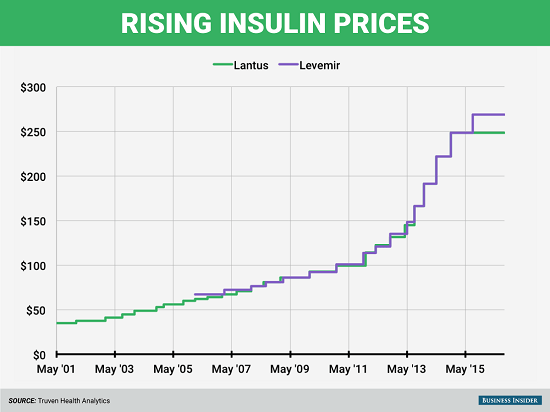
Here’s another example of Big Pharma gangster capitalism at work: Insulin Drug Price Inflation: Racketeering or Perverse Competition?

Don’t you wish you had a racket where you could raise prices by 10% a year like clockwork, or triple the price of your “product” every decade?

Pfizer just raised prices on 100 medications:

The increases are effective as of July 1. In most cases, the increases are just over 9%, which is in line with the annual 10% price hikes adopted by most drug companies. Putting that number in context, core inflation printed at 2% last week.

Here’s a chart of the net result of gangster capitalism:

Gangster capitalism is the new model of “growth” in America, the model used by every cartel from higher education to Pentagon contractors. Eliminate actual competition, raise prices in lockstep with other cartel members, lobby the government to pay your extortionist prices, and threaten any resisters with severe consequences.

Try resisting your local government’s property tax increases to cover insiders’ pensions and healthcare benefits: it’s always “for the children,” of course, and if you don’t pay up, we’ll just auction off your house.

There’s no difference between that and being told you’re gonna be wearing concrete overshoes if you don’t comply.

The U.S. economy is nothing more than an exploitive jumble of rackets, insider plundering and gangster capitalism. $8 per vial competing developed-world nations and $38,892 in the U.S. That says it all.

Why ‘Conspiracy Theories’ & Spirituality Are Intimately Connected

By Joe Martino

Source: Collective Evolution

Is it considered ‘not spiritual’ to talk about an elite or cabal running our world? This has become a commonplace today, and there is a great deal of ridicule that comes when people feel looking at the truth of what is playing out in our world is ‘crazy’ or a ‘negative’ thing to do. In fact, the ‘negative’ label on conspiracy theories we place is one of the biggest spiritual bypasses we can do. Let’s dive into this.

The truth is, understanding the way our world truly functions and consciousness evolution (spirituality) go hand in hand. Why? Because it is all part of life here. It is not separate! You don’t have spirituality on one side and conspiracies or truth on the other. It’s all interconnected in our life and human experience. And it’s time to bring them together.

The Challenge

This isn’t true 100% of the time of course, but in a lot of cases, we see those in the truth-seeking realm feel consciousness or spirituality is airy fairy and has no place in the big picture and is just a new age distraction. On the flip side, we see those engaged in spirituality-seeking feel conspiracy/truth-seeking people are crazy and negative. While there is truth to some extent in both cases, there is a lot more to the discussion and a very important purpose for both.

You’ve probably experienced it at some point, it’s believable that GMO’s are unhealthy and corporations are using them to make money in a number of ways but it’s damaging to people and the environment, but yet there is no possible way that’s happening with vaccines… or that 9/11 was an inside job. Let me be the first to say, there are a number of conspiracy theories that have no backing, no facts, are far-reaching and in many cases don’t even help us along our journey. But this is not the case with many, in fact, the amount of evidence is often staggering and it’s simply that we don’t want to believe it.

I’m writing this because I’m calling for an end of the reduction of conversation to ‘that’s crazy’ ‘that’s fake news’ ‘that’s a conspiracy’ etc. as it does nothing but maintain division, a lack of awareness and a misinformed world that can’t thrive. Time and time again what is often called ‘conspiracy’ turns out to be true only a few months or a year later. We can end this cycle by learning and choosing to listen instead of dismissing, then checking in with our hearts/souls about what role this is playing in our experience so we can dissolve the need for the cabal.

Why They Go Hand In Hand

Some of us view spirituality as learning techniques to feel good, as ways to cope with life and the challenges we have in our modern world. Some view it as a means to begin to feel better about the prospect of death. Others view it as a way to explore what’s beyond the physical and who we truly are.

From a conspiratorial side, when we’re talking about digging past mainstream media to find out what’s really going on in our world, some view it as a way to disempower the elite that does not have humanities best interests at heart. Others view it as a way to take back our power. Some see it as a way to uncover the truth of how our world truly works so we can begin to thrive. Some react to these truths with wanting revenge or justice, this is an important thing to note as this is where the spirituality comes in.

So it appears we have ‘two sides’ as we often like to do within ego states of consciousness. But what role does the elite and cabal play in our experience? How has that served to suppress our spirituality and why has it all happened? The two are intimately connected because part of the game we are playing on earth here is that we have to uncover what has been happening in our reality and remember who we truly are. This is a spiritual journey, that involves understanding the players in the game and the roles they play.

I’ve been running a conscious media and education company for 9.5 years now. Our mission is to bridge the gap between truth-seeking and spirituality via exploring a shift in consciousness taking place on our planet. We understand that both are part of one big picture in life and you can only go so far in each before you MUST bring in the other to deepen your understanding.

During the 9.5 years since I started Collective Evolution, I have seen thousands of people go through various stages of discovering and learning, both in truth-seeking and spirituality, that has sent them on different paths. Some begin to discover our food system is rigged for a lack of health and they begin eating cleaner. This leads them to understand our entire world is ‘rigged against us’ and suddenly there is a shift in how they see the world. I have seen others attend a yoga class and this begins a journey into connecting with self deeply.

But in both cases, I often see an identity form. The yogi becomes identified as a ‘spiritual person,’ dresses a certain way, talks a certain way and may refuse to look at anything the ‘truth-seekers’ are saying because they don’t want to fall into that crowd. The truth-seekers are often angry, pissed off at the world, call everyone else sheeple and think the elite need to die in prisons. They might look at the ‘yogi’ or ‘spiritual’ crowd as having fallen into pseudo-scientific new age deception because they look at consciousness and spirituality.

Then there are those who have journeyed beyond that stage and are simply authentic and understand how both ingredients, truth-seeking and spirituality, are one in the same and part of the journey. They are both a part of this game we call life and if we truly want to evolve, move forward, remove the cabal and so forth, we must see the truth and learn why it was there in the first place for our own evolution in consciousness.

It’s A Role!

Remember, what the cabal and elite are doing isn’t negative in the big picture scheme of things. To our mind it might be, but not to our souls. This is why you must connect deeply with self to overcome the vengeful hateful view the mind creates when we observe them.

What they are doing simply is. And for our souls, it is the journey we asked for to challenge ourselves to remember who we truly are in a very disconnected system. The cabal, are just souls having an experience too, and we all agreed on this together. This doesn’t mean we accept what they are doing in the physical and just take it, no, it simply means we must evolve our consciousness and overcome the need for them for it to stop.

How does that look or happen? We must understand why it’s there by going beyond the judgement and the emotion and see what the trap it creates for us. With that understanding, we no longer can get trapped in the angry, hateful emotions that hold this world in place and instead we choose, from a consciousness point of view, to create a different world. This not only affects collective consciousness and helps others awaken, but we then now can create a new world, both physically and consciously, that comes from a higher state of consciousness and not one that is built in fear, anger and judgement of the old one. Remaining in that old state will only create more of the same world.

Again, I feel it is very important to listen to the podcast episode on this one as it goes into deep detail about this.

Final Thoughts

If you find yourself viewing matters in either of these polarized lights, challenge yourself to ask why? Why have this opposition to either side and why are we coloring things as positive or negative in the first place? What is that showing us about ourselves? Our fear of looking at our own ‘darkness?’ Collective ‘darkness?’ In many ways, what the elite/cabal are doing is just a reflection of our own journeys on a macro scale. It’s reflecting humanity’s current state of consciousness as we awaken to the truth. Change Starts Within.

Unsouling From the Wilderness

By Kingsley L. Dennis

Source: Waking Times

“Crazy Horse dreamed and went into the world where there is nothing but the spirits of all things. That is the real world that is behind this one, and everything we see here is something like a shadow from that one.” ~Black Elk, Black Elk Speaks

“Modern man, I dutifully noted, is in search of a soul, and the age is an age of longing.” ~Theodore Roszak, Where the Wasteland Ends

Perhaps the reason some of us are feeling a sense of loss and longing is that we are, as Black Elk informs us, living in the shadow world. Our reality on this side may only be the fleeting ghosts of a place that is more real somewhere else. On this side we have broken our commitment to the earth and have unsouled ourselves from the wilderness. By the first century CE, the essayist Plutarch was asking, “Why is it that the gods are no longer speaking to us?”

For a long time now, we have been trying to create a new and different image of ourselves. It is an image where modern humanity is placed at the center of its own universe. We learn by observing, probing, experimenting, and finally dissecting and destroying the dynamic world we live within. From this, the modern mind started to develop a new reality for itself.

The collective reality in which we now reside does not take kindly to opposing perspectives. We have inherited an alienated consciousness that views the world as an outside entity – a world of objects that move in mechanical motion. This alienated consciousness has substituted the enchantment and mystery of living within a dynamic and animated world with a dream of the artificial, and ultimately the unreal. The modern landscape is now more scattered with administration than adventure. The central image of our modern age has been that of consumerism: the ability of the average person to buy the material goods they require in order to have a decent standard of living. A standard of living albeit promoted to us through our mainstream media and glamorous propaganda.

Only recently have some of us come to realize that consumerism has now become a contemporary form of crash therapy for unsatisfied people wanting to buy their way into happiness to escape from the very system they are simultaneously supporting. The easy acquisition of things has become more about trying to cover up anxiety as a substitute for contentment. Modern life, especially in the highly-developed West, is now rife with people parading their false selves in place of authenticity.

The modern history of the West has been about the removal of mystery, mind, and magic from the world around us. In the past there were realms of wilderness that existed outside of the social order, and each culture had these ‘wild zones’ where people danced with the little folk in the woods, undertook initiations in caves, circles, and hard-to-find corners. There were pagan rituals, crazy ecstasies, and unknown zones where primal energies were released. These were the places of wilderness, where dreamtime reigned, and clock-time was banned. And now these wild places are fewer and fewer as a new ‘reality order’ becomes the manifesto of the day. Now it is many of us who are feeling haunted. We have lost the presence of the ‘transcendent’ within our modern societies.

We must now recognize that something has happened – a break, a mutation, has occurred that has placed us in an ‘intermediate’ stage between eras. Modern life is being not so much rewritten as reconfigured. We are seeing odd things occurring in relation to time, speed, and distance. It’s as if right now the clock, and our sense of timing, is malfunctioning. This ahistorical period is out of time, until it resets itself. And here, the possibility of transcendence lingers like a phantasma.

We are in a time of carnivalesque distortion where ‘fast food’ is a parody of our normal food preparation and consumption; mediatized sport is a spectacle of its original form; and the music industry is one huge commercial carnival that mocks genuine creativity. In the pop music industry, the spectacle, the live show – the ‘carnival performance’ – is often more important than the actual merit of the song (even when the performer mimes, as they often do). We are in a different world right now – or at least a seemingly different reality.

In this new world of different relations, symbols, and meanings we have become unmoored from our harbors. We are talking about the fractal, the quantum, the molecular, the nano, the bots, artificial intelligence, and the singularity – yet we find we have no soulful connection with any of these terms or their significances. Perhaps we have entered a void-time.

The Sense of the Void

With human life having lost its reference to transcendence and the notion of the sacred, there is the ever-present danger that we may descend to a form of human morality that lacks any real meaning or higher principles. It is not hard to believe that a degree of inertia has crept into our modern societies. The result is that many of us may now be finding ourselves with a hollow space inside. This space becomes the perfect seedbed for the consuming desires, distractions, and attractions of modernity’s excesses. Within such an environment we wonder whether we may find ourselves waking up to a world where the dream is still dreaming itself and we can no longer distinguish what is real.

An age of the quantifiable has been ushered in and everyone, and everything, gets given a mark or a measurement. Ever since the industrial age brought in the points system – the marking scores – into mass education we’ve been carrying numbers around with us. Before then, students were known as apprentices and they spent time embedded in their discipline learning its skills. They either learnt great skills or they didn’t; now they get an 85, a 78, a 66, or a 45. Now all modern institutions think in numbers and our social status is quantified by such numbers, or grades, that allow us into other specialized zones – such as the members clubs, the elite institutions, or even into the ‘good credit’ rating books. The organic nature and capacity of a person has been stripped down to the quantifiable, and this measures the worth of an individual according to such grades. These associated numbers then follow the person around for the rest of their lives, influencing their careers, associations, and social freedoms. Society is now painting-by-numbers.

The mesmerizing void that is modern life tries to appease us with simulated pleasures. Through our unsouling from the greater transcendent wilderness we have become all too easily appeased by seeking inadequate answers to life’s meaning. By not seeking for the essential, we cannot hope to be anything other than temporary. Within the past century millions of people in developed parts of the world have distanced and divorced themselves from nature. We are negotiating how to adapt to a world structured within an increasingly artificial environment. The mutational shift is well underway, and new arrangements will need to be sought.

A potential lack of understanding can disconnect us from a world that is at the same time becoming increasingly connected. For thousands of years our ancestors lived alongside natural forces, learning from environmental cycles, and reading the world around them. This uncoupling from the wilderness is not only in favor of urban settings but eventually artificially constructed settings that will soon be made ‘smart.’ The profusion of what are called ‘mega-cities’ are set to implement ‘smart’ technologies which will be a combination of connected information and communication infrastructures.

A Moment of Reflection

We are, it is said, the most highly-developed and articulate species on planet Earth, and yet we live in a world of reflections. We are doomed never to be able to see directly our own faces. Our face, as well as our ‘true face’ as they say, is non-visible to us; and so we are guided by reflections and their appearances.

There is a short-story from Argentinean writer Jorge Luis Borges entitled ‘Fauna of Mirrors’ that tells of a time during the reign of the Yellow Emperor when the world of mirrors and the world of men were not, like today, cut off from one another.[i] Both kingdoms lived in harmony and each could come and go through the mirrors. Yet one night the mirror people invaded the earth and a mighty battle ensued until finally the magic arts of the Yellow Emperor prevailed. The mirror people were pushed back and imprisoned into their mirrors, and punished by being forced to repeat, as if in a dream, all the actions of the world of men. They were stripped of their power and their forms and reduced to mere reflections. A day will come, however, when the magic spell will be broken and little by little these reflections will awaken and will slowly differ from us. Then they will stop imitating the world of humans and eventually they will break through the glass once again to enter the earth.

They say that life imitates art far more than art imitates life. Upon reflection, every culture and society claim a portion of our private psyche as its own. With the narrowing of our sensibilities comes not only a much-diminished reality but also a contracted perspective whereby this condensed form of perception and visibility becomes as hyperreality to us. If it’s true that modern life has muffled the call of transcendental mystery, then it is equally true that it has made transcendence both a more needed and yet more difficult promise. The cry for the ‘death of the soul’ and the unsouling from the wilderness has helped to pave the slippery path toward a simplified hyperreality that is now stealing the show. Fasten seatbelts…

A Bardo Chat with: Aranyani, Hindu Goddess of the Forests 

Author (A): Hello Aranyani. Are you there?

Aranyani (Ai): (short pause) Hello…hello!

A: Hello Aranyani. How are you today?

Ai: Today? Why today? I don’t have days like you do.

A: Ah yes, sorry. I was thinking in my own terms of time. It’s a frequent trap!

Ai: That’s okay, we understand. Traps are there to break out of. I am good, thank you. I am well.

A: That is good to hear. I am glad to know you are well amidst all this disconnection going on right now.

Ai: Disconnection? I am gently strolling through my forests. There is no disconnection (another short pause). All is well here.

A: Sorry, I should have been more specific. I meant disconnection between us, humans, and the natural world. It seems that we’ve done a terrible job of respecting Nature and our environment.

Ai: Mmm, yes, that is so. I am not fond of strolling too near to your civilizations. But why do you call it a job? You see, already you show a wrong way to look at things. Your way of words shows how your mind thinks. Looking after the natural world, as you put it, is not a ‘job.’ It is a recognition of respect, or mutual interdependence, and of compassion and love.

A: Sorry again. I know that I use my words too loosely. It is the way we use phrases here.

Ai: Yes, I know how your species is. For one thing, you don’t listen at all very well. You consider yourselves as a separate species. My dear, nothing is separate. You see space between bodies and you label this as separation. You think and behave like children, and Nature is your forgiving mother.

A: I know, we’ve got a lot of things back-to-front. Would you care to explain more on this relationship?

Ai: (a soft sigh) Maybe a little. Everything communicates here, it always has. You don’t necessarily need a mouth or words or letters to communicate. It all communicates energetically, and you humans are also attuned to this. Every part was supposed to work together. You are strange in that you forgot how to properly listen. And now you build devices outside of yourselves to wrap around the earth – but you don’t need them. And there will be a time when you shall know this, and learn to communicate correctly, as you were always meant to – and not with your machine things. All of nature is alive, don’t you know that?

A: Yes, some of us do; but not enough, unfortunately.

Ai: You knew better before, a long time ago.

A: Yes, I have a feeling we did. Yet we now need to learn how to know in a different way.

Ai: Well….. (long pause)

A: Hello, are you there Aranyani?

Ai: Oh yes, sorry, I was dancing. I have a tune in my head. It’s been given to me from the trees.

A: Wonderful! I was saying that we need to learn how to know in a different way.

Ai: That’s not really how it is. Learning, knowing, and all these things – it’s all head stuff. You live too much in your heads. You always think you need to grab onto something – to know better, and the like. I would say you have to open up more, and to remember everything that was placed inside you. You are coming to a different place now…

A: Yes, thank you. And what do you mean by ‘coming to a different place’?

Ai: I mean you are not in your little tribal units anymore. You are now all over the earth. You grew and connected as you should, and now you are coming to a time when you can really be of help to the earth.

A: You mean as a global species?

Ai: (laughs) You and your fancy words. Yes, you are connecting more strongly with the body of Gaia now. Soon you will find your minds being changed for you. That should be fun!

A: Ah, and what do you mean by that?

Ai: (hums to herself) I don’t feel I should reveal too much just now. Not too many of you have realized that your minds are attuned to Gaia, your planet consciousness. Consciousness is not only those thoughts in your head, silly! (laughs). This is the true language, the natural language, and it is everywhere. This language flows through the trees, the plants, the animals, and through all of Gaia. There is a language that connects, and the humans are disconnected from this. Yes, that is the true disconnection. You talk about disconnect from Nature, but really it is disconnection from your shared language. You speak in tongues but only babble silly words.

A: Yes, true – we do babble a lot.

Ai: Babble, babble, yes you do! Like that story you tell yourselves. You call it the Tower of Babel, right?

A: Yes, that’s true. And it’s a perfect analogy. We tried to build a tower to our Creator and we ended up being divided in languages through our ignorance.

Ai: Yes, that’s it right there. You were disconnected through your ignorance.

A: Mm…yes (sighs)

Ai: Don’t worry, dear. You still have it all inside of you. Your connection to Origin and the universal language is still there. And you are not disconnected from us either. You are always with us, and you always have been.

A: Okay, sure. And thanks. But by being with you always are we not making the balance of Nature worse?

Ai: Oh, dear ones – it’s always about you, isn’t it!? Let me tell you that Nature is far more capable of taking care of herself than you are. Things change, yes. And you are making a mess and not clearing up your mess, like children. This is true too. Yet so many more things come to pass that are not in your hands – that is Nature. She is so far beyond your comprehension of her. You think of these separate things within Nature, like the trees and the forests, and the rivers. But you cannot yet see them as being all together as a wondrous Being. She is a Being far beyond your little minds. And she cares for you. Little children, wake up!

A: Yes, yes.

Ai: Be more joyful and love the things you have, and which surround you. The disconnection you speak of is less from Nature and more from yourselves (starts to sing)

A: That is so true – thank you.

Ai: I have to go now…byeee (voice fades into distance)

A: Yes, thank you Aranyani – bye!


About the Author

Kingsley L. Dennis is the author of The Phoenix Generation: A New Era of Connection, Compassion, and Consciousnessand The Sacred Revival: Magic, Mind & Meaning in a Technological Age, available at Amazon. Visit him on the web at http://www.kingsleydennis.com/.

References:

[i] See his short-story collection The Book of Imaginary Beings.