It’s a $cam! The American Way of War in the Twenty-First Century

war-is-money

By Tom Engelhardt

Source: TomDispatch.com

Let’s begin with the $12 billion in shrink-wrapped $100 bills, Iraqi oil money held in the U.S.  The Bush administration began flying it into Baghdad on C-130s soon after U.S. troops entered that city in April 2003.  Essentially dumped into the void that had once been the Iraqi state, at least $1.2 to $1.6 billion of it was stolen and ended up years later in a mysterious bunker in Lebanon.  And that’s just what happened as the starting gun went off.

It’s never ended.  In 2011, the final report of the congressionally mandated Commission on Wartime Contracting estimated that somewhere between $31 billion and $60 billion taxpayer dollars had been lost to fraud and waste in the American “reconstruction” of Iraq and Afghanistan.  In Iraq, for instance, there was that $75 million police academy, initially hailed “as crucial to U.S. efforts to prepare Iraqis to take control of the country’s security.”  It was, however, so poorly constructed that it proved a health hazard.  In 2006, “feces and urine rained from the ceilings in [its] student barracks” and that was only the beginning of its problems.

When the bad press started, Parsons Corporation, the private contractor that built it, agreed to fix it for nothing more than the princely sum already paid.  A year later, a New York Timesreporter visited and found that “the ceilings are still stained with excrement, parts of the structures are crumbling, and sections of the buildings are unusable because the toilets are filthy and nonfunctioning.”  This seems to have been par for the course.  Typically enough, the Khan Bani Saad Correctional Facility, a $40 million prison Parsons also contracted to build, was never even finished.

And these were hardly isolated cases or problems specific to Iraq.  Consider, for instance, those police stations in Afghanistan believed to be crucial to “standing up” a new security force in that country.  Despite the money poured into them and endless cost overruns, many were either never completed or never built, leaving new Afghan police recruits camping out.  And the police were hardly alone.  Take the $3.4 million unfinished teacher-training center in Sheberghan, Afghanistan, that an Iraqi company was contracted to build (using, of course, American dollars) and from which it walked away, money in hand.

And why stick to buildings, when there were those Iraqi roads to nowhere paid for by American dollars? At least one of them did at least prove useful to insurgent groups moving their guerrillas around (like the $37 million bridge the U.S. Army Corps of Engineers built between Afghanistan and Tajikistan that helped facilitate the region’s booming drug trade in opium and heroin).  In Afghanistan, Highway 1 between the capital Kabul and the southern city of Kandahar, unofficially dubbed the “highway to nowhere,” was so poorly constructed that it began crumbling in its first Afghan winter.

And don’t think that this was an aberration.  The U.S. Agency for International Development (USAID) hired an American nonprofit, International Relief and Development (IRD), to oversee an ambitious road-building program meant to gain the support of rural villagers.  Almost $300 million later, it could point to “less than 100 miles of gravel road completed.” Each mile of road had, by then, cost U.S. taxpayers $2.8 million, instead of the expected $290,000, while a quarter of the road-building funds reportedly went directly to IRD for administrative and staff costs.  Needless to say, as the road program failed, USAID hired IRD to oversee other non-transportation projects.

In these years, the cost of reconstruction never stopped growing.  In 2011, McClatchy Newsreported that “U.S. government funding for at least 15 large-scale programs and projects grew from just over $1 billion to nearly $3 billion despite the government’s questions about their effectiveness or cost.”

The Gas Station to Nowhere

So much construction and reconstruction — and so many failures.  There was the chicken-processing plant built in Iraq for $2.58 million that, except in a few Potemkin-Village-like moments, never plucked a chicken and sent it to market.  There was the sparkling new, 64,000-square-foot, state-of-the-art, $25 million headquarters for the U.S. military in Helmand Province, Afghanistan, that doubled in cost as it was being built and that three generals tried to stop.  They were overruled because Congress had already allotted the money for it, so why not spend it, even though it would never be used?  And don’t forget the $20 million that went into constructing roads and utilities for the base that was to hold it, or the$8.4 billion that went into Afghan opium-poppy-suppression and anti-drug programs and resulted in… bumper poppy crops and record opium yields, or the aid funds that somehow made their way directly into the hands of the Taliban (reputedly its second-largest funding source after those poppies).

There were the billions of dollars in aid that no one could account for, and a significant percentage of the 465,000 small arms (rifles, machine guns, grenade launchers, and the like) that the U.S. shipped to Afghanistan and simply lost track of.  Most recently, there was the Task Force for Business Stability Operations, an $800-million Pentagon project to help jump-start the Afghan economy.  It was shut down only six months ago and yet, in response to requests from the Special Inspector General for Afghanistan Reconstruction, the Pentagon swears that there are “no Defense Department personnel who can answer questions about” what the task force did with its money.  As ProPublica’s Megan McCloskey writes, “The Pentagon’s claims are particularly surprising since Joseph Catalino, the former acting director of the task force who was with the program for two years, is still employed by the Pentagon as Senior Advisor for Special Operations and Combating Terrorism.”

Still, from that pile of unaccountable taxpayer dollars, one nearly $43 million chunk did prove traceable to a single project: the building of a compressed natural gas station.  (The cost of constructing a similar gas station in neighboring Pakistan: $300,000.)  Located in an area that seems to have had no infrastructure for delivering natural gas and no cars converted for the use of such fuel, it represented the only example on record in those years of a gas station to nowhere.

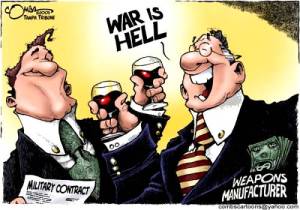
All of this just scratches the surface when it comes to the piles of money that were poured into an increasingly privatized version of the American way of war and, in the form ofovercharges and abuses of every sort, often simply disappeared into the pockets of the warrior corporations that entered America’s war zones.  In a sense, a surprising amount of the money that the Pentagon and U.S. civilian agencies “invested” in Iraq and Afghanistan never left the United States, since it went directly into the coffers of those companies.

Clearly, Washington had gone to war like a drunk on a bender, while the domestic infrastructure began to fray.  At $109 billion by 2014, the American reconstruction program in Afghanistan was already, in today’s dollars, larger than the Marshall Plan (which helped put all of devastated Western Europe back on its feet after World War II) and still the country was a shambles. In Iraq, a mere $60 billion was squandered on the failed rebuilding of the country.  Keep in mind that none of this takes into account the staggering billions spent by the Pentagon in both countries to build strings of bases, ranging in size from American towns (with all the amenities of home) to tiny outposts.  There would be 505 of them in Iraq and at least 550 in Afghanistan.  Most were, in the end, abandoned, dismantled, or sometimes simply looted.  And don’t forget the vast quantities of fuel imported into Afghanistan to run the U.S. military machine in those years, some of which was siphoned off by American soldiers, to the tune of at least $15 million, and sold to local Afghans on the sly.

In other words, in the post-9/11 years, “reconstruction” and “war” have really been euphemisms for what, in other countries, we would recognize as a massive system of corruption.

And let’s not forget another kind of “reconstruction” then underway. In both countries, the U.S. was creating enormous militaries and police forces essentially from scratch to the tune of at least $25 billion in Iraq and $65 billion in Afghanistan.  What’s striking about both of these security forces, once constructed, is how similar they turned out to be to those police academies, the unfinished schools, and that natural gas station.  It can’t be purely coincidental that both of the forces Americans proudly “stood up” have turned out to be the definition of corrupt: that is, they were filled not just with genuine recruits but with serried ranks of “ghost personnel.”

In June 2014, after whole divisions of the Iraqi army collapsed and fled before modest numbers of Islamic State militants, abandoning much of their weaponry and equipment, it became clear that they had been significantly smaller in reality than on paper.  And no wonder, as that army had enlisted 50,000 “ghost soldiers” (who existed only on paper and whose salaries were lining the pockets of commanders and others).  In Afghanistan, the U.S. is still evidently helping to pay for similarly stunning numbers of phantom personnel, though no specific figures are available.  (In 2009, an estimated more than 25% of the police force consisted of such ghosts.)  As John Sopko, the U.S. inspector general for Afghanistan,warned last June: “We are paying a lot of money for ghosts in Afghanistan… whether they are ghost teachers, ghost doctors or ghost policeman or ghost soldiers.”

And lest you imagine that the U.S. military has learned its lesson, rest assured that it’s still quite capable of producing nonexistent proxy forces.  Take the Pentagon-CIA program to train thousands of carefully vetted “moderate” Syrian rebels, equip them, arm them, and put them in the field to fight the Islamic State.  Congress ponied up $500 million for it, $384 million of which was spent before that project was shut down as an abject failure.  By then, less than 200 American-backed rebels had been trained and even less put into the field in Syria — and they were almost instantly kidnapped or killed, or they simply handed over their equipment to the al-Qaeda-linked al-Nusra Front.  At one point, according to the congressional testimony of the top American commander in the Middle East, only four or five American-produced rebels were left “in the field.”  The cost-per-rebel sent into Syria, by the way, is now estimated at approximately $2 million.

A final footnote: the general who oversaw this program is, according to the New York Times, still a “rising star” in the Pentagon and in line for a promotion.

Profli-gate

You’ve just revisited the privatized, twenty-first-century version of the American way of war, which proved to be a smorgasbord of scandal, mismanagement, and corruption as far as the eye could see.  In the tradition of Watergate, perhaps the whole system could be dubbed Profli-gate, since American war making across the Greater Middle East has represented perhaps the most profligate and least effective use of funds in the history of modern warfare.  In fact, here’s a word not usually associated with the U.S. military: the war system of this era seems to function remarkably like a monumental scam, a swindle, a fraud.

The evidence is in: the U.S. military can win battles, but not a war, not even against minimally armed minority insurgencies; it can “stand up” foreign militaries, but only if they are filled with phantom feet and if the forces themselves are as hollow as tombs; it can pour funds into the reconstruction of countries, a process guaranteed to leave them more prostrate than before; it can bomb, missile, and drone-kill significant numbers of terrorists and other enemies, even as their terror outfits and insurgent movements continue to grow stronger under the shadow of American air power.  Fourteen years and five failed states later in the Greater Middle East, all of that seems irrefutable.

And here’s something else irrefutable: amid the defeats, corruption, and disappointments, there lurks a kind of success.  After all, every disaster in which the U.S. military takes part only brings more bounty to the Pentagon.  Domestically, every failure results in calls for yet more military interventions around the world.  As a result, the military is so much bigger and better funded than it was on September 10, 2001.  The commanders who led our forces into such failures have repeatedly been rewarded and much of the top brass, civilian and military, though they should have retired in shame, have taken ever more golden parachutes into the lucrative worlds of defense contractors, lobbyists, and consultancies.

All of this couldn’t be more obvious, though it’s seldom said.  In short, there turns out to be much good fortune in the disaster business, a fact which gives the whole process the look of a classic swindle in which the patsies lose their shirts but the scam artists make out like bandits.

Add in one more thing: these days, the only part of the state held in great esteem by conservatives and the present batch of Republican presidential candidates is the U.S. military.  All of them, with the exception of Rand Paul, swear that on entering the Oval Office they will let that military loose, sending in more troops, or special ops forces, or air power, and funding the various services even more lavishly; all of this despite overwhelming evidence that the U.S. military is incapable of spending a dollar responsibly or effectively monitoring what it’s done with the taxpayer funds in its possession.  (If you don’t believe me, forget everything in this piece and just check out the finances of the most expensive weapons system in history, the F-35 Lightning II, which should really be redubbed the F-35 Overrun for its madly spiraling costs.)

But no matter. If a system works (particularly for those in it), why change it?  And by the way, in case you’re looking for a genuine steal, I have a fabulous gas station in Afghanistan to sell you…


Tom Engelhardt is a co-founder of the American Empire Project and the author of The United States of Fear as well as a history of the Cold War, The End of Victory Culture. He is a fellow of the Nation Institute and runs TomDispatch.com. His latest book is Shadow Government: Surveillance, Secret Wars, and a Global Security State in a Single-Superpower World.

Time Is Running Out For Pax Americana’s Apologists

aa-American-Empire-statue-of-liberty-and-military

By Rostisla Ischenko

Source: Dissident Voice

The paradox of the current global crisis is that for the last five years, all relatively responsible and independent nations have made tremendous efforts to save the United States from the financial, economic, military, and political disaster that looms ahead. And this is all despite Washington’s equally systematic moves to destabilize the world order, rightly known as the Pax Americana (“American peace”).

Since policy is not a zero-sum game; i.e., one participant’s loss does not necessarily entail a gain for another, this paradox has a logical explanation. A crisis erupts within any system when there is a discrepancy between its internal structure and the sum total of available resources (that is, those resources will eventually prove inadequate for the system to function normally and in the usual way).

There are at least three basic options for addressing this situation:

  1. Through reform, in which the system’s internal structure evolves in such a way as to better correspond to the available resources.
  2. Through the system’s collapse, in which the same result is achieved via revolution.
  3. Through preservation, in which the inputs threatening the system are eliminated by force, and the relationships within the system are carefully preserved on an inequitable relationship basis (whether between classes, social strata, castes, or nations).

The preservation method was attempted by the Ming and Qing dynasties in China, as well as the Tokugawa Shogunate in Japan. It was utilized successfully (in the 19th century) prior to the era of capitalist globalization. But neither of those Eastern civilizations (although fairly robust internally) survived their collision with the technologically more advanced (and hence more militarily and politically powerful) European civilization. Japan found its answer on the path of modernization (reform) back in the second half of the 19th century, China spent a century immersed in the quagmire of semi-colonial dependence and bloody civil wars, until the new leadership of Deng Xiaoping was able to articulate its own vision of modernizing reforms.

This point leads us to the conclusion that a system can be preserved only if it is safeguarded from any unwanted external influences; i.e., if it controls the globalized world.

The contradiction between the concept of escaping the crisis, which has been adopted by the US elite, and the alternative concept – proposed by Russia and backed by China, then by the BRICS nations and now a large part of the world – lay in the fact that the politicians in Washington were working from the premise that they are able to fully control the globalized world and guide its development in the direction they wish. Therefore, faced with dwindling resources to sustain the mechanisms that perpetuate their global hegemony, they tried to resolve the problem by forcefully suppressing potential opponents in order to reallocate global resources in their favor.

If successful, the United States would be able to re-enact the events of the late 1980s – early 1990s, when the collapse of the Soviet Union and the global socialist system under its control allowed the West to escape its crisis. At this new stage, it has become a question of no longer simply reallocating resources in favor of the West as a collective whole, but solely in favor of the United States. This move offered the system a respite that could be used to create a regime for preserving inequitable relationships, during which the American elite’s definitive control over the resources of power, raw materials, finance, and industrial resources safeguarded them from the danger of the system’s internal implosion, while the elimination of alternative power centers shielded the system from external breaches, rendering it eternal (at least for a historically foreseeable period of time).

The alternative approach postulated that the system’s total resources might be depleted before the United States can manage to generate the mechanisms to perpetuate its global hegemony. In turn, this will lead to strain (and overstrain) on the forces that ensure the imperial suppression of those nations existing on the global periphery, all in the interests of the Washington-based center, which will later bring about the inevitable collapse of the system.

Two hundred, or even one hundred years ago, politicians would have acted on the principle of “what is falling, that one should also push” and prepared to divvy up the legacy of yet another crumbling empire. However, the globalization of not only the world’s industry and trade (that was achieved by the end of the 19th century), but also global finance, caused the collapse of the American empire through a policy that was extremely dangerous and costly for the whole world. To put it bluntly, the United States could bury civilization under its own wreckage.

Consequently, the Russian-Chinese approach has made a point of offering Washington a compromise option that endorses the gradual, evolutionary erosion of American hegemony, plus the incremental reform of international financial, economic, military, and political relations on the basis of the existing system of international law.

America’s elite have been offered a “soft landing” that would preserve much of their influence and assets, while gradually adapting the system to better correspond to the present facts of life (bringing it into line with the available reserve of resources), taking into account the interests of humanity, and not only of its “top echelon” as exemplified by the “300 families” who are actually dwindling to no more than thirty.

In the end, it is always better to negotiate than to build a new world upon the ashes of the old. Especially since there has been a global precedent for similar agreements.

Up until 2015, America’s elite (or at least the ones who determine US policy) had been assured that they possessed sufficient financial, economic, military, and political strength to cripple the rest of the world, while still preserving Washington’s hegemony by depriving everyone, including (at the final stage) even the American people of any real political sovereignty or economic rights. European bureaucrats were important allies for that elite; i.e., the cosmopolitan, comprador-bourgeoisie sector of the EU elite, whose welfare hinged on the further integration of transatlantic (i.e., under US control) EU entities (in which the premise of Atlantic solidarity has become geopolitical dogma) and NATO, although this is in conflict with the interests of the EU member states.

However, the crisis in Ukraine, which has dragged on much longer than originally planned, Russia’s impressive surge of military and political energy as it moved to resolve the Syrian crisis (something for which the US did not have an appropriate response) and, most important, the progressive creation of alternative financial and economic entities that call into question the dollar’s position as the de facto world currency, have forced a sector of America’s elite that is amenable to compromise to rouse itself (over the last 15 years that elite has been effectively excluded from participation in any strategic decisions).

The latest statements by Kerry and Obama which seesaw from a willingness to consider a mutually acceptable compromise on all contentious issues (even Kiev was given instructions “to implement Minsk“) to a determination to continue the policy of confrontation – are evidence of the escalating battle being fought within the Washington establishment.

It is impossible to predict the outcome of this struggle – too many high-status politicians and influential families have tied their futures to an agenda that preserves imperial domination for that to be renounced painlessly. In reality, multibillion-dollar positions and entire political dynasties are at stake.

However, we can say with absolute certainty that there is a certain window of opportunity during which any decision can be made. And a window of opportunity is closing that would allow the US to make a soft landing with a few trade-offs. The Washington elite cannot escape the fact that they are up against far more serious problems than those of 10-15 years ago. Right now the big question is about how they are going to land, and although that landing will already be harder than it would have been and will come with costs, the situation is not yet a disaster.

But the US needs to think fast. Their resources are shrinking much faster than the authors of the plan for imperial preservation had expected. To their loss of control over the BRICS countries can be added the incipient, but still fairly rapid loss of control over EU policy as well as the onset of geopolitical maneuvering among the monarchies of the Middle East. The financial and economic entities created and set in motion by the BRICS nations are developing in accordance with their own logic, and Moscow and Beijing are not able to delay their development overlong while waiting for the US to suddenly discover a capacity to negotiate.

The point of no return will pass once and for all sometime in 2016, and America’s elite will no longer be able to choose between the provisions of compromise and collapse. The only thing that they will then be able to do is to slam the door loudly, trying to drag the rest of the world after them into the abyss.

Rostislav Ischenko is the President of Centre for System Analysis and Forecasting (Kiev) currently living in Moscow. Read other articles by Rostisla.

The Deep State: The Unelected Shadow Government Is Here to Stay

deep_state_2_0

By John W. Whitehead

Source: The Rutherford Institute

Behind the ostensible government sits enthroned an invisible government, owing no allegiance and acknowledging no responsibility to the people.” ― Theodore Roosevelt

America’s next president will inherit more than a bitterly divided nation teetering on the brink of financial catastrophe when he or she assumes office. He will also inherit a shadow government, one that is fully operational and staffed by unelected officials who are, in essence, running the country.

To be precise, however, the future president will actually inherit not one but two shadow governments.

The first shadow government, referred to as COG or continuity of government, is made up of unelected individuals who have been appointed to run the government in the event of a “catastrophe.”

The second shadow government, referred to as the Deep State, is comprised of unelected government bureaucrats, corporations, contractors, paper-pushers, and button-pushers who are actually calling the shots behind the scenes right now.

The first shadow government, COG, is a phantom menace waiting for the right circumstances—a terrorist attack, a natural disaster, an economic meltdown—to bring it out of the shadows, where it operates even now. When and if COG takes over, the police state will transition to martial law.

Yet as I point out in my book Battlefield America: The War on the American People, it is the second shadow government, the Deep State, which poses the greater threat to our freedoms. This permanent, corporatized, militarized, entrenched bureaucracy is unaffected by elections, unaltered by populist movements, and beyond the reach of the law.

This is the hidden face of the police state.

These two shadow governments, which make a mockery of representative government and the “reassurance ritual” of voting, have been a long time in the making. Yet they have been so shrouded in secrecy, well hidden from the eyes and ears of the American people, that they exist and function in contravention to the principles of democratic government.

As the following makes clear, these shadow governments, which operate beyond the reach of the Constitution and with no real accountability to the citizenry, are the reason why “we the people” have no control over our government.

The COG shadow government plan was devised during the Cold War as a means of ensuring that a nuclear strike didn’t paralyze the federal government.

COG initially called for three teams consisting of a cabinet member, an executive chief of staff and military and intelligence officials to practice evacuating and directing a counter nuclear strike against the Soviet Union from a variety of high-tech, mobile command vehicles. If the president and vice president were both killed, one of these teams would take control, with the ranking cabinet official serving as president.

This all changed after the attacks of September 11, 2001, when it became clear that there would be no warning against a terrorist attack. Instead of waiting until an attack occurred to mobilize part-time bureaucrats and activate evacuation schemes, George W. Bush opted to change COG and establish a full-time, permanent shadow government, stationed outside the capital, run by permanently appointed (not elected) executive officials.

COG has since taken on a power—and a budget—of its own.

Incredibly, under the Obama administration, the plans for the shadow government have expanded and grown far more elaborate and costly than many realize. It is what investigative journalist William M. Arkin refers to as “the latest manifestation of an obsession with government survival.”

In much the same way that the nation was taken hostage after 9/11 by color-coded terror alerts and “See Something, Say Something” campaigns that transformed us into a fearful, watchful nation of suspects, the government’s efforts to prepare us for a so-called national disaster have, in turn, left us a constant state of near-emergency and acclimated us to the sight of militarized police, military drills on American soil, privatized prisons, the specter of internment camps, and the erosion of constitutional rights, especially as they pertain to so-called “extremists,” domestic or otherwise.

Study the COG plans carefully, however, and you’ll find that the concern isn’t so much about protecting our government as it is about protecting the nation’s governmental elite.

As Arkin reports: “Countless billions have been spent on this endeavor over the years, a secret orgy of preparedness going on behind the scenes, one that ensures Washington can defend itself, take care of its own, and survive no matter what.”

To this end, the government has invested heavily in the “architecture of fear”: massive underground bunkers—the size of small cities—which are sprinkled throughout the country for the government elite to escape to “in case of an imminent nuclear strike so that they can set up a kind of Administration-in-exile, directing every order of business from retaliation to recovery.”

These bunkers, strategically located around the nation’s capital and in key states, represent a who’s who on the shadow government’s payroll, with every department and agency represented, from the Department of Education and the Trademark Office to the Small Business Administration and the National Archives.

No sector has been overlooked: military, surveillance, counterintelligence, scientific, political, judicial, corporate contractors, as well as computer programmers, engineers, fire fighters, craftsmen, security guards, branch chiefs, financial managers, supply officers, secretaries and stenographers, all of whom have been entrusted with special ID cards allowing them clearance into the doomsday survival sites. They’ve even included individuals tasked with patent and trademark processing. They even have contingency plans to save priceless works of art.

The Federal Relocation Arc near Washington DC will reportedly serve as the emergency bunker for “every Cabinet department (and every government organization deemed essential).” Site R, a 700,000-foot facility inside Raven Rock Mountain near Camp David, will serve as a backup Pentagon. Peters Mountain near Charlottesville, Va., is the likely site for the nation’s domestic spies to hide out. Congress will retire to a subterranean facility near the posh Greenbrier resortin West Virginia, which served as an internment facility for Japanese, Italian and German diplomats during World War II. And a 600,000-square-foot complex inside Virginia’s Mount Weather is expected to be the primary relocation site for the White House, the Supreme Court and much of the executive branch.

Built into the side of a mountain, Mount Weather, near Bluemont, Va., is staffed 24 hours a day, seven days a week. This self-contained facility contains, among other things, a hospital, crematorium, dining and recreation areas, sleeping quarters, reservoirs of drinking and cooling water, an emergency power plant, a radio/television studio and a full-time police and fire department.

There is also an Office of the Presidency at Mount Weather, which regularly receives top-secret national security information from all the federal departments and agencies. This facility was largely unknown to everyone, including Congress, until it came to light in the mid-1970s. Military personnel connected to the bunker have refused to reveal any information about it, even before congressional committees. In fact, Congress has no oversight, budgetary or otherwise, on Mount Weather, and the specifics of the facility remain top-secret.

These facilities reinforce a troubling government mindset that treats the American people as relatively insignificant and expendable. Because you know who’s not on the list of key-individuals-to-be-saved-in-the-eventuality-of-a-disaster? You and me and every other American citizen who is viewed as a mere economic unit to be tallied, bought and sold by those in power.

Not to worry, however. The government hasn’t completely forgotten about us.

In the event of a “national emergency”—loosely defined as “any incident, regardless of location, that results in extraordinary levels of mass casualties, damage, or disruption severely affecting the U.S. population, infrastructure, environment, economy, or government functions”—the executive branch and its unelected appointees will be given unchecked executive, legislative and judicial power.

In such an event, the Constitution will effectively be suspended, thereby ushering in martial law.

However, writing for Radar magazine, Christopher Ketcham suggests that the government won’t have completely forgotten about the rest of us. In fact, Ketcham believes that the government also has plans to imprison hundreds of thousands of “potentially suspect” Americans in detention camps.

Ketcham describes a program created by the Department of Homeland Security that relies on a database of Americans who might be considered potential threats in the event of a national emergency. Referred to by the code name Main Core, this database reportedly contains the names of millions of Americans who, “often for the slightest and most trivial reason, are considered unfriendly, and who, in a time of panic, might be incarcerated. The database can identify and locate perceived ‘enemies of the state’ almost instantaneously.”

Sounds unnervingly like the objectives of the government’s new Domestic Terrorism Czar and the Strong Cities network, which will be working to identify and target potential extremists, doesn’t it?

Under Ketcham’s scenario, if a terrorist attack occurs, the president will declare a national emergency, activating COG procedures and throwing the country into martial law with the shadow government at the helm. The administration will then round up the “dangerous” Americans listed in Main Core and place them in one of the many internment camps or private prisons built for just such an eventuality.

For all intents and purposes, the nation is one national “emergency” away from having a full-fledged, unelected, authoritarian state emerge from the shadows. All it will take is the right event—another terrorist attack, perhaps, or a natural disaster—for such a regime to emerge from the shadows.

As unnerving as that prospect may be, however, it is the second shadow government, what former congressional staffer Mike Lofgren refers to as “the Deep State, which operates according to its own compass heading regardless of who is formally in power,” that poses the greater threat right now.

Consider this: how is it that partisan gridlock has seemingly jammed up the gears (and funding sources) in Washington, yet the government has been unhindered in its ability to wage endless wars abroad, in the process turning America into a battlefield and its citizens into enemy combatants?

The credit for such relentless, entrenched, profit-driven governance, according to Lofgren, goes to “another government concealed behind the one that is visible at either end of Pennsylvania Avenue, a hybrid entity of public and private institutions ruling the country according to consistent patterns in season and out, connected to, but only intermittently controlled by, the visible state whose leaders we choose.”

This “state within a state” hides “mostly in plain sight, and its operators mainly act in the light of day,” says Lofgren, and yet the “Deep State does not consist of the entire government.”

Rather, Lofgren continues:

It is a hybrid of national security and law enforcement agencies: the Department of Defense, the Department of State, the Department of Homeland Security, the Central Intelligence Agency and the Justice Department. I also include the Department of the Treasury because of its jurisdiction over financial flows, its enforcement of international sanctions and its organic symbiosis with Wall Street.

All these agencies are coordinated by the Executive Office of the President via the National Security Council. Certain key areas of the judiciary belong to the Deep State, such as the Foreign Intelligence Surveillance Court, whose actions are mysterious even to most members of Congress. Also included are a handful of vital federal trial courts, such as the Eastern District of Virginia and the Southern District of Manhattan, where sensitive proceedings in national security cases are conducted.

The final government component (and possibly last in precedence among the formal branches of government established by the Constitution) is a kind of rump Congress consisting of the congressional leadership and some (but not all) of the members of the defense and intelligence committees. The rest of Congress, normally so fractious and partisan, is mostly only intermittently aware of the Deep State and when required usually submits to a few well-chosen words from the State’s emissaries.

In an expose titled “Top Secret America,” The Washington Post revealed the private side of this shadow government, made up of 854,000 contract personnel with top-secret clearances, “a number greater than that of top-secret-cleared civilian employees of the government.”

Reporting on the Post’s findings, Lofgren points out:

These contractors now set the political and social tone of Washington, just as they are increasingly setting the direction of the country, but they are doing it quietly, their doings unrecorded in the Congressional Record or the Federal Register, and are rarely subject to congressional hearings…

The Deep State not only holds the nation’s capital in thrall, but it also controls Wall Street (“which supplies the cash that keeps the political machine quiescent and operating as a diversionary marionette theater”) and Silicon Valley.

As Lofgren concludes:

[T]he Deep State is so heavily entrenched, so well protected by surveillance, firepower, money and its ability to co-opt resistance that it is almost impervious to change… If there is anything the Deep State requires it is silent, uninterrupted cash flow and the confidence that things will go on as they have in the past. It is even willing to tolerate a degree of gridlock: Partisan mud wrestling over cultural issues may be a useful distraction from its agenda.

Remember this the next time you find yourselves mesmerized by the antics of the 2016 presidential candidates or drawn into a politicized debate over the machinations of Congress, the president or the judiciary: it’s all intended to distract you from the fact that you have no authority and no rights in the face of the shadow governments.


Peter Levenda Podcast Roundup

hqdefault

Peter Levenda is best known as the author of the Sinister Forces series, a seminal trilogy on the occult history of the United States. He’s also the alleged author of the Simon Necronomicon. Like Robert Anton Wilson (with a more historical and sociological bent), Levenda is able to draw connections between a wide range of fascinating but seemingly disparate topics and consistently digs up mindblowing information that could leave readers questioning their understanding of reality. Throughout the year he’s been doing a larger than usual number of podcast interviews in part to promote his latest book The Hitler Legacy: The Nazi Cult in Diaspora, How it was Organized, How it was Funded, and Why it remains a Threat to Global Security in the Age of Terrorism. Fans of his writing will likely enjoy all the following podcasts which highlight different aspects of his work. Those new to Levenda might want to start with the Higherside Chats interview which provides an expansive yet concise overview of his research.

12/17/15: The Higherside Chats (Sinister Forces, Occult History and The Nine)

http://thehighersidechats.com/wp-content/uploads/2015/12/THC-Peter-Levenda-Free.mp3

12/10/15: Project Camelot (Nazi Roots of ISIS)

8/25/15 – 10/27/15: Dave Emory (10 Episodes on the Hitler Legacy)

https://wfmu.org/playlists/DX

8/7/15: Dreamland (w/ Joseph Farrell on the Dark Energies of the Modern World)

http://strieber.streamguys1.com/dreamland_08_07_15fr.mp3

4/18/15: Auticulture (on culture, religion, the occult, and geopolitics among other topics)

http://auticulture.com/podcasts/Levenda.mp3

The Business of War is the Cause of War

war-is-money

By Sergey Baranov & Ethan Indigo Smith

Source: Waking Times

If you objectively and consistently observe the mainstream media and its interpretation of global events, its omissive and deceptive character soon becomes abundantly clear. This could hardly be called incompetence. The coverage, which is popularly called “news,” is in fact nothing but a propaganda mechanism, designed to persistently shape public opinion in favor of war.

Who benefits from war?

Certainly not the people on the warring sides. People always suffer in war; their futures ruined and their lives destroyed. In fear, they look to their government to protect them, the very same government that is invested in war. War is a dirty business that profits off death and destruction while generating blood money for the profiteers. The people are told to look the other way, outside of their country – where the ‘enemy’ supposedly resides.

But what if the real enemy is inside the country, and wears expensive suits, not turbans? What if he speaks your language while living in luxury and sending his children to study at Princeton, Yale and Harvard? While your kids are sent off to fight in fraudulent wars for corporate interests masquerading as ‘patriotism’.

This is in fact jingoism – a nationalized fervor of aggression, based on the notion of supremacy, and usually founded in a lust for power and riches. This mindset, of course, isn’t new and is no different from Adolf Hitler’s extreme nationalism, or fascism.

Today we are living under the rule of oligarchical, trans-humanist, eugenicist elites that continuously consolidate power in order to control and confine humanity while methodically stripping us of the power to govern ourselves. One of the best ways to achieve this is to keep the people in constant fear of wars and threats of terrorism, that, in reality governments themselves typically create or sponsor. For example, we can look at the current threat of ISIS which is in fact a remodel of Al Qaeda, a group the CIA created in the 1970’s to fight the Russians in Afghanistan.

Constant mainstream promotion of ISIS with newly released videos of beheadings and other types of inhuman cruelty is used to scare the American people into the further submission, and ever-greater losses of rights and personal freedoms. The growing surveillance and domestic police state, and the passage of laws including the recent renewal of the Patriot Act, wouldn’t be possible without always frightening the general public. This policy ensures the constant funding of the military industrial complex, which unfortunately has taken over the government, as Dwight D. Eisenhower, the 34th President of the United States had foreseen and warned us about on Jan. 17th, 1961.

READ: Former Presidents Warn About the “Invisible Government” Running the United States

How can we stop the war machine?

Well, certainly not by fighting against it using its means. That’s what the machine is designed for, and an armed resistance will only be playing into its hands. After all, they’ve got the nukes and they will use them as they have already done in Hiroshima and Nagasaki. There must be another way to shut down this engine of death.

What is the way to a global peace? Certainly it isn’t paved with war… how absurd! Nor is it threats and rhetoric of war.

Furthermore, the nuclear threat means that the situation today is dire. The wars most of us have known in our lifetimes have not been nuclear which is why you need to wake up and get involved before it happens. There are no survivors under mushroom clouds – everybody dies.

There is no defense in the case of a nuclear war being unleashed – unless you were to commit yourself to living underground in a bunker for the rest of your life, without ever again seeing and feeling the sunshine. It is a death by a thousand cuts if you remain on the surface. There is no technology to clean up radiation and take it out of the air, water and land. The half-life of nuclear radiation is 4.5 billion years, equal to the age of our planet. That means that during this time, the radioactive particles will remain as deadly as they are today. This could be the end of all of us if nuclear war were to be released on a massive scale – a probability that is as high today as it has ever been, and growing proportionally with the insanity of politics.

The cold war between the Soviet Union and USA never ended, only slowly heated up. And even though the nuclear arms race developed through paranoia, the threat of nuclear war today, is in fact a very present and real one.

Realizing that war is an instrument to have us kill and be killed on behalf of corporate interests, we should be refusing the very notion of war, no matter how much we are lied to and instigated to do otherwise. War defeats individuals and empowers institutions. Wars do not happen naturally. They are orchestrated for political and economic advantage by corporate entities for which human life is only a means to a greater enrichment. The United States of America is not the only country in which the military industrial complex has taken over. The same can be seen in many modern nations.‘’War is good for the economy,’’ is a slogan often heard on the news in Israel.

But for which economy? For the economy of peace, or for the economy of war? Is it good for the people or is it good for those who are in the business of bullets and bombs?

Traveling the world and observing ordinary people, one will inevitably come to the conclusion that no one actually wants war. Regardless of the geographical location, nationality, skin color, social status etc., people want peace, and to see their children grow. Wars, although they may appear, are not fought between people. They are fought between military industrial factions and alliances warring for domination and control.

READ: All Wars Are Well Planned Banker Wars, Including World War 3

Banks financing the governments of warring sides are even more heavily involved than the war materials industries. They fund the entire game by lending money to the governments, further sinking nations in debt, while they use this money to kill each other off. Federal spending surges as the military is mobilized. Outlays for troops, weapons and munitions increases as conflicts escalate. Thee fraudulent and never-ending war in Iraq has already cost over 3 trillion dollars and counting – a steady flow of income for all those who are employed and benefiting from war.

While the average person wants to be left alone to live his or her life in peace on either side of an orchestrated conflict, government, corporations and institutions drag us into conflict time and again. The world has become a place where corporate interests, backed by corrupt governments, all funded by evil banks, violate human rights, freedom and dignity beyond measure. This poses an existential threat to the survival of our species that will not abate as long as the military industrial complex maintains its grip on our society and our culture.


About the Authors

Sergey Baranov is the author of Path: Seeking Truth in a World of Lies. Follow him on Facebook here. Follow Sergey on Facebook here https://www.facebook.com/sergey.baranov.path

Activist, author and Tai Chi teacher, Ethan Indigo Smith was born on a farm in Maine and lived in Manhattan for a number of years before migrating west to Mendocino, California. Guided by a keen sense of integrity and humanity, Ethan’s work is both deeply connected and extremely insightful, blending philosophy, politics, activism, spirituality, meditation and a unique sense of humour. Follow Ethan on Facebook here: https://www.facebook.com/pages/Ethan-Indigo-Smith/423549761069857?fref=ts

Glenn Greenwald Stands by the Official Narrative

2014_09_Screen-Shot-2014-09-12-at-12.35.03-PM

By William A. Blunden

Source: Dissident Voice

Glenn Greenwald has written an op-ed piece for the Los Angeles Times. In this editorial he asserts that American spies are motivated primarily by the desire to thwart terrorist plots. Such that their inability to do so (i.e., the attacks in Paris) coupled with the associated embarrassment motivates a public relations campaign against Ed Snowden. Greenwald further concludes that recent events are being opportunistically leveraged by spy masters to pressure tech companies into installing back doors in their products. Over the course of this article what emerges is a worldview which demonstrates a remarkable tendency to accept events at face value, a stance that’s largely at odds with Snowden’s own documents and statements.

For example, Greenwald states that American spies have a single overriding goal, to “find and stop people who are plotting terrorist attacks.” To a degree this concurs with the official posture of the intelligence community. Specifically, the Office of the Director of National Intelligence specifies four topical missions in its National Intelligence Strategy: Cyber Intelligence, Counterterrorism, Counterproliferation, and Counterintelligence.

Yet Snowden himself dispels this notion. In an open letter to Brazil he explained that “these [mass surveillance] programs were never about terrorism: they’re about economic spying, social control, and diplomatic manipulation. They’re about power.”

And the public record tends to support Snowden’s observation. If the NSA is truly focused on combatting terrorism it has an odd habit of spying on oil companies in Brazil and Venezuela. In addition anyone who does their homework understands that the CIA has a long history of overthrowing governments. This has absolutely nothing to do with stopping terrorism and much more to do with catering to powerful business interests in places like Iran (British Petroleum), Guatemala (United Fruit), and Chile (ITT Corporation). The late Michael Ruppert characterized the historical links between spies and the moneyed elite as follows: “The CIA is Wall Street, and Wall Street is the CIA.”1

The fact that Greenwald appears to accept the whole “stopping terrorism” rationale is extraordinary all by itself. But things get even more interesting…

Near the end of his article Greenwald notes that the underlying motivation behind the recent uproar of spy masters “is to depict Silicon Valley as terrorist-helpers for the crime of offering privacy protections to Internet users, in order to force those companies to give the U.S. government ‘backdoor’ access into everyone’s communications.”

But if history shows anything, it’s that the perception of an adversarial relationship between government spies and corporate executives has often concealed secret cooperation. Has Greenwald never heard of Crypto AG, or RSA, or even Google? These are companies who at the time of their complicity marketed themselves as protecting user privacy. In light of these clandestine arrangements Cryptome’s John Young comments that it’s “hard to believe anything crypto advocates have to say due to the far greater number of crypto sleazeball hominids reaping rewards of aiding governments than crypto hominid honorables aiding one another.”

It’s as if Greenwald presumes that the denizens of Silicon Valley, many of whose origins are deeply entrenched in government programs, have magically turned over a new leaf. As though the litany of past betrayals can conveniently be overlooked because things are different. Now tech vendors are here to defend our privacy. Or at least that’s what they’d like us to believe. In the aftermath of the PRISM scandal, which was disclosed by none other than Greenwald and Snowden, the big tech of Silicon Valley is desperate to portray itself as a victim of big government.

You see, the envoys of the Bay Area’s new economy have formulated a convincing argument. That’s what they get paid to do. The representatives of Silicon Valley explain in measured tones that tech companies have stopped working with spies because it’s bad for their bottom line. Thus aligning the interests of private capital with user privacy. But the record shows that spies often serve private capital. To help open up markets and provide access to resources in foreign countries. And make no mistake there’s big money to be made helping spies. Both groups do each other a lot of favors.

And so a question for Glenn Greenwald: what pray tell is there to prevent certain CEOs in Silicon Valley from betraying us yet again, secretly via covert backdoors, while engaged in a reassuring Kabuki Theater with government officials about overt backdoors? Giving voice to public outrage while making deals behind closed doors. It’s not like that hasn’t happened before during an earlier debate about allegedly strong cryptography. Subtle zero-day flaws are, after all, plausibly deniable.

How can the self-professed advocate of adversarial journalism be so credulous? How could a company like Apple, despite its bold public rhetoric, resist overtures from spy masters any more than Mohammad Mosaddegh, Jacobo Árbenz, or Salvador Allende? Doesn’t adversarial journalism mean scrutinizing corporate power as well as government power?

Glenn? Hello?

Methinks Mr. Greenwald has some explaining to do. Whether he actually responds with anything other than casual dismissal has yet to be seen.

  1. Michael C. Ruppert, Crossing the Rubicon: The Decline of the American Empire at the End of the Age of Oil, New Society Publishers, 2004, Chapter 3, page 53.

Bill Blunden is an independent investigator whose current areas of inquiry include information security, anti-forensics, and institutional analysis. He is the author of several books, including The Rootkit Arsenal and Behold a Pale Farce: Cyberwar, Threat Inflation, and the Malware-Industrial Complex. He is the lead investigator at Below Gotham Labs. 

Israelis – Not Muslims – Cheered in Jersey City on 9/11

threeoffivedancingisraelis

In debunking Donald Trump’s big lie about Jersey City Muslims celebrating the destruction of the World Trade Center, the corporate media have told an even bigger lie of omission. There was, indeed, shameless cheering on the banks of the Hudson River on 9/11. But it was by young Israelis, as was widely reported at the time. Fourteen years later, corporate media are covering up for Israel – which makes them even bigger liars than Trump.

By Glen Ford

Source: Black Agenda Report

“By making only a partial correction of Donald Trump’s prevarication, the corporate media were telling their own lie about what happened on 9/11.”

The corporate media don’t like Donald Trump. They used to like him a lot; in fact, Big Business Media are responsible for making this minor multi-millionaire into a household name. But Trump is on their hit list, nowadays, because the Republican presidential candidate insists on telling his own lies, rather than sticking to the list of official lies parroted by corporate media every minute of every day.

Donald Trump told a really “HUGE” – as he would put it – lie when he claimed to have watched thousands of Muslims cheering in Jersey City, New Jersey, as the World Trade Center came down on 9/11. Every corporate news outlet in the country rushed to debunk Trump’s fictitious account. The Washington Post offered psychological theories for why Trump gets away with telling fantastic lies. The New York Times said there was no evidence that Jersey City Muslims cheered the destruction on 9/11. CNN said it never happened. And, they were right.

However, by making only a partial correction of Donald Trump’s prevarication, the corporate media were telling their own lie about what happened on 9/11. There was, in fact, celebration in Jersey City on that fateful morning, and the incident did, briefly, make a major news splash. But the people doing the cheering weren’t Muslims: they were five young Israelis in a white moving van, who were observed in Liberty Park ecstatically taking pictures of themselves framed against the smoking ruins of the Twin Towers. As ABC News reported, the five were later arrested at gunpoint near the New Jersey Giants football stadium. Most U.S. intelligence sources believed the men were Israeli spies, and that their “moving company” was an Israeli intelligence cover. They were detained for a while, and then deported.

“Who is the biggest liar?”

In the year before 9/11 scores of young Israelis posing as “art students” were arrested after penetrating U.S. Defense Department and other classified sites. Both stories made national news. The corporate media could not have avoided running across articles on the “cheering Israelis” when they set about debunking Donald Trump’s “cheering Muslims” account. But, not one of them dare to mention that, yes, some people were seen celebrating 9/11 at Liberty State Park in Jersey City.

I was in a different part of the park on 9/11 morning, alone except for two young Israelis with very expensive cameras, carrying phony New Jersey press credentials, who claimed to be Polish but spoke Hebrew to each other. The two young men were giddy with joy at the destruction that the three of us were observing across the Hudson River.

Later that day, I learned from local and national news outlets about the five Israelis who were dancing with delight about a mile upriver from me and the two other Israelis. Articles about Israelis celebrating 9/11 would have come up in any search to correct Donald Trump’s tall tale – but the corporate media kept that part of the story from the public. They censored their own correction of Donald Trump. So, who is the biggest liar? Trump, who lies to advance his own personal interests, or the U.S. corporate media, who lie to the people on behalf of the State of Israel, and Zionism.


BAR executive editor Glen Ford can be contacted at Glen.Ford@BlackAgendaReport.com.

Related Article: The Five Dancing IsraelisArrested On 9-11

Little Murders in Retrospect

LittleMurders_blood2

By John R. Hall

Source: Dissident Voice

After their wildly successful anti-war classic Mash, actors Elliott Gould and Donald Sutherland ventured out on a very weak limb and made a film version of a hit and miss Broadway production.  Alan Arkin directed the film and played the part of mentally disturbed Lieutenant Practice of the NYPD.  The year was 1971.  My beautiful baby daughter had just entered the world.  I’d recently been convicted of twice refusing induction into the U.S. Army, and was awaiting my court date for sentencing.  Somehow, amid the mix of joy, sadness, and confusion, my wife and I managed to slip out and take in a movie.  Little Murders would haunt me for the rest of my life.

If you’re like virtually everyone I’ve ever quizzed about Little Murders, you not only missed seeing it, you’ve never even heard of it.  It is also likely that, if you happen to be among the few who actually saw it, you’d really like to forget it.  But, of course, you can’t.  44 years later I don’t remember all the gory details of the flick, but I do remember apathetic Alfred Chamberlain (Elliott Gould), focusing his camera on a newly deposited bowel movement in a toilet, and on a steaming pile of dog crap in a park.  He was a photographer and poop was his forte.  His subject matter of choice also reflected his world view.  If Alfred could have possibly cared less about anything, he would have.  Alfred’s world was shit.

Then one day while he was being beaten to a bloody pulp by street thugs, and not even bothering to defend himself, Alfred was saved by feisty, optimistic Patsy Newquist (Marcia Rodd).  Apathist that he was, Alfred tried to walk away without even thanking his heroine.  But Patsy fell for him, and decided to show him that the world wasn’t such a bad place after all.  It was no easy task, but she eventually married Alfred, put a hesitant smile on his glum face, taught him to fight for himself,  and convinced him that life was worth living.  Then she took a random bullet, splattering her husband with blood, and dying.

Little Murders took place in a somewhat exaggerated version of New York City, or Anytown, U.S.A.  Civil society had spiraled out of control and degenerated into a cesspool of fear, loathing, and random violence.  In spite of the raging nightmare of The Vietnam War, few Americans in 1971 would have believed that their country 44 years later would become such an accurate replica of the social wasteland of “Little Murders”.  But that is exactly where we are today, and then some; living in a world so violent and cold that there is nothing left which can shock us.  Mass murders, school shootings, infanticide, beheadings, immolation, cops run amok, manufactured terrorism, the Airport Gestapo, black sites and torture, endless wars for corporate profit, daily specter of nuclear annihilation.

But here in the U.S.A. we like to look on the bright side.  No sense in focusing on the negative when there’s so much positive energy in the world.  We’ve got Kim Kardashian’s ass to obsess about.  A spectacular spectators’ array of gladiator sports:  NFL, NBA, MLB, NHL, NCAA FB, Cage Fighting, NASCAR, Pro golf & tennis.  Black Friday deals on electronics, reality television, celebrity weddings, divorces, and sex changes, Dancing with the Stars, The Voice.  The upcoming Presidential Coronation Circus and Candy Crush.  Did I mention Kim Kardashian’s ass?  Thank God for Pollyanna’s Glad Game.  If not for such an array of inane, petty distractions, Americans would all end up like apathetic Alfred Chamberlain, or worse yet like angry, infuriated me.

Any American with his head screwed on straight should have suffered an extended and incurable case of righteous indignation by now.  While the National Rifle Association has succeeded in enshrining The Second Amendment alongside mom, home, and apple pie, little murders on the domestic front have been on the rise to the point that they’re as common as bedbugs in cheap motels.  But my countrymen do love their portable WMDs, apparently more than life itself.  It’s not just gun violence defining the nightmare which is America.  What has finally emerged is a complete lack of respect.  Respect for self and others, for all life forms, for Mother Earth itself.  Anyone paying attention can see it in their actions.  They litter the streets with their garbage, litter their skin with ill-conceived epidermal etchings, litter their bodies with poisonous food-like substances and soul-killing drugs, litter maternity wards with litters of unwanted children.  Alfred Chamberlain’s world has grown to fruition.

Of course, Americans have had plenty of inspiration as they’ve sacrificed their souls upon the alter of American Exceptionalism.  Their government has waged a nearly non-stop series of wars for corporate profit since Vietnam, Laos, and Cambodia.  Anyone paying a lick of attention knows that every one of these wars were waged for the benefit of Ronald McDonald and Mickey Mouse, and that official government explanations are only believed by fools.  At least our heroes in the White House, the Halls of Congress, and the Pentagon learned something during the Vietnam fiasco:  The new definition of winning a war is that you slaughter as many civilians as possible, bomb cities, destroy infrastructure, burn crops, and create enough chaos that the U.S. Military is forced to open permanent bases and swing wide the doors for corporate plunder.  Conveniently under armed protection.

This is exactly what happened in Afghanistan and Iraq, what went on in Libya recently, and what is now happening in Syria and elsewhere.  The American agenda is being rammed down the throats of unwilling participants wherever there are valuable resources to be plundered by Wall Street pirates.  Migrations of refugees from U.S. bombings seek asylum elsewhere, while foolish, careless Americans pay little heed.  A few hoorays for the red, white, and blue, thanks to our brave fighting men for slaughtering innocent foreigners, and back to watching Kim Kardashian’s ass over a can of Coca-Cola.  Things go better with Coke.

In 1971, I was shocked by the last scene of Little Murders, in which Alfred (still wearing his shirt splattered with his wife’s blood), and the father and brother of his recently deceased bride finally have a few moments of sheer joy.  Taking turns with a loaded rifle, they join in with their fellow New York citizens, becoming snipers from their apartment window,  Finding fun and laughter with each kill.  I’d no longer be shocked by the scene.  Now I get it.  It’s what species do in the final death throes of extinction.


Related Articles

“One of Those Little Things You Learn to Live with”:  On the Politics of Violence in Jules Feiffer’s Little Murders

Saturday Matinee: Little Murders