Freedom Rider: How the billionaires rule

Predatory capitalism has driven down wages and created a dystopia for workers.

By Margaret Kimberley

Source: Intrepid Report

President Calvin Coolidge said, “The business of America is business.” The expression is memorable because it always rang true. But nearly 100 years later an old trite saying has taken on an ever more terrifying meaning.

The ruling class wield their power more blatantly than ever. There is little effort to conceal their determination to rule over the people and to control the politicians who are now little more than their personal minions.

When the people get a little help, as happened with additional stimulus funds for the unemployed, politicians across the country took up arms for the ruling class and turned down free money just to stay in the good graces of their bosses.

Currently 25 states out of 50 have rejected additional help for the unemployed. The money came from the federal government and didn’t impact state budgets, but politicians know who calls the shots. When called upon to help struggling people they chose to do just the opposite. They helped their exploiters and, in the process, made a mockery of what passes for democracy.

There is no labor shortage in this country. Instead, there is a shortage of jobs that pay a living wage and that is because of the power of capitalists. They have grown richer precisely because they have forced workers to live in a constant state of precarity, and now it is quite literally better to stay home than to work for a pittance.

Of course, the richest man in the world, Amazon’s Jeff Bezos, is a master at coming up with new ways to subjugate workers. Any reports of job growth should be viewed with a very jaundiced eye as predatory capitalism has driven down wages and created a dystopia for workers. Bezos has mastered squeezing the most and giving the least.

Amazon warehouse workers suffer from injuries at higher rates than other employees in similar jobs but the injuries are part of the cost of doing business. It is expected that the grueling working conditions will create high turnover which is exactly what Amazon wants. A revolving door of employees serves their needs quite nicely. Bezos made a big deal about a $15 per hour starting salary but he could certainly afford to pay a lot more, a real living wage. The tight-fisted billionaire who could potentially become a trillionaire got rich the old fashioned way. He cheats workers.

Bezos also comes up with new and ingenious ways to spread the suffering. Amazon Flex delivery drivers are hired by apps and fired by algorithms. They have no interaction with human resources or any humans at all and they must pay a $200 fee to contest terminations that are rarely decided in their favor.

Even when American workers lose their jobs they are still at the mercy of corporate giants. ID.me contracts with states to provide public access to web sites such as those used for unemployment claims. Their facial recognition software doesn’t verify everyone properly and desperate people wait days and weeks for their unemployment payments to arrive. As with Amazon there is no one to speak to for help. But state governments turn over millions of dollars to ID.me in order to cheat people out of benefits they have earned. Currently 30 states contract with ID.me to make sure that the most vulnerable are kicked while they are down.

The algorithm hirings and firings and the facial recognition technology problems are not bugs in the system. They are features. They are doing precisely what they are intended to do, keep workers poor, desperate, and at the mercy of capitalists. Cruelty is the point.

One might ask who speaks for the people. Workers in several states had their unemployment saved by court decisions but those are few and far between. Politicians are as blatant as their corporate bosses and openly side with them against their constituents.

There is no way to reform this system. Democrats and republicans are equally eager to act at the behest of corporate interests. The people either vote in hopes of change that never comes or are apathetic because they see that the odds are against them.

The workers who refuse low pay under dangerous conditions are moving in the right direction. Whether they know it or not they are potentially building a new movement. A general strike is what the country needs. Of course that is why the hammer fell in an attempt to nip any resistance in the bud and get the cogs back into the machine. But the direction we must move in is clear. There is no salvation from a Biden or a Harris or any other name being floated. The people will have to move in a different direction if they are to save themselves.

Is Inflation “Transitory”? Here’s Your Simple Test

By Charles Hugh Smith

Source: Of Two Minds

Is inflation “transitory” in your household budget? Really? Where?

The Federal Reserve has been bleating that inflation is “transitory”–but what about the real world that we live in, as opposed to the abstract funhouse of rigged statistics? Here’s a simple test to help you decide if inflation is “transitory” in the real world.

Let’s start with some simple stipulations: price is price, there are no tricks like hedonics or substitution. Nobody cares if the truck stereo is better than it was 40 years ago, the price of the truck is the price we pay today, and that’s all that matters.

(Funny, the funhouse statistical adjustments never consider that appliances that used to last 30 years now break down and are junked after 3 years–if we adjusted for that, the $500 washer would be tagged at $5,000 today because it has lost 90% of its durability over the past 30 years.)

Second, inflation must be weighted to “big ticket” nondiscretionary items. The funhouse statistical trickery counts a $10 drop in the price of a TV (which you buy every few years at best) as equal to a $100 rise in childcare, which you pay monthly. No, no, no: a 10% rise in rent, healthcare insurance and childcare is $400 a month or roughly $5,000 a year. A 10% decline in a TV you buy every three years is $50. Even a 50% drop in the price of a TV ($250) is $83 per year–absolutely trivial, absolutely meaningless compared to $5,000 in higher big-ticket expenses.

You can forego the new TV but not the rent, childcare or healthcare. That’s the difference between “big ticket” nondiscretionary and discretionary (meals out, 3rd TV, etc.).

Third, we jettison the painfully obvious manipulation of “owners equivalent rent” for housing costs. Housing costs are the prices we pay for rent, owning a home and paying property taxes, insurance and maintenance costs to own the home. (Have you priced having a new roof put on your house by a licensed, reputable contractor? No? Well, it’s become a lot more expensive than it was a few years ago. Where is that enormous price leap in “owners equivalent rent”? Just how stupid does the Fed reckon we are?)

OK, here’s the test: let’s say markets finally take a deflationary dive from overvalued heights. Housing, stocks and other risk assets fall 30%. Trillions of dollars in “wealth” (that didn’t exist prior to the Everything Bubble inflating) has vanished, generating a reverse wealth effect as all the owners of these assets feel poorer and less inclined to borrow and spend. This is classically considered highly deflationary: demand drops, prices drop.

The three billionaires who own more assets than the bottom 50% of Americans (165 million Americans) will be crying, but how does life change for the 165 million Americans who own a vanishingly thin slice of these assets? Does their rent drop? No, for the reasons I explained in The Fed Is Wrong: Inflation Is Sticky: the big corporate landlords have to keep rents high to placate their lenders. (And let’s not forget greed: the greedy never want to lower prices, preferring to cling to the Fed’s fantasy of “transitory” trouble.)

Now let’s ask about the higher-income 150 million Americans who own homes and pay property taxes, who pay healthcare insurance, college tuition and fees, childcare and elderly care. Even if there is a deflationary crash in stocks and housing, what are the odds the overall costs of owning and maintaining your home will drop significantly?

What are the odds that local government will let property taxes drop with valuations? Shall we be honest and say zero? If real estate valuations plummet, then property tax rates will rise to compensate. Or other “creative” fees will be imposed to make up the shortfall in tax revenues.

What about childcare? What are the odds that childcare costs will drop 30%? Shall we be honest and say zero? The costs paid by childcare providers only go up, and so those who don’t charge enough (marginal providers) will close down, generating a shortage of supply that elevates prices.

What about elderly care? Will assisted living facilities suddenly drop 30% just because asset bubbles pop? No. The costs of assisted living march higher regardless of what asset valuations and interest rates do.

What about healthcare? Will all those costs drop 30% because assets declined? No. Everyone exposed to real-world pricing of healthcare will be paying more.

But what about the roofing contractor? Won’t they charge 30% less? The biggest expenses for the contractor are workers compensation insurance, liability insurance, disability insurance, FICA (Social Security and Medicare) and healthcare insurance, and none of those will drop a single dollar even if stocks drop 30%.

Just as 85% of local government expenses are labor-related, most of the expenses of the roofing contractor are labor-related. The roofing materials dropping a few bucks might lower the cost by a few percentage points, but the material costs are based on the costs of the manufacturers, distributors, truckers, etc., and these are also based on labor-related expenses, taxes, insurance and healthcare–none of which will drop a dime, regardless of what asset prices do.

Economist Michael Spence elucidated the difference between tradable and untradable goods and services. If you want your washer repaired, that service in untradable, as shipping your broken washer to China for repair is not financially viable. As labor costs rise in China and other offshore economies, that raises costs even for tradable goods.

The majority of essential services are untradable and the costs are dependent on “big ticket” expenses which cannot go down without imploding the economy and government: taxes, insurance, healthcare, childcare, elderly care, etc. cannot drop 30% because they’re based on labor costs, highly profitable systemic friction (Big Pharma, the Higher Education Cartel, Big Ag, healthcare and other quasi-monopolies) and the need for ever-higher tax revenues to provide services which the public demands.

Let’s also ponder the consequences of the extreme concentration of wealth and income in the top 5% of U.S. households. The top 10% own roughly 85% of all wealth, and the top 1% own more than half the financial wealth.

Any significant drop in financial assets will have almost no effect on the bottom 90% because they don’t own enough of these assets to be consequential. So the deflationary effect of the reverse wealth effect will be concentrated in the discretionary spending of the top 10%: the luxury imported vehicles, the $100 per plate dinners (those $60 bottles of wine add up), the $500/day resort vacation, the $2,500/week AirBnB rental, etc.

The declines in the cost of these discretionary luxuries may well be noteworthy, but there are thresholds below which prices cannot drop. The high-end restaurant has equally high-end expenses, and so marginal providers will close, leaving only those few who can maintain profitability as demand for luxury dining craters.

The resort has high expenses as well, and once profitability has been lost, resorts will close just like other marginal providers. Supply shrinks along with demand, and the survivors keep prices high enough or they too will close.

So the essential “big ticket” costs will keep rising and the discretionary luxuries only the top 10% can afford will drop–but not by much as all those luxury providers have the same high fixed costs.

So to recap the test: what are the odds of these “big ticket” expenses dropping 30% if asset prices drop 30%?

Taxes: zero.

Healthcare: zero.

Childcare: zero.

Elderly care: zero.

Costs of doing business: zero.

As for housing: the mortgage doesn’t drop if the market value of the house drops 30%, and any declines in insurance will be modest. The costs of maintenance won’t drop much, either, and might actually increase as the supply of skilled workers declines. (Nothing is more expensive than the “cheap” repair that has to be redone correctly.)

Rents may drop in areas nobody wants to live anymore, but rents will rise in places people do want to live.

The larger point here is the long economic cycles have turned. The 40-year decline in interest rates has turned, whether we admit it or not. The 40-year decline in the prices of goods due to financialization (lower interest rates, higher speculative assets) and globalization has turned. The 40-year expansion of the workforce has turned. The 40-year decline of oil/fuel/resources prices has turned. The 40-year fantasy that we can depend on other nations for our essential resources and components is drawing to a close.

Untradable goods and services, cost thresholds, resource security, the end of financialization / globalization and declining interest rates matter. The fantasy that the top 10% can prop up the economy by borrowing and spending the phantom wealth of insanely overvalued asset bubbles is drawing to a close.

Is inflation “transitory” in your household budget? Really? Where?

The Systemic Risk No One Sees

The unraveling of social cohesion has consequences. Once social cohesion unravels, the nation unravels.

By Charles Hugh Smith

Source: Of Two Minds

My recent posts have focused on the systemic financial risks created by Federal Reserve policies that have elevated moral hazard (risks can be taken without consequence) and speculation to levels so extreme that they threaten the stability of the entire financial system.

These risks are well known, though largely ignored in the current speculative frenzy.

But there is another systemic risk which few if any see: the collapse of social cohesion.

President Carter was prescient in his understanding that a nation’s greatest strength is its social cohesion, a cohesion that America’s unprecedented wealth / income / power inequalities has undermined. Consider this excerpt from his 1981 Farewell Address:

“Our common vision of a free and just society is our greatest source of cohesion at home and strength abroad, greater even than the bounty of our material blessings.”

In other words, a nation’s strength flows not just from its material wealth but from its social cohesion–a term for something that is intangible but very real, something that doesn’t lend itself to quantification or tidy definitions.

Here is my definition: Social cohesion is the glue binding the social order; it is the willingness of the citizenry to sacrifice individual gains for the common good.

Social cohesion is the result of the citizenry sharing a common purpose and identity and working toward the common good even at personal cost. Social cohesion arises from a national identity based on shared values and sacrifices.

To maintain social cohesion, opportunities to better their circumstances must be open to all (the social contract of social mobility) and sacrifices must be shared by the entire citizenry. If the privileged elites evade their share of sacrifice, social cohesion is lost and the entire social order unravels.

The glue binding the privileged elites to shared sacrifice is civic virtue, a moral code that demands elites devote a greater share of their own resources to the public good in exchange for their political and financial power.

Though no one dares confess this publicly, America is now a moral cesspool. As a result, the moral legitimacy of the nation’s leadership has been lost. Every nook and cranny of institutionalized America is dominated by self-interest, and much of the economy is controlled by profiteering monopolies and cartels which wield far more political power than the citizenry.

Civic virtue has been lost. What remains is elite self-interest masquerading as civic virtue.

In his Farewell Address, President Carter explained that “The national interest is not always the sum of all our single or special interests. We are all Americans together, and we must not forget that the common good is our common interest and our individual responsibility.”

Social cohesion, civic virtue and moral legitimacy are the foundation of every society, but they are especially important in composite states.

America is a composite state
, composed of individuals holding a wide range of regional, ethnic, religious and class-based identities. The national identity is only one ingredient in a bubbling stew of local, state and regional identities, ethnic, cultural and religious identities, educational/alumni, professional and tradecraft identities, and elusive but consequential class-based identities.

Composite states are intrinsically trickier to rule, as there is no ethnic or cultural identity that unifies the populace. Lacking a national identity that supersedes all other identities, composite states must tread carefully to avoid fracturing into competing regional, ethnic or cultural identities.

Composite states must establish a purpose-based identity that is understood to demand shared sacrifice, especially in crisis. In the U.S., the national purpose has been redefined by the needs of the era, but never straying too far from these core unifying goals: defending the civil liberties of the citizenry from state interference, defending the nation from external aggressors, and serving the common good by limiting the power of special interests and privileged elites.

We’ve failed to limit the power of privileged elites, failed to demand greater sacrifices of the wealthy in exchange for power, and so the moral legitimacy of the regime has been lost. And with the ascendance of self-interest and the elite’s abandonment of sacrifice, social cohesion has been lost.

This loss is reflected in the bitter partisanship, the increasingly Orwellian attempts to control the mainstream and social media narratives, the debauchery of “expertise” as dueling “experts” vie for control, the fraying of social discourse, the substitution of virtue-signaling for actual civic virtue, the institutionalization of white-collar crime (collusion, fraud, embezzlement, etc.), the increasing reliance on Bread and Circuses (stimulus, Universal Basic Income) as real opportunity dissipates, and the troubling rise in shootings, crime, random violence and plummeting marriage and birth rates.

The unraveling of social cohesion has consequences. Once social cohesion unravels, the nation unravels.

What’s the solution?
 At the national level, all that has been lost will have to be restored: civic virtue, moral legitimacy, the social contract of opportunity, shared sacrifice that falls most heavily on the wealthiest and most powerful, and a renewed national purpose centered on serving the common good.

Is such a restoration of moral legitimacy and shared purpose even possible? No one knows. If history is any guide, such a renewal is only possible after the empire of rampant self-interest implodes.

So what do we do in the meantime? Nurture our own social cohesion by living purposefully and sharing sacrifices and bounties with those we trust and admire–those in the lifeboat we chose to join.

There is More to BlackRock Than You Might Imagine

By F. William Engdahl

Source: New Eastern Outlook

A virtually unregulated investment firm today exercises more political and financial influence than the Federal Reserve and most governments on this planet. The firm, BlackRock Inc., the world’s largest asset manager, invests a staggering $9 trillion in client funds worldwide, a sum more than double the annual GDP of the Federal Republic of Germany. This colossus sits atop the pyramid of world corporate ownership, including in China most recently. Since 1988 the company has put itself in a position to de facto control the Federal Reserve, most Wall Street mega-banks, including Goldman Sachs, the Davos World Economic Forum Great Reset, the Biden Administration and, if left unchecked, the economic future of our world. BlackRock is the epitome of what Mussolini called Corporatism, where an unelected corporate elite dictates top down to the population.

How the world’s largest “shadow bank” exercises this enormous power over the world ought to concern us. BlackRock since Larry Fink founded it in 1988 has managed to assemble unique financial software and assets that no other entity has. BlackRock’s Aladdin risk-management system, a software tool that can track and analyze trading, monitors more than $18 trillion in assets for 200 financial firms including the Federal Reserve and European central banks. He who “monitors” also knows, we can imagine. BlackRock has been called a financial “Swiss Army Knife — institutional investor, money manager, private equity firm, and global government partner rolled into one.” Yet mainstream media treats the company as just another Wall Street financial firm.

There is a seamless interface that ties the UN Agenda 2030 with the Davos World Economic Forum Great Reset and the nascent economic policies of the Biden Administration. That interface is BlackRock.

Team Biden and BlackRock

By now it should be clear to anyone who bothers to look, that the person who claims to be US President, 78-year old Joe Biden, is not making any decisions. He even has difficulty reading a teleprompter or answering prepared questions from friendly media without confusing Syria and Libya or even whether he is President. He is being micromanaged by a group of handlers to maintain a scripted “image” of a President while policy is made behind the scenes by others. It eerily reminds of the 1979 Peter Sellers film character, Chauncey Gardiner, in Being There.

What is less public are the key policy persons running economic policy for Biden Inc. They are simply said, BlackRock. Much as Goldman Sachs ran economic policy under Obama and also Trump, today BlackRock is filling that key role. The deal apparently was sealed in January, 2019 when Joe Biden, then-candidate and long-shot chance to defeat Trump, went to meet with Larry Fink in New York, who reportedly told “working class Joe,” that, “I’m here to help.”

Now as President in one of his first appointees, Biden named Brian Deese to be the Director of the National Economic Council, the President’s main adviser for economic policy. One of the early Presidential Executive Orders dealt with economics and climate policy. That’s not surprising, as Deese came from Fink’s BlackRock where he was Global Head of Sustainable Investing. Before joining BlackRock, Deese held senior economic posts under Obama, including replacing John Podesta as Senior Adviser to the President where he worked alongside Valerie Jarrett. Under Obama, Deese played a key role in negotiating the Global Warming Paris Accords.

In the key policy post as Deputy Treasury Secretary under Secretary Janet Yellen, we find Nigerian-born Adewale “Wally” Adeyemo. Adeyemo also comes from BlackRock where from 2017 to 2019 he was a senior adviser and Chief of Staff to BlackRock CEO Larry Fink, after leaving the Obama Administration. His personal ties to Obama are strong, as Obama named him the first President of the Obama Foundation in 2019.

And a third senior BlackRock person running economic policy in the Administration now is also unusual in several respects. Michael Pyle is the Senior Economic Adviser to Vice President Kamala Harris. He came to Washington from the position as the Global Chief Investment Strategist at BlackRock where he oversaw the strategy for investing some $9 trillion of funds. Before joining BlackRock at the highest level, he had also been in the Obama Administration as a senior adviser to the Undersecretary of the Treasury for International Affairs, and in 2015 became an adviser to the Hillary Clinton presidential bid.

The fact that three of the most influential economic appointees of the Biden Administration come from BlackRock, and before that all from the Obama Administration, is noteworthy. There is a definite pattern and suggests that the role of BlackRock in Washington is far larger than we are being told.

What is BlackRock?

Never before has a financial company with so much influence over world markets been so hidden from public scrutiny. That’s no accident. As it is technically not a bank making bank loans or taking deposits, it evades the regulation oversight from the Federal Reserve even though it does what most mega banks like HSBC or JP MorganChase do—buy, sell securities for profit. When there was a Congressional push to include asset managers such as BlackRock and Vanguard Funds under the post-2008 Dodd-Frank law as “systemically important financial institutions” or SIFIs, a huge lobbying push from BlackRock ended the threat. BlackRock is essentially a law onto itself. And indeed it is “systemically important” as no other, with possible exception of Vanguard, which is said to also be a major shareholder in BlackRock.

BlackRock founder and CEO Larry Fink is clearly interested in buying influence globally. He made former German CDU MP Friederich Merz head of BlackRock Germany when it looked as if he might succeed Chancellor Merkel, and former British Chancellor of Exchequer George Osborne as “political consultant.” Fink named former Hillary Clinton Chief of Staff Cheryl Mills to the BlackRock board when it seemed certain Hillary would soon be in the White House.

He has named former central bankers to his board and gone on to secure lucrative contracts with their former institutions. Stanley Fisher, former head of the Bank of Israel and also later Vice Chairman of the Federal Reserve is now Senior Adviser at BlackRock. Philipp Hildebrand, former Swiss National Bank president, is vice chairman at BlackRock, where he oversees the BlackRock Investment Institute. Jean Boivin, the former deputy governor of the Bank of Canada, is the global head of research at BlackRock’s investment institute.

BlackRock and the Fed

It was this ex-central bank team at BlackRock that developed an “emergency” bailout plan for Fed chairman Powell in March 2019 as financial markets appeared on the brink of another 2008 “Lehman crisis” meltdown. As “thank you,” the Fed chairman Jerome Powell named BlackRock in a no-bid role to manage all of the Fed’s corporate bond purchase programs, including bonds where BlackRock itself invests. Conflict of interest? A group of some 30 NGOs wrote to Fed Chairman Powell, “By giving BlackRock full control of this debt buyout program, the Fed… makes BlackRock even more systemically important to the financial system. Yet BlackRock is not subject to the regulatory scrutiny of even smaller systemically important financial institutions.”

In a detailed report in 2019, a Washington non-profit research group, Campaign for Accountability, noted that, “BlackRock, the world’s largest asset manager, implemented a strategy of lobbying, campaign contributions, and revolving door hires to fight off government regulation and establish itself as one of the most powerful financial companies in the world.”

The New York Fed hired BlackRock in March 2019 to manage its commercial mortgage-backed securities program and its $750 billion primary and secondary purchases of corporate bonds and ETFs in no-bid contracts. US financial journalists Pam and Russ Martens in critiquing that murky 2019 Fed bailout of Wall Street remarked, “for the first time in history, the Fed has hired BlackRock to “go direct” and buy up $750 billion in both primary and secondary corporate bonds and bond ETFs (Exchange Traded Funds), a product of which BlackRock is one of the largest purveyors in the world.” They went on, “Adding further outrage, the BlackRock-run program will get $75 billion of the $454 billion in taxpayers’ money to eat the losses on its corporate bond purchases, which will include its own ETFs, which the Fed is allowing it to buy…”

Fed head Jerome Powell and Larry Fink know each other well, apparently. Even after Powell gave BlackRock the hugely lucrative no-bid “go direct” deal, Powell continued to have the same BlackRock manage an estimated $25 million of Powell’s private securities investments. Public records show that in this time Powell held direct confidential phone calls with BlackRock CEO Fink. According to required financial disclosure, BlackRock managed to double the value of Powell’s investments from the year before! No conflict of interest, or?

A Very BlackRock in Mexico

BlackRock’s murky history in Mexico shows that conflicts of interest and influence-building with leading government agencies is not restricted to just the USA. PRI Presidential candidate Peña Nieto went to Wall Street during his campaign in November 2011. There he met Larry Fink. What followed the Nieto victory in 2012 was a tight relationship between Fink and Nieto that was riddled with conflict of interest, cronyism and corruption.

Most likely to be certain BlackRock was on the winning side in the corrupt new Nieto regime, Fink named 52-year-old Marcos Antonio Slim Domit, billionaire son of Mexico’s wealthiest and arguably most corrupt man, Carlos Slim, to BlackRock’s Board. Marcos Antonio, along with his brother Carlos Slim Domit, run the father’s huge business empire today. Carlos Slim Domit, the eldest son, was Co-Chair of the World Economic Forum Latin America in 2015, and currently serves as chairman of the board of America Movil where BlackRock is a major investor. Small cozy world.

The father, Carlos Slim, at the time named by Forbes as World’s Richest Person, built an empire based around his sweetheart acquisition of Telemex (later America Movil). Then President, Carlos Salinas de Gortari, in effect gifted the telecom empire to Slim in 1989. Salinas later fled Mexico on charges of stealing more than $10 billion from state coffers.

As with much in Mexico since the 1980s drug money apparently played a huge role with the elder Carlos Slim, father of BlackRock director Marcos Slim. In 2015 WikiLeaks released company internal emails from the private intelligence corporation, Stratfor. Stratfor writes in an April 2011 email, the time BlackRock is establishing its Mexico plans, that a US DEA Special Agent, William F. Dionne confirmed Carlos Slim’s ties to the Mexican drug cartels. Stratfor asks Dionne, “Billy, is the MX (Mexican) billionaire Carlos Slim linked to the narcos?” Dionne replies, “Regarding your question, the MX telecommunication billionaire is.” In a country where 44% of the population lives in poverty you don’t become the world’s richest man in just two decades selling Girl Scout cookies.

Fink and Mexican PPP

With Marcos Slim on his BlackRock board and new president Enrique Peña Nieto, Larry Fink’s Mexican partner in Nieto Peña’s $590 billion PublicPrivatePartnership (PPP) alliance, BlackRock, was ready to reap the harvest. To fine-tune his new Mexican operations, Fink named former Mexican Undersecretary of Finance Gerardo Rodriguez Regordosa to direct BlackRock Emerging Market Strategy in 2013. Then in 2016 Peña Nieto appointed Isaac Volin, then head of BlackRock Mexico to be No. 2 at PEMEX where he presided over corruption, scandals and the largest loss in PEMEX history, $38 billion.

Peña Nieto had opened the huge oil state monopoly, PEMEX, to private investors for the first time since nationalization in the 1930s. The first to benefit was Fink’s BlackRock. Within seven months, BlackRock had secured $1 billion in PEMEX energy projects, many as the only bidder. During the tenure of Peña Nieto, one of the most controversial and least popular presidents, BlackRock prospered by the cozy ties. It soon was engaged in highly profitable (and corrupt) infrastructure projects under Peña Nieto including not only oil and gas pipelines and wells but also including toll roads, hospitals, gas pipelines and even prisons.

Notably, BlackRock’s Mexican “friend” Peña Nieto was also “friends” not only with Carlos Slim but with the head of the notorious Sinaloa Cartel, “El Chapo” Guzman. In court testimony in 2019 in New York Alex Cifuentes, a Colombian drug lord who has described himself as El Chapo’s “right-hand man,” testified that just after his election in 2012, Peña Nieto had requested $250 million from the Sinaloa Cartel before settling on $100 million. We can only guess what for.

Larry Fink and WEF Great Reset

In 2019 Larry Fink joined the Board of the Davos World Economic Forum, the Swiss-based organization that for some 40 years has advanced economic globalization. Fink, who is close to the WEF’s technocrat head, Klaus Schwab, of Great Reset notoriety, now stands positioned to use the huge weight of BlackRock to create what is potentially, if it doesn’t collapse before, the world’s largest Ponzi scam, ESG corporate investing. Fink with $9 trillion to leverage is pushing the greatest shift of capital in history into a scam known as ESG Investing. The UN “sustainable economy” agenda is being realized quietly by the very same global banks which have created the financial crises in 2008. This time they are preparing the Klaus Schwab WEF Great Reset by steering hundreds of billions and soon trillions in investment to their hand-picked “woke” companies, and away from the “not woke” such as oil and gas companies or coal. BlackRock since 2018 has been in the forefront to create a new investment infrastructure that picks “winners” or “losers” for investment according to how serious that company is about ESG—Environment, Social values and Governance.

For example a company gets positive ratings for the seriousness of its hiring gender diverse management and employees, or takes measures to eliminate their carbon “footprint” by making their energy sources green or sustainable to use the UN term. How corporations contribute to a global sustainable governance is the most vague of the ESG, and could include anything from corporate donations to Black Lives Matter to supporting UN agencies such as WHO. Oil companies like ExxonMobil or coal companies no matter how clear are doomed as Fink and friends now promote their financial Great Reset or Green New Deal. This is why he cut a deal with the Biden presidency in 2019.

Follow the money. And we can expect that the New York Times will cheer BlackRock on as it destroys the world financial structures. Since 2017 BlackRock has been the paper’s largest shareholder. Carlos Slim was second largest. Even Carl Icahn, a ruthless Wall Street asset stripper, once called BlackRock, “an extremely dangerous company… I used to say, you know, the mafia has a better code of ethics than you guys.” 

USA 2021: Capitalism For The Powerless, Crony-Socialism For The Powerful

By Tyler Durden

Source: Zero Hedge

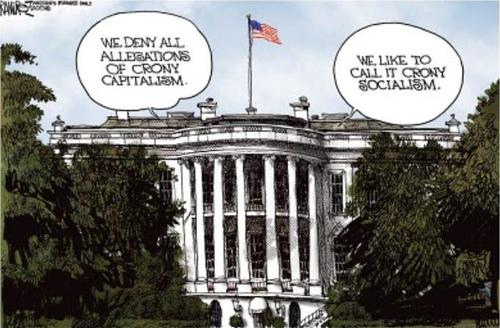
The supposed “choice” between “capitalism” and “socialism” is a useful fabrication masking the worst of all possible worlds we inhabit: Capitalism for the powerless and Crony-Socialism for the powerful. Capitalism’s primary dynamics are reserved solely for the powerless: market price of money, capital’s exploitive potential, free-for-all competition and creative destruction.

The powerful, on the other hand, bask in the warm glow of socialism: The Federal Reserve protects them from the market cost of money–financiers and the super-wealthy get their money for virtually nothing from the Fed, in virtually unlimited quantities–and the Treasury, Congress and the Executive branch protect them from any losses: their gains are private, but their losses are transferred to the public. The Supreme Court ensures the super-rich maintain this cozy crony-socialism by ensuring they can buy political power via lobbying and campaign contributions–under the laughable excuse of free speech.

Cronies get the best political system money can buy and you–well, you get to carry a sign on the street corner, just before you’re hauled off to jail for disturbing the peace (and you’re banned by social media/search Big Tech, i.e. privatized totalitarianism, for good measure).

The Federal Reserve is America’s financial Politburo: cronies get a free pass, the powerless get nothing. While the three billionaires who own more wealth than the bottom 165 million Americans can borrow unlimited sums for next to nothing thanks to the Fed (i.e. Crony-Socialist Politburo), the 165 million Americans pay exorbitant interest on payday loans, used car loans, student loans, credit cards and so on.

Capitalism (market sets price of money) for the powerless, Crony-Socialism (nearly free money) for the powerful–thanks to America’s Crony-Socialist Politburo, the Fed. Consider the “free market” plight of America’s working poor: earning low wages that are rapidly losing their purchasing power makes them a credit risk, i.e. prone to defaulting, so lenders (i.e. capital’s exploitive potential) charge high interest rates on loans to the working poor.

Since they pay such high rates of interest and earn so little, they default on their debt at higher rates–just what the lenders expected, and what the lenders created by charging sky-high rates of interest: gee, you’re having trouble paying 24% interest? Too bad you’re poor. You see the point: low wages, poverty and exorbitant rates of interest are mutually reinforcing: a primary driver of defaults and poverty is paying sky-high rates of interest and all the late fees, bounced check fees, etc. that go with 24% interest rates.

The Crony-Socialists have a much different deal with the Fed and its crony-bankers: the super-wealthy arrange for the corporations they own shares in to borrow billions of dollars to fund stock buybacks (which in a less exploitive era were illegal market manipulation). The super-wealthy Crony-Socialist’s personal wealth rises by $100 million thanks to the stock buybacks, and then the super-wealthy Crony-Socialist borrows $10 million for next to nothing against this newly conjured “wealth” (thanks, Fed!) to fund living large.

Crony-Socialist corporations pay no income tax thanks to loopholes and the Crony-Socialists who own the shares report $1 in salary and zero income because they borrowed their living expenses against their Fed-conjured wealth. Do you discern the difference between capitalism for the powerless and crony-socialism for the super-wealthy?

If you can’t yet discern the difference, then ask yourself: can you borrow $1 billion from the Fed’s cronies to buy back shares of your own company, and then borrow $10 million for near-zero rates of interest against the newly conjured “wealth”? You can’t? Well, why not?

If you answer “I don’t have enough collateral,” you missed the key point here: thanks to America’s Crony-Socialist Politburo (the Fed), the super-wealthy have no exposure to the market price of money. The Fed manipulates the cost of money to near-zero, and then funnels unlimited sums of this nearly-free money to corporations, financiers and the super-wealthy.

Collateral is unnecessary in Crony-Socialism; that’s just a excuse given to the powerless. Crony-Socialists borrow $1 billion for next to nothing, buy Treasuries with the free money, put the Treasuries up as collateral (but wait, didn’t they borrow the money? Never mind, it doesn’t matter), originate some financial instruments (CDOs, etc.), post those as collateral, and then leverage up another bet on that fictitious collateral.

If the bets all go bad, the Crony-Socialist claims the whole fraud is now a systemic risk and so the losses are transferred to the public / taxpayers to “save the financial system from collapse.” Isn’t Crony-Socialism fantastic?

Just as the rich kid caught with smack gets a suspended sentence and probation while the powerless kid gets a tenner in the War on Drugs Gulag, the super-wealthy Crony-Socialists avoid all the consequences of their gambles and frauds. America’s Crony-Socialist Politburo (the Fed) takes care of its cronies and the powerless bear the brunt of predatory exploitation that’s passed off as “capitalism.”

The only dynamic that’s even faintly “capitalist” about America’s Crony-Socialism is the price of political corruption is still a “market”: what’s the current price of protecting your monopoly or cartel from competition? It’s moving up fast, so better get those bribes (oops, I mean campaign contributions for the 2022 election) in now before the price of corrupting “democracy” goes even higher.

ARCHITECTS OF POWER: HOW THE GLOBAL ELITE PROFIT FROM EXTREME INEQUALITY & PRE-EMPT THE BACKLASH

By Dr. Tim Coles

Source: Waking Times

There is a new, mega-rich global elite consisting of a small number of billionaires and multibillionaires. Many of them made their money in the technology sector. Others play financial markets or inherit fortunes. They are wealthier and more powerful than some entire nation-states.

The British Ministry of Defence (MoD) says:

“Whilst there have always been differences between the wealthier, better educated and the less privileged, these differences appear likely to widen in the coming decades.”

The mega-rich deliberately order the world in ways that guarantee their wealth by institutionalising inequality. Occasionally, this is admitted. In 1997, a book published by the Royal Institute for International Affairs in the UK acknowledged:

“The present international order may not be the best of all possible worlds, but for one of the ‘fat cats of the West’ enjoying a privileged position in an international society that is structured and organised in ways which perpetuate those privileges, there are good reasons for not pursuing radical change.”

This is also true of internal policymaking. The third richest man in the world, Warren Buffett (worth over $80bn), confirmed this: “There’s been class warfare for the last 20 years, and my class has won.” This echoes his statement in 2006, just prior to the global financial crisis: “There’s class warfare all right… but it’s my class, the rich class, that’s making war, and we’re winning.” Around the same time, the liquidity firm Citigroup circulated an investor memo, stating: “Society and governments need to be amenable to disproportionately allow/encourage the few to retain that fatter profit share.” More recently, the UK MoD admitted: “In the coming decades, the very highest earners will almost certainly remain rich, entrenching the power of a small elite. Vested interests could reduce the prospect of economic reforms that would benefit the poorest.”

Consider the enormous concentration of wealth and power that results from this imbalance.

Ever-Increasing Power

Global and national inequality is staggering and getting worse. By 2011, a mere 147 – mainly US and European – corporations owned and controlled 40% of world trade and investment. Just four corporations influence the profitability and power of these 147: McGraw-Hill, which owns Standard & Poor’s ratings agency; Northwestern Mutual, owner of the indexer Russell Investments; the CME Group, which owns 90% of the Dow Jones market index; and Barclay’s bond fund index. Evaluative decisions by analysts at these firms affect the wealth and performance of each of the 147 giants.

That’s corporate wealth concentration. But what about wealth concentration among individuals?

There are 7.7 billion people in the world. Of those, just 2,153 are billionaires. According to Forbes, their combined wealth totals $8.7 trillion. The list of billionaires reflects where power is most concentrated: in the US. While China and Europe’s number of billionaires declined in the previous 12 months, the US and Brazil gained billionaires. The US is home to 607 billionaires or 0.000001% of the population. It is worth noting that President Donald Trump was a billionaire before he came to power. Trump has cut taxes for his fellow billionaires. As an indication of continued wealth concentration, consider the wealth disparity among the billionaire class itself. He Xiangjian, founder of the Midea Group, is the joint-50th richest person, worth over $19.8bn. Jeff Bezos, by comparison, the founder of Amazon, is the richest man in the world, worth over $131bn – more than six times He Xiangjian.

Part of the problem has been the US-led imposition of an economic dogma called “neoliberalism” (which is neither new nor liberal) on much of the rest of the world.

Neoliberalism can be roughly defined as:

1) Financialisation, i.e., allowing investors to make money from money as opposed to tangible things;

2) Deregulating financial services;

3) Taking out government insurance policies so that working people bail out financial institutions;

4) Cutting taxes for the wealthy;

5) Privatising public services to reduce social mobility;

6) Imposing austerity to make markets more attractive to investors.

Neoliberalism has cut taxes for the super-rich, enabling them to hold onto their wealth at the expense of others. According to Oxfam, the average rate of personal income tax for the wealthy was 62% in 1970. In 2013, it was 38%. In the UK, the poorest 10% pay a higher proportion of their income in taxes than the richest 10%. Global GDP, i.e., how much money there is in the world, is $80 trillion. But, of this, $7.6 trillion is untaxed. In the decade since the financial crisis, the number of billionaires doubled. This reveals that the system rewards greed. In 2017, 43 people owned as much wealth as half the world’s poorest. In 2018, the number was 26.

To put all this into perspective, Jeff Bezos owns as much wealth as the poorest fifty countries. When it comes to more ‘developed’ nations, Bezos’s wealth equals the entire GDP of Hungary. Consider how Bezos makes his money. Amazon is a corporation that primarily advertises and delivers products. The innovation, design, and investment in and of those products is the work of others. Amazon treats “workers like robots” by spying on them, discouraging unions, offering insecure contracts, and encouraging long hours. Amazon is also notorious for paying little or no corporation tax. Amazon is an online retailer. The Internet was developed by the US Defense Department in the 1960s as ARPANET, with public money. The satellites that enable online transactions are first and foremost military hardware. Not only did Amazon take advantage of state-funded innovation, but it also rewards government investors by selling the CIA cloud technology and the Pentagon artificial intelligence.

Bezos is far from being the only one. Bill Gates’s Microsoft and the late Steve Jobs’s Apple, which became the first trillion-dollar company, also enjoy low taxes, technologies developed with government grants, and procurement contracts.

Consider also the immoral activities of other hi-tech nouvelle méga riche. Without making it clear to users, Facebook founder Mark Zuckerberg (worth $66bn) has made his money by selling personal data to insurers and advertisers. Scientists have used Facebook in social media experiments without the knowledge or consent of users in an effort to see how memes affect mood.

Other mega-rich, including the hedge fund manager Robert Mercer of Renaissance Technologies, used Facebook to market political candidates. Other tech billionaires include Google founders Larry Page and Sergey Brin. Google technology was funded by the CIA’s venture capital firm In-Q-Tel. Also relying on technologies developed by the Pentagon with workers’ tax dollars, the company cooperates with the National Security Agency to spy on citizens and it has even enabled US assassination programmes.

Consequences

How do the billionaires get away with it, and what are the social and political consequences? The examples below are from the US, but it should be noted that the US exports its mega-wealth model.

A study by Martin Gilens and Benjamin I. Page on plutocracy (government by the rich) notes that the rich buy political parties. Politicians draft and/or vote for laws that help the rich. The authors analysed 1,779 policy issues in the US and conclude that “average citizens and mass-based interest groups have little or no independent influence.” Unlike the public, “economic elites and organised groups representing business interests have substantial independent impacts on US government policy.” Other research into wealth inequality in the US finds that “[c]ertain policies, such as the decreased support for unions and tax cuts favouring the relatively well-off and corporations, have benefitted a small minority of the population at the expense of the majority and have thus contributed to widening income inequality.”

At the turn of the last century, 9% of American families owned 71% of the nation’s wealth. The elite of the day included familiar names: John D. Rockefeller (oil), J.P. Morgan (banking), W. Averell Harriman (industry), and so on. Things balanced out after the Second World War, with the majority of Americans becoming middle class. Gradually, state controls over the economy were removed, and the situation reverted to the inequality of bygone centuries.

Since the 1970s, the US middle class has been shrinking. Until recently, the middle classes of Asia grew, precisely because strong Asian economies (notably China, South Korea, and Singapore) either retained some state controls or refused to adopt the US neoliberal model.

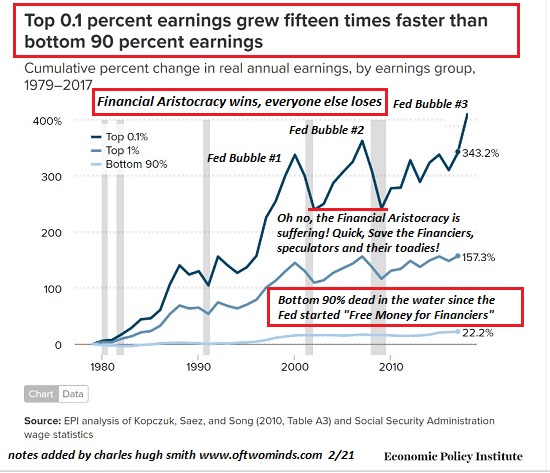
Alan B. Krueger, a labour economist and key Obama advisor, explains that, “since the 1970s income has grown more for families at the top of the income distribution than in the middle, and it has shrunk for those at the bottom.” Between 1979 and 2007, the top 1% ((multi)millionaires and (multi)billionaires) enjoyed a 278% increase in their after-tax incomes. But 60% of Americans saw their incomes rise by just 40%, which when adjusted for rising living costs means stagnation. Krueger notes that during that period, $1.1 trillion of annual income was moved to the top 1%. “Put another way, the increase in the share of income going to the top 1% over this period exceeds the total amount of income that the entire bottom 40 percent of households receives.”

The exportation of this model means that Australia, Britain, and Canada became what the billionaire-dollar liquidity firm Citigroup calls “plutonomies,” economies in which the rich drive luxury goods markets such as jewellery, fashion, cruises, and sports cars: hence the recent entry of celebrity Kylie Jenner into the billionaire class. The Citigroup document also notes that in plutonomies the top 1% owns 40% as much wealth as the bottom 95%. No matter where you live, you can’t escape the institutional structures that create inequality.

The US military exists, in part, to maintain the unjust status quo. Yet, it acknowledges the dangers of dominance: “A global populace that is increasingly attuned and sensitive to disparities in economic resources and the diffusion of social influence,” thanks in part to the very technologies that enrich the rich, “will lead to further challenges to the status quo and lead to system rattling events,” like Brexit or the Yellow Vest protestors in France.

The mega-rich and international think tanks and forums they sponsor are beginning to reluctantly accept that their status quo political puppets might get voted out of office and give way to so-called far-left or far-right parties unless they address wealth inequality.

New Paradigms of Control

The question, then, is how to deal with the restless and disaffected majority while not radically altering the system and taking away the privileges of the elite. In 1961, US President John F Kennedy said: “If a free society cannot help the many who are poor, it cannot save the few who are rich.” In the 1980s, World Economic Forum founder Klaus Schwab said: “Economic globalisation has entered a critical phase. A mounting backlash against its effects… is threatening a very disruptive impact on economic activity and social stability in many countries… This can easily turn into revolt.” More recently, he said: “Today, we face a backlash against that system and the elites who are considered to be its unilateral beneficiaries.” Likewise, the billionaire Johann Rupert of Cartier jewellery (one of the many luxury services driving plutonomies) said: “We are destroying the middle classes at this stage and it will affect us.” Similarly, the British MoD discusses “[m]anagement of societal inequalities,” as opposed to the elimination of social inequality.

Many of the new elites make people redundant by automating the workplace. While Amazon still relies on human shelf-stackers and delivery drivers, it uses an increasing number of physical robots to stack shelves and algorithmic robots to assist online customers. Likewise, Facebook and Google’s content filters rely on heavy automation. This is creating precarious employment conditions. According to the Washington Post (which is owned by Bezos): “…the modern emerging workforce of tech, urbanised professionals, and ‘gig economy’ labourers all represent an entirely new political demographic.” Politicians then “focus more on education, research and entrepreneurship, and less on regulations and the priorities of labour unions.”

But there are many problems. For one thing, the financial services economy, which markets everything, has made “education” a form of unsustainable debt. The quality of US education is notoriously low by world standards, and many young people are “overqualified” for menial jobs, like delivering for Uber or stacking shelves in Amazon warehouses. The UK MoD acknowledges that, “Freelance work is… often low-paid, lacking the benefits and security of formal employment and, therefore, the growth of the gig economy could increase inequality.”

The crisis of what to do with a young, indebted, restless population automated out of steady work by – and competing with – algorithms and physical robots has been considered for at least 50 years.

Traditionally, ‘education’ meant brainwashing children to work in menial jobs for life in adulthood. But as the economy changes and employment becomes less stable, new methods of ‘education’ for re-skilling adults are required. In the late 1960s, future political advisor Zbigniew Brzezinski authored a book in which he advocated for lifelong learning as a way of re-skilling an aging population that finds its employment opportunities diminished, as small-to-medium-sized businesses get overtaken by tech giants. Around the same time, the British Labour Party (when it was a real labour party) introduced the Open University with the aim of providing lifelong learning. Likewise, in the 1980s, futurist Alvin Toffler envisaged an “electronic village” in which flexible working hours and lifelong learning would be required in a hi-tech economy.

To keep the poor from rioting while trapping them in a system that works for those who design it, today’s multibillionaire elites help to privatise public services and education by offering scholarships and infrastructure investments. In doing so, they train poor people to work for their system by developing others’ technology skills while hiding their own taxable wealth in charity foundations.

Howard G. Buffett is the son of Warren. While enjoying largely tax-free wealth that further impoverishes the global poor, the Buffetts, via Howard’s foundation, invest in dams and irrigation in the poorest nations of Africa. Bezos’s foundation awards scholarships for STEM courses (Science, Technology, Engineering, Mathematics). Zuckerberg’s foundation seeks “to find new ways to leverage technology, community-driven solutions, and collaboration to accelerate progress in Science, Education, and within our Justice & Opportunity work.”

Conclusion

By using free online services, we have allowed ourselves to be the products that tech giants sell to advertisers. By not organising to raise taxes on the mega-wealthy, we have underfunded our public services. By not keeping an eye on who’s funding what, we’ve allowed our political parties to hoover up donations from elites. By failing to understand the economy, we’ve allowed a new normal of instability and political uncertainty to flourish to the advantage of asset managers and hedge fund investors. As the US pursues global domination, this model will continue to be exported. It’s time to wake up.

Sickcare is the Knife in the Heart of Employment–and the Economy

By Charles Hugh Smith

Source: Of Two Minds

We need to change the incentives of the entire system, not just healthcare, but if we don’t start with healthcare, that financial cancer will drag us into national insolvency all by itself.

American Healthcare is a growth industry in the same way cancer is a growth industry: both keep growing until they kill the host, which in the case of healthcare is the U.S. economy.

While a great many individuals in the system care about improving the health of their patients, the healthcare system itself only cares about one thing: maximizing profits by any means available, including sending many patients to an early grave via medications which corporations declared “safe” and rigged the political-regulatory-research systems to comply.

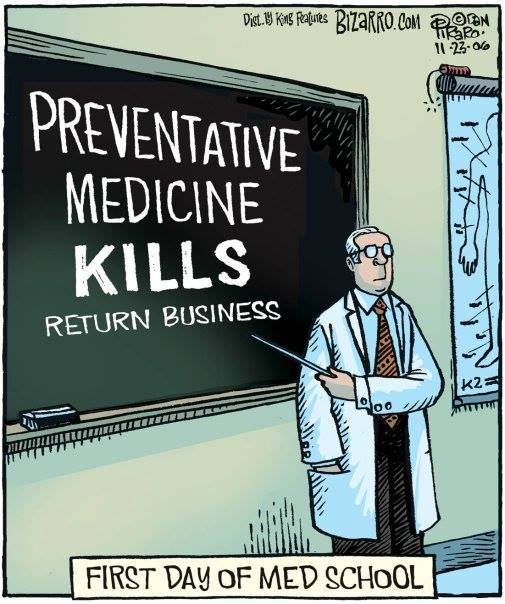
I call this maximizing profits by any means available system sickcare, for obvious reasons: this system profits by managing sickness, i.e. chronic diseases, rather than addressing the causes, which in most chronic disorders trace back to lifestyle: SAD (standard American diet), poor fitness and a generally unhealthy lifestyle of convenience (i.e. sedentary), heavy work/financial stress and addictions to meds, drugs, social media, etc.

Sickcare’s single-minded profiteering would be bad enough if we could afford its spiraling ever higher cost, but we cannot: as I noted way back in 2011, Sickcare Will Bankrupt the Nation all by itself. three years ago I noted that U.S. Healthcare Isn’t Broken–It’s Fixed (5/26/18), as generic meds that cost $22.60 for a month’s supply are pushed by Big Pharma as branded meds for $1,120 per month. Such a deal!

I’ve been discussing employment recently, and one of my patrons pointed out the enormously negative impact sickcare costs have on employment. I covered the incredibly negative impact of soaring sickcare insurance costs on small business back in 2011: Here’s Why Small Business Isn’t Hiring, and Won’t be Hiring (7/11/11), but the same soaring-costs dynamic makes Corporate America reluctant to hire anyone in America, too.

You’d have to be insane to pick America as your global base, given the grossly asymmetrical cost of healthcare in the U.S. compared to our developed-world competitors in Europe and East Asia (Japan and South Korea). Sadly, the treatment for your insanity will be so costly in America that your psychiatric problems will soon be exacerbated by financial ruin.

Those with heavily subsidized healthcare insurance may not realize that insurance for a family can cost more than a wage earner’s entire monthly net income. This generates a perverse incentive (from the perspective of a healthy economy, as opposed to a corrupt, rigged economy run for the exclusive benefit of profiteers, fraudsters, speculators and political fixers) for one spouse to quit their jobs or cut their hours to reduce the household income to the point that federal subsidies (ObamaCare) kick in and pay much or most of the insanely overpriced sickcare insurance tab.

The subsidies are of course ultimately paid by the taxpayers; sickcare profiteers thank you.

Needless to say, employers facing monthly healthcare insurance costs of $1,500 for an employee earning $2,500 will be looking for automation or overseas alternatives. How can the employer afford to keep paying healthcare insurance costs that spiral far above the Consumer Price Index (CPI)? Ultimately these higher costs come out of the employee’s paycheck, as employers could have given raises but instead had to fork over all the dough to the sickcare profiteers.

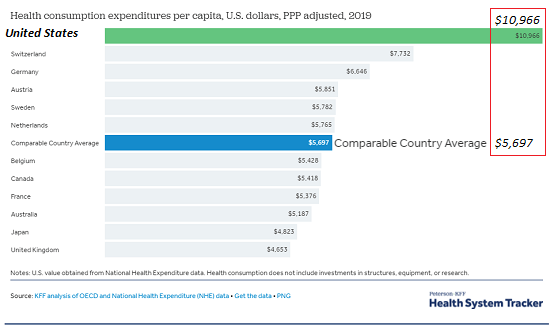
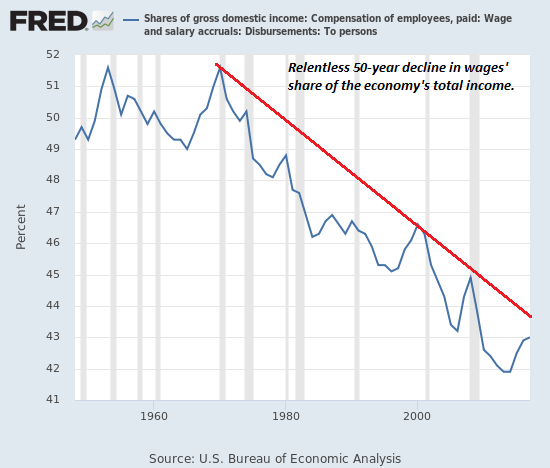
One driver of wages’ ever-declining share of the national income is trillions of dollars have been siphoned off by sickcare. As the comparison chart below shows, the U.S. pays roughly $5,000 more per capita (per person) per year for healthcare than other equally developed nations: the U.S. pays $10,966 per person per year and the average paid by other developed nations pay roughly half: $5,697 per person per year.

330 million Americans X $5,000 is $1.65 trillion a year. No wonder wages have gone nowhere for decades and corporations couldn’t wait to offshore jobs in America. (Not that the Corporate America needed much more of an incentive to offshore U.S. jobs, but let’s recognize that sickcare costs put American companies at a huge global disadvantage.)

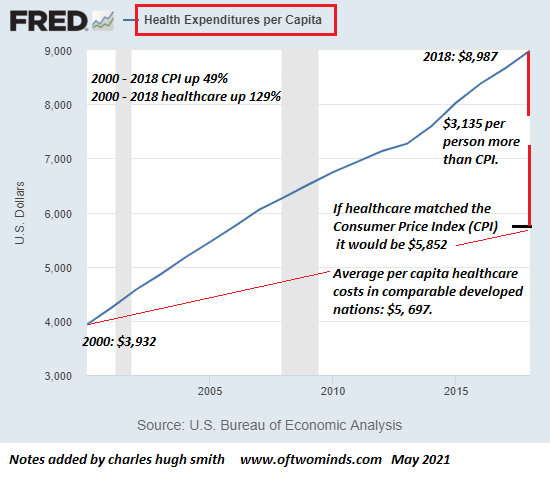
Please examine the chart below of healthcare expenses per capita (per person) in the U.S. from 2000 to 2018 (the last year available on the St. Louis Federal Reserve database). I’ve marked up the chart to indicate where healthcare costs per capita would be if healthcare had tracked the Consumer Price Index (CPI) for the past two decades.

Strikingly, the cost had U.S. healthcare risen by the same percentage as everything else–$5,852 per capita per year–is very close to the average costs in comparable developed nations: $5,697 per capita per year. Instead, U.S. healthcare costs per person were $9,000 per year as of 2018.

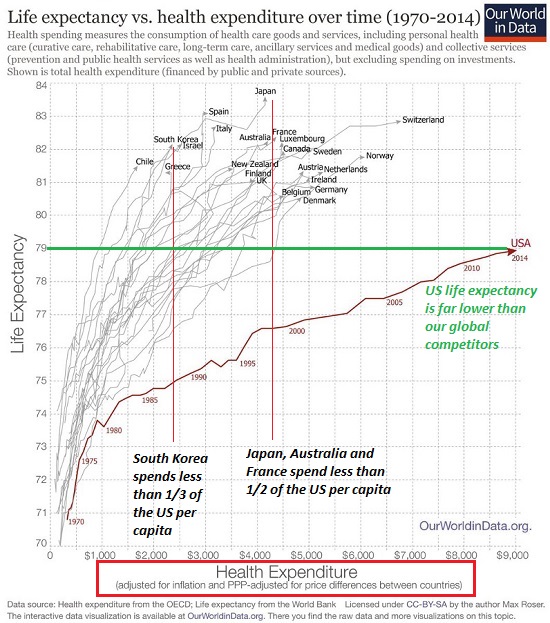
The third chart shows that the results of this asymmetric expenditure on health hasn’t done much in terms of life expectancy or other broad measures of national health and well-being. America is Number One in costs but far down the list of life expectancy and other measures of well-being.

The human and financial costs of this sick system are pervasive. Those trying to provide care within the sickcare system’s perverse incentives are burning out (see last chart), and businesses are crushed by ever-higher costs for everything related to healthcare. The “solution” for employers is to push more of the insane cost increases onto employees, who are already staggering under the weight of stagnant wages and skyrocketing inflation in sectors other than healthcare.

Small business entrepreneurs end up not hiring any workers because they can’t afford to provide the mandated healthcare. Having to do all the work needed to keep the business afloat burns out the owners and they close the business, to the detriment of their community and the local government, which loses the tax revenues generated by the enterprise.

Here’s a real-world example of how healthcare has become unaffordable for employers: in the mid-1980s I could buy comprehensive healthcare insurance for my single employees (mostly young) for 6 hours’ pay for the average employee and 4 hours of my pay. (My partner and I paid all the healthcare insurance costs, the employees paid zero, I’m just using the hours and pay as a means of measuring the cost of healthcare in terms of the purchasing power of wages.)

Can an employer buy equivalent comprehensive healthcare insurance today for 6 hours’ of the employees’ pay? No, not even close. (Note that I’m talking about real insurance, not bogus simulacra of insurance, i.e. catastrophic coverage.)

Sickcare is a win for the sickcare profiteers and a loss for employers, employees, communities, government and the nation. Like cancer, sickcare will keep growing until it kills the host. We’re getting close.

Sickcare is the knife in the heart of employment. Sickcare puts the nation at a tremendous competitive disadvantage, crushes small businesses and generates perverse incentives to automate and offshore jobs just to get out from underneath the dead weight of ever-higher sickcare costs.

We need a whole new approach to healthcare that includes every aspect of American culture, society, education, economics and governance. We need to ditch SAD (standard American diet) and our unhealthy lifestyle, and incentivize improving health from the ground up rather than generating chronic lifestyle diseases such as metabolic disorders and then managing these disorders as a means of maximizing profits. The national goal should not be profiting from an over-medicated populace, it should be eliminating the need for medications. (A healthy person has no need for handfuls of medications.) Rather than profit from 74% of the populace being overweight and 40% being obese, the national goal should be to eliminate lifestyle diseases entirely by changing behaviors and incentives, not costly procedures and medications. That would free healthcare to serve those suffering from non-lifestyle diseases.

As Charlie Munger famously noted, “”Show me the incentive and I will show you the outcome.” That’s how humans operate: we respond to the incentives presented, even if they diminish the health of the populace and bankrupt the nation. We need to change the incentives of the entire system, not just healthcare, but if we don’t start with healthcare, that financial cancer will drag us into national insolvency all by itself.

Anthony Fauci “has no clue and no authority to lecture on what is good for India”

By Colin Todhunter

Source: Dissident Voice

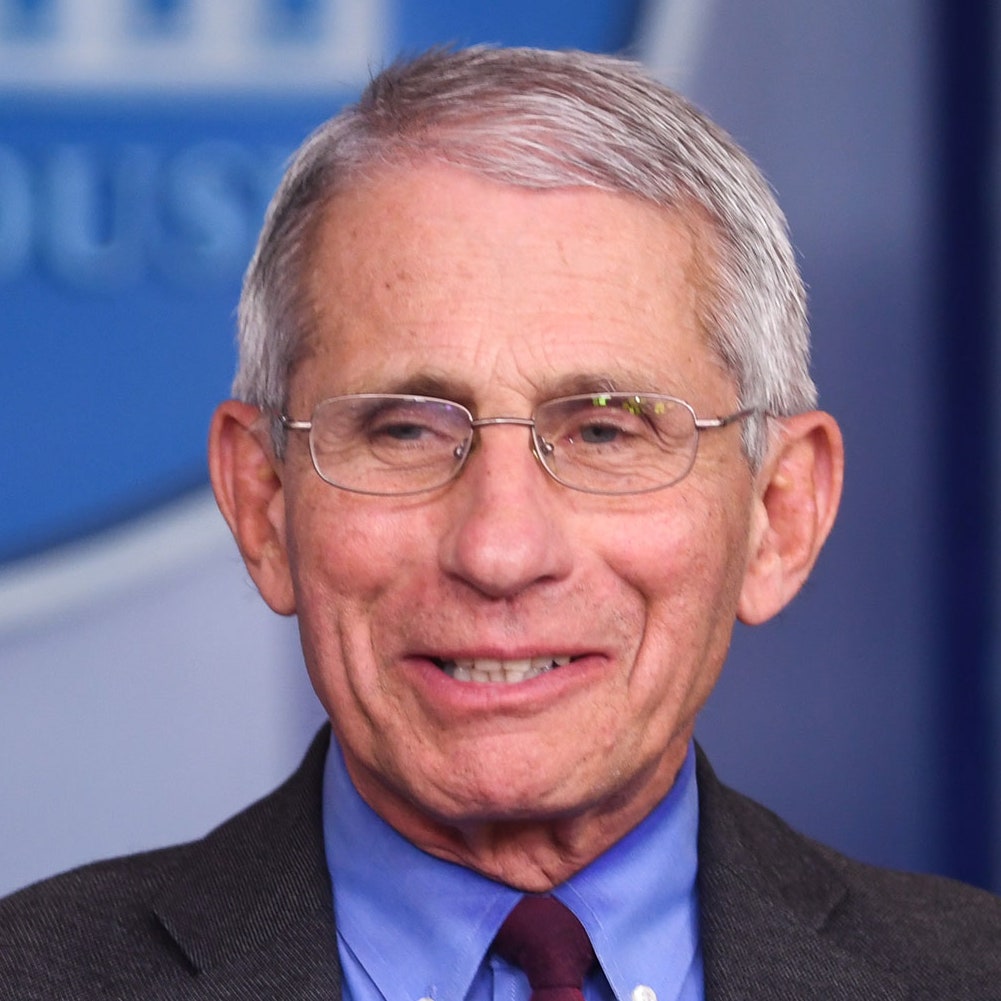
In light of the current COVID-related situation in India, Dr Anthony Fauci, the top US adviser on COVID, has called for India to implement a hard lockdown and for the mass roll-out of vaccines.

However, Fauci has no clue and no authority to lecture on what is good for India.

That is the view of journalist Ratna Chakraborty. Writing on the Empire Diaries website, she argues that the US is a rich nation, prints the world’s reserve currency, has robust financial coverage for the jobless and its population is spread out.

On the other hand, India is finance-strained, has a brittle economy that lives on the brink of disaster, does not have any financial coverage for the jobless, is densely populated and its people mostly live in congested clusters.

Given the government’s incompetence and the callousness demonstrated towards poorer sections of Indian society the first time around, Chakraborty says any new lockdown would again result in disaster. She adds that nothing has been learnt, with no attempt to upgrade the healthcare set-up nationwide.

It is worth recalling what renowned academic and activist Noam Chomsky said about India’s first lockdown.

During an interview with Amy Goodman of Democracy Now! back in May 2020, Chomsky said:

… you can almost describe it as genocidal. Modi gave, I think, a four-hour warning before a total lockdown. That’s (affected) over a billion people. Some of them have nowhere to go.

He added:

People in the informal economy, which is a huge number of people, are just cast out. Go walk back to your village, which may be a thousand miles away. Die on the roadside. This is a huge catastrophe in the making…

During the first lockdown in India, rural affairs commentator P Sainath painted a dreary picture of the impacts, not least the desperate plight of migrant workers, a shortage of cash to buy food and a potential shortage of food as farmers were unable to complete their harvests.

Sainath also reported the views of Dr. Sundararaman, a former executive director of the National Health Systems Resources Centre, who argued that there was a desperate need to:

identify and act on the reverse migrations problem and the loss of livelihoods. Failing that, deaths from diseases that have long tormented mostly poor Indians could outstrip those brought about by the corona virus.

Regardless of the destructive impact of the first lockdown in India and the questionable efficacy of lockdowns in terms of what they are supposed to achieve, another one would further push hundreds of millions towards poverty and hunger. It would merely fuel and accelerate the impoverishment caused by the first lockdown.

new report prepared by the Centre for Sustainable Employment at Azim Premji University (APU) has highlighted how employment and income had not recovered to pre-pandemic levels even by late 2020.

The report, ‘State of Working India 2021 – One year of Covid-19’ highlights how almost half of formal salaried workers moved into the informal sector and that 230 million people fell below the national minimum wage poverty line.

Even before COVID, India was experiencing its longest economic slowdown since 1991 with weak employment generation, uneven development and a largely informal economy. A recent article by the Research Unit for Political Economy highlights the structural weaknesses of the economy and the often desperate plight of ordinary people.

The study also found that there was a loss in monthly earnings for all types of workers: 13% for casual workers, 18% for the self-employed, 17% for those with temporary salaries, 5% for the permanent salaried and 17% overall.

The poorest 25% of households borrowed 3.8 times their median income, as against 1.4 times for the top 25%. The study noted the implications for debt traps.

Six months later, it was also noted that food intake was still at lockdown levels for 20% of vulnerable households.

How bad is COVID?

Given this impact, before listening to prominent individuals with apparent conflicts of interest related to vaccine roll-outs (see the editorial in the British Medical Journal ‘Covid-19, Politicisation, Corruption, and Suppression of Science’), the current COVID-related situation in India must be contextualised. The sensationalism needs to be put to one side.

According to Yohan Tengra, a Mumbai-based political analyst and healthcare specialist, the true number of infection rates can only be known by testing symptomatic people who have tested positive with either a virus culture test or PCR test that uses 24 cycles or less.

The PCR test has been used as the gold standard for COVID cases around the world. But it has been sharply criticised for being inaccurate, inappropriate, for using cycles in excess of 40 (thereby inflating the numbers) and for producing ‘false positives’.

It seems that even the Swedish Ministry of Health now thinks that it is not fit for purpose:

The PCR technology used in tests to detect viruses cannot distinguish between viruses capable of infecting cells and viruses that have been neutralised by the immune system and therefore these tests cannot be used to determine whether someone is contagious or not. RNA from viruses can often be detected for weeks (sometimes months) after the illness but does not mean that you are still contagious.

We also need to be reminded what the US Centers for Disease Control and Prevention stated about the PCR in December 2020. It is especially important to focus on PCR testing because these tests are the entire basis for restrictions and lockdowns (and vaccination); even when deaths were within normal annual ranges, ‘case’ levels were high and restrictions and ‘tiered lockdowns’ were still being imposed in places like the UK.

The following extract can be found on page 39 of the report from the CDC 2010-Novel Coronavirus (2019-nCoV) Real-Time RT-PCR Diagnostic Panel:

Detection of viral RNA may not indicate the presence of infectious virus or that 2019-nCoV is the causative agent for clinical symptoms. This test cannot rule out diseases caused by other bacterial or viral pathogens.

Perfectly healthy people are being tested and small often insignificant fragments of flu, common cold or some other virus can be detected. People are then labelled as a COVID ‘case’.

But that is not all. In their recent article ‘The Nuremberg Doctors Trial and Modern Medicine’s Panic Promotion of the FDA’s Experimental and Unapproved COVID-19 mRNA Vaccines’, Dr Gary G Kohls and Professor Michel Chossudovsky state that – with regard to the so-called ‘emergency use authorization’ (EUA) of COVID-19 vaccines – it is now established and confirmed by the WHO (January 20, 2021) that the entire data base pertaining to tabulation of confirmed positive cases (RT-PCR test) (since early February 2020 in 193 member states of the UN) is invalid.

The two authors note that this flawed methodology cannot be used to confirm the existence of an emergency situation. EUA criterion is therefore not only invalid but illegal.

Furthermore, there is currently decent scientific evidence to indicate asymptomatic transmission may not be significant.

According to Tengra, the case numbers being reported in India are mainly asymptomatic cases. The directors of the All India Institute of Medical Science and the India Council of Medical Research both say that there are many more asymptomatic cases this time than in the so-called ‘first wave’.

As these ‘cases’ comprise most of India’s case numbers, we should therefore be questioning the data as well as the PCR tests being used to detect the virus.

Tengra says the case fatality rate for COVID-19 in India was over 3% last year but has now dropped to below 1.5%. The infection fatality rate is even lower, with serosurvey results showing them to be between 0.05% to 0.1%.

As has occurred in many other countries, Tengra notes the way that death certificate guidelines are structured in India makes it easy for someone to be labelled as a COVID death just based on a positive PCR test or general symptoms. It is therefore often difficult to say who has died from the virus and who has been misdiagnosed.

We should also bear in mind that respiratory diseases like TB and respiratory tract infections such as bronchitis leading to pneumonia are major killers in India. These conditions are severely aggravated by air pollution and often require oxygen which can be in short supply during air pollution crises in places like Delhi at this time of the year.

Therefore, the current harrowing scenes we see in the media might not necessarily be due to the lethality of the virus but by the numbers who are ending up in hospital.

Vaccines

If the pandemic narrative has been constructed on the house of (statistical) cards outlined thus far, then we should be questioning the need for a mass vaccination campaign, which could actually lead to aggravating the current situation.

This is not lost on Dr Geert Vanden Bossche, a virologist who has held positions at several vaccine companies, carrying out vaccine research and development. He has also been involved with the Bill and Melinda Gates Foundation and has worked with the Global Alliance for Vaccines and Immunization (GAVI). Not an ‘anti-vaxxer’ in any sense of the term.

He offers insight into why it is quite possible that mass vaccine rollouts will actually lead to very disturbing levels of deaths directly related to COVID-19. Far from reducing the numbers and facilitating immunity, he anticipates ‘vaccine assisted immune escape’.

Vanden Bossche warns that mass infection prevention and mass vaccination with Covid-19 vaccines in the midst of the pandemic can only breed highly infectious variants. He offers a truly worrying scenario. Of course, not everyone might agree with his analysis but it is certainly a cause for concern.

There is also the entire issue regarding the necessity, efficacy and safety of the vaccines now being rolled out. The group ‘Doctors for COVID Ethics’ has recently raised serious doubts in all of these areas (its concerns have been published on the UK-based OffGuardian website).

In finishing, there are two questions we should ask.

Can we have confidence in science and evidence-based health and social policy where COVID-19 is concerned? And can we just assume – as governments and the media imply we should – that Anthony Fauci and the pharmaceutical corporations have ordinary people’s interests at heart?

In response to the first question, not much. In response to the second, certain interests have been riding and fuelling a wave of sensationalism and duplicity throughout.