
By Steven Harp
Source: Reality Sandwich
( ex machina from the phrase “deus ex machina” meaning “god from the machine”)
It seems unquestioned in the world today that science is on the verge of creating consciousness with computers. In a Promethean rapture inspired by its enormous technological success, science aspires now to seize control of fundamental powers at the very heart of the universe.
With the advent of modern science the reality of human consciousness has come to be regarded as physical alone. A caricature of consciousness has been compounded from such disparate elements as digital code, speculative evolutionary psychology, and a “neuro-phrenology” derived from colorized brain imaging. This caricature from scientists and engineers has gone into public circulation with the help of the media and it has become an acceptable counterfeit currency. And with cinematic virtuosity it has been made plausible by representations in the movies.
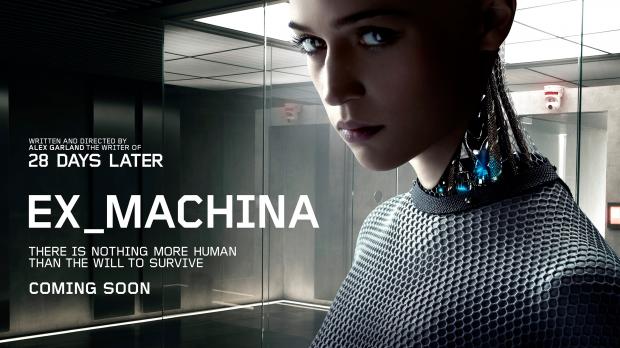
In the movie, Ex Machina we see another recycling of the classic Frankenstein story: Life is created from nonliving materials. A lone genius in an isolated laboratory, using the mysterious powers of science, creates new life. In the original Frankenstein story we have a dead body made alive by electricity. In Ex Machina we have a non-living “wetware” circuit given a mechanical body and made conscious by electricity.
This takes the story to a whole new level. Here the scientist is creating the very roots of being. To create consciousness-itself is equivalent to creating de novo cosmic absolutes such as space, matter, or light. It would be equivalent to creating a spectrum of color, a scale of tones, entire ranges of emotion, thought, pain, pleasure, and the entire dictionary of the contents of consciousness, all from the dark and silent abyss of nothingness.
How can something with neither mass nor dimension arise from that which has mass and dimension? How can that which has subjectivity and intentionality arise from that which has objectivity and has no intentionality? This is the magisterial conundrum and is recognized as the greatest mystery in science. No one, neither philosopher nor scientist, has a clue to the answer. It has famously been labeled the “hard problem of consciousness” by David Chalmers.
In both cases we see technology extrapolated to the creation our most fundamental being in which man becomes the maker of his most central essence, of what he is himself. The creation becomes the creator, the hand that draws itself.
This year alone has seen 8 major movies featuring synthetic or digital consciousness: Transcendence, Her, Chappie, Ex Machina, Lucy, Extant, Tomorrowland, and Terminator again. One has to ask, is there something more than a good story line here?
The claim that technology will give birth to consciousness itself within a computer is entirely based on implicit assumptions about the nature of consciousness and reality. The often made assumption that the brain is like a computer and that nerve impulses are like digital code has no direct experimental foundation and is based on superficial resemblances only. There is no real scientific basis for the claim that the digital processing of symbols should somehow be accompanied by inner experience, that is, by consciousness, awareness, qualia, feeling, sentience, etc.
A computer simulation of brain function is not going to produce consciousness any more than a computer simulation of kidney function is going to produce urine. There is no magic in computation. No amount of digital processing alone is ever going to produce a color. Without consciousness a computer program is a flow of electrons as meaningless and non-referential as those flowing in a wall.
Despite the flagrant and unbridgeable abyss between mind and matter it is the modern claim that if one can set up the right connections and run some electricity through it, a` la Frankenstein, consciousness will arrive on schedule from nonexistence. When undressed from the bewitching technical language this seems to be an equivalent in science of the Immaculate Conception. Or, in the current philosophical language we would call it the Immaculate Emergence. But perhaps Particle Parthenogenesis would be more accurate.
“We are on the edge of change comparable to the rise of human life on earth.” -Vernon Vinge
For materialists the arrival of artificial intelligence and machine consciousness is inevitable and only a matter of time. We have two main schools of thought developing on how to meet the coming technological tsunami – those who fear it and those who embrace it. We have on the fear side the notion that we are headed toward a near future where artificial intelligence or machine consciousness presents a danger to mankind (à la Stephen Hawking, Elon Musk, Nick Bostrom, etc.)
How this danger will manifest is the great unknown. There are countless possibilities. An embryonic AI lurking in the internet could suddenly cross the threshold into self-awareness and seize control of the world’s nuclear arsenals and missiles and demand surrender. Or, a self-aware internet could lay low and send out brain wave controlling vibrations through WIFI and the background hum of our electrical circuitry to enslave humankind in order to advance technology sufficiently to develop the body or bodies necessary for a now paralyzed internet consciousness. This may have already happened.
And for those who embrace the change we have the Kurzwellians’ vision of the very technological replacement of humanity. This scenario will begin when computers begin to learn and thus redesign themselves. At this point the computer, or computer network, or robot would be capable of designing computers or robots better than itself. Repetitions of this cycle would result in an intelligence explosion resulting in a superintelligence which may be beyond human comprehension. This has been called the technological singularity and could begin as early as 2040, although the date keeps getting pushed further into the future.
In this process consciousness will transcend the hazards and horrors of warm-blooded protoplasmic existence. The machine descendants of man will transcend our obsolete and obscene modules of flesh. They shall put away the sweaty, smelly, hairy, warty, fatty, itchy, scarred, flawed, urinating, shitting, hurting, needy, conflicted, misshapen sac of meat and gristle and the gravity-enslaved earthly existence to become ascended silicon masters and rule like gods in a heavenly cyberspace and perhaps even reconfigure the universe itself. “We shall be as gods!” is a not so hidden background thought.
Consciousness will emerge like a butterfly from its earthbound caterpillar stage and fly freely in the new digital noosphere of a virtual reality (à la Kurzweil, Moravec, Fredkin). The mortal human self will be subsumed like mitochondria in a giant computational eukaryote. Our evolutionary period will expire like the dinosaurs’ and we will become a symbiont in the superior host technology. We have been upgraded by Google! All hail Google! Superintelligence is all! Praise Intelligence!
For artificial intelligence enthusiasts this will be good news for mankind. Maintaining mortal human flesh is a logistical nightmare. It requires very specific atmospheric conditions, it requires a very limited temperature range, it requires a vast range of chemical and energy inputs, it requires specific social and sexual connections, it even requires entertainment. Not meeting even one of these requirements could result in the entire operating system crashing and all the data lost (you). Our wetware obviously makes for an inferior product when compared to a silicon based circuitry which could just as well exist in the vacuum of space with just a single source of electricity.
We shall put aside our earthly raiment of mortal skin and bone and be arrayed in the finest of indestructible metals, plastics, and silicons. We shall be free at last of nature and its’ inconveniences. All the wealth and riches of the imagination will be at the tip of our cursor. A million movie channels will be available and we will have an unbreakable silicon heart. We can even have our heart amputated like an infected appendix. After all it is only pixels! It is the next stage of evolution! Rejoice in the in the wonderful future of technology! Praise Evolution!
The notion that mind can be uploaded into a computer (Transcendence, Her, Chappie), if not completely loco, is radical in the extreme. But given the hubris of technological success and the realism of movie depictions, it has been made believable and in mainstream scientific circles it is near heresy to doubt the materialist premise of consciousness synthesis from raw physical materials.
However there is a curiosity in the movie, Ex Machina, that perhaps reveals a crack in the technological juggernaut. In the movie, Nathan, the techno-wizard internet mogul, has just created the most extraordinary technology in the history of science, a technology that would revolutionize the world and beyond. With Promethean daring he has just robbed the very cradle of consciousness and created Ava, a conscious robot that passes every Turing test. It would seem that he would be in a state of elation and brimming with fulfillment. Instead he is getting drunk at every opportunity. Alcohol is featured in almost every scene in which he appears. One must ask the question, what has gone wrong with Nathan?
Is this just an iniquitous twist of character? Or could he be plain old lonely? Or is it a metaphysical crisis? He lives like a hermit in a remote and isolated Northern region, but he has a retinue of very lovely synthetic ladies waiting for him in closets. And he has a beautiful and near mindless female companion and assistant that likes to dance. And then, he has the mysterious and unknown otherness of Ava. That should be adequate companionship.
But he has just synthesized consciousness. He has dramatically and inescapably demonstrated that life and consciousness are a merely physical phenomena that have no more meaning than electricity passing through a copper wire. He has shown that he himself is not much more than the ionic exchanges occurring through a polarized lipid membrane in a cranial bone flask. And when the switch is turned off he dissolves into nothingness.
Our lone genius clearly has grounds for a metaphysical crisis. He has experimentally proven a deeper isolation: That is the isolation that the vision of materialism prescribes for man – as a spark of consciousness in a meaningless void. There is no wider mystery in being alive… he is all there is… a pathetic lonely little god… isolated in time as well as space with a separation that he cannot mitigate, even with the agreeable companionship of his ersatz bitches.
It is more than ironic that our synthesizer of new consciousness is intent on anaesthetizing his own. But is this not also modern man? Alcohol is the universal drug of the world today. Nathan here is materialist everyman rather than the oversensitive genius. Modern man closes the door on his personal consciousness while aspiring to extend consciousness through external technological means. It seems modern man shares the same metaphysical disturbance as our techno-wizard, Nathan.
The materialist everyman has fixated on a physical literalism that excludes the meaningfulness inherent within every conscious experience. He has radically reduced the ontological range of life. Life has been stripped of inner meaning. He is abandoned to a complete separation and isolation in both time and space.
He has embraced the lawful Stalinesque reality of materialism as a total explanation for consciousness. He has embraced the scientific fundamentalism of consilience. And total explanations produce repressive states, both political and personal. However, modern man, like an eviscerated organism continues to live… even though partially.
The Frankenstein of today is more than an out-of-control technology. Our Frankenstein monster is the story that science has authority over all other interpretations of life and has replaced them with a grim and desolate paradigm about the nature of the universe and our place in it. Technology has come to shape the imagery by which the world is depicted and to affirm the underlying metaphysics of materialism. We have shaped our reality and now it shapes us. It is only natural then that Ava, the beautiful and sexy creature in Ex Machina kills her creator, Nathan. But modern man cannot kill his own soul so he must anaesthesize it.
But, exercising our imagination, let us suppose that consciousness, rather than being proven physically dependent is proven physically independent. Materialism, irrespective of technological successes, would be shown wrong and suggest that we have been living in the dark ages of a materialist ideology. And it would reveal the present day metaphysics of consciousness at the heart of a dysfunctional civilization.






 After the Crash