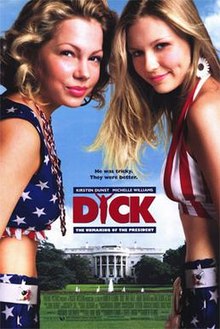
“Dick” (1999) is a cult comedy co-written (with Sheryl Longin) and directed by Andrew Fleming. It’s an absurdist retelling of the events surrounding the Watergate scandal which led to the resignation of Richard “Tricky Dick” Nixon (played in the film by Dan Hedaya). Kirsten Dunst and Michelle Williams star as Betsy and Arlene, two fun-loving and ditzy best friends, who, through a random chain of events, become the legendary “Deep Throat” figure ultimately responsible for bringing down the Nixon presidency. Will Ferrell and Bruce McCulloch star as this film’s version of Woodward and Bernstein. A roster of comedic actors including Teri Garr, Dave Foley, Harry Shearer, Jim Breuer and Ryan Reynolds also make appearances.
Les dents du singe (The Monkey’s Teeth) is the directorial debut of René Laloux, the animator who made Fantastic Planet and Time Masters. This, his first short, came out of the experimental La Borde clinic at Cour-Cheverny. As supervisor of artistic activities at La Borde, Laloux staged therapeutic puppet shows with the resident malades mentaux during the years before he gave them their big break in the motion picture business.
According to his obit in Positif, Laloux and his patients were aided in writing the screenplay for Les dents du singe by Félix Guattari, later the co-author of a number of influential books with the philosopher Gilles Deleuze; the group’s screenwriting method was something like a combination of “automatic writing, exquisite corpse, and Jung’s tests.” In 1960, Guattari was working at La Borde as a therapist. He had been drawn to the clinic by its founder, the Lacanian psychiatrist Jean Oury.
Oury baptized his clinic as soon as it opened in April 1953, writing a constitution that he dated Year I (a tongue-in-cheek reference to the French Revolution) and that defined the three guiding principles for this collective therapeutic undertaking. The mangers were protected by democratic centralism, reflecting the Marxist-Leninist ideal that was still popular in the year of Stalin’s death. The second principle reflected the idea of a communist utopia whereby each staff member would alternate between manual labor and intellectual work, which effectively made any status temporary. Tasks were assigned on a rotating basis: everyone in the clinic switched from medical care to housekeeping, from running workshops to preparing theatrical activities. The last principle was antibureaucratic, so things were organized in a communitarian way whereby responsibilities, tasks, and salaries were all shared. Although the term “institutional psychotherapy” had not yet been coined, many of its themes were already in evidence: spatial permeability, freedom of movement, a critique of professional roles and qualifications, institutional flexibility, and the need for a patients’ therapy club.
Hollywood has not yet produced many tales about bike-riding simians meting out justice at the dentist’s office, but I expect we’ll see a “reboot” of The Monkey’s Teeth before long.
In Ray Bradbury’s horror short story, ‘The Next in Line’ (1955), a woman visits the catacombs in Guanajuato, Mexico. Mummified bodies line the walls. Lying awake the next night, haunted by her macabre tour, she finds that her heart ‘was a bellows forever blowing upon a little coal of fear … an ingrown light which her inner eyes stared upon with unwanting fascination’.
Our present era is one in which the heart of culture is blowing hard upon a coal of fear, and the fascination is everywhere. By popular consent, horror has been experiencing what critics feel obliged to label a ‘golden age’. In terms of ticket sales, 2017 was the biggest year in the history of horror cinema, and in 2018, Hereditary and A Quiet Place have been record-breaking successes. In both the United States and the United Kingdom, sales of horror literature are up year over year – an uptick that industry folk partly attribute to the wild popularity of Netflix’s Stranger Things (2016-). And the success isn’t merely commercial. Traditionally a rather maligned genre, these days horror is basking in the glow of critical respectability. As The New York Times remarked this June, horror ‘has never been more bankable and celebrated than it is right now’.
As any historian of the genre will tell you, horror has had previous golden ages. Perhaps ours is just a random quirk of popular taste. But perhaps not. Perhaps we are intoxicated by horror today because the genre is serving a function that others aren’t. Can’t. Horror’s roots run deep, but they twist themselves into forms very modern. The imagination’s conversion of fear into art offers a dark and piercing mirror.
My earliest horror memory is Stay Out of the Basement (1992), one of R L Stine’s Goosebumps series of young adult novels. In the story, a botanist accidently creates a hybrid plant clone of himself. When the clone comes to life, he tries to steal his humanoid self’s life. The botanist’s children unmask the imposter, and in a mess of green blood and plant mush, the clone is felled with an axe. The rescued father disposes of the rest of the mutating plant matter, and the family is all set to live happily ever after. But at the very end, the daughter is standing in the garden and feels a small plant nudging her ankle. The plant whispers to her: ‘Please – help me. I’m your father.’ Stay Out of the Basement is no masterpiece, but I was young, and it struck me cold.
Horror is what anthropologists call biocultural. It is about fears we carry because we are primates with a certain evolved biology: the corruption of the flesh, the loss of our offspring. It is also about fears unique to our sociocultural moment: the potential danger of genetically modifying plants. The first type of fear is universal; the second is more flexible and contextual. Their cold currents meet where all great art does its work, down among the bottomless caves on the seabed of consciousness. Lurking here, a vision of myself paralysed in the dirt, invisible to those I love.
Horror has always been with us. Prehistoric cave paintings are rife with the animal-human hybrids that remain a motif of horror to this day. Every folktale tradition on Earth contains tales of malevolent creatures, petrifying ghosts and graphic violence. The classics are frequently horrifying: in Homer’s Odyssey, when the Cyclops encounters Odysseus’ men, the monster eats them, ‘entrails, flesh and the marrowy bones alike’.
We have always told horror stories, and we always will. Because horror is an artistic expression of an ontological truth: we are creatures formed in no small part by the things to which we are averse. Fear is a base ingredient of consciousness, partaking of brain circuits that are so ancient humans share them with all vertebrate lifeforms. As the neuroscientist Antonio Damasio has described, the whole weird soup of human feeling emerged as a result of our beginning to process whether to ‘approach or avoid … certain places or things or creatures’. Our cognition absorbs reality as a vast spectrum of potential encounters, and horror alchemises the dark end into art.
Thus, evolutionary analyses of horror mention monsters as the genre’s most defining feature. As the philosopher Stephen T Asma puts it, ‘during the formation of the human brain, the fear of being grabbed by sharp claws, dragged into a dark hole and eaten alive was not an abstraction’. For a quarter of a million years – the vast majority of Homo sapiens’ existence as a species – we lived outdoors, with giant hyenas, saber-toothed cats and other carnivores representing a real threat to life. That other ancient health risk, the biological pathogen, manifests itself in the tendency of monsters to be not only violent but also disgusting – feral, oozing blood and saliva, bearing their infectious teeth. From the evolutionary perspective, horror’s vast monstrous menagerie echoes with Paleolithic peril.
Historically, horror’s willingness to play directly to our evolved physiology has seen it earn a low reputation. Western culture was built on a vision of ourselves as above the beasts, above the beastliness of acquiescing helplessly to the demands of the body. But horror can bypass all intellect, extract from us an embarrassingly animalistic response. The skittish physicality of the ‘jump scare’ is a manipulation of what biologists call the startle response, present in all mammals. And cruder horror always contains that other ghastly reminder of our physicality: gore. Gore disgusts us, and the way that gore can be darkly compelling to us disgusts us. Whenever horror is criticised, it is criticised for staging a dark carnival of physicality. Perhaps the only sort of media we moralise more than we do horror is that other mainliner of bodily response, pornography.
Horror’s historical ghettoisation has meant that weightier, smarter horror reliably gets labelled as something else. The finest films of our current golden age have been dubbed ‘elevated horror’ and ‘post-horror’. In literary circles, works of horror seen as sufficiently cerebral get relabelled ‘Gothic’. It’s certainly true that great horror is always about more than gore. But we should be careful not to gentrify the genre by cleansing it of everything but the philosophy.
There are always beings that want to bite us, scratch us, puncture our fragile flesh. There is the terrible old coercion of brute, muscular force, the lethal threat of contagion and infection. There is darkness, disorientation. And looming explicitly or symbolically in all horror is that vast shadow that the anthropologist Ernest Becker said ‘haunts the human animal like nothing else’: death.
‘And he that sat on the cloud thrust in his sickle on the Earth; and the Earth was reaped’. Witness the machinations of that famous slasher, God (Revelation 14:16). Horror encodes the story of our long primate journey, but these biological foundations support the towering edifice of culture. And for millennia, horror merged with our oldest cultural phenomena: religion and folklore. In fact, for most of its history, horror wasn’t really art, as we tend to understand that term today. It certainly wasn’t fiction. Prior to about 1750, in our pivot toward the Enlightenment, the best horror stories can all be found within theology and lore. In Europe, for generations Satan was every bit as petrifying as Pennywise, the murderous clown of Stephen King’s It (1986). Demonic forces were terrifyingly real; in the Bible, Jesus spends almost as much time performing exorcisms as he does healing people. There were widespread societal panics about the threat of werewolves and vampires, and tens of thousands of women were murdered as witches.
This isn’t to judge the credulity of bygone peoples. But the reason that horror – unlike say tragedy, or comedy, or the epic – didn’t exist as an artistic genre until relatively recently is that its deep history is fundamentally pre-scientific. Nothing in the annals of art is as scary as what you’ll find in bygone worldviews. Who needs make-believe scares when everyone you know is awaiting the day of judgment, at which point an angel will sweep a sickle across the Earth and make the blood run for hundreds of miles? It is no coincidence that the Gothic – horror’s regal antecedent – emerged precisely at the moment when lots of people began to believe that God really might be dead. Modern horror is in part the story of what happens when our threatened minds shed a theology. Once holy texts can no longer entirely encode the terrors of being, horror enters fully the arena of art.
However, the old ways cast a long shadow. In the pantheon of genres, horror remains an adolescent, and it has a sort of adolescent relationship with its past: half rebellion, half dependency. On the one hand, more than any other genre, horror loves to thematise the coldest sorts of atheism. ‘All my tales,’ said horror grandee H P Lovecraft, ‘are based on the fundamental premise that common human laws and interests and emotions have no validity or significance in the vast cosmos-at-large.’ In The Silence of the Lambs(1988), amused by what he sees as clear evidence for the absence of any benevolent deity, the charmingly evil Hannibal Lecter ‘collects church collapses, recreationally’.
On the other hand, horror is marked everywhere by the centuries it spent wedded to otherworldly belief systems. In 2018’s biggest horror movie, Hereditary, an obscure figure from demonology possesses a teenage boy and wreaks death upon his family. Much Japanese horror features yūrei, tormented and enraged spirits denied a smooth passage to the afterlife. Horror was a dark, mutant child of the Enlightenment, and yet it can’t shake its pre-scientific genes. Its penchant for lurid supernaturalism is a big reason why, when it fails, it can so easily seem puerile. The modern, skeptical mind whispers: This is just silly. Haven’t we outgrown all this? On Halloween – a celebration of horror’s pre-artistic forms – children are meant to have the most fun.
Why does horror have this double-edged relationship with its religious and spiritual heritage? Perhaps because, for all its modernity, the sheer scale of theological enquiry still reflects the genre’s ambition. As leading horror author Joe Hill told me, horror is what we turn to when we want to explore ‘the biggest and darkest questions’. And even demoted from dogma to metaphor, the old myths offer a fine way to channel those grand subjects of which horror is so fond: good versus evil, the tribulations of the soul, the end of days. Even though it requires our suspension of disbelief, the paranormal presents us with the very real prospect of brittle reason splintering against the mystery of reality.
‘There’s a sense of uncertainty and potential wrongness underlying most of human existence,’ the Canadian author Gemma Files told me. All of humankind’s great mythic narratives know this, and horror doesn’t let us forget it. At the core of the numinous impulse – that oceanic feeling in which horror was submerged for so many centuries – is the strange certainty that reality is unpredictable and inscrutable, that certain things will forever resist the reach of the human mind. Horror will always share in this sense. It may have fallen from heaven, but it still isn’t entirely of this Earth. Cormac McCarthy’s The Road(2006) centres on a father and son as they wander across a blasted, post-apocalyptic America. The horrors are everywhere: they discover, chained in a basement, ‘a man with his legs gone to the hip and the stumps of them blackened and burnt’. The man is being harvested by cannibals, piece by piece. It is a bleak, fallen world, where the memory of a time when trout swam in the streams shimmers with celestial grace. When the father meets an elderly man, he tells him: ‘There is no God and we are his prophets.’
And so what of today? Horror reverberates with fears Paleolithic and God-fearing, but it is also always reacting to its present moment. And it seems reasonable to perceive any swell in the production and popularity of horror – any dawning of a new golden age – as the expression of a culture that is afraid. ‘In anxious times,’ David Bruckner, director of The Ritual (2017) and other horror movies, told me, ‘people are more likely to turn to horror. If you have an uneasy night at the movie theatre, you are sort of answering the call of your times.’
‘I think we’re living in a nightmare, basically.’ So said horror legend Ramsey Campbell, when I asked him why he thinks horror is flourishing right now. This is one of those things that cooler heads will say is your mind deceiving you. By many objective measures, for many people, life today is better than ever. But horror has never been too worried about culture’s long-term trajectory; it is always fixated on how it could all go badly wrong, any minute now. Horror is steeped in worry; its narratives frequently open with the calm before a terrible storm. And every person connected with horror that I interviewed smelled doom on the breeze.
Horror has always made good use of our deep aversion to what Lovecraft called ‘the oldest and strongest kind of fear’: the unknown. This is one of the ways in which horror (like the folktale) can display a sort of archetypal conservatism. In general terms, the best way to survive a horror setting is to be supremely, boringly sensible: don’t talk to strangers, don’t stay the night in a foreign town, don’t go to the aid of anyone who looks sick, don’t go into that crumbling old building. If a very attractive stranger tries to seduce you, it is almost definitely a trap. Respect tradition, do not commit sacrilege, listen to the advice of elderly locals. At the heart of a lot of horror is a conservative craving for the predictable and the known. The unpleasant atonal dissonance you’ll hear in every horror score reflects, through the collapse of harmony, the disintegration of familiar and comforting patterns out there in the world.
Horror, then, thrives on discombobulation. And today, the discombobulation is everywhere. The causes of the anxiety are scattershot, and you already know them. There are those scientific breakthroughs of the sort that get Silicon Valley execs psyched, but which many others find deeply, opaquely perturbing. Take artificial intelligence, whose rise has seen more and more science fiction turn horrific: ‘One day the AIs are going to look back on us the same way we look at fossil skeletons on the plains of Africa,’ says Nathan, a central character in Ex Machina (2015). And even if the robots don’t vanquish poor old Homo sapiens, other sorts of scientific experimentation might. One of the great horror trends of the 21st century has been the zombie, and in all of the best works of zombie fiction, the immediate cause of the outbreak is the same: biological experimentation gone horribly wrong. The zombie is the gnashing, lunging embodiment of that modern terror, the global pandemic. People might not fear Satan anymore, but they sure as hell fear Ebola.
Outside of the lab, there is that slower method of planetary destruction: climate change. ‘Horror,’ the author Jeff VanderMeer told me, ‘is the beauty of the natural world juxtaposed against the way we destroy those natural systems without understanding them.’ VanderMeer’s Southern Reach trilogy (2014), some of my favourite horror novels of all time, diluted my enjoyment of the UK’s recent heatwave and refused to let me forget that what I was basking in were the convulsions of an aching planet. A biosphere cast brutally off-balance forms the setting for M R Carey’s The Girl With All the Gifts(2014), where humanity has been devastated by a fungal infection. Where horror once worried about the weather gods, it now just worries about the weather. Climate change, meanwhile, is a major cause of mass migrations, potent fuel for what leading critic Leslie Klinger described to me as horror’s historical trend of feeding off ‘the invasion of foreigners into previously stable populations’. At a base level, we are in-groupish creatures. I’ve spent time with rural, paganish communities who enjoy a singsong and are sexually unrepressed; none of them tried to burn me alive in a giant wicker man. But horror says: you never know. Stick to your own.
If all these fears sound selfish, parochial, insular – don’t get the wrong idea. Horror offers a map of the psyche and, like fear itself, is inherently apolitical. It can easily offset its archetypal conservatism with a radical sort of anarchism. Horror might thematise our fear of the unknown – but it also warns about clinging too stubbornly to the familiar. In a lot of horror, survival is predicated on a capacity to quickly adapt to brutal change. Horror has little time for the conservative sentimentality that swirls around ideas such as institutions and tradition, and even something like the nation-state is often revealed as a sort of frilly, doomed illusion. The protections of social hierarchy or private property are never of any use, and horror loves to punish characters who arrogantly believe that wealth will shield them. In horror, the consolations of the past melt in contact with the white-hot heart of present fear. Conservatism fails because it is revealed that at bottom there is nothing to conserve. As the author Michael Marshall Smith put it to me, great horror often declares: ‘It’s just you versus the monster. Always has been. Always will be.’
In this, lots of horror is intensely universalising. Frequently, a scenario comes down to a simple contest between humankind and something else. Splitting up is a suicidal move in horror; survival often follows an impulse toward communal effort. Similarly universalising is the way that, at extreme moments of threat or fear, a given character’s skin colour or gender or nationality will often be effaced. At horror’s pitch, we perceive a simple human, doing what we all do every day of our lives: struggling to live, to persist, to overcome. In The Babadook(2014), a widowed mother is stalked by an amorphous, black-hatted monster that embodies her grief at losing her husband. The monster – her terrible, life-sucking trauma – threatens to claim her son, and destroy what is left of her family. Late in the film, bloodied and exhausted, the mother faces down the Babadook, yelling: ‘If you touch my son again, I’ll fucking kill you.’ The monster is tamed. It is a show of furious bravery that could be any mother, anywhere; courageous love in the face of total disorder.
It’s easy to romanticise horror, but there are also unsexy, funcitonal reasons why it’s having its moment right now. The streaming revolution has given creators a reliable and direct way to reach a dedicated, self-selecting audience. Trusting this audience, distributors like A24 and Blumhouse have put a great amount of both creative wherewithal and cold hard dollars into horror cinema. The genre has always been reliably profit-turning, but it has also always been prone to the lazy recycling of ideas and tropes. Today, even experimental horror can be profitable. In literature, meanwhile, a revival of interest in horror greats like Shirley Jackson, as well as a slew of Stephen King adaptations, has been a boost for the genre at large.
Yet on their own, these tantalising products would never suffice to make horror soar. Horror has been with us since the dawn of storytelling. It manifests the fears of the human animal, and even today echoes the slippery spiritual suspicion that reality isn’t what it seems. Our world is ripe for upending, and horror expresses that best. Horror can thrive today because ours is a strange and febrile cultural moment. It seems every civilisation has believed they are on the brink of cataclysmic change; such an idea has a weird narcissistic appeal. But today there is everywhere a deep feeling that the horses of disaster are about to plunge in the heavy clay. There is a sort of great loop being completed here: as horror has morphed from theology to art, the ruinous power has moved from the judgment of God to the hand of humans. The end of days in one programmer’s idle tinkering, in one laboratory’s overlooked quarantine protocols. Robert Louis Stevenson, author of The Strange Case of Dr Jekyll and Mr Hyde (1886), wrote, ‘Sooner or later, everyone sits down to a banquet of consequences.’ As a genre, horror is forever pulling up a chair, licking its lips at the feast to come.
Breathing this nervous air, current horror – like the theology that provided its former home – is animated by the full spectrum of human psychology. It is driven by our desire to stop all the clocks, shrink into a bubble of the familiar and the known, reject all things foreign. Equally, current horror is shot through with the bone-deep knowledge that if we can’t adapt, we will perish. Its narratives warn us not to cling to outdated consolations, to recognise that we all face the same monsters, in the end. The world has always been dark and full of terrors, and horror has always known it. The dark pleasure of enjoying horror is all about countenancing this awful truth from within a little bubble of safety. It is about the doppelgängered headspace of loathing the real thing but craving its imaginative facsimile. If the genre of horror has a master virtue, a single human quality that it consistently exalts, it is an old one: bravery. We are certain to need that, wherever we are headed.
With thanks to all the horror authors, editors, screenwriters, directors and critics who generously gave me their time to explore horror: Nick Antosca, Stephen T Asma, David Bruckner, Ramsey Campbell, Noël Carroll, Ellen Datlow, Gemma Files, Steven Gerrard, Joe Hill, Carole Johnstone, Leslie Klinger, John Langan, Lisa Morton, Andy Nyman, Jami O’Brien, Xavier Aldana Reyes, Priya Sharma, David J Skal, Michael Marshall Smith, Eugene Thacker, Paul Tremblay, and Jeff VanderMeer.
Society should not do the wrong thing for the right reason, even though it frequently does the right thing for the wrong reason.
History has shown us what happens when you try to make society too civilized, or do too good a job of eliminating undesirable elements. It also shows the tragic fallacy in the belief that the destruction of democratic institutions will cause better ones to arise in their place.
An obscure Texas political consultant named Bill Miller once said “politics is show business for ugly people”. It’s true for the most part, aside from the consequences. This is because the theatrics of politicians result in policies that affect the lives of others; often against the will of the governed. In books and movies, however, the characters are much ado about nothing. Until, that is, life imitates art.
So it is with the futuristic dystopian story of “A Clockwork Orange”. Both the book, by the author Anthony Burgess, and the film by director Stanley Kubrick, serve as moral dilemmas and cautionary tales plumbing such considerations as free will, the duality of mankind, societal anarchy, and the ascendancy of an all-powerful state.
A 1973 review written in Sight and Sound Magazine, stated: “Kubrick has appropriated theme, character, narrative and dialogue from Anthony Burgess’ novel, but the film is more than a literal translation of a construct of language into dramatic-visual form”. Therefore, for that reason, and for others described later, the film will remain this article’s primary focus.
As any perfunctory internet research will show, Stanley Kubrick is known as a visionary artist and director, but also as the subject of multiple conspiracies. In addition to A Clockwork Orange, Kubrick’s oeuvre includes avant-garde films such as Dr. Strangelove, The Shining, 2001 A Space Odyssey, and Eyes Wide Shut; to name a few. Just as these movies demonstrate the inner workings of mankind operating through the disparate threads which bind reality, so do some claim that a larger picture is presented as well. The big picture, of course, is said to include conspiratorial clues and undertones in Kubrick’s films ranging from Freemasonry, to America’s alleged faked moon landing, to an occultist global financial elite, and the terrorist attacks of 911 being planned as a world transformational event.
There exist multiple published writings, both online and in print, describing the secret meanings hidden in Kubrick’s movies. Furthermore, it has been argued that Kubrick’s “somewhat surreal films” appeal to the viewer’s subconscious and, therefore, “lend themselves to this sort of interpretation”.
That is another reason why Kubrick’s film will remain the focus of this essay, as opposed to the novel: Either these alleged conspiracies are imagined in the minds of the viewers, or Kubrick deliberately inserted these elements into his creations. Given Kubrick’s reputation for perfectionism, one can only conclude the symbolism was specifically placed and for exact reasons.
In his other films, like 2001 A Space Odyssey, it has been argued the strategic placement of the sun, or other circular lights, were utilized by Kubrick as symbolic movie projectors of sorts, whereby time and events unwind before the audience like a clock. Additionally, even in movies not directed by Kubrick, there are those who say mirrors are used to demonstrate mind control. It is a fact both of these visualizations are present in A Clockwork Orange.
Once again, and for all of the reasons delineated heretofore, the following presentation will analyze Kubrick’s film as opposed to the novel from which it derived. The story, and Kubrick’s alchemy, will then be analyzed through the lens of three separate realities followed by some concluding comments at the very end.
THE UNWINDING
In Kubrick’s A Clockwork Orange, the viewers witness the tragic life and circumstances of a teenager named Alex DeLarge navigating a decadent post-modern world. In the film, Alex is played by the actor Malcolm McDowell. The story unfolds against the backdrop of a futuristic dystopian society that has descended into anarchy and violence; especially within the younger generation.
The very first scene focuses on the evil-eyed Alex adorned with a black fedora and sunray eyeliner beneath his right eye. As the camera pulls back, the boy is shown with three of his young friends identified in the narrative as “droogs”. The youths are shown sitting in the Korova Milk Bar where they imbibe “Milk Plus”; or milk laced with recreational drugs of various types.
Upon leaving the bar, the boys come across a drunk lying in an alley and singing what Alex calls the songs of the drunk man’s “fathers”. This implies a line of separation between the previous time and the new; between the old and the young. This separation of time is actually confirmed when the drunk tells the young hooligans he no longer wants to live in this “stinking world” because there’s “no law and order anymore”, where the young “get onto the old”, and “it’s no world for an old man any longer”.
The boys commence to beat the old boozer senseless.
In the next scene, Alex and his droogs come across a group of five other boys who, on an abandoned theatrical stage, are attempting to rape a young woman. Seemingly, the stage implies the violence unfolding as melodrama, causing this viewer to question if the descent into societal violence was staged as well? The boys assaulting the woman were wearing military-style camo clothing and adorned with Nazi accoutrements. Alex taunted them in a near Shakespearean manner, and the rival gangs went to war. The battle also appeared as theatrically choreographed and was set in sync to Giaochino Rossini’s La Gazza Ladra overture.
In the next scene, we see Alex and his gang fleeing to the countryside in a red sports car, looking very much like four demons racing towards hell.
Chaos ensued until Alex eventually ended up in prison and, thus, in possession of the state.
In prison, Alex sat before an open Bible and fantasized he was a Roman soldier whipping the back of Jesus Christ. His voiceover narration said he didn’t like the New Testament’s “preachy talking” as much as the Old Testament’s violence and sex. He furthermore envisioned slicing open the throats of ancient enemies and later eating grapes fed to him by the naked wives and handmaidens of his vanquished foes.
In the privacy of the facility’s library, Alex petitioned the prison chaplain regarding a new treatment that could help him secure his freedom. The chaplain informed Alex the new treatment was called the Ludovico Technique and that it was dangerous. The boy then tells the priest that in spite of any potential danger, he wanted “for the rest of his life to be one act of goodness”.
In response, the chaplain tells Alex that “goodness is chosen” and “when a man cannot choose, he ceases to be a man”.
The next scenes showed a group of prisoners walking outside around a circle on the ground. Before the men are lined up for inspection, a cadre of dignitaries exit from a long hallway, and walk before the prisoners. In so doing, one man tells the others that, soon, the “prisons will be full of political prisoners” and that the “petty criminals need faster reconditioning”. Standing in line, Alex speaks up and the man selects Alex from the group. The viewer later discovers the man was actually the new Minister of the Interior who was visiting the prison that day.
Soon, Alex is admitted into the Ludovico Treatment Center and begins his reconditioning. He is strapped to a chair with brackets forcing both of his eyes open so they can’t be closed. He then watches violent videos of which he greatly enjoys at first. When a man begins to bleed on screen, Alex’s bloodlust is quenched, and speaking in the Nadsat lingo (a combination of Cockney English and Russian), he says: “It’s funny how the colors of the real world only seem really real when you viddy them on a screen”.
After the first video, another film is shown where a woman in a red wig is being gang-raped. Due to the drugs being injected into Alex’s bloodstream, he begins to feel ill, but he can’t avert his gaze due to the brackets on his eyes. Even trying to move his eyes away, he says: “I still could not get out of the line of fire of this picture”.
In another scene, Alex views another session which consists of Nazis marching, paratroopers jumping, bombs falling, and all to the light and airy melody of Beethoven’s “Ninth Symphony, Fourth Movement”. When Alex realizes the soundtrack is Beethoven, he begins to scream pitifully, begging the doctors to stop the treatment; because he once enjoyed that music as a free man.
Certainly one of the most challenging and difficult social problems we face today is, how can the State maintain the necessary degree of control over society without becoming repressive, and how can it achieve this in the face of an increasingly impatient electorate who are beginning to regard legal and political solutions as too slow? The State sees the spectre looming ahead of terrorism and anarchy, and this increases the risk of its over-reaction and a reduction in our freedom. As with everything else in life, it is a matter of groping for the right balance, and a certain amount of luck.
His treatment complete, Alex is then presented to a group of onlookers as the Ministry of Interior addresses the audience. The man tells them his political party promised Law and Order and “to make the streets safe for ordinary peace-loving citizens“.
In a demonstration that ensues on a raised dais, or stage, in front of the group, Alex is verbally and physically bullied while remaining unable to fight back. As the bully exits the stage, an overhead spotlight, appearing very much like a film projector, or the sun, follows the man as he bows and waves to the audience.
Next, Alex was presented with a gorgeous, nicely tanned, platinum blonde who stands topless before him wearing only a pair of cotton panties. As Alex, on his knees, reaches upward to touch her breasts, he becomes sick once again. The blonde then exits the stage similar to the bully, waving and bowing in dramatic fashion.
As the minister touts the new and improved Alex, the boy’s old prison chaplain rises up to challenge him, claiming Alex had been deprived of choice, and that his “reformation is insincere” because his conditioning requires “self-interest merely to avoid pain”. The chaplain then says: “He ceases to be a wrongdoer, he ceases also to be a creature capable of moral choice”.
In response, the Minister exclaims: “We’re not concerned with motives, with the higher ethics; we are concerned only with cutting down on crime and with relieving the ghastly congestions within our prisons”. He then added:
“He will be your true Christian, ready to turn the other cheek. Ready to be crucified rather than crucify. Sick to the very heart at the thought of even killing a fly. Reclamation. Joy before the angels of God! The point is that it works!”
The State had set Alex free. Literally. More chaos ensued; but, this time, it is all directed against the boy. As Alex eventually returns to his old self, and the State even apologizes for not knowing any better, it remains clear the government still views Alex as a political pawn to be played in its next theatrical production.
The viewer is left with the impression of the cycle continuing; or merely more of the same as the sun rises and sets over the spinning world.
Alex is characterised not only by his actions against society, but in the actions of the State against Alex. The two are equated in the film, his charm reproduced in its durance, the principal difference – a perhaps considerable one – in the State’s coarsely institutional and indiscriminately committed immoralities that Alex can only practise on a restricted scale.
[A clockwork orange is] an organic entity, full of juice and sweetness and agreeable odor, being turned into an automaton.
– Burgess, Anthony. 1987 prefatory note to “A Clockwork Orange: A Play With Music”
…the attempt to impose upon man, a creature of growth and capable of sweetness, to ooze juicily at the last round the bearded lips of God, to attempt to impose, I say, laws and conditions appropriate to a mechanical creation, against this, I raise my swordpen–”
– Burgess, Anthony. The character F. Alexander, “A Clockwork Orange”, p. 25
Through the Lens of Psychology and Violence, Chemically Enhanced
When I was a young man at college more than three decades ago, I asked one of my friends what he thought of the film A Clockwork Orange. Now, this guy had a high IQ. When younger, he was identified as a gifted child who then became member of Mensa, and later the dean of the psychology department at a large American university. I’ve never forgotten his answer. He said: “The future is sex and violence”.
Obviously, both he and Kubrick were proven correct.
Over the past four decades, global academia has made ignorant the youth in Western Societies. Whereas emphasis was once placed on critical thinking, logic, classic literature, science, and math, today’s schools now prioritize identity politics while the youth, especially boys, fall through society’s cracks mesmerized by television, violent video games, and drugs; prescribed or otherwise.
In A Clockwork Orange, Alex and his gang of droogs demonstrated awareness and cleverness, but simultaneously lacked compassion and empathy in ways that were near reptilian. Moreover, Alex’s parents were goofy enablers; the mother in particular, who had purple hair and seemed blind to her son’s evil. They were, in fact, perfect representations of the modern real-world parents who go on television, after their child murders and maims, to say: “He seemed like such a nice boy. We never saw it coming”.
This has remained true since the Columbine shooters through the most current of events in even the bucolic U.S. Midwestern state of Iowa, where two separate girls were recently brutally assaulted and murdered in as many months. Both the killers of Mollie Tibbets and Celia Barquin Arozamena were young men in their early twenties. In the latter case, the murderer, Collin Daniel Richards, admitted he had “an urge to rape and kill a woman” and the meme for his Facebook cover page said: “Let’s go commit a murder”.
Obviously, we no longer live in a Norman Rockwell world. Even so, we can’t say we weren’t warned by Kubrick in A Clockwork Orange.
The famous psychologist, Sigmund Freud, presented the idea that humans operate by means of a trinity of cognitive processes as follows: The Id (instincts), Ego (reality) and Superego (morality). Freud furthermore speculated these three systems (i.e. tripartite) developed at different stages of life.
In the case of Alex in Kubrick’s film, he was representative of the Id, acting out of his desire for childish satisfaction. It is therefore possible the Ego in the film was represented by the modifying presence of the prison chaplain, and with the State acting as the Superego taming Alex’s Id by means of chemically conditioned censorshipof action.
The Id, Ego, and Superego could also be perceived as manifested in the body (impulse), mind/soul (cognitive) and spirit (conscious /law).
As both the film, A Clockwork Orange, and present reality indicate: When balance is lacking, chaos follows in the form of hell on earth. But, on the other hand, if proper balance can be restored, then both individuals and society are better off.
But what is the proper balance and who decides? The State? Or, is there another way to unify mankind into peace and harmony?
By definition, a human being is endowed with free will. He can use this to choose between good and evil. If he can only perform good or only perform evil, then he is a clockwork orange–meaning he has the appearance of an organism lovely with colour and juice but is in fact only a clockwork toy to be wound up by God or the Devil or (since this is increasingly replacing both) the Almighty State. It is as inhumane to be totally good as it is to be totally evil. The important thing is moral choice. Evil has to exist along with good, in order that moral choice may operate. Life is sustained by the grinding opposition of moral entities.
– Burgess, Anthony. 1986 introduction to “A Clockwork Orange”
I think this suggests the failure of culture to have any morally refining effect on society. Hitler loved good music and many top Nazis were cultured and sophisticated men but it didn’t do them, or anyone else, much good.
Through the Lens of the Occult, Sun Worship, and Ancient Knowledge
Again, a simple internet search of “Stanley Kubrick occult” will yield a number of online links and even a book on the topic entitled “Kubrick’s Code: An Examination of Illuminati & Occult Symbolism in Stanley Kubrick’s Films”. In A Clockwork Orange, specifically, there are those who contend “subliminals”are present therein, including references to MK Ultra/mind control, Freemasonry, Sun/Solar worship, Templar/Iron Cross, Black Sun, the Eye of Horus, and more.
Having personally seen the movie, and recently, I will say these elements are definitely incorporated into the film. I was intrigued by the “Clockwork Orange as Sun” angle but, upon viewing the movie again, it appeared to me the solar aspect was presented (similar to Kubrick’s other films) as more of a film projector of sorts; whereby the viewers could nearly perceive themselves as projections in the screen, along with the fictional characters, as the story unwound.
A Clockwork Orange. Mechanical. Circles. Time.
It is also said the sun can affect people’s moods; as does film.
In the earliest written creation epic, the “Enuma Elish”, claimed by some scholars to have influenced the Bible’s Book of Genesis, Marduk is the Babylonian god who defeats the female water god, Tiamat. Marduk is then awarded fifty other names. In Mesopotamia and Sumeria, Marduk is known as the sun gods Shamash and Anu (Utu), respectively. In Egypt he was worshipped as Ra.
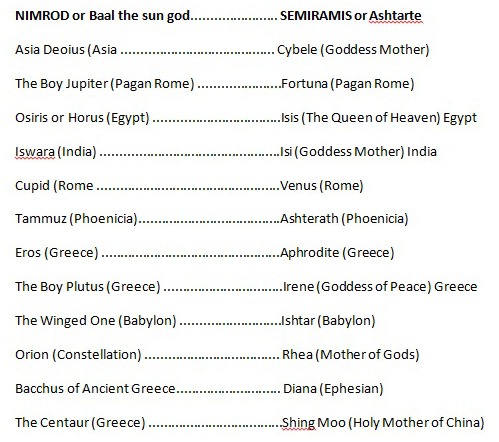
In the scriptures of Judaism and Christianity, Marduk and Tiamat were first identified as the humans Nimrod (In Genesis, chapter 10, called “a mighty hunter before the Lord”) and his wife Semiramis (later known as the mythological Queen of Heaven).
There are those who say it was Nimrod who established the first state religion by unifying mankind and building a tower in the Tigris/Euphrates region of antiquity. However, after he incorporated, and then diversified, he went public:
Did it all start on the plains of Shinar after a great flood, when the malesun overcame femalewater?
In A Clockwork Orange, Alex and his droogs were certainly warlike and sought to ravage the females in their paths. Moreover, perhaps as another clue, one of the songs on the film’s soundtrack is titled “Overture to the Sun”.
In the scene previously described, when the rival gang was in the act of melodramatically wrestling a woman in order to rape her on a stage, it did appear Kubrick incorporated elements of the “Enuma Elish” into his film: namely the expanse of sky above and a winged sun god overlooking acts of sex and violence (Chaos) below.
Within the occult, there are those identifying the Sun as being a symbol of Lucifer the Light Bringer and with the accompanying “illuminating rays of knowledge”; all supposedly essential to the ancient sun worship cult called “The Illuminati”.
Furthermore, others have connected both Freemasonry and the Illuminati as having originated in ancient Egypt:
Popular history texts and encyclopedias generally paint the Illuminati as having its origins in 1776 Bavaria. However, the origins go back much further. The Illuminati are tied directly through masonry to the sun and Isis cults of ancient Egypt.
In truth, Kubrick’s A Clockwork Orange has more occult symbols than even a U.S. dollar bill; along with specific parallels to Freemasonry. All of these visuals, like the Eye of Horus right on the money, are hidden in plain sight:
The checkered pattern is found in Freemason lodges and is known as “Moses Pavement” which symbolizes the duality of man. Of course, the Eye of Horus, snakes, and phalluses, are all symbols of the occult as well.
Why would Kubrick have included these in A Clockwork Orange and, also, in his other films?
Coincidence? Art? Conspiracy?
Let the readers, and viewers, decide.
Additionally, as addressed before, Kubrick’s film does include some peculiar references to Christianity. Complementing Alex’s aforementioned prison fantasy of being a Roman soldier in the act of whipping Christ, there was an earlier scene in his room where he fondles his pet snake before the snake appeared to act as a phallus between the legs of a naked woman pictured on his wall. The buttocks of the woman looked to have been held up by the raised arms of four naked Jesus Christ figurines; complete with crowns of thorns. Then, as a rapturous Alex enjoyed the music of Beethoven in a near masturbatory manner, he envisioned himself a vampire and saw a woman in a white (wedding?) dress being hung by rope, along with fiery explosions and men being crushed by rocks.
These examples, along with the symbols of Alex’s pet snake and the Eye of Horus on his right sleeve and right eye, leave the viewer with the impression the boy’s worldview was nothing short of Luciferian.
Moreover, just as western holidays like Christmas (Sol) and Easter (Ishtar) have their originations in ancient sun worship and female pagan fertility deities, so too, it seems, does A Clockwork Orange. In another example, one of the droogs in the Korova Milk Bar, with sun/projector overhead, drew milk from the breasts of a replica nymph that he called “Lucy”.
Are all of these occult references designed to point the viewer’s attention towards Lucifer? Was Kubrick trying to warn his audience that the future for both individual and state belonged to Satan? Or, is it possible the director was actually advocating for such?
Through the Lens of the Established State, Modern Politics , Time, and the Circular Cycles of Man
There are those who have tied Donald Trump to Kubrick’s A Clockwork Orange:
And, paradoxically, it now appears the Satanists are even threatened by The Orange Jesus as they seek to convert the younger generation.
Founded in 2012, The Satanic Temple (not to be confused with the Church of Satan) is a non-theistic organization that has gained prominence since President Trump’s election. The group reported it gained “thousands of new members” after Trump won the presidential race.
…Since the election, The Satanic Temple has launched multiple campaigns aimed at challenging Christian influence in the political sphere. One example is their After School Satan Clubs.
Obviously those on the Political Left, and some in the middle, view Trump as similar to the right-wing, authoritarian (law and order) party in Kubrick’s film; who brainwashed naive dupes into supporting misguided policies. Yet, to the other half of the audience watching the political theater on their screens, it appears that Trump is more comparable to Alex; who, after creating carnage in the proverbial political swamp, is now undergoing reeducation by the Established State right before their very eyes.
Could Kubrick have foreseen the inevitability of time’s passage delivering an Orange Reality TV Star to the world stage? It’s doubtful, because he didn’t write the book. Even so, is it still possible that Trump is a clockwork man, arriving right on schedule?
Since the times of the first songs, the elite have cynically oppressed the proles while telling them it’s for their own good; for their safety, or for the good of Mankind overall. That is the commonality of gangsters, thugs, neocons, corrupt politicians, fascists, and tyrannical collectivists. They abrogate timeless moral principles for their own benefit and tell us it’s for ours.
In the narrative of A Clockwork Orange, there is a contrarian to the current government, an author, who played dual roles in the film’s plot. Towards the end, he argues on the telephone with an unseen coconspirator that “the common people must not sell liberty for a quieter life”.
Yet, isn’t that what we’ve done today in the once free nations of the western world?
In many ways, A Clockwork Orange is a mirrored representation of modern America. In the movie, a right-wing party is the established power suppressing the rights of commoners in order to sustain its continuity of control; and the media, and opposition party, were fighting on the side of liberty.
Paradoxically, in the real world currently, the media, the Political Left, and lukewarm conservatives, are in singularity with the Established State; as Trump and his Deplorables wreak havoc before the global towers of power.
Based upon raw intuition, instinct, and Tweets, Trump is the political manifestation of Freud’s Id. Therefore, he and his gang of supporters must be reformed via electronic programming and conditioning (punishment and reward) by the state as it seeks to secure its everlasting continuity.
Play ball and society will experience harmony, but only on the state’s terms. Disobey at your own peril. This is one of the themes in A Clockwork Orange. Other undertones of the film speak to secrecy, smoke, mirrors, and mind control, where the state vanquishes the violent urges of its citizens by creating a new reality via cyclical, or looped, feedback. Consensus will be manufactured and contrarian views need not apply. Not acceptable? No problem. The state has a pill for that.
As humans, we have free will, and that is a right that cannot be denied to us. The Ludovico Technique represents the government’s, or any authority figure’s, interference with our personal liberties, and the dangers of these interferences. The battle of good versus evil is presented an innumerable amount of times in literature and cinema–but A Clockwork Orange puts a twist on this common theme. Which is worse, chosen evil or forced good? According to A Clockwork Orange, chosen evil is the lesser evil, because it demonstrates it allows us a choice. If humans lose moral choice, they become machines. Free will to choose between good and evil is the central theme and message in A Clockwork Orange.
Whether or not Trump is real or just an actor, like in Kubrick’s films, he has revealed certainrealities. The fact remains the state does not now endorse free will and it has, instead, resorted to electronic conditioning to form its new reality.
This will work until it doesn’t. Then the process begins again, just has it always has throughout history; as predictable as seasons, or the sun crossing the sky.
Conclusion
In researching this article, and Stanley Kubrick’s life’s work, I discovered many websites that were a strange combination of profoundly perceptive insights, unique observations, and batshit craziness. But one interesting theme presented in Kubrick’s storytelling is the idea of mankind’s Odyssey: Seeking meaning through faith, action, and fortune, upon the world stage; overcoming base instincts, then rising on a tide of reason and rationality, before the cycle rounds another bend and mankind falls again.
When watching A Clockwork Orange, the viewer is forced to consider the ironies of individual and state. In turn, this blogger now questions if both entities are not merely two parallel paths to hell on earth.
The sun rises and sets on individuals and nations alike. Yet, throughout history, Man’s Id was successfully moderated at times by his Ego and Superego thus allowing, for the most part, periods of equilibrium and justice; even if only for a season.
Fate or free will? That is the question. Given the cycles of history, where does hope now reside? Why would anyone have optimism at all?
In A Clockwork Orange, the Ludovico Technique was meant to fix dystopia’s problems. Today, in the real world, it is media narratives that are meant to address what ails us. Unfortunately, however, these are twin movies unspooling separately and all at once. In turn, it means certain worldviews must be reprogrammed, as it were.
This explains why social media companies are purging “incorrect thinkers” on their respective platforms. They are viewed as subversive moles, and petty criminals, damaging the fertile ground of the new world order.
It’s also why a bogus Russian dossier was utilized to derail the Orange Criminal. One wonders if he was wound up as part of a plan to place asunder the old ways; like the tide rolling out before the dawn of a new day.
The lesson learned from A Clockwork Orange is to beware the algorithmic hammers of conformity; always watching, ever ready, and waiting to shine down from on high; ceaselessly smiling, shaking hands, and kissing babies on the way.
Before new experiments and orthodoxies can be tried, there must be good reasons to do so. For out of chaos comes creation. The circle runs like clockwork and always on time.
The Id of Man will be tempered by a new religion; or perhaps an old one by another name.
Joe Lynch’s “Mayhem” feels like a timely film in a way it wouldn’t have a couple years ago. Whatever your political party may be, anger has been a palpable emotion in this country recently—it was anger that got Trump elected, and it’s anger that opposes his administration. But what do we do with that anger? How long can we keep it down before it overwhelms us? With his best film since “Wrong Turn 2,” Lynch channels that national anger into a stylish, smart, propulsive gore-fest set in a corporate America that takes no prisoners. But when did it?
Not only is “Mayhem” a brutal, visceral gut punch at a time of the year when we typically drown in awards bait, but it feels like a movie designed to tap into a vein of frustration and anger at a corrupt system. Hate your boss? Can’t control your road rage? Want to push your co-workers down a stairwell? Thinking mean things about the President and his cronies? “Mayhem” channels rage at an unfair society and the bullshit that trickles down from the Powers That Be into a paean to uncontrolled anger. Much more tonally consistent than the similar “The Belko Experiment,” “Mayhem” isn’t as much about id run rampant as it is two people finally loosed from moral and societal constraints in a way that allows them to enact bloody, vicious vengeance. There are times when the whole thing feels like an extended version of that scene from “Kingsman: The Secret Service,” or, worse, the movie that would be the favorite film of the lunatic followers of Tyler Durden in “Fight Club,” but this weird little genre exercise works way more often than it doesn’t, and actually has something to say in the process.
The premise of “Mayhem” is simple in a way that I think a lot of horror masters would admire. There’s an airborne disease, referred to as “Red Eye” for the single red-eye it gives those who suffer from it, that removes all societal and moral governance. So those infected with it don’t just get mad, they get bloody. And it happens to infect a firm (and not just any firm but the one that set the legal precedent for “Red-Eye Defense” by recently getting off a murderer who was infected with it at the time) filled with the kind of well-tailored monsters who barely control their impulse for cruelty anyway. These are the kind of people who gleefully step on the little man in the pursuit of the almighty dollar, and one of the most interesting aspects of “Mayhem” is the choice Lynch makes not to infect “average Joes” but people who seem to have practice unleashing their inner monsters. When John Towers (Steven Brand), the boss of this loathsome company, says to someone beneath him that “You must protect those above you,” it’s the kind of human shield mentality that CEOs and executives have been using for scapegoats for decades.
However, the protection in this case is literal, and the man that Towers needs it from is Derek Cho (Steven Yeun, going from fighting zombies on “The Walking Dead” to maniacal suits here), a rising star who is about to be fired on the day the infection hits the company. Rather than take his corporate execution the way so many do, he picks up a hammer and a nail gun and goes after the people above him, assisted by a client named Melanie Cross (Samara Weaving), who was in the office that day fighting an immoral foreclosure. Caroline Chikezie, Kerry Fox, and Dallas Roberts co-star as corporate monsters at Derek’s company, but the movie belongs to Yeun and Weaving, who both get exactly what Lynch is going for here. They are fearless and intense in ways that other performers would have missed. Yeun proves himself to be a more engaging leading man than I would have expected and Weaving has the energy of Margot Robbie—captivating and a little scary at the same time. They’re both really good, and it’s their commitment that keeps “Mayhem” humming.
“Mayhem” is at its best when it channels relatable stress into utter genre insanity. It’s like “Office Space” if Michael Bolton went on a murderous spree with a nail gun, playing on workplace stress instead of pure id, and it has a violent momentum that’s hard to deny, well-directed by Lynch (who might use a few too many quick cuts but also stages a brutal scene to Faith No More, so all is forgiven). It can be such a relentless experience that it surely won’t be for everyone, but it works best when considered as a film that’s essentially about people willing to kill, bribe and offer power to anyone to not only save their own skins but also excuse their own horrors. Whether you would levy such accusations at Trump or the candidate he beat a year ago, there’s something about watching a movie about unleashing repressed anger at injustice a year after Election Day 2016 that just feels right.
A real-life Breaking Bad for the psychadellic set, The Sunshine Makers reveals the entertaining, untold story of Nicholas Sand and Tim Scully, the unlikely duo at the heart of 1960s American drug counterculture. United in a utopian mission to save the planet through the consciousness-raising power of LSD, Orange Sunshine, as they tried to stay one step ahead of the feds.
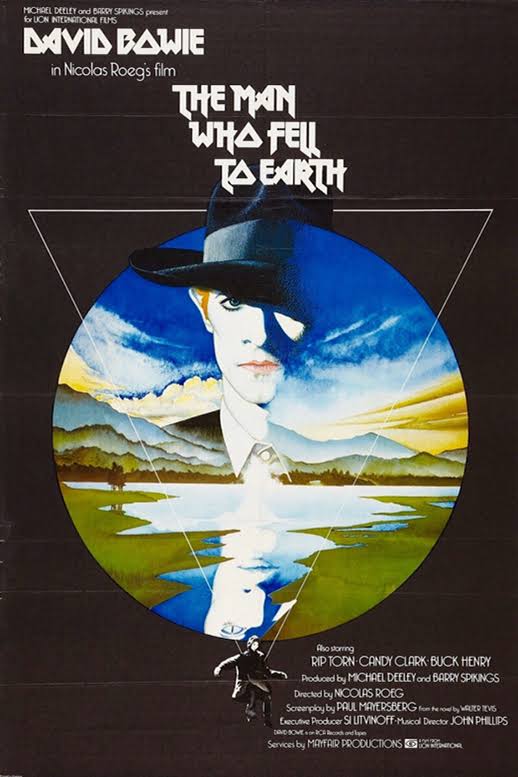
“The Man Who Fell to Earth” (1976) is a British science fiction film directed by Nicolas Roeg, written by Paul Mayersberg, and based on Walter Tevis’s 1963 novel of the same name. David Bowie (in his first feature film role) stars as an extraterrestrial who crash lands in New Mexico while on a mission to save his home planet. Going by the name of Thomas Newton, he soon meets Oliver Farnsworth (Buck Henry), Mary-Lou (Candy Clark) and Dr. Nathan Bryce (Rip Torn), who become his closest allies. Due to personal and professional betrayals, Newton’s secret is revealed and he’s captured by a government agency. While imprisoned he’s subject to tortuous medical tests which break his spirit, replacing his more “alien” personality traits with those of a modern American.
In Philip K. Dick’s novel VALIS, fictionalized versions of Dick and K. W. Jeter become obsessed with Valis, a film starring musician Eric Lampton. This plot element was based on Dick and Jeter’s real obsession with The Man Who Fell to Earth.





 After the Crash
