
Forecast 2023 — Get Out of the Way if You Can’t Lend a Hand

By James Howard Kunstler

Source: Kunstler.com

“The powerful are panicking, and so they should. Their secrets are leaking.” —Miranda Devine

“It’s all just snake oil. We want to save the planet, and the life upon it, but we’re not willing to pay the price and bear the consequences. So we make up a narrative that feels good and run with it.” — Raul Ilargi Meier

“2023 could be a pivotal year for the USA if the pervasive lying can be exposed, digested, and believed. All that exposure has to happen amidst continuing boondoggles toward the Great Reset agenda.” – Truman Verdun

“More borrowing only ever makes sense if you are expecting a larger economy in the future.  All economic expansion is based on energy.  Countries with energy can expand, those without cannot.” —  Chris Martenson

“To be an enemy to America can be dangerous, but to be a friend is fatal.” — Henry Kissinger

“The incorrect narrative provided by mainstream media (MSM) is that climate change is our worst problem. To lessen this problem, citizens need to move quickly away from fossil fuels and transition to renewables. The real narrative is that we are running short of fossil fuels that can be profitably extracted, and renewables are not adequate substitutes. However, this narrative is too worrisome for most people to handle.” — Ugo Bardi

It’s hard to contemplate 2023 without spiraling into nausea, tachycardia, and cold sweat. But it is an inescapable duty here to lay out the probabilities ahead. I’ve been doing this forecast thing for some years now, and, of course, I am often wrong, so take some solace in that and relax. Maybe the new year will be all unicorns, rainbows, talking gerbils, and candied violets.

   2022 sure was a cold shower. The long emergency I talk so much about finally got up to cruising speed, with the ectoplasmic “Joe Biden” revving our country into economic, political, and cultural collapse — a hat-trick of calamity — and he did it more swiftly and directly than any emperor managed in late-day Rome, with policies and actions 180-degrees contra to America’s public interest — cheered on by a thinking class that had obviously lost it consensual mind.

     Was the governing strategy simply to do the opposite of what the loathed and detested Mr. Trump would do? Could it be that simple or that automatic? The thinking class’s eyes have a zombified glaze these days. It’s obvious, you might agree, that “Joe Biden” is not in charge of anything, really. He’s an animatronic figure programmed to read a teleprompter and not much else. Half the time, he can’t even find his way off-stage after doing that one trick. The claque pulling his strings just may be the crew you see around him (you know, WYSIWYG): Susan Rice, Ron Klain, Jake Sullivan, Antony Blinken, Victoria Nuland, and company. Ms. Rice has kept herself completely hidden backstage at the White House for two years. Nobody ever hears about her or sees her. Weird, a little bit, for the Director of the Domestic Policy Council.

      Or else, are there puppeteers deeper in the shadows, say, “JB’s” former boss Barack Obama, Der Schwabenklaus and his WEF retinue, Bill Gates and other tech billionaires, the “systemically important” bankers, George Soros…? Or some coven of super-elite warlocks we’d never heard of? The US leadership dynamic is truly mystifying and has been for two whole years. Will mysteries be revealed in 2023? Personally, I think so. Things are lining up in that direction, though who knows whether the damage can even be reversed at this point. And now onto the shape of things to come….

Economy

     All you can really say is that the folks running things have hijacked every module of our nation’s interests and tilted them down into decadence and ruin. They’ve tanked whatever’s left of the US economy with an array of surefire idiotic maneuvers. By spending trillions of dollars that don’t exist to buy votes, they’ve inflated away our money’s purchasing power — an Econ 101 level mistake. The “Green New Deal” is a swindle, an out-front, in-your-face nefarious operation to subvert Western Civ by the WEF, and its stooges — laid out explicitly in its house publications.

     There is no way we can run our society as currently outfitted on any combination of alt.energies. All the Greenies can really accomplish with this crusade is to destroy the complex systems we rely on faster than would happen in the normal course of things, foreclosing any chance of an orderly retreat to a plausibly downscaled arrangement for daily life. We are exiting the current system anyway, like it or not — the longstanding thesis of The Long Emergency.

      This gets to the heart of the conundrum we face. Ill-intentioned as the WEF and its allies may be, the world is heading toward a Great Re-set. The catch is, it won’t be the WEF’s version of it, their schematic techno-nirvana with a tiny comfortable elite lording over the bug-eating hoi-polloi. They somehow miss the glaring point that the energy required to run their precious transhuman tech won’t be there. By the way, the WEF’s core idea of central control by a coordinated world government is at odds with the core reality of the times ahead, which is that life is about to get much more local and downscaled — the exact opposite of centralized. Everything organized at the giant scale is veering into failure: empires, global corporations, hypertrophic cities, giant universities, giant farms, you name it. Their business models are broken. The activities these things represent have to get smaller, finer, and more regional. Depending on what we’re able to salvage and re-purpose from the fabricated leftovers of Modernity, we’ll be lucky to land back in life lived at the level of the early 1800s. Or else, if we really mess up, we’ll plunge haplessly into a dark age in a resource-stripped world.

      The “Green New Deal,” based on a combination of wishful thinking and self-destructive malice, includes the deliberate undermining of what’s left of America’s oil industry by cancelling pipelines, drilling licenses on public lands, draining the strategic petroleum reserve, and other efforts to sabotage what’s left. America still has a lot of oil in the ground, yet much of it is hard to get at and uneconomical to produce at the scale required. It’s a money-loser, and losing money consistently doesn’t pencil out for any real business.

     This hard reality is especially true of shale oil, which had a good run production-wise 2009 to 2022, though the producers could barely make a dime at it. The shale oil “miracle” was largely a byproduct of near-zero interest rates. Investors flocked to it after 2009 because they couldn’t get any yield from bonds. Shale oil was played-up as a sure thing. It took investors a decade, and over a hundred oil company bankruptcies, to catch on — and now shale oil can’t attract enough new investment to keep up the giant operations at scale. The main shale oil regions, the Permian Basin in Texas and the Bakken fields of North Dakota, have entered permanent decline as they run out of “sweet spots” to drill and frack. Considering the new era of capital scarcity ahead, money for shale oil companies will be even harder to get and we’ll get less shale oil every year, while conventional oil continues its own remorseless decline. The catch here is that oil prices are just as likely to go down as up because the foundering economy creates substantial demand destruction — meaning that customers drop out of the market.

      Natural gas involves similar dynamics. There seems to be a lot of it for now in the Marcellus formation spread over Pennsylvania, Ohio, West Virginia, and into New York (where fracking has been prohibited for years). Natgas is very useful for electric generation, home heating, and some manufacturing, but not so much for transportation. Shale gas production is also based on “sweet spots” for drilling and there are fewer of them every year. The depletion curve for natgas is even more extreme than it is for oil: the flow stops all at once. The early shale gas plays in the southern US — Haynesville, Fayetteville, Barnett — have been in decline for years. As with shale oil, producing shale gas is expensive, with all the trucks ceaselessly delivering sand, water, and fracking chemicals to the drilling pads, and then transporting waste liquids off-site. Prediction: in 2023, we’ll hear the first rumblings about “nationalizing the oil industry,” which will be a giant step toward killing it altogether, given the all-around incompetence of government.

      The strategy of changing out oil-based cars and trucks for electric vehicles (EVs) is a loser on several counts beyond the disruption and instability facing US oil production. One, it’s premised on the fantasy that we can continue living in a suburban sprawl arrangement by other means. Two, the electric grid is too inadequate and fragile to support the charging of so many millions of EVs in addition to everything else we ask it to do. Three, the middle class is being decimated, so there are fewer credit-worthy customers for cars priced out of their shrinking budgets anyway. Four, far less capital will be available for consumer loans. The car industry itself may not survive the re-possession orgy coming in 2023 for defaulted auto loans. That shortfall will infect banking, too. The economy is already hurting. The “Green New Deal” will cut its wobbly legs off.

     Similarly, the new mandates against the use of nitrogenous fertilizers (made from natgas). European countries are already on-board with this WEF folly. The Netherlands, Europe’s leading food producer, is going so far as to forcibly shut down thousands of farms and limit fertilizer use on the remaining ones. Germany is likewise limiting fertilizers. Canada fell in line next. Prediction: in early 2023, “Joe Biden” will set in motion anti-fertilizer policies in the US. There will be plenty of squawking in the big farming states, rising to angry protests. The tractor convoys may invade Washington. The situation sets up a grim prospect for the US food supply: scarcity, high prices, and hunger ahead.

      The Ukraine bread-basket is out of the picture in 2023, unless military action ends well before planting season. Thanks to “Joe B’s” stupid sanctions policy, a more vulnerable Europe can’t depend on Russia, another world-leading grain producer. By summer, the projected harvests all over Western Civ will be inadequate to feed the existing populations. Routine grain exports to the poor nations of the “global south” will stop and a lot of people will starve in those countries. By then, it will be too late to fix anything. The price of food will soar throughout Western Civ, aggravating other economic crises that will amount to metastasizing poverty. Populations will get very restless. Governments will fall (candidates: France, Germany, UK, Australia, the USA). In some places they will not recover in their prior form.

     As a general proposition, Globalism is done. That got that underway in earnest with the Covid shut-downs. Now, geopolitical friction gets worse and trade relations deteriorate further. There will still be trade between nations, but much reduced. Global supply chains are already wrecked, especially for specialized mechanical replacement parts and electronic components. It will be harder to fix cars, trucks, turbines, really any sort of machine, including computers and things run by them. A lot of commercial activity will just stop.

     Europe has already blundered into buying its one-way ticket to Palookaville. Germany and the rest paid for that ticket by going along with feckless US policy to “weaken” Russia with sanctions (mission not accomplished). The coup de grace was the US wrecking the Nord Stream pipelines. So, Euroland has inadvertently decided to ditch its industrial base, which means they go medieval or worse. They have committed economic suicide. They’d better hope reincarnation is for-real. Anyway, they’re not coming back from this fiasco the way they went into it, that is, the way things were. When the shock of winter is over in early 2023, strife will be the new leitmotif in the Old World. People grow desperate in the six-weeks-wont of springtime. Nations crack up.

     America’s economy largely hinges on finance now that financialization replaced manufacturing as the basis for prosperity. Alas, financialized prosperity is false prosperity, since it consists mainly of borrowing ever greater amounts of money to keep up the mere appearance of prosperity. In real life, prosperity requires producing things of value, not just trading increasingly abstract financial instruments purporting to represent money. I’ve discussed this enough in books, prior blogs, and previous forecasts. Suffice it to say we’ve run out the string on this stunt. All we’re left with now is the debt markers, documents that purport to represent wealth. The collateral is all the stuff we produced previously that is still standing: buildings, developed properties, public works. A lot of this stuff is deteriorating quickly, losing its value — for instance the tens of millions of suburban houses built with shitty, short-lived materials like strand-board and vinyl… all the cars….

    Financialization led to the current inflation in our debt-based money system. More borrowing becomes more money going into existence, chasing a declining amount of goods as production falls off and supply lines choke. Services also suffer. People can’t afford to eat out, get acupuncture, visit hair-dressers. When the inflation is bad enough, say more than ten percent annually, it will cause enough economic damage to provoke a big contraction in activity, bringing on a deluge of loan defaults on mortgages, car payments, and corporate obligations. Loan defaults cause money to disappear from the system. This flips inflation into deflation. The bond-market is blowing up as this occurs, because bonds are debts and they’re not being serviced or paid-off. The imploding bond market infects the stock markets and they crash, too.

      Before long, nobody has money, except people who invested in gold and silver. Prediction: the change-over from inflation to deflation comes in summer of 2023 and gathers momentum into the fall. The implosion leads to economic conditions worse than the Great Depression of the 1930s because our social and family arrangements have disintegrated along with our towns and cities. Civil disorder ignites. The government attempts lockdowns, but this time without a disease to blame it on. It’s no longer safe to be a politician.

The Covid-19 Story Backfires Badly and Hell Breaks Loose

     Against the backdrop of a developing economic depression, the public can no longer avoid seeing the calamity that the mRNA vaccines have instigated. Early death is in the news daily now and from exactly the adverse effects that have been derided as “conspiracy theory” by public health experts since 2021: myocarditis, blood clots, organ damage, neurological illness, unusually aggressive cancers, damaged immune systems. Meanwhile, America’s public health aristocracy — Dr. Tony Fauci, Rochelle Walensky, Francis Collins, Deborah Birx, Surgeon General Vivek Murthy, and many, many others will be compelled to testify under oath before newly re-constituted House committees and finally answer for all their dishonesty in the Covid-19 response saga. They lied about everything, especially the “vaccines?” It will go worse for them as public sentiment turns from submission to official bullshit to rage over a deadly fraud.

      By then, the past efforts of this gang to mislead the public on Twitter and other social media will be well-documented. The exposed slime-trail of money and corruption between Pharma and federal bureaucrats will finally make an impression on the long-bamboozled nation. The mainstream media will be dragged into this morass and the public will begin to understand how the newspaper editors and TV news producers, too, were bought off by Pharma and controlled by the national security state to pimp for the Democratic Party and globalist interests outside the USA. This exposure could be the end of the great legacy news organs, The New York Times and the rest of the gang. Their executives will have to testify along with everyone else. They might not be prosecuted — in a gesture of respect for the First Amendment — but rather will suffer badly from their loss of credibility.

     All of this will aggravate the animus against the government and the Democrat Party’s “Joe Biden” regime — which will be under assault from separate inquiries into the Hunter Biden laptop and its abundant evidence of bribery and treason, and hearings about the wide-open border, payments to Ukraine, and the gestapo-like behavior of the FBI.

    Here’s a scenario for you: The Justice Department will be drowning in criminal referrals. The FBI will be in a state of paralysis, unable to carry out more insults against US citizens as its systematic crimes are revealed. When the DOJ dithers about bringing action, the public will be even more enraged. The current Attorney General, Merrick Garland, gets dragged into Congress to answer for his misconduct and the resulting humiliation will run him out of office. “Joe Biden” may be forced to resign, drowned in a sea of troubles and scandals revealed. A deal will be made to let Veep Kamala Harris off the hook in exchange for her resignation.

      That will leave the Republican Speaker of the House, whoever it is, to become president. He will fire every political appointee in the executive branch and replace them with people who will follow the law. It will look like a promising return to decency and the rule of law. But the damage to America’s prestige will have been so gross by then that the federal government has lost legitimacy. The financial crisis, meanwhile, puts the government into something that smells like bankruptcy. The country is in a ferocious depression, the people have no money, but neither does the government. Real authority devolves to states and localities. The playing out of these dynamics also depends on what is happening outside the USA.

Europe in Macro 

    Don’t forget, Europe, the west end of the Eurasian landmass, used to be an important part of the world, with an aggregate GDP greater than even the USA’s or China’s. Europe is the birthplace of Western Civ, a division of the human project the past few thousand years that yielded tremendous advances in science, art, music, philosophy, and organized intelligence generally. Now it is on the rocks. Europe, in the aggregate, as represented, say, by the European Union, or NATO, made a grave error going along with the USA’s foolish Neocon project to make a heap trouble in Ukraine in order to “weaken” Russia.

     Russia was no longer a threat to the USA after 1991. Once the USSR was done as a political entity, and after Russia recovered from the daze of collapse, it wanted to be treated by the West as a normal European nation. Russia became a market economy, like all the others in Europe. It held elections like the others, had a legislature, a new body of property law, a private news media, regular banks, and all the other trappings of modern political normality. Russia even requested early-on to become a member of NATO. The USA and Europe refused NATO membership, but also refused to admit Russia into European normality. Instead, led by the USA, the West conducted an asset stripping operation which hampered Russia’s redevelopment.

     Otherwise, the West mostly ignored Russia, and in spite of all that Russia got back on its feet, got some industries going, especially oil-and-gas, and enjoyed two decades of relative stability. Russia eventually began reaching out in the world and made trade agreements with other countries. It built those Nord Stream gas pipelines. It organized a regional “customs union” among its Eurasian neighbors that functioned rather like the Eurozone.

     As that was all happening — pay attention — around 2010 then-Secretary of State Hillary Clinton sat on a State Department’s Committee on Foreign Investment in the United States (CFIUS) that threatened to block the sale of a Canadian company, Uranium One, to Rosatom, the Russian State Atomic Energy Corporation, on the grounds that Uranium One’s assets included 20-percent of the USA’s uranium supply. Selling all that American uranium to Russia looked kind of bad, you’d think, and you’d be right. But then, suddenly, about $150-million dollars poured into the Clinton Foundation — much of it from Uranium One’s owner, one Frank Giustra — plus Bill Clinton happened to get a half-million dollar speaking gig in Russia, and… whaddaya know, CFIUS ended up approving the sale. The public hardly heard a peep about it. (Where was the US new media?)

     During that same period, Hillary Clinton also helped facilitate the transfer of American bio-medical, nuclear, and Info technology to the high-tech consortium called Skolkovo, Russia’s version of Silicon Valley. Much of the tech at issue was dual-use, good for civilian and military applications. Again, tens of millions of dollars gushed into the Clinton Foundation from the corporate participants in the Skolkovo deal. Crickets from the news media again.

    In 2011, relations between the US and Russia soured when President Putin accused the US of fomenting protests in Russia over its parliamentary elections. And from there, our State Department decided that Russia and the USA could not even pretend to be friendly.

     Jump ahead to 2014: Neocons in the Obama administration figured it was time to cut Russia back down to size. That effort crystalized around the former Soviet province, Ukraine, and blossomed into the US-sponsored-and-organized Maidan Revolution, utilizing Ukraine’s sizeable Stepan Bandara legacy Nazi forces in the vanguard, to foment violence in Kiev’s main city square. The US shoved out elected Ukraine President Yanukovych — who angered America by pledging to join Russia’s Custom’s Union instead of the EU — and installed its own puppet Yatsenyuk, who was ultimately replaced by the candy tycoon, Poroshenko, replaced by the Ukrainian TV star, comedian Volodymyr Zelensky. Ha Ha. Who’s laughing now? (Nobody.)

     From 2014-on, Ukraine, with America’s backing, did everything possible to antagonize Russia, especially showering the eastern provinces of Ukraine, called the Donbas, with artillery, rockets, and bombs to harass the Russia-leaning population there. After eight years of that, and continued American insults (the Steele Dossier, 2016 election interference), and renewed threats to drag Ukraine into NATO, Mr. Putin had enough and launched his “Special Military Operation” to discipline Ukraine. Once that started, American Defense Secretary Lloyd Austin stated explicitly to the world that America’s general policy now was to “weaken Russia.”

     That declaration was accompanied by America’s policy to isolate Russia economically with ever more sanctions. Didn’t work. Russia just turned eastward to the enormous Asian market to sell its oil and gas and utilized an alternate electronic trade-clearance system to replace America’s SWIFT system. Sanctions also gave Russia a reason to aggressively pursue an import-replacement economic strategy — manufacturing stuff that they had been buying from the West, for instance, German machine tools critical for industry.

     Russia did sacrifice more than $50-billion in financial assets stranded in the US banking system — we just confiscated it — but, ultimately, that only harmed the US banking system’s reputation as a safe place to park money, and made foreign investors much more wary of stashing capital in American banks. Net effect: the value of the ruble increased and stabilized, and Russia found new ways to neutralize American economic bullying.

     Europe was the big loser in all that. For a while, Europe could pretend to go along with the US / NATO project, pouring arms and money into Ukraine, and at the same time depend on Russian oil and gas imports. Eight months into the Ukraine-Russia conflict, the US blew up the Nord Stream One and Two pipelines, and that was the end of Europe’s supply of affordable natgas, to heat homes and power industry. In a sane world, that sabotage would have been considered an act of war against Germany by the USA. But it only revealed the secret, humiliating state of vassalage that Europe was in. Europe had already made itself ridiculous buying into the hysteria over climate change and attempting to tailor its energy use to so-called “renewables” in history’s biggest virtue-signaling exercise. Germany, the engine of the EU’s economy, made one dumb mistake after another. It invested heavily in wind and solar installations, which fell so short of adequacy they were a joke, and it closed down its nuke-powered electric generation plants so as to appear ecologically correct.

    So now, Germany, and many other EU member states, teeter on the edge of leaving Modernity behind. They managed to scramble and fill their gas reserves sufficiently this fall to perhaps squeak through winter without freezing to death, but not without a lot of sacrifice, chopping down Europe’s forests, and wearing their coats indoors. Now, only a few days into Winter, it remains to be seen how that will work out. We’ll know more in March of the new year. France had been the exception in Europe, due to its large fleet of atomic energy plants. But many of them have now aged-out, some shut down altogether, and “green” politics stood in the way of replacing them, so France, too, will find itself increasingly subject to affordable energy shortages.

     Prediction: Europe’s industry will falter and close down by painful increments. The EU will not withstand the economic stress of de-industrialization. It will shatter and leave Europe once again a small continent of many small fractious nations with longstanding grudges. Some of these countries may break-up into smaller entities in turn, as Yugoslavia, Czechoslovakia, and Russia did in the 1990s. Keep in mind, the macro trend world-wide will be downscaling and localization as affordable energy recedes for everyone. Since the end of World War Two, Europe was the world’s tourist theme park. Now it could go back to being a slaughterhouse. The Euro currency will have to be phased out as sovereign bankruptcies make the EU financial system untenable, and animosities and hostilities arise. Each country will have to return to its traditional money. Gold and silver will play a larger role in that.

     The USA poured over $100-billion into Ukraine in arms, goods, and cash in 2022. That largesse will not continue as America sinks into its Second Great Depression. In any case, much of that schwag was fobbed off with. The arms are spent, the launchers destroyed. A lot of weapons were trafficked around to other countries and non-state actors. Russia is going to prevail in Ukraine. The news emanating from American media about Ukraine’s military triumphs has been all propaganda. There was hardly ever any real doubt that Russia dominated the war zone strategically and tactically. Even its withdrawals from one city or another were tactically intelligent and worthwhile, sparing Russian lives. The Special Military Operation wasn’t a cakewalk because Russia wanted to avoid killing civilians and refrain from destroying infrastructure that would leave Ukraine a gutted, failed state. Over time, the USA proved itself to be negotiation-unworthy, and Ukraine’s president Zelensky refused to entertain rational terms for settling the crisis. So, now the gloves are off in Ukraine. As of December 29, Russia shut off the lights in Kiev and Lvov.

     The open questions: how much punishment does Ukraine seek to suffer before it capitulates? Will Zelensky survive? (Even if he runs off to Miami, he may not survive.) What exactly will be left of Ukraine? In 2023 Russia will decide the disposition of things on-the-ground. Failed states make terrible neighbors. One would imagine that Russia’s main goal is to set up a rump Ukraine that can function, but cease to be an annoying pawn of its antagonists. Ukraine will no longer enjoy access to the Black Sea; it will be landlocked. The best case would be for Ukraine to revert to the agricultural backwater it was for centuries before the mighty disruptions of the modern era. Perhaps Russia will take it over altogether and govern it as it had ever since the 1700s — except for Ukraine’s brief interlude post-USSR as one of the world’s most corrupt and mal-administered sovereign states.

     Bottom line: Ukraine is and always was within Russia’s sphere-of-influence, and will remain so. The USA has no business there and it will be best for all concerned when we bug out. Let’s hope that happens without America triggering a nuclear World War Three. (Yeah, “hope” is not a plan. Try prayer, then.) Mr. Putin’s challenge going into 2023 is to conclude the Ukraine hostilities without humiliating the USA to the degree that we do something really stupid.

     Asia

       The enormous region where most of the world’s people live is swirling with quickly changing dynamics. It’s hard to tell what kind of shape China is actually in at the close of 2022. The CCP capitulated on its extreme lockdown policy and now the country seems gripped by a new and severe outbreak of the Covid virus. It’s killing a lot of people, including quite a few higher-ups in the CCP. The world saw the beginning of a popular revolt in China through the fall of 2022 as demonstrations erupted. The political side remains opaque.

     The economic side, less so. China’s wealth since year 2000 has derived from its immense factory capacity and cheap labor force. Globalism is wobbling, and with that the world’s supply line network. If trade relations with the USA continue to sour, both China and the USA will suffer. China will find itself at over-capacity, even for the giant Asian market. And they are competing with several other quickly-industrialized nations in the south, plus India, plus the old stalwarts South Korea and Japan.

      The main problem for China, and indeed all the Pacific Rim nations on the Asian side: energy. China doesn’t have very much oil in the ground and is utterly dependent on imports. It has a lot of low-quality coal. It’s building coal and nuke plants like mad. Will that suffice? Electricity is great, but you need fossil fuels to run heavy industries. In the great shiftings of 2022, China made deals for getting more oil and gas from Russia. That might work for a while. But Russia’s energy resources are probably near peak production now. What happens on the way down from that peak? Maybe Russia will be less avid for sharing its fossil fuels with its neighbors. Maybe that will cause political friction. Maybe a desperate China will reach out and try to grab resources from Russia’s vast Siberian territories? Not next year, though….

     The Neocon-led US foreign policy establishment is insane for sure, but the CCP is only not-crazy during times of great stability. Throw in some popular dissent and some economic distress, and the CCP could go cuckoo. Uncle Xi shows very Mao-like tendencies for creative despotism. The party must have a long game for Taiwan, but a distressed and crazed CCP, and an agitated Uncle Xi, could turn that into a short game out of desperation — and then what? We’d have two really crazed governments, the USA and China, ginning up the Eastern theater of World War Three. The upshot of predicament depends to some extent on how delicately Mr. Putin can organize America’s exit from Ukraine.

     Prediction: For 2023 internal friction will preoccupy China as it attempts to square its operations with those pressing trends of our time: downscaling and relocalization. All this could easily lead to regional strife in China. For decades, the CCP has been the glue between its disparate peoples. It may prove to not be superglue.

     Japan remains as enigmatic as ever. It has drifted economically for nearly forty years. Now it looks like it’s drifting into a sovereign bankruptcy as it loses control of its deeply-gamed bond markets. I’ll stick to my old predication that Japan is en route to going medieval. Its pre-industrial culture was very charming and worked well for long periods of history. Industrial modernity demoralized them. Japan imports all its oil. Without it, you can’t even begin to run a modern war machine, so there won’t be a second reaching-out for resources as in the 20th century. The Japanese will not be alone in the new medievalism when this era completes itself.

The Deep State, an Appreciation

    America is at a crossroads, a threshold, a tipping point. Every vital institution in the land has been at least partially wrecked, most especially the ones in charge of the rule of law, which was the best thing we had going for us. The Deep State is for real — the weaponization of a national bureaucracy against the nation itself. Yet, it’s certainly not just an American thing; it’s happening across Western Civ. Is it some natural process of self-destruction? An auto-immune disorder of a giant cultural organism, with parts attacking the whole? The USA, Great Britain, Canada, and Australia took such special pride in being open societies and now they are consumed in censorious lunacy. Continental Europe had a sketchier history with liberty, the enlightened individualism of Everyman, though they actually birthed its principles. But now the whole works is infected and ailing, and by what? It’s as if some cosmic spike protein came among us all and got into our hearts.

     Most major religions feature some version of the idea of death-and-rebirth, and it’s a fact that we see ourselves embedded in cycles, especially seasons. Things turn and return, are born, develop, degenerate, pass away. This was the brilliant application of Strauss and Howe’s Fourth Turning theory to the study of history, and by those terms we are have entered a deep secular winter of the human project. One can appreciate how the onset of winter spooked our prehistoric ancestors. They developed their prayerful ceremonies for bringing back the sun, and warmth, and new growth, dancing around the fire in the skins of animals, often making blood sacrifices to the mysterious forces in charge of… everything. The modern way of reenacting all that seems to be industrial-strength warfare. Many of us are praying right now that we don’t have to go through that.

      More likely, I think, we’ll forego the nuclear fire and simply go through a collapse of the socioeconomic organization that our governance rests on, and the Deep State illness with it. It’ll come with plenty of hardship, but it will purge the poisons that have disordered us, and when we get through it, we’ll make new arrangements for daily life. For some years, I’ve been calling this process a long emergency, and now we seem to be right in the thick of it. I believe in the natural process called emergence. Systems transform themselves organically from one state to another when acted upon by the circumstances of time and place. The outcome is usually a surprise, and not all surprises are bad. So, adios 2022 and hello little baby 2023. Lead us where you will and let’s go forward into it bravely. As Bob said so many years ago, it’s all right, Ma. It’s life and life only….

The Early 21st Century Dystopian Nightmare Reality

By Dr. Joseph Sansone

Source: Global Research

Welcome to the early 21st century dystopian nightmare reality where Orwell’s 1984 is no longer fiction, and if you are hearing voices, it could be the government transplanting those thoughts in your head.

If you think your appliances are listening to you, well, you may be right. Truth is treason and fact is fiction.

Freedom is selfish and fascism is kindness.

Killer robots are being deployed and the Malthusian depopulation agenda is being implemented.

An evolution of good old fashion eugenics called transhumanism is being sold as the advancement of the human race, and global technocrats are openly planning to use artificial intelligence to decide which industries to eliminate in an effort to stop economic growth.

The infrastructure for smart cities, the sophisticated prisons of the future, are in place or being employed. The force and coercion of deadly gene therapy shots continues despite the enormous evidence of causing harm. Unimaginably, masks, lockdowns, and vaccine passports, in many places, may be here to stay. Don’t be surprised if the classic film Casablanca is banned because it critiques fascism by highlighting the oppressive government policy of asking for your vaccine passport, I mean, “Your Papers Please”.

The recent reports in San Francisco about the decision to use killer robots to target American citizens suspected of crimes, should be an eye opener for those still looking the other way. This, of course, is just the beginning.

A Chinese company is promoting a ‘new species’ of 5G powered artificial intelligence driven robots to do everything from serving you coffee to pumping gas. However, these robots may be more of a ‘Terminator’ style prototype than a ‘Jetsons’ automated house keeper. The planned future may entail these terminator style robots for law enforcement purposes, or stated more clearly, oppression. Nothing could go wrong here.

As if this absurdity wasn’t enough, according to Aman Jabbi, the sophisticated prisons called smart cities will include street lights that can kill, total surveillance, and forcing people into the Metaverse under a new digital slavery system. Rural and suburban America will be eliminated as humans are herded into these smart cities. According to Jabbi, much of the infrastructure is in place in many areas of the United States, including Florida and Georgia.

A next generation prototype city, called Neom, or ‘the line’, is being constructed in Saudi Arabia. According to Joseph Bradley, Neom’s technology and digital CEO, “NEOM is not about building a smart city, it is about building the first cognitive city, where world-class technology is fueled with data and intelligence to interact seamlessly with its population.”

As frightening as this is, the previously mentioned deliberate plan proposed by the World Economic Forum (WEF), to use artificial intelligence to decide which industries to liquidate in order to stop economic growth, should send a chill down your spine.

That’s right, the WEF is actually proposing that economic growth is bad and that economic growth should diminish.

This of course is to save the planet from the natural phenomenon called climate change. This psychotic, I mean noble goal, is to stop the depletion of natural resources. Of course, this system must be fair, so artificial intelligence will be used to decide who gets to succeed, and who gets to fail. Don’t worry, I’m sure that algorithm will be proprietary information, like the ones used in the voting machines, or the ingredients of those Covid shots.

If you are wondering how long it will take for the self appointed masters of the universe to determine whether all the useless humans are necessary, you need not wait. There are some interesting coincidences that have emerged globally since the introduction of the Covid gene therapy shots. All cause mortality is going up while birth rates are dropping. Evidence is emerging that these shots may be both a biological and technological weapon. After all, those semi synthetic blood clots are normal. No worries, nothing to see here, move it along.

The high priests of knowledge and truth in our society have determined that for our own good, we are not allowed to know the contents of the Covid shots. These same high priests have also protected us from knowing the algorithm in our computerized voting machines. Fortunately, the government and media and big tech have colluded to protect us from free speech and have actively censored information about the dangerous Covid shots, and our fake elections.

Well, you know what they say, a little knowledge can be dangerous…

Pilot programs of a centralized digital bank currency are currently being rolled out. A CDBC has the potential to create a total slave system where your money is not yours, but instead, is more of an allowance based on approved behavior as the algorithm can be tied into your ESG score. Access to normal life activities can eventually be tied to your speech and political views. Or maybe you’ll be allowed to buy food when you get your gene therapy booster.

Eugenics has evolved into transhumanism, where our billionaire Marxists are seeking to live forever while experimenting on the human race. As mentioned in a previous article, this was prophesized by C.S. Lewis in his book That Hideous Strength. Written shortly after WWII, this work of fiction depicts fascist intellectuals seeking to merge humans with artificial intelligence to find a way to live forever and sanitize humanity. Ultimately, the transhumanists were deceived and were in fact communicating with dark entities. Well, we do know the globalists are evil.

The fusion of Malthusian population control cultists and climate change cultists has led to this abysmal thing called The Great Reset. The Great Reset is a “revolution” led by billionaire technocrats

The Great Reset is unrestricted warfare on the human race.

I see a few scenarios where this can go. Most aren’t so good. We can see total control and a prison planet emerge, it could all blow up and civilization collapse, or we could see the emergence of pockets of liberty as we enter the new dark age. The globalists could fail and we see a free planet emerge. Or there could be a fusion of the two extremes. Nothing is certain. Although, I would argue that the only way possible good outcomes can emerge is if there is active resistance at all levels.

In some way, we all signed up for the early 21st century dystopian nightmare reality.

We all have a choice. We can hide and grovel on our knees, or we can enter the arena, and work to stop global genocide, preserve the human race, and the elusive, yet beautiful thing, called freedom.

It is a wonderful time to be alive. We get to slay the dragon, or die trying.

Biotech Giants Using GMOs to Build Food Tyranny

By Colin Todhunter

Source: Off-Guardian

The article below was written the day before India’s state-run biotech regulator, the Genetic Engineering Appraisal Committee (GEAC), approved genetically modified (GM) mustard for commercial cultivation. This decision was taken on 26 October 2022.

The regulatory clearance for GM mustard means the crop is fit for environmental release. However, the Supreme Court has yet to rule on the matter and government stated a while back that it would wait until that ruling is in.

What follows provides insight into the deceptions and scientific fraud that underpin this decision as well as the consequences for food and agriculture.

We are currently seeing rising food prices due to a combination of an engineered food crisis for geopolitical reasons, financial speculation by hedge funds, pension funds and investment banks and profiteeringby global grain trade conglomerates like Cargill, Louis Dreyfus, ADM and Bunge.

In addition, agri firms like Bayer, Syngenta (ChemChina) and Corteva cynically regard current circumstances as an opportunity to promote their agenda and seek commercialisation of unregulated and improperly tested genetically engineered (GE) technologies.

These companies have long promoted the false narrative that their hybrid seeds and their GE seeds, along with their agrichemicals, are essential for feeding a growing global population. This agenda is orchestrated by vested interests and career scientists – many of whom long ago sold their objectivity for biotech money – lobby groups and disgraced politiciansand journalists.

Meanwhile, in an attempt to deflect and sway opinion, these industry shills also try to depict their critics as being Luddites and ideologically driven and for depriving the poor of (GE) food and farmers of technology.

This type of bombast disintegrates when confronted with the evidence of a failing GE project.

As well as this kind of emotional blackmail, prominent lobbyists like Mark Lynas– unable or unwilling to acknowledge that genuine food security and food sovereignty can be achieved withoutproprietary products – trot out other baseless and absurd claims that industry critics are Kremlin stooges, while displaying their ignorance of geopolitics.

Indeed, who would you turn to for an analysis of current US-Russia relations? An advocate for GE foods and pesticides who makes inaccurate claims from his perch at the Gates Foundation-funded Cornell Alliance for Science. Or a renowned academic like Professor Michael Hudson whose specialist field covers geopolitics.

But it would not be the first time that an industry activist like Lynas has ventured beyond his field of claimed expertise to try to score points.

However, dirty tricks and smears are par for the course because the agri biotech emperor has been shown to have no clothes time and again – GE is a failing, often detrimental technology in search of a problem. And if the problem does not exist, the reality of food insecurity will be twisted to serve the industry agenda, and regulatory bodies and institutions supposedly set up to serve the public interest will be placed under intense pressure or subverted.

The performance of GE crops has been a hotly contested issue and, as highlighted in a 2018 piece by PC Kesavan and MS Swaminathan in the journal Current Science, there is sufficiently strong evidence to question their efficacy and the devastating impacts on the environment, human health and food security, not least in places like Latin America.

new report by Friends of the Earth (FoE) Europe shows that big global biotech corporations like Bayer and Corteva, which together already control 40% of the global commercial seed market, are now trying to cement complete dominance. Industry watchdog GMWatch notes these companies are seeking to increase their control over the future of food and farming by extensively patenting plants and developing a new generation of genetically modified organisms (GMOs).

These companies are moving to patent plant genetic information that can occur naturally or as a result of genetic modification. They claim all plants with those genetic traits as their “invention”. Such patents on plants would restrict farmers’ access to seeds and impede breeders from developing new plants as both would have to ask for consent and pay fees to the biotech companies.

Corteva has applied for some 1,430 patents on new GMOs, while Bayer has applications for 119 patents.

Mute Schimpf, food campaigner at Friends of the Earth Europe, says:

Big biotech’s strategy is to apply for wide patents that would also cover plants which naturally present the same genetic characteristics as the GMOs they engineered. They will be lining their pockets from farmers and plant breeders, who in turn will have a restricted access to what they can grow and work with.”

For instance, GMWatch notes that Corteva holds a patent for a process modifying the genome of a cell using the CRISPR technique and claims the intellectual property rights to any cells, seeds and plants that include the same genetic information, whether in broccoli, maize, soy, rice, wheat, cotton, barley or sunflower.

The agri biotech sector is engaged in a corporate hijack of agriculture while attempting to portray itself as being involved in some kind of service to humanity.

And this is a global endeavour, which is also currently being played out in India.

GM MUSTARD

recent report on the Down to Earth website stated that the Genetic Engineering Appraisal Committee (GEAC), India’s apex regulatory body, might approve the commercial cultivation of GM mustard. In response, concerned citizens have written to the government, objecting to the potential approval of unsafe, unneeded and unwanted GMOs.

The decision whether to allow the commercialisation of what would be the first GE food crop in India has been dragging on for years. COVID delayed the process, but a decision on GM mustard now appears to be close.

However, serious conflicts of interest, sleight of hand and regulatory delinquency – not to mention outright fraud – could mean the decision coming down in favour of commercialisation.

The bottom line is government collusion with global agribusiness, which is trying to hide in the background, despite much talk of Professor Pental and his team at Delhi University being independent developers of GM mustard (DMH 11).

GM mustard presents an opportunity to make various herbicide tolerant (HT) mustard hybrids using India’s best germ plasm, which would be an irresistible money spinner for the seed and chemical manufacturers.

In 2016, campaigner Aruna Rodrigues petitioned India’s Supreme Court seeking a moratorium on the release of any GMOs into the environment pending a comprehensive, transparent and rigorous biosafety protocol in the public domain conducted by agencies of independent expert bodies, the results of which are made public.

In her writ, Rodrigues stated:

In 2002, Proagro Seed Company (now Bayer), applied for commercial approval for exactly the same construct that Prof Pental and his team are now promoting as HT Mustard DMH 11. The reason today matches Bayer’s claim then of 20% better yield increase (than conventional mustard). Bayer was turned down because the ICAR [Indian Council of Agricultural Research] said that their field trials did not give evidence of superior yield.”

The petition says that 14 years later invalid field trials and unremittingly fraudulent data now supposedly provide evidence of a superior yield of 25%.

Rodrigues continues:

HT DMH 11 is the same Bayer HT GMO construct – a herbicide tolerant GMO of three alien genes. It employs, like the Bayer construct, pollen sterilisation technology BARNASE, with the fertility restorer gene BARSTAR (B & B system) (modified from the original genes sourced from a soil bacterium) and the herbicidal bar gene in each GMO parental line. The employment of the B & B system is to facilitate the making of hybrids as mustard is largely a self-pollinating crop (but outcrosses at rates of up to 20%). There is no trait for yield. HT DMH 11 is straightforwardly an herbicide tolerant (HT) crop, though this aspect has been consistently marginalised by the developers over the last several years.”

In order to produce a hybrid, two parent lines had to be genetically modified. Barnase and barstar technology was used in the parent lines. And the outcome is three GMOs: the two parents and the offspring, DMH 11, which will be ideal for working with glufosinate (Bayer’s ‘Liberty’ and ‘Basta’).

According to Rodrigues:

… the plan is that the official route for the first-time release of a HT crop and a food crop will be through HT DMH 11 and/or its two HT parental lines by stealth. Since the claimed YIELD superiority of HT DMH 11 through the B & B system over non-GMO varieties and hybrids is quite simply NOT TRUE…”

In her numerous affidavits submitted to India’s Supreme Court, Rodrigues has set out in some detail why GE crops are a threat to human health and the environment and are unsuitable for India. She briefly communicated some of her concerns in a 2020 interview titled GMO Issue Reaches Boiling Point in India: Interview with Aruna Rodrigues.

Moreover, various high-level reports have advised against introducing GM food crops to India: The ‘Jairam Ramesh Report’ of February 2010, imposing an indefinite moratorium on Bt Brinjal; The ‘Sopory Committee Report’ (August 2012); The ‘Parliamentary Standing Committee’ (PSC) Report on GM crops (August 2012); and The ‘Technical Expert Committee (TEC) Final Report’ (June-July 2013).

These reports conclude that GM crops are unsuitable for India and that existing biosafety and regulatory procedures are inadequate. Appointed by the Supreme Court, the TEC was scathing about the regulatory system prevailing in India, highlighting its inadequacies and inherent serious conflicts of interest. The TEC recommended a 10-year moratorium on commercial release of GM crops. The PSC also arrived at similar conclusions.

According to eminent lawyer Prashant Bhushan, these official reports attest to just how negligent India’s regulators are and to a serious lack of expertise on GM issues within official circles.

Aruna Rodrigues long ago noted the abysmal state of GMO regulatory oversight in the country and the need for the precautionary principle to be applied without delay. But not much has changed and the regulatory position basically remains the same.

Rodrigues asserts that the two parent lines and the hybrid DMH-11 require full independent testing, which has not occurred. And it has not occurred because of a conflict of interest and regulatory delinquency.

Rodrigues notes:

India is suddenly faced with the deregulation of GMOs. This is disastrous and alarming, without ethics and a scientific rationale.”

GM mustard is said to out-yield India’s best cultivars by 25-30%. The choice of the correct ‘comparators’ is an absolute requirement for the testing of any GMO to establish whether it is required in the first place. But Rodrigues argues that the choice of deliberately poor ‘comparators’ is at the heart of the fraud.

In the absence of adequate and proper testing and sufficient data, no statistically valid conclusions of mean seed yield (MSY) of DMH 11 could be drawn anyhow. Yet they were drawn by both the regulators and developers who furthermore self-conducted and supervised the trials. Without valid data to justify it, DMH 11 was allowed in pre-commercial large scale field trials in 2014-15.

For an adequate basis for a comparative assessment of MSY, Rodrigues argues it was absolutely necessary for the comparison to include the cross (hybrid) between the non-modified parental lines (nearest isogenic line), at the very start of the risk assessment process and throughout the subsequent stages of field testing, in addition to other recommended ‘comparators’. None of this was done.

Deliberately poor non-GMO mustard varieties were chosen to promote prospects for DMH 11 as a superior yielding GMO hybrid, which then passed through ‘the system’ and was allowed by the regulators, a classic non-sequitur by both the regulators and Dr Pental.

The fraud continued, according to Rodrigues, by actively fudging yield data of DMH 11 by 15.2% to show higher MSY. In her various Supreme Court petitions, she has offered a good deal of evidence to show how it was done.

Rodrigues says:

It matters not a jot if HT DMH 11 is not approved. What does matter is that its two HT (GMO) parental lines are: HT Varuna-barnase and HT EH 2-barstar will be used ‘for introgressing the bar-barnase and bar- barstar genes into new set of parental line to develop next generation of hybrids with higher yields” (according to the developer and regulator).”

She says this extraordinary admission confirms that the route to any number of ‘versions’ of HT mustard DMH 11 is invested in these two GMOs as parents – India will have hundreds of low-yielding HT mustard hybrids, using India’s best mustard cultivars at great harm to farmers and contaminating the country’s seeds and mustard germ plasm irreversibly.

In effect, according to Rodrigues, India faces a three-in-one regulatory jugglery in a brazen display of collusion to fraud the nation by regulatory institutions of governance.

Moreover, HT mustard DMH 11 will make no impact on the domestic production of mustard oil, which was a major reason why it was being pushed in the first place. The argument was that GM mustard would increase productivity and this would help reduce imports of edible oils.

Until the mid-1990s, India was virtually self-sufficient in edible oils. Then import tariffs were reduced, leading to an influx of cheap (subsidised) edible oil imports that domestic farmers could not compete with. This effectively devastated the home-grown edible oils sector and served the interests of palm oil growers and US grain and agriculture commodity company Cargill.

It came as little surprise that in 2013 India’s then Agriculture Minister Sharad Pawar accused US companies of derailing the nation’s oil seeds production programme.

Whether in India, Europe or elsewhere, the industry’s agenda is to use GE technology to secure intellectual property rights over all seeds (and chemical inputs) and thus gain total control over food and farming. And given what has been set out here – they seek to achieve this by all means necessary.

The Fourth Turn, Turn, Turn

By Charles Hugh Smith

Source: Of Two Minds

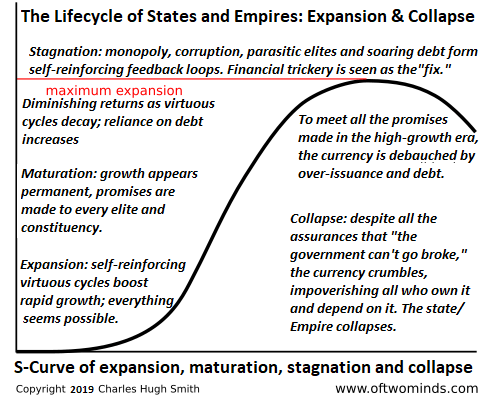
The cycles of The Fourth Turning, Fischer and Turchin are all in alignment at this point in history..

The 1997 book The Fourth Turning: An American Prophecy proposed a cyclical pattern of four 20-year generations which culminate in a national crisis every 80 years. The book identifies these dates as Fourth Turnings: 1781 (Revolutionary War), 1861 (Civil War) and 1941 (global war). add 80 years and voila, 2021.

I use the term Fourth Turning generically to describe an existential crisis that decisively changes the course of national identity and history.

In other words, we don’t have to accept the book’s theory of generational dynamics to accept an 80-year cycle. There are other causal dynamics in play that also tend to cycle: the credit (Kondratieff) cycle, for example.

While each of the previous existential crises were resolved positively, positive outcomes are not guaranteed: dissolution and collapse are also potential outcomes.

David Hackett Fischer’s book The Great Wave: Price Revolutions and the Rhythm of History proposes another cycle: humans expand their numbers and consumption until they’ve exploited and depleted all available resources.

As resources become scarce, societies and economies unravel as humans do not respond well to rising prices generated by scarcities.

The unraveling continues until consumption is realigned with the resources available. In the past this meant either a mass die-off that drastically reduced human numbers and consumption (for example, The Black Plague), a decline in fertility that slowly reduced population to fit resources, mass migration to locales with more resources or the discovery and exploitation of a new scalable energy source that enabled a new cycle of rising consumption.

The 14th century Black Death reduce Europe’s population by roughly 40%, enabling depleted forests to regrow and depleted agricultural land to restore fertility.

Once the human population regained its numbers and consumption in the 17th century, wood was once again under pressure as the key source of energy, shipbuilding, housing, etc.

The development of steam power and the technologies of mining enabled the exploitation of coal, which soon replaced wood as the primary energy source.

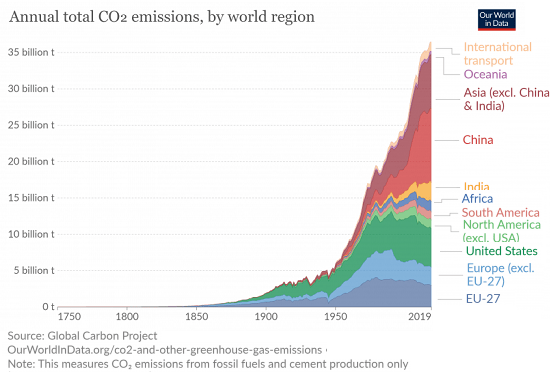
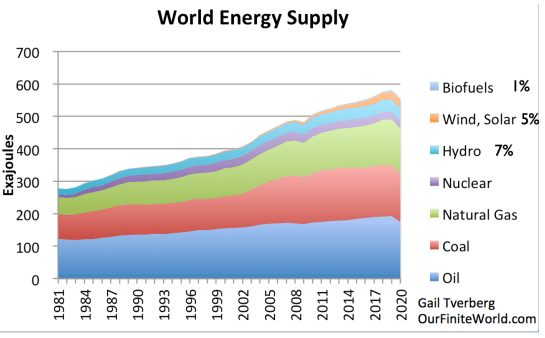
Oil and natural gas added to the energy humans could tap, followed (at a much more modest level) by nuclear power. Despite gargantuan investments, the recent push to develop solar and wind energy has yielded very modest results, as globally these sources provide about 5% of total energy consumption. (See chart below)

It’s self-evident that despite breezy claims of endless expansion of consumption, the global human population has now exceeded the resources available for practical extraction. Energy, fresh water, wild fisheries and fertile soils have all been exploited and the easy/cheap-to-extract resources have been depleted.

(The chart below of global CO2 emissions is a proxy for energy / resource consumption.)

So once again it’s crunch-time: either we proactively reduce consumption to align with available resources, or Nature will do it for us via scarcities.

Peter Turchin proposed another socio-economic cycle of 50 years in his book Ages of Discord: in the integrative stage, people find reasons to cooperate. In the disintegrative stage at the end of the cycle, people no longer find much common ground or reasons to cooperate. Political, social and financial extremes proliferate, culminating in a rolling crisis.

In Turchin’s analysis, the previous 50-year age of discord began around 1970, and the current era of discord began in 2020. Those who lived through the domestic terrorism, urban decay, stagflation and political/social/legal crises of the 1970s recall how inter-related crises dominated the decade.

In my analysis, the last period of discord in the 1970s was “saved” by the supergiant oil fields discovered in the 60s coming online in the late 1970s and early 1980s. That oil enabled a 40-year boom which is now ending, with no new scalable source of energy available to replace oil, much less enable an expansion of consumption.

In other words, the cycles of The Fourth Turning, Fischer and Turchin are all in alignment at this point in history. We have proliferating political, social and financial extremes and a forced transition to lower consumption to align with declining energy.

Turn, turn, turn. Right when we need to cooperate on transforming a high-consumption, bubble-dependent “waste is growth” Landfill Economy to declining consumption / Degrowth, we’re beset by discord and demographic pressures, as the promises made to the elderly back when it was expected that there would always be 5 workers per retiree cannot possibly be kept now that the worker-retiree ratio is 2-to-1 and there are no limits on healthcare spending for the elderly.

Humans are happy to expand their numbers and consumption and much less happy to consume less. They tend to start revolutions and wars in vain attempts to secure enough resources to maintain their profligate consumption and expansion.

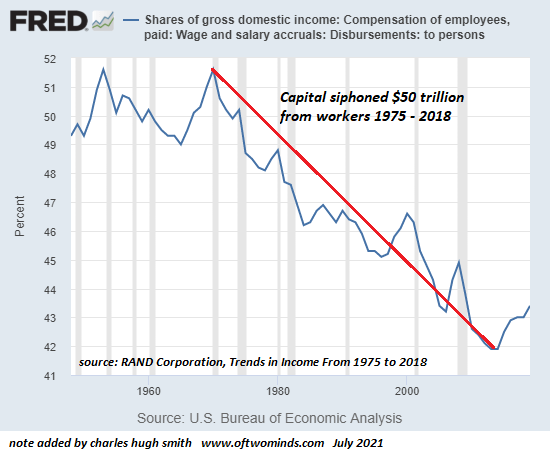
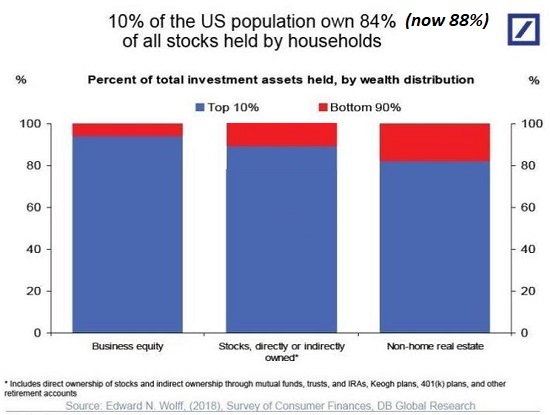
Today’s extremes of wealth and income inequality are optimized to spark political discord and revolts. The wealthiest 20% will be able to pay higher prices, but the bottom 40% will not. The middle 40% will find their disposable income, i.e. their income left over after paying for essentials, will drop to near-zero.

When 80% of the populace are crunched financially, revolutions and the overthrow of governments follow.

As I’ve outlined in previous posts, global inequalities are widening as the Core exploits its built-in advantages at the expense of the vulnerable Periphery.

Core nations will be much better able to maintain their consumption at the expense of the Periphery nations, which will experience sharp declines in purchasing power and consumption.

Previous Fourth Turnings have been resolved one way or another within 5 to 7 years. If this Turning began in 2020, we can expect resolution by 2025 – 2027.

As I explained in my book Global Crisis, National Renewal, those nations that embrace Degrowth will manage the transition, while those that cling to the endless-expansion, bubble-dependent Waste Is Growth model will fail.

This is why I keep talking about making Plans A, B and C to preserve optionality and reduce financial commitments and consumption now rather than passively await crises over which we will have little direct control.

As I’ve endeavored to explain, those anticipating decades of time to adjust are overlooking the systemic fragilities of the current global financial/supply systems. Tightly bound systems of interconnected dependency chains have been optimized to work perfectly in an era of expansion. They’re not optimized to gradually adjust to contraction; they’re optimized to break and trigger domino-like breakdowns in interconnected chains.

We don’t control these macro-trends, we only control our response.

Consider the Chickens

Intelligence, ethics, and the inner lives of animals

By Rafia Zakaria

Source: The Baffler

I OWE CHICKENS AN APOLOGY. Not only have I been eating them until very recently, but I have refused to even consider the possibility of a chicken having any kind of inner life. This estimation was not made from a lack of interaction. As children, my twin brother and I purchased baby chicks from a street vendor. We did this unfazed by the fact that quite often, the chickens would die. Once, when we were nine, we had two that lived, a hen and a rooster. No one told us that we should probably get more hens. Not having any other female companions, the rooster exerted his attentions on the one chicken. She would lay an egg or two every day, much to our delight, but soon sickened and died. Then there was only an incel rooster who roamed our compound and terrorized the women. After a few ugly incidents, he was “given away” to one of the women who worked at our house. We were never told what happened to him, and I didn’t care. There is nothing worse than an incel rooster patrolling your house all day long.

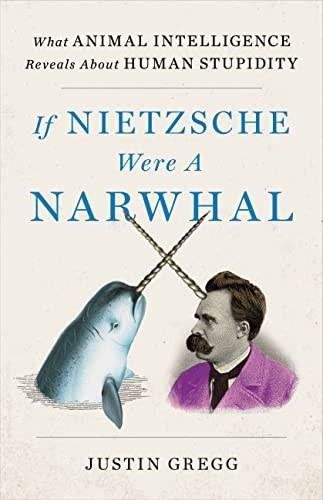
Now, so many years later, I’ve found my way to animal behaviorist Justin Gregg’s brilliant new book If Nietzsche Were a Narwhal: What Animal Intelligence Reveals About Human Stupidity. Gregg’s chicken coop is “a huge enclosed area” with high rafters, because as an animal scientist, he knows them to be jungle birds who need perches on which to sleep at night. But it is not only the magisterial heights of Gregg’s discussion of chickens that stayed with me. I was struck also by Gregg’s description of his chickens’ varied personalities, one anxious, another friendly, and so on; he tells us that these chickens do have inner lives and thus a consciousness of themselves as distinct from others. Instead of the feckless creatures I (and most people) assume them to be, chickens have just the sort of intelligence that is necessary for their own survival. They don’t think like humans, Gregg tells us, because they do not need to.

Intelligence, in Gregg’s explanation, does not exist in the way SATs or other IQ tests would have you believe. Those tests quantify a certain kind of ability to process information. People who do not do well on such tests may have other kinds of abilities that simply are not being measured. Intelligence is not one easily definable thing; engineers working on artificial intelligence cannot agree on a definition of it. But what humans have is a tendency to ask why things operate in a certain way. In Gregg’s terminology, humans are “why specialists,” a proclivity that in natural selection terms is no advantage and perhaps even a liability. A narwhal swimming around in the sea, for instance, would never have the kind of mental breakdown that the German philosopher pondering nihilism suffered toward the end of his life. Animal intelligence is practical and does not get caught up in abstract thought. By and large, animals make calculations based on what they can observe; ideas such as “causality,” which lie at the crux of human intelligence, are outside their capacity for thought.

Humans evolved to become why specialists. As Gregg tells it, 200,000 years ago, humans were hanging out with chimpanzees and exhibited no interest in the whys. They could make rudimentary tools and had some kind of assemblage of grunts that allowed for basic communication. He notes that roughly 40,000 years ago, cave paintings were created. Here were humans asking the whys; symbolic representation is an exclusively human thing.

Inability to be why specialists does not mean that animals are not capable of “metacognition,” the ability to be conscious of their own thinking or cognition. One of the most stunning examples in this book full of stunning examples is that of Natua, a dolphin at the Dolphin Research Center in Florida. An experiment was set up where Natua was exposed to two kinds of sounds, one a very high tone and one a very low tone. After hearing the sound, Natua had to choose between two paddles, one for the high and another for the low. If he chose correctly, he was given a fish for a reward. If he did not, he was sent for a long time-out, in that the experiment stopped. As the experiment progressed, the high tone sound came very close to the low sound such that they were nearly indistinguishable. At this point, Natua was unable to tell the difference; “he just started randomly pressing paddles,” Gregg writes. His behavior proved that some animals are capable of metacognition, the awareness that they do not know, or that their thinking about something is wrong.

It is no surprise that Gregg is pessimistic about how humans have used their abilities as why specialists, and he thinks that there is a chance that humans might not even survive over another century. The prospect of nuclear war and the climate crisis suggest, in Gregg’s view, that the end is possible. In the meantime, developing a consciousness of animals as beings who are capable of metacognition, of having individual personalities and so on, points to the need for a new ethics. This new set of basic premises would abandon the centering principle that the animal-human relationship must always be of one having dominion over the other.

But if you consider the continued resistance to the idea of animal rights, it is hard to be optimistic about the emergence of a new ethics of mutuality that eschews the dominion portion. Too many human rationalizations, attached to what we eat, what we wear, how we live, are predicated on the belief that we are the only feeling beings and that our actions upon animals are independent of consequences. If you know the fear of a chicken or a cow or a pig about to be slaughtered, you may look at your food in a different way. You might eschew fried chicken or beef or pork completely. If you understand that a horse being whipped is suffering terribly, is extremely scared and dissolute, you can also understand that there is a need for a radical expansion of mindfulness and a concomitant shrinking of power.

In the moral universe informed by Gregg’s argument, the survival of the human race is not an imperative for the planet because humans as a species have been far more disastrous for the world than others. “Prognostic myopia” keeps us horribly and condemnably in the moment, burning fossil fuels and trashing the oceans even though we know that it is terrible for the environment. This is a unique position among philosophers, a lot of whom have lately concerned themselves with questions of ethics and planetary survival. 

As a contrast to Gregg, the Oxford Associate Professor in Philosophy William MacAskill, in his What We Owe the Future, proposes “effective altruism” as a way to live ethically in times of climate crisis. If Gregg argues against human exceptionalism, MacAskill reduces humans to data points, where the survival of the most, and the most benefit to the planet, are guideposts to a present and future ethics. Using Gregg’s arguments, however, effective altruism is rendered meaningless. Even those who live sparingly on twenty-six thousand pounds a year, like MacAskill, are still a burdensome threat, unless we define their worth according to tiresome illusions of human exceptionalism.

If Nietzsche Were A Narwhal is the sort of critical look at human dominion that our world needs. A few years ago, Brown University environmental historian Bathsheba R. Demuth wrote Floating Coast: An Environmental History of the Bering Strait, a similarly groundbreaking look at the consequences of the extractive relationship humans have had with the environment. Just as Gregg reveals the risks of humans imagining their power over animals as shorn of consequences, Demuth reveals the consequences of human dominion over nature.

Thinkers and scientists like Gregg and Demuth are presenting readers with the urgent and pressing necessity for a new ethics. The unthinking, extractive, and dominant human treats animals as a lower form of existence, rather than a different form; we assess the environment based on what can be extracted from it. Like our means of communication, our means of travel, of treating disease, and so much else, our ethics need an urgent and pressing update that takes into consideration the understanding of animals. Factory farms, the constant consumption of animal products, and the greedy use of fossil fuels are the seeds of destruction.

I am not sure I could have offered the chicken and rooster of my childhood a deluxe chicken coop with high rafters, but an argument for better living conditions and the introduction of new companions for the rooster would have been easier if we had understood the first thing about the animals around us. I do not need to underscore the rapid pace at which our world is changing. If Nietzsche Were A Narwhal is a must-read because it explains how we can save the world only if we exist in symbiosis with the thinking, feeling creatures that have had the misfortune of sharing the planet with humans, who turn out not to be as intelligent as they believe themselves to be.

Make Sure You Download the Latest Ministry of Propaganda Updates

By Charles Hugh Smith

Source: Of Two Minds

It’s time once again to check for Ministry of Propaganda updates, which like Windows and iOS is constantly being updated to counter new threats and enhance the user experience (heh).

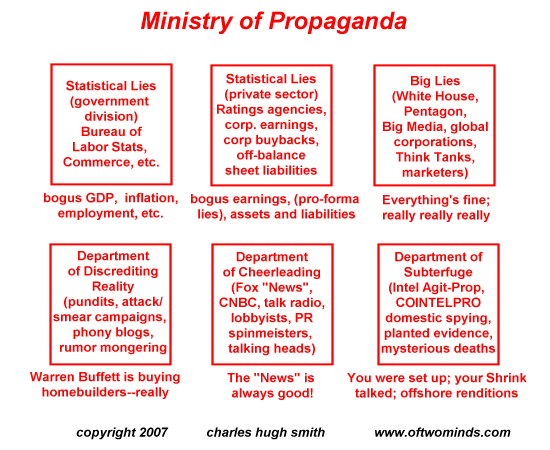
Much like the other operating systems that underpin our daily lives, the core functions of the MoP don’t change much. My chart from 2007 remains an instructive summary of MoP operations, with the only changes being Mr. Buffett is now buying oil companies and social media corporations are now major media players.

The core mission of the Ministry of Propaganda isn’t just to push a desirable narrative–it’s to mystify the underlying dynamics of a system that benefits the few at the expense of the many by promoting a self-serving worldview (weltanschauung) that explains how the world works in a way that protects the interests of those in power.

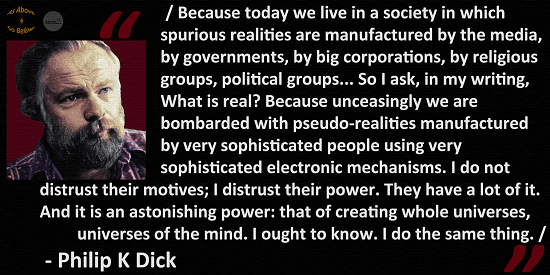
As science fiction author Philip K. Dick explains in the quote below, the MoP narrative isn’t just a cloak thrown over the underlying dynamics, it’s the creation of an entire universe / worldview, including contexts for understanding what’s going on, establishing what’s valuable and what isn’t, and what behaviors enhance status and which ones marginalize us.

The Ministry of Propaganda isn’t monolithic: various factions compete to push their self-serving narratives. As Dick noted, this includes governments, corporations, religious and political groups, each of which understands that once the populace accepts their worldview, their power is cemented in realms far above mere force.

A key mechanism in establishing a dominant worldview is the think-tank or equivalent self-serving body claiming authority over what’s true / false and important / unimportant. This can be authority over the “correct” interpretation of spiritual texts, economic policies, healthcare “standards of care,” geopolitical goals, etc.

Since humans are innately social, status-striving beings, hierarchies of authority and power are the air we breathe. Those who establish themselves as authorities don’t just gain power, they cement their power on the basis of their authority rather than on loyalty or competence.

The enormous powers of social media and traditional media to promote claims of authority have generated a deranging snarl of conflicting agendas and narratives. Various centers of power collaborate on pushing worldviews that benefit their interests, but this isn’t entirely coherent. The one thing all participants in the Ministry of Propaganda agree on is our power is deserved and must be defended against all threats, which includes hostile entities inside and outside the national borders.

This fragmented, constantly shifting cacophony of competing authorities is destabilizing. As the tectonic plates of worldviews collide, the edges crumble and people naturally seek the safety of some core set of beliefs, in effect “circling the wagons” in an attempt to restore some internal stability.

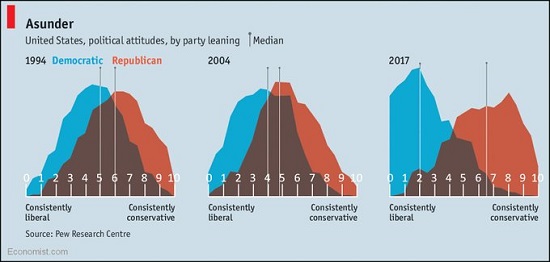
We see this in the intense political polarization of this era (see chart below). To make sense of the competing claims of authority, we reduce the perimeter of what’s defendable, putting more of the world into “outside enemies” (them) and reserving the “safe, trusted place” for fewer of “us.”

With so many competing factions in the Ministry of Propaganda, there’s a proliferation of propaganda such that there is literally nothing left but PR. In a universe constructed of nothing but agit-prop and PR, we all have our favorites examples. James Bond picks up his Nokia phone. Even though nobody’s seen a Nokia phone in ages, if you want to be cool like Bond, go buy a Nokia phone.

Marketing is the MoP’s entire universe. Everybody’s selling something to gain or maintain power, status, mindshare or the ultimate prize, the dominant worldview.

To ease the confusion, please download the latest updates from the Ministry. These updates replace all that misinformation, misdirection, and blatant marketing with the, ahem, facts, or the correct interpretation of the facts. (We had to destroy the village in order to save it. OK, got it.)

While it’s fun to sort all the propaganda into various boxes, we would do well to look for what all the marketers / MoP players seek to mystify. In my analysis, what must be mystified at all costs boils down to the unsustainability of 1) the current consumption of resources, 2) the current method of creating capital so the few can buy up the planet’s most valuable assets, 3) neocolonialism, the modern replacement for the old model of occupation and exploitation by force, and 4) neofeudalism, the economic / social /political arrangement in which the majority of the populace are modern-day serfs with extremely limited agency and power which they are told is limitless.

“You can be anything you choose to be!” Or at least your digital avatar can do so, and that’s practically as good as actually having agency and power in the real world. Or so we’re told, mindlessly, endlessly without pause or respite.

More on these topics in the coming weeks.

An Engineered Food and Poverty Crisis to Secure Continued US Dominance 

By Colin Todhunter

Source: Dissident Voice

In March 2022, UN Secretary-General Antonio Guterres warned of a “hurricane of hunger and a meltdown of the global food system” in the wake of the crisis in Ukraine.

Guterres said food, fuel and fertiliser prices were skyrocketing with supply chains being disrupted and added this is hitting the poorest the hardest and planting the seeds for political instability and unrest around the globe.

According to the International Panel of Experts on Sustainable Food Systems, there is currently sufficient food and no risk of global food supply shortages.

We see an abundance of food but skyrocketing prices. The issue is not food shortage but speculation on food commodities and the manipulation of an inherently flawed global food system that serves the interests of corporate agribusiness traders and suppliers of inputs at the expense of people’s needs and genuine food security.

The war in Ukraine is a geopolitical trade and energy conflict. It is largely about the US engaging in a proxy war against Russia and Europe by attempting to separate Europe from Russia and imposing sanctions on Russia to harm Europe and make it further dependent on the US.

Economist Professor Michael Hudson recently stated that ultimately the war is against Europe and Germany. The purpose of the sanctions is to prevent Europe and other allies from increasing their trade and investment with Russia and China.

Neoliberal policies since the 1980s have hollowed out the US economy. With its productive base severely weakened, the only way for the US to maintain hegemony is to undermine China and Russia and weaken Europe.

Hudson says that, beginning a year ago, Biden and the US neocons attempted to block Nord Stream 2 and all (energy) trade with Russia so that the US could monopolise it itself.

Despite the ‘green agenda’ currently being pushed, the US still relies on fossil fuel-based energy to project its power abroad. Even as Russia and China move away from the dollar, the control and pricing of oil and gas (and resulting debt) in dollars remains key to US attempts to retain hegemony.

The US knew beforehand how sanctions on Russia would play out. They would serve to divide the world into two blocks and fuel a new cold war with the US and Europe on one side with China and Russia being the two main countries on the other.

US policy makers knew Europe would be devastated by higher energy and food prices and food importing countries in the Global South would suffer due to rising costs.

It is not the first time the US has engineered a major crisis to maintain global hegemony and a spike in key commodity prices that effectively trap countries into dependency and debt.

In 2009, Andrew Gavin Marshall described how in 1973 – not long after coming off the gold standard – Henry Kissinger was integral to manipulating events in the Middle East (the Arab-Israeli war and the ‘energy crisis’). This served to continue global hegemony for the US, which had virtually bankrupted itself due to its war in Vietnam and had been threatened by the economic rise of Germany and Japan.

Kissinger helped secure huge OPEC oil price rises and thus sufficient profits for Anglo-American oil companies that had over-leveraged themselves in North Sea oil. He also cemented the petrodollar system with the Saudis and subsequently placed African nations, which had embarked on a path of (oil-based) industrialisation, on a treadmill of dependency and debt due to the spike in oil prices.

It is widely believed that the high-priced oil policy was aimed at hurting Europe, Japan and the developing world.

Today, the US is again waging a war on vast swathes of humanity, whose impoverishment is intended to ensure they remain dependent on the US and the financial institutions it uses to create dependency and indebtedness – the World Bank and IMF.

Hundreds of millions will experience (are experiencing) poverty and hunger due to US policy. These people (the ones that the US and Pfizer et al supposedly cared so much about and wanted to get a jab into each of their arms) are regarded with contempt and collateral damage in the great geopolitical game.

Contrary to what many believe, the US has not miscalculated the outcome of the sanctions placed on Russia. Michael Hudson notes energy prices are increasing, benefiting US oil companies and US balance of payments as an energy exporter. Moreover, by sanctioning Russia, the aim is to curtail Russian exports (of wheat and gas used for fertiliser production) and for agricultural commodity prices to therefore increase. This too will also benefit the US as an agricultural exporter.

This is how the US seeks to maintain dominance over other countries.

Current policies are designed to create a food and debt crisis for poorer nations especially. The US can use this debt crisis to force countries to continue privatising and selling off their public assets in order to service the debts to pay for the higher oil and food imports.

This imperialist strategy comes on the back of ‘COVID relief’ loans which have served a similar purpose. In 2021, an Oxfam review of IMF COVID-19 loans showed that 33 African countries were encouraged to pursue austerity policies. The world’s poorest countries are due to pay $43 billion in debt repayments in 2022, which could otherwise cover the costs of their food imports.

Oxfam and Development Finance International have also revealed that 43 out of 55 African Union member states face public expenditure cuts totalling $183 billion over the next five years.

The closure of the world economy in March 2020 (‘lockdown’) served to trigger an unprecedented process of global indebtedness. Conditionalities mean national governments will have to capitulate to the demands of Western financial institutions. These debts are largely dollar-denominated, helping to strengthen the US dollar and US leverage over countries.

The US is creating a new world order and needs to ensure much of the Global South remains in its orbit of influence rather than ending up in the Russian and especially Chinese camp and its belt road initiative for economic prosperity.

Post-COVID, this is what the war in Ukraine, sanctions on Russia and the engineered food and energy crisis are really about.

Back in 2014, Michael Hudson stated that the US has been able to dominate most of the Global South through agriculture and control of the food supply. The World Bank’s geopolitical lending strategy has transformed countries into food deficit areas by convincing them to grow cash crops – plantation export crops – not to feed themselves with their own food crops.

The oil sector and agribusiness have been joined at the hip as part of US geopolitical strategy.

The dominant notion of ‘food security’ promoted by global agribusiness players like Cargill, Archer Daniel Midland, Bunge and Louis Dreyfus and supported by the World Bank is based on the ability of people and nations to purchase food. It has nothing to do with self-sufficiency and everything to do with global markets and supply chains controlled by giant agribusiness players.

Along with oil, the control of global agriculture has been a linchpin of US geopolitical strategy for many decades. The Green Revolution was exported courtesy of oil-rich interests and poorer nations adopted agri-capital’s chemical- and oil-dependent model of agriculture that required loans for inputs and related infrastructure development.

It entailed trapping nations into a globalised food system that relies on export commodity mono-cropping to earn foreign exchange linked to sovereign dollar-denominated debt repayment and World Bank/IMF ‘structural adjustment’ directives. What we have seen has been the transformation of many countries from food self-sufficiency into food deficit areas.

And what we have also seen is countries being placed on commodity crop production treadmills. The need for foreign currency (US dollars) to buy oil and food entrenches the need to increase cash crop production for exports.

The World Trade Organization’s Agreement on Agriculture (AoA) set out the trade regime necessary for this type of corporate dependency that masquerades as ‘global food security’.

This is explained in a July 2022 report by Navdanya International – Sowing Hunger, Reaping Profits – A Food Crisis by Design – which notes international trade laws and trade liberalisation has benefited large agribusiness and continue to piggyback off the implementation of the Green Revolution.

The report states that US lobby and trade negotiations were headed by former Cargill Investors Service CEO and Goldman Sachs executive – Dan Amstutz – who in 1988 was appointed chief negotiator for the Uruguay round of GATT by Ronald Reagan. This helped to enshrine the interests of US agribusiness into the new rules that would govern the global trade of commodities and subsequent waves of industrial agriculture expansion.

The AoA removed protection of farmers from global market prices and fluctuations. At the same time, exceptions were made for the US and the EU to continue subsidising their agriculture to the advantage of large agribusiness.

Navdanya notes:

With the removal of state tariff protections and subsidies, small farmers were left destitute. The result has been a disparity in what farmers earn for what they produce, versus what consumers pay, with farmers earning less and consumers paying more as agribusiness middlemen take the biggest cut.

‘Food security’ has led to the dismantling of food sovereignty and food self-sufficiency for the sake of global market integration and corporate power.

We need look no further than India to see this in action. The now repealed recent farm legislation in India was aimed at giving the country the ‘shock therapy’ of neoliberalism that other countries have experienced.

The ‘liberalising’ legislation was in part aimed at benefiting US agribusiness interests and trapping India into food insecurity by compelling the country to eradicate its food buffer stocks – so vital to the nation’s food security – and then bid for food on a volatile global market from agribusiness traders with its foreign reserves.

The Indian government was only prevented from following this route by the massive, year-long farmer protest that occurred.

The current crisis is also being fuelled by speculation. Navdanya cites an investigation by Lighthouse Reports and The Wire to show how speculation by investment firms, banks and hedge funds on agricultural commodities are profiting off rising food prices. Commodity future prices are no longer linked to actual supply and demand in the market but are based purely on speculation.

Archer Daniels Midland, Bunge, Cargill and Louis Dreyfus and investment funds like Black Rock and Vanguard continue to make huge financial killings, resulting in the price of bread almost doubling in some poorer countries.

The cynical ‘solution’ promoted by global agribusiness to the current food crisis is to urge farmers to produce more and seek better yields as if the crisis is that of underproduction. It means more chemical inputs, more genetic engineering techniques and suchlike, placing more farmers in debt and trapped in dependency.

It is the same old industry lie that the world will starve without its products and requires more of them. The reality is that the world is facing hunger and rising food prices because of the system big agribusiness has instituted.

And it is the same old story – pushing out new technologies in search of a problem and then using crises as justification for their rollout while ignoring the underlying reasons for such crises.

Navdanya sets out possible solutions to the current situation based on principles of agroecology, short supply lines, food sovereignty and economic democracy – policies that have been described at length in many articles and official reports over the years.

As for fighting back against the onslaught on ordinary people’s living standards, support is gathering among the labour movement in places like the UK. Rail union leader Mick Lynch is calling for a working class movement based on solidarity and class consciousness to fight back against a billionaire class that is acutely aware of its own class interests.

For too long, ‘class’ has been absent from mainstream political discourse. It is only through organised, united protest that ordinary people will have any chance of meaningful impact against the new world order of tyrannical authoritarianism and the devastating attacks on ordinary people’s rights, livelihoods and standards of living that we are witnessing.

What Will You Say When Millions Of People Starve To Death?

By Michael Snyder

Source: End of the American Dream

For a long time, those of us that were claiming that a global famine was coming were widely mocked.  The skeptics could see the exact same trends that everyone else could see, but they just assumed that we would find a way to muddle through somehow.  So they didn’t want to listen to common sense, and they weren’t interested in warnings from “gloom and doomers” such as myself.  But I don’t consider myself to be a “doom and gloomer” because I am actually a very optimistic person.  I am so excited to be living during this time in human history, but I also know that very difficult times are ahead of us.  One of the major trends that I keep writing about over and over is famine, because the truth is that there simply is not going to be enough food for everyone on the planet in 2023 and beyond.  Of course the mainstream media is also starting to issue similar warnings.  For example, the following comes from a Yahoo News article entitled “Millions in East Africa face starvation due to drought”

The World Health Organization warned on Wednesday that millions of people in East Africa face the threat of starvation. Speaking at a media briefing in Geneva, WHO Director-General Tedros Adhanom Ghebreyesus said that drought, climate change, rising prices and an ongoing civil war in northern Ethiopia are all contributing to worsening food insecurity.

Over 50 million people in East Africa will face acute food insecurity this year, a study from late July by the World Food Programme and Food and Agriculture Organization found. Roughly 7 million children are suffering from malnourishment and, according to the United Nations High Commissioner for Refugees, hundreds of thousands are leaving their homes in search of food or livelihoods. Affected countries include Djibouti, Ethiopia, Kenya, Somalia, South Sudan, Sudan and Uganda.

In Somalia, authorities are projecting that vegetable and grain production will “drop by about 80% this year” due to the endless drought that they are currently experiencing.

Millions of precious people in Africa are facing imminent starvation.  But most of us in the western world don’t care, because our grocery stores are still full of food.

If you are one of those people that are choosing to ignore what is happening on the other side of the planet, you can afford to be cocky for now.

But conditions are starting to change here too.

Earlier today, I came across an excellent article about how the multi-year megadrought in the western half of the country is absolutely devastating the ranching industry…

The megadrought in the Western U.S., the region’s worst in 1,200 years, is threatening America’s cattle heartland: withering pastures, wrecking feed harvests and endangering a quintessential way of life.

The drought is forcing ranchers here in Texas and across the Southern plains to make an agonizing decision: Sell early now for less money than they planned on — or hold on, pray for rain and risk losing everything.

Sadly, more ranchers are deciding to sell off cattle with each passing day.

If you can believe it, the rate at which cattle are being sold is now 120 percent above last year’s level…

Over the last two weeks of July, the national cattle sale rate also jumped to 120 percent above 2021 levels — an average that reporting by The Hill and KAMR suggested conceals even higher frenzies of sales in some markets.

What this means is that lots of beef is coming on to the market.

Beef prices had been soaring, but in the short-term all of the cattle that are being slaughtered will help to moderate prices.

However, the outlook for 2023 is grim.  The national cattle herd just keeps getting smaller and smaller, and some beef producers in Oklahoma are now predicting that ground beef “could eventually top $50 per pound”

Thanks to the unending economic symptoms of the pandemic and 2022’s inflation double-punch, average beef prices are currently about twice what they were in 2019. Add in the deepening widespread drought, a shortage of hay and feed, skyrocketing prices, transport costs, and various other metrics, some Southwest Oklahoma beef producers suggest cheap ground beef could eventually top $50 per pound.

If the price of ground beef does reach 50 dollars a pound, what do you think our country will look like?

Needless to say, at that point there will be absolutely no debate about whether we are in a global food crisis or not.

And we are also being told that we could soon be facing shortages of potatoes and tomatoes.  The following comes from Zero Hedge

Days ago, we said the next food insecurity problem that may impact Americans’ eating habits could be an emerging potato shortage. Now there appears to be another issue: Tomatoes are getting squeezed, and risks of a ketchup shortage rise as a severe drought batter California’s farmland.

California accounts for a quarter of the world’s tomato output. The worst drought in 1,200 years has forced farmers to abandon fields as crops turn to dust amid a water crisis.

I recently wrote an entire article about the coming tomato shortage that you can find right here.  Unless some rain comes along, the tomato crop in California this year is going to be absolutely disastrous.

So are you ready to eat less pizza because there isn’t enough pizza sauce to go around?

And are you ready to pay twice as much for spaghetti sauce at the grocery store?

On top of everything else, we are also potentially facing an extremely painful shortage of cotton

Intense drought has forced cotton farmers to abandon millions of acres that have produced so little cotton that they are no longer worth harvesting, the Wall Street Journal reported Tuesday.

Farmers will harvest an estimated 7.13 million acres, abandoning approximately 5.35 million acres due to an ongoing drought hammering southern U.S. states, representing an estimated abandonment rate of 42.87%, according to the National Cotton Council of America, who based their analysis on U.S. Department of Agriculture (USDA) data. This represents the smallest harvest by area since 1868, The Wall Street Journal reported.

What I have touched on in this article is just the tip of the iceberg.

Agricultural production is going to be way down all over the planet this year.

But we will surely find a way to “muddle through” somehow, right?

If you have been a skeptic of reports of shortages and famine, it is time to wake up.

We really are staring an unprecedented global crisis right in the face, and the months ahead are going to be filled with pain.