The Art of Doublespeak: Bellingcat and Mind Control

By Edward Curtin

Source: Behind the Curtain

In the 1920s, the influential American intellectual Walter Lippman argued that the average person was incapable of seeing or understanding the world clearly and needed to be guided by experts behind the social curtain.  In a number of books he laid out the theoretical foundations for the practical work of Edward Bernays, who developed “public relations” (aka propaganda) to carry out this task for the ruling elites.  Bernays had honed his skills while working as a propagandist for the United States during World War I, and after the war he set himself up as a public relations counselor in New York City.

There is a fascinating exchange at the beginning of Adam Curtis’s documentary, The Century of Self, where Bernays, then nearly 100 years old but still very sharp, reveals his manipulative mindset and that of so many of those who have followed in his wake.  He says the reason he couldn’t call his new business “propaganda” was because the Germans had given propaganda a “bad name,” and so he came up with the euphemism “public relations.”  He then adds that “if you could use it [i.e. propaganda] for war, you certainly could use it for peace.”  Of course, he never used PR for peace but just to manipulate public opinion (he helped engineer the CIA coup against the democratically elected Arbenz government in Guatemala in 1954 with fake news broadcasts).  He says “the Germans gave propaganda a bad name,” not Bernays and the United States with their vast campaign of lies, mainly aimed at the American people to get their support for going to a war they opposed (think weapons of mass destruction).  He sounds proud of his war propaganda work that resounded to his credit since it led to support for the “war to end all wars” and subsequently to a hit movie about WWI, Yankee Doodle Dandy, made in 1942 to promote another war, since the first one somehow didn’t achieve its lofty goal.

As Bernays has said in his book Propaganda,

The American motion picture is the greatest unconscious carrier of propaganda in the world today.

He was a propagandist to the end.  I suspect most viewers of the film are taken in by these softly spoken words of an old man sipping a glass of wine at a dinner table with a woman who is asking him questions. I have shown this film to hundreds of students and none has noticed his legerdemain.  It is an example of the sort of hocus-pocus I will be getting to shortly, the sly insertion into seemingly liberal or matter-of-fact commentary of statements that imply a different story.  The placement of convincing or confusing disingenuous ingredients into a truth sandwich – for Bernays knew that the bread of truth is essential to conceal untruth.

In the following years, Bernays, Lippman, and their ilk were joined by social “scientists,” psychologists, and sundry others intent on making a sham out of the idea of democracy by developing strategies and techniques for the engineering of social consensus consonant with the wishes of the ruling classes.  Their techniques of propaganda developed exponentially with the development of technology, the creation of the CIA, its infiltration of all the major media, and that agency’s courting of what the CIA official Cord Meyer called in the 1950s “the compatible left,” having already had the right in its pocket. Today most people are, as is said, “wired,” and they get their information from the electronic media that is mostly controlled by giant corporations in cahoots with government propagandists.  Ask yourself: Has the power of the oligarchic, permanent warfare state with its propaganda and spy networks increased or decreased over your lifetime. The answer is obvious: the average people that Lippman and Bernays trashed are losing and the ruling elites are winning.

This is not just because powerful propagandists are good at controlling so-called “average” people’s thinking, but, perhaps more importantly, because they are also adept – probably more so – at confusing or directing the thinking of those who consider themselves above average, those who still might read a book or two or have the concentration to read multiple articles that offer different perspectives on a topic.  This is what some call the professional and intellectual classes, perhaps 15-20 % of the population, most of whom are not the ruling elites but their employees and sometimes their mouthpieces.  It is this segment of the population that considers itself “informed,” but the information they imbibe is often sprinkled with bits of misdirection, both intentional and not, that beclouds their understanding of important public matters but leaves them with the false impression that they are in the know.

Recently I have noticed a group of interconnected examples of how this group of the population that exerts influence incommensurate with their numbers has contributed to the blurring of lines between fact and fiction. Within this group there are opinion makers who are often journalists, writers, and cultural producers of some sort or other, and then the larger number of the intellectual or schooled class who follow their opinions.  This second group then passes on their received opinions to those who look up to them.

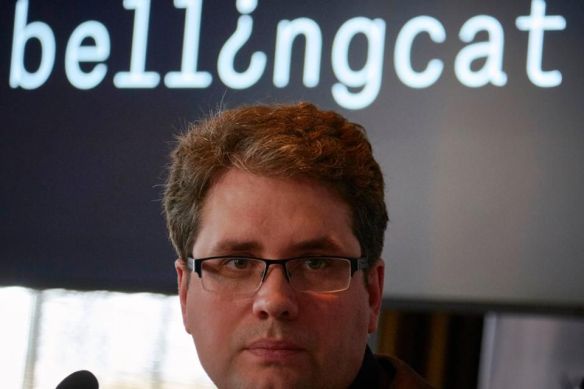
There is a notorious propaganda outfit called Bellingcat, started by an unemployed Englishman named Eliot Higgins, that has been funded by The Atlantic Council, a think-tank with deep ties to the U.S. government, NATO, war manufacturers, and their allies, and the National Endowment for Democracy (NED), another infamous U.S. front organization heavily involved in so-called color revolution regime change operations all around the world, that has just won the International Emmy Award for best documentary. The film with the Orwellian title, Bellingcat: Truth in a Post-Truth World, received its Emmy at a recent ceremony in New York City.  Bellingcat is an alleged group of amateur on-line researchers who have spent years shilling for the U.S. instigated war against the Syrian government, blaming the Douma chemical attack and others on the Assad government, and for the anti-Russian propaganda connected to, among other things, the Skripal poisoning case in England, and the downing of flight MH17 plane in Ukraine. It has been lauded by the corporate mainstream media in the west.  Its support for the equally fraudulent White Helmets (also funded by the US and the UK) in Syria has also been praised by the western corporate media while being dissected as propaganda by many excellent independent journalists such as Eva Bartlett, Vanessa Beeley, Catte Black, among others.  It’s had its work skewered by the likes of Seymour Hersh and MIT professor Theodore Postol, and its US government connections pointed out by many others, including Ben Norton and Max Blumenthal at The Gray Zone. And now we have the mainstream media’s wall of silence on the leaks from the Organization for the Prohibition on Chemical Weapons (OPCW) concerning the Douma chemical attack and the doctoring of their report that led to the illegal U.S. bombing of Syria in the spring of 2018.  Bellingcat was at the forefront of providing justification for such bombing, and now the journalists Peter Hitchens, Tareq Harrad (who recently resigned from Newsweek after accusing the publication of suppressing his revelations about the OPCW scandal) and others are fighting an uphill battle to get the truth out.

Yet Bellingcat: Truth in a Post-Truth World won the Emmy, fulfilling Bernays’ point about films being the greatest unconscious carriers of propaganda in the world today.

Who presented the Emmy Award to the film makers, but none other than the rebel journalist Chris Hedges.  Why he did so, I don’t know.  But that he did so clearly sends a message to those who follow his work and trust him that it’s okay to give a major cultural award to a propaganda outfit.  But then, perhaps he doesn’t consider Bellingcat to be that.

Nor, one presumes, does The Intercept, the billionaire Pierre Omidyar owned publication associated with Glen Greenwald and Jeremy Scahill, and also read by many progressive-minded people. The Intercept that earlier this year disbanded the small team that was tasked with reviewing and releasing more of the massive trove of documents they received from Edward Snowden six years ago, a minute number of which have ever been released or probably ever will be. As Whitney Webb pointed out, last year The Intercept  hosted a workshop for Bellingcat.  She wrote:

The Intercept, along with its parent company First Look Media, recently hosted a workshop for pro-war, Google-funded organization Bellingcat in New York. The workshop, which cost $2,500 per person to attend and lasted five days, aimed to instruct participants in how to perform investigations using “open source” tools — with Bellingcat’s past, controversial investigations for use as case studies…Thus, while The Intercept has long publicly promoted itself as an anti-interventionist and progressive media outlet, it is becoming clearer that – largely thanks to its ties to Omidyar – it is increasingly an organization that has more in common with Bellingcat, a group that launders NATO and U.S. propaganda and disguises it as “independent” and “investigative journalism.”

Then we have Jefferson Morley, the editor of The Deep State, former Washington Post journalist, and JFK assassination researcher, who has written a praiseworthy review of the Bellingcat film and who supports Bellingcat.  “In my experience, Bellingcat is credible,” he writes in an Alternet article, “Bellingcat documentary has the pace and plot of a thriller.”

Morley has also just written an article for Counterpunch“Why the Douma Chemical Attack Wasn’t a ‘Managed Massacre’” – in which he disputes the claim that the April 7, 2018 attack in the Damascus suburb was a false flag operation carried out by Assad’s opponents. “I do not see any evidence proving that Douma was a false flag incident,” he writes in this article that is written in a style that leaves one guessing as to what exactly he is saying.  It sounds convincing unless one concentrates, and then his double messages emerge.  Yet it is the kind of article that certain “sophisticated” left-wing readers might read and feel is insightful.  But then Morley, who has written considerably about the CIA, edits a website that advertises itself as “the thinking person’s portal to the world of secret government,” and recently had an exchange with former CIA Director John Brennan where “Brennan put a friendly finger on my chest,” said in February 2017, less than a month after Trump was sworn in as president, that:

With a docile Republican majority in Congress and a demoralized Democratic Party in opposition, the leaders of the Deep State are the most—perhaps the only—credible check in Washington on what Senator Bob Corker (R-Tenn.) calls Trump’s “wrecking ball presidency.”  

Is it any wonder that some people might be a bit confused?

“I know what you’re thinking about,” said Tweedledum; “but it isn’t so, nohow.”

“Contrariwise,” continued Tweedledee, “if it was so, it might be; and if it were so, it would be; but as it isn’t, it ain’t.  That’s logic.”

As a final case in point, there is a recent book by Stephen Kinzer, Poisoner in Chief: Sidney Gottlieb And The CIA Search For Mind Control, the story of the chemist known as Dr. Death who ran the CIA’s MK-ULTRA mind control project, using LSD, torture, electric shock therapy, hypnosis, etc.; developed sadistic methods of torture still used in black sites around the world; and invented various ingenious techniques for assassination, many of which were aimed at Fidel Castro.  Gottlieb was responsible for brutal prison and hospital experiments and untold death and suffering inflicted on all sorts of innocent people.  His work was depraved in the deepest sense; he worked with Nazis who experimented on Jews despite being Jewish himself.

Kinzer writes in depth about this man who considered himself a patriot and a spiritual person – a humane torturer and killer.  It is an eye-opening book for anyone who does not know about Gottlieb, who gave the CIA the essential tools they use in their “organized crime” activities around the world – in the words of Douglass Valentine, the author of The CIA as Organized Crime and The Phoenix Program. Kinzer’s book is good history on Gottlieb; however, he doesn’t venture into the present activities of the CIA and Gottlieb’s patriotic followers, who no doubt exist and go about their business in secret.

After recounting in detail the sordid history of Gottlieb’s secret work that is nauseating to read about, Kinzer leaves the reader with these strange words:

Gottlieb was not a sadist, but he might well have been…. Above all he was an instrument of history.  Understanding him is a deeply disturbing way of understanding ourselves.

What possibly could this mean?  Not a sadist?  An instrument of history?  Understanding ourselves?  These few sentences, dropped out of nowhere, pull the rug out from under what is generally an illuminating history and what seems like a moral indictment. This language is pure mystification.

Kinzer also concludes that because Gottlieb said so, the CIA failed in their efforts to develop methods of mind control and ended MK-ULTRA’s experiments long ago. Why would he believe the word of a man who personified the agency he worked for: a secret liar? He writes,

When Sydney Gottlieb brough MK-ULTRA to its end in the early 1960s, he told his CIA superiors that he had found no reliable way to wipe away memory, make people abandon their consciences, or commit crimes and then forget them.

As for those who might think otherwise, Kinzer suggests they have vivid imaginations and are caught up in conspiracy thinking: “This [convincing others that the CIA had developed methods of mind control when they hadn’t] is Sydney Gottlieb’s most unexpected legacy,” he asserts. He says this although Richard Helms, the CIA Director, destroyed all MK-Ultra records. He says that Allen Dulles, Gottlieb, and Helms themselves were caught up in a complete fantasy about mind control because they had seen too many movies and read too many books; mind control was impossible, a failure, a myth, he maintains. It is the stuff of popular culture, entertainment. In an interview with Chris Hedges, interestingly posted by Jefferson Morley at his website, The Deep State, Hedges agrees with Kinzer.  Gottlieb, Dulles, et al. were all deluded.  Mind control was impossible.  You couldn’t create a Manchurian Candidate; by implication, someone like Sirhan Sirhan could not have been programmed to be a fake Manchurian Candidate and to have no memory of what he did, as he claims.  He could not have been mind-controlled by the CIA to perform his part as the seeming assassin of Senator Robert Kennedy while the real killer shot RFK from behind. People who think like this should get real.

Furthermore, as is so common in books such as Kinzer’s, he repeats the canard that JFK and RFK knew about and pressured the CIA to assassinate Fidel Castro. This is demonstrably false, as shown by the Church Committee and the Assassinations Record Review Board, among many others. That Kinzer takes the word of notorious liars like Richard Helms and the top-level CIA operative Samuel Halpern is simple incredible, something that is hard to consider a mistake.  Slipped into a truth sandwich, it is devoured and passed on. But it is false. Bullshit meant to deceive.

But this is how these games are played. If you look carefully, you will see them widely.  Inform, enlighten, while throwing in doubletalk and untruths.  The small number of people who read such books and articles will come away knowing some history that has no current relevance and being misinformed on other history that does. They will then be in the know, ready to pass their “wisdom” on to those who care to listen. They will not think they are average.

But they will be mind controlled, and the killer cat will roam freely without a bell, ready to devour the unsuspecting mice.

The Year of Manufactured Hysteria

By CJ Hopkins

Source: Consent Factory, Inc.

Well, it looks like we’ve somehow managed to survive another year of diabolical Putin-Nazi attacks on democracy. It was touch-and-go there for a while, especially coming down the home stretch, what with Jeremy Corbyn’s desperate attempt to overthrow the UK government, construct a British version of Auschwitz, and start rounding up and mass-murdering the Jews.

That was certainly pretty scary … but then, the whole year was pretty scary.

The horror began promptly in early January, when Rachel Maddow revealed that Putin was projecting words out of Trump’s mouth in real-time, i.e., literally using Trump’s head like a puppet, or one of those Mission Impossible masks. And that was just the tip of the iceberg, as, despite the best efforts of Integrity InitiativeBellingcat, and other such establishment psyops, Internet-censoring sites like NewsGuard, and an army of mass hysteria generators, Putin’s legion of Russian “influencers” was continuing to maliciously influence Americans, who were probably also still under attack by brain-eating Russian-Cubano crickets!

While Resistance members were still wrapping their heads in anti-cricket aluminum foil, Putin (i.e., Russian Hitler) ordered Trump (i.e., Russian-asset Hitler) to launch a coup in Venezuela (i.e., Russian Hitler’s South American ally), probably to distract us from “Smirkboy Hitler” and his acne-faced gang of MAGA cap-wearing Catholic high-school Hitler Youth, who were trying to invade and Hitlerize the capital. Or maybe the coup was meant to distract us from the un-American activities of Bernie Sanders, who had also been deemed a Russian asset, or a devious “Kremlin-Trump operation,” or was working with Tulsi Gabbard to build an army of blood-drinking Hindu nationalists, genocidal Assadists, and American fascists to help the Iranians (and the Russians, of course, and presumably also Jeremy Corbyn) frontally assault the State of Israel and drive the Jews into the sea.

As if all that wasn’t horrifying enough (and ridiculous and confusing enough), by early Spring there was mounting evidence that Putin had somehow gotten to Mueller, possibly with one of those FSB pee-tapes, and was sabotaging the “Russiagate” coup the Intelligence Community, the Democratic Party, the corporate media, and the rest of the Resistance had been methodically preparing since 2016. Liberals’ anuses began puckering and unpuckering as it gradually became clear that the “Mueller Report” was not going to prove that Donald Trump had colluded with Putin and Julian Assange to steal the presidency from Hillary Clinton and transform the United States of America into a genocidal Putin-Nazi Reich.

Meanwhile, the anti-Semitism pandemic that had mysteriously erupted in 2016 (i.e., right around the time Trump won the nomination) was raging unchecked throughout the West. Jews in Great Britain were on the brink of panic because approximately 0.08 percent of Labour Party members were anti-Semitic, as opposed to the rest of the British public, who have never shown any signs of anti-Semitism (or any other kind of racism or bigotry), and are practically a nation of Shabbos goys. Clearly, Corbyn had turned the party into his personal neo-Nazi death cult and was planning to carry out a second Holocaust just as soon as he renationalized the British railways!

And it wasn’t just the United Kingdom. According to corporate media virologists, idiopathic anti-Semitism was breaking out everywhere. In France, the “Yellow Vests” were also anti-Semites. In the U.S.A., Jews were facing “a perfect storm of anti-Semitism,” some of it stemming from the neo-fascist fringe (which has been a part of the American landscape forever, but which the corporate media has elevated into an international Nazi movement), but much of it whipped up by Ilhan Omar, who had apparently entered into a “Red-Brown” pact with Richard Spencer, or Gavin McInnes, or some other formerly insignificant idiot.

Things got very confusing for a while, as Republicans united with Democrats to denounce Ilhan Omar as an anti-Semite (and possibly a full-fledged Islamic terrorist) and to condemn the existence of “hate,” or whatever. The corporate media, Facebook, and Twitter were suddenly swarming with hordes of angry anti-Semites accusing other anti-Semites of anti-Semitism. Meghan McCain couldn’t take it anymore, and she broke down on the Joy Behar Show and begged to be converted to Judaism, or Zionism, right there on the air. This unseemly display of anti-anti-Semitism was savagely skewered by Eli Valley, an “anti-Semitic” Jewish cartoonist, according to McCain and other morons.

Then it happened … perhaps the loudest popcorn fart in political history. The Mueller Report was finally delivered. And just like that, Russiagate was over. After three long years of manufactured mass hysteria, corporate media propaganda, books, T-shirts, marches, etc., Robert Mueller had come up with squat. Zip. Zero. Nichts. Nada. No collusion. No pee-tape. No secret servers. No Russian contacts. Nothing. Zilch.

Cognitive dissonance gripped the nation. There was beaucoup wailing and gnashing of teeth. Resistance members doubled their anti-depressant dosages and went into mourning. Shell-shocked liberals did their best to pretend they hadn’t been duped, again, by authoritative sources like The Washington PostThe New York TimesThe Guardian, CNN, MSNBC, et al., which had disseminated completely fabricated stories about secret meetings which never took placepower grid hackings that never happenedRussian servers that never existedimaginary Russian propaganda peddlers, and the list goes on, and on, and on … and hadn’t otherwise behaved like a bunch of mindless, shrieking neo-McCarthyites.

Except that Russiagate wasn’t over. It immediately morphed into “Obstructiongate.” As the corporate media spooks explained, Mueller’s investigation of Trump was never about collusion with Russia. No, it was always about Trump obstructing the investigation of the collusion with Russia that the investigation was not about, and that everyone knew had never happened. In other words, Mueller’s investigation was launched in order to investigate the obstruction of his investigation.

Or whatever. It didn’t really matter, because, by this time, Assange had been arrested for treason, or for jumping bail, or for smearing poo all over the walls of the Ecuadorean embassy, and The New York Times was reporting that a veritable “constellation” of social media accounts “linked to Russia and far-right groups” was disseminating extremist “disinformation,” and Putin had unleashed the Russian spywhale, and “Jews were not safe in Germany again,” because the Putin-Nazis had formed an alliance with the Iranian Nazis and the Syrian Nazis, who were backing the Palestinian Nazis that Antifa was fighting on behalf of Israel, and Jews were not safe in the UK either, because of Jeremy Corbyn, who Donald Trump (who, let’s all remember, is literally Hitler) was conspiring with a group of “unnamed Jewish leaders” to prevent from becoming prime minister, and Iran was conspiring with Hezbollah and al Qaeda to amass an arsenal of WMDs to launch at Israel and Saudi Arabia, and other peaceful Middle Eastern democracies, and Trump was finally going to go full-Hitler and declare martial law on the Fourth of July, and he was operating literal “concentration camps” where immigrants were being forced to drink out of toilets, which looked almost exactly the same as the “detention facilities” Obama had operated, except for … well, you know, the “fascism.” So who had time to worry about the corporate media colluding with an attempted Intelligence Community coup?

Then, in August, right on cue, some racist whack job murdered a bunch of people, and so now, as if the mass hysteria hadn’t already been jacked up to the max, America had “a white nationalist terrorist problem,” or was in the throes of a “white nationalist terrorism crisis.” Trump was now officially our “Nihilist-in-Chief,” and “a white supremacist who inspires terrorism” and was basically no different than Anwar al-Awlaki. It was time to take some extraordinary measures along the lines of the Patriot Act, except focused on potential white supremacist terrorists, or anyone the Editorial Board of The New York Times might deem a “threat.”

This sudden outbreak of “Trump-inspired terrorism” and the manufactured “fascism” hysteria that followed got the Resistance through end of the Summer and into the Autumn, which was always when the main event was scheduled to begin. See, these last three years have basically been a warm-up for what is about to happen … the impeachment, sure, but that’s only one part of it.

If you thought the global capitalist ruling classes and the corporate media’s methodical crushing of Jeremy Corbyn was depressing to watch … well, prepare yourself for 2020. The Year of Manufactured Mass Hysteria was not just the Intelligence Community and the corporate media getting their kicks by whipping the public up into an endless series of baseless panics over imaginary Russians and Nazis. It was the final phase of cementing the official “Putin-Nazi” narrative in people’s minds.

For the sake of anyone new to my columns, here’s how the Putin-Nazi narrative works …

The Putin-Nazi narrative has two basic parts, or messages, which are constantly repeated: (1) “Russia is attacking our democracy!; and (2) “fascism is spreading like wildfire!,” both of which parts are essentially fictions. This official Putin-Nazi narrative was introduced in the Summer of 2016, and replaced the official “War on Terrorism” narrative, which had run for fifteen years, and which was just as fictional. It has been methodically reinforced and repeated by the neoliberal establishment, the corporate media (and, more recently, the alternative media, and even by extremely intelligent anarchist anthropologists like David Graeber) for the last three years on a daily basis. At this point it has become our “reality,” just as the War on Terror became our “reality” … as the Cold War had previously been our “reality.”

When I say that this narrative has become our “reality,” I mean that it is now virtually impossible to refute it in any mainstream forum without being dismissed as a “conspiracy theorist,” or an “anti-Semite,” or a “Russian asset.” It has become axiomatic and is taken for granted that we are experiencing an explosion of anti-Semitism, and fascism, and that Russia is out to get us (so axiomatic that someone like Graeber falls into the trap of defending Corbyn by relying on, and thus reifying, the very “fascism” hysteria that was used to destroy him).

Never mind that the entire planet continues to be ruled by global capitalism, transnational corporations, and supra-governmental bodies, and that most of it is occupied by the U.S. military, NATO, and other GloboCap allies, and assorted corporate military contractors. Never mind that Russia isn’t “attacking” anyone, and that the “Nazis” haven’t taken over anything, and that no one is rounding up and murdering the Jews, or the Mexicans, or anyone else for that matter … because when have facts had anything to do with maintaining an official narrative?

The answer, in case you were wondering, is “never.” We are, all of us, living in a fiction. A fiction authored by those in power to serve the interests of those in power. That’s what an official narrative is. It makes no difference whether we believe it or not. It functions as “reality” regardless. If you doubt that … well, just ask Jeremy Corbyn. Or watch as the Labour “anti-Semitism crisis” evaporates into thin air, as the War on Terror did in 2016, once it no longer served a useful purpose.

As for 2020, I’m afraid the manufactured mass hysteria is only going to get worse. The global capitalist ruling classes are determined to snuff out this populist rebellion, and to make sure it never happens again, or at the very least not on this scale. Anyone who gets in the way is going to be branded an “anti-Semite,” or a “fascist,” or a “Russian asset.” Politicians who do not toe the line are going to have their political careers and personal reputations destroyed. (Did you notice how it took less than two days after the crushing of Jeremy Corbyn for the smearing of Sanders as an anti-Semite or “soft on anti-Semitism” to begin?)

Mainstream journalists who dare to question the official Putin-Nazi narrative, even in the most respectful way, are going to come under increasing pressure to tone it down or suffer the consequences. Putin-Nazi paranoia will metastasize. Dissident websites will be deplatformed and demonitized. The Internet will be increasingly monitored for any and all forms of non-conformity. Dissent will be increasingly stigmatized. “Reality” will be increasingly policed. It’s all going to get extremely unpleasant, and that’s assuming that civil war doesn’t break out.

And as for me, I’m just a political satirist with a barely respectable cult-sized following, so they’ll probably let me get away with continuing to cover the whole ugly show (as long as no one starts to take me seriously). I’ll try to find the humor in it, but honestly, just between you and me, what’s coming may not be all that funny.

The Forgotten Past Will Always be Repeated

By Robert Fantina

Source: CounterPunch

“Those who cannot remember the past are condemned to repeat it.” So said George Santayana.

It is difficult today to look at many, many situations in the world and not see some of the worst events in history being repeated, especially as they relate to racism and genocide. Has the world forgotten Nazi atrocities against Jews, Gypsies, intellectuals and others? Do we not remember the horrific U.S. bombing of two Japanese cities? Are Churchill’s colonial atrocities no longer worth considering?

We will review some of the most egregious events unfolding in front of us today.

Israel: This racist, apartheid state, which, for over 70 years has brutally oppressed the Palestinian people, this year declared itself the nation-state of the Jewish people, and only the Jewish people. Yet 25% of people who live within the borders of the Zionist entity are not Jewish. And despite marginalizing fully one-quarter of its residents, and relegating them to second-class citizen status, government spokespeople have the nerve to proclaim Israel as a democracy.

And what international outrage does this bring? Despite flagrant and constant violations of international law, not to mention common human decency, most of the countries of the world either ignore it all, or issue gentle rebukes, at best. And the world’s media seldom reports on it.

Myanmar: For several years now, the repression and expulsion of the Rohingya people has been ongoing government policy. A United Nations study of August 2018 found evidence of widespread violations of human rights. As of that date, nearly three-quarters of a million Rohingya people have had to flee their homeland due to the brutal persecution they have experienced. The U.N. study stated that military abuses of the Rohingyas “undoubtedly amount to the gravest crimes under international law.” Yet, like Israel’s brutal oppression of the Palestinians, this gets little press in North America.

India: Earlier this year, the government of India revoked Article 370 in the constitution that allowed occupied Kashmir some limited autonomy. Since that time, tens of thousands of Indian troops have stormed into Kashmir, communications with the outside world have been cut, and news media personal are forbidden from entering. The death toll from this recent repression is unknown. Government officials have publicly announced plans to colonize Kashmir using the same model of land confiscation and illegal settlement construction that Israel has used for decades against Palestine. Again, one listens in vain for international opposition to these crimes against humanity.

Additionally, India has now passed a law easing the path for citizenship for many refugees, but making immigration by Muslims more difficult. This has caused widespread protest demonstration throughout India, which are being met with police violence.

Saudi Arabia: That nation’s brutal onslaught against the people of Yemen continues, with the Yemeni death toll in the thousands and constantly rising. A bill passed by the U.S. Congress to prevent the U.S. from selling more weaponry to Saudi Arabia (the largest buyer of weapons from the U.S.) for use in Yemen was vetoed by President Donald Trump, thus enabling the continued slaughter of the Yemenis.

United States: Undergirding all this is the United States. That nation provides huge amounts of financial support to apartheid Israel, as well as protecting it from the legitimate consequences of its action on the international stage. Government spokespeople talk of ‘monitoring’ the situation in Myanmar, and have been mainly silent about India.

But the U.S. remains busy: its decades-long sanctions against Cuba remain. Following some easing of restrictions during the administration of President Barack Obama, Trump has re-issued them all. His sanctions against Iran, in violation of the Joint Comprehensive Plan of Action (JCPOA) and international law are causing great hardship for the people there. The U.S. supports the overthrow of the governments of Venezuela, issuing cruel sanctions against that country, and Syria, going so far as to actually arm, equip and train anti-government terrorist groups in the country, where, due largely to U.S. interference, hundreds of thousands of people have died, and hundreds of thousands more have been injured and left homeless. U.S. brutality toward the Yemenis has been mentioned above. The U.S. was involved in the recent overthrow of the Bolivian government.

Yet as recently as this week, U.S. Secretary of State Mike Pompeo proclaimed that the U.S. supports the right of people everywhere to self-determination. He said this when announcing additional sanctions against Iran, the irony of it certainly being lost on him and Trump. Self-determination is all well and good in the eyes of the U.S. government, as long as certain conditions are met: the form of government the people select must not be socialist; it must be a government that will do the U.S.’s bidding; it must not be a government that thinks its country’s natural resources are its own; it must not question or oppose Israel in any way, and it must not put its people before U.S. corporate profits. It must, in all ways and at all times, be willing to do its part to satisfy the U.S.’s geo-political goals.

As we look at the results of forgetting, or not learning from, history, we should ask an important question: When similar behaviors, perpetrated by German, Italian and English leaders happened before, what was the result? Additional questions arise: Did Germany succeed in annexing its neighbors? Were Italy and England successful in achieving their political goals? No, the result of such behaviors was a war whose devastation exceeded anything that can be imagined. And it brought the United States into its role as a super-power, which has been detrimental for much of the world.

The U.S. has never been interested in human rights or international law. Those in power in that country have only coveted riches, and have been, and are, willing to obtain them in any way possible, regardless of how much blood must flow. And that blood can be of innocent men, women and children in a far-off country, or of its own citizens who it sends to war. It will attempt, however futilely, to order the world to its liking. And as people protest, all possible efforts will be made to crush them.

One thing the U.S. and many other nations have failed to learn is that people will only be able to tolerate the thwarting of their legitimate aspirations for a limited amount of time: they will not allow it to go on forever. Working to genuinely assist them will make more friends and allies, and ultimately be far more beneficial for the world than opposing them and oppressing them ever will.

Until the U.S. and other powerful nations learn this vital lesson, the suffering they cause will be unending.

The American Empire Will Fall, Not America Itself

Credit: JOEL PETT

By Gunnar Olson

Source: Land Destroyer

The collapse of an entire nation is as spectacular as it is rare. For a nation to simply cease to exist it must suffer such absolute defeat across the entire spectrum of what constitutes a nation; economically, militarily, culturally, socially and politically.

What is much more common is a transition from existing, prevailing socioeconomic, political and military orders to new ones driven by new, emerging special interests. It can happen quickly and violently, or take place as a long-term process with ups and downs and both constructive and destructive processes intertwining.

For the United States, a massive nation with the third largest population on the planet, the largest military and still currently the largest economy, for it to suffer such full-spectrum defeat is impossible.

What is not impossible is for the small handful of special interests currently directing US policy foreign and domestic, to find itself displaced by a new order consisting of entirely different kinds of special interests and, hopefully, special interests that better reflect the best interests of the United States as a whole and function more sustainably among the nations of the world rather than hovering above them.

It is a process that is already ongoing.

America’s Prevailing Order is Fading 

The current special interests driving US foreign and domestic policy are centered around Wall Street and Washington and represent an increasingly unrealistic, unsustainable, archaic network based on traditional banking, energy and manufacturing monopolies.

Many of the tools used by these special interests to maintain and expand their power and influence including mass media, extensive lobbying, networks dedicated to political subversion abroad and political distractions at home find themselves increasingly ineffective as both the American people and nations around the globe become increasingly familiar with them and as they begin developing effective countermeasures.

While US special interests dedicate a seemingly immense amount of time countering “Russian” or “Chinese” “propaganda,” it is primarily alternative media from the United States and its partner nations that have done the most to expose and diminish the unwarranted influence wielded from Wall Street and Washington. Wikileaks is a prime example of this.

As America’s elite and their networks weaken, alternatives continue to grow stronger.

An unsustainable socioeconomic and political model, coupled with equally unsustainable military campaigns abroad along with a political and media strategy that is no longer even remotely convincing even to casual observers demarks what is an irreversible decline of America’s current, prevailing order.

America’s Elite Face Challenges from Within as Well as From Abroad

The topic of Chinese corporations out-competing long-established US monopolies has become an increasingly common topic across global media. It is indeed this process that has precipitated the seemingly pointless and futile US-led trade war against China, a futile exercise that seems to only highlight the decline of America’s established elite rather than address it.

Corporations like Huawei, despite facing serious setbacks owed to US sanctions and efforts to undermine them, still move forward, while their US competitors continue to struggle. This is because despite setbacks, Huawei is built upon a solid foundation of business and economic fundamentals, while its American counterparts, despite their initial advantages owed to a lack of competition, have neglected and continue to neglect such fundamentals.

But Chinese corporations aren’t the only challengers America’s established elite face.

Within the US itself some of the most innovative and disruptive companies in the world are cropping up, challenging not only foreign competition but also long-established monopolies based in the US.

Electric vehicle manufacturer Tesla is a perfect example of this. Its breakneck pace of innovation, high-profile successes and the disruptive impact it is having on traditional car manufacturing is setting back the American car industry first and foremost. It also poses a serious threat to the petroleum-centric energy model the US has adopted and propagated globally for over a century.

American car manufacturing monopolies have spent decades developing a model of planned obsolescence and marketing gimmicks as a stand-in for genuine consumer value and innovation. The industry has become a means of simply making as much money as possible and to increase profits each year, with “making cars” merely the means through which this money and the influence it buys is being accumulated.

Tesla has for years now been growing both in terms of business and in terms of sociopolitical influence. US car manufacturing monopolies have attempted to ape the most superficial aspects of Tesla’s appeal, but have entirely failed to examine or replicate the substance that drives the new company’s success.

Just as the US elite have attempted to use what could be described as “dirty tricks” rather than direct competition to deal with competitors like Huawei abroad, similar “dirty tricks” have been employed against disruptive companies within the US itself like Tesla. Attempts by faux-unions to complicate Tesla’s US-based factories are one example of this.

US-based aerospace manufacturer SpaceX is another example of an American-bred competitor directly challenging (and threatening) long-established US monopolies, in this case aerospace monopolies like Lockheed Martin, Boeing and Northrop Grumman.

SpaceX is not only driving aerospace innovation forward at breakneck speeds, it is driving down the overall cost of access to space at the same time. It is doing this at such impressive rates that established aerospace monopolies like Lockheed, Boeing and Northrop, even with their immense lobbying networks, are unable to dissuade SpaceX customers (including the US government itself) from purchasing rides on its rockets.

Bloated monopolies who have become overly reliant on maintaining profits through lobbying and political games have little means to overhaul their massive organizations in the face of real competition as it emerges. Because of this, the prevailing order driving US policy faces an insurmountable obstacle that already appears to have resulted in terminal decline and displacement.

Those doing the displacing stand to assume the position at the levers of American power and influence, with an opportunity to set an entirely new course into the future that will have a fundamental impact on both the American nation and its people, and the nations of the world it will interact with.

America’s New Order May Seek Genuine Competition and Collaboration 

Tesla and SpaceX are prominent examples, but by no means the only examples of the ongoing transition that is increasingly evident within America. There are emerging innovations and companies threatening virtually every area America’s current elite dominate. From the alternative media targeting the deeply rooted corporate media of America, to a growing movement of local organic farmers chipping away at America’s massive agricultural monopolies, there are already many tangible examples of a transition taking place; a positive transition that those interested in truly addressing the negative aspects of America’s current role globally can invest in or contribute toward.

In what is perhaps a hopeful sign of the new America that might emerge as this process continues forward is the fact that emerging disruptors like Tesla are not afraid of collaborating with other nations, seeking to simply do business rather than construct a global spanning network aimed at dominating others. Tesla’s massive Gigafactory going into operation in Shanghai, China takes place as the US attempts to sever China’s access to the economic benefits of doing business with the US for purely political and hegemonic purposes.

Despite the apparent hostilities between the US and nations like Russia and China, the consensus in nations targeted by America’s current prevailing order is one of simply wanting to do business on equal terms. Whatever hostility may exist is reserved not for America as a nation or as a people, but toward the handful of special interests obstructing constructive competition and collaboration between these nations and the US.

In the near to intermediate future, this process will continue to resemble a bitter struggle as US special interests attempt to maintain their grip on power, fighting against inevitable decline and displacement, and against competitors both abroad and within the US itself.

Beyond that, there is a hopeful future where the US finds itself a constructive member of a multipolar world, constructively competing against and collaborating with nations rather than attempting to assert itself over them.

Because of this, it is important for nations and peoples to refrain from unnecessary, broad hostilities and to instead patiently weather current efforts emanating from Wall Street and Washington. It is important to establish ties and relations with US interests genuinely interested in true competition and collaboration and who represent America’s future, and to distinguish them from deeply rooted US interests that represent America’s abusive past and and are responsible for America’s current decline.

The foreign policies of Moscow, Beijing and even of many emerging and developing nations may seem overly passive or appeasing, but around the capitals of the world many are aware of the transition taking place in America and are attempting to position themselves advantageously for the fall of the American Empire so they can do business with those who assume the levers of power in America once it does.

The Child That Christmas Forgot: How Would Jesus Fare in the American Police State?

By John W. Whitehead

Source: The Rutherford Institute

“Once upon a midnight clear, there was a child’s cry, a blazing star hung over a stable, and wise men came with birthday gifts. We haven’t forgotten that night down the centuries. We celebrate it with stars on Christmas trees, with the sound of bells, and with gifts… We forget nobody, adult or child. All the stockings are filled, all that is, except one. And we have even forgotten to hang it up. The stocking for the child born in a manger. It’s his birthday we’re celebrating. Don’t let us ever forget that. Let us ask ourselves what He would wish for most. And then, let each put in his share, loving kindness, warm hearts, and a stretched out hand of tolerance. All the shining gifts that make peace on earth.”—The Bishop’s Wife (1947)

The Christmas story of a baby born in a manger is a familiar one.

The Roman Empire, a police state in its own right, had ordered that a census be conducted. Joseph and his pregnant wife Mary traveled to the little town of Bethlehem so that they could be counted. There being no room for the couple at any of the inns, they stayed in a stable (a barn), where Mary gave birth to a baby boy, Jesus. Warned that the government planned to kill the baby, Jesus’ family fled with him to Egypt until it was safe to return to their native land.

Yet what if Jesus had been born 2,000 years later?

What if, instead of being born into the Roman police state, Jesus had been born at this moment in time? What kind of reception would Jesus and his family be given? Would we recognize the Christ child’s humanity, let alone his divinity? Would we treat him any differently than he was treated by the Roman Empire? If his family were forced to flee violence in their native country and sought refuge and asylum within our borders, what sanctuary would we offer them?

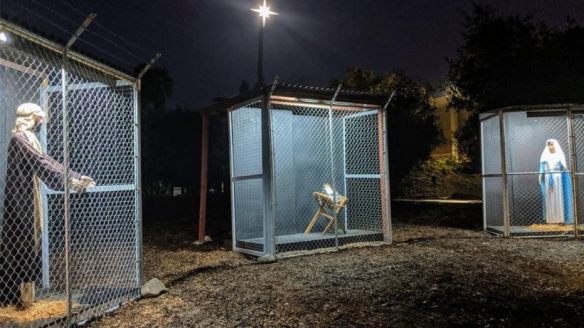
A singular number of churches across the country are asking those very questions, and their conclusions are being depicted with unnerving accuracy by nativity scenes in which Jesus and his family are separated, segregated and caged in individual chain-link pens, topped by barbed wire fencing.

These nativity scenes are a pointed attempt to remind the modern world that the narrative about the birth of Jesus is one that speaks on multiple fronts to a world that has allowed the life, teachings and crucifixion of Jesus to be drowned out by partisan politics, secularism, materialism and war.

The modern-day church has largely shied away from applying Jesus’ teachings to modern problems such as war, poverty, immigration, etc., but thankfully there have been individuals throughout history who ask themselves and the world: what would Jesus do?

What would Jesus—the baby born in Bethlehem who grew into an itinerant preacher and revolutionary activist, who not only died challenging the police state of his day (namely, the Roman Empire) but spent his adult life speaking truth to power, challenging the status quo of his day, and pushing back against the abuses of the Roman Empire—do?

Dietrich Bonhoeffer asked himself what Jesus would have done about the horrors perpetrated by Hitler and his assassins. The answer: Bonhoeffer risked his life to undermine the tyranny at the heart of Nazi Germany.

Aleksandr Solzhenitsyn asked himself what Jesus would have done about the soul-destroying gulags and labor camps of the Soviet Union. The answer: Solzhenitsyn found his voice and used it to speak out about government oppression and brutality.

Martin Luther King Jr. asked himself what Jesus would have done about America’s warmongering. The answer: declaring “my conscience leaves me no other choice,” King risked widespread condemnation when he publicly opposed the Vietnam War on moral and economic grounds.

Even now, despite the popularity of the phrase “What Would Jesus Do?” (WWJD) in Christian circles, there remains a disconnect in the modern church between the teachings of Christ and the suffering of what Jesus in Matthew 25 refers to as the “least of these.”

As the parable states:

“Then the King will say to those on his right, ‘Come, you who are blessed by my Father; take your inheritance, the kingdom prepared for you since the creation of the world. For I was hungry and you gave me something to eat, I was thirsty and you gave me something to drink, I was a stranger and you invited me in, I needed clothes and you clothed me, I was sick and you looked after me, I was in prison and you came to visit me.’ Then the righteous will answer him, ‘Lord, when did we see you hungry and feed you, or thirsty and give you something to drink? When did we see you a stranger and invite you in, or needing clothes and clothe you? When did we see you sick or in prison and go to visit you?’ The King will reply, ‘Truly I tell you, whatever you did for one of the least of these brothers and sisters of mine, you did for me.’ Then he will say to those on his left, ‘Depart from me, you who are cursed, into the eternal fire prepared for the devil and his angels. For I was hungry and you gave me nothing to eat, I was thirsty and you gave me nothing to drink, I was a stranger and you did not invite me in, I needed clothes and you did not clothe me, I was sick and in prison and you did not look after me.’ They also will answer, ‘Lord, when did we see you hungry or thirsty or a stranger or needing clothes or sick or in prison, and did not help you?’ He will reply, ‘Truly I tell you, whatever you did not do for one of the least of these, you did not do for me.’”

This is not a theological gray area: Jesus was unequivocal about his views on many things, not the least of which was charity, compassion, war, tyranny and love.

After all, Jesus—the revered preacher, teacher, radical and prophet—was born into a police state not unlike the growing menace of the American police state. When he grew up, he had powerful, profound things to say, things that would change how we view people, alter government policies and change the world. “Blessed are the merciful,” “Blessed are the peacemakers,” and “Love your enemies” are just a few examples of his most profound and revolutionary teachings.

When confronted by those in authority, Jesus did not shy away from speaking truth to power. Indeed, his teachings undermined the political and religious establishment of his day. It cost him his life. He was eventually crucified as a warning to others not to challenge the powers-that-be.

Can you imagine what Jesus’ life would have been like if, instead of being born into the Roman police state, he had been born and raised in the American police state?

Consider the following if you will.

Had Jesus been born in the era of the America police state, rather than traveling to Bethlehem for a census, Jesus’ parents would have been mailed a 28-page American Community Survey, a mandatory government questionnaire documenting their habits, household inhabitants, work schedule, how many toilets are in your home, etc. The penalty for not responding to this invasive survey can go as high as $5,000.

Instead of being born in a manger, Jesus might have been born at home. Rather than wise men and shepherds bringing gifts, however, the baby’s parents might have been forced to ward off visits from state social workers intent on prosecuting them for the home birth. One couple in Washington had all three of their children removed after social services objected to the two youngest being birthed in an unassisted home delivery.

Had Jesus been born in a hospital, his blood and DNA would have been taken without his parents’ knowledge or consent and entered into a government biobank. While most states require newborn screening, a growing number are holding onto that genetic material long-term for research, analysis and purposes yet to be disclosed.

Then again, had Jesus’ parents been undocumented immigrants, they and the newborn baby might have been shuffled to a profit-driven, private prison for illegals where they first would have been separated from each other, the children detained in make-shift cages, and the parents eventually turned into cheap, forced laborers for corporations such as Starbucks, Microsoft, Walmart, and Victoria’s Secret. There’s quite a lot of money to be made from imprisoning immigrants, especially when taxpayers are footing the bill.

From the time he was old enough to attend school, Jesus would have been drilled in lessons of compliance and obedience to government authorities, while learning little about his own rights. Had he been daring enough to speak out against injustice while still in school, he might have found himself tasered or beaten by a school resource officer, or at the very least suspended under a school zero tolerance policy that punishes minor infractions as harshly as more serious offenses.

Had Jesus disappeared for a few hours let alone days as a 12-year-old, his parents would have been handcuffed, arrested and jailed for parental negligence. Parents across the country have been arrested for far less “offenses” such as allowing their children to walk to the park unaccompanied and play in their front yard alone.

Rather than disappearing from the history books from his early teenaged years to adulthood, Jesus’ movements and personal data—including his biometrics—would have been documented, tracked, monitored and filed by governmental agencies and corporations such as Google and Microsoft. Incredibly, 95 percent of school districts share their student records with outside companies that are contracted to manage data, which they then use to market products to us.

From the moment Jesus made contact with an “extremist” such as John the Baptist, he would have been flagged for surveillance because of his association with a prominent activist, peaceful or otherwise. Since 9/11, the FBI has actively carried out surveillance and intelligence-gathering operations on a broad range of activist groups, from animal rights groups to poverty relief, anti-war groups and other such “extremist” organizations.

Jesus’ anti-government views would certainly have resulted in him being labeled a domestic extremist. Law enforcement agencies are being trained to recognize signs of anti-government extremism during interactions with potential extremists who share a “belief in the approaching collapse of government and the economy.”

While traveling from community to community, Jesus might have been reported to government officials as “suspicious” under the Department of Homeland Security’s “See Something, Say Something” programs. Many states, including New York, are providing individuals with phone apps that allow them to take photos of suspicious activity and report them to their state Intelligence Center, where they are reviewed and forwarded to law-enforcement agencies.

Rather than being permitted to live as an itinerant preacher, Jesus might have found himself threatened with arrest for daring to live off the grid or sleeping outside. In fact, the number of cities that have resorted to criminalizing homelessness by enacting bans on camping, sleeping in vehicles, loitering and begging in public has doubled.

Viewed by the government as a dissident and a potential threat to its power, Jesus might have had government spies planted among his followers to monitor his activities, report on his movements, and entrap him into breaking the law. Such Judases today—called informants—often receive hefty paychecks from the government for their treachery.

Had Jesus used the internet to spread his radical message of peace and love, he might have found his blog posts infiltrated by government spies attempting to undermine his integrity, discredit him or plant incriminating information online about him. At the very least, he would have had his website hacked and his email monitored.

Had Jesus attempted to feed large crowds of people, he would have been threatened with arrest for violating various ordinances prohibiting the distribution of food without a permit. Florida officials arrested a 90-year-old man for feeding the homeless on a public beach.

Had Jesus spoken publicly about his 40 days in the desert and his conversations with the devil, he might have been labeled mentally ill and detained in a psych ward against his will for a mandatory involuntary psychiatric hold with no access to family or friends. One Virginia man was arrested, strip searched, handcuffed to a table, diagnosed as having “mental health issues,” and locked up for five days in a mental health facility against his will apparently because of his slurred speech and unsteady gait.

Without a doubt, had Jesus attempted to overturn tables in a Jewish temple and rage against the materialism of religious institutions, he would have been charged with a hate crime. Currently, 45 states and the federal government have hate crime laws on the books.

Had anyone reported Jesus to the police as being potentially dangerous, he might have found himself confronted—and killed—by police officers for whom any perceived act of non-compliance (a twitch, a question, a frown) can result in them shooting first and asking questions later.

Rather than having armed guards capture Jesus in a public place, government officials would have ordered that a SWAT team carry out a raid on Jesus and his followers, complete with flash-bang grenades and military equipment. There are upwards of 80,000 such SWAT team raids carried out every year, many on unsuspecting Americans who have no defense against such government invaders, even when such raids are done in error.

Instead of being detained by Roman guards, Jesus might have been made to “disappear” into a secret government detention center where he would have been interrogated, tortured and subjected to all manner of abuses. Chicago police have “disappeared” more than 7,000 people into a secret, off-the-books interrogation warehouse at Homan Square.

Charged with treason and labeled a domestic terrorist, Jesus might have been sentenced to a life-term in a private prison where he would have been forced to provide slave labor for corporations or put to death by way of the electric chair or a lethal mixture of drugs.

Indeed, as I show in my book Battlefield America: The War on the American People, given the nature of government then and now, it is painfully evident that whether Jesus had been born in our modern age or his own, he still would have died at the hands of a police state.

Thus, as we draw near to Christmas with its celebrations and gift-giving, we would do well to remember that what happened on that starry night in Bethlehem is only part of the story. That baby in the manger grew up to be a man who did not turn away from evil but instead spoke out against it, and we must do no less.

Political Collapse: The Center Cannot Hold

By Kirkpatrick Sale

Source: CounterPunch

Have you noticed? From Hong Kong to Baghdad, Paris to Tehran, 2019 is shaping up to be, as the New York Times dubbed it, “the year of the protest.” Violent—and often deadly—anti-government protests are breaking out throughout the world in an unprecedented fashion, in rich countries as well as poor, as people everywhere are expressing their anger at corrupt, inefficient, brutal, and unresponsive regimes.

But what isn’t so much in the news is worse—worse enough that they don’t want to tell you. At the moment, there are no less than 65 countries are now fighting wars—there are only 193 countries recognized by the United Nations, so that’s a third of the world. These are wars with modern weapons, organized troops, and serious casualties—five of them, like Afghanistan, Libya, Syria, Somalia, and Yemen, with 10,000 or more deaths a year, another 15 with more than 1,000 a year—all of them causing disruptions and disintegrations of all normal political and economic systems, leaving no attacked nation in a condition to protect and provide for its citizens. From 2015 to 2019 more state-based conflicts were engaged in than at any time since World War II, with an estimated 1 million deaths in all.

In addition, there are at least 638 other conflicts between various insurgent and separatist militias, armed drug bands, and terrorist organizations, increasing each year as states fail or collapse completely.

What has made the wars and internal disputes even more egregious as the years go on is that chaotic weather has a direct effect on how societies function. Agriculture, of course, is impacted by higher temperatures, lack of rain, droughts, and wildfires, and crops have failed in many places over the last five years, including North and Central Africa, the Middle East, India, Pakistan, northern China, northern Europe, Argentina, Brazil, Central America, and even parts of North America. The collapse of Syria, for example, and subsequent civil wars were made more devastating if not directly caused by the drought of 2006-2011, in which 75 per cent of the farms failed and 85 per cent of the livestock died. And an official United Nations report in 2019, by 100 experts from 52 countries, warned that things will only get worse, with the world’s land and water resources exploited at “unprecedented rates,” threatening “the ability of humanity to feed itself.”

One obvious consequence, beyond death, famine, disease and starvation, is, as the U.N. report’s lead author says, “a massive pressure for migration,” a desperate attempt to find some refuge and relief when homes have been destroyed and families are uprooted. According to the United Nations, in what I regard as a certain undercount, in 2019 there were 272 million migrants worldwide, up from 258 million in 2017, with the weather in 2019 causing more refugees even than warfare. (The unprecedented crisis at the U.S. southern border in 2019 is only one manifestation of the porous and chaotic collapse of boundaries across the Americas, Africa, and most of Asia.) And meanwhile, the International Committee of the Red Cross in 2018 estimated that more than 100,000 people are simply “missing,” a figure it admits “represents only a fraction” of those who are unaccounted for by any government or organization.

Given the turmoil over wars and immigration threats, it is not surprising that half the world is without coherent government.

Organizations that track these things say that of the 174 covered nations, 76 are in various stages of collapse—that would be 43 per cent—and that excludes a dozen smaller nations that are locked into autocracy and poverty. These include seven completely failed states—Congo-Brazzaville, Central African Republic, Syria, Yemen, Somalia, South Sudan, and Venezuela—and another seven that are on the edge—Guinea, Haiti, Iraq, Zimbabwe, Afghanistan, Chad, and the Sudan—plus 19 that are in an “alert” category, meaning that some but not all government functions have failed, 15 in Africa and 4 in Asia.

In other words, many political systems in the world have effectively collapsed, people are dispossessed and without governments, and almost everywhere else, including the U.S. and Europe, governments are severely strained and political rifts abound. The vote for Brexit in the U.K., the election of Donald Trump (and the subsequent attempts to overturn it), the turmoil that erupted in December 2018 in France and Belgium, the continued protests in Poland were all examples of the population of developed nations coming to see that the attempt to establish capitalist-led democracies in an internationalist arrangement of benefit to corporate and banking interests just was not working, and a rising segment of what were called “deplorables” in America did not want any longer to be powerless, manipulated, and disdained. These turmoils also demonstrated that the established powers in these countries, especially the U.S. and Britain, resisted all of these attempts to change the status quo and in effect ignored or tried to thwart the popular will (cf. the “impeachment” farce)—the developed world’s form of the failed state. Those fissures have widened as the years have worn on, and as one astute observer, James Kunstler, put it in 2019, “The West is enduring paroxysms of political uproar and disenchantment.”

And here’s something weird that sums it all up. It is the opinion of two recent political scientists that “the state system seems to be failing all over the world,” and they have proposed a new study called “archy” to examine how to grow, maintain, and fund states so as to avert their collapse. No better evidence of the seriousness of the world’s “uproar and disenchantment” can there be when academics need to create a discipline to overcome it.

Yeats summed it up some years ago: “The center cannot hold. Mere anarchy is loosed upon the world.”


Kirkpatrick Sale’s new book The Collapse of 2020 will be published in January.

How Surveillance and Propaganda Work in ‘the Free World’

By Brian Cloughly

Source: Strategic Culture Foundation

A Bloomberg report of October 22 was concise and uncompromising in declaring Russia to be a surveillance state. Harking back to the good old days of the Cold War, as is increasingly the practice in much of the Western media, Bloomberg recounted that “The fourth of 10 basic rules Western spies followed when trying to infiltrate Russia’s capital during the Cold War — don’t look back because you’re never alone — is more apt than ever. Only these days it’s not just foreigners who are being tracked, but all 12.6 million Muscovites, too. Officials in Moscow have spent the last few years methodically assembling one of the most comprehensive video-surveillance operations in the world. The public-private network of as many as 200,000 cameras records 1.5 billion hours of footage a year that can be accessed by 16,000 government employees, intelligence officers and law-enforcement personnel.”

Terrifying, one might think. Straight out of Orwell’s 1984, that dystopian prediction of what the world could become, as noted in one description of how the face of the state’s symbolic leader, Big Brother, “gazes at you silently out of posters and billboards. His imposing presence establishes the sense of an all-seeing eye. The idea that he is always watching from the shadows imposes a kind of social order. You know not to speak out against The Party — because big brother is watching… The face always appears with the phrase Big Brother is watching you. As if you could forget.” Such is the terrifying Bloomberg picture of Moscow where there are supposedly 200,000 video cameras. You can’t blow your nose without it being seen. And wait for the next phase, in which Big Brother will hear you laugh.

In line with the Western approach, there is little mention of surveillance in other cities, but the website ‘Caught on Camera’ has analysed world-wide practices. It reports that there are some 25 million closed-circuit surveillance cameras world-wide and “the United Kingdom [with 4 million cameras] has more CCTV activity than any other European country, per capita… surprisingly, the Wandsworth borough in London in particular has more CCTV cameras than Boston, Dublin, Johannesburg and San Francisco put together. It is estimated there are 500,000 cameras dotted around London. The average person living in London will be recorded on camera 300 times in one day.”

The statistics obtained by Caught on Camera and comparitech differ markedly from those in the Bloomberg story which was retailed throughout the Western world by many news outlets, who increasingly refer to the West as “the Free World”. Comparitech records that as at August 2019 Moscow, with a population of 12.4 million, had 146,000 (not 200,000) cameras, while London’s 9 million citizens were being watched by 627,707 cameras. The picture (if one may use that word) is slightly slanted. To put it another way, London has 68 cameras for each 1,000 people, and the ratios elsewhere are enlightening: Shanghai 113 (China is in treble figures in three cities); Atlanta (Ga) 15; Chicago 13; Baghdad, Sydney and Dubai 12; Moscow and Berlin 11; and St Petersburg, Canberra and Washington DC tie at 5.

The slanting doesn’t stop there, because there are other ways of attacking Russia, spearheaded by such as the Washington Post, which highlighted the Bloomberg surveillance tale. The Post behaves like Big Brother focusing on Winston Smith, the hapless victim/hero of 1984 whose job it is “to rewrite the reports in newspapers of the past to conform with the present reality.” There is an eerie resonance in this, because the Post’s reportage on Russia verges on the obsessively censorious, while it avoids mention of anything remotely positive.

Understandably, the Post relies heavily on such sources as “Meduza, a Latvia-based online news outlet that covers the Kremlin” which reported that the Russian government “passed a law earlier this year that lets Vladimir Putin take all the country’s Internet traffic off the World Wide Web if he decrees that there’s an ‘emergency’.”

The fact that the intelligence services of the West have worked for a long time to devise strategies and tactics to destroy internet services in Russia and many other countries is neither here nor there, but it is important for Western propaganda purposes to condemn Russia for taking measures to counter the manoeuvres of the West’s cyberwar agencies. The Post emphasised that arrangements were made by various Russian ministries and agencies, including the Emergencies Ministry and the Federal Security Service which “is the successor to the KGB, where Putin was once an officer.”

The absurdity of that needlessly-injected personal point is amusing in a way, and serves to highlight the unending reiteration of detail intended to set the western public against Russia. Naturally, there is exclusion of information that could lead to audiences approving of Russia in any way.

The news site Axios states it aims to “deliver the cleanest, smartest, most efficient and trust-worthy experience for readers and advertisers alike” but when it comes to Russia it appears that there could be a bit of selectivity in that delivery. For example, in October the UK’s Guardian newspaper reported approvingly that according to the World Health Organisation (WHO), alcohol consumption in Russia “has dropped by 43% since 2003” and commented that the WHO had “put the decrease down to a series of measures brought in under the sport-loving president, Vladimir Putin, including restrictions on alcohol sales and the promotion of healthy lifestyles.” But Axios didn’t report it quite like that.

The Guardian also noted that “The last Soviet leader, Mikhail Gorbachev, led an anti-alcohol campaign with partial prohibition, which brought down consumption from the mid-1980s until 1990. But after the collapse of the Soviet Union, alcohol consumption exploded, continuing to rise until the start of the 2000s. Under Putin, Russia has introduced measures including a ban on shops selling any alcohol after 11 pm, increases in the minimum retail price of spirits and an advertising blackout.” The result has been “increased life expectancies in Russia, which reached a historic peak in 2018, at 78 years for women and 68 years for men. In the early 1990s, male life expectancy was just 57 years.”

This is an amazing societal development. In no other country has there been a comparable initiative that resulted in such a massive and positive shift in community habits.

The BBC was more coy than the Guardian about allocating approval for the remarkable success of the programme, and confined itself to reporting that the WHO “attributed the decline to a series of alcohol-control measures implemented by the state, and a push towards healthy lifestyles.” There was no reference to President Putin, and indeed the credit went elsewhere, because “alcohol-control measures introduced under former President Dmitry Medvedev included advertising restrictions, increased taxes on alcohol and a ban on alcohol sales between certain hours.”

Axios followed suit, and ‘Radio Free Europe’ didn’t mention Presidents Putin, Medvedev or Gorbachev, retailing simply that the “decline in consumption was due to “alcohol-control measures introduced at the beginning of the 2000s.” There were no reports of the achievement in US mainstream outlets or the UK’s resolutely right-wing anti-Russia media. (The Guardian doesn’t carry a Russian flag; it merely reports without xenophobic bias.)

The WHO Case Study provides an admirably detailed timeline of legislature and other developments concerning Russia’s successful drive against alcohol abuse, recording, for example, that in 2018 there was a “presidential decree on ‘National Purposes and Strategic Development Challenges of the Russian Federation until 2024’… including in the field of public health. The aim is to increase life expectancy to 78 years by 2024 and to 80 years by 2030, as well as the proportion of citizens leading a healthy lifestyle and systematically engaging in physical activities and sports.”

Don’t expect such an initiative to be praised or even mentioned by the Western media. Big Brother prefers to slant the cameras.

US government drops case against Max Blumenthal after jailing journalist on false charges

As the mysterious disappearance of Secret Service records and complete absence of evidence supporting its case came to light, the US government dropped its bogus charges against journalist Max Blumenthal.

By Ben Norton

Source: Grayzone

The US government has dropped its bogus charge of “simple assault” against journalist Max Blumenthal, after having him arrested on a 5-month-old warrant and jailed for nearly two days.

The Grayzone has learned that Secret Service call logs recorded during the alleged incident were either not kept or destroyed. The mysteriously missing evidence included print documents and radio recordings that may have exposed collusion between Secret Service officers operating under the auspices of the US State Department and violent right-wing hooligans in an operation to besiege peace activists stationed inside Venezuela’s embassy in Washington, DC.

Blumenthal, who is the editor of The Grayzone, was arrested at his home on October 25 by a team of DC cops who had threatened to break down his door. He later learned that he was listed in his arrest warrant as “armed and dangerous,” a rare and completely unfounded designation that placed Blumenthal at risk of severe harm by the police.

The government’s case rested entirely on a false accusation by a right-wing Venezuelan opposition activist, Naylet Pacheco, that Blumenthal and Benjamin Rubinstein had assaulted her while they were delivering food to Venezuela’s embassy in Washington, DC in the early morning on May 8. (Rubinstein is the brother of journalist and Grayzone contributor Alexander Rubinstein, who was reporting from inside the embassy at the time.)

The Grayzone has reported extensively on the corruption of coup leader Juan Guaidó, whom Washington recognizes as “interim president” of Venezuela, as well as the scandals plaguing Guaidó’s “ambassador” to the United States, Carlos Vecchio.

Vecchio personally presided over the weeks-long siege of Venezuela’s embassy in Washington, DC, stage-managing efforts by a mob of rabid right-wing activists to prevent peace activists from receiving deliveries of food and sanitary supplies.

As The Grayzone reported, the Donald Trump administration has diverted USAID funding originally intended to assist Central American migrants to pay the salaries of Vecchio and his team in Washington.

The US Department of Justice dismissed its case against Blumenthal on December 6. On the same day, it also dropped charges against Rubinstein, who had been arrested on May 8, hours after the food delivery.

“I’m relieved the government has finally decided to drop these phony charges against me. But I’m also disgusted,” Max Blumenthal said, “because I should never have been hauled out of my house and thrown in jail for an obviously politically motivated, false allegation that the police failed to investigate.”

Disappeared Secret Service call logs ‘highly unusual’

Lawyers representing Blumenthal and Rubinstein placed multiple and highly specified discovery requests to the prosecutor for Secret Service call recordings and reports logged on May 8 at the location of the embassy food delivery. The US prosecutor was unable to satisfy the request, verbally confirming that if the documents had existed, they no longer did.

“This is highly unusual and highly notable, almost inexplicable in the ordinary course of operations that these records were not maintained and preserved,” said Carl Messineo, the counsel to Rubinstein and a co-founder of the Partnership for Civil Justice Fund. “Given the false nature of allegations and that they advanced a prosecution based on these it is really questionable that this information was not produced.”

Beyond the mysterious disappearance of the call logs, there was a complete dearth of evidence on the prosecution’s side.

William Moran, who served as Blumenthal’s attorney, wondered why law enforcement trusted Pacheco, an accuser with such clear credibility issues. “The local police advanced a fraudulent case against a journalist on the word of a complainant who told at least six different, increasingly exaggerated stories and made identical accusations that night about at least three other individuals,” he said.

One Venezuelan opposition member whose identity remains under a protective order provided testimony to police attempting to corroborate Pacheco’s claims about Blumenthal and Rubinstein. According to Moran, that person had been convicted for the impeachable offense of writing fraudulent checks.

“The DC police wholly failed to conduct a proper investigation before calling for the arrest and imprisonment of a dissident journalist that they labeled without any cause whatsoever as ‘armed and dangerous,’ placing him in mortal danger,” Moran stated.

A pattern of false assault allegations and police collusion

The arrest of Blumenthal was part of a wider pattern of political persecution of those who resisted the seizure of the Venezuelan embassy by a US-backed coup administration.

On November 13, police appeared at the home of Medea Benjamin to threaten her with arrest, after she too was falsely accused of assault. Benjamin, a co-founder and leader of the anti-war group CODEPINK, had been a prominent figure in the Venezuelan Embassy Protection Collective.

Benjamin was accused by members of the Venezuelan opposition of assaulting Representative Debbie Wasserman-Schultz, who had joined Carlos Vecchio for a press conference on Capitol Hill. The police eventually left without arresting Benjamin, because they did not have a warrant.

Video of the incident revealed that it was, in fact, Benjamin who was assaulted by Vecchio’s notoriously violent minions.

During the same press conference, a member of the Venezuelan opposition seized the phone of journalist Wyatt Reed. When Reed complained to a Secret Service officer on site, the officer brushed him off.

Diliana Bustillos, a Venezuelan opposition lobbyist who participated in a May 8 press conference falsely accusing peace activists of violence, threatened Reed after the incident, warning that he would “end up like [Max Blumenthal] and Ben [Rubinstein].”

Mara Verheyden-Hilliard, a civil liberties lawyer with the Partnership for Civil Justice Fund, was present throughout much of the embassy siege. She noticed clear collusion between the right-wing opposition mob outside and the Secret Service, who were operating at the time under the watch of the State Department.

“Throughout the siege of the peace activists at the Venezuelan embassy,” Verheyden-Hillard said, “it was apparent to those on the scene that there was what looked like a facilitated effort between the government and the mob besieging the embassy.”

Mainstream media silence, demonization by regime change activists

The Washington Post reported extensively on the siege of the Venezuelan embassy, presenting the situation largely from the opposition’s perspective. The paper’s correspondent, Marissa Lang, uncritically conveyed Pacheco’s false charges, writing that “she said she was pushed against a wall and kicked by several men, then spent hours at a hospital being treated.”

However, the Washington Post did not report on Blumenthal’s arrest and imprisonment five months later or any of his public comments about the high-profile incident.

Meanwhile, an assortment of malicious regime-change cheerleaders seized on Blumenthal’s arrest to defame him with false and now-discredited claims on social media:

  • Bellingcat founder Elliot Higgins promoted a Medium post by an anonymous author who has routinely smeared Blumenthal, which featured his arrest warrant and a video of the complainant’s false testimony. He then repeatedly criticized skeptics who expressed doubts about the completely unfounded allegations against Blumenthal. Higgins’ website Bellingcat is funded by the National Endowment for Democracy, a regime change arm of the US government, and the UK Foreign Office via the Zinc Network, among other entities.
  • Foreign Policy senior editor and anti-China hawk James Palmer declared without a scintilla of evidence that Blumenthal “assault[ed] people freely.”
  • Freelance journalist and longtime Syria regime-change activist Danny Gold claimed falsely and without proof that Blumenthal “kicked an old woman in the stomach.”
  • Idrees Ahmad, a Stirling University professor of journalism who has obsessively denigrated Blumenthal and even phoned him to threaten him against publishing a factual investigative report on the Syrian White Helmets, falsely accused Blumenthal of “manhandling an elderly woman.”
  • Istanbul-based TRT World contributor Wilson Dizard suggested that Blumenthal was guilty before being proven innocent, insisting that a Grayzone account of his arrest “does not actually provide an alternative version of events.”
  • Oz Katerji, the notorious regime change fanatic who was recently fired from the Daily Mail for denigrating its columnist Peter Hitchens on social media, declared that he would “probably buy the guys who shackled pro-Assad war crimes denier Max Blumenthal to the floor for assaulting a Venezuelan protester a beer or two.” Katerji later insisted without any basis that “there’s video evidence” to support the false charge against Blumenthal.
  • Dutch regime-change activist Thomas van Linge, who fancied himself a Syria expert before moving on to advocate for Western-backed right-wing opposition groups in Iran, Bolivia, Hong Kong, and beyond, denied that Blumenthal’s arrest was political and instead outrageously claimed he was “arrested for kicking a pregnant woman.” Even in the totally fabricated accusations against Blumenthal, no one ever claimed that the alleged victim, right-wing Venezuelan activist Naylet Pacheco, who is 58 years old, was pregnant. As of the publication of this article, van Linge still has not deleted this patently false, defamatory claim.
  • Neil Hauer, a self-described “freelance analyst” who has previously consulted for the European Union and US Marines, called journalist Jeet Heer a “moron” for publicly advocating for Blumenthal.
  • UK liberal interventionist Sunny Hundal also attacked Heer for defending Blumenthal, asserting that “given the person in question I think you should exercise some judgement before accepting his story at face value.”
  • The anonymous right-wing Reagan Battalion Twitter account falsely claimed that Blumenthal was “arrested for kicking a pregnant woman,” misrepresenting the identity of the complainant while not even bothering to frame the non-existent incident as an alleged assault. In a previous spasm of mendacity, the Reagan Battalion declared that Blumenthal “works for” foreign socialist governments and smeared him as “a puppet for every dictator around the globe.”
  • Liberal feminist Mona Eltahawy falsely smeared Blumenthal as a supposed abuser of women and a “piece of shit.”
  • Right-wing pro-Israel lobby group StopAntisemitism.org defamed Blumenthal, who is Jewish, as an “antisemite,” cheered his arrest, and falsely asserted he “assault[ed] a Venezuelan opposition figure.” This pro-Israel organization has also smeared left-wing Jewish activist Ariel Gold and Muslim American progressives Ilhan Omar, Rashida Tlaib, and Linda Sarsour as supposed “antisemites.”
  • Joshua Holland, a liberal contributor to The Nation, publicly lashed out at media critic Joe Emersberger and implied the false, totally unsubstantiated allegations could be true.
  • Joshua Frank, an editor of the former-muckraking website CounterPunch, downplayed the attack on Blumenthal, whitewashed the state repression, and called on people “to not blow this all out of proportion, as Max is likely to do for his own gain.” Frank, who has viciously maligned journalists and activists who opposed the international proxy war on Syria, also derided this present reporter, Ben Norton, with superficial ad hominem insults.
  • Sean Davis, a co-founder of the hard-right website The Federalist and a longtime conservative activist who has worked for numerous Republican politicians, spread the fake accusations. Davis’ website The Federalist has been widely criticized for blatant racism (it once had a tag devoted specifically to “black crime“), and it published an article defending far-right Alabama judge Roy Moore after he was accused of dating teenage girls as young as 14.

Asked about the wave of libelous attacks spurred by his arrest on false charges, Blumenthal commented, “The outpouring of support I’ve received from around the world has been more profound and meaningful than any of the smears from the usual suspects. But that does not mean that I will let this campaign of lies go unanswered. This whole episode began with a false, defamatory accusation, and I plan to take the necessary actions to see it ends with a sense of justice.