
Arguments Against Despair

By David Edwards

Source: Media Lens

Eliot Jacobson is a retired professor of mathematics and computer science who regularly appears on our Twitter feed discussing the climate crisis. He sends tweets under the grim title, ‘Your “moment of doom” for the day’. These channel the latest news on rapidly rising carbon emissions and temperatures, catastrophic examples of extreme weather, and so on. It’s depressing fare, and Jacobson is candid about the level of anguish he feels:

‘I woke up feeling angry at about 2:30 AM this morning.

‘It’s easy to find something wrong with just about anything I look at. It’s all projection. I’ve been writing and deleting Tweets, but I still feel angry.

‘I’m angry that there’s very little I can do and there’s no way out.’

In a blog post, he wrote:

‘This sadness is so overwhelming, so all-consuming, that it takes my breath away. The things I do to cope with the weight of it all are mere distractions from this sadness. Volunteer for a few hours, then sadness. Go for a walk, then sadness. Listen to music, read, visit websites, then sadness. Visit with friends or family, then sadness. Sadness returns every time I have a moment to reflect on the predicament of the present moment.’

I’m no stranger to this emotional roller-coaster. 1988 was the big year for me, when NASA scientist James Hansen told the world we were heading for disaster. I had no difficulty believing him.

It seemed inconceivable to me that the profit motive driving global industry could be restrained, let alone reversed, in time. I was then working as a marketing manager for British Telecom in the West End of London where I set up a Green Initiatives Group. Small changes were made, but they were just window dressing – deeper changes impacting profit were completely unthinkable. It seemed obvious to me that this fundamentalist corporate resistance must, sooner or later, lead to disaster.

I first protested for action on climate change with Friends of the Earth on the streets of central London in October 1989. I was 27 when I started campaigning; I’m now 61. I’ve thought a lot, worried a lot, talked a lot, read a lot, and written a lot about these issues for three and a half decades, more than half my life.

It seems absolutely incredible to me – by which I mean it seems something that I honestly would not have believed was possible – that what seemed like an urgent crisis to me in the late 1980s can still seem like ‘hype’, a ‘liberal tax scam’, an ‘oligarch plot’ and ‘bourgeois hysteria’ to large numbers of people in 2023. In the 1980s, we said things would change when there were ‘bodies in the streets’ – but the bodies are all around us now, and there is still no sign of meaningful change.

I say all this to make clear that I am in no way complacent about, or indifferent to, the looming climate catastrophe (it seems absurd to even describe it as ‘looming’). My comments below are not intended to detract from the vital need to take immediate action; they are addressed to the despair that I know many people, like Jacobson, are feeling.

You, Me And The Mysterium Tremendum

After everything I have myself suffered, it seems to me that we have two main tasks at the present time: first, to do everything in our power to avert the terrifying crisis threatening us with extinction. Second, to do everything we can to transform the fear and suffering of our predicament into love and bliss.

The first of these is new. The second may sound preposterous, even annoying, but it has actually always been the great human task.

Many activists devoted to action, to change, despise the very idea that our own happiness should be any kind of concern. The suggestion is dismissed as self-indulgent ‘navel gazing’. We have to dispense with all such ‘sentimentality’ and focus on ‘hard politics’. We have to plunge into the darkness of realpolitik and fight for our lives. It’s going to be bruising, to hurt – forget all kitten-cuddling ideas about ‘love’ and feeling good. And how on earth can you feel ‘bliss’ when the world is falling apart? Such nonsense!

As so often, the anger is rooted in fear – the fear that such concerns will divert energy and attention away from what really matters. The counter-argument is that not giving a damn about personal feelings, about our needs as human beings in this short life, is actually one of the key factors that got us into this fine mess in the first place. (See my Cogitation: ‘Our Indifference To Ourselves’ – Beyond The ‘Virtue’ Of Self-Sacrifice – Parts 1 and 2)

Just as I can’t understand how so many people can fail to see the truth of the existential crisis we’re facing, I can’t understand how people can feel so absolutely certain about the significance, the meaning, of this crisis that they fall into absolute despair.

First of all, we need to remember that despair is a function of mind; it is not something mandated by Existence. As Thoreau noted, we have a choice:

‘However mean your life is, meet it and live it; do not shun it and call it hard names.’ (Thoreau, ‘Walden’, Oxford University Press, 1997, p.292)

This has been as true for everyone in human history facing death from illness, starvation, genocide, as it is for all of us now, facing extinction.

I find the universe so mysterious, so fundamentally Unknown, and even Unknowable, that I cannot establish a solid base of existential certainty that allows me to be confidently desperate about even this situation.

Of course, climate collapse is terrible for us – I don’t want to die, you don’t want to die; we don’t want so-called human ‘civilisation’ to disappear. But we all do have to die and the deeper significance of even a disaster on this scale is fundamentally unknown.

We are a miniscule part of billions of years of existence involving 200 billion galaxies each containing 200 billion stars, and who knows how many planets, swirling over distances that completely defy imagination – all of it emerging out of the mysterium tremendum, the how and why of Existence (we can’t say Creation; we don’t even know if it has a beginning or an end).

This immensity of space and time has led to this moment that stands before us. Here we are! Everything in this cosmos has led us here. We can’t just blame politicians, corporate executives and their journalistic enablers – the universe made them as they are and this is what the universe has given us to deal with.

Who are we to break down in despair as if we were certain about the final meaning of what is happening? What do we really know about anything? Do we really know enough to find a solid position from which we can cast judgement even on the extinction of human life, or even of all life, on this planet? 

In November, spiritual writer Steve Taylor posted a poem, ‘Being Watched by The Moon’, on Facebook. Taylor wrote of our cosmic near neighbour:

‘Then I noticed a look of concern on her face.

There was a glint of disapproval, a hint of dismay

in her gaze, as it followed me home

as if she was witnessing an accident, or a crime.

Had I done something wrong? I wondered.

Had I injured or offended someone?

Had I gone astray, and lost the meaning of my life?

But then I looked closer, and realised:

she wasn’t just watching me.

She was watching the whole world.’

A glint of ‘concern’, ‘disapproval’ and ‘dismay’, as if ‘witnessing an accident, or a crime’? Is this really the most likely reaction of the Moon? After all, she has seen a lot – she’s around 4.5 billion years old, about the same age as the Earth. Human beings have been around for just 2.8 million years, and in our problematic modern form for just 200,000 years. The Sun formed about 4.6 billion years ago from an enormous molecular cloud that gave birth to numerous other stars. Our star has about 5 billion years of life left; she’s in her prime. The universe itself is about 13.8 billion years old – at least in this cycle, if it is a cycle. We don’t know where all this comes from, what it means, what lies at the base of it all. 

Worst case scenarios suggest that human-induced climate change might devastate most animal and plant species to such an extent that it could take five million years for life to recover. But 5 million years is a blink of the cosmic eye to old-timers like the Moon, Earth and Sun whose memories stretch back, not millions, but billions of years. And if things don’t work out here post-climate collapse, maybe they’ll go better among the billions and billions of stars out there – that’s a lot of stars, a lot of possibility. From this perspective, one might surmise that human despair at the prospect of human extinction is one more manifestation of an egotism that causes us to vastly overestimate our own importance.

Might it alter our despairing perspective to consider that the enlightened mystics might be right in declaring that, not just plants and animals, but the entire universe is alive? We think life arises miraculously, ‘accidentally’ (what on earth does that mean?), Lazarus-like, from dead matter. But atoms are pretty lively phenomena; they are whizzing flea circuses of jumping sub-atomic particles, quantum waves and other forms of energy. Might we one day conclude that what we call life arises from these subtler forms of life? Is energy in some sense life?

And might our despair be leavened by the possibility, as mystics also insist, that, not just human beings, but the entire cosmos is conscious? What would it mean, if it turns out that even rocks are consciousness in a kind of coma; that evolution is ultimately a process of consciousness awakening from the slumber (not the death) of matter?

If everything is alive and everything is conscious, then even human beings are unable to inflict any real damage – a manifestation of eternal life rises and falls, comes and goes, but the ocean of living consciousness continues completely unharmed.

The universe seems to consist of objects, of material ‘things’. But that is not all: these rocks, animals, planets and stars appear in the something that is no-thing that we call space. Likewise, our awareness also provides an internal space in which sense perceptions, thoughts and emotions can appear and be known. We assume the universe is material and yet awareness seems non-material, seems entirely other than that which is material. Is it possible that external space and the internal space of awareness are related? Could they actually be the same phenomenon? We tend to see our internal space as an epiphenomenon of the brain, but is external space an epiphenomenon of matter?

Could the mystics even be right when they insist that awareness evolves in the universe by moving from ageing bodies to new ones? Westerners find this a childishly obvious example of wishful thinking. But does that make it untrue? Do we imagine that Buddha, Bodhidharma, Nagarjuna, Lao tse and all other enlightened humans were inventing when they made this claim over and over again? Could they even be right in arguing that consciousness moves from old, exhausted planets to fresh, new planets better suited to the continued evolution of consciousness?

If that sounds ludicrous, is it any crazier than the idea that the universe suddenly emerged from nothingness – nothing, nothing, nothing, then, Bang! – or that it has somehow always existed? These appear to be the only two possibilities, and yet both seem totally nonsensical to us. If the only logical possibilities seem impossible, how can we so confidently root our despair in our clearly inadequate human capacity for logic?

Satchitananda

I controversially suggested our task was to find bliss in the face of looming extinction. Is that possible? Is it moral even to try in the face of so much suffering?

Seasoned meditators tell us that the mysterious awareness perceiving these words is inherently blissful. Not just pleasurable, mind you – ecstatic. We are told the bliss is already there, is always there; that it is the very nature of awareness. The idea is captured in the Sanskrit epithet ‘satchitananda’, or ‘reality, consciousness, bliss’ – existence is aware and awareness is blissful.

This sounds counter-intuitive standing at a bus stop on a rainy Monday morning commute to work. We are here, we are aware, thank you very much, and we are emphatically not beaming with delight.

There are two possible explanations for this contradiction: either all the enlightened mystics were talking nonsense, or we are not in fact here, not in fact aware, and are therefore not able to experience the bliss that is here.

But if we’re not here, where on earth are we?

We are physically here, of course, but our minds are not in the present; they are in the past and in the future. Because the past and future do not exist, because they are mere ideas in the mind, when we are thinking we are absent; we are not truly here.

There are times when I sit in meditation for an hour when thoughts finally drop away; thoughts by which I am otherwise unceasingly plagued by day and night (dreams are thinking in pictures). When thoughts drop away, even for a moment, something very subtle, but very powerful slips through. In my experience, it emerges like a wispy strand of pink candy floss spinning out from some completely unknown depth and melting into my heart (my ‘dantian’ and ‘lower dantian’, in the terminology of Qigong). The melting is experienced as a sweetness, a delight, that glows with unconditional love for everyone and everything.

It is clear, sitting alone in a room, that this loving bliss is uncaused. I may have been as miserable as sin about the state of the world before slumping down to watch my thoughts and feelings – nothing in my world has objectively changed in that hour. In fact, as all the mystics insist, this loving delight has not been caused; it has simply been unveiled, revealed.

Thought is the veil. This is why we can’t feel the bliss of existence: it is hidden from us by layer upon layer of thought, rather like the multiple layers of cloud that typically greet solemn holidaymakers returning to Britain.

Human beings are the only animal that can become lost in the unreal world of mentation. All the virtuous, politically correct and well-intentioned thought by which we have always hoped to make the world a better place – the whole, misguided 17th and 18th century dream of the European ‘Enlightenment’ – has combined with all other thoughts to form an almost impenetrable barrier between us and the real source of civilisation, of personal and global salvation, within us.

The truth is that we have destroyed our planet and become almost completely estranged from the inherent bliss of being because we have sought civilisation and happiness in our heads. In reality, true civilisation – not the ability to build machines to pyrrhically ‘conquer’ nature, other animals and humans – is found when we transcend thought and connect deeply and often with our hearts.

‘The Best People In The World’ – Actual Human Civilisation

The very idea of technological ‘progress’ implies some kind of ‘Manifest Destiny’. It is our ‘destiny’ – the natural path of any ‘advanced’ civilisation on any planet – to develop ever more powerful technology, that we might one day voyage across the cosmic ocean just as we once voyaged across the water and air of our home planet.

But this may be wrong. It may be that the right option is to journey inwards in an exploration of being, of consciousness, to an unimagined brave new world of love and bliss.

Perhaps we don’t hear anything from highly technological ‘civilisations’ out there in the cosmos because the whole effort is a suicidal wrong turn that leads to near-instant decline and extinction. The cosmos may nevertheless be teeming with genuinely civilised beings who have gone in a very different direction.

After all, even on our planet, there have been examples of authentically civilised humans – people who live in their hearts rather than in their heads, who are free of our obsessive thinking. They appear to have rooted their daily lives in the kind of love and bliss that we in the West can only find in meditation.

In his book, ‘The Conquest of Paradise’, writer and ecologist Kirkpatrick Sale described the low-tech, Taino society encountered by the Spanish conquistadors in 1492:

‘So little a part did violence play in their system that they seem, remarkably, to have been a society without war (at least we know of no war music or signals or artifacts, and no evidence of intertribal combats) and even without overt conflict (Las Casas reports that no Spaniard ever saw two Tainos fighting).’ (Kirkpatrick Sale, ‘The Conquest of Paradise’, Papermac, 1992, p.99)

But the lack of violence was only one aspect of the Tainos’ towering civilisation:

‘And here we come to what was obviously the Tainos’ outstanding cultural achievement, a proficiency in the social arts that led those who first met them to comment unfailingly on their friendliness, their warmth, their openness, and above all – so striking to those of an acquisitive culture – their generosity.’ (p.99)

Even Admiral Cristobal Colon (‘Christopher Columbus’ in old money), the man who brought death and disaster to the lives of the Taino, recorded in his journal:

‘They are the best people in the world and above all the gentlest. They became so much our friends that it was a marvel… They traded and gave everything they had, with good will.’ (pp.99-100)

He continued:

‘I sent the ship’s boat ashore for water, and they very willingly showed my people where the water was, and they themselves carried the full barrels to the boat, and took great delight in pleasing us. They are very gentle and without knowledge of what is evil; nor do they murder or steal.’

Colon added:

‘They love their neighbours as themselves, and they have the sweetest talk in the world, and are gentle and always laughing.’ (p.100)

Sale wrote poignantly:

‘It is to be regretted that the Admiral, unable to see past their nakedness, as it were, knew not the real virtues of the people he confronted. For the Tainos’ lives were in many ways as idyllic as their surroundings, into which they fit with such skill and comfort. They were well fed and well housed, without poverty or serious disease. They enjoyed considerable leisure, given over to dancing, singing, ballgames, and sex, and expressed themselves artistically in basketry, woodworking, pottery, and jewellery. They lived in general harmony and peace, without greed or covetousness or theft.’ (pp.100-101)

American geographical scholar Carl Sauer concluded:

‘…the tropical idyll of the accounts of Columbus… was largely true’. (p.101)

The Tainos were human beings who lived in their hearts, not in their heads. They had no august universities packed with thinkers, philosophers and other half-crazed intellectuals; no 24/7 outpourings of media pollution – they lived in the bliss of awareness unclouded by obsessive thought.

As for us! By painful contrast, in his book, ‘Impact of Western Man’, historian William Woodruff commented on the society from which Colon had sailed:

‘No civilization prior to the European had occasion to believe in the systematic material progress of the whole human race; no civilization placed such stress upon the quantity rather than the quality of life; no civilization drove itself so relentlessly to an ever-receding goal; no civilization was so passion-charged to replace what is with what could be; no civilization had striven as the West has done to direct the world according to its will; no civilization has known so few moments of peace and tranquillity.’ (Sale, ibid, p.91, my emphasis)

To live in the head, to sacrifice the moment for the future, to prioritise the ‘serious’, ‘important’ work of the greedy, plotting mind over the bliss of the heart is to build a self-destructive, doomed version of fake ‘civilisation’.

Or consider the experience of the Mexican anthropologist Miguel Covarrubias on visiting the island of Bali in 1938. Covarrubias wrote:

‘No other race gives the impression of living in such close touch with nature, creates such a complete feeling of harmony between the people and the surroundings… The Balinese belong in their environment in the same way that a humming-bird or an orchid belongs in a Central American jungle.’ (Miguel Covarrubias, ‘Island of Bali’, KPI, 1986, p.11)

Covarrubias added:

‘A man is assisted by his neighbours in every task he cannot perform alone; they help him willingly and as a matter of duty, not expecting any reward other than the knowledge that, were they in his case, he would help in the same manner’. (p.14)

The result, Covarrubias wrote, was a village system which operated as ‘a closely unified organism in which the communal policy is harmony and cooperation – a system that works to everybody’s advantage’. (p.15)

In the late 1990s, I worked with the Swedish ecologist and activist Helena Norberg-Hodge who lived for many years among the people of Ladakh on the Tibetan plateau of Northern India. In her book ‘Ancient Futures’, Norberg-Hodge wrote of how she was bewildered by the strange fact that the Ladakhis were always smiling:

‘At first I couldn’t believe that the Ladakhis could be as happy as they appeared. It took me a long time to accept that the smiles I saw were real. Then, in my second year there, while at a wedding, I sat back and observed the guests enjoying themselves. Suddenly I heard myself saying, “Aha, they really are that happy”. Only then did I recognize that I had been walking around with cultural blinders on, convinced that the Ladakhis could not be as happy as they seemed. Hidden behind the jokes and laughter had to be the same frustration, jealousy, and inadequacy as in my own society. In fact, without knowing it, I had been assuming that there were no significant cultural differences in the human potential for happiness. It was a surprise for me to realize that I had been making such unconscious assumptions, and as a result I think I became more open to experiencing what was really there.’ (Helena Norberg-Hodge, ‘Ancient Futures – Learning From Ladakh,’ Sierra, 1992, p.84)

As amongst the Tainos, fighting in traditional Ladakhi society was unknown, disputes were settled quickly and peaceably, and when one person had a problem the entire community did its best to help:

‘In traditional Ladakh, aggression of any sort is exceptionally rare: rare enough to say that it is virtually non-existent… Even arguments are rare. I have hardly ever seen anything more than mild disagreement in the traditional villages—certainly nothing compared with what you find in the West.’ (p.46)

Norberg-Hodge concluded:

‘I have never met people who seem so healthy emotionally, so secure, as the Ladakhis.’ (p.85)

These societies that seem so ‘primitive’ and ‘uncivilised’ to goal-oriented, power-obsessed, head-trapped Europeans, were actually exemplars of authentic human civilisation.

I am not suggesting that we can become like the Tainos, Balinese and Ladakhis. If we are too high-tech primitive to save ourselves from climate disaster, we can obviously not hope to create that kind of paradise on earth.

What I am suggesting, though, is that the existence of these societies powerfully supports the contention of the mystics: that awareness unclouded by obsessive thinking is indeed in the nature of bliss and love. I am suggesting that such low-tech civilisations may exist in abundance, undetected, on other planets that will of course continue to thrive no matter what happens on our planet. I am also suggesting that you and I can create a little patch of this paradise in our own hearts.

Perhaps in our world as it is, genuinely civilised, loving societies are doomed to be destroyed by brutal, head-trapped, Western-style societies. But you and I still have the freedom, even in the face of this wider brutality, even in the face of environmental catastrophe, to live a life overflowing with love and bliss. Maybe that is all that is possible for us, and maybe that is enough. 
Send in the Clowns

Yellen and Garland perform back-to-back surprise visits to Ukraine

By Philip Giraldi

Source: The Unz Review

Sometimes I think that the script being used by the Biden Administration to manage its foreign and national security policies has been written by George Orwell, though I am not sure if it based on 1984 or Animal Farm. Maybe it is a combination of the two. Either way, it would help explain why there is something seriously wrong here. For example, at the end of February Congress, confronted by a debt ceiling, began discussing cutting Medicare and Social Security while more recently a banking sector crisis seems to be developing so Treasury Secretary Janet Yellen decided to go off doing photo-ops in Kiev embracing Ukraine’s President Volodymyr Zelensky shortly after handing him the keys to the US economy. She explained to Zelensky how the White House had approved an additional $12 billion in aid to Ukraine during the previous week, including $2 billion for the military and $10 billion to support Zelensky’s government and other infrastructure needs. The US Treasury is now de facto the source of the Ukraine government’s entire annual budget. In addition, Yellen described glowingly how the Treasury and State Departments will implement a new round of sanctions against more than 200 entities and individuals with ties to Russia’s military, high-technology industries, and its metals and mining sectors. The US Department of Commerce is also enforcing export restrictions on materials and technology, including semiconductors, sold by American companies to customers in Russia and China.

In defense of her grand mission, Yellen penned an op-ed for the always compliant New York Times explaining the importance of Ukraine to the United States. She wrote how in Ukraine “…Russia’s barbaric attacks continue — but Kyiv stands strong and free. Ukraine’s heroic resistance is the direct product of the courage and resilience of Ukraine’s military, leadership and people. But President Volodymyr Zelensky and the Ukrainians would be the first to admit that they can’t do this alone — and that international support is crucial to sustaining their resistance. I’m in Kyiv to reaffirm our unwavering support of the Ukrainian people. Mr. Putin is counting on our global coalition’s resolve to wane, which he thinks will give him the upper hand in the war. But he is wrong. As President Biden said here last week, America will stand with Ukraine for as long as it takes… Ukrainians are fighting for their lives on the front lines of the free world. Today, and every day, they deserve America’s unyielding support.”

The Yellen op-ed drones on with a lie so large that it is astonishing that the New York Times would even print it: “When confronted with scenes of brutality and oppression, Americans have always been quick to stand up and do the right thing. Our strength as a nation comes from our commitment to our ideals — and our capacity to see in others the same desires that animated our own struggles for freedom and justice.” But then she tops that with assurances from “President Zelensky, [who] has pledged to use these funds in the ‘most responsible way.’ We welcome this commitment, as well as his longstanding agenda to strengthen good governance in Ukraine.” Huh?

And here is Yellen’s version of “Why We Fight!”: “Our support is motivated, first and foremost, by a moral duty to come to the aid of a people under attack. We also know that, as President Zelensky has said, our assistance is not charity. It’s an investment in ‘global security and democracy.’ Let’s look at the strategic impact of our support for Ukraine so far. Mr. Putin’s war poses a direct threat to European security, as well as to the laws and values that underpin the rules-based international system.”

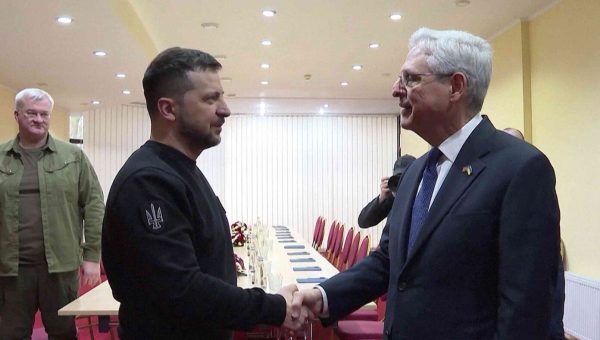
So, Americans have a “moral duty” apparently up to and including sending their sons and daughters to die supporting Ukraine. And ah yes, it’s all about the “free” world, democracy and the notorious rules based international system! Has anyone yet cited Hegel’s observation that the President Joe Biden Administration’s foreign policy has already “repeated itself, first as a tragedy in Afghanistan, second as a farce”? Meanwhile one suspects Zelensky was laughing all the way to the bank as Yellen disappeared over the horizon to come up with the cash, as that old expression goes, and he probably already has one of his buddies shopping for a new villa on the French Riviera to supplement his other real estate! But wait! The story became even more exciting the following week, involving another visit to Mr. Z by America’s nearly invisible Attorney General Merrick Garland, a man who can literally look Z in the eye as they are both very short. Garland is generally engaged in chasing white supremacists and requiring all new FBI hires to learn all about how to identify and pursue antisemites, but he has made two trips to Kiev to meet mano-a-mano with the brave olive drab t-shirt clad warrior who is already being beatified as the twenty-first century’s Winston Churchill.

Garland was in town to do the other thing the engages his sense of law and order, which is to set up a tribunal to arrest, prosecute and punish Russian war criminals after Ukraine emerges triumphant from its conflict with the unimaginably evil President Vladimir Putin. It would be modeled on the Nuremberg Tribunals that tried leading Nazis after the Second World War, and Garland has cited his family’s escape from the so-called holocaust to explain why he is intent on personally being involved in delivering what he describes as “justice.” A Justice Department spokeswoman described Garland’s mission as being in Kiev to personally “reaffirm America’s commitment to help hold Russia responsible for war crimes committed in its unjust and unprovoked invasion against its sovereign neighbor.”

Garland had several meetings with President Volodymyr Zelensky and foreign law enforcement officials including Ukrainian Prosecutor General Andriy Kostin while attending what was billed as the “United for Justice Conference.” Zelensky elaborated that the purpose of the conference was to hold Russia’s leadership accountable for the alleged atrocities carried out by its army. “The main issue of all these meetings is accountability,” he said. The US Justice Department is reportedly actively engaged in the gathering of evidence to indict the Russians. During Garland’s first visit to Ukraine in June 2022 he announced the appointment of Eli Rosenbaum, an Office of Special Investigations prosecutor best known for going after former Nazis, to direct American efforts to identify and track Russian war criminals.

Garland laid it on thick, as was expected from someone responsible for prosecuting the rest of the world when it steps out of line. He told his hosts that “Just over twelve months ago, invading Russian forces began committing atrocities at the largest scale in any armed conflict since the Second World War. We are here today in Ukraine to speak clearly, and with one voice: the perpetrators of those crimes will not get away with them. In addition to our work in partnership with Ukraine and the international community, the United States has also opened criminal investigations into war crimes in Ukraine that may violate US law.” He concluded by throwing out the complete bullshit party line much beloved by Joe Biden and Tony Blinken, that “The United States recognizes that what happens here in Ukraine will have a direct impact on the strength of our own democracy.”

Of course, there is more than a little bit of irony in all this, not to mention top level hypocrisy, as the United States has killed more people directly or indirectly while committing more crimes against humanity dished out in various ways over the past twenty years than any other country, except, predictably, Israel, which currently is committing crimes against humanity on a nearly daily basis. Curiously, however, the normally tone-deaf White House and Pentagon seem to understand, on a certain level, that opening up Pandora’s box might not be a good idea when it comes to war crimes. Last week Secretary of Defense Lloyd Austin refused to share US information on alleged Russian crimes with the International Criminal Court (ICC) in the Hague. The Pentagon is blocking the Biden administration from sharing evidence with the ICC collected by American intelligence agencies regarding Russian activities in Ukraine because helping the court investigate Russians might set a precedent that could help pave the way for it to prosecute Americans. Washington does not recognize the ICC, fearing that it might well seek to examine the sorry record of US military crimes in Asia and Africa. Israel similarly does to recognize the court for roughly the same reason.

So here we are, two top level officials from the Biden regime sneak into Kiev to give an arch crook money and unlimited moral support, together with a pledge that more cash is on the way as are arms and war crimes tribunals await those nasty Russians. And guess what? It is all packaged as being good for America! This sounds like a song that was sung previously in places like Vietnam, Iraq and Afghanistan and it was a tissue of lies then just as it is now. Yellen ought to have stayed home to tend to the banking system and should be giving the billions of dollars earmarked for Zelensky back to the American people. If Garland wants to investigate anyone it should be the Pentagon, the intelligence agencies, and Congress. And yes, his own FBI! And don’t forget how the Bidens and Clintons became multi-millionaires! And then there is the destruction of Nord Stream. Funny how every time one turns over a rock in and around the US government something really smelly surfaces.

A Fed-Issued Digital Currency: The Mark of the Beast

A Fed-issued digital currency would be no more in our interests than the current dollar system.

By Jeremy R. Hammond

Source: Jeremy R. Hammond Blog

China’s ‘Social Credit’ System

“And he causeth all, both small and great, rich and poor, free and bond, to receive a mark in their right hand, or in their foreheads: And that no man might buy or sell, save he that had the mark, or the name of the beast, or the number of his name.” — Revelation 13:16-17

In China, as you have likely heard, the government has been experimenting with a “social credit” system aimed at giving politicians even greater control over people’s behavior. China was, of course, also the country whose authoritarian “lockdown” response to the outbreak of SARS‑CoV‑2—the coronavirus that causes COVID‑19 and was likely engineered in a Chinese lab with US government funding—was pointed to as a model for the rest of the world to follow by the World Health Organization (WHO).

The WHO has since been aiming to acquire even more centralized global authority to issue diktats in the event of another pandemic, such as implementation of “lockdown” measures that might include travel restrictions, prevention of employment, and vaccine mandates or passport systems.

As of December 2020, around the time of the initial outbreak of the virus in Wuhan, China, social credit laws and regulations had been implemented in an estimated 80 percent of the country.

Naturally, the system is characterized by its proponents as a benevolent means to reward socially responsible people while denying privileges to unsavory and untrustworthy characters and businesses. But you and I both recognize the grave threat posed by politicians wielding this type of power and control over the population. It is an obvious threat to privacy and liberty.

The people of China regrettably but unsurprisingly appear to have welcomed this system, although the perception of public approval might be largely an artifact of people being afraid to publicly criticize the system lest their names be placed on one of the government’s “blacklists”.

As with any law or government policy, we should view it through the lens of how such power could be used as opposed to how politicians say they intend to use it.

A glimpse of how it could be used is the city of Rongcheng’s prohibition on “spreading harmful information”, violations of which could result in subtraction of points off residents’ social credit scores.

Such prohibitions must be seen in light of how governments are in the habit of interpreting “harmful information” as any information that does not align with the adopted political agenda. In the US during the COVID‑19 pandemic, there has been no greater purveyor of misinformation than the US government itself.

According to MIT Technology Review, the central government actually pressed the city to scale back the threat to individual liberty posed by its social credit system, such as enabling residents to opt-out. “The Chinese government did emphasize that all social-credit-related punishment has to adhere to existing laws,” the Review states, “but laws themselves can be unjust in the first place.”

The takeaway from that article is that “the social credit system does not (yet) exemplify abuse of advanced technologies like artificial intelligence”. But that’s no reason for the citizenry to consent to the implementation of systems that are conducive to extreme governmental abuses of authority.

A July 2019 article in Wired magazine related the example of Liu Hu, a journalist who was arrested, fined, and blacklisted, reportedly for writing about censorship and government corruption. He found himself on a “List of Dishonest Persons Subject to Enforcement by the Supreme People’s Court as ‘not qualified’ to buy a plane ticket, and banned from travelling some train lines, buying property, or taking out a loan.”

A more recent Newsweek article appropriately describes the system this way:

On an individual level, the government seeks to instill in the public an increased sense of morality to discourage everything from fraud and plagiarism to counterfeit goods and petty crime. But a system to make individual actions more transparent would necessitate the creation of tools to monitor all aspects of life. Social control, if not the original aim, could be an inevitable consequence, researchers say.

. . . While China’s vision of the system has yet to emerge as a dystopian tool for control driven by big data, there are real concerns about the way personal information is to be collected and processed to create social credit profiles, which could have lasting implications for individuals.

An untrustworthy government has no place dictating to its citizens what types of behaviors should be regarded as creating or breaking trust.

Human Rights Watch provides the example of lawyer Li Xioaolin, who was denied a plane ticket home while away on a work trip inside China because his name was on a blacklist of “untrustworthy” people in relation to a years-old court-related issue that he thought he had resolved.

According to Human Rights Watch, journalist Liu Hu was punished not for criticizing the government and exposing corruption but for having offered an apology that the government deemed “insincere” after losing a defamation case for publishing an article alleging that someone was an extortionist. Still, the organization notes, in both cases, “penalties were exacted in wildly arbitrary and unaccountable manners.” Additionally, “the courts failed to notify them, leaving them no chance to contest their treatment.”

According to the human rights organization, between 2013 and 2017, the Chinese government imposed more than seven million punishments to people for failing to carry out local court orders, which punishments have included publicly naming and shaming individuals and barring them from flights and trains.

After experiencing the totalitarianism of the disastrously harmful lockdown regimes and the accompanying efforts to coerce the population into accepting COVID‑19 vaccines and to censor truths countering the government’s incessant lies (I was permanently banned from LinkedIn, for example, for accurately reporting that the CDC’s claim that COVID‑19 vaccines provide greater protection against SARS‑CoV‑2 infection than natural immunity was a bald-faced lie), it should not be too difficult to imagine such a system being dangerously used to silence critics and punish dissenters so that whatever ruling regime can continue its crimes against humanity unobstructed.

The idea of a “social credit” score, of course, is inherently tied to the idea of central banking. In the US, the central bank is the Federal Reserve, a government-legislated private monopoly over the supply of currency. Increasingly, there is talk of a central bank digital currency, heightening concerns about the government having the means to exercise power over us and control our behavior.

“Project Hamilton”

As an example of how the Fed is exploring the idea of adopting a digital currency, the Massachusetts Institute of Technology (MIT) has teamed up with the Federal Reserve Bank of Boston under the appropriately named “Project Hamilton”.

Alexander Hamilton, of course, was instrumental in the adoption of central banking by the US government, famously at odds with Thomas Jefferson, who rightly opposed the idea and warned about the dangers inherent in such an institution. Jefferson appeared to hold the view that the means of exchange and interest rates ought to be determined by the market as opposed to being determined by fiat by a roomful of central planners.

Jefferson accurately foresaw how the government would use the central bank to pay for its spending as an alternative to raising taxes directly, and how the debt that would consequently be incurred by this uncontrolled spending would ultimately be borne by future generations.

In a letter to John Wayles Eppes in 1813, for example, Jefferson wrote:

I have said that the taxes should be continued by annual or biennial re-enactments; because a constant hold, by the nation, of the strings of the public purse, is a salutary restraint, from which an honest government ought not to wish, nor a corrupt one to be permitted, to be free. No tax should ever be yielded for longer than that of the Congress granting it, except when pledged for the reimbursement of a loan.

. . . Bank-paper must be suppressed, and the circulating medium must be restored to the nation to whom it belongs. . . . Treasury bills, bottomed on taxes, bearing, or not bearing interest, as may be found necessary, thrown into circulation, will take the place of so much gold & silver, which last, when crouded, will find an efflux into other countries, and thus keep the quantum of medium at its salutary level.

In a letter to John Taylor in 1816, Jefferson described central banking as rightly “reprobated” and as “a blot left in all our constitutions, which, if not covered, will end in their destruction”. He wrote, “And I sincerely believe with you, that banking establishments are more dangerous than standing armies; & that the principle of spending money to be paid by posterity, under the name of funding, is but swindling futurity on a large scale”.

Jefferson viewed the federal government as having no authority to institute a central banking system. As he wrote in 1791, “The incorporation of a bank, and the powers assumed by this bill, have not, in my opinion, been delegated to the United States, by the Constitution.”

The stated aim of Project Hamilton “is to investigate the technical feasibility of a general purpose central bank digital currency (CBDC) that could be used by an economy the size of the United States and to gain a hands-on understanding of a CBDC’s technical challenges, opportunities, risks, and tradeoffs.”

The project is part of MIT’s “Digital Currency Initiative”, which is aimed at bringing minds together “to conduct the research necessary to support the development of digital currency and blockchain technology.”

The aim of the collaboration with the Federal Reserve Bank of Boston has been “to develop a hypothetical CBDC.” MIT describes the possibility of a “central-bank-issued digital currency” as “a unique opportunity to address challenges in our existing payments system and design an economy that is more resilient, participatory, and open.”

We can reasonably assume that Thomas Jefferson, were he alive today, would disagree and view the idea as anathema to both a sound economy and a free society.

Noting that it was Alexander Hamilton “who laid the foundation for a U.S. central bank”, a project white paper published in February 2022 concluded that it is “critical” for research to continue for “achieving goals for a CBDC.” That is, it is not a question of whether the Fed should adopt a digital currency but how and when.

Biden’s Executive Order and Project Lithium

In January 2022, the Federal Reserve Board of Governors similarly published a paper titled “Money and Payments: The U.S. Dollar in the Age of Digital Transformation”, the aim of which was “to foster a broad and transparent public dialogue about CBDCs in general, and about the potential benefits and risks of a U.S. CBDC.”

Then in March 2022 President Joe Biden signed an “Executive Order on Ensuring Responsible Development of Digital Assets”, which declares the supposed need for the US government to “regulate” digital assets, including for the purpose of preventing circumvention of its sanctions regimes—in which context we might remember the US government’s criminal sanctions regime against Iraq in the 1990s and how Secretary of State Madeleine Albright insisted that the “price” of half-a-million dead Iraqi children was “worth it”.

The executive order, number 14067, describes how the government has an interest in maintaining the US dollar’s “central role” in “the global financial system”, which refers to the use of the dollar as a reserve currency. To that end, the order states, the Biden administration “places the highest urgency on research and development efforts into the potential design and deployment options of a United States CBDC.”

The White House is intent on determining what actions would be required to launch such a currency “if doing so is deemed to be in the national interest”. Of course, as the example of half a million excess childhood deaths in Iraq due to sanctions once again illustrates, determining just what is in the “national interest” is not a task that government policymakers seem particularly good at.

The lockdown measures, which utterly failed to project those at highest risk from COVID-19 while causing devastating harms globally, are another useful example of the ineptitude of policymakers when it comes to making decision that are in our best interests.

Following Biden’s executive order, in April 2022, the Depository Trust & Clearing Corporation (DTCC) announced “the development of the first prototype to explore how a CBDC might operate”. This endeavor was given the name “Project Lithium”, on which the DTCC is collaborating with The Digital Dollar Project (DDP), an organization that advocates US leadership “in advancing a CBDC” and encourages the executive branch of government “to support appropriate legislation” to authorize further research and development of such a currency.

The DDP published a white paper in May 2020 concluding that the US government “should, and must, take a leadership role in this new wave of digital innovation” and preserve the dollar’s role as “the world’s primary reserve currency” by working toward “the launch of a tokenized digital dollar”.

End the Fed!

Naturally, advocates of a central bank digital currency describe the aims of such a development as benign, just as the Federal Reserve system was originally established on the pretext that having a more centrally controlled economy would benefit all.

In truth, the Federal Reserve system serves the interests of the financially and political elite at the expense of the rest of us. Central banking itself, whatever the form of currency issued, is harmful to the economy because central banks essentially exist to effect a transfer of wealth upward. Schools of economic thought like Keynesianism and Modern Monetary Theory (MMT), which I like to refer to as “Keynesianism 2.0”, exist to justify the existence of central banks.

The Fed, a government-legislated private monopoly over the currency supply, enables the government to spend on whatever, including endless wars (euphemistically called “defense” spending), but the means of paying for it all, the creation of “money” out of thin air, results in upward wealth transfer. The elite classes who receive the newly created dollars first are able to spend it for purchasing assets prior to the resulting devaluation that manifests in the form of higher prices for goods and services.

Monetary inflation robs us of our purchasing power and so serves as a hidden tax. It also causes widespread malinvestment and major economic distortions like the housing bubble that burst in 2007 and precipitated the 2008 financial crisis, not to mention the current housing bubble and general asset inflation. (For more on that, see my book Ron Paul vs. Paul Krugman: Austrian vs. Keynesian Economics in the Financial Crisis.)

We are meant to believe we need centralized control over the currency supply for economic growth, but central banks instead serve to impede real economic growth in favor of enabling the government’s endlessly wasteful and harmful spending.

The chief appeal of a cryptocurrency like Bitcoin is that it is a decentralized medium of exchange that serves to compete with central-bank-issued currency and potentially enables people to opt-out of the exploitative dollar system. The idea of a “legal tender” digital currency in the hands of the bankers and politicians is anathema to the whole concept of a peer-to-peer electronic cash system.

One might argue that the replacement of print dollars with a centrally controlled cryptocurrency is just a natural evolution from the current system, in which exchange of actual cash is becoming less frequent and most transactions occur digitally anyway. We should keep up with the times and adapt to advancements in technology, the argument goes.

However, this overlooks the more fundamental issue that we should not have central banks in the first place. The way I see it, the movement towards replacing the US dollar with a Fed-issued cryptocurrency is far from benign. We have seen in the past few years just how far government policymakers are willing to go to exercise authoritarian control over us.

To illustrate, remember how businesses deemed “non-essential” were shut down by clueless bureaucrats under threat of punishment, and how coercive measures including mandates and travel restrictions were used to get people to accept COVID‑19 vaccinations?

With the World Economic Forum (WEF) having announced its “Great Reset” agenda, which ties directly into the global mass vaccination agenda, the advocates of greater centralized control over society do not deserve the benefit of our doubt about their intentions. It would be naïve to think that if the authoritarians in government had even greater means to penalize citizens for disobedience to the regime that they would not attempt to use it. It is safer to assume that if they can utilize a digital currency to control our behavior, they will.

It seems therefore imperative to oppose a centralized digital currency, but we also need to go further than that and oppose the existence of the Federal Reserve altogether. Whatever the form of currency, centralized economic planning is an abomination and anathema to the principle of a free market.

“And I heard another voice from heaven, saying, Come out of her, my people, that ye be not partakers of her sins, and that ye receive not of her plagues.” — Revelation 18:4

Ukraine is America’s Afghanistan More Than Russia’s

By Peter Van Buren

Source: We Meant Well

The thinking in Washington goes like this: for the “low cost” of Ukrainian lives and some American dollars, the West can end Putin’s strategic threat to the United States. No Americans are dying. It’s not like Iraq or Afghanistan ’01-’21. This is post-modern, something new, a clean great power war, Jackson Pollack for war. Getting a lot of foreign policy mojo at little cost. It’s almost as if we should have though of this sooner.

Um, we did. It didn’t work out past the short run and there’s the message. Welcome to Afghanistan 1980’s edition with the U.S. playing both the American and the Soviet roles.

At first glance it seems all that familiar. Russia invades a neighboring country who was more or less just minding its own business. Russia’s goals are the same, to push out its borders in the face of what it perceives as Western encroachment on the one hand, and world domination on the other. The early Russian battlefield successes break down, and the U.S. sees an opportunity to bleed the Russians at someone else’s bodily expense. “We’ll fight to the last Afghani” is the slogan of the day.

The CIA, via our snake-like “ally” in Pakistan, floods Afghanistan with money and weapons. The tools are different but the effect is the same: supply just enough firepower to keep the bear tied down and bleeding but not enough to kill him and God forbid, end the war which is so profitable — lots of dead Russkies and zero Americans killed (OK, maybe a few, but they are the use-and-forget types of foreign policy, CIA paramilitary and Special Forces, so no fair counting them.) And ironic historical bonus: in both Afghanistan 1980s and Ukraine, some of the money spent is Saudi. See the bothersome thread yet?

Leaving aside some big differences that enabled initial successes in Afghanistan, chief among which is the long supply lines versus Ukraine’s border situation, let’s look at what followed early days.

Though NATO countries and others sent small numbers of troops and material to Afghanistan, the U.S. has gone out of its way to make Ukraine look like a NATO show when it is not. Washington supposedly declared support for Ukraine to preserve and empower NATO (despite the fact that Ukraine was not a member.) Yet, to keep Germany on sides in the Russian-Ukraine war, Washington (allegedly) conducted a covert attack on Germany’s critical civilian infrastructure that will have lasting, negative consequences for the German economy. Seymour Hersh reported the Nord Stream pipeline connecting cheap Russian natural gas to Europe via Germany was sabotaged by the United States. An act of war. The destruction of an ally’s critical infrastructure, and no doubt a brush back pitch carefully communicated to the Germans alongside a stern warning to stay put on sanctions against energy trade with Russia. It’s a helluva thing, blowing up the pipeline to force Germany to color inside the lines NATO (actually the U.S.) laid out. This, in addition to the U.S. treating NATO countries as convenient supply dumps and little more, shows that NATO will emerge from Ukraine broken. One does also wonder if the future of Europe is at stake why the greatest concern is expressed in Washington and not Bonn or Paris.

As with Afghanistan, there are questions if we Americans will ever be able to leave, about whether Colin Powell’s “Pottery Barn” rules applies — you break it, you bought it. President Zelensky, portrayed in the West as a cross between Churchill and Bono, in actuality was a comedian and TV producer who won the 2019 Ukrainian presidential election. Zelensky’s popularity was due in part to his anti-establishment image and promises to fight corruption and improve the economy. He was also aided by his portrayal of a fictional president in a popular TV show, which helped to increase his name recognition and appeal to young voters.

Zelensky was preceded by the Ukrainian Revolution, also known as the Euromaidan Revolution, which began in late 2013 as a series of protests in response to then-President Viktor Yanukovych’s decision to reject an association agreement with the European Union and instead pursue closer ties with Russia. The protests grew in size and intensity, with demonstrators occupying the central Maidan Nezalezhnosti square in Kiev, demanding Yanukovych’s resignation and new elections. In February 2014, the situation escalated when Yanukovych’s security forces cracked down on protesters, resulting in violent clashes that left dozens dead. This led to Yanukovych fleeing the country and a new government being formed in Ukraine. The revolution also sparked tensions with Russia, which subsequently annexed Crimea and supported separatists in eastern Ukraine. None of those problems goes away even if the Russia army retreats to its pre-invasion borders. The notion that there is nothing going on here except a rough land grab by a power-made Putin is shallow and incomplete.

What’s left are concerns about the level of corruption in Ukraine, and the U.S.’s role in addressing it. Despite the U.S. providing significant financial aid to Ukraine, there have been reports of corruption and mismanagement of funds. Some have argued that the U.S. has not done enough to address these issues, and has instead turned a blind eye in order to maintain its strategic interests in the region. America’s history with pouring nearly unlimited arms and money into a developing nation and corruption is not a good one (see either Afghanistan, 1980s or ’01 onward.) Corruption can only get worse.

A great fear in Afghanistan was arms proliferation, weapons moving off the battlefield into the wrong hands. Whether that be a container of rifles or the latest anti-aircraft systems, an awful lot of weapons are loose in Ukraine. In the case of Afghanistan, the real fear was for Stinger missiles, capable of shooting down modern aircraft, ending up in terrorist hands. The U.S. has been chasing these missiles through the world’s arms bazaars ever since, right into the Consulate in Benghazi. It is worse in Ukraine. America’s top-of-the-line air defense tools are being employed against Russian and Iranian air assets. What would those countries pay for the telemetry data of a shoot down, never mind actual hardware to reverse engineer and program against? There are no doubt Russian, Chinese, Iranian and other intelligence agencies on the ground in Ukraine with suitcases full of money trying to buy up what they can. Another cost of war.

It is also hard to see the end game as the demise of Putin. This would mean the strategy is not fight until the last Afghani/Ukrainian but to fight until the last Russian. The plan is for that final straw to break, that last Russian death, to trigger some sort of overthrow of Putin. But by whom? Trading Putin for a Russian-military lead government seems a small gain. Look what happened the last time Russia went through a radical change of government — we got Putin. In Afghanistan, it was the Taliban x 2.

History suggests the U.S. will lose in a variety of ways in Ukraine, with the added question of who will follow Putin and what might make that guy a more copacetic leader towards the United States. As one pundit put it, it is like watching someone play Risk drunk.

Rage Against The War Machine: What Rage? ‘When Will They Ever Learn?’

By Robert J. Burrowes

In his iconic 1950s anti-war hit song ‘Where Have All the Flowers Gone?’, Pete Seeger posed the eternal question about war: ‘when will they ever learn?’ Of course, Seeger’s question was primarily directed at those individuals who choose to participate in the fighting. But it might equally have been directed at those in the ‘anti-war’ movement.

A few years later in 1963, Native Canadian Buffy Sainte-Marie penned the equally iconic ‘Universal Soldier’ to draw attention to ‘individual responsibility’ for war.

The question ‘Why war?’ has troubled human beings for millennia and individuals of conscience have long resisted it, sometimes paying a heavy price for doing so. And back in 1932, two of humanity’s giants – Albert Einstein and Sigmund Freud – grappled with the question, exchanging letters on the subject.

See ‘Why War?’

Beyond war, a great deal of effort has gone into understanding conflict and violence, including their structural and cultural components, and I have noted some of these efforts, including my own, in a wide range of documents such as these:

‘Why Violence?’,

‘Comforting a Baby is Violent’,

‘The War to End War 100 Years On: An Evaluation and Reorientation of our Resistance to War’ and

‘Einstein and Freud’s ‘Why War?’

Revisited: Why Anti-War Efforts Go Nowhere’.

Four things fundamentally missing from all previous efforts to halt a particular war or to end war generally, however, are these:

  1. a serious effort to understand the dysfunctional psychology, and what causes it, that drives human violence generally,
  2. a serious effort to analyse war as a system of power: Who is causing it, why and how? (This is important because understanding how power works in the world system as well as who, precisely, is driving what is happening, why, and how they are doing it are crucial prerequisites for developing an effective strategy to resist, or end, war.)
  3. a sophisticated nonviolent strategy based on this understanding and analysis that is thoughtfully designed to address each of the foundational components of war, and
  4. sufficient courageous people committed to implementing this strategy by participating in it themselves and mobilizing others to do so too.

Consequently, to say that anti-war efforts lack sophistication is to put it mildly in the extreme. As the very long history of ‘anti-war’ struggle clearly demonstrates.

And so it was listening to the anti-war speeches delivered in Washington DC at the Rage Against the War Machine rally on 19 February 2023. You can watch whole or abridged versions of these speeches here: Rage Against the War Machine.

Rage might give a person power in some contexts but, in itself, rage has zero strategic value. And are these people really feeling ‘rage’ about the ongoing war all over the planet or even the war in Ukraine? And acting on it? Of course not. Even if they were, as mentioned ‘rage’ is no substitute for acting powerfully (that is, strategically) to end war.

Moreover, there is a simple reason for this. Most anti-war activists do not feel rage against the war machine for the simple reason that they are terrified of it.

And this fear incapacitates them, leaving most anti-war activists too scared to seriously commit themselves to doing what is necessary to end war. Again, as the record demonstrates.

Hence, they complain powerlessly, rather than analysing, devising strategy and then acting powerfully knowing that their actions will contribute to the long-term struggle to end war once and for all.

So let me go back a step and analyze why the anti-war movement is so frightened and powerless and why it cannot learn from its own history of failure.

Why do most people complain?

In essence, this happens because when they were children, their parents interfered with their emotional expression which, in turn, stifled those innate behaviors bestowed by evolution to ensure that the baby, and later the child and then adult, acted to have their needs met. Usually by a young age, the child will learn to complain powerlessly when they do not get what they want. But complaining, rather than acting, does not meet their needs.

Thus, just as the child, endlessly thwarted by a parent who ignores the child’s genuine needs and then ignores their pleas to have these addressed, is trapped in the mode of complaining, most activists never learn that the role of politicians is to ignore them too. Of course, the value in this for those who genuinely wield power in society and whose aim is to facilitate perpetual war to achieve a variety of Elite ends (notably including the ongoing consolidation of Elite power and the maximization of corporate profits by financing both sides in any war) is that efforts of this nature, such as public protests against ‘government policies’ absorb and dissipate dissent, as intended.

And so it was on 19 February 2023 when a list of anti-war speakers echoed the eternal cries of powerlessness at one of the latest manifestations of an anti-war street protest:

‘Enough is enough! We demand change! Do the right thing! Implement ceasefire in Ukraine!’ See ‘Twenty Years after the Start of the War in Iraq, People Around the World are still Raging Against the War Machine’.

Einstein and Freud’s ‘Why War?’ Revisited: Why Anti-War Efforts Go Nowhere

Really?

As even former US Secretary of State Alexander Haig once noted about a massive anti-war demonstration: ‘Let them march all they want, as long as they continue to pay their taxes.’ See Alexander Haig. As a four-star general, Haig, not regarded as the most intelligent Secretary of State in US history, certainly understood that tactical choice is a question of strategy. Most activists have no idea.

So What Must We Do to End War?

Earlier in this article I identified four elements missing from the anti-war movement’s efforts. Let me restate them and offer my own learning in relation to these points.

  1. a serious effort to understand the dysfunctional psychology, and what causes it, that drives human violence generally.

As the final stage of more than four decades investigating the cause of violence, I spent 14 years living in seclusion with Anita McKone. You can read what I learned in the document ‘Why Violence?’, in which I explain the destructive impact of the ‘visible’, ‘invisible’ and ‘utterly invisible’ violence that adults relentlessly inflict on children – resulting in the bulk of the adult human population being unconsciously terrified, self-hating and powerless, with Anita’s description of our process in:

‘Fearless Psychology and Fearful Psychology: Principles and Practice’.

If you like, you can also read other articles I have written such as

‘The Psychology of Projection in Conflict’ and

‘Challenges for Resolving Complex Conflicts’.

  1. a serious effort to analyse war as a system of power: Who is causing it, why and how? This is important because understanding how power works in the world system as well as who, precisely, is driving what is happening, why, and how they are doing it are crucial prerequisites for developing an effective strategy to resist, or end, war.

I made considerable effort to explain this as part of a wider study identifying the Global Elite and how its power is exercised in the world system. This included explaining why the Elite has a vested interest in ensuring that war continues. For more than 200 years, members of this Elite have carefully facilitated the precipitation of war and then profited immensely from financing both sides in any war of significance as well as the rebuilding of infrastructure and the care of injured soldiers in its aftermath. Hence, preparations for war, the conduct of war and the rebuilding/healing necessary post-war is the most profitable economic venture, by far, conducted on Planet Earth and it greatly enriches Elite families, such as the Rothschilds and Rockefellers, as well as their agents.

See Historical Analysis of the Global Elite: Ransacking the World Economy Until ‘You’ll Own Nothing.’

  1. a nonviolent strategy based on this understanding and analysis that is thoughtfully designed to address each of the foundational components of war.

First, this requires a completely different approach to parenting if we want to raise powerfully nonviolent children.

See ‘My Promise to Children’ and

‘Do We Want School or Education?’

And given that strategy has long been a passion of mine and nonviolent strategy particularly, I investigated this thoroughly when I wrote The Strategy of Nonviolent Defense: A Gandhian Approach.

But for the simplest explanation of nonviolent strategy to end war, you can read it on this website starting with the list of ‘Strategic Goals for Ending War’.

  1. sufficient courageous people committed to implementing this strategy by participating in it themselves and mobilizing others to do so too. This is important because nonviolent activism to end war has a price, measured in jail terms, adverse psychological assessments from people intent on stopping you, and a myriad other penalties depending on the legal jurisdiction in which the activist operates.

But if the antiwar activist is not willing to pay the price of their nonviolent activism, then the victims of wars in other places will pay the price of war with their lives.

Clearly, identifying sufficient courageous people is a primary challenge and the obvious shortage of courageous and tenacious people committed to strategically resisting war is just another outcome of our violently dysfunctional parenting of children mentioned in the first point above.

So if we are going to mobilize sufficient people willing to act powerfully over an extended period to resist all of those foundational elements that make war possible, we must profoundly alter our parenting model to produce powerful children and offer adults a chance to heal from the violence they suffered as children as well.

See ‘Putting Feelings First’ and ‘Nisteling: The Art of Deep Listening’.

Otherwise we are condemned to watch people speak against war and march up and down in ‘anti-war’ rallies (or employ other tactics devoid of strategic impact) until the world is blown up.

An Obvious Criticism

An obvious criticism of the approach I have outlined above is that it is ‘too slow’. It offers no quick solution to deal with the immediacy of the threat we face at the current moment with the proxy war being fought by the US and NATO through Ukraine against Russia which includes the risk of the war ‘going nuclear’.

See ‘The Dire Significance of Putin’s Feb 21 Speech’.

And I am well aware of the many calls for negotiations on the one hand – see, for example, ‘The Ukraine War: Think Deeper Or We Shall All Lose’ – and long-standing US war-fighting policy on the other as routinely explained in a plethora of US Government ‘defense strategy’ documents.

See, for example, ‘2022 National Defense Strategy of The United States of America’ and a thoughtful discussion of US nuclear strategy by Professor Michel Chossudovsky in

‘“Preemptive Nuclear War”: The Historic Battle for Peace and Democracy. A Third World War Threatens the Future of Humanity’.

I am also aware of calls, such as that by Scott Ritter, for US anti-war activists to focus on nuclear arms control as the highest priority for now.

See ‘Scott Ritter on the War Machine and the Future of the Antiwar Movement’.

And other perspectives and proposals besides.

But the obvious response to the ‘too slow’ criticism of my longer-term proposals above is simple: The result of the current crisis is so far beyond the existing anti-war movement to realistically influence, it is laughable. And so, in my view – which is consistent with my research into, and analysis of, what has transpired historically:

see Historical Analysis of the Global Elite: Ransacking the World Economy Until ‘You’ll Own Nothing.’ – the war will most probably end when Russia has defeated the Ukrainian state but only after the war has been dragged on for as long as it can be conducted profitably, from an Elite perspective.

And while there is undoubtedly considerable risk of the war ‘going nuclear’ through policy or strategic miscalculation – see ‘Stanislav Petrov, “The Man Who Saved The World,” Dies At 77’ – accident – see Command and Control – or rogue local ‘initiative’, the Elite will ‘gamble’ against these possibilities while (presumably) constraining it at policy level, as has most likely occurred throughout the nuclear age.

Insane? Of course, it is insane. See ‘The Global Elite is Insane Revisited’. It’s just that, in my view, there is nothing new to observe here: Just repetition of what we have seen before, which includes being taken to the brink of nuclear war and relying on ‘unknown factors’ – including, but not exclusively, background control by the Elite – to avoid it.

Conclusion

War is brutal. The Elite perpetuates war endlessly to capture control of people and resources to maintain the existing system of world power and make monumental profits. It will not be stopped because we make fine speeches, chant anti-war slogans at rallies or call for negotiations.

The human world is a system of power. And we need to understand how that system of power works to understand, and change, the world. This applies particularly when dealing with systems, structures and processes at the heart of Elite power, such as economics and war.

But underlying even this we need to understand the psychology of human violence because this also enables us to understand why the Elite controls world affairs to precipitate war (among a vast range of other violent and exploitative outcomes) as well as why ‘ordinary’ people fight in wars and the vast bulk of people who identify as ‘anti-war’ are so powerless.

In essence, war will be ended by analysing and understanding what makes it all happen and taking action intelligently, courageously and tenaciously to change what makes it possible; that is, by resisting in strategically appropriate ways the foundational components on which the entire system of war is built.

And given the ultimate foundation of the war system is our violent parenting model that renders virtually all humans into a state of fearful submission to violence, we haven’t even started the long journey to end war yet.

Nevertheless, while my own lifetime of effort has failed to remedy anything significant about the war system, out of love for my uncles, great uncles and humanity generally – see ‘Who Am I?’ – I continue to focus my own attention on undermining its foundations as documented above. It is slow, ‘unrewarding’ work in the short term.

But my hope is that some future generations of humans, assuming we effectively resist a myriad of current and future threats notably including the vast range of threats we all face at the hands of the Elite now – see ‘We Are Being Smashed Politically, Economically, Medically and Technologically by the Elite’s “Great Reset”: Why? How Do We Fight Back Effectively?’ – will live in a world without violence and war.

Obviously, given the precarious state of the world in many respects, a tremendous amount of intelligent, strategically-oriented action will be needed for this hope to be realized.

Biodata: Robert J. Burrowes has a lifetime commitment to understanding and ending human violence. He has done extensive research since 1966 in an effort to understand why human beings are violent and has been a nonviolent activist since 1981. He is the author of ‘Why Violence?’ http://tinyurl.com/whyviolence His email address is flametree@riseup.net and his website is here. http://robertjburrowes.wordpress.com

The Devil’s Milkshake

The water’s just fine!

By Tarence Ray

Source: The Baffler

YOU’VE SEEN IT BEFORE. An industrial disaster poisons a town’s food or water supply. Residents get angry. Public officials try to dispel that anger through a public act of self-sacrifice, of reassurance. They convene a press conference, whereupon some hapless courtier brings forth a chalice of the supposedly poisoned material. And then, in front of God and the television cameras, the public official imbibes.

Examples from recent history abound. In 2019, former Japanese prime minister Shinzo Abe ate possibly irradiated rice balls from Fukushima to demonstrate the progress made toward rebuilding the prefecture since its 2011 nuclear meltdown. In 2013, former Colorado governor John Hickenlooper claimed he drank fracking fluid to assuage his constituents’ concerns around natural gas drilling. (Not “tasty,” he said.) And, most famous of all, in 2016 Barack Obama took a sip of (filtered) water from the lead-poisoned water supply of Flint, Michigan, to prove it was safe. (“This is not a stunt,” he noted of the stunt.)

Officials are already lining up to drink the forbidden poison issuing from East Palestine, Ohio. When a Norfolk Southern freight train derailed there earlier this month, producing an airborne toxic event of hazardous chemicals, concerns about the water inevitably arose. Enter one Troy Nehls, a Republican congressman from Texas, who became the first intrepid soul through the breach. On February 16, Nehls—who was inexplicably in Ohio, some fourteen hundred miles away from his district—posted a video to Twitter to get word out that the water was safe. To prove it, Nehls slurped it up. This was promptly followed by a video from Ohio lieutenant governor Jon Husted, wherein a group of public officials huddled together and threw back shots of supposed tap water like they were freshman college students out on the town.

But Nehls and Husted were just the undercard features. On February 21, following reports that Norfolk Southern had funded preliminary tests declaring the water totally safe, Ohio’s Republican governor Mike DeWine and a merry caravan, including an EPA official and a congressman, stalked around East Palestine with news cameras, gamely drinking from residents’ taps. (“That’s good,” the EPA official gushed. “That’s really cold coming from the tap.”) The photos and videos from this danse macabre mirrored Husted’s, but on a grander scale—half a dozen people standing around, toasting and clashing cups together like they were at a medieval banquet. If these dizzying trends hold, it’s probably a matter of time before Transportation Secretary Pete Buttigieg, or even President Biden, follows suit.

Years ago, I surveyed the literature looking for a name or term to describe this phenomenon of consuming potentially tainted materials. After all, it seemed to be increasing in frequency, and I’d even started witnessing it at the level of local politics. But if there was a name, I couldn’t find it. So I gave it one: the Devil’s Milkshake.

The Devil’s Milkshake is bipartisan. Neither Democrats nor Republicans hold monopoly on it. Which means it can be multiple things, depending on who wields it. To some, it’s cynical political theater, meant to make the politician look invincible and brave. To others, it can be a genuine—yet transparently phony—attempt at showing solidarity. And to others still, it abets a kind of mass hysteria, in which public officials feel increasingly pressured to outdo each other for attention and admiration.

The Devil’s Milkshake can also be an effective way for a public official to shirk any commitment to doing something about the conditions that gave rise to the disaster in the first place. One time I was at a town hall in Martin County, Kentucky, where the water system has been degraded by years of coal mining, corruption, and neglect. Residents were getting sick, and they’d convened the town hall to demand action from the local government. But instead of committing to any substantive action, one local official ran to the front of the hall and demanded a glass of that sweet local tap, so he could drink it right there on the spot, and thus prove that nothing needed changing. A few awkward minutes passed, wherein the crowd grew uncomfortable with the prospect of witnessing a man poison himself in public. So they talked the official down. To this day, Martin County’s water is still unsafe to drink.

It’s likely the Devil’s Milkshake is a modern phenomenon. After all, medieval rulers used to employ taste testers precisely in order to avoid being poisoned. But historical examples are nonetheless difficult to track down because the phenomenon has been heretofore unnamed. So I’ve had to crowdsource its history. It’s clear, reviewing this data, that public officials have had to tweak, refine, and workshop the spectacle; it developed over time through a process of trial and error.

A PhD student at Indiana University, Justin Hawkins, sent me what is perhaps the earliest historical example. In the 1850s, New York City was in the middle of an adulterated milk scandal. Across the country, thousands of infants were dying every year from milk cut with “swill”—excess mash from nearby distilleries, whitened with plaster and drained of nutrients. Tammany Hall sent an Alderman named Michael Tuomey to investigate. But Tuomey vigorously defended the dairy owners and their milk supply. While visiting one dairy, Tuomey threw back some whiskey with the farmers, concluded the milk was perfectly safe, and slandered anyone who thought otherwise as “prejudice[d].” But, as Hawkins points out, it’s unclear whether or not Tuomey’s stunt was performed before a crowd. This highlights a crucial ingredient in the Devil’s Milkshake formula: for it to be a proper Devil’s Milkshake, it must be performed in public, or at least in front of cameras.

The second criteria of the Devil’s Milkshake is that one must actually go through with it. This example came to me by way of a researcher friend, Jack Norton. It’s the story of New York governor Hugh Carey who, in 1981, volunteered to drink a big glass of polychlorinated biphenyls, or PCBs, from a contaminated state office building in order “to satisfy the unions” that the building was safe. Carey, however, was warned that doing so might actually make him sick, and so he reportedly did not follow through. He nonetheless displayed a curious willingness to put his body on the line for the sake of scoring political points.

Occasionally, the Devil’s Milkshake can be fobbed off on the inferiors or family members of the elected official trying to harness its powers. To illustrate this, we turn to our cousins across the pond. In 1990, four years after the fatal mad cow disease was discovered in Britain’s beef supply, the nation’s agriculture minister, John Selwymn Gummer, carted his four-year-old daughter before news cameras and tried to feed her an “absolutely delicious” hamburger. Six years later, researchers confirmed humans could be infected with the degenerative neurological disease—and in 2007, the daughter of a Gummer family friend died of it. Perhaps Gummer’s logic was that of a hostage taker: if his audience saw his craven recklessness, they, too, might be willing to put their lives on the line to make beef sales go up.

But perhaps the grimmest example of the Devil’s Milkshake is that of Peruvian president Alberto Fujimori and his fisheries minister, Felix Alberto Canal Torres. This story was sent to me by Twitter user @JimmyFalunGong. In 1991, cholera was spreading throughout Peru by way of raw fish, resulting in massive profit losses to the Peruvian fishing industry. In order to get the industry back on its feet, President Fujimori and Minister Torres chowed down on some raw fish live on television, hoping to encourage the public to do the same. Unfortunately, the epidemic wore on for months, eventually killing over three thousand people, and Minister Torres reportedly wound up hospitalized with cholera, no doubt acquired from the raw fish.  

The Gummer and Fujimori-Torres debacles show that, from the very beginning, the Devil’s Milkshake was always just that: a deal with the devil. A gamble. One that, if successful, could pay enormous dividends. But, if unsuccessful, could be very embarrassing. Perhaps that’s why nowadays, the Devil’s Milkshake is most likely just a stage trick. When that aide brings out the chalice, whatever’s inside almost certainly isn’t poison. It’s something harmless that is meant to look poisonous. (Someone on Twitter even pointed out that the officials taking shots of East Palestine’s water in lieutenant Governor Husted’s video had neglected to hide their bottle of Smart Water.) Besides, even if President Obama really did drink lead-poisoned water in Flint, his stunt missed the point: prolonged, chronic exposure is what leads to severe impairment, not a single sip. Race, class, and geography are the major determinants of environmental harm. Most people know this, which is why many Flint residents viewed Obama’s theatrics with skepticism.

Yet I would argue that leaders like President Obama are, like the constituents they seek to deceive, fully aware of this structural truth. It’s what makes the Devil’s Milkshake so strange. The stunt seems to be a tacit acknowledgement by the ruling class that they know the general public doesn’t trust them. (Only 19 percent of Americans believe they can trust the government “most of the time.”) Its recent proliferation must be seen as proof of a ruling class desperate to uphold the illusion of democracy. It is the last gasp of a dying order, drinking and eating its way to the grave, restrained or unwilling to fix anything, and thus doomed to play act a fantasy before klieg lights and newscasters. The dizzying amount of Devil’s Milkshake footage issuing from East Palestine only proves their desperation: these people could not be more unlike you. In fact, the only thing you have left in common with them is the fact that they, too, still have to eat food and drink water to stay alive. That’s it. The Devil’s Milkshake is a measure of the gaping chasm between you and them.

The sad thing is that, sometimes, the water or food in question is actually safe to consume. Watersheds can be hard to wrap your head around. A lot of hysterical and paranoid information leeched into the ether following the East Palestine toxic event. People upstream from the Ohio River worried that they, too, were at risk of exposure. Were boil water advisories fifty miles southeast in Pittsburgh related to the derailment—even though local officials said otherwise? Were birds dying in Kentucky because of the crash? All these places probably are under threat, but from other things entirely: chemical plants, microplastics, algae blooms, air pollution, you name it.

The public has by now seen so many of these large-scale pollution events that they well understand no one will be held accountable; that the clean-up will be, at best, half-assed; and that we’re just going to bide our time until the next one occurs. (Indeed, in the weeks since the East Palestine incident, a commercial tanker truck full of chemicals crashed outside Tucson, killing the driver and releasing a plume of nitric acid into the air; a train derailed in Texas, killing one; another train carrying coal derailed in Nebraska; and on and on.) People, naturally, have lost trust in their leaders to keep them safe. No amount of poisonous water consumed by governors, congressmen, or EPA officials will restore that trust.

This is why the Devil’s Milkshake is ultimately an insult to your intelligence. The point isn’t to give you actionable information about what’s going on. If it was, public officials would just do that, instead of histrionically parading around in front of the cameras to show off the sacrifice they’re making. Nor is the point to rebuild trust in institutions. After all, these figures could just fix the problems, and make our natural and infrastructural environments responsive to crises and safe to navigate.

No, the point of the Devil’s Milkshake is to arrest further complaint. To recycle anger back into “acceptable” forms of discourse and mechanisms of accountability. To move on, forget it ever happened. It’s almost as if, through this act of symbolic consumption, a public official telegraphs their willingness to die for corporate America’s sins. That, because they’re willing to literally metabolize the issue, it’s been addressed, processed, and fixed.

The problem with this is that no one ever forgets. People remember it all. Not just the fear and terror of seeing a black pillar of smoke towering over their community. Not just the health scares and medical bills, the family members and friends and pets dying before their time. Not just the agonizing mystery of it all, of wondering which recent toxic event is responsible for their debilitating sickness, or if they’re crazy for even having that thought.

They’ll also remember the most terrifying, mind-bending thing of all: that their leaders sacrificed them at the almighty altar of profit, and then mocked them for daring to question it. They’ll wake up in the middle of the night, their minds retracing the choreographed ritual of power known as the Devil’s Milkshake, their gleeful leaders sending up veritable toasts to the fact they were getting away with it all. And this remembering brings on a final realization: that the next time may be even worse.

Silicon Valley Bank Crisis: The Liquidity Crunch We Predicted Has Now Begun

A worker, middle, tells customers that the Silicon Valley Bank headquarters is closed on Friday, March 10, 2023, in Santa Clara, California. Silicon Valley Bank was shut down on Friday morning by California regulators and was put in control of the U.S. Federal Deposit Insurance Corporation. (Justin Sullivan/Getty Images/TNS)

By Brandon Smith

Source: Alt-Market.us

There has been an avalanche of information and numerous theories circulating the past few days about the fate of a bank in California know as SVB (Silicon Valley Bank). SVB was the 16th largest bank in the US until it abruptly failed and went into insolvency on March 10th. The impetus for the collapse of the bank is tied to a $2 billion liquidity loss on bond sales which caused the institution’s stock value to plummet over 60%, triggering a bank run by customers fearful of losing some or most of their deposits.

There are many fine articles out there covering the details of the SVB situation, but what I want to talk about more is the root of it all. The bank’s shortfalls are not really the cause of the crisis, they are a symptom of a wider liquidity drought that I predicted here at Alt-Market months ago, including the timing of the event.

First, though, let’s discuss the core issue, which is fiscal tightening and the Federal Reserve. In my article ‘The Fed’s Catch-22 Taper Is A Weapon, Not A Policy Error’, published in December of 2021, I noted that the Fed was on a clear path towards tightening into economic weakness, very similar to what they did in the early 1980s during the stagflation era and also somewhat similar to what they did at the onset of the Great Depression. Former Fed Chairman Ben Bernanke even openly admitted that the Fed caused the depression to spiral out of control due to their tightening policies.

In that same article I discussed the “yield curve” being a red flag for an incoming crisis:

…The central bank is the largest investor in US bonds. If the Fed raises interest rates into weakness and tapers asset purchases, then we may see a repeat of 2018 when the yield curve started to flatten. This means that short term treasury bonds will end up with the same yield as long term bonds and investment in long term bonds will fall.”

As of this past week the yield curve has been inverted, signaling a potential liquidity crunch. Both Jerome Powell (Fed Charman) and Janet Yellen (Treasury Secretary) have indicated that tightening policies will continue and that reducing inflation to 2% is the goal. Given the many trillions of dollars the Fed has pumped into the financial system in the past decade as well as the overall weakness of general economy, it would not take much QT to crush credit markets and by extension stock markets.

As I also noted in 2021:

We are now at that stage again where price inflation tied to money printing is clashing with the stock market’s complete reliance on stimulus to stay afloat. There are some that continue to claim the Fed will never sacrifice the markets by tapering. I say the Fed does not actually care, it is only waiting for the right time to pull the plug on the US economy.”

But is that time now?  I expanded on this analysis in my article ‘Major Economic Contraction Coming In 2023 – Followed By Even More Inflation’, published in December of 2022. I noted that:

This is the situation we are currently in today as 2022 comes to a close. The Fed is in the midst of a rather aggressive rate hike program in a “fight” against the stagflationary crisis that they created through years of fiat stimulus measures. The problem is that the higher interest rates are not bringing prices down, nor are they really slowing stock market speculation. Easy money has been too entrenched for far too long, which means a hard landing is the most likely scenario.”

I continued:

In the early 2000s the Fed had been engaged in artificially low interest rates which inflated the housing and derivatives bubble. In 2004, they shifted into a tightening process. Rates in 2004 were at 1% and by 2006 they rose to over 5%. This is when cracks began to appear in the credit structure, with 4.5% – 5.5% being the magic cutoff point before debt became too expensive for the system to continue the charade. By 2007/2008 the nation witnessed an exponential implosion of credit…”

Finally, I made my prediction for March/April of 2023:

Since nothing was actually fixed by the Fed back then, I will continue to use the 5% funds rate as a marker for when we will see another major contraction…The 1% excise tax added on top of a 5% Fed funds rate creates a 6% millstone on any money borrowed to finance future buybacks. This cost is going to be far too high and buybacks will falter. Meaning, stock markets will also stop, and drop. It will likely take two or three months before the tax and the rate hikes create a visible effect on markets. This would put our time frame for contraction around March or April of 2023.”

We are now in the middle of March and it appears that the first signs of liquidity crisis are bubbling to the surface with the insolvency of SVB and the shuttering of another institution in New York called Signature Bank.

Everything is tied back to liquidity. With higher rates, banks are hard-pressed to borrow from the Fed and companies are hard-pressed to borrow from banks. This means companies that were hiding financial weakness and exposure to bad investments using easy credit no longer have that option. They won’t be able to artificially support operations that are not profitable, they will have to abandon stock buybacks that make their shares appear valuable and they will have to initiate mass layoffs in order to protect their bottom line.

SVB is not quite Bear Stearns, but it is likely a canary in the coal mine, telling us what is about to happen on a wider scale. Many of their depositors were founded in venture capital fueled by easy credit, not to mention all the ESG related companies dependent on woke loans. That money is gone – It’s dead. Those businesses are quietly but quickly crumbling which also conjured a black hole for deposits within SVB. It’s a terribly destructive cycle. Surely, there are numerous other banks in the US in the same exact position.

I believe this is just the beginning of a liquidity and credit crisis that will combine with overt inflation to produce perhaps the biggest economic crash America has ever seen. SVB’s failure may not be THE initiator, only one among many. I suspect that in this scenario larger US banks may avoid the kind of credit crash that we saw with Bear Stearns and Lehman Brothers in 2008. But, contagion could still strike multiple mid-sized banks and the effects could be similar in a short period of time.

With all the news flooding the wire on SVB it’s easy to forget that all of this boils down to a single vital issue: The Fed’s stimulus measures created an economy utterly addicted to easy and cheap liquidity. Now, they have taken that easy money away. In light of the SVB crash, will the central bank reverse course on tightening, or will they continue forward and risk contagion?

For now, Janet Yellen and the Fed have implemented a limited backstop and a guarantee on deposits at SVB and Signature. This will theoretically prevent a “haircut” on depositor accounts and lure retail investors with dreams of endless stimulus.  It is a half-measure, though – Central bankers have to at least look like they are trying. 

SVB’s assets sit at around $200 billion and Signature’s assets are around $100 billion, but what about interbank exposure and what about the wider implications?  How many banks are barely scraping by to meet their liquidity obligations, and how many companies have evaporating deposits?  The backstop will do nothing to prevent a major contagion.

There are many financial tricks that might slow the pace of a credit crash, but not by much.  And, here’s the kicker – Unlike in 2008, the Fed has created a situation in which there is no escape. If they do pivot and return to systemic bailouts, stagflation will skyrocket even more. If they don’t use QE, then banks crash, companies crash and even bonds become untenable, which puts the world reserve status of the Dollar under threat. What does that lead to? More stagflation. In either case, rapidly rising prices on most necessities will be the consequence.

How long will this process take? It all depends on how the Fed responds. They might be able to drag the crash out for a few months with various stop-gaps. If they go back to stimulus then the banks will be saved along with equities (for a while) but rising inflation will suffocate consumers in the span of a year and companies will still falter. My gut tells me that they will rely on contained interventions but will not reverse rate hikes as many analysts seem to expect.

The Fed will goose markets up at times using jawboning and false hopes of a return to aggressive QE or near-zero rates, but ultimately the trend of credit markets and stocks will be steady and downward.  Like a brush fire in a wind storm, once the flames are sparked there is no way to put things back the way they were.  If their goal was in fact a liquidity crunch, well, mission accomplished.  They have created that exact scenario.  Read my articles linked above to understand why they might do this deliberately.

In the meantime, it appears that my predictions on timing are correct so far. We will have to wait and see what happens in the coming weeks. I will keep readers apprised of events as new details unfold.  The situation is rapidly evolving.

In a Multipolar World, the Idea of a New World Order Dies

By Timothy Alexander Guzman

Source: Silent Crow News

When former US President and war criminal George W. Bush and his neocon regime launched their anti-terrorism campaign after the September 11th attacks, he declared that “Every nation, in every region, now has a decision to make. Either you are with us, or you are with the terrorists.”  Western threats against the Global South continues today.  In the recent Munich Security Conference 2023, German Foreign Minister Annalena Baerbock said that “Neutrality is not an option, because then you are standing on the side of the aggressor,” she continued “and this is a plea we are also giving next week to the world again:  Please take a side, a side for peace, a side for Ukraine, a side for the humanitarian international law, and these times this means also delivering ammunition so Ukraine can defend itself.”  Most of the world does not agree with Western leaders that Russia is the aggressor in this conflict.  Ukraine goal is to become a member of NATO which would be a threat to Russia’s security concerns right on its borders.  As history shows, it was Ukraine who has bombed the Donbas region for more than 8 years which includes the areas of Donetsk and Luhansk killing more than 8,000 people with the help of US-NATO forces whose sole purpose is to destroy Russia.  This is the work of the Western powers who want nothing more than to contain Russia’s rise as a major player on the world stage.        

Not only Russia has been a victim of Western aggression, many countries in the Global South has also witnessed endless wars, coups and regime change operations with western-backed color revolutions since the end of World War II.  Since the war started in Ukraine, it is only now that the mainstream media is starting to take notice that the Global South is starting to rebel against Western powers on many levels at least according to France24.com, ‘Ukraine war exposes splits between Global North and South’ reflects on the current situation that “a tectonic chasm appears to have split the Global North from the Global South. Confronted with the sort of aggression and territorial expansionism that the postwar world order was designed to avert, the Western alliance, also called the Global North, has overcome competition and rivalries to maintain unity.” The West defeated their “competition and rivalries” by bombing countries back to the stone age like they did to Iraq and Libya.  It is well known that Saddam Hussein and Muammar Gaddafi wanted to change course in how their countries conducted business with the rest of the world by abandoning the use of US dollars in favor of other currencies.  In the case of Iraq, the US and its allied partners were also doing Israel a favor in destroying an adversary.  So, a shift has taken place with “more than 70 years after the end of World War II, several countries of Asia, Africa, the Middle East, and South America that were “emerging” for decades have essentially emerged on the world stage” forming what is now known as the ‘Global South.’

The war in Ukraine has changed everything for the globalists insane vision for humanity, now they accuse Russia of being the aggressor for expanding its footprint in Ukraine but ignoring the 8-year bombing campaign in the Donbas region by the Ukrainian forces with NATO’s assistance.  Did the US and in most cases their NATO allies “avert” their own “aggressive” wars against Vietnam, Iraq, or Libya?  As for “territorial expansion” doesn’t the US, France, and other Western powers still have colonies around the world?  The US also illegally occupies northern Syria and Iraq with military bases, and that is a form of territorial expansion. 

Newsweek published an interesting opinion piece by Michael Gfoeller and David H. Rundell, ‘Nearly 90 Percent of the World Isn’t Following Us on Ukraine | Opinion’ says that there is a growing anti-Western sentiment in the Global South:

Alliances that were created in part to counter Western economic and political influence are expanding. Egypt, Saudi Arabia, and Turkey have announced their interest in joining the BRICS (Brazil, Russia, India, China, and South Africa). The Shanghai Cooperative Organization currently links China, Russia, India, and Pakistan, among others. Iran plans to join this month while Bahrain, Egypt, Saudi Arabia, and Qatar are likely to become “dialogue partners,” or candidate members.

Additionally, China’s ambitious Belt and Road Initiative is tying many African nations to Beijing with cords of trade and debt. Russia is also reaching out in the form of Foreign Minister Sergey Lavrov, who recently addressed his 22 Arab League counterparts in Cairo before touring a number of African countries.

If that’s not enough to give the West pause, Moscow is again on the offensive in Latin America, strengthening its military relationships with Nicaragua, Venezuela, and Cuba. The two powerhouses of that region, Brazil, and Mexico, have pointedly refused to back Western sanctions against Russia

Gfoeller and Rundell admit on a mainstream media news magazine that dollarsare tools of economic warfare from imposing crippling sanctions to asset seizures on countries who don’t follow Washington’s orders, but it is only an opinion piece, obviously not an article that will make the front-page news:  

The dollar’s reserve currency status remains a pillar of the global economic order, but trust in that order has been damaged. Economic sanctions have weaponized parts of the international banking and insurance sectors including the SWIFT fund transfer system. Assets have been seized and commodity contracts canceled. Calls for de-dollarization have become louder. When Russia demanded energy payments in rubles, yuan or UAE Dirhams, China and India complied.

These concerns are generating considerable anti-Western sentiment across much of the Global South. While a nuclear-armed Russia shows no willingness to end a war its leaders cannot afford to lose; the West is rapidly losing the rest and thus undermining the very rules-based international order it has sought to create. Our most promising solution to this dilemma is likely to be some sort of diplomatic compromise

Yes, it’s true the dynamics of the world order has changed dramatically since the day US President George H.W. Bush (whose father Prescott Bush, a founder of the Union Banking Corporation, an investment bank that had ties to a German businessman, Fritz Thyssen who supported the Nazis) gave a speech on the invasion of Iraq on January 16th, 1991.  Here is part of what he said:

This is an historic moment. We have in this past year made great progress in ending the long era of conflict and cold war. We have before us the opportunity to forge for ourselves and for future generations a new world order—a world where the rule of law, not the law of the jungle, governs the conduct of nations. When we are successful—and we will be—we have a real chance at this new world order, an order in which a credible United Nations can use its peacekeeping role to fulfill the promise and vision of the U.N.’s founders

They had passed the test then, today, it’s a different story, the world is tired of Western hypocrisy, of its continuous wars and CIA-backed coups against their governments who don’t always agree with their prescriptions for democracy.  However, the idea of a new world order did not begin with Bush Sr, it began after the creation of the League of Nations after World War I when US President Woodrow Wilson called for a new world order to enhance global security and democracy.  But the idea of forming a new world order or globalist empire to impose a rules-based order should be a forgone conclusion, they don’t work, and they are destructive.  Globalist power structures or empires eventually destroy themselves from within, so, is it worth it for the regime in power?  Some people would also say that Russia and China want to rule the world.  They don’t, they know managing an empire is immoral, extremely costly, and incredibly ridicules to rule a world full of different ideas, cultures, ethnicities, and languages.  They know that diplomacy, respect, and trade is a better option for the sake of humanity.  Now, does it mean that in a multipolar world, future wars will be prevented? Not necessarily, but at least it’s worth a try given the fact that the US and its Western allies have created nothing but wars and chaos since the end of World War II and now we are at a point that this world order-based system is about to unleash a devastating war involving nuclear weapons.    

Since World War II, it has been the US at the forefront who has been building a world order based on its hegemonic projections to control every nation on earth.  China’s Ministry of Foreign Affairs decided to take the gloves off and publish, ‘US Hegemony and Its Perils’ which exposes how the US has used its superpower status including its economic, financial, political, and military machine to create their ‘hegemonic playbook:

The United States has developed a hegemonic playbook to stage “color revolutions,” instigate regional disputes, and even directly launch wars under the guise of promoting democracy, freedom and human rights. Clinging to the Cold War mentality, the United States has ramped up bloc politics and stoked conflict and confrontation. It has overstretched the concept of national security, abused export controls and forced unilateral sanctions upon others. It has taken a selective approach to international law and rules, utilizing or discarding them as it sees fit, and has sought to impose rules that serve its own interests in the name of upholding a “rules-based international order.”

This report, by presenting the relevant facts, seeks to expose the U.S. abuse of hegemony in the political, military, economic, financial, technological, and cultural fields, and to draw greater international attention to the perils of the U.S. practices to world peace and stability and the well-being of all peoples

China is not seeking to become the next empire as the mainstream media is warning about especially FOX news and others.  In 2018, Dr. Chandra Muzaffar, a Malaysian political scientist and activist wrote ‘China, A New Imperial Power? asked in his introduction “Is China a new imperial power threatening some of the developing economies in Asia and Africa?”  He said that “this is a perception that is being promoted through the media by certain China watchers in universities and think-tanks mainly in the West, various politicians and by a segment of the global NGO community.”  One of the red flags for US and European media networks was that China was offering unpayable loans to poor countries in what was and still is considered a “debt trap” at least to the China war hawks in Washington.  Dr. Muzaffar explains why the West is wrong about China’s debt trap concerning one of the countries who accepted a loan and that is Pakistan:

Pakistan has taken loans from China for projects under the China Pakistan Economic Corridor (CPEC). The US 50 billion CPEC is a network of infrastructure projects that are currently under construction throughout Pakistan that will connect China’s Xinjiang province with Gwadar port in Pakistan’s Balochistan province. A number of these projects will strengthen Pakistan’s energy sector which is vital for its economic growth. They will help to reduce its severe trade deficit. Debt servicing of CPEC loans which will only start this year amounts to less than 80 million.

Pakistan’s largest creditors are not China, but Western countries and multilateral lenders led by the IMF and international commercial banks. Its foreign debt “is expected to surpass 95 billion this year and debt servicing is projected to reach 31 billion by 2022-2023.” There is evidence to show that its creditors “have been actively meddling in Pakistan’s fiscal policies and its sovereignty through debt rescheduling programs and the conditionalities attached to IMF loans”

He also says that the majority of Africa’s long-term debt has been managed by the International Monetary Fund (IMF) and the World Bank but says that “many African states have Chinese debt. This in itself is not a problem — provided loans are utilized for the public good. In this regard, infrastructure financing under the Belt and Road Initiative (BRI) — building ports, railways and fiber-optic cables — appears to be a major component of China’s involvement in Africa.” 

Djibouti had excepted 1.4 billion from China that allowed China to build its first military base.  Western bureaucrats and military officials claimed that China is expanding its empire in Africa according to a report by the US Naval Institute (USNI) on what U.S. Africa Commander Army Gen. Stephen Townsend told the House Armed Services Committee back in April 2021 “that the People’s Liberation Army was expanding its existing naval installation adjacent to a Chinese-owned commercial deep-water port and also seeking other military basing options elsewhere on the continent” and that “Their first overseas military base, their only one, is in Africa, and they have just expanded that by adding a significant pier that can even support their aircraft carriers in the future. Around the continent they are looking for other basing opportunities.” Dr. Muzaffar reminds us that “It should be noted at the same time that Djibouti also hosts the largest US military base in Africa” However, he also makes the case that China’s rise is economic in nature while the West continues its neocolonial agenda:

Djibouti aside, Chinese ventures in Africa have been almost totally economic. The quid pro quo for the Chinese it is true has been access to the continent’s rich natural resources. But it is always access, never control. Control over the natural resources of the nations they colonised was the driving force behind 19th century Western colonialism. Control through pliant governments and, in extreme cases, via regime change continues to be a key factor in the West’s — especially the US’s — quest for hegemony over Africa and the rest of the contemporary world.

It is because China’s peaceful rise as a global player challenges that hegemony that the centres of power in the West are going all out to denigrate and demonise China. Labelling China as a new imperial or colonial power is part of that vicious propaganda against a nation, indeed a civilisation that has already begun to change the global power balance. It is a change — towards a more equitable distribution of power — that is in the larger interest of humanity. For that reason, the people of the world should commit themselves wholeheartedly to the change that is embracing all of us

China understands what invading empires are capable of since they were invaded themselves by Japan’s Imperial forces during World War II which was a horrible occupation that led to the countless deaths and the destruction of Chinese society.  The Soviets also lived through the horrors of Hitler’s invading forces.  Maintaining an empire is immoral and costly, so rising powers such as China, Russia or India are not interested in controlling and occupying any sovereign countries for their political or economic gain.   

A Multipolar World is Inevitable as the UN Vote to Condemn Russia Invasion Fails  

Western nations and their allies including the US, European Union, Canada, Australia, UK, Japan, South Korea, Taiwan, and other puppet governments represent more than 1 billion people which has been held together under a rules-based unipolar world order, as for the Global South, it accounts for more than 6 billion people.  Regarding the war in Ukraine, many countries who are part of the Global South abstained from voting for a UN General Assembly on March 2nd, 2022, to condemn Russia’s invasion including 17 African countries.  The East African ‘17 African countries abstain from UN vote to condemn Russia invasion’ said that more than 35 countries had decided to abstain from voting to condemn Russia’s invasion of Ukraine “Some 35 countries abstained from the vote, including Russia and China, and African states – Burundi, Senegal, South Sudan, South Africa, Uganda, Mali and Mozambique.”  Algeria, Bolivia, Cuba, Iran, Iraq, Laos, Mozambique, Nicaragua, Pakistan, South Africa, and Vietnam also Abstained shows that the tide is turning against the West.  Those who voted against the resolution was Belarus, Eritrea, North Korea, and Syria.  Times are changing indeed. 

The European branch of Carnegie Endowment for International Peace or Carnegieeurope.eu published an article by Senior fellow Stefan Lehne ‘After Russia’s War Against Ukraine: What Kind of World Order?’ began his piece with the European Union’s foreign affairs chief, Josep Borrell and his comments on the difference between Europe and the rest of the world or as Borrell called the “jungle” earned protests and was criticized for it.  Borrel said that “the best combination of political freedom, economic prosperity and social cohesion that humankind has been able to build” as he compared Europe to the Global South by saying that “most of the world is a jungle and the jungle could invade the garden.”  Lehne tried to justify Borrell’s comments by saying that “this was likely a reference to Robert Kagan’s 2018 book, The Jungle Grows Back: America and Our Imperiled World.” Lehne said that Kagan’s book “amounts to a stark warning about the consequences of a U.S. retreat from its global responsibilities. Kagan writes that without determined American leadership, nations would revert to traditional patterns of behavior and the world would relapse into disorder, darkness, and chaos.”  So according to the European establishment and evidently, Robert Kagan who is the husband of Victoria Nuland who supported the coup in Ukraine back in 2014, only Europe and the US can lead the global population into a just, prosperous future even though they are responsible for many of the problems the world faces today.  The fact is that Western powers support and sometimes participate in continues wars, maintain colonial possessions, impose economic and political sanctions against those who did not follow orders to offering poor nations loans from globalist institutions such as the World Bank or the IMF that can never be repaid to organizing regime change and coups against governments they don’t like.  This is not to say that there are a handful of countries in the Global South who will betray their people for political or economic gain who will join the West if the opportunity arises such as the Brazilian president, Lula De Silva.  Overall, it is the West who has created most of the disorder, darkness, and chaos around the world in the first place. 

As for Russia, Lehne says that “Russia turned into an aggressive revisionist power.”  But he fails to mention that the actions by US-NATO forces politically and militarily caused Russia to become aggressive.  “As demonstrated by Russia’s war in Georgia in 2008, its annexation of Crimea and intervention in the Donbas in 2014, and its invasion of Ukraine in 2022, the leadership in Moscow is determined to reverse some of the losses of the 1990s, increase Russia’s territory, and establish robust zones of influence.”  So now Russia wants to expand its territory?  So after, Ukraine the Russians will invade Poland, Finland, perhaps Italy, maybe Spain?    

I disagree with Lehne’s conclusion that “Globalization has slowed but will not be completely reversed.”  The Global South is already reversing the stranglehold of Western powers on many levels.  One good example is what is happening in the African country of Burkina Faso as the government demanded that French troops withdraw from the country during rising tensions between both governments according to an africanews.com in a recent article ‘Burkina Faso confirms demanding France to withdraw troops’ reported that “The Burkina Faso government clarified on Monday that it has asked ex-colonial ruler France to pull its troops out of the insurgency-hit country within a month.”  France has more than 400 special forces troops in what is called the junta-ruled nation.  Spokesman Jean-Emmanuel Ouedraogo told Radio-Television du Burkina that“We are terminating the agreement which allows French forces to be in Burkina Faso,” government.”  He said that diplomatic relations will not end despite increasing tensions between both governments, but that is just one example.  Stepan Lehne believes that economic interdependence and international communications will need Western institutions and that is why he believes that the “the current multilateral system inherited from the postwar period will therefore survive.”  Lehne does see the reality that the world order is becoming irrelevant in the years to come “But the commitment to its rules will continue to diminish, and power politics and transactional dealmaking will often prevail.” 

The US-NATO Agenda: Balkanize Russia and Then Go to War Against China

As we all know, the US-NATO alliance is waging a proxy war in Ukraine to destabilize Russia. The ultimate goal is to balkanize Russia as they did to the former Yugoslavia.  Washington’s war hawks both Democrat and Republican, long dreamed of breaking up Russia to prevent it from becoming a rising political and economic power on the world stage.  Russia hater Zbigniew Brzezinski, a former US national security advisor to President, Jimmy Carter, a professor at Columbia University and a member of the Council of Foreign Relations (CFR) and the Bilderberg group wrote ‘The Grand Chessboard: American Primacy and Its Geostrategic Imperatives’ which was published in 1998 clearly stated that “It is imperative that no Eurasian challenger emerges, capable of dominating Eurasia and thus of also challenging America.”

As for the rise of China, the US is in the stages of planning for a war.   On January 28th, 2023, Reuter’s published ‘U.S. four-star general warns of war with China in 2025’ that “A four-star U.S. Air Force general said in a memo that his gut told him the United States would fight China in the next two years” General Mike Minihan, who heads the Air Mobility Command said, “I hope I am wrong,” he continued “My gut tells me will fight in 2025.”  The bottom line is that the US and European bureaucrats, international bankers, corporations, intelligence agencies and their Military-Industrial Complex known as the MIC all fear a multipolar world and that’s why the talk of war with Russia and China is a major part of their agenda. 

A joint statement between Russia and China was released on February 4th, here is part of the statement:

The sides support the deepened strategic partnership within BRICS, promote the expanded cooperation in three main areas: politics and security, economy and finance, and humanitarian exchanges. In particular, Russia and China intend to encourage interaction in the fields of public health, digital economy, science, innovation and technology, including artificial intelligence technologies, as well as the increased coordination between BRICS countries on international platforms. The sides strive to further strengthen the BRICS Plus/Outreach format as an effective mechanism of dialogue with regional integration associations and organizations of developing countries and States with emerging markets

The West fears the BRICS coalition and their potential to draw in the rest of the Global South.  Speaking of the Global South, an interesting analysis by the Bennet Institute for Public Policy’ sponsored by the University of Cambridge called the ‘War in Ukraine widens global divide in public attitudes to US, China and Russia – report’ suggests that the Global South and their support for China, Russia or both has increased significantly: 

However the report also identifies a zone of illiberal and undemocratic societies, stretching from East Asia through the Middle East and out towards West Africa, characterised by the exact opposite trend: populations that have steadily increased support for China, Russia, or both, in recent years. 

Among the 1.2 billion people who inhabit the world’s liberal democracies, three-quarters (75%) now hold a negative view of China, and 87% a negative view of Russia, according to the report, published today by the University’s Centre for the Future of Democracy (CFD).

Yet among the 6.3 billion who live in the world’s remaining 136 countries, the opposite is the case – with 70% of people feeling positively towards China and 66% towards Russia.  The analysis includes significant public opinion data from emerging economies and the Global South, and suggests this divide is not just economic or strategic but based in personal and political ideology

Is the Idea of a New World Order Dead?  

The Multipolar world is becoming a reality for Washington, Brussels, and the rest of their allies as their relevance is starting to diminish in the coming years, but Washington and its NATO lapdogs are willing to launch World War III against Russia and China and whoever they consider an enemy even if it means starting a nuclear war so that their world order remains relevant.  Is the West willing to risk a nuclear war for the sake of their world order even if it kills them in the process?  In the case of a nuclear war, where will the Western bureaucrats, bankers, corporate leaders, and their families run to?  Patagonia, Argentina? perhaps to one of the small islands in the pacific, maybe Fiji?  These Western leaders do not care about their citizens, they are psychopaths who are power hungry, and they will do anything they can to remain in power even if it means that their own lives will be at risk in the event of a nuclear war between the east and the west.  

Hopefully, the West will come to its senses and try to make peace with the rest of the world and abandon its idea of globalism, but from what we see in the war in Ukraine and their saber-rattling with China over Taiwan, they won’t.  Globalist David Rockefeller once said that “We are on the verge of a global transformation. All we need is the right major crisis and the Nations will accept the New World Order!” well, Rockefeller must be rolling in his grave because the world is experiencing a different kind of crisis that is challenging the economic, political, and military landscape that has been in place for centuries.    

Will there be problems and conflicts in a Multipolar world? maybe, anything is possible, but it is fair to say that the world needs something different because from what has happened in the last 500 years with Britain, France, Spain, and the Netherlands and centuries later, the US as global rulers, they only led the world to endless wars and bloodshed, so it’s time for a change.  What the world needs a new system where diplomacy, respect, and trade is the rule of law rather than wars, regime change, economic sanctions, interfering in foreign elections, biological warfare, and political assassinations.  A Multipolar world has the chance to establish a balanced landscape where no Western power can dictate its rules-based order to its former colonies and to the rest of the planet, a new landscape where even the thought of a nuclear war becomes unthinkable, and that’s the kind of world we all want.