Navigating The Space Between Worlds

Mastering the art of being in the world, even when we know it’s filled with heavy challenges and chaos.
By Joe Martino

Source: The Pulse

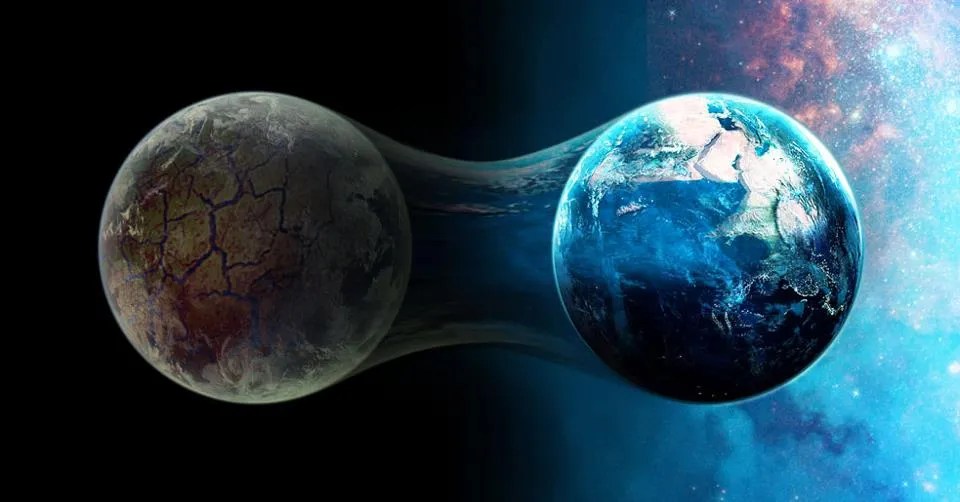
Over the last few decades, many have written about our time as a space where humanity is between worlds. On one hand, we have our current way of life which is incredibly demanding on our minds and bodies, is rather toxic, and filled with conflict and destruction. On the other hand is a vision for a world that’s slower, more connected, more natural, and more loving.

As we navigate what appears to be the dying stages of the old paradigm, the intensity of what it is seems to increase. The qualities of the old system become louder, acting as an evolutionary pressure to push things along.

Many become inspired to explore ways to bring the ‘new world’ to the here and now via their actions.

How do I live without money?
How do I exit the toxicity of our current system?
How do I not participate anymore?

If we aren’t careful, these questions can create a framing of our current world that can make it very hard to live within.

If we deeply judge the need to work, to make money, to pay taxes etc, all of it can become a heavy thing to carry. We end up waking up every day dreading going to work, and having endless conversations, thoughts and emotions about how the bad guys are ruining life for us and we’re the victims in it all.

While there may be truth to some of the observations about our society, the framing of it in our minds is disempowering many of us, and it’s making our current moment dreadful. Further, it holds us back from living and being able to solve the problem.

So how do we work with this? How do we live in the space between worlds?

What Feels Natural To Us?

Indeed, our current societal design is not supportive of human beings thriving. In that sense, it has been poorly designed. We have such an easy time as a species doing this because our higher-order thinking allows us to override what is good for our biology. Simply put: it’s easy to ignore our needs using our thinking, especially when we become so identified with life cognitively.

I have 7 alpacas. The moment they need to poop, they just do it, no thinking, no “I’ll just finish this paragraph,” they just do it. They listen to their biology. Humans on the other hand don’t always listen. In some cases we don’t because we have social structures, social norms, and brains to hold this all together. But we also don’t because we’ve learned to ignore our body, feelings, and emotions in many ways.

While our higher-order thinking is beautiful in one sense, how do we know when it begins to work against us?

I often use an example with friends and clients of a bear. The bear (a mammal like us) was likely raised by an attached parent. It learned how to ‘bear’ and how to be in its environment from that parent in its natural environment. If that bear’s ecosystem was cut down or destroyed by humans, it wouldn’t stay for too long. It would know that concrete, a lack of forest, and a lack of fresh water aren’t good for it, and it would leave to find a suitable home. The bear is simply following its connection to its biology.

We as humans know we are doing this to animals and call it ‘displacing nature/animals.’ Interestingly, we tend to see ourselves ‘outside’ of nature, conveniently ignoring how we’re ‘displacing’ ourselves.

As mentioned, humans are resilient in that we can survive in different environments. We find ways to adjust, cope, and problem solve within environments that are not natural to us. Here I’m not just talking about physical environments but also emotional ones. We find ways to survive in abusive situations for example. We know we should leave, but sometimes we feel we can’t or don’t have the capacity to.

Further, there are difficult elements to our environments like not having access to clean food, clean water, and shelter without having to work very hard to get them.

Because of our amazing thinking brains, humans can do and create incredible things, but we can also become so cognitively and mentally identified that we override our basic biology so much so that we build systems that aren’t attuned to our own well-being.

Thus, humans are currently surviving, but we are in no way thriving. And we did this to ourselves via a disconnection from ourselves.

To be clear, it’s not that we shouldn’t have roads, technology, and societal systems, it’s that they should be designed with human and natural thrivability in mind. Instead, our world is designed with economic thrivability and elite power structures in mind. All at the expense of human wellness.

The tricky part is, that the more people see and experience this truth, the more we can become angered and upset by it. This is fair. A boundary feels crossed because we living now aren’t necessarily the ones who built it or are choosing it. “Why am I subjected to a system I don’t like nor support, yet feel like I can’t escape it?”

As I stated in my essay If No One Wants This, Why Are We Doing It? our way of life doesn’t feel natural to us deep down and it’s overwhelming the challenge is we can’t change it overnight. So what do we do to live within it without driving ourselves mad?

Exploring The Art of Existing Between Worlds

Over the last 15 years exploring alternative thinking and spiritual spaces, I have discovered that it’s common for people to want to fully “exit” the system. They don’t want to integrate, use money, or do anything within the system as they feel it’s “toxic.”

As mentioned, these feelings are somewhat valid, but how we choose to navigate them is everything. Here are a few key observations.

1. Having unprocessed anger, resentment, victimhood and judgment for the system is a recipe for disaster.

If we go to work each day, pay taxes, or drive on highways with the mindset and emotional drive that we are victims and stuck, we will certainly make our lives feel more challenging. Our mental, emotional, physical, and spiritual framing at that point is that of contraction and stuckness. And it’s often built on a nervous system foundation of survival.

Everything will feel much more difficult in this state. Now, this doesn’t mean we can’t observe the state of the world, understand it, and explore how to change it, all of that can be done without getting stuck in mental and emotional traps. But we have to be careful about the general state of mind and being we are taking into our daily lives. Without being aware of this, we give all of our power away to the system and allow it to dictate how we feel.

I’ve watched people panic and freak out about not eating organic apples, yet their mindset and relationship with themselves and the world is creating more toxicity in themselves than a non-organic apple.

When this mindset goes unchecked, our locus of control for our own well-being is outside of us, not inside. (Key note, I’m not suggesting that the system doesn’t have toxic effects on us, I’m saying that there is a space where we can exist within the system with greater wellness.)

Can we begin to see work, life, and what we currently have going as an opportunity? Can we change the lens through which we see it so it doesn’t add to greater dis-ease? Can we support ourselves, our nervous system, and our emotional well-being through practice that helps us build capacity and resilience?

2. Trying to exit completely is incredibly hard, and most end up just as unhappy.

I have found a lot of people trying everything in their power to avoid working and making money. Here I’m not referring to people who are not well or injured and can’t work, I’m talking about folks who can yet have such a degree of judgment toward the system that they avoid being within it.

Often this path leaves people stuck, uninspired, unable to experience much of the world, and unable to even afford fun projects at home. Life begins to become small, and these people rarely seem truly happy.

That said, intentional communities are an interesting path for some. Although they work and exist within the system in more ways than people think. Sure, a few places are fully off grid, but for the most part money, utilities, land purchases, property tax etc, are all part of the mix.

If you don’t have a lot of money, this path is very tough. People can of course move to countries where things are very cheap and start over, but even that is tough for most people as it’s still expensive and work still needs to be found to live well into the future.

1. Exploring capacity and resilience building to exist in our current world and help solve problems within it seems a fruitful path. This includes doing small things within the system to make life more natural.

To me, this is a path that is accessible to most people and provides a meaningful balance of making a difference and enjoying life. I may also be biased toward this as this is the path I’ve chosen and have taught throughout my work since 2009.

For example, I chose to start a company and embrace the world as it was in 2009. I built my business on a foundation of creating an amazing work environment for employees to work, rest, grow, and contribute to a ‘collective evolution.’ Over time, I was able to give back by hiring 14 people to come into this environment of serving something greater than our personal ambitions, yet those were taken care of too.

We did some amazing projects around the world with excess funds, and we helped establish an internet culture of wellness, consciousness and conscious media. If I had kept the system at a distance, those benefits would not have been shared.

Humans have lived for such a long time in unnatural ways, disconnected from ourselves, and not processing our emotions and traumas, our nervous systems hold that history. It is further being re-inforced by the reality that yes, there is toxicity still in our world. It is badly designed.

But still, regulation and capacity at a deep cellular level need to be restored for most of us. We need to clear out the messy stuff. Otherwise, we will take our pains into any revolutionary systems that pops up outside the system anyway. We see this a lot with intentional communities that collapse.

This means focusing on deeply restoring physiological safety, wellbeing, emotional fluidity and regulation is foundational to living well, and it can be done even in the existing system. Even though our system is tough, this path gives us much more energy, resilience and capacity to exist within the system and make as big a difference as possible while enjoying life.

This path is work. It acknowledged that it isn’t easy to feel great in our world due to the poor design, but that it’s still within our capacity if we focus on it.

This doesn’t mean we ignore the need to change or adjust our system. But this path gives us the greatest ability to do so as we will have built the capacity and deep empowerment to actually do it, vs. being feeling stuck, tired and victimized resisting the system so heavily.

Existing in a space between worlds means building individual and collective wellbeing, and creating change along the way. The more resilient we are, the more we can make money and use it as a tool to find ways to make our lives better, less reliant on the system, and healthier.

In that space of wellness, we can have meaningful conversations and learn to hold visions of a future world that isn’t built on hating and resenting the old. If I’m honest, almost all of the successful changes and projects I’ve seen out there have come from this space of being.

In summary, taking stock of whether our observations of the world have become deep disempowering judgements is a worthwhile reflection. Being ‘awake to corruption’ doesn’t have to come with lifelong resentment toward the system, where we comment online about ‘the bad guys’ ruining things for everyone. Or that somehow Biden, Trump, Trudeau etc. are the root of the problems. I hate to say it but, this gets us nowhere.

Questioning whether we are truly living our lives in a way that promotes emotional, physical, and spiritual well-being and expansiveness is important. Without this, our foundation is weak.

The path forward I’m suggesting is one of building enough strength, well-being, and energy to live with wellness in our current system, so we have energy left over to see clearly and act upon changing what is not natural to us. Good sensemaking of our current events goes alongside this, but as you’ll note from my previous work, good sensemaking is built on a healthy nervous system.

How to Navigate Our Low-Trust, Increasingly Dysfunctional Society and Economy

By Charles Hugh Smith

Source: Of Two Minds

Politicians and corporate managers have an enviable record of self-enrichment but very little to show in terms of putting the long-term interests of the citizenry above their own short-term gains.

This week’s focus is on self-reliance, a topic of increasing relevance than is more complex that it may seem.

Sociologists differentiate between high-trust and low-trust societies: in high-trust social orders, citizens tend to trust institutions and each other to conform to social norms, enabling strangers to trust a vast circle of transactions and socio-economic ties. Low-trust societies are plagued with distrust of authority and institutions and fear of getting taken advantage of by strangers, so the circles of trust are small, inhibiting social mobility and economic growth.

Economies and political systems can also be understood as high-trust or low-trust. If the political system excels at rewarding insiders and incumbents while leaving critical problems unsolved, citizens have little reason to trust the system.

The same is true of economies that greatly enrich insiders and incumbents at the expense of the citizenry via monopoly/cartel price-gouging, shrinkflation, degrading the quality of goods and services and the immiseration of standard services, forcing customers to “upgrade” from wretched to merely dismal.

Conventional pundits and economists are constantly whining that Americans “just don’t get it”: they tout our soaring per capita wealth, i.e. we’re getting richer, so everyone should be delighted, yet only 20% of the public are “satisfied with the way things are going.”

What the well-compensated pundits and economists are ignoring (or are paid to ignore) is the decay of the U.S. from a high-trust-functional to a low-trust-dysfunctional society and economy: Americans will still go out of their way to aid strangers, but their trust in institutions has plummeted to lows, as has their trust in the political-corporate elites’ leadership: politicians and corporate managers have an enviable record of self-enrichment but very little to show in terms of putting the long-term interests of the citizenry above their own short-term gains.

People understand the name of the game now is to spout all the expected optimistic PR of “innovation” and “serving the public” while maximizing their private gain at the expense of the nation. Offshoring America’s essential industrial supply chains wasn’t done to serve the nation; it was done to maximize profits, 90% of which flow to the top 10%. Pushing us into debt servitude is highly profitable, but it isn’t benefiting us or the nation.

Americans were told to trust long, hyper-globalized single-source supply chains as “efficient” (i.e. profitable) and trustworthy, yet they’ve discovered these supply chains are vulnerable and fragile. Americans were told that corporate monopolies were selling them “innovations” when in fact they were being sold highly addictive (and therefore highly profitable) goods and services.

Americans were told that their financial security was increasing even as the U.S. economy became increasingly dependent on hyper-financialized asset bubbles and central bank bailouts, the precise opposite of stability. Rather than producing more financial security for the bottom 80%, these “innovations” greatly expanded the gulf between the wealthy and the increasingly precarious bottom 80%.

Americans were told to trust that the hyper-centralization of political and financial power would benefit them, when the evidence is piling up that this hyper-centralization has increased the dysfunction of core institutions and the fragility of essential systems.

Doesn’t it ring hollow to glorify our soaring wealth while households declare bankruptcy due to medical bills, college students sign up for a lifetime of debt servitude to pay tuition and inflation has destroyed 20% of every wage earner’s paycheck just since January 2020? All that “soaring wealth” is asymmetrically distributed, but let’s not talk about that, let’s talk about statistics that mask that asymmetry.

What the well-compensated pundits and economists are paid to ignore is the concentration of the vast majority of all this new wealth and income in the top 10%. Soaring wealth only widens wealth inequality; it doesn’t benefit the nation, it weakens its foundations by accelerating the decay of trust in core institutions and systems.

What happens when high-trust decays to low-trust is the circle of reliable, trustworthy sources and people shrinks to the local, decentralized level. Rather than trust Big Ag, Big Fast-Food and supply chains of highly processed glop to feed us, we start turning to local sources of real food.

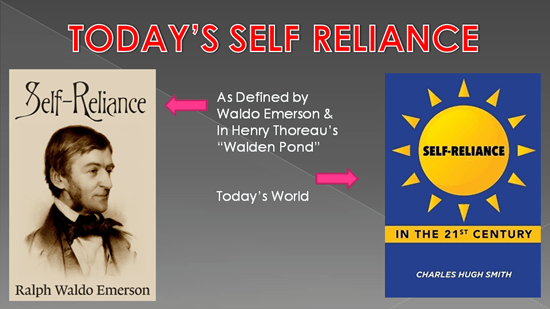
In the same way, we rediscover the value of thinking for ourselves rather than accepting self-serving memes-of-the-day. We rediscover the value of what Ralph Waldo Emerson wrote about in his 1841 essay Self-Reliance (free text, Project Gutenberg).

Emerson counsels us to “be our best selves,” and not to count property wealth above all else. (“They measure their esteem of each other by what each has, and not by what each is.”)

Emerson understood that the values of a society are the foundation of its economic order. A system lacking any principles and values other than greed and self-enrichment is a rotten structure doomed to collapse. It is not just the larger socio-economic order that needs a rock-solid value system; each individual must ground their choices and actions in a value system they have embraced on their own. (“Nothing can bring you peace but yourself. Nothing can bring you peace but the triumph of principles.”)

What Emerson is espousing is self-reliance, in thought, in values, and in economic and financial matters. In today’s world of crumbling hyper-globalization, self-reliance extends to the practical world of where our essential goods and services are coming from.

Gordon Long and I discuss these and many other aspects of Self-Reliance in the 21st Century in our wide-ranging podcast Self Reliance (45 min).

We discuss how the American economy has changed over the past 40 years, to the detriment of the nation’s values and the security of its citizenry, and what self-reliance means today– the topic of my book Self-Reliance in the 21st Century. (Read the first chapter for free.)

How can we best navigate our low-trust, increasingly dysfunctional society and economy? By strengthening our own self-reliance.

What Happened To The Truth Movement?

Over the years many aspects of the “truth movement” have devolved into an insufferable dumpster fire. But we can still salvage it.

By Benny Wills

Source: The Free Thought Project

From 2004 – 2016, I felt like I was a part of something special. I was participating in an “awakening.” The world was changing. Consciousness was shifting. The hidden hand was being exposed and all secrets were being revealed!

Right?

Or maybe it was wishful thinking.

9/11 happened. And for the next decade and a half, people all over the world began to question the events of that day. Then, major events in general. It was the beginning of an uprising. A revolution!

Right…?

Something else emerged during that time. Social media.

Social media has its upsides and downsides. Mostly upsides. But the downsides have serious ramifications. Specifically on communication.

Social media brings us together and tears us apart.

2001: A Truth Odyssey

By 2001, almost everyone was online and connected to the internet. But it was still in its infancy.

The iPhone didn’t exist. There was no YouTube, Facebook, Instagram, or Twitter. Even MySpace wasn’t around yet.

We had access to the internet, but we had no idea what we were in store for.

As the internet expanded, so did our ability to share information.

Alternative perspectives, counter-narratives, and “conspiracy theories” became more accessible. For the first time (possibly) in history, “official stories” were being challenged in real time. With evidence to support claims.

I was dubious about 9/11 as it was happening. Not because of the internet. Not because I was a conspiracy theorist. But because I hated George Bush. As a born and raised Democrat, I didn’t trust him. I was staunchly anti-war (and still am), and I knew America’s response to the attacks was going to be insane.

A few years later, someone shared a documentary with me called Loose Change. A film deconstructing the 9/11 narrative. My mind was blown, and it was off to the races.

Down, Down, Down The Rabbit Hole.

YouTube hit the scene in 2005. I used it strictly for conspiracy-related research.

Conspiracy content blew up online. A truth movement had begun. The masses were on the verge of waking up, well, en masse.

Right?!?!

Divide & Conquer

Fast forward to 2024. I have good news and bad news.

The good news is that more people are questioning things than ever. Distrust in anything mainstream is at an all time high.

The bad news:

Societal division is worse than it’s ever been. In my lifetime anyway. It’s hard to even call it division because division implies splitting into two halves.

This is a direct result of thumb-typed communication. (Generation Text.)

These days, most people prefer texting, emailing, or commenting over direct engagement. We yearn for human connection, but we’ve patterned ourselves to avoid it as much as possible. (I’m speaking generally, of course.)

Confronting someone is uncomfortable. But confrontation is a necessary part of human interaction. It’s a key component in solving conflict or avoiding it altogether. But since it can be terrifying, people today have the easy-out of typing instead of speaking.

Typed communication lacks empathy. It’s indirect. Impersonal. It’s both a barrier and a shield.

So people say things to each other online that they would never say out loud. They rip each other apart over the slightest differences of opinion. Many (especially YouTube commenters) hide behind avatars and pseudonyms to say whatever they want with no accountability.

Basically, everyone has free rein to be an asshole with zero repercussions.

Worst of all, no one is listening to each other anymore.

We haven’t just been divided; we’ve been fractalized into smithereens.

Awake Vs. Woke

The “awake” crowd is as insufferable as the “woke” one. Change my mind.

Mean-spirited mudslinging and public shaming are the online norm.

Checking the timeline on Facebook, for instance, is a disheartening experience.

It’s a daily mélange of proselytizing, bickering, and judging others. The sentiment is “my way or the highway.”

“I’m right, and you’re wrong. And not only are you wrong, you’re also a stupid idiot.”

Many on the alternative or “conspiracy” side of things have fallen into the same trap as the “sheep” they condemn.

Arrogant allegiance to ideas, beliefs, and opinions.

Critical Thinking

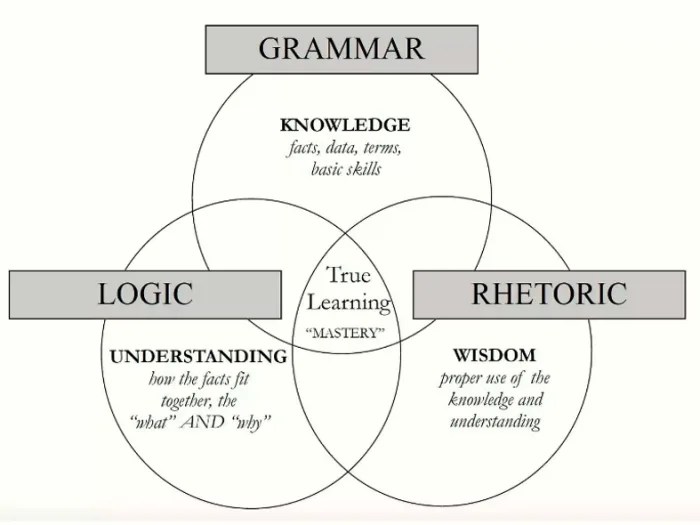
At the height of the truth movement in the 2010s, there was an emphasis on critical thinking. The Trivium was making a comeback.

Grammar, logic, and rhetoric

In that order. 

More often than not, online communication is rhetoric without grammar and logic to back it up.

Sweeping generalizations abound.

  • Accusations
  • Declarations
  • Proclamations
  • & Polarizing opinions disguised as facts

But opinions are not facts. (And you are not your opinions.)

“A great many people think they are thinking when they are merely rearranging their prejudices.” – William James

Social media algorithms are designed to keep you in a feedback loop.

A lot of people use their (typed) voice online to “speak the truth.” But they’re preaching to the choir in an echo chamber.

There’s camaraderie to be found in this. Which is good. But the likelihood of their rantings reaching those who (they feel) need to hear them is small.

The aggression that comes through many posts is ugly and derogatory.

Anger

Anger is a powerful emotion. But it’s like fire. It can warm your house or burn it down.

“Heat not a furnace for your foe so hot that it do singe yourself.” – William Shakespeare

Many people lean on anger to convey their conviction about a topic. They use it to stress the importance of something. But more often than not, it’s ineffective.

Anger is best utilized when it’s the seed preceding something more interesting.

In other words, anger alone is a weak emotion for personal expression.

When anger sparks an idea, and that idea is built upon with clarity and care, the expression of that idea has the power to shift someone’s perspective.

Many of my poems and JoyCamp videos came from an angry place. But anger is nowhere to be found in the final product.

Some think I’m too soft in my approach. Well, they’re welcome to think whatever they want. I’ve learned through trial and error that bluntly and angrily stating “the truth” is a fool’s errand. People don’t want to hear it, no matter how right or passionate you are.

Use anger like clay and sculpt it.

I tried anger in my 20s, and it got me nowhere. If anything, it only made situations worse. Speaking loudly and angrily puts more distance between your conversation partner and the point you want them to understand.

I’m committed to the truth and helping others discover it for themselves. Over the course of 15 years, I developed a nuanced approach to communication that actually works. One that I’ve taught to hundreds of people in my Parrhesia program (now called Free Your Speech).

If you didn’t pull the trigger on Parrhesia when I was offering it live, you can still purchase the course itself.

>>Free Your Speech: The Art of Communication

I’ve dropped the price to $149. It’s an election year. It’s probably worth your while.

Logic

It’s agonizing to witness your friends, family, and society at large fall into what you perceive as traps.

What’s painfully obvious to you is beyond absurd or ridiculous to them. And no matter how much you try to convince them otherwise, they double down on their commitment to the trap.

People are not logical. They’re emotional and motivated by fear, comfort, and ego.

“No one can possibly behave above his own level of understanding. Don’t expect people to do any better than they are compelled to do at their present level. Your problem is assuming that they should and could behave better. Understand this and annoyance disappears. As you gradually awaken you will feel the urge to share your discovery with others. Because you will find others in various stages of receptivity, remember this: Never give more than others can understand and appreciate in the moment. This is cosmic law. To try and give what others cannot receive is like tossing a ball against a brick wall—it bounces back to strike you. Jesus explained this law by saying that we should not cast our pearls before swine; that is, before those whose comprehension of truth makes them indifferent or hostile about it.” – François Fénelon

This is the cornerstone of my communication philosophy and approach.

The Real Awakening

There is no truth movement. There never was. There is only your journey to discovering what the truth is.

Pick your lane and choose your battles wisely.

Worry less about the world and other people’s opinions.

Concern yourself with what you’re capable of. Challenge your comfort zone. And focus your efforts on how you can help.

The most exciting rabbit hole is YOU.

Until next time.

Much love,

Benny

PS- Build Bridges

27 Premises

Silent Assumptions to Drive Systemic Thinking

By J Circio

Source: Modern Mythology

When you derive a conclusion, how do you get there? As you gather facts and pieces of narratives and figure out the picture that the puzzle should be configured into, what assumptions are you making — do you need to make for the sake of expediency, if nothing else — to get there without spending the better part of a lifetime so you no longer require a shortcut?

These are intrinsically generalizations, since they seem to arise from experience such as — if you find blue seashells every time you go to a particular sea shore, you might derive that sea shells are often blue and so come to conclude that is a general rather than local effect.

The following list each contain a brief explanation, and then a few additional comments. More on this in the upcoming Newsletter! (December 2023)

Talk with a GPT instructed to follow these 27 Premises, aka Narrative Machine-139.

1. Simpler is not necessarily more correct; Complicated is not necessarily more correct.

This principle challenges the idea that the truth or correctness of an idea, theory, or system can be judged based on its simplicity or complexity alone. It’s a rebuttal to both any rigid application of Occam’s Razor, which suggests that simpler explanations are generally better, and to the assumption that more complex theories are inherently more sophisticated or accurate simply on account of their complexity.

“Correctness” is question and context dependent, not innate.

2. Simplicity often obscures inner complications… and the inverse is also often true.

This principle underscores the notion that both simplicity and complexity can be misleading in their own ways. A simple explanation might overlook critical nuances, while a complex one might overcomplicate what is fundamentally straightforward.

An important corollary is that looking at a problem with the mindset of optimal complexity, or optimal simplicity, each will bring out some dynamics and minimize or remove others. Ideally, both frames need to be considered, although not always equally weighted.

3. Anything true is likely propped up by unspoken falsehoods. The inverse is sometimes but not always true.

This suggests that truths are often supported by assumptions or beliefs that may not be accurate. It underscores the importance of scrutinizing the underlying assumptions of any ‘truth,’ as well as the extreme difficulty of actually doing so. The inverse — that falsehoods can support truths — is acknowledged as a less common but possible scenario.

Logical relationship is based on assumptions about likeness, mimesis, and consistency with specified rules. In generalized form, it is tautological. This was a major fin de siecle fixation (before WW1), and in many ways historically and culturally, the devastation of that particular apocalypse was a form of answer to the question, in terms of some of the potential outcomes of “applied reason.”

Of that which goes beyond such tautological relationships, to quote Wittgenstein, “we cannot speak.” As he would also later come to recognize, that includes a significant portion of life.

4. Everything is relatively dependent on context; everything is in some sense connected, but not equivalently.

Context is critical in understanding any concept, idea, or system, as the environment in which anything might come to be. This principle aligns with systems theory, where the meaning and function of a component can only be fully understood in relation to the whole system. It also touches on existentialist ideas about individual perception being shaped by one’s unique context, however the emphasis is on the distributed interconnections of systems that actually operate within the world.

Everything is relatively dependent/contingent, and the range of possibilities that exist within those overlapping contexts in a given place and time, which is another way of saying that everything is connected but not equivalent. Your mileage may vary based on the local neighborhood you’re living in, whether that means solar system or city block. The same is likely true regarding time.

5. Time has various senses, such as that which is measured versus that which allows for experience.

This principle integrates ideas from physics and phenomenology. While time has measurable physical properties, our experience of time is subjective and varies based on individual perception and context.

Time can be measured through the entropy in a system, and it can be distorted by mass (4d curvature), but as a field that allows for experience to occur, our experience of time is just another socio-biological construct of our nervous system.

6. There are no first causes. Look instead for drivers of outcomes.

In line with complex systems theory, this principle rejects the notion of an original, singular cause of events, suggesting that causes are themselves effects of prior conditions, forming an interconnected web of causality.

The billiard ball model is oftentimes less salient than the idea of ‘entanglement.’ Attempting to chase that train to its point of origin will invariably lead you back to the big bang, although that neither means that it necessarily started there, or that it was ‘caused’ by it. Rather, if that had not happened, its antecedents would similarly not exist. That is to say the chain is one of contingency and continuity rather than discrete causality.

7. Nothing happens for a “reason”. (Causal syncretism).

This principle challenges the notion of a singular, directed purpose in events, instead favoring a view of causality where events are contingent on preceding conditions, always “reasons” plural. This aligns with complex systems theory, where outcomes are often the result of numerous interacting variables rather than a linear cause-effect relationship.

“It was meant to be.” Only in the sense that everything happens because many other things did or didn’t happen. What can we actually make of this contingency?

8. Meaning is something we project on the world, not the other way around.

This principle reflects the existentialist and constructivist view that meaning is not an inherent property of the world but is either constructed or imagined by individuals through their interactions, experiences, and interpretations.

Meaning is dependent on action and intent. What is the meaning of a rock? What is the meaning of a flower? What is the meaning of that letter you sent to me? Only one of these makes sense. Even the Buddha’s “flower sermon” only makes sense because of the intention behind holding up the flower, even if its specific meaning is enigmatic.

9. Conversely, and yet equally, our meaning is shaped by our being in the world.

Expanding on the previous as a corollary and yet seemingly contradictory point, this principle suggests that our personal meaning is contingent on our interactions with the world around us. There is in fact no contradiction here. This is a phenomenological view, recognizing that our consciousness and perception shape our understanding and meaning-making processes.

Our meaning is shaped by our own being in the world. We are not in any way inseparable from the worlds in which we have been. “Nothing exists within a void.” That also has dual meaning.

10. No point of view, model, or experience can singularly encompass the truth; they can only model it well or poorly, which is to say, be more or less pertinent to the needs of a specific situation.

This aligns with the philosophical understanding that absolute objectivity is unattainable, and in fact incoherent. All perspectives and models are inherently limited by virtue of their very existence, and can only approximate truth within specific contexts.

Those “needs” might be broad or narrow. Relating back to the first Premise, this is a determinative factor when it comes to how to model a situation, how many variables are necessary to track, and how they should be evaluated.

11. Correlation isn’t causation except when it is.

This principle addresses a fundamental concept in statistics and scientific reasoning, emphasizing the distinction between correlation (when two variables are related) and causation (when one variable directly affects another). While correlation does not inherently imply causation, there are instances where a causal relationship does exist, emphasizing the need for careful analysis in understanding relationships between variables.

This impetus to look for the exception to the rule holds true for many other things as well: e.g. The human mind isn’t like a computer… except in the ways it is.

12. Cause is often both partial and plural.

This principle suggests that in many situations, causes are not singular or absolute but are instead multiple and interconnected, each contributing partially to the outcome. It emphasizes a more nuanced understanding of causality that acknowledges the complexity and interdependence of factors in various contexts.

13. Beware false binaries, such as Free Will/Determinism.

This principle emphasizes the importance of recognizing and challenging oversimplified dichotomies, like the free will versus determinism debate. It suggests that such binary oppositions often fail to capture the complexity and nuance of philosophical, scientific, and ethical concepts.

Outcomes are determined within the context of systems, and in that sense nothing exists “outside” of the system including our own volition. We are free to the extent that our available range of choices allow us to be, although those actions are similarly conditioned (and so on down the chain). All parts affect all other parts, if not universally in the same type or measure.

14. Emergent complexity makes determinism problematic, and randomness or order may appear to emerge at certain levels of complexity or scale.

This principle addresses the challenges determinism faces in the context of complex systems, where emergent properties and behaviors can arise unpredictably. It suggests that at different levels of complexity, what may seem random or orderly may be a product of the system’s own inherent complexity. The unpredictability and non-linearity inherent in complex systems, where larger patterns and behaviors emerge from the interactions of simpler components, render deterministic models less applicable or even irrelevant in certain contexts.

Emergent complexity makes determinism not just epistemologically problematic, but also it doesn’t seem to hold between different scales. For example, things may appear more random at certain levels of complexity or scale, and deterministic at others.

15. Taxonomic categories are descriptive, not prescriptive.

This principle suggests that the classifications and categories we use in various disciplines are tools for describing the world, not inherent truths that dictate how the world must be. It aligns with contemporary understandings in linguistics, biology, and social sciences, challenging essentialist and fixed views of categorization.

We cannot learn all we need to know about an entity from its descriptive taxonomy. Language conceals as it reveals. This has cross-domain salience.

16. Fixed reality is always off limits.

This principle suggests that reality is not knowable without introducing some form of extension or abstraction based on our own prior assumptions, our experiences, and is similarly contingent upon the types of experience we can have. This aligns with post-structuralist ideas about the fluidity of meaning and reality.

We are required to look around corners to derive anything about the world we live in. This is at the root of the “problem of language” and representation in western philosophy.

17. Consciousness as we so far know it on earth is an embodied phenomenon.

This principle posits that consciousness may be a fundamentally embodied experience, emerging from the interactions between a living organism and its environment. It suggests that consciousness is not an abstract or detached entity but is intimately connected to the physical and experiential realities of organisms, operating within an environment.

More on this in upcoming notes.

18. Complexity and emergence on their own don’t simply result in capacity for experience.

This principle posits that consciousness arises not merely as a byproduct of complexity, but from a confluence of various factors within a system, leading to emergent phenomena that cannot be predicted solely from the properties of individual components. It emphasizes the role of emergence in the development of consciousness and warns against simplistic, reductionist views.

19. Consciousness may have a plurality of forms.

This principle recognizes the diversity and continuum of consciousness across different life forms, challenging the notion of a singular, universal model of consciousness. It posits that consciousness manifests in various forms, each unique to its bearer’s biological and ecological makeup.

20. The form of embodiment appears to determine cognitive shaping.

This principle acknowledges the significant role of the body in shaping cognition and consciousness, challenging the traditional dichotomy between the self and the external world. It suggests that the form of embodiment — how an entity exists within an existing ecosystem — plays a crucial role in the development and nature of its consciousness.

21. Self is sustained by narrative.

This is influenced by both existentialism and narrative psychology. It posits that our sense of self is constructed through the stories we tell about ourselves and our experiences, highlighting the importance of narrative in identity formation.

In this specific sense, we don’t exist save as a figment of our collective imagination, and the universe is just another such narrative construction, even if what it represents is obviously quite ‘real’ in a sense that none of our stories are. (Real, but singularly unknowable.)

22. Stories collectivize experience.

This aligns with the role of narrative in forming collective identities and shared understandings, a concept central to folklore and myth studies. Stories serve a crucial role in shaping collective understanding, identity, and social cohesion, but they also have the power to enforce and sustain hierarchies, manipulate public opinion, and solidify power structures.

This dual aspect of storytelling reflects its significant influence in societies, capable of both unifying and dividing through the central lie that the signifier is an entity akin to the signified.

23. A group, when regarded as a single entity, is a kind of mental fiction.

This principle acknowledges that while we often conceptualize groups as singular entities, this is a cognitive simplification. Each member of a group retains individuality as actually existing entities, whereas the group identity is an abstract construct.

The singular entities described by a group are not a mental fiction, nor are they usually strictly limited by that definition.

24. Entities are replicated within other minds by way of narrative methods.

This principle reflects the idea that our understanding of others and the world is mediated through the stories we construct and share, highlighting the role of narrative in shaping our understanding and internal representation of entities, whether they are individuals, groups, concepts, or events. It suggests that our mental models of these entities are largely formed and communicated through storytelling and narrative frameworks.

Our experience is direct, certain, and present to ourselves, and to no one else. Language is one of the primary ways that humans attempt to bridge that gap, to maintain the illusion of a society when living in groups far larger than actual kinship groups.

25. Ideology is a form of fashion.

This principle suggests that aesthetics, beyond mere surface beauty, play a significant role in forming ideologies, cultural hierarchies, and power dynamics. It emphasizes that our understanding and interpretation of the world are profoundly influenced by aesthetic values and preferences.

“Aesthetics” as based in the “image”, a field of idealized possibilities and desires that run through the whole of our daily lives, composed among other things of what we want to see and how we want to be seen. Much of our ethics might amount to the attempt to make that idealized vision a reality.

26. Performance is a fundamental aspect of social life.

This principle, drawing from Judith Butler’s concept of performativity and the ideas presented in the excerpt, suggests that performance and performativity are fundamental aspects of social life, shaping and reifying social relations, structures, and ethics. It highlights the dual nature of performance as both a real act in the world and a constructed representation that can distort reality.

This might seem a path through which ethics can be materialized from art — as if by a single work you might write a new Gospel through the act of speaking or writing. There is a danger, however, in misunderstanding the function of performativity.

It is not a process that lends inherent truth to the concepts it conveys, but rather, it creates a semblance of reality, often masking their inherently subjective and contingent nature.

27. Interpretation is in part an act of projection.

This principle reflects the postmodernist view that multiple interpretations of any text or artwork are valid. It acknowledges the intersubjective / co-creative nature of understanding and interpretation.

There is no singularly correct reading of a book, movie, album, meme, piece of street theater. This includes the creator’s reading of their own work. Some are however nearer or further from the mark. (Determined by who or what? There’s the rub).

There’s a deeper level to it. Mythic symbols — like a god such as Dionysus — tend to bear a great deal of resemblance on the people investing attention (manna) into that image. This is true whether that reflection is a positive or negative one. As an embodiment of libidinally repressed “homicidal fury” (in Rene Girdard’s words), to Freud, Dionysus was a threat. To Nietzsche, he came to represent the allure of a kind of revolution of the spirit. To Jung, the potential of casting off restriction seemed most salient. And so on.

It might even seem as if we only see the psychology of the person speaking writ large in their symbols and the stories they make of them. And yet it is not quite so. The fact that they aren’t just a simple mirror is the greater mystery, as there’s a character hiding out there within or perhaps beyond the symbol, or at least a bias or tendency, which exists outside our influence, on the other side of the mirror.

Reading List Recommendations

For more explication in the following, begin with the following list:

Philosophy and Systems Theory:

  • “The Structure of Scientific Revolutions” by Thomas Kuhn — Explores how scientific theories and paradigms evolve and are influenced by historical and social contexts.
  • “The Logic of Scientific Discovery” by Karl Popper — A critical analysis of the philosophy of science, emphasizing the importance of falsifiability in scientific theories.

Complexity Theory and Biology:

  • “Complexity: A Guided Tour” by Melanie Mitchell — Offers an accessible introduction to complexity theory and its applications in various disciplines, including biology and computer science.
  • “The Web of Life: A New Scientific Understanding of Living Systems” by Fritjof Capra — This book delves into the principles of living systems and their relevance to understanding complex biological and ecological networks.

Semiotics and Phenomenology:

  • “Course in General Linguistics” by Ferdinand de Saussure — A foundational text in the study of semiotics, exploring the nature of linguistic signs and their meaning.
  • “Being and Time” by Martin Heidegger — A seminal work in phenomenology, discussing concepts of being, time, and existence.

Existentialism:

  • “Existentialism is a Humanism” by Jean-Paul Sartre — A concise introduction to existentialist philosophy, emphasizing human freedom and responsibility.
  • “On Truth and Lie in a Non-moral Sense” by Friedrich Nietzsche — Examination of several cogent concepts.

Narrative Psychology and Myth Studies:

  • “The Hero with a Thousand Faces” by Joseph Campbell — Examines the common patterns in global myths, highlighting the significance of storytelling in human culture. The monomyth reduces differences and conflates similarities, which poses both a conceptual tool and a potential cognitive risk, if unexamined.
  • “Acts of Meaning” by Jerome Bruner — Explores the role of narrative in shaping human perception, cognition, and culture.

Folklore and Myth Studies:

  • “Mythologies” by Roland Barthes — A collection of essays analyzing modern myths and the semiotics of popular culture.
  • “The Power of Myth” by Joseph Campbell and Bill Moyers — A dialogue exploring the enduring power of myth in human society.

Manuel DeLanda:

  • “A Thousand Years of Nonlinear History” — DeLanda applies the concepts of nonlinearity and self-organization to interpret the course of history, offering a unique perspective on social and biological systems.
  • “Intensive Science and Virtual Philosophy” — This book tackles the topic of virtuality and its relation to reality, emphasizing the role of topological thinking in understanding complex systems.

Jean Baudrillard:

  • “Simulacra and Simulation” — Baudrillard’s exploration of the nature of reality, simulation, and the hyperreal offers critical insights into the impact of media and technology on society.
  • “The Consumer Society: Myths and Structures” — An analysis of consumer culture, exploring themes of consumption, social stratification, and the creation of modern myths.

Peter Godfrey-Smith:

  • “Other Minds: The Octopus, the Sea, and the Deep Origins of Consciousness” — An intriguing exploration of consciousness through the lens of cephalopod intelligence, blending philosophy, biology, and the study of the mind.
  • “Metazoa” — extends this exploration into the history of evolution beyond cephalopods.
  • “Theory and Reality: An Introduction to the Philosophy of Science” — This book provides an accessible introduction to the main themes in the philosophy of science, from logical positivism to scientific realism and antirealism.

John Gray:

  • “Straw Dogs: Thoughts on Humans and Other Animals” — Gray challenges the commonly held beliefs about what it means to be human, questioning humanism and our perceptions of human progress.
  • “The Silence of Animals: On Progress and Other Modern Myths” — A contemplative work that critiques the idea of human progress and explores the value of contemplating the world beyond human-centric narratives.

Additional Recommendations:

  • “Narrative Machines: Modern Myth, Revolution & Propaganda” by James Curcio — This work examines the role of narrative and myth in shaping cultural and political realities.
  • “Nonzero: The Logic of Human Destiny” by Robert Wright — An exploration of cultural evolution, arguing that human history is marked by a trend toward increased complexity and cooperation.
  • “Chaos: Making a New Science” by James Gleick — A seminal work on chaos theory, illustrating how the principles of chaos are evident in various scientific disciplines.
  • “The Postmodern Condition: A Report on Knowledge” by Jean-François Lyotard — This book examines the status of knowledge in the computerized societies of the West and the legitimization of knowledge in the postmodern era.
  • “The Spell of the Sensuous: Perception and Language in a More-Than-Human World” by David Abram — An examination of the relationship between human perception, language, and the natural world, advocating for a more ecologically attuned way of living.
  • “The Society of the Spectacle” by Guy Debord — A critical theory of media and consumer culture, examining the ways in which reality is constructed and consumed.
  • “Finite and Infinite Games” by James P. Carse — Explores the concept of life as a series of games, each with different rules and outcomes, influencing our perception of identity and reality.

This Is Not Freedom, America: The Profit Incentives Driving the American Police State

By John & Nisha Whitehead

Source: The Rutherford Institute

“When plunder becomes a way of life for a group of men in a society, over the course of time they create for themselves a legal system that authorizes it and a moral code that glorifies it.” ― Frédéric Bastiat, French economist

Pay no heed to the circus politics coming out of Washington DC. It’s just more of the same grandstanding by tone-deaf politicians oblivious to the plight of the citizenry.

Don’t allow yourselves to be distracted by the competing news headlines cataloging the antics of the ruling classes. While they are full of sound and fury, they are utterly lacking in substance.

Tune out the blaring noise of meaningless babble. It is intended to drown out the very real menace of a government which is consumed with squeezing every last penny out of the population.

Focus instead on the steady march of the police state at both the national, state and local levels, and the essential freedoms that are being trampled underfoot in its single-minded pursuit of power.

While the overt and costly signs of the despotism exercised by the increasingly authoritarian regime that passes itself off as the United States government are all around us—warrantless surveillance of Americans’ private phone and email conversations by the FBI, NSA, etc.; SWAT team raids of Americans’ homes; shootings of unarmed citizens by police; harsh punishments meted out to schoolchildren in the name of zero tolerance; drones taking to the skies domestically; endless wars; out-of-control spending; militarized police; roadside strip searches; privatized prisons with a profit incentive for jailing Americans; fusion centers that collect and disseminate data on Americans’ private transactions; and militarized agencies with stockpiles of ammunition, to name some of the most appalling—you rarely hear anything about them from the politicians, the corporations or the news media.

So what’s behind the blackout of real news?

Surely, if properly disclosed and consistently reported on, the sheer volume of the government’s activities, which undermine the Constitution and dance close to the edge of outright illegality, would give rise to a sea change in how business is conducted in our seats of power.

Yet when we’re being bombarded with wall-to-wall news coverage and news cycles that change every few days, it’s difficult to stay focused on one thing—namely, holding the government accountable to abiding by the rule of law—and the powers-that-be understand this.

As with most things, if you want to know the real motives behind any government program, follow the money trail.

When you dig down far enough, you quickly find that those who profit from Americans being surveilled, fined, scanned, searched, probed, tasered, arrested and imprisoned are none other than the police who arrest them, the courts which try them, the prisons which incarcerate them, and the corporations, which manufacture the weapons, equipment and prisons used by the American police state.

These injustices, petty tyrannies and overt acts of hostility are being carried out in the name of the national good—against the interests of individuals, society and ultimately our freedoms—by an elite class of government officials working in partnership with megacorporations that are largely insulated from the ill effects of their actions.

Everywhere you go, everything you do, and every which way you look, we’re getting swindled, cheated, conned, robbed, raided, pickpocketed, mugged, deceived, defrauded, double-crossed and fleeced by governmental and corporate shareholders of the American police state out to make a profit at taxpayer expense.

Not only are Americans forced to spend more on taxes than the annual financial burdens of food, education and clothing combined, but we’re also being played as easy marks by hustlers bearing the imprimatur of the government.

Examples of this legalized, profits-over-people, government-sanctioned extortion abound.

On the roads: Not satisfied with merely padding their budgets by issuing speeding tickets, police departments have turned to asset forfeiture and speeding and red light camera schemes as a means of growing their profits. Despite revelations of corruption, collusion and fraud, these money-making scams have been being inflicted on unsuspecting drivers by revenue-hungry municipalities. Now legislators are hoping to get in on the profit sharing by imposing a vehicle miles-traveled tax, which would charge drivers for each mile behind the wheel.

In the prisons: States now have quotas to meet for how many Americans go to jail. Increasing numbers of states have contracted to keep their prisons at 90% to 100% capacity. This profit-driven form of mass punishment has, in turn, given rise to a $70 billion private prison industry that relies on the complicity of state governments to keep the money flowing and their privately run prisons full, “regardless of whether crime was rising or falling.” As Mother Jones reports, “private prison companies have supported and helped write … laws that drive up prison populations. Their livelihoods depend on towns, cities, and states sending more people to prison and keeping them there.” Private prisons are also doling out harsher punishments for infractions by inmates in order to keep them locked up longer in order to “boost profits” at taxpayer expense. All the while, prisoners are being forced to provide cheap labor for private corporations. No wonder the United States has one of the largest prison populations in the world.

In the schools: The public schools have become a microcosm of the total surveillance state which currently dominates America, adopting a host of surveillance technologies, including video cameras, finger and palm scanners, iris scanners, as well as RFID and GPS tracking devices, to keep constant watch over their student bodies. Likewise, the military industrial complex with its military weapons, metal detectors, and weapons of compliance such as tasers has succeeded in transforming the schools—at great taxpayer expense and personal profit—into quasi-prisons. Rounding things out are school truancy laws, which come disguised as well-meaning attempts to resolve attendance issues in the schools but in truth are nothing less than stealth maneuvers aimed at enriching school districts and court systems alike through excessive fines and jail sentences for “unauthorized” absences. Curiously, none of these efforts seem to have succeeded in making the schools any safer.

In the endless wars abroad: Fueled by the profit-driven military industrial complex, the government’s endless wars are wreaking havoc on our communities, our budget and our police forces. Having been co-opted by greedy defense contractors, corrupt politicians and incompetent government officials, America’s expanding military empire is bleeding the country dry at a rate of more than $93 million per hour. Future wars and military exercises waged around the globe are expected to push the total bill upwards of $12 trillion by 2053.  Talk about fiscally irresponsible: the U.S. government is spending money it doesn’t have on a military empire it can’t afford. War spending is bankrupting America.

In the form of militarized police: The Department of Homeland Security routinely hands out six-figure grants to enable local municipalities to purchase military-style vehicles, as well as a veritable war chest of weaponry, ranging from tactical vests, bomb-disarming robots, assault weapons and combat uniforms. This rise in military equipment purchases funded by the DHS has, according to analysts Andrew Becker and G.W. Schulz, “paralleled an apparent increase in local SWAT teams.” The end result? An explosive growth in the use of SWAT teams for otherwise routine police matters, an increased tendency on the part of police to shoot first and ask questions later, and an overall mindset within police forces that they are at war—and the citizenry are the enemy combatants. Over 80,000 SWAT team raids are conducted on American homes and businesses each year. Moreover, government-funded military-style training drills continue to take place in cities across the country.

In profit-driven schemes such as asset forfeiture: Under the guise of fighting the war on drugs, government agents (usually the police) have been given broad leeway to seize billions of dollars’ worth of private property (money, cars, TVs, etc.) they “suspect” may be connected to criminal activity. Then—and here’s the kicker—whether or not any crime is actually proven to have taken place, the government keeps the citizen’s property, often divvying it up with the local police who did the initial seizure. The police have actually being trained in seminars on how to seize the “goodies” that are on police departments’ wish lists. According to the New York Times, seized monies have been used by police to “pay for sports tickets, office parties, a home security system and a $90,000 sports car.”

By the security industrial complex: We’re being spied on by a domestic army of government snitches, spies and techno-warriors. In the so-called name of “precrime,” this government of Peeping Toms is watching everything we do, reading everything we write, listening to everything we say, and monitoring everything we spend. Beware of what you say, what you read, what you write, where you go, and with whom you communicate, because it is all being recorded, stored, and catalogued, and will be used against you eventually, at a time and place of the government’s choosing. This far-reaching surveillance, carried out with the complicity of the Corporate State, has paved the way for an omnipresent, militarized fourth branch of government—the Surveillance State—that came into being without any electoral mandate or constitutional referendum. That doesn’t even touch on the government’s bold forays into biometric surveillance as a means of identifying and tracking the American people from birth to death.

By a government addicted to power: It’s a given that you can always count on the government to take advantage of a crisis, legitimate or manufactured. Emboldened by the citizenry’s inattention and willingness to tolerate its abuses, the government has weaponized one national crisis after another in order to expand its powers. The war on terror, the war on drugs, the war on illegal immigration, asset forfeiture schemes, road safety schemes, school safety schemes, eminent domain: all of these programs started out as legitimate responses to pressing concerns and have since become weapons of compliance and control in the police state’s hands. Now that the government has gotten a taste for flexing its police state powers by way of a bevy of COVID-19 lockdowns, mandates, restrictions, contact tracing programs, heightened surveillance, censorship, overcriminalization, etc., “we the people” may well find ourselves burdened with a Nanny State inclined to use its draconian pandemic powers to protect us from ourselves.

This perverse mixture of government authoritarianism and corporate profits has increased the reach of the state into our private lives while also adding a profit motive into the mix. And, as always, it’s we the people, we the taxpayers, we the gullible voters who keep getting taken for a ride by politicians eager to promise us the world on a plate.

This is a far cry from how a representative government is supposed to operate.

Indeed, it has been a long time since we could claim to be the masters of our own lives. Rather, we are now the subjects of a militarized, corporate empire in which the vast majority of the citizenry work their hands to the bone for the benefit of a privileged few.

Adding injury to the ongoing insult of having our tax dollars misused and our so-called representatives bought and paid for by the moneyed elite, the government then turns around and uses the money we earn with our blood, sweat and tears to target, imprison and entrap us, in the form of militarized police, surveillance cameras, private prisons, license plate readers, drones, and cell phone tracking technology.

With every new tax, fine, fee and law adopted by our so-called representatives, the yoke around the neck of the average American seems to tighten just a little bit more.

All of those nefarious deeds by government officials that you hear about every day: those are your tax dollars at work.

It’s your money that allows for government agents to spy on your emails, your phone calls, your text messages, and your movements. It’s your money that allows out-of-control police officers to burst into innocent people’s homes, or probe and strip search motorists on the side of the road. And it’s your money that leads to Americans across the country being prosecuted for innocuous activities such as growing vegetable gardens in their front yards or daring to speak their truth to their elected officials.

As I make clear in my book Battlefield America: The War on the American People and in its fictional counterpart The Erik Blair Diaries, this is not freedom, America.

“Bidenomics” Is A Fraud Based On Deliberately Misrepresented Stats

By Brandon Smith

Source: Alt-Market.us

Economic issues are some of the most politically abused issues often because the data politicians exploit is easy to present out of context. The vast majority of the public doesn’t spend their time immersed in the intricacies of monetary policy, unemployment stats and the processes of inflation vs deflation. They hear a soundbite on the news or social media once in a while, assume it must be true and then go on with their day.

This is how economic crisis events always seem to take the population by surprise – The establishment tells people all is well and no one questions the narrative in the face of numerous warning signs. Sometimes, the populace continues to believe that everything is fine despite the financial framework burning down around them, all because the “experts” continue to convince them that recovery is “right around the corner.”

There are numerous incentives for government officials and mainstream economists to mislead the citizenry with tales of imminent prosperity in the midst of instability. Primarily, the goal is to keep the middle-class population as docile as possible so that they don’t revolt until it’s too late (the middle class being predominantly conservative, and the greatest threat to any corrupt regime). Understand that economics is the root of power, and economic perception is the key to influencing the masses.

Hidden Indicators And Rampant Money Printing

The reality is that the US was hurtling towards stagflationary disaster ever since the crash of 2008, when Barack Obama and Joe Biden (with the help of the Federal Reserve) oversaw the near doubling of the national debt from $10 trillion to almost $20 trillion – The most egregious abuse of monetary policy that the US had ever seen.

And, keep in mind this was only the officially reported cash. Because of pressure brought by people like Ron Paul in 2011, the government was forced to pursue a limited audit of the Federal Reserve bailouts at that time. This revealed at least $16 trillion created from nothing by the Fed to prop up the failing system.

In 2006, right before the derivatives collapse, the Federal Reserve conveniently and abruptly ended their M3 money supply report. They now only report the M2 money supply, which does not include the vast assets held in corporate coffers, large time deposits in banks, institutional money market funds, short-term repurchase agreements (repo), and larger liquid assets. It was as if they knew an inflationary event was about to take place and they needed to obscure the evidence.

In other words, in economics there is the “official government data” and then there is the REAL data, which is sometimes so hidden it is impossible to quantify.

Even if we only go by the M2 report, the money supply skyrocketed starting in 2020, and rose exponentially through 2021 and 2022 – It jumped by 40% in only two years. This is why the cost of most necessities has risen 25% or more.

I’m sure most readers have noticed that inflation is not going away despite Joe Biden’s claims that he has “cut inflation in half” under his “Bidenomics” plan. This is because inflation is cumulative. The CPI might fluctuate, but the effects of inflation remain as prices tend to increase and stay high perpetually.

There Is No Such Thing As “Bidenomics”

The supposed financial progress that Biden is trying to take credit for has nothing to do with Biden’s policies. Not a thing. Unless, of course, you count market manipulation as a positive.

For example, the reduction in CPI is directly related to the continuous interest rate hikes of the Federal Reserve, which Biden has zero control over. The Fed is autonomous and makes its decisions independent of the White House or government. This is a fact openly admitted by former chairman Alan Greenspan. When the fed raises rates, debt becomes more expensive, lending slows down and thus the economy slows down.

One of the only ways that Biden can influence CPI is through artificial deflation of energy prices. The Biden Administration has been dumping US strategic oil reserves on the market for the past year as a means to suppress oil prices, thereby directly and indirectly keeping the CPI numbers down. This is not progress, it’s economic fraud.

The misuse of stats extends to other sectors, such as Biden’s attempt to take credit for the recent reduction in the US deficit. Again, this has nothing to do with Biden; the Fed’s interest rate hikes make it more expensive for the government to take on debt, therefore, debt spending drops.

It’s also not a situation that signals a recovery in the economy – The Fed continues to hike rates supposedly to stall inflation, but higher rates in a debt heavy environment lead to inevitable deflationary upheaval. As I predicted a year ago, the Fed is continuing to increase interest rates until this happens.

Employment Miracle Or Employment Scam?

This issue has been brought up by many analysts but I’ll touch on it again here because Biden is relentless in his falsehoods when it comes to employment data. FACT: 72% of all “new jobs” Biden takes credit for were originally lost during the pandemic lockdowns. The very lockdowns which Democrats avidly enforced and tried to keep in place perpetually. You can’t take credit for “creating” jobs that you are responsible for destroying.

In terms of higher labor demand, the pressure is in low wage service sector jobs and these are the majority of jobs added since Biden took office. And, this rush into retail/service was purchased with $8 trillion+ in covid stimulus cash along with a moratorium on rent and student loan payments. That much extra money in circulation buys at least a few years of consumer spending, propping up jobs numbers.

Throughout history, such gains from inflationary actions and government interventions are always short term, and they always end with a dramatic plunge in employment once the effects subside.

Biden’s Fake Manufacturing Boom

Biden has recently touted a jump in US manufacturing as the latest achievement of Bidenomics, but like every other claim he makes, you have to look at the context. These are not free market manufacturing facilities built according to market demand. Rather, Biden is pumping billions of taxpayer dollars into green tech, once again artificially engineering a “manufacturing boom” through government subsidies for products that have limited demand.

Biden wants to rig the demand, too, by enforcing climate laws which make gas, oil and coal sources too expensive and solar panels and wind turbines cheaper by comparison. For example, Biden is increasing costs for oil and gas exploration on federal lands, while greatly lowering the prices for building solar farms on federal lands. In other words, the government uses your money to create factories for green tech and then creates laws which force people to use that green tech.

In the meantime, Joe’s manufacturing “boom” paid for with tax dollars also comes at the cost of America’s oil, gas and coal industries, not to mention less energy freedom for the general public. It’s socialism, not a revolution in domestic manufacturing.

For Biden, The Key Is To Create As Many Government Cash Injections As Possible Until 2025

You want to know why Democrats are so angry that the Supreme Court blocked Biden’s plan to make taxpayers cover student loan debts? It’s not because they care about naive college kids who paid too much money for garbage degrees – It’s because student debt relief would immediately add trillions more in spending in the short term to the US economy.

An interesting side effect of the college loan moratorium is the surprising credit boost – As soon as college loan payments were put on hold, millions of former students had their credit ratings increase by default. Meaning, they could now hike their credit limits and spend MORE money they don’t have. It’s an incredibly sneaky way to artificially prop up the system WITHOUT using direct stimulus measures that rely on the central bank. This false boost will disappear by October of this year.

Biden’s constant attempts to introduce infrastructure programs are another way the government can create the illusion of recovery by using debt spending as a means to mitigate the signals of greater fiscal decline. Without Fed stimulus it’s the only option Biden has, and as rates rise it becomes costly.

The bottom line is this – The US economy is on a short timetable as long as the Fed continues to raise interest rates into weakness as a means to suppress inflation. As we witnessed in the spring, higher rates are already breaking the back of mid-tier banks across the western world and the Fed’s backstop funds are only enough to stall the debt crisis for a time. I continue to predict that once the Fed Funds Rate is raised to 6% or more, we will once again see a banking calamity similar to the 2008 crash, but this time if the Fed steps in with a bailout hyperinflation will be the immediate result.

Bidenomics is a sham in every respect. Anything that could be considered an economic improvement is due to the Federal Reserve playing the odds with interest rates. A massive 40% increase in the money supply sure helps in obscuring fiscal weakness as well. Luckily, nearly 60% of Americans in recent polls say they aren’t buying the Bidenomics fairytale – They see the dangers around them every day.

The covid event was a catalyst that revealed all the weaknesses of the US system that many of us in alternative economics have been warning about for years. And now it seems as if the establishment is trying to drag things along for just a little while longer. The reason why is up for speculation, but the fact remains that a broken structure cannot be propped up with stop gaps. I’m doubtful that Biden will be able to ride the wave created by covid stimulus until the end of 2024. Something has to give.

Your Efforts Make A Difference, And We Can Win This Thing

By Caitlin Johnstone

Source: CaitlinJohnstone.com

We can win this thing and create a healthy, harmonious world, and the work each of us does to help bring this about makes a real difference. The more I observe and learn about human behavior, the more convinced of this I become.

Let me explain.

Every positive change in human behavior is always preceded by an expansion of consciousness. This is true whether you’re talking about positive behavioral changes in an individual or in a collective.

By “expansion of consciousness” I mean an increase in awareness — someone or a group of someones becoming more aware of something than they previously were:

  • Someone gaining a new perspective on the forces within themselves which drive them to seek out dysfunctional relationships.
  • An addict becoming more conscious of the inner dynamics that compel them to use.
  • A victim of abuse realizing that abuse is happening, and that a better life is possible, and that they deserve it.
  • A community becoming aware that their clergy have been sexually abusing children.
  • The US civil rights movement making Americans more aware of the injustice and destructiveness of racism.
  • Increased literacy and a greater ability to distribute the written word giving society a greater hunger for freedom and democracy and less tolerance for overt tyranny.
  • Etc.

Conditions don’t get better until the forces which give rise to them are clearly seen and understood. This movement from the darkness of unconsciousness into the light of awareness can create the illusion that things are getting worse, because they turn up so much ugliness.

After the 1955 lynching of Emmett Till, his mother made the decision to hold an open-casket funeral to expose the world to the cruelty that black Americans were being subjected to by showing his mutilated body to the public. In that moment it looked like the world was being made more ugly, because an ugliness that had previously gone unseen by many people was being published in papers across the country. But it was later said that “The open-coffin funeral held by Mamie Till Bradley exposed the world to more than her son Emmett Till’s bloated, mutilated body. Her decision focused attention on not only American racism and the barbarism of lynching but also the limitations and vulnerabilities of American democracy.”

Similarly, the dawn of the internet has turned up a tremendous amount of ugliness and cruelty that had previously gone unseen and unknown to most people. This can lead to the mistaken impression that the internet itself is making people more cruel and ugly than they previously were, but it isn’t. It’s just turning up humanity’s longstanding inner demons that had previously functioned solely in the dark.

It looks ugly, it moves in a sloppy, clumsy, two-steps-forward-one-step-back shamble, but human consciousness is undeniably expanding. We’re getting so much better at sharing ideas and information with each other that we’ve arguably changed more as a species in the last thirty years than we did in the previous thirty centuries. We might outwardly look similar to the way we looked in our grandparents’ time, but billions of human brains connected to each other through the internet is something that is wildly unprecedented in the entire history of our species. Nothing like this has ever happened before.

So humanity is indisputably becoming more conscious, as awkward and sloppy as our situation looks right now. We’re becoming more and more aware of the problems our species faces, and our rulers are having to do more and more work to pull the wool over our eyes and keep us marching in a way that is convenient to them.

Police brutality. The abuses of Israeli apartheid. The agony of poverty. The ravages of ecocide. The ways we’ve been deceived and manipulated by the mass media. People are becoming more and more aware of these things than they used to be, because the truth about them is suddenly vastly more visible now than it previously was.

And what’s exciting is that we all have the ability to participate in, and facilitate, this expansion of consciousness. We each have the ability to help humanity become more conscious in our own small way, thereby bringing us that much closer to a positive shift in our collective behavior.

Anything you can do to help make humanity a little more aware of the abusive nature of the systems which drive the problems we now face makes a difference, even if it’s a difference as small as making one single person a little bit more aware of one specific aspect of the tyranny we’re being subjected to. It doesn’t make a huge difference, but it does make a difference. And as long as it makes the slightest bit of difference, it is worth doing, because a lot of slight differences adds up to a massive difference. And there are a whole lot of people who have the ability to do this.

What this means is that we each have the ability to directly and meaningfully participate in the creation of a healthy world, because we are each able to directly and meaningfully advance the only factor that ever leads to positive changes in human behavior. We can do this through the new technologies which have expanded humanity’s ability to share ideas and information like videos, blogs, podcasts, tweets and memes, and we can do this through older means like holding demonstrations, creating art, distributing literature, writing messages on walls, and just having conversations.

Anything you can do to help people become more aware of injustice, abuses, propaganda and tyranny, whether in your own community or in the world, makes a difference. Does this mean you will single-handedly save the day like the protagonist in a Hollywood movie? No. That’s not how real change happens, and it never has been. Real change is the result of sustained efforts of many, many people whose individual actions could never achieve much on their own.

I think the protagonist-driven storytelling models humanity uses in its legends, folk tales, novels and films often plays an unwholesome role in distorting people’s expectations about the efficaciousness of their own individual actions. Those storytelling models are designed to appeal to the human ego, which gets a tremendous amount of energy and attention in this particular slice of spacetime, but they are not accurate representations of the way real change actually happens in real life. In real life, change happens because a great many people put their shoulders up against the change that was needed and shoved in the required direction.

So that’s what we can all do: we can all lean our shoulders into the expansion of human consciousness and shove. Spread awareness of what’s going on in the world, make people more aware that we’re all being deceived and manipulated at mass scale, and help people to see that a better world is possible. The more people open their eyes to what’s happening, the more shoulders there are to help join in our collective shove toward consciousness.

Ultimately what we’re looking at is humanity’s journey toward becoming a conscious species. One that’s no longer driven by unconscious animal impulses and the flailings of illusory egoic constructs in our psyches, and is instead driven by a lucid perception of reality and a desire for the greater good of all beings.

We can all play a role in this achievement, both by expanding our own consciousness as far as it can go by bringing clarity to our own minds, our own worldviews and our own inner processes, and by helping others to become more aware of the world around them. It won’t often unfold in a way that is elegant and linear and egoically pleasing, but it will unfold. And if it unfolds enough, positive change becomes inevitable.

THE BATTLE AGAINST BEWITCHMENT: UPSETTING SETTLED MINDS

By Gary Z McGee

Source: Waking Times

“Philosophical thinking that doesn’t do violence to one’s settled mind is no philosophical thinking at all.” ~Rebecca Goldstein

Comfort zones are a curious thing. So warm and secure. So safe and reassuring. So satisfying and certain. Beliefs have a similar effect on us. Especially the core beliefs that we take for granted. But beliefs are comfort zones with reinforced invulnerability; or, at least, the illusion of it.

Such reinforcements are like prison bars that most of us are not even aware of. We’re so completely indoctrinated, so utterly pre-programmed, that we don’t even know that we don’t know that we’ve been conditioned to blindly believe in something simply because enough people convinced us it was true.

The problem with reinforced comfort zones is that there is no growth. A regular comfort zone, you can stretch. A reinforced comfort zone, you’re usually not even aware it needs to be stretched. A regular comfort zone allows for trial and error, it allows for questioning, and so there is at least potential for self-improvement and self-overcoming. But a reinforced comfort zone does not allow for trial and error. It doesn’t allow for “blasphemous” questioning, because it is taken for granted as already perfect or “simply the way it is.”

Regular comfort zones can be healthy, giving us a safe haven, a place where we can heal and lick our wounds. But reinforced comfort zones are unnecessary safety nets based upon fear (of God, the Unknown, Death) placation, and self-pity. It’s a place where cognitive dissonance rules and any notion of attempting to think outside the box is met with: You simply need to have faith in the “box”.

The Battle Against Bewitchment:

Philosophy is a battle against the bewitchment of our intelligence by means of language.” ~Ludwig Wittgenstein

Self-Inflicted Philosophy is at the forefront of the battle against bewitchment. Self-inflicted philosophy is about upsetting settled minds. It’s about toppling the reinforced comfort zones of blind belief. It’s about flattening the “box” that everyone talks a big game about thinking outside of but when it really comes down to it, they cling to the “box” out of fear of the unknown or out of faith in what they believe they know.

Foremost, self-inflicted philosophy is about questioning the self to the nth degree through self-interrogation. But you can only get so far in such questioning before you are met with the reinforced comfort zone of a blind belief. So, self-inflicted philosophy is also about questioning the layer-upon-layer of cultural, political, and religious indoctrination that led to that reinforced comfort zone to begin with.

When you don the cloak of a self-inflicted philosopher, no belief, no matter how true it may seem, is off the hook for being questioned with ruthless skepticism and unwavering circumspection. In the battle against bewitchment, the destruction of a belief, no matter how powerful, is mere collateral damage to the Occam’s razor of universal truth. Hell, even “universal truth” is not beyond questioning.

When you don the cloak of a self-inflicted philosopher, the concept of belief is nixed from your interpretation of the universe. There is no place for belief here, only thought, only deep inquiry, only imaginative curiosity. You replace all usage of “belief” or “believe” with “thought” or “think”. You don’t believe that you certainly exist, you “think” that you “probably” exist. But you could be wrong. So you remain circumspect, for even your interpretation of your own existence could be an illusion, no matter how “true” it may feel.

There will be those who will say, “You are merely believing that you don’t believe.” But that is patently false, because you are not “believing” in non-belief, you are “thinking/inquiring/imagining” through non-belief, with the understanding, the flexibility that your thinking “could” be wrong. And that’s the rub: it is much easier to alter a thought than a belief. It is almost impossible to alter a belief. You are more likely to question a thought than you are a belief. And so, rather than get trapped in a reinforced comfort zone, you stay ahead of the curve by thinking rather than believing, and then by questioning what you think so that you don’t accidentally begin to believe it.

In the spirit of upsetting settled minds, you don’t believe in having an unsettled mind, you think that having an unsettled mind is more productive, more progressive, and more open-minded than having a settled mind (an unquestioning belief). You realize that belief in general is counterproductive, because you understand that the human mind is a delusion-generator rather than a truth-generator. It pumps out delusions like a spider pumps out webs. But, unlike the spider, it tends to get caught in them. Thereby, you understand that the only window to truth is through a questioning, circumspect, and a skeptical mindset, rather than through an unquestioning, dogmatic, and certain mindset.

The only solution to a delusion-generator is a question-generator. Luckily, the human brain is both. As a self-inflicted philosopher, you don’t believe that this is certainly true; rather, you think that this is probably true. And you’re willing to question everything to “prove” it. Indeed, you’ve transformed Descartes’ “I think therefore I am” into I think, therefore I question.

Tapping into the question-generator:

“It is far better to grasp the universe as it really is than to persist in delusion, however satisfying and reassuring.” ~Carl Sagan

The problem with the human brain is that is never knows when it has been duped by a delusion, so it is almost always better to not believe anything just in case it’s a delusion. A kind of reverse Pascal’s Wager. It’s almost always better to, as Aristotle suggested, “entertain a thought without accepting it.” Just take it all into consideration and let it pass through the sieve of probability. Then, whatever doesn’t insult your soul, think about it, dissect it, inquire about it. Be curious about it. Just don’t make the mistake of believing it.

You are more likely to grasp the universe “as it really is” by questioning it than by believing it. You don’t believe the universe is certainly a certain way; rather, you think the universe may be a certain way, but you’re willing to question further so as to get you closer to the way the universe “really is”. If you cling to a particular belief of how the universe is, then you block yourself from ever getting closer to the universe “as it really is.” Better to simply not have a belief in the first place. Better to simply think and keep the motor running on the question-generator so as to keep the delusion-generator in check.

The opposite of belief is neither disbelief nor doubt, but clarity of a thought. Without beliefs reinforcing the comfort zone, you are liberated to stretch it. You are clear enough to think outside it, you are courageous enough to question it. When the reinforcements fall away, the comfort zone becomes a sacred rather than stagnant place. It is free to grow through self-improvement rather than remain stuck in self-reassurance. Indeed, without beliefs cluttering the mindset, you’re finally able to drop the “set” and move into “mind.”

Free of the “mindset” of a settled mind, you move into the mindfulness of a questioning mind. You become a walking, talking, question-generator, able to consistently counter-balance the delusion-generator of the human condition. You’re ahead of the curve, surfing Aslam’s Infinite Circle on the surfboard of Occam’s razor. In absolute awe over the beautiful unfolding of an ultimately unknowable universe. On the edge of your own curiosity, questioning all “answers” countering all beliefs, elusive of all delusions. You’re a self-inflicted philosopher, and not even God is safe from your ruthless inquiry.