This Chart Defines the 21st Century Economy

By Charles Hugh Smith

Source: Of Two Minds

There is nothing inevitable about such vast, fast-rising income-wealth inequality; it is the only possible output of our financial and pay-to-play political system.

One chart defines the 21st century economy and thus its socio-political system: the chart of soaring wealth/income inequality. This chart doesn’t show a modest widening in the gap between the super-wealthy (top 1/10th of 1%) and everyone else: there is a veritable Grand Canyon between the super-wealthy and everyone else, a gap that is recent in origin.

Notice that the majority of all income growth now accrues to the the very apex of the wealth-power pyramid. This is not mere chance, it is the only possible output of our financial system. This is stunning indictment of our socio-political system, for this sort of fast-increasing concentration of income, wealth and power in the hands of the very few at the top can only occur in a financial-political system which is optimized to concentrate income, wealth and power at the top of the apex.

Well-meaning conventional economists have identified a number of structural causes of rising wealth/income inequality, dynamics that I’ve often discussed here over the past decade:

1. Global wage arbitrage resulting from the commodification of labor, a.k.a. globalization

2. A winner-takes-most power law distribution of the gains reaped from new technologies and markets

3. A widening mismatch between the skills of the workforce and the needs of a rapidly changing economy

4. The concentration of capital gains in assets such as high-end real estate, stocks and bonds that are owned almost exclusively by the top 10% of households

5. The long-term stagnation productivity

6. The secular decline in the percentage of the economy that flows to wages and salaries

While each of these is real, the elephant in the room few are willing to mention much less discuss is financialization, the siphoning off of most of the economy’s gains by those few with the power to borrow and leverage vast sums of capital to buy income streams–a dynamic that greatly enriches the rentier class which has unique access to central bank and private-sector bank credit and leverage.

Apologists seek to explain away this soaring concentration of wealth as the inevitable result of some secular trend that we’re powerless to rein in, as if the process that drives this concentration of wealth and power wasn’t political and financial.

There is nothing inevitable about such vast, fast-rising income-wealth inequality; it is the only possible output of our financial and pay-to-play political system.

Policy tweaks such as tax reform are mere public relations ploys. The cancer eating away at our economy and society arises from the Federal Reserve and the structure of our financial system, and the the degradation of our representative democracy into a pay-to-play auction to the highest bidder.

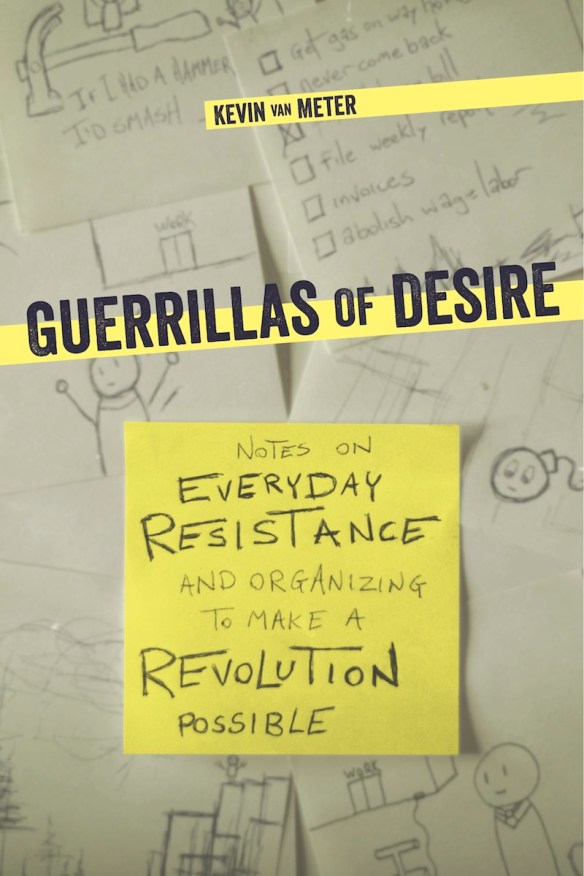
The Seeds of Anti-Capitalist Revolt Found in Everyday Resistance: A Review of Guerrillas of Desire – Notes on Everyday Resistance and Organizing to Make a Revolution Possible by Kevin Van Meter (AK Press, 2017)

By Scott Campbell

Source: Institute for Anarchist Studies

Back when I first began selling my labor for a wage in the wasteland of suburbia’s strip malls, I can recall the tedium of stocking shelves, summoning up insincere courtesy in the face of entitled customers and obnoxious bosses, comparing the stacks of money counted at the end of the day with the totals on our paychecks, and feigning adherence to whatever motivational façade management cooked up to mask the reality of our exploitation.

Yet I also remember, much more vividly and fondly, the latent and occasionally eruptive defiance among my co-workers. This included the constant collective complaining about the job, taking more and longer-than-approved breaks, working as little as possible, fudging time sheets, stealing, and the intermittent screaming matches with the boss in the middle of the store. Underpinning all these actions was an unspoken but broadly understood code of silence when it came to such transgressions and, when appropriate, expressions of support for them.

At the time, I didn’t think much about this, it was just how things happened and I’ve encountered similar experiences to varying degrees in every workplace since. Our actions weren’t guided by a political framework nor was there any attempt to organize them in a directed manner. It was more a spontaneous, innate reaction to experiencing the coercion of capitalism. I had cause to reflect upon this anew while reading Kevin Van Meter’s new book, Guerrillas of Desire: Notes on Everyday Resistance and Organizing to Make a Revolution Possible, published by AK Press and the Institute for Anarchist Studies.

In the preface, Van Meter observes that the question motivating him is not “What is to be done?” but “How do people become what they are?” Throughout the course of the book he seeks to provide an answer by locating power in the resistance of workers, apart from any political ideology or organization. Whether and how that inherently anti-capitalist refusal of work develops into revolt or rebellion are the questions he compellingly urges us to reflect and act upon.

To reach that point, Guerrillas of Desire ambitiously takes on multiple tasks that feed into and build on one another. Van Meter initiates a dialogue between anarchism and Autonomist Marxism that leads to a reconceptualization of the working class, bolstered in part by a historical accounting of workplace actions such as the ones I recounted. He labels these “everyday resistance,” committed by “guerrillas of desire,” and proposes a focus on those deeds as the entry point for organizing revolutionary resistance to capitalism. The impetus for this initiative, concisely carried out in under 160 pages, is his proposal that the current approach to organizing is conceptually flawed and therefore destined to fail. “Guerrillas of Desire offers a contentious hypothesis: the fundamental assumption underlying Left and radical organizing, including many strains of anarchism, is wrong. I do not mean organizationally dishonest, ideologically inappropriate, or immoral. I mean empirically incorrect” (13). The incorrect basis for current organizing is the assumption that the poor and working classes are unorganized and passive and that it therefore rests upon activists and organizations to educate and mobilize them for their own sakes. Van Meter instead proposes that there is in fact informal organization and resistance occurring, it is just of a sort that does not fit within the Left’s organizing vision and therefore goes unseen, unrecognized, and unincorporated into political theories, analysis, and action.

To provide a political frame for understanding the “everyday resistance” of the working class, Van Meter draws upon anarchism’s mutual aid – the material and emotional cooperation and reciprocal support that exists in societies – with Autonomist Marxism’s self-valorization – autonomous working class action that counters the state and capitalism, primarily the refusal of work in its myriad forms. Combined together and reinforcing one another, mutual aid and the refusal of work comprise the “everyday resistance” of the working class.

These phenomena also give definition to what is meant by “working class,” which Van Meter defines as “autonomous from both capitalism and the official organization of the Left, broadly including all those who work under capitalism, based in relationships between workers rather than as a structural component of the economy or sociological category” (32). Rather than being premised on income, occupation, or union membership, the working class under Van Meter’s formulation is made up of all those who must perform work under capitalism – be it waged or unwaged, in the factory, home, office, bedroom, affective, or social spheres. However, when they are not taking action in response to their subjugation under capitalism, these people are just workers. They become a class through the process of struggling against the conditions imposed upon them by capitalism. This struggle initially takes the form of everyday resistance based on mutual aid and the refusal of work. It is everyday resistance that unites individual workers as a class because such resistance, even when performed by one person, requires at a bare minimum the tacit complicity of co-workers and preferably their active collaboration.These acts and the social relationships they create and depend on lay the groundwork for the broader and overt organizing against capitalism more commonly interpreted as working class struggle. Using this framework as offered by Van Meter, we can understand the working class as composed of the relationships forged among workers actively in resistance against capitalism.Without anti-capitalist struggle, the working class does not exist.

After laying this theoretical groundwork, the bulk of the book traces the various forms of resistance by slaves, peasants, and workers in the industrial and social factories (the expansion of capitalist logic from the factory into society at large, in particular in service, immaterial, and reproductive work), creating a lineage and legacy of working class resistance against the various formations of capitalism that spans centuries. “Viewing the working class broadly to include slaves and peasants as well as students, homemakers, immigrants, and factory and office workers reveals the breadth of struggle and generalized revolt against work that continues to be imposed” (128). In doing so, Van Meter further builds the framework of the working class as being formed through its self-activity against the demands and deprivations of capitalism.

The historical survey brings the discussion into the present, where Van Meter offers a proposal to address his initial hypothesis that the Left is carrying out its organizing work in an incorrect way. His suggestion is for the organizers of today and in the future to begin their work by “reading the struggles” already underway in the form of everyday resistance. Through investigation and documentation by organizers, new relationships may be fostered with guerillas of desire that allow everyday resistance to expand into larger and more overt forms of autonomous anti-capitalist struggle. He proposes that the seeds of the new, liberatory worlds sought by anarchism and Autonomist Marxism are to be found in the everyday resistances that are already occurring rather than in the latest organizing manual or official Left strategy document..

While impressed after reading through this formulation, I was left with lingering questions. It remained unclear how, for instance, everyday resistance morphed into more overt, organized resistance and the part organizers positioning themselves as readers of struggle played in such a development. The personal anecdotes he provided on stepping back from ideological assumptions and reorienting towards the collective experiences of communities during his work in Long Island were helpful. It brought to mind the story of Marxist-Leninist intellectuals heading off to the Chiapan jungle with grand plans of starting a peasant guerrilla force. Only when they arrived, they found the population had no time or interest in their grandiose ideology. It was only when they dropped their assumptions and worked within the community to understand its needs, concerns and own history of resistance that the Zapatistas emerged. That, however, is a rather specific and exceptional example. I feel Van Meter’s proposal to begin organizing from within everyday resistance based on the notion that it will lead to more overt resistance could benefit from further articulation and direction.

Similarly, the focus on work as existing solely within the capitalist sphere left me curious as to his vision of the place of non-leisure activity under capitalism or even after capitalism. The refusal of the work that maintains capitalism is indispensable. Yet I would not advocate the refusal of work that maintains communal and personal well-being or builds autonomous organization, or writes books reviews in spare time, for example. Certainly, Van Meter would not advocate that either, but it remains a matter necessitating clarification and one that I believe extends beyond an issue of semantics.

Despite those questions, Guerrillas of Desire is aspirational in its scope and contains ideas and proposals worthy of consideration by radicals reflecting on how to engage in the current moment. In a time when mobilizing and organizing around class has fallen off the radar of many, it is a welcome reminder of the importance of paying attention to the working class and the integral role working class struggle plays in resistance to capitalism, alongside the currently more prevalent resistances to capitalist white supremacy, heteropatriarchy, colonization, environmental destruction and more.

Van Meter assists in this advocacy by accessibly presenting an updated Autonomist Marxist perspective of the working class, expanding it, breathing life into, and imbuing it with its own power, separate from both capitalism and the official Left. As such, he allows readers who may toil in a variety of ways under capitalism to see themselves within the working class, conceptualize their activities as part of a broader resistance with a rich history, and inspire them to build on that legacy.


Scott Campbell is a radical writer and translator based in California. He is part of the collectives that publish the websites El Enemigo Común and It’s Going Down. His personal site is fallingintoincandescence.com

Guerrillas of Desire is available here!


Why We’re Doomed: Our Economy’s Toxic Inequality

By Charles Hugh Smith

Source: Of Two Minds

Anyone who thinks our toxic financial system is stable is delusional.

Why are we doomed? Those consuming over-amped “news” feeds may be tempted to answer the culture wars, nuclear war with North Korea or the Trump Presidency.

The one guaranteed source of doom is our broken financial system, which is visible in this chart of income inequality from the New York Times: Our Broken Economy, in One Simple Chart.

While the essay’s title is our broken economy, the source of this toxic concentration of income, wealth and power in the top 1/10th of 1% is more specifically our broken financial system.

What few observers understand is rapidly accelerating inequality is the only possible output of a fully financialized economy. Various do-gooders on the left and right propose schemes to cap this extraordinary rise in the concentration of income, wealth and power, for example, increasing taxes on the super-rich and lowering taxes on the working poor and middle class, but these are band-aids applied to a metastasizing tumor: financialization, which commoditizes labor, goods, services and financial instruments and funnels the income and wealth to the very apex of the wealth-power pyramid.

Take a moment to ponder what this chart is telling us about our financial system and economy. 35+ years ago, lower income households enjoyed the highest rates of income growth; the higher the income, the lower the rate of income growth.

This trend hasn’t just reversed; virtually all the income gains are now concentrated in the top 1/100th of 1%, which has pulled away from the top 1%, the top 5% and the top 10%, as well as from the bottom 90%.

The fundamental driver of this profoundly destabilizing dynamic is the disconnect of finance from the real-world economy.

The roots of this disconnect are debt: when we borrow from future earnings and energy production to fund consumption today, we are using finance to ramp up our consumption of real-world goods and services.

In small doses, this use of finance to increase consumption of real-world goods and services is beneficial: economies with access to credit can rapidly boost expansion in ways that economies with little credit cannot.

But the process of financialization is not benign. Financialization turns everything into a commodity that can be traded and leveraged as a financial entity that is no longer firmly connected to the real world.

The process of financialization requires expertise in the financial game, and it places a premium on immense flows of capital and opaque processes: for example, the bundling of debt such as mortgages or student loans into instruments that can be sold and traded.

These instruments can then become the foundation of an entirely new layer of instruments that can be sold and traded. This pyramiding of debt-based “assets” spreads risk throughout the economy while aggregating the gains into the hands of the very few with access to the capital and expertise needed to pass the risk and assets off onto others while keeping the gains.

Profit flows to what’s scarce, and in a financialized economy, goods and services have become commodities, i.e. they are rarely scarce, because somewhere in the global economy new supplies can be brought online.

What’s scarce in a financialized economy is specialized knowledge of financial games such as tax avoidance, arbitrage, packaging collateralized debt obligations and so on.

Though the billionaires who have actually launched real-world businesses get the media attention–Bill Gates, Jeff Bezos, Steve Jobs, et al.–relatively few of the top 1/10th of 1% actually created a real-world business; most are owners of capital with annual incomes of $10 million to $100 million that are finance-generated.

This is only possible in a financialized economy in which finance has become increasingly detached from the real-world economy.

Those with the capital and skills to reap billions in profits from servicing and packaging student loan debt have no interest in whether the education being purchased with the loans has any utility to the indebted students, as their profits flow not from the real world but from the debt itself.

This is how we’ve ended up with an economy characterized by profound dysfunction in the real world of higher education, healthcare, etc., and immense fortunes being earned by a few at the top of the pyramid from the financialized games that have little to no connection to the real-world economy.

Anyone who thinks our toxic financial system is stable is delusional. If history is any guide (and recall that Human Nature hasn’t changed in the 5,000 uears of recorded history), this sort of accelerating income/wealth/ power inequality is profoundly destabilizing–economically, politically and socially.

All the domestic headline crises–culture wars, opioid epidemic, etc.–are not causes of discord: they are symptoms of the inevitable consequences of a toxic financial system that has broken our economy, our system of governance and our society.

Killing the Biosphere to Fast-track Human Extinction

By Robert J. Burrowes

Several years ago in Cameroon, a country in West Africa, a Western Black Rhinoceros was killed. It was the last of its kind on Earth.

Hence, the Western Black Rhinoceros, the largest subspecies of rhinoceros which had lived for millions of years and was the second largest land mammal on Earth, no longer exists.

But while you have probably heard of the Western Black Rhinoceros, and may even have known of its extinction, did you know that on the same day that it became extinct, another 200 species of life on Earth also became extinct?

This is because the sixth mass extinction event in Earth’s history is now accelerating at an unprecedented rate with 200 species of plants, birds, animals, fish, amphibians, insects and reptiles being driven to extinction on a daily basis. And the odds are high that you have never even heard of any of them. For example, have you heard of the Christmas Island Pipistrelle, recently declared extinct? See ‘Christmas Island Pipistrelle declared extinct by IUCN’.

Apart from the 200 species extinctions each day however, and just to emphasize the catastrophic extent of this crisis, myriad local populations of many species are driven to extinction daily and millions of individual lifeforms are also killed. See ‘Biological annihilation via the ongoing sixth mass extinction signaled by vertebrate population losses and declines’.

For a taste of the vast literature on this subject touching only on impacts in relation to insects, see ‘Death and Extinction of the Bees’, ‘Insectageddon: farming is more catastrophic than climate breakdown’ and ‘“Decimated”: Germany’s birds disappear as insect abundance plummets 76%’.

Is anything being done to end this omnicide (the destruction of all life)?

Not really, although there is plenty of rhetoric and limited action in some contexts as all bar a few committed individuals and organizations ignore this onslaught while even fewer take action that addresses the underlying cause and/or fundamental drivers of this killing. Unfortunately, most effort is still wasted on lobbying elites.

For example, in the latest example of the foolishness of lobbying elites to take action in our struggle to defend Earth’s biosphere, the European Union has again just renewed Monsanto’s licence to keep poisoning (and otherwise destroying) our world – see ‘German vote swings EU decision on 5-year glyphosate renewal’ – despite the already overwhelming evidence of the catastrophic consequences of doing so. See, for example, ‘Killing Us Softly – Glyphosate Herbicide or Genocide?’ and GM Food Crops Illegally Growing in India: The Criminal Plan to Change the Genetic Core of the Nation’s Food System’.

Of course, massive poisoning of the biosphere is only one way to destroy it and while elites and their agents drive most of this destruction they nevertheless often rely on our complicity. To itemize just a few of these many techniques for destroying our biosphere in most of which we are complicit, consider the following. We destroy rainforests – see Cycles of Wealth in Brazil’s Amazon: Gold, Lumber, Cattle and Now, Energy’ – we contaminate and privatize the fresh water – see Groundwater drunk by BILLIONS of people may be contaminated by radioactive material spread across the world by nuclear testing in the 1950s’ and ‘Nestlé CEO Denies That Water is an Essential Human Right’ – we overfish and pollute the oceans – see New UN report finds marine debris harming more than 800 species, costing countries millions’ – we eat meat despite the devastating impact of animal agriculture on Earth’s biosphere – see ‘The True Environmental Cost of Eating Meat’ – we destroy the soil – see ‘Only 60 Years of Farming Left If Soil Degradation Continues’ – and we use our cars and air travel (along with our meat-eating) as key weapons in our destruction of Earth’s atmosphere and climate with atmospheric carbon dioxide, methane and nitrous oxide levels all breaking new records in 2016. See ‘Greenhouse Gas Bulletin’.

But if you think that is bad enough, did you know about the out-of-control methane releases into the atmosphere that we have triggered – see ‘7,000 underground gas bubbles poised to “explode” in Arctic’ and ‘Release of Arctic Methane “May Be Apocalyptic,” Study Warns’ – and did you know that scientists at the University of Leicester warn that we are destroying the Earth’s oxygen? See ‘Global warming disaster could suffocate life on planet Earth, research shows’ and ‘The Extinction Event Gains Momentum’.

In addition, relying on our ignorance and our complicity, elites kill vast areas of Earth’s biosphere through war and other military violence (without even considering the unique, and possibly life-ending, devastation if the recently and repeatedly threatened nuclear war eventuates) – see, for example, the Toxic Remnants of War Project and the film ‘Scarred Lands & Wounded Lives’ – subject it to uncontrolled releases of radioactive contamination – see Fukushima Radiation Has Contaminated The Entire Pacific Ocean And It’s Going To Get Worse’ – and use geoengineering to wage war on its climate, environment and ultimately ourselves. See, for example, ‘Engineered Climate Cataclysm: Hurricane Harvey’, ‘Planetary Weapons and Military Weather Modification: Chemtrails, Atmospheric Geoengineering and Environmental Warfare’, ‘Chemtrails: Aerosol and Electromagnetic Weapons in the Age of Nuclear War’ and ‘The Ultimate Weapon of Mass Destruction: “Owning the Weather” for Military Use’.

Of course, all of this is done at immediate cost to human beings, particularly indigenous peoples – see, for example, Five ways climate change harms indigenous people’ –  and those who are in the worst position to resist – see Global Poverty: How the Rich Eat the Poor and the World: The Big Lies’ – but elites know they can ignore our lobbying and occasional, tokenistic and disorganized protests while relying on the fear and powerlessness of most of us to ensure that we do nothing strategic to fight back.

And given the unrelenting criminal onslaught of the insane global elite – see ‘The Global Elite is Insane’  – directed against Earth’s biosphere, together with the elite’s many sycophantic academic, bureaucratic, business, legal, media, military, political and scientific servants who deny science and threaten human survival in the interests of short-term personal privilege, corporate profit and social control, it is long past time when those of us who are genuinely concerned should be developing and implementing a strategy that recognises the elite and its many agents as opponents to be resisted with a careful and powerful strategy.

So, in essence, the problem is this: Human beings are destroying the biosphere and driving countless lifeforms, including ourselves, to extinction. And there is little strategic resistance to this onslaught.

There is, of course, an explanation for this and this explanation needs to be understood if we are to implement a strategy to successfully halt our omnicidal assault on Earth’s biosphere in time to save ourselves and as many other species as possible in a viable ecological setting.

This is because if you want to solve a problem or resolve a conflict, then it is imperative to know and act on the truth. Otherwise you are simply acting on a delusion and whatever you do can have no desirable outcome for yourself, others, the Earth or its multitude of creatures. Of course, most people are content to live in delusion: it averts the need to courageously, intelligently and conscientiously analyse what is truly happening and respond to it powerfully. In short: it makes life ‘easier’ (that is, less frightening) even if problems keep recurring and conflicts are suppressed, to flare up periodically, rather than resolved.

And, of course, this is how elites want it. They do not want powerful individuals or organizations interfering with their scheme to (now rapidly) consolidate their militarized control over the world’s populations and resources.

This is why, for example, elites love ‘democracy’: it ensures disempowerment of the population. How so? you might ask. The fundamental flaw of democracy is that people have been deceived into surrendering their personal power to act responsibly – in relation to the important social, political, economic, environment and climate issues of the day – to elected ‘representatives’ in government who then fearfully represent the elites who actually control them (whether through financial incentives, electoral support or other means), assuming they aren’t members of the elite themselves and simply represent elite priorities out of shared interest (as does Donald Trump).

And because we delegate responsibility to those powerless politicians who fearfully (or out of shared interest) act in response to elite bidding, the best scientific information in relation to the state of the Earth is simply ignored or rejected while conservative ‘scientific warnings’ advocating ‘strategies’ that must fail are widely circulated. See, for example, ‘World Scientists’ Warning to Humanity: A Second Notice’.

So this widespread failure to respond thoughtfully and powerfully is a fundamental reason that we are killing the biosphere and destroying life on Earth. Too few humans are willing to accept personal responsibility to understand why the violence is occurring and to participate in a carefully designed strategy to avert our own extinction, let alone save countless other species from premature entry into the fossil record. It is easier to leave responsibility to others. See ‘The Delusion “I Am Not Responsible”’.

And, clearly, time is running out, unless you are gullible enough to believe the elite-sponsored delusion that promotes inaction, and maximizes corporate profits in the meantime, because we are supposed to have until ‘the end of the century’. Far from it, however. As some courageous scientists, invariably denied access to mainstream news outlets, explain it: near-term human extinction is now the most likely outcome.

One of these scientists is Professor Guy McPherson who offers compelling evidence that human beings will be extinct by 2030. For a summary of the evidence of this, which emphasizes the usually neglected synergistic impacts of many of these destructive trends (some of which are noted above) and cites many references, listen to the lecture by Professor McPherson on ‘Climate Collapse and Near Term Human Extinction’.

Why 2030? Because, according to McPherson, the ‘perfect storm’ of environmental assaults that we are now inflicting on the Earth, including the 28 self-reinforcing climate feedback loops that have already been triggered, is so far beyond the Earth’s capacity to absorb, that there will be an ongoing succession of terminal breakdowns of key ecological systems and processes – that is, habitat loss – over the next decade that it will precipitate the demise of homo sapiens sapiens.

In relation to the climate alone, another scientist, Professor Kevin Anderson, who is Deputy Director of the UK’s premier climate modelling institution, the Tyndall Centre for Climate Change Research, has warned that emissions are now out of control and we are heading for a world that is 6 degrees hotter; he pointed out that even the International Energy Agency, and conservative organisations like it, are warning that we are on track for a 4 degree increase (on the pre-industrial level) by 2040. He also accused too many climate scientists of keeping quiet about the unrealistic assessments put out by governments. See ‘What They Won’t Tell You About Climate Catastrophe’.

So be wary of putting any credence on ‘official’ explanations, targets and ‘action-plans’ in relation to the climate that are approved by large gatherings, whether governmental or scientific. Few people have the courage to tell the truth when it guarantees unpopularity and can readily manifest as career-extinction and social and scientific marginalization.

As an aside, it is perhaps worth mentioning that most people have long forgotten that a decade ago (when the global temperature was .8 degrees above the pre-industrial level) it had been suggested that a decrease in global temperature to not more than .5 degrees above the pre-industrial level was actually necessary to achieve a safe climate, with the Arctic intact (although there was no clear feasible method for humans to reduce the global temperature to this level with any speed). Sadly we have made little progress in the past decade apart from to keep raising the ‘acceptable’ limit (whether to 2 degrees or ‘only’ 1.5). Most humans love to delude themselves to avoid dealing with the truth.

Hence, for those of us committed to responding powerfully to this crisis, the fundamental question is this: Why, precisely, are human beings destroying life on Earth? Without an accurate answer to this question, any strategy to address this crisis must be based on either guesswork or ideology.

So let us briefly consider some possible answers to this question.

Some people argue that it is genetic: human beings are innately violent and, hence, destructive behaviors towards themselves, others and the Earth are ‘built-in’ to the human organism; for that reason, violence cannot be prevented or controlled and humans must endlessly destroy.

However, any argument that human beings are genetically-predisposed to inflict violence is easily refuted by the overwhelming evidence of human cooperation throughout the millennia and there are endless examples, ranging from the interpersonal to the international, of humans cooperating to resolve conflict without violence, even when these conflicts involve complex issues and powerful vested interests. There are also plentiful examples of humans, particularly indigenous communities, living in harmony with, rather than destroying, nature.

Other analysts argue that human violence and destructiveness are manifestations of political, economic and/or social structures – such as patriarchy, capitalism and the state, depending on the perspective – and while I agree that (massive) structural violence actually occurs, I do not believe that these structures, by themselves, constitute an adequate explanation of the cause of violence.

This is simply because any structural explanation cannot account for violence in all contexts (including the violence that led to creation of the structure in the first place) or explain why it doesn’t happen in some contexts where a particular perspective indicates that it should.

So is there another plausible explanation for human violence? And can we do anything about it? Let me offer an explanation and a way forward that also takes advantage of the insights of those traditions that have critiqued structural violence in its many forms.

I have been researching why human beings are violent since 1966 and the evidence has convinced me that the origin of all human violence is the violence inflicted by adults on children under the guise of what sociologists call ‘socialization’. This violence takes many forms – what I call ‘visible’, ‘invisible’ and ‘utterly invisible’ violence – and it creates enormously damaged individuals who then personally inflict violence on themselves, those around them (including their own children) and the Earth, while creating, participating in, defending and/or benefiting from structures of violence and exploitation. For a full explanation of this point, see Why Violence?’ and Fearless Psychology and Fearful Psychology: Principles and Practice.

Hence, in my view, the evidence is overwhelming that if we want to end human violence, whether inflicted on ourselves, others or the Earth, then the central feature of our strategy must be to end adult violence against children. See ‘My Promise to Children’. I claim that this must be ‘the central feature of our strategy’ for the simple reason that each damaged child grows up to become a willing and active perpetrator of violence when, if they were not so damaged, they would be powerful agents of peace, justice and sustainability committed to resisting violence and exploitation in all contexts until it is eliminated.

This profound evolutionary inheritance – to be an individual of integrity who consciously chooses and lives out their own unique, powerful and nonviolent life path – has been denied to virtually all of us because humans endlessly terrorize their children into mindless obedience and social conformity, leaving them powerless to access and live out their conscience.

And this makes it very easy for elites: By then using a combination of our existing fear, indoctrination (via the education system, corporate media and religion) and intimidation (via the police, legal and prison systems), sometimes sweetened with a few toys and trinkets, national elites maintain social control and maximize corporate profits by coercing the rest of us to waste our lives doing meaningless work, in denial of our Selfhood, in the corporate-controlled economy.

As I implied above, however, we need not be content with just working to end violence against children. We can also work to end all other manifestations of violence – including violence against women, indigenous peoples, people of color, Islamic and working class people, and violence against the Earth – but recognize that if we tackle this violence without simultaneously tackling violence at its source, we fundamentally undermine our effort to tackle these other manifestations of violence too.

Moreover, tackling structural violence (such as capitalism) by using direct violence cannot work either. Because violence always feeds off fear it will always proliferate and remanifest, whether as direct, structural, cultural or ecological violence, however beneficial any short-term outcome may appear.

Importantly then, apart from understanding and addressing the fundamental cause of this crisis, we must implement a comprehensive strategy that takes into account and addresses each and every component of it. There is no point working to achieve a single objective that might address one problem no matter how important that particular problem might be. The crisis is too far advanced to settle for piecemeal action.

Hence, if you wish to tackle all of this violence simultaneously, you might consider joining those participating in the comprehensive strategy simply explained in The Flame Tree Project to Save Life on Earth. If you wish to tackle violence in a particular context, direct, structural or otherwise, consider using the strategic approach outlined in Nonviolent Campaign Strategy or Nonviolent Defense/Liberation Strategy.

And if you would like to publicly commit yourself to participate in the effort to end all human violence, you can do so by signing the online pledge of The Peoples Charter to Create a Nonviolent World.

Killing the biosphere is the most effective way to destroy life on Earth because it destroys the ecological foundation – the vast array of incredibly diverse and interrelated habitats – on which organisms depend for their survival. And we are now very good at this killing which is why averting human extinction is already going to be extraordinarily difficult.

Hence, unless and until you make a conscious personal decision to participate strategically in the struggle to save life on Earth, you will be one of those individuals who kills the biosphere as a byproduct of living without awareness and commitment: A person who simply over-consumes their way to extinction.

So next time you ponder the fate of humanity, which is inextricably tied to the fate of the Earth, it might be worth considering the unparalleled beauty of what Earth has generated. See, for example, Two White Giraffes Seen in Kenyan Conservation Area’.

And as you do this, ask yourself how hard you are willing to fight to save life on Earth.


Biodata: Robert J. Burrowes has a lifetime commitment to understanding and ending human violence. He has done extensive research since 1966 in an effort to understand why human beings are violent and has been a nonviolent activist since 1981. He is the author of Why Violence? His email address is flametree@riseup.net and his website is here.


Robert J. Burrowes
P.O. Box 68
Daylesford
Victoria 3460
Australia

Email: flametree@riseup.net

Websites:

https://thepeoplesnonviolencecharter.wordpress.com/ (Nonviolence Charter) https://tinyurl.com/flametree (Flame Tree Project to Save Life on Earth) https://tinyurl.com/whyviolence (‘Why Violence?’) https://feelingsfirstblog.wordpress.com/ (Feelings First) https://nonviolentstrategy.wordpress.com/ (Nonviolent Campaign Strategy) https://nonviolentliberationstrategy.wordpress.com/ (Nonviolent Defense/Liberation Strategy) https://anitamckone.wordpress.com (Anita: Songs of Nonviolence) https://robertjburrowes.wordpress.com/ (Robert) https://globalnonviolencenetwork.wordpress.com/ (Global Nonviolence Network)

Perpetual Prosperity And The ‘Strategy of Tension’

By Graham Vanbergen

Source: TruePublica

Marco Rubio, the American politician, attorney and former Speaker of the Florida House of Representatives once said; “Every nation on the Earth that embraces market economics and the free enterprise system is pulling millions of its people out of poverty. The free enterprise system creates prosperity, not denies it.”

Statements such as these are common amongst politicians, especially wealthy ones who hold wealth driven values. But one man’s prosperity is another man’s misery in a world blighted by an economic model that demands eternal growth.

The only one constant that sits well with this model is that world population continues to increase, but even that is tailing off. Global population currently sits at 7.5 billion and rising at a rate of 80 million per year. The rate of population increase was 2.19 percent at its peak in 1963, which has now halved.

Concerns of the Fourth Industrial Revolution fusing the physical, digital and biological worlds, and impacting all disciplines, economies and industries emanate from the corporations who now see their future declining revenue potential being rescued through reduced reliance on human labour.

Get Briefed, Get Weekly Intelligence Reports – Essential Weekend Reading – Safe Subscribe

Subscribe!

To keep prosperity on a perpetual upward trajectory in the backdrop of a continually shrinking and less well off consumer base, the most politically influential now work in concert with the corporate behemoths – the new rulers of the world.

The strategies adopted to keep the ball rolling over the last few decades centre around a financial architecture that requires drastic anti-democratic political support. As Noam Chomsky warns “The very design of neoliberal principles is a direct attack on democracy.

One does not have to look far to see these principles at work. Trillions of desperately needed taxes to support a decaying system of civil society are illegally offshored by household named corporations and individuals. Unfortunately, this form of extreme neoliberalism still isn’t enough to keep the ball rolling.

Naomi Klein’s 2007 book ‘Shock Doctrine, the rise of Disaster Capitalism’ exploded the myth that the global free market triumphed democratically. Klein highlights how the “puppet strings behind the world-changing crises and wars of the last four decades is the real story of how America’s “free market” policies came to dominate the world, through the exploitation of disaster-shocked people and countries.”

Then, one year later, Klein’s prognosis saw the 2008 financial crisis offering up more disaster shocked peoples at the global level as neoliberalism wriggled free from the remnants of regulation to reach a new pinnacle for the few and a created an even greater crisis of daily life for the hundreds of millions left behind.

This erroneous ideology delivered little more than world economic stagnation, crippling austerity, peak inequality, a global environmental crisis, the slowest economic recovery in history and monumental debt of every country it infected. This was no mistake, no unforeseen event, that we were told stunned our leaders and their captains.

The problem always existed that extreme wealth was never going to come from a global post-war peace through globalisation – so a ‘strategy of tension’, an Anglo/American innovation, was invented to keep the exploitation model alive.

The actual definition of this strategy is that “Western governments during the Cold War used tactics that aimed to divide, manipulate and control public opinion using fear, propaganda, disinformation, psychological warfare, agents provocateurs, and terrorist actions in order to achieve their strategic aims.

Amongst many, one of those aims was financial domination.

During the closing days of the Cold War, the UK, US and other western governments along with the secret services colluded to engineer terrorist attacks inside Western Europe, to be blamed on Russia. This is now so well documented it needs no elaboration here (1).

However, the objective was always clear. By mobilising public opinion against left-wing parties (and their policies) and legitimising war, capitalism was to be forever invigorated. Ultimately though, this required the denying of national independence movements, mainly in the third world, to fund new forms of Western wealth.

The Cold War, stoked and fuelled by a deliberate strategy of tension gave us ‘Red Russia’ and the potential for nuclear Armageddon. When that ran its course, imaginary foes such as Saddam Hussein and Gaddafi were invented. The war on terror was used as a means to an end. Today, Red Russia is back on the agenda once again.

Dr Nafeez Ahmed, the award winning investigative journalist wrote about this Strategy of Tension:

The immense fear and chaos generated by the impact of this phenomenon throughout Western Europe was instrumental in legitimising the interventionist policies of the Anglo-American alliance throughout the Cold War period. The number of people killed across the third world as a consequence of this militarisation process is shocking, its implications genuinely difficult to absorb.” (2)

Ahmed goes on to say that 12 to 15 million people since WW2 have been sacrificed for this strategy with many millions more suffering as their economies were destroyed and denied the right to restructure whilst Western corporations made fortunes at their ultimate expense.

Dr Daniele Ganser, a Swiss historian who specialises in contemporary history, international politics, covert warfare, resource wars and geo-strategy confirms that this strategy is very much alive and in use to this day.

“What you may have, if you translate our experience from the Cold War to the current day situation, is that a strategy of tension is still being implemented, but this time against Muslims,” Ganser says. “We all know that the west is dependent upon oil, and a pretext is needed to develop more operations in Iran, Iraq etc. We can’t just go there and invade them, so we have to have this idea that they’re trying to kill us, then it’s possible, or at least imaginable that a strategy of tension in which the Muslims are playing the role that the communists played in the Cold War, is happening.”

The result is that the world is facing a new desperate multi-faceted game of thrones – as it morphs into something even more destructive.

Conflict and change is now the new norm. Global peace and domestic security is fading as the world order spirals out of control. This engineered spiral is going to prove to be a disaster for everyone, in what looks a lot like a coming global collapse on every front.

Civil society is now shrouded in a cycle of fear, terrorism, surveillance and experiencing a perpetual loss of rights and liberties as the world order disintegrates.

Today, we are now unable to make reasonable predictions of our near future as war, lawlessness, terrorism and now threats of nuclear annihilation become ever more real.

Even hope is diminishing. People of the West are now so afraid they want to stop perceived threats from foreigners, they want them expelled. Manufactured geo-political tensions have created a migration of people in the 21st century even greater than mankind’s greatest tragedy – the last world war. This is no mistake, no unforeseen event either.

China was once the greatest economic power on earth, followed by India, Britain and then America. Not once has the continent of Africa produced a global GDP exceeding 5% in its history, with 16% of the world’s population.

Having deprived this entire continent any possible chance of progression, a migrant surge is now destabilising the very regions responsible for pillaging it.

Alongside all of these pressures, environmental collapse seems inevitable when extreme capitalism sees natural catastrophic events such as the oil industry viewing melting ice caps as nothing more than an investment opportunity.

America is still fighting wars in the Middle East, threatening China, Iran, Korea, India, and even the European Union. The EU is breaking down into four distinct regions as the fifty-year unity project is visibly disintegrating. Is this just a fight for dwindling resources or something else?

Total global debt is now $227 trillion – or 327 percent of global GDP and something like 45 percent higher than the 2008 apex of the financial meltdown.

The Bank of International Settlements urged just two months ago that policymakers need to press on with rate rises notwithstanding the financial market turbulence it will cause.

The world’s six largest pension saving systems – the US, UK, Japan, Netherlands, Canada and Australia – are expected to reach a $224 trillion gap by 2050, a new study by the World Economic Forum shows. Implosion is its only obvious trajectory as there is nowhere near than amount of money anywhere in the world to plug such a gap as that (3).

Total US household debt surged by $460 billion last year, the sharpest one-year rise ever, with an eye-watering $13 trillion outstanding (4). Britain’s household debt is rising at 10 percent per year, five times the rate of earnings growth and has just surpassed the 2008 level of debt as households struggle to keep afloat (5).

The World Economic Forum has also determined that unemployment, an energy price shock, fiscal crisis, failure of national governance and profound social instability makes up the top five global risks to economic performance (6).

To rid the world of its debt’s, kick-start the world economy and take advantage of the shifting global chess board, some believe conflict is the only consequential route left. NATO’s threats to Russia supported by mass media hysteria only adds to the WEF global risks list.

We have a lot to be fearful of. The fact that any combination of the risk list could happen at the same time in today’s world is no longer the conspiratorial thinking of doom-mongers but the architecture of a strategy that the world has seen before.

Public intellectual Tariq Ali wrote a warning in his 2010 book “The Obama Syndrome: Surrender at Home, War Abroad:

This is the permanent tension that lies at the heart of a capitalist democracy and is exacerbated in times of crisis. In order to ensure the survival of the richest, it is democracy that has to be heavily regulated rather than capitalism.”

Seven years after Ali’s book we are experiencing a never-ending relay of crisis after crisis; democracy under threat, capitalism out of control and the very real threat of facing another human catastrophe.

In his sobering analysis, Professor Ugo Bardi, a professor in Physical Chemistry at the University of Florence and president of the Association for the Study of Peak Oil (ASPO), dissects historical statistics on war to unpick the patterns of the violence of the past. He warns that statistical data suggests we are on the brink of heading into another round of major wars resulting, potentially, in mass deaths on a scale that could rival what we have seen in the early 20th century. This is confirmation indeed that a ‘Strategy of Tension’, controlled or not, is heading towards its ultimate apogee. At this juncture, it is reasonable to conclude we are all in trouble.


(1) Operation Gladio (see Post war creation) https://en.wikipedia.org/wiki/Operation_Gladio

(2) Nafeez Ahmed – Strategy of Tension: http://www.nafeezahmed.com/2007/05/strategy-of-tension.html

( 3 ) Global pension funding gap: https://www.weforum.org/press/2017/05/global-pension-timebomb-funding-gap-set-to-dwarf-world-gdp/

(4) US household debt: https://www.wsws.org/en/articles/2017/02/20/debt-f20.html

(5) UK household debt: http://www.telegraph.co.uk/business/2017/07/31/growing-risk-uk-household-debts-warns-moodys-amid-lending-boom/

(6) World Economic Forum – Global Risks: http://reports.weforum.org/global-risks-2017/global-risks-of-highest-concern-for-doing-business-2017/

Newsletter: From Neoliberal Injustice To Economic Democracy

By Kevin Zeese and Margaret Flowers

Source: Dissident Voice

The work to transform society involves two parallel paths: resisting harmful systems and institutions and creating new systems and institutions to replace them. Our focus in this article is on positive work that people are doing to change current systems in ways that reduce the wealth divide, meet basic needs, ensure sustainability, create economic and racial justice and provide people with greater control over their lives.

When we and others organized the Occupation of Washington, DC in 2011, we subtitled the encampment ‘Stop the Machine, Create a New World’, to highlight both aspects of movement tasks — resistance and creation. One Popular Resistance project, It’s Our Economy, reports on economic democracy and new forms of ownership and economic development.

Throughout US history, resistance movements have coincided with the growth of economic democracy alternatives such as worker cooperatives, mutual aid and credit unions. John Curl writes about this parallel path in “For All the People,” which we summarized in “Cooperatives and Community Work are Part of American DNA.”

Mahatma Gandhi’s program of nonviolent resistance, satyagraha, had two components: obstructive resistance and constructive programs. Gandhi promoted Swaraj, a form of “self-rule” that would bring independence not just from the British Empire but also from the state through building community-based systems of self-sufficiency. He envisioned economic democracy at the village level. With his approach, economics is tied to ethics and justice — an economy that hurts the moral well-being of an individual or nation is immoral and business and industry should be measured not by shareholder profit but by their impact on people and community.

Today, we suffer from an Empire Economy. We can use Swaraj to break free from it. Many people are working to build a new economy and many cities are putting in place examples of economic democracy. One city attempting an overall transformation is Cooperation Jackson in Jackson, Mississippi.

Economic Democracy in response to neoliberalism

In his new book, Out of the Wreckage: A New Politics for an Age of Crisis, George Monbiot argues that a toxic ideology of greed and self–interest resulting in extreme competition and individualism rules the current economic and political culture. It is built on a misrepresentation of human nature. Evolutionary biology and psychology show that humans are actually supreme altruists and cooperators.  Monbiot argues that the economy and government can be radically reorganized from the bottom up, enabling people to take back control and overthrow the forces that have thwarted human ambitions for a more just and equal society.

In an interview with Mark Karlin, Monbiot describes how neolibealism arose over decades, beginning in the 1930s and 40s with John Maynard Keynes, Friedrich Hayek and others, and is now losing steam, as ideologies do. Monbiot says we need a new “Restoration Story.”

We are in the midst of writing that new story as people experience the injustice of the current system with economic and racial inequality, destruction of the environment and never ending wars. Indeed, we are further ahead in creating the new Restoration Story than we realize.

Cooperatives

New research from the University of Wisconsin–Madison’s Center for Cooperatives (UWCC) has found there are 39,594 cooperatives in the United States, excluding the housing sector, and there are 7 million employer businesses that remain “potential co-op candidates.” These cooperatives account for more than $3 trillion in assets, more than $500 billion in annual revenue and sustain nearly two million jobs. This May, the Office of Management and Budget approved including coop questions in the Economic Census so that next year the US should have more accurate figures. The massive growth of cooperatives impacts many segments of the economy including banking, food, energy, transit and housing among others.

In cooperatives, workers or consumers decide directly how their business operate and work together to achieve their goals; it is a culture change from the competitive extreme capitalist view dominated by self-interest.

In Energy Democracy: Advancing Equity in Clean Energy Solutions, editors Denise Fairchild and Al Weinrub describe energy cooperatives that are creating a new model for how we organize the production and distribution of energy, which is decentralized, multi-racial and multi-class.

Lyn Benander of Co-op Power, a network of many cooperatives in New England and New York, writes that they transform not just energy but also their communities:

First, people come together across class and race to make change in their community by using their power as investors, workers, consumers, and citizens ready to take action together. Then, they work together to build community-owned enterprises with local capital and local jobs to serve local energy needs. It’s a proven strategy for making a real difference.

In Lancaster, CA, the mayor has turned the town into a solar energy capital where they produce power not just for themselves, but also to sell to other cities. They are also moving to create manufacturing jobs in electric buses, which more cities are buying, and energy storage. Research finds that rooftop solar and net-metering programs reduce electricity prices for all utility customers, not just those with solar panels. The rapid growth of rooftop solar is creating well-paying jobs at a rate that’s 17 times faster than the total U.S. economy. Rooftop solar, built on existing structures, such as homes and schools, puts energy choices in the hands of customers rather than centralized monopolies, thereby democratizing energy.

Including housing cooperatives would greatly increase the number of cooperatives. According to the National Association of Housing Cooperatives, “Housing cooperatives offer the more than one million families who live in them several benefits such as: a collective and democratic ownership structure, limited liability, lower costs and non-profit status.”  Residents of a mobile home park in Massachusetts decided to create a housing cooperative to put the residents in charge of the community when the owner planned to sell it.

Related to this are community land trusts. A section of land is owned in a trust run as a non-profit that represents the interests of local residents and businesses. Although the land is owned by the trust, buildings can be bought and sold. The trust lowers prices and can prevent gentrification.

Universal Basic Income

Another tool gaining greater traction is a universal basic income.  James King writes in People’s Policy Project that “. . . a universal basic income (UBI) – a cash payment made to every person in the country with no strings attached – is becoming increasingly popular in experimental policy circles. . . payments  [would be] large enough to guarantee a minimum standard of living to every person independent of work. In the US, that would be roughly $12,000 per person based on the poverty line.”

The wealth divide has become so extreme in the United States that nearly half of all people are living in poverty. A small UBI would provide peace of mind, financial security and the possibility of saving money and building some wealth. A report by the Roosevelt Institute, this week, found that a conservative analysis of the impact of a UBI of $1,000 per month would grow the economy by 12.56 percent after an eight-year implementation, this translates to a total growth of $2.48 trillion.

Public Finance

Another major area of economic democracy is the finance sector. At the end of 2016 there were 2,479 credit unions with assets under 20 million dollars in the United States. Members who bank in credit unions are part of a cooperative bank where the members vote for the board and participate in other decisions.

Another economic democracy approach is a public bank where a city, state or even the national government creates a bank using public dollars such as taxes and fee revenues. Public banks save millions of dollars that are usually paid in fees to Wall Street banks, and the savings can be used to fund projects such as infrastructure, transit, housing, healthcare and education, among other social needs. Public banks can also partner with community banks or credit unions to fund local projects. This could help to offset one of the negative impacts of Dodd-Frank, which has been a reduction in community banks. In testimony, the Secretary of Treasury, Stephen Munchin, said we could “end up in a world where we have four big banks in this country.”

North Dakota is the only state with a public bank, and it has the most diverse, locally-owned banking system in the country. Stacey Mitchell writes that “North Dakota has six times as many locally owned financial institutions per person as the rest of the nation. And these local banks and credit unions control a resounding 83 percent of deposits in the state, more than twice the 30 percent market share such banks have nationally.” Public banking campaigns are making progress in many parts of the country, among them are Oakland, Los Angeles, Philadelphia, Santa Fe, and other areas.

Mutual Aid

When crises occur, no matter what their cause, people can work together cooperatively and outside of slow and unresponsive state systems to meet their needs. This is happening in Athens, Greece, which has been wracked by financial crisis and austerity for years. People have formed “networks of resistance” that meet in community assemblies organized around needs of the community, such as health care and food. They started with time banks as a base for a new non-consumer society.

Similar efforts are underway in Puerto Rico following the devastation of Hurricane Maria. A group called El Llamado is coordinating more than 20 mutual aid efforts, and providing political education and support for self-organizing at the same time.

As George Monbiot describes it, this is consistent with the truth about what human beings are:

We survived despite being weaker and slower than both our potential predators and most of our prey. We did so through developing, to an extraordinary degree, a capacity for mutual aid. As it was essential to our survival, this urge to cooperate was hard-wired into our brains through natural selection.

As we face more crises, whether in lack of access to health care, education, housing, food or economic and climate disasters, let’s remember that we have the capacity to meet our needs collectively.  In fact, every day, people are putting in place a new economic democracy that allows people to participate based on economic and racial justice as well as real democracy. As these alternatives are put in place, they may become dominant in our economy, communities and politics and bring real democracy and security to our lives.


Kevin Zeese and Margaret Flowers are co-directors of Popular Resistance. Read other articles by Kevin Zeese and Margaret Flowers.

The New Economy: Unemployment and the Return of the American Hobo

By Sheldon Greaves

Source: Cogito!

A few years ago I read somewhere about a trend in the “gig economy” in which people who had been reduced to living in their cars or RVs roamed the country by the thousands; homeless, nomadic workers driving from one temporary job to another. It painted a tragic picture; underpaid, overworked, often lacking health insurance, men and women, many of whom ought to be enjoying retirement but were working in warehouses filling orders for Amazon (“Camperforce”) or stocking shelves in a big-box store.

It sharply reminded me of the Great Depression, another time when mobile workers moved from place to place across the country in search of work. Thinking about this I realized that what we were seeing was the return of the migrant worker apart from the seasonal farm worker, i.e., the Hobo. Also called Tramps, Bums and other less charitable names, these men were the displaced detritus of the Great Depression who wandered the country looking for any jobs that would help them survive and, if there was any left over, to send home to their families. It was a dangerous life; travelling by hopping freight trains or hitchhiking on the highways wasn’t the safest way to get around. Many hobos were maimed or killed in accidents travelling this way, or were victims of violence. Loren Eisley’s wonderful memoir All the Strange Hours recalls his days as a young hobo with all of the dangers and troubles that went with being a hobo. They also faced hostility from towns naturally suspicious of outsiders, especially if there wasn’t any work even for the locals.

But the hobos also became a part of American folklore. The music of Woody Guthrie, who spent quite a bit of time on freight trains himself, helped to make the plight of these unemployed workers known to the rest of the country. Government programs found ways to harness this pool of labor and skill, pouring it into vast projects, many of which continue to contribute to national economy today.

There was, however, another side to hobo life. It became a sort of counter-culture, a rebellion of sorts against a social order that had unfairly cast aside decent, hard-working people for the sake of profit. Hobo life in some cases became a form of dropout culture, mainly, I suspect, as a way of embracing what apparently could not be avoided. An old professor of mine, who spent some of his youth as a tramp, recalled how some of his tramping companions actually knew more about science and literature than his college professors, but preferred tramping as a better way to enjoy God’s creations. Dropouts indeed.

I have been fascinated by American dropout culture as a response to moments when society becomes economically, intellectually, morally, and spiritually intolerable and so, like a few Biblical figures, one leaves, going out of bondage, but into the wilderness for whatever it may bring one. Historically, I’ve noticed that from Roanoke to the 1960’s and 70’s, the dropouts generally seemed to have a point, even if it wasn’t clear at the time. Sometimes the dropouts used their unique viewpoint to inform changes for the better, or became part of grander projects as happened with the government work projects of the New Deal.

So it is with some bemusement that I have noticed an interesting trend when it comes to the mobile temp workers, hobos with RVs or living out of their cars. Over the last seven or so years a small body of literature has emerged celebrating the homeless, wandering worker. Getting out of debt is a common reason for ditching less settled living, and as a rejection of consumerism (Ironic, given how many of these mobile temp jobs are serving precisely that consumer economy). The whole thing has a Small is Beautiful/Voluntary Simplicity vibe to it. Three of the six or so book titles of the last few years even reference “living in a van down by the river” in homage to a classic SNL skit.

So which is it? Is the new hobo a national tragedy in slow-motion, or rebellion against consumer culture, a new manifestation of the All-American dropout? I think it’s too early to tell. This may be nothing more or less than trying to make the best of a bad situation. I hope it’s more than that.

Famed American author and philosopher Eric Hoffer, himself a long-time migrant worker, had some remarkable insights into the responsibility of a nation to do right by such men and women. In his essay, “The Role of the Undesirables”, based on his own experience in government work camps in the early 1930’s. He draws some interesting and telling comparisons between the “human junk pile” that made up the bulk of his fellow workers and the early American pioneers–themselves undesirables from Europe–who built the nation. He points out that these pioneers craved change, much like the RV hobos of today. Hoffer writes: “…the quality and destiny of a nation are determined to a considerable extent by the nature and potentialities of its inferior elements.” He further argues that the quality of a nation is likewise manifest by how those at the bottom rise to the top. And that, I submit, is the problem. Is there an endgame to the RV hobo life that involves a chance to settle back down, to enjoy some of the fruits of one’s labor in security and dignity? Certainly a life on the road can be exciting. I find the idea compelling myself. But the other kind of mobility–upward mobility–has all but ceased to exist in this country. I cannot yet say whether these economic rebels of the road are truly making a new way of living, or accepting the unacceptable.

“The Richest Nation On Earth” Why Are Many Americans Broke?

By Timothy Gatto

Source: OpEdNews.com

I’m going to talk about some things that many people take for granted and that most writers not will write about. I’m going to throw a lot of information and figures out in this article and I really hope that people start to think about what these facts and figures really mean.

I want to preface this that I am not a mathematician nor am I an economist. I am however, someone who can read and the figures on going to give you come directly from the government. I didn’t make these numbers up.

Many people have read some of my articles know that I detest the fact that 55% of our national budget is comprised of our so-called “defense budget”. Many Americans have written and talked about the fact that this nation is involved “in endless war”. What most people don’t realize is how much of our national treasure is devoted to our military.

Let me start by telling how much this nation spends on our so-called “defense budget”. This money that we spend isn’t to defend people of the United States, these funds go to enrich the defense contractors and the people who fund our politicians in Congress.

This is the part where I throw the amounts that fund our so-called “defense budget”:

$2,988,083.00 is the total amount for the US budget. Out of this almost $3 trillion, $582 billion dollars go to the Department of Defense. This doesn’t include all the money that goes to the defense investigative agency the DIA, or to the CIA, or to the NSA, or to the FBI or any other intelligence agencies.

The number of people in the United States in 2017 is 326,474,083. If Congress cut the defense budget for 25% by closing overseas bases and cutting the number military that serve in our endless war machine, we would save $145 billion dollars. If you divide that number by the number of people living in the United States, every man woman and child, it would come out to almost $485,260,952. If Congress only returned 5% of that money “as a dividend” to the American people that would mean a windfall of almost $25,000. A family of four would receive hundred thousand dollars.

I’m not supposing that the government would do anything of the sort, I’m just throwing some numbers around to make people think. We always hear the United States is the richest nation on earth, and this just illustrates where all our wealth is going. Many people explain that the defense industry and shore up our economy and we stop producing arms and having a large military it would hurt the United States economically. What I’m saying is that if we cut the military spending by 25% we would not only give a windfall to the American people, but we could also rebuild our infrastructure and pay down our national debt.

If people honestly looked at those numbers, it should make them angry. How many aircraft carriers do we need to defend the people of the United States? How many cruise missiles do we need to protect the people of the United States? How many spy agencies do we need to protect us from our so-called enemies? We have an ocean on each side of the United States. We have enemies across the world that we ourselves have created. One only must look at the demonization of Russia to understand how United States makes an enemy. The United States needs an enemy to justify the amount of money spent on the military. We are all being sold a giant bill of goods that is unjustifiable and really is criminal when you look at how much money we spend.

I am not isolationist nor my pacifist, I’m just someone who holds citizenship in a country that has lost its perspective.

I would also like to point out that the recent fires in California should be looked at by every citizen in the United States. There are anomalies about these fires vaporizing brick, melting glass and vaporizing steel. There also anomalies where houses were demolished by this fire, yet trees next to these houses were not touched by fire. There also videos on YouTube that showed a tree burning from the inside out. What disturbs me is that many of the videos I looked at looked much like the anomalies that happened at the World Trade Center. I’m not explaining the fires, but I would like people to look at these videos and judge for yourself. I wasn’t going to write about this, but I felt an obligation to at least mention it.

Instead of just accepting the way America puts its money into our war Department, we should demand accountability and justification for all that they do. As a retired servicemember with over 20 years in the United States Army I feel that the military is out of control. Never in my lifetime have I seen military spending on the scale with no discernible enemy creeping up on our shores. As citizens I believe that every American should hold count Congress accountable for this wasteful military spending that should really go to rebuilding United States infrastructure and creating an economy that consumes things instead of just treading water to stay alive. “As the richest nation on earth” we should be helping our citizens instead of interfering in the affairs of other nations. As an American citizen I am angry as hell and I believe that every citizen should feel the same anger that I feel.


Tim Gatto is Ret. US Army and has been writing against the Duopoly for the last decade. He has two books on Amazon, “Kimchee Days, or Stoned-Cold Warriors” and “Complicity to Contempt”.