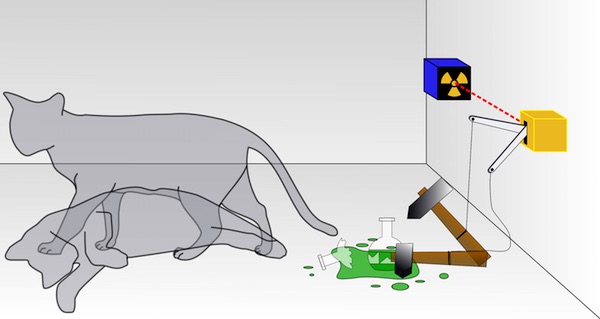
Physicist Erwin Schrödinger in 1935 tried to explain the (consequences of the) uncertainty principle, defined by Werner Heisenberg as a core theme of Albert Einstein’s view of quantum mechanics, to … Albert Einstein. The latter must have been thrilled. Even though he did not like the uncertainty principle (God does not play dice). The thought experiment became known as “Schrödinger’s cat”. Since you cannot know both a particle’s position and its speed -and that’s just one example-, you have to assume all possible outcomes are valid (superposition). Only when you “look” does one particular outcome become the “reality”. It’s all part of the subatomic “world”
Wikipedia: “In Schrödinger’s original formulation, a cat, a flask of poison, and a radioactive source are placed in a sealed box. If an internal monitor (e.g. a Geiger counter) detects radioactivity (i.e. a single atom decaying), the flask is shattered, releasing the poison, which kills the cat. The Copenhagen interpretation implies that, after a while, the cat is simultaneously alive and dead. Yet, when one looks in the box, one sees the cat either alive or dead, not both alive and dead. This poses the question of when exactly quantum superposition ends and reality resolves into one possibility or the other.”
As I’m trying to explain this, I very much have to wonder if I get it right. And I always thought that follows the uncertainty principle too: I can understand it and not understand it both at the same time. A physicist might fare a bit better, but it won’t come easy.
This is what I was thinking of with regards to the war in Ukraine. Before the fighting started, all possible outcomes seemed equally possible. If you did not look too closely at numbers of soldiers and weaponry, that is. But once it did start (when Schrödinger’s box was opened), it became clear very rapidly that Ukraine had no chance of winning. So why are we still acting as if the box remains closed? Because that way we get to spend billions more on armory, and we get western people to support Zelensky and his neo-nazis as those same people suffer from high prices for everything. Any outcome is still possible!
Take the Kakhovka dam narrative, or Nord Stream or any of the numerous other examples. When both sides accuse each other of perpetrating a certain event, Schrödinger’s box remains closed. Which is exactly what our politicians and arms makers desire. They don’t want us to know that they’ve been beaten by Russia, because you would no longer support their policies and their arms purchases. They want “superposition”. They can’t very well declare victory -though they try-, but they don’t need to either. They need uncertainty. Politicians, arms makers and media. They all profit from keeping you in the dark.
The best comment on Kakhovka I’ve seen perhaps comes from @CheburekiMan on Twitter: “Restoring water flow to the North Crimean Canal was top priority for Russia, the very first act of the SMO. Before Kiev shut off the flow in 2014, the canal was supplying 85% of Crimea’s water. So much depended on it, from crops to industry to drinking water, that’s how important it is. Now the pro-Ukraine bleating sheep want people to believe that Russia would wreck the dam, empty the reservoir and cause serious harm to its own people by running the canal dry. It’s so bonkers that one has to seriously consider such ideas are the result of brain damage, or perhaps fetal alcohol syndrome.”
Where Orwell comes in is in the terminology. Where “War equals Peace”. The EU pays its member states for the second hand weapons they “donate” to Kiev, through something called the European Peace Fund (aka Facility). Mass weapons deliveries that get huge numbers of people killed, are labeled “Peace”. Zelensky touts a plan labeled a Peace Plan, which demands Russia give back all territories, pay war reparations, deliver Putin et al to some international criminal court etc. The chance of that happening is of course zero, but as long as Schrödinger’s box remains closed, anything is possible. Still, it is a War Plan, not a Peace Plan.
Similarly, Zelensky and his international backers are organizing a Peace Summit, where everybody is invited except Russia. That makes it a War Summit. The suggestion made to westerners is that this is a globally supported initiative, but it is only a small part of the world population (10%?) that supports it. NATO+Japan+Australia. Did I leave anyone out? New Zealand? Ha ha ha, I read that Jacinda Ardern was made a dame. If you know a better illustration of how deep we’ve sunk, I’m game.
All the rest of the world is much more interested in the economic developments that involve BRICS+. 31 and counting nations have expressed interest in joining. And they’re not going to risk their potential role in that over a local fight far away that they know is long decided. US/NATO, in provoking this war, have lost not only the fight, but much more importantly, their economic power. Recently, the G7 were talking about what they were going to do in Central Asia. Which is basically all the “-Stans” left over after the Soviet Union dissolved. But the G7 is not going to do anything, it has no power there anymore. All these countries want to join the BRICS+. Why would you join a waning power if you have a shot at joining a power in its ascendancy, that all your neighbors are also joining?
The same attitude is prevalent in Africa, South America, East Asia, etc. Full of countries that remember how they were treated through the years by first Europe and then the US. The world has changed beyond recognition since the start of Russia’s SMO, and the “globalist west” is the only “region” that doesn’t recognize this. The USD won’t be replaced tomorrow as the reserve currency, but it doesn’t have to be. The process goes step by step, and is unstoppable. Hemingway’s famous words about how you go bankrupt (first gradually, then suddenly) have us on the wrong foot here. We only look at the “suddenly” part when it comes to the reserve currency, and ignore all the “gradually” steps. And then one day we will wake up and everything’s changed.
The rest of the world sees Schrödinger’s box as open. Only the west thinks that it’s still closed, and all possible outcomes are still viable.
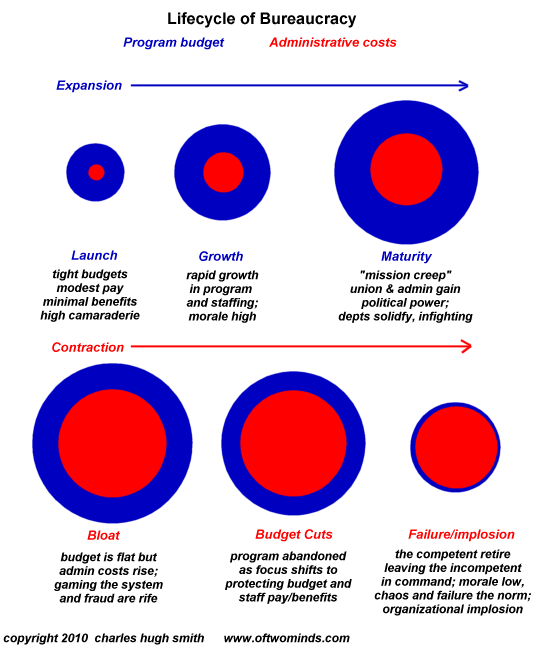
By this terminal stage, the competent have been driven out, quit or burned out.
What happens with the competent retire, burn out or opt out? It’s a question few bother to ask because the base assumption is that there is an essentially limitless pool of competent people who can be tapped or trained to replace those who retire, burn out or opt out, i.e. quit in favor of a lifestyle that doesn’t require much in the way of income or stress.
These assumptions are no longer valid. A great many essential services that are tightly bound to other essential services are cracking as the competent decide (or realize) they’re done with the rat-race.
The drivers of the Competent Opting Out are obvious yet difficult to quantify. Those retiring, burning out and opting out will deny they’re leaving for these reasons because it’s not politic to be so honest and direct. They will offer time-honored dodges such as “pursue other opportunities” or “family obligations.”
1. The steady increase in workloads, paperwork, compliance and make-work (i.e. work that has nothing to do with the institution’s actual purpose and mission) that lead to burnout. There is only so much we can accomplish, and if we’re burdened with ever-increasing demands for paperwork, compliance, useless meetings, training sessions, etc., then we no longer have the time or energy to perform our productive work.
I wrote a short book on my experience of Burnout. I believe it is increasingly common in jobs that demand responsibility and accountability yet don’t provide the tools and time to fulfill these demands. Once you’ve burned out, you cannot continue. That option no longer exists.
For others, the meager rewards simply aren’t worth the sacrifices required. The theme song playing in the background is the Johnny Paycheck classic Take this job and shove it.
Healthcare workloads, paperwork and compliance are one example of many. Failure to complete all the make-work can have dire consequences, so it becomes necessary to do less “real work” in order to complete all the work that has little or nothing to do with actual patient care. Alternatively, the workload expands to the point that it breaks the competent and they leave.
2. Loss of autonomy, control, belonging, rewards, accomplishment and fairness. Professor Christina Malasch pioneered research on the causes of burnout, which can be summarized as any work environment that reduces autonomy, control, belonging, rewards, accomplishment and fairness. Despite a near-infinite avalanche of corporate happy-talk (“we’re all family,”–oh, barf) this describes a great many work environments in the US: in a word, depersonalized. Everyone is a replaceable cog in a great impersonal machine optimized to maximize profits for shareholders.
3. The politicization of the work environment. Let’s begin by distinguishing between policies enforcing equal opportunity, pay, standards and accountability, policies required to fulfill the legal promises embedded in the nation’s social contract, and politicization, which demands allegiance and declarations of loyalty to political ideologies that have nothing to do with the work being done or the standards of accountability necessary to the operation of the complex institution or enterprise.
The problem with politicization is that it is 1) intrinsically inauthentic and 2) it substitutes the ideologically pure for the competent. Rigid, top-down hierarchies (including not just Communist regimes but corporations and institutions) demand expressions of fealty (the equivalent of loyalty oaths) and compliance to ideological demands (check the right boxes of party indoctrination, “self-criticism,” “struggle sessions,” etc.).
The correct verbiage and ideological enthusiasm become the basis of advancement rather than accountability to standards of competence. The competent are thus replaced with the politically savvy. Since competence is no longer being selected for, it’s replaced by what is being selected for, political compliance.
It doesn’t matter what flavor of ideological purity holds sway–conservative, progressive, communist or religious–all fatally erode competence by selecting for ideological compliance. Everyone knows the enthusiasm is inauthentic and only for show, but artifice and inauthenticity are perfectly adequate for the politicization taskmasters.
4. The competent must cover for the incompetent. As the competent tire of the artifice and make-work and quit, the remaining competent must work harder to keep everything glued together. Their commitment to high standards and accountability are their undoing, as the slack-masters and incompetent either don’t care (“I’m just here to qualify for my pension”) or they’ve mastered the processes of masking their incompetence, often by blaming the competent or the innocent for their own failings.
This additional workload crushes the remaining competent who then burn out and quit, go on disability or opt out, changing their lifestyle to get by on far less income, work, responsibility and far less exposure to the toxic work environments created by depersonalization, politicization and the elevation of the incompetent.
5. As the competent leadership leaves, the incompetent takes the reins, blind to their own incompetence. It all looked so easy when the competent were at the helm, but reality is a cruel taskmaster, and all the excuses that worked as an underling wear thin once the incompetent are in leadership roles.
By this terminal stage, the competent have been driven out, quit or burned out. There’s only slack-masters and incompetent left, and the toxic work environment has been institutionalized, so no competent individual will even bother applying, much less take a job doomed to burnout and failure.
This is why systems are breaking down before our eyes and why the breakdowns will spread with alarming rapidity due the tightly bound structure of complex systems.
The West is now waking up to the reality of the emerging, polycentric and fluid global order, Alastair Crookewrites.
More than a year into Russia’s Special Operation, the initial burst of European excitement at western push-back on Russia has dissipated. The mood instead has turned to “existential dread, a nagging suspicion that [western] civilisation may destroy itself”, Professor Helen Thompson writes.
For an instant, a euphoria had coalesced around the putative projection of the EU as a world power; as a key actor, about to compete on a world scale. Initially, events seemed to play to Europe’s conviction of its market powers: Europe was going to bring down a major power – Russia – by financial coup d’état alone. The EU felt ‘six feet tall’.
It seemed at the time a galvanising moment: “The war re-forged a long-dormant Manichaean framing of existential conflict between Russia and the West, assuming ontological, apocalyptic dimensions. In the spiritual fires of the war, the myth of the ‘West’ was rebaptised”, Arta Moeini suggests.
After the initial disappointment at the lack of a ‘quick kill’, the hope persisted – that if only the sanctions were given more time, and made more all-embracing, then Russia surely would ultimately collapse. That hope has turned to dust. And the reality of what Europe has done to itself has begun to dawn – hence Professor Thomson’s dire warning:
“Those who assume that the political world can be reconstructed by the efforts of human Will, have never before had to bet so heavily on technology over [fossil] energy – as the driver of our material advancement”.
For the Euro-Atlanticists however, what Ukraine seemed to offer – finally – was validation for their yearning to centralise power in the EU, sufficiently, to merit a place at the ‘top table’ with the U.S., as partners in playing the Great Game.
Ukraine, for better or worse, underlined Europe’s profound military dependence on Washington – and on NATO.
More particularly, the Ukraine conflict seemed to open the prospect for consolidating the strange metamorphosis of NATO from military alliance to an enlightened, Progressive, peace alliance! As Timothy Garton Ash effused in the Guardian in 2002, “NATO has become a European peace movement” where one could watch “John Lennon meet George Bush”.
The Ukraine war is portrayed, in this vein, as the “war that even former pacifists can get behind. All its proponents seemed to be singing is “Give War a Chance””.
“…especially in the past 12 months, telegenic female leaders such as the Finnish Prime Minister, Sanna Marin, German Foreign Minister, Annalena Baerbock, and Estonian Prime Minister, Kaja Kallas, have increasingly served as the spokespersons of enlightened militarism in Europe … ”
“No political party in Europe better exemplifies the shift from militant pacifism to ardent pro-war Atlanticism than the German Greens. Most of the original Greens had been radicals during the student protests of 1968 … But as the founding members entered middle age, fissures began to appear in the party – that would one day tear it apart”.
“Kosovo then changed everything:The 78-day NATO bombing of what remained of Yugoslavia in 1999, ostensibly to halt war crimes committed by Serbian security forces in Kosovo, would forever transform the German Greens. NATO for the Greens became an active military compact concerned with spreading and defending values such as human rights, democracy, peace, and freedom – well beyond the borders of its member states”.
A few years later, in 2002, an EU functionary (Robert Cooper) could envisage Europe as a new ‘liberal imperialism’. The ‘new’ was that Europe eschewed hard military power, in favour of weaponising both a controlled ‘narrative’ and controlled participation in its market. He advocated for ‘a new age of empire’, in which Western powers no longer would have to follow international law in their dealings with ‘old fashioned’ states; they could use military force independently of the United Nations; and could impose protectorates to replace regimes which ‘misgovern’.
The German Greens’ Foreign Minister, Annalena Baerbock, has continued with this metamorphosis, scolding countries with traditions of military neutrality, and imploring them to join NATO. She has invoked Archbishop Desmond Tutu’s line: “If you are neutral in situations of injustice, you have chosen the side of the oppressor”. And the European Left has been utterly captivated. Major parties have abandoned military neutrality and opposition to war – and now champion NATO. It is a stunning reversal.
All this may have been music to the ears of the Euro-élites anxious for the EU to rise to Great Power status, but this soft-power European Leviathan was wholly underpinned by the unstated (but essential) assumption that NATO ‘had Europe’s back’. This naturally implied that the EU had to tie itself ever closer to NATO – and therefore to the U.S. which controls NATO.
But the flip-side to this Atlanticist aspiration – as President Emmanuel Macron noted – is its inexorable logic that Europeans simply end by becoming American vassals. Macron was trying rather, to rally Europe towards the coming ‘age of empires’,hoping to position Europe as a ‘third pole’ in a concert of empires.
The Atlanticists were duly enraged by Macron’s remarks (which nonetheless drew support of other EU states). It could even seem (to furious Atlanticists) that Macron actually was channelling General de Gaulle who had called NATO a “false pretence” designed to “disguise America’s chokehold over Europe”.
There are however, two related schisms that flowed out from this ‘re-imagined’ NATO: Firstly, it exposed the reality of internal European rivalries and divergent interests, precisely because the NATO lead in the Ukraine conflict sets the interests of the Central East European hawks wanting ‘more America, and more war on Russia’ up and against that of the original EU western axis which wants wanting strategic autonomy (i.e. less ‘America’, and a quick end to the conflict).
Secondly, it would be predominantly the western economies that would have to bankroll the costs and divert their manufacturing capacity towards military logistic chains. The economic price, non-military de-industrialisation and high inflation, potentially, could be enough to break Europe – economically.
The prospect of a pan-European cohesive identity might be both ontologically appealing – and be seen to be an ‘appropriate accessory’ to an aspiring ‘world actor’ – yet such identity becomes caricature when mosaic Europe is transformed into an abstract de-territorialised identity that reduces people to their most abstract.
Paradoxically, the Ukraine war – far from consolidating the EU ‘identity’, as first imagined – has fractured it under the stresses of the concerted effort to weaken and collapse Russia.
Secondly, as Arta Moeini, the director of the Institute for Peace and Diplomacy, has observed:
“The American push for NATO expansion since 1991 has enlarged the alliance by adding a host of faultline states from Central and Eastern Europe. The strategy, which began with the Clinton administration but was fully championed by the George W. Bush administration, was to create a decidedly pro-American pillar on the continent, centred on Warsaw – which would force an eastward shift in the alliance’s centre of gravity away from the traditional Franco-German axis”.
“By using NATO enlargement to weaken the old power centres in Europe that might have occasionally stood up to [Washington] such as in the run-up to the invasion of Iraq, Washington ensured a more compliant Europe in the short-term. The upshot, however, was the formation of a 31-member behemoth with deep asymmetries of power and low compatibility of interests” – that is much weaker and more vulnerable – than it believes itself to be”.
Here is the key: “the EU is much weaker than it believes it to be”. The outset of the conflict was defined by a cast of mind entranced by the notion of Europe as a ‘mover and shaker’ in world affairs, and mesmerised by Europe’s post-war prosperity.
EU leaders convinced themselves that this prosperity had bequeathed it the clout and the economic depth to contemplate war – and to weather its reversals – with panglossian sanguinity. It has produced rather, the converse: It has put its project in jeopardy.
In John Raply and Peter Heather’s The Imperial Life Cycle, the authors explain the cycle:
“Empires grow rich and powerful and attain supremacy through the economic exploitation of their colonial periphery. But in the process, they inadvertently spur the economic development of that same periphery, until it can roll back and ultimately displace its overlord”.
Europe’s prosperity in this post-war era, thus was not so much one of its own making, but drew benefit from the tail-end of accumulations hewn from an earlier cycle – now reversed.
“The fastest-growing economies in the world are now all in the old periphery; the worst-performing economies are disproportionately in the West. These are the economic trends that have created our present landscape of superpower conflict — most saliently between America and China”.
America may think of itself as exempt from the European colonial mould, yet fundamentally, its model is
“an updated cultural-political glue that we might call “neoliberalism, NATO and denim”, which follows in the timeless imperial mould: The great wave of decolonisation that followed WW2 was meant to end that. But the Bretton Woods system, which created a trading regime that favoured industrial over primary producers and enshrined the dollar as the global reserve currency – ensured that the net flow of financial resources continued to move from developing countries to developed ones. Even when the economies of the newly-independent states grew, those of the G7 economies and their partners grew more”.
A once-mighty empire is now challenged and feels embattled. Taken aback by the refusal of so many developing countries to join with isolating Russia, the West is now waking up to the reality of the emerging, polycentric and fluid global order. These trends are set to continue. The danger is that economically weakened and in crisis, western countries attempt to re-appropriate western triumphalism, yet lack the economic strength and depth, so to do:
“In the Roman Empire, peripheral states developed the political and military capacity to end Roman domination by force… The Roman Empire might have survived – had it not weakened itself with wars of choice – on its ascendant Persian rival”.
The final ‘transgressive’ thought goes to Tom Luongo: “Allowing the West to keep thinking they can win – is the ultimate form of grinding out a superior opponent”.
In the year 2000, the U.S. government debt was $3.5 trillion, equal to 35% of the Gross Domestic Product (GDP). By 2022, the debt was $24 trillion, equal to 95% of GDP. The U.S. debt is soaring, hence America’s current debt crisis. Yet both Republicans and Democrats are missing the solution: stopping America’s wars of choice and slashing military outlays.
Suppose the government’s debt had remained at a modest 35% of GDP, as in 2000. Today’s debt would be $9 billion, as opposed to $24 trillion. Why did the U.S. government incur the excess $15 trillion in debt?
The single biggest answer is the U.S. government’s addiction to war and military spending. According to the Watson Institute at Brown University, the cost of U.S. wars from fiscal year 2001 to fiscal year 2022 amounted to a whopping $8 trillion, more than half of the extra $15 trillion in debt. The other $7 trillion arose roughly equally from budget deficits caused by the 2008 financial crisis and the Covid-19 pandemic.
Facing down the military-industrial lobby is the vital first step to putting America’s fiscal house in order.
To surmount the debt crisis, America needs to stop feeding the Military-Industrial Complex (MIC), the most powerful lobby in Washington. As President Dwight D. Eisenhower famously warned on January 17, 1961, “In the councils of government, we must guard against the acquisition of unwarranted influence, whether sought or unsought, by the military-industrial complex. The potential for the disastrous rise of misplaced power exists and will persist.” Since 2000, the MIC led the U.S. into disastrous wars of choice in Afghanistan, Iraq, Syria, Libya, and now Ukraine.
The Military-Industrial Complex long ago adopted a winning political strategy by ensuring that the military budget reaches into every Congressional district. The Congressional Research Service recently reminded Congress that, “Defense spending touches every Member of Congress’s district through pay and benefits for military servicemembers and retirees, economic and environmental impact of installations, and procurement of weapons systems and parts from local industry, among other activities.” Only a brave member of Congress would vote against the military-industry lobby, yet bravery is certainly no hallmark of Congress.
America’s annual military spending is now around $900 billion, roughly 40% of the world’s total, and greater than the next 10 countries combined. U.S. military spending in 2022 was triple that of China. According to Congressional Budget Office, the military outlays for 2024-2033 will be a staggering $10.3 trillion on current baseline. A quarter or more of that could be avoided by ending America’s wars of choice, closing down many of America’s 800 or so military bases around the world, and negotiating new arms control agreements with China and Russia.
Yet instead of peace through diplomacy, and fiscal responsibility, the MIC regularly scares the American people with a comic-book style depictions of villains whom the U.S. must stop at all costs. The post-2000 list has included Afghanistan’s Taliban, Iraq’s Saddam Hussein, Syria’s Bashar al-Assad, Libya’s Moammar Qaddafi, Russia’s Vladimir Putin, and recently, China’s Xi Jinping. War, we are repeatedly told, is necessary for America’s survival.
A peace-oriented foreign policy would be opposed strenuously by the military-industrial lobby but not by the public. Significant public pluralities already want less, not more, U.S. involvement in other countries’ affairs, and less, not more, US troop deployments overseas. Regarding Ukraine, Americans overwhelmingly want a “minor role” (52%) rather than a “major role” (26%) in the conflict between Russia and Ukraine. This is why neither Biden nor any recent president has dared to ask Congress for any tax increase to pay for America’s wars. The public’s response would be a resounding “No!”
While America’s wars of choice have been awful for America, they have been far greater disasters for countries that America purports to be saving. As Henry Kissinger famously quipped, “To be an enemy of the United States can be dangerous, but to be a friend is fatal.” Afghanistan was America’s cause from 2001 to 2021, until the U.S. left it broken, bankrupt, and hungry. Ukraine is now in America’s embrace, with the same likely results: ongoing war, death, and destruction.
The military budget could be cut prudently and deeply if the U.S. replaced its wars of choice and arms races with real diplomacy and arms agreements. If presidents and members of congress had only heeded the warnings of top American diplomats such as William Burns, the U.S. Ambassador to Russia in 2008, and now CIA Director, the U.S. would have protected Ukraine’s security through diplomacy, agreeing with Russia that the U.S. would not expand NATO into Ukraine if Russia also kept its military out of Ukraine. Yet relentless NATO expansion is a favorite cause of the MIC; new NATO members are major customers of U.S. armaments.
The U.S. has also unilaterally abandoned key arms control agreements. In 2002, the U.S. unilaterally walked out of the Anti-Ballistic Missile Treaty. And rather than promote nuclear disarmament—as the U.S. and other nuclear powers are required to do under Article VI the Nuclear Non-Proliferation Treaty—the Military-Industrial Complex has sold Congress on plans to spend more than $600 billion by 2030 to “modernize” the U.S. nuclear arsenal.
Now the MIC is talking up the prospect of war with China over Taiwan. The drumbeats of war with China are stoking the military budget, yet war with China is easily avoidable if the U.S. adheres to the One-China policy that properly underpins U.S.-China relations. Such a war should be unthinkable. More than bankrupting the U.S., it could end the world.
Military spending is not the only budget challenge. Aging and rising healthcare costs add to the fiscal woes. According to the Congressional Budget Office, debt will reach 185 percent of GDP by 2052 if current policies remain unchanged. Healthcare costs should be capped while taxes on the rich should be raised. Yet facing down the military-industrial lobby is the vital first step to putting America’s fiscal house in order, needed to save the U.S., and possibly the world, from America’s perverse lobby-driven politics.
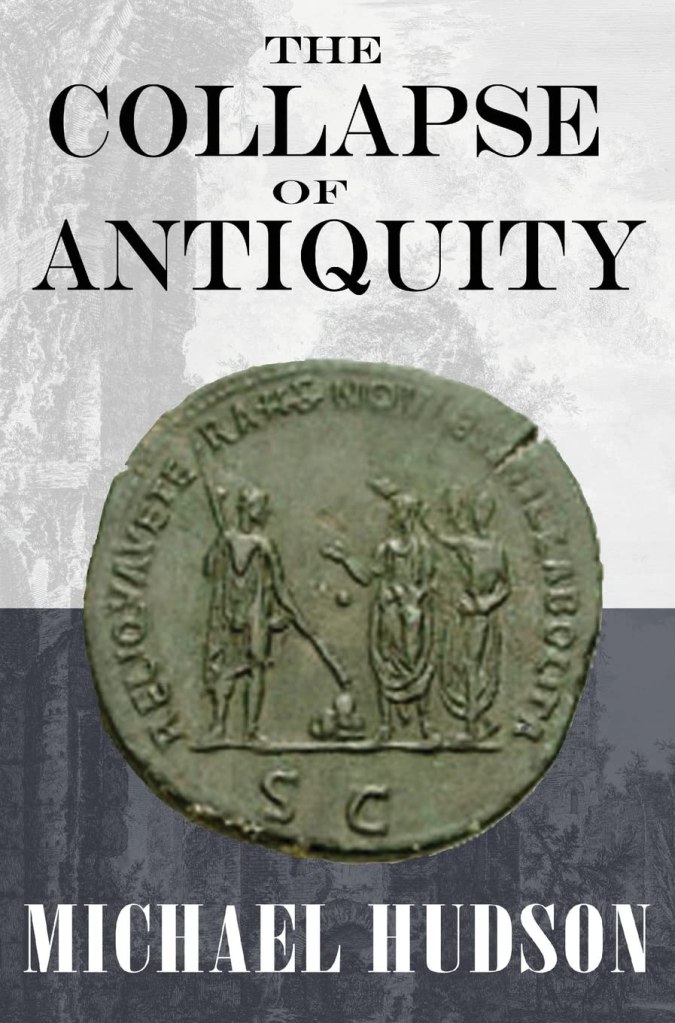
Prof. Hudson’s main thesis is absolutely devastating: he sets out to prove that economic/financial practices in Ancient Greece and Rome – the pillars of Western Civilization – set the stage for what is happening today right in front of our eyes: an empire reduced to a rentier economy, collapsing from within.
And that brings us to the common denominator in every single Western financial system: it’s all about debt, inevitably growing by compound interest.
Ay, there’s the rub: before Greece and Rome, we had nearly 3,000 years of civilizations across West Asia doing exactly the opposite.
These kingdoms all knew about the importance of canceling debts. Otherwise their subjects would fall into bondage; lose their land to a bunch of foreclosing creditors; and these would usually try to overthrow the ruling power.
Aristotle succinctly framed it: “Under democracy, creditors begin to make loans and the debtors can’t pay and the creditors get more and more money, and they end up turning a democracy into an oligarchy, and then the oligarchy makes itself hereditary, and you have an aristocracy.”
Prof. Hudson sharply explains what happens when creditors take over and “reduce all the rest of the economy to bondage”: it’s what’s called today “austerity” or “debt deflation”.
So “what’s happening in the banking crisis today is that debts grow faster than the economy can pay. And so when the interest rates finally began to be raised by the Federal Reserve, this caused a crisis for the banks.”
Prof. Hudson also proposes an expanded formulation: “The emergence of financial and landholding oligarchies made debt peonage and bondage permanent, supported by a pro-creditor legal and social philosophy that distinguishes Western civilization from what went before. Today it would be called neoliberalism.”
Then he sets out to explain, in excruciating detail, how this state of affairs was solidified in Antiquity in the course of over 5 centuries. One can hear the contemporary echoes of “violent suppression of popular revolts” and “targeted assassination of leaders” seeking to cancel debts and “redistribute land to smallholders who have lost it to large landowners”.
The verdict is merciless: “What impoverished the population of the Roman Empire” bequeathed a “creditor-based body of legal principles to the modern world”.
Predatory oligarchies and “Oriental Despotism”
Prof Hudson develops a devastating critique of the “social darwinist philosophy of economic determinism”: a “self-congratulatory perspective” has led to “today’s institutions of individualism and security of credit and property contracts (favoring creditor claims over debtors, and landlord rights over those of tenants) being traced back to classical antiquity as “positive evolutionary developments, moving civilization away from ‘Oriental Despotism’”.
All that is a myth. Reality was a completely different story, with Rome’s extremely predatory oligarchies waging “five centuries of war to deprive populations of liberty, blocking popular opposition to harsh pro-creditor laws and the monopolization of the land into latifundia estates”.
So Rome in fact behaved very much like a “failed state”, with “generals, governors, tax collectors, moneylenders and carpet beggars” squeezing out silver and gold “in the form of military loot, tribute and usury from Asia Minor, Greece and Egypt.” And yet this Roman wasteland approach has been lavishly depicted in the modern West as bringing a French-style mission civilisatrice to the barbarians – while carrying the proverbial white man’s burden.
Prof. Hudson shows how Greek and Roman economies actually “ended in austerity and collapsed after having privatized credit and land in the hands of rentier oligarchies”. Does that ring a – contemporary – bell?
Arguably the central nexus of his argument is here:
“Rome’s law of contracts established the fundamental principle of Western legal philosophy giving creditor claims priority over the property of debtors – euphemized today as ‘security of property rights’. Public expenditure on social welfare was minimized – what today’s political ideology calls leaving matters to ‘the market’. It was a market that kept citizens of Rome and its Empire dependent for basic needs on wealthy patrons and moneylenders – and for bread and circuses, on the public dole and on games paid for by political candidates, who often themselves borrowed from wealthy oligarchs to finance their campaigns.”
Any similarity with the current system led by the Hegemon is not mere coincidence. Hudson: “These pro-rentier ideas, policies and principles are those that today’s Westernized world is following. That is what makes Roman history so relevant to today’s economies suffering similar economic and political strains.”
Prof. Hudson reminds us that Rome’s own historians – Livy, Sallust, Appian, Plutarch, Dionysius of Halicarnassus, among others – “emphasized the subjugation of citizens to debt bondage”. Even the Delphic Oracle in Greece, as well as poets and philosophers, warned against creditor greed. Socrates and the Stoics warned that “wealth addiction and its money-love was the major threat to social harmony and hence to society.”
And that brings us to how this criticism was completely expunged from Western historiography. “Very few classicists”, Hudson notes, follow Rome’s own historians describing how these debt struggles and land grabs were “mainly responsible for the Republic’s Decline and Fall.”
Hudson also reminds us that the barbarians were always at the gate of the Empire: Rome, in fact, was “weakened from within”, by “century after century of oligarchic excess.”
So this is the lesson we should all draw from Greece and Rome: creditor oligarchies “seek to monopolize income and land in predatory ways and bring prosperity and growth to a halt.” Plutarch was already into it: “The greed of creditors brings neither enjoyment nor profit to them, and ruins those whom they wrong. They do not till the fields which they take from their debtors, nor do they live in their houses after evicting them.”
Beware of pleonexia
It would be impossible to fully examine so many precious as jade offerings constantly enriching the main narrative. Here are just a few nuggets (And there will be more: Prof. Hudson told me, “I’m working on the sequel now, picking up with the Crusades.”)
Prof. Hudson reminds us how money matters, debt and interest came to the Aegean and Mediterranean from West Asia, by traders from Syria and the Levant, around 8th century B.C. But “with no tradition of debt cancellation and land redistribution to restrain personal wealth seeking, Greek and Italian chieftains, warlords and what some classicists have called mafiosi [ by the way, Northern European scholars, not Italians) imposed absentee land ownership over dependent labor.”
This economic polarization kept constantly worsening. Solon did cancel debts in Athens in the late 6th century – but there was no land redistribution. Athens’ monetary reserves came mainly from silver mines – which built the navy that defeated the Persians at Salamis. Pericles may have boosted democracy, but the eventful defeat facing Sparta in the Peloponnesian War (431-404 B.C.) opened the gates to a heavy debt-addicted oligarchy.
All of us who studied Plato and Aristotle in college may remember how they framed the whole problem in the context of pleonexia (“wealth addiction”) – which inevitably leads to predatory and “socially injurious” practices. In Plato’s Republic, Socrates proposes that only non-wealthy managers should be appointed to govern society – so they would not be hostages of hubris and greed.
The problem with Rome is that no written narratives survived. The standard stories were written only after the Republic had collapsed. The Second Punic War against Carthage (218-201 B.C.) is particularly intriguing, considering its contemporary Pentagon overtones: Prof. Hudson reminds us how military contractors engaged in large-scale fraud and fiercely blocked the Senate from prosecuting them.
Prof. Hudson shows how that “also became an occasion for endowing the wealthiest families with public land when the Rome state treated their ostensibly patriotic donations of jewelry and money to aid the war effort as retroactive public debts subject to repayment”.
After Rome defeated Carthage, the glitzy set wanted their money back. But the only asset left to the state was land in Campania, south of Rome. The wealthy families lobbied the Senate and gobbled up the whole lot.
With Caesar, that was the last chance for the working classes to get a fair deal. In the first half of the 1st century B.C. he did sponsor a bankruptcy law, writing down debts. But there was no widespread debt cancellation. Caesar being so moderate did not prevent the Senate oligarchs from whacking him, “fearing that he might use his popularity to ‘seek kingship’” and go for way more popular reforms.
After Octavian’s triumph and his designation by the Senate as Princeps and Augustus in 27 B.C., the Senate became just a ceremonial elite. Prof Hudson summarizes it in one sentence: “The Western Empire fell apart when there was no more land for the taking and no more monetary bullion to loot.” Once again, one should feel free to draw parallels with the current plight of the Hegemon.
Time to “uplift all labor”
In one of our immensely engaging email exchanges, Prof. Hudson remarked how he “immediately had a thought” on a parallel to 1848. I wrote in the Russian business paper Vedomosti: “After all, that turned out to be a limited bourgeois revolution. It was against the rentier landlord class and bankers – but was as yet a far cry from being pro-labor. The great revolutionary act of industrial capitalism was indeed to free economies from the feudal legacy of absentee landlordship and predatory banking — but it too fell back as the rentier classes made a comeback under finance capitalism.”
And that brings us to what he considers “the great test for today’s split”: “Whether it is merely for countries to free themselves from US/NATO control of their natural resources and infrastructure — which can be done by taxing natural-resource rent (thereby taxing away the capital flight by foreign investors who have privatized their natural resources). The great test will be whether countries in the new Global Majority will seek to uplift all labor, as China’s socialism is aiming to do.”
It’s no wonder “socialism with Chinese characteristics” spooks the Hegemon creditor oligarchy to the point they are even risking a Hot War. What’s certain is that the road to Sovereignty, across the Global South, will have to be revolutionary: “Independence from U.S. control is the Westphalian reforms of 1648 — the doctrine of non-interference in the affairs of other states. A rent tax is a key element of independence — the 1848 tax reforms. How soon will the modern 1917 take place?”
Let Plato and Aristotle weigh in: as soon as humanly possible.
Small farmers produce up to 80% of the food in the non-industrialised countries. However, they are currently squeezed onto less than a quarter of the world’s farmland. The period 1974-2014 saw 140 million hectares – more than all the farmland in China – being taken over for soybean, oil palm, rapeseed and sugar cane plantations.
GRAIN noted that the concentration of fertile agricultural land in fewer and fewer hands is directly related to the increasing number of people going hungry every day. While industrial farms have enormous power, influence and resources, GRAIN’s data showed that small farms almost everywhere outperform big farms in terms of productivity.
In the same year, policy think tank the Oakland Institute released a report stating that the first years of the 21 century will be remembered for a global land rush of nearly unprecedented scale. An estimated 500 million acres, an area eight times the size of Britain, were reported bought or leased across the developing world between 2000 and 2011, often at the expense of local food security and land rights.
Institutional investors, including hedge funds, private equity, pension funds and university endowments, were eager to capitalise on global farmland as a new and highly desirable asset class.
This trend was not confined to buying up agricultural land in low-income countries. Oakland Institute’s Anuradha Mittal argued that there was a new rush for US farmland. One industry leader estimated that $10 billion in institutional capital was looking for access to this land in the US.
Although investors believed that there is roughly $1.8 trillion worth of farmland across the US, of this between $300 billion and $500 billion (2014 figures) is considered to be of “institutional quality” – a combination of factors relating to size, water access, soil quality and location that determine the investment appeal of a property.
In 2014, Mittal said that if action is not taken, then a perfect storm of global and national trends could converge to permanently shift farm ownership from family businesses to institutional investors and other consolidated corporate operations.
WHY THIS MATTERS
Peasant/smallholder agriculture prioritises food production for local and national markets as well as for farmers’ own families, whereas corporations take over fertile land and prioritise commodities or export crops for profit and markets far away that tend to cater for the needs of more affluent sections of the global population.
In 2013, a UN report stated that farming in rich and poor nations alike should shift from monocultures towards greater varieties of crops, reduced use of fertilisers and other inputs, increased support for small-scale farmers and more locally focused production and consumption of food. The report stated that monoculture and industrial farming methods were not providing sufficient affordable food where it is needed.
In September 2020, however, GRAIN showed an acceleration of the trend that it had warned of six years earlier: institutional investments via private equity funds being used to lease or buy up farms on the cheap and aggregate them into industrial-scale concerns. One of the firms spearheading this is the investment asset management firm BlackRock, which exists to put its funds to work to make money for its clients.
BlackRock holds shares in a number of the world’s largest food companies, including Nestlé, Coca-Cola, PepsiCo, Walmart, Danone and Kraft Heinz and also has significant shares in most of the top publicly traded food and agriculture firms: those which focus on providing inputs (seeds, chemicals, fertilisers) and farm equipment as well as agricultural trading companies, such as Deere, Bunge, ADM and Tyson (based on BlackRock’s own data from 2018).
Together, the world’s top five asset managers – BlackRock, Vanguard, State Street, Fidelity and Capital Group – own around 10–30% of the shares of the top firms in the agrifood sector.
The article Who is Driving the Destructive Industrial Agriculture Model? (2022) by Frederic Mousseau of the Oakland Institute showed that BlackRock and Vanguard are by far the biggest shareholders in eight of the largest pesticides and fertiliser companies: Yara, CF Industries Holdings K+S Aktiengesellschaft, Nutrien, The Mosaic Company, Corteva and Bayer.
These companies’ profits were projected to double, from US$19 billion in 2021 to $38 billion in 2022, and will continue to grow as long as the industrial agriculture production model on which they rely keeps expanding. Other major shareholders include investment firms, banks and pension funds from Europe and North America.
Through their capital injections, BlackRock et al fuel and make huge profits from a globalised food system that has been responsible for eradicating indigenous systems of production, expropriating seeds, land and knowledge, impoverishing, displacing or proletarianizing farmers and destroying rural communities and cultures. This has resulted in poor-quality food and illness, human rights abuses and ecological destruction.
SYSTEMIC COMPULSION
Post-1945, the Rockefeller Chase Manhattan bank with the World Bank helped roll out what has become the prevailing modern-day agrifood system under the guise of a supposedly ‘miraculous’ corporate-controlled, chemical-intensive Green Revolution (its much-heralded but seldom challenged ‘miracles’ of increased food production are nothing of the sort; for instance, see the What the Green Revolution Did for India and New Histories of the Green Revolution).
Ever since, the IMF, the World Bank and the WTO have helped consolidate an export-oriented industrial agriculture based on Green Revolution thinking and practices. A model that uses loan conditionalities to compel nations to ‘structurally adjust’ their economies and sacrifice food self-sufficiency.
Countries are placed on commodity crop production treadmills to earn foreign currency (US dollars) to buy oil and food on the global market (benefitting global commodity traders like Cargill, which helped write the WTO trade regime – the Agreement on Agriculture), entrenching the need to increase cash crop cultivation for exports.
Today, investment financing is helping to drive and further embed this system of corporate dependency worldwide. BlackRock is ideally positioned to create the political and legislative framework to maintain this system and increase the returns from its investments in the agrifood sector.
The firm has around $10 trillion in assets under its management and has, according to William Engdahl, positioned itself to effectively control the US Federal Reserve, many Wall Street mega-banks and the Biden administration: a number of former top people at BlackRock are in key government positions, shaping economic policy.
So, it is no surprise that we are seeing an intensification of the lop-sided battle being waged against local markets, local communities and indigenous systems of production for the benefit of global private equity and big agribusiness.
For example, while ordinary Ukrainians are currently defending their land, financial institutions are supporting the consolidation of farmland by rich individuals and Western financial interests. It is similar in India (see the article The Kisans Are Right: Their Land Is at Stake) where a land market is being prepared and global investors are no doubt poised to swoop.
In both countries, debt and loan conditionalities on the back of economic crises are helping to push such policies through. For instance, there has been a 30+ year plan to restructure India’s economy and agriculture. This stems from the country’s 1991 foreign exchange crisis, which was used to impose IMF-World Bank debt-related ‘structural adjustment’ conditionalities. The Mumbai-based Research Unit for Political Economy locates agricultural ‘reforms’ within a broader process of Western imperialism’s increasing capture of the Indian economy.
Yet ‘imperialism’ is a dirty word never to be used in ‘polite’ circles. Such a notion is to be brushed aside as ideological by the corporations that benefit from it. Instead, what we constantly hear from these conglomerates is that countries are choosing to embrace their entry and proprietary inputs into the domestic market as well as ‘neoliberal reforms’ because these are essential if we are to feed a growing global population. The reality is that these firms and their investors are attempting to deliver a knockout blow to smallholder farmers and local enterprises in places like India.
But the claim that these corporations, their inputs and their model of agriculture is vital for ensuring global food security is a proven falsehood. However, in an age of censorship and doublespeak, truth has become the lie and the lie is truth. Dispossession is growth, dependency is market integration, population displacement is land mobility, serving the needs of agrifood corporations is modern agriculture and the availability of adulterated, toxic food as part of a monoculture diet is feeding the world.
And when a ‘pandemic’ was announced and those who appeared to be dying in greater numbers were the elderly and people with obesity, diabetes and cardio-vascular disease, few were willing to point the finger at the food system and its powerful corporations, practices and products that are responsible for the increasing prevalence of these conditions (see campaigner Rosemary Mason’s numerous papers documenting this on Academia.edu). Because this is the real public health crisis that has been building for decades.
But who cares? BlackRock, Vanguard and other institutional investors? Highly debatable because if we turn to the pharmaceuticals industry, we see similar patterns of ownership involving the same players.
A December 2020 paper on ownership of the major pharmaceuticals companies, by researchers Albert Banal-Estanol, Melissa Newham and Jo Seldeslachts, found the following (reported on the website of TRT World, a Turkish news media outlet):
Public companies are increasingly owned by a handful of large institutional investors, so we expected to see many ownership links between companies — what was more surprising was the magnitude of common ownership… We frequently find that more than 50 per cent of a company is owned by ‘common’ shareholders who also own stakes in rival pharma companies.”
The three largest shareholders of Pfizer, J&J and Merck are Vanguard, SSGA and BlackRock.
In 2019, the Centre for Research on Multinational Corporations reported that payouts to shareholders had increased by almost 400 per cent — from $30 billion in 2000 to $146 billion in 2018. Shareholders made $1.54 trillion in profits over that 18-year period.
So, for institutional investors, the link between poor food and bad health is good for profit. While investing in the food system rakes in enormous returns, you can perhaps double your gains if you invest in pharma too.
These findings predate the 2021 documentary Monopoly: An Overview of the Great Reset, which also shows that the stock of the world’s largest corporations are owned by the same institutional investors. ‘Competing’ brands, like Coke and Pepsi, are not really competitors, since their stock is owned by the same investment companies, investment funds, insurance companies and banks.
Smaller investors are owned by larger investors. Those are owned by even bigger investors. The visible top of this pyramid shows only Vanguard and Black Rock.
A 2017 Bloomberg report states that both these companies in the year 2028 together will have investments amounting to $20 trillion.
While individual corporations – like Pfizer and Monsanto/Bayer, for instance – should be (and at times have been) held to account for some of their many wrongdoings, their actions are symptomatic of a system that increasingly leads back to the boardrooms of the likes of BlackRock and Vanguard.
Today, capitalist power can be summed up with the names of the three biggest investment funds in the world: BlackRock, Vanguard and State Street Global Advisor. These giants, sitting at the centre of a huge galaxy of financial entities, manage a mass of value close to half the global GDP, and are major shareholders in around 90% of listed companies.”
These firms help shape and fuel the dynamics of the economic system and the globalised food regime, ably assisted by the World Bank, the IMF, the WTO and other supranational institutions. A system that leverages debt, uses coercion and employs militarism to secure continued expansion.
I’d like to pose a question I’ve been dancing around for the last couple of posts: Is the United States a failed society?
That may seem overly dramatic, but please hear me out.
Recently, it has once again come to the attention of the news media that Americans are an order of magnitude more likely to die at every age than citizens of other advanced, wealthy, industrialized nations.
This was most recently expounded by a Financial Times correspondent named John Burn-Murdoch. The article itself is paywalled, but this Twitter thread contains all the relevant information:
It makes for sobering reading. A lot of times the discussion just focuses on total life expectancy, that is, the number on the death certificate. That’s fallen too, but not as dramatically. But life expectancy differs at various ages. Yet, what the numbers invariably show is that, at every single age Americans are more likely to die than their counterparts in other wealthy industrialized nations.
For example, one in 25 five-year-olds in the United States will not live to see their fortieth birthday. That means a lot of parents are going to have to bury their children. But at every age, whether you’re twenty-five or fifty, your chances of dying are much higher in the United States than anywhere else. By age 29, the average American is four times more likely to die than a 29 year-old in another country. I’ve heard plenty of stories from people in their twenties and thirties talking about their high-school years like military veterans recounting their service during wartime (“fifteen in my class didn’t make it out.”). And those are just ordinary citizens!
In other words, growing up in the United States is extraordinarily deadly.
In fact, the social outcomes for the average American are worse than the most socially deprived areas of the United Kingdom like Blackpool—an area synonymous with industrial decline. At every single point along the income distribution, Americans are more likely to be hurt, injured, or killed than their peers in other wealthy, developed nations.
Furthermore, these trends are exclusively confined to the United States. Even Cuba, a relatively poor country under continuous sanctions by the United States since the nineteen-sixties, now has better health outcomes (e.g. life expectancy, infant mortality, chronic diseases). So, too, does China, which has overtaken the U.S. in a number of health metrics despite being the largest country in terms of total population.
The Atlantic’s Derek Thompson has called the United States “The Rich World’s Death Trap.” He interviews John Burn-Murdock here:
The bottom line is this: in many ways, your life chances are much, much lower in the United States than in any other wealthy, industrialized nation in the world. This is simply undeniable.
Which leads me to pose the question I asked above.
Peer Countries
Because this is such a fraught topic, it’s worthwhile to get some things out of the way. Certainly your life chances in the United States are better than many other parts of the world at the moment.
Some places are run by military dictatorships like North Korea or Myanmar. Some places are in outright civil war like Syria, Libya or Sudan. Some areas are in an active shooting war like Ukraine and Russia. Some countries have huge areas of absolute deprivation like sub-Saharan Africa, India, the Philippines or Afghanistan. Some countries have lost control over parts of their territory to drug gangs like Mexico, El Salvador, Peru and Ecuador. You’re certainly better off here than in many of those other countries.
So let’s just acknowledge that right off the bat. Of course, this raises questions about just how supposedly wonderful the current state of our world actually is, but that’s a topic for another time.
But I think it’s absolutely invalid to invoke those countries as a justification for the abysmal statistics listed above. Here’s why: the United States is at the absolute apex of the global economy, and has been since World War Two. We issue the world’s reserve currency. We have more billionaires than anywhere else. We are home to the largest and most powerful corporations in the world. No country in the world is more wealthy or powerful than the United States at the present moment.
This is the concept of peer nations. Those are the ones we should be judging ourselves against. You can use a number of indicators for this. The United States is a member of both the OECD and the G-7. In fact, it is the key member of these organizations. It is at peacetime. It is an electoral democracy. It has the world’s largest GDP. It is surrounded by the world’s two largest oceans and has benign neighbors to the north and the south. It has not had a war on its home soil since the 1860s.
Simply put, the United States has more resources at its disposal and more wherewithal to tackle social problems than anywhere else in the world.
So, unlike many other countries around the world, the United States has no excuse whatsoever for the sorry state of its citizenry, and comparing the United States to non-peer countries is no more than pathetic excuse-making in the face of damning evidence that the U.S. government simply chooses to ignore burgeoning social problems and leaves the majority of its citizens to fend for themselves.
What Else Is New?
Reading these facts, I’m wondering why any of this this is news to people. As far back as 2013 I noted the following:
Americans die younger and experience more injury and illness than people in other rich nations, despite spending almost twice as much per person on health care.
That was the startling conclusion of a major report released earlier this year by the U.S. National Research Council and the Institute of Medicine. It received widespread attention. The New York Times concluded: “It is now shockingly clear that poor health is a much broader and deeper problem than past studies have suggested.”
It received widespread attention all right, and then was promptly forgotten. But even earlier, in 2012, there was this report from The Lancet:
American teenagers have the highest rates of drug and alcohol abuse in the developed world. And they are far more likely to be killed by violence than peers in Europe. This lost generation, whose unemployment rate is 20 percent, leads the modern world in some of the most dangerous and irresponsible behaviors, according to a new study released by the Lancet medical journal.
In 2019, husband-and-wife economists Angus Deaton and Anne Case coined the term “deaths of despair,” and noted that these were exclusively confined to the United States. In 2020, they published a book chronicling their grim studies with that same title. It, too, received a brief burst of attention in the media and then promptly disappeared down the memory hole just like everything else.
So this is old news. As Burn-Murdock’s article notes, the divergence between the U.S. and its peers has been continuously growing since around 1990, and has been getting even more acute in recent years.
The above podcast touts how “rich” we are compared with other nations using metrics like dollar income. But what does a high salary even mean when you are less likely to survive than other places? What are you supposed to do with that money, anyway—fill your oversized house with crap? As the saying goes, “you can’t take it with you.” This also belies the insanely high cost of everything in America, especially housing, which leads to 70 percent of Americans feeling financially stressed according to CNBC, despite how “rich” we supposedly are. According to Brookings, 44 percent of Americans earn low wages in this allegedly “rich” country.
And, as economist Dean Baker has noted, people in many other countries choose to take their additional “income” as leisure time, which may be another reason why they are so much healthier than we are. Americans work longer hours than anyone else, and at unusual times. The United States has a lousy work culture, with much less vacation or family leave time than other countries. Americans also take less vacation, work longer days, and retire later. Citizens of other countries also don’t have to pay for as many things out of their own pocket—from transportation, to retirement, to health care—due to a misguided fear of “socialism,” making income comparisons misleading. What sense does it make to earn a lot of money if you are lonely and isolated and have no time off to enjoy it? And much of that extra income is dedicated to cushioning ourselves from the fallout of a society decaying around us and positional goods to compete with everyone else.
My question is this: if the United States is not a failed society, then by what criteria should we judge success? Are context-free income statistics, GDP, and the number of billionaires really the appropriate measure for a good society rather than the well-being of the average citizen? People like to tout America’s so-called “innovation,” but one area we don’t seem to be innovating very much in is keeping our citizens healthy and alive.
The symptoms versus the disease
The reasons given for the above statistics are the usual ones: gun violence, drug overdoses, suicides, car crashes, metabolic diseases, and lack of access to basic and preventative health care compared to other nations.
But I want to distinguish the symptoms from the disease.
In medicine, doctors are taught to separate the symptoms from the disease. If a patient is suffering from a fever, jaundice, and swelling, for example; the fever, jaundice, and swelling aren’t what is making them ill. Instead, these are all symptoms caused by the disease which the patient is afflicted with, and it is the doctor’s job to determine what the disease is from the symptoms and try to cure it.
If that is the case, then what is the disease we are suffering from in this instance? In my opinion, it is this: American society is fundamentally rotten to the core.
We have effectively restructured our entire society as a lottery. Under this system, you’re entitled to precisely nothing except what you can claw free from the impersonal market casino rigged in favor the House. American society been transformed into a brutal winner-take-all tournament in the name of “meritocracy,” and most Americans seem to be okay with that.
At every point on their hierarchy, from the highest perch to the lowest, everyone is desperately trying to maintain their current position, hyperattuned to status, fearful of falling into the abyss, clawing each other’s eyes out to hold onto their small piece of the pie in a crabs-in-a-bucket scenario. “There is no such thing as society” has been elevated from a political statement to a a central guiding tenet where it’s every man for himself and the devil take the hindmost.
While other nations at least try to look after the welfare of all of their citizens, in America if you are not rich, successful or an entrepreneur, then your life is worth nothing. If you aren’t good enough, or don’t measure up, then you deserve to suffer. We actively hate the poor and think they should die. We talk about them like animals. Average is over. The rich get richer. Winners take all.
Cutthroat capitalism is the order of the day. Your only task when you get up every morning is to get as much of the other guy’s money as possible into your own bank account by any means necessary for the next twenty-four hours and do it all over again the next day. There is no higher purpose. “Freedom” is defined as the ability for the rich to do whatever they like to the rest of us without consequence or sanction. It’s a world of predator and prey where you can either be one or the other—there is no other option.
Unlike in other countries, in the United States the government does not exist to help its citizens; rather, its primary role is to funnel money to a series of well-connected insiders feeding at various troughs. The rest of us are on our own. No one is on your side.
In every country, you need to educate your citizenry and keep them safe and healthy. That is the most basic task of any government, anywhere. In the United States, these tasks are delegated to predatory institutions designed to extract as much money as possible so that sticky-fingered middlemen can siphon off as vast amounts to feather their nests. A small sliver of executives in finance, education and health care get obscenely rich while the rest of the population struggles and is mired in debt, assuming they can even access those services at all. As a result, Americans pay wildly inflated prices for just about everything, from health care, to education, to energy, to entertainment and telecommunications. And the system cannot be changed because those insiders and middlemen fund the political campaigns and spend billions on highly effective propaganda. The rich people at the apex cynically strip-mine society for their benefit, while there are fewer paths than ever to a middle class lifestyle for the average person.
“Everything for myself and my immediate offspring; nothing for other people,” is the pervasive ethos: “I dont want pay for someone else’s (health care, education, fill-in-the blank).” But once that attitude becomes endemic, you no longer have anything even resembling a society anymore; you have only collection of individuals fending for themselves. As the title of a post from a few years back put it, “I don’t know how to explain to you that you should care about other people.”
It is a nation of sociopaths where fellow citizens are seen as either enemies or competitors. The simple warmth of human kindness has been abolished. Americans walk around in a constant state of fear and high alertness like the prey animals they have become. Or else they have the thousand-yard-stare grazing in the aisles at Walmart. I’ve mentioned before how many Americans seem to be crazed and deranged, or zonked out on drugs, and don’t know how to behave around other people or show basic decency. People seem more and more desperate. I personally have witnessed many more acts of erratic behavior and dangerous driving lately, and have heard similar stories from other people. American society seems to be under more pressure than ever before, and people are cracking up left and right. It feels like a lot of people—even the supposedly “successful” ones—have basically checked out and are simply going through the motions.
The United States is a plantation society to the core. At a basic, fundamental level, American society is not set up not to deliver a good quality of life to it citizens, but rather for a small segment of hard, hard men to get unfathomably rich beyond the dreams of avarice, with the rest of us no more than insects to be stepped on in pursuit of that goal. And if some people happen to enjoy good lives anyway under that system, well, it’s more of an unintentional side-effect than a deliberate outcome. Perhaps you’re one of those hard men (or women), or hope to be. Good for you, I guess.
So I think that’s the fundamental reason for all of the above. That’s the disease, and everything else is merely a symptom—our refusal to properly fund universal health care; our built environment designed exclusively around cars and lack of public transportation; our fat and sugar-laden diets; our overcrowded prisons; our opioid-addicted homeless; our frayed social safety nets; our violent, trigger-happy cops; our extortionate education costs; our predatory financial institutions; our refusal to build affordable housing; and our propensity to shoot one another. American society is rotten to the core.
For example, even though our weekly mass shootings make international headlines, they don’t really have that much of an impact on life expectancy when you compare them against the size of the world’s third most populous nation, despite troubling statistics like these:
Last year (2022), two people died from gun violence in the United States every hour. In 2023, there have been at least 160 mass shootings across the US so far this year. There are 120 guns for every 100 Americans. No other nation has more civilian guns than people. About 44% of US adults live in a household with a gun, and about one-third personally own one.
But that’s not the question we should be asking. The question we should be asking is this: what does this level of gun massacres and homicidal mania say about the nature of American society itself?
What does it say about American society that so many people have to turn to alcohol, opioids and other addictive drugs just to cope?
What does it say about America that it produces so many mentally-ill and broken people?
What does it say that Americans are so much fatter and sicker than people in other countries?
What does it say that we lock up more of our citizens than anywhere else in the world?
Americans are prickly and thin-skinned. They can’t bear any criticism of their nation, and will absolutely lose their minds at even the implication that they do not live in the best country on earth, despite mountains of evidence to the contrary (unless you are very wealthy). They will rationalize away all of the statistics listed above. Or else they will resort to immigrants as a way to shore up their fragile egos: “Everyone wants to move here!!!” Interestingly, according to the podcast above (-14:39), U.S. immigrants seem to live about as long as anyone else in the world. Perhaps it’s because immigrant communities tend to look after each other and manage to keep the toxic, every-man-for-himself individualism of mainstream American culture at arm’s length. Too bad for the rest of us, though.
In the end, the facts speak for themselves: By the standards that actually matter for the average individual, compared to peer nations, the United States is an objective failure.
Why is it like this? Some pessimists say that it’s been like this from day one and there’s nothing we can do about it. Perhaps they’re right. But the facts tell a different story. According to the data, it’s really only since 1990 that this yawning chasm in social outcomes has opened up in between the United States and the rest of the world. During the New Deal era, for instance, these gaps didn’t exist or actually favored Americans. The United States was able to accomplish big things like building the Hoover Dam and putting a man on the moon, and people didn’t hate and fear their own government. The U.S. was perceived very differently abroad.
Here’s what I think happened. Starting in the 1970s a small group of sociopathic men at the top of the hierarchy acquired the means and the tools to reshape the United States in their own image. They founded think-tanks. They funded economics departments and political campaigns. They bought up the media. They started television networks to promote their agenda. They packed the courts. They used the latest cutting-edge psychological research and techniques that had been developed in the service of advertising to remold the society like putty in their hands. Throughout the decade of the 1980s under Reagan, their plans ultimately came to fruition, and the transformation was compete by 1990 which is why the changes became apparent after then. Ever since, we’ve been living in the society that they have created. I’m skeptical that Americans were always inherently more sociopathic and antisocial than people everywhere else—I think to a large extent we’ve been made to be this way.
So we’re all living in the end result of that. And now that it has been accomplished, we see the ugly results everywhere around us, including increasing political radicalization and strife as the failure of this vision of society is becoming increasingly apparent but we seem to be incapable of envisioning an alternative or are too fearful of change. Instead, we seem to be doubling down. I fear it’s already too late to turn things around, and this is just the way American society will be forever now and things will just continue to get worse and worse for the vast majority of us. We will remain the (not so) rich world’s death trap, permanently.
I’ll conclude with this passage which I read years ago:
If I could paint the country in one broad stroke, I would say it’s a place where one concept of freedom – used to lobby for private interests and free markets – is at odds with another kind: the ability to lead a life you enjoy. Fewer and fewer seem privileged with this second kind. Not Trayvon Martin, who was a victim of a certain kind of racism which had, as its root, private property anxiety. Not the natural gas employee who has consigned himself to a life of doing something that he feels ought not to be done. Even I – who have managed to escape from time to time – always find, upon return, a cordial invitation to fall in line.
Brazil’s Luiz Inacio Lula da Silva has called on BRICS nations to create an alternative to replace the dollar in foreign trade. Other experts suggest President Joe Biden’s policies will destroy America’s middle class for good. The news comes when China and Russia strengthen ties with Brazil and Latin America. Brazil’s leader questioned the institution of the U.S. dollar as the world’s trade currency in the first place and asked why each country could not trade in its currency.
This brings to the forefront the historical moment when the gold standard was abolished in favor of the current system. When President Richard Nixon moved to abolish the gold standard as a commitment mechanism, his administration ushered in decades of relative volatility and made hard currency.
The exchange of gold was severely curtailed through the Bretton Woods international monetary agreement of 1944. When the International Monetary Fund was established, the U.S. Dollar became the most potent currency in the world. Initially, the role of the IMF was only to assist with international transactions, but as we see today, that institution has far overstepped its original purpose. Today, the IMF is a leverage arm for the United States and a few European nations to fund countries/regimes that align with its policy. The U.S., for instance, has an almost 20% share of contributions to the fund.
The primary purpose of remaining off the gold standard is that the government can print money endlessly, with two primary goals. First, a massive defense budget and needless proxy wars would not be possible if the United States were on the gold standard. Secondly, the people who control the central banks cannot extract interest on national debts that are currently out of control. So, the fiat currency supposedly backed by the “full faith and credit” of the government, the dollar, is worth what lying politicians and finance ministers say it is.
One look at the worldwide bond market reveals a disturbing imbalance. The U.S., which now has over $51 trillion in outstanding debt, has borrowed more to finance wars and programs than China, Japan, Germany, Italy, France, the U.K., and Canada combined. The American taxpayer is responsible for almost 40% of all the foreign debt in the world. And the outlook for the short and long-term future could be better.
President Joe Biden wants to borrow even more when his administration conducts a proxy war against Russia in Ukraine. With billions flowing into Europe’s most corrupt country, Americans are on the precipice of an economic catastrophe not seen since the Great Depression.
According to the Bipartisan Policy Center in Washington and the Congressional Budget Office, the government will no longer be able to pay everyone — including bondholders, Social Security recipients, and federal employees — sometime this summer or early this fall. A New York Times report from late March outlines the situation. But the problem is far worse than many experts suggest. No matter which way lawmakers move, the U.S. has almost insurmountable fiscal issues. The ramifications will be dire whether or not they raise the debt limit. And if the BRICS countries go off the dollar as a trade currency… Well.
Many experts predict that American greenbacks won’t be worth the printed paper if the world stops using the U.S. dollar as its world currency reserve. Moreover, if the dollar loses its value significantly, every American who owes a credit card loan or a home mortgage will find it ten times harder to pay off those debts.
To make matters worse, millions of jobs will be sacrificed for the Federal Reserve to get any financial stability. Analysis from RSM International shows that the central banks must “induce” a recession to get America’s economic situation in check. And the dollar being made useless by the larger world community was not a factor in their analysis.
The bottom line is if we were still on the gold standard, this would be fine. The gold standard reduced the risks of such economic crises and recessions. Income levels were higher when we were on the bullion-backed system. More importantly, the gold standard created hard limits on printing money and limiting military spending. For more intuition on this, this Barron’s report reveals how our current failing system came into being. The information also serves as a crystal ball for what will happen.
As confidence in the dollar wanes and U.S. policy overseas gets more aggressive toward BRICS nations and others, the tipping point of the American hegemony draws closer.


 After the Crash