Individual Wealth in Perspective

billionairehousing

By James Hall

Source: Negotium

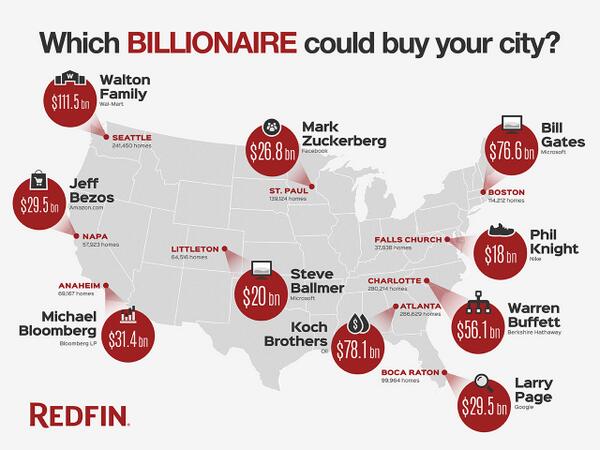
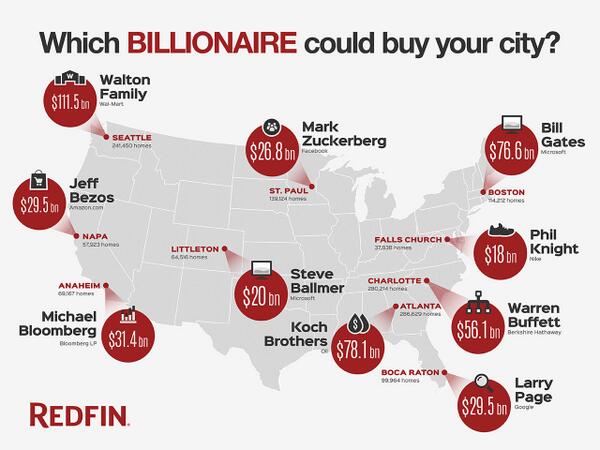
A quaint comparison of what money can buy in today’s market has Bill Gates being able to afford every home in Boston. His $76.6 billion reported by the Washington Post or the $78.4 billion by Forbes seems a pittance when put up against John D. Rockefeller’s peak wealth of $318.3 billion (based on 2007 US dollar). According to your resident commissars over at MSNBC, “The median net worth of American households hasn’t changed much over the past decades, it’s about $20,000.” So if Gates decided to purchase all the Beantown houses, whom would he pay for the bricks and mortar? Certainly, most Americans may think of “their home is their castle”, but few actually own a debt free deed to their grand estate. No wonder the banks and financial institutions, are so fond of placing liens on real property.

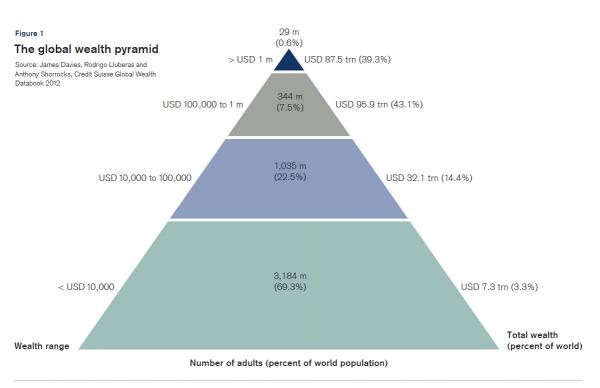
The proportional context of looking at individual wealth within the relative value of global wealth is examined in the essay; It’s A “0.6%” World: Who Owns What Of The $223 Trillion In Global Wealth, seems trite. Zerohedge concludes, “The bottom line: 29 million, or 0.6% of those with any actual assets under their name, own $87.4 trillion, or 39.3% of all global assets.”

CSwealth

Here are the stunning facts:

“In 2012, 3.2 billion individuals – more than two-thirds of the global adult population – have wealth below USD 10,000, and a further one billion (23% of the adult population) are placed in the USD 10,000–100,000 range.

The average wealth holding is modest in the base and middle segments of the pyramid, total wealth amounts to USD 39 trillion, underlining the potential for new consumer trends products and for the development of financial services targeted at this often neglected segment.

The remaining 373 million adults (8% of the world) have assets exceeding USD 100,000.

And then the top of the pyramid: 29 million US dollar millionaires, a group which contains less than 1% of the world’s adult population, collectively owns nearly 40% of global household wealth.

Some 84,500 individuals are worth more than USD 50 million, and 29,000 are worth over USD 100 million.”

After absorbing this macro economic analysis, it should ease the pain that the stewardship of world wealth is in such trustworthy hands. No need to burden the masses with the weight of building wealth, when that formula for getting to the top of the financial pyramid, has room for only the few. The expert obelisk creators never meant for wealth sharing and the tools to construct one’s own prosperity are not included in your capital accumulation education. The liability of mortgage and property tax obligations to retain your edifice requires regular payments to maintain the privilege of possession. Ownership is only a conditional wealth asset.

Investopedia says 3 Simple Steps To Building Wealth are:

“You need to make it. This means that before you can begin to save or invest, you need to have a long-term source of income that’s sufficient enough to have some left over after you’ve covered your necessities.

You need to save it. Once you have an income that’s enough to cover your basics, you need to develop a proactive savings plan.

You need to invest it. Once you’ve set aside a monthly savings goal, you need to invest it prudently.”

Ordinary consumers do not build great fortunes. The elementary prescription for “getting ahead” is severely limited in thinking for a world that frequently conducts business as a blood sport. However, many of the enterprises that carve out a market for their products or services have a distinct edge over the unconnected entrepreneur. Namely, government directed and controlled startups or collaborated ventures frequently become the commercial giants of the economy. Here lays the confusion when defining wealth as an accounting device of personal ownership of assets.

In addition, governments are often in the privatization and sale of state assets. The Economists reports that the “IMF estimate that non-financial government assets average 75% of GDP in advanced economies. In most countries, these are worth more than financial assets (stakes in listed firms, sovereign-wealth and securities holdings and the like).”

Liquid cash flow and high worth individuals, especially with inside track contacts, are able to cherry pick sweet heart deals. Such opportunities, usually transfers treasure, but infrequently are engines of new wealth creation. The only guarantee is that money, made or lost depending upon the accounting needs of the vulture predator, is never an option for the normal hard working taxpayer.

Unless people accept the reality that creating and growing wealth is a noble objective that involves the widespread commerce participation of a merchant class, the outrageous disparity of the top down wealth stream will widen even more, as the top tier inclusion narrows to fewer mega-billionaires.

Global business encourages transnational conglomerates with commercially identifiable names and logos. When entire economies prevail under a business plan that eliminates any rival competition, and achieves sole market dominance, the prospects to advance the individual wealth ledger of the average person diminishes.

An opportunistic society can only exist when independent business flourishes. Government bureaucrats and corporate technocrats oppose an unambiguous free market economy. As the map of the über-billionaires illustrates, their checkbook could swallow up entire cities. However, digesting, let alone growing communities into quality environments for future generations, takes an active involvement in the wealth building process that rewards contributing players.

Without a widespread populace practicing mutually beneficial business transactions, the capacity to achieve the skills necessary to compete successfully, will never develop. Instead of making money, saving money and investing money, learn the aptitude of business as a lifelong endeavor.

The poor will always be scraping the bottom, until they learn how to advance their abilities for the betterment of their own families. The alternative to greater concentration of wealth is to initiate a viable substitute to the financial stranglehold that furthers the appetites of egomaniacs like the character, Bretton James in the movie Money Never Sleeps. In the end, the true individual wealth that anyone can attain is the sincerity and moral substance of his or her own character. Money may not snooze from making more cash, but is only a means to elevate living a life worth lived.

In such a quest, the super rich may have a net worth equivalent to one’s property, but they can never afford the essence of your family or measure of your community.


The Six-Hour Day

Source: The Hipcrime Vocab

But don’t look for it in Calvinist America anytime soon, where we’re always on the hunt to ferret out “moochers:”

Gothenburg (Sweden) (AFP) – Robert Nilsson, a 25-year-old mechanic in Sweden’s second city Gothenburg, may be the harbinger of a future where people work less and still enjoy a high standard of living. He gets out of bed at the same time as everyone else, but instead of rushing to work, he takes it easy, goes for a jog, enjoys his breakfast, and doesn’t arrive at his Toyota workshop until noon, only to punch out again at 6:00 pm.

“My friends hate me. Most of them think because I work six hours, I shouldn’t be paid for eight,” Nilsson said, talking while fitting part of a rear window onto a Toyota Prius with swift, expert moves.

Sweden often stuns first-time visitors with its laid-back prosperity, making foreigners wonder how it is possible to have both lots of money and lots of leisure.

Part of the answer, according to economists, is a productive and well-educated workforce that adapts to new technologies quicker than most. Exactly how much –- or how little –- Swedes work compared with other nations is a somewhat open question.

“We have a 40-hour work week, but also we have a little more absence than many people and we start work late in life because we study longer,” said Malin Sahlen, an analyst at Timbro, a libertarian Stockholm-based think tank. In 2012, the average Swede worked a total of 1,621 hours, according to the Paris-based Organisation for Economic Co-operation and Development. This is more than the Netherlands with 1,381 hours, but less than Britain with 1,654 hours or the United States with 1,790 hours – and way below Chile’s 2,029 and Mexico’s 2,226 hours.

“We could work more, that’s a fact,” said Sahlen.

But far from looking to increase time spent at work, some in Sweden are out to prove that less is more and that cutting hours can boost productivity.

In an international productivity ranking by the Conference Board, a non-profit business research organisation, Sweden was already placed close to the top, coming 11th out of 61 countries. The United States was third, the Netherlands number five, and Britain number 13, whereas Chile and Mexico were both in the bottom third.

[…]

Left-wing councillor Pilhem says the concept has already proven its merits — at mechanic Nilsson’s workplace, Toyota. Toyota’s Gothenburg branch introduced the six-hour day in 2002 to make its facilities more efficient by having two shifts, one in the morning and one in the afternoon, instead of a single, longer one. Nilsson confirms that in his experience a six-hour day — paid as much as eight — is more efficient because it requires fewer breaks.

“Every time you have a break, it takes 10 to 15 minutes to get back to work, because you have to see where you were when you left off,” he said.

That efficiency is reflected in the salary, as the Toyota workshop pays technicians like Nilsson 29,700 Swedish kronor (3,300 euro, $4,510) a month, well above the 25,100 kronor (2,790 euro, $3,810) national average for workers in the private sector.

“It was a huge success straight away,” said Toyota service centre manager Elisabeth Jonsson. “We saw the results, and everything was working for the staff, for the company, for the customers, so I don’t think we ever had any discussion about putting an end to it.”

Swedes test a future of less work, more play (Yahoo! News)

Clearly, laziness will turn Sweden into an impoverished, hellish dystopia. Oh, wait, that’s the U.S. I’m describing.

Here’s a Reddit page on the article. From that page:

I used to work salary at 30 hrs a week. They told me I needed to go to 40 and get a corresponding pay increase. I did not want to but they made me.

Getting in at 9am and leaving at 3pm left me so much free time that working 30 hours a week felt like a hobby. I had more time outside of work during the day than at work. Now my butt is stuck in a chair 40 hours a week still doing 30 hours a week worth of work.

Though instead of adding just 2 hours to the work day, it added more like 4.

Extra Rush hour driving time 45 mins each way instead of 15- 1 hour extra.

Necessary Lunch Break- 1 hour extra

2 hours extra at the office- 2 hrs

So, even though I got a corresponding 33% increase in pay (from 6 hrs a day to 8 hrs a day), the time it is costing me increased by 61% (from 6.5 hrs to 10.5 hrs).

So technically, by earning more I got a pay cut.

Despite my top line salary going up 33%, my earnings per hour devoted to work dropped by 17%.

Definitely not worth it.

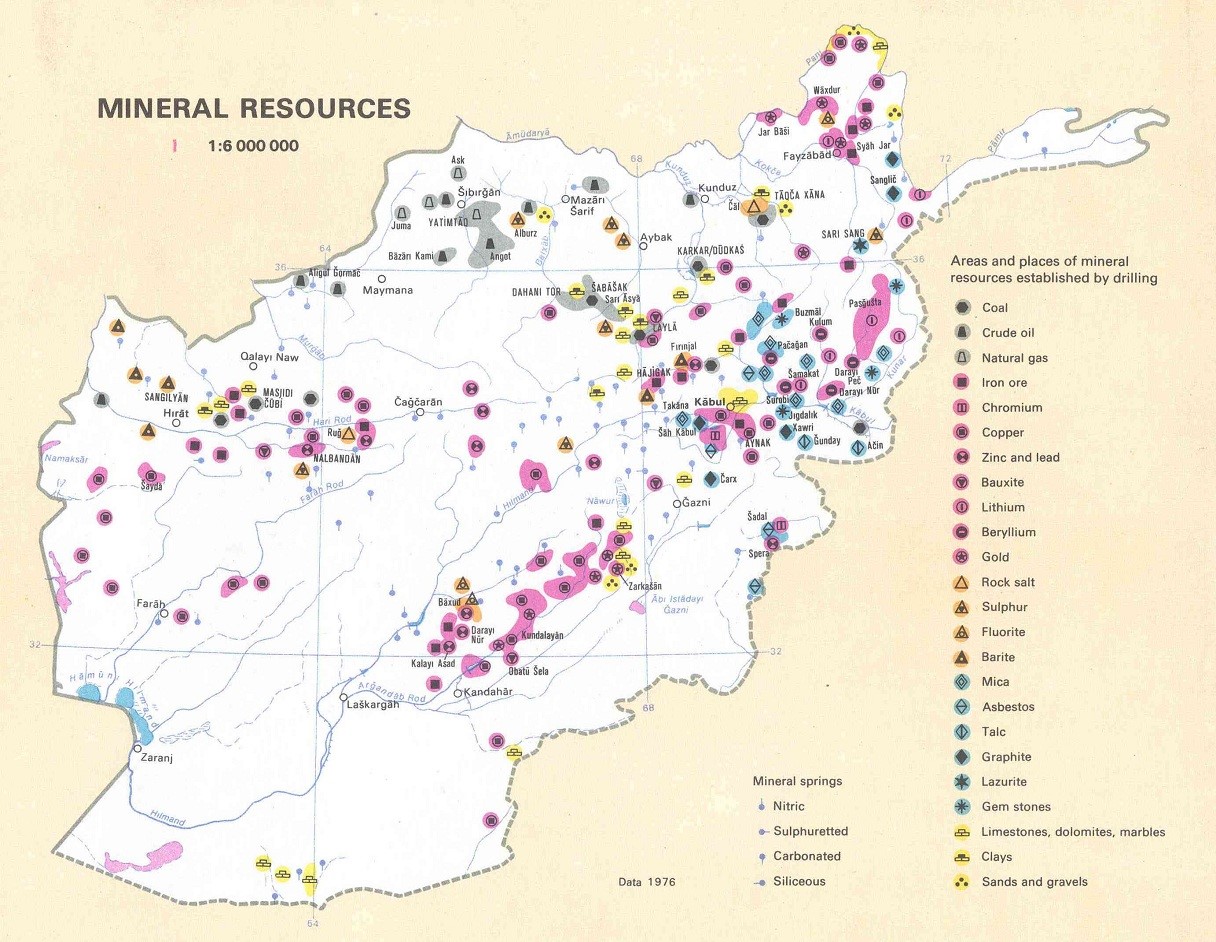
What Would Afghan Spending Buy at Home?

By Russ Baker

Source: WhoWhatWhy

Most of the stories headlining how President Obama plans to cut troops in Afghanistan as part of his planned exit from that country have not bothered to provide numbers on U.S. military spending there.

A few have, but almost in passing. For example, CNN doesn’t indicate the current levels of spending, but notes that

Tony Blinken, Obama’s deputy national security adviser, told CNN that the United States will spend about $20 billion on the continued military presence in Afghanistan after 2014.

In other words, $20 billion is what the U.S. will spend after it has effectively “withdrawn.”

Too bad news organizations don’t routinely give us a sense of what we are spending, or what else we might get for the same monies directed toward other purposes.

But here’s one thing to consider: $20 billion is about one-third to one-half of what the United States Department of Education spends on elementary, secondary and vocational education, and comparable to what it spends on higher education.

When President Obama released his Fiscal Year 2013 budget, Education Secretary Arne Duncan “announced that high-quality education is absolutely critical to rebuilding our economy.” Maybe so, but domestic spending is constantly under assault—and the lawmakers who reflexively support any and all military allocations are often the same ones complaining about “big government” and “wasteful” spending.

Here are a few other comparative statistics: (numbers vary, of course, from year to year)

-$20 billion is what the U.S. government budgeted for 2013 to subsidize often-struggling farmers

-It’s four-fifths of what we spend for science, space and technology

-It’s more than twice the budget of the Environmental Protection Agency

-It’s a third of what we spend on veterans’ hospital and medical care—on the people who fight in all wars combined

-It’s about a third of what we spend on administration of justice

-It’s five times what’s budgeted for energy conservation in 2014 and 2015

-It’s about 8 times what we spend on national parks—which have suffered continued cuts in recent years, resulting in reduced services and closures

If it’s not achieving something of clear benefit to Americans, why does the spending continue at such levels? Here’s another thing to consider, a graphic on Afghanistan we’ve run in the past to considerable interest:

11

Sources for Budget Data:

OMB Historical Budget Tables

Department of Interior 2014 Budget Highlights

It’s Time to Start Believing Again – Why Basic Income Could and Should be the Next Global Political Movement

Source: Thought Infection

Things change slowly and then all at once. 

If there is one great consistency about change in the 21st century, it is that things seem to change almost imperceptibly right up until they become inevitable. Many good examples of this effect can be found in the world of technology such as the rise of the internetthe fall of film-cameras, or the explosive growth of the green energy industry. In all of these cases the exponential nature of technological advances led many to discount major changes that eventually disrupted entire industries. While this effect is best understood in the world of technology I think this kind of change can also be seen in social and political spheres.

Political movements must by necessity start with only a minority of individuals working very hard for very many years to push forward on an issue. For a very long time it can appear that little or no progress is being made, but below the surface opinions and minds are slowly shifting. This slow progression continues in the background, almost imperceptibly until some sort of tipping point is reached and a sudden shift in the public and political sentiment can occur. A good example of this effect would be the momentous shift away from a deep and vitriolic hatred of gays only a few decades ago towards increasing acceptance today.

In addition to the energy provided by a small group of dedicated individuals, flashpoint social or political change also requires the maneuvering room in order for rapid revolutionary change to happen. The room for new ideas to maneuver can be created by a collapse of incumbent ideology, or in the case of the greatest shifts it often comes from a wider, systemic loss of faith in the system. When people become embittered with things as they are they will inevitably start looking to those offering alternative views.

A person without belief is a power vacuum. 

I think we are currently stand at time when conditions are set for the next global political movement to take hold. We are seeing clear symptoms of a systemic erosion of faith in the political and economic systems as they stand today.

Economic hardship and unemployment has become endemic across large parts of the developed world. Those who do work find themselves squeezed between longer working hours, higher on the job demands, increasing costs of living, and loss of both job security and benefits.

Times feel tough, and people are starting to ask why they are tough. Did we have some sort of disaster? Are our crops failing, or our industries falling apart? What happened that is making institutions like education and health too expensive to support?

Thomas Piketty, in his recent book provides strong evidence that the economic pathology of the current geopolitical situation may simply be the symptoms of a larger economic disease. When capital out-competes labour, it inevitably leads to increasing wealth disparity and the associated economic problems that we see today. People can see that the economic gains that our collective hard-work creates is going disproportionately into the hands of the wealthy. People can see that the game is rigged against them, and they don’t really want to play any more.

At the same time as economic realities are being thrust upon workers around the world, people are also increasingly detached from mainstream politics. Little real change has happened despite perpetual political promises to deliver such. Political detachment combined with economic hardship is a dangerous mix, and is credited with leading to the rise of extreme political groups like the Golden Dawn in Greece and other far-right parties in the UK and France. The rise of more extremist politics is also apparent in the increasingly polarized and broken political landscape of the United States.

The disengagement of the public from the political sphere is particularly strong for those who are also disproportionately affected by the economic slow-down, the youth. It is an unappreciated fact that there are actually more millenials in the United States than there are baby boomers. Whatever politician figures out how to engage the millenial generation politically is going to run the world.

From my perspective, there seems to be a clear build-up of political tension across the globe. While we can argue about specific economic and political maladies that have led us to this point, I think the simple fact is that people are losing faith in the system as a whole. As people lose faith, governments become more detached and fearful of their citizens, leading more people to lose faith in the system, and thus a vicious cycle of political breakdown is perpetuated.

So how do we stop this?

The answer is surprisingly simple – We need to believe again.

People need to believe that the world will be better for their children than it was for them. This is the magic that drives people to get up in the morning and go to school and work, to put in the long hours of hard work, to make discoveries, to invent new technologies, and improve the world. The economy will flourish only as long as people truly believe they can better their own life, and that of their children.

Without faith in the global economic and political system, we have nothing. 

Believe it or not, there just might be one simple medicine which (while it would not solve all of our problems) could go a long way to solving the twin problems of political and economic break down.

Basic income.

There is a long list of reasons that basic income makes for sensible economic policy, which I will not go through here. Suffice it to say that basic income would (1) give workers the leverage to demand more from work, (2) give individuals and innovators the means to do their thing, (3) give corporations more incentive to automate their production, and (4) generally support the consumption economy. (Some worry that such a basic income might lead to less incentive to work, but I say that if you need to use starvation as a threat to get people to work for you, then your business is not profitable enough.)

Perhaps most importantly, basic income would be the solution to restore the faith of the common individual in the current system of global capitalism. By institutionalizing the social contract in the form of a cash dividend for everyone, basic income would finally enshrine the promise that a rich and successful society must first deliver a minimal living standard to everyone.

Serious realistic types might rush to play down the importance of belief in the political system. Who cares whether the rabble believes in what the government and politicians do, as long as it is functional? But these people are completely missing the central truth of the matter here. Belief is the only power in the world that matters. My dollar is only worth what we collectively agree it to be worth, and the same goes for our societies. If we fail to create societies which inspire belief, then we are lost. If we do not find a way fill that vacuum left by eroding belief, then someone else will.

It is time for something that we can believe in, it is time for basic income. 

Inequality Has Been Eliminated

etc_stack15__01__630x420

By Chad Hill

Source: the Hipcrime Vocab

Have you heard? Inequality has been eliminated.

What? You didn’t know that? Well, certain “professional” economists have proved it is true.
You may wonder, when you drive around your town, why formerly occupied strip malls lie abandoned, and the only local businesses are Cash-For-Gold, Payday Loans, Dollar Stores, and tattoo parlours. You may ignore the people standing near freeway exits with signs begging for work or money (these have exploded where I live), or the people rolling around shopping carts with all their worldly possessions, or the people living in their cars. It’s all an illusion. Detroit? Chicago? Merely a mirage.

You may wonder at all the empty, shuttered factories, or the fact that the Wal-Mart Super Store is the town’s biggest employer, or that “help wanted” signs seem to appear only in the local Arby’s or Home Depot (or my favorite “owner operators wanted”). You may puzzle at the foreclosed homes stripped of copper and being overgrown with weeds that litter towns from coast to coast. The entire neighborhoods that lie empty and abanadoned? Another mirage, silly. The crumbling roads and local governments “tightening their belts?” Not happening.

Not happening. Nope, none of it.

You may have heard stories about people thirty or forty years ago with high-school educations being able to get jobs that supported families, allowed them to buy a house and save money. You may have heard about people able to save up enough to go to college by just working a summer job. You may have heard of people twenty or thirty years ago with full-time jobs that had benefits such as paid vacations and health care, which are now being stripped away job by job. You may have heard about something called a “union.”

False. All false. The world is getting more equal every day thanks to globalized corporate capitalism. The economists told me so.

You may even know people who have lost their job and are unable to find another one because employers discriminate against the unemployed. You may know someone with huge debt burdens because the cost to train workers is borne entirely by the workers themselves, and you have to go tens of thousands of dollars into debt just to get a job at all. Or you may know someone who was foreclosed upon, or drowning in debt due to an unforeseen circumstance or medical emergency. You might know people who’ve had to take jobs with much lower pay and benefits than the ones they had before. You may know people working brutally long hours, or denied extra work time so that they don’t qualify for health care benefits. You may know people who have used food stamps to feed themselves or their families, even though they work full time jobs. You may know older people who have to work because they can’t afford to retire.

They all deserve it. All of them. They’re all lazy. Laziness has exploded since 2008, don’t you know. Everyone gets exactly what they deserve. It’s never been  better time to be a worker under capitalism.

You may look on the outrageous fortunes spend by the rich and conclude that they are reaping more and more benefits by breaking wages and shipping jobs overseas. Don’t you believe it! Their riches are making everyone better off. Just look at Bill Gates! He gives money to poor people in Africa. And Steve Jobs. He invented the iPod in his basement, or something. Soaring CEO salaries are great. The bailouts were all paid back. And the soaring stock market prices will make everyone rich! Don’t worry about the costs for food, housing, education and transport. The “free market” will take care of it all and unleash abundance, but only if the “job creators” don’t have to pay taxes. Those trust fund kids getting unpaid internships and getting jobs downtown – that’s just a natural part of capitalism, it has nothing to do with inequality. The fact that entire cities are unaffordable for people making less than six figures? College and health care costs? Forget about it. Nothing to do with inequality, which, by the way, has been going down, not up. Besides, even if it were going up, inequality doesn’t matter, what matters is that life is getting better even for people even at the bottom. They love being in debt and working for minimum wage! And besides, the life for the average person is getting better and better the more riches the wealthy and powerful accumulate. After all we have smart phones. SMART PHONES!!!

All those people protesting around the world? They just don’t understand capitalism.

You may even have read books and articles asserting that we are a “winner-take-all” economy, a “servant economy,” or something like that. Not true! Those books and articles were all written by “leftists” and “liberals” who don’t understand science and statistics. Articles like this are just sensationalism by liberals who hate our freedom:

76% of Americans are living paycheck-to-paycheck (CNN)

The Middle Class Is Steadily Eroding. Just Ask the Business Community (NYT)

The Financial Vulnerability of Americans (House of Debt)

Employment Down, Profits Up: The Aftermath of the Financial Crisis in 1 Graph (The Atlantic)

‘Happy Days’ no more: Middle-class families squeezed as expenses soar, wages stall (Wall Street Journal)

A Dozen Facts about America’s Struggling Lower-Middle-Class (Brookings)

America’s Sinking Middle Class (NYT)

Why So Little Media Coverage of How the Rich Are Becoming Richer and the Middle Class Wages are Being Squeezed? (Naked Capitalism)

RIP, the middle class: 1946-2013 (Salon)

Yep, Being a Young, American Adult Is a Financial Nightmare (The Atlantic)

Ripping Off Young America: The College-Loan Scandal (Rolling Stone)

Median CEO Pay Just Topped $10M for the First Time (Slate)

Upgrade or Die (George Packer)

San Francisco’s Income Inequality Rivals that of Developing Nations (Vanity Fair)

Gap Between Rich And Poor In Manhattan “Rivals Sub-Saharan Africa” (Gothamist)

How did the economists come to this conclusion, you ask? Well, Piketty made a few spreadsheet errors. And thanks to that, the professional economist caste can breathe a sigh of relief that all of the things I named above don’t exist, and happily go back to their blackboards and spreadsheets in their corporate-funded free-market think-tank cubicles and university offices.

Because inequality is entirely dependent upon r being greater than g. That is, the rate of return to capital (yes, let’s just argue about what constitutes “capital,” that will make this whole thing go away), must be greater than g, the rate of growth of the economy. Because, heaven knows, it’s not like workers could ever get paid less than the growth of the economy, right?

Right?

Read the full article here: http://hipcrime.blogspot.com/2014/06/inequality-has-been-eliminated.html

Notes Toward a Future of Activism

anonymous_telecomix_2012_5_31

By Micah White

Source: Reconstruction 10.3

<1> Contemporary activism begins from the realization that for the first time in history, a synergy of catastrophes face us. Our physical environment is dying, our financial markets are collapsing and our culture, fed on a diet of junk thought, is atrophying — unable to muster the intellectual courage to face our predicament. While some may caution against immediate action by pointing out that societies often predict perils that never come, what is remarkable about our times is that the apocalypse has already happened.

<2> When we compare the anxiety of our age to that of the Cold War era, we see that what differentiates the two periods is where the threat is temporally located. During the Cold War, the threat of nuclear destruction was always imagined to be in the future. What terrorized the Cold War generation was the thought of life after a nuclear holocaust. Anxiety was therefore centered on what life would be like “the day after” the future event, which was symbolized by the blinding light of a mushroom cloud on the horizon. Thus the post-apocalyptic narrative was deployed in a series of nuclear holocaust science-fiction stories either to mobilize fear in the name of anti-nuke peace — the exemplar of this tactic being the horrifying and scientifically realistic 1984 BBC docudrama Threads in which civilization collapses into barbarism — or, like Pat Frank’s 1959 novel Alas, Babylon, convince a wary public that winning and happily surviving nuclear war is possible, given resourcefulness, discipline and patriotism.

<3> But for those of us alive today, the catastrophic event is not located in the future. There is no “post”-apocalyptic per se because we are already living in the apocalyptic. And although we can anticipate that life is going to get starker, darker and hellish, the essential feature of our times remains that we do not fear the future as much as we fear the present. We can notice this temporal shift in the work of James Lovelock, whose Gaia Hypothesis is gaining traction inside and outside of the scientific community. According to Lovelock’s latest book, The Vanishing Face of Gaia: A Final Warning, even if we were to immediately cease all C02 emissions, sudden and drastic climate change will still occur. In fact, Lovelock argues that a drastic decrease in emissions would trigger climate catastrophe immediately whereas continuing emissions will trigger climate catastrophe eventually and unpredictably. This realization — that the line into a post-climate-change world has already been crossed — fundamentally changes the temporal and spatial assumptions underpinning activist struggles. And the first aspect of activism that must be rethought is our notion of temporality.

<4> The typical activist project is inscribed within the horizon of a modern conception of temporality. The modernist activist acts as if we occupy a present moment that is a discrete point on the linear progression between a mythical, ancient past and an either utopian or dystopian future. But if we accept this model, then the goal of the activist can only be to change the future by preventing the dystopian possibility from being realized. This involves pushing for changes in laws and behaviors in the present that will impact our predictions of how the future will be. But activism based on this temporal model — which as John Foster points out in The Sustainability Mirage: Illusion and Reality in the Coming War on Climate Change underpins “green capitalism” and “sustainable development” — inevitably fails. For one, unable to accurately predict the future, we constantly play the game of basing our actions on rosy predictions while the future grows increasingly gloomier. Another problem with relying on linear temporality is the assumption that time moves in only one direction. Without the freedom to imagine going backwards, we are left the task of steering the runaway train of industrialization without hope of turning around.

<5> Of course, linear time is not the only way to understand temporality and some models can have even worse political consequences. Take for example, the notion that time is cyclical. For the Roman Stoics, time was marked by a series of conflagrations in which the world was razed and a new one formed only to be razed again. In times of adversity when resistance seems impossible, such as the build-up to World War 2, a watered down version of cyclical temporality sometimes enters the cultural consciousness. It infected Nazis who cheered total war and anti-Nazis who used the spurious argument that only by a catastrophic Nazi triumph would a communist state be realized because only then would the people rise up. A similar line of thought was pursued by Martin Heidegger in a letter to Ernst Jünger in which he wondered if the only way to “cross the line” into a new world is to bring the present world to its awful culmination. Unlike the linear conception of time that calls the activist to act in order to realize an alternate future, the cyclical conception is often leveraged to justify inaction or worse, action contrary to one’s ideals.

<6> To escape the problems of linear time and cyclical time, activism must rely on a new temporality. Perhaps the best articulation of this new activist temporality is in the work of Slavoj Žižek. In his most recent book, First as Tragedy, Then as Farce, Žižek blames the failure of contemporary activism on our assumption that time is a one-way line from past to future. He argues that activism is failing to avert the coming catastrophe because it is premised on the same notions of linear time that underpin industrial society. According to Žižek, therefore, a regeneration of activism must begin with a change in temporality. Paraphrasing Jean-Pierre Dupuy, Žižek writes, “if we are to confront adequately the threat of (social or environmental) catastrophe, we need to break out of this ‘historical’ notion of temporality: we have to introduce a new notion of time.” This new notion of time is a shift of perspective from historical progress to that of the timelessness of a revolutionary moment.

<7> The role of the activist should not be to push history in the right direction but instead to disrupt it altogether. Žižek writes, “this is what a proper political act would be today: not so much to unleash a new movement, as to interrupt the present predominant movement. An act of ‘divine violence’ would then mean pulling the emergency cord on the train of Historical Progress.” To accomplish this act of revolutionary violence involves a switch of perspective from the present-looking-forward to the future-looking-backward. Instead of trying to influence the future by acting in the present, Žižek argues that we should start from the assumption that the dread catastrophic event — whether it be sudden climate catastrophe, a “grey goo” nano-crisis or widespread adoption of cyborg technologies — has already happened, and then work backwards to figure out what we should have done. “We have to accept that, at the level of possibilities, our future is doomed, that the catastrophe will take place, that it is our destiny — and then, against the background of this acceptance, mobilize ourselves to perform the act which will change destiny itself and thereby insert a new possibility into the past.” In other words, only by assuming that the feared event has already happened, can we imagine what actions would need to have been taken to prevent its occurrence. These steps would then be actualized by the present day activist. “Paradoxically,” he concludes, “the only way to prevent the disaster is to accept it as inevitable.”

<8> Žižek is right to suggest that activism is at a crossroads; any honest activist will admit that lately our signature moves have failed to arouse more than a tepid response. The fact is that our present is being swallowed by the future we dreaded — the dystopian sci-fi nightmare of enforced consumerism and planet-wide degradation is, day-by-day, our new reality. And thus, activism faces a dilemma: how to walk the line between false hope and pessimistic resignation. It is no longer tenable to hold the nostalgic belief that educating the population, recycling and composting our waste and advocating for “green capitalism” will snatch us from the brink. Likewise, it is difficult to muster the courage to act when the apocalyptic collapse of civilization seems unavoidable, imminent and, in our misanthropic moments, potentially desirable. Žižek’s shift in temporality offers us a way to balance the paralyzing realization that our demise is inevitable with the motivating belief that we can change our destiny. By accepting that as the world is now we are doomed, we free ourselves to break from normalcy and act with the revolutionary fervor needed to achieve the impossible.

<9> The question for would-be activists is therefore not, “how does one engage in meaningful activism when the future is so bleak?” but instead “how does one engage in revolutionary activism when the present is so dark?”

<10> Corresponding to the necessary temporality shift is a spatial change in activism. The future of activism will be the transformation of strictly materialist struggles over the physical environment into cultural struggles over the mental environment. Green environmentalism, red communism and black anarchism will merge into blue mental environmentalism — activism to save our mental environment will eclipse activism to reclaim our physical environment. A key opening to this new form of politics appeared in 1989 with the founding of Adbusters, the internationally distributed anti-consumerism magazine whose subtitle is The Journal of the Mental Environment.

<11> Adbusters is a Situationist inspired offspring of the environmentalism movement. At the time of its formation, there was an active anti-logging movement in British Columbia, Canada. And responding to sagging public support for cutting down old growth trees, the logging industry introduced the “Forests Forever” advertising campaign. As the name suggestions, this campaign argued that the logging industry was not cutting down forests as much as they were protecting forests. It was the kind of disingenuous advertising ploy known as “greenwashing”– a term that, it is worth noting, originated in that same year. Disgusted by what he saw, Kalle Lasn, who was an experimental filmmaker at the time, created a short claymation anti-ad in which an old-growth tree explains to a sapling that a ancient forests are being replaced by tree farms. His intention was to air the anti-ad on the same television stations that the logging industry had used.

<12> When Lasn tried to buy airtime for his anti-ad on the same television station that aired the Forests Forever advertisements, he was refused. That was the founding event of Adbusters: the realization that while corporations can lie to us via the airwaves, we are unable to respond using the same means. But the message of Adbusters goes beyond concerns over the veracity of the information we receive — and here we would do well to follow Jacques Ellul who spoke of the difficulty in distinguishing between information and propaganda. Instead, it is a matter of how the advertisements we see populate our minds with a picture of reality. This picture of reality, our worldview, colors everything we perceive. Thus, the mental environmentalist movement is concerned with the pollution of our minds.

<13> While some may wish to frame this transition in terms of a new development, I think it is just as accurate to view it as an old phenomenon. Hundreds of years ago, for example, “pollution” had an exclusively unscientific, immaterial and spiritual meaning. In the 14th century to pollute meant to desecrate, defile, or contaminate what is sacred such as one’s soul or moral sensibility. Not until the late nineteenth-century did pollution take on the scientific and materialist connotation it has today. The unfortunate consequence is that with the changing meaning of the word pollution, we’ve become increasingly concerned about desecration of our external, natural environment while ignoring the defilement of our internal, mental environment. The future of activism is a return to the early meaning of pollution.

<14> Activism is entering a new era in which environmentalism will cease viewing our mental environment as secondary to our physical environment. No longer neglecting one in favor of the other, we will see a push on both fronts as the only possible way of changing either. This will involve a shift away from a materialist worldview that imagines there to be a one-way avenue between our interior reality and the external reality. Instead, recognition of the permeability of this barrier, an exploration of the mutually sustaining relationship between mindscape and landscape, will open, and reopen, new paths for politics.

<15> This movement toward an activism of the mental environment is based on an ontological argument that can be stated succinctly: our minds influence reality and reality influences our minds. Although simply stated, this proposition has profound implications because it challenges the West’s long standing Cartesian divisions between internal and external reality that serve to ignore the danger of mental toxins. Whereas traditional politics has assumed a static mind that can only be addressed in terms of its rational beliefs, blue activism believes in changing external reality by addressing the health of our internal environment. This comes from an understanding that our mental environment influences which beings manifest, and which possibilities actualize, in our physical reality.

<16> At first it may seem like a strange argument. But the imaginary has been a part of environmentalism since the beginning. Most people trace the lineage of the modern environmentalist movement back to Rachel Carson’s 1961 Silent Spring. Carson’s book argued that the accumulation of toxic chemicals in our environment could work its way up the food chain, causing a widespread die- off. It may not have been the first time the bioaccumulation argument had been made, but it was the first time that it resonated with people. Suddenly, a movement of committed activists and everyday citizens rallied under the environmentalism flag.

<17> Looking back on Carson’s book from the perspective of mental environmentalism, it is significant that it begins, not with hard science as we may expect because Carson was a trained scientist, but with fantasy. The first chapter, entitled “A Fable for Tomorrow,” reads like a fairy tale: “There once was a town in the heart of America where all life seemed to live in harmony with its surroundings.” She then goes on to describe an idyllic, pastoral community known for its abundant agriculture and wild biodiversity. She writes of foxes and deer; laurel, virburnum and alder; wild birds and trout. However, the beauty of the place is not permanent – an evil, invisible malady spreads across the land. Birds die, plants wilt and nature grows silent. The suggestion is that the land has been cursed; if this were a different story perhaps the farmers would have prayed, offered sacrifices to the gods or asked their ancestors for help. Instead, Carson shifts the blame away from transcendental forces and back to the materialist domain of man. “No witchcraft, no enemy action had silenced the rebirth of new life on this stricken world.” Carson concludes, “The people had done it to themselves.”

<18> Some literary critics have argued that the reason “Silent Spring” resonated with the larger public, sparking a movement of everyday people is largely due to this opening fable. They explain that Carson’s story takes Cold War era fears of radioactivity (an invisible, odorless killer) and redirect them into a new fear over environmental pollution that is, likewise, an invisible, odorless killer. This is a compelling interpretation that explains the rhetorical power of Carson’s story but it misses the larger point. Namely, that at its origin, environmentalism was grounded in a mythological story about a cursed land. Faced with a choice over whether to continue in this fantastical, narrative vein or enter the domain of scientific facts, environmentalism tried the latter. Environmentalism has thus become a scientific expedition largely regulated by Western scientists who tell us how many ppb of certain pollutants will be toxic and how many degrees hotter our earth can be before we are doomed. But here we see again the linear temporal model cropping up again which may explain the inability, according to James Lovelock, of the Intergovernmental Panel on Climate Change to predict the rising temperatures we have experienced. In light of the failures of the exclusively scientific approach, it is worth considering another option.

<19> What if Carson had written about how the disappearance of birds was accompanied by the appearance of flickering screens in every home? What if she had drawn a connection between the lack of biodiversity and the dearth of infodiversity? Or the decrease in plant life and the increase in advertised life? To do so would necessitate a new worldview: a blue worldview that acknowledges the interconnection between mental pollution and environmental degradation, spiritual desecration and real-world extinctions.

<20> Keeping one foot within the domain of imagination, environmentalism could speak not only of the disappearance of the wild birds due to physical pollutants but also their disappearance due to mental pollutants. We could wonder at the connection between a culture’s inability to name more than a handful of plants, and the lack of biodiversity in the surrounding nature. And instead of assuming that the lack of biodiversity in external reality caused our poor recognition skills, we would entertain the opposite possibility: that the fewer plants we recognize, the fewer plants will manifest.

<21> Blue activism begins with the realization that internal reality is connected to external reality and then wonders at the relation between pollution of internal reality and the desecration of external reality. The primary pollutant of our mental environment is corporate communication. It is no longer controversial to claim that advertisers stimulate false desires. Any parent knows that after their child watches the Saturday morning cartoons they will suddenly “need” new toys, new treats, new junk. But the effects of advertising go beyond, what the marketers call, “demand generation”. Advertising obliterates autopoesis, self-creation. It is an info-toxin that damages our imagination and our world picture, essential elements of our mental environment. Activists must work on the assumption that there is a connection between the level of pollution in our minds and the prevalence of pollution in our world. At the most basic level, this is because when our minds are polluted, and our imaginations stunted, we are unable to think of a different way of doing things. At a more complex level, it is because our mental environment dictates, to a certain extent, whether certain beings manifest in our physical environment. Naming calls beings into existence and when all the words we know are corporate-speak, the only beings that will manifesto are corporate- owned.

<22> To understand how the pollution of the mental environment can impact the manifestation of beings, consider the story of the Passenger Pigeon. In 1810 one of the great American ornithologists, Alexander Wilson, observed a flock of Passenger Pigeons so plentiful that it blacked out the sun for three days. On another occasion he documented a flock estimated to be two hundred and forty miles long and a mile wide and comprised of over a billion — 1,000,000,000 — birds. A century later, the last passenger pigeon died in the Cincinnati Zoological Garden on September 1, 1914. How do we explain this alarming extinction of the Passenger Pigeon?

<23> If we take a materialist activist position, then we will argue that their sudden demise is due to a combination of forces, all of which are located outside the psyche: overhunting combined with unenforced laws against killing the birds in their nesting places was exacerbated by the telegraph which was used to track the birds over hundreds of miles. The species death of the passenger pigeon is thus interpreted as a tragedy of specific technologies: guns, nets, laws and communication systems. Of course, this account is not wrong; it would be mistaken to argue that these technologies did not play a major factor in their extinction.

<24> But physical environmentalism boils down to conservationism. It is allopathic, only able to treat the symptom, the disappearance of the birds, without considering the root cause. By focusing our attention exclusively on material forces, we are confined to certain activist tactics: a spectrum from reformist gestures of calling for greater enforcement of environmental protection laws, courageous tree sits and militant ELF arsons. And while these actions are commendable, and with open acknowledgment that a diversity of tactics is necessary, the focus on a secular materialist politics is limiting our success. Under this model, Ted Turner is considered a philanthropic hero because he is the nation’s largest landowner and maintains the largest privately owned bison herd. What we do not need is a rich patron of endangered species, but instead a world without endangered species. That requires more than money, it necessitates a paradigm shift.

<25> The unexplainable extinction of the passenger pigeon is a symptom of the state of our mental environment. Species facing extinction can only be saved if we take their disappearance as a symptom and address the root cause of their disappearance. Because of an over-reliance on a secular, materialist conception of politics, scientists dictate the aims of activists. The irony is that our exclusive concern over the physical environment renders us unable to save it.

<26> The curious interplay between our imagination and external reality gives credence to the argument that the struggles over the mental environment are the future of activism. The future of activism begins with the realization that only with a clear mind, a clean mental environment, do we approach the possibility of a clean physical environment.

<27> Dispel immediately the notion that our mental environment is unique to each individual. Just as we share our natural environment, we also share our mental environment, which is crafted through the culture we consume – the television shows we watch, the websites we frequent and the symbols and concepts that comprise our thoughts. Thus, the mental environment is not something entirely within us but is instead something that is outside of our complete control and shared collectively.

<28> Activism of the mental environmentalism is not a politics of solipsism, or an attempt to dodge the imperative of direct action. Instead, developing a politics of anti-consumerism and anti-materialism, places the role of imagination back into the forefront. Denying corporations the right to dominate our mental environment is the most effective long-term strategy of insurrection in the twenty- first century because it directly influences the manifestation of our natural environment. By targeting the mental polluters, vandalizing billboards and blacking out advertisements, we do more than clean up urban blight — we clear a creative space for a revolutionary moment.

Always Low Wages, More Pollution: Why Barack & Michelle Obama Relentlessly Shill For Wal-Mart

walmart-obama-apmichelle_obama_walmart_030311-thumb-640xauto-2467

Democrats in labor unions and figures like former Labor Secretary Robert Reich and others were justly outraged at Barack Obama’s latest wet kiss to Wal-Mart earlier this month. But First Lady Michelle Obama has been in bed with the giant retailer for years. Is this a nasty bug in the Obama presidency, or a corrupt core feature?

By BAR managing editor Bruce A. Dixon

Source: Black Agenda Report

Low Wages, Always: Barack and Michelle Obama Bestow More Wet Kisses on Wal-Mart

“…the willingness of the Obama Administration to do the bidding of Wal-Mart shows just how hollow has become the pretense of elected black Democrats to representing the poor and oppressed…”

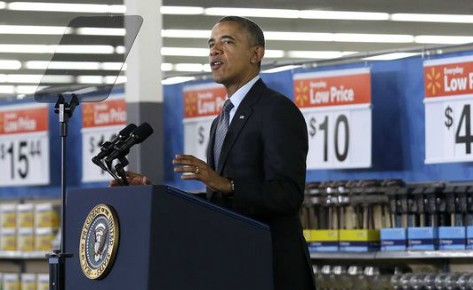
Earlier this month President Obama visited a Bay Area Wal-Mart to praise the world’s largest and most anti-union retailer for its supposed environmental responsibility. The fact is that Wal-Mart’s maintenance of diesel-fueled supply chains between its stores and wherever on the planet wages are lowest and environmental restrictions are totally absent make it a major ongoing contributor to runaway climate change. The president’s appearance therefore, was simply a hypocritical exercise in greenwashing for Wal-Mart.

Though it was an insult to working people and to many of his abject and fervent supporters, it should have been no surprise. It wasn’t President Obama’s first wet kiss to Wal-Mart and with almost three more years in office to go it won’t be his last. Still the willingness of the Obama Administration to do the bidding of Wal-Mart shows just how hollow has become the pretense of elected black Democrats to representing the poor and oppressed.

There was a time when Democrats in the White House did not dare openly shill for the giant retailer. Hillary Clinton served on Wal-Mart’s board of directors through most of the 1980s, while her husband Bill was governor of Arkansas. Even then, Wal-Mart was notorious for overworking and underpaying its workers, violating labor laws to thwart unions, and sopping up prodigious amounts of corporate welfare in the forms of tax breaks and subsidies of all kinds. Being in bed with those crooks wasn’t just an embarrassment, it was a hypocritical affront to Democratic voters, so somewhere on the 1992 road to the White House, Hillary resigned from Wal-Mart’s board. Similarly in 2007 with her husband on the way to the White House, Michelle Obama felt compelled to resign from the board of TreeHouse Foods, a major Wal-Mart vendor. “I won’t shop there,” said presidential candidate Barack Obama when questioned about Wal-Mart at an AFL-CIO labor forum.

Of course labor audiences in 2007 and 2008 were where Obama pledged to renegotiate NAFTA, and immediately raise the minimum wage as soon as he took office. The president never mentioned raising the minimum wage again till about 2012 when Republicans were safely in control of the House of Representatives, and instead of renegotiating NAFTA, President Obama is engaged in secret negotiations to extend it across the Atlantic and Pacific Oceans. Evidently the Obama that promises is a different guy, and far less powerful, than the Obama that acts.

“…The first lady allowed the unscrupulous retailer to leverage her personal image …”

Safely in office, Michelle and Barack Obama have enthusiastically embraced Wal-Mart. The first lady allowed the unscrupulous retailer to leverage her personal image as an advocate of exercise and healthy eating in her “Let’s Move” initiative, and spouting the company line that the best solution to urban “food deserts” is opening more Wal-Mart neighborhood grocery stores. Michelle Obama’s many appearances at and pronouncements around Wal-Mart have done the retailer more good than she and Hillary could ever have done in another decade or two apiece on its board of directors.

Right now Wal-Mart is approaching 30% of the US retail grocery market, with far lower wages, fewer hours, skimpier benefits, and longer and dirtier supply chains than its major competitors. As I said a couple years ago in an article about Michelle Obama’s cynical embrace of Wal-Mart:

Wal-Mart’s business model of corrupting public officials, lying about job creation numbers, rampant sex and race discrimination, relentlessly low wage and benefit levels, and aspirations to monopoly control of local markets across the country make it a bad neighbor, a worse boss, an unfair competitor and sometimes a criminal enterprise.

Wal-Mart has been a leader in the corporate practice of weaponizing its charitable giving, turning it into a lever to open new markets in urban America, to neutralize and isolate opposition, and to curry favor with local political figures. Wal-Mart made it rain on selected charities and ministries in areas like Newark and Chicago when it needed to colonize those new markets. President Obama recognized this “achievement” in the corruption of Democratic party politics in March 2014 by nominating Wal-Mart’s chief of charitable giving to head up his Office of Management and Budget.

Wal-Mart was even allowed, along with McDonalds and other large, low-wage employers, to shape the drafting of regulations governing Obamacare, in ways that exempted the retailer from having to ensure large numbers of its workers for the first several years.

The fiction that elected Democrats represent poor and working people and stand for safeguarding the environment is just that – a fiction. There is a new neoliberal paradigm that allows Democrats to mumble a few words about raising the minimum wage when the other party controls Congress, that claims the moment they took office was the day the oceans stopped rising. If these were curable bugs in the political system, votes and advocacy would wake enough people up to change them. But what if they’re not bugs in the system at all. What if these are its core and immutable features? What then? Isn’t it time to step outside their two-party, capitalist box, to dream and begin to build something else?

Bruce A. Dixon is managing editor at Black Agenda Report and a state committee member of the GA Green Party. He lives and works in Marietta GA and can be reached at bruce.dixon(at)blackagendareport.com.

This American Empire, It Too Will Collapse

Imperial_Overreach

By Dave Lefcourt

Source: RINF.com

Here is my sense; like all empires before it this American one reached its apex after WWII. It’s on a downward trajectory and will eventually fall or be overtaken.

And I believe most Americans will be taken by surprise as in “How could this happen”?

That’s because most Americans are in the words of Paul Craig Roberts “insouciant”, without a care, too passively indifferent, too besotted with technological gadgetry, have feelings of entitlement and believe in American exceptionalism to bother to notice their government has become sinister-which most others in the world recognize, but their governments too intimidated or blackmailed into following us or they will be demonized. Think Iran, Iraq under Saddam-though earlier an ally in his war with Iran in the 80′s-now the newly announced new cold war with Russia and soon to be China.

As for us Americans take an honest look at what passes for our modern American “culture” nowadays-and contributes to maintaining domestic tranquility at all costs. In no particular order:

Consumerism-excessive and beyond all need. And in conjunction with it

Corporatism and commercialization of the public square i.e. the “mallization” of America.

Sports mania, particularly over Pro football and its marketing.

Popular movies featuring gore, crashes, mayhem, aliens, illusion, “virtual” characters replacing real people.

Celebrity gossip as “news”.

Government surveillance by way of technological gadgetry-cell phones, ipods, computers, email, GPS, EZ pass, toll cameras.

MSM becoming complicit in government actions and its propaganda

Addiction with drugs and alcohol

Incarceration-the highest rates of all 1 st world industrialized democraci

Militarization of local and state police

A trillion dollars in college student debt.

Though certainly not contributing to maintaining domestic tranquility, throw in the bailouts of the big banks too big to fail, income inequality worse than the 1920′s and clearly articulated in the 2011 occupy movement that coined the disparity between the 1% and the 99%, no single payer universal health insurance coverage for all, ignoring global warming and the further despoiling of the environment, the demise of domestic manufacturing, the outsourcing of jobs, home foreclosures and bankruptcy stemming from unscrupulous lenders et al and domestically its an America becoming unrecognizable to these old eyes.

As for the policies and actions of our government that unmistakably reveals its true nature, here again in no particular order are:

  • The war industry-the trillion dollar military/corporate/political complex and its revolving door of key players that move seamlessly between each to maintain its control. The other key element is the creation of,
  • “Enemies” contrived such as the “global war on terror”, and the new “cold war” with Russia.
  • Initiating unnecessary and illegal wars and occupations in Afghanistan and Iraq
  • CIA coups, assassinations to create instability to promote endless war
  • NSA surveillance of everyone in the world through “back doors” of computers and software
  • Absolute control of the political agenda and the enacting of laws, regulations oversight and enforcement to the benefit of corporate interests
  • Justice Department lawyers writing memos “legalizing” all executive actions but kept secret for reasons of national security with no oversight by the Congress or the courts
  • Exercise hegemony worldwide, surround Iran, Russia with “allies”, NATO, a thousand military bases worldwide and a floating armada of carrier task forces
  • Initiate cyberwarfare as was done in Iran in 2010 and its enrichment of uranium
  • Engage in extraordinary rendition, indefinite detention and torture of suspects
  • Targeting and prosecuting whistleblowers, hounding Edward Snowden for exposing the NSA‘s illegal surveillance practices.

These domestic and foreign policies and actions are not those of a government that is representative of the people in a democratic republic. These are policies and actions of a plutocracy of oligarchs and an empire willing to go to any length to maintain its hegemony worldwide and control domestically.

Incredibly, what’s propping up this edifice of domestic indulgence and propaganda and foreign villainy is the FED printing money, selling billions in treasury notes to China, Japan, even Russia underpinned by what else, our previous debt in the trillions and all based on the assumption these countries will continue to buy our debt. But it’s a form of blackmail these other countries have accepted, at least for the present. That can’t last forever.

For sure one can’t predict the actual demise of an empire, even the American one. But hubris, American exceptionalism, the sense of entitlement and the idea of it being the “indispensible nation” surely won’t save it from the trash heap of other empires long gone. Such illusions may contribute, even hasten that inevitable collapse.

Dave is the author of “DECEIT AND EXCESS IN AMERICA, HOW THE MONEYED INTERESTS HAVE STOLEN AMERICA AND HOW WE CAN GET IT BACK”, Authorhouse, 2009