5/15 Global Day of Solidarity for Fast Food Workers

The New Yorker Daily, December 5 2013

The New Yorker Daily, December 5 2013

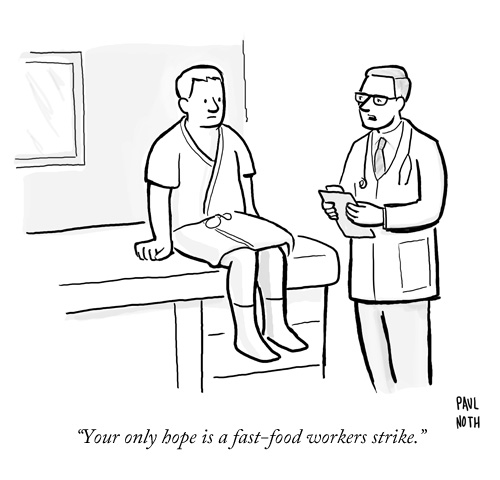
Today is the day of the largest global fast food strike yet, targeting major chain restaurants including McDonald’s, Burger King, Wendy’s, Taco Bell and KFC. Organized with the help of Fast Food Forward, the Service Employees International Union and a number of regional activist organizations, fast food workers in 150 cities and 33 countries (including Morocco, Japan, India, Belgium, Germany, Brazil, Argentina and New Zealand) are taking action for better pay and working conditions.

RT will post updates of the event throughout the day here: http://rt.com/news/159180-fast-food-worker-strike/

Sarah Kendzior describes the nature of the struggle that fast food employees commonly experience in the following excerpt from “The Minimum Wage Worker Strikes Back”:

Jenina dropped out of nursing school after her mother lost her job, because she needed the tuition money to pay bills. Her income from McDonald’s, where she started working as a high school senior, helps support her mother and younger sister. Patrick’s Chipotle income helps support his mother, a makeup artist who has struggled to find steady work since the recession. Krystal’s Taco Bell income helps support her son; her sister, who lives with her and works at Jack in the Box; and now, her newborn daughter.

Every worker I interview is supporting someone: an unemployed parent, a child, a sibling, a friend. Most of their friends and family members work in fast food or other service industries. Everyone is in their twenties or older. All but one is African-American.

They dream of different jobs. The women want to be nurses, the men want to work in the automotive or culinary industries. But no one can pay for training when they cannot save for day to day, much less for the future.

As a result, fast food workers are turning to activism: not out of ideological motives, but because overturning the economic system seems more feasible than purchasing the credentials for a new career.

Read the full article here: https://medium.com/debt-ridden/fa4c36eb306b

The US Government Thinks it Can Fool Us into a War with Russia

pissoffirs1

By Nick Bernabe

Source: The Anti-Media

It seems like only a few months ago (because it was) when the government that rules America was condemning the brutal crackdown against protesters by the Ukrainian government. The then-Russian backed regime was fending off large crowds of protesters who were angry about the Ukrainian government’s close ties with Russia, resorting to violence and anti-riot tactics to disperse the crowds.

In a statement issued by the White House on January 19th, before the new Western backed ‘legitimate’ government of Ukraine took power, US officials condemned the violence against protesters:

“We are deeply concerned by the violence taking place today on the streets of Kyiv and urge all sides to immediately de-escalate the situation. The increasing tension in Ukraine is a direct consequence of the government failing to acknowledge the legitimate grievances of its people.

Instead, it has moved to weaken the foundations of Ukraine’s democracy by criminalizing peaceful protest and stripping civil society and political opponents of key democratic protections under the law. We urge the government of Ukraine to take steps that represent a better way forward for Ukraine, including repeal of the anti-democratic legislation signed into law in recent days, withdrawing the riot police from downtown Kyiv, and beginning a dialogue with the political opposition.

From its first days, the Maidan movement has been defined by a spirit of non-violence and we support today’s call by opposition political leaders to reestablish that principle. The U.S. will continue to consider additional steps — including sanctions — in response to the use of violence.”

In a noble yet ironic –selective at best– attempt to stand up for human rights, what the US government said in the above statement made sense. Kind of.

While fighting for freedom of speech is a good thing, it should be stood up for even when it’s inconvenient. Now, as the US and allies in the West deliver billions in loans, tech and intel to the new central-banker-run government in Ukraine, Kiev is fully engaging (and killing) pro-Russian protesters in the East of Ukraine and even in the Southwestern port city of Odessa. Ahh yes, the sweet smell of selective humanitarianism.

Then –lockstep with American political talking heads– US media outlets immediately began referring to these pro-Russian (former)protesters as insurgents, militants, militiamen, radicals, separatists and terrorists just before the killing started a few months ago. They knew it was coming. 40 pro-Russians were burned alive in a building on Friday and there was hardly a mention of it in the news. You see, now the protesters are called terrorists so it’s okay to kill them. When did the media stop calling them protesters and start calling them terrorists? When it became politically convenient. Iraq remembers.

The US government (and citizen by default through taxes) is actively supporting the crony, human rights abusing, unelected Ukrainian regime through billions in loans, military training and equipment of which we can only speculate about.

As an American citizen, I do not consent to this insane foreign policy. And, according to a recent survey by the Wall Street Journal, it seems that at least 47% of Americans agree with me:

Americans in large numbers want the U.S. to reduce its role in world affairs even as a showdown with Russia over Ukraine preoccupies Washington, a Wall Street Journal/NBC News poll finds.

In a marked change from past decades, nearly half of those surveyed want the U.S. to be less active on the global stage, with fewer than one-fifth calling for more active engagement—an anti-interventionist current that sweeps across party lines.

…The poll findings, combined with the results of prior Journal/NBC surveys this year, portray a public weary of foreign entanglements and disenchanted with a U.S. economic system that many believe is stacked against them. The 47% of respondents who called for a less-active role in world affairs marked a larger share than in similar polling in 2001, 1997 and 1995. 

Good! So the propaganda isn’t working, but the government doesn’t really care about public opinion anymore. After all, how many Americans would actually support sending billions of US dollars to an oppressive Ukrainian puppet regime while our own schools and infrastructure dwindle into a bureaucratic wasteland and the country falls $16+ Trillion into debt? Not me.

Another small detail to remember as the US government escalates tensions in Ukraine under the banner of de-escalation (I know it’s Orwellian, but what isn’t nowadays) is that the American government likely helped overthrow the democratically elected, Russian-aligned former government of Ukraine. As this leaked tape of a conversation between diplomats proves, the US government hand picked central banker Arseniy Yatsenyuk to be the new ‘legitimate’ leader of Ukraine long before the coup took place. Oh yeah, “Fuck the EU” while we’re at it!

Victoria Nuland, Assistant Secretary of State for European and Eurasian Affairs, later haphazardly apologized for her remarks that were recorded and leaked anonymously when she appeared at a press conference, clearly shaken up and taken back by the leak:

So while the US government and their media cohorts continue to push for the West’s version of “stability, democracy and self-determination” in Ukraine, the truth is that they were and continue to be part of the driving force causing these very problems they seek to fix. But hey, what’s new?

In no way do I seek to condone Putin or Russia’s actions in Ukraine. Russia is also a large oppressor in the region and is an oligarchy which is structured and governed much like America, for the rich. The Russian-American proxy war in Ukraine will have one guaranteed loser, the innocent Ukrainian civilians who are caught in the crossfire of this banker resource conflict. Both American and Russian citizens must regain control over their governments or these injustices will continue. Please share this article if you think WWIII is a bad idea.

Piketty, Meet Orwell: Why Modern Oligarchy MUST Turn Fascist

index

By Patrick Walker

Source: OpEdNews.com

If Frenchman Thomas Piketty, for all his brainiac academic wonkiness, has become a U.S. publishing sensation and economics rock star, it’s not merely due to his high-profile promoters. Granted, Piketty touters like Paul Krugman and Joseph Stiglitz carry high-brow clout (rather justified, given their own economics Nobel Prizes), among both fellow economists and intellectually serious progressives; it’s hardly surprising they help set intellectual fashions. But the deeper reason Piketty crossed the Atlantic so well is his timeliness: he had an economic message America’s most politically aware citizens were desperately waiting to hear.

For me (and, I suspect, for millions like me), the translated Piketty message–and I mean translated not just from French to English, but from economics to political activism, is this: your governance is illegitimate, and you now have the go-ahead signal to REVOLT. Not that many of us weren’t ready to revolt anyway (Occupy Wall Street, the anti-XL pipeline movement, and the food service workers’ strike were among the most prominent foreshocks), but the point is that Piketty gave us a new intellectual legitimacy. All true idealists are at some level truth seekers, and nothing gives us the needed conviction to go overturning the social order (a task people of conscience don’t undertake lightly) than indisputable evidence that the current order is illegitimate–a menace to the common good.

Having been irreversibly persuaded ourselves of the need for revolt, we feel free–in good conscience and citing the same evidence that persuaded us–to spread the message of revolt.

Piketty gave us the needed evidence–and as I mean to argue passionately here, Orwell closes the deal. I mean to say the twentieth-century Brit has “crossed the pond” perhaps even better than Piketty, and that we’ll fail to grasp the truly sinister implications of Piketty if we don’t make Orwell his required intellectual “diet supplement.” All modern oligarchic governance must end, in Orwell’s unforgettable image, in “a boot stamping on a human face forever.” Nothing less is at stake in our call to radical action.

Before proceeding, I wish to make one point of intellectual clarity. Careful readers will perhaps have noted that what I called illegitimate, in light of Piketty, is our governance. Now, I could easily have chosen a more familiar word, like government or system or society, but I fear that in doing so, I would have lost needed precision. Even a qualification like political system might not do the trick. For by governance I mean something wider than government and narrower than society, and wish to avoid (for now) distracting questions about the adequacy or legitimacy of the political system bequeathed to us by this nations’ founders. By governance, I means the whole collection of institutions, organizations, laws, and practices that determine how we are actually governed. So in the term, I very much intend to include the media, police and military, political parties, PACs, and other interest groups. Everything variable, in short, that enters the equation of how our nation is governed. It’s the final result of that equation–summarized in the word governance– that’s now provably illegitimate.

As I feel no shame (but rather, great pride) in saying, I write as a tribal progressive–NOT as a tribal Democrat. In fact, it’s my being a tribal progressive that frees me of the intellectual blinders necessarily entailed by being a tribal Democrat. For no tribal Democrat is intellectually equipped to grasp the illegitimacy of our governance, which is clearly–in a system monopolized by two parties–a bipartisan affair. Not that any sane person would say that both parties share culpability equally; anyone who fails to properly assign greater blame to Republicans has respected, heavyweight constitutional scholars like Thomas Mann and Norman Ornstein–writers long noted for their nonpartisan balance and objectivity–to answer to. Their deservedly popular book It’s Even Worse than It Looks places the lion’s share of the blame for Congressional dysfunction (the piece of the illegitimacy puzzle they deal with) squarely on right-wing extremism. But our governance is scarcely a matter simply of Congress–or of one party. Any thorough analysis of our current illegitimacy would have to include Congressional Democrats, the Supreme Court, President Obama, the “shadow governance” of the Deep State, and the maggot swarms of lobbyists who descend on Washington daily. And that’s just the tip of the iceberg. But it’s hardly my purpose to sort out in depth the agents responsible for our gravely dysfunctional oligarchy, but rather to spotlight its grievous, jackboot-trampling-face consequences. For, as I intend to prove, oligarchs can ultimately rule us in no other way.

Now, my calling myself a “tribal progressive” is something of a joke, modeled of course on the notion of unthinking, party-line-towing tribal Democrats and Republicans. In fact, I also self-identify as an intellectual and truth seeker, and therefore as someone for whom–as for Orwell–there’s something deeply sinister in the notion of a banned or off-limits book. Consequently, I’ve been known to indulge myself in authors and works whose reputation among the politically correct Left is, to put it mildly, dubious. Hence, I’ve read with pleasure Friedrich Hayek’s Road to Serfdom, a thoughtful and thought-provoking work once favorably reviewed by no less a lefty idol than John Maynard Keynes. And I’m now reading Francis Fukuyama’s The End of History and the Last Man, a work bearing even the sulfurous stench of favorable reviews by adoring neocons. Yet, it’s reading Fukuyama that–far from reinforcing my faith in current U.S. governance–has, in conjunction with Piketty, obliterated all sense of its legitimacy. In fact, it’s because of Fukuyama (a learned, thoughtful author unfortunate in his associates and admirers–perhaps culpably) that I consider the whole question raised by Picketty as one of legitimacy.

And it’s the crucial question of legitimacy–the very heart of governance–that forcefully links Piketty to Orwell.

So here we’ve reached the heart of my topic. As Fukuyama deeply understands, the very survival of a political system or government depend on its legitimacy in the eyes of enough of its citizens. Crucially, not all of its citizens, indeed not even a majority, but enough citizens wielding the means of force and control to keep the doubters of its legitimacy in line. Hitler, as Fukuyama for example notes, was never elected by a majority, and probably never even freely supported by one. Little matter; the millions of Nazi supporters he did have were able to acquire near-monopoly of the means of force and control in German society, with the lethal consequences known to history. The complacent, misguided souls who cowishly nod their heads to Sinclair Lewis’s famous title statement “It Can’t Happen Here” probably fail to grasp that fascists’ required legitimacy is a minority matter; they certainly fail to grasp that Lewis himself believed it could. The it of course being U.S. fascism–and I believe it’s not only possible, but largely in place, and inevitable if we don’t soon change course.

Why? This is where Piketty’s strongly argued thesis about the nature of capitalism meets the brutal rubber of Orwell’s fascist road. See, Piketty’s central thesis is that the very nature of capitalism, because rewards to capital owners normally accumulate faster than general economic growth, is to produce oligarchic societies. Unless, says Piketty, extraordinary circumstances or government intervention–like high taxes–bring the rewards to capital in line with everyone else’s benefits from the economy. Now, the extraordinary circumstances, like world wars, are hardly desirable, and even depend for much of their effect on giving society a compelling rationale to tax the very rich. But as Piketty is keenly aware, extraordinary circumstances are by definition rare, and barring them, capital-owning oligarchs possess powerful means for thwarting government correctives to natural capitalist inequality. Like, say, buying the governments that would implement those correctives. Which clearly describes our current U.S. predicament–especially after the Supreme Court, itself an oligarchs’ plaything, has made buying our government infinitely easier.

So where does Orwell come in? The quick-and-dirty answer is, in vividly detailing the thoroughly modern, technology-based methods by which a tiny minority, hell-bent on exploiting a majority, recruits a critical mass of supporters (only a minority–though of millions–is needed) to keep the exploited majority at bay. In other words, as the word supporters clearly implies, the tiny minority (in our case, capitalist oligarchs) recruits just enough people who believe the exploitative governance of a majority by a capitalist minority is legitimate. And uses those millions of recruits to hold the exploited majority in terror. For once the majority gradually awakens to the illegitimacy of their exploitation by a handful of oligarchs, only a sizable minority (say, millions) of brainwashed or paid-off recruits wielding powerful modern weaponry, can keep the awakening majority from turning on the oligarchs. In other words, only a fascist government–one that recruits by technologies of propaganda and reigns by technologies of terror–can ultimately serve the aims of modern oligarchs.

Now, Piketty’s own historic examples might seem to refute the notion of oligarchs needing the modern Orwellian toolkit, but citing such historical counterexamples is shallow, and does not account for the fact that times–and above all, technologies–have changed. The key notion is that Orwellian methods are serving the aims of modern twenty-first century oligarchs, not those of nineteenth century France or England–a golden age for oligarchs Piketty often cites. In fact, today’s oligarchs require an economically richer, better-educated populace of servants than their nineteenth century counterparts; and even where they don’t strictly require it, such a populace is a fact on the ground they simply have to deal with–and control.

So, for example, even your average Walmart or McDonald’s peon needs to be–and in fact is–more literate and economically better off than your average eighteenth-century peon (or factory drudge) pure and simple. While condemning large segments of the population to unthinking drudgery (with no leisure for thoughtful politics) remains a perennial part of the oligarch toolkit, it simply can’t play the same role in population control it did when the drudges weren’t even allowed to vote. And of course, with legions of the unemployed poor, often replaced by cheaper foreign workers or robots, now having leisure for politics (if not necessarily thoughtful politics), the old-timey oligarch trick of denying the franchise is quickly making a comeback. But sadly for oligarchs, big enough segments of the U.S. population consider this trick illegitimate that it can never come anywhere close to being the chief means of control. So again, this is where Orwell comes in–and even building support for denial of the franchise requires massive Orwellian propaganda. Oligarchs must thank God every day for a critical mass of fearful, resentful racists and xenophobes–which clearly describes much of the Republican Party’s base.

Of course, racism and xenophobia are the hardly only Orwellian propaganda tools for recruiting oligarch lapdogs, though it must admitted they have served –and will long continue to serve–Republican oligarchs admirably. Patriotism, especially of the self-interested zero-sum variety where foreigners’ agendas and competition for resources and market share make them a threat to “our way of life,” has admirably served oligarchs from both parties. This has been especially true of fossil fuel oligarchs, who’ve successfully brainwashed Americans on the “energy independence” necessity of fossil fuels–even though our nation has been dramatically affected by the global climate harm these outmoded fuels are causing. And fossil-oligarch propaganda is remarkably adaptable; fossil fuels’ role as geopolitical muscle can be stressed now that large-scale plans for export prove the energy-independence argument was always hogwash.

But neither propaganda nor force exhaust the control tools in the oligarch toolkit; the fact is, there are certain “oligarch support industries” that have distinct trickle-down benefits. Not that trickle-down economists ever worked in the manner its ideologues proposed; in fact, the successful trickle-down depends on Big Government in a way that would have horrified trickle-down economics’ original small-government proponents. Understanding the mechanism involves understanding what I mean by “oligarch support industries”; by and large, I mean the industries, based on force and spying, that either distract attention from oligarchs, or potentially crack skulls on their behalf, once the legitimacy of their governance has been shaken in the eyes of large segments of the population. Offhand, I’d say this constitutes all branches of the U.S. military, mercenaries, and military contractors; government and private surveillance organizations; and police and private security organizations. Now, no one ever went broke serving the needs of the rich; in fact, providing oligarch support industries has become a huge U.S. business sector. But the very hugeness of that sector has swollen well beyond meeting oligarch needs, and can only be attributed to a perverse (perverse because it depends on Big Government) form of trickle-down.

See, precisely because no one ever went broke meeting the needs of the rich–and protecting their sorry asses in case the legitimacy of their governance breaks down is a huge oligarch need–investors in oligarch support industries soon become–if they weren’t already–oligarchs themselves. Now, a standard part of Piketty’s model is that oligarchs spend a portion of their vast wealth to buy government, in order both to protect and expand their already excessive wealth. Unsurprisingly, oligarchs created by oligarch support industries behave in exactly the same way: they invest heavily in lobbying government to support and expand their industries. Now, since the oligarch support industries in question straddle the public and private sectors, the lobbying successfully expands jobs–essentially, spying and potentially cracking skulls, both inside and outside our government. In no other case I can think of has “trickle-down economics” been so wildly successful. And even without oligarch propaganda, the overly swollen leagues of soldiers, spies, cops, rent-a-cops, and surveillance and weapons manufacturers–by now swollen well beyond the original protection needs of their oligarch employers–have a vested interest in serving oligarchs both inside and outside their industries.

And of course–though legally and morally this is not supposed to be the case–one must include many elected officials, elected and unelected judges, and journalists in corporate-owned media–as unofficial members of the oligarch support industries. While Republicans are clearly worse, it’s clear once again that these illegitimate members of the oligarch support industries are bipartisan–as was most recently proved by the eleven Democrat Senators (let’s brand them “the Keystone Eleven”) who were ready to surpass even Obama’s service to fossil fuel oligarchs by taking approval of the environmentally insane Keystone XL pipeline out of his cowardly, dithering election-year hands. Clearly, these Democrats are prepared to use the fascist jackboot against conscientious Americans on behalf of fossil-fuel oligarchs, since thousands of heroic citizens are pledged to civil disobedience against the unconscionable pipeline.

While the “boot stamping a human face” approach, backed by fascist pro-government courts, has already been used against Occupy Wall Street, I suspect approval of the XL pipeline will show us fascism–Orwellian brutality supporting Piketty’s increasingly dominant oligarchs–in its most blatant form. This will be, of course, because enough conscientious citizen have seen through oligarch propaganda to realize oligarch agendas threatens humanity’s very survival. So bipartisan is the push for pro-oligarch fascism that eleven Democrats openly decided noble Keystone protesters deserved Orwellian brutality.

Until we widely disseminate the fact that Orwell is other side of Piketty–that a “boot stamping on a human face forever” is the logical conclusion of runaway economic inequality–we’ll never (until we’re ALL destroyed by climate change) see an end to illegitimate oligarch rule.

The Vindication of Daniel Ortega

0,,4477394_4,00

By toni solo

Source: Axis of Logic

North American and European economies continue to be stuck with intractable, if for the moment moderate, stagflation. Prices for most household purchases steadily increase while majority incomes stagnate. By contrast, corporate incomes increase, subsidized by Western government and Central Bank policy. The resulting increase in inequality is clearly a deliberate policy outcome responding to the weakening of Western economies relative to global counterparts led by China and Russia.

Among those counterparts, Latin America, for long one of the world’s most unequal regions, is playing a leading role demonstrating how to reduce inequality. That is true to some extent in Brazil and Argentina, but it is particularly the case in the bloc of countries grouped in the Bolivarian Alternative for the Americas (ALBA). Western governments and corporate media regularly criticise the governments of ALBA members like Venezuela, Bolivia, Ecuador and Nicaragua while omitting the solidity and consistency of those countries’ economic and social success over the last seven or eight years. Nicaragua is a perfect example of that pattern, having achieved the highest regional decline in inequality along with Bolivia and Ecuador.

A July 2013 World Bank paper “Deconstructing the Decline in Inequality in Latin America” shows that ALBA members Bolivia, Ecuador and Nicaragua are the countries that had most reduced inequality as of 2011. Nicaragua had the highest average GINI coefficient year-on-year fall of  2.6% between 2000 and 2011. The figures for Bolivia and Ecuador are 2.05 and 1.99 respectively. In terms of an overall decline in the GINI coefficient in the region the figures for the period covered by the World Bank report are that Bolivia’s dropped 15.5%, followed by Nicaragua (12.2%), Argentina (10.7%), Peru (8.7%) and Venezuela (8.5%). (The figure for Ecuador is absent because data prior to 2003 were unavailable.)

Nicaragua in macro
Nicaragua is a Central American and Caribbean country with a population now of over 6 million. For decades it was the second poorest country in the Americas. Devastated by a US government contrived war in the 1980s, from 1990 to 2007 the country was governed on neoliberal principles dictated by foreign donor governments and multilateral financial institutions like the World Bank and the International Monetary Fund. In January 2007, President Daniel Ortega took office leading the second democratically elected government of the Frente Sandinista de Liberación Nacional.

2007 was the year in which global economic crisis followed the collapse of the Western financial system. Despite Western propaganda to the contrary, the effects of that crisis clearly persist. Even so, over the last five years, in that highly adverse international economic environment, Nicaragua has maintained better growth than its Central American neighbours, averaging over 5% a year. That success is the result of socialist inspired policies, responsive to the country’s emphatically Christian culture, based on the fundamental principles of solidarity and shared responsibility in all areas of national life.

The 2013 report of the United Nation’s Economic Commission for Latin America and the Caribbean (ECLAC) places Nicaragua among the more successful regional economies on a variety of indicators. For example, between 2010 and 2013, foreign direct investment more than doubled from US$491m to US$1004m, representing a much greater percentage improvement than in Costa Rica (43.5%), Honduras (8.7%) and Guatemala (40.5%). In El Salvador, the same indicator almost doubled, but at a much lower level from US$117m to US$224m.

Nicaragua’s international trade is now well over twice the value of its exports in 2005. In Latin America and the Caribbean in 2013, only Peru had higher fixed capital growth than Nicaragua as a percentage of GDP. Nicaragua’s figure of 29.2% is about 7% greater than Costa Rica and Honduras and over double that of El Salvador or Guatemala. Price inflation has held at around 7% for the last three years. Foreign external debt is around 31% of GDP. Foreign reserves are over twice those of 2006. In August 2013, two years after Nicaragua exited its last IMF programme, the IMF’s deputy director for the western hemisphere declared Nicaragua’s economy to be solid and stable.

Global context
The current crisis in the West suggests similarities with the prolonged economic crisis in North America and Europe from 1873 to 1896. The Western powers resolved that crisis through a virulent burst of imperialist aggression, setting the stage for the global wars of the 20th Century. Since the end of World War 2 in 1945, the appearance of democracy in the West has depended on externalizing onto the majority world the costs of mitigating and managing inequality in Europe and North America.

A key witness to that fact is former French President Jacques Chirac who in the 2008 documentary “10 mai Africaphonie” stated, with uncharacteristic honesty, “We forget one thing…namely that much of the money in our wallets comes precisely from the exploitatation over centuries of Africa. Not completely, but a lot of it comes from the exploitation of Africa. So we have to show a bit of common sense. I won’t say generosity, but common sense, some justice to render to Africans… you might say ….what was taken from them. As much as necessary, if we want to avoid the worst convulsions or difficulties with the political consequences these might bring in the near future.”

As the West’s neocolonial options recede, most clearly in Asia and Latin America, the United States and its European allies embrace more than ever the logic of fascism, the alliance of corporate interests and coercive government. Domestically, their policies protect wealthy elites while cutting back on provision for education, health care and social security. Overseas, to intimidate Iran, destroy Libya and attack Syria, NATO country governments have allied themselves with feudal tyrannies like Saudi Arabia and Qatar and with Al Qaeda and other terrorist groups.

To intimidate Russia, they have funded, trained and supported murderous neonazi groups in Ukraine while deploying military resources including missile systems around Russia’s borders. To intimidate China, they harrass North Korea, encourage Japanese nationalism and increase military deployments in the Pacific. Extensive military deployment is also a key element of Western efforts to reset their countries’ neocolonial control in Africa in response to China’s growing influence there.

The perfidious dollar
Underlying these developments is the end of global dollar hegemony and the steady emergence of multipolar alternatives. China, Russia and various countries in Asia and Latin America are conducting trade more and more in their own currencies or even, in the Latin American and Caribbean ALBA framework, in kind. As Western economic dominance declines, especially relative to Russia and China, the United States and the European Union compensate increasingly overseas with terrorist subversion and outright military aggression. Their corrupt political and economic system staggers like a zombie from one crisis to the next.

The Western powers cling to vestiges of their former global power by continuing to dominate the world’s financial system and through ruthless military barbarism. Their financial dominance persists in large part because commodity prices, especially oil and gas are denominated internationally in dollars. In 1971, the US government floated the dollar in order more freely to fund the Vietnam War and its broader imperialist foreign policy. Since then, in effect, only the United States has been able to use its own credit to fund economic growth and finance deficit spending.

Every other country has needed dollars in order to ensure their people’s economic development, mainly to guarantee energy needs and attract foreign investment. Even the wealthy Eurozone countries and Japan are subject to that dollar hegemony. The US Federal Reserve and its Primary Dealer network manage dollar liquidity in the global financial system. The Primary Dealers are all subsidiaries of crooked, giant North American, European and Japanese global financial corporations, too big to fail and too big to jail. They act in close collusion with the Federal Reserve and the other Western Central Banks, monitoring and managing international financial, currency and commodities markets.

Low wages and deregulation
The various mechanisms of dollar hegemony necessarily promote deep inequality around the world because international competition to earn dollars via exports encourages low wages, restricting domestic demand in the exporting countries. Ever since the 1980s the pernicious low wage effects of dollar hegemony have been progressively compounded by neoliberal propaganda for radical deregulation, urging low taxes, attacking organized labour and dismantling financial and commercial controls, especially of international capital flows. Incomes in the West began to stagnate as the rate of profit for Western corporations slowed and former well paid jobs were outsourced overseas.

The demise of the Soviet Union signalled a deregulation boom. In Europe and North America, mergers and acquisitions increasingly concentrated corporate power, strengthening the drive for deregulation. The resulting fraudulent financial innovation and free transfer of capital across the world lead to the Long Term Capital Management debacle and the Mexican, Russian and Asian currency crises of the 1990s. Despite these disastrous outcomes and the subsequent Enron and Worldcom scandals, deregulation continued to drive asset bubbles and easy credit so as to compensate for stagnant incomes, especially in the United States, leading directly to the crisis of 2007.

Poverty reduction in Nicaragua
This dead hand of decrepit neoliberal corporate capitalism was choking the Central American economies when Daniel Ortega took office as President of Nicaragua’s second democratically elected Sandinista government in January 2007. In such a dismal international economic context, poverty reduction represented a monumental challenge. Even so, President Ortega’s Sandinista government quickly set out in an extremely determined way to reduce poverty with a policy program whose many components are worth listing, if only because they show what can be done by an extremely poor country despite largely adverse international conditions. Extreme poverty in Nicaragua has been cut from over 17%  in 2006 to just over 5% now.

Addressing intractable balance of payments difficulties, the government sought to broaden Nicaragua’s trade with Latin America, the Russian Federation, Asia  and elswhere. Similarly, the government diversified its development cooperation, maintaining links with traditional partners in North America, Europe and Asia but also deepening its relationships with Venezuela, Cuba, Mexico and Brazil. Attracting greater foreign investment was also a key policy objective. Joining the ALBA framework, led by Venezuela and Cuba, freed up around US$500 million a year to invest primarily in production but also in major social programs.

To give Nicaragua’s overwhemingly agricultural economy much needed domestic stimulus, government programmes have prioritized small and medium producers of basic grains, cattle and coffee. The cooperative sector received support and resources to develop existing production cooperatives and form new ones. Small and medium sized businesses benefited from greater access to credit. The government has prioritized tourism, ensuring that it integrates closely with other sectors of the economy, especially small and medium sized businesses.

Economic democracy
This democratization of the Nicaraguan economy has radically transformed the position of women. Flagship programmes like Zero Hunger and Zero Usury, as well as property titling programmes and social housing are all directed at women beneficiaries. President Daniel Ortega’s insistence on genuine democracy and national reconciliation made possible tripartite agreement on a minimum wage framework between government, labour unions and employers organizations. Since 2010, that framework has ensured an annual increase in the minimum wage several percentage points greater than the rate of inflation.

In the last three years, those domestic stimulus measure were accompanied by administrative measures relating to equitable tax and social security reform which have helped significantly increase government revenue and stabilize the social security system for the foreseeable future. As Nicaragua’s economy generates progressively more formal employment, both tax revenue and social security income benefit. ECLAC reports that while formal employment has declined throughout the rest of the region, in Nicaragua it has grown steadily through 2012 and 2013

One key mechanism reducing inequality has been to use subsidies in the most sensitive areas affecting ordinary families’ costs. Apart from free health care and education, the government subsidizes the cost of public transport. Bus companies in the capital Managua receive preferential prices for fuel, oil, tyres and spare parts in exchange for pegging fares at 10 US cents. Taxis in Managua as well as inter-urban and acuatic transport in the rest of the country also receive similar benefits enabling the Transport Ministry and local municipalities to negotiate favourable fare tariffs for transport users.

Low income families benefit from subsidized electricity for consumers using under 150Kw a month. The government also operates a retail network offering basic food stuffs at preferential prices through local general stores. Over 58,000 families have benefited from subsidized or free housing. Low-income families nationwide have benefited from a free construction materials program enabling impoverished families to repair defective roofs.

Other social investment programs include assistance for people, especially children, with disability as well as food support for vulnerable groups such as the elderly. The Amor para los más Chiquitos programme has helped around 32,000 very young children at risk, ensuring they enjoy care, education and attention rather than ending up on the streets. That programme has worked with over 420,000 families providing advice and guidance in the care of young children under 6 years old. The government’s efforts to promote social stability also encompass property titling programs that have issued over 180,000 title deeds bringing security of tenure to over 800,000 people.

Health, education, infrastructure
Health and education are crucial expenses for most families in Nicaragua as everywhere else. The availability of free public health care has made a massive difference to low income families who cannot afford private care. The government is steadily equipping the public health system with the resources it needs to improve its services year by year. Emphasising preventive health care, government vaccination programs applied over 4,100,000 doses in 2013. The Casa Materna programme, almost tripling facilities to assist expectant mothers in rural areas, has helped the government reduce maternal mortality, which fell 35% from 2007 to 50 deaths per 100,000 live births in 2012.

Likewise in education, government expenditure improving infrastructure is accompanied by a range of programmes supporting low income families. The Merienda Escolar programme for adequate nutrition for primary school children, ensures provision of meals for over 1,000,000 pre-school and primary school children. Low income families also get help with schooling inputs. Apart from regular primary and secondary education, the government has invested heavily in vocational technical training for young people and improved access to education in rural areas. Follow up to the successful literacy programs of the government’s early years is consolidating the eradication of illiteracy. Education programmes for children with special needs include the integration of children with slight disability into the regular school system as well as dedicated programmes for children whose disability is more severe.

The transformation of government social and economic policy is physically much more obvious in terms of energy and infrastructure. National road, port and airport infrastructure has been almost completely renovated. Construction is on schedule of the new oil refinery being built near León with the Venezuelan State oil company PDVSA. Dependence on oil fired thermal generating stations has dropped from over 80% to less than 50% of the country’s generating capacity thanks to investment in renewable energy sources. Work on the long delayed Brazilian financed Tumarin hydroelectric project on Nicaragua’s Caribbean Coast should begin later this year. Also by the end of this year the results of the feasibility studies for the Interoceanic Canal will permit work to begin on that epoch making project and its sub-projects. These include an interoceanic rail link and pipeline, new airports and two deep water ports on the country’s Pacific and Caribbean coasts.

Confidence, security, democracy
Domestic and international confidence has been fundamental in making all this transformational social and economic investment happen. Despite a comparative lack of resources, Nicaragua’s police and army are acknowledged to have the best record in the region combating narcotics and other organized crime. Overseas, Nicaragua’s community oriented policing is recognized as a model, largely because the country has prevented the spread of the gang culture prevalent in neighbouring El Salvador and Honduras. While common delinquency remains a persistent problem, enhanced security in rural areas has been crucial in encouraging the small and medium farm production that has transformed Nicaragua’s agricultural economy since 2006.

The success of the Sandinista government’s economic policies has resulted from consensus-building  with private business organizations and labour unions by means of constant consultation with all sectors of the national economy. Similarly, government social policy has been developed in close collaboration with the country’s municipal authorities. Many resources and implementation of much social and economic policy have been channelled through the country’s 153 local authorities. The positive impact of that strategic partnership is most obvious from investment in improved municipal infrastructure, in sports facilities for young people and in support for local small and medium sized businesses.

Another fundamental component in the success of President Ortega’s social and economic strategy  has been the deliberate and active promotion of the role of women. Previously, women in Nicaragua were in effect structurally excluded from both economic and political life, denied their legitimate role in decision making and as economic agents. Nicaragua is now acknowledged among the world leaders in guaranteeing political representation for women. Less well known is the transformational role of women in Nicaragua’s economy through access to resources via government programs like Zero Hunger and Zero Usury and ensuring property titles to families previously without secure tenure. All those programs prioritize women beneficiaries.

More specific to Nicaragua has been the consolidation of the country’s Caribbean Coast into the national economy. That process has been a continuation of the historic autonomy project for Nicaragua’s Caribbean coast initiated under the first Sandinista government in the 1980s. In the next five to ten years, the economy of the Caribbean coast is likely to change radically. It has become an ever more popular tourist destination. The recovery in 2012 of Nicaragua’s maritime territory, usurped for decades by Colombia, has opened up new commercial opportunities. The Interoceanic Canal and its sub-projects will definitively end the area’s historic and geographic separation from Nicaragua’s Pacific coast.

Daniel Ortega – Central America’s leading regional statesman

Based on broad consultation and consensus, President Daniel Ortega has implemented strategic policies through a ministerial team led operationally by Rosario Murillo, successfully managing all the various complex factors in relation to social investment, the macro and domestic aspects of economic policy, infrastructure development and energy policy, fiscal and administrative reform, trade and agricultural renewal and security. He has done so constrained by the continuing international economic crisis and in the face of relentless, vicious national and international disinformation campaigns. But the results speak for themselves and explain why Nicaragua’s political opposition have been unable to muster more than 10% support nationally for well over a year, while support for President Ortega is consistently well over 60%.

Aside from the incomparable figure of Fidel Castro, Daniel Ortega is the most outstanding statesman of Central America and the Caribbean of the last thirty years. Rosario Murillo stands with Dilma Rousseff and Cristina Kirchner among Latin America’s women leaders transforming the region’s societies and economies. Under the leadership of Daniel Ortega and Rosario Murillo, Nicaragua’s government team has proved by any measure to be among the most effective in Latin America and the Caribbean. Many Western government officials will acknowledge that in private. Multilateral organizations have recognized it publicly for years now. It is long past time for the Western corporate and alternative media to recognize it too.

The Economics Of Marriage

rings

Michael Snyder recently wrote an interesting analysis of the relationship between the declining economy and the declining state of marriage in the U.S. While I share much of the same concerns my perspective is different in certain respects. For example, I do not share the same alarm Snyder has regarding the trend of unmarried couples cohabitating. In some cases it’s preferable to living alone and can provide an equivalent sense of interpersonal support as marriage on a day to day level. However, I would agree that the institution of marriage has a generally positive impact on social and domestic cohesion (though it’s unfortunate that the state gets involved for tax purposes or when incompatible couples are pressured to stay married for reasons of religion or tradition).

Another point of disagreement is regarding the declining rate of childbirth. If humanity (especially the governments and corporations it creates) continues to consume, pollute and wage wars at the current rate, a voluntary reduction in birth rate may ethically create the needed time to change or reverse such trends before they cause a mass die-off. Child-free adults also have more potential to keep up with current events and be politically active. Snyder rightfully points out that the current economic structure is destroying jobs but failed to mention that with increased technology and automation, the fact is that less workers are needed in modern societies. The choice of not having children can be seen as an adaptation to current economic reality. So how will we survive as an aging majority population? Probably with the help of technology and the children of immigrants.


The Economics Of Marriage

By Michael Snyder

Source: Investment Watch

According to a startling new study conducted at Bowling Green University, the marriage rate in America has fallen precipitously over the past 100 years.

In 1920, there were 92.3 marriages for every 1,000 unmarried women.  In 2012, there were only 31.1 marriages for every 1,000 unmarried women.

That is not just a new all-time low, that is a colossal demographic earthquake.

That same study found that the marriage rate has fallen by an astounding60 percent since 1970 alone.

As a result, U.S. households look far different today than they once did.

Back in 1950, 78 percent of all households in the U.S. contained a married couple.  Today, that number has declined to 48 percent.

That is a very troubling sign if you consider the family to be one of the fundamental building blocks of society.

When young people are asked why they are delaying marriage today, one of the things that always seems to get brought up is money.  There is a feeling (especially among men) that you should achieve a certain level of financial security before making the big plunge.

And it is a fact that the more money you have, the more likely you are to be married.  Just check out the following stats about income and marriage from a recent Business Insider article

83% of 30- to 50-year-old men in the top 10% of annual earnings are married today, whereas only 64% of median earners and half of those in the bottom 25th percentile are hitched.

Now, compare that to men in 1970, whose marriage rates were 95% (top earners), 91% (median earners), and 60% (bottom 25th percentile of earners), respectively.

A lot of people like to think that “love is the only thing that matters” when it comes to marriage, but the cold, hard numbers tell a different story.  In fact, one very shocking survey discovered that 75 percent of all American women would have a problem even dating an unemployed man…

Of the 925 single women surveyed, 75 percent said they’d have a problem with dating someone without a job. Only 4 percent of respondents asked whether they would go out with an unemployed man answered “of course.”

“Not having a job will definitely make it harder for men to date someone they don’t already know,” Irene LaCota, a spokesperson for It’s Just Lunch, said in a press release. “This is the rare area, compared to other topics we’ve done surveys on, where women’s old-fashioned beliefs about sex roles seem to apply.”

Unfortunately for American men, there simply are not enough good jobs to go around.  In fact, the number of working age Americans without a job has increased by 27 million since the year 2000, and businesses in the U.S. are being destroyed faster than they are being created.

Due to a lack of economic opportunities, a rising percentage of our young people have been giving up on the “real world” and have been moving back in with Mom and Dad.  For much more on this, please see my previous article entitled “29 Percent Of All U.S. Adults Under The Age Of 35 Are Living With Their Parents“.  And when you break down the numbers, you find that young men are almost twice as likely to move back in with their parents as young women are.

But economic factors alone certainly do not account for the tremendous decline in the marriage rate that we have witnessed in this country.  Shifting cultural attitudes also play a huge role.

A whole host of opinion polls and surveys show that Americans simply do not value marriage and having children as much as they once did.  For example, the Pew Research Center has found that the younger you are, the more likely you are to believe that “marriage is becoming obsolete” and that “children don’t need a mother and a father to grow up happily”.

In fact, an astounding 44 percent of all Americans in the 18 to 29-year-old age bracket now believe that “marriage is becoming obsolete”.

And why should they get married?  Our movies and television shows constantly tell them that they can have the benefits of being married without ever having to make a lifelong commitment.

This sounds particularly good to men, since they can run around and have sex with lots of different women without ever having to “settle down”.

But there are most definitely consequences for this behavior.  The “sexual revolution” has left behind countless broken hearts, shattered dreams, unintended pregnancies and devastated families.

In addition, the U.S. has become a world leader when it comes to sexually-transmitted disease.

It is hard to believe this number, but according to the Centers for Disease Control and Prevention approximately one-third of the entire population of the United States (110 million people) currently has a sexually transmitted disease.

So nobody should claim that the “sexual revolution” has not had any consequences.

But most Americans don’t actually run around and sleep with lots of different people at the same time.  Instead, most Americans seem to have adopted a form of “serial monogamy“.

In America today, most people only sleep with one person at a time, and “living together” is being called “the new marriage”.

According to the CDC, 74 percent of all 30-year-old women in the U.S. say that they have cohabitated with a romantic partner without being married to them, and it has been estimated that 65 percent of all couples that get married in the United States live together first.

Many believe that by “trying out” the other person first that it will give them a much better chance of making marriage work if they eventually do choose to go down that path.  Unfortunately, that does not seem to work out very well in practice.  In fact, the divorce rate for couples that live together first is significantly higher than for those that do not.

And when it comes to divorce, America is the king.

For years, the U.S. has had the highest divorce rate in the developed world.

But it wasn’t always this way.  Back in 1920, less than one percent of all women in the United States were currently divorced or separated.  Today, approximately 15 percent of all women in the United States are currently divorced or separated.

So why are so many people getting divorced?

Of course there are a lot of factors involved (including money), but a big one is cheating.  According to one survey, 41 percent of all spouses admit to infidelity.  Many Americans simply find it very difficult to stay committed to one person for an extended period of time.

As a result of what I have discussed so far, it is easy to see why people in our society are so lonely and so isolated.  Less people are getting married, more divorces are happening and couples are having fewer children.  This means that our households are smaller and we have far fewer family connections than we once did.

100 years ago, 4.52 people were living in the average U.S. household, but now the average U.S. household only consists of 2.59 people.

That is an astounding figure.

And the United States has the highest percentage of one person households on the entire planet.

But we weren’t meant to live alone.  We were meant to love and to be loved.

Often, those that are being hurt the most by our choices as a society are the children.  They need strong, stable homes to grow up in, and we are not providing that for millions upon millions of them.

When you look at just women under the age of 30 in the United States,more than half of all babies are being born out of wedlock.

That would have been unimaginable 100 years ago.

And of course when there is no marriage involved, a lot of times the guy does not stick around.  At this point, approximately one out of every three children in the United States lives in a home without a father, and in many impoverished areas of the country the rate is well over 50 percent.

In addition, women are waiting much longer to have children than they once did.

In 1970, the average woman had her first child when she was 21.4 years old.  Now the average woman has her first child when she is 25.6 years old.

The biggest reason for this, once again, is money

In the United States, three-quarters of people surveyed by Gallup last year said the main reason couples weren’t having more children was a lack of money or fear of the economy.

The trend emerges as a key gauge of future economic health — the growth in the pool of potential workers, ages 20-64 — is signaling trouble ahead. This labor pool had expanded for decades, thanks to the vast generation of baby boomers. Now the boomers are retiring, and there are barely enough new workers to replace them, let alone add to their numbers.

We are waiting longer to have children and having fewer of them, but those children are needed for the economic future of this country.

Fifteen years from now, one out of every five Americans will be over the age of 65.  All of those elderly Americans are going to want the rest of us to keep the financial promises that were made to them.  But that is going to turn out to be quite impossible.  We simply do not have enough people.

In the end, the economics of marriage does not just affect those that are thinking of getting married or those that are already married.

The truth is that the economics of marriage affects all of us.

May Day

tumblr_mm4ek4kbR81rju234o1_500

May Day has a long history of being a culturally significant day for a number of reasons. In ancient Europe it was a time of Pagan festivities celebrating the first day of summer. It’s the day the Illuminati was founded by Adam Weishaupt in 1776 and happens to be the birthday of radical labor activist Mother Jones (in 1830) and mystical Christian theorist Pierre Teilhard de Chardin (in 1881). May Day continues to be celebrated around the world as a day of struggle for worker’s rights. More facts about the importance of May Day to Labor history and our current situation are presented in the following article:

What’s Left of May Day?

By Nathan Schneider

Source: Al Jazeera

On May 1, 1933, the Catholic journalist and activist Dorothy Day went to New York’s Union Square to distribute copies of the first issue of her newspaper The Catholic Worker. As she made her way through the crowd, she had a ready audience of thousands: men in coats, ties, and hats — as low-wage workers and radicals apparently used to dress — gathered around a maze of signs for labor unions, fraternal societies, and parties representing the various varieties of socialism then on offer. These groups disagreed in every way they could think to, but they shared the square regardless. For decades, in the U.S. and around the world, May Day was International Workers’ Day, commemorating protesters killed in Haymarket Square, Chicago, during the 1886 strike for an eight-hour workday. It also had earlier roots as a spring holiday of maypoles and flower baskets.

Dorothy Day was only one among many at Union Square trying to suggest a way out of the economic crisis of the time. This was well into the Great Depression, when the breadlines and the legions of unemployed people posed an existential threat to American capitalism; skirmishes between fed-up workers and abusive employers were common and often bloody. Day proposed a synthesis of Christian love and communist solidarity, militant pacifism in pursuit of “a society where it is easier to be good.” The Catholic Worker quickly became the script for a new religious and political movement. Within months, circulation grew from a first run of 2,500 copies to 10 times that, and it reached 150,000 before Day’s pacifist convictions caused subscriptions to drop during the lead-up to World War II. Each May Day, New York’s Catholic Workers still celebrate the birth of their movement with a communal supper and singing.

May Day to Law Day

Since the presidency of Grover Cleveland, authorities have made a point of replacing May Day with the more innocuous observance of Labor Day in September — a time for barbecues, sales and last-ditch beach trips. Dwight Eisenhower declared May 1 to be Law Day, an almost universally ignored opportunity to celebrate the rule of law. But immigrants, who still have connections to countries where May Day is celebrated, continue to use the first of May to claim their rights. In 2006, millions took part in the “day without an immigrant” strikes, and it is immigrants — impatient for meaningful reform from Washington — who will rally at Union Square today. But as May Day comes and goes each year, many in the United States don’t even notice.

Two years ago was an exception. In the fall of 2011, Occupy Wall Street captured the world’s attention with its village-like encampments in public squares and slogans against economic injustice. After a wave of police raids evicted nearly all of the encampments in late fall, Occupy activists started planning for the following May Day. They even started talking about a general strike.

The idea of a mass strike was something of a novelty: most of the core Occupy activists, like most young people nowadays, had never had the chance to join a union at work. The fierce kind of labor organizing visible at Union Square in 1933 was long ago repressed or domesticated during the Cold War’s witch hunts. The Occupiers, therefore, had to rely on their imaginations. They studied the history of May Days past and debated what a general strike in the 21st century could look like. The kind of strike they discussed in those meetings in New York was only partly a matter of pickets and labor songs; what they really wanted on the “day without the 99%” was to turn the city (and the Internet) into a canvas, a gigantic work of art painted by everybody — causing chilling economic disruption alongside proof that a better world is possible. “I’m totally in love with the general strike,” one organizer said during a planning meeting in January 2012. “To me, it’s analogous to seeing the face of God.”

Out of reach

When May Day came, pickets swarmed around midtown in the morning by the dozen. They merged with hundreds of guitarists marching south from Bryant Park, playing and singing in unison as an “Occupy Guitarmy,” past the classes of the “Free University” at Madison Square Park. They arrived at Union Square to find fellow activists dancing around a maypole, weaving together ribbons inscribed with the grievances from one of the movement’s early documents. Throughout the square, union members and immigrants’ groups rallied together, thanks to months of marathon planning meetings led by Occupiers. Around 30,000 people marched from Union Square to the financial district, chanting into the exhaust of the NYPD scooters hemming them in on either side. Four police helicopters hovered overhead.

I walked part of the way with an elderly nun, one who’d been going to protests since Dorothy Day was leading them. “When did it become like this?” she kept asking as she marveled at the level of police intimidation at a peaceful march. The day amounted to more than what May Day has typically been, but far short of what the Occupiers had dreamed of. The march did not repeat itself the year after. The world remained untransformed. There was no measurable general strike.

But perhaps there should have been.

The eight-hour day that the Chicago strikers sought in 1886 is still out of reach for many Americans. Many of us are forced to work overtime or multiple jobs just to make ends meet. The economist Thomas Piketty has revealed how profoundly wealth inequality is widening and deepening; a recent study, meanwhile, documents the vastly outsize influence of a wealthy few on U.S. politics — which we see reflected in the absence of policies to confront crises from mass incarceration to climate change.

Replacing May Day with Labor Day was part of a decades-long effort to stifle the vibrancy of populist movements. And Labor Day is not enough. As inequality widens and our democracy weakens, we are losing the spirit of May Day, and suffering the consequences. Occupy’s May Day didn’t catch on as some hoped, but what it aspired to was right: an organized population powerful enough to confront an entrenched elite, and hopeful enough to celebrate democracy in the streets.


Nathan Schneider is the author of “Thank You, Anarchy: Notes From the Occupy Apocalypse” and “God in Proof: The Story of a Search From the Ancients to the Internet.” He has written about religion and resistance for Harper’s, The Nation, The New York Times, The Chronicle of Higher Education and elsewhere, and is an editor of two online publications, Killing the Buddha and Waging Nonviolence.


Collapsing Standard of Living: Kleptocrats and Militarists Fleece Americans

117142

By Prof. James Petras

Source: GlobalResearch.ca

American living standards are plunging and it’s not simply because they are paid less, work longer (or shorter hours) under highly stressful workplace conditions and pay a higher percentage of their income for health and pension coverage.  The ‘workplace’ is only one of several locations where American working people are experiencing a sharp decline in living standards.  The new oligarchical Kleptocrats and political elites have elaborated new ways to fleece Americans.  These include: 

(1)   Increased costs and declining quality of internet, cable and other communication systems.

(2)   Intensive pervasive and perpetual surveillance by punitive espionage agencies eroding personal freedoms and violating the confidentiality of personal, political and business decisions affecting everyday life.

(3)   Large scale, repeated financial swindles by the most active and influential private and publicly trading investment companies resulting in the loss of hundreds of billions of dollars in pensions and savings for tens of millions of middle and working class investors.

(4)   Increases in taxes and charges, including sales taxes, social security deductions, medical co-payments and reductions in social services.  This is a result of the government’s commitment to finance US corporate investments and bail-outs.  Big business hoards their cash holdings abroad to avoid taxes on overseas profits.  To pay dividends they borrow.  The growth of corporate debt, concentrated in a few large corporations, holds the US taxpayer liable for any present or future collapse of the financial markets.  This corporate-induced ‘hoarding of capital’ compromises present and future living standards.  It plays a major role in the deterioration of employment, wages, social services and public infrastructure.

(5)   The astronomical growth of state spending on wars of conquest, financial giveaways propping up right-wing dictatorships and building a vast network of global military bases, proxy wars and other empire building measures reduce living standards of Americans.  By militarizing everyday life, citizens are subject to mindless repetitive propaganda designed to lower their mental capacity.  State terror-mongering propagandists in the mass media distract citizens from their declining living standards.  Political elites bully citizens to continue ‘sacrificing’ basic living standards.  Video games reproduce the worlds of war and terror, reflecting the real world policies of the ruling class.

Video games allow Americans who know they no longer have influence on political decisions and whose living standards are in decline, to vicariously exercise power and realize favorable outcomes on their mobiles.  Purchasing mobiles, video games and other gadgets enrich billionaires’— so-called “high tech” capitalists – and convert citizens into impoverished consumers.  They inhabit a bubble of illusions and passivity in the face of growing economic inequalities and political-cultural impoverishment.

The Political Bases of Declining Living Standards

The case of Comcast, the communication monopoly’s seizure of internet, is illustrative of how politics and plunder converge.  Comcast TWC, the largest communications company, presently will control 40% of the US broadband and one-third of the US cable television market.  By controlling the internet, Comcast will monopolize the principal means of communication of most Americans.  The Federal Communications Commissions (FCC), which is supposed to regulate the industry and prevent price gouging monopolies, is “dominated by senior former industry officials” (Financial Times, (FT) 4/14/, pg. 9).  Almost every elected national politician from Obama down has received substantial campaign funds from Comcast.  During Senate hearings on Comcast’s bid to monopolize the internet through the take-over of Time Warner Cable, Comcast CEO David Cohen smirked and brushed off the Senators puff-questions.  FCC complicity, Senatorial whitewashing of the private monopoly, is only part of the story.  The internet was developed largely by public funds as was Google’s search engine:  the public sector took  the risk and the private monopolists , in this case Comcast, harvest the profits.

Comcast charges Americans several times greater then what it costs to use the internet in Sweden, South Korea, Singapore and elsewhere.  Yet, US average internet speed is as little as a tenth as fast as that in Japan.  In other words the hundreds of millions of US citizens who rely on the internet spend more money for less internet quality in their work day and everyday life.  Their work life is intensified, their free time is reduced and their living standards are diminished.  With greater concentration of ownership, come greater inequalities in power and income, and a greater disparity of living standards.  All of which is obscured by the main beneficiaries – the communication barons and their political cronies.

Declining Living Standards in the Era of the Police State

‘Living’ in the deepest and most intimate sense of the term, means the ability to share ideas, feelings and experiences with individuals, families, friends and citizens  without the intrusive and pervasive presence of a punitive state apparatus.  When a state spy apparatus intercepts, collects, files, analyzes and makes a police evaluation of citizen’s communications, scientists refer to it as a police-state.  The gigantic growth of a police state and its permeation of civil society has dramatically changed for the worse the fundamental bases of inter-personal life and communications.  Police state rule, has sharply deteriorated cultural, social, political and economic living conditions.  The ‘standards’ for living have been harshly reduced.  The ‘legal’, but arbitrary, executive prerogatives of the state have been enhanced.  The parameters of the basic rights of citizens have shrunk.  As police state expenditures grow and the subjects of surveillance increase, so do budgets and taxes.

Kleptocracy:  The Highest Stage of Capitalism

Marx and Marxists for the greater part of the 19th and 20th century, focused on capital’s exploitation of labor and the resources of overseas colonies and neo-colonies.  In the 21st century a new more dynamic and totally parasitic form of economy has emerged based in the dominant financial sector.  Kleptocrats engaged in large-scale, perpetual financial swindles and the pillage of the public treasury greatly impoverish  small  investors, and the pension funds of  employees and workers.

For the better part of two decades, major financial institutions have been engaged in systematic large scale swindles, involving the sale of fraudulent financial packets (dubbed ironically “securities”), profiteering based on insider trading and other illicit activity which is prejudicial to productive activity, investors, tax payers, salary, and wage workers.

Every major investment banks in the US and Europe has been repeatedly investigated, fined and rarely prosecuted.  They pay a relatively light fine and return to criminal activity.  Looking only at the mega-swindles, involving hundreds of billions of dollars, we would include Enron, the Information Tech “bubble” of the 1990’s to 2000, the Home Mortgage fraud, the Barron, Lehman and Bear Sterns scam. In the run-up to the 2008-9 financial crash , Goldman Sachs, JP Morgan, Wells Fargo, Bank of America were part of the “pump and dump” of low grade home mortgage bonds and equities.  The swindlers are recidivists and are so because of the complicity of top Government officials at every moment.  State officials design the rules promoting Kleptocracy (deregulation), suspend safeguards, provide tax incentives, and eliminate risk via trillion dollar bailouts of the biggest investment kleptocrats when the swindlers cannibalize their assets and run out of new victims to swindle.

Under kleptocratic capitalism the apex of the system is occupied by the top fifty investment banks, hedge funds and speculators who ‘make markets’.  They determine what ‘stocks or investment objects are targeted, to be pumped or dumped, at what rate and for what period of time.  The entire activity of the kleptocratic elite has nothing to do with financing the ‘real economy’.  Kleptocrats creates paper ‘values’ – paper assets at paper prices, for real victims and huge profits.  The kleptocratic system operates like a chain.  Kleptocratic speculators extract the savings and investments of a second tier of financial houses. They draw on real resources:  savings, trust and pension funds.  The second tier speculators are the ‘bag men’ for the dominant kleptocrats and they receive a minor share of the booty in exchange for conning the savings of producers.  They write the prospectus to entice investment funds; they formulate the promise of lucrative returns. They send progress reports to clients in exchange for ‘commissions. They also ‘take the rap”, when the crises hits and bankruptcies, foreclosures and scams unfold.

The pension funds, the individual trusts and savings of workers and employees, resulting from decades of creating value in the real economy, forms the base of the pyramid.  They have no influence on the political officials who promote, protect and bailout the kleptocrats.  Under the kleptocratic elite ideology of “too big to fail”, the state eliminates all the risk for the klepto’s and imposes the losses on the second tier, who pass the losses on to the wage and salaried workers as taxpayers, via trillion dollar transfers from Treasury. Investors suffer  via the loss of equity;  workers via the loss of jobs, homes, income and social services.  Given the vast chasm between the perpetual fraudulent transactions in the mega paper economy and the daily work routines at the bottom, there is great uncertainty, volatility, and insecurity in the work-life of the wage and salaried classes.  The uncertainty and capriciousness of the ‘normal’ capitalist economic cycle, is vastly exacerbated by the turbulence caused by the mega-swindles, endless frauds and crooked trades, endemic to the kleptocratic stage of capital.

Kleptocrats and Militarists Together:  They Shall Overcome

Just as kleptocrats rule the paper economy, political confidence men and women engage in imperial wars prejudicing the real economy.  Imperial militarists extract wealth from the Treasury (the taxpayer) via perpetual political swindles.  Imperial invasions and interventions of sovereign countries are ‘sold’ to the taxpayers as “wars on terror”; non-nuclear Iran is sold as a nuclear threat; the violent overthrow of the democratically elected Ukraine government by a pro Washington junta is sold as a “democratic transition”.  Just as the kleptocracy’s “driving force” is repeated, large scale swindles, so the governing militarist elite’s “driving force” is the perpetual need to engage in warfare.

The ‘bridge’ between the kleptocrats and the militarists is the respectable financial press (Financial Times (FT), the Wall Street Journal(WSJ).  They publicize and praise high level paper transactions (buy outs and mergers) and encourage imperial warfare everywhere and all the time.  They editorialize in favor of wars which destroys lucrative trade and investment markets in the real economy because they are aligned with the kleptocrats   linked to the paper economy.  The Financial Times should change its name to the Military Times.  The editors and columnists have supported wars destroying the Libyan, Iraq, Syrian and Ukrainian economies and back sanctions prejudicing trade with Iran.  The financial press no longer promotes market relations of the real economy; it is embedded in the paper economy of the kleptos.

Kleptocratic activities have become ‘routinized’ and based on advanced technology and have created highly respected billionaires.  Even as I write today (4/14/14) the FT reports that ‘insiders at some of the hottest private and publically traded web companies sold big personal stakes before the slump in stock companies’ (my emphasis) taking advantage of a bubble of their own creation (“pump”) to reap billions at the expense of small investors.  Tell it to Jeff Bezos, CEO of Amazon, and Sheryl Sandberg, CEO of Facebook, who sold at the pre-slump peak, prior to the tech bubble bursting

Domestic Corporate Debt and Overseas Corporate Tax Havens

According to Standards and Poor (S and P), the rating agency, “the biggest US companies have added significantly to their debts during the past three years, at the same time as corporate cash piles have increased” (FT 4/14/14).  The total cash holding of the 1,100 companies rated by S and P rose by $204 billion to 1.23 trillion between 2010-13.  However, during the same time span their gross debts grew fivefold, rising from $748 billion to $4 trillion.  Their net debt (gross debt minus cash holdings) rose 24 percent to $2.78 trillion.  By holding cash overseas, US corporations avoid domestic taxes – increasing fiscal pressures, the tax burden on domestic producers and workers, heightening the regressive nature of the tax system  Secondly, by loading up on domestic debt, the corporate elite crowds out local borrowers.  Piling up debt increases corporate vulnerability to bankruptcy if and when interest rates rise.  The corporate elite evading taxes via overseas cash piles include Apple, Microsoft, Cisco Systems, Chevron, and Merck among others.  All told the top 25 multi nationals account for 43 percent of the total debt (FT 4/14/14).

Hoarding profits overseas avoids taxes.  High domestic indebtedness results from the need to pay dividends and inflate returns to big shareholders.  In other words, corporate elites escape taxes and increase economic insecurity for domestic job holders, both of which contribute to a decline in the material and psychological dimensions of ‘living standards’.

Kleptocracy and Militarism:  Declining Living Standards

The rise of a powerful kleptocratic economic elite which ‘interpenetrates’ and shares power with a militarist political elite have joined forces to pillage the productive economy and the US Treasury.  Their powerful links are the main reason for heightening class inequalities, political and social insecurities.  They have driven American society into a permanent state of crises and wars. Over the past quarter century, Americans have lived through two major economic crashes, prolonged periods of stagnation and declining income, three major wars and a multitude of overt and covert military operations – all of which have eroded living standards.

Military propaganda saturates the mass media and permeates all mass spectacles. Stock reports, dominate the economic news.  Investment speculators and swindlers are presented as cultural heroes.  The gap between elite opinion and interests and those of the majority of citizens widens.

This leads politicians to greater dependence on billionaire campaign funders.  The electoral process is unabashedly and totally controlled by the economic oligarchy. The vast majority of Americans recognizes and publically admit their total lack of political influence on all public issues of interest including those privileging the kleptocrats and the warlords.

The deeply felt and pervasive malaise resulting from social impotence in vital spheres of life is the clearest expression of the decline of political living standards.  The shrinking of public involvement, the narrow focus of isolated individuals manipulating computerized gadgets , the replacement of face to face public engagement by impersonal electronic communications, are an expression of the decline of social living standards.  The rise of ethno-religious chauvinism among klepto-elites is matched by the political warlords’ reliance on systematic deception and espionage of American citizens. Warlords and kleptocrats are enclosed in privileged living enclaves, including the private appropriation of former public spaces, but their  intrusion into private communications define the diminished world of everyday life for the most Americans.  Life expectancy may have increased but human life has decreased, drastically, over the past quarter of a century.

Conclusion

Blood and gore does not drip off the Saville suited clever inside trader.  They never see or hear their victims, nor do they have an interest in them, except to fleece them collectively and anonymously.

America is ruled by a division of labor. The financial speculators, corporate tax evaders, investment bankers – the kleptocratic ruling class– pillage the treasury and productive economy.  Their political counterparts manipulate, distract and police their exploited victims – to ensure that they submit or are intimidated if they protest.

When they political elites come up short, there are the new “opiums of the people’ videos, painkillers, terror threats, entertainment and sports spectacles.

But citizens are restless– as living standards continue to decline.  Nobody believes in bailing out speculators because they are ‘too big to fail”.  Nobody trusts the political leaders who lied their way to twelve year wars, adding others along the way.  No one follows media pundit extremists in defense of kleptocrats and warlords.  Passive resistance is widespread because it is clear to most Americans that living standards are in a free fall.  Time awaits a popular backlash. Will it happen in our lifetime?

Lawrence Lessig on Reforming America’s Political System

Lawrence_Lessig_at_ETech_2008

In an April 10 op-ed featured in The Atlantic, Lawrence Lessig argued that the greatest challenge for a movement to reform America’s political system is “the politics of resignation”:

We accept the status quo not because we want it, and certainly not because we don’t care about “process.” To the contrary: We are resigned precisely because we view the very process by which we would effect change as corrupt. We thus steer away from the politics of reform, and focus our (dwindling level of) political attention on other issues instead.

I happen to disagree, because while I think it’s true that many view the process by which we effect change as corrupt, I think that’s less of a problem than the fact that the process actually is corrupt, and that in reality there’s little that the average person can do about it (especially since the average American today is struggling economically and is too busy with work, seeking work, or distracting themselves to avoid work). And why shouldn’t Americans feel cynical after witnessing politician after politician of both major parties break promises to  implement positive and meaningful changes on larger issues of economic and foreign policy?

Regardless, as a solution Lessig proposes a “political moonshot”, a super PAC to end all super PACS, which he describes in further detail in the following passage:

On May 1, May Day (or better “mayday”), we will announce the first steps of an experiment to see if such a machine could be built. Over the past year, we have been working with some of D.C.’s best analysts, to calculate the cost of winning enough seats in 2016 to pass fundamental reform. That battle will begin this year, with a smaller fund targeted in five districts across the country, for the purpose of seeing what works, and what the bigger campaign in 2016 would actually take. That smaller fund will be raised Kickstarter-style, first through small contributions from the bottom up, then matched by a few large contributions from the top down.

While I would like to see such an effort succeed, I can’t see it happening through feeding more money into a system already corrupted by an inordinate concentration of wealth, especially if donations are matched by “a few large contributions from the top down”. An approach I’d rather see (though just as politically unlikely), would be to allocate tax dollars for publicly funded elections with strict limits on “war chests” and advertising. I have no idea how such changes could be made with the current politicians in office and given the current system, how any candidate committed to reducing the influence of money in politics would be nominated, much less get elected. Ever the optimist, Lessig addresses this issue (on a presidential level) arguing:

But if no ordinary candidate makes this the issue, then maybe we should begin to think about an extraordinary one. A public figure with enormous respect—think David Souter or Christine Todd Whitman or Michael Bloomberg—who runs a campaign with a single promise: that if elected, he or she will hold the government hostage until Congress passes fundamental reform; and then once that reform is enacted, will resign—leaving the vice president to become president.

Think of this as president-as-bankruptcy-judge, taking control for the single purpose of reorganizing a government, and once finished, turning it back to the politicians, now free to lead because the kryptonite of special interest money is gone.

Again, while I would like to see such a plan succeed, history shows that money and vested interests are never defeated so quickly and easily. Is it mere coincidence that the two presidents with the greatest potential to fight for the people were Abraham Lincoln and JFK? Anyway, the tentacles of influence extend far deeper into the Washington DC political establishment than just the surface level of electoral politics. Though I may be overly cynical (or optimistic, depending on one’s point of view), I tend to agree more with the approach taken by candidate for class president Tammy in the film “Election” who delivered this short but effective campaign speech: