Oligarchs, Bankers, and Swindlers

us-imperialism-latin-america-racism12

Washington’s “New Managers” in Latin America

By James Petras

Source: Dissident Voice

Amid raging corruption, social pathologies and outright political thuggery, a new gang of vassal regimes has taken-over Latin America. The new rulers are strictly recruited as the protégé’s of US financial and banking institutions. Hence the financial press refers to them as the “new managers” – of Wall Street.

The US financial media has once again provided a political cover for the vilest crimes committed by the ‘new managers’ as they launch their offensive against labor and in favor of the foreign and domestic financiers.

To understand the dynamics of the empire’s new vassal managers we will proceed by identifying (1) the illicit power grab (2) the neo-liberal policies they have pursued (3) the impact of their program on the class structure (4) their economic performance and future socio-political perspectives.

Vassals as Managers of Empire

Latin America’s current vassalage elite is of longer and shorter duration.

The regimes of longer duration with a historical legacy of submission, corruption and criminality include Mexico and Colombia where oligarchs , government officials and death squads cohabitate in close association with the US military, business and banking elites.

Over the past decades 100,000 citizens were murdered in Mexico and over 4 million peasants were dispossessed in Colombia. In both regimes over ten million acres of farmland and mining terrain were transferred to US and EU multinationals.

Hundreds of billions of illicit narco earnings were laundered by the Colombian and Mexican oligarchy to their US accounts via private banks.

The current political managers, Peña in Mexico and Santos in Colombia are rapidly de-nationalizing strategic oil and energy sectors, while savaging dynamic social movements – hundreds of students and teachers in Mexico and thousands of peasants and human rights activists in Colombia have been murdered.

The new wave of imperial vassals has seized power throughout most of Latin America with the direct and indirect intervention of the US. In 2009, Honduras President Manuel Zelaya was ousted by a military coup backed by Secretary of State Hillary Clinton. Zelaya’s program of agrarian reform, regional integration (with Venezuela) and constitutional elections was abolished. Zelaya was replaced by a US vassal, Roberto Micheletti who proceeded to murder several hundred landless rural workers and indigenous activists.

Washington moved to organize a constitutional cover by promoting a highly malleable landowner, Porfirio Lobo Sosa to the presidency.

The State Department next ousted Paraguyan President Francisco Lugo who governed between 2008-2012. Lugo promoted a moderate agrarian reform and a centrist regional integration agenda.

With the backing of Secretary of State Clinton, the Paraguayan oligarchy in Congress seized power, fabricated an impeachment decree and ousted President Lugo. He was briefly replaced by Vice President Federico Franco (2012-2013).

In 2013, Washington backed the capital Asuncion’s, notorious crime boss for President, one Horacio Castes – convicted for currency fraud in 1989, drug running in 1990, and most recently (2010) money laundering.

The Honduras and Paraguayan coups established (in miniature) the precedent for a new wave of ‘big country’ political vassals. The State Department moved toward the acceleration of banking takeovers in Brazil, Argentina and Peru.

In rapid succession, between December 2015 and April 2016 vassal managers seized power in Argentina and Brazil. In Argentina millionaire Mauricio Macri ruled by decree, by-passing constitutional legality. Macri fired scores of thousands of public service workers, closed social agencies and appointed judges and prosecutors without Congressional vote. He arbitrarily arrested social movement leaders – violating democratic procedures.

Macri’s Economic and Finance Ministers gained millions of dollars by ‘buying into’ multinational oil companies just prior to handing over private options on public enterprises.

The all-encompassing swindles and fraud carried out by the ‘new managers’ were covered up by the US media,who praised Macri’s professional team.

Moreover, Macri’s economic performance was a disaster. Exorbitant user fees on utilities and transport for consumers and business enterprises, increased three to ten-fold, forcing bankruptcy rates to soar and households to suffer light and gas closures.

Wall Street vulture funds received seven billion dollar payment from Macri’s managers, for defaulted loans purchased for pennies over a dollar, twenty-fold greater then the original lenders.

Data based on standard economic indicators,highlights the worst economic performance in a decade and a half.

Price inflation exceeds 40%; public debt increased by twenty percent in six months. Living standards and employment sharply declined. Growth and investment data was negative. Mismanagement, official corruption, and arbitrary governance did not induce confidence among local small and medium size businesses.

The respectable media, led by the New York Times, the Financial Times, the Wall Street Journal, and the Washington Post falsified every aspect of Macri’s regime. Failed economic policies implemented by bankers turned cabinet ministers were dubbed long-term successes; crude ideologically driven policies promoting foreign investor profiteering were re-invented as business incentives.

Political thugs dismantled and replaced civil service agencies were labelled ‘a new management team’ by the vulgar propaganda scribes of the financial press.

In Brazil, a phony political power grab by Congressional opportunists ousted elected President Dilma Rousseff. She was replaced by a Washinton approved serial swindler and notorious bribe taker, Michel Temer.

The new economic managers were predictably controlled by Wall Street, World Bank and IMF bankers. They rushed measures to slash wages, pensions and other social expenditures, to lower business taxes and privatize the most lucrative public enterprises in transport, infrastructure, landholdings, oil and scores of other activities.

Even as the prostitute press lauded Brazil’s new managers’, prosecutors and judges arrested three newly appointed cabinet ministers for fraud and money laundering. ‘President’ Temer is next in line for prosecution for his role in the mega Petrobras oil contracts scandal for bribes and payola.

The economic agenda by the new managers are not designed to attract new productive investments. Most inflows are short-term speculative ventures. Markets, especially in commodities, show no upward growth, much to the chagrin of the free market technocrats. Industry and commerce are depressed as a result of the decline in consumer credit, employment, and public spending induced by ‘the managers’ austerity policies.

Even as the US and Europe embrace free market austerity, it evokes a continent wide revolt. Nevertheless, Latin America’s wave of vassal regimes remain deeply embedded in decimating the welfare state and pillaging public treasuries led by a narrow elite of bankers and serial swindlers.

Conclusion

As Washington and the prostitute press hail their ‘new managers’ in Latin America, the celebration is abruptly given way to mass rage over corruption and demands for a shift to the political left.

In Brazil, “President” Temer rushes to implement big business measures, as his time in office is limited to weeks not months. His time out of jail is nearing a deadline. His cabinet of ‘technocrats’ prepare their luggage to follow.

Maurico Macri may survive a wave of strikes and protests and finish the year in office. But the plunging economy and pillage of the treasury is leading business to bankruptcy, the middle class to empty bank accounts and the dispossessed to spontaneous mass upheavals.

Washington’s new managers in Latin America cannot cope with an unruly citizenry and a failing free market economy.

Coups have been tried and work for grabbing power but do not establish effective rulership. Political shift to the right are gyrating out of Washington’s orbit and find no new counter-balance in the break-up of the European Union.

Vassal capitalist takeovers in Latin America generated publicist anesthesia and Wall Street euphoria; only to be rudely shocked to reality by economic pathologies.

Washington and Wall Street and their Latin America managers sought a false reality of unrestrained profits and pillaged wealth. The reality principle now forces them to recognize that their failures are inducing rage today and uprisings tomorrow.


James Petras is author of The End of the Republic and the Delusion of Empire, Extractive Imperialism in the Americas: Capitalism’s New Frontier (with Henry Veltmeyer), and The Politics of Empire: The US, Israel and the Middle East. Read other articles by James, or visit James’s website.

2016 election decides who controls the drug trade

04cd33bf632b3727f5f42ed26a16ae08

By Daniel Hopsicker

(Mad Cow Morning News)

In the Presidential Election of 2016, Republican and Democratic insiders are wrestling like two dogs over a bone over who controls the illegal drug trade.

To the victor go the spoils. Who wins the election wins control of America’s vast drug bazaar, largest in the world, whose proceeds prop up lucky bankers and politicians lapping at the trough of  the biggest richest slush fund in the history of the world.

It’s the smart play

It’s the biggest business in the world, and the No. 1 industry on the face of the planet, in terms of foreign trade. And if you didn’t know that about the illegal drug trade, then the vast amounts spent on propaganda and disinformation every year in the so-called “War on Drugs” is working.

The first industry to globalize vertically was the illegal drug business. It’s an open question whether drug trafficking drove globalization, or the other way around.

Negotiated by Bill Clinton, the chief beneficiary of NAFTA (North American Free Trade Agreement)—by dollar volume and impact on the economy—was the drug trade.

The Democrats, committed to globalization, will continue to farm out transportation and money laundering to, among others,  minions of Mexico’s President Enrique Nieto Pena, cronies of retired Colombian strongman Alvaro Uribe, and a host of eager bankers from the world’s largest banks.

Will a Republican victory will bring back Oliver North? No, it’ll be a Trump Administration appointee with a certain erect posture and short-but-stylishly-cut hair,  chosen to occupy the Oliver North seat on the National Security Council.

The Enterprise Lives. And prospers.

Why there’s no Global War on Johnnie Walker Red

Although America’s sun is slowly sinking  below the horizon, the country still boasts the biggest and the best illegal drug delivery pipeline on the planet, so efficient it’s sick, the and envy of the world. The UK and Europe may be nipping at our heels, growing bigger vis a vis the U.S. as drug consumers, but the U.S. remains the biggest market.

This market is what we sell to the world; one of a few businesses where we’re still No. 1, along with financial services, which basically means meaning laundering drug money, and movies based on comic books.

Here’s a statistic from the UN’s World Drug Report for 2016:

207,000 drug-related deaths globally.

Compare that with this fact from the UN’s World Health Organization:

“In 2012, 3.3 million deaths, or 5.9 percent of all global deaths, were due to alcohol consumption.”

If the U.S. cares about the health of its citizens we’ll soon have a Liquor Enforcement Administration(an LEA), with approximately sixteen times the funding that the War on Drugs receives every year, which is 40 billion dollars.

That’s within reach of the Pentagon budget; its safe to say it ain’t gonna happen.

It doesn’t happen, becauses of the banks, and also because, as the UN World Drug Report also states, and flatly, worldwide people spend more money on drugs every day than on food.

Yup. You can look it up.

An even bigger reason: Global Too Big to Jail Banks.

London’s Financial Times has warning for global elite

Even when you think you’re talking about something else, you’re talking about drugs, even if you don’t know it. London’s Financial Times briefly surfaced from the 19th Century with a headline reading “Global elites must heed the warning of populist rage’

“The explanation for the prolonged stagnation in real incomes are repeated financial crises and subsequent weak recoveries, which have destroyed popular confidence in the competence and moral principles, honesty, and decency of the elite.”

The greedy parasitic elite that betrayed the middle class, and the country.

The Times continues, “The role of finance is excessive. The financial system remains riddled with perverse incentives.”

Without drug money there is no financialization. Because the banks by themselves don’t have the capital. Some say that sounds like a good thing.

“Air America meets  Traffic meets Pineapple Express”

A steady diet of movies like the upcoming ‘Mena’ starring Tom Cruise playing the supposedly-swashbuckling former Air America  pilot Barry Seal, has given the movie-going public the idea that the real action in the illegal drug trade is in drug trafficking.

That’s not the case. The real action is in money laundering. Because if you can’t wash clean the money you end up with, it quickly becomes useless to anyone with more long-term goals than throwing the biggest party or longest orgy the world has ever seen. And because money weighs more than drugs—and is way more bulky unless you’re smuggling marijuana which is today considered more out of the stone age than old school.

So there’s a problem. Providing a solution are casinos, bodegas, cambios, Western Union, grocery stores, restaurants, even dry cleaners, and banks. Especially banks. In fact it they weren’t for laundering drug money, HSBC, JP Morgan, Barclays and Bank of America would have already gone the way of Mario Brothers or YAHOO, which only makes news anymore when pieces are sold off in foreclosure.

Three brief moments  in time in the drug trade

A Turkish boat carrying a massive 3.2 tonnes of high purity cocaine hidden in a ballast tank at the front of the MV Hamal was busted 100 miles east of the Aberdeenshire coast.

It was a record $673 million (£512 million) cocaine haul.The captain and second in command—Mumin Sahin and Emin Ozmen—were convicted, and sent to prison.

The Captain and the second in command” are the drug trade’s equivalent of David Letterman Show favorites Mujibur and Sirajul, who ran a t-shirt shop in a tiny frontage near the Ed Sullivan Theater. They were ordinary people who Letterman found exceptional just because there were so ordinary.

Is there a shortage of people ready to take a chance smuggling a half-billion cargo?  Is that the plan?

“Operation SCREENPLAY” gets a tentative green light

OPERATION Screenplay will go down as one of the all-time great UK drug busts,” enthused John McGowan, head of border investigations.

“To put it in perspective, the total seizure of cocaine by all police forces in England and Wales in 2014-15 was 3.4 tons. That was for everything.  This single seizure was 3.2 tons.”

In a blatant pitch for more government funding—so that he could presumably really go to town, he added, “And all we had was intelligence from the French that there was a considerable quantity of cocaine on board.”

The paper seemed not so sure. The report ended, “Despite the size of the seizure, anecdotal evidence suggests police did not record a dip in the amount of cocaine on our streets.”

Playing whack-a–mole around the world

An expert who testified at their trial about “recognised trade routes” for shipping cocaine was perhaps a little too candid. He told the jury:

“It is now south of Venezuela and Guyana because of a lot of enforcement activity by the USA patrolling the coast. It’s massive importation – unprecedented in my experience.”

Those sneaky traffickers. Always playing whack-a-mole.

Cocaine production in Colombia increased dramatically—shooting up a staggering 46 percent—last year.  The country now has the resources to produce 712 tons of cocaine annually. Growth exploded in lawless areas in the Sierra Nevada mountains in the north and in the Amazon region, on the Venezuelan and Ecuadorean borders and along the Pacific coast.

But cultivation dropped in central Colombia, where the people running  both Colombia’s government and drug trade of Colombia.

Huh. Imagine that.

The Mexican Navy left with many barrels of zesty condiments

The Mexican navy found 13 tons of cocaine inside barrels of hot sauce in Manzanillo, 500 miles west of Mexico City. The barrels full of zesty condiment and cocaine were believed to belong to the Sinaloa Cartel.

A week earlier, busy Mexican sailors discovered almost a ton of cocaine—more than 900 keys—floating in the open sea off the coast of Chiapas.

A ton of cocaine. Just… floating…100 miles from shore.

The world’s richest industries

How much money an industry makes is the best rule of thumb for how much clout that industry exerts on the countries in which it operates. The illegal drug trade has yearly revenues exceeding the 946 billion in annual revenue of Walmart, Microsoft, Google, Ebay, and British Petroleum, combined.

In the U.S., and almost everywhere else, it’s a cash cow of almost unimaginable proportions.

The richest industries are all based on at assets we use in our lives every day, from computers to entertainment, to oil, to shopping, to drugs. According to therichest.com, “They are industries we give our hard-earned money to out of necessity, desire, or a mix of the two. And they also tend to be the most valuable, and not just from a monetary standpoint.  Their value lies in the fact that they’re needed to help society advance and function smoothly.”

Imagine several hundred million people trying to get through Monday morning with coffee. Luckily, that won’t ever happen.


About Daniel Hopsicker

Daniel Hopsicker is an investigative journalist dubious about the self-serving assertion of U.S. officials that there are no American Drug Lords.

Government, Terrorism, Money, Education and Other Important Discussions

images

By Phillip J. Watt

Source: The Mind Unleashed

The elite power structure – which uses the monetary system, war, false flags and the monopolized media as their primary mechanisms of control – has infiltrated every major government of the Western World. How do we know this? It’s simple; if they hadn’t been hijacked, then governments would have already begun a process of revolutionizing the way in which our societies are organized so that it benefits all of us, not just a select few.

The US Presidential race and two of its candidates have shown a small amount of hope for real change in America, something that not just its citizens desperately need, but the entire world too. Once the game is changed in the US – so that the government no longer works for those in control of the multinational and banking corporations – it will undoubtedly reverberate around the world.

Clinton is obviously a mouthpiece of the status quo and therefore cannot be trusted to enact real change. After all, she is an oligarch. On the other hand, Sanders and Trump appear to be anti-establishment, but are they really? It’s difficult to really know, because they could be controlled opposition. Yet even if they are separate to the existing order, can we really trust that they’ll do the job that the world’s peoples, and the environment, truly need?

Actions always speak louder than words, so regardless of the rhetoric of Trump and Sanders, does their policy agenda actually align to the truths that have been exposed by the many independent social researchers who are doing a wonderful job for the betterment of humanity?

Read below and decide for yourself.

The Real Policies for Change

This list is by no means exhaustive, but it reflects the fundamental shifts that we should be implementing in the short term to move into a new era of health and prosperity for humanity, and the environment we inhabit. In other words, these changes are the first essential steps if we want to overcome the dysfunction and deception that plague the hearts and minds of the people, as well as the systems that guide our collective activity.

If a political party or politician does not discuss these topics in general, then they are not aligned to the changes that we need, and therefore true progress. This is most likely because of two reasons; ignorance and/or corruption.

In any case, the exact way forward in each area is of course open for debate, but there must be an open and transparent dialogue held among the people. Simply, we all need to understand not just the issues, but the potential solutions to them.

This is obviously happening within conscious circles and progressive movements, however it’s not yet active within the mainstream mentality. This is just more evidence which illustrates that our politicians have failed us; that’s because it’s their job to bring these issues to the light of day so that everybody can participate in their resolution, if they so choose.

1. Monetary Policy: The way the economy is designed must rid society from the saturation of debt, move beyond indebtment to the oligarchs, cease the creation of fake currency by banks, overcome economic slavery by making the currency supply one of value and guarantee that local economies prosper.

2. Taxation Policy: The tax burden put on the people and the evasion of tax by multinational corporations needs to be resolved. One such method is abolishing all taxes and implementing a 2% debit-transaction taxso that citizens pay less tax, all individuals and businesses pay their fair share and there is an abundance of revenue to heal the wounds of a decaying society.

3. Budgeting Policy: Government revenues must be effectively and efficiently utilized to ensure the development of robust social services, increased wealth equality, the eradication of poverty, widespread sustainable practices, appropriate national defense programs and necessary infrastructure.

4. Defense and Foreign Policy: With unjust wars and false flag terrorism being the norm of the 21st Century, any decision to go to war must be sanctioned by the people via referendum. The reasons must be transparentally documented and validated as based in truth. All events at home and abroad that impact the decision-making of defense and foreign relations must be subject to robust and open investigations. Because national security is the first priority, all international relations should be treated diplomatically as the first line of defense.

5. Media Policy: The way in which information is disseminated throughout society must not be managed by monopolies, or a government. Media must be an open source platform where independent investigations are implemented and presented without bias. Any monopoly on the media must be disassembled so that the populace has unrestricted access to all the information necessary for the health and well-being of each individual and the community as a whole.

6. Education Policy: The way in which our children are educated is an indoctrination into the status quo, particularly economically and politically. The education system must therefore ensure that all children exercise their right to gain access to information that will help them to grow into healthy, happy and honorable adults, as well as question the way in which we organize society so that we can evolve it in alignment with our needs.

7. Governmental Policy: The amalgamation of government and business needs to be dissected. Politicians and bureaucrats are servants of the people and therefore must be representative of the needs and wants of the people. Moreover, government intervention of individual liberty and the free market must be also reduced.

8. Energy Policy: There is no longer any need to rely on fossil fuels, so creating the energy that society needs must be replaced with renewable resources – such as solar, air, water, wave, plant and free-energy technologies. Energy must also be made cheaply available to the public.

9. Health Policy: All foods and so-called medicines which impact the long-term health of the people must be labelled appropriately. Health programs that support emotional, psychological, philosophical, physical, spiritual, social and behavioral vitality must also be deeply embedded into schooling and other educational platforms. Holistic and preventative approaches to dis-ease must also be brought to the forefront of health education instead of relying on a symptomatic and prescriptive medical framework.

10. Medicine Policy: The pharmaceutical monopolies must be transformed into meeting the needs of the people, not shareholders and their profits. All natural and cheap remedies to disease – such as plant-based medicines and meditation – must be fully documented and reincorporated back into health education.

11. Housing Policy: Every person has a right to live in safe, comfortable and affordable housing. No individual should be homeless, unless by choice. Employment and Housing Policy must also be designed to ensure that the purchase of land is affordable and achievable for all.

12. Food Policy: The damaging impacts of industrial agriculture on earth’s natural systems, as well as the erosion of local economies (which is the direct result of trade agreements that primarily benefit the multinationals), needs to be reversed. One such way is by replacing it with a localized/regionalized Permaculture model where individuals and communities are supported to grow their own produce. This will help to increase local employment, as well as reconnect people to nature, the food they eat and their health requirements. In addition, all foods must be properly labelled and contain no toxic ingredients. GMOs must also be abandoned and organic foods must be readily available.

13. Water Policy: All citizens have a right to access safe and clean water. They should be supported to capture their own water needs. Where this is not possible, no toxins such as fluoride will be added to the water supply.

14. Animal Policy: All animal agriculture systems must respect the health and happiness of those animals. They must not subject them to any conditions in which they consistently suffer. One particular approach would be to incorporate it into a widespread permaculture model, in which animals are treated humanely.

15. Environmental Policy: Any practice that is environmentally unsustainable and negatively impacts the health and diversity of our natural systems is to be transformed into the opposite. The increasing extinction of animal and plant life must be reversed, as well as the trends of deforestation, ocean acidification and desertification.

16. Drug Policy: The war-on-drugs has been an epic failure because it has generated more crime, addiction, mental health problems and sent the market underground. It has also stigmatized the natural right to explore one’s own body and consciousness. The therapeutic and developmental aspects of so-called illegal drugs must be holistically researched so that society can be educated on both their positive and negative impacts. All illegal substances must be made legal, as they have begun to do in some countries, and a thoroughly-informed society must have safe access to pure substances for their own therapeutic, developmental and leisurely needs.

17. Sovereignty Policy: All citizens have natural rights, some of which have eroded through the recent policies of Western Governments. One example is privacy and another is the right to protest. This stripping of our rights needs to immediately stop and all rights aligned with natural law are to be reintroduced. No flesh and blood person should be treated as a legal fiction that works for a corporation impersonating as a government. This means that no legislation can impede on the natural laws that all individuals have a right to exercise.

18. Immunization Policy: All vaccines must be robustly studied independent of the pharmaceutical industry and the results made available to the public. All previous disease and death resulting from vaccines must also be publicly available. None will contain any ingredients other than to immunize against a specific disease. In addition, no child or adult will be forced or coerced into taking vaccines; every person must have their natural right to choose intact.

19. Atmospheric Policy: All geoengineering and chemical spraying programs are to immediately cease. The impacts that these programs have already had on the health of humanity, as well as the environment, must be holistically investigated and reversed.

20. Social Security Policy: Pensioners, people with a disability and other persons who require financial support must be treated with respect and must be able to comfortably live above the poverty line. Where possible, they will be supported to increase their education, training and skills so that they reenter the workforce. There should also be widespread volunteering programs with inherent incentives so the knowledge, skills and services of the elderly can be utilized for the benefit of the community.

Further Thoughts

There are many more areas that need to evolve, but its important to focus on the priorities in such as short piece. No doubt, many of you reading this would have been shocked and confused by some of the information herein. You might have even rejected elements to it, because it might have seemed too conspiratorial or challenging to believe. That’s okay; every single one of us who have woken up to these realities felt the same the first time we heard them too.

In any case, if you’d like to do follow up research, the links provided above will help you to initiate the process. Go deep too; it’s only when we individually undertake our own independent and robust research that we can come to a solid understanding of the true state of the world. The tip of course is to not be fooled by the propaganda narratives of the matrix-media and ensure we undertake research through the independent channels and progressive social researchers.

Furthermore, the above plans of attack are designed for the short to mid term. This does not discount the deeper agenda of moving from an economy of scarcity, to one of abundance. There are many models to achieve this, such as several resource-based economies, but until we build the foundations and start moving in that direction we have to work with what’s in front of us, right now.

In addition, of course it’s necessary to build new systems outside of the existing model to make the old ones redundant, yet we still need to use the systems that we’ve got and aim to transform society from within. After all, a balanced and holistic approach, is always the right approach.

Final Thoughts

Never has a government exposed all of the above issues. They might touch on some of them to some degree, but unfortunately we don’t have so-called leaders who actually call out the real challenges that we collectively face. There’s no doubt that some politicians know about these actualities, but the reality is they don’t publicly disclose it in fear of losing their credibility, or their livelihood.

But things are changing. Not only are more and more people joining the awakening community by educating themselves and taking action in response to these dysfunctions, but there are also political parties forming who dare to expose these truths to their audience and design robust policies in response. One such group is The Australian Sovereignty Party (ASP); in fact, many of the links above will direct you to the policies they’ve designed to rectify the failures of past governments.

Many parties around the world could learn a thing or two from this political force.

If you’re Australian, I highly encourage you to read the policy material at their website and join if their ethos resonates with you. Any person from around the world can join as an affiliate member too, so anyone is more than welcome to sign up to learn about how a true political party works. In addition, share this article and the ASPs progressive policies among your friends and family so that the momentum builds to bring Australians (and others) up-to-date with a political outfit that actually represents the real needs of you, me and all of us.

If you also believe in transforming our world into a better place, then at the very least research their policies. I know you’ll be pleasantly surprised (view their website here and follow them on facebook here). Furthermore, following is an interview I did with the President of the ASP, Daniel Huppert. In it he discusses many of the issues found in this article and the ASPs policy response to them. Enjoy.


ABOUT THE AUTHOR

Phillip J. Watt lives in Australia. His written work deals with topics from ideology to society, as well as self-development. Follow him on Facebook or visit his website.

Blood Money: Four More Years of Drug War Horror with HRC

hillary-clinton-winking-AP-640x480

By Chris Floyd

(Empire Burlesque)

The Drug War, like the Terror War, is essentially a vast machine for profiteering by the purveyors of weapons and tools of repression. Like the Terror War, the Drug War demonstrably exacerbates the problems it purports to address, and has led to widespread chaos, death and state corruption of almost unfathomable levels. And Hillary Clinton, almost certain to be the next president, is deeply complicit in both of these malevolent enterprises.

Clinton’s extensive and eager involvement in the genuinely insane hyper-militarizataion of American policy in the so-called War on Terror is well-attested. Indeed, she boasts of it, trumpeting how she urged a reluctant Obama into destroying Libya, for example: a “great victory” which she famously celebrated by crowing over the rape and murder of Libyan leader Moamar Gaddafi: “We came, we saw, he died!” The neocons who pressed for the war of aggression against Iraq — which Clinton supported — are now flocking to her banner, as are the war profiteers and their Wall Street allies. And why not? Clinton is the most hawkish Democratic candidate since Henry Jackson. The blood money will continue to flow like the Nile in flood under her watch.

But Clinton’s role in the Drug War is perhaps less well-known. Jesse Franzblau remedies this with an excellent article at CounterPunch, noting her instrumental role in the slaughterfest and corruption feast that the Drug War has spawned in Mexico. Franzblau writes of the $2.5 billion Merida Initiative:

Negotiated behind closed doors in the last years of the Bush administration, the plan was originally proposed as a three-year program. Yet Hillary Clinton’s State Department pushed aggressively to extend it, overseeing a drastic increase of the initiative that continues today.

Much of this aid goes to U.S.-based security, information, and technology contracting firms, who make millions peddling everything from helicopter training to communications equipment to night-vision goggles, surveillance aircrafts, and satellites.

This aid comes in addition to the direct sales of arms and other equipment to Mexico authorized by the State Department, as Christy Thorton pointed out in a 2014 New York Times op-ed. Those sales reached $1.2 billion in 2012 alone, the last full year of Clinton’s tenure. Indeed, as the Mérida Initiative has grown, Mexico has become one of the world’s biggest purchasers of U.S. military arms and equipment.

But while sales have boomed for U.S.-based contractors, the situation in Mexico has badly deteriorated. The escalation of U.S. counter-drug assistance in the country has paralleled a drastic increase in violence, fueling a drug war that’s killed more than 100,000 people since 2006.

Turning Mexico into a major fountain of war profits: quite another accomplishment for a secretary of state whose skills have been lavishly praised by no less than Henry Kissinger, her close friend and advisor. Franzblau goes on to lay out, in grim detail, how Clinton’s State Department, openly flouting U.S. law, increased its cooperation with Mexican military and law enforcement units known to be perpetrating horrific human rights abuses:

Human Rights Watch reported in 2011, for example, on widespread cases of torture in Guerrero going back to 1994. The group noted regular abuses by police and military forces, including “cases of homicide, torture, and extortion” overseen by the judicial police chief in the northern part of the state. The same report highlighted strong evidence of the involvement of military officials from Chilpancingo in cases of kidnapping and disappearances in 2010, as the U.S. embassy was clearing officials for training from the same military base.

The payoff for these illegalities has been sweet for the future president:

Notably, several of the contractors that profited from U.S. security assistance in Mexico — such as General Electric, Lockheed Martin, and United Technologies Corporation, which owns Sikorsky — reportedly contributed to the Clinton Foundation. And according to the transparency group Open Secrets, Clinton currently tops the list of all 2016 presidential candidates in campaign contributions from the military contracting industry.

By the end of Clinton’s first term in 2021, we will be in the 20th year of the Terror War — and the 50th year of the Drug War. How many more lives, how many more communities, how many more countries will be laid waste by these inhuman engines of greed and power — and their “progressive” champions — in that time?

The Growing Acceptance of Marijuana Smoking in Society

group-adults-marijuana-watching-movie_7515

By Keith Stroup, NORML Legal Counsel

Source: NORML Blog

We are at a tipping point in this country regarding the legalization of marijuana, and it is exhilarating to experience the ending of prohibition and the start of legalization. Even as the changes in marijuana policy evolve, however, I find it disturbing that many Americans and most elected officials are still not comfortable with the idea of adults smoking marijuana.

I have always been honest about my marijuana smoking, something relatively easy for me because for much of my adult life I have lived in a protective NORML bubble. We sometimes joke that at NORML we drug test employees, and if they don’t fail, they do not get hired!

In my world, people are not judged by their choice of intoxicants and whether or not they smoke themselves as marijuana smoking is simply no big deal. I realize that my world is atypical. Many Americans, perhaps most, are now willing to permit adults to smoke marijuana, but they would like for us to stay in the closet and keep our marijuana smoking to ourselves. It continues to carry a negative social stigma.

As we approach 4/20, the unofficial national holiday for marijuana smokers, I was asked how the public acceptance of marijuana smoking had changed since I first began smoking 50 years ago.

Enormous Gains in Acceptance

The easy answer, of course, is that we have seen enormous positive gains in the way the general public perceives marijuana smokers and marijuana smoking. The reality is actually more nuanced, and there are issues surrounding the use of marijuana that remain problematic and contribute to the prejudice we continue to experience.

The 1930s, 40s and 50s were the Dark Ages of marijuana prohibition, when marijuana was seen as a serious threat to the public health and safety, presumed to be evil, dangerous and capable of turning ordinary people into violent killers and rapists as well as ultimately leading to insanity. Marijuana smoking was seen as deviant behavior that reflected poorly on one’s character and morality.

Most Americans at the time had never smoked marijuana, knew almost nothing about it and had formed their opinions largely on the exaggerated anti-marijuana propaganda advanced by the government and reflected in major newspapers. While a few “reefer maniacs” remain, the country has moved beyond this ignorant phase of our drug policy history.

By the 1960s, marijuana smoking began to be popular among those on the cutting edge of the cultural revolution then taking place. Use was closely identified with those referred to as “long-haired hippies,” who were seen as lazy, rebellious and undisciplined, often involved in the growing anti-Vietnam War movement and therefore un-American.

The dominant culture feared the changes they were seeing among America’s youth and sometimes blamed marijuana as the cause. Young people were challenging traditional values and lifestyles, experimenting with “free sex” and communal living, trying hallucinogens (encouraged by Tim Leary’s call to “turn-on, tune-in and drop-out”), learning about eastern religions and generally seeking a “higher consciousness.” Marijuana was seen as a symbol for those who were challenging authority.

I first smoked marijuana in 1965 when I was a first year law student at Georgetown Law School in Washington, DC, and I can attest to the necessary fear and paranoia we all felt when we did get together with friends to smoke some weed. People were still being sent to jail for several years for the possession or use of even a little marijuana in many states, and those who took the risk to sell us marijuana were especially vulnerable to long prison sentences.

Naturally, everyone tried to be careful when deciding with whom and where they felt comfortable smoking. At that time, there was no public acceptance of marijuana smoking, and it was considered by most to be the first step towards a heroin habit, There was little tolerance for those who ignored the rules.

When we founded NORML in late 1970, only 12% of the public supported the legalization of marijuana. To most of the other 88%, marijuana smoking was seen as something that would disqualify one from being taken seriously by the mainstream culture. No employer would hire someone who acknowledged their marijuana use, assuming they would be an unfit employee. Most would call the police if they somehow discovered a neighbor was a marijuana smoker, fearing they might present a threat to the neighborhood if left to their own devices.

I recall vividly the reaction from many of my friends and associates when, having graduated from a prestigious law school, I began to be publicly identified with NORML and with marijuana smoking. Most reflected disappointment that I would “waste my time” on such a frivolous issue and some presumed I had lost my moral compass and was advancing an agenda that was misguided and bound to fail. Why would someone who had the good fortune to achieve a good education throw it all away in an effort to legalize marijuana?

Attitudes Today

Compared to those years, we have indeed come a long distance, and the world today seems relatively more enlightened towards marijuana smoking. Even today the President of the United States can joke about his earlier marijuana use without the slightest harm to his standing or credibility. In fact, to some degree it adds to his cachet and makes him more relevant than he might otherwise seem to younger Americans.

Roughly 60% of the country today support full legalization, regardless of why one smokes. While that obviously reflects a higher level of acceptance of marijuana smoking, it does not mean the prejudice against marijuana smokers has ended.

When one digs deeper into the survey data, we find that many of the non-smokers who now support full marijuana legalization do so because they see prohibition as a failed public policy and not because they approve of marijuana smoking. Although they oppose prohibition and favor regulation and control, 64% of those non-smokers have an unfavorable opinion of those of us who smoke. To them, the fact that we choose to smoke marijuana does not justify treating us as criminals but nonetheless causes them to think poorly of us.

The Fight for Social Clubs

We see the continued bias against marijuana smoking as even the first states to legalize marijuana for all adults have made no provisions to permit smoking outside the home. I don’t mean public smoking but rather clubs or venues where marijuana smokers can gather to socialize with other marijuana smokers and share their marijuana with friends.

Led by Denver NORML, efforts are currently underway to pass an initiative that would authorize licenses for marijuana social clubs and special events (think 4/20 and Cannabis Cups), because the city council has balked at efforts to pass similar legislation. Remember, most elected officials in Colorado opposed Amendment 64 when it was on the ballot.

Even in a state that has now largely embraced legal marijuana, that has a thriving legal marijuana industry providing more than $100 million in tax revenue annually to the state, and that encourages marijuana tourism, elected officials are still reticent to do anything that might officially acknowledge that marijuana smoking is acceptable conduct. We are begrudgingly allowed to smoke marijuana, so long as we stay in our homes and out of sight. Permitting us to smoke in a social setting apparently threatens the established social order.

Moving Forward

We clearly have more work ahead and need to consider why this anti-marijuana prejudice still exists and what we can do to move beyond it.

We will win this battle for totally fair treatment only when we improve the public perception of marijuana smokers. We have to overcome the “Cheech and Chong” stoner image of a pot smoker who sits on the sofa all day eating junk food.

Because marijuana remains illegal in most states and under federal law, most smokers who hold good jobs in business or industry or the professions simply cannot stand up and be counted, because they would lose their jobs and their ability to support their families. As a result, the majority of middle class smokers are largely invisible to the non-smoking public.

We have to find ways to let America know that marijuana smokers are just ordinary Americans who work hard, raise families, pay taxes and contribute in a positive way to our communities. We need to do a better job of letting our non-smoking friends and neighbors know that those of us who smoke are otherwise just like them, with varied interests and hobbies. Marijuana smoking is not the dominant facet of our lives. We are not slackers in any way, nor do we pose any threat to those in society who choose not to smoke.

For those smokers who are self-employed or who are otherwise not subject to drug testing, it is crucial that you come out of the closet and let your community and your professional colleagues see that you are good neighbors as well as responsible marijuana smokers. There should be no social stigma attached to the responsible use of marijuana.

I am confident that within a few years, marijuana smoking will be seen by most Americans as the equivalent of drinking alcohol but safer, and I look forward to that day.

We are not there yet.


Saturday Matinee: Reefer Madness the Movie Musical

MI0000825539

The earliest version of Reefer Madness was released in 1936. It was financed by a church group who intended it to be a morality tale warning parents of supposed dangers of cannabis use and helped prime the public for prohibitionist Harry Anslinger’s Marihuana Tax Act introduced a year later. In spring of 72, the founder of NORML, Keith Stroup, rediscovered the film and organized college campus screenings throughout California to raise funds for the California Marijuana Initiative which would potentially legalize cannabis in the 1972 fall elections. Though the initiative failed to pass, Reefer Madness was soon after elevated to the status of cult classic and became notorious for midnight movie screenings with spirited audience participation including mass pot smoking during key scenes.

Reefer Madness was “re-imagined” as a musical comedy by Kevin Murphy and premiered in Los Angeles in 1998 and in 2005 Showtime created the cable movie version directed by Andy Fickman and starring Kristen Bell, Christian Campbell, and John Kassir reprising their stage roles.

On the Drug War, and Other “Mistakes”

nixon-war-on-drugs-quote

By Kevin Carson

Source: Center for a Stateless Society

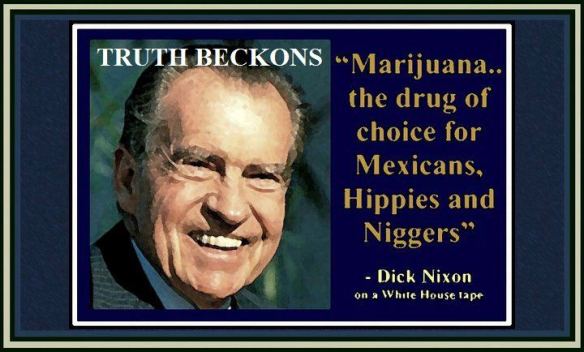
In a new article at Harper’s (“Legalize It All,” April 2016), Dan Baum recalls a 1994 confession by former Nixon domestic policy adviser John Ehrlichmann, about Nixon’s motives in first launching the War on Drugs. Baum, interviewing Ehrlichman for a book on drug prohibition, asked a “series of earnest, wonky questions, that he impatiently waved away”:

“The Nixon campaign in 1968, and the Nixon White House after that, had two enemies:  the antiwar Left, and black people…. We knew we couldn’t make it illegal to be either against the war or black. But by getting the public to associate the hippies with marijuana and blacks with heroin, and then criminalizing both heavily, we could disrupt those communities. We could arrest their leaders, raid their homes, break up their meetings, and vilify them night after night on the evening news. Did we know we were lying about the drugs? Of course we did.”

Judged by those objectives, Nixon’s War on Drugs and its subsequent dramatic escalation under Reagan have been resounding successes.

Many liberals, unfortunately, are prone to describing the War on Drugs as a “failure” — much as the Vietnam or Iraq War was “a mistake” — implicitly accepting the general goals of the American state as good and well-meaning, and merely unfortunate in their execution. The liberals who frame the wars in this way, as Noam Chomsky has argued, share the hawks’ view that “America owns the world” and has the right to define as a “threat” any country that defies its authority or attempts to undermine the global corporate order. And liberals and progressives are nauseatingly prone to referring to criminal foreign wars of aggression and domestic police wars on civil society as something “we” did.

But if you genuinely think the actions of the American state have anything to do with “we” or “us,” either you belong to the economic classes served by the state, or you probably still ask the dentist to save your extracted molars to put under your pillow.

Long before I saw Ehrlichman’s admission, I noted that the expanded War on Drugs against crack and meth under Reagan and Clinton had had a disruptive effect on two of the demographic groups (inner city black people and rural poor whites) that, as it happens, are least socialized to cheerfully accept direction from authority figures behind desks.

Going back to the passage of the Virginia Slave Code after the defeat of Bacon’s Rebellion, running through the use of racial divisions to split and defeat the southern tenant farmers’ unions, and right up to the present, the possibility of a strategic political alliance between poor black and white people has been one of the major fears of the propertied classes who control the American state.

So whether it be Nixon’s or Reagan’s War on Drugs, or the Clintons’ support for a Crime Bill (to “bring to heel” so-called black “super-predators”) that completed America’s growth into the largest carceral state in the world, the fact that a third of the urban black male population is in some phase of the “criminal justice” system and deprived of the franchise has had an enormous effect on radical political possibilities in this country. It has gone a long way towards nullifying the effects of the Voting Rights Act, in much the same way that Black Codes nullified the effects of Emancipation. Jeb Bush’s purge of 70,000 alleged “felons” — mostly not felons, but mostly black — from the Florida voting rolls was the main factor in handing the presidency to his brother.

I’m not, by the way, the kind of conspiracist who thinks every government policy fits into some larger, malign strategy that serves as the “real” motivation for all officials. I don’t doubt a great deal of legislation and executive action is intended as a good faith response to the stated concerns of policy-makers. Of course even such “well-meaning” policies are subject to the law of unintended consequences, mission creep, refusal to reassess in response to feedback on their effectiveness, and abusive or self-dealing execution by the bureaucracies tasked with enforcement.

But even when policies are sincerely “well-meaning,” they still tend to serve vested interests through a sort of structural “invisible hand” effect. The “well-meaning” policies that get passed are those that structurally benefit the economic ruling class, and those that get repealed are those that no longer do so.

The state does not represent “us,” and the destructive and genocidal effects of its policies are not “mistakes.”