Saturday Matinee: BrainDead

309052-3

“BrainDead” (2016) is a political/sci fi satire created by Robert and Michelle King. It originally aired last Summer (on CBS!) in the midst of the heated presidential campaign and the story takes place in the same time-frame following aspiring filmmaker Laurel Healy (Mary Elizabeth Winstead) as she gradually uncovers a plot hatched by a parasitic alien species to divide and conquer the country via covert takeover of DC. The necessary tonal shifts of the plot are handled surprisingly well, balancing horror, comedy, romance, and conspiracy thriller. Instead of traditional plot recaps, episodes feature a clever musical synopsis by Jonathan Coulton. While enjoyable and provocative (for network TV at least), the writers missed an opportunity to incorporate the bizarre presidential campaign directly into the plot (though the connection is implied). While the plot serves as a satisfying allegory it fails to explain brain dead behavior of politicians and pundits before and after the alien invasion. Unfortunately this won’t be addressed in future episodes since the series wasn’t renewed.

You can watch the first and only season of BrainDead here.

(Note: due to spam ads it may take several clicks to get the videos to play. Pop-up windows or tabs should be immediately closed to prevent slowdowns).

‘Conspiracy Theories’ and Clandestine Politics

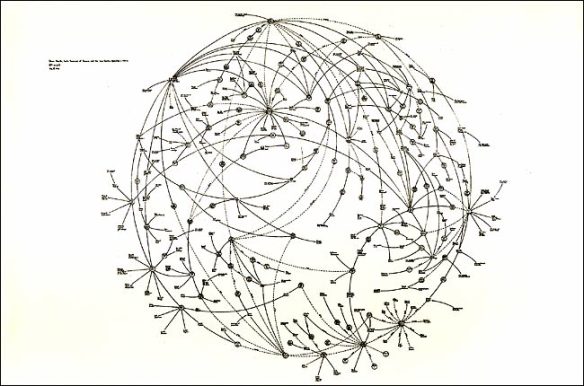
MarkLombardi

By Jeffrey M. Bale

Source: Lobster Magazine

Very few notions generate as much intellectual resistance, hostility, and derision within academic circles as a belief in the historical importance or efficacy of political conspiracies. Even when this belief is expressed in a very cautious manner, limited to specific and restricted contexts, supported by reliable evidence, and hedged about with all sort of qualifications, it still manages to transcend the boundaries of acceptable discourse and violate unspoken academic taboos. The idea that particular groups of people meet together secretly or in private to plan various courses of action, and that some of these plans actually exert a significant influence on particular historical developments, is typically rejected out of hand and assumed to be the figment of a paranoid imagination. The mere mention of the word ‘conspiracy’ seems to set off an internal alarm bell which causes scholars to close their minds in order to avoid cognitive dissonance and possible unpleasantness, since the popular image of conspiracy both fundamentally challenges the conception most educated, sophisticated people have about how the world operates and reminds them of the horrible persecutions that absurd and unfounded conspiracy theories have precipitated or sustained in the past. So strong is this prejudice among academics that even when clear evidence of a plot is inadvertently discovered in the course of their own research, they frequently feel compelled, either out of a sense of embarrassment or a desire to defuse anticipated criticism, to preface their account of it by ostentatiously disclaiming a belief in conspiracies. (1)

They then often attempt to downplay the significance of the plotting they have uncovered. To do otherwise, that is, to make a serious effort to incorporate the documented activities of conspiratorial groups into their general political or historical analyses, would force them to stretch their mental horizons beyond customary bounds and, not infrequently, delve even further into certain sordid and politically sensitive topics. Most academic researchers clearly prefer to ignore the implications of conspiratorial politics altogether rather than deal directly with such controversial matters.

A number of complex cultural and historical factors contribute to this reflexive and unwarranted reaction, but it is perhaps most often the direct result of a simple failure to distinguish between ‘conspiracy theories’ in the strict sense of the term, which are essentially elaborate fables even though they may well be based upon a kernel of truth, and the activities of actual clandestine and covert political groups, which are a common feature of modern politics. For this and other reasons, serious research into genuine conspiratorial networks has at worst been suppressed, as a rule been discouraged, and at best been looked upon with condescension by the academic community. (2) An entire dimension of political history and contemporary politics has thus been consistently neglected. (3)

For decades scholars interested in politics have directed their attention toward explicating and evaluating the merits of various political theories, or toward analyzing the more conventional, formal, and overt aspects of practical politics. Even a cursory examination of standard social science bibliographies reveals that tens of thousands of books and articles have been written about staple subjects such as the structure and functioning of government bureaucracies, voting patterns and electoral results, parliamentary procedures and activities, party organizations and factions, the impact of constitutional provisions or laws, and the like. In marked contrast, only a handful of scholarly publications have been devoted to the general theme of political conspiracies–as opposed to popular anti-conspiracy treatises, which are very numerous, and specific case studies of events in which conspiratorial groups have played some role — and virtually all of these concern themselves with the deleterious social impact of the ‘paranoid style’ of thought manifested in classic conspiracy theories rather than the characteristic features of real conspiratorial politics. (4)

Only the academic literature dealing with specialized topics like espionage, covert action, political corruption, terrorism, and revolutionary warfare touches upon clandestine and covert political activities on a more or less regular basis, probably because such activities cannot be avoided when dealing with these topics. But the analyses and information contained therein are rarely incorporated into standard works of history and social science, and much of that specialized literature is itself unsatisfactory. Hence there is an obvious need to place the study of conspiratorial politics on a sound theoretical, methodological, and empirical footing, since ignoring the influence of such politics can lead to severe errors of historical interpretation.

This situation can only be remedied when a clear-cut analytical distinction has been made between classic conspiracy theories and the more limited conspiratorial activities that are a regular feature of politics. ‘Conspiracy theories’ share a number of distinguishing characteristics, but in all of them the essential element is a belief in the existence of a ‘vast, insidious, preternaturally effective international conspiratorial network designed to perpetrate acts of the most fiendish character’, acts which aim to ‘undermine and destroy a way of life.’ (5)

Although this apocalyptic conception is generally regarded nowadays as the fantastic product of a paranoid mindset, in the past it was often accepted as an accurate description of reality by large numbers of people from all social strata, including intellectuals and heads of state. (6) The fact that a belief in sinister, all-powerful conspiratorial forces has not been restricted to small groups of clinical paranoids and mental defectives suggests that it fulfills certain important social functions and psychological needs.(7)

First of all, like many other intellectual constructs, conspiracy theories help to make complex patterns of cause-and-effect in human affairs more comprehensible by means of reductionism and oversimplification. Secondly, they purport to identify the underlying source of misery and injustice in the world, thereby accounting for current crises and upheavals and explaining why bad things are happening to good people or vice versa. Thirdly, by personifying that source they paradoxically help people to reaffirm their own potential ability to control the course of future historical developments. After all, if evil conspirators are consciously causing undesirable changes, the implication is that others, perhaps through the adoption of similar techniques, may also consciously intervene to protect a threatened way of life or otherwise alter the historical process. In short, a belief in conspiracy theories helps people to make sense out of a confusing, inhospitable reality, rationalize their present difficulties, and partially assuage their feelings of powerlessness. In this sense, it is no different than any number of religious, social, or political beliefs, and is deserving of the same serious study.

The image of conspiracies promoted by conspiracy theorists needs to be further illuminated before it can be contrasted with genuine conspiratorial politics. In the first place, conspiracy theorists consider the alleged conspirators to be Evil incarnate. They are not simply people with differing values or run-of-the-mill political opponents, but inhuman, superhuman, and/or anti-human beings who regularly commit abominable acts and are implacably attempting to subvert and destroy everything that is decent and worth preserving in the existing world. Thus, according to John Robison, the Bavarian Illuminati were formed ‘for the express purpose of ROOTING OUT ALL THE RELIGIOUS ESTABLISHMENTS, AND OVERTURNING ALL THE EXISTING GOVERNMENTS IN EUROPE.’ (8)

This grandiose claim is fairly representative, in the sense that most conspiracy theorists view the world in similarly Manichean and apocalyptic terms.

Secondly, conspiracy theorists perceive the conspiratorial group as both monolithic and unerring in the pursuit of its goals. This group is directed from a single conspiratorial centre, acting as a sort of general staff, which plans and coordinates all of its activities down to the last detail. Note, for example, Prince Clemens von Metternich’s claim that a ‘directing committee’ of the radicals from all over Europe had been established in Paris to pursue their insidious plotting against established governments. (9)

Given that presumption, it is no accident that many conspiracy theorists refer to ‘the Conspiracy’ rather than (lower case)conspiracies or conspiratorial factions, since they perceive no internal divisions among the conspirators. Rather, as a group the conspirators are believed to possess an extraordinary degree of internal solidarity, which produces a corresponding degree of counter solidarity vis-a-vis society at large, and indeed it is this very cohesion and singleness of purpose which enables them to effectively execute their plans to destroy existing institutions, seize power, and eliminate all opposition.

Thirdly, conspiracy theorists believe that the conspiratorial group is omnipresent, at least within its own sphere of operations. While some conspiracy theories postulate a relatively localized group of conspirators, most depict this group as both international in its spatial dimensions and continuous in its temporal dimensions. ‘[T]he conspirators planned and carried out evil in the past, they are successfully active in the present, and they will triumph in the future if they are not disturbed in their plans by those with information about their sinister designs.’(10)

The conspiratorial group is therefore capable of operating virtually everywhere. As a consequence of this ubiquitousness, anything that occurs which has a broadly negative impact or seems in anyway related to the purported aims of the conspirators can thus be plausibly attributed to them.

Fourthly, the conspiratorial group is viewed by conspiracy theorists as virtually omnipotent. In the past this group has successfully overthrown empires and nations, corrupted whole societies, and destroyed entire civilizations and cultures, and it is said to be in the process of accomplishing the same thing at this very moment. Its members are secretly working in every nook and cranny of society, and are making use of every subversive technique known to mankind to achieve their nefarious purposes. Nothing appears to be able to stand in their way–unless the warnings of the conspiracy theorists are heeded and acted upon at once. Even then there is no guarantee of ultimate victory against such powerful forces, but a failure to recognize the danger and take immediate countervailing action assures the success of those forces in the near future.

Finally, for conspiracy theorists conspiracies are not simply a regular feature of politics whose importance varies in different historical contexts, but rather the motive force of all historical change and development. The conspiratorial group can and does continually alter the course of history, invariably in negative and destructive ways, through conscious planning and direct intervention. Its members are not buffeted about by structural forces beyond their control and understanding, like everyone else, but are themselves capable of controlling events more or less at will. This supposed ability is usually attributed to some combination of demonic influence or sponsorship, the possession of arcane knowledge, the mastery of devilish techniques, and/or the creation of a preternaturally effective clandestine organization. As a result, unpleasant occurrences which are perceived by others to be the products of coincidence or chance are viewed by conspiracy theorists as further evidence of the secret workings of the conspiratorial group. For them, nothing that happens occurs by accident. Everything is the result of secret plotting in accordance with some sinister design.

This central characteristic of conspiracy theories has been aptly summed up by Donna Kossy in a popular book on fringe ideas:

Conspiracy theories are like black holes–they suck in everything that comes their way, regardless of content or origin…Everything you’ve ever known or experienced, no matter how ‘meaningless’, once it contacts the conspiratorial universe, is enveloped by and cloaked in sinister significance. Once inside, the vortex gains in size and strength, sucking in everything you touch. (11)

As an example of this sort of mechanism, one has only to mention the so-called ‘umbrella man’, a man who opened up an umbrella on a sunny day in Dealey Plaza just as President John F. Kennedy’s motorcade was passing. A number of ‘conspiracy theorists’ have assumed that this man was signalling to the assassins, thus tying a seemingly trivial and inconsequential act into the alleged plot to kill Kennedy. It is precisely this totalistic, all-encompassing quality that distinguishes ‘conspiracy theories’ from the secret but often mundane political planning that is carried out on a daily basis by all sorts of groups, both within and outside of government. It should, however, be pointed out that even if the ‘umbrella man’ was wholly innocent of any involvement in a plot, as he almost certainly was, this does not mean that the Warren Commission’s reconstruction of the assassination is accurate.

However that may be, real covert politics, although by definition hidden or disguised and often deleterious in their impact, simply do not correspond to the bleak, simplistic image propounded by conspiracy theorists. Far from embodying metaphysical evil, they are perfectly and recognizably human, with all the positive and negative characteristics and potentialities which that implies. At the most basic level, all the efforts of individuals to privately plan and secretly initiate actions for their own perceived mutual benefit –insofar as these are intentionally withheld from outsiders and require the maintenance of secrecy for their success–are conspiracies. Moreover, in contrast to the claims of conspiracy theorists, covert politics are anything but monolithic. At any given point in time, there are dozens if not thousands of competitive political and economic groups engaging in secret planning and activities, and most are doing so in an effort to gain some advantage over their rivals among the others. Such behind-the-scene operations are present on every level, from the mundane efforts of small-scale retailers to gain competitive advantage by being the first to develop new product lines to the crucially important attempts by rival secret services to penetrate and manipulate each other. Sometimes the patterns of these covert rivalries and struggles are relatively stable over time, whereas at other times they appear fluid and kaleidoscopic, as different groups secretly shift alliances and change tactics in accordance with their perceived interests. Even internally, within particular groups operating clandestinely, there are typically bitter disagreements between various factions over the specific courses of action to be adopted. Unanimity of opinioon historical judgements. There is probably no way to prevent this sort of unconscious reaction in the current intellectual climate, but the least that can be expected of serious scholars is that they carefully examine the available evidence before dismissing these matters out of hand.


Footnotes

1. Compare Robin Ramsay, ‘Conspiracy, Conspiracy Theories and Conspiracy Research’, Lobster 19 (1990), p. 25: ‘In intellectually respectable company it is necessary to preface any reference to actual political, economic, military or paramilitary conspiracies with the disclaimer that the speaker “doesn’t believe in the conspiracy theory of history (or politics)”.’This type of disclaimer quite clearly reveals the speaker’s inability to distinguish between bona fide conspiracy theories and actual conspiratorial politics.

2. The word ‘suppress’ is not too strong here. I personally know of at least one case in which a very bright graduate student at a prestigious East Coast university was unceremoniously told by his advisor that if he wanted to write a Ph.D. thesis on an interesting historical example of conspiratorial politics he would have to go elsewhere to do so. He ended up leaving academia altogether and became a professional journalist, in which capacity he has produced a number of interesting books and articles.

3. Complaints about this general academic neglect have often been made by those few scholars who have done research on key aspects of covert and clandestine politics which are directly relevant to this study. See, for example, Gary Marx, ‘Thoughts on a Neglected Category of Social Movement Participant: The Agent Provocateur and the Informant’, American Journal of Sociology 80:2 (September 1974), especially pp. 402-3. One of the few dissertations dealing directly with this topic, though not in a particularly skilful fashion, is Frederick A. Hoffman, ‘Secret Roles and Provocation: Covert Operations in Movements for social Change’ (Unpublished Ph.D. Dissertation: UCLA Sociology Department, 1979). There are, of course, some excellent academic studies which have given due weight to these matters–for example, Nurit Schleifman, Undercover Agents in the Russian Revolutionary Movement: The SR Party, 1902-1914 (Basingstoke: Macmillan/ St. Anthony’s College, 1988); and Jean-Paul Brunet, La police de l’ombre: Indicateurs et provocateurs dans la France contemporaine (Paris: Seuil, 1990)–but such studies areunfortunately few and far between.

4. The standard academic treatments of conspiracy theories are Richard Hofstadter, ‘The Paranoid Style in American Politics’, in Hofstadter, The Paranoid Style in American Politics and Other Essays (New York: Knopf, 1966), pp. 3-40; Norman Cohn, Warrant for Genocide: The Myth of the Jewish World-Conspiracy and the Protocols of the Elders of Zion (Chico, CA: Scholars, 1981 [1969]); J. M. Roberts, The Mythology of the Secret Societies (London: Secker & Warburg, 1972); Johannes Rogallavon Bieberstein, Die These von der Verschwrung, 1776-1945: Philosophen, Freimaurer, Juden, Liberale und Sozialisten als Verschwrergegen die Sozialordnung (Frankfurt am Main: Peter Lang, 1976); and Carl F. Graumann and Serge Moscovici, eds., Changing Conceptions of Conspiracy (New York: Springer, 1987). See also the journalistic studies by George Johnson, Architects of Fear: Conspiracy Theories and paranoia in American Politics (Los Angeles: Tarcher, 1983); and Jonathan Vankin, Conspiracies, Cover-Ups, and Crimes: Political Manipulation and Mind Control in America (New York: Paragon House, 1992).

5. See Hofstadter, ‘Paranoid Style’, pp. 14, 29.

6. Although conspiracy theories have been widely accepted in the most disparate eras and parts of the world, and thus probably have a certain universality as explanatory models, at certain points in time they have taken on an added salience due to particular historical circumstances. Their development and diffusion seems to be broadly correlated with the level of social, economic, and political upheaval or change, though indigenous cultural values and intellectual traditions determine their specific form and condition their level of popularity.

7. As many scholars have pointed out, if such ideas were restricted to clinical paranoids, they would have little or no historical importance. What makes the conspiratorial or paranoid style of thought interesting and historically significant is that it frequently tempts more or less normal people and has often been diffused among broad sections of the population in certain periods. Conspiracy theories are important as collective delusions, delusions which nevertheless reflect real fears and real social problems, rather than as evidence of individual pathologies. See, for example, Hofstadter,’Paranoid Style’, pp. 3-4.

8. See his Proofs of a Conspiracy Against All the Religions and Governments of Europe, Carried on in the Secret Meetings of free Masons, Illuminati, and Reading Societies, Collected from Good Authorities (New York: G. Forman, 1798), p. 14. This exhibits yet another characteristic of ‘conspiracy theorists’–the tendency to over-dramatize everything by using capital letters with reckless abandon.

9. See his ‘Geheime Denkschrift nber die Grundung eines Central-Comites der nordischen Machte in Wien’, in Aus Metternichs nachgelassenen Papieren, ed. by Richard Metternich-Winneburg (Vienna: 1881),vol. 1, p. 595, cited in Rogalla von Bieberstein, These von der Verschwrung, pp. 139-40.

10. Dieter Groh, ‘Temptation of Conspiracy Theory, Part I’, in Changing Conceptions of Conspiracy, p. 3. A classic example of conspiratorial works that view modern revolutionary movements as little more than the latest manifestations of subversive forces with a very long historical pedigree is the influential book by Nesta H. Webster, Secret Societies and Subversive Movements (London: Boswell, 1924). For more on Webster’s background, see the biographical study by Richard M. Gilman, Behind World Revolution: The Strange Career of Nesta H. Webster (Ann Arbor: Insight, 1982), of which only one volume has so far appeared.

11. Kooks: A Guide to the Outer Limits of Human Belief (Portland: Feral House, 1994), p. 191.

12. For more on P2, see above all the materials published by the Italian parliamentary commission investigating the organization, which are divided into the majority (Anselmi) report, five dissenting minority reports, and over one hundred thick volumes of attached documents and verbatim testimony before the commission. Compare also Martin Berger, Historia de la loggia masonica P2 (Buenos Aires: El Cid, 1983); Andrea Barbieri et al, L’Italia della P2 (Milan: Mondadori, 1981); Alberto Cecchi, Storia della P2 (Rome: Riuniti, 1985); Roberto Fabiani, I massoni in Italia (Milan: L’Espresso, 1978); Gianfranco Piazzesi, Gelli: La carriere di un eroe di questa Italia (Milan: Garzanti, 1983); Marco Ramat et al, La resistabile ascesa della P2: Poteri occulti e stato democratico (Bari: De Donato, 1983); Renato Risaliti, Licio Gelli, a carte scoperte (Florence: Fernando Brancato, 1991); and Gianni Rossi and Franceso Lombrassa, In nome della ‘loggia’: Le prove di come lamassoneria segreta ha tentato di impadronarsi dello stato italiano. Iretroscena della P2 (Rome: Napoleone, 1981). Pro P2 works include those of Gelli supporter Pier Carpi, Il caso Gelli: La verita sulla loggia P2 (Bologna: INEI, 1982); and the truly Orwellian work by Gelli himself, La verita (Lugano: Demetra, 1989), which in spite of its title bears little resemblance to the truth.

13. For the AB, see Ivor Wilkins and Hans Strydom, The Super-Afrikaners: Inside the Afrikaner Broederbond (Johannesburg: Jonathan Ball, 1978); and J.H.P.Serfontein, Brotherhood of Power: An Expose of the Secret Afrikaner Broederbond (Bloomington and London: Indiana University, 1978).Compare also B. M. Schoeman, Die Broederbond in die Afrikaner-politiek (Pretoria: Aktuele, 1982); and Adrien Pelzer, Die Afrikaner-Broederbond: Eerste 50 jaar (Cape Town: Tafelberg, 1979).

14. See his Historians’ Fallacies: Toward a Logic of Historical Thought (New York: Harper & Row, 1970), pp. 74-8.


Let’s Give the CIA the Credit It Deserves

By Norman Solomon

Source: OpEdNews.com

For months now, our country has endured the tacit denigration of American ingenuity. Countless statements — from elected officials, activist groups, journalists and many others — have ignored our nation’s superb blend of dazzling high-tech capacities and statecraft mendacities.

Fortunately, this week the news about release of illuminating CIA documents by WikiLeaks has begun to give adequate credit where due. And not a moment too soon. For way too long, Russia has been credited with prodigious hacking and undermining of democracy in the United States.

Many Americans have overlooked the U.S. government’s fantastic hacking achievements. This is most unfair and disrespectful to the dedicated men and women of intelligence services like the CIA and NSA. Far from the limelight, they’ve been working diligently to undermine democracy not just overseas but also here at home.

Today, the massive new trove of CIA documents can help to put things in perspective. Maybe now people will grasp that our nation’s undermining of democracy is home-grown and self-actualized. It’s an insult to the ingenious capacities of the United States of America to think that we can’t do it ourselves.

Contrary to all the public relations work that U.S. intelligence agencies have generously done for them, the Russians don’t even rank as peripheral to the obstacles and prospects for American democracy. Rest assured, throughout the long history of the United States, we haven’t needed foreigners to get the job done.

In our current era, can Vladimir Putin take any credit for purging huge numbers of African Americans, Latinos and other minority citizens from the voter rolls? Of course not.

Did Putin create and maintain the barriers that prevented many low-income people from voting on November 8? Only in his dreams.

Can the Kremlin hold a candle to the corporate-owned cable TV channels that gave Donald Trump umpteen free hours of uninterrupted air time for speeches at his campaign rallies? Absolutely not.

Could any Russian operation claim more than a tiny sliver of impact compared to the handiwork of FBI Director James Comey as he boosted Donald Trump’s prospects with a pair of gratuitous announcements about a gratuitously re-opened probe of Hillary Clinton’s emails during the last days of the 2016 campaign? No way.

Is Putin anything but a miniscule lightweight in any efforts to manipulate the U.S. electorate compared to “dark money” American billionaires like the Koch brothers? Give us a break.

And how about the Fourth Amendment of the U.S. Constitution? The Kremlin can only marvel at the way that the CIA, the NSA and the bipartisan leadership in Washington have shredded the Fourth Amendment while claiming to uphold it.

To sum up: The CIA’s efforts to tout Russia add up to jaw-dropping false modesty! The humility of “deep state” leaders in Langley is truly awesome.

Let’s get a grip. Overwhelmingly, the achievements of thwarting democracy in America have been do-it-yourself operations. It’s about time that we give adequate credit to the forces perpetuating this country’s self-inflicted wounds to American democracy.

To loosely paraphrase the beloved comic-strip character Pogo, when the subject is grievous damage to democracy at home, “We have met the ingenuity and it is U.S.” But we’re having a terrible time recognizing ourselves.

Made For Each Other

 2565241-avp__democrats_vs__republicans_by_cwgodzilla

By James Howard Kunstler

Source: Kunstler.com

Don’t be fooled by the idiotic exertions of the Red team and the Blue team. They’re just playing a game of “Capture the Flag” on the deck of the Titanic. The ship is the techno-industrial economy. It’s going down because it has taken on too much water (debt), and the bilge pump (the oil industry) is losing its mojo.

Neither faction understands what is happening, though they each have an elaborate delusional narrative to spin in the absence of any credible plan for adapting the life of our nation to the precipitating realities. The Blues and Reds are mirrors of each other’s illusions, and rage follows when illusions die, so watch out. Both factions are ready to blow up the country before they come to terms with what is coming down.

What’s coming down is the fruit of the gross mismanagement of our society since it became clear in the 1970s that we couldn’t keep living the way we do indefinitely — that is, in a 24/7 blue-light-special demolition derby. It’s amazing what you can accomplish with accounting fraud, but in the end it is an affront to reality, and reality has a way of dealing with punks like us. Reality has a magic trick of its own: it can make the mirage of false prosperity evaporate.

That’s exactly what’s going to happen and it will happen because finance is the least grounded, most abstract, of the many systems we depend on. It runs on the sheer faith that parties can trust each other to meet obligations. When that conceit crumbles, and banks can’t trust other banks, credit relations seize up, money vanishes, and stuff stops working. You can’t get any cash out of the ATM. The trucker with a load of avocados won’t make delivery to the supermarket because he knows he won’t be paid. The avocado grower will have to watch the rest of his crop rot. The supermarket shelves empty out. And you won’t have any guacamole.

There are too many fault lines in the mighty edifice of our accounting fraud for the global banking system to keep limping along, to keep pretending it can meet its obligations. These fault lines run through the bond markets, the stock markets, the banks themselves at all levels, the government offices that pretend to regulate spending, the offices that affect to report economic data, the offices that neglect to regulate criminal misconduct, the corporate boards and C-suites, the insurance companies, the pension funds, the guarantors of mortgages, car loans, and college loans, and the ratings agencies. The pervasive accounting fraud bleeds a criminal ethic into formerly legitimate enterprises like medicine and higher education, which become mere rackets, extracting maximum profits while skimping on delivery of the goods.

All this is going to overwhelm Trump soon, and he will flounder trying to deal with a gargantuan mess. It will surely derail his wish to make America great again — a la 1962, with factories humming, and highways yet to build, and adventures in outer space, and a comforting sense of superiority over all the sad old battered empires abroad. I maintain it could get so bad so fast that Trump will be removed by a cadre of generals and intelligence officers who can’t stand to watch someone acting like Captain Queeg in the pilot house.

That itself might be salutary, since only some kind of extreme shock is likely to roust the Blue and Red factions from their trenches of dumb narrative. If the Democratic Party had put one-fiftieth of the effort it squanders on transgender bathroom privileges into policy for mitigating our tragic misinvestments in suburban sprawl, we might have gotten a head-start toward a plausible future. Instead, the Democratic Party has turned into a brats-only nursery school, with the kiddies fighting over who gets to play with the Legos. The Republican Party is Norma Desmond’s house in Sunset Boulevard, starring Donald Trump as Max the Butler, working extra-hard to keep the illusions of yesteryear going.

All of this nonsense is a distraction from the task at hand: figuring out how to live in the post techno-industrial world. That world is not going to operate the ways we’re used to. It will crush our assumptions and expectations. Lying about everything won’t be an option. We won’t have the extra resources to cover up our dishonesty. Our money better be sound or it will be laughed at, and then you’ll starve or freeze to death. You’d better hope the rule of law endures and work on keeping it alive where you live. And nobody will get special brownie points for the glory of sexual confusion.

I look for the financial fireworks to start around March – April, as the irresolvable debt ceiling debate in congress grinds into a bitter stalemate, and it becomes obvious that there will be no voucher for the great infrastructure spending orgy that Trump’s MAGA is based on. Elections in France and the Netherlands have the potential to shake apart the European Union, and with that the footing of European banks. Pretty soon, everybody in all parties and factions will be asking: “Where did the glittering promises of Modernity go…?” As we slip-side into the first stages of a world made by hand.

Goose-stepping Our Way Toward Pink Revolution

7158ef9ad95b21ae22abe271cdefd349

By CJ Hopkins

Source: CounterPunch

So the global capitalist ruling classes’ neutralization of the Trumpian uprising seems to be off to a pretty good start. It’s barely been a month since his inauguration, and the corporate media, liberal celebrities, and their millions of faithful fans and followers are already shrieking for his summary impeachment, or his removal by … well, whatever means necessary, including some sort of “deep state” coup. Words like “treason” are being bandied about, treason being grounds for impeachment (not to mention being punishable by death), which appears to be where we’re headed at this point.

In any event, the nation is now officially in a state of “crisis.” The editors of The New York Times are demanding congressional investigations to root out the Russian infiltrators who have assumed control of the executive branch. According to prize-winning economist Paul Krugman, “a foreign dictator intervened on behalf of a US presidential candidate” … “we are being governed by people who take their cues from Moscow,” or some such nonsense. The Washington Post, CNN, MSNBC, The Guardian, The New Yorker, Politico, Mother Jones, et al. (in other words virtually every organ of the Western neoliberal media) are robotically repeating this propaganda like the Project Mayhem cultists in Fight Club.

The fact that there is not one shred of actual evidence to support these claims makes absolutely no difference whatsoever. As I wrote about in these pages previously, such official propaganda is not designed to be credible; it is designed to bludgeon people into submission through sheer relentless repetition and fear of social ostracization … which, once again, is working perfectly. Like the “Iraq has WMDs” narrative before it, the “Putin Hacked the Election” narrative has now become official “reality,” an unchallengeable axiomatic “fact” that can be cited as background to pretend to bolster additional ridiculous propaganda.

This “Russia Hacked the Election” narrative, let’s remember, was generated by a series of stories that it turned out were either completely fabricated or based on “anonymous intelligence sources” that could provide no evidence “for reasons of security.” Who could forget The Washington Post‘s “Russian Propagandist Blacklist” story (which was based on the claims of some anonymous’ blog and a third rate neo-McCarthyite think tank), or their “Russians Hacked the Vermont Power Grid” story (which, it turned out later, was totally made up), or CNN’s “Golden Showers Dossier” story (which was the work of some ex-MI6 spook-for-hire the Never Trump folks had on their payroll), or Slate‘s “Trump’s Russian Server” story (a half-assed smear piece by Franklin Foer, who is now pretending to have been vindicated by the hysteria over the Flynn resignation), or (and this is my personal favorite) The Washington Post‘s “Clinton Poisoned by Putin” story? Who could possibly forget these examples of courageous journalists speaking truth to power?

Well, OK, a lot of people, apparently, because there’s been a new twist in the official narrative. It seems the capitalist ruling classes now need us to defend the corporate media from the tyrannical criticism of Donald Trump, or else, well, you know, end of democracy. Which millions of people are actually doing. Seriously, absurd as it obviously is, millions of Americans are now rushing to defend the most fearsome propaganda machine in the history of fearsome propaganda machines from one inarticulate, populist boogeyman who can’t maintain his train of thought for more than fifteen or twenty seconds.

All joking aside, the prevailing mindset of the ruling classes, and those aspiring thereto, is more frightening than at any time I can remember. “The Resistance” is exhibiting precisely the type of mindlessly fascistic, herd-like behavior it purports to be trying to save us from. Yes, the mood in Resistance quarters has turned quite openly authoritarian. William Kristol captured it succinctly: “Obviously strongly prefer normal democratic and constitutional politics. But if it comes to it, [I] prefer the deep state to the Trump state.” Neoliberal Rob Reiner put it this way: “The incompetent lying narcissistic fool is going down. Intelligence community will not let DT destroy democracy.” Subcommandante Micheal Moore went to the caps lock to drive the point home: “It doesn’t take a rocket scientist to figure out what was going on: TRUMP COLLUDING WITH THE RUSSIANS TO THROW THE ELECTION TO HIM,” and demanded that Trump be immediately detained and renditioned to a secure facility: “Let’s be VERY clear: Flynn DID NOT make that Russian call on his own. He was INSTRUCTED to do so. He was TOLD to reassure them. Arrest Trump.”

These a just a few of the more sickening examples. The point is, millions of American citizens (as well as citizens of other countries) are prepared to support a deep state coup to remove the elected president from office … and it doesn’t get much more fascistic than that.

Now I want to be clear about this “deep state” thing, as the mainstream media is already labeling anyone who uses the term a hopelessly paranoid conspiracy theorist. The deep state, of course, is not a conspiracy. It is simply the interdependent network of structures where actual power resides (i.e., the military-industrial complex, multinational corporations, Wall Street, the corporate media, and so on). Its purpose is to maintain the stability of the system regardless of which party controls the government. These are the folks, when a president takes office, who show up and brief him on what is and isn’t “possible” given economic and political “realities.” Despite what Alex Jones may tell you, it is not George Soros and roomful of Jews. It is a collection of military and intelligence officers, CEOs, corporate lobbyists, lawyers, bankers, politicians, power brokers, aides, advisers, and assorted other permanent members of the government and the corporate and financial classes. Just as presidents come and go, so do the individuals comprising the deep state, albeit on a longer rotation schedule. And, thus, it is not a monolithic entity. Like any other decentralized network, it contains contradictions, conflicts of interest. However, what remains a constant is the deep state’s commitment to preserving the system … which, in our case, that system is global Capitalism.

I’m going to repeat and italicize that to hopefully avoid any misunderstanding. The system the deep state primarily serves is not the United States of America, i.e., the country most Americans believe they live in; the system it serves is globalized Capitalism. The United States, the nation state itself, while obviously a crucial element of the system, is not the deep state’s primary concern. If it were, Americans would all have healthcare, affordable education, and a right to basic housing, like more or less every other developed nation.

And this is the essence of the present conflict. The Trump regime (whether they’re sincere or not) has capitalized on people’s discontent with globalized neoliberal Capitalism, which is doing away with outmoded concepts like the nation state and national sovereignty and restructuring the world into one big marketplace where “Chinese” investors own “American” companies that manufacture goods for “European” markets by paying “Thai” workers three dollars a day to enrich “American” hedge fund crooks whose “British” bankers stash their loot in numbered accounts in the Cayman Islands while “American” workers pay their taxes so that the “United States” can give billions of dollars to “Israelis” and assorted terrorist outfits that are destabilizing the Middle East to open up markets for the capitalist ruling classes, who have no allegiance to any country, and who couldn’t possibly care any less about the common people who have to live there. Trump supporters, rubes that they are, don’t quite follow the logic of all that, or see how it benefits them or their families.

But whatever … they’re all just fascists, right? And we’re in a state of crisis, aren’t we? This is not the time to sit around and analyze political and historical dynamics. No, this is a time for all loyal Americans to set aside their critical thinking and support democracy, the corporate media, and the NSA, and CIA, and the rest of the deep state (which doesn’t exist) as they take whatever measures are necessary to defend us from Putin’s diabolical plot to Nazify the United States and reenact the Holocaust for no discernible reason. The way things are going, it’s just a matter of time until they either impeach his puppet, Trump, or, you know, remove him by other means. I imagine, once we get to that point, Official State Satirist Stephen Colbert will cover the proceedings live on the “Late Show,” whipping his studio audience up into a frenzy of mindless patriotic merriment, as he did in the wake of the Flynn fiasco (accusing the ruling classes’ enemies of treason being the essence of satire, of course). After he’s convicted and dying in jail, triumphant Americans will pour out onto the lawn of Lafayette Square again, waving huge flags and hooting vuvuzelas, like they did when Obama killed Osama bin Laden. I hope you’ll forgive me if I don’t attend. Flying home may be a little complicated, as according to The Washington Post, I’m some kind of Russian propagandist now. And, also, I have this problem with authority, which I don’t imagine will go over very well with whatever provisional government is installed to oversee the Restoration of Normality, and Love, of course, throughout the nation.

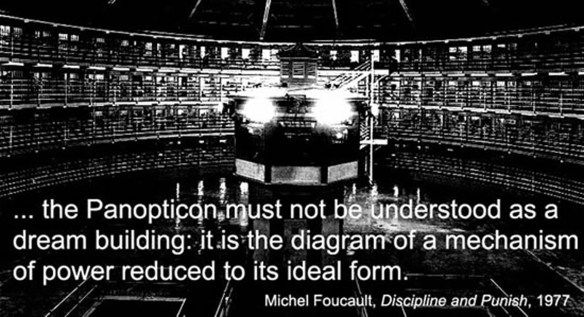
Media, Mind-Control, & Meditation: Plato’s E-Cave Panopticon and Beyond

panopticon-image

By Mankh (Walter E. Harris III)

Source: Axis of Logic

“Relax,” said the night man,
”We are programmed to receive.
You can check-out any time you like, 
But you can never leave!”

 – The Eagles, from “Hotel California”

In Plato’s Allegory of the Cave, people saw a shadow play on the wall and perceived it as reality. Today that Cave has morphed to provide umpteen TV channels and mini-screen gadgets; and the once sanctified living room cave has expanded into a free-range bubble of consciousness – heads bowed before an electronic altar, seemingly oblivious to the outside world.

“The “panopticon” refers to an experimental laboratory of power in which behaviour could be modified, and Foucault viewed the panopticon as a symbol of the disciplinary society of surveillance.”[1]

In Plato’s E-Cave, not only are the people watching a shadow play, they, and the shadows they watch, are being watched.

HyperNormalization
With a veneer of calm aplomb, the masses communicate 24-7, often in a frenetic urgency of the mundane, hence one interpretation of HyperNormalization. In all the years of overhearing cell-phone conversations in public, I can’t recall one snippet of philosophy or practical advice, rather stuff like, ‘yeah OMG I’ll get the chips!’ and ‘I’ll be there in like 30 seconds!’; if you’re old enough, you’d remember the days when, you got there when you got there! That said, a cell-phone can be a helpful even life-saving device.

The USEmpire election appears to have both proven and disproven the main theory of Adam Curtis’ fascinating new documentary “HyperNormalization.”

“Curtis argues that since the 1970s, governments, financiers, and technological utopians have given up on the complex “real world” and built a simple “fake world” that is run by corporations and kept stable by politicians.”[2]

The California cyber-tech-boom was a love-child of LSD-consciousness that found refuge in E-wizardy all the while looking to escape repressive politics. In his book “2030” Pepe Escobar describes it as: “Digital network capitalism would then shape post-modern globalization, from the New Economy before the end of the millennium to every digital wall to be broken beyond. California cosmology forged our world.”

According to Wikipedia:

“The term “hypernormalisation” is taken from Alexei Yurchak’s 2006 book Everything was Forever, Until it was No More: The Last Soviet Generation, about the paradoxes of life in the Soviet Union during the 20 years before it collapsed. A professor of anthropology at the University of California, Berkeley, he argues that everyone knew the system was failing, but as no one could imagine any alternative to the status quo, politicians and citizens were resigned to maintaining a pretence of a functioning society. Over time, this delusion became a self-fulfilling prophecy and the “fakeness” was accepted by everyone as real, an effect which Yurchak termed “hypernormalisation”.”[3]

First off, I see HyperNormalization as a half-truth because while the self-referential, gossipy world is fake, it is a veneer for a very real world of resource extraction and the violence perpetrated to maintain the status quo – and that is what the fakers ignore. As far as the election, many expected the Clinton dynasty to prevail as the corrupt, business as usual lesser of two evils. Breaking snooze: Where’s  the headline news that Melania Trump plans to focus on helping women and children?; I saw that mentioned on CNN’s Anderson Cooper 360, such a perfect antidote for Hillary’s loss and The Donald’s anti-feminist track record.

Even though WikiLeaks revealed the DNC (Democratic National Convention) was rigged against Sanders and leaks of Podesta/Clinton e-mails may have been proverbial straws for Hillary’s campaign camel, the prevailing media sentiment was that she would win – despite the fact that the day before the election some polls indicated a shrinking 3-4 point lead, thus with the typical margin of error, it was, in effect, tied. Yet the mass hyper-surprise!; and all that after the corporate media and comedy shows had simultaneously bashed Trump and given him more air-time than a kite on a windy day – both disdaining and elevating him, a media-mindfuck if ever there was one.

And there was little uproar when Gary Johnson and Jill Stein were excluded from debates and virtually banned from all corporate news, thus proving (if you didn’t know already) that it’s not a truly democratic election. Yet carry on we must and do the best we can with what we got, was the general sentiment, in other words, “the “fakeness” was accepted by everyone as real” aka HyperNormalization.

Yet the non-coastal, poor and middle America White working class (with sides of KKK and minorities!), which reportedly was the key demographic for The Don’s victory, was voting out of bare-bones needs; in effect they were not HyperNormalized. Then again, if Trump, who promises to challenge the status quo, caves-in to Deep State pressure, we will have an answer to an interesting article’s titular question: “President Trump: big liar going to Washington or Tribune of the People?”[4] And if that answer is the former, then the mostly White working poor will also have been duped/HyperNormalized.

You see, it’s hard to know what’s what; which all seems to prove HyperNormalization as the dominant societal charade; which screen is real, if any?

What you perceive is what you get
Another key phrase in Curtis’ documentary is “managed perception” – akin to Chomsky and Herman’s  “Manufacturing Consent: The Political Economy of the Mass Media” (1988) which showed how opinions and desensitized agreement to the status quo became a product to be mined and marketed. Witness CBS Chairman Les Moonves’ comment from February 2016:

“Man, who would have expected the ride we’re all having right now? … The money’s rolling in and this is fun. I’ve never seen anything like this, and this [is] going to be a very good year for us. Sorry. It’s a terrible thing to say. But, bring it on, Donald. Keep going.” [5] And, if i might satirically add, like an orangey topped Duracell battery, The Don does seem to have a lot of energy.

HyperNormalization is also akin to Sheldon Wolin’s theory  of “inverted totalitarianism,” where the faceless corporate machine wields so much entertainment and bureaucratic power that the people barely notice they are being played hook, line, and sinking feelings.

Some of Curtis’ info, however, is inaccurate or questionable. For examples, he blames the demise of the Occupy Movement on lack of vision and planning yet neglects to mention the FBI coordinated systemic crackdown on the ‘camps’ across the country. [6]

About Syria he says that President Bashar al-Assad retaliated with a “vengeful fury,” whereas Assad has defended his actions as self-defense for his people; numerous journalists back the Syrian President’s claim.

Post-election, I wonder: Why were so many liberals, lefties, and women more surprised that Trump won than that the DNC/HRC rigged it against Sanders? Were they simply feeling impotent due to HyperNormalized shadow play? Whatever the case, his victory revealed a crack in the smooth screen of HyperNormalization.

According to Patrick Caddell’s survey before the election, the populace seems to be hip to what’s happening:

“Powerful interests from Wall Street banks to corporations, unions and political interest groups have used campaign and lobbying money to rig the system for them. They are looting the national treasury of billions of dollars at the expense of every man, woman and child. AGREE = 81%; DISAGREE = 13%…

“The country is run by an alliance of incumbent politicians, media pundits, lobbyists and other powerful money interests for their own gain at the expense of the American people. AGREE = 87%; DISAGREE = 10%

The real struggle for America is not between Democrats and Republicans but between mainstream American and the ruling political elites. AGREE = 67%; DISAGREE = 24%.” [7]

This makes it seem it is the ‘how-to bring about change’ that is the deeper conundrum of the HyperNormalized world. Then again, people too often seem to have only their own best interests at heart. Approximately 90% of Americans want their food labeled so as to know if they contain GMOs etc. or not, yet hardly a peep out of anyone that climate change or the “environment” aka Mother Earth & Nature-beings were deliberately excluded as a main topic of the presidential debates. This makes it seem that, in general, Americans want clean food for themselves, they want a clean environment so they can go ‘play in the park’ by themselves. And that brings us to the Great Disconnect and Standing Rock.

Flow like water, be steady as a rock
Part of HyperNormalization is a disconnect from Nature and from being self- and community-guided, and therefore disconnected from the Original Peoples of Turtle Island. While many people are certainly aware of what’s happening with Standing Rock, the corporate media’s lack of attention, let alone empathy, fosters lack of concern for the outcome, lack of being outraged by the violent and racist treatment of those in prayer and peacefully protecting the main source of water for the Standing Rock Sioux and other Natives as well as approximately 17-million people downstream. The real-fake outrage is over the outcome of a fake election.

For many Native reservations where poverty and PTSD are prevalent, the people are anything but HyperNormalized; they are struggling to survive – as with Standing Rock, they are not asking for much: clean water and the space to live their lives with ancient traditions timelessly connected with the land, the water, the stones…

Plato, imagining a prisoner getting outside of the Cave, wrote: “Slowly, his eyes adjust to the light of the sun. First he can only see shadows. Gradually he can see the reflections of people and things in water and then later see the people and things themselves. Eventually, he is able to look at the stars and moon at night until finally he can look upon the sun itself .” [8]

Standing Rock is bringing people together, raising consciousness at many levels. As one example from a little over a week ago:

“In a “historic” show of interfaith solidarity, 500 clergy members prayed along the banks of North Dakota’s Cannonball River on Thursday where they “bore witness with the Standing Rock Sioux Nation,” which has faced intimidation, violence, and arrests for protecting their sacred land and water supply from the threats of a massive oil pipeline. According to the Episcopal News Service, “The interfaith group spent more than five hours on site, marching, singing hymns, sharing testimony, and calling others to join them in standing with the more than [300] tribes who have committed their support to the Sioux Nation as they protest the route of the Dakota Access Pipeline (DAPL).” [9]

This solidarity is in stark contrast with the election where a typically 51/49 system determines an outcome for a society literally programmed for exciting close-call winners – think sporting events,
reality shows, awards ceremonies.

Outside in and inside out
There are many ways to get outside the Cave. One of those is by going within. When I first started to meditate, as is common, I became aware of the constant chatter in my head and soon realized that the mind left unattended will rattle on endlessly. Meditation then showed me that once the chatter quiets, one then has access to other frequencies, other ‘channels’ – what happens then is a very personal matter yet also impersonal because one becomes connected with another source of thinking-seeing-feeling. Chatter, like cell-phones, has it’s usefulness, say, if you forgot to turn the stove off. My point to the personal anecdote is that the corporate media is too much chatter, endlessly looping itself. The gadgets, too, though useful, seem hard-wired for HyperNormalization.

Some of the chatter we must live with, yet by learning to follow our intuitions, listening to and connecting with Nature, talking with elders and little children we can better tune-out from the shadow-play, we can find new and ancient ways for more people – and that includes trees, rivers, etc. –  “to look at the stars and moon at night” and “look upon the sun itself.”

“Sin filo ya y derrotada se quejó: Soy más fuerte que ella, pero no le puedo hacer daño y ella a mi, sin pelear. me ha vencido.’”

“Without sharpness and defeated, it [the sword] complained: ‘I am stronger than the water, but I cannot harm her. And the water, without fighting, has conquered me.’” [10]

NOTES:
1.    Panopticism here and here.
2.    Ibid.
3.    HyperNormalization
4.    See here.
5.    “Les Moonves: Trump’s run is ‘damn good for CBS’”. See here.
6.    “Revealed: how the FBI coordinated the crackdown on Occupy
7.    “Patrick Caddell; The Pollster Who ‘Got it Right’
8.    “Allegory of the Cave
9.    “A Prayer for People and Planet: 500 Clergy Hold ‘Historic’ Mass Gathering for Standing Rock
10.    “Questions & Swords: Folktales of the Zapatista Revolution” as told by Subcomandante Marcos, Cino Puntos Press, El Paso, Texas, 2001, p.82.

To watch “HyperNormalization”, click here.

Mankh (Walter E. Harris III) is an essayist and resident poet on Axis of Logic. In addition to his work as a writer, he is a small press publisher and Turtle Islander. His new book of genre-bending poetic-nonfiction is “Musings With The Golden Sparrow.” You can contact him via his literary website.


Phantom Democracy in the Age of the Internet

trumpandflag

By Nozomi Hayase

Source: Dissident Voice

After the Electoral College vote, the Trump presidency is now official. As denial and blame games continue, it becomes clear this was not a foreign government coup d’état. The truth is that democracy in America has been rotten to the core for decades. It is meddled with by corporate lobbyists, Big Pharma, Big Oil and Wall Street –those who are addicted to money and power.

American democracy is hollowed out, veiled with a loud media echo chamber, bringing feigned solidity to its emptiness. Out of this vacuum emerges a madness for power. U.S. politics is a contest of those who are driven by insatiable hunger – the most callous, cunning and manipulative people in society.

In this system, only people who lack empathy and advance self-serving agendas without concerns for others can rise to the top. The results of this year’s presidential election may mean that this person who many saw as ‘unfit to be president’ was better suited to play this dirty game than his opponent, Hillary Clinton.

Ascent of Trump

Donald Trump, a perceived outsider, seemed to appear out of nowhere. The former producer of the American game show The Apprentice sniffed the vulnerability of disfranchised Americans who are continually betrayed by the establishment. He then quickly moved in for the kill, turning the electoral arena into a new Reality TV show.

With social media as a hunting ground, this new Republican contender made direct connection with his audience, pouring out charm and grooming them with fake promises. By deploying words as weapons of control, he managed to garner favorable reactions from his followers. His language cast a magic spell where contradictory remarks and lies bypassed critical examination. Emotions triumphed over reason and under the grip of irrational logic, facts no longer seemed to matter. With a chameleon-like ability to shape-shift and say whatever voters wanted to hear, he was able to create a mirage and ensnare the populace into a grandiose fantasy.

What was the press, as a supposed watchdog of power doing during this Trump’s uncanny rise in popularity? Mainstream media did nothing to prevent it and instead facilitated this process. His bombastic comments hit jackpot high ratings in the corporate media and rhetoric not bound by facts was not only tolerated, but actively promoted with their shortsighted mentality of profit at any cost.

WikiLeaks and the Democratizing Power of the Internet

This same corporate media also buried a few important facts regarding the 2016 U.S. presidential election. This year’s election was an unprecedented phenomenon. This is not only because the lesser evil game was fought between two of the historically most disliked candidates, but also because of the role played by a new actor from outside of the U.S. electoral arena. Days before the election, a Forbes article acknowledged the significance of WikiLeaksDNC emails, calling them a “Holy Grail of understanding of U.S. electoral politics.” It noted how “few understand the importance of WikiLeaks in the eventual writing of the history of presidential politics.”

WikiLeaks has shown how elections in the existence of a truly free press will never be the same as before. U.S. politics sponsored by corporate masters creates a milieu of deception, lies and fraud that is fraught with corruption. These power driven politicians can only thrive in secrecy. When their actions are exposed, like Hillary’s highly paid Goldman Sachs speeches, crafted public images that suck the masses into their illusions of grandeur tend to shatter. Contrary to hysterical rants of ‘Russia hacked the election!’, the defeat of the Clinton dynasty was a testimony to the power of transparency.

WikiLeaks, the world’s first global 4th estate, which operates outside of any government was birthed on the Internet. It showed a potential for emancipation unleashed by this Net. Much of the force of democratization on the Internet is being subverted to create mass surveillance and censorship. Yet at the same time, its effect of empowering ordinary people cannot be denied.

In fact, Bernie Sander’s campaign was built on social media’s grassroots organizing. With independent campaign funding, this virtually unknown senator from Vermont successfully sparked the idea of socialism and raised issues of Wall Street corruption, economic injustice and poverty at a national level. Sander’s largest support came from millennials. It was these natives of the Internet that galvanized his political revolution.

Fake News and Fake Authority

Democrats appear to be disconnected with this new reality of the Internet’s bottom up spontaneous crowd gathering or even worse were adversaries to it. This was shown in their reaction to the corruption revealed in the DNC email database and Trump’s winning of the election.

On the second day of the Democratic National Convention, hundreds of Sanders delegates who learned about DNC’s rigging of the primary walked out in protest. Chanting “This is what Democracy looks like!”, they vowed not to go with Hillary. This crisis of the American political system opened up an opportunity for real democracy. But then, Bernie turned away, urging his supporters to nominate Hillary and sided with the corrupted Democratic Party. His failure to seize this historical moment helped throw the election to Trump, who the Clinton campaign had portrayed as a ‘pied piper candidate’.

After all this came the Fake News explosion. Some established liberal media, freaked out by the country quickly turning red in this Republican takeover, created a new red scare. On November 24, an article in The Washington Postmade wild accusations that Russia was engaging in propaganda during the election to spread ‘fake news’ in favor of Trump. The anonymous site that claimed to have identified these fake news sites that the author cited in the article, was shown to be nothing but a black list that labels anyone who challenges the official narrative as untrustworthy or even insinuating them to be Russian agents, spies or traitors.

Despite U.S. Intelligence Chief James Clapper’s claim that intelligence agencies lacked strong evidence for WikiLeaks’ connection with an alleged Russian cyberattack, it was way easier for progressives to ignore facts and spread paranoia, blaming the loss of Clinton on anyone but themselves.

In the age of the Internet, fake news can easily be manufactured and spread. Yet, at the same time it can also be shut down with countering views that surround them. Also, in this new environment, traditional media is losing its monopolizing power to disseminate information. They no longer can claim to be the sole purveyor of truth. In the case of the Washington Post‘s fake news scandal, The Intercept and Matt Taibbi of Rolling Stone quickly denounced and challenged its claim, halting this report on ‘fake news’. Social media networks also countered the gatekeepers who tried to dictate what is real through filtering views that challenge the official narrative. In the end, this fake news article was debunked, with Wapo issuing a correction on that story shortly after its publication. What this has shown is the publisher’s false authority and the establishment’s desperate attempt to reassert their shrinking legitimacy to keep people under their sphere of influence.

From Regime Change to Game Changer

The election is over and liberals’ hope to stop the rise of demagoguery is fading. The president elect began recruiting his rich buddies into his cabinet. Recently, he convened a group of Silicon Valley tech leaders to invite them into his new ‘construction project to rebuild America’. As this void of American democracy is being filled with more blatant patronage networks, new insurgencies of civic power are also arising. The potent and creative power of the Internet is already here. Those who have experienced it will not easily succumb to the reality being handed down to them from the teetering Trump Tower.

Just as the power of the Internet can be used by the oligarchic class to corral the masses, it can also be used to empower the people, through its open network. When the liberating force of a free net is claimed by citizens to create movements across borders, linking diverse struggles, it can give all a chance to not only change a regime, but to change the game altogether.

One game changer is WikiLeaks. With the creative use of technology, this Internet of the media built a robust network that is resistant to censorship, making it possible for the organization to be free from state and corporate influence, allowing it to truly serve the interests of the people. It has gained its own credibility through a perfect record of authentication of documents and rigorous scientific journalism that publishes full and verifiable archives. Despite corporate media’s smearing of the organization, public opinion polls indicate that Americans strongly approve WikiLeaks’ Podesta leaks.

Another democratic tool that is available to people everywhere is cryptocurrency like Bitcoin. With this new invention, ordinary people now have power to create their own money and peer-to-peer networks that are not intermediated by any governments, banks or corporations. Just as WikiLeaks distributes free speech beyond borders and lets truth be discovered through each individual’s participation, with Bitcoin, free speech becomes an app that can be downloaded from anywhere by anyone and values are created through people transacting freely, verified by a consensus of equal peers.

In Their Nothingness, We Find Our Power

On January, 20 2017, Trump will be sworn in with the Oath of Office. The White House will become his new executive boardroom. With this United States Incorporated, the Constitution may be slowly shredded off from his business contract. With the president elect’s proposal on Twitter to give penalties, including jail time or loss of citizenship for burning the American flag, coupled with his recent call for the expansion of nuclear weapons, many are rightfully fearful of the future.

Yet, wars and destruction of civil society are already happening around the world. Crackdowns on cash and schemes of demonetization are taking place in countries like Venezuela and India. When faced with the reality of their national currencies quickly disappearing or losing value, people are waking up to the fact that these claimed values are fake and that they are not backed by real economic activity or anything of true value. More and more people are seeing bubbles pumped up by toxic assets and fraud of financial engineering that rent-seeks earnings of hard working people and creates money out of thin air.

In his speech “Currency Wars and Bitcoin’s Neutrality”, technologist and author Andreas Antonopoulos spoke of how “cash is being eradicated around the world as a scourge.” He then pointed out how governments are waging currency wars against other countries and their own people in order to benefit from a crisis they artificially created. He emphasized how governments and central banks can’t win this game, because “cash is something that we can create, electronic cash, self sovereign cash, digital cash – Bitcoin.” He then noted how this math-based ‘Internet of money’ offers an exit from this old world of currency wars. He alerted the Bitcoin community that as the battle intensifies, those who create a new infrastructure as an exit from nation-state gated economies, and those who point to this exit will be called traitors, criminals, thug and terrorists.

This war on cash and censorship with Fake News memes are attacks on our fundamental freedoms. It is a battle for truth, involving the question of who will define our human reality. This war is now full on, yet mostly brewing beneath the radar. Just before Christmas, President Obama quietly signed into law the 2017 National Defense Authorization Act. This included the ‘Countering Disinformation and Propaganda Act’, which was presented to help counter foreign enemy propaganda, yet is actually a McCarthy era-style censorship law.

We live in a time when traditional authority and leaders have failed us and there is vacuousness in this space where a center used to hold. In the story of Faust, Goethe wrote about a universal man following his thirst for knowledge. In this journey, Dr. Faust meets Mephisto (the devil) who tried to trick and tempt him to come under his control. In the scene A Dark Gallery, Faust told Mephisto, “In your Nothingness I hope to find my All”. He then took the key and entered into this mysterious unknown.

Our quest for real democracy invokes this thirst for knowledge. It invites us all to enter into the realm of Nothingness. We no longer want to believe; we want to know. We no longer blindly accept a world conceived by a few elites. Now, in this chaos and abyss we are descending into, we may be able to find the real source of our own legitimacy. With knowledge that springs from deep within, we are able to penetrate the deception of those who seek to control us and recognize their actual emptiness. In their nothingness, we can find the creative power that has always been there, power that can bring life back to this phantom of democracy.


Nozomi Hayase, Ph.D., is a writer who has been covering issues of freedom of speech, transparency, and decentralized movements. Her work is featured in many publications. Find her on twitter @nozomimagine. Read other articles by Nozomi.

Indict Clinton For the Russian DNC and RNC Hack