104 years ago on this day, Bass Reeve passed away from Bright’s Disease. Who was he and why haven’t we heard of him before? This great article from Political Blindspot‘s Micah Naziri explains:
The REAL ‘Lone Ranger’ Was An African American Lawman Who Lived With Native American Indians
The real “Lone Ranger,” it turns out, was an African American man named Bass Reeves, who the legend was based upon. Perhaps not surprisingly, many aspects of his life were written out of the story, including his ethnicity. The basics remained the same: a lawman hunting bad guys, accompanied by a Native American, riding on a white horse, and with a silver trademark.
Historians of the American West have also, until recently, ignored the fact that this man was African American, a free black man who headed West to find himself less subject to the racist structure of the established Eastern and Southern states.
While historians have largely overlooked Reeves, there have been a few notable works on him. Vaunda Michaux Nelson’s book, Bad News for Outlaws: The Remarkable Life of Bass Reeves, Deputy U.S. Marshal, won the 2010 Coretta Scott King Award for best author. Arthur Burton released an overview of the man’s life a few years ago. Black Gun, Silver Star: The Life and Legend of Frontier Marshal Bass Reeves recounts that Reeves was born into a life of slavery in 1838. His slave-keeper brought him along as another personal servant when he went off to fight with the Confederate Army, during the Civil War.
Reeves took the chaos that ensued during the war to escape for freedom, after beating his “master” within an inch of his life, or according to some sources, to death. Perhaps the most intruiging thing about this escape was that Reeves only beat his enslaver after the latter lost sorely at a game of cards with Reeves and attacked him.
After successfully defending himself from this attack, he knew that there was no way he would be allowed to live if he stuck around.
Reeves fled to the then Indian Territory of today’s Oklahoma and lived harmoniously among the Seminole and Creek Nations of Native American Indians.
After the Civil War finally concluded, he married and eventually fathered ten children, making his living as a Deputy U.S. Marshall in Arkansas and the Indian Territory. If this surprises you, it should, as Reeves was the first African American to ever hold such a position.
Burton explains that it was at this point that the Lone Ranger story comes in to play. Reeves was described as a “master of disguises”. He used these disguises to track down wanted criminals, even adopting similar ways of dressing and mannerisms to meet and fit in with the fugitives, in order to identify them.
Reeves kept and gave out silver coins as a personal trademark of sorts, just like the Lone Ranger’s silver bullets. Of course, the recent Disney adaptation of the Lone Ranger devised a clever and meaningful explanation for the silver bullets in the classic tales. For the new Lone Ranger, the purposes was to not wantonly expend ammunition and in so doing devalue human life. But in the original series, there was never an explanation given, as this was simply something originally adapted from Reeves’ personal life and trademarking of himself. For Reeves, it had a very different meaning, he would give out the valuable coins to ingratiate himself to the people wherever he found himself working, collecting bounties. In this way, a visit from the real “Lone Ranger” meant only good fortune for the town: a criminal off the street and perhaps a lucky silver coin.
Like the Lone Ranger, Reeves was also expert crack shot with a gun. According to legend, shooting competitions had an informal ban on allowing him to enter. Like the Lone Ranger, Reeves rode a white horse throughout almost all of his career, at one point riding a light grey one as well.
Like the famed Lone Ranger legend Reeves had his own close friend like Tonto. Reeves’ companion was a Native American posse man and tracker who he often rode with, when he was out capturing bad guys. In all, there were close to 3000 of such criminals they apprehended, making them a legendary duo in many regions.
The final proof that this legend of Bass Reeves directly inspired into the story of the Lone Ranger can be found in the fact that a large number of those criminals were sent to federal prison in Detroit. The Lone Ranger radio show originated and was broadcast to the public in 1933 on WXYZ in Detroit where the legend of Reeves was famous only two years earlier.
Of course, WXYZ and the later TV and movie adaptions weren’t about to make the Lone Ranger an African American who began his career by beating a slave-keeper to death. But now you know. Spread the word and let people know the real legend of the Lone Ranger.
In “Bad Boy Bubby” (1993), an Australian film by writer/director Rolf de Heer, Nicholas Hope gives a brilliant performance as Bubby, a man who’s been kept confined and abused physically and emotionally by his mother for 35 years. He eventually escapes and has a number of chance encounters which reveal different aspects of himself and society. The first portion of the film is the most brutal, but as Bubby ventures out into the world the film’s tone lightens a bit and becomes more of a traditional (yet still twisted) dark comedy. Bad Boy Bubby is definitely not for all tastes and is initially difficult to watch, but is ultimately rewarding for its uniformly great performances, writing and direction.
Yesterday Amiri Baraka, a longtime activist and one of the great American poets, passed away at age 79. The cause of his death, at Beth Israel Medical Center in Newark, New Jersey, was not immediately released, but he was hospitalized in the facility’s intensive care unit since Dec. 21 and had a long struggle with diabetes.
Reflecting the exploratory and always-evolving nature of his mind, Amiri’s career path connected him to the Greenwich Village Beat community, the Black Nationalists, the Black Arts Movement (which he founded in 1964), and Marxist-Leninists. Though his beliefs during different stages of life may have different labels, he was consistently committed to justice, unity, social change and the struggle against oppression. As a revolutionary organizer, cultural critic, poet, novelist, essayist, historian, playwright, publisher and orator, Amiri Baraka’s words and ideas have influenced and inspired untold numbers of people around the world. His works have also been the source of much controversy, outrage and condemnation, at least during the initial time of their release.
One of Baraka’s last great acts as a rabble-rouser was his recitation of his poem “Somebody Blew Up America” before 2,000 people at the September 2002 Geraldine R. Dodge Poetry Festival held in Stanhope, New Jersey. This was incredibly courageous because throughout the country (especially on the East Coast) just one year after the attacks, questioning the official 9/11 story was enough to make one viewed as a conspiracy theorist, an apologist for terrorists, possibly traitorous, and/or insensitive to victims and their families. To do so and implicate the Israeli government, as Amiri Baraka did in his poem, led to accusations of antisemitism from the Anti-Defamation League. Many at the time believed the accusations even though under closer scrutiny it was obviously untrue because in the poem he clearly condemns the murder of Jews in the Holocaust and the lines in question could more accurately be described as anti-Zionist.
Who know why Five Israelis was filming the explosion And cracking they sides at the notion?
Amiri Baraka was appointed Poet Laureate of New Jersey just one month before delivering “Somebody Blew Up America” to the public. Despite pressure from the powers that be to resign immediately, he steadfastly refused. In his own words, from an October 2, 2002 post on his website: “I WILL NOT ‘APOLOGIZE’, I WILL NOT ‘RESIGN!'” Governor Jim McGreevey and state legislators discovered there was no legal way to remove Poet Laureate appointees so in an act revealing their fear, hatred and desperation, they abolished the post in July 2003. This is just one chapter of many from Baraka’s often history-making career, but it’s emblematic of his courage, integrity, dedication to truth, and stubborn stance against injustice. This isn’t to say he was a saint or superhero. None of us are without fault, but what we can learn from Amiri is that development of political thought and civic engagement can and should be lifelong processes, and one can remain true to oneself yet open to new ideas and experiences. Above all, his life is a reminder that simple words (especially when composed and unleashed with skill at the right place and time) contain immense power; sometimes enough to change the world.
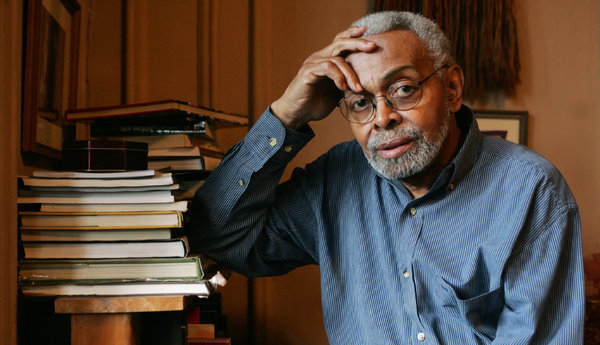
Photo: Ruth Fremson/The New York Times
Somebody Blew Up America
They say its some terrorist, some barbaric A Rab, in Afghanistan It wasn’t our American terrorists It wasn’t the Klan or the Skin heads Or the them that blows up nigger Churches, or reincarnates us on Death Row It wasn’t Trent Lott Or David Duke or Giuliani Or Schundler, Helms retiring
It wasn’t The gonorrhea in costume The white sheet diseases That have murdered black people Terrorized reason and sanity Most of humanity, as they pleases
They say (who say?) Who do the saying Who is them paying Who tell the lies Who in disguise Who had the slaves Who got the bux out the Bucks
Who got fat from plantations Who genocided Indians Tried to waste the Black nation
Who live on Wall Street The first plantation Who cut your nuts off Who rape your ma Who lynched your pa
Who got the tar, who got the feathers Who had the match, who set the fires Who killed and hired Who say they God & still be the Devil
Who the biggest only Who the most goodest Who do Jesus resemble
Who created everything Who the smartest Who the greatest Who the richest Who say you ugly and they the goodlookingest
Who define art Who define science
Who made the bombs Who made the guns
Who bought the slaves, who sold them
Who called you them names Who say Dahmer wasn’t insane
Who? Who? Who?
Who stole Puerto Rico Who stole the Indies, the Philipines, Manhattan Australia & The Hebrides Who forced opium on the Chinese
Who own them buildings Who got the money Who think you funny Who locked you up Who own the papers
Who owned the slave ship Who run the army
Who the fake president Who the ruler Who the banker
Who? Who? Who?
Who own the mine Who twist your mind Who got bread Who need peace Who you think need war
Who own the oil Who do no toil Who own the soil Who is not a nigger Who is so great ain’t nobody bigger
Who own this city
Who own the air Who own the water
Who own your crib Who rob and steal and cheat and murder and make lies the truth Who call you uncouth
Who live in the biggest house Who do the biggest crime Who go on vacation anytime
Who killed the most niggers Who killed the most Jews Who killed the most Italians Who killed the most Irish Who killed the most Africans Who killed the most Japanese Who killed the most Latinos
Who? Who? Who?
Who own the ocean
Who own the airplanes Who own the malls Who own television Who own radio
Who own what ain’t even known to be owned Who own the owners that ain’t the real owners
Who own the suburbs Who suck the cities Who make the laws
Who made Bush president Who believe the confederate flag need to be flying Who talk about democracy and be lying
Who the Beast in Revelations Who 666 Who know who decide Jesus get crucified
Who the Devil on the real side Who got rich from Armenian genocide
Who the biggest terrorist Who change the bible Who killed the most people Who do the most evil Who don’t worry about survival
Who have the colonies Who stole the most land Who rule the world Who say they good but only do evil Who the biggest executioner
Who? Who? Who?
Who own the oil Who want more oil Who told you what you think that later you find out a lie
Who? Who? Who?
Who found Bin Laden, maybe they Satan Who pay the CIA, Who knew the bomb was gonna blow Who know why the terrorists Learned to fly in Florida, San Diego
Who know why Five Israelis was filming the explosion And cracking they sides at the notion
Who need fossil fuel when the sun ain’t goin’ nowhere
Who make the credit cards Who get the biggest tax cut Who walked out of the Conference Against Racism Who killed Malcolm, Kennedy & his Brother Who killed Dr King, Who would want such a thing? Are they linked to the murder of Lincoln?
Who invaded Grenada Who made money from apartheid Who keep the Irish a colony Who overthrow Chile and Nicaragua later
Who killed David Sibeko, Chris Hani, the same ones who killed Biko, Cabral, Neruda, Allende, Che Guevara, Sandino,
Who killed Kabila, the ones who wasted Lumumba, Mondlane, Betty Shabazz, Die, Princess Di, Ralph Featherstone, Little Bobby
Who locked up Mandela, Dhoruba, Geronimo, Assata, Mumia, Garvey, Dashiell Hammett, Alphaeus Hutton
Who killed Huey Newton, Fred Hampton, Medgar Evers, Mikey Smith, Walter Rodney, Was it the ones who tried to poison Fidel Who tried to keep the Vietnamese Oppressed
Who put a price on Lenin’s head
Who put the Jews in ovens, and who helped them do it Who said “America First” and ok’d the yellow stars
Who killed Rosa Luxembourg, Liebneckt Who murdered the Rosenbergs And all the good people iced, tortured, assassinated, vanished
Who got rich from Algeria, Libya, Haiti, Iran, Iraq, Saudi, Kuwait, Lebanon, Syria, Egypt, Jordan, Palestine,
Who cut off peoples hands in the Congo Who invented Aids Who put the germs In the Indians’ blankets Who thought up “The Trail of Tears”
Who blew up the Maine & started the Spanish American War Who got Sharon back in Power Who backed Batista, Hitler, Bilbo, Chiang kai Chek
Who decided Affirmative Action had to go Reconstruction, The New Deal, The New Frontier, The Great Society,
Who do Tom Ass Clarence Work for Who doo doo come out the Colon’s mouth Who know what kind of Skeeza is a Condoleeza Who pay Connelly to be a wooden negro Who give Genius Awards to Homo Locus Subsidere
Who overthrew Nkrumah, Bishop, Who poison Robeson, who try to put DuBois in Jail Who frame Rap Jamil al Amin, Who frame the Rosenbergs, Garvey, The Scottsboro Boys, The Hollywood Ten
Who set the Reichstag Fire
Who knew the World Trade Center was gonna get bombed Who told 4000 Israeli workers at the Twin Towers To stay home that day Why did Sharon stay away?
Who? Who? Who?
Explosion of Owl the newspaper say The devil face cd be seen
Who make money from war Who make dough from fear and lies Who want the world like it is Who want the world to be ruled by imperialism and national oppression and terror violence, and hunger and poverty.
Who is the ruler of Hell? Who is the most powerful
Who you know ever Seen God?
But everybody seen The Devil
Like an Owl exploding In your life in your brain in your self Like an Owl who know the devil All night, all day if you listen, Like an Owl Exploding in fire. We hear the questions rise In terrible flame like the whistle of a crazy dog
Like the acid vomit of the fire of Hell Who and Who and WHO who who Whoooo and Whooooooooooooooooooooo!
David Sirota reports on the successful political strategy used by activist Mason Tvert to help decriminalize recreational marijuana use in Colorado. It demonstrates how a slight shift in the public discourse can lead to large and rapid changes in attitudes towards an issue, and hopefully this strategy will be used in other states and countries currently prohibiting recreational cannabis use. Excerpts from Pando Daily:
“Marijuana has been illegal because of the perception of harm surrounding it — that’s how they made it illegal, that’s how it is illegal currently,” Tvert tells me in the shop’s bustling lobby. “Our opponents’ goal has been to maintain a perception of harm. So our idea has been to get people to understand that marijuana is not as harmful as they’ve been led to believe, and not as harmful as a product like alcohol that is already legal.”
Despite increasingly absurd attempts by the government’s drug-war apparatus to obscure the obvious truth, decades of medical and social science research on everything from physiologicaltoxicity, to domestic violence to addiction has proven Tvert’s point that cannabis is less harmful than alcohol. But it was only a few years ago that Tvert’s colleague and future mentor at MPP, Steve Fox, happened upon a key political revelation in the reams of survey data about drug policy.
“He was looking at the polling and discovered that of those who think marijuana is safer than alcohol, 75 percent think it should be legal,” Tvert recounts as we wait behind a customer who is interrogating one of the shop’s staff members about THC and CBD content. “In other words, the number one indicator of whether or not you support marijuana being legal is whether you recognize it is safer than alcohol.”
From that revelation came the creation of the group headed by Tvert that was entirely focused on drawing the alcohol-marijuana comparison. Aptly named Safer Alternative For Enjoyable Recreation (aka SAFER), it was predicated on a two-step strategy.
“Rather than trying to increase the percentage of people who think marijuana should be legal, we simply tried to increase the percentage of people who understand marijuana is less harmful than alcohol, which would naturally produce an increase in the percentage of people who support legalization,” he says.
…In their view, this script-flipping tactic has worked better than any other strategy before it. Not only has it resulted in Colorado legalized weed, but national polls seem to support the larger theory. Indeed, as surveys show more Americans are now viewing marijuana as less harmful than alcohol, they are simultaneously showing a majority now support legalization across the country.
…But even beyond lessons about cannabis is an even larger lesson about how assumptions and frames of reference so often determine the difference between status quo and disruption.
In drug policy, the assumption had long been that prohibition is pro-safety and that legalization is a dangerous experiment. So instead of only amplifying old messages about legalization (it will raise tax revenue, it will end criminal justice iniquities, etc.) Tvert, SAFER and MPP creatively changed the fulcrum of the entire conversation. Rather than portray their fight as one for a brand new, wholly unknown and therefore frightening reality, they used alcohol – a product that most are already comfortable with – to recast their push as one designed to create a new version of current reality. And not just a new version, but a safer reality that doesn’t statutorily encourage people who want to use a mind-altering substance to only use one that is more harmful than cannabis.
…With the rise of social media and the slow-motion fall of a monopoly media that once had complete control over the public policy conversation, there is clearly more opportunity than ever to change the terms of the debate, even on issues that seem utterly intractable.
Chris Hedges’ regular columns for Truthdig.com are consistently informative and provocative, but his latest piece offers a particularly critical analysis of the current political moment in the United States. In the following excerpt he ruminates on a number of recent actions of our modern corporate totalitarian state:
Via Truthdig:
The object of efficient totalitarian states, as George Orwell understood, is to create a climate in which people do not think of rebelling, a climate in which government killing and torture are used against only a handful of unmanageable renegades. The totalitarian state achieves this control, Arendt wrote, by systematically crushing human spontaneity, and by extension human freedom. It ceaselessly peddles fear to keep a population traumatized and immobilized. It turns the courts, along with legislative bodies, into mechanisms to legalize the crimes of state.
The corporate state, in our case, has used the law to quietly abolish the Fourth and Fifth amendments of the Constitution, which were established to protect us from unwarranted intrusion by the government into our private lives. The loss of judicial and political representation and protection, part of the corporate coup d’état, means that we have no voice and no legal protection from the abuses of power. The recent ruling supporting the National Security Agency’s spying, handed down by U.S. District Judge William H. Pauley III, is part of a very long and shameful list of judicial decisions that have repeatedly sacrificed our most cherished constitutional rights on the altar of national security since the attacks of 9/11. The courts and legislative bodies of the corporate state now routinely invert our most basic rights to justify corporate pillage and repression. They declare that massive and secret campaign donations—a form of legalized bribery—are protected speech under the First Amendment. They define corporate lobbying—under which corporations lavish funds on elected officials and write our legislation—as the people’s right to petition the government. And we can, according to new laws and legislation, be tortured or assassinated or locked up indefinitely by the military, be denied due process and be spied upon without warrants. Obsequious courtiers posing as journalists dutifully sanctify state power and amplify its falsehoods—MSNBC does this as slavishly as Fox News—while also filling our heads with the inanity of celebrity gossip and trivia. Our culture wars, which allow politicians and pundits to hyperventilate over nonsubstantive issues, mask a political system that has ceased to function. History, art, philosophy, intellectual inquiry, our past social and individual struggles for justice, the very world of ideas and culture, along with an understanding of what it means to live and participate in a functioning democracy, are thrust into black holes of forgetfulness.
The political philosopher Sheldon Wolin, in his essential book “Democracy Incorporated,” calls our system of corporate governance “inverted totalitarianism,” which represents “the political coming of age of corporate power and the political demobilization of the citizenry.” It differs from classical forms of totalitarianism, which revolve around a demagogue or charismatic leader; it finds its expression in the anonymity of the corporate state. The corporate forces behind inverted totalitarianism do not, as classical totalitarian movements do, replace decaying structures with new structures. They instead purport to honor electoral politics, freedom of expression and the press, the right to privacy and the guarantees of law. But they so corrupt and manipulate electoral politics, the courts, the press and the essential levers of power as to make genuine democratic participation by the masses impossible. The U.S. Constitution has not been rewritten, but steadily emasculated through radical judicial and legislative interpretation. We have been left with a fictitious shell of democracy and a totalitarian core. And the anchor of this corporate totalitarianism is the unchecked power of our systems of internal security.
Our corporate totalitarian rulers deceive themselves as often as they deceive the public. Politics, for them, is little more than public relations. Lies are told not to achieve any discernable goal of public policy, but to protect the image of the state and its rulers. These lies have become a grotesque form of patriotism. The state’s ability through comprehensive surveillance to prevent outside inquiry into the exercise of power engenders a terrifying intellectual and moral sclerosis within the ruling elite. Absurd notions such as implanting “democracy” in Baghdad by force in order to spread it across the region or the idea that we can terrorize radical Islam across the Middle East into submission are no longer checked by reality, experience or factually based debate. Data and facts that do not fit into the whimsical theories of our political elites, generals and intelligence chiefs are ignored and hidden from public view. The ability of the citizenry to take self-corrective measures is effectively stymied. And in the end, as in all totalitarian systems, the citizens become the victims of government folly, monstrous lies, rampant corruption and state terror.
Most of us are well aware of the problem of human labor being displaced by technology. The Thought Infection blog recently posted an informative overview of how even jobs we might not immediately think of as being at risk of obsolescence are steadily being encroached upon by technology. In this follow up article, he explains how automation has an especially destabilizing effect on the financial sector and economic system.
Excerpt:
The advent of algorithmic trading extends the game that has always existed in markets, but now the speed is faster, the stakes are higher and we can’t be sure who is in control.
The manipulation abilities of trading algorithms may already (and if not, soon will) extend beyond this kind of inter-algorithmic effects. Given that trading algorithms can act on human informational sources, such as Twitter, as news is released, it is not outlandish to imagine that these algorithms could also be producing information in an effort to manipulate the market. Given that algorithms are becoming better at turning basic information into natural language, it seems possible that an algorithm could be designed to Tweet out false information about a company to try to depress the stock price.
If we take the ketchup manufacturer again and we imagine they are in a precarious position due to a new bill to remove subsidies for tomato growing. Imagine a bunch of tweet/comment/news bots aimed at pushing the public dialogue to make it seem that the subsidies are going to be removed. If massively parallelized, this kind of attack on public sentiment could have a significant effect on the ketchup manufacturer and provide an opportunity for major profits. I think it’s likely this kind of algorithmic sentiment manipulation is already happening on some level.
Even this kind of sentiment manipulation is only a drop in the bucket compared to what may become possible in the near future. The astounding profits which can be made in this kind of algorithmic trading is driving huge investment in artificial intelligence. In the near future, algorithmic traders will be capable of much more complex manipulations to try to move market prices.
…Perhaps by identifying those congressmen who are on the fence about subsidies, a targeted campaign to manipulate the opinions of those in said congressman’s district could have a real effect on the outcome for ketchup manufacturers. This may seem a bit ridiculous, but even a tiny effect on the perceptions and opinions of one individual can make a big difference if spread across a wide enough group.
What he speculates could be our greatest threat in the future is not Terminator-like cybernetic weapons but “an army of Gordon Gekko-bots capable of manipulating every aspect of our legal and political systems in an aim to maximize market profits.”
While most of us were celebrating New Year’s Eve last Tuesday, former activist lawyer Lynne Stewart and her family were celebrating her freedom. On December 31, she was granted a compassionate release from a prison in Fort Worth, Texas by a federal judge and the following day she was back home in Brooklyn.
In 2005 Lynne Stewart was found guilty of helping Sheikh Omar Abdel Rahman (the client she was defending at the time) communicate with supporters. She was sentenced to 28 months in prison and later resentenced for 10 years. Prior to her conviction Stewart was an attorney who represented many economically disadvantaged and anti-establishment defendants such as members of the Weather Underground and Black Panthers.
In 2005, Stewart was also diagnosed with breast cancer and due to her sentencing, crucial and potentially life-saving surgery was delayed for 18 months. By the time she received treatment, her cancer reached Stage Four and had metastasized to the point that her operating physician commented that her condition was the worst he had seen. By December 2013 she was also diagnosed with anemia, high blood pressure, asthma and diabetes, and was likely to have only 18 months left to live according to her doctor.
Despite the fact that Lynne Stewart never should have served such a sentence for trumped up charges designed to hype the pointless “War on Terror” in the first place, it’s fortunate that such a courageous person deserving of respect won’t die alone in prison. Her release is a victory for her family, friends, and countless supporters who fought tirelessly for her cause, including Justice for Lynne Stewart, the Center for Constitutional Rights, the National Lawyers Guild, independent news outlets including Building Bridges Radio, Law and Disorder Radio, and Black Agenda Report, and public figures such as Desmond Tutu, William Pepper, Mark Lane, and Dick Gregory. In support of Stewart’s release, Gregory had this to say:
“The reason for the prosecution and persecution of Lynne Stewart is evident to us all. It was designed to intimidate the entire legal community so that few would dare to defend political clients whom the State demonizes and none would provide a vigorous defense. It also was designed to narrow the meaning of our cherished first amendment right to free speech, which the people of this country struggled to have added to the Constitution as the Bill of Rights.”