Saturday Matinee: M.C. Escher: Journey to Infinity

By Matt Zoller Seitz

Source: RogerEbert.com

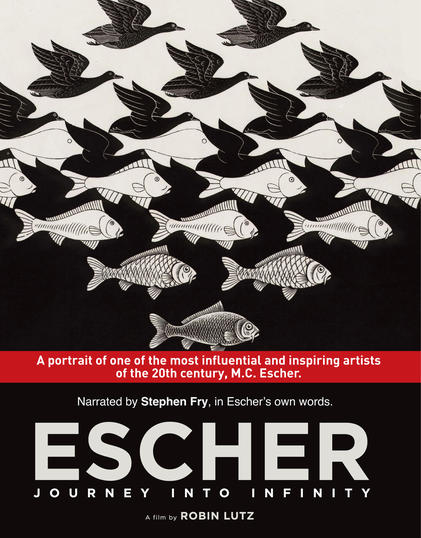
Documentaries about visual artists tend to be so boringly conceived—talk about the life, show a picture, talk about the life, show another picture—that you may not realize what you’ve been missing until you see one as excellent as “M.C. Escher: Journey to Infinity.” 

Written and directed by Robin Lutz, this is a rare feature that takes the trouble not just to understand its subject and communicate his significance, but find ways to show us, visually, how his style evolved, and the principles behind that evolution. 

The tale begins with the standard-issue “This is a movie about a great artist, here are a few summary details abut his life and art,” with some landscape and architecture shots and images of Escher’s work. Then it becomes increasingly daring and fanciful, yet always remaining in service to the M.C. Escher, the Dutch draftsman and printmaker whose art became internationally famous during the post-World War II era. 

Escher was a rare artist who managed to combine his influences into something genuinely new. His work is a geometric/mathematical surrealist vision of the objectively perceivable world, but also a subjective interior, evoking ancient Arabic-North African graphics; the Salvador Dali-Pablo Picasso-Georges Braque anti-realist sensibilities of the ’20s and ’30s, and computer models that would not become popular until decades after Escher’s own experiments. 

Lutz and his collaborators, including a team of graphic designers and animators, make Escher’s art come to life in surprising and amusing ways, from having one of his trademark salamanders appear in an otherwise “realistic” frame and travel across increasingly “unreal” panoramas until we’re in an Escher print, to re-imagining intricately patterned Escher artworks so that we seem to glide along them, or into them/through them. This happens slowly enough so that we can appreciate how deftly the artist translated negative space into positive space, in ways that made the distinction seem arbitrary: for instance, the black spaces between joined silhouettes of lizards or amphibians might become black birds with white spaces between them, then go back again. Or people and animals might move along one stretch of diagonal stairs and jump to another, seeming to go upside down or sideways, in defiance of gravity, emphasizing the brain-teasing techniques Escher perfected.

Lutz and his team have found a cinematic analogy for the movement of the eye over static pictorial art reproduced in a book or hanging on a museum wall. The movie is especially good at evoking that “wow” moment when you realize that a thing you were looking at has turned into another thing. It’s explaining the magic trick without ruining the magic, a magic trick of a different sort. 

This approach is so dazzling that one wishes the filmmakers had pushed it a bit further, deploying it even more often, or in more and subtler variations—perhaps figuring out a way to have the film itself flip back on itself structurally at key points, or end precisely where it started, so that the project itself seemed to have no beginning or end. (There’s a hint of this, but not much more.)

Musician Graham Nash, a devotee of Escher who contacted him late in his life, says Escher dismissed the idea that he was an artist. Throughout the movie, we hear Escher align himself with scientists and mathematicians, often trashing his own skills as a representational draftsman and speaking of his heroes and colleagues with awe. 

This isn’t to say that Escher was down on himself at all times, or that that he entirely rejected the notion he was making art. Escher’s letters, performed in voice-over by actor Stephen Fry, make it clear that he challenged himself to improve his abilities and expand his vision and grew irritable when stuck in a groove. And yet there was always a sense—particularly once Escher hit his forties and realized he was indeed a global phenomenon—that a “real” artist wouldn’t be as entertaining. This is the world’s misconception, not Escher’s, but it’s still a shame that he let himself feel diminished by it. There’s power and profundity in Escher’s art, yet the puzzle-box aspect is what pulls you into it. 

The movie makes a case that we should talk about Escher the way we talk about one of his inspirations, Johann Sebastian Bach, who like Escher was clever as well as substantive. Escher earned the comparison. Why do we resist it? Perhaps there’s still something in us, even this late into human development, that worries that if you’re having fun, it can’t be art. Escher struggled with that misconception, too, right up to the end.  

Watch M.C. Escher: Journey to Infinity on Kanopy here: https://www.kanopy.com/product/mc-escher-journey-infinity

Kids die last as Biden plays tough guy: Humbled US Leaves Chaos and Mass Murder While Fleeing Afghanistan

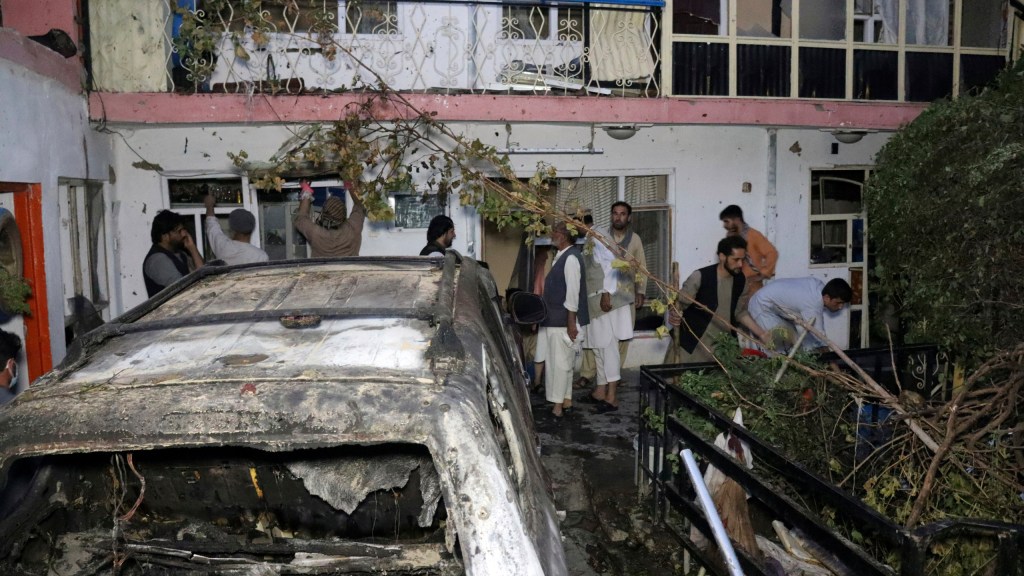
Afghan people are seen inside a house after U.S. drone strike in Kabul, Afghanistan, Sunday, Aug. 29, 2021. A U.S. drone strike destroyed a vehicle carrying “multiple suicide bombers” from Afghanistan’s Islamic State affiliate on Sunday before they could attack the ongoing military evacuation at Kabul’s international airport, American officials said. (AP Photo/Khwaja Tawfiq Sediqi)

By Dave Lindorff

Source: This Can’t Be Happening

America’s last days in Afghanistan offered a sickening display of all that was wrong with the $2.3-trillion, 20-year failed attempt by a blundering, self-congratulatory but decaying empire to have its way in a place it neither really cared about at all, nor understood in the least.

First there was a catastrophic but predictable attack on US and Taliban troops as well as desperate civilians trying to escape the ruins and chaos of the country the US occupier was leaving behind to the victorious Taliban. One or more IS-K terrorists wearing exploding vests filled with shrapnel, possibly backed by other IS fighters firing automatic weapons, were reportedly joined by panicked US Marines confused about who the attacking enemy was. The explosion and ensuing fire-fight ended up slaughtering 170 or more Afghans (civilians and Taliban fighters) and 13 US service mena and women (12 Marines and one Navy medic) and badly wounding many more.

That terrorist attack was followed by a drone rocket revenge attack ordered by President and Commander in Chief Joe Biden . It was an attack which by all accounts went spectacularly and horrifically awry, killing not an IS-K terror plotter as initially claimed by the Pentagon, but a family of 10 including a US interpreter, all of whom — both three adults and seven children including a child of only 2 —  had been given papers allowing them to get on one of the US evacuation flights at the Kabul Airport, but they had been unable to get through all the various checkpoints to accomplish that.

There were fabricated reports of secondary explosions used to suggest that the van that was struck had been carrying terrorists wearing explosive belts, which were completely untrue according to US and other foreign reporters who went to the scene. There were also reports of secondary explosions in an adjacent building, which were also false and self-serving to those in Washington trying to deny the disastrous error.

The two incidents provided a graphic illustration of why the US lost its longest war. First of all, terrorism has never been diminished in Afghanistan because of the US invasion and occupation of that country. Not only did the Taliban adept some of the strategies of resistance fighters against US occupation, such as in Iraq, turning to IED explosions and car bombs, but new terror groups like the Islamic State moved into the chaotic scene, attacking both US and Taliban forces. The latest attack at the airport was one of the largest of the war in terms of the number of victims.

Meanwhile, the errant missile slaughter of an entire family of pro-American would be immigrants by a US drone missile was proof positive of what critics of US drone warfare have been saying for years: Drones, often piloted by pilots halfway around the world in Nevada and Pennsylvania (near me) are a grotesquely deadly form of warfare that kills vastly more innocent people than the actual targets that it seeks to kill. Often the reason is mistaken coordinates or even flight-controller errors, but just as often it is a problem of bad intelligence, frequently caused by US “assets” in country providing deliberately wrong targeting information either to sabotage US efforts and increase opposition to the US occupiers, or simply to settle scores with an asset’s own rival.

A lack of transparency and honesty by the Pentagon and the White House through four presidencies has made things worse. Information about civilian deaths are since the beginning of this war in 2001 has been withheld, and when it is impossible to deny — for example when as has happened all too many times in this war, a wedding processing is blown up when it is confused with a group of enemy forces on the move — the number of innocents murdered is low-balled.

Biden did what George Bush, Barack Obama and Donald Trump couldn’t do:  he has finally ended the war on Afghanistan by the US. He made a mess about it by dragging out the process by seven months when he could have negotiated an armistice and brought the troops home immediately upon taking he office. The Taliban would have been happy to accept a peaceful return to power and the US could have negotiated a peaceful exit for both US troops and Afghans wanting to leave. Instead, Biden ended up being a fourth president at war in Afghanistan, with blood on his own hands, and the US ended up losing a fighting war — badly.

Meanwhile, the war may be over for US troops, but it isn’t over for Afghanistan. The US violence and destruction of that long-suffering country has left it confronting a bloody civil war now as factions  and tribal regions vie for power. As well, Biden has said that the US will still feel free — despite the blatant illegality of such actions under international law — to bomb and send in armed drones to attack targets by air in Afghanistan, just as the US did in the last days of the US military’s retreat.  US soldiers will still be fighting, but instead facing bullets and IEDs in Afghanistan they’ll be sitting in air-conditioned pods on US military bases using video-game-like air-conditioned pods to control death-bringing, rocket-armed drones.

America itself will also still be in a state of war, as Congress continues to leave in place the 2001 Authorization for Use of Military Force (AUMF). That war authorization, approved by Congress on September 18, 2001, after no hearings or debate to launch the illegal war on Afghanistan, was also used to launch the so-called War on Terror. The latter has been an amorphous, borderless “war” that legal shills working for the government like former US Assistant Attorney General John Yoo have successfully claimed includes, until rescinded, the entire territory of the United States within its Constitution and Bill of Rights-shredding “battlefield.” It has given presidents, in the view of the  Supreme Court, dictatorial powers undreamt of by the Constitution’s authors, permitted indefinite incarceration without charge or trial, warrantless government eavesdropping, extra-judicial government murder and kidnapping, and the jailing of whistleblowers and journalists in violation of US laws designed to defend such people and their actions.

Biden has done nothing to put an end to the continuing air war against Afghanistan or to the War on Terror.

There will be no ticker-tape parade for veterans of the Afghanistan War or the War on Terror. It will likely be erased from US history to the extent that the US government and the duopoly War Party and their complicit mass media can do it.  Just as vastly bloodier Vietnam and Korean Wars have been white-washed into family-friendly noble if unsuccessful efforts to “defend freedom,” the Afghanistan War will be remembered, if it is remembered at all, as an attempt to punish the attackers of 9/11 (never mind that no Afghani or Taliban fighter ever attacked the US, on 9/11 or anytime during the last two decades of US war on Afghanistan). The rest of those sordid two decades will be whitewashed away.

We shouldn’t let that happen.

Instead we should remember the slaughtered family of  Zemari Ahmadi, who paid with their lives so that President Biden could “look tough” in the face of critics at home blasting his botched decision to pull US forces out of Afghanistan.

Mission Accomplished

U-S-A!  U-S-A!  We’re Number One!  

By Paul Edwards

Source: Information Clearing House

It took America 15 years to airlift its whipped, arrogant ass out of Vietnam; in Afghanistan it took 20.  All the young men and women our diseased, criminal “leaders” doomed to be killed, mangled, or commit suicide in or after those fake, bullshit “wars” were, in effect, shit-canned by them like rotten meat.  Trillions that should have educated, inspired, and nurtured them were wasted and stolen by our rabid, raping Capitalist War Machine.

After 20 years of blustering, pious deception, colluded in by the hillbilly ninnies laughingly referred to as our government, led by four despicable Presidents—as contemptible a set of moral and spiritual monsters as could be dredged up from the foetid latrines of history—this hideous charade can be seen for what it was: a brazen scam to engorge our Death Merchants with blood money.

The coprophagous Corporate Press and its petting zoo of hired political porn stars rage against ersatz villains in this Bozo pratfall of America’s Potemkin regime, imported, installed and bankrolled by this unraveling empire in its last pathetic shot at a grotesque simulation of world hegemony.

One is in awe at the spectacle of the blackguard war pimps who stampeded this simple-minded, helpless country into these exercises in folk murder, pointing fingers and anathematizing anyone but themselves, disgusting human sepsis that they are.
 The only indisputable truth about the Afghan debacle is that the U.S. War Machine and its wholly-owned Congress and Press, hyped fear and outrage at 9/11 to spin the mythical GWOT and two decades of limitless profiteering using the brutal destruction of a poor, defenseless country as a weapons-testing experiment. 

Whether that country could be dominated and pacified, much less remade, had no relevance in their calculus.  Outcomes in their pretend “wars” mean nothing: what matters is that the Federal money spigot be jammed wide open and massive profits from their death devices never end.  Schopenhauer nailed the war industry a century ago: “Created by the wars that required it, the machine now creates the wars it requires”. Under American assault, Afghanistan and its people who survive, have suffered a devastation of historic proportions, comparable to massacres The Empire inflicted on Cuba and the Philippines in its early days. Nothing can ever alter this villainy, another bloody stain smeared on our long, rabid history. Curiously, though, in a twist of historical irony, The Empire has undoubtedly wounded itself more grievously than it did Afghanistan.

The fact is that after a long chain of blundering, idiotic policy trainwrecks and staggeringly stupid military humiliations—all acts of blatant piracy for the War Machine—The Empire, far from cementing its hold on its craven lapdogs, Britain, Australia, and NATO, is now regarded by the world as an unhinged, imbecile giant without brains, ethics, honor, or even any sense of self-preservation.  Nations, universally, stare at us with the kind of bated-breath foreboding that would be felt watching an untethered lunatic venture across Zambesi Gorge on a tightrope.

When the sheer, brute madness and psychotic hubris of a tyrannical regime deceives its people into mortal peril, as the U.S. government has, the inevitable end is overthrow or implosion.  Empires fall from their fatal morbid pathology, without exception. 

When an entire people is aroused and mobilized against its its tyrants, elites, or aristocrats, there is blood in the streets.  In the French Revolution, mass rage exploded in indiscriminate murder of the nobility. Such raging mayhem is not even conceivable to us now, and never was.  Even the rising of Americans in rebellion against their ruling Capitalist War Machine is unimaginable.  We are stupefied by propaganda into blind, autonomic obedience.  Disaster, when it comes, will be horribly mishandled, as all else has been, by our Capitalist criminals and their political whores.

And yet, even given their dull passivity and refusal to face their reality, it amazes Americans tolerate living under this ridiculous, contemptible gang of baldfaced liars, dimwit conmen, and black-hearted slugs: McConnell and Pelosi, Schumer and McCarthy, Mancin and Cruz, and their vomitus ilk.  Sure, money buys the commercials that are all the deeply stupid absorb, but even the densest must smell the decayed mummies behind the masks.

These odious moral thugs, who sold America on vengeful, phony “wars”, now join their chorus of shameless flacks, grasping wildly at any alibi for their cowardice and folly.  They bayed for revenge and blood, dodging their duty to check the imbecile, Bush, Jr., and his psychically twisted Igor, Cheney, cheered shape-shifting bullshitter Obama, subhuman Trump, and now drub vacuous, impaired Biden for blundering into the only inevitable endgame. 

The chaos and dislocation at the end of empires has always been  commensurate with their magnitude, reach and duration.  The French inflamed Europe; the Spanish and British dislocated the  Western financial system; the Nazi and Russian destabilized the world and brought agony and death to hundreds of millions. 

The fall of Imperial America, while certain, cannot be predicted as to mode and method.  It may come in a series of our floundering, catastrophic military idiocies—though upping the ante against Russia and/or China will put a swift, devastating end to that process—or in a climax of economic spasms leading to flight from the dollar as reserve currency and national bankruptcy.  What is certain is that it will be the most cataclysmic disruption the world has ever suffered.  Empires, as the terminally ill, cannot self-rescue.  They die devoured by their own inherent horrors.

The Houses of Dead and Crooked Souls

By Edward Curtin

Source: Behind the Curtain

“A house constitutes a body of images that give mankind proofs or illusions of stability.”      – Gaston Bachelard, The Poetics of Space

There is a vast and growing gulf between the world’s rich and poor.  An obscene gulf. If we can read houses, they will confirm this.  They offer a visible lesson in social class.

Houses stand before us like books on a shelf waiting to be read, and when the books are missing, as they are for a vast and growing multitude of the homeless exiled wandering ones and those imprisoned, their absence serves to indict the mansion-dwelling wealthy and to a lesser extent those whose homes serve to shield them from the truth of the ill-begotten gains of the wealthy elites who create the world’s suffering through their avarice, lies, and war making.

Many regular people want to say with Edmund in Eugene O’Neill’s play, Long Day’s Journey into Night:

The fog is where I wanted to be. Halfway down the path you can’t see this house. You’d never know it was here. Or any of the other places down the avenue. I couldn’t see but a few feet ahead. I didn’t meet a soul. Everything looked and sounded unreal. Nothing was what it is.That’s what I wanted – to be alone with myself in another world where truth is untrue and life can hide from itself….Who wants to see life as it is, if they can help it?

Yet the rich don’t hide or give a damn. They flaunt their houses.  They know they are crooks and creators of illusions.  Their nihilism is revealed in their conspicuous consumption and their predatory behavior; they want everyone else to see it too.  So they rub it in their faces.  Their wealth is built on the blood and suffering of millions around the world, but this is often hidden knowledge.

For many regular people prefer the fog to the harsh truth.  It shields them from intense anger and the realization that the wealthy elites who run the world and control the media lie to them about everything and consider them beneath contempt.  That would demand a response commensurate with the propaganda – rebellion.  It would impose the moral demand to look squarely at the houses of death with their tiny cells in which the wealthy elites and their henchmen imprison and torture truth tellers like Julian Assange, an innocent man in a living hell; to make connections between wealth and power and the obscene flaunting of the rich elite’s sybaritic lifestyles in houses where every spacious room testifies to their moral depravity.

The recent news of Barack Obama’s vile selfie birthday celebration for his celebrity “friends” at his 29-acre estate and mansion (he has another eight-million-dollar mansion in Washington, D. C.) on Martha’s Vineyard is an egregious recent case in point.  If he thinks this nauseating display is proof of his stability and strength – which obviously he does – then he is a deluded fool.  But those who carry water for the military-intelligence-media complex are amply rewarded and want to tell the world that this is so.  It’s essential for the Show.  It must be conspicuous so the plebians learn their lesson.

Obama’s Vineyard mansion stands as an outward sign of his inner disgrace, his soullessness.

Trump’s golden towers and his never-ending self-promotion or the multiple million-dollar mansions of high-tech, sports, and Hollywood’s superstars send the same message.

Take Bill Gates’ sixty-three-million-dollar mansion, Xanadu, named after William Randolph Hearst’s estate in Citizen Kane, that took seven years to build.

Take the house up the hill from where I live in an erstwhile working-class town that sold for one million plus and now is being expanded to double its size with a massive swimming pool that leaves no grass uncovered. Every week, three black window-tinted SUVs arrive with New Jersey plates to join two white expensive sedans to oversee the progress in this small western Massachusetts town where McMansions rise throughout the hills faster than summer’s weeds.

Take the blue dolomite stone Searles Castle with its 60 acres, 40 rooms, and “dungeon” basement down the hill on Main St. that was recently bought by a NYC artist who also owns seven grand estates around the country that he showcases as examples of his fine artistic taste.  “All these houses have endless things to do — it’s just mind-boggling,” he has said. The artist, Hunt Slonem, calls himself a “glamorizer,” and his “exotica” paintings, inspired by Andy Warhol’s repetition of soup cans and Marilyn Monroe, hang in galleries, museums, cruise ships, and the houses of film celebrities.  Like his showcase houses, his exotica must have endless things to do.

What would Vincent van Gogh say?  Perhaps what he wrote to his brother Theo: that the greatest people in painting and literature “have always worked against the grain” and in sympathy with the poor and oppressed.  That might seem “mind-boggling” to Slonem.

Such ostentatious displays of wealth and power clearly reveal the delusions of the elites, as if there are no spiritual consequences for living so.  Even if they read Tolstoy’s cautionary tale about greed, How Much Land Does A Man Need?, it is doubtful that its truth would register.  Like Tolstoy’s protagonist Pahόm, they never have enough.  But like Pahόm, the Devil has them in his grip, and like him, they will get their just rewards, a small room, a bit of land to imprison them forever.

His servant picked up the spade and dug a grave long enough for Pahóm to lie in, and buried him in it. Six feet from his head to his heels was all he needed.

Where does the money for all these estates, not just Slonem’s, come from? Who wants to ask?

Getting to the roots of wealth involves a little digging.  Slonem’s castle was originally commissioned in the late 1800s by Mark Hopkins for his wife.  Hopkins was one of the founders of the Central Pacific Railroad, which was built by Irish and Chinese immigrants.  Labor history is quite illuminating on the ways immigrants have always been treated, in this case “the dregs of Asia” and the Irish dogs.  Interestingly enough, the great black scholar and radical, W. E. B. Du Bois, a town native, worked at the castle’s construction site as a young man.  No doubt it informed his future work against racism, capitalism, and economic exploitation.

Wealthy urbanites flooded this area after September 11, 2001, and now, in their terror of disease and death, they have bought every house they could find.  Their cash-filled pockets overflow with blood-money and few ask why. To suggest that massive wealth is almost always ill-begotten is anathema.  But innocence wears many masks, and the Show demands washed hands and no questions asked.

It is rare that one becomes super-wealthy in an honest and ethical way.  The ways the rich get money almost without exception lead downward, to paraphrase Thoreau from his essay, “Life Without Principle.”

Since the corona crisis began, investment firms such as the Blackstone Group have been gobbling up vast numbers of houses across the United States as their prices have gone through the roof.  The lockdowns – an appropriate prison term – have set millions of regular people back on their heels as the wealthiest have gotten exponentially wealthier. Poverty and starvation have increased around the world.  This is not an accident.  Despair and depression are widespread.

There is a taboo in life in general and in journalism: Do not ask where people’s money comes from.  Thoreau was so advised long ago:

Do not ask how your bread is buttered; it will make you sick…

But the super-wealthy do not get sick.  They are sick.  For they revel in their depravity and push it in the faces of regular people, many who envy them and wish to become super-rich and powerful themselves.  Of course there are the blue bloods whose method is understatement, but it takes many decades to enter their theater of deception.  In many ways, these people are worse, for their personae have been crafted over decades of play-acting and public relations so their images are laundered to smell fresh and benevolent.  They often wear the mask of philanthropy, while the history of their wealth lies shrouded in an amnestic fog.

Yet soul murder includes suicide, and while the old and new moneyed ones smoothly justify their oppression of the vast majority, many regular people kill the best in themselves by envying the rich.

Years ago, I discovered some documents that showed that one of this country’s most famous philosophers, known for his lofty moral pronouncements, owned a lot of stock in companies that were doing evil things – war making, poisoning and killings huge numbers with chemicals, etc.  But his image was one of Mr. Clean, Mr. Good Guy. I suspect this is typical and that there are many such secrets in the basements and attics of the rich.

But let us also ask where the writers and presenters of the mainstream and alternative media get their money.  Although “to follow the money” is a truism, few do.  If we do, we will learn that money talks and those who take it toe the line, nor do they live in shacks by the side of the road or rent like so many others.  They invest with Black Rock and their ilk and have money managers who can increase their wealth while shielding them from the ways that money is made on the backs of the poor and working people.  And they lie about people like Assange, Daniel Hale, Reality Winner, Craig Murray, et al., all imprisoned for daring to reveal the depredations of the power elites, the violence at the heart of predatory capitalism.

Yes, houses speak.  But few ever speak of where their money comes from.  Those that are on the take – which has multiple meanings – always plead innocent.  Yes, I can hear you say that I am being too harsh; that there are exceptions.  That is obvious.  So let’s skip the exceptions and focus on the general principle. There is a Buddhist principle that right livelihood is a core ethic in earning money.  Jesus had another way of putting it but was of course in agreement, as were so many others whom people hold in highest esteem.

Thoreau wrote: “If you are acquainted with the principle, what do you care for a myriad instances and applications.”

The truth is that for most people, work, if they can find it, is drudgery and hard, a matter of survival. The late great Studs Terkel called it hell and rightly said that most jobs are not big enough for people because they crush the soul, they lack meaning.  And behind all ledgers of great wealth lie crushed souls.  This reality is so obvious and goes by many names, including class warfare, that further commentary would be redundant.

A few years ago, I visited Mark Twain’s house in Hartford, Connecticut.  It is advertised as “a house with a heart and a soul.”  It is not a house but a mansion, and it was an ostentatious display in Twain’s time. Similar or worse than Obama’s mansion on Martha’s Vineyard today.  It has no soul or heart.  It was built with Twain’s wife’s family money.  Her father was an oil and coal tycoon from upstate New York.  Twain reveled in opulent respectability.  He lived the life of a Gilded Age tycoon, an American magnate. It is not a pretty story, but the Twain myth says otherwise.  Not that he catered to popular tastes to please the crowd and his domineering wife and that he lived in luxury, but that he was a radical critic of the establishment.  This is false.  For he withheld for the most part the publication of his withering take on American imperialism until after his death.  He committed soul murder.  But his mansion impressed his neighbors and his humor distracted from his luxurious lifestyle.  His house still stands as a cautionary tale for those who will read it.

Baudelaire once said that in palaces “there is no place for intimacy.”  This is no doubt why in people’s dreams small, simple houses with a light in the window loom large.  Bachelard says, “When we are lost in darkness and see a distant glimmer of light, who does not dream of a thatched cottage or, to go more deeply still into legend, of a hermit’s hut.”  For here man and God meet in solitude; here human intimacy is possible.  “The hut can receive none of the riches ‘of this world.’  It possesses the felicity of intense poverty; indeed, it is one of the glories of poverty; as destitution increases, it gives access to absolute refuge.”

He is not espousing actual poverty, but the oneiric depths of true desire, the dreams of hope, reconciliation, and simple living that run counter to the amassing of wealth to prove one’s power and majesty. A humble house of truth, not a mansion of lies. This, to borrow the title of William Goyen’s novel, is “the house of breath” where the spirit can live and pseudo-stability gives way to faith, for insecurity is the essence of life.

There is such a hermit’s hut where the light shines.  It is the tiny cell in Belmarsh Prison where Julian Assange hangs onto his life by a thread.  His witness for truth sends an inspiring message to all those lost in the world’s woods to look to his fate and not turn away.  To follow to their sources the money that greases the palms of all the so-called journalists and politicians who want him dead or imprisoned for life, who tell their endless lies, not just about him, but about everything.

The house of propaganda is built on unanimity.  When one person says no, the foundation starts to crumble.  The houses of the rich dead and crooked souls, erected to project the stability of their bloody illusions, start to crumble into sand when people dissent one by one.

Soon the fog lifts and there is no hiding any more.  At the end of the path, you can see the vultures circling overhead as their prey go running out of their mansions in terror.

Sing Hallelujah!

Saturday Matinee: EMILY @ THE EDGE OF CHAOS

Synopsis by Kino Lorber

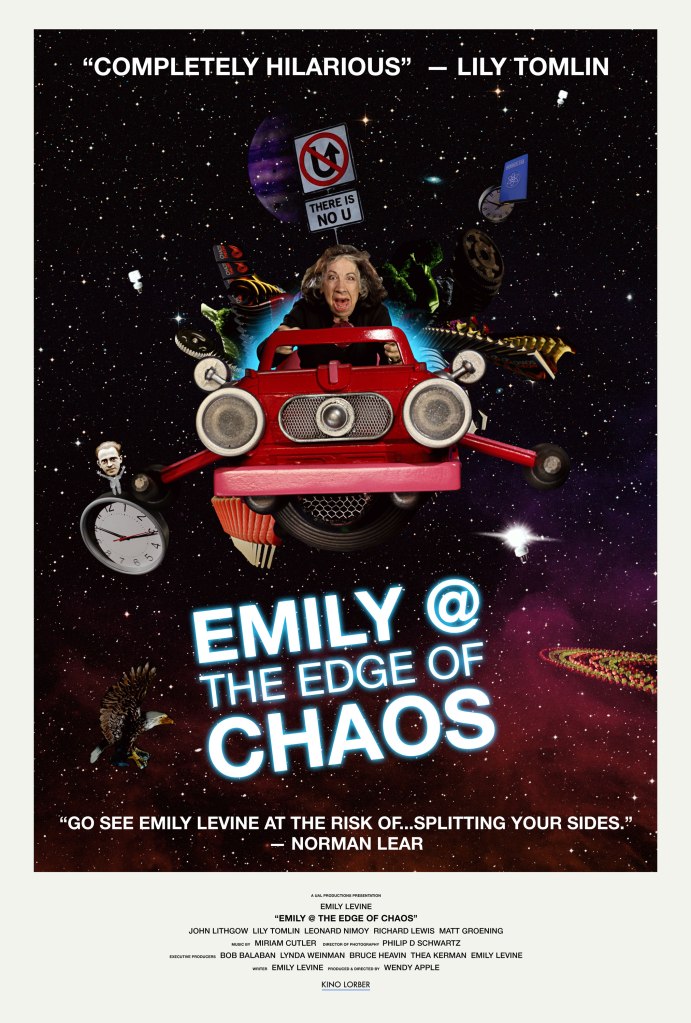
The brilliantly illuminating Emily @ the Edge of Chaos interweaves Emily Levine’s live performance with animation, appearances by scientists, and animated characters (John Lithgow as Sir Isaac Newton, Lily Tomlin as Ayn Rand, Leonard Nimoy as Sigmund Freud, Richard Lewis as Aristotle, Matt Groening as Aldo Leopold). The film uses physics – which explains how the universe works – to explain our metaphysics – the story of our values, our institutions, our interactions. Using her own experience and a custom blend of insight and humor, provocation and inspiration, personal story and social commentary, Emily takes her audience through its own paradigm shift: from the Fear of Change to the Edge of Chaos.

Emily Levine, like her film, was one-of-a-kind. She was a television writer, a stand-up performer, and an out-of-the box-thinker, whose brilliant TED talks have been seen by millions. She made this film with Wendy Apple, who produced and directed it. Wendy died in 2017 and Emily continued working on the film until she also passed away in 2019.

Watch Emily @ The Edge of Chaos on Kanopy here: https://www.kanopy.com/product/emily-edge-chaos

The Great Battle for the Future

By Cory Morningstar

Source: Organic Radicals

A nightmare totalitarian industrial world, in which everything living is being poisoned to death and in which dehumanised people are subjected to full-spectrum physical and psychological control by slave-masters they never dare question.

So here is where the modern world and its self-mythologising cult of “progress” was leading us… Who’d have thought it, eh?

The warnings have been there, of course, whether from science fiction writers and filmmakers (They Live!The Terminator,  Equals...), musicians or the dozens of thinkers featured on this website.

They warned us where this would end up if we didn’t do something, but we collectively spurned their advice and here we are, on the very brink of a long-term and probably fatal dystopia.

The important question now is how we are going to get out of this global hi-tech concentration camp.

Part of the answer is that we need to keep alive, and spread as widely as possible, a vision of how the world could be, of another way of living which is utterly different from the sterile and robotic hell currently lined up for us and those who will come after.

It is very much part of the ruling elite’s propaganda to insist that their future is the only future, that no other possibility even exists.

They are always keen to dismiss the idea of a different society as totally fanciful, empty-headed or even positively dangerous, removing us from the protective bliss of the prison they have built around us.

This lie is reinforced in people’s minds by the way that the other, possible, world is increasingly distant from contemporary reality.

It is hard to imagine a transition from where we are today (let alone where we are heading) to where many of us would like to be.

It is particularly hard, even impossible, if you go along with the ruling elite’s deliberate confusion of the passing of time with the strengthening of their industrial profit-system.

If you see “the future” as necessarily an extension of the path that has brought us from the past to the present, then their version seems inevitable. It is therefore crucial to break free from this idea of some kind of predestined vector taking us towards a hyper-industrial destiny.

Industrial capitalist development was never the only possible form which human society could have taken over the last few centuries. The shape our present has taken is not due to the passing of time but to very specific processes and actions which have occurred.

If we want to reconnect with the “other world” in our hearts, and understand why it seems so unattainable, we would therefore do well to look back at how we landed up on the disastrous path of industrialised tyranny.

A key period to analyse is the Middle Ages, when capitalism first started to take over our lives.

Silvia Federici makes some very interesting observations on this period in her book Caliban and the Witch. (1)

She rejects the conventional wisdom that a “transition to capitalism” occurred as some kind of natural social evolution.

Instead, she points out that the power of the ruling elite was being threatened by the growing confidence of the 99%, who were increasingly rebelling against authority and servitude.

With the outright slavery of the Roman Empire left behind, these medieval rebels saw ahead of them a better future, one based on social justice, freedom and local autonomy.

They were on the path leading towards the light, towards genuine social progress rather than to the fake “progress” of technological sophistication and profusion.

But this didn’t go down well with the ruling class, who feared that their power and privilege would be lost for ever.

Instead of escaping from slavery into freedom, our ancestors therefore found themselves engaged in a Great Battle for the Future with the dark forces of tyranny.

This battle raged for centuries all over Europe and in the parts of the world colonised and occupied by the dominant system.

In England the most famous uprising was the peasants’ revolt of 1381, during which radical preacher John Ball told his contemporaries that the time had come when they could “cast off the yoke they have borne so long and win the freedom they have always yearned for”. (2)

But there were plenty of others, such as the Kett’s Rebellion of 1549 in which the rebels seized control of Norwich, then the second biggest city in the country.

The 17th century radicals of the English Revolution, such as Gerrard Winstanley, represent perhaps the last flowering of this wave of revolt.

The Great Battle for the Future was even fiercer on continental Europe. As Federici points out, the uprisings of the Cathars in France and the Anabaptists in Germany were not just about isolated local grievances but represented an ideological and metaphysical challenge to the world of authority, power and property. (3)

Federici argues that capitalism was in fact the reaction of the ruling elite against their potential loss of control.

She writes: “Capitalism was the counter-revolution that destroyed the possibilities that had emerged from the anti-feudal struggle – possibilities which, if realized, might have spared us the immense destruction of lives and the natural environment that has marked the advance of capitalist relations worldwide. This much must be stressed, for the belief that capitalism ‘evolved’ from feudalism and represents a higher form of social life has not yet been dispelled”. (4)

There is a strange echo here with the 20th century, when fascism emerged at a moment when the ruling elite (by this stage firmly capitalist) again faced the threat of popular insurrection.

The parallel even extends to the way in which the medieval bourgeoisie, often depicted as leading the radical onslaught against feudal power, sought common cause with their supposed enemies in the nobility in order to stamp out popular revolt.

This same bourgeoisie, which by the 20th century liked to think of itself as “liberal“, was likewise happy to see the boot of fascism keep the rabble in their place.

Capitalism – the new form taken by malevolent ruling-class domination – subjugated our ancestors by cutting them off from their sources of subsistence and autonomy.

Common land was confiscated – enclosed – making self-sufficiency impossible. Food could no longer be freely gathered or hunted, rivers could no longer be fished, wood for fuel could no longer be picked up in the privatised forests.

People were forced into the money system, forced to earn “wages” just to live, forced into factories and workhouses, reduced to craven dependency on the capitalist system.

Federici describes the period as one of “relentless class struggle” in which “the medieval village was the theater of daily warfare”. (5)

“Everywhere masses of people resisted the destruction of their former ways of existence, fighting against land privatization, the abolition of customary rights, the imposition of new taxes, wage-dependence, and the continuous presence of armies in their neighbourhoods, which was so hated that people rushed to close the gates of their towns to prevent soldiers from settling among them”. (6)

In order to impose the New Normal of capitalism on the unwilling people, the power elite used what Federici terms “social enclosure”, (7) a precursor of today’s “social distancing”.

She writes: “In pursuit of social discipline, an attack was launched against all forms of collective sociality and sexuality including sports, games, dances, ale-wakes, festivals, and other group-rituals that had been a source of bonding and solidarity among workers”. (8)

“Taverns were closed, along with public baths. Nakedness was penalized, as were many other ‘unproductive’ forms of sexuality and sociality. It was forbidden to drink, swear, curse”. (9)

In another striking parallel with the 2020s (and indeed the 1920s/1930s) the rich elite tried to create “a new type of individual” (10) – a servile, malleable and thus profitable type.

To this end it set out to separate us from our bodies and from our very sense of who we are.

“According to Max Weber, the reform of the body is at the core of the bourgeois ethic because capitalism makes acquisition ‘the ultimate purpose of life,’ instead of treating it as a means for the satisfaction of our needs; thus it requires that we forfeit all spontaneous enjoyment of life. Capitalism also attempts to overcome our ‘natural state,’ by breaking the barriers of nature and by lengthening the working day beyond the limits set by the sun, the seasonal cycles, and the body itself, as constituted in pre-industrial society”. (11)

The communal cohesion traditionally woven by, and among, women was specifically targeted by the ruling class in their efforts to disempower and enslave the common people, says Federici.

This took the form of the notorious fearmongering over “witches”, resulting in the murder of untold numbers of innocent women: “The witch-hunt destroyed a whole world of female practices, collective relations and systems of knowledge that had been the foundation of women’s power in pre-capitalist Europe, and the condition for their resistance in the struggle against feudalism”. (12)

She adds: “The witch-hunt deepened the divisions between women and men, teaching men to fear the power of women, and destroyed a universe of practices, beliefs, and social subjects whose existence was incompatible with the capitalist work discipline”. (13)

The witch hunts were thus part of the general philosophical war being waged by industrial capitalism on any way of thinking not flattened and reduced to the pitiful level of its own limited, sterile and life-hating slave-dogma.

Explains Federici: “This is how we must read the attack against witchcraft and against that magical view of the world which, despite the efforts of the Church, had continued to prevail on a popular level through the Middle Ages. At the basis of magic was an animistic conception of nature that did not admit to any separation between matter and spirit, and thus imagined the cosmos as a living organism, populated by occult forces, where every element was in ‘sympathetic’ relation with the rest”. (14)

The primary tool used by the ultra-rich minority to oppress the majority was, of course, the state.

Far from representing some kind of benign collective self-interest, as some absurdly persist in maintaining, the modern state emerged in the 14th century “as the only agency capable of confronting a working class that was regionally unified, armed and no longer confined in its demands to the political economy of the manor”. (15)

Whether claiming to be fighting “heresy”, “witchcraft” or disorder, the ruling elite deployed all the violence and propaganda of its inquisitions, wars and laws to bring the population to heel. And, as we all know to our cost, it won that Great Battle for the Future.

But because its sociopathic greed knows no end, because its “growth” is based on ever-increasing profit for the ultra-rich, it can never stop treading us further and further into the toxic industrial dust of its total control.

Today we have reached another key moment in history, when the ruling elite – under the feeble pretext of combatting a flu virus – hopes to essentially return us to the slave status we escaped a thousand years ago.

All its liberal pretence at “democracy” is going out of the window as the brutal reality of elite power becomes clear to those who have eyes to see.

There will be resistance, you can be sure of that, even if the advance disabling of certain potential sources of dissent means it may take a while for rebels to regroup and find their common voice.

Those of us who do resist will be embarking on another Great Battle for the Future.

We will be fighting for the same world of freedom and humanity and closeness to nature which inspired our ancestors hundreds of years ago.

Moreover, awareness of this historical context will be key to the way we resist.

We can never go back to the past but we can refer back to it and take our sense of direction from it.

It is clear that our defeat in the last Great Battle for the Future (and many subsequent struggles) saw us shunted down the wrong path, away from the bright future of which we dreamed and deeper and deeper into the gloom of enslavement.

We will not be able to reach our lost future by continuing along this path as it can only take us further and further from our desired destination.

The key realisation here is that industrialism, including all its technology and infrastructure, is simply an aspect of capitalism, of the slavery imposed upon us hundreds of years ago when we looked set to break free from the domination of the ruling elite.

Industrialism is not neutral. It is not something that can be turned around and used for our good. It is the prison in which we are locked.

The newnormalist technological tyranny currently being unleashed will hopefully make this inconvenient truth more evident and widely understood.

However, the underlying problem does not lie in industrialism’s excesses but in its very essence and raison d’être, as a means of control and exploitation.

We will not find the better future of which we dream in a world still polluted by factories, airports, motorways, pipelines, pylons, refineries and power stations.

The long-term happiness and self-fulfilment of humankind will not arrive via internet connections, phone networks and electricity supplies, but from their absence.

We need to destroy the whole industrial capitalist machine at the same time as we shake off this latest notching-up of repression, otherwise it will all just happen again and we will never be free.

Our victory in this 21st century Great Battle for the Future has got to be final and conclusive.

1. Silvia Federici, Caliban and the Witch (Brooklyn: Autonomedia, 2004).
2. Peter Marshall, Demanding the Impossible: A History of Anarchism (London: Fontana, 1993), p. 91.
3. See also Paul Cudenec, The Stifled Soul of Humankind (Sussex, Winter Oak Press, 2014).
4. Federici, pp. 21-22
5. Federici, p. 26.
6. Federici, p. 82.
7. Federici, p. 84.
8. Federici, p. 83.
9. Federici, p. 137.
10. Federici, p. 135.
11. Ibid
12. Federici, p. 103.
13. Federici, p. 165.
14. Federici, pp. 141-42.
15. Federici, p. 84.

COVID-19 Vaccine Passports Are Here – But Who Benefits Most From Them?

c

By David Helfrich

Source: The Pulse

Whether it’s a restaurant in Quebec or a hotel in Portugal, you will now need to furnish a Covid-19 vaccine passport verifying vaccination status prior to entering these spaces. Proponents of the vaccine passports argue that these health passes allow businesses to re-open in key economic sectors while encouraging vaccination that will benefit public health. Critics of these passports – which are often utilized in the form of a digital health pass – argue that there are considerable ethical, technical, and scientific challenges that render Covid-19 vaccine passports both impracticable and unequitable.

Covid-19 vaccine passports raise serious questions about the commitment society has for fundamental rights surrounding bodily autonomy and integrity: the concept that each human being has autonomy and self-determination over their own body.

While it is true that vaccine mandates have been around for quite some time, and have been administered as requirements for children to attend public school and are sometimes required to travel to parts of the world where viruses like diphtheria and yellow fever are prevalent, mandating Covid-19 vaccines as a universal requirement for travel, employment and/or access to broader public services and benefits is breaking new ground with regards to removing choice by compelling one to take a vaccine in order to participate in the broader economy and access opportunity.

Regardless of one’s personal view on the Covid-19 vaccines (I personally chose to get vaccinated to mitigate the chance of infection and transmission to more vulnerable populations), this is an area where our principles are challenged. Do we really stand for the concept of “my body; my choice” – or do we only rally for this principle when it appeals to our politics/personal beliefs?

Ironically, many who do not recognize the right for a woman to exercise autonomy over her reproductive choices are now claiming the right to exercise bodily autonomy to make their own medical decisions. Conversely, many pro-choice activists are now mocking those who refuse the vaccine by claiming that they don’t have the right to bodily autonomy in this instance because their decision affects other people — which is exactly the argument pro-life activists rely upon (claiming that a pregnant woman is making a decision that affects the unborn) in their attempts to deny a woman’s right to choose.

While the more efficacious vaccines have proven to be instrumental in both mitigating infection rates as well as severe disease should a breakthrough infection occur, not all vaccines are created equal. The current Covid-19 vaccines in use around the world vary significantly with regards to efficacy, durability, and their respective capacity to protect against emergent strains.

Presumably, a passenger from the United States vaccinated with the Moderna vaccine and a second passenger from Chile vaccinated with the Sinopharm vaccine may be considered “fully vaccinated” – depending on one’s definition – despite the fact that the latter vaccine features efficacy that is but a fraction of the former’s.

Access to the more efficacious vaccines remains scarce and is driven by economic, political, and geographic factors creating a special luxury travel class for vaccinated travelers hailing from high-income countries, while disadvantaging travelers from low-income countries and/or regions with little or no access to effective vaccines. This creates a glaring disparity that limits one’s ability to move about the world, access opportunity, and visit loved ones, exacerbating global inequities that disproportionately affect communities that have already been ravaged by the pandemic and subsequent lockdowns, particularly in the Global South.

Before any vaccine passport system can be equitably rolled out, the problem of universal access must be solved. Even in high-income countries where an inordinate amount of resources have been thrown at vaccine rollout efforts to ensure wide access, alarming health disparities based on race continues to persist. In the US, Black and Brown communities continue to have lower SARS-CoV-2 vaccine rates compared to the overall population, and their historic (and often well-founded) distrust of the for-profit health system should not prevent them from enjoying basic rights, accessing opportunity, and engaging in much needed social activity after over a year of isolation and lockdowns that have taken a toll on our collective physical/mental health and well-being.

Additionally, vaccine passports pose significant privacy concerns and raise a myriad of complex problems and moral conundrums as it pertains to civil liberties, surveillance, and mobility that aren’t easily resolved. From Verizon’s attempt to deploy thermal cameras to detect fevers in football stadiums to New York’s IBM “Excelsior Pass” app that leverages blockchain technology to prove that you’ve been vaccinated, tech companies are scrambling to cash out on innovative ways to peer into our private lives while undermining our civil liberties. Without a strong commitment to legal protections for privacy, the data that will be collected by big tech companies every time our vaccine passport credentials are shared will inevitably be sold for commercial purposes and even shared with law enforcement, which would lead to further burdens on over-policed communities. The prospect of being tracked in this manner would not only further isolate communities that should be encouraged to access public benefits and spaces, but could also presumably further undermine public confidence in even getting the vaccine to begin with.

There is historical precedent for how a crisis has been used to curtail civil liberties and basic freedoms. Just weeks after the 9/11 attacks, Congress took advantage of the widespread fear and panic to pass the Patriot Act, expanding its authority to spy on its own citizens. Despite the Patriot Act being touted as an essential tool to combat terrorism, the Department of Justice itself admitted (in 2015) that the Patriot Act failed to help solve any major terrorism cases whatsoever. Despite this, it has taken immense efforts to try and salvage even a fraction of the civil liberties that the Patriot Act sought to undermine. Once such liberties are curtailed, it can become exceedingly difficult to reclaim them.

Without famed whistleblower Edward Snowden’s 2013 disclosures revealing the scope and scale of mass government surveillance, we may still be in the dark about how these immense government powers have been abused. Now, Snowden (along with many other civil liberties experts) warn that pandemic powers seized during this global health health crisis will be used to build a new “architecture of oppression” that could see liberal democracies transformed into autocratic countries imposing social credit scores, widescale restrictions on movement, and draconian censorship on free speech and expression.

When we ponder the real-world utility of implementing a Covid-19 Vaccine Passport — the question must be asked: Who will benefit most from this immensely complicated and inequitable proposition? Will it be the public health and civil liberty of the global population? Will it be Big Tech companies leveraging new surveillance technology? Will it be governments infringing upon data privacy rights? There are always unintended (and intended) consequences to such measures that must be thoroughly scrutinized, debated, and considered prior to enactment.

Particularly in the United States, vaccination status has become yet another tribal rift in a society replete with identity divisions and divergent opinion as it pertains to just about everything. Regardless of one’s view on how best to achieve the expeditious end to this global pandemic, perhaps a universal rallying call delivering a message to world governments to respect civil liberties and address global inequities would be a unique area where the tapestry of humanity can coalesce to stand for both the rights of the individual and the collective, rebuking those over-reaching forces that aim to exploit a crisis by curtailing hard-fought civil liberty gains at every turn.

Dive deeper with this conversation: The Glaring Issues With Vaccine Passports