WHO WILL BE ‘BRAVE’ IN HUXLEY’S NEW WORLD?

By John W. Whitehead & Nisha Whitehead

Source: Waking Times

“ ‘Science?’….’Yes,’ Mustapha Mond was saying, ‘that’s another item in the cost of stability. It isn’t only art that’s incompatible with happiness; it’s also science. Science is dangerous; we have to keep it most carefully chained and muzzled…I’m interested in truth, I like science. But truth’s a menace, science is a public danger. As dangerous as it’s been beneficent. It has given us the stablest equilibrium in history…But we can’t allow science to undo its own good work. That’s why we so carefully limit the scope of its researchers…We don’t allow it to deal with any but the most immediate problems of the moment. All other enquiries are most sedulously discouraged…Our Ford himself did a great deal to shift the emphasis from truth and beauty to comfort and happiness…[but] People still went on talking about truth and beauty as though they were the sovereign goods. Right up to the time of the Nine Years’ War. That made them change their tune all right. What’s the point of truth or beauty or knowledge when the anthrax bombs are popping all around you? That was when science first began to be controlled – after the Nine Years’ War. People were ready to have even their appetites controlled then. Anything for a quiet life. We’ve gone on controlling ever since. It hasn’t been very good for truth, of course. But it’s been very good for happiness. One can’t have something for nothing. Happiness has got to be paid for. You’re paying for it, Mr. Watson – paying because you happen to be too much interested in beauty. I was too much interested in truth; I paid too.’ “ ~Aldous Huxley’s Brave New World

Where does one start in discussing the famed fiction novel of Huxley? Although most agree that there is a definite brilliance to the piece, most are also confused as to what was Huxley’s intention in writing the extremely influential dystopic vision. Was it meant to be taken as an exhortation? An inevitable prophecy? Or rather…was it meant as an Open Conspiracy?

What do I mean by an Open Conspiracy?

If we are going to talk about such things our story starts with H.G. Wells, whom Aldous acknowledged he was most certainly influenced by, particularly by Wells’ novels “A Modern Utopia,” “The Sleeper Awakes,” and “Men Like Gods,” when writing his “Brave New World.”

Although Aldous is quoted as referring to Wells as a “horrid, vulgar little man,” (Wells was indeed not a very likeable individual) it was not for reasons one might first assume. Aldous did share a Wellsian perspective in that society should be organised based on a caste system. Perhaps this was one of the reasons Aldous was so fascinated with learning about India’s Hindu religious beliefs and practices, which had coexisted for centuries with a deeply ingrained caste system to which India is still struggling to remove itself from to this day. This is not to say that one caused the other, or that Hinduism has not offered a plethora of great works and insights, but that it had become corrupted and thoroughly intertwined with upholding India’s caste system at some point one cannot deny; that it was used to justify a system of hierarchy from slave to the god-like state of a Brahmin and that British imperialists had always been greatly fascinated by this form of social organization one cannot deny.

Aldous was always interested in the subject of religion, but more so for its uses in behaviourism and mental conditioning achieved through such techniques as entering states of trance where an individual’s suggestibility could be manipulated. Hypnopædia was not just some quirky sci-fi concoction. It is also why Aldous was so interested in the work of Dr. William Sargant, whom Aldous repeatedly refers to in his writings and lectures and who was involved with the Tavistock Institute and MKUltra. More on this in Part two.

These spiritual/religious studies are what shaped the core thesis of Aldous’ book “Doors of Perception” which is considered the instruction manual for what started the counterculture movement. The title is influenced by the poet William Blake who wrote in 1790 in his book “The Marriage of Heaven and Hell,”:

“if the doors of perception were cleansed then everything would appear to man as it is, Infinite. For man has closed himself up, till he sees all things through narrow chinks of his cavern“

Another major influence for “Doors of Perception” was again H.G. Wells, from his book “The Door in the Wall,” which examines the contrast between aesthetics and science and the difficulty in choosing between them. The protagonist Lionel Wallace is unable to bridge the gap between his imagination and his rational, scientific side which leads to his death.

Aldous writes in his “Doors of Perception,”:

“That humanity at large will ever be able to dispense with Artificial Paradises seems very unlikely…Art and religion, carnivals and saturnalia [ancient Roman pagan festival], dancing and listening to oratory – all these have served, in H.G. Wells’s phrase, as Doors in the Wall…Under a more realistic, a less exclusively verbal system of education than ours, every Angel (in Blake’s sense of that word) would be permitted as a sabbatical treat, would be urged and even, if necessary, compelled to take an occasional trip through some chemical Door in the Wall into the world of transcendental experience. If it terrified him, it would be unfortunate but probably salutary. If it brought him a brief but timeless illumination, so much the better. In either case the Angel might lose a little of the confident insolence sprouting from systematic reasoning and the consciousness of having read all the books…But the man who comes back through the Door in the Wall will never be quite the same as the man who went out…”

Aldous was always chasing the perfect drug that would be minimal in its physically destructive effects but would allow an individual to tap into an almost consumer state of a religious/spiritual out-of-body experience, a transcendence that promised a connection with the Infinite, inner peace and enlightenment.

Enlightenment and inner peace in a pill, ready for whenever one needed a short holiday from the “illusion” of reality.

The name Soma, which Aldous used to name his fantasy ideal drug in “Brave New World,” was based off a plant whose juices were used to create the spiritual drink which was described in both the ancient religious practices of the Vedic tradition and Zoroastrianism, which called the plant and spiritual drink by the same name, Soma. Today, it is a mystery as to what plant they were referring to in these texts. Huxley no doubt chased after this dragon the entire latter half of his life, and indeed, psilocybin mushrooms are theorised as one of the potential candidates for what could have been named Soma centuries ago.

It is perhaps here that people are the most confused about the character of Huxley. After all, he was obviously walking the walk so to speak, thus didn’t he truly believe that psychedelics were the path to freedom through enlightenment?

Well, the argument has been made that Huxley’s approach to LSD [and other psychedelics] was essentially oligarchic, that it was to be regarded as a dangerous substance to be sampled only by such fine and visionary minds as his own. That is, those who had the mental strength, the mental stamina to reach enlightenment; those who were too weak to sustain such mental rigours would become the very opposite, and risked falling into the dark pit of complete madness, although this in of itself was perceived by many to be a form of clairvoyance. After all, what is it to be mad in a world that is sickeningly and inhumanely “normal”? This is most certainly how Ken Kesey thought when writing his “One Flew Over the Cuckoo’s Nest,” that madness itself was a form of liberation from the shackles of capitalist societal constraints.

Perhaps madness was the goal, it was after all, much more attainable that the promised enlightenment…

As William Sargant noted in his book “Battle for the Mind: A Physiology of Conversion and Brain-Washing” J.F.C. Hecker was studying the dancing mania phenomenon that occurred during the Black Death, which was a social phenomenon that arose in Europe between the 14th and 17th centuries. It involved groups of people who would begin to dance erratically during the Plague, sometimes thousands at a time until they would fall from exhaustion or from injuries. It was thought to have arisen in Aachen, Germany in 1374 and quickly spread throughout Europe with one of the last observations of it occurring in 1518 in Alsace, France.

Hecker observed in his research on the dancing mania that heightened suggestibility had the capability to cause a person to “embrace with equal force, reason and folly, good and evil, diminish the praise of virtue as well as the criminality of vice.”

Such a state of mind was likened to the first efforts of the infant mind, Sargant writes “this instinct of imitation when it exists in its highest degree, is also united a loss of all power over the will, which occurs as soon as the impression on the senses has become firmly established, producing a condition like that of small animals when they are fascinated by the look of a serpent.”

I wonder if Sargant imagined himself the serpent…

It is no wonder that the Tavistock Institute and the CIA became involved in looking at the effects of LSD and how to influence and control the mind. And perhaps it is no coincidence that Aldous Huxley was in close correspondence with William Sargant to which Sargant even refers to Aldous’ “insights” multiple times in his book “Battle for the Mind.”

Aldous is also quoted in a lecture he delivered to the Tavistock Group, California Medical School in 1961:

“There will be, in the next generation or so, a pharmacological method of making people love their servitude, and producing dictatorship without tears, so to speak, producing a kind of painless concentration camp for entire societies, so that people will in fact have their liberties taken away from them, but will rather enjoy it, because they will be distracted from any desire to rebel by propaganda or brainwashing, or brainwashing enhanced by pharmacological methods. And this seems to be the final revolution.”

Aldous goes on to state a year later in a lecture titled “The Ultimate Revolution” at UC Berkeley Language Center 1962:

“Today we are faced, I think, with the approach of what may be called the ultimate revolution, the final revolution, where man can act directly on the mind-body of his fellows…we are in process of developing a whole series of techniques which will enable the controlling oligarchy who have always existed and presumably will always exist to get people to love their servitude. This is the, it seems to me, the ultimate in malevolent revolutions shall we say, and this is a problem which has interested me many years and about which I wrote thirty years ago, a fable, Brave New World, which is an account of society making use of all the devices available and some of the devices which I imagined to be possible making use of them in order to, first of all, to standardize the population, to iron out inconvenient human differences, to create, to say, mass produced models of human beings arranged in some sort of scientific caste system.”

Yes, yes we get it. This is all to be taken as “warnings” to the public, a terrible necessity that will come about if over-population is not addressed (as he makes clear in his Brave New World Revisited). With over-population comes over-organization which in turn leads to the scientific advances in technology which we are told by Aldous can only lead to totalitarianism. Thus, population growth and advances in the sciences are the greatest threat to humankind. Wait, that sounds oddly very much like the reasonings of Mustapha Mond, have we come around full circle, what exactly does Aldous agree and disagree with here? Are we to have a scientific dictatorship in order to avoid a totalitarian system in the form of a scientific dictatorship?

In H.G. Wells’ “Open Conspiracy: Blueprints for a World Revolution,” he describes his vision for a Modern Religion:

‘…if religion is to develop unifying and directive power in the present confusion of human affairs it must adapt itself to this forward-looking, individuality-analyzing turn of mind; it must divest itself of its sacred histories…The desire for service, for subordination, for permanent effect, for an escape from the distressful pettiness and mortality of the individual life, is the undying element in every religious system.

The time has come to strip religion right down to that [service and subordination is all Wells wants to keep of the old relic of religion]…The explanation of why things are is an unnecessary effort…The essential fact…is the desire for religion and not how it came about…The first sentence in the modern creed must be, not “I believe,” but “I give myself.” ‘

Hmm, is this the same Revolution as Aldous is speaking about? After all, there is a lot of similarity between H.G. Wells’ description of his “Modern Religion” and what Aldous is preaching in his “Doors of Perception,” to which Wells is undoubtedly a large influence. The desire to escape from the distressful pettiness and mortality of the individual life, that the explanation for why one does something is not important, only to be motivated by the desire for release, for a complete catharsis that only the fervour of a “religious,” a “spiritual” experience can bring about.

It is the desire for, not the care for why. To believe is not even acceptable, because to believe pertains to thought, it is merely a matter of surrender, that you give yourself. It is not to act with reason but to be possessed by its very opposite; to be in a state of existence where there are no words, and thus there are no thoughts, just direct sensory feeling.

The ultimate achievement is to completely surrender oneself to the external world, perhaps to a dictatorship without tears…

The reader should be aware that Wells wrote a book titled “The New World Order” in 1940, and is the first that I am aware of to pioneer this now-infamous term. The reader should also be aware that Julian Huxley (Aldous Huxley’s brother) was a co-author of “The Science of Life,” a part of Wells’ trilogy “The Outline of History” (1919), “The Science of Life” (1929), and “The Work, Wealth, and Happiness of Mankind” (1932) to which Wells made no qualms should be regarded as the new Bible. Julian was also a prominent member of the British Eugenics Society, serving as its Vice-President from 1937-1944 and its President from 1959-1962. Interesting life choices from the authors of the “new Bible.”

In addition, Aldous’ grandfather Thomas Huxley (“Charles Darwin’s bulldog”) was the biology teacher of H.G. Wells and was one of the largest influences in Wells’ life, promoting the works of Charles Darwin and Thomas Malthus, for more on this refer to my paper. Although Thomas Huxley lived before the time of the “science” of Eugenics, he was a stout Malthusian and thus one can rather safely say would have been a eugenicist if offered the chance.

Thus, we should regard Aldous’ mention of the stylish ‘Malthusian belt’ in his “Brave New World,” under a more somber light perhaps…

And now we are ready to walk through the doors of perception on Aldous himself, the true Huxley behind the projected illusion. We may not find Infinity at the end of this excursion, but we will most certainly be better equipped to tell the difference between Huxley’s self and non-self, between what is real and what is false.


Saturday Matinee: Punk: Attitude

“Punk: Attitude” (2005) is a documentary tracing the roots, meaning and enduring influence of the punk movement of the late 70s and early 80s. Directed by Don Letts, the film offers an insider’s perspective because Letts was a catalyzing agent for the developing London punk scene, having run a clothing store called Acme Attractions and hosted parties as a reggae DJ, both often frequented by band members of groups such as The Sex Pistols, The Clash and The Pretenders. Letts later managed The Slits and began his film career as a director of Clash music videos.

Punk: Attitude also features interviews with artists directly and indirectly involved with the early punk scene including Wayne Kramer (The MC5), Mick Jones (The Clash), Jello Biafra (The Dead Kennedys), Chrissie Hynde (The Pretenders), and David Johansen (The New York Dolls) among many others. Though some punk fans may dispute the relevance of certain featured musicians or feel others were overlooked, the film provide a candid, fairly comprehensive and at times contradictory overview of punk rock as iconoclastic, raw and diverse as the music itself.

The Empire of Lies Breaks Down: Ugly Truths the Deep State Wants to Keep Hidden

By John W. Whitehead & Nisha Whitehead

Source: The Rutherford Institute

“The world is a dangerous place, not because of those who do evil, but because of those who look on and do nothing.”—Albert Einstein

America is breaking down.

This breakdown—triggered by polarizing circus politics, media-fed mass hysteria, racism, classism, fascism, fear-mongering, political correctness, cultural sanitation, virtue signaling, a sense of hopelessness and powerlessness in the face of growing government corruption and brutality, a growing economic divide that has much of the population struggling to get by, and militarization and militainment (the selling of war and violence as entertainment)—is manifesting itself in madness, mayhem and an utter disregard for the very principles and liberties that have kept us out of the clutches of totalitarianism for so long.

In New York City, for example, a 200-year-old statue of Thomas Jefferson holding the Declaration of Independence will be removed from the City Council’s chambers where it has presided since 1915. Despite Jefferson’s many significant accomplishments, without which we might not have the rights we do today, he will be banished for having been, like many of his day, a slaveowner. Curiously, that same brutal expectation of infallibility has yet to be applied to many other politically correct yet equally imperfect and fallible role models of the day.

In Washington, DC, a tribunal of nine men and women spoke with one voice to affirm that the government and its henchmen can literally get away with murder and not be held accountable for their wrongdoing. The Supreme Court’s latest rulings are yet another painful lesson in compliance, a reminder that in the American police state, “we the people” are at the mercy of law enforcement officers who have almost absolute discretion to decide who is a threat, what constitutes resistance, and how harshly they can deal with the citizens they were appointed to ‘serve and protect.”

All across the country, from California to Connecticut and every point in between, men and women who have worked faithfully and diligently at their jobs for years are being terminated for daring to believe that they have a right to bodily integrity; that they should not be forced, against their conscience or better judgment, to choose between individual liberty and economic survival; and that they—and not the government, or the FDA, or the CDC, or the Corporate State—have dominion over their bodies. Conveniently enough, this COVID-19 pandemic has created yet another double standard in how “we the people” navigate this country: while “we the middling classes” are subjected to vaccine mandates and denied even the right to be skeptical about the origins of the COVID virus, let alone the efficacy of the so-called cure, the government, corporations and pharmaceutical companies have been shielded from liability with blanket immunity laws that ensure we are little more than guinea pigs for their questionable experiments.

And then in Pennsylvania, a man traveling on a commuter train harassed, assaulted and then raped a woman over the course of 40 minutes and more than two dozen train stops while fellow travelers, watching and filming the attack, did nothing. Not a single witness called 911. Not a single bystander intervened to help the woman. Despite the fact that the man was outnumbered and could have been overwhelmed by those on the train, no collective effort was made to ward off the attack. Only when it was too late, when the damage had been done and the train had pulled into its last stop, did police show up to intervene.

There is an allegory here for what is happening to our country and its citizens, who have also been waylaid by a madman (the Deep State), stripped of their safety nets (their rights undermined and eroded), and savaged out in the open by a fiend (the American Police State and its many operatives—the courts, the legislatures and their various armies) that is devoid of humanity while those not in the immediate crosshairs watch safely from a distance without making a move to help.

This is madness, yet there is a method to this madness.

This is how freedom falls and tyranny rises.

Remember, authoritarian regimes begin with incremental steps: overcriminalization, surveillance of innocent citizens, imprisonment for nonviolent—victimless—crimes, etc. Bit by bit, the citizenry finds its freedoms being curtailed and undermined for the sake of national security. And slowly the populace begins to submit.

No one speaks up for those being targeted.

No one resists these minor acts of oppression.

No one recognizes the indoctrination into tyranny for what it is.

Historically this failure to speak truth to power has resulted in whole populations being conditioned to tolerate unspoken cruelty toward their fellow human beings, a bystander syndrome in which people remain silent and disengaged—mere onlookers—in the face of abject horrors and injustice.

Time has insulated us from the violence perpetrated by past regimes in their pursuit of power: the crucifixion and slaughter of innocents by the Romans, the torture of the Inquisition, the atrocities of the Nazis, the butchery of the Fascists, the bloodshed by the Communists, and the cold-blooded war machines run by the military industrial complex.

We can disassociate from such violence. We can convince ourselves that we are somehow different from the victims of government abuse. We can continue to spout empty political rhetoric about how great America is, despite the evidence to the contrary.

We can avoid responsibility for holding the government accountable.

We can zip our lips and bind our hands and shut our eyes.

In other words, we can continue to exist in a state of denial. Yet there is no denying the ugly, hard truths that become more evident with every passing day.

  1. The government is not our friend. Nor does it work for “we the people.”
  2. Our so-called government representatives do not actually represent us, the citizenry. We are now ruled by an oligarchic elite of governmental and corporate interests whose main interest is in perpetuating power and control.
  3. Republicans and Democrats like to act as if there’s a huge difference between them and their policies. However, they are not sworn enemies so much as they are partners in crime, united in a common goal, which is to maintain the status quo.
  4. The lesser of two evils is still evil.
  5. Some years ago, a newspaper headline asked the question: “What’s the difference between a politician and a psychopath?” The answer, then and now, remains the same: None. There is virtually no difference between psychopaths and politicians.
  6. More than terrorism, more than domestic extremism, more than gun violence and organized crime, the U.S. government has become a greater menace to the life, liberty and property of its citizens than any of the so-called dangers from which the government claims to protect us
  7. The government knows exactly which buttons to push in order to manipulate the populace and gain the public’s cooperation and compliance.
  8. If voting made any difference, they wouldn’t let us do it.
  9. America’s shadow government—which is comprised of unelected government bureaucrats, corporations, contractors, paper-pushers, and button-pushers who are actually calling the shots behind the scenes right now and operates beyond the reach of the Constitution with no real accountability to the citizenry—is the real reason why “we the people” have no control over our government.
  10. You no longer have to be poor, black or guilty to be treated like a criminal in America. All that is required is that you belong to the suspect class—that is, the citizenry—of the American police state. As a de facto member of this so-called criminal class, every U.S. citizen is now guilty until proven innocent.
  11. “We the people” are no longer shielded by the rule of law. By gradually whittling away at our freedoms—free speech, assembly, due process, privacy, etc.—the government has, in effect, liberated itself from its contractual agreement to respect our constitutional rights while resetting the calendar back to a time when we had no Bill of Rights to protect us from the long arm of the government.
  12. Private property means nothing if the government can take your home, car or money under the flimsiest of pretexts, whether it be asset forfeiture schemes, eminent domain or overdue property taxes. Likewise, private property means little at a time when SWAT teams and other government agents can invade your home, break down your doors, kill your dog, wound or kill you, damage your furnishings and terrorize your family. 
  13. We now find ourselves caught in the crosshairs of a showdown between the rights of the individual and the so-called “emergency” state, and “we the people” are losing.
  14. All of those freedoms we cherish—the ones enshrined in the Constitution, the ones that affirm our right to free speech and assembly, due process, privacy, bodily integrity, the right to not have police seize our property without a warrant, or search and detain us without probable cause—amount to nothing when the government and its agents are allowed to disregard those prohibitions on government overreach at will.
  15. If there is an absolute maxim by which the federal government seems to operate, it is that the American taxpayer always gets ripped off.
  16. Our freedoms—especially the Fourth Amendment—continue to be choked out by a prevailing view among government bureaucrats that they have the right to search, seize, strip, scan, spy on, probe, pat down, taser, and arrest any individual at any time and for the slightest provocation.
  17. Forced vaccinations, forced cavity searches, forced colonoscopies, forced blood draws, forced breath-alcohol tests, forced DNA extractions, forced eye scans, forced inclusion in biometric databases: these are just a few ways in which Americans continue to be reminded that we have no control over what happens to our bodies during an encounter with government officials.
  18. Finally, freedom is never free. There is always a price—always a sacrifice—that must be made in order to safeguard one’s freedoms.

We cannot remain silent in the face of the government’s ongoing overreaches, power grabs, and crimes against humanity.

Evil disguised as bureaucracy is still evil. Indeed, this is what Hannah Arendt referred to as the banality of evil.

As I make clear in my book Battlefield America: The War on the American People and in its fictional counterpart The Erik Blair Diaries, such evil happens when bureaucrats (governmental and corporate) unquestioningly carry out orders that are immoral and inhumane; obey immoral instructions unthinkingly; march in lockstep with tyrants; mindlessly perpetuate acts of terror and inhumanity; and justify it all as just “doing one’s job.”

Such evil prevails when good men and women do nothing.

By doing nothing, by remaining silent, by being bystanders to injustice, hate and wrongdoing, good people become as guilty as the perpetrator.

There’s a term for this phenomenon where people stand by, watch and do nothing—even when there is no risk to their safety—while some horrific act takes place (someone is mugged or raped or bullied or left to die): it’s called the bystander effect.

It works the same whether you’re talking about kids watching bullies torment a fellow student on a playground, bystanders watching someone dying on a sidewalk, passengers on a train filming a fellow traveler be raped without intervening to help, or citizens remaining silent in the face of government atrocities.

We need to stop being silent bystanders.

It’s time to stand up for truth—for justice—for freedom—not just for ourselves but for all humanity. Tomorrow may be too late.

America Is Now a Kleptocrapocracy

By Charles Hugh Smith

Source: Of Two Minds

I’ve coined a new portmanteau word to describe America’s descent: kleptocrapocracy, a union of kleptocracy (a nation ruled by kleptocrats) and crapocracy, a nation drowning in a moral sewer of rampant self-interest in which the focus is cloaking all the skims, scams, rackets and bezzles in some virtuous-sounding garb, a nation choking on low-quality junk ceaselessly hawked by robocalls, spam, phishing and Big Tech manipulation.

It’s little wonder trust has collapsed in America: the only thing we can trust is whatever’s being pitched is deceptively packaged to mask the self-interest and profiteering of the perps.

The stench from the decomposing carcasses of once-trusted institutions is everywhere. Insiders and the marketers they pay to cloak their grifting are banking bennies at the expense of hapless debt-serfs who fell for the scam. You need these three costly medications, and then when the side-effects kick in, you need six more to counteract the first three, and so on. But trust us; your “health” (heh) is our only concern. Uh, sure.

Why do state universities need to market themselves like a roto-rooter service? Maybe because they’re both working the sewers: state universities are exploiting the student loan sewers, desperate to recruit another batch of debt-serfs who fell for the 3-card monte game in which a lifetime of debt is exchanged for a credential of dubious value.

The competition for the remaining pool of debt-serfs is heating up, so like everything else in America, the game is now all about marketing, virtue-signaling, exploiting Big Tech manipulation, and so on.

Doing something useful is now for chumps. The opportunities in America are all about getting rich by doing, well, nothing: skimming 20% “guaranteed” returns in DeFi, mining cryptos, trading stablecoins, selling volatility, etc.–getting rich and then living large on the sweat of the chumps who are still working (poor deluded fools!).

The obvious goal here is for everyone to get in on trading stablecoins, buying rentals with DeFi, churning meme stocks, etc. Why should anyone lower themselves to doing something useful anymore? Why bother?

Labor has been degraded for decades in speculative-frenzy America. Why work when the Fed has our backs and all those newly issued trillions are up for grabs? Doing something useful is for chumps.

Nobody seems to ask what happens when we’re all minting fortunes off speculative churn and there’s nobody filling potholes, stocking shelves or carrying bags of QuikCrete to customers’ trucks.

And while we’re on the subject of sewage: if America’s security services and Big Tech oligarchies track everything and everyone, why are we drowning in robocalls, spam, SMS-spam (smishing), etc.? Couldn’t the NSA/CIA track the spammers and robo-callers down and rendition them (warrantlessly, of course) to a hellhole camp in an unnamed country?

Of course they could. But the ruination of everyday life is of no concern to the kleptocrats (fly with me to the stars!) or our dysfunctional government, which has become nothing more than an invitation-only auction of favors that elevates the relentless pursuit of self-interest and profiteering to new kleptocratic heights.

Please don’t make the mistake of expecting anything to work properly in America. The components are garbage, the parts are on back-order, the people who knew how to make the kludgy mess function just quit in disgust, and we’ll have to get back to you about your request, as our service staff just left to launch an OnlyFans site.

I don’t want to work, I’m minting money speculating, but gol-darn it, I want everyone else to wait on me and meet my needs for low, low quality goods and services at not-so-low prices, and if I’m not treated well enough by everyone earning chump-change, then I’ll freak out, and if that doesn’t pan out, I’ll blame it all on my meds. Accountability is like work–only for chumps.

Trust me, everything’s going great and we’re all going to get wealthier and wealthier until we won’t be able to take it any more, it will be so great. I hope everyone here is hungry because the banquet of consequences is being served.

Planet of the Living Dead (Halloween 2021)

By Mickey Z.

Source: Dissident Voice

The only thing we have to fear…

(the dude who signed Executive Order 9066)

Halloween is an odd holiday. The ostensible concept — as it has evolved to become — is to shock, startle, frighten, petrify, horrify, and/or terrify… all while consuming enough high fructose corn syrup to keep the American Dental Association content for another century or two. Every year, as October 31 nears, loyal consumers squander a small fortune to adorn their soon-to-be-foreclosed-upon abodes with Made-in-China images of tombstones, skulls, ghouls, goblins, monsters, zombies, and even the occasional bloody severed limb or two. But let’s face it, none of these cardboard depictions remotely compare to the real-life horrors we passively accept as normal.

Who needs Dracula when we’ve got ruling class vampires sucking us dry — stealing not only our blood but also our jobs, homes, health, autonomy, sovereignty, and future? Why bother with Michael Myers when legions of Y chromosome ghouls unleash far worse cruelty — every minute of every day — via male pattern violence? Never forget:

  • No zombie is more frightening than those stumbling around in masks and chanting “trust the science.” 
  • Never mind Jason and his hockey mask when you’ve got “Brandon” playing left wing. 
  • Bats, pumpkins, and skeletons vs. pornographers, pimps, and pedophiles? No contest. 
  • Elm Street’s Freddie ain’t got nothing on corporations transformed into “persons” — set free to pillage the ecosystem and co-opt our minds. 
  • And I’ll take Godzilla’s side over pesticide, genocide, and ecocide. 

Here’s one more 24/7 real-life nightmare far more dreadful than anything the Halloween-Industrial Complex can conjure up: When all those kids come knocking on your door, expecting brightly colored toxins called “candy,” you might wish to remind yourself that across the globe, an estimated 10,000 extra children are dying each month thanks to unnecessary lockdowns and restrictions. 

Cue the ominous music: 10,000 dead. Every single month. From preventable causes. Because most of the world bought into the Covid lies. The next time you’re at a sporting event or a concert (for the vaccinated-only, of course), take a good, slow look around you and get a feel for what 10,000 looks like. It’s a whole lot more terrifying than the whir of a chainsaw echoing down a desolate Texas highway. Remember: “We’re all in this together.”

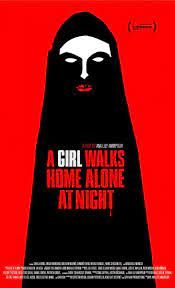
Saturday Matinee: A Girl Walks Home Alone at Night

By Jonathan Romney

Source: Film Comment

A term beloved of French film critics—and one I never tire of borrowing, just because it pinpoints its referent so well—is OVNI, meaning “UFO.” It’s used to refer to a film, usually a first feature, that’s next to impossible to categorize, that seems to have come out of nowhere, to have been made entirely against the odds—a film that appears to originate if not actually from other planets, then from some parallel cinematic dimension where the usual rules don’t apply.

Little could qualify more for OVNI-dom than an “Iranian vampire Western,” as Ana Lily Amirpour’s first feature has been dubbed. In fact, the skewed quality of A Girl Walks Home Alone at Night is accentuated by the fact that it both is and isn’t “really” Iranian. That is, the film is in Farsi, and stars a cast of Iranian or Iranian-American actors, but was shot in California, not far from Bakersfield, where writer-director Ana Lily Amirpour grew up. Taft stands in for Bad City, as the subtitles call it—or “Shahr Bad,” which may possibly be a Farsi play on words—a run-down, isolated burg where weird things happen by night, and nothing too ordinary takes place by day.

The Girl of the title (Sheila Vand) is a gamine-ish music fan who likes to dance alone in her poster-decorated den. But when she steps out onto the streets, she’s not the imperiled victim that the title—misleadingly, cleverly—would have you expect. She’s a figure of menace: a marauder who wears a chador over a very Gallic stripy matelot top, adding a curious dash of indie-kid chic to her image as a ghost figure who glides rather than walk. In fact, her gliding gait comes from the fact that she’s commandeered a terrified child’s skateboard. Spreading her robe like black wings, the Girl haunts the night like an Islamic descendant of Musidora’s Irma Vep, lawless masked heroine of Louis Feuillade’s silent serial Les Vampires.

The Girl is indeed a vampire, and more than a match for supposedly the scariest presence on this city’s mean streets—thuggish drug dealer Saeed (Dominic Rains), who has “SEX” tattooed across his neck, a sleazy drooping moustache on his chops, and a pad filled with big-bad-hunter tat (deer’s heads, tiger-print throws…). The predatory Saeed practically licks his chops at the thought of feral sex when the Girl’s canines pop out to full length with an almost comical sound effect; he doesn’t look so happy once she snaps his finger off.

The Girl can be downright terrifying: the young boy who loses his skateboard probably hasn’t done anything to merit being chilled to the bone by her, when she leans in to ask him if he’s been good, then warns him (in one of the most authentically ghoulish horror-movie rasps since Mercedes McCambridge did voice duty for Linda Blair), “I can take your eyes out of your skull and give them to the dogs to eat.” We don’t, by the way, see the dogs of Bad City, but the local cat is unsettling enough: a naturally charismatic starer which looks like it’s taking a break from sitting in a Bond villain’s lap, and which gets the best close-up in the film.

Meanwhile in Bad City, a devilishly handsome young man named Arash (Arash Marandi) is coping with the depressed excesses of his overweight junkie dad Hossein (Marshall Manesh), and working as gardener and handyman to a rich family whose spoiled daughter, the recent recipient of a nose job, sees him as her latest toy.

Things take an overtly comic turn when Arash—something of a sweet-natured dork despite his quiffed rebel demeanor—attends a Halloween party as Dracula. Walking home the worse for wear in a too-baggy cape and really ill-fitting fangs, he meets the Girl, who “lures” him to her den—or rather, wheels her decidedly floppy prospective beau back to her place on the skateboard. Things turn romantic, at once chastely and very sensually, in a beautiful extended take, as Arash approaches her and she closes in—not, as you’d expect, on his neck, but on his chest. It all happens in swoony slow motion, but with a mirror ball spinning round and filling the room with sparkles at crazy speed: a magnificent, and inexplicably romantic, paradox of pacing that adds to the eerie romance of the scene.

The couple later tryst at dead of night at the local power plant, itself lit up like a jeweled city. Why at the power plant? For the chiaroscuro, of course—that seems to be what motivates Amirpour most. This is one of those films that are shot in black and white because a director is genuinely in love with the affective and expressive possibilities of that visual choice, and especially with its ability to draw magic out of night scenes: I’m reminded of another piece of black-and-white small-town dream romance, Eric Mendelsohn’s Judy Berlin (99), which used an eclipse as the narrative excuse for its midsummer night’s encounters. In her own nightscapes, Amirpour doesn’t mess around with half-measures: DP Lyle Vincent saturates his shadows with the inkiest of blackness (as does the graphic novel that Amirpour has created to accompany the film).

A Girl Walks Home Alone at Night is a wayward, genuinely oneiric creation—look at its sudden arresting focus-pull on some oil derricks, and its graceful, gratuitous interlude of a transgender cowgirl figure dancing with a helium balloon. It manages to be tender, chilly, comic, and willfully bizarre all at once, but never has you wishing it would choose one register and stick to it. In his very enthusiastic recent review, David Thomson invokes not only David Lynch, but Vigo, Cocteau, and Buñuel, no less. Perhaps more modestly, A Girl Walks reminded me most of early Jarmusch, and of the general spirit of  late-Seventies/early-Eighties punk-influenced U.S. cinema (names like Scott B and Beth B, Amos Poe, Slava Tsukerman of Liquid Sky), because of Amirpour’s brisk disregard for genre norms, for the sense that she’s up for telling whatever story she wants to tell, any way she wants to tell it. While manifestly very polished and composed, the film nevertheless gives the impression that it’s making itself up—or dreaming itself into being—as it goes along.

There’s an oddly innocent blazing-youth romanticism about it, especially when the Girl and Arash bond over music. That feeling comes across all the more strongly because non-Farsi speakers will depend on the subtitles: it adds a tender but absurd irony to the revelation that the last song the Girl listened to was, of all things, Lionel Richie’s “Hello.” Fortunately, there’s cooler stuff on the soundtrack: the Tom-Waits-in-Tehran opening number by Iranian band Kiosk, and some Morricone-ish fanfare by Federale, a group from Portland.

A Girl Walks Home Alone at Night is bound to cause a stir in academic circles for the way that it blurs its Eastern and Western codes so thoroughly: making manifestly American settings stand in for an imaginary Iran, playing provocatively on the chador as Islamic garment and as vampire-cape substitute, having its heroine at once tender lover and murderous monster in a way that neither Anne Rice nor Stephenie Meyer would quite recognize. Overall, Amirpour’s film feels like an elaborately punkish code-scrambling gesture rather than a fully formed organic statement, but that doesn’t matter—it has style, grace, and imagination, and as artistic gestures go, could hardly be more devil-may-care. By the time it takes a final Aldrich-esque drive into the shadows, A Girl Walks Home has more than earned your attention—and got you wondering where that shadow-steeped road leads, either for its romantic duo or for Amirpour as audacious writer-director.

Watch A Girl Walks Home Alone at Night on Kanopy here: https://www.kanopy.com/product/girl-walks-home-alone-night

You Don’t Have To Wait For Halloween To See Monsters, Because They Are Already All Around Us

By Michael Snyder

Source: End of the American Dream

A lot of Americans will dress up like monsters this Halloween, but there is no way that they could ever be as frightening as the actual monsters that walk our halls of power on a daily basis.  Some of the things that I am going to share with you in this article are deeply disturbing, but they need to be revealed because the people that have been doing these things need to be held accountable.  Real life horror movies play out in secret facilities all across America day after day, and much of the time the incredibly sick things that are being done to animals are being funded by our tax dollars.  But because the corporate media keeps very quiet about these “experiments”, most Americans never hear about what is really going on behind closed doors.

The good news is that some brave investigators are starting to pull back the veil and reveal the truth about the horrific animal abuse that is taking place.

Here is one example of what I am talking about…

“Our investigators show that Fauci’s NIH division shipped part of a $375,800 grant to a lab in Tunisia to drug beagles and lock their heads in mesh cages filled with hungry sand flies so that the insects could eat them alive,” White Coat Waste told Changing America. “They also locked beagles alone in cages in the desert overnight for nine consecutive nights to use them as bait to attract infectious sand flies.”

How sick do you have to be to do something like that to innocent little puppies?

Dr. Anthony Fauci and the others that were involved in funding this research are monsters.

And it turns out that this wasn’t the first time that they funded this sort of “experimentation”.

Back in 2016, they spent more than 18 million dollars to torture beagles “for 22 months” before finally killing and dissecting them…

Fauci’s team had previously, in 2016, strapped the infectious sand flies to beagles at the NIAID lab in Bethesda, Maryland, allowing them to feed on the dogs for 22 months.

The White Coat Waste Project alleges that the dogs developed infectious legions before researchers killed and dissected them.

This procedure cost $18,430,917.

Fauci and everyone else involved in such “experiments” aren’t just criminals.

They are monsters in the worst sense of the word.

If you are sickened by what you have read already, you may want to stop, because there is more.

What Fauci and his minions did to 44 beagle puppies at a facility in Menlo Park, California has no place in a civilized society…

Another procedure – which the NIH funded to the tune of $1.8m – saw 44 beagle puppies undergo a ‘cordectomy,’ which saw their vocal cords cut to stop them barking.

That experiment, which took place in Menlo Park, California, saw the dogs then pumped full of drugs, before being killed and dissected.

What would “justice” look like for crimes of this magnitude?

The next time someone in the corporate media tries to call Fauci a “hero”, it should make you want to vomit.

Of course Fauci and his minions have moved on from just experimenting on animals.

Today, innocent people all over the globe are the guinea pigs.

And it turns out that Fauci’s NIH is now publicly admitting to funding incredibly twisted research on “a bat coronavirus” at the Wuhan Insitute of Virology just before the pandemic hit…

White House coronavirus adviser Dr. Anthony Fauci and National Institutes of Health Director Francis Collins have declared under oath that they did not fund the dangerous gain-of-function virus research in China that now is believed be the origin of the COVID-19 pandemic.

But now the NIH has admitted in a letter to the leading Republican on the House Oversight Committee that the U.S. funded an experiment at the Wuhan Insitute of Virology in which a bat coronavirus was modified, creating a virus that made mice “sicker” than the original virus.

We all know the rest of the story.

But after everything that has transpired, Fauci and his minions are still treated like heroes, and that is because we have a national love affair with evil.

If you doubt this, just consider the “holiday” that is coming up.  It is a festival of evil, darkness and death, and yet Americans will spend more than 1o billion dollars celebrating it this year…

The 2021 Halloween season is breaking the bank this year.

According to the National Retail Federation’s annual survey, Americans are expected to spend $10.14 billion this year on Halloween-related items. The price tag grew by $2 billion in comparison to last year’s numbers.

Unless you are already sold out to evil, why in the world would anyone want to celebrate such a “holiday”?

By now, pretty much everyone understands that our modern “Halloween” comes directly from a very wicked ancient pagan festival known as “Samhain”.

Over the years, many have told me that they just celebrate Halloween for some “innocent fun” and that the holiday doesn’t mean anything evil to them.

But what if you celebrated a Satanic black mass and put a bunch of “positive” labels on all of the various elements of that ritual?

Would that make it okay?

Of course not.

Giving evil an “alternative” name does not transform it into something good.

So stop pretending.

Fauci and his minions call the evil they are committing “scientific research”, and millions upon millions of Americans are willing to go along with their torture of animals “for the greater good”.

Of course “the greater good” is now being used to justify all sorts of nightmarish crimes against humanity.

We live at a time when the level of evil on this planet is reaching a great crescendo, and it is truly sickening to watch.

But when things are at their darkest, that is when light is needed the most, and so let us all endeavor to be the greatest lights to this world that we possibly can.