How 90% of American Households Lost an Average of $17,000 in Wealth to the Plutocrats in 2016

By Paul Buchheit

Source: Information Clearing House

America has always been great for the richest 1%, and it’s rapidly becoming greater. Confirmation comes from recent work by Thomas Piketty, Emmanuel Saez, and Gabriel Zucman; and from the 2015-2016 Credit Suisse Global Wealth Databooks (GWD). The data relevant to this report is summarized here.

The Richest 1% Extracted Wealth from Every Other Segment of Society 

These multi-millionaires effectively shifted nearly $4 trillion in wealth away from the rest of the nation to themselves in 2016. While there’s no need to offer condolences to the rest of the top 10%, who still have an average net worth of $1.3 million, nearly half of the wealth transfer ($1.94 trillion) came from the nation’s poorest 90% — the middle and lower classes, according to Piketty and Saez and Zucman. That’s over $17,000 in housing and savings per lower-to-middle-class household lost to the super-rich.

Put another way, the average 1% household took an additional $3 million of our national wealth in one year while education and infrastructure went largely unfunded.

It Gets Worse: Each MIDDLE-CLASS Household Lost $35,000 to the 1% 

According to Piketty and Saez and Zucman, the true middle class is “the group of adults with income between the median and the 90th percentile.” This group of 50 million households lost $1.76 trillion of their wealth in 2016, or over $35,000 each. That’s a $35,000 decline in housing and financial assets, with possibly increased debt, for every middle-class household.

Housing Wealth for the 90% Has Been Converted into Investment Wealth for the Plutocrats

In the 1980s, the housing wealth of the bottom 90% made up about 15 percent of total household wealth (Figure 8 here and Page 41 here).

In the 1980s, the corporate equities owned by the richest .01% made up about 1.2 percent of total household wealth (Figure 8 here).

Housing was 12 times greater than super-rich stock holdings back then. Now they’re nearly equal. The home values of 112,000,000 households have been reduced to just over 5 percent of total wealth, while the stocks and securities of the richest 12,000 households are approaching 5 percent of total wealth. Our homes have turned to dust, and the plutocrats have turned the dust into gold.

Even the Wages of the Poorest Americans Have Been Transferred to the Plutocrats 

It’s bad enough that the poorest 50% of America have no appreciable wealth, but their income has not increased in 40 years (see Table 1 here). More evidence comes from Pew Research.

As Piketty, Saez, and Zucman note, the richest 1% and the poorest 50% “have basically switched their income shares.” They explain, “We observe a complete collapse of the bottom 50% income share in the US between 1978 and 2015, from 20% to 12% of total income, while the top 1% income share rose from 11% to 20%.”

Making America Great for 1% of Us 

In his book, Glass House: The 1% Economy and the Shattering of the All-American Town, Brian Alexander describes today’s America through the lens of his hometown of Lancaster, Ohio, which had been a leading glasswares manufacturer. But the town started falling apart in the 1980s. A major glasswares company was bought up with borrowed money by private equity firms, which then cut jobs and wages, allowed manufacturing facilities to fall into disrepair, stopped contributing to pensions, moved company headquarters out of state, and demanded tax breaks to keep the glassware plant in Lancaster.

Capitalism as usual. Yet 59 percent of Lancaster’s county voted for Trump. Alexander explains that the people of Lancaster “remained captured by an ultra-conservative, anti-tax philosophy that prevented them from raising funds to repair the crumbling streets..”

Delusions persist about the power of the market and the dangers of governing ourselves. The business media has conditioned us to fear the words ‘social’ and ‘public,’ as if they connote evil or ineptitude or anti-Americanism. But the public good depends on cooperation. Society fosters individual accomplishment, not the other way around.

The obscene transfer of wealth and income to the plutocrats won’t end until we demand a return to the Commons, where we work as a society rather than allow predatory plutocratic individuals to control us. There are 112 million households in America that are giving thousands of their hard-earned dollars to the 1%, and we have finally begun to fight back, together, as a massive force of Americans who refuse to let the theft continue.


Paul Buchheit is a writer for progressive publications, and the founder and developer of social justice and educational websites, including: UsAgainstGreed.org, PayUpNow.org, and RappingHistory.org. This article was first published at Common Dreams

I think therefore I am capital

ea35012b67112d2997cf0b42c21e2b928e14e6e4

By Jamie Goldrick

Source: Adbusters

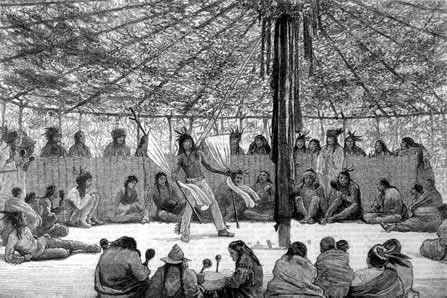
In the worldview of the Cree, life is lived along a trail of experiences. Sharing experience with others is a result of the crossing of two life trails. Life is experienced as a tangled pattern of all beings. In this way, beings do not occupy one world, as in the Western sense: they inhabit their own relational field.

To the Cree, even the wind is alive. It interacts and has agency, and it has the capacity to come into contact with other beings and be affective. In this respect the wind too has the capacity to be alive as it can give shape to the world. For the Yukaghir in Siberia, Elk have the capacity to enter into personhood depending upon which relational field they enter.

In animist cosmology, objects can be ascribed personhood simply by the fact that they have potential to enter into relations with the environment and other living beings. According to Anthropologist Tim Ingold, “different creatures have different points of view of the world, because of different capabilities and perception they attend to the world in different ways”. Thus to the animist, life is lived through the relational field that objects enter into with each other. Regarding all beings and objects, we exist, therefore we are.

Edward Tylor coined the term animism in 1871. He used it to describe the idea that inanimate beings and objects were attributed with spirits. To Tylor, an evolutionist, this was just an aberration on the part of the animists, a “magical philosophy grounded in error” and nothing more than the simple mistake of a basic society on the path to modernity.

Steeped in the western philosophical tradition, Tylor naturally found focus in rational inquiry and scientific progress. He is a product of the Enlightenment, espousing such values as the natural rights of humans to life, liberty and property. Roy Porter, describing Immanuel Kant, observes:

For Kant enlightenment was man’s final coming of age, the emancipation of human consciousness from an immature state of ignorance and error. He believed that this process of mental liberation was actively at work in his own lifetime. The advancement of knowledge – understanding of nature, but human self-knowledge no less -would propel this giant leap forward.

Yet even to this day Enlightenment values have yet to break free from the shackles of Christianity, perhaps even the Classical Period that came before it as well. There are blind spots and limitations to rational inquiry and scientific progress. Our thinking is infected by it.

One such blind spot presumes a nature-culture divide, the notion that we are different than other sentient beings. In this worldview, animals exist as mere automata. They are machines without consciousness, all body and no mind, or to use Descartes’ famous cogito ergo sum, the definitive difference between us and all other beings on this planet is consciousness: I think, therefore I am.

Thus the environment, the humans who had yet to achieve enlightenment and the animals alike who inhabited it were objects to be manipulated and used by us, the subjects. This is the ontological basis that the West is built upon. It is the foundation that provides the philosophical conditions for capitalism to flourish. The gulf between what is theorized in the minds of men and what is a lived environmental reality was alluded to by one of the foundational thinkers of the Enlightenment, Adam Smith in The Wealth of Nations:

The same division that caused the social organism to grow also causes the individual worker to become impoverished …the man whose life is spent in performing a few simple operations generally becomes as stupid and ignorant as it is possible for a human creature to become.

The Wealth of Nations relied upon the bodily suffering of the disempowered to function at the expense of an abstract social body and to those in possession of the means of production. Written in 1776, things have somewhat changed in the past 240 years.

Briefly, it has been a long, arduous, and somewhat brutal journey for capital to the present day. Capital, in its search for surplus value, has penetrated through domestic markets, foreign markets, future markets, even now to our very sociality via the technological advances that have allowed for online social networking to occur. The collapse of the Bretton Woods agreement, which eliminated the gold standard, allowed the dollar to become symbolic and abstract, facilitating a new definition of economic worth, as evinced by the liberalization of capital markets, the emergence of futures markets, and the notorious derivatives. Economic value has become anthropocentric, a closed human based value system, abstracted from the material environment.

Take for example Google’s $66 billion turnover in 2014, Facebook’s 1.3 billion users, or Twitter’s initial stock market flotation of 23 billion. This value is located in the climate cooled data centers of financial institutions, abstracted from reality. This descent into the digital ether compounds as these abstract value systems begin to play a greater and more influential role in our lives. At a time when our relationship to nature urgently needs to be re-­examined, the gulf between nature and culture grows exponentially. Nature – earth’s ‘free gifts’ – becomes further objectified, commodified and excluded from our sense of being-in-the-world.

Maurizio Lazzarato notes that Neoliberalism relies on the individuality of its users, which has a profound effect upon our understanding of the new digital labor. To Lazzarato, digital labor functions by uniting and bringing together extreme individualization and dividuation (the collection of individuals’ idiosyncrasies into data banks) of individuals. The appendages of digital labor feed off our subjectivity and thus enslave us. As Marx argued, machinery enslaves and is manifested as a form of fixed capital. Today these machinic processes have invaded the daily. Lazzarato observes that we are currently enslaved by the mega-machine. Once our individual identity is stripped, a process called machinic enslavement, the individual is rendered as “a gear, a cog, a component part of business and financial assemblages”.

Today the circulation of capital is now the principal means of generating profit. Capital is reliant on human activity to function and flow. Immaterial capital flows are reliant on dividuals to •connect the circuits• between entities. This modern machinic enslavement does not subscribe to traditional categories of subject/object or human/machine binaries. The dividual does not stand by an external machine, for as Lazzarato notes “together they constitute a human machine apparatus in which humans are but recurrent and interchangeable parts of production and consumption. The individual is part of the machine: part-mineral, part-mind and integral to the functioning of modern day capitalism. By habitually updating a status, Googling a mundane thought, or checking into any given establishment, the bodily language of non-engagement now screams: I think, therefore I am capital.

Technology, paced by notions of progress and modernity, has always had an ambivalent place in Western discourse. The obsession with progress obfuscates the objective effects of technology. Technology once demarcated the distinction between work time and leisure time. According to E.P. Thompson: “Before the industrial revolution, time was task based, with the introduction of the machine to the factory floor, this brought the time-keeper, the informer and the fines.” Capital intensive machines had to be attended to round the clock to function. With the advent of the steam engine, the shift from organic to carbon power, a new proletariat was born. Today technology is once again blurring the boundaries by creating a social factory from out of our leisure and private time. History repeats itself, first as tragedy, second as farce. Innovation within the dominant paradigm of capitalism serves to innovate existing forms of domination. In this case, those who control the visions of the future control the present.

The predominant discourse of think therefore I am, and our obsession with progress blinds us to the realities of the day. We are within its apparatus when we work, or when we play, when reaching out to others, or solitarily in our own homes. What if we could see the true effects of this mega-machine? Strip away Cartesian subjectivity and take on the oft forgotten worldview of the animist. Proclaim “what manner are these things, part mineral, part mind that serve the few and enslave the many, while fouling the land, the water and the air! “We can no longer see objects as they truly exist in the world. To use Descartes’ term, now we are the automata, cogs and gears, the circuitry of the mega­ machine, assembled on the false logic of a nature/culture divide.

Set to the backdrop of species collapse, the disappearance of the rainforests, the acidification of the oceans, the mega-machine operates faster than ever before. The creatures outside look in, from person to machine, and then from human to person, and from person to machine again; but already it is impossible to say which is which….


-Jamie Goldrick is a filmmaker and contributing editor to Rabble magazine in Ireland.

Made For Each Other

 2565241-avp__democrats_vs__republicans_by_cwgodzilla

By James Howard Kunstler

Source: Kunstler.com

Don’t be fooled by the idiotic exertions of the Red team and the Blue team. They’re just playing a game of “Capture the Flag” on the deck of the Titanic. The ship is the techno-industrial economy. It’s going down because it has taken on too much water (debt), and the bilge pump (the oil industry) is losing its mojo.

Neither faction understands what is happening, though they each have an elaborate delusional narrative to spin in the absence of any credible plan for adapting the life of our nation to the precipitating realities. The Blues and Reds are mirrors of each other’s illusions, and rage follows when illusions die, so watch out. Both factions are ready to blow up the country before they come to terms with what is coming down.

What’s coming down is the fruit of the gross mismanagement of our society since it became clear in the 1970s that we couldn’t keep living the way we do indefinitely — that is, in a 24/7 blue-light-special demolition derby. It’s amazing what you can accomplish with accounting fraud, but in the end it is an affront to reality, and reality has a way of dealing with punks like us. Reality has a magic trick of its own: it can make the mirage of false prosperity evaporate.

That’s exactly what’s going to happen and it will happen because finance is the least grounded, most abstract, of the many systems we depend on. It runs on the sheer faith that parties can trust each other to meet obligations. When that conceit crumbles, and banks can’t trust other banks, credit relations seize up, money vanishes, and stuff stops working. You can’t get any cash out of the ATM. The trucker with a load of avocados won’t make delivery to the supermarket because he knows he won’t be paid. The avocado grower will have to watch the rest of his crop rot. The supermarket shelves empty out. And you won’t have any guacamole.

There are too many fault lines in the mighty edifice of our accounting fraud for the global banking system to keep limping along, to keep pretending it can meet its obligations. These fault lines run through the bond markets, the stock markets, the banks themselves at all levels, the government offices that pretend to regulate spending, the offices that affect to report economic data, the offices that neglect to regulate criminal misconduct, the corporate boards and C-suites, the insurance companies, the pension funds, the guarantors of mortgages, car loans, and college loans, and the ratings agencies. The pervasive accounting fraud bleeds a criminal ethic into formerly legitimate enterprises like medicine and higher education, which become mere rackets, extracting maximum profits while skimping on delivery of the goods.

All this is going to overwhelm Trump soon, and he will flounder trying to deal with a gargantuan mess. It will surely derail his wish to make America great again — a la 1962, with factories humming, and highways yet to build, and adventures in outer space, and a comforting sense of superiority over all the sad old battered empires abroad. I maintain it could get so bad so fast that Trump will be removed by a cadre of generals and intelligence officers who can’t stand to watch someone acting like Captain Queeg in the pilot house.

That itself might be salutary, since only some kind of extreme shock is likely to roust the Blue and Red factions from their trenches of dumb narrative. If the Democratic Party had put one-fiftieth of the effort it squanders on transgender bathroom privileges into policy for mitigating our tragic misinvestments in suburban sprawl, we might have gotten a head-start toward a plausible future. Instead, the Democratic Party has turned into a brats-only nursery school, with the kiddies fighting over who gets to play with the Legos. The Republican Party is Norma Desmond’s house in Sunset Boulevard, starring Donald Trump as Max the Butler, working extra-hard to keep the illusions of yesteryear going.

All of this nonsense is a distraction from the task at hand: figuring out how to live in the post techno-industrial world. That world is not going to operate the ways we’re used to. It will crush our assumptions and expectations. Lying about everything won’t be an option. We won’t have the extra resources to cover up our dishonesty. Our money better be sound or it will be laughed at, and then you’ll starve or freeze to death. You’d better hope the rule of law endures and work on keeping it alive where you live. And nobody will get special brownie points for the glory of sexual confusion.

I look for the financial fireworks to start around March – April, as the irresolvable debt ceiling debate in congress grinds into a bitter stalemate, and it becomes obvious that there will be no voucher for the great infrastructure spending orgy that Trump’s MAGA is based on. Elections in France and the Netherlands have the potential to shake apart the European Union, and with that the footing of European banks. Pretty soon, everybody in all parties and factions will be asking: “Where did the glittering promises of Modernity go…?” As we slip-side into the first stages of a world made by hand.

Over Half of Every Tax Dollar You Give to Uncle Sam is Spent on This

us-flag-bombs

By Phillip Schneider

Source: Waking Times

Most people probably don’t think too much about this, but are you aware of just how much of your income is being used to fuel the military industrial complex?

Conveniently omitted from the corporate/state-run media organizations is the fact that some 53 percent of your tax dollars are spent on the military. That’s right, more than half of the money you give to Uncle Sam for the privilege of being American income is spent directly on military.

In 2011 the budget for the US Government was over 3 trillion dollars, while military spending included a $717 billion request from the pentagon, $200 billion towards “overseas contingency funding” for the two major conflicts we are engaged in, and $40 billion in black budget intelligence which includes the CIA, NSA, and other agencies where the amount of money given is never fully disclosed.

In addition, $94 billion was spent on non-DOD military operations, $100 billion on health care and veterans benefits, and $400 billion was spent paying off the interest on debt raised to pay for past wars. This all adds up to over 1.6 trillion dollars spent on so-called defense. That is more than what was spent during the second world war after being adjusted for inflation.

Defense Spending Or Offense Spending?

Now it is true that defense spending is important to American interests. You might be inclined to think about how much worse off we would be without a military. Without a strong defense, if a country decided to engage us in any sort of negative way militarily we wouldn’t be able to resist or hold our ground.

However, what is typically called “defense spending” is by-and-large nothing offense spending designed to support a policy of military interventionism which exploits many nations for their natural resources and establishes Rothschild controlled central banks wherever and whenever they can.

To see this, one needs not look beyond the excuses for going to war in the first place. From the Gulf of Tonkin incident of August 1964, to the supposed WMD’s in Iraq, to Obama’s attempt in the summer of 2013 to begin bombing campaigns in Syria, nearly each and every war is initiated alongside war propaganda intended to serve the special interests who profit from the lucrative military-industrial complex that Eisenhower warned us about in his farewell address of 1961.

Why would they need to continuously lie to get us into war if there was a plausible reason for “defending ourselves” in the first place?

Drone Bombings Are America’s Slap In The Face To The World

When you take the immediate danger of American soldiers out of the equation, and in some cases any human input at all, it creates a situation where the public generally doesn’t see any problem with bombing the living daylights out of another country because it is out of sight, out of mind. For this reason, the drone program has become one of the military’s most insidious operations in history.

To put the drone program into perspective you have to understand its scale and its ability to remain covert. During the Obama presidency alone, the US has bombed a total of eight countries. Syria, Iraq, Libya, Afghanistan, Yemen, Somalia, Uganda, and Pakistan. Also, Obama became the worlds first Nobel Peace Prize winner to bomb another Nobel Peace Prize winner when he authorized a strike on a Afghan hospital run by the 1999 Peace Prize recipient Doctors Without Borders, killing at least 22 people. And somehow, bombs somehow keep on falling in places where Obama boasts that he hast ended two wars.

A recent whistle blower exposed the fact that about 90 percent of those killed in drone strikes are not the intended targets. Yes, you heard that right. For every ten people killed by American drones, nine are innocent bystanders, some of which are merely patients in a hospital suspected of harboring terrorists.

“What is war but mass murder on a scale impossible by private police forces?” – Austrian economist Murray Rothbard

This Money Could Be Spent Fixing Our Country, Or Better Yet Not Stolen From Us

In 2014 one fighter jet ended up costing the US $400 billion dollars. That amount of money could have payed for every homeless person in America to have a house worth $600,000. Imagine what that kind of money could have done if it were spent on humanitarian efforts, or better yet, if left in the hands of hardworking Americans who are supporting the economy through their free market decisions.

At the end of the day, we are all cash-cows for Uncle Sam and his globalist military industrial complex.

This short video puts it all nicely into perspective:

Fuck Work

 tumblr_mkr6eleomu1qiyurho1_r2_500

Economists believe in full employment. Americans think that work builds character. But what if jobs aren’t working anymore?

By James Livingston

Source: aeon

Work means everything to us Americans. For centuries – since, say, 1650 – we’ve believed that it builds character (punctuality, initiative, honesty, self-discipline, and so forth). We’ve also believed that the market in labour, where we go to find work, has been relatively efficient in allocating opportunities and incomes. And we’ve believed that, even if it sucks, a job gives meaning, purpose and structure to our everyday lives – at any rate, we’re pretty sure that it gets us out of bed, pays the bills, makes us feel responsible, and keeps us away from daytime TV.

These beliefs are no longer plausible. In fact, they’ve become ridiculous, because there’s not enough work to go around, and what there is of it won’t pay the bills – unless of course you’ve landed a job as a drug dealer or a Wall Street banker, becoming a gangster either way.

These days, everybody from Left to Right – from the economist Dean Baker to the social scientist Arthur C Brooks, from Bernie Sanders to Donald Trump – addresses this breakdown of the labour market by advocating ‘full employment’, as if having a job is self-evidently a good thing, no matter how dangerous, demanding or demeaning it is. But ‘full employment’ is not the way to restore our faith in hard work, or in playing by the rules, or in whatever else sounds good. The official unemployment rate in the United States is already below 6 per cent, which is pretty close to what economists used to call ‘full employment’, but income inequality hasn’t changed a bit. Shitty jobs for everyone won’t solve any social problems we now face.

Don’t take my word for it, look at the numbers. Already a fourth of the adults actually employed in the US are paid wages lower than would lift them above the official poverty line – and so a fifth of American children live in poverty. Almost half of employed adults in this country are eligible for food stamps (most of those who are eligible don’t apply). The market in labour has broken down, along with most others.

Those jobs that disappeared in the Great Recession just aren’t coming back, regardless of what the unemployment rate tells you – the net gain in jobs since 2000 still stands at zero – and if they do return from the dead, they’ll be zombies, those contingent, part-time or minimum-wage jobs where the bosses shuffle your shift from week to week: welcome to Wal-Mart, where food stamps are a benefit.

And don’t tell me that raising the minimum wage to $15 an hour solves the problem. No one can doubt the moral significance of the movement. But at this rate of pay, you pass the official poverty line only after working 29 hours a week. The current federal minimum wage is $7.25. Working a 40-hour week, you would have to make $10 an hour to reach the official poverty line. What, exactly, is the point of earning a paycheck that isn’t a living wage, except to prove that you have a work ethic?

But, wait, isn’t our present dilemma just a passing phase of the business cycle? What about the job market of the future? Haven’t the doomsayers, those damn Malthusians, always been proved wrong by rising productivity, new fields of enterprise, new economic opportunities? Well, yeah – until now, these times. The measurable trends of the past half-century, and the plausible projections for the next half-century, are just too empirically grounded to dismiss as dismal science or ideological hokum. They look like the data on climate change – you can deny them if you like, but you’ll sound like a moron when you do.

For example, the Oxford economists who study employment trends tell us that almost half of existing jobs, including those involving ‘non-routine cognitive tasks’ – you know, like thinking – are at risk of death by computerisation within 20 years. They’re elaborating on conclusions reached by two MIT economists in the book Race Against the Machine (2011). Meanwhile, the Silicon Valley types who give TED talks have started speaking of ‘surplus humans’ as a result of the same process – cybernated production. Rise of the Robots, a new book that cites these very sources, is social science, not science fiction.

So this Great Recession of ours – don’t kid yourself, it ain’t over – is a moral crisis as well as an economic catastrophe. You might even say it’s a spiritual impasse, because it makes us ask what social scaffolding other than work will permit the construction of character – or whether character itself is something we must aspire to. But that is why it’s also an intellectual opportunity: it forces us to imagine a world in which the job no longer builds our character, determines our incomes or dominates our daily lives.

In short, it lets us say: enough already. Fuck work.

Certainly this crisis makes us ask: what comes after work? What would you do without your job as the external discipline that organises your waking life – as the social imperative that gets you up and on your way to the factory, the office, the store, the warehouse, the restaurant, wherever you work and, no matter how much you hate it, keeps you coming back? What would you do if you didn’t have to work to receive an income?

And what would society and civilisation be like if we didn’t have to ‘earn’ a living – if leisure was not our choice but our lot? Would we hang out at the local Starbucks, laptops open? Or volunteer to teach children in less-developed places, such as Mississippi? Or smoke weed and watch reality TV all day?

I’m not proposing a fancy thought experiment here. By now these are practical questions because there aren’t enough jobs. So it’s time we asked even more practical questions. How do you make a living without a job – can you receive income without working for it? Is it possible, to begin with and then, the hard part, is it ethical? If you were raised to believe that work is the index of your value to society – as most of us were – would it feel like cheating to get something for nothing?

We already have some provisional answers because we’re all on the dole, more or less. The fastest growing component of household income since 1959 has been ‘transfer payments’ from government. By the turn of the 21st century, 20 per cent of all household income came from this source – from what is otherwise known as welfare or ‘entitlements’. Without this income supplement, half of the adults with full-time jobs would live below the poverty line, and most working Americans would be eligible for food stamps.

But are these transfer payments and ‘entitlements’ affordable, in either economic or moral terms? By continuing and enlarging them, do we subsidise sloth, or do we enrich a debate on the rudiments of the good life?

Transfer payments or ‘entitlements’, not to mention Wall Street bonuses (talk about getting something for nothing) have taught us how to detach the receipt of income from the production of goods, but now, in plain view of the end of work, the lesson needs rethinking. No matter how you calculate the federal budget, we can afford to be our brother’s keeper. The real question is not whether but how we choose to be.

I know what you’re thinking – we can’t afford this! But yeah, we can, very easily. We raise the arbitrary lid on the Social Security contribution, which now stands at $127,200, and we raise taxes on corporate income, reversing the Reagan Revolution. These two steps solve a fake fiscal problem and create an economic surplus where we now can measure a moral deficit.

Of course, you will say – along with every economist from Dean Baker to Greg Mankiw, Left to Right – that raising taxes on corporate income is a disincentive to investment and thus job creation. Or that it will drive corporations overseas, where taxes are lower.

But in fact raising taxes on corporate income can’t have these effects.

Let’s work backward. Corporations have been ‘multinational’ for quite some time. In the 1970s and ’80s, before Ronald Reagan’s signature tax cuts took effect, approximately 60 per cent of manufactured imported goods were produced offshore, overseas, by US companies. That percentage has risen since then, but not by much.

Chinese workers aren’t the problem – the homeless, aimless idiocy of corporate accounting is. That is why the Citizens United decision of 2010 applying freedom of speech regulations to campaign spending is hilarious. Money isn’t speech, any more than noise is. The Supreme Court has conjured a living being, a new person, from the remains of the common law, creating a real world more frightening than its cinematic equivalent: say, Frankenstein, Blade Runner or, more recently, Transformers.

But the bottom line is this. Most jobs aren’t created by private, corporate investment, so raising taxes on corporate income won’t affect employment. You heard me right. Since the 1920s, economic growth has happened even though net private investment has atrophied. What does that mean? It means that profits are pointless except as a way of announcing to your stockholders (and hostile takeover specialists) that your company is a going concern, a thriving business. You don’t need profits to ‘reinvest’, to finance the expansion of your company’s workforce or output, as the recent history of Apple and most other corporations has amply demonstrated.

So investment decisions by CEOs have only a marginal effect on employment. Taxing the profits of corporations to finance a welfare state that permits us to love our neighbours and to be our brothers’ keeper is not an economic problem. It’s something else – it’s an intellectual issue, a moral conundrum.

When we place our faith in hard work, we’re wishing for the creation of character; but we’re also hoping, or expecting, that the labour market will allocate incomes fairly and rationally. And there’s the rub, they do go together. Character can be created on the job only when we can see that there’s an intelligible, justifiable relation between past effort, learned skills and present reward. When I see that your income is completely out of proportion to your production of real value, of durable goods the rest of us can use and appreciate (and by ‘durable’ I don’t mean just material things), I begin to doubt that character is a consequence of hard work.

When I see, for example, that you’re making millions by laundering drug-cartel money (HSBC), or pushing bad paper on mutual fund managers (AIG, Bear Stearns, Morgan Stanley, Citibank), or preying on low-income borrowers (Bank of America), or buying votes in Congress (all of the above) – just business as usual on Wall Street – while I’m barely making ends meet from the earnings of my full-time job, I realise that my participation in the labour market is irrational. I know that building my character through work is stupid because crime pays. I might as well become a gangster like you.

That’s why an economic crisis such as the Great Recession is also a moral problem, a spiritual impasse – and an intellectual opportunity. We’ve placed so many bets on the social, cultural and ethical import of work that when the labour market fails, as it so spectacularly has, we’re at a loss to explain what happened, or to orient ourselves to a different set of meanings for work and for markets.

And by ‘we’ I mean pretty much all of us, Left to Right, because everybody wants to put Americans back to work, one way or another – ‘full employment’ is the goal of Right-wing politicians no less than Left-wing economists. The differences between them are over means, not ends, and those ends include intangibles such as the acquisition of character.

Which is to say that everybody has doubled down on the benefits of work just as it reaches a vanishing point. Securing ‘full employment’ has become a bipartisan goal at the very moment it has become both impossible and unnecessary. Sort of like securing slavery in the 1850s or segregation in the 1950s.

Why?

Because work means everything to us inhabitants of modern market societies – regardless of whether it still produces solid character and allocates incomes rationally, and quite apart from the need to make a living. It’s been the medium of most of our thinking about the good life since Plato correlated craftsmanship and the possibility of ideas as such. It’s been our way of defying death, by making and repairing the durable things, the significant things we know will last beyond our allotted time on earth because they teach us, as we make or repair them, that the world beyond us – the world before and after us – has its own reality principles.

Think about the scope of this idea. Work has been a way of demonstrating differences between males and females, for example by merging the meanings of fatherhood and ‘breadwinner’, and then, more recently, prying them apart. Since the 17th century, masculinity and femininity have been defined – not necessarily achieved – by their places in a moral economy, as working men who got paid wages for their production of value on the job, or as working women who got paid nothing for their production and maintenance of families. Of course, these definitions are now changing, as the meaning of ‘family’ changes, along with profound and parallel changes in the labour market – the entry of women is just one of those – and in attitudes toward sexuality.

When work disappears, the genders produced by the labour market are blurred. When socially necessary labour declines, what we once called women’s work – education, healthcare, service – becomes our basic industry, not a ‘tertiary’ dimension of the measurable economy. The labour of love, caring for one another and learning how to be our brother’s keeper – socially beneficial labour – becomes not merely possible but eminently necessary, and not just within families, where affection is routinely available. No, I mean out there, in the wide, wide world.

Work has also been the American way of producing ‘racial capitalism’, as the historians now call it, by means of slave labour, convict labour, sharecropping, then segregated labour markets – in other words, a ‘free enterprise system’ built on the ruins of black bodies, an economic edifice animated, saturated and determined by racism. There never was a free market in labour in these united states. Like every other market, it was always hedged by lawful, systematic discrimination against black folk. You might even say that this hedged market produced the still-deployed stereotypes of African-American laziness, by excluding black workers from remunerative employment, confining them to the ghettos of the eight-hour day.

And yet, and yet. Though work has often entailed subjugation, obedience and hierarchy (see above), it’s also where many of us, probably most of us, have consistently expressed our deepest human desire, to be free of externally imposed authority or obligation, to be self-sufficient. We have defined ourselves for centuries by what we do, by what we produce.

But by now we must know that this definition of ourselves entails the principle of productivity – from each according to his abilities, to each according to his creation of real value through work – and commits us to the inane idea that we’re worth only as much as the labour market can register, as a price. By now we must also know that this principle plots a certain course to endless growth and its faithful attendant, environmental degradation.

Until now, the principle of productivity has functioned as the reality principle that made the American Dream seem plausible. ‘Work hard, play by the rules, get ahead’, or, ‘You get what you pay for, you make your own way, you rightly receive what you’ve honestly earned’ – such homilies and exhortations used to make sense of the world. At any rate they didn’t sound delusional. By now they do.

Adherence to the principle of productivity therefore threatens public health as well as the planet (actually, these are the same thing). By committing us to what is impossible, it makes for madness. The Nobel Prize-winning economist Angus Deaton said something like this when he explained anomalous mortality rates among white people in the Bible Belt by claiming that they’ve ‘lost the narrative of their lives’ – by suggesting that they’ve lost faith in the American Dream. For them, the work ethic is a death sentence because they can’t live by it.

So the impending end of work raises the most fundamental questions about what it means to be human. To begin with, what purposes could we choose if the job – economic necessity – didn’t consume most of our waking hours and creative energies? What evident yet unknown possibilities would then appear? How would human nature itself change as the ancient, aristocratic privilege of leisure becomes the birthright of human beings as such?

Sigmund Freud insisted that love and work were the essential ingredients of healthy human being. Of course he was right. But can love survive the end of work as the willing partner of the good life? Can we let people get something for nothing and still treat them as our brothers and sisters – as members of a beloved community? Can you imagine the moment when you’ve just met an attractive stranger at a party, or you’re online looking for someone, anyone, but you don’t ask: ‘So, what do you do?’

We won’t have any answers until we acknowledge that work now means everything to us – and that hereafter it can’t.

How the Super-Rich Will Destroy Themselves

HangTheBankers

By Paul Buchheit

Source: Nation of Change

Perhaps they believe that their underground survival bunkers with bullet-resistant doors and geothermal power and anti-chemical air filters and infrared surveillance devices and pepper spray detonators will sustain them for two or three generations.

Perhaps they feel immune from the killings in the streets, for they rarely venture into the streets anymore. They don’t care about the great masses of ordinary people, nor do they think they need us.

Or do they? There are a number of ways that the super-rich, because of their greed and lack of empathy for others, may be hastening their own demise, while taking the rest of us with them.

1. Pandemic (Because of Their Disdain for Global Health)

“A year ago the world was in a panic over Ebola. Now it’s Zika at the gate. When will it end?” –Public health expert Dr. Ali Khan.

It could end with a global pandemic that spreads with the speed of the 1918 Spanish Flu, but with a virulence that kills over half of us, rich and poor alike. Vanderbilt University’s Dr. William Schaffner warned us a decade ago, “You’ve got to really invest vast resources right now to protect us from a pandemic.” Added infectious disease specialist Dr. Stephen Baum, “There’s nobody making vaccines anymore because the profitability is low and the liability is high.”

The flu is just one of our worries. It has been estimated that less than 10 percent of the budget for health research is spent on diseases that cause 90 percent of the world’s illnesses. According to a study in The Lancet, of the 336 new drugs developed in the first decade of this century, only four of them were for diseases impacting third-world peoples. World Health Organization director Margaret Chan lamented the long decades of disregard for the African-centered effects of the Ebola virus: “Ebola has historically been confined to poor African nations. The R&D incentive is virtually non-existent. A profit-driven industry does not invest in products for markets that cannot pay.”

The super-rich had better make sure their anti-chemical air filters are also anti-viral.

2. Terrorism (Because of Global Inequality)

In The Spirit Level, Richard Wilkinson and Kate Pickett document some of the most frightening effects of inequality: higher levels of crime and violence, impacting all classes of people.

Inequality is worst at the global level, and the victims of global greed are getting more violent. The World Protests report concluded that the most recent decade represents one of the most agitated periods in modern history — comparable to pre-Civil-War days, World War 1, and the Civil Rights era. According to expert Scott Atran, terrorism primarily appeals to young men who are bored and underemployed; for them, “jihad is an egalitarian, equal-opportunity employer.”

The terrorism of the future could easily take the form of the viral killers mentioned above. As Dr. Khan notes, “A deadly microbe like smallpox — to which we no longer have immunity — can be easily recreated in a rogue laboratory.”

3. Drought (Because of Their Denial of Environmental Destruction)

National Geographic’s 2012 Greendex Survey reveals a remarkable human response to environmental damage: “[Those] demonstrating the least sustainable behavior as consumers, are least likely to feel guilty about the implications of their choices for the environment.” Citizens of Mexico, Brazil, China, and India tend to be most concerned about climate change, pollution, and species loss, while American, French, and British consumers are more concerned about the state of the economy and the cost of energy and fuel.

Even worse than denial is the outright suppression of climate-saving technologies, as, for example, by the American Legislative Exchange Council (ALEC), which wants to charge the “freeriders” who install solar panels on their roofs.

The result of this environmental contempt, according to a Columbia University study, is the prospect of “drought beyond the sub-tropics and into the Northern Hemisphere mid-latitudes, regions of globally important agricultural production.”

The super-rich can while away the hours in their underground bunkers watching videos of the good old days when the earth was cool.

4. Atrophy (Because of the Debt-Induced Collapse of Innovation)

A Small Business Administration study found that only 2% of the Millennial Generation are entrepreneurs (self-employed or business owners), compared to 6.7% of Baby Boomers and 5.4% in Generation X. According to the Kauffman Foundation, 20- to 34-year-olds made up over a third of all new business startups in 1997, but less than a quarter of them today. The super-rich have manipulated the financial system to the point that would-be entrepreneurs, many of them young and deeply in debt, are unable or unwilling to take chances on new startups.

Yet on a global scale youth entrepreneurship is on the rise. America is exceptional in its entrepreneurial decline.

5. Decay (Because of Their Disregard for Our Crumbling Infrastructure)

The corporate elite may face further business collapse if they continue to ignore the breakdown in our nation’s infrastructure. The American Society of Civil Engineers estimates that every American household is losing $3,400 per year in disposable income due to infrastructure deficiencies.

The tens of billions of dollars already being paid for additional transportation and storage costs may not kill the capitalists, but the losses to China and other fast-developing nations will surely deflate their stock prices and their egos.

How the Super-Rich Could Help Themselves

Amidst all the talk of unity and prayer and peace, a solution exists: job opportunities and affordable housing. The super-rich could prolong life for all of us, including themselves, if they recognized the need to support a strong society. If not, they’ll be ensconced in their bunkers with their children at their sides, with nowhere to go and nothing to do.

Media, Mind-Control, & Meditation: Plato’s E-Cave Panopticon and Beyond

panopticon-image

By Mankh (Walter E. Harris III)

Source: Axis of Logic

“Relax,” said the night man,
”We are programmed to receive.
You can check-out any time you like, 
But you can never leave!”

 – The Eagles, from “Hotel California”

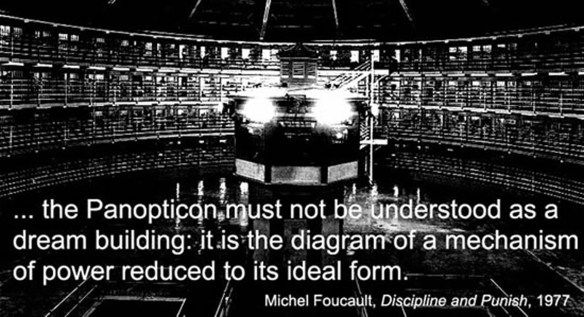
In Plato’s Allegory of the Cave, people saw a shadow play on the wall and perceived it as reality. Today that Cave has morphed to provide umpteen TV channels and mini-screen gadgets; and the once sanctified living room cave has expanded into a free-range bubble of consciousness – heads bowed before an electronic altar, seemingly oblivious to the outside world.

“The “panopticon” refers to an experimental laboratory of power in which behaviour could be modified, and Foucault viewed the panopticon as a symbol of the disciplinary society of surveillance.”[1]

In Plato’s E-Cave, not only are the people watching a shadow play, they, and the shadows they watch, are being watched.

HyperNormalization
With a veneer of calm aplomb, the masses communicate 24-7, often in a frenetic urgency of the mundane, hence one interpretation of HyperNormalization. In all the years of overhearing cell-phone conversations in public, I can’t recall one snippet of philosophy or practical advice, rather stuff like, ‘yeah OMG I’ll get the chips!’ and ‘I’ll be there in like 30 seconds!’; if you’re old enough, you’d remember the days when, you got there when you got there! That said, a cell-phone can be a helpful even life-saving device.

The USEmpire election appears to have both proven and disproven the main theory of Adam Curtis’ fascinating new documentary “HyperNormalization.”

“Curtis argues that since the 1970s, governments, financiers, and technological utopians have given up on the complex “real world” and built a simple “fake world” that is run by corporations and kept stable by politicians.”[2]

The California cyber-tech-boom was a love-child of LSD-consciousness that found refuge in E-wizardy all the while looking to escape repressive politics. In his book “2030” Pepe Escobar describes it as: “Digital network capitalism would then shape post-modern globalization, from the New Economy before the end of the millennium to every digital wall to be broken beyond. California cosmology forged our world.”

According to Wikipedia:

“The term “hypernormalisation” is taken from Alexei Yurchak’s 2006 book Everything was Forever, Until it was No More: The Last Soviet Generation, about the paradoxes of life in the Soviet Union during the 20 years before it collapsed. A professor of anthropology at the University of California, Berkeley, he argues that everyone knew the system was failing, but as no one could imagine any alternative to the status quo, politicians and citizens were resigned to maintaining a pretence of a functioning society. Over time, this delusion became a self-fulfilling prophecy and the “fakeness” was accepted by everyone as real, an effect which Yurchak termed “hypernormalisation”.”[3]

First off, I see HyperNormalization as a half-truth because while the self-referential, gossipy world is fake, it is a veneer for a very real world of resource extraction and the violence perpetrated to maintain the status quo – and that is what the fakers ignore. As far as the election, many expected the Clinton dynasty to prevail as the corrupt, business as usual lesser of two evils. Breaking snooze: Where’s  the headline news that Melania Trump plans to focus on helping women and children?; I saw that mentioned on CNN’s Anderson Cooper 360, such a perfect antidote for Hillary’s loss and The Donald’s anti-feminist track record.

Even though WikiLeaks revealed the DNC (Democratic National Convention) was rigged against Sanders and leaks of Podesta/Clinton e-mails may have been proverbial straws for Hillary’s campaign camel, the prevailing media sentiment was that she would win – despite the fact that the day before the election some polls indicated a shrinking 3-4 point lead, thus with the typical margin of error, it was, in effect, tied. Yet the mass hyper-surprise!; and all that after the corporate media and comedy shows had simultaneously bashed Trump and given him more air-time than a kite on a windy day – both disdaining and elevating him, a media-mindfuck if ever there was one.

And there was little uproar when Gary Johnson and Jill Stein were excluded from debates and virtually banned from all corporate news, thus proving (if you didn’t know already) that it’s not a truly democratic election. Yet carry on we must and do the best we can with what we got, was the general sentiment, in other words, “the “fakeness” was accepted by everyone as real” aka HyperNormalization.

Yet the non-coastal, poor and middle America White working class (with sides of KKK and minorities!), which reportedly was the key demographic for The Don’s victory, was voting out of bare-bones needs; in effect they were not HyperNormalized. Then again, if Trump, who promises to challenge the status quo, caves-in to Deep State pressure, we will have an answer to an interesting article’s titular question: “President Trump: big liar going to Washington or Tribune of the People?”[4] And if that answer is the former, then the mostly White working poor will also have been duped/HyperNormalized.

You see, it’s hard to know what’s what; which all seems to prove HyperNormalization as the dominant societal charade; which screen is real, if any?

What you perceive is what you get
Another key phrase in Curtis’ documentary is “managed perception” – akin to Chomsky and Herman’s  “Manufacturing Consent: The Political Economy of the Mass Media” (1988) which showed how opinions and desensitized agreement to the status quo became a product to be mined and marketed. Witness CBS Chairman Les Moonves’ comment from February 2016:

“Man, who would have expected the ride we’re all having right now? … The money’s rolling in and this is fun. I’ve never seen anything like this, and this [is] going to be a very good year for us. Sorry. It’s a terrible thing to say. But, bring it on, Donald. Keep going.” [5] And, if i might satirically add, like an orangey topped Duracell battery, The Don does seem to have a lot of energy.

HyperNormalization is also akin to Sheldon Wolin’s theory  of “inverted totalitarianism,” where the faceless corporate machine wields so much entertainment and bureaucratic power that the people barely notice they are being played hook, line, and sinking feelings.

Some of Curtis’ info, however, is inaccurate or questionable. For examples, he blames the demise of the Occupy Movement on lack of vision and planning yet neglects to mention the FBI coordinated systemic crackdown on the ‘camps’ across the country. [6]

About Syria he says that President Bashar al-Assad retaliated with a “vengeful fury,” whereas Assad has defended his actions as self-defense for his people; numerous journalists back the Syrian President’s claim.

Post-election, I wonder: Why were so many liberals, lefties, and women more surprised that Trump won than that the DNC/HRC rigged it against Sanders? Were they simply feeling impotent due to HyperNormalized shadow play? Whatever the case, his victory revealed a crack in the smooth screen of HyperNormalization.

According to Patrick Caddell’s survey before the election, the populace seems to be hip to what’s happening:

“Powerful interests from Wall Street banks to corporations, unions and political interest groups have used campaign and lobbying money to rig the system for them. They are looting the national treasury of billions of dollars at the expense of every man, woman and child. AGREE = 81%; DISAGREE = 13%…

“The country is run by an alliance of incumbent politicians, media pundits, lobbyists and other powerful money interests for their own gain at the expense of the American people. AGREE = 87%; DISAGREE = 10%

The real struggle for America is not between Democrats and Republicans but between mainstream American and the ruling political elites. AGREE = 67%; DISAGREE = 24%.” [7]

This makes it seem it is the ‘how-to bring about change’ that is the deeper conundrum of the HyperNormalized world. Then again, people too often seem to have only their own best interests at heart. Approximately 90% of Americans want their food labeled so as to know if they contain GMOs etc. or not, yet hardly a peep out of anyone that climate change or the “environment” aka Mother Earth & Nature-beings were deliberately excluded as a main topic of the presidential debates. This makes it seem that, in general, Americans want clean food for themselves, they want a clean environment so they can go ‘play in the park’ by themselves. And that brings us to the Great Disconnect and Standing Rock.

Flow like water, be steady as a rock
Part of HyperNormalization is a disconnect from Nature and from being self- and community-guided, and therefore disconnected from the Original Peoples of Turtle Island. While many people are certainly aware of what’s happening with Standing Rock, the corporate media’s lack of attention, let alone empathy, fosters lack of concern for the outcome, lack of being outraged by the violent and racist treatment of those in prayer and peacefully protecting the main source of water for the Standing Rock Sioux and other Natives as well as approximately 17-million people downstream. The real-fake outrage is over the outcome of a fake election.

For many Native reservations where poverty and PTSD are prevalent, the people are anything but HyperNormalized; they are struggling to survive – as with Standing Rock, they are not asking for much: clean water and the space to live their lives with ancient traditions timelessly connected with the land, the water, the stones…

Plato, imagining a prisoner getting outside of the Cave, wrote: “Slowly, his eyes adjust to the light of the sun. First he can only see shadows. Gradually he can see the reflections of people and things in water and then later see the people and things themselves. Eventually, he is able to look at the stars and moon at night until finally he can look upon the sun itself .” [8]

Standing Rock is bringing people together, raising consciousness at many levels. As one example from a little over a week ago:

“In a “historic” show of interfaith solidarity, 500 clergy members prayed along the banks of North Dakota’s Cannonball River on Thursday where they “bore witness with the Standing Rock Sioux Nation,” which has faced intimidation, violence, and arrests for protecting their sacred land and water supply from the threats of a massive oil pipeline. According to the Episcopal News Service, “The interfaith group spent more than five hours on site, marching, singing hymns, sharing testimony, and calling others to join them in standing with the more than [300] tribes who have committed their support to the Sioux Nation as they protest the route of the Dakota Access Pipeline (DAPL).” [9]

This solidarity is in stark contrast with the election where a typically 51/49 system determines an outcome for a society literally programmed for exciting close-call winners – think sporting events,
reality shows, awards ceremonies.

Outside in and inside out
There are many ways to get outside the Cave. One of those is by going within. When I first started to meditate, as is common, I became aware of the constant chatter in my head and soon realized that the mind left unattended will rattle on endlessly. Meditation then showed me that once the chatter quiets, one then has access to other frequencies, other ‘channels’ – what happens then is a very personal matter yet also impersonal because one becomes connected with another source of thinking-seeing-feeling. Chatter, like cell-phones, has it’s usefulness, say, if you forgot to turn the stove off. My point to the personal anecdote is that the corporate media is too much chatter, endlessly looping itself. The gadgets, too, though useful, seem hard-wired for HyperNormalization.

Some of the chatter we must live with, yet by learning to follow our intuitions, listening to and connecting with Nature, talking with elders and little children we can better tune-out from the shadow-play, we can find new and ancient ways for more people – and that includes trees, rivers, etc. –  “to look at the stars and moon at night” and “look upon the sun itself.”

“Sin filo ya y derrotada se quejó: Soy más fuerte que ella, pero no le puedo hacer daño y ella a mi, sin pelear. me ha vencido.’”

“Without sharpness and defeated, it [the sword] complained: ‘I am stronger than the water, but I cannot harm her. And the water, without fighting, has conquered me.’” [10]

NOTES:
1.    Panopticism here and here.
2.    Ibid.
3.    HyperNormalization
4.    See here.
5.    “Les Moonves: Trump’s run is ‘damn good for CBS’”. See here.
6.    “Revealed: how the FBI coordinated the crackdown on Occupy
7.    “Patrick Caddell; The Pollster Who ‘Got it Right’
8.    “Allegory of the Cave
9.    “A Prayer for People and Planet: 500 Clergy Hold ‘Historic’ Mass Gathering for Standing Rock
10.    “Questions & Swords: Folktales of the Zapatista Revolution” as told by Subcomandante Marcos, Cino Puntos Press, El Paso, Texas, 2001, p.82.

To watch “HyperNormalization”, click here.

Mankh (Walter E. Harris III) is an essayist and resident poet on Axis of Logic. In addition to his work as a writer, he is a small press publisher and Turtle Islander. His new book of genre-bending poetic-nonfiction is “Musings With The Golden Sparrow.” You can contact him via his literary website.


“Why Don’t You Just Get a Better Job” and Other Dumb Shit People Say to Low-Income Earners Stuck in Precarious Work

precarious-work

By Chloe Ann King

Source: The Hampton Institute

For most of my working life I have been stuck in the hospitality industry which is lowly paid, painfully precarious and poorly regulated. In New Zealand, where I live, hospitality employers mostly treat you as nothing more than an easily replaceable unit to turn-over-profit. I have spent over a decade in this industry and as such I have become acutely aware of the fact that no matter how many shifts I work or how many poorly paid jobs I undertake; I will never have enough money to meet rising living costs.

Sometimes, my life is a bit depressing. You know what I mean? I get up, I go and work one of my multiple jobs and I come home. Each week I check my bank balance and I feel pretty put-out about how low my pay is as compared to how hard I worked for it.

Obviously, working hard at minimum wage jobs is never going to land me economic security. No matter how hard I have worked in the hospo industry I have never ever received a pay-rise, not once. The lie of “hard work” serves to convince us that if we fail to achieve happy, healthy and joy filled lives which are economically secure thanks to well paid jobs, it is because we failed to work hard enough for it. Constantly we are told that external factors do not affect us. This type of pervasive ‘positive’ rhetoric isendlessly used by many self-help Gurus such as Tony Robbins, one of America’s most well-known motivational speakers.

The lie of “hard work” is pitched to us – those from the working and lower classes, by not only self-help gurus and spiritualists but politicians and well intentioned high school teachers and even our parents, as being one of the best paths to prosperity. This myth is perpetuated and disseminated by the mainstream media as motivational newsworthy ‘human interest’ stories. However, there is very little which is human about these types of stories. The core of these news pieces has nothing to do with humanity or being human and everything to do with selfishness and individualism and play on insecurities and our need to compare our lives to others who we think or we are passive aggressively told, have it better than us.

A few months ago the NZ Herald (New Zealand’s most read newspaper which controls the national narrative) ran yet another one of these “motivational” articles on a young landlord named Gary Lin. Who has managed to buy up a staggering eleven properties citing “hard work” as a reason for his success. He told the NZ Herald,

“Work hard, work smart, save hard, and invest smart. Wealth creation is not rocket science – perseverance and hard work can get you there.”

As if wealth creation is something we should as young people, be aspiring to. In times of great wealth inequality, we should be demanding wealth dispersal not setting out to create and covet wealth for ourselves. Gary, unlike most of us, was given a hefty “leg up” or what we poor folk call a “handout” by his father in the sum of $200,000 as a wedding gift which allowed him to buy his first home which cost him $175,000. I guess for some people money really does grow on trees.

I hate to break it to you Gaz – can I call you Gaz? But “hard work” had nothing to do with your successes in life.

Gaz got lucky. He won the genetic lottery and was born into wealth – he did not earn the money that helped him buy his first home. It was given to him. Instead of using his unearned wealth to help others he made the choice to punch-down and profit off the growing number of people stuck in the rental trap by hoarding properties. Gaz has engaged in predatory behavior by renting his properties out at market rental rates. In an unregulated rental market the odds are never in favor of tenants. As George Monbiot wrote for the Guardian, Rent is another term for unearned income.”

People like Gaz rarely acknowledge their economic success is at the expense of those from the lower and working classes. To recognize this Gaz, might have to feel a little bit bad about how he came into his millionaire property portfolio. He might have some kind of world shattering epiphany that he is not as smart as he believes and his successes are owed more to an ability to stomach the ruthless actions and attitudes needed to ‘make it’ in a society that is quickly turning into a dystopian one. Which makes The Hunger Games, look like child’s play. Sociopathy and luck had more to do with Gaz’s successes in life than actual “hard work”, talent and intelligence.

Lawyer and anti-poverty activist David Tong, responded to Gaz’s flawed belief that anyone can own property if they just “work hard” enough, with these words:

“Motivational read from the NZ Herald: You too can be a rich property investor. If dad gives you a $200,000 gift”

“Hard work” and motivation don’t mean shit in a broken economy that was built on the blood, backs and bones of the working class and the most marginalized and vulnerable. Increasingly, accessing upward mobility – which buying property can help you obtain as well as a better quality of life, is becoming an impossible task because of low wages, insecure work and a flooded job market. People are just struggling to get off minimum wage let alone save for a house.

***

The New Zealand Council of Trade Unions states that “At least 30% of New Zealand’s workers – over 635,000 people – are in insecure work. We believe it may well cover 50% of the workforce.” No matter how hard you work it is impossible to get ahead when your employer only offers you inconsistent hours and denies your basic right to a guarantee of minimum hours.

Casual contracts are used widely within the hospitality and service industries and state that your employer owes you “no minimum of hours.” But the expectation is that you will cover and come in when needed and if you refuse you are often faced with penalties. Such as having your shifts cut the next week. Having the stability of a salary as opposed to waged work is a far off dream for so many of us. You can’t budget let alone save money for a house when you never know what your pay-check is going to be from one week to the next.

Economic insecurity because of cut shifts and insecure hours has been a major feature of my working life. For example, last year just before Christmas I had my shifts cut in half. I went from working between four and five shifts a week down to only two. I was given six days’ notice and when I pointed out how hard this would hit me economically to a Duty manager I was told, “I should go and find a second job” and reminded that “I was only on a casual contract so there was not much I could do about it.”

For the last few months I had been back-breakingly flexible for this employer. I had come in whenever I was needed and covered shifts at short notice. I had worked hard to make every customer’s experience an enjoyable one, all this for minimum wage. I spent most of December desperately scrounging around for a second job, as did two other workers who had suffered the same fate.

I popped into the same work soon after my shifts had been cut to collect my tips and one of the regulars who had been drinking, accosted me verbally and demanded to know why I was in such vocal support of the recent rolling strikes of Bunnings Warehouse workers. These workers had been subject to Zero Hour contracts, eternal bullying and harassment from managers and no guarantee of shifts or rosters. He said “why don’t these Bunnings workers just go out and get a better job”. This statement coming from a white male Baby Boomer who enjoyed free tertiary education and did not start his working life off in debt. All is crimson and gold in middle class Whiteywood, I guess.

“Why don’t you just go and get a better job?” This singular narrative epitomizes the ignorant attitudes of people like Gaz and the regular from my work whose name is ironically Gary, as well. It also puts the sole responsibility of finding well paid and meaningful work onto the worker, while absolving a government’s responsibility to push for job creation which serves their citizenry and the environment and to raise the minimum wage to a living wage, in New Zealand.

If over 30% of the workforce is stuck in precarious work and large sectors of the workforce earn below Aotearoa’s living wage of $19.25 an hour, finding “better work” is statistically impossible for a vast majority of us. There are thousands of hospitality businesses in Auckland, New Zealand, and only a handful pay a living wage and nearly none offer a guarantee of hours. As such telling people to “get a better job” is like telling them to buy a lotto ticket and live in hope they take out the jackpot.

***

No matter what the Gaz’s, Gary’s and the self-help superstars such as Tony Robbins of this world have to say on the myth of “hard work” and perseverance paying off one day, the reality is our ability to access upward mobility; buy a house; obtain a decent standard of living is tied to what type of work you can access. External factors not only deeply impact people’s lives they oppress those who do not benefit from certain types of privilege. Not all roads lead to Rome. More often than not for us poor folk they lead to roadblocks and hurdles that increase based on the colour of your skin, the class you were born into and/or your gender, how bodily abled you are and your sexuality or a combination of all of these.

People’s situations are complicated and difficult and cannot be curtailed into passive aggressive motivational “one liners” that nearly always punch-down and not up. Our working class struggles cannot be solved by a set of self-help rules or keys or steps which are meant to guide anyone to economic stability and lead you to the life of your dreams and a perfect job. In the book, The New Soft War on Women, the chapter entitled ‘Doing Well May Not Work Out So Well’, Caryl Rivers and Rosaling C. Barnett, write,

“We like to believe that the workplace is fair and that if we do a good job, we will be rewarded. After all, that’s the American way. But this belief is less true for women than it is for men. Indeed, too often women’s performance which is stellar gets fewer rewards than men do – even men who are less than outstanding.”

During a major speech at Wellesley College, presidential candidate Hillary Clinton, talked about the role women can play in politics and public life, she said,

“We know we’ve got to keep pushing at that glass ceiling. We have to try and break it… Obviously. I hope to live long enough to see a woman elected president of the United States.”

Encouraging women to break the glass ceiling is all well and good but what if moving off minimum wage and accessing a living wage, is no easy feat? In America alone, 6 out of every 10 women are stuck on minimum wage.

The Glass Ceiling is so high up most of us can barely even see it. Researchers at the non-profit group Catalyst point out, “[…] when you start from behind, it’s hard enough to keep pace, never mind catch up-regardless of what tactics you use.” Both Rivers and Barnett went on to write,

“Doing all the right things to get ahead-using those strategies regularly suggested in self-help books, coaching sessions and the popular press-pays off much better for men than it does for women.”

As women, we do not struggle to “get ahead” because of personal failings but this struggle is born from structural sexism which creates gendered inequality.

Telling white women and women of colour to be more ambitious and just “work harder” if they want to smash the Glass Ceiling and obtain a decent standard of living is almost laughable. Considering many women, in particular, indigenous women and women of colour, are still struggling to make it out of the basement. Still, self-help gurus such as Tony Robbins preach to millions that none of what I am writing about actually matters: race, gender… whatever you were born as, and into, does not have to hold you back. You just have to believe in yourself and follow the Tony Robbin’s step-by-step guide to snagging a life beyond anything you could ever dream of. Which he has called: ’12 Keys to an Extraordinary Life’. You couldn’t make this shit up. He said at a recent event:

“I don’t care if you are young or old, I don’t care what your colour is, what your gender is, what country you come from, if you understand the science of building wealth you can have an abundance of it. If you violate those rules [of the 12 keys to an Extraordinary Life] either because you’re ignorant to them or you don’t apply then, you are going to have financial stress”

Tony, who sounds uncomfortably like Gaz in his belief anyone can become a millionaire, may as well have just said “we are all one”! “Everyone can make it no matter what grinding and economically depressive situations you come from”! And be done with it.

Financial stress is not brought about because you have unknowingly violated one or more of the ’12 Keys to an Extraordinary Life’ which Tony has made tens of millions off. Violating female stereotypes of passivity have a lot more to do with our failure or success in the workplace than how hard we do, or do not, hustle for top positions and top earning brackets. Rivers and Barnett write, “Competent women violate the traditional female stereotype of passivity. And that violation can trigger a reaction of fear and loathing [in the workplace].”

Financial stress is brought about because of injustices such as the pay-gap and the coloured pay-gap. Something Tony, has clearly gone out of his way to ignore. Self-help gurus and people like Gaz and Gary tend to, “displace questions of social justice and frame their rhetoric by the individualist and corporatist values of a consumer society,” as both Jeremy Carrette and Richard King wrote in the book, Selling Spirituality: the silent take over of religion.

Both Rivers and Barnett point out in relation to the American pay gap,

“Hispanic/Latino women have the lowest median earnings, earning just 55 percent of the median weekly earnings of white men; black women have, median weekly earnings of 64 percent of those of white men.”

The pay gap for America’s first nation indigenous women also sits at 55 cents in the dollar compared to white men, as non-profit AAUW reports. Indigenous women are faced with earning nearly half of what white men do in America.

Similarly, in Aotearoa indigenous Maori and Pasifika women, face significant coloured/indigenous pay-gaps compared to white men and women. TheDominion Post, reported last year, “Maori and Pasifika women are more likely to be in the lowest paying jobs, which increases the poverty in their lives and communities.” The Human Rights Commission has been tracking unfairness and inequality at work and cites that Pasifika women on average earn $57,668 while white men earn $66,900. What this data shows us is that, “Men are paid more than women overall and within ethnic groups. The effects increase when combining several factors as is the case between New Zealand European men and Pacific women. These patterns have persisted over time.”

These “patterns” of women of colour and Indigenous women being paid significantly less than white men and women, to do the same damn jobs have “persisted” all over the world from America to Aotearoa. Injustice and oppression is locally and globally connected.

A more accurate description of what the aspirational metaphor of the Glass Ceiling is made out of is to say it is made from lead. So many women are much more likely to fall off what Rivers and Barnett have labelled the “glass cliff” than triumphantly smash the glass ceiling into a million little pieces. Following Tony Robbin’s guide to obtaining some magical, fairy-tale life, or any other pseudo bullshit glittery guides to financial freedom, aren’t going to be very effective for women born into a system which was built to silence and eradicate them.

The only thing I am aspiring to “smash” is white imperial patriarchal systems that at best disempower women and at worst, brutally and often violently oppress them.

***

As workers we are criticized for our behavior whether we are told we need to be “more ambitious” or we “just need to work harder” in response to our perceived failure to land a great job with good pay and consistent hours. I am so tired of listening to people who endlessly tell me to go and get a “better job” or a “real job” (what does that even mean?!). And I have lost count of the times I have been told by people who hold anti-protester positions to “go and get a job” while I am on the picket line or the protest ground. As if the low waged work I do counts for absolutely nothing. As if service industry work is some kind of phantom job.

This is for anyone who has ever told a service worker to go and get a “job” or a “real job”: why don’t you make your own double shot soy latte, flip your own burgers and pour your own damn beer and make your own designer espresso martini, which costs more than I make in an hour.

When as a worker, I refuse to put up with horrible workplace conditions and hit the picket line or call the Union as a form of resistance I have been called a “trouble maker”, “dirty hippy” and an “inconvenience”. I am proud to be all of those things. I am glad I stood up and was brave and risked job loss (sometimes I have lost my job for speaking out) and arrest in an attempt to better my workplace conditions. The only people who are “dirty” are those who seize on disaster capitalism and economically benefit from the oppression of others… I am looking at you Tony Robbin’s and Gaz.

We need more workers collectively rising up and following the lead of Health Care workers, Bunning Warehouse and Supermarket workers and more recently Bus drivers. Who have all relentlessly hit union backed picket lines to demand ‘fair pay for fair work’ and better work conditions, in New Zealand. And less people thinking magically one day their lives will get better if they just play by the rules and perform their duties at work without complaint. This is nothing but blind faith. It is like believing in god: no matter how long you patiently wait he is not going to come and save you.

People from the working classes and those who have been in the wake of the 2008 financial crash, disenfranchised from the middle and upper-classes can save each other. But we need to refuse to allow those who hold power to continue to pit us against one another in some kind of Capitalist Death Match. Where the only prize you get is some demeaning job where the wages are so low you have to pick between buying food or paying the electricity bill. Starving or freezing does not sound like much of a “win” to me. It sounds like bullshit.

The more people who push against injustice in staggering numbers the harder it is for the media to ignore us and distort our messages of resistance.

Many people’s grinding situations have nothing to do with individual ‘bad choices’ or laziness or you know, violating the ’12 Steps to an Extraordinary Life’. No matter how many times we hear rotten rhetoric like this we must refuse – absolutely – to accept these types of pervasive and dominant narratives. At their core these narratives use shame and ruggedly focus on the individual as a method to pacify and silence. We must disrupt language that is designed to disempower and divide workers while seeming to empower. We need to seek out ways to elevate the voices of our most vulnerable and the messages of people of conscience who can envision a better world and whose political imaginations outstretch the dominant reality.

Lastly, we need to fight and stand with other workers against employers who exploit their employees and view them as nothing more than units to turn-over capital. Jeremy Carrette and Richard King, went on to write in their before mentioned book:

“We are never obliged to accept the dominant version of reality (however conceived throughout history) without question.”