An Open Letter to the People of the United States: Election or Revolution?

votefornobody

(Editor’s note: While we do believe positive change is possible on a local level through grass-roots campaigns and voter initiatives, until major systemic changes are forced into existence we have no reason to expect anything from presidential politics other than what we’ve been subjected to for the past few decades.)

By Robert J. Burrowes

As citizens of the USA with a presidential election approaching you have a wonderful opportunity to ponder whether to participate in this election or to participate in the ongoing American Revolution.

Your first revolution might have overthrown the authority of the British monarchy and aristocracy but the one in progress must remove the US elite which has executed a political coup against your government. And you cannot remove elite coupmakers in a fraudulently conducted election in which the ‘choice’ is essentially between two violently insane individuals, each of whom represents the violently insane US elite. See ‘The Global Elite is Insane‘ and ‘Why Violence?

The real value of this second revolution, which moves along steadily with routine outbreaks over a multitude of peace, environmental and social justice issues and occasional ‘uprisings’, such as the Occupy Movement in 2011 which spawned a range of new and visionary initiatives, is that it could give citizens of your country the chance to finally reclaim the Republic for those people who genuinely care about ‘life, liberty and the pursuit of happiness’. And, just as importantly, have sufficient vision to regard these aspirations as something to be shared with the entire US population, starting with Native Americans, and even those of us in the rest of the world including those countries that are currently victims of US elite violence, whether it be wars, drone strikes, coups, economic exploitation or ecological destruction.

Such a revolution might rewrite your constitution and replace the second amendment ‘right of the people to keep and bear arms’ with the right to live free of the fear of gun violence. It might result in a form of social organization that distributes wealth equitably (perhaps by actually taxing the wealthy and outlawing the use of offshore tax havens) while reallocating the annual military (killing) budget to life-enhancing projects such as poverty alleviation, affordable housing, free education, free healthcare, clean water, renewable energy technologies, and a substantial budget for compensation to those countries that the US elite has systematically exploited or simply destroyed during the past 200 years. This would allow the 50 million US citizens who live in poverty, and another billion people around the world who also live in poverty, the chance to live a decent life.

Now, you might ask, ‘How are we, the ordinary citizens of the United States, even with our handguns, rifles and assault weapons, going to take on the US military and police to remove elite control of our government?’ Well, the answer is that you do not need even one weapon for this ongoing revolution and, in fact, you are vastly better off without them. Weapons have only one use – to kill people – and any revolution worth the name has a more profoundly ambitious aim than this.

What you need is intelligence, commitment, courage and a sound nonviolent strategy. The US elite controls your government and has crippled your republic because, over successive generations, you have let them. Every time you cooperate with the elite, because you are scared, by paying your taxes (more than 50% of which finances US wars and other military violence), putting your money into their corporate banks, shopping at their corporate shopping malls, buying and consuming the ‘news’ presented by their corporate media, rationalizing their policies as reasonable, participating in their unjust and violent legal system, fighting (as an enlisted person or as a mercenary) in their military forces, working in their prison system, accepting exploited employment of any kind, eating their poisoned and genetically mutilated foods (GMOs), going along with their endless attempts to divide you along racial, class, religious and other lines, you simply consent to their control. Why?

You have a simple alternative. Consciously and systematically participate in the ongoing nonviolent revolution that is already taking place and give it added life by your presence. Remake the US republic as you want it by withdrawing your cooperation with elite structures and processes while creating alternatives that meet your needs and the needs of those around you.

Join those US visionaries who are creating cooperatives where people are both managers and valued workers, take your money out of elite banks and put it into financial organizations that exist or which you create to serve the interests of their members (or, if you prefer, use LETSystems), refuse to participate in or pay for (with your taxes) US imperialism (and win friends all over the world), grow or buy healthy locally-grown organic/biodynamic (and, if you are concerned about the climate catastrophe as well, vegetarian) food, read progressive news outlets so that you know what is really going on in the USA and the world, read literature that deepens your understanding and concern for humanity and doesn’t just offer you a distraction from the horror in which you live, and support or even become one of those many fine nonviolent activists in your country who take personal risks in the struggle to create a better world.

If you want more of what you have, then you should vote and/or buy a gun. They have an equivalent outcome: they both legitimize elite violence and exploitation directed at you and those you love.

If you want to participate in this second and ongoing American revolution, then spend your time participating in the wholesome activities that many grassroots organizations already offer and in creating its next manifestations in your own neighborhood. It is the powerful conscience-based choices that you make as an individual that define your Self. And it is these choices that will have most impact on your family, neighborhood, community organization, trade union, religious organization and elsewhere and that will help decide the future of the USA and its role in the world.

Now you might say, I do some or even all of the sorts of things you mentioned above, so why not vote too? My answer is simply this: Voting is an act of disempowerment. It’s essential message is ‘I appoint you to govern for me’. I prefer to govern myself (both meanings intended). And you?

So what of those who present the ‘lesser evil’ argument: one candidate is so bad that it is better to have the other. This ‘argument’ is not worthy of scrutiny. If you are deceived by this argument, you will vote forever in the delusional hope that you will one day get a choice to vote for someone genuinely decent. In 2008, Barack Obama was supposed to be the candidate of hope and change. Did you get that hope and change? Are you going to get it with Clinton or Trump? Of course not. Elites simply ensure that change via the electoral system cannot happen; its function is to absorb and dissipate our dissent.

If you vote you are saying that you endorse this system of electoral exploitation. The tragedy is that even third-party candidates, who may be people of genuine principle, have no chance. Even worse, they add a veneer of legitimacy to your corrupt electoral system.

In essence, if you vote for the ‘lesser evil’ you are still voting for an ‘evil’ and, more importantly, you have participated in and endorsed an ‘evil’ system: one which denies you a genuine ‘free and fair’ choice to vote for a candidate who actually represents your interests and views and has a reasonable chance of winning. And, having won, is then able to actually implement their policies (rather than be stymied by a power structure that has no intention of letting this happen). Given your circumstances, ‘the only winning move is not to play’ their corrupt game and to put your energy into a genuinely winning move: working for the regeneration of American society.

Look at it this way. If there are two rotten eggs, would you choose the one that is less rotten and eat it? Presumably you would seek another option and only after you have identified and fixed what is causing the problem in the first place. The point is this: Unless you spend your time deeply contemplating the nature of the society in which you want to live and then devoting your time and energy into creating that society, you will never have it. And you have betrayed yourself.

The reality is that either Clinton or Trump is going to be president of the USA for the next four years and a lot of people (both in the US but particularly in foreign countries) are going to die because of it (through US military violence and corporate exploitation). What we can do is to invest our political energy into creating a United States in which, at some point in the future, the likes of Clinton and Trump, and those they represent, no longer drive outcomes in our world.

To reiterate: I am not saying ‘Don’t vote and do nothing’ (as so many people do already). I am suggesting that you ponder the dysfunctionality of your society, do some research into the secretive ‘deep state’ (or military-industrial complex or power elite or the 1% or however you wish to describe it) that controls your ‘republic’ with its electoral system designed to delude you into believing that you have a say in governing your nation, and then consider how you want to engage politically and act in accord with your conscience in doing so. It is only by doing this that we will have any chance of getting the society and the world that we want, even if it is beyond our lifetimes (and assuming we can avert extinction at our own hand in the meantime).

In summary, profound change only occurs from the ‘bottom up’ when enough ordinary people take the initiative to remake their own society. And if you are really interested in doing this, one important place to start is by reviewing the way in which you nurture children. See ‘My Promise to Children‘.

Other straightforward options, in addition to those mentioned above, include participation in ‘The Flame Tree Project to Save Life on Earth‘ and signing the online pledge of ‘The People’s Charter to Create a Nonviolent World‘.

But for those of you who are serious strategic thinkers, I have outlined a strategy for removing coupmakers on the website Nonviolent Defense/Liberation Strategy which is a straightforward presentation of the more detailed explanation offered in the book
The Strategy of Nonviolent Defense: A Gandhian Approach‘.

Is our destiny in our own hands? Only if we have enough people of courage to accept responsibility for it. Are you one of them?


Biodata: Robert J. Burrowes has a lifetime commitment to understanding
and ending human violence. He has done extensive research since 1966 in
an effort to understand why human beings are violent and has been a
nonviolent activist since 1981. He is the author of ‘Why Violence?
His email address is flametree@riseup.net
and his website is at http://robertjburrowes.wordpress.com


Robert J. Burrowes
P.O. Box 68
Daylesford
Victoria 3460
Australia
Email: flametree@riseup.net

Websites:
Nonviolence Charter
Flame Tree Project to Save Life on Earth
‘Why Violence?’
Nonviolent Campaign Strategy
Nonviolent Defense/Liberation Strategy
Anita: Songs of Nonviolence
Robert Burrowes
Global Nonviolence Network

Charlie Kaufman on Zombie Ants, Mind Control, and Consumerist Culture

By The Unknown

Source: High Existence

Charlie Kaufman has one of the most inventive and original minds in Hollywood. That’s probably why he has eluded mainstream success.

Mr. Kaufman is perhaps best known for writing the modern classic Eternal Sunshine of the Spotless Mind, for which he was awarded an Oscar for best original screenplay. He’s also the writer of Being John Malkovich, Adaptation, Anomalisa, and the writer-director of the little-known but brilliant Synecdoche, New York, which Roger Ebert named the “best film of the decade” (2000-2010).

In the words of fellow writer Jeremy Brock:

One of the few screenwriters to transcend his profession, Charlie Kaufman is responsible for some of the most unique, daring, and inventive screenplays in contemporary cinema. […] His films deal with identity, mortality, relationships, and the meaning or purpose of life. They are metaphysical, self-reflexive, hyper-aware, often using surrealist conceits to explore our fundamental anxieties. It is in this tradition of finding new, startling, and funny ways of exploring human psychology that Charlie Kaufman sits comfortably amongst the world’s greatest living writers.

Fans love him. Critics adore him. Mainstream audiences… ignore him.

And that’s a shame.

In a world filled with sequels, prequels, remakes, and reboots, creativity is dying in Hollywood.Worse than dying, I’d argue that creativity is being tied up, beaten, tortured, mocked, murdered, then thrown in a gutter and pissed on.

You could argue that I’m cynical.

You could also argue that I’m tired of being patronized by the regurgitated garbage Hollywood pukes up and tries to spoon feed us. We all know the difference between food and vomit, and Hollywood’s been steadily feeding us barf for the last ten years while distracting us with silly airplane noises like we’re babies.

But I’m getting sidetracked.

This isn’t about my personal disdain for Hollywood; this is about Charlie Kaufman’s views on consumerism, and Charlie Kaufman is much more polite, intelligent, and eloquent than I am.

I stumbled across a speech Charlie Kaufman delivered at a BAFTA lecture in 2011 and absolutely loved it.

Mr. Kaufman was supposed to deliver a speech about screenwriting, but gave the audience much more. The full speech covers a broad range of topics, but I spliced together a few of my favorites — Zombie Ants, Mind Control, and Consumerist Culture — and created the video below.

Watch and listen as Charlie Kaufman dissects and diagnoses the fallacies of our present-day culture, but rather than react with juvenile indignation (as I did in my brief rant earlier), he responds with poignant words of heartbroken yet hopeful wisdom.

Enjoy!

Google’s lemmings: Pokémon go where Silicon Valley says

index

An analysis of Ingress and Pokémon Go reveals important truths about corporate control and the ability of our mobile phones to organize our desires.

By Alfie Brown

Source: ROAR Magazine

his article has a clickbaity title but a sobering and concerning point to make. In 2010, Google started up what is now a very important subsidiary, Niantic Inc. Google starts up a lot of companies each year and acquires a great many more, so there is nothing special in this. What is important is that whilst most of us see Google’s acquisition of every “start-up” and endless development of “subsidiary” companies with different names as simply an attempt to completely monopolize the market, the case of Niantic shows us that there is more to the extent of Google’s power.

Six years on from its inception with the launch of its biggest game yet, Pokémon Go, Niantic has hit the headlines and people are finally paying attention to the company, with some apparent leftists even claiming we ought to boycott Pokémon Go. In fact, Niantic have been working on mobile phone psychology and social organization for several years. An analysis of the company’s two big games, Ingress and Pokémon Go, shows us some important truths about the world we are living in, about corporate control and about the ability of our mobile phones to organize our desires.

Niantic developed their first major game, Ingress, in 2011. The game, one of the most important of recent years, is a key ideological tool for Google — one that, unlike Pokémon Go, is little publicized. Ingress has seven million or more players and Ingress tattoos show the degree to which people define themselves by the application. Some players even describe Ingress as a “lifestyle” rather than a “game”. The reader can be forgiven for thinking: “I don’t play it, so why would this apply to me?” But the entertainment coming out of Google via Niantic is in line with Google’s wider project of regulating our movements and experiences of the physical world; unless you don’t use Google or any of its applications, many of which come built-it to our phones and cannot be uninstalled, this applies to you.

Ingress reflects a trend of mobile phone application development (which includes Google Maps and Uber, among other well-known apps) designed to regulate and influence our experience of the city, turning the mobile phone into a new kind of unconscious: an ideological force driving our movements while we remain only semi-aware of what propels us and why we are propelled in the directions we are.

I first considered the importance of mobile phone games to be about a kind of “distraction” — an argument I made in my book and related article in The New Inquiry. Later, when playing Ingress for the first time, I realized there was a lot more to it than this. Ingress, rather than simply distracting us from the city around us, actually trains us to become Google’s perfect citizens. In Ingress, the player moves around the real environment capturing “portals” represented by landmarks, monuments and public art, as well as other less-famous features of the city. The player is required to be within physical range of the “portal” to capture it, so the game constantly tracks the player via GPS. Importantly, it not only monitors where we go, but directs us where it wants us to move.

As such it is very much the counterpart of Google Maps, which is also developing the ability not only to track our movements but to direct them. Of course, Google’s algorithms have long since dictated which restaurants we visit, which cafés we are aware of and which paths we take to get to these destinations. Now though, Google is developing new technology that actually predicts where you will want to go based on the time, your GPS location and your habitual history of movement stored in its infinitely powerful recording system. This, like Ingress, shows us a new pattern emerging in which the mobile phone dictates our paths around the city and encourages us, without realizing it, to develop habitual and repetitious patterns of movement. More importantly still, such applications anticipate our very desires, not so much giving us what we want as determining what we desire.

Here again, the connection with the concept of the unconscious is useful. While some have seen the unconscious as a morass of unregulated desires, followers of Freud and later of Lacanian psychoanalysis have been keen to show precisely how structured the unconscious is by outside forces. Our mobile phones pretend to be about fulfilling our every desire, giving us endless entertainment (games), easy transport (Uber) and instant access to food and drink (OpenRice, JustEat) and even near-instantaneous sex and love (Tindr, Grindr). Yet, what is much scarier than the fact that you can get everything you want via your mobile phone is the possibility that what you want is itself set in motion by the phone.

Into precisely this atmosphere enters Pokémon Go, out just days ago, and already the most significant mobile phone release of 2016. The game is, of course, made by none other than Niantic Labs. A series of hysterical events have already arisen from the ethical minefield that is Pokémon Go. In the case of Ingress, academic study has already been dedicated to the fact that the game has sent young children into unlit city parks at 3am. With Pokémon Go, Australian police have had to respond to a bunch of Pokémon trainers trying to get into a police station to capture the Pokémon within and some people found a dead body instead of a Pokémon. It has already been suggested that Pokémon Go is eventually going to kill someone — and since that article was published someone has crashed into a police car and another has been run-over while hunting Pokemon. But, as with Ingress, it is not the occasional mad story to emerge that should concern us, but the psychological and technological effects of every user’s experience.

The premise of Pokémon Go is simply that you use your GPS to find Pokémon in the real environment and then your camera to make the Pokémon visible, so that the world is enriched by looking through the screen at what lies behind it, as in the image below:

images

The Pokémon itself is an incredible phenomenon deserving of a book length study. Perhaps for now we can say that the Pokémon is the perfect example of what Jacques Lacan called the objet a, that perfectly cute fetishised but illusive object of desire that would truly make us happy if only we could just get our hands on it. We never do, because there is always a newer, cuter and harder to capture version that we just have to catch!

Dystopian visions of what technology and videogames would lead to seem to have got something completely wrong. Depictions of the dystopian videogame future have always tended to see the future as involving each individual isolated from the rest and sat quietly alone in a small room hooked up into a computer through which their lives are exclusively lived. In other words, the importance of the physical environment recedes in favor of the imaginary electronic world. On the contrary to these predictions of the future, we now live in a dystopia where Google and its subsidiaries send us madly around the city almost non-stop in directions of its choosing in search of the objects of desire, whether that be a lover on Tindr, a bowl of authentic Japanese ramen or that elusive Clefairy or Pikachu.

In the 1990s parents could ask their children to “get outside more” to escape the videogame space, but now it is the games that make us charge around the city capturing portals and collecting Pokémon and going on dates. Putting aside the full access that Google gets to your accounts via Pokémon Go, this shows us something really dangerous. It points to the increasing reality that there really is no escape from Google — and that while we are doing what we think we want, believing that we are just using our phones to help us get it, in fact Google has an even greater power, a truly revolutionary one: the ability to create and organize desire itself.

It is this truly revolutionary power that is important when it comes to Pokémon Go and Ingress. To say that these games are revolutionary is not to say that they are doing any good, nor that they are “radical”, and certainly it is not to say that they are left-wing — on the contrary, the revolution in desire appears to be corporate, hegemonic and centralized. If the left is to have any hope, however, it must not resist Pokémon Go, as Jacobin have now famously suggested, but understand and perhaps even embrace the power of the mobile phone to re-organize desire and look for ways forward from here.


Alfie Bown is the author of Enjoying It: Candy Crush and Capitalism (Zero, 2015) and The PlayStation Dreamworld (Polity, forthcoming 2017). He is the co-editor of the Hong Kong Review of Books and writes on the politics of technology and videogames for many publications.

The Eye of the Beholder: There is Never Anything New

414JCSYLsPL._SX332_BO1,204,203,200_

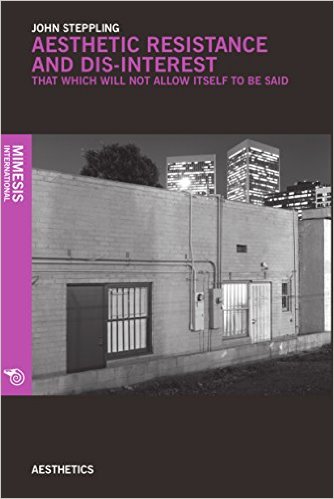
A review of John Steppling’s new book, Aesthetic Resistance and Dis-Interest

By Paul Haeder

Source: Dissident Voice

it is through mimesis, (identification with the mirror image) that one gains a sense of unity, self-containment and mastery over the body. If that was all that there was to it, humanity would be condemned to dwell forever entombed in the hell of mirrors. However, the identification with an Other in the mirror opens out the possibility for symbolic thought.

— John Desmond, author, thinker, who is interested in the history of marketing; construction of knowledge in marketing; consuming culture; morality and marketing; advertising and public policy

The beauty of ideas and words and sculpting frames and philosophical groundings is that we in Western culture having nothing more challenging than the numbness of a consumer-wrecked world where crass hucksterism and financial voodoo wizardry – even with its nuclear tipped propaganda, surveillance and missile dragnet technological orgasm science serves up – pales in comparison to any tried and tested narrative grammar of idea wizards.

Yet, dealing with words now, we see, as one noted playwright and thinker attests, involves PR packaged thinking, possibly a flagrant fascism tied to what can be written (thought) and what cannot be (said).

The title to his book says it all, sometimes – Aesthetic Resistance and Dis-Interest – That Which Will Not Allow Itself to be Said. This is just out in 2016, by playwright, raconteur and philosopher, John Steppling, from the organization, Mimesis International. The book is a compilation of some of his blog postings, and not to denigrate the word “blog” to mean anyone and their uncle expressing anything out there on the world wide web.

Like stepping stones into Steppling’s mind, each essay is a revving reverberating call to mental action, as each essay follows the Introduction with more nitrous oxide pumped into each cylinder of the 12 cylinder motor of his mind: one, Narrative & Empathy; two, Magical Thinking; three, Pedagogy; four, Nothing is Art; five, The Impossible Playwright; six, Someone to Watch Over Me; seven, The Political Uncanny; eight, That Which Will Not Allow Itself to be Said; nine, The Hidden Narrative.

Here, Steppling drills down into the cortex of the American – European, white, patriarchal, Puritan and Elitist – brain, sort of the flash mob mentality we are downloading determinedly. He plugs holes in the tinny junk thinking and pseudo intellectualism hovering around academia, the So Called Liberal Media, the Corporate boardrooms, the waiting rooms at TED Talks 3.0, and the ER’s resuscitating the pop culture that doubles in the minds of the masters of consumption as true art (sic). It’s a violent country, the art is anti-art, and the world of the Imperialist, right-wing or leftie, is predicated on a Heart of Darkness destruction that Steppling decants into the incantation:

The unfinished and fragmentary now emerge as comments all by themselves. When the worst aggressions in society today are often those paraded as benign, or self branded as innocent, even curative, the default response must be one of disconnection. The age of marketing, fueled by Imperialist Capital, has obliterated ideas of belief. Ideas of evidence and trust in our own feelings are all the time under duress and coercion. Aesthetic coercion is the staple of a system of image and narrative control the erases the individual while unrelentingly trumpeting his triumph.

Mimesis conceptually and psychoanalytically is something Theodore Adorno, Robert Hullor-Kentor and Fabo Akcelrud Durao study as they break into the mind of the human condition under the duress of capitalism-hucksterism-market competition-cultural posturing in order to understand how we as thinkers and believers re-narrate when we read a novel or watch a film, as well as engage with poetry and theater. Steppling is looking at this sirocco of thought tied to art, and it’s only that, art, if it changes us somehow. Art can mean buildings, parks, ways entire city blocks and towns are laid out and made to be something more than a mess against nature or utilitarian. Or practical in the Puritanical way. Looking at the Palaeolithic rock paintings around the world, Steppling posits that these sophisticated and voluminous paintings are “exclusively mimetic participation in a magical object .. and that Neolithic artifacts represent a significant change of consciousness, and of the human relationship to the group.”

This short book delves into the heart of what it is to be human, what Pierre Janet (L’Evolution de la Memoire) says how we become the very beingness of “I” – Narration created humanity. This book is just a small sluice into the larger wetlands that spread across the more rarefied postulations of Steppling’s thoughts and comments, here, at this blog: John Steppling – The Practice of Writing – Theatre Film Culture).

Ironically, his most recent post talks about his youth, when he was born in 1951, Laguna Beach, where his mother worked at Woolsworth and father acted in community theater. Steppling looks at Charles Olson and his work in the Yucatan, the same year, 65 years ago, and in that looking back, Steppling unfragments the fragments of memory, youth, childhood, origin, which all boils down to a Western culture seeded with capitalism that is moved by destruction and the boom in the bust:

When Olson dug into the dirt of the Yucatan hills, my parents had moved to Laguna Beach. My mother worked at Woolworths as a counter girl. My father acted in the community theatre there. It was a sleepy beautiful barely touched village, really. It lay off the old Highway — the old PCH. In those years nobody thought about the destruction of entire pine forest in the San Bernadino mountains. Olson didn’t dream of tourist high rises, resorts for white people, all across the Yucatan peninsula.

A half century has been spent in the West destroying things, and destroying people, and destroying beauty. A post apocalyptic treeless suburb, that is the inner circle of hell. Having to live next to affluent white men who bitch about Jews, and then look to play a round of golf at one of the thousands of courses in drought ravaged California. While in far off corners of the globe U.S. made bombs explode and kill and maim. These same guys, over drinks, might discuss topics like ‘reverse racism’. Fifty solid years of this. — John Steppling’s blog

Imagine in this crass, Hollywood-drenched, Chosen Few World of high financial and structural violence and rape and rapine, resource wars, total cultural and physical annihilation of the tribes, and we have Steppling surfing these monster 100-foot waves seeking what it means to be in the present reading the footprints of the past, histories written and rewritten, and into the eye of the poet, which is the vortex of our cultural wars: “The sedimentation of terror into language, specifically into the naming of things, is that magical element in spoken text that differentiates it from reading to oneself silently. Both can be mimetic, but the range of the frightening is greater when it happens on stage.”

Steppling dis-interns the graveyards of humanity and philosophy in a process of eliminating vis-a-vis this modern, scientific and technocratic metallic world the magic, the thoughtful, the greater good of humanity to express, as poets and as the players, actors, in this life theater. He ties this into those who have fought to erase memory, to dominate:

The domination of nature coincided with the neutralizing of Language. Shorn of terror, the cry became the concept, Dionysian energy was expelled, superstition replaced by logic. This was the force of Enlightenment thinking, and the correctives were real, but less observed, the cleansing of that which allowed for the tragic to reveal itself. The tragic as a sensibility; and without that sensibility, the infinite domination, unchecked rational horror grow on the underside of the image and word.

He’s looking at class in most of his work, and Steppling discovers that corporate interests have eliminated the outsider, helped to cull the very idea of class and what the artist’s role is in “the great Spectacle today.” We see threaded like glacial melt Steppling’s look at how we in this punishment society put down the poor, forcing the poor into some crazy reformulaton in our theater or film.

Housebreak them. Make them heel. Make them sentimental. This is the paternalism of ‘encouragement.’ I’ve always felt insulted when anyone wanted to encourage me. Encouragement is the sadism of the ownership class, the good plantation owner, those who enjoy the power that comes from encouragement. I’ve said before, grants and the writing of applications for grants is a form of psychological servitude.

Art, politics, education, and creativity, the word, the intersection of a neoliberalism, a fake Left, all those ideas come into the mental landscape of Steppling, who is a studied playwright, living in a world of intellectual conceptualizations, and he sees the bright line of mimesis as how Adorno formulated it – “as a way out from under the crushing conformity and standardization of mass culture, to trace authentic artworks and to trace the path of their occurrence,” John writes.

I’ve been experiencing first-hand this deadening of culture, ideas, words, poetry, in the education systems I have taught in, and the echo of William Burroughs who called school “the Job” is a place where Steppling and I and so many others see as penal colonies where “the spontaneous fantasies of children are literally beaten out of them . . . the business of extinguishing that fantasy and creativity.”

Mimesis is a form of expression, not a Xerox copier in the head. – John Steppling

This book is a slice on the microscope slide looking at the DNA of modern American psychosis – and the truth is in the antithesis of human and narrative truth, Steppling has discovered in his six decades on the planet:

The only truth now is bureaucratic, administrative, or data based. The fixedness of both ideas and beliefs in those ideas, has disappeared from the contemporary life. One feels that people, in general, deal with quantifications, with administrative rules and regulations. The age of regulations. They do not explore the nature of meaning.

I can digress here, which is one of Steppling’s favorite pastimes writing — entering and exiting the rabbit hole. Punishment, retribution, class war, patriarchal bullshit. Check this out — state of ever-Blue Politics of Washington State:

Division of child support services killing the parent (mostly men) big time if some part of child support has not been paid:

a warning — driver’s license will be suspended; no commercial driver’s license shall be gotten; all Fish and Wildlife licenses issued suspended (can’t fish, hunt, or trap); can’t gather seaweed or shellfish; you won’t be able to maintain insurance coverage; doing business in the state of WA will be affected; your ability to practice your licensed profession, occupation, or trade in WA will be suspended; you shall be held in contempt of court by the state of WA.

In so many ways, Steppling speaks to my own struggle with education and social work and social justice in this state or anywhere. Imagine, you fuck up and don’t pay child support, so, the state goes after you with vengeance. Ahh, then you end up in Haeder’s casebook, homeless, strung out, lost, abandoned. It does happen, these laws and punishments, this retributive society, one that is spittle from Hollywood and the leadership (sic) class that is bent on eviscerating the poor. Steppling says there are no writers, poets, musicians, artists, philosophers really chipping away at the pedantic or the narrow self-important angles to get a real narrative of what sort of fascism that is here now and has been here for decades. Again, time and time again, I talk to these Democrats, these people voting for same sex marriage, same sex adoption, goofy ideas about girls and women in war, all the shitty PC and broken diversity crap, and, alas, we are in a time of collective abandonment, a psyche that is cleaved by trauma, because really very few care to know the cause of so much class hate, class pain.

The bedrock of this lack of thinking and struggle to see meaning as the universal pathway to thought is a society transforming nature and the inclination of the human to work within self outward, working to be original and the same at the time, but now we are a culture denuded of agency, split into identities created by marketing and advertising, and transfixed into a “giant apparatus of policing.” The checks and balances are those so-called culture purveyors, those gesticulating freaks that are unwilling to see a life, live a life, outside of Capital Imperialism, Neoliberalism, Fascism of Privatization.

Steppling doesn’t delve deeply in some of the neo-tribalist thinkers in any of his work; I’ve always been able to make that leap by thinking about the ideas of tribalism cocooned in the philosopher Daniel Quinn’s brain, who calls this a period of remembering, dislodging the great forgetting around what it is to be human outside the narrow constraints of 12,000 or 8,000 years of totalitarian agriculture. John does see tribes of the past living in relatively stable settings. The elimination of so many tribes around the world in the name of capital, manifest destiny, whiteness, is a testament to Western societies slurping up the coin of the realm at a price: “ . . . contemporary societies of the West have perfected a kind of industrial level violence and irrational lust for conquest, and a fetid clenched jaw blindness that has no rival in history. It is the culmination of something that went very wrong.”

Steppling looks at theater, architecture, post-modernism, Freudian and Jungian psychology, the art scene, fine art, photography, Hollywood, propaganda, education, all the lower forms of capitalism, all those devolving collective dendrites of a culture preened by cultural gatekeepers and the models of each generation’s tragically hip pseudo thinkers, all those posing intellectuals.

The crucible of Steppling’s galvanizing thinking is tied to what is authentic artwork, what is the concrete thing that is the spontaneous creative gravity pulling forth this flash-point of the highly creative, which is at the same instance a series of contradictions that make the process magic and concrete.

Edward Said calls this the undefined time and place. Steppling adds, “These are the contours of the imagination. We hear, we invent, we are deaf – but all of it is engaged with, and absorbed.”

In the larger frame of Steppling’s looming and far-ranging essays on/at/in his blog, we are taken into a minefield of the depraved minds of those cultural and propaganda spinners who have not only co-opted liberalism and urbanity . . . but what it means to be a writer, someone telling stories versus someone marketing stories, spinning and PR-lobbing things that are not accurate. This world Steppling covers extensively in his writing, calling to task the posings/posturing and the denaturing of figurative art into something set in a ghost-land of misled identities, narratives and characters.

We get to the data driven shit world of today, all the bureaucracies, this punishment culture, this one driven by a war machine run by USA, Israel, the G-7, the wicked stinger of the scorpion called capitalism. There is a critique of the whiteness of this imperialism, depraved and puritan all in one heave, and there is gentrification of the land and culture and arts, as well as this art-loving haute bourgeoisie class that has denuded meaning and hard work from education, learning, and thinking. This is the class warfare that provides the fodder for ever more Draconian and pervasive punishment and retribution and financial recriminations.

A world people by bearded Duck Dynasty creeps and nerds stuck in Ikea-furnished prisons. It all comes down to lacking curiosity and dependence on technocratic dogma. Titrating back into this deadening tool of marketing and generic history and measured thinking. Steppling calls for open schools which “must offend, must drive some off, must never be bland or generic. Better to be wrong.”

Paulo Freire’s pedagogy, “teaching people to see and hear is the first thing. And then to stimulate the mimetic in relation to all of it. To relearn narrative and story. That is the beginning.”

What Freire posits – He who thinks and does not learn is in great danger.

The vocabulary of our times is not up to snuff in Steppling’s view. It’s torn from our collective memory, reshaped as a kind of amnesia, what Russell Jacoby calls “… the general loss of memory is not to be explained solely psychological . . . . Rather it is social amnesia – memory driven out of mind by the social and economic dynamics of this society.” In the critical mass of the mind in this human condition is what we might like to consider true artwork, a type of “force of negativing the madness of society, the waste and abuse, and this is the negative dialectic; negate the negation, for that is the reality today.”

Daily I toil teaching people around me – younger – to live with resistance and refusal as the underpinning of any life in this hijacked capitalism, the drone warfare of consumerism bombarding us every nano second. Steppling is a friend of Henry Giroux, and in this short book pulls from one of his books, The Violence of Organized Forgetting (2014):

Students are now taught to ignore human suffering and to focus mainly on their own self-interests and by doing so they are being educated to exist in a political and moral vacuum. Education under neoliberalism is a form of radical depoliticization, one that kills the radical imagination and the hope for a world that is more just, equal, and democratic.

This insight Steppling brings to art, unraveling the fabric of mass media, his microscope on those attempts at art in TV, and his dog-earing philosophy-psychology-the dark arts of culture. For him, there is a real sense of lamentation in America, longing for some imagined or pre-invented past where there was “order” or some sense of commonly held beliefs.

We are in a time of conformity, Steppling poses, even in our supposed non-conforming perception, and in that broken covenant this society has a  “narcissistic desire . . . self aggrandizement . . . splitting and projection of our bad selves onto the Other.”

He ventures back to how much we have changed in America, how culture is tied to an infantile psyche, “ever afraid of being found out in its incompleteness, in turn cannot afford to gaze too long at certain things.”

I see it everyday, working in Chinatown, Portland, serving as a case manager for homeless, recovering addicts, early release prisoners, veterans, families. This gaze, this head down society looking at those flip after flip pages of self-loathing and self-aggrandizement, well, it is madness to see the broken people living on pavement, actually in the doorways of fancy restaurants and hip shoe stores. Raging lunacy, pickled brains, entire families and their dogs out there, in the oh so hip Portlandia represents what Steppling pinpoints in his work.

I stop and talk to those really down and out, on my way to my office where I serve people who have at least gotten teeth yanked, bellies checked, and are in temporary housing and tied to the recovery model of Narcotics Anonymous, Heroin Anonymous, Alcoholics Anonymous, you name it, all those sponsors and other case managers. These people on the streets have their stories too, amazing ones, torn from the psychological hell that people create for their children, spouses, friends, lovers.

“The purpose of Western capitalist society is to erase ALL stories and replace them with commercials, or, in other words, with anti-stories,” he writes. This is the crux of what Steppling uncovers throughout his musings and philosophical ministerial show. Until the story we have in 21st America is one where the working stiffs, including social workers and teachers like me, imagine we may be moving up some ladder, to be the kings and queens of our castles, to have those two week trips to Machu Pichu, or wherever, any fantasy that has been peddled in the crap we consume — TV, drama, movies, news, magazines, the WWW, education.

I find it more and more difficult to find empathy coming from these people, and even supposedly successful folk with jobs and mortgages and some flimsy undergraduate degrees can spew some of the most hateful fascist craps — “Way too many people on earth. Seven-point-one billion, so someone has to go. I have no problem putting the needle in the arm of some loser druggies shooting or snorting up. They should be the first to go.”

This propaganda consumed by these suburbanites, calling for eugenics and mass slaughter against those we love to stigmatize. You know, people who were once loved or held as babies, now on the streets, struggling, lunatics panhandling, voices in their heads, forever driven to show us how close we are to disaster. Ourselves.

Steppling cites Arno Gruen, how hatred is fueled to destroy empathy. “Sometimes we blame the victims. They make us feel very uncomfortable; we are ashamed of our empathy because we hate the victim ourselves.” (The Betrayal of the Self, 2007)

This is what Steppling unseals in this hermetically coffined society where the stories of struggle — real struggle, the hardscrabble struggle of barely knowing who we are, let alone the struggle of the streets, this school to prison pipeline and cradle to grave social system that has been set up by Capitalism  — are never written about with depth and empathy and understanding, and the victims grow, and nothing Hollywood or literary-wood or drama-wood produces even is close to the reality of struggle, near death, Dickensian and Kafka-esque, all of the stories that need to be told, never get told.

Just cut-outs, the reality of people who do not exist in the minds of the controllers, those gate-keepers, those plied with money artists and editors and MFA instructors and super-star Oprah Book of the Month folk.

His look at the death of agency and the death of independent thought, the killing of questioning minds and the suffocation of the soul speak loudly in this book and on/in/at his blog.

Just today . . . . Thinking about Steppling’s look at this failure of the punishment state, the war on drugs, the war on people, I ran into story after story on my caseload — people the triple victim of a penality-corrupt legal-penal system. Older women, now clean and sober, in stable housing my organization provides, with some hands up, and yet, story after story of obscene legal bills being busted for possession, spending 75 days in the clinker and coming out with $3000 bills for the court costs and the fees and such, and, then, two years later, after homelessness, after living on the streets, dumpster diving, scrapping, anything but dealing with letter and summons and warrnats, bam, the $3000 is now $5000, and then the driver’s license is suspended, another $1500 owed there for penalities.

Imagine, trying to get these people minimum wage jobs, and then all these fees and retributions and pounds of flesh held against them, in the tens of thousands per person. Former homeless people, who were not worrying about US Postal deliveries or summons or the long arm of the law creating debtors’ fees, prison, etc. These are not the stories of the elite, the vaunted value-added ones educated at Harvard or UCLA. The stories of my people are on the police blotters or are ripped to shreds by the middle class Speilbergs or anyone with hearts of stone and brains channeled for the One Percent, to tell stories that are both lies and false memories.

Imagine this entire gambit broken down as a way to push more propaganda and the dark arts of vilifying and blaming the victim.

Foreclosure after couch surfing after stolen children after endless payments to the ferryman and the financial philanderers.

This is the way Steppling points his readers to, as the underskin of his work:

And one sees it today in corporate news coverage. The control by the state of “message.” The “message” of the Olympics is Russia is bad, and full of stupid people. You see terms like “cassocks” used a lot. You see the control in what is covered and what is NOT covered. Your see it in the idiotic disinformation on the planned covert destabilizing of Venezuela (as an example). . . . The media distorts Israeli violence and apartheid. It treats all dissent in the US as either terrorism or kooks. And most of all, the control is exercised via ” entertainment.” The constant, CONSTANT, outpouring of stupidity.

So we are here, where disagreements with the law, the financial rules, all those bankers’ games, everything that culls any sense of common sense, that is somehow suspect. There is madness in what Steppling points to, and this is a country that is in possession of a stone (stoic) heart of a killer, as D.H, Lawrence wrote.

The struggle to understand and value art that “knows something that we do not know” is a constant theme in John Steppling’s work-world.

Commodifying Dissent: Media, the Arts and the Hope in Cooperatives

Empire-USA-déclin

By Yoav Litvin

Source: CounterPunch

In the latest onslaught of apocalyptic news updates: The European Union is in crisis after the BREXIT vote, endless wars continue to ravage Africa and the Middle East causing millions of refugees to flee for their lives, ISIS strikes again, this time slaughtering over one hundred and fifty innocent Iraqis in Baghdad, and man-made climate change is wreaking havoc, fueling the third major mass extinction of species on Earth.

Meanwhile, back in the halls of empire the theatrics of the electoral process, together with the usual seasonal sports spectacles are mesmerizing and distracting the vast majority of the American public from the pressing issues threatening society. Despair and hatred mar our streets, nightclubs, schools, churches and movie theaters. Greed has overtaken empathy and a few powerful individuals have squashed the collective. Whole communities have been ravaged by neoliberal agendas that imprison and impoverish, all in the name of the almighty greenback.

But it is just another day at the office for the 1%. They own the Executive, Legislative and Judicial branches of government. As Chris Hedges frequently stresses: “We’ve undergone a corporate coup d’etat in slow motion. And it’s over. We’ve lost, and they’ve won.”

The vast majority of media sources, the watchdogs meant to protect democracy and the people’s interests at all costs, have succumbed to the rule of profit, aka “ratings”. They have become de factopropaganda outlets meant to manufacture consent and sell us on the faux virtues of consumerism and the American dream.

The corporate-owned mainstream media has been complicit on many levels. It is business as usual when a major outlet like MSNBC casually interrupts US Congresswoman Jane Harman speaking about NSA mass surveillance to feature the “breaking news” of teen pop star Justin Bieber’s DUI arrest. News networks carry on for hours with mind-numbing repetition about Donald Trump’s racist and misogynist antics, while all but completely ignoring a massive sit-in led by Democracy Spring, a movement that champions an end to the corruption of big money in our politics. Pundits whose job is to cry wolf endlessly discuss ISIS and the “threat of radical Islam”, but thorough analyses of the continued crimes of capitalism and imperialism are taboo, not to mention any productive discussions about systemic alternatives.

In this climate of corrupted news outlets, media that are independent of corporate funding are crucial in providing the people accurate information about systems of power and control.

But historically, the media has not been the only watchdog for the people and against powerful interest groups. Artists and other creatives have often used their works to voice progressive ideals that rebel against widely held conceptions of gender, race and class. As such, artists have been among the first voices of dissent to be targeted by totalitarian and fascist regimes. In the American capitalist culture, artists fall prey to a system that monetizes and commodifies all walks of life, including health care and education. Many artists willfully sell out, becoming court jesters who contribute their art to the needs of empire, i.e. as propaganda. Now studied as a degree at schools for higher education, the bulk of arts have become part of an “art market” – a multi-billion dollar industry that is more about a lifestyle and an investment, than it is about progressive messages or a passion for a new and interesting aesthetic. In the current cynical era when replicas sell for $100,000, there is little room for political art that expresses genuine and independent notions that challenge systemic conventions.

There are exceptions. Some artists refuse to corrupt themselves and their art by adhering to the whims of the “art market”. Notably, since the late sixties, there has been a movement of graffiti and street artists who have claimed public space from private owners. Born in the Washington Heights neighborhood in New York City (arguably) and now a global phenomenon, graffiti and street art often empower disenfranchised communities by serving as a voice of dissent, and providing free, uncensored messages regardless of commercial constraints.

The pathology behind the hijacking of media and the arts by the lords of capital runs deeper than the mere criminality of the 1%. It lies at the roots of one of the fundamental American values- individualism, where the achievements of the lone genius are sanctified, and those of the collective are ignored or even vilified. Individualism divides and conquers, providing the promise of immense spoils for victors, while always blaming failure on individual inadequacies, not systemic ones.

The cult of individualism has been so deeply ingrained in the American psyche that it has degenerated the biological human affinity to empathize rather than disregard, collaborate rather than dominate and has stifled the desire to give without the expectation of immediate return. Individualism has made cooperation a waste of time. But the fact of the matter is that humans have evolved as a social species and naturally yearn for and need connection, affirmation, love and stimulation to survive, thrive and create.

The crises humanity faces leave no choice but to decommodify dissent, abandon notions of individuality at the expense of others, topple hierarchies, and unite around democratic cooperatives that promote community, democracy and solidarity. Returning ownership of dissent to the public is a crucial step towards revolutionizing the workspaceen route toward a truly free and just democratic society.

Yoav Litvin is a Doctor of Psychology/ Behavioral Neuroscience.

Is the US Economy Heading for Recession?

3 Signs Corporate Work Culture Has Become Toxic to the Human Spirit

Playtime-2

(Editor’s note: There are of course countless more signs of the toxicity of our culture, but the three mentioned in the article are significant ones.)

By Sigmund Fraud

Source: Waking Times

Feeling trapped on the corporate ladder? You’re not alone… our work culture has become uncaring, toxic and rather dangerous to our well-being. 

Everybody seems to be working harder and harder these days, but genuinely happy people are hard to come by, even amongst those who actually have decent jobs. The truth is, very few people are fit and able to succeed under the current status quo of living to work, and more of us than ever are slipping behind in a corporate culture that is becoming increasingly toxic and impossible to endure.

Suspended in ‘survival mode,’ the individual is really not doing well in this environment. But, corporations are doing well, and have grown to have an enormous impact on our lives, even affecting how we educate our children, programming them with the ambition to grow up to become human resources just like everyone else.

Our society hasn’t always been so dominated by the corporate model, as it is today, though. In just the last 150 years or so, the corporation has become more pervasive and influential than the church and most political parties have ever been. Now, human relationships, commerce, and organized human endeavor are monopolized under the corporate model, making financial profit, rather than truer virtues, the primary driver of the vast bulk of daily human activity.

Is dedication to the corporate work model serving us well?

So many people hate their jobs and work only for the weekends… then they go nuts in 48-hour orgies of convenience and excess in order to ferociously attempt to reclaim their lives for themselves. Were human beings meant to live this way? 

Who feels it knows it, and in order for the world to change, individuals must first have good reason to love their own lives. The corporate work trap is holding far too many good people in bondage, side-lining them from being change-makers in a needy world.

Here are 3 signs the corporate work culture has become toxic to the human spirit and that it must be abandoned.

1.) The culture of over-work and over-competition is driving us crazy and turning us against each other. 

Entry into the corporate worker-bee culture is about being selected, and the education system grooms children and young adults to work for and think in terms of being evaluated, tested, judged and ranked against friends and peers who are subdivided by age, gender and aptitude.

The aim is to be chosen, so early on we are taught to be selectable. We learn to follow the leader, follow the rules, fall in line, and to do our best to be the best at whatever else everyone else is doing.

In order to prosper in the corporate work scene, value must be proven, again and again, and the sense of urgent competition never stops.

To make ourselves always available for this level of participation, we’ve been programmed to sacrifice our most valuable asset, time. The important roles in life, such as caregiving to the young and old (those who don’t work), are snowed under, giving us less and less room to be human and throwing us further and further out of alignment with the natural rhythms of life.

Bad work culture is everyone’s problem, for men just as much as for women. It’s a problem for working parents, not just working mothers. For working children who need time to take care of their own parents, not just working daughters. For anyone who does not have the luxury of a full-time lead parent or caregiver at home.” [Anne-Marie Slaughter]

2.) The corporate work culture is socially engineering us to conform to a wasteful, meaningless consumer lifestyle. 

We are several generations deep into the greatest mass social engineering project ever initiated against human beings. A true and vast global cultural revolution. Enforced on us with mis-education, brainwashing, peer-pressure, propaganda, economics, regulations, ordinances, laws, and the seizure of personal time, our culture has been deliberately transformed into a consumer wasteland by the empires of media, advertising and business.

Colonized by television and mass media, the modern mind has been weened on the illusion that happiness is external and can be purchased. Kept as far as possible from personal development and spiritual growth, we are now expected to be total consumers of media and of stuff, always in pursuit of endless growth and instant gratification.

“We’ve been led into a culture that has been engineered to leave us tired, hungry for indulgence, willing to pay a lot for convenience and entertainment, and most importantly, vaguely dissatisfied with our lives so that we continue wanting things we don’t have. We buy so much because it always seems like something is still missing.

Western economies, particularly that of the United States, have been built in a very calculated manner on gratification, addiction, and unnecessary spending. We spend to cheer ourselves up, to reward ourselves, to celebrate, to fix problems, to elevate our status, and to alleviate boredom.” [David Cain]

Which is why we work so hard… because working gives us the freedom to consume… which is what we are supposed to be doing. We fit in when we work to consume to obey. And we’ve been trained to believe that fitting in matters.

“The perfect customer is dissatisfied but hopeful, uninterested in serious personal development, highly habituated to the television, working full-time, earning a fair amount, indulging during their free time, and somehow just getting by. Is this you?”  [David Cain]

3.) The corporate work model has become the contemporary slave management program for a world ruled by fiat money masters. 

What we are told to believe is prosperity, is really just an elegant trap, an illusion. And at the very top of this pyramid of lies is the dark secret as to why we all have to work so hard in order to experience life on planet earth.

At its very core, the world economy is based on a rigged fiat monetary system that is explicitly designed to create and perpetuate debt slavery, both personal and public. The dollar is a private enterprise, privately owned by a select few people who create money for the rest of us and get paid like gods to do so.

For every dollar that is put into play in this world, a dollar plus interest is then owed to the people who own the money. The more we do, the deeper in debt we go. It’s guaranteed. At present, more money is owed to the money masters than is actually in circulation. This is bondage, it is servitude, and it is slavery.

It’s also the secret which has allowed the 1% to become the 1%, and why income equality between workers and plantation owners is so outrageous.

We don’t have time to resist any of this in any meaningful way, because we’re struggling to make it work in the corporate world, jockeying against each other for illusory wealth and prestige on a playing field created by criminals. The further we go down this road, the more control these people are given over our lives, and the more intrusive they are permitted to be.

The hamster wheel won’t stop until we have honest money.


Final Thoughts

So, we know that the corporate culture as is doesn’t serve us well, so we must then ask ourselves what we do wish for our lives to be like. Do we really need to buy into all that is being offered here?

The movement for change is growing, and avenues for expressing yourself outside of this system are growing along side of our awareness of just how ridiculous and toxic the corporate work culture has become.

Life is all possibility and our highest potential awaits us, although, before we can fully realize it, we’ll have to break through the crusty fog of wrongfully imposed culture and fully activate our imagination, creativity and courage.

Mother Earth May Have Good Reason to Slaughter Us

jing-jang-yin-yang-planet-hd-high-definition-fullscreen

By Jack Balkwill

Source: Dissident Voice

Decades ago James Lovelock constructed a principle called the Gaia hypothesis, contending that a biosphere teeming with life works together with inorganic matter to self-regulate conditions for maintaining a livable planet.

The oxygen levels in our air are maintained, and the salinity of the seas – everything that’s needed to keep conditions within the zones which nurture life on the planet.  This is a theory embraced by many deep environmentalists because it offers hope for the future of life forms on the planet.

When one creature (such as man) gets to be so out of control that it threatens the other life forms, Gaia, or Mother Earth, pushes back toward a healthy balance, according to some theorists (the Gaia principle has many variations).

In the ancient Greek religion, before Zeus was king of the gods in the classical period, or Zeus’ father Cronus was king of the gods, or Cronus’ father Uranus was king of the gods, there was Gaia, the earth mother, who created the heavens, the various gods, and man.  Gaia regulated the growing of crops, healed the sick, and was the earth itself to her followers.

Many of the most ancient religions around the world had as their chief deity a female, and my guess is because they reasoned that since it is the female who gives birth, a creator must be female.

The universe within us

Each of us humans is a microcosm of the Gaia principle.  Within us, we have about a hundred trillion unique creatures which do not share our DNA.  Cells containing our DNA only number about ten trillion, so they are vastly outnumbered.  The microbes within us are in many forms — bacteria, fungi, archaea and viruses.

When our microbes are out of balance, it can be life-threatening, so a major function of our immune system is to regulate them, to keep one species from over reproducing, just as, in the Gaia theory, life forms are regulated within the massive biosphere.

If, for example, Candida reproduces to a high level, our immune system will try to destroy enough of it to get back to a balance.  Candida at normal levels may actually be beneficial, and is thought to attack some harmful invaders. At extreme levels of overgrowth Candida may become deadly to us.

Most of the life forms within us are friendly, and we would die without them.  They have a great many functions, working together to keep us alive.  In the end, if we die, they no longer have a home.

And most of the life forms outside of us are also beneficial, aiding Mother Nature in maintaining a delicate balance.

Symbioses

Oak trees have dropped their heavy acorns for millions of years, right beside their trunks.  In such a place, the acorn has little chance of growing with no sunlight under the canopy of mother tree.  But squirrels are happy to carry the acorns away from the tree to bury them in case they are needed for food during an extreme winter.  The squirrels don’t eat all of what they bury most years, giving the oak an opportunity to spread its genetic material.

In return the oak provides a home for the squirrel, which builds nests in oak trees and eats the acorns.  There are interactions between species all over the planet with which we are not yet familiar, but it is clear that species depend on one another for survival, just as the microbes within us are maintained in a balance that sustains life.

A flower may provide pollen to the bee, and in return the bee pollinates other flowers, benefiting both species.

But sometimes man gets in the way

Who would think a massive animal like a moose would rely on the lowly beaver for its well being?  When beaver hats were a popular fad, beaver were killed off in such large numbers that moose began to starve.  One of the favorite foods of moose is the shoots growing in wetlands, and without beavers to dam streams creating wetlands, moose began to go hungry and started feeding on tree bark, killing trees.

Of course, it was inadvertent that a fad of humans started killing off moose.  But we’ve done such things throughout our history and have more control over nature than we realize.

When sperm whales were slaughtered to near extinction, giant squid began to rise up to the surface in the oceans, no longer having to fear their primary enemy, the sperm whales that fed upon them.  Giant squid previously stayed in deep parts of the ocean to avoid sperm whales.  We have no idea what happens in the long term when a creature like the giant squid, with a ravenous appetite, begins feeding in a part of the biosphere from which it was banned for millions of years, but certainly it must upset the food chain.

It is thought that some animals, such as mammoths, became extinct at the hand of man.  Such creatures disappeared in North America about the time it was populated by humans.

Whether directly or indirectly, we are responsible for the extinction of a great many species.

Intelligence, whatever that is

Many people seem to think that humans are somehow superior creatures.  We have a formula for determining intelligence which predicts that a species is intelligent when its brain is large enough to take care of all of the functions of its body, with something left over.  That something left over is intelligence.  So it’s largely brain size in proportion to body size that suggests degrees of intelligence.

There is an old belief that elephants have a pea brain, but it is not true.  An elephant has a large brain, but needs most of it for maintaining its massive bodily functions, so what’s left over may not be great intelligence, but the elephant is certainly an intelligent animal.

The cetaceans, the large toothed whales, all have brains larger than human brains.  Some scientists have speculated that they may be more intelligent than humans.

When people say, “But cetaceans haven’t invented nuclear weapons,” they are showing, perhaps, a flaw in the human being, not a comparative virtue.

Those who support the theory that cetaceans are more intelligent theorize that they may understand that being more in harmony with nature is the intelligent thing to do for long term survival, rather than making automobiles which pollute the planet and the many other destructive things humans do.

At any rate the other creatures appear to help maintain the balance of life within the biosphere, interrelating in complex ways, while humans have reproduced out of control, crowding out other life forms, taking more than our share of resources, and polluting the planet.

So another way to look at the Gaia theory is to describe it as a kind of immune system for the biosphere.  When it has an organism that is overpopulating and causing other organisms to die, that organism must be regulated, just as for a Candida overgrowth or cancer within a human.

The traditional way that Mother Nature has regulated the human population is with disease.  It worked well up to the twentieth century, when humans began to poison their drinking water with chlorine or other agents to kill off water-borne diseases, which had previously wiped out the populations of entire cities.

Will humans be brought under control by Mother Nature?

In the 1970’s there was a movement to reduce the human population, quite popular with many.  I donated to that cause, and was surprised to see it vanish.  I suspected that it was killed by the capitalists, who have a vision that the population must continue to grow for there to be more consumers, hence, more profit.  Capitalists insist that “growth” continue without considering finite limits consistent with the size of the planet.

So how will Gaia maintain the delicate balance with the human organism out of control?  She might introduce a new disease for which we have no antidote.  It was the first thing I thought of when the AIDS epidemic began decades ago.  A perfect killer, to destroy the immune function, allowing almost anything to then kill the host.  But mankind seems to now have that disease under control.

Or Mother Nature might allow us to commit suicide by climate change from our nasty habit of spewing carbon emissions, and other anti-environmental things we are doing in destroying our little blue planet. We are releasing massive toxins into the environment in the form of dioxins from paper and plastic making, radiation from nuclear power plants and bomb making, insecticides, herbicides, and other dangerous chemicals.

A recent report by The World Economic Forum and Ellen MacArthur Foundation stated that at the current rate, the weight of plastic in the oceans will exceed the weight of the fish.  When I heard this a few weeks ago I posted on Facebook, “The epitaph for human beings will read ‘they thought they were an intelligent species.’”

As an old man I take heart that young people seem to be far more aware of the degradation of the planet’s environment, giving me hope that they will find a solution and assist Mother Gaia in her quest for purification and renewal.

The alternative is to leave her no choice but to see us as a cancer that must be eliminated for the good of the whole.


Jack Balkwill is an activist in Virginia. He can be reached at libertyuv@hotmail.com Read other articles by Jack.