The Science (and Mystery) of Sleep

dream-web-270x204

Given the widespread use of technology and stresses caused by economic instability, it’s no surprise that more than one out of three adults in America today get less than seven hours of sleep a night and 38% reported unintentionally falling asleep during the day at least once in the past month according to a Centers for Disease Control’s Morbidity and Mortality Report. What may come as more of a surprise are results of studies which indicate just how important getting a healthy amount of sleep really is for our physical and mental well-being. According to a recent article by Dr. Joseph Mercola, risks associated with sleep deprivation include:

  1. Reaction Time Slows: When you’re sleep-deprived, you’re not going to react as quickly as you normally would, making driving or other potentially dangerous activities, like using power tools, risky. One study even found that sleepiness behind the wheel was nearly as dangerous as drinking and driving.2
  2. Your Cognition Suffers: Your ability to think clearly is also dampened by lack of sleep. If you’re sleep-deprived, you will have trouble retaining memories, processing information, and making decisions. This is why it’s so important to get a good night’s sleep prior to important events at work or home.
  3. Emotions Are Heightened: As your reaction time and cognition slows, your emotions will be kicked into high gear. This means that arguments with co-workers or your spouse are likely and you’re probably going to be at fault for blowing things out of proportion.

Meanwhile, previous research has found that sleep deprivation has the same effect on your immune system as physical stress or illness,3 which may help explain why lack of sleep is tied to an increased risk of numerous chronic diseases.

In addition, getting less than seven hours of sleep or having regular interrupted and/or impaired sleep can affect hormone levels and expression of genes which can:

  • Increase your risk of heart disease and cancer

  • Harm your brain by halting new neuron production. Sleep deprivation can increase levels of corticosterone (a stress hormone), resulting in fewer new brain cells being created in your hippocampus

  • Contribute to a pre-diabetic, insulin-resistant state, making you feel hungry even if you’ve already eaten, which can lead to weight gain

  • Contribute to premature aging by interfering with your growth hormone production, normally released by your pituitary gland during deep sleep (and during certain types of exercise, such as high-intensity interval training)

  • Increase your risk of dying from any cause

Read the full article here: http://articles.mercola.com/sites/articles/archive/2014/03/27/sleep-deprivation-risks.aspx

A recent post at Thought Infection also highlights the importance of sleep, speculating on how it could serve as a biological compression algorithm. From the article’s conclusion:

One might think about it like a similar process that happens when a computer is put to sleep. The energetically costly RAM is compressed and dumped to the much more efficient, but also much slower hard disk. Perhaps the brain might operate in a similar way, finding the most energetically efficient means to store new memories in synaptic circuits by connecting new memories to old ones.

Taking this a little further, I think this idea has given me a little bit of insight into how biological brains function. Unlike a computer which fills up the hard drive with new information stored with (more or less) perfect fidelity, organic brains have to have some pre-existing map to connect a novel sensation both in order to make sense of it and to store the memory of it.

An apple is only an apple after you know what an apple is.

The brain does not have an unlimited tape of memory onto which to record, or an infinite supply of energy to build synapses. The brain must make due with what resources it has, and that is the genius of it. Because brains must find ways that new ideas and memories connect to old ones, we are energetically required to find new ways of thinking about the world every night. Sleep reinvents us one night at a time.

Read the full article here: http://thoughtinfection.com/2014/04/12/is-sleep-a-biological-compression-algorithm/

While this theory may possibly explain an important neurological function of sleep, the subjective experience of the dream state remains as shrouded in mystery as ever.

Anecdotal evidence suggests that during sleep it sometimes is not just one’s direct experiences being processed but also future experiences and experiences of loved ones, ancestors, and those of people going through traumatic events as well. In other words, in rare cases it may also be an an interconnected and non-local state of consciousness.

The following two examples were recently featured in an article reposted at Red Ice Creations:

Scene 1. Mark Twain was famous for mocking every orthodoxy and convention, including, it turns out, the conventions of space and time. As he relates the events in his diaries, Twain and his brother Henry were working on the riverboat Pennsylvania in June 1858. While they were in port in St. Louis, the writer had a dream:


In the morning, when I awoke I had been dreaming, and the dream was so vivid, so like reality, that it deceived me, and I thought it was real. In the dream I had seen Henry a corpse. He lay in a metallic burial case. He was dressed in a suit of my clothing, and on his breast lay a great bouquet of flowers, mainly white roses, with a red rose in the centre.

Twain awoke, got dressed, and prepared to go view the casket. He was walking to the house where he thought the casket lay before he realized “that there was nothing real about this—it was only a dream.”

Alas, it was not. A few weeks later, Henry was badly burned in a boiler explosion and then accidentally killed when some young doctors gave him an overdose of opium for the pain. Normally the dead were buried in a simple pine coffin, but some women had raised $60 to put Henry in a metal one. Twain explains what happened next:

When I came back and entered the dead-room Henry lay in that open case, and he was dressed in a suit of my clothing. He had borrowed it without my knowledge during our last sojourn in St. Louis; and I recognized instantly that my dream of several weeks before was here exactly reproduced, so far as these details went—and I think I missed one detail; but that one was immediately supplied, for just then an elderly lady entered the place with a large bouquet consisting mainly of white roses, and in the center of it was a red rose, and she laid it on his breast.

Who would not be permanently marked, at once inspired and haunted, by such a series of events? Who of us, if this were our dream and our brother, could honestly dismiss it as a series of coincidences? Twain could not. He was obsessed with such moments in his life, of which there were many. In 1878 he described some of them in an essay and even theorized how they worked. But he could not bring himself to publish it, as he feared “the public would treat the thing as a joke whereas I was in earnest.” He offered the essay to the North American Review on the condition that it be published anonymously. The magazine refused to do so. Finally, Twain published the article in Harper’s, in two installments: “Mental Telegraphy: A Manuscript With a History” (1891) and “Mental Telegraphy Again” (1895).

Mental telegraphy. The technological metaphor points to Twain’s conviction that such events were connected to the acts of reading and writing. Indeed, he suspected that whatever processes this mental telegraphy involved had some relationship to the sources of his literary powers. The “manuscript with a history” of the first essay’s title refers to a detailed plotline for a story about some Nevada silver mines that one day came blazing into his mind. Twain came to believe that he had received this idea from a friend 3,000 miles away through mental telegraphy.

Scene 2. The American forensic pathologist Janis Amatuzio’s book Beyond Knowing is filled with extraordinary stories of impossible things that routinely happen around death. Here is one such tale.

It began one night when Amatuzio encountered a very troubled hospital chaplain, who asked her if she knew how they had found the body of a young man recently killed in a car accident. Amatuzio replied that her records showed that the Coon Rapids Police Department had recovered the body in a frozen creek bed at 4:45 a.m.

“No,” the man replied. “Do you know how they really found him?” The chaplain then explained how he had spoken with the dead man’s wife, who related a vivid dream she’d had that night of her husband standing next to her bed, apologizing and explaining that he had been in a car accident, and that his car was in a ditch where it could not be seen from the road. She awoke immediately, at 4:20, and called the police to tell them that her husband had been in a car accident not far from their home, and that his car was in a ravine that could not be seen from the road. They recovered the body 20 minutes later.

Read the full article here: http://chronicle.com/article/Embrace-the-Unexplained/145557


The Begining is Near

the-begining-is-near_jason

Source: Zen Gardner

We have free will, a majestic gift of choice coupled with conscious awareness at a level that seems to be unique to creation. All of creation has its own vibrational attributes, but humanity has been gifted in a very special way. Whether we utilize this gift consciously or not appears to be the dilemma we’re faced with.

Yet we seek an escape from this life, a place of refuge. Ironic. Or is it a sense of knowing that something more real and wonderful exists?

There’s much talk about portals, energy vortices, jump locations and wormholes. Where we’re trying to go to is a fundamental issue. The point is, how and where do we find a place of transition to other circumstances? Is it activism? Is it our personal way of perceiving reality?

Or both?

Do we already have access to this other reality? Has escape always been the default position in this accosted world resulting in religion and sequestered lives driven by survival and an engineered sense of scarcity? Is this what has happened to the stand and fight mentality?

Does Humanity Get What It “Deserves”?

This is a huge question. Not just the karma issue, but the even deeper innate mechanics of the Universe. If Universe is perfect in every way, everything we’re experiencing is “justified”. Has humanity allowed itself, yes allowed itself, to be so degraded that its very decrepit condition invites and encourages predators?

To continue the analogy, are the parasites and viruses “going for the whole enchalada”?

Pretty serious stuff to consider, especially in the light of society being a reflection or reinforcement of anything imposed upon it. The question remains; does a dying body politic invite the very influences it eschews?

The Universe is Reflective

What we impose comes back. What we are willing to receive is another factor. But just imagine we’re abutted with a huge energetic field, ready to do our bidding. An extremely empowering notion. No matter what is living in this force field is considered fair game for such a Universal force. As an independent resource we should revel in such an idea.

Most profoundly, this “field” reflects our intentions and desires.

Now picture a human race that is enthralled with its own survival, under similarly subjected conditions. But they’re under attack. Where will they place themselves in the scheme of things? Will they realize their condition, or relinquish their autonomy for something that seems to save them?

Taking It Lying Down Is a Choice

A dead or dying organism invites parasites of all kinds. This is the current state of our world. As perverted, drugged down and immune deficient humanity glides into their brave new world of somatazation, we see the growth of the totalitarian police state.

We’re inviting it. By our acquiesced degradation.

A dead animal, or human, decays at an accelerating pace. Parasitic organisms move swiftly to devour and do away with the dead corpse. It’s natural. So the degradation of ethical and spiritual aspects of human culture. As we lay down, we accept the seemingly inevitable. A terrible vortex to find our collective selves, but we are there apparently, circling the drain.

This discourse may seem to meander, but it has its purpose.

Our Aliveness is the Key

An alive, resilient body is not a target for disease. The dead and dying are. The overall diseased “body politic”  today is  a sitting duck for control and manipulation. Ours is to keep alive and activating.

As synchronicity has it, as I was pondering these thoughts, I walked past a dead animal under a tree by the roadside. It was infested with hungry insects devouring the food. The next day all that was there was the fur. They work fast once the subject has succumbed.

Will humanity succumb? It doesn’t look good from a macro perspective. But I know individually the awakening is creating health and wellness at an enormous rate. Will it be in time?

It’s up to us.

Be alive. Be active.

You are in charge. Use your majesty of free will.

Love, Zen

Podcast Roundup

4/2: Guillermo Jimenez has a conversation with Danny Benavides at Traces of Reality to discuss the drug war, the surveillance state, and the increasing use of violence by the Border Patrol among other topics:

http://tracesofreality.com/wp-content/uploads/2014/04/Traces-of-Reality-Radio-2014.03.28-Danny-Benavides.mp3

4/2: At Red Ice Radio, host Henrik Palmgren interviews Mark Gray to discuss occult symbolism, synchronicity and geomancy in  connection to a number of current events. Mystical phenomenon or pattern recognition gone awry? You decide:

http://rediceradio.net/radio/2014/RIR-140402-markgray-hr1.mp3

4/3: Dave Lindorff of This Can’t Be Happening interviews Elena Teyer mother-in-law of Ibragim Todashev, the man executed by the FBI during their “investigation” of the Boston Bombing. They reveal many details about the case which were ignored by corporate news coverage:

http://media62.podbean.com/pb/ca9ac429bc5bf18a823cf98eb9a28f7a/533db613/data1/blogs18/661545/uploads/ThisCantBeHappening_040214.mp3

4/4: On the Meria Heller show, Meria and guest Catherine Austin Fitts deliver useful information on the banking system, investing on priorities and improving one’s lifestyle:

http://meria.net/ipod/040114.mp3

4/5: Computer security expert Conrad Jaeger joins host Greg Carlwood at The Higher Side Chats to talk about the deep web, cyber security and the surveillance state:

http://thehighersidechats.com/wp-content/uploads/2014/04/101-Deep-Web.mp3

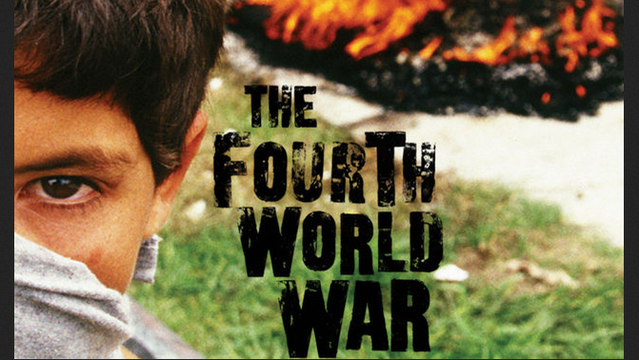
Saturday Matinee: The Fourth World War

the_fourth_world_war

From Big Noise Films:

From the front-lines of conflicts in Mexico, Argentina, South Africa, Palestine, Korea, and the North; from Seattle to Genova, and the War on Terror in New York, Afghanistan, and Iraq, The Fourth World War is the story of men and women around the world who resist being annihilated in this war.While our airwaves are crowded with talk of a new world war, narrated by generals and filmed from the noses of bombs, the human story of this global conflict remains untold. The Fourth World War brings together the images and voices of the war on the ground. It is a story of a war without end and of those who resist.The product of over two years of filming on the inside of movements on five continents, The Fourth World War is a film that would have been unimaginable at any other moment in history. Directed by the makers of This Is What Democracy Looks Like and Zapatista, produced through a global network of independent media and activist groups, it is a truly global film from our global movement.

For English speakers, portions of the film may need translation, activated by clicking on the “CC” button on bottom right corner of the video (on some mobile device browsers the function can be found on the upper right corner).

It’s Official: U.S. Political, Economic and Legal Systems are (even more) FUBAR

JusticeScalesCorruption_mega

Some might argue they’ve been FUBAR for some time now. Most of the world knows that power corrupts and the rich (as well as the national security state which protects their interests) are above the law. By paying off the right law makers and law enforcers they figuratively and sometimes literally get away with murder. Now, thanks to two recent court rulings, the wealthy in the U.S. are free to lavish unlimited bribes on politicians and can get away with not just murder but child rape. These are the types of stories that corporate media shills don’t want you to know, but with the internet more people than ever are becoming aware (and justifiably outraged).


DuPont Heir Avoids Jail Time for Raping His Children

Judge ruled he “will not fare well” in prison

By John Vibes

Source: Intellihub.com

Weeks ago, we published a report about a member of the DuPont family with a prolonged history of sexually abusing children.  The man in question, 47-year-old Robert H. Richards IV, confessed to molesting both of his children and managed to avoid jail time because the judge said that he would not hold up well in prison.

At the time that we reported this story, it was ridiculed as “conspiracy theory” or “sensationalism”, by people who did not want to believe that this type of blatant systematic corruption exists.

However, now that the mainstream media has finally begun to pick this story up, it has gone viral and sparked outrage world wide.

Richards is a member of both the DuPont family, who built the worldwide chemical empire, and the Richards family, who co-founded the prestigious corporate law firm Richards Layton & Finger.

Richards was able avoid any jail time, thanks to his overpriced lawyers and the prestige of his families.  In 2008, Richards confessed to the fourth-degree rape of his daughter, and only received probation.  Then years later in 2010, he confessed to sexually abusing his son when he was just a toddler.  Now this information is finally coming to light as the result of a civil lawsuit that was recently filed by his ex-wife.

Kendall Marlowe, executive director of the National Association for Counsel for Children, told The News Journal that sex offenders are jailed for the safety of the children they threaten.

“Child protection laws are there to safeguard children, and adults who knowingly harm children should be punished,” she said. “Our prisons should be more rehabilitative environments, but the prison system’s inadequacies are not a justification for letting a child molester off the hook.”

It is actually shocking that the mainstream media has picked up this story at all.  There is a deep history of crime, corruption and pedophilia among aristocratic families.  Luckily, stories like this are actually beginning to get mainstream recognition, but it is unfortunate that most people out there won’t believe that a story is credible until it is seen in one of the state regulated, corporately owned news sources.

John Vibes is an investigative journalist, staff writer and editor for Intellihub News where this article originally appeared. He is also the author of an 65 chapter Book entitled “Alchemy of the Timeless Renaissance” and is an artist with an established record label.


Ignorance is Strength, Freedom is Slavery, Money is Speech

By Kathy Malloy

Source: MikeMalloy.com

It was bad enough when the Supremes declared corporations were people in the infamous Citizens United decision. Now they have decided that money is free speech. In other words, money is to be given the same constitutional protection as free speech. The Washington Post explains it this way:

A split Supreme Court Wednesday struck down limits on the total amount of money an individual may spend on political candidates as a violation of free speech rights, a decision sure to increase the role of money in political campaigns.

The 5 to 4 decision sparked a sharp dissent from liberal justices, who said the decision reflects a wrong-headed hostility to campaign finance laws that the court’s conservatives showed in Citizens United v. FEC , which allowed corporate spending on elections.

“If Citizens United opened a door,” Justice Stephen G. Breyer said in reading his dissent from the bench, “today’s decision we fear will open a floodgate.”

So there it is, the final nail in the coffin to free and fair elections. Bye-bye campaign finance rules. “We the people” is now “we the wealthy.” The First Amendment protection of free speech was designed by the framers of our Constitution to protect our right to express our political opinions and exchange information and ideas without fear of governmental reprisal. By definition, it gives this right equally to every American citizen. Now the Roberts Court has decided, a la Orwell, that some people are more equal than others. If James Madison wanted to equate money with free speech, he would’ve drafted it into the Bill of Rights back in 1787. He must be flipping in his grave. His protection of all citizens has become a guarantee that the vast majority of us will no longer have any say in our electoral process.

This decision must make billionaires like Sheldon Adelson laugh so hard they spit gold coins out their noses. Now Adelson can select from a bevy of eager Neocons up on his auction block. And the brothers Koch can purchase any candidate they think will best do their bidding on Capitol (Capital?) Hill. And the 99% of the rest of us? Well, we will march lemming-like to the polls and pull the lever for whichever corporate candidate the 1% has purchased and placed on the ballot. Our elections will now be about as free and fair as those in N. Korea.

What was that Thomas Jefferson wrote in the Declaration of Independence? Something about what must happen whenever a government becomes destructive of our unalienable rights . . . .

The System: Deserving Contempt, Resistance and Undermining

You are part of the global uprising

By Rob Kall

Source: OpEdNews.com

Let’s face it, the system is pathologically broken, designed to hurt and exploit the middle class. it is contemptible. The courts are contemptible, the Judges are contemptible, the politicians– almost all of them– are contemptible, the political parties are contemptible. The mainstream media are contemptible. The vast legion of police and police leaders who violate the law or protect lawless cops are contemptible. The laws that are passed by lobbyist-bought or intolerant fundamentalist influenced politicians are contemptible.

So where do we turn to fight back, to bravely move forward towards hope and progress?

First, we don’t put all our eggs in the electoral basket. That is a delusional idea. Okay, so vote, even donate to really strong progressive candidates. But don’t delude yourself into thinking that any effort or donations to electoral activity is enough. Consider electoral action to be comparable to lightly tapping the brakes on a deadly car crash that is already under way.

The fact is the system is not only toxic and broken, it is biting back aggressively at people who speak out in the ways that people fighting for democracy have traditionally fought back.  Chris Hedges says,

” All acts of resistance–including nonviolent protest–have been conflated by the corporate state with terrorism. The mainstream, commercial press has been emasculated through the Obama administration’s repeated use of the Espionage Act to charge and sentence traditional whistle-blowers.”

Hedges wrote, last year, about Jeremy Hammond, before he was convicted and sentenced for hacking:

” He said he is fighting as “an anarchist communist” against “centralized state authority” and “exploitative corporations.” His goal is to build “leaderless collectives based on free association, consensus, mutual aid, self-sufficiency and harmony with the environment.” It is essential, he said, that all of us work to cut our personal ties with capitalism and engage in “mass organizing of protests, strikes and boycotts.” Hacking and leaking, he said, are part of this resistance–“effective tools to reveal ugly truths of the system.”

And further discussing Hammond, Hedges says,

” He said resistance must be a way of life. He intends to return to community organizing when he is released, although he said he will work to stay out of prison. “The truth,” he said, “will always come out.” He cautioned activists to be hyper-vigilant and aware that “one mistake can be permanent.” But he added, “Don’t let paranoia or fear deter you from activism. Do the down thing!”

if you want work towards a positive future– one that supports social, economic and ecological justice, fairness and safety– you must stand up to the system– hack it, whistleblow it, expose it, resist it, defy it, undermine it and do all you can every day to wake people up to the malignant, pathological threat assault THEY and their families and communities are currently being subjected to.

James C. Scott, anarchist scholar and  Sterling Professor of Political Science and Anthropology at Yale University.  writes, in his book,  Two Cheers for Anarchism: Six Easy Pieces on Autonomy, Dignity and Meaningful Work and Play

“One day you will be called upon to break a big law in the name of justice and rationality. Everything will depend on it. You have to be ready. How are you going to prepare for that day when it really matters? You have to stay “in shape” so that when the big day comes you will be ready. What you need is “anarchist calisthenics.” Every day or so break some trivial law that makes no sense, even if it’s only jaywalking. Use your own head to judge whether a law is just or reasonable. That way, you’ll keep trim; and when the big day comes, you’ll be ready.”

Keith Farnish, author of Undermining and Times Up, talks about how the system systematically engages in a plethora of ways to not only disconnect us but that make us forget that we were connected or desperately need to be connected to be fully human. We have to fight back, but he writes,

“…you can’t attack these great systems, these great structures head on, it’s really not going to work, you’re not powerful enough to do that.

“The only way that we’re going to really get to return humanity to a decent way of living is to look at those tools of disconnection and get people to realize what’s going on.  Allow people to be connected again because once you connect people, once you take away all the things that are masking that need that humanity really has to be connected, then you end up with awareness.”

So, to fight disconnection and get people reconnected you have to fight the ways that the system disconnects people from each other and from the positive aspects of community, family and humanity that keep us being fully human.

Farnish says technology  keeps us distracted– that people don’t like to hear that almost everything they’ve ever believed in is wrong and they will do everything in their power to retain those beliefs.

“anyone can be an underminer”

“the  vast majority of the time I am doing community work which is a form of undermining because what that community work does is allow people to appreciate what’s local to them.”

The thing is Farnish’s goal for undermining goes all the way– to the point that the industrial world is totally undermined and no longer working. That would put people in a situation where they depended entirely on local resources. He says that’s necessary .

“… we need to be looking smaller, yes we need to be banding into communities that are self sufficient, there’s no way we can exist in using any form of mass anything, which is destructive.  Therefore we have to start breaking things down into smaller chunks.

We need to be more self controlling.  We need to understand that global government and even national government are only in it for the interests of the greater corporate world.  But once you start getting local, we call it local government, local administration, then you get a lot more control back.  So I can see the argument and that is an inevitable outcome of undermining these great industrial worlds.”

Farnish is not talking about toning things down. He’s talking about shutting them down:

” Greenpeace is saying you can have less damaging technologies, well yes, relatively, 10% less damaging, 20% less damaging, they still screw everything up.  They’re still killing the planet.”

The quotes from Keith Farnish come from my interview with him, here. I said,

” I’ve talked for a couple of years now about the idea that when the dinosaurs died it wasn’t that the little tiny mammals, the little mice, the one-foot high horse, the birds, they didn’t attack the giant dinosaurs and replace them; they out-survived them.  Think in terms of what you’re talking about here,   this dinosaur of industrial corporate civilization.”

Farnish replied,

” Yes, I can see that.  I think it’s a very good metaphor.  We have a situation where these dinosaurs, yep I think that’s a good way of, although saying that, I mean, they were natural beings and they were wiped out in a mass extinction event.  We’re coming to a massive extinction event, I think this is true, but it’s a mass extinction event caused by something that is entirely unnatural.This idea that you’ve got niches that the people can go into in order to create a new world, yes that’s one way of looking at it but as you say those niches weren’t created until the dinosaurs went.  Now, industrial civilization, we can wait for it to collapse if we want.  We can say, okay we’ll wait it out.  But the problem with waiting it out is when it does collapse, there’s nothing left.  It’s done so much damage, there’s already this mass extinction event which is inevitable.

Or we can say industrial civilization is something that we have to get rid of before this mass extinction takes place.  Before the Earth is in a state that we can no longer live there.  Before it collapses while we are totally dependent on it.  That’s another side of things because if we remain dependent upon civilization, when it collapses we’re gone as well.

So we have to learn how to start walking away. We have to become less dependent on it. We have to become connected outside of industrial civilization. So the small mammals, the shrew-like creatures, they didn’t do that. They waited it out. There was a mass extinction event, that mass extinction event actually wiped out the vast majority of the shrew-like creatures as well, fortunately there were a few that managed to survive but who knows what might have come about if that mass extinction hadn’t taken place.

I can guarantee that if humans would have been around at the time, they wouldn’t have survived that mass extinction event either. “

And I threw in another ” another biological metaphor into the conversation.

“There are some insects that plant their eggs in another insect or mammal and then when the egg hatch, they consume the living breathing creature, killing it in the process, and I kind of conceptualize that the way towards a future where corporations and industrial civilization are no longer the dominating destroyers is absolutely not one where there is direct confrontation but rather where we begin building alternative infections that grow into positive structures and constructions where they lead to the acceleration of the death of this industrial civilization.”

Keith Farnish relied,

“Yes, I mean I have used the metaphor on the website of spiders spinning their webs in the eaves or mice making their homes under the floor boards, quietly and industriously.  You’re quite right.  We need to be doing things all the time.  We need to be creating communities, we need to become self-sufficient.  All of these things need to be taking place as a replacement, as a viable replacement for what is going to go and that’s something that we should be starting now.Regardless of whatever we do, because in a way that is both a method by which we can live in the future and also a way we can undermine the system.  So for instance, if you grow your own food, you’re not going to buy your food from the supermarket because you’ll learn to love that food that you’ve grown.  You’ll treasure that, you’ll protect that.  The supermarket becomes something that’s other worldly.  It’s something that other people use.

If people don’t shop at supermarkets then supermarkets close down.  That’s a great lump of civilization gone.  The mass consumerism, this idea that you can only get your food in approved places of mass consumption…. “

I said to Keith Farnish, in our interview,

“… your book on undermining goes into a lot of detail on many many different ways and different approaches on how to undermine, starting with just a black magic marker and changing the message on a poster to blocking the entrances to shopping malls. They can get very risky or they can get minimally risky but a lot of them involve in some ways breaking the law.”

Farnish replied:

“Yeah. The law, I think we’ve got to distinguish between what’s legal and what’s lawful here. Laws in, certainly laws in Western countries are, they are statutes, they are things that have been put there by politicians to control you to make sure that you do whatever the system wants you to do. There are certain things like murder, taking someone’s property although you do question where the property came from in the first place, obviously harming someone directly in some way, taking away their liberty, that kind of thing, these common features of human morality, and that’s what I would consider to be a law and they’re the laws by which humans should live.

Yes breaking the law, if we can use that phrase is something that underminers will inevitably do, and it’s incredibly liberating. It’s a wonderful thing. In the vast majority of cases you’re not going to get in any trouble for it if you’re careful and I do provide some instructions on how to be careful but we are going to have to break the law because the laws are about controlling people.

Laws are about benefiting the corporate world and if we’re going to change things then those legal instruments that are being put in place to control people have to be broken apart. They have to be challenged constantly otherwise nothing will change and that is why we have to distinguish between what is lawful? What is something that is naturally right and moral for humans to do and where that overrides what politicians and corporations have put in place to make themselves rich or make themselves powerful.

If you stop a factory polluting the river you could be breaking the law but morally you’re doing the right thing.

So I say to you. What are you doing with the rest of your life? What can you do to make humanity better? What can you do to make the world a little bit better for your children and your grandchildren?

The answer is, a hell of a lot. My hope is that this article will stretch the boundaries of your imagination. You have the potential for a bigger vision and you’ll have to fight for it. Many of the tools of disconnection that Farnish refers to are built to restrict and limit your imagination. You can do ANYTHING. Some of those anythings may cost you more than you are willing to pay. But at the least, please, please expand your view and think of all the possibilities. Snowden was not the first whistleblower. Neither was Daniel Ellsberg.

And please, don’t try to do this alone. Connect, connect, connect. That’s the way bottom-up change is made to happen.  Simply connecting in new ways to the same or new people in your communities can be revolutionary, can be  undermining can be resistance. Like Jim Scott says. Do something every day.  Raise your voice. Expose the lies of the dominating system. Take public the secrets that the billionaires, the corrupt politicians hold tight. Refuse! Refuse to follow the rules that most people accept as mandatory. A few years back police were arresting people who shot videos or photos of them. But people kept at it, exposing their acts, rejecting their orders to stop, REFUSING to give up their rights. Now, not only has the law made it clear that you CAN videotape police, but the police are beginning to record themselves. I’m sure it will be a battle, getting public access to ALL police recordings. But it could happen.  Stand up and refuse. In his brilliant book, Domination and the Arts of Resistance, James C. Scott says, “Any public refusal, in the teeth of power, to produce the words, gestures, and other signs of normative compliance is typically construed– and typically intended — as an act of defiance.” Scott points out, “ON very rare occasions when what has been orchestrated as a mass public demonstration of domination and enthusiastic consent erupts into a public display of repudiation from below, the ‘formidable shadow of general impotence’ becomes what can only be described as a symbolic rout.”

We’re talking about parades, ceremonies, public events. Even a moment of televised disruption can open the consciousness of millions and expose the lie of of power and the vulnerability of the elites running the performance.  This can be highly planned, like Medea Benjamin did when she interrupted President Obama, or it can be spontaneous, when you discover an unexpected opportunity. I interviewed Medea on how to do it, here.

One last thing. Don’t get stuck with absolutism. You don’t have to change your life completely. Your organization does not have to totally change. Every resistant, undermining, bottom-up step you take as a conscious act contributes to progress. It may take thousands or millions of people doing millions or billions of small acts. But that’s possible. It is the ONLY way that most of the changes in the world happen. Matter of fact, don’t expect your single action will be THE one. Consider your acts to be like drops of water eroding a massive edifice.

Rob Kall is executive editor, publisher and website architect of OpEdNews.com, Host of the Rob Kall Bottom Up Radio Show (WNJC 1360 AM), and publisher of Storycon.org, President of Futurehealth, Inc, and an inventor . He is also published regularly on the Huffingtonpost.com

Listen to over 200 of Rob’s Podcast interviews here.

Neil Kramer on Hypnotic Handshakes & Jedi Mind Tricks

obi-wan

Neil Kramer recently posted an interesting piece on hypnosis, Neural Linguistic Programing and social control. He began his essay with an analysis of the tricks of illusionist Darren Brown. While seemingly magic, they’re actually a skillful use of various psychological reading and manipulation techniques which exploit subconscious and unconscious processes (ie. mirroring, eye accessing cues, cold reading and NLP).  To explain some of the psychological mechanisms behind such “Jedi mind tricks”, he provides the following description of a hypnotic handshake:

Many actions are learned and operate as a single chunk of behavior: shaking hands and tying shoelaces being two good examples. However, if the behavior is diverted or frozen midway, the person literally has no mental space for this. He is stopped in the middle of unconsciously executing a behavior without a corresponding pattern. The mind crashes, suspending itself in trance until either something happens to give a new direction, or it reboots itself. A skilled hypnotist uses that momentary confusion and suspension of normal processes to induce a TDS trance.

By interrupting the pattern of a normal handshake in a particular manner, the hypnotist causes the subject to wonder what is going on. If the handshake continues to develop in a way which is out-of-keeping with expectations, a simple, non-verbal trance is created, which may then be reinforced by the hypnotist. All these responses happen naturally and automatically without telling the subject to consciously focus on an idea.

Also intriguing and relevant to the current moment is Kramer’s analysis of how principles of hypnosis are used by corporate media as a tool for mass control and manipulation:

Confusion is a tool used by hypnotists to put the subject into an altered state. The slumbering brain state induced by injudiciously watching TV and surfing the net achieves exactly the same thing. This is how the Empire implants its messages deep into the minds of the great unwashed masses. To the unconscious observer, the messages are not properly perceived at the point of entry. They are nevertheless permanently recorded in precise detail and influence the individual emotionally, intellectually, and physically with their latent memes.

For this to have impact on a mass scale, people need to also believe that they are finite, separate, the world happens “out there”, and they are essentially powerless. Once this is achieved, the covert messaging is much more readily absorbed. The isolated little human seeks comfort and reassurance wherever he can find it. If the mind is suitably controlled, the thrill of a new gadget, the delight of a new snack food, the consolation of a new TV drama, and the platitudes of government, may constitute all the solace required to get through another day. The prescribed messaging sinks in and no-one is any the wiser.

This deception can be swiftly dismantled with one simple mental gear shift: for the common man to cease regarding his mind as some plain old fiddle churning out the tunes of unseen dubious impresarios – and instead to recognize it as an exquisite Stradivarius violin that is at its greatest when playing the authentic and beautiful music of his own making.

Read the complete essay here: http://neilkramer.com/hypnotic-handshakes-jedi-mind-tricks.html

YouTube user Hypernosis0’s channel features a number of clips deconstructing Darren Brown’s techniques including the following example:

This episode of Stuff They Don’t Want You to Know examines how marketers employ behavioral psychology and neuroscience to encourage consumerism:

What’s Wrong With TED Talks?

2009-02-04-DSC05656

Though it was released late last year, I just recently found this provocative speech from Benjamin Bratton which addresses problems of the TED talks format ironically delivered as a TED talk (hat tip to 21st Century Wire).

Many of the issues brought up by Bratton have previously been addressed through satire in various Onion Talks.

Despite its problems, in defense of TED it is to their credit that they allowed a forum for an anti-TED presentation. There have also been a few thought provoking TED talks that I felt did not fall into the trap of over-simplification and yet conveyed ideas elegantly and efficiently. Unfortunately, some of those have been censored for ideological reasons, including this must-see talk by Nick Hanauer about economic inequality: