“The executive power in our government is not the only, perhaps not even the principal, object of my solicitude. The tyranny of the legislature is really the danger most to be feared, and will continue to be so for many years to come. The tyranny of the executive power will come in its turn, but at a more distant period.”― Thomas Jefferson, Democracy in America
It is time to recalibrate the government.
For years now, we have suffered the injustices, cruelties, corruption and abuse of an entrenched government bureaucracy that has no regard for the Constitution or the rights of the citizenry.
By “government,” I’m not referring to the highly partisan, two-party bureaucracy of the Republicans and Democrats. Rather, I’m referring to “government” with a capital “G,” the entrenched Deep State that is unaffected by elections, unaltered by populist movements, and has set itself beyond the reach of the law.
We are overdue for a systemic check on the government’s overreaches and power grabs.
We have lingered too long in this strange twilight zone where ego trumps justice, propaganda perverts truth, and imperial presidents—empowered to indulge their authoritarian tendencies by legalistic courts, corrupt legislatures and a disinterested, distracted populace—rule by fiat rather than by the rule of law.
This COVID-19 pandemic has provided the government with the perfect excuse to lay claim to a long laundry list of terrifying lockdown powers (at both the federal and state level) that override the Constitution: the ability to suspend the Constitution, indefinitely detain American citizens, bypass the courts, quarantine whole communities or segments of the population, override the First Amendment by outlawing religious gatherings and assemblies of more than a few people, shut down entire industries and manipulate the economy, muzzle dissidents, reshape financial markets, create a digital currency (and thus further restrict the use of cash), determine who should live or die, and impose health mandates on large segments of the population.
These kinds of crises tend to bring out the authoritarian tendencies in government.
That’s no surprise: power corrupts, and absolute power corrupts absolutely.
Where we find ourselves now is in the unenviable position of needing to rein in all three branches of government—the Executive, the Judicial, and the Legislative—that have exceeded their authority and grown drunk on power.
This is exactly the kind of concentrated, absolute power the founders attempted to guard against by establishing a system of checks of balances that separate and shares power between three co-equal branches: the executive, the legislative and the judiciary.
“The system of checks and balances that the Framers envisioned now lacks effective checks and is no longer in balance,” concludes law professor William P. Marshall. “The implications of this are serious. The Framers designed a system of separation of powers to combat government excess and abuse and to curb incompetence. They also believed that, in the absence of an effective separation-of-powers structure, such ills would inevitably follow. Unfortunately, however, power once taken is not easily surrendered.”
Unadulterated power in any branch of government is a menace to freedom.
There’s no point debating which political party would be more dangerous with these powers.
The fact that any individual—or branch of government—of any political persuasion is empowered to act like a dictator is danger enough.
So what we can do to wrest back control over a runaway government and an imperial presidency?
It won’t be easy.
We are the unwitting victims of a system so corrupt that those who stand up for the rule of law and aspire to transparency in government are in the minority.
This corruption is so vast it spans all branches of government: from the power-hungry agencies under the executive branch and the corporate puppets within the legislative branch to a judiciary that is, more often than not, elitist and biased towards government entities and corporations.
We are ruled by an elite class of individuals who are completely out of touch with the travails of the average American.
We are viewed as relatively expendable in the eyes of government: faceless numbers of individuals who serve one purpose, which is to keep the government machine running through our labor and our tax dollars. Those in power aren’t losing any sleep over the indignities we are being made to suffer or the possible risks to our health. All they seem to care about are power and control.
We are being made to suffer countless abuses at the government’s hands.
We have little protection against standing armies (domestic and military), invasive surveillance, marauding SWAT teams, an overwhelming government arsenal of assault vehicles and firepower, and a barrage of laws that criminalize everything from vegetable gardens to lemonade stands.
In the name of national security, we’re being subjected to government agencies such as the NSA, FBI and others listening in on our phone calls, reading our mail, monitoring our emails, and carrying out warrantless “black bag” searches of our homes. Adding to the abuse, we have to deal with surveillance cameras mounted on street corners and in traffic lights, weather satellites co-opted for use as spy cameras from space, and thermal sensory imaging devices that can detect heat and movement through the walls of our homes.
That doesn’t even begin to touch on the many ways in which our Fourth Amendment rights are trampled upon by militarized police and SWAT teams empowered to act as laws unto themselves.
In other words, freedom—or what’s left of it—is threatened from every direction.
The predators of the police state are wreaking havoc on our freedoms, our communities, and our lives. The government doesn’t listen to the citizenry, it refuses to abide by the Constitution, which is our rule of law, and it treats the citizenry as a source of funding and little else. Police officers are shooting unarmed citizens and their household pets. Government agents—including local police—are being armed to the teeth and encouraged to act like soldiers on a battlefield. Bloated government agencies are fleecing taxpayers. Government technicians are spying on our emails and phone calls. Government contractors are making a killing by waging endless wars abroad.
In other words, the American police state is alive and well and flourishing.
Nothing has changed, and nothing will change unless we insist on it.
Set in the year 2020, V for Vendetta (written and produced by the Wachowskis) provides an eerie glimpse into a parallel universe in which a government-engineered virus wreaks havoc on the world. Capitalizing on the people’s fear, a totalitarian government comes to power that knows all, sees all, controls everything and promises safety and security above all.
Concentration camps (jails, private prisons and detention facilities) have been established to house political prisoners and others deemed to be enemies of the state. Executions of undesirables (extremists, troublemakers and the like) are common, while other enemies of the state are made to “disappear.” Populist uprisings and protests are met with extreme force. The television networks are controlled by the government with the purpose of perpetuating the regime. And most of the population is hooked into an entertainment mode and are clueless.
Sounds painfully familiar, doesn’t it?
As director James McTeighe observed about the tyrannical regime in V for Vendetta, “It really showed what can happen when society is ruled by government, rather than the government being run as a voice of the people. I don’t think it’s such a big leap to say things like that can happen when leaders stop listening to the people.”
Clearly, our leaders have stopped listening to the American people.
We are—and have been for some time—the unwitting victims of a system so corrupt that those who stand up for the rule of law and aspire to transparency in government are in the minority. This corruption is so vast it spans all branches of government—from the power-hungry agencies under the executive branch and the corporate puppets within the legislative branch to a judiciary that is, more often than not, elitist and biased towards government entities and corporations.
We are ruled by an elite class of individuals who are completely out of touch with the travails of the average American. We are relatively expendable in the eyes of government—faceless numbers of individuals who serve one purpose, which is to keep the government machine running through our labor and our tax dollars.
What will it take for the government to start listening to the people again?
In V for Vendetta, as in my new novel The Erik Blair Diaries, it takes an act of terrorism for the people to finally mobilize and stand up to the government’s tyranny: in Vendetta, V the film’s masked crusader blows up the seat of government, while in Erik Blair, freedom fighters plot to unmask the Deep State.
These acts of desperation and outright anarchy are what happens when a parasitical government muzzles the citizenry, fences them in, herds them, brands them, whips them into submission, forces them to ante up the sweat of their brows while giving them little in return, and then provides them with little to no outlet for voicing their discontent: people get desperate, citizens lose hope, and lawful, nonviolent resistance gives way to unlawful, violent resistance.
This way lies madness.
Then again, this madness may be unavoidable unless we can wrest back control over our runaway government starting at the local level.
How to do this? It’s not rocket science.
There is no 10-step plan. If there were a 10-step plan, however, the first step would be as follows: turn off the televisions, tune out the politicians, and do your part to stand up for freedom principles in your own communities.
Stand up for your own rights, of course, but more importantly, stand up for the rights of those with whom you might disagree. Defend freedom at all costs. Defend justice at all costs. Make no exceptions based on race, religion, creed, politics, immigration status, sexual orientation, etc. Vote like Americans, for a change, not Republicans or Democrats.
Most of all, use your power—and there is power in our numbers—to nullify anything and everything the government does that undermines the freedom principles on which this nation was founded.
Don’t play semantics. Don’t justify. Don’t politicize it. If it carries even a whiff of tyranny, oppose it. Demand that your representatives in government cut you a better deal, one that abides by the Constitution and doesn’t just attempt to sidestep it.
The United States suffered through two lethal waves of contagion in the past year and a half. The first was a viral pandemic that killed about one in 500 Americans—typically, a person over 75 suffering from other serious conditions. The second, and far more catastrophic, was a moral panic that swept the nation’s guiding institutions.
Instead of keeping calm and carrying on, the American elite flouted the norms of governance, journalism, academic freedom—and, worst of all, science. They misled the public about the origins of the virus and the true risk that it posed. Ignoring their own carefully prepared plans for a pandemic, they claimed unprecedented powers to impose untested strategies, with terrible collateral damage. As evidence of their mistakes mounted, they stifled debate by vilifying dissenters, censoring criticism, and suppressing scientific research.
If, as seems increasingly plausible, the coronavirus that causes Covid-19 leaked out of a laboratory in Wuhan, it is the costliest blunder ever committed by scientists. Whatever the pandemic’s origin, the response to it is the worst mistake in the history of the public-health profession. We still have no convincing evidence that the lockdowns saved lives, but lots of evidence that they have already cost lives and will prove deadlier in the long run than the virus itself.
One in three people worldwide lost a job or a business during the lockdowns, and half saw their earnings drop, according to a Gallup poll. Children, never at risk from the virus, in many places essentially lost a year of school. The economic and health consequences were felt most acutely among the less affluent in America and in the rest of the world, where the World Bank estimates that more than 100 million have been pushed into extreme poverty.
The leaders responsible for these disasters continue to pretend that their policies worked and assume that they can keep fooling the public. They’ve promised to deploy these strategies again in the future, and they might even succeed in doing so—unless we begin to understand what went wrong.
The panic was started, as usual, by journalists. As the virus spread early last year, they highlighted the most alarming statistics and the scariest images: the estimates of a fatality rate ten to 50 times higher than the flu, the chaotic scenes at hospitals in Italy and New York City, the predictions that national health-care systems were about to collapse.
The full-scale panic was set off by the release in March 2020 of a computer model at the Imperial College in London, which projected that—unless drastic measures were taken—intensive-care units would have 30 Covid patients for every available bed and that America would see 2.2 million deaths by the end of the summer. The British researchers announced that the “only viable strategy” was to impose draconian restrictions on businesses, schools, and social gatherings until a vaccine arrived.
This extraordinary project was swiftly declared the “consensus” among public-health officials, politicians, journalists, and academics. Anthony Fauci, director of the National Institute of Allergy and Infectious Diseases, endorsed it and became the unassailable authority for those purporting to “follow the science.” What had originally been a limited lockdown—“15 days to slow the spread”—became long-term policy across much of the United States and the world. A few scientists and public-health experts objected, noting that an extended lockdown was a novel strategy of unknown effectiveness that had been rejected in previous plans for a pandemic. It was a dangerous experiment being conducted without knowing the answer to the most basic question: Just how lethal is this virus?
The most prominent early critic was John Ioannidis, an epidemiologist at Stanford, who published an essay for STAT headlined “A Fiasco in the Making? As the Coronavirus Pandemic Takes Hold, We Are Making Decisions Without Reliable Data.” While a short-term lockdown made sense, he argued, an extended lockdown could prove worse than the disease, and scientists needed to do more intensive testing to determine the risk. The article offered common-sense advice from one of the world’s most frequently cited authorities on the credibility of medical research, but it provoked a furious backlash on Twitter from scientists and journalists.
The fury intensified in April 2020, when Ioannidis followed his own advice by joining with Jay Bhattacharya and other colleagues from Stanford to gauge the spread of Covid in the surrounding area, Santa Clara County. After testing for Covid antibodies in the blood of several thousand volunteers, they estimated that the fatality rate among the infected in the county was about 0.2 percent, twice as high as for the flu but considerably lower than the assumptions of public-health officials and computer modelers. The researchers acknowledged that the fatality rate could be substantially higher in other places where the virus spread extensively in nursing homes (which hadn’t yet occurred in the Santa Clara area). But merely by reporting data that didn’t fit the official panic narrative, they became targets.
Other scientists lambasted the researchers and claimed that methodological weaknesses in the study made the results meaningless. A statistician at Columbia wrote that the researchers “owe us all an apology.” A biologist at the University of North Carolina said that the study was “horrible science.” A Rutgers chemist called Ioannidis a “mediocrity” who “cannot even formulate a simulacrum of a coherent, rational argument.” A year later, Ioannidis still marvels at the attacks on the study (which was eventually published in a leading epidemiology journal). “Scientists whom I respect started acting like warriors who had to subvert the enemy,” he says. “Every paper I’ve written has errors—I’m a scientist, not the pope—but the main conclusions of this one were correct and have withstood the criticism.”
Mainstream journalists piled on with hit pieces quoting critics and accusing the researchers of endangering lives by questioning lockdowns. The Nation called the research a “black mark” for Stanford. The cheapest shots came from BuzzFeed, which devoted thousands of words to a series of trivial objections and baseless accusations. The article that got the most attention was BuzzFeed’s breathless revelation that an airline executive opposed to lockdowns had contributed $5,000—yes, five thousand dollars!—to an anonymized fund at Stanford that had helped finance the Santa Clara fieldwork.
The notion that a team of prominent academics, who were not paid for their work in the study, would risk their reputations by skewing results for the sake of a $5,000 donation was absurd on its face—and even more ludicrous, given that Ioannidis, Bhattacharya, and the lead investigator, Eran Bendavid, said that they weren’t even aware of the donation while conducting the study. But Stanford University was so cowed by the online uproar that it subjected the researchers to a two-month fact-finding inquiry by an outside legal firm. The inquiry found no evidence of conflict of interest, but the smear campaign succeeded in sending a clear message to scientists everywhere: Don’t question the lockdown narrative.
In a brief interlude of journalistic competence, two veteran science writers, Jeanne Lenzer and Shannon Brownlee, published an article in Scientific American decrying the politicization of Covid research. They defended the integrity and methodology of the Stanford researchers, noting that some subsequent studies had found similar rates of fatality among the infected. (In his latest review of the literature, Ioannidis now estimates that the average fatality rate in Europe and the Americas is 0.3 to 0.4 percent and about 0.2 percent among people not living in institutions.) Lenzer and Brownlee lamented that the unjust criticism and ad hominem vitriol had suppressed a legitimate debate by intimidating the scientific community. Their editors then proceeded to prove their point. Responding to more online fury, Scientific American repented by publishing an editor’s note that essentially repudiated its own article. The editors printed BuzzFeed’s accusations as the final word on the matter, refusing to publish a rebuttal from the article’s authors or a supporting letter from Jeffrey Flier, former dean of Harvard Medical School. Scientific American, long the most venerable publication in its field, now bowed to the scientific authority of BuzzFeed.
Editors of research journals fell into line, too. When Thomas Benfield, one of the researchers in Denmark conducting the first large randomized controlled trial of mask efficacy against Covid, was asked why they were taking so long to publish the much-anticipated findings, he promised them as “as soon as a journal is brave enough to accept the paper.” After being rejected by TheLancet, TheNew England Journal of Medicine, and JAMA, the study finally appeared in the Annals of Internal Medicine, and the reason for the editors’ reluctance became clear: the study showed that a mask did not protect the wearer, which contradicted claims by the Centers for Disease Control and other health authorities.
Stefan Baral, an epidemiologist at Johns Hopkins with 350 publications to his name, submitted a critique of lockdowns to more than ten journals and finally gave up—the “first time in my career that I could not get a piece placed anywhere,” he said. Martin Kulldorff, an epidemiologist at Harvard, had a similar experience with his article, early in the pandemic, arguing that resources should be focused on protecting the elderly. “Just as in war,” Kulldorff wrote, “we must exploit the characteristics of the enemy in order to defeat it with the minimum number of casualties. Since Covid-19 operates in a highly age specific manner, mandated counter measures must also be age specific. If not, lives will be unnecessarily lost.” It was a tragically accurate prophecy from one of the leading experts on infectious disease, but Kulldorff couldn’t find a scientific journal or media outlet to accept the article, so he ended up posting it on his own LinkedIn page. “There’s always a certain amount of herd thinking in science,” Kulldorff says, “but I’ve never seen it reach this level. Most of the epidemiologists and other scientists I’ve spoken to in private are against lockdowns, but they’re afraid to speak up.”
To break the silence, Kulldorff joined with Stanford’s Bhattacharya and Sunetra Gupta of Oxford to issue a plea for “focused protection,” called the Great Barrington Declaration. They urged officials to divert more resources to shield the elderly, such as doing more tests of the staff at nursing homes and hospitals, while reopening business and schools for younger people, which would ultimately protect the vulnerable as herd immunity grew among the low-risk population.
They managed to attract attention but not the kind they hoped for. Though tens of thousands of other scientists and doctors went on to sign the declaration, the press caricatured it as a deadly “let it rip” strategy and an “ethical nightmare” from “Covid deniers” and “agents of misinformation.” Google initially shadow-banned it so that the first page of search results for “Great Barrington Declaration” showed only criticism of it (like an article calling it “the work of a climate denial network”) but not the declaration itself. Facebook shut down the scientists’ page for a week for violating unspecified “community standards.”
The most reviled heretic was Scott Atlas, a medical doctor and health-policy analyst at Stanford’s Hoover Institution. He, too, urged focused protection on nursing homes and calculated that the medical, social, and economic disruptions of the lockdowns would cost more years of life than the coronavirus. When he joined the White House coronavirus task force, Bill Gates derided him as “this Stanford guy with no background” promoting “crackpot theories.” Nearly 100 members of Stanford’s faculty signed a letter denouncing his “falsehoods and misrepresentations of science,” and an editorial in the Stanford Dailyurged the university to sever its ties to Hoover.
The Stanford faculty senate overwhelmingly voted to condemn Atlas’s actions as “anathema to our community, our values and our belief that we should use knowledge for good.” Several professors from Stanford’s medical school demanded further punishment in a JAMA article, “When Physicians Engage in Practices That Threaten the Nation’s Health.” The article, which misrepresented Atlas’s views as well as the evidence on the efficacy of lockdowns, urged professional medical societies and medical-licensing boards to take action against Atlas on the grounds that it was “ethically inappropriate for physicians to publicly recommend behaviors or interventions that are not scientifically well grounded.”
But if it was unethical to recommend “interventions that are not scientifically well grounded,” how could anyone condone the lockdowns? “It was utterly immoral to conduct this society-wide intervention without the evidence to justify it,” Bhattacharya says. “The immediate results have been disastrous, especially for the poor, and the long-term effect will be to fundamentally undermine trust in public health and science.” The traditional strategy for dealing with pandemics was to isolate the infected and protect the most vulnerable, just as Atlas and the Great Barrington scientists recommended. The CDC’s pre-pandemic planning scenarios didn’t recommend extended school closures or any shutdown of businesses even during a plague as deadly as the 1918 Spanish flu. Yet Fauci dismissed the focused-protection strategy as “total nonsense” to “anybody who has any experience in epidemiology and infectious diseases,” and his verdict became “the science” to leaders in America and elsewhere.
Fortunately, a few leaders followed the science in a different way. Instead of blindly trusting Fauci, they listened to his critics and adopted the focused-protection strategy—most notably, in Florida. Its governor, Ron DeSantis, began to doubt the public-health establishment early in the pandemic, when computer models projected that Covid patients would greatly outnumber hospital beds in many states. Governors in New York, New Jersey, Pennsylvania, and Michigan were so alarmed and so determined to free up hospital beds that they directed nursing homes and other facilities to admit or readmit Covid patients—with deadly results.
But DeSantis was skeptical of the hospital projections—for good reason, as no state actually ran out of beds—and more worried about the risk of Covid spreading in nursing homes. He forbade long-term-care centers to admit anyone infected with Covid and ordered frequent testing of the staff at senior-care centers. After locking down last spring, he reopened businesses, schools, and restaurants early, rejected mask mandates, and ignored protests from the press and the state’s Democratic leaders. Fauci warned that Florida was “asking for trouble,” but DeSantis went on seeking and heeding advice from Atlas and the Great Barrington scientists, who were astonished to speak with a politician already familiar with just about every study they mentioned to him.
“DeSantis was an incredible outlier,” Atlas says. “He dug up the data and read the scientific papers and analyzed it all himself. In our discussions, he’d bounce ideas off me, but he was already on top of the details of everything. He always had the perspective to see the larger harms of lockdowns and the need to concentrate testing and other resources on the elderly. And he has been proven correct.”
If Florida had simply done no worse than the rest of the country during the pandemic, that would have been enough to discredit the lockdown strategy. The state effectively served as the control group in a natural experiment, and no medical treatment with dangerous side effects would be approved if the control group fared no differently from the treatment group. But the outcome of this experiment was even more damning.
Florida’s mortality rate from Covid is lower than the national average among those over 65 and also among younger people, so that the state’s age-adjusted Covid mortality rate is lower than that of all but ten other states. And by the most important measure, the overall rate of “excess mortality” (the number of deaths above normal), Florida has also done better than the national average. Its rate of excess mortality is significantly lower than that of the most restrictive state, California, particularly among younger adults, many of whom died not from Covid but from causes related to the lockdowns: cancer screenings and treatments were delayed, and there were sharp increases in deaths from drug overdoses and from heart attacks not treated promptly.
Chart by Jamie Meggas
If the treatment group in a clinical trial were dying off faster than the control group, an ethical researcher would halt the experiment. But the lockdown proponents were undeterred by the numbers in Florida, or by similar results elsewhere, including a comparable natural experiment involving European countries with the least restrictive policies. Sweden, Finland, and Norway rejected mask mandates and extended lockdowns, and they have each suffered significantly less excess mortality than most other European countries during the pandemic.
A nationwide analysis in Sweden showed that keeping schools open throughout the pandemic, without masks or social distancing, had little effect on the spread of Covid, but school closures and mask mandates for students continued elsewhere. Another Swedish researcher, Jonas Ludvigsson, reported that not a single schoolchild in the country died from Covid in Sweden and that their teachers’ risk of serious illness was lower than for the rest of the workforce—but these findings provoked so many online attacks and threats that Ludvigsson decided to stop researching or discussing Covid.
Social-media platforms continued censoring scientists and journalists who questioned lockdowns and mask mandates. YouTube removed a video discussion between DeSantis and the Great Barrington scientists, on the grounds that it “contradicts the consensus” on the efficacy of masks, and also took down the Hoover Institution’s interview with Atlas. Twitter locked out Atlas and Kulldorff for scientifically accurate challenges to mask orthodoxy. A peer-reviewed German study reporting harms to children from mask-wearing was suppressed on Facebook (which labeled my City Journalarticle “Partly False” because it cited the study) and also at ResearchGate, one of the most widely used websites for scientists to post their papers. ResearchGate refused to explain the censorship to the German scientists, telling them only that the paper was removed from the website in response to “reports from the community about the subject-matter.”
The social-media censors and scientific establishment, aided by the Chinese government, succeeded for a year in suppressing the lab-leak theory, depriving vaccine developers of potentially valuable insights into the virus’s evolution. It’s understandable, if deplorable, that the researchers and officials involved in supporting the Wuhan lab research would cover up the possibility that they’d unleashed a Frankenstein on the world. What’s harder to explain is why journalists and the rest of the scientific community so eagerly bought that story, along with the rest of the Covid narrative.
Why the elite panic? Why did so many go so wrong for so long? When journalists and scientists finally faced up to their mistake in ruling out the lab-leak theory, they blamed their favorite villain: Donald Trump. He had espoused the theory, so they assumed it must be wrong. And since he disagreed at times with Fauci about the danger of the virus and the need for lockdowns, then Fauci must be right, and this was such a deadly plague that the norms of journalism and science must be suspended. Millions would die unless Fauci was obeyed and dissenters were silenced.
But neither the plague nor Trump explains the panic. Yes, the virus was deadly, and Trump’s erratic pronouncements contributed to the confusion and partisanship, but the panic was due to two preexisting pathologies that afflicted other countries, too. The first is what I have called the Crisis Crisis, the incessant state of alarm fomented by journalists and politicians. It’s a longstanding problem—humanity was supposedly doomed in the last century by the “population crisis” and the “energy crisis”—that has dramatically worsened with the cable and digital competition for ratings, clicks, and retweets. To keep audiences frightened around the clock, journalists seek out Cassandras with their own incentives for fearmongering: politicians, bureaucrats, activists, academics, and assorted experts who gain publicity, prestige, funding, and power during a crisis.
Unlike many proclaimed crises, an epidemic is a genuine threat, but the crisis industry can’t resist exaggerating the danger, and doomsaying is rarely penalized. Early in the 1980s AIDS epidemic, the New York Times reported the terrifying possibility that the virus could spread to children through “routine close contact”—quoting from a study by Anthony Fauci. Life magazine wildly exaggerated the number of infections in a cover story, headlined “Now No One Is Safe from AIDS.” It cited a study by Robert Redfield, the future leader of the CDC during the Covid pandemic, predicting that AIDS would soon spread as rapidly among heterosexuals as among homosexuals. Both scientists were absolutely wrong, of course, but the false alarms didn’t harm their careers or their credibility.
Journalists and politicians extend professional courtesy to fellow crisis-mongers by ignoring their mistakes, such as the previous predictions by Neil Ferguson. His team at Imperial College projected up to 65,000 deaths in the United Kingdom from swine flu and 200 million deaths worldwide from bird flu. The death toll each time was in the hundreds, but never mind: when Ferguson’s team projected millions of American deaths from Covid, that was considered reason enough to follow its recommendation for extended lockdowns. And when the modelers’ assumption about the fatality rate proved too high, that mistake was ignored, too.
Journalists kept highlighting the most alarming warnings, presented without context. They needed to keep their audience scared, and they succeeded. For Americans under 70, the probability of surviving a Covid infection was about 99.9 percent, but fear of the virus was higher among the young than among the elderly, and polls showed that people of all ages vastly overestimated the risk of being hospitalized or dying.
The second pathology underlying the elite’s Covid panic is the politicization of research—what I have termed the Left’s war on science, another long-standing problem that has gotten much worse. Just as the progressives a century ago yearned for a nation directed by “expert social engineers”—scientific high priests unconstrained by voters and public opinion—today’s progressives want sweeping new powers for politicians and bureaucrats who “believe in science,” meaning that they use the Left’s version of science to justify their edicts. Now that so many elite institutions are political monocultures, progressives have more power than ever to enforce groupthink and suppress debate. Well before the pandemic, they had mastered the tactics for demonizing and silencing scientists whose findings challenged progressive orthodoxy on issues such as IQ, sex differences, race, family structure, transgenderism, and climate change.
And then along came Covid—“God’s gift to the Left,” in Jane Fonda’s words. Exaggerating the danger and deflecting blame from China to Trump offered not only short-term political benefits, damaging his reelection prospects, but also an extraordinary opportunity to empower social engineers in Washington and state capitals. Early in the pandemic, Fauci expressed doubt that it was politically possible to lock down American cities, but he underestimated the effectiveness of the crisis industry’s scaremongering. Americans were so frightened that they surrendered their freedoms to work, study, worship, dine, play, socialize, or even leave their homes. Progressives celebrated this “paradigm shift,” calling it a “blueprint” for dealing with climate change.
This experience should be a lesson in what not to do, and whom not to trust. Do not assume that the media’s version of a crisis resembles reality. Do not count on mainstream journalists and their favorite doomsayers to put risks in perspective. Do not expect those who follow “the science” to know what they’re talking about. Science is a process of discovery and debate, not a faith to profess or a dogma to live by. It provides a description of the world, not a prescription for public policy, and specialists in one discipline do not have the knowledge or perspective to guide society. They’re biased by their own narrow focus and self-interest. Fauci and Deborah Birx, the physician who allied with him against Atlas on the White House task force, had to answer for the daily Covid death toll—that ever-present chyron at the bottom of the television screen—so they focused on one disease instead of the collateral damage of their panic-driven policies.
“The Fauci-Birx lockdowns were a sinful, unconscionable, heinous mistake, and they will never admit they were wrong,” Atlas says. Neither will the journalists and politicians who panicked along with them. They’re still portraying lockdowns as not just a success but also a precedent—proof that Americans can sacrifice for the common good when directed by wise scientists and benevolent autocrats. But the sacrifice did far more harm than good, and the burden was not shared equally. The brunt was borne by the most vulnerable in America and the poorest countries of the world. Students from disadvantaged families suffered the most from school closures, and children everywhere spent a year wearing masks solely to assuage the neurotic fears of adults. The less educated lost jobs so that professionals at minimal risk could feel safer as they kept working at home on their laptops. Silicon Valley (and its censors) prospered from lockdowns that bankrupted local businesses.
Luminaries united on Zoom and YouTube to assure the public that “we’re all in this together.” But we weren’t. When the panic infected the nation’s elite—the modern gentry who profess such concern for the downtrodden—it turned out that they weren’t so different from aristocrats of the past. They were in it for themselves.
Far from being a war against “white supremacy,” the Biden administration’s new “domestic terror” strategy clearly targets primarily those who oppose US government overreach and those who oppose capitalism and/or globalization.
In the latest sign that the US government’s War on Domestic Terror is growing in scope and scale, the White House on Tuesday revealed the nation’s first ever government-wide strategy for confronting domestic terrorism. While cloaked in language about stemming racially motivated violence, the strategy places those deemed “anti-government” or “anti-authority” on a par with racist extremists and charts out policies that could easily be abused to silence or even criminalize online criticism of the government.
Even more disturbing is the call to essentially fuse intelligence agencies, law enforcement, Silicon Valley, and “community” and “faith-based” organizations such as the Anti-Defamation League, as well as unspecified foreign governments, as partners in this “war,” which the strategy makes clear will rely heavily on a pre-crime orientation focused largely on what is said on social media and encrypted platforms. Though the strategy claims that the government will “shield free speech and civil liberties” in implementing this policy, its contents reveal that it is poised to gut both.
Indeed, while framed publicly as chiefly targeting “right-wing white supremacists,” the strategy itself makes it clear that the government does not plan to focus on the Right but instead will pursue “domestic terrorists” in “an ideologically neutral, threat-driven manner,” as the law “makes no distinction based on political view—left, right or center.” It also states that a key goal of this strategic framework is to ensure “that there is simply no governmental tolerance . . . of violence as an acceptable mode of seeking political or social change,” regardless of a perpetrator’s political affiliation.
Considering that the main cheerleaders for the War on Domestic Terror exist mainly in establishment left circles, such individuals should rethink their support for this new policy given that the above statements could easily come to encompass Black Lives Matter–related protests, such as those that transpired last summer, depending on which political party is in power.
Once the new infrastructure is in place, it will remain there and will be open to the same abuses perpetrated by both political parties in the US during the lengthy War on Terror following September 11, 2001. The history of this new “domestic terror” policy, including its origins in the Trump administration, makes this clear.
It’s Never Been Easier to Be a “Terrorist”
In introducing the strategy, the Biden administration cites “racially or ethnically motivated violent extremists” as a key reason for the new policy and a main justification for the War on Domestic Terror in general. This was most recently demonstrated Tuesday in Attorney General Merrick Garland’s statement announcing this new strategy. However, the document itself puts “anti-government” or “anti-authority” “extremists” in the same category as violent white supremacists in terms of being a threat to the homeland. The strategy’s characterization of such individuals is unsettling.
AG Merrick Garland: “In the FBI’s view, the top domestic violent extremist threat comes from racially or ethically motivated violent extremists specifically those who advocate for the superiority of the white race.” pic.twitter.com/4JtruuMSv2
For instance, those who “violently oppose” “all forms of capitalism” or “corporate globalization” are listed under this less-discussed category of “domestic terrorist.” This highlights how people on the left, many of whom have called for capitalism to be dismantled or replaced in the US in recent years, could easily be targeted in this new “war” that many self-proclaimed leftists are currently supporting. Similarly, “environmentally-motivated extremists,” a category in which groups such as Extinction Rebellion could easily fall, are also included.
In addition, the phrasing indicates that it could easily include as “terrorists” those who oppose the World Economic Forum’s vision for global “stakeholder capitalism,” as that form of “capitalism” involves corporations and their main “stakeholders” creating a new global economic and governance system. The WEF’s stakeholder capitalism thus involves both “capitalism” and “corporate globalization.”
The strategy also includes those who “take steps to violently resist government authority . . . based on perceived overreach.” This, of course, creates a dangerous situation in which the government could, purposely or otherwise, implement a policy that is an obvious overreach and/or blatantly unconstitutional and then label those who resist it “domestic terrorists” and deal with them as such—well before the overreach can be challenged in court.
Another telling addition to this group of potential “terrorists” is “any other individual or group who engages in violence—or incites imminent violence—in opposition to legislative, regulatory or other actions taken by the government.” Thus, if the government implements a policy that a large swath of the population finds abhorrent, such as launching a new, unpopular war abroad, those deemed to be “inciting” resistance to the action online could be considered domestic terrorists.
Such scenarios are not unrealistic, given the loose way in which the government and the media have defined things like “incitement” and even “violence” (e. g., “hate speech” is a form of violence) in the recent past. The situation is ripe for manipulation and abuse. To think the federal government (including the Biden administration and subsequent administrations) would not abuse such power reflects an ignorance of US political history, particularly when the main forces behind most terrorist incidents in the nation are actually US government institutions like the FBI (more FBI examples here, here, here, and here).
Furthermore, the original plans for the detention of American dissidents in the event of a national emergency, drawn up during the Reagan era as part of its “continuity of government” contingency, cited popular nonviolent opposition to US intervention in Latin America as a potential “emergency” that could trigger the activation of those plans. Many of those “continuity of government” protocols remain on the books today and can be triggered, depending on the whims of those in power. It is unlikely that this new domestic terror framework will be any different regarding nonviolent protest and demonstrations.
Yet another passage in this section of the strategy states that “domestic terrorists” can, “in some instances, connect and intersect with conspiracy theories and other forms of disinformation and misinformation.” It adds that the proliferation of such “dangerous” information “on Internet-based communications platforms such as social media, file-upload sites and end-to-end encrypted platforms, all of these elements can combine and amplify threats to public safety.”
Thus, the presence of “conspiracy theories” and information deemed by the government to be “misinformation” online is itself framed as threatening public safety, a claim made more than once in this policy document. Given that a major “pillar” of the strategy involves eliminating online material that promotes “domestic terrorist” ideologies, it seems inevitable that such efforts will also “connect and intersect” with the censorship of “conspiracy theories” and narratives that the establishment finds inconvenient or threatening for any reason.
Pillars of Tyranny
The strategy notes in several places that this new domestic-terror policy will involve a variety of public-private partnerships in order to “build a community to address domestic terrorism that extends not only across the Federal Government but also to critical partners.” It adds, “That includes state, local, tribal and territorial governments, as well as foreign allies and partners, civil society, the technology sector, academic, and more.”
The mention of foreign allies and partners is important as it suggests a multinational approach to what is supposedly a US “domestic” issue and is yet another step toward a transnational security-state apparatus. A similar multinational approach was used to devastating effect during the CIA-developed Operation Condor, which was used to target and “disappear” domestic dissidents in South America in the 1970s and 1980s. The foreign allies mentioned in the Biden administration’s strategy are left unspecified, but it seems likely that such allies would include the rest of the Five Eyes alliance (the UK, Australia, Canada, New Zealand) and Israel, all of which already have well-established information-sharing agreements with the US for signals intelligence.
The new domestic-terror strategy has four main “pillars,” which can be summarized as (1) understanding and sharing domestic terrorism-related information, including with foreign governments and private tech companies; (2) preventing domestic terrorism recruitment and mobilization to violence; (3) disrupting and deterring domestic terrorism activity; and (4) confronting long-term contributors to domestic terrorism.
The first pillar involves the mass accumulation of data through new information-sharing partnerships and the deepening of existing ones. Much of this information sharing will involve increased data mining and analysis of statements made openly on the internet, particularly on social media, something already done by US intelligence contractors such as Palantir. While the gathering of such information has been ongoing for years, this policy allows even more to be shared and legally used to make cases against individuals deemed to have made threats or expressed “dangerous” opinions online.
Included in the first pillar is the need to increase engagement with financial institutions concerning the financing of “domestic terrorists.” US banks, such as Bank of America, have already gone quite far in this regard, leading to accusations that it has begun acting like an intelligence agency. Such claims were made after it was revealed that the BofA had passed to the government the private banking information of over two hundred people that the bank deemed as pointing to involvement in the events of January 6, 2021. It seems likely, given this passage in the strategy, that such behavior by banks will soon become the norm, rather than an outlier, in the United States.
The second pillar is ostensibly focused on preventing the online recruitment of domestic terrorists and online content that leads to the “mobilization of violence.” The strategy notes that this pillar “means reducing both supply and demand of recruitment materials by limiting widespread availability online and bolstering resilience to it by those who nonetheless encounter it.“ The strategy states that such government efforts in the past have a “mixed record,” but it goes on to claim that trampling on civil liberties will be avoided because the government is “consulting extensively” with unspecified “stakeholders” nationwide.
Regarding recruitment, the strategy states that “these activities are increasingly happening on Internet-based communications platforms, including social media, online gaming platforms, file-upload sites and end-to-end encrypted platforms, even as those products and services frequently offer other important benefits.” It adds that “the widespread availability of domestic terrorist recruitment material online is a national security threat whose front lines are overwhelmingly private-sector online platforms.”
The US government plans to provide “information to assist online platforms with their own initiatives to enforce their own terms of service that prohibits the use of their platforms for domestic terrorist activities” as well as to “facilitate more robust efforts outside the government to counter terrorists’ abuse of Internet-based communications platforms.”
Given the wider definition of “domestic terrorist” that now includes those who oppose capitalism and corporate globalization as well as those who resist government overreach, online content discussing these and other “anti-government” and “anti-authority” ideas could soon be treated in the same way as online Al Qaeda or ISIS propaganda. Efforts, however, are unlikely to remain focused on these topics. As Unlimited Hangout reported last November, both UK intelligence and the US national-security state were developing plans to treat critical reporting on the COVID-19 vaccines as “extremist” propaganda.
Another key part of this pillar is the need to “increase digital literacy” among the American public, while censoring “harmful content” disseminated by “terrorists” as well as by “hostile foreign powers seeking to undermine American democracy.” The latter is a clear reference to the claim that critical reporting of US government policy, particularly its military and intelligence activities abroad, was the product of “Russian disinformation,” a now discredited claim that was used to heavily censor independent media. This new government strategy appears to promise more of this sort of thing.
It also notes that “digital literacy” education for a domestic audience is being developed by the Department of Homeland Security (DHS). Such a policy would have previously violated US law until the Obama administration worked with Congress to repeal the Smith-Mundt Act, thus lifting the ban on the government directing propaganda at domestic audiences.
The third pillar of the strategy seeks to increase the number of federal prosecutors investigating and trying domestic-terror cases. Their numbers are likely to jump as the definition of “domestic terrorist” is expanded. It also seeks to explore whether “legislative reforms could meaningfully and materially increase our ability to protect Americans from acts of domestic terrorism while simultaneously guarding against potential abuse of overreach.” In contrast to past public statements on police reform by those in the Biden administration, the strategy calls to “empower” state and local law enforcement to tackle domestic terrorism, including with increased access to “intelligence” on citizens deemed dangerous or subversive for any number of reasons.
To that effect, the strategy states the following (p. 24):
“The Department of Justice, Federal Bureau of Investigation, and Department of Homeland Security, with support from the National Counterterrorism Center [part of the intelligence community], are incorporating an increased focus on domestic terrorism into current intelligence products and leveraging current mechanisms of information and intelligence sharing to improve the sharing of domestic terrorism-related content and indicators with non-Federal partners. These agencies are also improving the usability of their existing information-sharing platforms, including through the development of mobile applications designed to provide a broader reach to non-Federal law enforcement partners, while simultaneously refining that support based on partner feedback.”
Such an intelligence tool could easily be, for example, Palantir, which is already used by the intelligence agencies, the DHS, and several US police departments for “predictive policing,” that is, pre-crime actions. Notably, Palantir has long included a “subversive” label for individuals included on government and law enforcement databases, a parallel with the controversial and highly secretive Main Core database of US dissidents.
DHS Secretary Alejandro Mayorkas made the “pre-crime” element of the new domestic terror strategy explicit on Tuesday when he said in a statement that DHS would continue “developing key partnerships with local stakeholders through the Center for Prevention Programs and Partnerships (CP3) to identify potential threats and prevent terrorism.” CP3, which replaced DHS’ Office for Targeted Violence and Terrorism Prevention this past May, officially “supports communities across the United States to prevent individuals from radicalizing to violence and intervene when individuals have already radicalized to violence.”
The fourth pillar of the strategy is by far the most opaque and cryptic, while also the most far-reaching. It aims to address the sources that cause “terrorists” to mobilize “towards violence.” This requires “tackling racism in America,” a lofty goal for an administration headed by the man who controversially eulogized Congress’ most ardent segregationist and who was a key architect of the 1994 crime bill. As well, it provides for “early intervention and appropriate care for those who pose a danger to themselves or others.”
In regard to the latter proposal, the Trump administration, in a bid to “stop mass shootings before they occur,” considered a proposal to create a “health DARPA” or “HARPA” that would monitor the online communications of everyday Americans for “neuropsychiatric” warning signs that someone might be “mobilizing towards violence.” While the Trump administration did not create HARPA or adopt this policy, the Biden administration has recently announced plans to do so.
Finally, the strategy indicates that this fourth pillar is part of a “broader priority”: “enhancing faith in government and addressing the extreme polarization, fueled by a crisis of disinformation and misinformation often channeled through social media platforms, which can tear Americans apart and lead some to violence.” In other words, fostering trust in government while simultaneously censoring “polarizing” voices who distrust or criticize the government is a key policy goal behind the Biden administration’s new domestic-terror strategy.
Calling Their Shots?
While this is a new strategy, its origins lie in the Trump administration. In October 2019, Trump’s attorney general William Barr formally announced in a memorandum that a new “national disruption and early engagement program” aimed at detecting those “mobilizing towards violence” before they commit any crime would launch in the coming months. That program, known as DEEP (Disruption and Early Engagement Program), is now active and has involved the Department of Justice, the FBI, and “private sector partners” since its creation.
Barr’s announcement of DEEP followed his unsettling “prediction” in July 2019 that “a major incident may occur at any time that will galvanize public opinion on these issues.” Not long after that speech, a spate of mass shootings occurred, including the El Paso Walmart shooting, which killed twenty-three and about which many questions remain unanswered regarding the FBI’s apparent foreknowledge of the event. After these events took place in 2019, Trump called for the creation of a government backdoor into encryption and the very pre-crime system that Barr announced shortly thereafter in October 2019. The Biden administration, in publishing this strategy, is merely finishing what Barr started.
Indeed, a “prediction” like Barr’s in 2019 was offered by the DHS’ Elizabeth Neumann during a Congressional hearing in late February 2020. That hearing was largely ignored by the media as it coincided with an international rise of concern regarding COVID-19. At the hearing, Neumann, who previously coordinated the development of the government’s post-9/11 terrorism information sharing strategies and policies and worked closely with the intelligence community, gave the following warning about an imminent “domestic terror” event in the United States:
“And every counterterrorism professional I speak to in the federal government and overseas feels like we are at the doorstep of another 9/11, maybe not something that catastrophic in terms of the visual or the numbers, but that we can see it building and we don’t quite know how to stop it.”
This “another 9/11” emerged on January 6, 2021, as the events of that day in the Capitol were quickly labeled as such by both the media and prominent politicians, while also inspiring calls from the White House and the Democrats for a “9/11-style commission” to investigate the incident. This event, of course, figures prominently in the justification for the new domestic-terror strategy, despite the considerable video and other evidence that shows that Capitol law enforcement, and potentially the FBI, were directly involved in facilitating the breach of the Capitol. In addition, when one considers that the QAnon movement, which had a clear role in the events of January 6, was itself likely a government-orchestratedpsyop, the government hand in creating this situation seems clear.
It goes without saying that the official reasons offered for these militaristic “domestic terror” policies, which the US has already implemented abroad—causing much more terror than it has prevented—does not justify the creation of a massive new national-security infrastructure that aims to criminalize and censor online speech. Yet the admission that this new strategy, as part of a broader effort to “enhance faith in government,” combines domestic propaganda campaigns with the censorship and pursuit of those who distrust government heralds the end of even the illusion of democracy in the United States.
My recent posts have focused on the systemic financial risks created by Federal Reserve policies that have elevated moral hazard (risks can be taken without consequence) and speculation to levels so extreme that they threaten the stability of the entire financial system.
These risks are well known, though largely ignored in the current speculative frenzy.
But there is another systemic risk which few if any see: the collapse of social cohesion.
President Carter was prescient in his understanding that a nation’s greatest strength is its social cohesion, a cohesion that America’s unprecedented wealth / income / power inequalities has undermined. Consider this excerpt from his 1981 Farewell Address:
“Our common vision of a free and just society is our greatest source of cohesion at home and strength abroad, greater even than the bounty of our material blessings.”
In other words, a nation’s strength flows not just from its material wealth but from its social cohesion–a term for something that is intangible but very real, something that doesn’t lend itself to quantification or tidy definitions.
Here is my definition: Social cohesion is the glue binding the social order; it is the willingness of the citizenry to sacrifice individual gains for the common good.
Social cohesion is the result of the citizenry sharing a common purpose and identity and working toward the common good even at personal cost. Social cohesion arises from a national identity based on shared values and sacrifices.
To maintain social cohesion, opportunities to better their circumstances must be open to all (the social contract of social mobility) and sacrifices must be shared by the entire citizenry. If the privileged elites evade their share of sacrifice, social cohesion is lost and the entire social order unravels.
The glue binding the privileged elites to shared sacrifice is civic virtue, a moral code that demands elites devote a greater share of their own resources to the public good in exchange for their political and financial power.
Though no one dares confess this publicly, America is now a moral cesspool. As a result, the moral legitimacy of the nation’s leadership has been lost. Every nook and cranny of institutionalized America is dominated by self-interest, and much of the economy is controlled by profiteering monopolies and cartels which wield far more political power than the citizenry.
Civic virtue has been lost. What remains is elite self-interest masquerading as civic virtue.
In his Farewell Address, President Carter explained that “The national interest is not always the sum of all our single or special interests. We are all Americans together, and we must not forget that the common good is our common interest and our individual responsibility.”
Social cohesion, civic virtue and moral legitimacy are the foundation of every society, but they are especially important in composite states.
America is a composite state, composed of individuals holding a wide range of regional, ethnic, religious and class-based identities. The national identity is only one ingredient in a bubbling stew of local, state and regional identities, ethnic, cultural and religious identities, educational/alumni, professional and tradecraft identities, and elusive but consequential class-based identities.
Composite states are intrinsically trickier to rule, as there is no ethnic or cultural identity that unifies the populace. Lacking a national identity that supersedes all other identities, composite states must tread carefully to avoid fracturing into competing regional, ethnic or cultural identities.
Composite states must establish a purpose-based identity that is understood to demand shared sacrifice, especially in crisis. In the U.S., the national purpose has been redefined by the needs of the era, but never straying too far from these core unifying goals: defending the civil liberties of the citizenry from state interference, defending the nation from external aggressors, and serving the common good by limiting the power of special interests and privileged elites.
We’ve failed to limit the power of privileged elites, failed to demand greater sacrifices of the wealthy in exchange for power, and so the moral legitimacy of the regime has been lost. And with the ascendance of self-interest and the elite’s abandonment of sacrifice, social cohesion has been lost.
This loss is reflected in the bitter partisanship, the increasingly Orwellian attempts to control the mainstream and social media narratives, the debauchery of “expertise” as dueling “experts” vie for control, the fraying of social discourse, the substitution of virtue-signaling for actual civic virtue, the institutionalization of white-collar crime (collusion, fraud, embezzlement, etc.), the increasing reliance on Bread and Circuses (stimulus, Universal Basic Income) as real opportunity dissipates, and the troubling rise in shootings, crime, random violence and plummeting marriage and birth rates.
The unraveling of social cohesion has consequences. Once social cohesion unravels, the nation unravels.
What’s the solution? At the national level, all that has been lost will have to be restored: civic virtue, moral legitimacy, the social contract of opportunity, shared sacrifice that falls most heavily on the wealthiest and most powerful, and a renewed national purpose centered on serving the common good.
Is such a restoration of moral legitimacy and shared purpose even possible? No one knows. If history is any guide, such a renewal is only possible after the empire of rampant self-interest implodes.
So what do we do in the meantime? Nurture our own social cohesion by living purposefully and sharing sacrifices and bounties with those we trust and admire–those in the lifeboat we chose to join.
After fifteen months of assiduous reading, study, observation, and research, I have come to some conclusions about what is called COVID-19. I would like to emphasize that I have done this work obsessively since it seemed so important. I have consulted information and arguments across all media, corporate and alternative, academic, medical, books, etc. I have consulted with researchers around the world. I have read the websites of the CDC, the World Health Organization, and government and non-government health organizations. In other words, I have left no stone unturned, despite the overt or covert political leanings of the sources. I have done this as a sociologist and writer, not as a medical doctor, although many of my sources have been medical doctors and medical studies.
My succinct conclusions follow without links to sources since I am not trying to persuade anyone of anything but just stating for the public record what I have concluded. Life is short. I am going to say it now.
I know that vast numbers of people have been hypnotized by fear, threats, and bribes to accept the corporate mainstream media’s version of COVID-19. I have concluded that many millions are moving in a trance state and do not know this. They have been induced into this state by a well-organized, very sophisticated propaganda campaign that has drawn on the human fear of death and disease. Those behind this have no doubt studied the high incidence of hypochondriasis in the general population and the fear of an invisible “virus” in societies where belief in God and the spiritual invisible has been replaced by faith in science. Knowing their audience well, they have concocted a campaign of fear and confusion to induce obedience.
I do not know but suspect that those who have been so hypnotized tend to be mainly members of the middle to the upper classes, those who have invested so much belief in the system. This includes the highly schooled.
I know that to lockdown hundreds of millions of healthy people, to insist they wear useless masks, to tell them to avoid human contacts, to destroy the economic lives of regular people have created vast suffering that was meant to teach people a lesson about who was in control and that they better revise their understanding of human relations to adjust to the new digital unreality that the producers of this masquerade are trying to put in place of flesh and blood, face to face human reality.
I know that the PCR test invented by Kary Mullis cannot test for the alleged virus or any virus and therefore all the numbers of cases and deaths are based on nothing. They are conjured out of thin air in a massive act of magic. I know that the belief that it can so test began with the unscientific PCR Corona protocol created by Christian Drosten in Germany in January 2020 that became the standard method for testing for SARS-CoV-2 worldwide. I am sure this was preplanned and part of a high-level conspiracy. This protocol set the cycle threshold (amplification) at 45 which could only result in false positive results. These were then called cases: An act of fraud on a massive scale.
I do not know if the alleged virus has ever been isolated in the sense of being purified or detached from everything else aside from being cultured in a lab. Therefore I do not know if the virus exists.
I know that the experimental mRNA “vaccines” that are being pushed on everyone are not traditional vaccines but dangerous experiments whose long-term consequences are unknown. And I know that Moderna says its messenger RNA (mRNA) non-vaccine “vaccine” functions “like an operating system on a computer” and that Dr. Robert Malone, inventor of mRNA vaccine technology, says that the lipid nanoparticles from the injections travel throughout the body and settle in large quantities in multiple organs where the spike protein, being biologically active, can cause massive damage and that the FDA has known this. Additionally, I know that tens of thousands of people have suffered adverse effects from these injections and many thousands have died from them and that these figures are greatly underestimated due to the reporting systems. I know that with this number of casualties in the past these experimental shots would have been stopped long ago or never started. That they have not, therefore, convinces me that a radically evil agenda is under way whose goal is harm not health because those in charge know what I know and much more.
I do not know where this alleged virus originated, if it exists.
I know that from the start of this crisis, there was a concerted effort across the world to deny access to proven effective treatments such as hydroxychloroquine, steroids, ivermectin in a planned effort to vaccinate as many people as possible. This alone reveals an agenda centered not on health but on getting as many people as possible to submit to being vaccinated and controlled. Social control is the name of this deadly game.
I know that those pushing these vaccines – The World Economic Forum, the World Health Organization, the Gates Foundation, the Rockefeller Foundation, etc. – have a long history of wanting to drastically reduce the world’s population and that their promotion of eugenics under various names is very well known. I am convinced that the totally untested mRNA-type “gene therapy” is the key to their plan for population reduction.
I do not know if they will succeed.
I know they must be resisted.
I do not know why so many good people cannot see through this evil. I can only attribute it to having been seduced by a massive hypnotic propaganda campaign that has appealed to their deepest fears and will result in those fears being realized because they thought they were free. It is a great tragedy.
I know that all the statistics about cases and deaths “from” COVID-19 have been manipulated to create a fake pandemic. One of the most obvious proofs of this is the alleged disappearance of the flu and deaths from influenza. Only someone in a trance could fail to understand the absurd logic in the argument that this was the result of mask wearing when at the same time the air-born COVID-19 spread like wildfire until that stopped precipitously in January 2021 when a tiny number of people had been vaccinated.
I know there has been barely any excess mortality throughout all this.
I do not know where it will all end but hope against hope the growing opposition to this fraud will grow and defeat it despite the organized censorship that is underway against dissenting opinions. I know that when organized censorship on this scale takes place those behind it are afraid of the revelation of the truth. A simple understanding of history confirms this.
I know that the temporary reprieve the authorities have granted to their subjects will be followed by further restrictions on fundamental freedoms, the corona virus lockdowns will likely return, “vaccine” boosters will be promoted, and the World Economic Forum’s push for a Great Reset with a Fourth Industrial Revolution will lead to the marriage of artificial intelligence, cyborgs, digital technology, and biology with the USA and other countries continuing to slip into a new form of fascist control unless people across the world stand up and resist in great numbers. I am heartened by signs that this resistance is growing.
Finally, I know if the authoritarian forces win the immediate battle, someone will write a book with a title like that of Milton Mayer’s classic, They Thought They Were Free. It will be censored. Perhaps it will first be shared via samizdat. But in the end, after much suffering and death, the truth about this evil agenda will prevail and there will be much weeping and gnashing of teeth.
We are in a spiritual war for the soul of the world.
Beginning this week, the censorship heavy Facebook rolled out a new warning to users alerting them to the possibility that they may have seen “extremist content” or may be friends with extremists. Every member of the Free Thought Project received one of these warnings — despite years of promoting only peace and freedom for all.
“Are you concerned that someone you know is becoming an extremist?” read one of the messages that some users received. Another read, “you may have been exposed to harmful extremist content recently.” Both included links to “get support” where users can report content they deem extremist.
In a teleconference three weeks ago, a senior administration official told reporters of a plan that sounds reminiscent of the Minority Report by attacking “pre-crime.”
“We will work to improve public awareness of federal resources to address concerning or threatening behavior before violence occurs,” the official said.
The official went on to explain how this would work, which involves family members and friends snitching on each other.
We will work to improve public awareness of federal resources to address concerning or threatening behavior before violence occurs. And on that, I would just note that one of the things we’re talking about is the need to do something in this space, like the “See something” — “If you see something, say something” concept that has been promulgated previously by DHS. This involves creating contexts in which those who are family members or friends or co-workers know that there are pathways and avenues to raise concerns and seek help for those who they have perceived to be radicalizing and potentially radicalizing towards violence.
The official also announced that the government would be partnering with big tech to achieve “increased information sharing” between tech platforms to help combat this potential for radicalization.
It now appears that it’s here.
On Thursday, Facebook said the extremist warning was a test for a global approach to prevent radicalization on the site.
“This test is part of our larger work to assess ways to provide resources and support to people on Facebook who may have engaged with or were exposed to extremist content, or may know someone who is at risk,” said a Facebook spokesperson in an emailed statement to Reuters. “We are partnering with NGOs and academic experts in this space and hope to have more to share in the future.”
But exactly what Facebook considers “extremism” or “extremist content” remains unclear. What is perfectly clear, however, is that they will undoubtedly crack down on political speech, vaccine safety speech, and all other legal free speech that may challenge the status quo — as this has been their MO from the start.
As Facebook moves the needle on censorship of free speech to an all time high, last week, they were sued in the Texas Supreme Court for allowing child predators to groom and recruit children for sex-trafficking.
The lawsuit, carried out by a group of children who were recruited on Facebook by their abusers, was successful in moving forward last week. The group sued Facebook for negligence and product liability, saying that Facebook failed to warn about or attempt to prevent sex trafficking from taking place on its internet platforms. The suits also alleged that Facebook benefited from the sexual exploitation of trafficking victims, according to a report in the Houston Chronicle.
The three victims accused Facebook of “running “an unrestricted platform to stalk, exploit, recruit, groom, and extort children into the sex trade.” One was 15 when an older man contacted her on Facebook, offered her a modeling job, photographed her, posted the pictures on the now-defunct BackPage website, and prostituted her to other men, leading her to be “raped, beaten, and forced into further sex trafficking.” The other two girls were 14, and reported almost identical experiences, with one openly pimped out for “dates” on Instagram, a Facebook subsidiary,” Graham Dockery explained.
Facebook lawyers argued the company was shielded from liability under Section 230 of the federal Communications Decency Act, which states that what users say or write online is not akin to a publisher conveying the same message.
This should totally be the case, but if Facebook can claim Section 230 on child trafficking, then why do they target and eliminate political speech so viciously? If Facebook does not act as a neutral party and removes peaceful anti-establishment content, they have no legal basis to claim entitlement under Section 230.
The court disagreed with Facebook’s lawyers, ruling, “We do not understand Section 230 to ‘create a lawless no-man’s-land on the Internet’ in which states are powerless to impose liability on websites that knowingly or intentionally participate in the evil of online human trafficking.”
“Holding internet platforms accountable for the words or actions of their users is one thing, and the federal precedent uniformly dictates that Section 230 does not allow it,” the opinion said. “Holding internet platforms accountable for their own misdeeds is quite another thing. This is particularly the case for human trafficking.”
For years, TFTP has reported on this phenomenon of Facebook attacking political speech while child exploitation goes unchecked. In 2018, Facebook and Twitter — without warning or justification — deleted the pages of Free Thought Project and Police the Police which had over 5 million followers.
During this purge, they also removed hundreds of other pages including massive police accountability groups, antiwar activists, alternative media, and libertarian news outlets. Facebook claimed to remove these pages in the name of fighting disinformation online and creating a safer user experience. But this was a farce. Illustrating just how big of an ostentatious sham this was, just weeks after claiming to keep their community safe, a child was openly sold on their platform.
This was no isolated incident either. The Guardian reported a study in 2020 that suggested Facebook is not fully enforcing its own standards banning content that exploits or endangers children.
According to the study, it examined at least 366 cases between January 2013 and December 2019, according to a report from the not-for-profit investigative group Tech Transparency Project (TPP) analyzing Department of Justice news releases.
Of the 366 cases of child sex abuse on Facebook, the social media giant reported just 9% of them to authorities. Investigations initiated by authorities discovered the other 91% of the cases — not Facebook.
As the great purge of anti-establishment views continues, remember that this company who claims they have your best interests in mind, according to the aforementioned lawsuit, is benefiting from the exploitation and trafficking of children.
“When plunder becomes a way of life for a group of men in a society, over the course of time they create for themselves a legal system that authorizes it and a moral code that glorifies it.” ― Frédéric Bastiat, French economist
If there is an absolute maxim by which the American government seems to operate, it is that the taxpayer always gets ripped off.
With every new tax, fine, fee and law adopted by our so-called representatives, the yoke around the neck of the average American seems to tighten just a little bit more.
Everywhere you go, everything you do, and every which way you look, we’re getting swindled, cheated, conned, robbed, raided, pickpocketed, mugged, deceived, defrauded, double-crossed and fleeced by governmental and corporate shareholders of the American police state out to make a profit at taxpayer expense.
The overt and costly signs of the despotism exercised by the increasingly authoritarian regime that passes itself off as the United States government are all around us: warrantless surveillance of Americans’ private phone and email conversations by the FBI, NSA, etc.; SWAT team raids of Americans’ homes; shootings of unarmed citizens by police; harsh punishments meted out to schoolchildren in the name of zero tolerance; drones taking to the skies domestically; endless wars; out-of-control spending; militarized police; roadside strip searches; privatized prisons with a profit incentive for jailing Americans; fusion centers that collect and disseminate data on Americans’ private transactions; and militarized agencies with stockpiles of ammunition, to name some of the most appalling.
Meanwhile, the three branches of government (Executive, Legislative and Judicial) and the agencies under their command—Defense, Commerce, Education, Homeland Security, Justice, Treasury, etc.—have switched their allegiance to the Corporate State with its unassailable pursuit of profit at all costs and by any means possible.
By the time you factor in the financial blowback from the COVID-19 pandemic with its politicized mandates, lockdowns, and payouts, it becomes quickly apparent that we are now ruled by a government consumed with squeezing every last penny out of the population and seemingly unconcerned if essential freedoms are trampled in the process.
As with most things, if you want to know the real motives behind any government program, follow the money trail.
When you dig down far enough, you quickly find that those who profit from Americans being surveilled, fined, scanned, searched, probed, tasered, arrested and imprisoned are none other than the police who arrest them, the courts which try them, the prisons which incarcerate them, and the corporations, which manufacture the weapons, equipment and prisons used by the American police state.
Examples of this legalized, profits-over-people, government-sanctioned extortion abound.
On the roads: Not satisfied with merely padding their budgets by issuing speeding tickets, police departments have turned to asset forfeiture and red light camera schemes as a means of growing their profits. Despite revelations of corruption, collusion and fraud, these money-making scams have been being inflicted on unsuspecting drivers by revenue-hungry municipalities. Now legislators are hoping to get in on the profit sharing by imposing a vehicle miles-traveled tax, which would charge drivers for each mile behind the wheel.
In the schools: The security industrial complex with its tracking, spying, and identification devices has set its sights on the schools as “a vast, rich market”—a $20 billion market, no less—just waiting to be conquered. In fact, the public schools have become a microcosm of the total surveillance state which currently dominates America, adopting a host of surveillance technologies, including video cameras, finger and palm scanners, iris scanners, as well as RFID and GPS tracking devices, to keep constant watch over their student bodies. Likewise, the military industrial complex with its military weapons, metal detectors, and weapons of compliance such as tasers has succeeded in transforming the schools—at great taxpayer expense and personal profit—into quasi-prisons. Rounding things out are school truancy laws, which come disguised as well-meaning attempts to resolve attendance issues in the schools but in truth are nothing less than stealth maneuvers aimed at enriching school districts and court systems alike through excessive fines and jail sentences for “unauthorized” absences. Curiously, none of these efforts seem to have succeeded in making the schools any safer.
In the endless wars abroad: Fueled by the profit-driven military industrial complex, the government’s endless wars are wreaking havoc on our communities, our budget and our police forces. Having been co-opted by greedy defense contractors, corrupt politicians and incompetent government officials, America’s expanding military empire is bleeding the country dry at a rate of more than $32 million per hour. Future wars and military exercises waged around the globe are expected to push the total bill upwards of $12 trillion by 2053. Talk about fiscally irresponsible: the U.S. government is spending money it doesn’t have on a military empire it can’t afford. War spending is bankrupting America.
In the form of militarized police: The Department of Homeland Security routinely hands out six-figure grants to enable local municipalities to purchase military-style vehicles, as well as a veritable war chest of weaponry, ranging from tactical vests, bomb-disarming robots, assault weapons and combat uniforms. This rise in military equipment purchases funded by the DHS has, according to analysts Andrew Becker and G.W. Schulz, “paralleled an apparent increase in local SWAT teams.” The end result? An explosive growth in the use of SWAT teams for otherwise routine police matters, an increased tendency on the part of police to shoot first and ask questions later, and an overall mindset within police forces that they are at war—and the citizenry are the enemy combatants. Over 80,000 SWAT team raids are conducted on American homes and businesses each year. Moreover, government-funded military-style training drills continue to take place in cities across the country.
In profit-driven schemes such as asset forfeiture: Under the guise of fighting the war on drugs, government agents (usually the police) have been given broad leeway to seize billions of dollars’ worth of private property (money, cars, TVs, etc.) they “suspect” may be connected to criminal activity. Then—and here’s the kicker—whether or not any crime is actually proven to have taken place, the government keeps the citizen’s property, often divvying it up with the local police who did the initial seizure. The police are actually being trained in seminars on how to seize the “goodies” that are on police departments’ wish lists. According to the New York Times, seized monies have been used by police to “pay for sports tickets, office parties, a home security system and a $90,000 sports car.”
By the security industrial complex: We’re being spied on by a domestic army of government snitches, spies and techno-warriors. In the so-called name of “precrime,” this government of Peeping Toms is watching everything we do, reading everything we write, listening to everything we say, and monitoring everything we spend. Beware of what you say, what you read, what you write, where you go, and with whom you communicate, because it is all being recorded, stored, and catalogued, and will be used against you eventually, at a time and place of the government’s choosing. This far-reaching surveillance, carried out with the complicity of the Corporate State, has paved the way for an omnipresent, militarized fourth branch of government—the Surveillance State—that came into being without any electoral mandate or constitutional referendum. That doesn’t even touch on the government’s bold forays into biometric surveillance as a means of identifying and tracking the American people from birth to death.
By a government addicted to power: It’s a given that you can always count on the government to take advantage of a crisis, legitimate or manufactured. Emboldened by the citizenry’s inattention and willingness to tolerate its abuses, the government has weaponized one national crisis after another in order to expand its powers. The war on terror, the war on drugs, the war on illegal immigration, asset forfeiture schemes, road safety schemes, school safety schemes, eminent domain: all of these programs started out as legitimate responses to pressing concerns and have since become weapons of compliance and control in the police state’s hands. Now that the government has gotten a taste for flexing its police state powers by way of a bevy of COVID-19 lockdowns, mandates, restrictions, contact tracing programs, heightened surveillance, censorship, overcriminalization, etc., “we the people” may well find ourselves burdened with a Nanny State inclined to use its draconian pandemic powers to protect us from ourselves.
These injustices, petty tyrannies and overt acts of hostility are being carried out in the name of the national good—against the interests of individuals, society and ultimately our freedoms—by an elite class of government officials working in partnership with megacorporations that are largely insulated from the ill effects of their actions.
This perverse mixture of government authoritarianism and corporate profits has increased the reach of the state into our private lives while also adding a profit motive into the mix. And, as always, it’s we the people, we the taxpayers, we the gullible voters who keep getting taken for a ride by politicians eager to promise us the world on a plate.
This is a far cry from how a representative government is supposed to operate.
Indeed, it has been a long time since we could claim to be the masters of our own lives. Rather, we are now the subjects of a militarized, corporate empire in which the vast majority of the citizenry work their hands to the bone for the benefit of a privileged few
Adding injury to the ongoing insult of having our tax dollars misused and our so-called representatives bought and paid for by the moneyed elite, the government then turns around and uses the money we earn with our blood, sweat and tears to target, imprison and entrap us, in the form of militarized police, surveillance cameras, private prisons, license plate readers, drones, and cell phone tracking technology.
All of those nefarious deeds by government officials that you hear about every day: those are your tax dollars at work.
It’s your money that allows for government agents to spy on your emails, your phone calls, your text messages, and your movements. It’s your money that allows out-of-control police officers to burst into innocent people’s homes, or probe and strip search motorists on the side of the road. And it’s your money that leads to Americans across the country being prosecuted for innocuous activities such as growing vegetable gardens in their front yards or daring to speak their truth to their elected officials.
Just remember the next time you see a news story that makes your blood boil, whether it’s a police officer arresting someone for filming them in public, or a child being kicked out of school for attending a virtual class while playing with a toy gun, remember that it is your tax dollars that are paying for these injustices.
There was a time in our history when our forebears said “enough is enough” and stopped paying their taxes to what they considered an illegitimate government. They stood their ground and refused to support a system that was slowly choking out any attempts at self-governance, and which refused to be held accountable for its crimes against the people.
Their resistance sowed the seeds for the revolution that would follow.
Unfortunately, in the 200-plus years since we established our own government, we’ve let bankers, turncoats and number-crunching bureaucrats muddy the waters and pilfer the accounts to such an extent that we’re back where we started.
Once again, we’ve got a despotic regime with an imperial ruler doing as they please.
Once again, we’ve got a judicial system insisting we have no rights under a government which demands that the people march in lockstep with its dictates.
And once again, we’ve got to decide whether we’ll keep marching or break stride and make a turn toward freedom.
But what if we didn’t just pull out our pocketbooks and pony up to the federal government’s outrageous demands for more money?
What if we didn’t just dutifully line up to drop our hard-earned dollars into the collection bucket, no questions asked about how it will be spent?
What if, instead of quietly sending in our checks, hoping vainly for some meager return, we did a little calculating of our own and started deducting from our taxes those programs that we refuse to support?
As I make clear in my book Battlefield America: The War on the American People, if the government and its emissaries can just take from you what they want, when they want, and then use it however they want, you can’t claim to be anything more than a serf in a land they think of as theirs.
In the Soviet Union, everybody was aware that the media was controlled by the state. But in a corporate state like the U.S., a veneer of independence is still maintained, although trust in the media has been plummeting for years.
The Washington Post’s glaring conflicts of interest have of late once again been the subject of scrutiny online, thanks to a new article denouncing a supposed attempt to “soak” billionaires in taxes. Written by star columnist Megan McArdle — who previously argued that Walmart’s wages are too high, that there is nothing wrong with Google’s monopoly, and that the Grenfell Fire was a price worth paying for cheaper buildings — the article claimed that Americans have such class envy that the government would “destroy [billionaires’] fortunes so that the rest of us don’t have to look at them.” Notably, the Post chose to illustrate it with a picture of its owner, Jeff Bezos, making it seem as if it was directly defending his power and wealth, something they have been accusedof onmorethanoneoccasion.
There was considerable speculation online as to whether Bezos himself wrote the piece, so blatantly in his interest it was. Unfortunately, this sort of speculation has raged ever since the Amazon CEO bought the newspaper in 2013 for $250 million.
Being owned by the world’s richest individual does not mean that TheWashington Post and its employees are rolling in dough themselves. Far from it: Bezos’ revolution at the newspaper, which has led to both increased pageviews and company value, has been largely based on simply squeezing workers harder than before. In an interview with the Columbia Journalism Review, management acknowledged that Post reporters are pushed to produce almost four times as many stories as their peers at The New York Times. Furthermore, the Post writes and rewrites the same story but from slightly different angles and with different headlines in order to generate more clicks, and thus more revenue. Thanks to new technology, reporters’ every keystroke is monitored and they are under constant pressure from management not to fall behind. The technique of constant surveillance is not unlike what hyper-exploited Amazon warehouse workers who wear GPS devices or Fitbit watches have to endure.
Bezos is currently worth a shade under $200 billion, with his wealth nearly doubling since the beginning of the coronavirus pandemic in 2020. With such a fortune to protect, the obvious solution is to acquire media outlets to control the narrative in the face of rising public disenchantment with rampaging inequality. Omar Ocampo, a researcher for the Program on Inequality and the Common Good at the Institute for Policy Studies, said that this is a common tactic among the super wealthy. “Billionaire ownership of major news outlets is but another tool the billionaire class deploys for the purpose of wealth defense. It gives them the power to set the terms of the agenda and influence public opinion in their favor,” Ocampo told MintPress.
But Bezos is far from the only senior figure with questionable connections. The company’s CEO, Frederick Ryan, was a senior member of the Reagan White House, rising to become the 40th president’s assistant and later the chairman of the Ronald Reagan Presidential Foundation. He later became CEO of Politico. In the Post’s announcement of the hiring move, they themselves noted that among Ryan’s biggest achievements at their rival outlet was “helping the news organization win a lucrative advertising deal with Goldman Sachs and host presidential debates before the 2008 and 2012 Republican primaries.”
Another neoconservative in a key position is Editorial Page Editor Fred Hiatt. Under Hiatt’s tenure, anti-establishment columnists like Dan Froomkin were let go and warmongers like the late Charles Krauthammer, Paul Wolfowitz, and David Ignatius moved in. “After being so wrong on such a huge story as the invasion of Iraq, hawkish ideologue Fred Hiatt should have been terminated as editorial page editor,” Jeff Cohen, former Professor of Journalism at Ithaca College and founder of media watchdog group Fairness and Accuracy in Reporting, told MintPress, adding:
In a decent media system, someone who has been so inaccurate on so many issues as Hiatt would not be in a powerful media position two decades later. Powerful voices in U.S. media often argue that society should be a ‘meritocracy’ — with advancement based on ability or achievement. Hiatt proves that the U.S. corporate media system is just the opposite — a ‘kakistocracy’ — where the unqualified and unprincipled rise to the top.”
Other highly questionable hires include Jerusalem correspondent Ruth Eglash, who spent seven years putting out content that was often indistinguishable from Israeli government propaganda. At the time of her hire, activists highlighted the conflicts of interest she had, given her husband’s job as a PR rep for the country. In November 2020, Eglash quit the Post to become chief of communications for the Israeli ambassador to the United States and United Nations. “My experiences as a journalist have afforded me a great instinct of how to better tell Israel’s unique story,” she said, adding “a strong U.S.-Israel relationship and showcasing Israel’s successes to the world has [sic] always been a passion of mine.”
At the center of the news cosmos
The Washington Post is among the most powerful, influential, and widely-read media outlets in the United States. Its position as the dominant newspaper in the nation’s capital reinforces its place as a thought-leading, agenda-setting publication. Whatever appears in the Post will likely be in the rest of the nation’s media, so authoritative is its reputation.
There are no more important pages than its editorial section, where its board comes together to lay out the collective wisdom of its most senior journalists and editors. Through its editorial page, the senior staff lay out the newspaper’s line to others and broadcast what they see as the correct position on the most pressing issues of the day. Hence, editorials are essentially instructions to their well-heeled and influential readers in D.C. and around the country on what to think about any given subject.
This is particularly troublesome as, despite the fact the newspaper presents itself as a defender of liberty and a champion of the people (its tagline is “Democracy Dies in Darkness”), the editorial board has represented the interests of the powerful over ordinary Americans on issue after issue. The following editorials are examples of this in action.
Could we be any more pro-war?
The Post’s editorial board has generally been extremely supportive of whatever conflicts the U.S. has started, and has consistently warned against ending the violence. In a 2015 editorial entitled “Drone strikes are bad; no drone strikes would be worse,” it balked at the idea of stopping the highly controversial bombing campaigns throughout the Middle East and North Africa. By that time, President Barack Obama was bombing seven countries simultaneously. Nevertheless, the Post argued that drones had successfully defeated Al-Qaeda and that the use of drone strikes “shouldn’t be up for review.”
In recent times, the rising newspaper of record has also been a driver of increased hostilities with China, describing Beijing’s military’s moves in the South China Sea as “provocations” against the U.S., spreadingrumors about the COVID-19 virus’s origin, and demanding American companies like Apple “resist China’s tyranny” and begin to relocate their production facilities elsewhere to punish the Chinese government.
On Latin America too, the editorial board has proven to be extremely hawkish. It immediately endorsed a U.S.-backed far-right coup in Bolivia in 2019, insisting that “there could be little doubt who was ultimately responsible for the chaos: newly resigned President Evo Morales.” The Post condemned him for refusing to “cooperate” with “Bolivia’s more responsible leaders,” who were organizing his overthrow, and chastised him for using the word “coup” for what was going on. Morales, they concluded, was a victim of his own “insatiable appetite for power” and his inability to “accept that a majority of Bolivians wanted him to leave office.”
In 2002, the paper also supported a coup against Hugo Chavez, falsely claiming the Venezuelan president had ordered the shooting of thousands of demonstrators and absurdly asserting that “there’s been no suggestion that the United States had anything to do with [it].
The WaPo editorial board’s less than subtle take on drone warfare
In more recent times, it has demanded more action to unseat Chavez’s successor, Nicolas Maduro, including supporting U.S. sanctions that have now killed over 100,000 people, according to a United Nations rapporteur. The Post’s justification in 2017 was that Maduro was on the verge of carrying out his own “coup,” “abolish[ing] the opposition-controlled legislature, cancel[ing] future elections and establish[ing] a regime resembling that of Cuba’s” — none of which has happened. In its efforts to oust the democratically-elected leader, the Post even aligned itself with Donald Trump and endorsed far-right coup leader Juan Guaidó as “Venezuela’s legitimate president,” a position some polls have suggested as little as 3% of Venezuelans hold.
The editorial board has expressed its desire to see regime change in leftist-controlled Nicaragua, too. President Daniel Ortega, it claims, is “taking a sledgehammer” to opposition against him, while it also demands that the U.S., which has done nothing but offer “mild verbal opposition” to his rule, do more. What happened to the U.S. of the 1980s, “which spent so much money and political capital to promote democracy in Nicaragua?” they ask sadly.
In reality, of course, the U.S. is currently trying to strangle Nicaragua’s economy through sanctions. And in the 1980s, Washington’s “democracy promotion” agenda included the funding, training and arming of fascist death squads who wrought havoc across Central America, killing hundreds of thousands in genocides from which the area may never recover. The architects of the violence were found guilty in U.S. courts, while the Reagan administration was tried and convicted by the International Court of Justice on 15 counts that amount to international terrorism. That the Post’s editorial board remembers that history as “promoting democracy” is particularly worrisome.
Fake news, fake newspapers
The Washington Post was the key supporter of fake news detection system “PropOrNot,” which was almostimmediatelyexposed as a fake operation itself, forcing the newspaper to publicly distance itself from its own reporting. Yet it was the Post itself that perpetuated the most notorious and damaging fake news story of the 21st century: the Iraqi weapons of mass destruction hoax and Saddam Hussein’s fictional links to al-Qaeda.
In a highly influential editorial entitled “Irrefutable” the Post wrote that, after watching Secretary of State Colin Powell’s speech at the United Nations, “it is hard to imagine how anyone could doubt that Iraq possesses weapons of mass destruction… And [Powell] offered a powerful new case that Saddam Hussein’s regime is cooperating with a branch of the al-Qaeda organization that is trying to acquire chemical weapons and stage attacks in Europe.”
“No page was more crucial in propelling the disastrous U.S. invasion of Iraq than the Post‘s editorial page — which beat the drums for war in a couple dozen editorials in the six months leading up to the invasion,” Cohen told MintPress, adding:
The Post’s op-ed page was almost as cartoonishly wrong on Iraq, offering little dissent or corrective to the editorial page’s jingoism — especially in that pivotal media moment following Colin Powell’s error-filled U.N. speech. While the editorial page offered up its ‘Irrefutable’ verdict, the op-ed page’s liberal voice offered an embarrassing column, headlined ‘I’m Persuaded’.”
The Post played a major role in manufacturing consent for the deadliest war since Vietnam, publishing 27 editorials in support of an invasion. As with PropOrNot, it backtracked long after the dust had settled, apologizing for its role in amping the public up to accept that war. Yet to this day it continues to push for others.
Surveillance state champion
Despite telling its readers that “Democracy Dies in Darkness,” The Washington Post certainly has a negative opinion about those individuals who work to shine a light on illegal government activities. In 2016, its editorial board demanded “no pardon for Edward Snowden,” condemning his backers like filmmaker Oliver Stone and expressing outrage that Snowden had revealed that the U.S. was spying on Russia and carrying out cyberattacks against China. In its long denunciation, it insisted that the NSA’s massive surveillance operation against the American public resulted in “no specific harm, actual or attempted.” As such, the editorial board made history by becoming the first newspaper ever to call for the imprisonment of its own source, on whose back and information it won a Pulitzer Prize.
If Snowden was not worthy of defending, then it is no surprise that the Post’s editorial team expressed their delight when Julian Assange was dragged out of the Ecuadorian Embassy in London, declaring it a “victory for the rule of law.” “Julian Assange is not a free-press hero. And he is long overdue for personal accountability,” they wrote, spreading baseless conspiracy theories that the Australian publisher worked with Russia to hack American democracy.
The Ecuadorian government of Rafael Correa, which offered asylum to the Western dissidents, also came under fire. In 2013, the Post (falsely) labeled Correa an “autocrat” and “the hemisphere’s preeminent anti-U.S. demagogue.” They also directly threatened him, writing that, “If Mr. Correa welcomes Mr. Snowden, there will be an easy way to demonstrate that Yanqui-baiting has its price.”
Of course, the Post is now intimately linked with the national security state after Amazon signed a number of deals to provide intelligence and computing services to several three-letter agencies. In 2020, the Bezos-owned Amazon Web Services signed a new deal with the CIA worth tens of billions of dollars.
The editorial board has also gone up to bat for Immigration and Customs Enforcement (ICE) multiple times, insisting that it is “the wrong target for outrage,” presenting the agency as key in the battle against art theft and nuclear proliferation. “Abolishing ICE is not a serious policy proposal,” the board wrote in 2018, despite the fact that the U.S. survived without the agency perfectly well until its creation in 2003.
Attacking any pro-people policy
The Washington Post has aggressively attempted to beat back any new political movements challenging the establishment. Chief among them has been the one around Bernie Sanders, for whom the newspaper has reserved a special ire. In 2016, it famously ran 16 negative stories on Sanders in the space of 16 hours and has used its fact-checking page to relentlessly undermine him, sometimes to bizarre effect.
“Bernie Sanders keeps saying his average donation is $27, but his own numbers contradict that,” read the headline of one article, which detailed how his average donation was actually $27.89, not $27. It also gave his statement that six men (one of whom is Bezos) hold as much wealth as the bottom half of the world’s population “three Pinocchios” — the designation just below the most egregious lie. This was because, they argued, billionaires’ wealth is tied up in stocks, not money itself, and most people own essentially nothing. Why this disproved his assertion they did not explain. Going undisclosed is that both Bezos and the Post’s chief fact-checker Glen Kessler, who is the scion of a fossil fuel baron, would stand to lose a fortune if Sanders were elected.
In 2020, the Post was no less hostile to Sanders, publishing an editorial headlined “We should pay more attention to the Democrats who pay attention to reality,” which stated that “Mr. Sanders promises unlimited free stuff to everyone; other candidates propose smarter, more targeted approaches.”
The Post’s higher-ups have been careful to oppose virtually every piece of progressive or pro-people policy proposals. Chief among them has been healthcare. The United States is alone in the developed world in not offering some kind of universal healthcare to its population. Its privatized system is multiple times more expensive than that of comparable countries and has the worst outcomes in the West. Yet the board has consistently scare-mongered its readers, claiming “Single-payer health care would have an astonishingly high price tag,” and attacking Medicare-For-All proponents running for office. “Why go to the trouble of running for president to promote ideas that can’t work?” it asked rhetorically, before going on to insist that moving towards a healthcare system like that of Canada, Japan or Western Europe does not meet a “baseline degree of factual plausibility.”
On education, it has been just as regressive. “There are consequences to making college free,” it warned readers. Chief among these would be that private universities would make less money, which, apparently should be a major concern. “Forgiving student loans the wrong way will only worsen inequality,” ran the headline of another editorial, in which the board pretended to be ultra-left elite-hating radicals, arguing that we should not make college free because Ivy League graduates would benefit the most (around one-third of the Post’s editorial team attended an Ivy League school). It also feigned a far-left position on charter schools, pretending that essentially privatizing schools and handing them over to businesses to run would solve racial inequality in America, and that anyone who opposed them (like teachers’ unions) was no progressive.
Perhaps the most blatant conflict of interest the Post has displayed is in their committed opposition to a wealth tax. “Elizabeth Warren wants a ‘wealth tax.’ It might backfire,” they wrote, making a series of bizarre and illogical arguments against the plan, such as immigrants will stop wanting to come to the U.S. if such a tax is imposed (the threshold for paying a wealth tax is $50 million). Five months later, the board reaffirmed their position: “A wealth tax isn’t the best way to tax the rich,” they wrote, claiming that rich people “can afford the best accountants and lawyers,” and so taxing them is presumably impossible.
Of course, the Post’s owner, Jeff Bezos, has every reason to go all out to prevent a wealth tax gaining traction. A CNBCstudy calculated that Bezos would be forced to pay $5.7 billion annually if Warren’s tax plans came to fruition.
The Post has also taken a firm stand against serious regulation of monopolies, decrying a supposed “antitrust onslaught” against Google, spearheaded by simplistic “break-them-up” rhetoric from dishonest actors. In 2016, it also lambasted Sanders for his “oversimplified,” “crowd-pleasing” demagoguery on Wall Street regulation, insisting that there has actually been widespread reform of the financial sector since 2008, making another crash unlikely.
Unsurprisingly for an outlet owned by a poverty-wage employer, the Post has also consistently opposed a national $15 minimum wage. In March, it categorically stated that “[a] $15 minimum wage won’t happen” and Democrats should stop trying to make it happen. Instead, they advised, they should “practice the art of the possible.” This, the board explained, meant falling in line behind Arkansas arch-Republican Senator Tom Cotton to support his proposals for a creeping state-by-state rise to $10.
On the climate, too, the Post has pushed extremely regressive positions, opposing a Green New Deal outright and suggesting the atmosphere be turned into a giant free market where polluters can trade credits and speculate. “The left’s opposition to a carbon tax shows there’s something deeply wrong with the left,” they wrote. They also endorsed the highly controversial process of fracking. Seeing as the Post’s editorial board is littered with former employees of the notorious climate-change denyingWall Street Journal, its stance is perhaps not surprising.
On COVID, the Post has consistentlyopposedteachers’ unions calls to keep schools closed, as well as standing against $2,000 checks. A universal payout is a “bad idea” they stated, but one “whose time has come because of politics, not economics.” So committed was the editorial team’s opposition to the idea of helping the poor that it presented Republican Majority Leader Mitch McConnell as a voice of sanity in Washington.
This does not mean that the Post was against direct payments to all people. In fact, all Post employees received a $2,021 bonus from management in January as a gesture of appreciation for their work during the pandemic. Two grand for me, not for thee.
Junk-food news
The point of a fourth estate is that it is supposed to shine a light on the powerful and hold them to account. But when corporate media are largely owned and sponsored by the super wealthy themselves, the claim that this is what they do is increasingly hard to maintain. In the Soviet Union, everybody was aware that the media was controlled by the state. But in a corporate state like the U.S., a veneer of independence is still maintained, although trust in the media has been plummeting for years.
While The Washington Post presents itself as an adversarial publication standing up to power, the fact that its senior staff constantly comes to such a hardline neoliberal elitist consensus on so many issues shows how little ideological diversity there is among its staff. Democracy dies at The Washington Post editorial board.

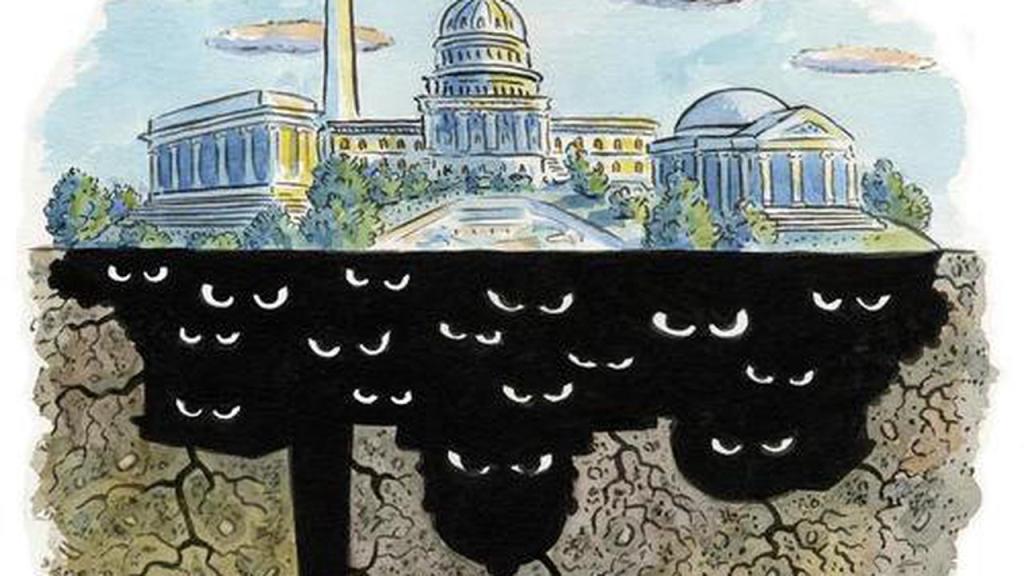

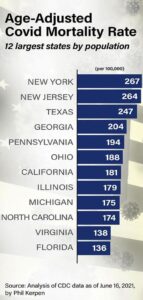
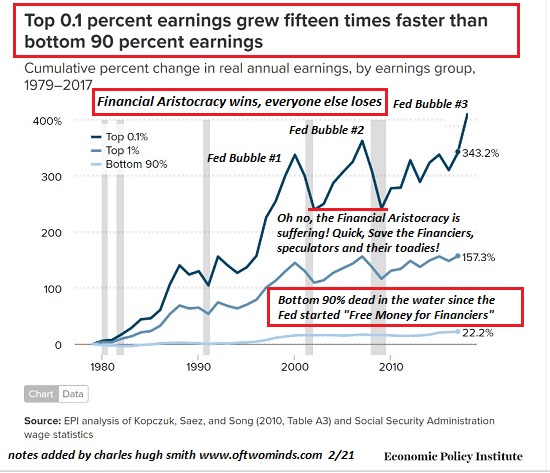
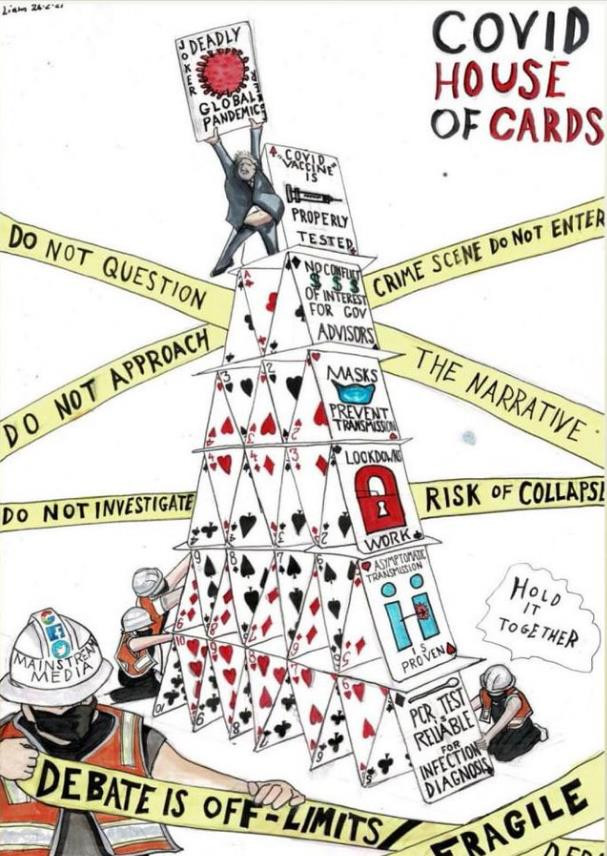


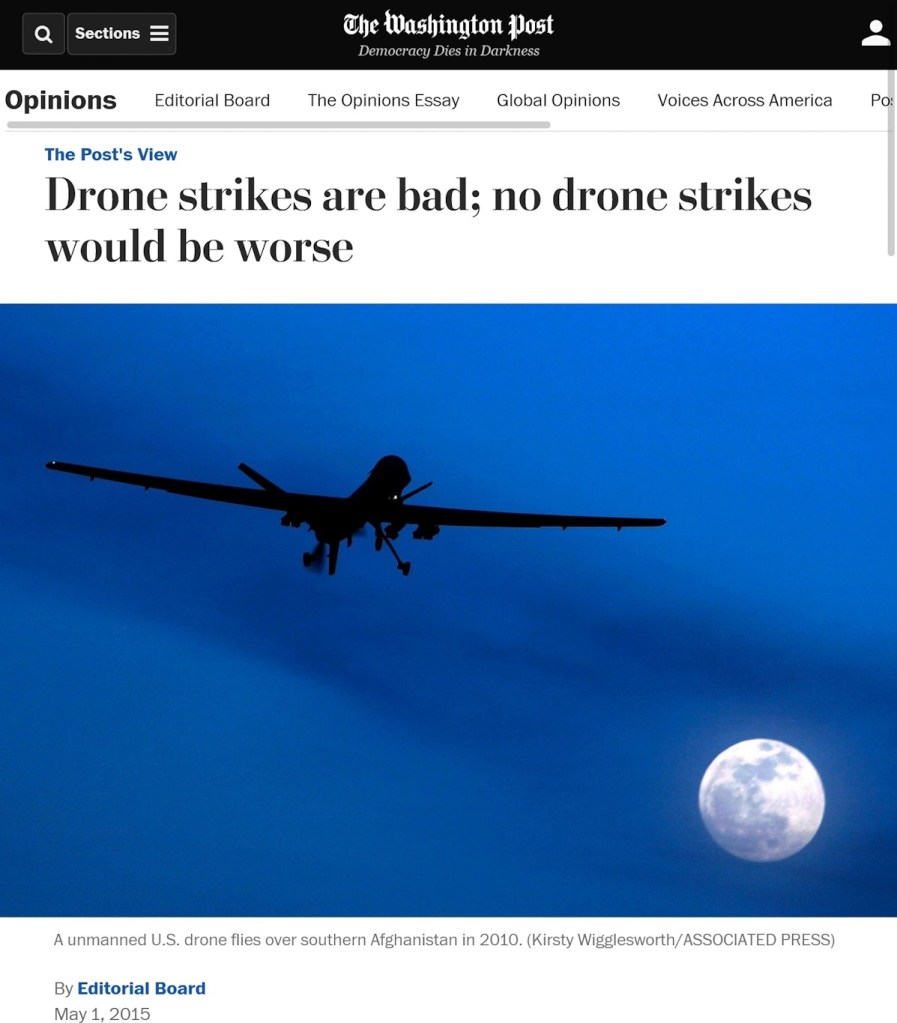
 After the Crash