Mr. Lif, Ayla Nero and The Polish Ambassador

By Tom Keiser
Source: WFMU
“It makes no sense. I mean, how can people just vanish off the face of the Earth in this day and age?”
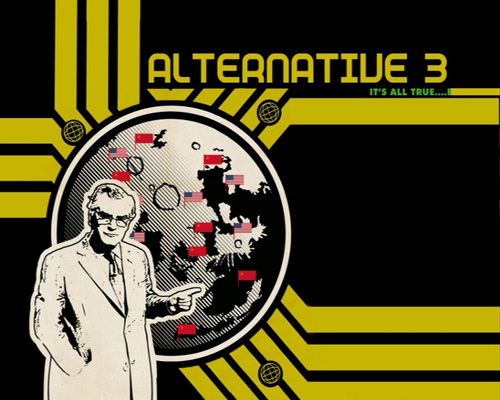
In 1977, a conspiracy was hatched involving writers, actors, politicians, scientists, and Brian Eno. The British television series Science Report was about to be cancelled, and its scheduled April 1 finale gave the creators an opportunity to prank those who believed everything they saw on television, and those so skeptical of everything as to see conspiracies all over the place. The resulting program, Alternative 3, is a classic in fake news programming; The War Of The Worlds by way of the BBC’s 1957 spaghetti harvest hoax.
Alternative 3 is presented as an investigation, with an aborted episode of Science Report as the frame. Twenty-four people interviewed for a Science Report episode on Britain’s “brain drain” have gone missing, including three profiled before the introduction. Over the next hour, further pieces of the puzzle are put into place, connecting the disappearances to the death of a prestigious astronomer, the drunk ravings of a former astronaut, and the theories of an early proponent of the climate change hypothesis, Dr. Carl Gerstein. Contemporary news events, such as the Tangshan earthquake and United Kingdom heatwave and drought in 1976, and the North American mega-blizzard of early 1977, hint at a more destructive event than even the producers of The Day After Tomorrow could have imagined.
Gerstein finally unveils Alternative 3, one of a trio of ways for the human race to survive what he sees as an irreversible and cataclysmic return to the ice age. Compared to the “drastic reduction of the human population” (Alternative 1), and a plan to build underground bases to ride the catastrophe out (Alternative 2), Alternative 3 sounds just as good or bad. But since Alternative 3 is the name of the program, one can guess which is being implemented, and when it’s revealed, it’s a real doozy.
The program’s host, Tim Brinton, was a respected presenter and eventually became a Conservative MP, lending credibility to Alternative 3. Director Christopher Miles worked on feature films and television before and after the program’s release, and writer David Ambrose would go on to write screenplays for The Final Countdown and D.A.R.Y.L., among other films.
Labor issues delayed Alternative 3’s release until June 20, 1977, removing its April Fool’s context entirely — aside from a title card at the end placing the episode at it’s intended release date. The episode’s production values are very similar to British TV documentaries past and present, although it almost resembles self-parody at spots. The segues and dramatizations anticipate Look Around You by 25 years.
The otherworldly tone of the space sequences can be chalked up to Brian Eno’s score, later released under the track “Alternative 3” in his 1978 album Music For Films. Eno would return to lunar exploration later in his career. His 1983 album Apollo: Atmospheres and Soundtracks was later reworked as the soundtrack to the 1989 Apollo program documentary For All Mankind.
There are a few recognizable faces in Alternative 3, at least if you really know your stuff. Shane Rimmer, a self-proclaimed “rent-a-Yank” for British films and the voice of Scott Tracy on the classic TV show Thunderbirds played astronaut Bob Grodin. Richard Marner, who played Dr. Gerstein, became better known in the UK for the show ‘Allo ‘Allo, where he played an inept Nazi colonel. And Norman Chancer, who played science reporter Charles Welbourne, may be best known for his role as Moritz, the unorthodox psychologist in Local Hero.
To this day, many people think Alternative 3 to be disinformation. Viewers at the time believed the disinfo to come from the U.S, British, and Soviet governments, perhaps too busy calling Anglia TV with their outrage to see the cast listing in the credits. A novel based on the TV special also led credence to their worries. The prevaling line of thought these days is that the special was indeed a hoax, but based on factual information. Therefore, Alternative 3 was made to make a real Alternative 3 situation look like such a science fiction fantasy as to remove it from the public’s consciousness. Others still even believe that not only is Alternative 3 real, but is connected to our contact with extraterrestrials. But even a skeptic can love Alternative 3 as an entertaining hour of programming, and it also works as a great counterpoint to 1978’s Capricorn One, about a botched Mars landing being faked to prevent NASA from going under.
No matter what you take from Alternative 3, or what you believe about it, this film will stay with you, just like the sight Bob Grodin saw on the dark side of the moon.
Related Article:
The Truth About Alternative 3 (An archived newsletter excerpt featuring a letter from Leslie Watkins, author of the novelization of the screenplay available here: https://archive.org/details/Alternative3-33rdAnniversaryEdition )

By Jay Dyer
Source: Jay’s Analysis
Spielberg’s Minority Report is now an important film to revisit. Based on the short story by visionary science fiction author Phillip K. Dick, Spielberg’s film version implements an important number of predictive programming elements not found in Dick. Both are worth a look, but the film is important for JaysAnalysis, since now 13 years later, we are actually seeing the implementation of the total technocratic takeover, including pre-crime tracking systems.
Although the film and the short story present the precognition as a metaphysical mystery by telepathic individuals who can see into the aether, the real pre-crime systems are based on A.I. and the digitizing of all records under total information awareness. And as I’ve said, this was DARPA’s plan for the Internet all along.
In fact, a good friend of mine worked for a few years digitizing mass medical records, and while most are aware of Google’s attempts to digitize all books, most do not know why. I’ve warned for several years now the end goal of all this digitization is not for “efficiency” and trendy techy cool iWatches to monitor heart rates and location. The ultimate goal is total mind control, loss of free will and the complete rewrite of all past reality.
Consider, for example, the power the system will wield with the ability to “delete” all past versions of literature – religious texts, Shakespeare, 1984, nothing will be sacred and unable to be “revised.” Remember that in 2009 Amazon erased Orwell’s 1984. Your own past may even be deleted, subject to revision or altered to make you the next villain! All this is revealed in detail in Minority Report. Thus, while the public adopts “Kindles,” print itself is assigned the doom of the kindled fire – like Farenheit 451, as Richard Grove has said.
Minority Report’s setting is a 2055 dystopic D.C., where Agent John Anderton (Tom Cruise) is framed for two murders from within his own PreCrime Corporation ranks by the CEO, Lamar Burgess (Max Von Sydow). (Note: The existing system appears to be a merger of private and government sectors.) I’m sure most readers have seen the film, so I’ll spare you detailed plot recaps and hit the highlights for the sake of our purposes.
The film’s PreCrime alerts a private corporation to a predetermined murder event ahead of time, giving the Agents of the corporation time to save victims. Hailed as a perfect system, the infallibility of PreCrime has made D.C. the safest city in the world, with no murders for several years. As a result, the PreCrime test requires a total surveillance society, something akin to complete panopticism. In fact, the advertising in D.C. is user specific, targeting pedestrian’s personal desires based on retina scans – and all travel requires retinal scanning and mass microchipping.
We are now on the verge of the implementation of retinal scanning, as the U.S. military has engaged in retinal scanning in occupied territories for several years now. It is important to understand that the action of the military abroad are often a test ground for the implementation of such surveillance and tracking technology at “home.” In October 2010, the Guardian reported of U.S. troops stationed in Afghanistan:
“With each iris and fingertip scanned, the device gave the operator a steadily rising percentage chance that the goat herder was on an electronic “watch list” of suspects. Although it never reached 100%, it was enough for the man to be taken to the nearest US outpost for interrogation.
Since the Guardian witnessed that incident, which occurred near the southern city of Kandahar earlier this year, US soldiers have been dramatically increasing the vast database of biometric information collected from Afghans living in the most war-torn parts of southern and eastern Afghanistan. The US army now has information on 800,000 people, while another database developed by the country’s interior ministry has records on 250,000 people.”
Wired Magazine reported millions were the goal. The goal is not millions, but the entire globe, where any and all information is now currency for “big data.” This is exactly the world Minority Report foresaw, and for those curious about Phillip K. Dick, whispers are his foresight was due to being well-connected with the Silicon Valley elites. This is how Ubik foresaw the “Internet of Things” I’ve written about many times, and probably in part why Dick went insane (or was targeted). Slate writes of Ubik:
“Samsung, the world’s largest manufacturer of televisions, tells customers in its privacy policy that “personal or other sensitive” conversations “will be among the data captured and transmitted to a third party” through the TV’s voice-recognition software. Welcome to the Internet of Things.
Sci-fi great Philip K. Dick warned us about this decades ago. In his classic 1969 novel Ubik, the characters have to negotiate the way they move and how they communicate with inanimate objects that monitor them, lock them out, and force payments.”
Just as the predictive algorithm in Asimov’s Foundation was able to track mass movements, so now the same algorithmic tracking is in place across the “web of things” that are capable of being recorded and tracked – and that’s most things. The Pentagon has a virtual “you” in a realtime 3D interface that updates its data consistently from everything done on the web. The Register reported in 2009 about this simulated warfare and predictive software:
“Defense analysts can understand the repercussions of their proposed recommendations for policy options or military actions by interacting with a virtual world environment,” write the researchers.
“They can propose a policy option and walk skeptical commanders through a virtual world where the commander can literally ‘see’ how things might play out. This process gives the commander a view of the most likely strengths and weaknesses of any particular course of action.”
It’s not telepathic Samantha Morton’s in a tub of goo, it’s Google and DARPA developing highly advanced technology along the lines of what William Binney exposed, as a former NSA employee. Think here of War Games (1983), where the A.I. bot was able to war game future scenarios of global thermonuclear war, but thankfully Ferris Bueller was there to save us. If this was displayed in 1983 in pop culture, imagine how far that technology has come 30 years later. Lest anyone think the “precrime” is merely for security and weekend Xbox enjoyment, recall what I wrote two years back:
“Capitalism, communism, nationalism, 401ks, blah blah blah, all of these things are basically obsolete. Why? Because of the nature of the real secret high-tech and plans for mega SmartCities that are to come. You see, you think you are getting ahead and climbing the scum social ladder, and you aren’t even aware that the CEO of IBM Ginni Rommety gives lectures about SmartCities where everything you do will be rationed, tracked and traced by the central supercomputers, with pre-crime determining whether you are guilty of crimethink. So everything you are trusting in is already obsolete. You think I’m exaggerating? On the contrary, you and your children’s futures are determined (you don’t have a future), and if you are allowed to live past the great culling, you will essentially be boxed into a giant WalmartTargetGameStopUniversity City that will literally be run by a supercomputer. Watch for yourself:”
And lest anyone think PreCrime is a thing of the future, consider that it has been used for two years in the U.K. The New Scientist and 21stCenturyWire report:
“That’s the hope of police in the US, who have begun using advanced software to analyse crime data in conjunction with emails, text messages, chat files and CCTV recordings acquired by law enforcement. The system, developed by Wynyard, a firm based in Auckland, New Zealand, could even look at social media in real time in an attempt to predict where the gang might strike next.
“We’re trying to get to the source of the mastermind behind the criminal activity, that’s why we’re setting up a database so everybody can provide the necessary information and help us get higher up the chain,” says Craig Blanton of the Marion County Sheriff’s Office in Indiana. Because Felony Lane Gang members move from state to state to stay one step ahead, the centralised database is primed to aggregate historical information on the group and search for patterns in their movements, Blanton says.
“We know where they’ve been, where they are currently and where they may go in the future,” he says. “I think had we not taken on this challenge, we along with the other 110 impacted agencies would be doing our own thing without better knowledge of how this group operates.”
It’s not the only system that police forces have at their disposal. PredPol, which was developed by mathematician George Mohler at Santa Clara University in California, has been widely adopted in the US and the UK. The software analyses recorded crimes based on date, place and category of offence. It then generates daily suggestions for locations that should be patrolled by officers, depending on where it calculates criminal activity is most likely to occur.”
Returning to the film, an interesting tidbit occurs about three times that I noticed. Any time Anderton or his fellow Agents access the “Temple,” the holding site of the telepathic PreCogs, the sound made is distinctly the iPhone power on sound. The first iPod premiered in 2001, so I’m assuming it’s the same sound for turning on, but readers can correct me. I find it curious if not, since the sound would likely be chosen for a reason. This puts the infamous 1984 Apple ad in a new, ominous light.
If you’ve seen the important Spike Jonze film, Her, you’ll see why. In Her, lead character Theodore (Joaquin Phoenix) falls in love with an iOS – his operating system. The iOS of his future is an intelligent software system with capability for learning (like the A.I. in War Games), and ultimately transcends its own limitations.
I bring this up because Minority Report is distinctly dominated by eye imagery. While seemingly insignificant, it is my opinion that Siri and Apple in particular are crucial in the implementation of the coming new order. Apple ads have contained a distinctly esoteric and significant cultural referent. This is not to say Microsoft or any of the other tech giants are insignificant, on the contrary, I believe they are all arms of one entity and the appearance of competition is largely illusory.
There is only one military industrial complex, and DARPA and Google and Apple and Microsoft are all its children. The façade of competition is enough to advance the technology by the tech nerds that serve it, but in the end, it all serves the same system. My point here is that the iPhone is much more than an iPhone. It is actually an EYEphone, functioning as the eye of Sauron himself, as A.I. reconnaissance before the takeover.
I have mentioned before the whispers are the iPhone of the next few years will contain a Siri that communicates with you like a personal assistant. I have finally found an article on this here, which describes it directly in connection to Her, like I said here. “Viv” will do the following:
“On the other hand, not only will Viv recognize disparate requests, she will also be able to put them together. Basically, Viv is Siri with the ability to learn. The project is being kept heavily under wraps, but the guys at Viv have hinted that they’re working towards creating a “global brain,” a shared source of artificial intelligence that’s as readily accessible as heat or electricity. It’s unclear how soon a breakthrough of this magnitude can happen. But if this team made Siri, you can bet their next project is going to blow the tech world to pieces.”
In order to endear the public to that idea, a prototype Siri had to be offered. While this may be a rumor, it will eventually come. And the dystopic scenario presented in Her will meet the nightmare of Minority Report. For now, it all seems harmless (though we are seeing a generation of youth destroyed by screens and pads – Steve Jobs didn’t let his own kids play with an iPad!), but the end goal I assure is nefarious.
The dominant ideology of these tech giants is pure and total dysgenics (not eugenics). In order for the total rewrite to come, the existing structure must be destroyed. The “old way” of doing things will be scapegoated as the technocracy replaces it, offering utopia and salvation, but the synthetic rewrite is a Trojan horse. Humanity will be enslaved in the same virtual Matrix Anderton is enslaved in, in the film.
The film’s tag line, which pops up numerous times in the story, is about running. “Everybody runs,” and John spends most of the film on the run from the very system he operated. The film asks the question multiple times, “Can you see?” and when we think of this on a deeper level in terms of predictive programming, I think we are intended to look beyond the immediate narrative. There are also numerous hat tips to Blade Runner, where again the “running” imagery comes to the fore. Can we run from the panopticon? Do we have eyes to see the iEYES that are “infallibly” surveilling us perpetually?

By Bill Gibron
Source: Pop Matters
Film has always been a visual medium. In the days before sound, the image was all we had. It told our story, established our characters, and accentuated the drama or comedy. Visual flair is as old as movies themselves, and yet so few directors today seem to rely on and relish in the imaginative or outrageous. Since the early ’60s, Hollywood and its filmmakers have de-evolved style in a vicious cycle real world recreation for the hyper-stylized universe of the big screen, exploiting small events to find the hidden theatrics. Instead of broad canvases of color or rich, dense imagery, we witness the mundane or maudlin. Even those epic dreamscapes woven by complex computers and deranged art designers usually have one foot firmly planted in the easy to recognize and rationalize. But not The City of Lost Children. It harkens back to a more old-fashioned pictographic mindset. In many significant and indirect ways, the wild world of Marc Caro and Jean-Pierre Jeunet is art come to life. As in their previous film together, 1991’s Delicatessen, it is a fairy tale presentation of pure unbridled, wonderfully wicked imagination. It’s the Brothers Grimm as envisioned by Salvador Dali and filmed by Fritz Lang.
This is a lost classic, a film not often discussed when visionary works of imaginative cinema are mentioned. Part of this may be due to its foreign film roots. Or perhaps, for many, the film is too dark, not your typical sweet Saturday morning matinee. There are very disturbing subtexts to City that do not exist in other flights of fancy. The children here are indeed lost, either captured and tormented by a character known as Krank, or forced into a life of juvenile crime by the manipulative twins who run an orphanage. We do not see mothers or fathers. There are no caregivers or guardians, nor do we see orphans or outcasts longing for them. This lack of unconditional love creates youths who are vastly more mature, discussing subjects like love and fear with ferocious intensity and sly maturity. The strongman known as One is the closest we have to any type of parental figure, and even he is not really the older, bigger brother. “No parents” does not equal “no worries” in City. This is also a film that wallows in the subtle beauty of the grotesque, amplifying ugliness to illustrate unbridled absurdity. From Jean Paul Gautier’s Marquis de Sade meets Moby Dick fashion statements to the walleyed, demon-like faces of the child-napping zealot Cyclops, the film takes the long lost look of the circus sideshow and melds it to a nightmarish world of technological and emotional freaks.
Jean-Pierre and Marc are obviously obsessed with the carnival. The entire color scheme seems lifted from a tattooed man’s body illustrations. Like Fellini’s La Strada, which sought to tell a simple tale of love and the human spirit within the unreal realm of the circus, the filmmakers use the fantastical festival setting as a means of expressing their themes. Within its pandemonium pallet are the purity of youth, the pain of age, the wickedness of greed, and the comfort of love. There are also religious philosophies at play, battles with God both figuratively and literally. Krank and his army of clones fight and argue amongst themselves, all in the hope that, one day, the Creator will return to right his genetic missteps. The twins lord over their orphan charges like devils at the seat of Satan’s cloven hoof, waiting for instruction and brimstone beatitudes. Even the Cyclops proclaim their undying faith by blinding themselves, hoping that God will see that through both their devotion and their evangelism how truly gifted with sight (both internal and external) they are. Just like the wistful notion of running off to join the traveling show, The City of Lost Children is a chance not taken, a place where the oppression of maturity, of the stark reality of mortality and responsibility turn adults into monsters, and children into commodities.
The viewer can see many divergent ideals and inspirations at work here. But the most interesting influence to wind its way throughout the entire film is American cartoonist and inventor Rube Goldberg. Goldberg’s ingenious drawings illustrated incredibly complicated and multi-stepped procedures to achieve the most basic of results. Several set pieces in the film apply his principles and influences, and there is a giddy joy when their cause and effect logic draws to its ultimate conclusion. One sequence, involving the animal kingdom and a call to arms, is as beautiful as it is ridiculously complex. Like all other special, unnerving aspects of this movie, from the twisted fable at the core of its narrative, to the subtle pronouncements on love and family, The City of Lost Children is indeed like one of Goldberg’s wildest inventions. It’s a film that hitches its humor to the stinger of a flea, rides it on the heads of circus strongmen, and brings its heartfelt conclusion to rest in the bubbling tank of a talking, sarcastic brain. Yet the movie never gets lost itself. There is a perverse logic in its over symbolic and stylized storytelling.
No discussion of City would be complete without a word or two about the film’s music and its wonderful performances. As he has done in so many other films for auteurs like David Lynch and Paul Schrader, Angelo Badalamenti creates the perfect score, adding the clarion call of the calliope and the lonesome moan of the strings to underscore the strangeness and the sadness. This is a town under fire from within (the gangs of mercenary urchins) and without (the abductions), and Badalamenti creates a theme and an aural presence for every ideal. Sonically, The City of Lost Children is a near seamless matching of music to moving image. As for the actors, Ron Perlman has always seemed like a stunt waiting to be cast. Usually unrecognizable in face altering or obliterating make-up, he normally essays roles as unreal as the location in this film. But interestingly enough, he is the very human core of the film, a strong, faithful muscleman whose basic needs match his simpleton intellect. His is a perfectly modulated, understated performance. Among the child actors, little Judith Vittet stands out as Miette, a child who carries an incredible amount of adult soul and beauty within her delicate, French bisque features. And as usual, Jeunet regular Dominique Pinon applies his elastic facial features to the creation of six distinct characters, all out of minimal dialogue and elegant pantomime.
A movie like The City of Lost Children doesn’t really want to show us where the secrets of youth are hidden. It buries its message of adulthood and its perils in elaborate sets and visually arresting images. It symbolizes the dead end of avarice, the importance of familial bonds, and the painful loss of innocence through dreams in wonderful, paint box strokes. But it still leaves us wondering if such a place actually exists. For some, the manufactured wonders of Disney World or Universal Studios theme parks offer a glimpse into the sacred village of eternal childhood. Still others find it in the magic of their offspring at play, in their riotous laughter. Many see it in the eyes of their son or daughter as they light up in loving response. And there are those who, no matter how hard they try or how long they look, will never find the City. It will pass them by, or they will look over or through it in pursuit of a more complicated, unimportant goal. Jean-Pierre Jeunet and Marc Caro have at least provided a roadmap to the mythological place in their film La Cité des Enfants Perdus. Just turn right at your dreams, be on the lookout for your heartstrings, and ride your imagination all the way to where the sea meets the sky.

By Pepe Tesoro
Source: We Are the Mutants
Thomas Pynchon’s 1966 novel The Crying of Lot 49 is usually regarded as one of the best testimonies of Cold War paranoia and early psychedelic ’60s culture. Even though it is a keen and pointed exploration of the growing anxieties over the exponential post-war rise of mass media and market capitalism, the central conspiracy revealed in the novel doesn’t reproduce itself through the then-new and fascinating forces of radio waves or cathode rays. Quite the opposite: the kernel of the conspiracy in Pynchon’s novel lays precisely in a clandestine communication network sent through old-fashioned, conventional mail. This network itself possesses roots that go back as far as medieval nobility feuds, its presence identified with something as ancient and basic as graffiti. Fredric Jameson attributed the true effectiveness of the novel to this anomalous feature. “[T]he force of Pynchon’s narrative,” he writes in The Geopolitical Aesthetic: Cinema and Space in the World System, “draws not on the advanced or futuristic technology of the contemporary media so much as from their endowment with an archaic past.”
It would seem that in order to perform an adequate exploration of the psychological and social and political disruptions of an era’s newest and most cutting-edge technological developments, sometimes it is required to take one or two steps back, as if the reflection over contemporary objects would be better served through the examination of old and already familiar realities. The long history and deep cultural footprint of retro-futuristic aesthetics in Pynchon’s fictional universe seems to point in somewhat the same direction. But this odd narrative movement doesn’t just go backwards; it also, quite interestingly, usually goes downwards. That’s the case of the The Crying of the Lot 49, where the occult conspiracy that our poor protagonist, Oedipa Maas, struggles to unveil, doesn’t just rely on the old means of the mail. Its members are imagined as marginalized individuals living in between the remnants and scraps of industrial machinery, as if the life of the vagabond would be the only true escape from the madness of modern civilization. These elusive individuals, as imagined by Oedipa, seem to be:
…squatters who stretched canvas for lean-tos behind smiling billboards along all the highways, or slept in junkyards in the stripped shells of wrecked Plymouths, or even, daring, spent the night up some pole in a lineman’s tent like caterpillars, swung among a web of telephone wires, living in the very copper rigging and secular miracle of communication, untroubled by the dumb voltages flickering their miles, the night long, in the thousands of unheard messages.
This supposed conspiracy of the homeless and the outcast, not subtly named W.A.S.T.E., is then imagined as a hidden net that mimics modern global communication networks, and even lives as close as it can to those hardware channels. And precisely because of that, it stays totally untouched by modernity and is invisible to its gaze. The particular mixture of secrecy, homelessness, and clandestine communication systems in Oedipa’s imagination was not new at the time, and can be traced back to the life and especially the works of one Leon Ray Livingston.
Livingston, born in 1872, was probably the most notorious American hobo. “Hobo“ is actually a rather particular term in American cultural history; it doesn’t merely designate an individual who lacks a stable location or place for living, but it instead indicates a quite idiosyncratic American social character, determined by the country’s own history of geographical expansion and industrialization. The hobo was a homeless man that crossed the entire continent, from city to city, throughout the growing railroad’s network, surfing the new, blossoming industrial landscapes a job at a time. Throughout the years, the hobo came to be recreated by the national cultural imagination as a romantic figure, a mystical outsider, a mysterious and almost invisible inhabitant of the modern world’s new industrial features, constantly at the edge of society, always trying to avoid unwelcome company and harassing authorities. That popular image was mostly the work of Livingston.
Livingston was not just a hobo; he was also a popular author. Under the pen name of “A-No1,” he published a series of books that fictionalized the hobo lifestyle and basically created from scratch the romantic and enigmatic portrait just described. But probably the most fascinating and persistent myth that emerged from the A-No1 books was the existence of a secret hobo code, presented in unnoticed and almost invisible chalk or charcoal graffiti. This code, composed of cryptic, seemingly ordinary and almost-childish hieroglyphs and symbols, was supposedly used by traveling hobos to transmit messages to their colleagues, such as “Dangerous town,” “Safe place to spend the night,” or “Here lives a nice lady.” It is known and well-documented (mostly through the work of filmmaker Bill Daniel) that the practice of signing the side of wagons and rail post with their personal monikers was and still is a spread practice for hobos and railroad workers in America. But with respect to a secret code that transmitted useful messages from hobo to hobo, there is not much evidence that it actually existed. After all, why would the hobo, a supposedly elusive and off-the-grid character, want to make public their own secret means of communication? It is not unfair to assume that the publication of the hobo code was probably nothing more than a ploy to fabricate and maintain that same legendary elusiveness.
Either way, thanks to Leon Ray Livingston’s works, the hobo’s supposed secret code became a common emblem of the intriguing and puzzling (and pretty much fantastic) mysteries of industrial civilization’s own underground realities. It seemed at the same time spooky and exhilarating to imagine that the unstoppable machine of progress was leaving behind, in its own dark residue, a striving secret society of outcasts and ostracized rebels living an almost chivalrous adventure, having happily exchanged social status and at times mental health to be free of the oppressive commands of power. I think it goes without saying how popular this common narrative has stayed throughout the years in science fiction and, more generally, in popular culture. The mystic figure of the marginalized can be tracked from the charming and magical homeless lady in Frank Capra’s A Pocketful of Miracles, to the cyberpunk Martian mutant separatists in Total Recall, to the Lo-Teks in Johnny Mnemonic and the Nebuchadnezzar crew in The Matrix series, just to name a few. These cyberpunk re-imaginations fall under the myth of the “hidden utopia”: the assumption that the hopes of resistance against the conspiracy of modern civilization lays in a counter-conspiracy of the outcasts, the unlikely sub-inhabitants of its most obscure and remote corners.
This is exactly what is deployed by Pynchon in The Crying of the Lot 49. Or, at least, this is how a borderline-paranoid protagonist tends to imagine a seemingly active but always evasive conspiracy, as if the myth of the hidden utopia could be also a borderline-paranoid fantasy of those made anxious and disoriented by postmodern subjectivity. It’s also possible to observe the echo of the hobo graffiti’s legend in Pynchon’s book, as the W.A.S.T.E. logo, a simply drawn muted cornet, suspiciously similar to the purported signs of the hobo code, appears to have been placed all over the most seemingly mundane corners of Oedipa’s reality, such as on the walls of a public bathroom or on the edge of a sidewalk.
But the recovery and use by Pynchon of these older cultural cues is not an idealization of the hidden problems of the homeless and the marginalized. After all, any social articulation outside the limits of the community itself can easily turn into a contradiction, a fantasy, a paradox not allowed by the predominant culture. If the whole world has been conquered by malignant forces and crooked interests, the possibility of a constructive, non-nihilistic escape from this system literally lays outside of this world. That’s why Pynchon, as Oedipa, finds himself at a dead end, accepting that, if W.A.S.T.E. and its obscure conspirators were to exist, its own definition would prohibit the final revelation of its actual existence. That’s good for Pynchon, who playfully explores the literary potential of such contradiction, but it ain’t so good for Oedipa, who is still and forever trapped in modern society, and seems destined to always live on the epistemic edge of paranoia, unable to determine if everything she experiences is a convoluted prank by her ex-lover, if she has gone definitively crazy, or if W.A.S.T.E. is, in fact, real.
In a dream-like episode in the middle of the novella, Oedipa encounters an old ex-anarchist friend, Jesús Arrabal, who, torn apart by the demise of the emancipatory narrative, has to admit to her the metaphysical impossibility, or at least almost supernatural essence, of any revolutionary promise: “You know what a miracle is. Not what Bakunin said. But another world’s intrusion into this one.” Alien invasion? Religious intervention? Not quite, but similarly unlikely: the possibility that, under the all-mighty and ubiquitous forces of the Machinery and the cannibalistic and expanding logic of Capital, there could have formed a secret alliance of those who have been cast out of society, those who inhabit the obscure nooks of the dirt and the piles of garbage, under the colossal figure of the ominous constructions and highways. Like parasites in the wires of modern communication systems, these posited liberatory beings have been exiled in a land “invisible yet congruent with the cheered land [Oedipa] lived in,” barely but firmly surviving out of the realm of the living, right next to where we stand, but nevertheless unnoticed by the naked eye.
INDIAN COUNTRY NEWS
"It is the duty of every man, as far as his ability extends, to detect and expose delusion and error"..Thomas Paine
Human in Algorithms
From the Roof Top
I See This
blog of the post capitalist transition.. Read or download the novel here + latest relevant posts
अध्ययन-अनुसन्धानको सार
 After the Crash