Saturday Matinee: Matangi / Maya / M.I.A.

Synopsis from MIADocumentary.com

Drawn from a cache of personal video recordings from the past 22 years, director Steve Loveridge’s Sundance award winning MATANGI / MAYA / M.I.A. is a startlingly personal profile of the critically acclaimed artist, chronicling her remarkable journey from refugee immigrant to pop star.

She began as Matangi. Daughter of the founder of Sri Lanka’s armed Tamil resistance, she hid from the government in the face of a vicious and bloody civil war. When her family fled to the UK, she became Maya, a precocious and creative immigrant teenager in London. Finally, the world met her as M.I.A. when she emerged on the global stage, having created a mashup, cut-and-paste identity that pulled from every corner of her journey along the way; a sonic sketchbook that blended Tamil politics, art school punk, hip-hop beats and the unwavering, ultra-confident voice of a burgeoning multicultural youth.

Never one to compromise on her vision, Maya kept her camera rolling throughout. MATANGI / MAYA / M.I.A. provides unparalleled, intimate access to the artist in her battles with the music industry and mainstream media as her success and fame explodes, becoming one of the most recognizable, outspoken and provocative voices in music today.

Watch the full film on Kanopy here: https://www.kanopy.com/product/matangi-maya-mia-0

What is the soul if not a better version of ourselves?

By John Cottingham

Source: aeon

What is the point of gaining the whole world if you lose your soul? Today, far fewer people are likely to catch the scriptural echoes of this question than would have been the case 50 years ago. But the question retains its urgency. We might not quite know what we mean by the soul any more, but intuitively we grasp what is meant by the loss in question – the kind of moral disorientation and collapse where what is true and good slips from sight, and we find we have wasted our lives on some specious gain that is ultimately worthless.

It used to be thought that science and technology would gain us the world. But it now looks as though they are allowing us to destroy it. The fault lies not with scientific knowledge itself, which is among humanity’s finest achievements, but with our greed and short-sightedness in exploiting that knowledge. There’s a real danger we might end up with the worst of all possible scenarios – we’ve lost the world, and lost our souls as well.

But what is the soul? The modern scientific impulse is to dispense with supposedly occult or ‘spooky’ notions such as souls and spirits, and to understand ourselves instead as wholly and completely part of the natural world, existing and operating through the same physical, chemical and biological processes that we find anywhere else in the environment.

We need not deny the value of the scientific perspective. But there are many aspects of human experience that cannot adequately be captured in the impersonal, quantitatively based terminology of scientific enquiry. The concept of the soul might not be part of the language of science; but we immediately recognise and respond to what is meant in poetry, novels and ordinary speech, when the term ‘soul’ is used in that it alerts us to certain powerful and transformative experiences that give meaning to our lives. Such experiences include the joy that arises from loving another human being, or the exaltation when we surrender to the beauty of a great artistic or musical work, or, as in William Wordsworth’s poem ‘Tintern Abbey’ (1798), the ‘serene and blessed mood’ where we feel at one with the natural world around us.

Such precious experiences depend on certain characteristic human sensibilities that we would not wish to lose at any price. In using the term ‘soul’ to refer to them, we don’t have to think of ourselves as ghostly immaterial substances. We can think of ‘soul’ as referring, instead, to a set of attributes ­­– of cognition, feeling and reflective awareness – that might depend on the biological processes that underpin them, and yet enable us to enter a world of meaning and value that transcends our biological nature.

Entering this world requires distinctively human qualities of thought and rationality. But we’re not abstract intellects, detached from the physical world, contemplating it and manipulating it from a distance. To realise what makes us most fully human, we need to pay attention to the richness and depth of the emotional responses that connect us to the world. Bringing our emotional lives into harmony with our rationally chosen goals and projects is a vital part of the healing and integration of the human soul.

In his richly evocative book The Hungry Soul (1994), the American author Leon Kass argues that all our human activities, even seemingly mundane ones, such as gathering around a table to eat, can play their part in the overall ‘perfecting of our nature’. In the more recent book Places of the Soul (3rd ed, 2014), the ecologically minded architect Christopher Day speaks of the need for humans to live, and to design and build their dwellings, in ways that harmonise with the shapes and rhythms of the natural world, providing nourishment for our deepest needs and longings.

The language of ‘soul’ found here and in many other contexts, ancient and modern, speaks ultimately of the human longing for transcendence. The object of this yearning is not well-captured in the abstract language of theological doctrine or philosophical theory. It is best approached through praxis, or how that theory is enacted. Traditional spiritual practices – the often simple acts of devotion and commitment found in rites of passage marking the birth or death of a loved one, say, or such rituals as the giving and receiving of rings – provide a powerful vehicle for the expression of such longings. Part of their power and resonance is that they operate on many levels, reaching deeper layers of moral, emotional and spiritual response than can be accessed by the intellect alone.

The search for ways to express the longing for a deeper meaning in our lives seems to be an ineradicable part of our nature, whether we identify as religious believers or not. If we were content to structure our lives wholly within a fixed and unquestioned set of parameters, we would cease to be truly human. There is something within us that is always reaching forward, that refuses to rest content with the utilitarian routines of our daily existence, and yearns for something not yet achieved that will bring healing and completion.

Not least, the idea of the soul is bound up with our search for identity or selfhood. The French philosopher René Descartes, writing in 1637, spoke of ‘this me, that is to say the soul by which I am what I am’. He went on to argue that this soul is something entirely nonphysical, but there are now very few people, given our modern knowledge of the brain and its workings, who would wish to follow him here. But even if we reject Descartes’s immaterialist account of the soul, each of us retains a strong sense of ‘this me’, this self that makes me what I am. We are all engaged in the task of trying to understand the ‘soul’ in this sense.

But this core self that we seek to understand, and whose growth and maturity we seek to foster in ourselves and encourage in others, is not a static or closed phenomenon. Each of us is on a journey, to grow and to learn, and to reach towards the best that we can become. So the terminology of ‘soul’ is not just descriptive, but is what philosophers sometimes call ‘normative’: using the language of ‘soul’ alerts us not just to the way we happen to be at present, but to the better selves we have it in our power to become.

To say we have a soul is partly to say that we humans, despite all our flaws, are fundamentally oriented towards the good. We yearn to rise above the waste and futility that can so easily drag us down and, in the transformative human experiences and practices we call ‘spiritual’, we glimpse something of transcendent value and importance that draws us forward. In responding to this call, we aim to realise our true selves, the selves we were meant to be. This is what the search for the soul amounts to; and it is here, if there is a meaning to human life, that such meaning must be sought.

Saturday Matinee: Ghost in the Shell

“Ghost in the Shell” (1995) is a cyberpunk anime directed by Mamoru Oshii and based on the manga of the same name by Masamune Shirow. Set in 2029 Japan, the plot centers on Motoko Kusanagi, a cyborg public-security agent hunting a mysterious hacker known as the Puppet Master who has manipulated the minds of cyborg-human hybrids. With her partner Batou she corners the hacker, but questions about her own identity sends her quest in an unforeseen direction.

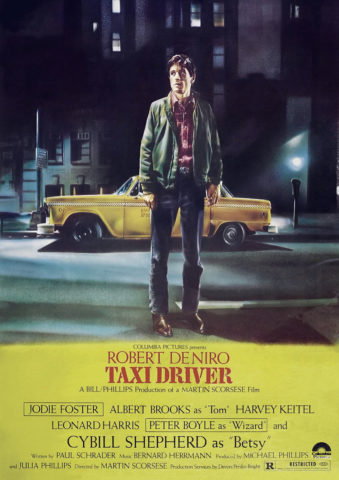
Saturday Matinee: Taxi Driver

By Roger Ebert

Source: RogerEbert.com

Are you talkin’ to me? Well, I’m the only one here. –Travis Bickle in “Taxi Driver”

It is the last line, “Well, I’m the only one here,” that never gets quoted. It is the truest line in the film. Travis Bickle exists in “Taxi Driver” as a character with a desperate need to make some kind of contact somehow–to share or mimic the effortless social interaction he sees all around him, but does not participate in.

The film can be seen as a series of his failed attempts to connect, every one of them hopelessly wrong. He asks a girl out on a date, and takes her to a porno movie. He sucks up to a political candidate, and ends by alarming him. He tries to make small talk with a Secret Service agent. He wants to befriend a child prostitute, but scares her away. He is so lonely that when he asks, “Who you talkin’ to?” he is addressing himself in a mirror.

This utter aloneness is at the center of “Taxi Driver,” one of the best and most powerful of all films, and perhaps it is why so many people connect with it even though Travis Bickle would seem to be the most alienating of movie heroes. We have all felt as alone as Travis. Most of us are better at dealing with it.

Martin Scorsese’s 1976 film (re-released in theaters and on video in 1996 in a restored color print, with a stereophonic version of the Bernard Herrmann score) is a film that does not grow dated, or over-familiar. I have seen it dozens of times. Every time I see it, it works; I am drawn into Travis’ underworld of alienation, loneliness, haplessness and anger.

It is a widely known item of cinematic lore that Paul Schrader’s screenplay for “Taxi Driver” was inspired by “The Searchers,” John Ford’s 1956 film. In both films, the heroes grow obsessed with “rescuing” women who may not, in fact, want to be rescued. They are like the proverbial Boy Scout who helps the little old lady across the street whether or not she wants to go.

“The Searchers” has Civil War veteran John Wayne devoting years of his life to the search for his young niece Debbie (Natalie Wood), who has been kidnapped by Commanches. The thought of Debbie in the arms of an Indian grinds away at him. When he finally finds her, she tells him the Indians are her people now, and runs away. Wayne then plans to kill the girl, for the crime of having become a “squaw.” But at the end, finally capturing her, he lifts her up (in a famous shot) and says, “Let’s go home, Debbie.”

The dynamic here is that Wayne has forgiven his niece, after having participated in the killing of the people who, for 15 years or so, had been her family. As the movie ends, the niece is reunited with her surviving biological family, and the last shot shows Wayne silhouetted in a doorway, drawn once again to the wide open spaces. There is, significantly, no scene showing us how the niece feels about what has happened to her.

In “Taxi Driver,” Travis Bickle also is a war veteran, horribly scarred in Vietnam. He encounters a 12-year-old prostitute named Iris (Jodie Foster), controlled by a pimp named Sport (Harvey Keitel). Sport wears an Indian headband. Travis determines to “rescue” Iris, and does so, in a bloodbath that is unsurpassed even in the films of Scorsese. A letter and clippings from the Steensmas, Iris’ parents, thank him for saving their girl. But a crucial earlier scene between Iris and Sport suggests that she was content to be with him, and the reasons why she ran away from home are not explored.

The buried message of both films is that an alienated man, unable to establish normal relationships, becomes a loner and wanderer, and assigns himself to rescue an innocent young girl from a life that offends his prejudices. In “Taxi Driver,” this central story is surrounded by many smaller ones, all building to the same theme. The story takes place during a political campaign, and Travis twice finds himself with the candidate, Palatine, in his cab. He goes through the motions of ingratiating flattery, but we, and Palatine, sense something wrong.

Shortly after that Travis tries to “free” one of Palatine’s campaign workers, a blonde he has idealized (Cybill Shepherd), from the Palatine campaign. That goes wrong with the goofy idea of a date at a porno movie. And then, after the fearsome rehearsal in the mirror, he becomes a walking arsenal and goes to assassinate Palatine. The Palatine scenes are like dress rehearsals for the ending of the film. With both Betsy and Iris, he has a friendly conversation in a coffee shop, followed by an aborted “date,” followed by attacks on the men he perceived as controlling them; he tries unsuccessfully to assassinate Palatine, and then goes gunning for Sport.

There are undercurrents in the film that you can sense without quite putting your finger on them. Travis’ implied feelings about blacks, for example, which emerge in two long shots in a taxi driver’s hangout, when he exchanges looks with a man who may be a drug dealer. His ambivalent feelings about sex (he lives in a world of pornography, but the sexual activity he observes in the city fills him with loathing). His hatred for the city, inhabited by “scum.” His preference for working at night, and the way Scorsese’s cinematographer, Michael Chapman, makes the yellow cab into a vessel by which Travis journeys the underworld, as steam escapes from vents in the streets, and the cab splashes through water from hydrants–a Stygian passage.

The film has a certain stylistic resonance with “Mean Streets” (1973), the first Scorsese film in which Keitel and De Niro worked together. In the earlier film Scorsese uses varying speeds of slow-motion to suggest a level of heightened observation on the part of his characters, and here that technique is developed even more dramatically; as the taxi drives through Manhattan’s streets, we see it in ordinary time, but Travis’ point-of-view shots are slowed down: He sees hookers and pimps on the sidewalks, and his heightened awareness is made acute through slow motion.

The technique of slow motion is familiar to audiences, who usually see it in romantic scenes, or scenes in which regret and melancholy are expressed–or sometimes in scenes where a catastrophe looms, and cannot be avoided. But Scorsese was finding a personal use for it, a way to suggest a subjective state in a POV shot. And in scenes in a cab driver’s diner, he uses closeups of observed details to show how Travis’s attention is apart from the conversation, is zeroing in on a black who might be a pimp. One of the hardest things for a director to do is to suggest a character’s interior state without using dialog; one of Scorsese’s greatest achievements in “Taxi Driver” is to take us inside Travis Bickle’s point of view.

There are other links between “Mean Streets” and “Taxi Driver” that may go unnoticed. One is the “priest’s-eye-view” often used in overhead shots, which Scorsese has said are intended to reflect the priest looking down at the implements of the Mass on the altar. We see, through Travis’ eyes, the top of a taxi dispatcher’s desk, candy on a movie counter, guns on a bed, and finally, with the camera apparently seeing through the ceiling, an overhead shot of the massacre in the red-light building. This is, if you will, the final sacrifice of the Mass. And it was in “Mean Streets” that Keitel repeatedly put his finger in the flame of a candle or a match, testing the fires of hell: here De Niro’s taxi driver holds his fist above a gas flame.

There has been much discussion about the ending, in which we see newspaper clippings about Travis’ “heroism,” and then Betsy gets into his cab and seems to give him admiration instead of her earlier disgust. Is this a fantasy scene? Did Travis survive the shoot-out? Are we experiencing his dying thoughts? Can the sequence be accepted as literally true?

I am not sure there can be an answer to these questions. The end sequence plays like music, not drama: It completes the story on an emotional, not a literal, level. We end not on carnage but on redemption, which is the goal of so many of Scorsese’s characters. They despise themselves, they live in sin, they occupy mean streets, but they want to be forgiven and admired. Whether Travis gains that status in reality or only in his mind is not the point; throughout the film, his mental state has shaped his reality, and at last, in some way, it has brought him a kind of peace.


Watch the full film for free here.

Saturday Matinee: Heathers

“Heathers” (1988) is a dark high school comedy written by Daniel Waters and directed by Michael Lehmann. “The Heathers” of the title refers to Westerburg High School’s elite clique of popular girls, whose  newest member is Veronica Sawyer (Winona Ryder). Fed up with the Heathers’ constant peer pressure and obnoxious social circle she becomes increasingly attracted to J.D. (Christian Slater), a mysterious, rebellious – and possibly psychotic – new student. This 80’s cult film was most likely inspired by a thematically similar (but tonally different) 70’s high school film called “Massacre at Central High“.

Watch Heathers on Hoopla here: https://www.hoopladigital.com/title/11896270