America’s Addiction to War Comes with a 15 Trillion Dollar Price Tag

To surmount the debt crisis, America needs to stop feeding the Military-Industrial Complex, the most powerful lobby in Washington.

By Jeffrey D. Sachs

Source: Information Clearing House

In the year 2000, the U.S. government debt was $3.5 trillion, equal to 35% of the Gross Domestic Product (GDP). By 2022, the debt was $24 trillion, equal to 95% of GDP. The U.S. debt is soaring, hence America’s current debt crisis. Yet both Republicans and Democrats are missing the solution: stopping America’s wars of choice and slashing military outlays.

Suppose the government’s debt had remained at a modest 35% of GDP, as in 2000. Today’s debt would be $9 billion, as opposed to $24 trillion. Why did the U.S. government incur the excess $15 trillion in debt?

The single biggest answer is the U.S. government’s addiction to war and military spending. According to the Watson Institute at Brown University, the cost of U.S. wars from fiscal year 2001 to fiscal year 2022 amounted to a whopping $8 trillion, more than half of the extra $15 trillion in debt. The other $7 trillion arose roughly equally from budget deficits caused by the 2008 financial crisis and the Covid-19 pandemic.

Facing down the military-industrial lobby is the vital first step to putting America’s fiscal house in order.

To surmount the debt crisis, America needs to stop feeding the Military-Industrial Complex (MIC), the most powerful lobby in Washington. As President Dwight D. Eisenhower famously warned on January 17, 1961, “In the councils of government, we must guard against the acquisition of unwarranted influence, whether sought or unsought, by the military-industrial complex. The potential for the disastrous rise of misplaced power exists and will persist.” Since 2000, the MIC led the U.S. into disastrous wars of choice in Afghanistan, Iraq, Syria, Libya, and now Ukraine.

The Military-Industrial Complex long ago adopted a winning political strategy by ensuring that the military budget reaches into every Congressional district. The Congressional Research Service recently reminded Congress that, “Defense spending touches every Member of Congress’s district through pay and benefits for military servicemembers and retirees, economic and environmental impact of installations, and procurement of weapons systems and parts from local industry, among other activities.” Only a brave member of Congress would vote against the military-industry lobby, yet bravery is certainly no hallmark of Congress.

America’s annual military spending is now around $900 billion, roughly 40% of the world’s total, and greater than the next 10 countries combined. U.S. military spending in 2022 was triple that of China. According to Congressional Budget Office, the military outlays for 2024-2033 will be a staggering $10.3 trillion on current baseline. A quarter or more of that could be avoided by ending America’s wars of choice, closing down many of America’s 800 or so military bases around the world, and negotiating new arms control agreements with China and Russia.

Yet instead of peace through diplomacy, and fiscal responsibility, the MIC regularly scares the American people with a comic-book style depictions of villains whom the U.S. must stop at all costs. The post-2000 list has included Afghanistan’s Taliban, Iraq’s Saddam Hussein, Syria’s Bashar al-Assad, Libya’s Moammar Qaddafi, Russia’s Vladimir Putin, and recently, China’s Xi Jinping. War, we are repeatedly told, is necessary for America’s survival.
 

A peace-oriented foreign policy would be opposed strenuously by the military-industrial lobby but not by the public. Significant public pluralities already want less, not more, U.S. involvement in other countries’ affairs, and less, not more, US troop deployments overseas. Regarding Ukraine, Americans overwhelmingly want a “minor role” (52%) rather than a “major role” (26%) in the conflict between Russia and Ukraine. This is why neither Biden nor any recent president has dared to ask Congress for any tax increase to pay for America’s wars. The public’s response would be a resounding “No!”

While America’s wars of choice have been awful for America, they have been far greater disasters for countries that America purports to be saving. As Henry Kissinger famously quipped, “To be an enemy of the United States can be dangerous, but to be a friend is fatal.” Afghanistan was America’s cause from 2001 to 2021, until the U.S. left it broken, bankrupt, and hungry. Ukraine is now in America’s embrace, with the same likely results: ongoing war, death, and destruction.

The military budget could be cut prudently and deeply if the U.S. replaced its wars of choice and arms races with real diplomacy and arms agreements. If presidents and members of congress had only heeded the warnings of top American diplomats such as William Burns, the U.S. Ambassador to Russia in 2008, and now CIA Director, the U.S. would have protected Ukraine’s security through diplomacy, agreeing with Russia that the U.S. would not expand NATO into Ukraine if Russia also kept its military out of Ukraine. Yet relentless NATO expansion is a favorite cause of the MIC; new NATO members are major customers of U.S. armaments.

The U.S. has also unilaterally abandoned key arms control agreements. In 2002, the U.S. unilaterally walked out of the Anti-Ballistic Missile Treaty. And rather than promote nuclear disarmament—as the U.S. and other nuclear powers are required to do under Article VI the Nuclear Non-Proliferation Treaty—the Military-Industrial Complex has sold Congress on plans to spend more than $600 billion by 2030 to “modernize” the U.S. nuclear arsenal.

Now the MIC is talking up the prospect of war with China over Taiwan. The drumbeats of war with China are stoking the military budget, yet war with China is easily avoidable if the U.S. adheres to the One-China policy that properly underpins U.S.-China relations. Such a war should be unthinkable. More than bankrupting the U.S., it could end the world.

Military spending is not the only budget challenge. Aging and rising healthcare costs add to the fiscal woes. According to the Congressional Budget Office, debt will reach 185 percent of GDP by 2052 if current policies remain unchanged. Healthcare costs should be capped while taxes on the rich should be raised. Yet facing down the military-industrial lobby is the vital first step to putting America’s fiscal house in order, needed to save the U.S., and possibly the world, from America’s perverse lobby-driven politics.

The Enemy From Within

The war industry, a state within a state, disembowels the nation, stumbles from one military fiasco to the next, strips us of civil liberties and pushes us towards suicidal wars with Russia and China.

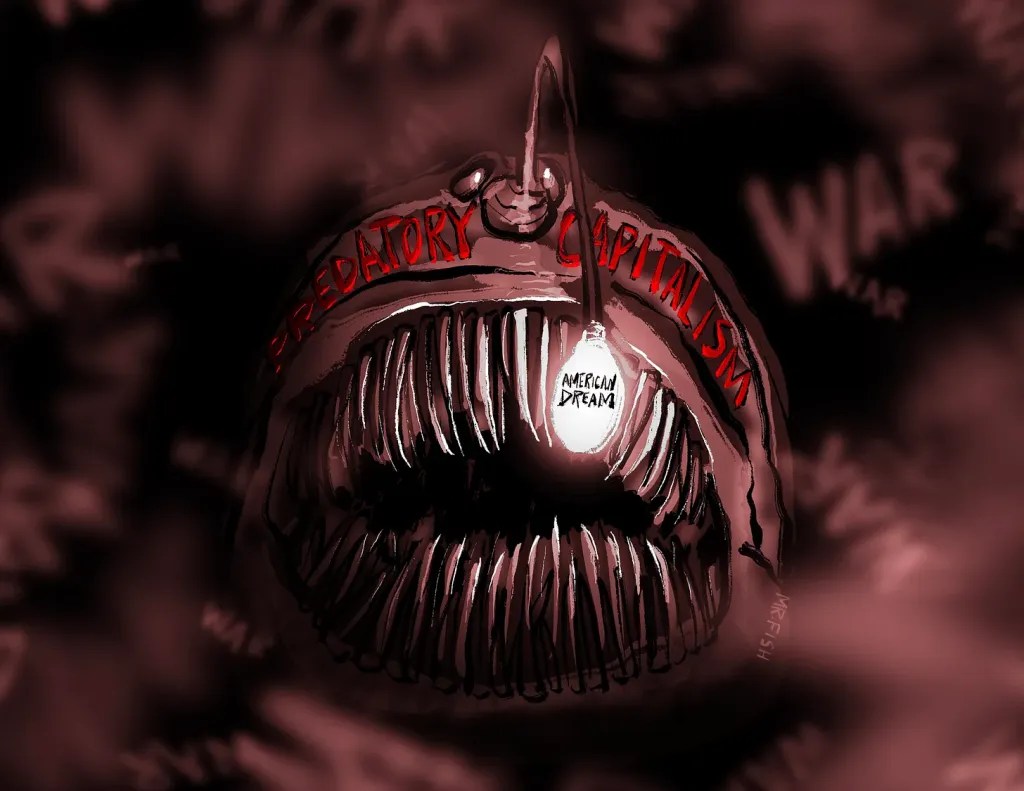
You Are What They Eat – by Mr. Fish

By Chris Hedges

Source: ScheerPost

America is a stratocracy, a form of government dominated by the military. It is axiomatic among the two ruling parties that there must be a constant preparation for war. The war machine’s massive budgets are sacrosanct. Its billions of dollars in waste and fraud are ignored. Its military fiascos in Southeast Asia, Central Asia and the Middle East have disappeared into the vast cavern of historical amnesia. This amnesia, which means there is never accountability, licenses the war machine to economically disembowel the country and drive the Empire into one self-defeating conflict after another. The militarists win every election. They cannot lose. It is impossible to vote against them. The war state is a Götterdämmerung, as Dwight Macdonald writes, “without the gods.”

Since the end of the Second World War, the federal government has spent more than half its tax dollars on past, current and future military operations. It is the largest single sustaining activity of the government. Military systems are sold before they are produced with guarantees that huge cost overruns will be covered. Foreign aid is contingent on buying U.S. weapons. Egypt, which receives some $1.3 billion in foreign military financing, is required to devote it to buying and maintaining U.S. weapons systems. Israel has received $158 billion in bilateral assistance from the U.S. since 1949, almost all of it since 1971 in the form of military aid, with most of it going towards arms purchases from U.S. weapons manufacturers. The American public funds the research, development and building of weapons systems and then buys these same weapons systems on behalf of foreign governments. It is a circular system of corporate welfare. 

Between October 2021 and September 2022, the U.S. spent $877 billion on the military, that’s more than the next 10 countries, including China, Russia, Germany, France and the United Kingdom combined. These huge military expenditures, along with the rising costs of a for-profit healthcare system, have driven the U.S. national debt to over $31 trillion, nearly $5 trillion more than the U.S.’s entire Gross Domestic Product (GDP). This imbalance is not sustainable, especially once the dollar is no longer the world’s reserve currency. As of January 2023, the U.S. spent a record $213 billion servicing the interest on its national debt. 

The public, bombarded with war propaganda, cheers on their self-immolation. It revels in the despicable beauty of our military prowess. It speaks in the thought-terminating clichés spewed out by mass culture and mass media. It imbibes the illusion of omnipotence and wallows in self-adulation.

The intoxication of war is a plague. It imparts an emotional high that is impervious to logic, reason or fact. No nation is immune. The gravest mistake made by European socialists on the eve of the First World War was the belief that the working classes of France, Germany, Italy, the Austro-Hungarian Empire, Russia and Great Britain would not be divided into antagonistic tribes because of disputes between imperialist governments. They would not, the socialists assured themselves, sign on for the suicidal slaughter of millions of working men in the trenches. Instead, nearly every socialist leader walked away from their anti-war platform to back their nation’s entry into the war. The handful who did not, such as Rosa Luxemburg, were sent to prison.

A society dominated by militarists distorts its social, cultural, economic and political institutions to serve the interests of the war industry. The essence of the military is masked with subterfuges — using the military to carry out humanitarian relief missions, evacuating civilians in danger, as we see in the Sudan, defining military aggression as “humanitarian intervention” or a way to protect democracy and liberty, or lauding the military as carrying out a vital civic function by teaching leadership, responsibility, ethics and skills to young recruits. The true face of the military — industrial slaughter — is hidden.

The mantra of the militarized state is national security. If every discussion begins with a question of national security, every answer includes force or the threat of force. The preoccupation with internal and external threats divides the world into friend and foe, good and evil. Militarized societies are fertile ground for demagogues. Militarists, like demagogues, see other nations and cultures in their own image – threatening and aggressive. They seek only domination. 

It was not in our national interest to wage war for two decades across the Middle East. It is not in our national interest to go to war with Russia or China. But militarists need war the way a vampire needs blood.

After the collapse of the Soviet Union, Mikhail Gorbachev and later Vladimir Putin lobbied to be integrated into western economic and military alliances. An alliance that included Russia would have nullified the calls to expand NATO — which the U.S. had promised it  would not do beyond the borders of a unified Germany — and have made it impossible to convince countries in eastern and central Europe to spend billions on U.S. military hardware. Moscow’s requests were rebuffed. Russia was made the enemy, whether it wanted to be or not. None of this made us more secure. Washington’s decision to interfere in Ukraine’s domestic affairs by backing a coup in 2014 triggered a civil war and Russia’s subsequent invasion. 

But for those who profit from war, antagonizing Russia, like antagonizing China, is a good business model. Northrop Grumman and Lockheed Martin saw their stock prices increase by 40 percent and 37 percent respectively as a result of the Ukraine conflict. 

A war with China, now an industrial giant, would disrupt the global supply chain with devastating effects on the U.S. and global economy. Apple produces 90 percent of its products in China. U.S. trade with China was $690.6 billion last year. In 2004, U.S. manufacturing output was more than twice China’s. China’s output is now nearly double that of the United States. China produces the largest number of ships, steel and smartphones in the world. It dominates the global production of chemicals, metals, heavy industrial equipment and electronics. It is the world’s largest rare earth mineral exporter, its greatest reserve holder and is responsible for 80 percent of its refining worldwide. Rare earth minerals are essential to the manufacture of computer chips, smartphones, television screens, medical equipment, fluorescent light bulbs, cars, wind turbines, smart bombs, fighter jets and satellite communications. 

War with China would result in massive shortages of a variety of goods and resources, some vital to the war industry, paralyzing U.S. businesses. Inflation and unemployment would rocket upwards. Rationing would be implemented. The global stock exchanges, at least in the short term, would be shut down. It would trigger a global depression. If the U.S. Navy was able to block oil shipments to China and disrupt its sea lanes, the conflict could potentially become nuclear.

In “NATO 2030: Unified for a New Era,” the military alliance sees the future as a battle for hegemony with rival states, especially China. It calls for the preparation of prolonged global conflict. In October 2022, Air Force General Mike Minihan, head of Air Mobility Command, presented his “Mobility Manifesto” to a packed military conference. During this unhinged fearmongering diatribe, Minihan argued that if the U.S. does not dramatically escalate its preparations for a war with China, America’s children will find themselves “subservient to a rules based order that benefits only one country [China].”

According to the New York Times, the Marine Corps is training units for beach assaults, where the Pentagon believes the first battles with China may occur, across “the first island chain” that includes, “Okinawa and Taiwan down to Malaysia as well as the South China Sea and disputed islands in the Spratlys and the Paracels.”.

Militarists drain funds from social and infrastructure programs. They pour money into research and development of weapons systems and neglect renewable energy technologies. Bridges, roads, electrical grids and levees collapse. Schools decay. Domestic manufacturing declines. The public is impoverished. The harsh forms of control the militarists test and perfect abroad migrate back to the homeland. Militarized Police. Militarized drones. Surveillance. Vast prison complexes. Suspension of basic civil liberties. Censorship.

Those such as Julian Assange, who challenge the stratocracy, who expose its crimes and suicidal folly, are ruthlessly persecuted. But the war state harbors within it the seeds of its own destruction. It will cannibalize the nation until it collapses. Before then, it will lash out, like a blinded cyclops, seeking to restore its diminishing power through indiscriminate violence. The tragedy is not that the U.S. war state will self-destruct. The tragedy is that we will take down so many innocents with us.

China, Russia and India Versus USA, EU and Japan: Axis Powers of a New Global Cold War?

By Gilbert Mercier

Source: New Junkie Post

The birth of a bipolar world order?

Since 2014, which marked the first Russian intervention in Ukraine, a new global geopolitical dynamic has amplified under conflicting impulses. The areas of direct, or more often proxy conflicts, have been in many senses contained with some sort of cynical pressure-cooker mechanism. If empires always seek hegemony, sane geopolitics imply balance to avoid slipping into World War scenarios. We have presently reached a Cold War-like balance between two blocks: the West and their satellites on one side, against BRICS nations and their affiliates on the other side. In the best case scenario, this new cold war could give birth to a lasting bipolar world order: curiously enough, following pretty closely Orwell’s cartography of Oceania & Eurasia.

The West is defined by the US empire and its vassals

The two axes of powers must be explained more precisely. On one side “the West” includes US, UK, EU, Canada, Japan, South Korea and Australia. The command headquarters of this imperial structure are of course located in the United States of America. The empire’s military muscle is NATO. As for the junior members such as the UK, European Union and Japan, they are, despite some claims of the contrary the vassals of big Uncle Sam.

One factor could be viewed as a miscalculation by Vladimir Putin. In many ways his decision last year to start a military operation in Ukraine had a paradoxical effect. The intervention was an attempt by Russia to prevent Ukraine from joining NATO & the EU, but this has failed as Western military gears as well as direct assistance have poured in. Just like in Afghanistan in the 1980’s Russia was effectively sucked into a West proxy war. Meanwhile, NATO has found a new raison d’etre with Finland now officially a member and Sweden soon also to become one. The general paranoia used in Western media to depict Putin as the ultimate bogeyman has worked wonders on Europe’s public opinion.

BRICS & affiliates

On the other side it is more complex as China’s dominance is more subdued than that of the US. Besides the BRICS nations of Brazil, Russia, India, China & South-Africa, other nations are gravitating into the same geopolitical orbit: notably Iran, Venezuela and African countries such as Mali and Burkina Faso. While China is clearly the biggest power within BRICS, the other two major players, which are Russia and India, also are heavyweights on an overall geopolitical and economic scale.

Russia holds vast reserves of energy products, such as gas and oil, and since the European sanctions has quickly worked on redirecting its energy production both towards China and India. India, which has become the most populous country on Earth, has just like China a considerable manufacturing power as well as a huge internal market for products and services. In other words, neither China nor India have to rely mainly on exports to sustain their respective economic growth.

Non-alignment is dead

The concept of non-alignment in a multipolar world, dear to the likes of Tito and de Gaulle, has unfortunately become a geopolitical faux pas at best, or a risky behavior for a small state wanting to stay independent at worst. Because of a lack of political will and leadership, the European Union has basically capitulated from asserting itself as a third block to become a provincial entity of the US empire. The notion of true non-alignment might have run its course in this new bipolar order.

As matter of fact, one of the Ukraine war’s major side effects has been to speed up the process of obedient realignment of the EU to the US. European leaders with their respective media propaganda divisions (either state or corporate controlled) have managed to convince the bulk of their public opinion that the ogre Vladimir Putin and Russia had to be defeated in Ukraine as if the hordes from a memory of the Red Army were about to invade Europe. The Ukraine war has been sold in Europe as a war of necessity to counter an existential threat that was never really there. Public opinion largely bought it, and the financial rewards are pouring into the coffers of the military-industrial complex, as well as US and Qatari energy businesses of natural gas liquefaction, to replace the well-organized Russian gas supply Europe used to get before the sanctions against Russia.

Ukraine war cannot be won on the battle fields

Despite what most people are lead to believe in the West, a military victory by Ukrainian forces, even with full logistic support from NATO in equipment and training is quasi impossible. After all, a lesson should be learned from Afghanistan where the Taliban managed to defeat the mighty alliance. If the EU and the United States cared for the welfare of Ukrainians, they would come to the realization that only a diplomatic solution can resolve the crisis. A sine qua non condition of diplomacy is that it requires concessions on all sides.

For example, let’s take the case of Crimea. It has a complex history. During the 15th century Crimea was under control of the Ottoman Empire. In 1783, the Russian Empire of Tsarina Catherine the Great annexed Crimea after a conflict with Turkey. Lastly, under the authority of Nikita Khrushchev, the USSR gave Crimea to Ukraine in 1954. Therefore, Crimea was Russian for 171 years while it was Ukrainian for only 60 years. The weight of history, in this case, should tilt the balance in favor of Russia.

Military-industrial complex Uber Alles

Wars have always been capitalism‘s best friend. Ultimately they are seldom about the lofty notions of patriotism but systematically about profits. Ukraine’s Western proxy adventure is no exception. As matter of fact, it has been a gargantuan bonanza for the global military-industrial complex and its stockholder war profiteers. Case in point: since Russia started its military operation in Ukraine in February 2022, the United States has spent $30 billion in military equipment which was shipped to Ukraine. This is according to the US Department of Defense.

For its part the European Union is planning a 74 billion Euros increase in military spending within three years. This trend of huge increase in military spending affects all the EU 27 members, as they are allocating bigger shares of their respective GDPs to this weapons race. In December 2022, the European Defense Agency proudly announced that EU defense spending had surpassed 200 billion Euros for the first time in the union’s history. What an accomplishment!

Needless to say, military-industrial consortium and their unscrupulous stockholders have collected huge dividends from the death and destruction business. Stocks in the so-called aerospace & defense area of the market have been incredibly profitable for investors and are therefore in high demand. On average, most defense-company stocks have seen their values increase by 25 to 30 percent since February 2022.

Naturally, in terms of military spending, the United States represents the lions’ share with a whopping 38 percent of the global military spending. It is an astronomical $800 billion a year or 3.1 percent of the US GDP. Unfortunately other major powers are catching up. In second place comes China with $293 billion or 1.7 percent of its GDP; then India with $76.6 billion; the UK with 68.4 billion; Russia with $65.9 billion or 3.1 percent of GDP; France and Germany with $56 billion each; and Japan with $54 billion. In France, despite a very concerning debt, the Macron administration has announced that 413 billion Euros will be spent on the military between 2024 and 2030.

Taiwan: the Ukraine of the far-east?

With Russia sucked into what can be called a military quagmire in Ukraine, one has to wonder if the Oceania empire, with its Washington nevralgic center, would not indeed want to take advantage or even provoke a Chinese move to take over Taiwan, in accordance to the One-China precept. This could create a Ukrainian-like situation for China in Taiwan. Instead of having the obedient EU to absorb part of the cost in the West, in the Pacific it could be US vassals such as Japan, South-Korea and Australia that could get involved into a proxy war with China, and therefore increase their military spending in US equipment. Trillion of dollars would be wasted in resources to allow the chess masters of geopolitics to keep playing their mindless criminal games. Everywhere, the brutal Russian roulette folly of capitalism, either state or corporate, would thrive while all populations suffer.

US to double its ‘defense’ budget

Signe’s second toon du jour SIGN17e Military

By Drago Bosnic

Source: InfoBRICS.org

Back in late March, top American General Mark Milley, Chairman of the Joint Chiefs of Staff, said that the United States of America would be doubling its military budget in case the Kiev regime was defeated by Russia. At the time, Milley claimed that “not supporting Ukraine now would lead to a massive increase in future defense budgets”. He also added that “it would lead to a global conflict that has been avoided since World War II ended”.

“If that rules-based order, which is in its 80th year, if that goes out the window, then be very careful,” Milley said while testifying before the US Congress on March 23, further adding: “We’ll be doubling our defense budgets at that point because that will introduce not an era of great power competition. That’ll begin an era of great power conflict. And that’ll be extraordinarily dangerous for the whole world.”

Firstly, it should be noted that Milley’s remark about the so-called “rules-based (world) order” supposedly lasting 80 years is completely misplaced. The geopolitical situation in the last three decades has merely been a shadow of the post-WWII global order. With the US conducting virtually incessant aggression against the entire world, any notion that there are actual rules that equally apply to everyone is beyond laughable. However, his claim that Washington DC would need to double its “defense” spending is much more serious and consequential. Ironically, he’s threatening to do that while “warning” about a looming global conflict, one which is solely caused by the US itself, as it’s the only country on the planet with an openly stated strategy of “full spectrum dominance”.

Milley testified before the House Appropriations Committee-Defense on the next year’s DoD (Department of Defense) budget, alongside Defense Secretary Lloyd Austin. The figure for the Pentagon officially stands at $842 billion, $69 billion more than the $773 billion the military requested for 2023. However, the total spending on national “defense”, including work on nuclear weapons (officially under the jurisdiction of the Department of Energy), pushes that up to $886 billion. This is without including the so-called “aid” for the Kiev regime, which stood at approximately $113 billion at the beginning of 2023. However, the updated figure is now getting closer to $150 billion and there’s no indication that it will stop growing any time soon.

General Milley has repeatedly described the conflict in Ukraine as “an important national interest” and “fundamental to the United States, to Europe and to global security”. It could be argued that it’s neither of those things, as the world, the EU and the US itself all have more pressing concerns. Unfortunately, this notion is extremely unlikely to lead to any peaceful settlement, especially as the US Military Industrial Complex (MIC) keeps getting its windfall. While some members of Congress have consistently been skeptical about the “aid” for the Kiev regime, the majority still have a strong preference for the official narrative. The skeptics usually cite “the US and Kiev regime’s failure to more clearly define their strategic goals” as the primary reason for the lack of “more adamant support”.

This clearly indicates that the only “strategic goal” is to keep the war going for as long as possible, which also explains the repeated calls for the perpetual increase of the Pentagon’s budget. However, Milley’s call for doubling it is a major escalation and it’s unclear how exactly Washington DC is planning to achieve such a monumental task. Global military spending for 2022 was around $2.1 trillion, meaning that the US is already at over 40% of the world’s total with its current budget. Doubling it, even over the next several years (also taking into account other superpowers would certainly respond to it) could push that figure close to 60%. In terms of the US federal budget, it would also require further cuts to investment in healthcare, infrastructure, education, etc.

As the military currently spends approximately 15% of the entire US federal budget, obviously, doubling it would mean the percentage would go up to (or even over) 30%. Such figures are quite close to what the former Soviet Union was spending in terms of its overall budget, which was one of the major factors that contributed to its unfortunate dismantlement. On the other hand, it also forces others to drastically increase their own military spending. If China were to follow suit, its military budget would then be close to $500 billion, with Russia’s military budget approaching $200 billion. This would cause a military spending “death spiral” that would be extremely difficult (if possible at all) to control, leading the world into an unprecedented arms race.

However, this “new” Cold War could potentially be far more dangerous than the “old” one, as there would be approximately half a dozen superpowers and great powers competing for influence and a bigger geopolitical footprint. On the other hand, if the rest of the world refuses to respond in kind, such a massive increase in US military spending would only push the multipolar world into greater integration, as it would be the only way to counter US aggression without doubling their own military budgets. Either way, the US is left with a choice – further escalate, not only with Russia, but the rest of the world as well, or find an off-ramp. Otherwise, its inflation will surge so much that the “doubling” of the Pentagon’s budget will happen on its own.

Where the $1.3 Trillion Per Year U.S. Military Budget Goes

By Eric Zuesse

Source: The Duran

Nobody can give a precise dollar-number to U.S. ‘Defense’ spending because the U.S. ‘Defense’ Department has never been able to pass an audit, and is by far the most corrupt of all federal Departments (and is the ONLY Department that has never passed an audit), and also because much of America’s military spending is being paid out from other federal Departments in order to keep down the published annual U.S. Government ‘Defense’ expenditure numbers (which come from ONLY the “U.S. ‘Defense’ Department). Those are expenditures for America’s privatized and overwhelmingly profit-driven Military-Industrial Complex. (By contrast: Russia and China require, by law, that their armaments-firms be majority-owned by the Government itself.)

According to the best available estimates, the U.S. Government has been spending, in total, for over a decade now, around $1.3T to $1.5T annually on ‘defense’, and this is around half of all military spending worldwide by all 200-or-so nations, and is more than half (around 53%) of all of the U.S. federal Government’s ‘discretionary’ (or congressionally voted for) annual expenditures.

Unlike regular manufacturers, which sell entirely or mainly to consumers and to businesses, not to their Government, armament-firms need to control their Government in order to control their markets (which are their Government and its ‘allied’ Governments — including NATO), and so they (in purely capitalist countries such as the U.S.) do control their Government. This is why the armaments-business (except in countries whose armaments-sector is socialized) is infamously corrupt. In order to hide the extent of that corruption (and to promote ever-higher military spending), the ‘news’-media need — in those countries — to be likewise effectively controlled by the investors in those firms.

Consequently, America, which has no national-security threat from any country (so, these astronomical ‘defense’-expenditures are blatantly inappropriate), spends annually around half of all of the money that the entire world spends on the military. And most of that money gets paid to its armaments-firms. Or, as Stephen Semler, an expert on these matters, put it regarding last year’s numbers, “How much of the $858 billion authorized by the FY2023 NDAA will be transferred to military contractors? I estimate $452 billion.” That is 52% of the 53% of the federal Government’s discretionary spending that is being allocated to ‘Defense’. Thus, 26% of the money that Congress authorizes the U.S. federal Government to pay each year, goes to military contractors. Thus: if $452B is going to armaments-firms, and if $1.356T is going to ‘defense’ (both of which are reasonable estimates), then one-third of ‘defense’ spending goes to armaments-firms, and that is around 17% of the money that the U.S. Government pays each year for everything (including non-discretionary).

If this had not been happening each year after the end of the Soviet Union in 1991, then the current U.S. federal debt would be far less, if any at all — but, in any case, that expense (which went, and is going, to exceptionally rich individuals) will be paid by future generations of Americans, by means of both increased taxes and reduced services from the U.S. Government. What pays for bombs (and funds the purchase of yachts) today will be taken from everyone’s infants tomorrow. And it is taking millions of lives in the targeted lands, and has been doing so for decades now. A psychopathic U.S. Government is producing these results.

America’s ‘Defense’ Department is so corrupt that when I happened recently to be re-reading my 14 January 2020 article about its corruptness, “US Military Spending: TRILLIONS of Dollars Unaccounted For”, yet a new detail of this corruptness, which I had not previously noticed, struck me. It happened in this passage:

——

Mick West, who blogs as metabunk, is a propagandist for the “Establishment” or the billionaires’ preferences of what the public should believe; and, on 16 May 2018, he headlined “Debunked: Missing $21 Trillion / $6.5 Trillion / $2.3 Trillion – Journal Vouchers”.

He presented a representative of America’s Military-Industrial Complex (MIC) asserting, to US House members, that “this is not a new story, it dates back to 2001 and before,”.

And, West noted:

“All these things are accounting things that, as Norquist says ‘occur after the money is spent’. They are things that you want to get right in your accounting, but if you get the values wrong then it does not mean you’ve lost the money. It means you’ve got some estimate wrong, and you’ll put to little or to much [West meant “too much or too little”] in one fund or another.”

Referring, then, to the $21 trillion, he wrote:

“This is just more of the same though, still not missing money, still just unsupported accounting information transfers.”

However, only a sucker would take that casual attitude to the enormous amount of money in the ‘defense’ budget that is “unsupported” as to who received it, and whether or not those payments were in accord with what Congress had actually authorized.

Furthermore, such a casual attitude toward US ‘defense’-expenditures — the expenditures which constitute actually over half of the US federal Government’s discretionary expenditures, and even around half of the total world’s military expenditures — is an invitation to corruption in over half of this Government’s annually authorized spending; and any intelligent person would expect that such an invitation would be taken advantage of by insiders who are in a position to benefit from it.

West quotes from only one alleged authority, the “Defense Department Comptroller, David L. Norquist,” a person who is largely responsible for the problem, who said “it’s an accounting problem that does need to be solved because it can help hide other underlying issues,” but (at 1:43 in the accompanying video) “it’s not the same thing as not being able to account for money that Congress has given you to spend, but it’s still a problem that needs to be fixed.”

Mick West simply trusted this statement, by Norquist — though Norquist is one of the officials responsible for the problem — but Norquist failed to prove (and wasn’t even asked to prove) it, by the Representatives whom he was there addressing, who didn’t seem to be alarmed about where that $21T actually went) his key assertion, that “it’s not the same thing as not being able to account for money that Congress has given you to spend.”

Even if that assertion is true (which should not be assumed, and which even seems ludicrous on its very face), the problem is unquestionably an invitation to corruption in ‘defense’-expenditures, and those are precisely the type of federal expenditures that overwhelmingly dominate the income to the federal Government’s contractors, the corporations that make all or most of their profits from sales to the federal Government and to its allied governments (such as to the Saud family).

Therefore, casually allowing — and not even investigating as being possibly treasonous — these expenditures, is, itself, enormously scandalous, but the Representatives there were treating it so casually.

In fact, at the very opening of the hearing, which was held on 10 January 2018 (at 02:12 in the video of the 1:41:33-long hearing, above) the Chairman of the Committee emphasized the “We must spend more” on the military, even though we already spend around half of the entire world’s military expenditures. Manifestly, this hearing was a charade.

In the full video, the passage that Mick West quoted from is at 18:00-22:00, and the Representatives were clearly on the side of the charade, not on the side of the American people. Clearly, all members of that Committee, the House Armed Services Committee, behave as if they are in the pockets of firms such as Lockheed Martin.

On 15 November 2018, Reuters headlined “Pentagon fails its first-ever audit, official says”, and reported that: “‘We failed the audit, but we never expected to pass it,’ Deputy Secretary of Defense Patrick Shanahan told reporters.”

On 27 November 2018, The Nation headlined “Exclusive: The Pentagon’s Massive Accounting Fraud Exposed” and David Lindorff opened:

“On November 15, Ernst & Young and other private firms that were hired to audit the Pentagon announced that they could not complete the job. Congress had ordered an independent audit of the Department of Defense, the government’s largest discretionary cost center — the Pentagon receives 54 cents out of every dollar in federal appropriations — after the Pentagon failed for decades to audit itself. The firms concluded, however, that the DoD’s financial records were riddled with so many bookkeeping deficiencies, irregularities, and errors that a reliable audit was simply impossible.”

So, that was the result of the latest version of this charade, which is virtual treason by the Federal Government.

In short: Congress is satisfied for this situation to continue, and the members of Congress evidently have no fear that the voters back home will vote against them if a challenger makes this issue a major issue in that Senator’s or Representative’s next Party primary.

The presumption is that the voters don’t care, and that the ‘news’-media won’t enlighten the voters about this matter, and about how it impacts, for example, which nations the US will categorize as being an “ally,” to sell weapons to, and which nations it will categorize as being an “enemy,” to target for conquest.

——

So, what now struck me now was the name there, “David Norquist.” Maybe you remember the famous libertarian phrase about spending by the U.S. federal Government, that the libertarian goal is to “shrink it down to the size where we can drown it in the bathtub.” Here is one of the many articles that were published about that:

——

https://www.ussc.edu.au/analysis/grover-norquists-no-tax-call-a-wedge-for-republicans

10 December 2012

GROVER NORQUIST’S NO-TAX CALL A WEDGE FOR REPUBLICANS


  • By 
    Dr Nicole Hemmer, Honorary Associate, United States Studies Centre

“Who the hell is Grover Norquist, anyway?”

The question came from former US president George HW Bush this northern summer, but in the past few weeks many Americans have been asking the same thing.

Norquist, an anti-tax activist, now dominates discussion of the fiscal cliff. His “no-new-taxes” pledge has been signed by nearly every Republican in congress. The problem? To avoid going off that fiscal cliff, congress must make a “grand bargain” by January 1. If it doesn’t include tax rate increases, President Barack Obama won’t sign it into law.

Republicans are in a bind. They could agree to tax-rate increases on Americans making more than $US250,000 a year in return for cuts to programs such as Medicare. That, however, would mean breaking Norquist’s pledge. And Norquist has made it clear that any Republican who does so will face a primary challenge in the next election.

So, to echo Bush: “Who the hell is Grover Norquist, anyway?”

Norquist runs Americans for Tax Reform, an anti-tax organisation he founded in 1986.

His opposition to taxation is an expression of his deep disdain for government. “I don’t want to abolish government,” he famously quipped. “I just want to shrink it down to the size where we can drown it in the bathtub.”

This “starve the beast” mentality has long been a conservative strategy for reducing the size of government. A strict diet of diminishing revenues, anti-tax advocates argue, will naturally lead to a smaller federal state.

——

As it turns out, David Norquist and Grover Norquist are brothers. So: while David Norquist makes money by fronting for the billionaires who control firms such as Lockheed Martin Corporation, Grover Norquist makes money by fronting for the billionaires who control firms such as Lockheed Martin Corporation. David does it by rationalizing away those peoples’ corruptness as being a concern for U.S. taxpayers; and Grover does it by leading the Republican argument against the Government’s non-‘defense’ spending. (While Republicans want to reduce non-‘defense’-spending, they want to increase ‘defense’-spending. Democrats want to increase all federal spending, but ESPECIALLY for ‘defense’.)

The standard libertarian claim that “shrinking the government” is at all an issue or what motivates their wealthiest donors whom they are actually fronting for, is a lie. The only real issue that is involved here is: Who is, and who isn’t, getting the Government’s money.

All of federal politicians’ talk about the need to eliminate “waste, fraud and abuse” is also lies, because they themselves — those federal office-holders — got there and stay there by participating in it. If they’re not corrupt, they’re not in office, because this system is built upon corruption.

Whereas Republican billionaires demand that all federal expenditures except for ‘defense’ get slashed, Democratic billionaires demand that all federal expenditures get slashed but that ‘defense’ spending must never be reduced. So: what’s the real difference (except for the hypocritical rhetoric on the Democratic or “liberal” side)? The billionaires who control those arms-contracting companies control also which contenders for federal offices will become elected.

And here is how one of the billionaires’ ‘news’-media (in this case, the “Fact Check” columnist at the New York Times), on 3 December 2018, cited uncritically David Norquist’s fraudulent argument that nothing more was involved here than an accounting-problem — as-if those congressional and ‘Defense’ Department officials were upholding their obligations to THEIR “stockholders,” who are all U.S. citizens — by continuing to tolerate unauditable financial books at the largest federal Department: “The Misleading Claim That $21 Trillion in Misspent Pentagon Funds Could Pay for ‘Medicare for All’: Representative-elect Alexandria Ocasio-Cortez, the rising liberal star, cited a figure that refers to nearly two decades of internal financial adjustments, not actual spending.” And even the grandstanding ‘progressives’ in Congress did not take to task that lying ‘news’-medium for attacking them on a mere sub-allegation to the real issue here, which was the enormous corruptness that inevitably stands behind all of this.

The only way for an authentic progressive political candidate to deal with this is to declare publicly (and to document it by means of linked-to-evidence news-reports online, like the present one) that ‘our’ Government and media are controlled by the organized mega-crooks, who are this nation’s wealthiest individuals — the only group of individuals who benefit from it — who are this nation’s actual enemies: its corrupters. But, of course, no billionaire will fund such a campaign, and any news-medium that reports on it (except by lying against it) will likewise get no investors.

That is how bad that the situation really is. People need to be discussing this, in public, here and elsewhere. Because that is the problem. It is the problem that needs to be fixed. But how can it be done? And THAT is the question.

PS: Preliminary reports suggest that on account of this Government’s dual World War III against both Russia and China, the ‘Defense’ budget for next year will probably soar perhaps more than by 10%. The Congress now is well over 95% neoconservatives, in both houses. They’ve virtually all been bought.

Rage Against The War Machine: What Rage? ‘When Will They Ever Learn?’

By Robert J. Burrowes

In his iconic 1950s anti-war hit song ‘Where Have All the Flowers Gone?’, Pete Seeger posed the eternal question about war: ‘when will they ever learn?’ Of course, Seeger’s question was primarily directed at those individuals who choose to participate in the fighting. But it might equally have been directed at those in the ‘anti-war’ movement.

A few years later in 1963, Native Canadian Buffy Sainte-Marie penned the equally iconic ‘Universal Soldier’ to draw attention to ‘individual responsibility’ for war.

The question ‘Why war?’ has troubled human beings for millennia and individuals of conscience have long resisted it, sometimes paying a heavy price for doing so. And back in 1932, two of humanity’s giants – Albert Einstein and Sigmund Freud – grappled with the question, exchanging letters on the subject.

See ‘Why War?’

Beyond war, a great deal of effort has gone into understanding conflict and violence, including their structural and cultural components, and I have noted some of these efforts, including my own, in a wide range of documents such as these:

‘Why Violence?’,

‘Comforting a Baby is Violent’,

‘The War to End War 100 Years On: An Evaluation and Reorientation of our Resistance to War’ and

‘Einstein and Freud’s ‘Why War?’

Revisited: Why Anti-War Efforts Go Nowhere’.

Four things fundamentally missing from all previous efforts to halt a particular war or to end war generally, however, are these:

  1. a serious effort to understand the dysfunctional psychology, and what causes it, that drives human violence generally,
  2. a serious effort to analyse war as a system of power: Who is causing it, why and how? (This is important because understanding how power works in the world system as well as who, precisely, is driving what is happening, why, and how they are doing it are crucial prerequisites for developing an effective strategy to resist, or end, war.)
  3. a sophisticated nonviolent strategy based on this understanding and analysis that is thoughtfully designed to address each of the foundational components of war, and
  4. sufficient courageous people committed to implementing this strategy by participating in it themselves and mobilizing others to do so too.

Consequently, to say that anti-war efforts lack sophistication is to put it mildly in the extreme. As the very long history of ‘anti-war’ struggle clearly demonstrates.

And so it was listening to the anti-war speeches delivered in Washington DC at the Rage Against the War Machine rally on 19 February 2023. You can watch whole or abridged versions of these speeches here: Rage Against the War Machine.

Rage might give a person power in some contexts but, in itself, rage has zero strategic value. And are these people really feeling ‘rage’ about the ongoing war all over the planet or even the war in Ukraine? And acting on it? Of course not. Even if they were, as mentioned ‘rage’ is no substitute for acting powerfully (that is, strategically) to end war.

Moreover, there is a simple reason for this. Most anti-war activists do not feel rage against the war machine for the simple reason that they are terrified of it.

And this fear incapacitates them, leaving most anti-war activists too scared to seriously commit themselves to doing what is necessary to end war. Again, as the record demonstrates.

Hence, they complain powerlessly, rather than analysing, devising strategy and then acting powerfully knowing that their actions will contribute to the long-term struggle to end war once and for all.

So let me go back a step and analyze why the anti-war movement is so frightened and powerless and why it cannot learn from its own history of failure.

Why do most people complain?

In essence, this happens because when they were children, their parents interfered with their emotional expression which, in turn, stifled those innate behaviors bestowed by evolution to ensure that the baby, and later the child and then adult, acted to have their needs met. Usually by a young age, the child will learn to complain powerlessly when they do not get what they want. But complaining, rather than acting, does not meet their needs.

Thus, just as the child, endlessly thwarted by a parent who ignores the child’s genuine needs and then ignores their pleas to have these addressed, is trapped in the mode of complaining, most activists never learn that the role of politicians is to ignore them too. Of course, the value in this for those who genuinely wield power in society and whose aim is to facilitate perpetual war to achieve a variety of Elite ends (notably including the ongoing consolidation of Elite power and the maximization of corporate profits by financing both sides in any war) is that efforts of this nature, such as public protests against ‘government policies’ absorb and dissipate dissent, as intended.

And so it was on 19 February 2023 when a list of anti-war speakers echoed the eternal cries of powerlessness at one of the latest manifestations of an anti-war street protest:

‘Enough is enough! We demand change! Do the right thing! Implement ceasefire in Ukraine!’ See ‘Twenty Years after the Start of the War in Iraq, People Around the World are still Raging Against the War Machine’.

Einstein and Freud’s ‘Why War?’ Revisited: Why Anti-War Efforts Go Nowhere

Really?

As even former US Secretary of State Alexander Haig once noted about a massive anti-war demonstration: ‘Let them march all they want, as long as they continue to pay their taxes.’ See Alexander Haig. As a four-star general, Haig, not regarded as the most intelligent Secretary of State in US history, certainly understood that tactical choice is a question of strategy. Most activists have no idea.

So What Must We Do to End War?

Earlier in this article I identified four elements missing from the anti-war movement’s efforts. Let me restate them and offer my own learning in relation to these points.

  1. a serious effort to understand the dysfunctional psychology, and what causes it, that drives human violence generally.

As the final stage of more than four decades investigating the cause of violence, I spent 14 years living in seclusion with Anita McKone. You can read what I learned in the document ‘Why Violence?’, in which I explain the destructive impact of the ‘visible’, ‘invisible’ and ‘utterly invisible’ violence that adults relentlessly inflict on children – resulting in the bulk of the adult human population being unconsciously terrified, self-hating and powerless, with Anita’s description of our process in:

‘Fearless Psychology and Fearful Psychology: Principles and Practice’.

If you like, you can also read other articles I have written such as

‘The Psychology of Projection in Conflict’ and

‘Challenges for Resolving Complex Conflicts’.

  1. a serious effort to analyse war as a system of power: Who is causing it, why and how? This is important because understanding how power works in the world system as well as who, precisely, is driving what is happening, why, and how they are doing it are crucial prerequisites for developing an effective strategy to resist, or end, war.

I made considerable effort to explain this as part of a wider study identifying the Global Elite and how its power is exercised in the world system. This included explaining why the Elite has a vested interest in ensuring that war continues. For more than 200 years, members of this Elite have carefully facilitated the precipitation of war and then profited immensely from financing both sides in any war of significance as well as the rebuilding of infrastructure and the care of injured soldiers in its aftermath. Hence, preparations for war, the conduct of war and the rebuilding/healing necessary post-war is the most profitable economic venture, by far, conducted on Planet Earth and it greatly enriches Elite families, such as the Rothschilds and Rockefellers, as well as their agents.

See Historical Analysis of the Global Elite: Ransacking the World Economy Until ‘You’ll Own Nothing.’

  1. a nonviolent strategy based on this understanding and analysis that is thoughtfully designed to address each of the foundational components of war.

First, this requires a completely different approach to parenting if we want to raise powerfully nonviolent children.

See ‘My Promise to Children’ and

‘Do We Want School or Education?’

And given that strategy has long been a passion of mine and nonviolent strategy particularly, I investigated this thoroughly when I wrote The Strategy of Nonviolent Defense: A Gandhian Approach.

But for the simplest explanation of nonviolent strategy to end war, you can read it on this website starting with the list of ‘Strategic Goals for Ending War’.

  1. sufficient courageous people committed to implementing this strategy by participating in it themselves and mobilizing others to do so too. This is important because nonviolent activism to end war has a price, measured in jail terms, adverse psychological assessments from people intent on stopping you, and a myriad other penalties depending on the legal jurisdiction in which the activist operates.

But if the antiwar activist is not willing to pay the price of their nonviolent activism, then the victims of wars in other places will pay the price of war with their lives.

Clearly, identifying sufficient courageous people is a primary challenge and the obvious shortage of courageous and tenacious people committed to strategically resisting war is just another outcome of our violently dysfunctional parenting of children mentioned in the first point above.

So if we are going to mobilize sufficient people willing to act powerfully over an extended period to resist all of those foundational elements that make war possible, we must profoundly alter our parenting model to produce powerful children and offer adults a chance to heal from the violence they suffered as children as well.

See ‘Putting Feelings First’ and ‘Nisteling: The Art of Deep Listening’.

Otherwise we are condemned to watch people speak against war and march up and down in ‘anti-war’ rallies (or employ other tactics devoid of strategic impact) until the world is blown up.

An Obvious Criticism

An obvious criticism of the approach I have outlined above is that it is ‘too slow’. It offers no quick solution to deal with the immediacy of the threat we face at the current moment with the proxy war being fought by the US and NATO through Ukraine against Russia which includes the risk of the war ‘going nuclear’.

See ‘The Dire Significance of Putin’s Feb 21 Speech’.

And I am well aware of the many calls for negotiations on the one hand – see, for example, ‘The Ukraine War: Think Deeper Or We Shall All Lose’ – and long-standing US war-fighting policy on the other as routinely explained in a plethora of US Government ‘defense strategy’ documents.

See, for example, ‘2022 National Defense Strategy of The United States of America’ and a thoughtful discussion of US nuclear strategy by Professor Michel Chossudovsky in

‘“Preemptive Nuclear War”: The Historic Battle for Peace and Democracy. A Third World War Threatens the Future of Humanity’.

I am also aware of calls, such as that by Scott Ritter, for US anti-war activists to focus on nuclear arms control as the highest priority for now.

See ‘Scott Ritter on the War Machine and the Future of the Antiwar Movement’.

And other perspectives and proposals besides.

But the obvious response to the ‘too slow’ criticism of my longer-term proposals above is simple: The result of the current crisis is so far beyond the existing anti-war movement to realistically influence, it is laughable. And so, in my view – which is consistent with my research into, and analysis of, what has transpired historically:

see Historical Analysis of the Global Elite: Ransacking the World Economy Until ‘You’ll Own Nothing.’ – the war will most probably end when Russia has defeated the Ukrainian state but only after the war has been dragged on for as long as it can be conducted profitably, from an Elite perspective.

And while there is undoubtedly considerable risk of the war ‘going nuclear’ through policy or strategic miscalculation – see ‘Stanislav Petrov, “The Man Who Saved The World,” Dies At 77’ – accident – see Command and Control – or rogue local ‘initiative’, the Elite will ‘gamble’ against these possibilities while (presumably) constraining it at policy level, as has most likely occurred throughout the nuclear age.

Insane? Of course, it is insane. See ‘The Global Elite is Insane Revisited’. It’s just that, in my view, there is nothing new to observe here: Just repetition of what we have seen before, which includes being taken to the brink of nuclear war and relying on ‘unknown factors’ – including, but not exclusively, background control by the Elite – to avoid it.

Conclusion

War is brutal. The Elite perpetuates war endlessly to capture control of people and resources to maintain the existing system of world power and make monumental profits. It will not be stopped because we make fine speeches, chant anti-war slogans at rallies or call for negotiations.

The human world is a system of power. And we need to understand how that system of power works to understand, and change, the world. This applies particularly when dealing with systems, structures and processes at the heart of Elite power, such as economics and war.

But underlying even this we need to understand the psychology of human violence because this also enables us to understand why the Elite controls world affairs to precipitate war (among a vast range of other violent and exploitative outcomes) as well as why ‘ordinary’ people fight in wars and the vast bulk of people who identify as ‘anti-war’ are so powerless.

In essence, war will be ended by analysing and understanding what makes it all happen and taking action intelligently, courageously and tenaciously to change what makes it possible; that is, by resisting in strategically appropriate ways the foundational components on which the entire system of war is built.

And given the ultimate foundation of the war system is our violent parenting model that renders virtually all humans into a state of fearful submission to violence, we haven’t even started the long journey to end war yet.

Nevertheless, while my own lifetime of effort has failed to remedy anything significant about the war system, out of love for my uncles, great uncles and humanity generally – see ‘Who Am I?’ – I continue to focus my own attention on undermining its foundations as documented above. It is slow, ‘unrewarding’ work in the short term.

But my hope is that some future generations of humans, assuming we effectively resist a myriad of current and future threats notably including the vast range of threats we all face at the hands of the Elite now – see ‘We Are Being Smashed Politically, Economically, Medically and Technologically by the Elite’s “Great Reset”: Why? How Do We Fight Back Effectively?’ – will live in a world without violence and war.

Obviously, given the precarious state of the world in many respects, a tremendous amount of intelligent, strategically-oriented action will be needed for this hope to be realized.

Biodata: Robert J. Burrowes has a lifetime commitment to understanding and ending human violence. He has done extensive research since 1966 in an effort to understand why human beings are violent and has been a nonviolent activist since 1981. He is the author of ‘Why Violence?’ http://tinyurl.com/whyviolence His email address is flametree@riseup.net and his website is here. http://robertjburrowes.wordpress.com

Saturday Matinee: Stranger at the Gate

How Many Strangers Are At the Gate?

By David Swanson

Source: Let’s Try Democracy

Spolier Alert: if you want to watch an excellent 30-minute film without knowing what happens, scroll down and watch it before reading any of these words.

We’ve long known that U.S. mass-shooters are disproportionately trained in shooting by the U.S. military. I don’t know whether the same applies to those who kill in the U.S. with bombs. I wouldn’t be surprised if the connection were even greater.

The Oscar-nominated short film Stranger at the Gate tells the story of a man who went from a difficult childhood straight into the U.S. military at 18.

When learning to shoot at paper targets, he had concerns about killing actual people. He recounts being given the advice that if he could look at those he would kill as anything other than human he would have no problems. So, that, he says, is what he did.

But, of course, conditioning people to thoughtlessly kill doesn’t provide them with any way of being unconditioned again, of comfortably ceasing to be self-deceptive murderers.

This guy went off to U.S. wars where he killed people he thought of as Muslims. The characterization of the people killed as belonging to an evil religion, was largely a game of military propaganda. The actual motivations of those picking the wars tended to have more to do with power, global domination, profits, and politics. But bigotry has always been used to sucker the rank and file into doing what’s desired.

Well, this good soldier did his job and returned to the United States believing that he had done his job, and that that job had been to kill Muslims because of the evil of Muslims. There was no Off switch.

He was troubled. He was drunk. The lies didn’t rest easily. But the lies had a tighter grip than the truth. When he saw that there were Muslims in his hometown, he believed he needed to kill them. Yet he grasped that he would no longer be praised for it, that he would now be condemned for it. Even so, he still believed in the cause. He decided that he would go to the Islamic Center and find proof of the evil of the Muslims that he could show everyone, and then he would blow the place up. He hoped to kill at least 200 people (or non-people).

The men and women at the Islamic Center welcomed him and transformed him.

In the United States today one may want to rewrite this line:

“Do not neglect to show hospitality to strangers, for by so doing some people have entertained angels without knowing it.”

in this way:

“Do not neglect to show hospitality to strangers, for by so doing some people have entertained would-be mass-murderers without knowing it.”

How many?

Nobody knows.

The Lords of Chaos

The politicians and shills in the media who orchestrated 20 years of military debacles in the Middle East, and who seek a world dominated by U.S. power, must be held accountable for their crimes.

We’re Number One – by Mr. Fish

By Chris Hedges

Source: The Chris Hedges Report

Two decades ago, I sabotaged my career at The New York Times. It was a conscious choice. I had spent seven years in the Middle East, four of them as the Middle East Bureau Chief. I was an Arabic speaker. I believed, like nearly all Arabists, including most of those in the State Department and the CIA, that a “preemptive” war against Iraq would be the most costly strategic blunder in American history. It would also constitute what the International Military Tribunal at Nuremberg called the “supreme international crime.” While Arabists in official circles were muzzled, I was not. I was invited by them to speak at The State Department, The United States Military Academy at West Point and to senior Marine Corps officers scheduled to be deployed to Kuwait to prepare for the invasion.

Mine was not a popular view nor one a reporter, rather than an opinion columnist, was permitted to express publicly according to the rules laid down by the newspaper. But I had experience that gave me credibility and a platform. I had reported extensively from Iraq. I had covered numerous armed conflicts, including the first Gulf War and the Shi’ite uprising in southern Iraq where I was taken prisoner by The Iraqi Republican Guard. I easily dismantled the lunacy and lies used to promote the war, especially as I had reported on the destruction of Iraq’s chemical weapons stockpiles and facilities by the United Nations Special Commission (UNSCOM) inspection teams. I had detailed knowledge of how degraded the Iraqi military had become under U.S. sanctions. Besides, even if Iraq did possess “weapons of mass destruction” that would not have been a legal justification for war.

The death threats towards me exploded when my stance became public in numerous interviews and talks I gave across the country. They were either mailed in by anonymous writers or expressed by irate callers who would daily fill up the message bank on my phone with rage-filled tirades. Right-wing talk shows, including Fox News, pilloried me, especially after I was heckled and booed off a commencement stage at Rockford College for denouncing the war. The Wall Street Journal wrote an editorial attacking me. Bomb threats were called into venues where I was scheduled to speak. I became a pariah in the newsroom. Reporters and editors I had known for years would lower their heads as I passed, fearful of any career-killing contagion. I was issued a written reprimand by The New York Times to cease speaking publicly against the war. I refused. My tenure was over.

What is disturbing is not the cost to me personally. I was aware of the potential consequences. What is disturbing is that the architects of these debacles have never been held accountable and remain ensconced in power. They continue to promote permanent war, including the ongoing proxy war in Ukraine against Russia, as well as a future war against China

The politicians who lied to us — George W. BushDick CheneyCondoleezza RiceHillary Clinton and Joe Biden to name but a few — extinguished millions of lives, including thousands of American lives, and left Iraq along with Afghanistan, Syria, Somalia, Libya and Yemen in chaos. They exaggerated or fabricated conclusions from intelligence reports to mislead the public. The big lie is taken from the playbook of totalitarian regimes. 

The cheerleaders in the media for war — Thomas FriedmanDavid RemnickRichard CohenGeorge PackerWilliam KristolPeter BeinartBill KellerRobert KaplanAnne ApplebaumNicholas KristofJonathan ChaitFareed ZakariaDavid FrumJeffrey GoldbergDavid Brooks and Michael Ignatieff — were used to amplify the lies and discredit the handful of us, including Michael MooreRobert Scheer and Phil Donahue, who opposed the war. These courtiers were often motivated more by careerism than idealism. They did not lose their megaphones or lucrative speaking fees and book contracts once the lies were exposed, as if their crazed diatribes did not matter. They served the centers of power and were rewarded for it.

Many of these same pundits are pushing further escalation of the war in Ukraine, although most know as little about Ukraine or NATO’s provocative and unnecessary expansion to the borders of Russia as they did about Iraq. 

“I told myself and others that Ukraine is the most important story of our time, that everything we should care about is on the line there,” George Packer writes in The Atlantic magazine. “I believed it then, and I believe it now, but all of this talk put a nice gloss on the simple, unjustifiable desire to be there and see.”

Packer views war as a purgative, a force that will jolt a country, including the U.S., back to the core moral values he supposedly found amongst American volunteers in Ukraine.

“I didn’t know what these men thought of American politics, and I didn’t want to know,” he writes of two U.S. volunteers. “Back home we might have argued; we might have detested each other. Here, we were joined by a common belief in what the Ukrainians were trying to do and admiration for how they were doing it. Here, all the complex infighting and chronic disappointments and sheer lethargy of any democratic society, but especially ours, dissolved, and the essential things — to be free and live with dignity — became clear. It almost seemed as if the U.S. would have to be attacked or undergo some other catastrophe for Americans to remember what Ukrainians have known from the start.”

The Iraq war cost at least $3 trillion and the 20 years of warfare in the Middle East cost a total of some $8 trillion. The occupation created Shi’ite and Sunni death squads, fueled horrific sectarian violence, gangs of kidnappers, mass killings and torture. It gave rise to al-Qaeda cells and spawned ISIS which at one point controlled a third of Iraq and Syria. ISIS carried out rape, enslavement and mass executions of Iraqi ethnic and religious minorities such as the Yazidis. It persecuted Chaldean Catholics and other Christians. This mayhem was accompanied by an orgy of killing by U.S. occupation forces, such as as the gang rape and murder of Abeer al-Janabi, a 14-year-old girl and her family by members of the U.S. Army’s 101st Airborne. The U.S. routinely engaged in the torture and execution of detained civilians, including at Abu Ghraib and Camp Bucca

There is no accurate count of lives lost, estimates in Iraq alone range from hundreds of thousands to over a million. Some 7,000 U.S. service members died in our post 9/11 wars, with over 30,000 later committing suicide, according to Brown University’s Costs of War project. 

Yes, Saddam Hussein was brutal and murderous, but in terms of a body count, we far outstripped his killings, including his genocidal campaigns against the Kurds. We destroyed Iraq as a unified country, devastated its modern infrastructure, wiped out its thriving and educated middle class, gave birth to rogue militias and installed a kleptocracy that uses the country’s oil revenues to enrich itself. Ordinary Iraqis are impoverished. Hundreds of Iraqis protesting in the streets against the kleptocracy have been gunned down by police. There are frequent power outages. The Shi’ite majority, closely allied with Iran, dominates the country. 

The occupation of Iraq, beginning 20 years ago today, turned the Muslim world and the Global South against us. The enduring images we left behind from two decades of war include President Bush standing under a “Mission Accomplished” banner onboard the USS Abraham Lincoln aircraft carrier barely one month after he invaded Iraq, the bodies of Iraqis in Fallujah that were burned with white phosphorus and the photos of torture by U.S. soldiers. 

The U.S. is desperately attempting to use Ukraine to repair its image. But the rank hypocrisy of calling for “a rules-based international order” to justify the $113 billion in arms and other aid that the U.S. has committed to send to Ukraine, won’t work. It ignores what we did. We might forget, but the victims do not. The only redemptive path is charging Bush, Cheney and the other architects of the wars in the Middle East, including Joe Biden, as war criminals in the International Criminal Court. Haul Russian President Vladimir Putin off to The Hague, but only if Bush is in the cell next to him. 

Many of the apologists for the war in Iraq seek to justify their support by arguing that “mistakes” were made, that if, for example, the Iraqi civil service and army were not disbanded after the U.S. invaded, the occupation would have worked. They insist that our intentions were honorable. They ignore the hubris and lies that led to the war, the misguided belief that the U.S. could be the sole major power in a unipolar world. They ignore the massive military expenditures spent annually to achieve this fantasy. They ignore that the war in Iraq was only an episode in this demented quest. 

A national reckoning with the military fiascos in the Middle East would expose the self-delusion of the ruling class. But this reckoning is not taking place. We are trying to wish the nightmares we perpetuated in the Middle East away, burying them in a collective amnesia. “World War III Begins With Forgetting,” warns Stephen Wertheim.

The celebration of our national “virtue” by pumping weapons into Ukraine, by sustaining at least 750 military bases in more than 70 countries and by expanding our naval presence in the South China Sea, is meant to fuel this dream of global dominance.

What the mandarins in Washington fail to grasp is that most of the globe does not believe the lie of American benevolence or support its justifications for U.S. interventions. China and Russia, rather than passively accepting U.S. hegemony, are building up their militaries and strategic alliances. China, last week, brokered an agreement between Iran and Saudi Arabia to re-establish relations after seven years of hostility, something once expected of U.S. diplomats. The rising influence of China creates a self-fulfilling prophecy for those who call for war with Russia and China, one that will have consequences far more catastrophic than those in the Middle East.

There is a national weariness with permanent war, especially with inflation ravaging family incomes and 57 percent of Americans unable to afford a $1,000 emergency expense. The Democratic Party and the establishment wing of the Republican Party, who peddled the lies about Iraq, are war parties. Donald Trump’s call to end the war in Ukraine, like his lambasting of the war in Iraq as the “worst decision” in American history, are attractive political stances to Americans struggling to stay afloat. The working poor, even those whose options for education and employment are limited, are no longer as inclined to fill the ranks. They have far more pressing concerns than a unipolar world or war with Russia or China. The isolationism of the far right is a potent political weapon.

The pimps of war, leaping from fiasco to fiasco, cling to the chimera of U.S. global supremacy. The dance macabre will not stop until we publicly hold them accountable for their crimes, ask those we have wronged for forgiveness and give up our lust for uncontested global power. The day of reckoning, vital if we are to protect what is left of our anemic democracy and curb the appetites of the war machine, will only come when we build mass anti-war organizations that demand an end to the imperial folly threatening to extinguish life on the planet.