Obama’s Rape of Libya Part II

13_14_Hillary_Libya-300x233

By Stephen Lendman

Source: SteveLendmanBlog

In 2011, he and then secretary of state Hillary Clinton bore full responsibility for the rape and destruction of Libya, transforming Africa’s most developed country into a cauldron of endless violence, instability, turmoil and unspeakable human suffering – the aftermath of all US imperial wars.

They flagrantly violated international, constitutional and US statute laws – attacking another country threatening no others, killing tens of thousands of noncombatant men, women, children, the elderly and infirm.

They were warned in advance of chaotic conditions following an attack but went ahead anyway. They knew extremist groups would flourish in its aftermath – ISIS, Al Qaeda and others Washington supports.

Libya today has no central authority. Based in Tripoli, US-installed puppet rule (the so-called Government of National Accord – GNA) controls one small part of the country – a rival Benghazi government, disparate groups and tribes most of it.

Endless violence, disorder, human deprivation and misery reflect daily life – the legacy of America’s “humanitarian intervention” and “responsibility to protect” – code language for naked aggression, war OF terror on humanity, the horror no one can imagine without experiencing it firsthand.

Last year, war correspondent Jon Lee Anderson said “(t)here is no overstating the chaos of post-Qaddafi Libya.” Various elements compete for control. “Armed militias roam the streets…(N)early a third of the country’s population has fled across the border to Tunisia.” Others head for Europe – treated with disdain and internment under concentration camp conditions on arrival.

No country may attack another except in self-defense and only if authorized by Security Council members. In 2007, candidate Obama, a one-time University of Chicago Law School senior lecturer, said the following:

“The president does not have power under the Constitution to unilaterally authorize a military attack in a situation that does not involve stopping an actual or imminent threat to the nation.”

He’s terror-bombed seven countries and used terrorist foot soldiers to do his dirty work since taking office. He repeatedly lied to the public about his actions.

Time and again he’s proved lawless, ruthless and never to be trusted. Raping Libya a second time has nothing to do with protecting America’s “national security interests” or restoring stability to a war-torn country – everything to do with US imperial viciousness.

Obama saying the United States, Europe and other countries “have a great interest in seeing stability in Libya because the absence of stability has helped to fuel some of the challenges that we’ve seen in terms of the migration (sic) crisis in Europe and some of the humanitarian tragedies that we’ve seen in the open seas between Libya and Europe” ignored America’s responsibility for transforming a stable nation under responsible leadership into dystopian hellishness.

He massacred Libyans mercilessly while claiming he “did the right thing (by) preventing what could have been…a bloodbath in Libya…”

On Tuesday, he lied calling indefinite aggression a “30-day mission” – on the phony pretext of combating the scourge of ISIS Washington created and supports.

He’s raped Libya since 2011, new terror-bombing continuing where earlier assaults left off, virtually certain to go on indefinitely, perhaps with varying degrees of intensity, supplemented with US and other NATO special forces on the ground operating covertly.

His tenure ends in January. If Hillary succeeds him, perhaps she’ll turn the entire region and beyond ablaze.


Stephen Lendman lives in Chicago. He can be reached at lendmanstephen@sbcglobal.net. His new book as editor and contributor is titled “Flashpoint in Ukraine: US Drive for Hegemony Risks WW III.”

http://www.claritypress.com/LendmanIII.html

Related Article: Libya: The US is now bombing a state it has already destroyed

Hillary Clinton and American Empire

1015636467

By

Source: CounterPunch

Despite the lack of evidence linking Orlando mass murderer Omar Mateen to Daesh (ISIS) in any operational (direct) sense, the first inclination of U.S. Presidential hopeful Hillary Clinton was to renew American bombing of Syria, Iraq and Libya— the very nations that were destroyed by U.S. bombs directed by Mrs. Clinton and from whence Daesh arose. In so doing Mrs. Clinton made it evident that she is an unrepentant militarist whose bloodlust, combined with her longstanding interest in promoting American business interests, ties her to the U.S. imperial project of the last century and one-half. The precise moral difference between mass murders for personal and state reasons depends on a theory of the state at odds with this imperial project.

The company that employed Omar Mateen, G4S, is a British-based ‘security’ company that operates in 120 countries and as a ‘private’ supplier of public services to the Department of Homeland Security, the U.S. Army and to the very same State Department that Mrs. Clinton led as Secretary of State. The company advertises itself capable of ‘mitigating liability’ for the U.S. government— the ruse used by the CIA and other clandestine and quasi-clandestine government agencies to circumvent civil prohibitions on their activities by employing ‘private’ companies to carry them out. The NSA’s domestic surveillance programs tie to those of the FBI, DEA and CIA through this legalistic dodge. And ‘private contractors’ were behind some of the more grotesque slaughters in recent American wars.

The classical liberal separation of economic from political interests used to legitimate state violence is one that the Clintons have spent their ‘public’ careers undermining. As leading proponents of neoliberalism, the Clintons have spent three decades conflating ‘private’ interests with the public interest. In history this tie of U.S. business interests to U.S. military incursions runs from residual European imperialism, including genocide against the indigenous population and slavery, to direct wars, proxy wars, coups, assassinations, murders and particularly odious ‘wars of attrition.’ What is corruption in the liberal worldview is the nature of the capitalist-state acting in / on imperial interests in a Marxian frame. If this corruption is ‘solvable,’ such has yet to be demonstrated in the U.S.

Hillary Clinton’s use of the horrific crime in Orlando to instigate further crimes against untold innocents abroad is hidden behind manufactured fears of a lunatic and craven enemy (ISIS) that is in fact both a product of earlier U.S. atrocities across the Middle East and but a pale ghost of the savagery of combined U.S. actions in the region. The American leadership’s practice of creating crises that it must then ‘respond’ to led the way to the sequential slaughters, disruptions and dislocations that now finds substantial portions of the Middle East in ruins and millions of refugees flooding an increasingly xenophobic Europe. That this leadership never seems to learn from its ‘mistakes’ suggests motivations at work other than those presented at press conferences.

Where G4S, Omar Mateen’s employer, fits in is that Mr. Mateen was in many respects the perfect mercenary— ‘our psychopath’ if we were paying for his services. Murdering 49 people and wounding 50 more is, in addition to being an atrocity, a crime and a moral calamity, a complicated logistical feat. In 2004 U.S. Colonel James Steele was brought to Iraq, in a war that Bill Clinton publicly supported and Hillary Clinton voted for, to engineer like atrocities. Mr. Mateen’s crimes would have been business-as-usual in U.S. led slaughters of innocent civilians in Nicaragua and El Salvador in the 1980s and in Iraq in the 2000s. And G4S is precisely the type of ‘public-private partnership’ favored by the Clintons to ‘mitigate liability’ behind a veil of ‘private’ actions.

This isn’t to suggest that Hillary Clinton had any part in the murders carried out by Mr. Mateen. It is to suggest that in any human and / or moral sense she is congenitally unfit for public office. The most generous explanation of her support for George W. Bush’s criminal slaughter in Iraq is that she was misled by the manufactured evidence proffered by the Bush administration. That the war tied through history to the Clinton’s own sanctions against Iraq that resulted in half a million innocents dying from privation and to eight years of bombing that left much of the country in ruins suggests that Mrs. Clinton probably well understood that Iraq posed no threat to the U.S. in 2001. That the war was coincidentally a boon to Western business interests was / is as grotesque as it was predictable.

If conceptual clarity around these issues seems wanting here— that is the point. Neoliberalism as some unified theory of political economy ties through history to the Washington Consensus that in turn ties to American imperial history. Western imperialism— state-corporatism as division of the global economic spoils through insertion / assertion of ‘national’ interests, has five centuries of reasonably well defined history behind it. In this regard Donald Trump’s relative rhetorical reticence to use military force as a first choice is a threat to this imperial order whereas Hillary Clinton’s willingness to destroy an entire region of the world on a whim to benefit Exxon Mobil and Goldman Sachs makes her the ‘safe’ choice from the institutional perspective.

Washington Consensus precepts are:

*Fiscal discipline

*A redirection of public expenditure priorities toward fields offering both high economic returns and the potential to improve income distribution, such as primary health care, primary education, and infrastructure

*Tax reform (to lower marginal rates and broaden the tax base)

*Interest rate liberalization

*A competitive exchange rate

*Trade liberalization

*Liberalization of inflows of foreign direct investment

*Privatization

*Deregulation (to abolish barriers to entry and exit)

*Secure property rights

Against this imperial history the U.S. view that national elections are an internal matter places U.S. voters as the nominal ‘choosers’ of political economy for much of the world. In political terms, the 800+ military bases that the U.S. keeps around the globe serve as quasi-private security forces to assure repatriation of ‘profits’ for multi-national corporations in the form of resources, plentiful, cheap labor and the broader economy of imperial conquest. In fact, as opposed to theory, these profits are the reciprocal of the death, misery, subjugation and immiseration inevitably put forward by Western economists and politicians as the result of ‘free-choice’ by those on the losing end of American imperial fortune. That increasing numbers of Americans are on this losing end helps explain current (and heretofore slight) political unrest and its reciprocal in establishment support for Mrs. Clinton.

Hillary Clinton’s toxic jargon that “America never stopped being great” poses a seeming conundrum for her supporters who aren’t dedicated sociopaths. If U.S. wars in Southeast Asia, Central America, the Middle East and Northern Africa are evidence of this greatness, then what are the moral and political bases of such a judgment? Mrs. Clinton’s nostalgia for the days of alleged national unity following the attacks of September 11, 2001 is apparently for the erasure of the history that led to the attacks and not for unity per se. Conversely, given the absence of any operational link to Daesh, Omar Mateen could just as well have claimed that his crimes were motivated by Napoleon Bonaparte or Jesus Christ were ISIS not such a well-implanted foe.

Externally, and in contradiction of to the exceptionalists, the democratists and Western neoliberals, the U.S. is broadly considered the greatest threat to world peace on the planet. Brought to the fore in the current Presidential election cycle is that Western elites— inherited wealth, bailout-dependent bankers, the corporate lootocracy dependent on wildly goosed (by the Federal Reserve) asset prices and various and sundry agents, functionaries and court pleaders, are now well-understood to have interests diametrically opposed to those of the vast majority of Americans. The conceptual leap not yet taken by the American electorate is the international nature of this class divide.

bipartychart

Chart: the bi-Party system of electoral control in the U.S. is put forward as representing majority political views when combined it represents less than one-third of voting-age political affiliation. In terms of global political reach, the American political leadership represents such a small minority’s interests that even relatively minor rebellions could quickly overwhelm it. Source: Gallup, Pew Research.

This international ‘footprint’ is fact regardless of whether or not Americans consider it when voting. Internal economic dislocations, such as jobs lost and stagnant wages from trade agreements, find their reciprocals in indigenous economies destroyed, in ‘developing market’ industries shut out through subsidized ‘competition,’ in IMF ‘workouts’ that place ownership of developing industries in Western hands and through commodification and expropriation of millennia of accumulated knowledge to be put back as alien product against the peoples and cultures that developed it. In this respect, the ‘Clinton model’ of sweatshop labor as economic development joins the ‘Obama model’ of subverting civil law in the interests of corporate-state plutocrats.

Calls to unify behind Hillary Clinton in her bid to become President pose the heavily engineered outcome of the Democratic primaries as the popular will. In this sense they are roughly analogous to the calls to unite behind George W. Bush following the Bush v. Gore Supreme Court decision in 2000. The Clintons paved the way for Mr. Bush’s brutal militarism much as Barack Obama maintained the institutional infrastructure of the ‘unitary Presidency’ and the capacity for launching criminal wars of opportunity. Between Hillary Clinton and Donald Trump, it is Mrs. Clinton who has the proven record as guardian of empire and imperial prerogative. Her unbridled militarism is an expression of this prerogative.

The question for Democrats is how evil can someone be to still be worthy of voting for? Alleged stark differences between Hillary Clinton and George W. Bush find very high degrees of synchronicity between their actual policies (and those of Barack Obama). And lest this be unclear, it is the Democratic establishment that chose Mrs. Clinton as its candidate (chart above), and not the politically and economically dispossessed electorate. The grift that American elections reflect the popular will, and therefore confer political legitimacy, contrasts with the facts that the dominant Parties are largely and increasingly unpopular and that the popular will bears no relation to the policies decided upon and enacted by the American political establishment.

Rob Urie is an artist and political economist. His book Zen Economics is published by CounterPunch Books.

On the Drug War, and Other “Mistakes”

nixon-war-on-drugs-quote

By Kevin Carson

Source: Center for a Stateless Society

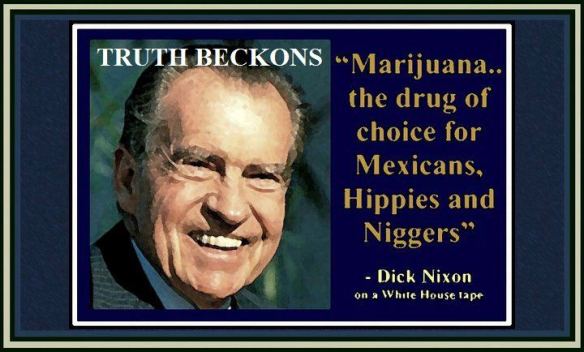
In a new article at Harper’s (“Legalize It All,” April 2016), Dan Baum recalls a 1994 confession by former Nixon domestic policy adviser John Ehrlichmann, about Nixon’s motives in first launching the War on Drugs. Baum, interviewing Ehrlichman for a book on drug prohibition, asked a “series of earnest, wonky questions, that he impatiently waved away”:

“The Nixon campaign in 1968, and the Nixon White House after that, had two enemies:  the antiwar Left, and black people…. We knew we couldn’t make it illegal to be either against the war or black. But by getting the public to associate the hippies with marijuana and blacks with heroin, and then criminalizing both heavily, we could disrupt those communities. We could arrest their leaders, raid their homes, break up their meetings, and vilify them night after night on the evening news. Did we know we were lying about the drugs? Of course we did.”

Judged by those objectives, Nixon’s War on Drugs and its subsequent dramatic escalation under Reagan have been resounding successes.

Many liberals, unfortunately, are prone to describing the War on Drugs as a “failure” — much as the Vietnam or Iraq War was “a mistake” — implicitly accepting the general goals of the American state as good and well-meaning, and merely unfortunate in their execution. The liberals who frame the wars in this way, as Noam Chomsky has argued, share the hawks’ view that “America owns the world” and has the right to define as a “threat” any country that defies its authority or attempts to undermine the global corporate order. And liberals and progressives are nauseatingly prone to referring to criminal foreign wars of aggression and domestic police wars on civil society as something “we” did.

But if you genuinely think the actions of the American state have anything to do with “we” or “us,” either you belong to the economic classes served by the state, or you probably still ask the dentist to save your extracted molars to put under your pillow.

Long before I saw Ehrlichman’s admission, I noted that the expanded War on Drugs against crack and meth under Reagan and Clinton had had a disruptive effect on two of the demographic groups (inner city black people and rural poor whites) that, as it happens, are least socialized to cheerfully accept direction from authority figures behind desks.

Going back to the passage of the Virginia Slave Code after the defeat of Bacon’s Rebellion, running through the use of racial divisions to split and defeat the southern tenant farmers’ unions, and right up to the present, the possibility of a strategic political alliance between poor black and white people has been one of the major fears of the propertied classes who control the American state.

So whether it be Nixon’s or Reagan’s War on Drugs, or the Clintons’ support for a Crime Bill (to “bring to heel” so-called black “super-predators”) that completed America’s growth into the largest carceral state in the world, the fact that a third of the urban black male population is in some phase of the “criminal justice” system and deprived of the franchise has had an enormous effect on radical political possibilities in this country. It has gone a long way towards nullifying the effects of the Voting Rights Act, in much the same way that Black Codes nullified the effects of Emancipation. Jeb Bush’s purge of 70,000 alleged “felons” — mostly not felons, but mostly black — from the Florida voting rolls was the main factor in handing the presidency to his brother.

I’m not, by the way, the kind of conspiracist who thinks every government policy fits into some larger, malign strategy that serves as the “real” motivation for all officials. I don’t doubt a great deal of legislation and executive action is intended as a good faith response to the stated concerns of policy-makers. Of course even such “well-meaning” policies are subject to the law of unintended consequences, mission creep, refusal to reassess in response to feedback on their effectiveness, and abusive or self-dealing execution by the bureaucracies tasked with enforcement.

But even when policies are sincerely “well-meaning,” they still tend to serve vested interests through a sort of structural “invisible hand” effect. The “well-meaning” policies that get passed are those that structurally benefit the economic ruling class, and those that get repealed are those that no longer do so.

The state does not represent “us,” and the destructive and genocidal effects of its policies are not “mistakes.”

Saturday Matinee: Casshern

Casshern_movie

“Casshern” (2004) is a live-action adaptation of the anime of the same name written and directed by Kazuaki Kiriya. The story takes place during a period after a 50 year war in which a resistance movement regularly clashes with the military. When scientist Azuma’s soldier son Tetsuya is killed in battle, Azuma uses his research to bring him back to life. After learning the truth about supposed terrorists he was once ordered to kill, Tetsuya fights against the military with the aid of a prototype cyborg suit. The film is notable for strikingly anime-like special effects and action set pieces, atmospheric score, and poignant conclusion with a clearly pacifist message.

Watch the full movie with English subtitles here.

The Popular Myth of Democracy in America

Fascism_Corporate_Fascist_America

By Stephen Lendman

Source: SteveLendmanBlog

No nation in world history promised more and delivered less to its citizens and people worldwide. None more greatly threatens world peace – putting humanity’s survival up for grabs like never before.

None did more harm to more people globally over a longer duration. None matches the menace it represents – a presstitute media supported fascist gangster state willing to risk destroying planet earth to own it, run by a bipartisan criminal class.

From inception, America was always run by the people who own it, as first Supreme Court Chief Justice John Jay explained.

John Adams believed power belonged exclusively to the rich, well-born and able. Today it’s about monied interests in charge – deciding who holds all top positions in government, elected and appointed.

People have no say whatever. Ignore electoral politics, intended solely to deceive – manipulating people to believe new bums are more worthy than current ones.

Voting is a waste of time, accomplishing nothing. Duopoly power rules.

America is a one-party state with two wings, indistinguishable from each other on issues mattering most – militantly pro-war, pro-business, anti-populist no matter what names and faces hold top positions.

Police state laws enforced by powerful security forces at the federal, state and local levels assure wealth and privilege interests are exclusively served at the expense of public welfare.

Elections are farcical, exercises in theater, not democracy. Candidates for the nation’s top offices are cardboard cutouts of each other, distinguishable only by their disingenuous rhetoric – promises made, forgotten and broken once in office.

The public interest be damned. People are used, not served, deceived to believe politicians represent them.

Embedded power runs America, politicians serving entrenched interests exclusively, chosen for that reason. Ordinary people thinking their enfranchisement matters are living in a fantasy world.

Government of, by and for the people is the grandest of grand hoaxes. Media scoundrels perpetuate the myth with all the familiar slogans and high-minded posturing.

Jimmy Carter was right last summer calling America an “oligarchy with unlimited political bribery…a complete subversion of our political system as a payoff to major contributors.”

Republicans and Democrats operate by the same corrupted standards. “(U)nlimited) money” serves their interests at the expense of constituents they represent.

America’s system is too debauched to fix. It’s too late for tinkering around the edges.

A complete makeover is needed – a popular revolution, replacing oligarchy with grassroots democracy for the first time in the nation’s history, freed from money control.

Today is the most perilous time in world history. We have a choice.

Accept the status quo, its endless wars, oligarch control over the greater good, unprecedented wealth disparity between rich and all others, along with harsh crackdowns on nonbelievers and risk of potential humanity destroying nuclear war – or refuse any longer to tolerate a system responsible for so much harm and misery to so many people worldwide.

Survival depends on choosing wisely. What kind of world do you want to live in? What kind do you want your children to inherit?


Stephen Lendman lives in Chicago. He can be reached at lendmanstephen@sbcglobal.net. 

His new book as editor and contributor is titled “Flashpoint in Ukraine: US Drive for Hegemony Risks WW III.”

http://www.claritypress.com/LendmanIII.html

Visit his blog site at sjlendman.blogspot.com. 

War fraud: The great lies behind imperial warfare in the 21st century

By Mark Taliano

Source: Intrepid Report

The “War On Terror” and “The War On Drugs” are both fraudulent, and they are both related. In a classic example of “reverse projection”, ”the War on Terror” is literally a “War for Terror,” and the “War on Drugs” is literally a “War for Drugs.”

Terror, coupled with the illegal trade in narcotics, particularly heroin, is enabling the orchestration, and funding, of illegal warfare which serves the interests of an international oligarch class as it destroys humanity.

The barbarity of the military operations conducted by the West is beyond the imagination of most domestic audiences, even when details are publicized.

Broadly speaking, we can decode the 9/11 terror wars using a simple formula:

  • Problem
  • Reaction
  • Solution

NATO imperialists engineer or exploit problems to create reactions, with a view to creating previously planned solutions. Typically, problems (i.e, 9/11 crimes) serve to engineer public consent (reaction) for illegal invasions (solution).

The “end-game” also contradicts publically stated goals. Evidence demonstrates that the invasions of Afghanistan, Iraq, Libya, and Syria, as well as the war in Ukraine, were launched and prosecuted with a view to destroy each country through invasion, occupation, plunder, and to establish military footholds. The popular notion that the wars are being prosecuted for humanitarian purposes is absolutely ridiculous.

Afghanistan

In Afghanistan, for example, drug-trafficking warlords such as Gulbuddin Hekmatyar were used to create extremist “jihadist” armies (mujahideen) to destroy the Soviet-protected socialist republic. The long-standing CIA-terror group alliance, which pre-dates Afghanistan, continues to be empowered by profits from illegal drug trafficking: According to U.S sources, the production of opium (which is eventually processed into heroin) has increased “40-fold” since the initial invasion of Afghanistan.

So, the invasion destroyed a secular, socialist government and filled the vacuum with extremist drug-trafficking terrorist warlords. But imperialists gained a military foothold in the country.

Iraq

We all know now that the fraudulent “Weapons Of Mass Destruction” pretext was used for the criminal invasion of Iraq. The engineered problem was followed by mixed reactions from a less gullible public, but the invasion (solution), was launched (on the heels of genocidal sanctions) anyway.

Joe Quinn reports that in this invasion, US Death Squads manufactured a civil war to divert attention from the real culprits: the occupiers. A 10,000 strong “Shia militia” under US command is used to terrorize the population and to destroy Iraqi grassroots resistance. Often, the terrorists bomb civilian targets and falsely blame innocent groups—false flag tactics—which in turn create engineered friction and retaliation. Black propaganda operations are a CIA specialty. Consequently, Iraq is now an unstable terrorist quagmire, whereas before the invasion it was a modern, well-developed country free of any identifiable terror groups.

Libya

The NATO invasion of Libya, previously the wealthiest country in Africa, was also a product of repeated Western lies, and now, it too, is a hotbed of terrorism, vice, and drug trafficking. Erin Banco reports in “Drug And Human Trafficking In ‘Lawless’ Libya Is Funding ISIS” that the West’s “lack of foresight has enabled different groups of fighters to traffic a continuous supply of arms, drugs and people across Libya’s borders, helping to bankroll some of the world’s most violent terrorists.”

Syria

The invasion of Syria is following predictable patterns as well. A constellation of extremist, mercenary terror groups, including ISIS—all supported by the West—are trying to destroy Syria. Drug trafficking, stolen oil and artifacts are being used to finance the mass murder, and death squads, often under the cover of the Free Syrian Army (FSA) are being used to create a “civil war,” and to destroy President Assad’s government. The terror and mass murder are primarily orchestrated externally with a view to making Syria safe for Wahhabism, barbarity, and a NATO military presence.

A Wikileaks cable indicates that since 2011, more than 230,000 people have died and a million have been injured. But despite the so-far-successful alliance of Syria, Iran, and Russia in destroying the mercenary terrorists and in saving Syria, the West can take some consolation: the US already has a military foothold in the country. Only time will tell if the West succeeds in creating and sustaining yet another unstable, terrorist-infested vassal state.

Despite what naysayers might think, the NATO-perpetrated holocaust is in many respects a neocon success story: a succession of previously independent countries have been destroyed, and a NATO presence has been installed. In fact, the wars for Terror and Drugs are winning, despite ostensible setbacks.

The whole process of death and destruction is not rational or moral, and the degeneracy is beyond evil. Commentators call it imperialism.


The Militarization of the Superhero

quitely_all_star_superman

Editor’s note: In honor of Grant Morrison’s 56th birthday, enjoy Dan Sanchez’s excellent analysis of the humanist anti-militarist messages of Morrison’s body of work.

By Dan Sanchez

Source: Voices of Liberty

Grant Morrison Vs. the Super-Soldiers

At this year’s Comic-Con (a huge event in the worlds of comics and superhero blockbusters), celebrated writer Grant Morrison:

“…told a crowd of 2,600 that he’s done all he can with traditional superheroes. He’s sick of the ‘military entertainment complex,’ in which today’s characters always seem to be working for the government…” [Rolling Stone]

The creative industry’s booming superhero sector would be wise to take this criticism to heart, as Morrison is the preeminent genius of the genre. He wrote the most commercially successful graphic novel ever, his 1989 Batman: Arkham Asylum, as well as the comic series All-Star Superman (2005–2008), widely acclaimed as one of the all-time best stories about that archetypal superhero.

The Scottish scribe is not only a master practitioner of the genre, but is even its foremost philosopher, having written the definitive book on the superhero, the national bestselling Supergods: What Masked Vigilantes, Miraculous Mutants, and a Sun God from Smallville Can Teach Us About Being Human, which the Memphis Flyer aptly described as:

“…at once a well-researched history, an entertaining memoir, intriguing cosmological analysis, and a surprising personal revelation…”

Morrison’s disdain for the militarization of his art form is in line with his upbringing. As he relates in Supergods, his father was:

“…a working-class World War II veteran who’d swapped his bayonet for a Campaign for Nuclear Disarmament badge and became a pacifist “Spy for Peace” in the Committee of 100.”

As Morrison has explained in interviews, his father did not suffer from “shell shock” so much as from a “political shock.” His dad remembered first believing that he was going to war to “fight fascism,” and then realizing that “we were just as bad as they were,” after witnessing atrocity after atrocity.

Raised by both parents according to “pacifist principles,” young Morrison once told a Boy Scouts recruiter:

“I refuse to be part of any paramilitary organization, and that includes the Boy Scouts.”

In the sixties, his father was arrested protesting the American nuclear missile bases then located in Scotland. Morrison tells of growing up in the terrifying shadow of:

“…the Bomb, always the Bomb, a grim and looming, raincoated lodger, liable to go off at any minute, killing everybody and everything. (…)

Accompanying imagery was provided by the radical antiwar samizdat zines my dad brought home from political bookstores on High Street. Typically, the passionate pacifist manifestoes within were illustrated with gruesome hand-drawn images of how the world might look after a spirited thermonuclear missile exchange.”

In his childhood home, these horrific images contested with the “shiny futurity” of the covers of his “mum’s beloved science fiction paperbacks.” This struggle played out on his TV screen as well, until victory was claimed for optimism by the dramatic arrival of superheroes into his life:

“On television, images of pioneering astronauts vied with bleak scenes from Hiroshima and Vietnam: It was an all-or-nothing choice between the A-Bomb and the Spaceship. I had already picked sides, but the Cold War tension between Apocalypse and Utopia was becoming almost unbearable. And then the superheroes rained down across the Atlantic, in a dazzling prism-light of heraldic jumpsuits, bringing new ways to see and hear and think about everything.”

Ironically, these saving superheroes entered Scotland in the duffle bags of the very same American soldiers who also delivered the Bomb. As Morrison put it in an interview, they brought with them both the disease and the cure.

The sunny, scifi superheroes of the “Silver Age” of comics flew and swung into Morrison’s psyche, saving him from the debilitating existential terror of the Bomb. For the Hulk, having a Gamma Bomb blow up in his face was only the beginning of his career. The Flash could outrun a nuclear blast wave without breaking a sweat. And Superman could stroll out of ground zero without so much as a sun tan.

“Before it was a Bomb, the Bomb was an Idea. Superman, however, was a Faster, Stronger, Better Idea. It’s not that I needed Superman to be “real,” I just needed him to be more real than the Idea of the Bomb that ravaged my dreams. I needn’t have worried; Superman is so indefatigable a product of the human imagination, such a perfectly designed emblem of our highest, kindest, wisest, toughest selves, that my Idea of the Bomb had no defense against him.”

For Morrison, the superheroes were a hopeful, defiant answer to nuclear nihilism, because they were:

“…the best current representation of something we all might become, if we allow ourselves to feel worthy of a tomorrow where our best qualities are strong enough to overcome the destructive impulses that seek to undo the human project…”

Since childhood, the superhero represented to Morrison the antithesis of the ultimate form of warfare. It is no wonder that he would now speak out against its military conscription.

Morrison later turned his love for superheroes into a career as comic book writer. Early in that career, Alan Moore, a fellow Brit, revolutionized the genre, starting in 1982 with his dark, deconstructionist Marvelman (later retitled Miracleman for fear of Marvel Comics’ lawyers). In this revised origin story, Moore recast Britain’s classic Superman-type character as having been engineered as a living weapon by the Royal Air Force.

Moore inaugurated what Morrison calls the “Dark Age” of superhero comics. Realism, political analogy, dystopia, mass carnage, graphic violence, and antiheroes characterized this new age, as well as higher literary standards.

Moore’s first American title was Watchmen (published in 1986–87 and made into a Hollywood movie in 2009). Written during the heightened nuclear tensions of the Reagan years, Moore’s Watchmen was also haunted by the Bomb. Morrison described it as a:

“…murder mystery set against a familiar backdrop of Cold War nuclear paranoia, but located in an alternate history where the appearance of one single American superhuman in 1959 had deformed and destabilized global politics, economies, and culture itself.”

That single superhuman was Doctor Manhattan, who placed his godlike powers in the service of the US government, swinging the Cold War’s balance of power in America’s favor, and making the Vietnam War a cakewalk instead of a quagmire.

Watchmen launched the comic world’s analog to pop music’s “British Invasion” of American culture, an invasion that also included writers such as Neil Gaiman and Morrison himself.

America’s answer to the British “Dark Age” Invasion was Frank Miller: especially his hardboiled 1986 Batman story The Dark Knight Returns. The story also features Superman, and in Hollywood influenced both The Dark Knight Rises and the upcoming Superman v Batman: Dawn of Justice. Morrison wrote:

“The thoroughly modern Batman of The Dark Knight Returns was an antiestablishment rebel and ruthless pragmatist, but Miller’s Superman was an idealistic government stooge in the pay of an all but mummified Ronald Reagan, president forever and ever, amen. A memorable sequence of panels introducing Superman to the story depicted a visual dissolve of the flag on the White House roof, where the rippling stripes of Old Glory morphed into an abstract close-up detail of the famous S shield.”

Morrison further characterized Miller’s Batman as:

“…no bleeding-heart liberal but a rugged libertarian.”

…and his Superman, in contrast, as a:

“…compromised champion of the powers that be, serving the letter of the law, no matter how corrupt its administration became.”

Miller’s story, like Moore’s, also featured the threat of nuclear war and such themes as superhero registration/regulation. And both Watchmen and The Dark Knight Returns are often assigned reading in university courses.

The Cold War, Reagan-era superhero could sometimes be a government stooge, like Moore’s Doctor Manhattan and Miller’s Superman. But in such instances, he was recognized as a stooge.

This has often not been the case for the post-Cold War super-stooge. Starting in the “humanitarian interventionist” Clinton era, the western superhero began celebrating what Charles Krauthammer called America’s “unipolar moment” by strutting the globe, not as government lackeys, but as government badasses.

This was especially the case in the title Stormwatch under the authorship of Warren Ellis, yet another Brit, starting in 1996. Ellis’s heroes were, as Morrison put it:

“…UN-sanctioned operatives with a mandate to monitor superhuman activity and to police violations of the various protocols and sanctions governing the use of extranormal abilities. Costumes became functional field outfits, designed for espionage and black-ops work. Ellis suggested a new take on the T.H.U.N.D.E.R. Agents–S.H.I.E.L.D. model, combining spy thrills with grimy, violent superheroics in a world of genetic manipulation, weaponized flesh, and budget restrictions.”

In 1999, Ellis went even further in this vein with The Authority. Ellis’s new superteam was an updated “Justice League,” with its own parallels of Superman and Batman. The powers and costumes were alike, but the similarities ended there. As Morrison wrote:

“The Justice League never resorted to lethal force, but Ellis’s heroes would happily cut off your head and beat you to death with it if that’s what it took to stop you from being a dictator or a “bastard.” These hombres meant business, and the bad guys could no longer rely on that handy code against killing, which had kept superheroes in check for so long.”

The “heroes” of the Authority decapitated, dismembered, and impaled with abandon. In Marvelman, Alan Moore graphically showed what would happen in the “real world” when supervillains got their hands on frail mortals. Now superheroes too were gleefully exploring the myriad ways to disrupt human anatomy.

The Authority was as ambitious as it was severe. As Morrison wrote:

“The opening page of The Authority no. 1 showed Earth as seen from space accompanied by a single caption. ‘They think there’s no one left to save the world.’”

But the classic superhero trope of “saving the world” had a distinctly imperial ring with this team of, in Morrison’s words, “strutting imperial warrior superhumans.”

“Unlike Alan Moore’s troubled heroes, the members of the Authority were comfortable with their powers, using them sensibly to fight “bastards” and improve the lot of everyone on planet Earth. It was the utopian vision of [Superman creators] Siegel and Shuster strained through British cynicism and delivered on the end of a spiked leather glove. It… suggested a new kind of superfascist, one who was on our side.”

Also unlike the superheroes of yesteryear, these “friendly” imperial superfascists did not shy away from incurring extensive “collateral damage,” if that’s what it took to terminate the superhuman dictators, terrorists, and other “bastards” plaguing the planet.

In one storyline, to defeat an enemy empire on a parallel Earth, the Authority wages total war on the planet. In the last battle, the team’s shaman, called the Doctor, floods the entire Italian peninsula with a move of two fingers, killing everyone on it, man, woman, and child.

The team leader then issues a triumphal global broadcast, announcing the regime change:

“This is Jenny Sparks for the Authority. Albion is free of the Blue. Sicily and the Italian capital infrastructure are gone. If needed, we can annihilate the Hanseatic regions within the hour. If we’re asked to, we will go into China and Japan. If we have to, we will personally expunge the royal blood and military rape culture from the face of the planet. We’re here to give you a second chance. Make a world worth living in. We are the Authority. Behave.”

Morrison liked both Stormwatch and The Authority, and was even creatively involved in the latter. But in hindsight, he now sees that their spirit presaged dark things to come, both in superhero fiction and global superpower reality.

“For a while, it was exciting. In The Authority, the no-nonsense army toughs were on our side for a change, but it was a particular kind of power fantasy: that of impotent liberals, who feared deep down that it was really only force and violence that got things done and not patient diplomacy, and that only soldiers and very rich people had the world figured out. Gifted Irish writer Garth Ennis had occupied this territory for years; his soldier-hardman heroes influenced the new generation of supermen and women. These books were a capitulation to a kind of thinking that would come to dominate the approaching first decade of the new millennium. Soon the no-compromise bomb and ‘cripple what you don’t agree with’ approach of the Authority would be put to practice in the real world with horrific results. And it wouldn’t be liberals doing the damage”

Throughout the 90s, Morrison’s own career was taking off as well, but in a decidedly non-militaristic direction. After the smash hit of his 1989 Arkham Asylum, he was a hot commodity in the comics industry. But his subsequent explorations of the superhero were worlds away from the “grim ‘n’ gritty” comics of the 80s and 90s.

In his titles Animal Man, Doom Patrol, and The Invisibles, Morrison preferred to explore the intersection of the cosmic, the quirky, and the counter-cultural. Morrison’s gonzo inventiveness and bubbling-over genius quickly made a splash. With obscure superheroes, he felt free to take the genre in radically experimental directions, infusing it with such elements as transcendentalism, surrealism, and even dadaism, making his books cult classics among more discerning and literary comic readers.

But sometimes quirkiness just isn’t called for, so in 1997, when he got a crack at the Justice League itself and its all-star roster (Superman, Batman, Wonder Woman, the Flash, etc) in the title JLA, he gave these iconic characters the iconic (yet still boldly and brilliantly inventive) treatment they deserved.

“There would be no obtrusive postmodern meta-tricks in JLA, just unadulterated, gee-whiz, unadorned sci-fi myths in comic form, giving back to the superheroes the respect and dignity a decade of ‘realism’ and harsh critique had stripped away.”

Morrison had no interest joining a paramilitary organization as a boy, and he had no interest writing one as an adult. And so Morrison’s Justice League members were not “operatives” or “imperial warrior superhumans,” but genuine superheroes.

In the first storyline, the Justice League repelled an alien invasion: and unlike the Authority, did so without harming innocents. In this story, it was the villains and not the heroes who promised to “make the world a better place” by taking it over and remaking it. Morrison ends the adventure with an exchange that cautions against interventionism:

Wonder Woman: “When does intervention become domination?”

Superman: “I can only tell you what I believe, Diana. Humankind has to be allowed to climb to its own destiny. We can’t carry them there.”

In another storyline, the League takes on the “Ultramarines,” who, like Marvelman, were bio-engineered, duped, and exploited by the military.

And in his final story, “World War III,” the great menace is not a person, but a psychic weapon on auto-pilot called Mageddon, which causes its victims to destroy each other by instilling in them “war fever.” Ages ago it destroyed its godlike creators, and now it threatens to destroy humanity by pitting it against itself.

The Justice League manages to temporarily confer superpowers to all the people of Earth, who then together vanquish Mageddon. For his finale, Morrison has an embodiment of war itself as the villain, and regular people rising up and becoming superheroes to defeat it. Thus, a decade before he wrote Supergods, Morrison had already manifested his vision of the superhero as:

“…the best current representation of something we all might become [represented by the population of Earth becoming superheroes], if we allow ourselves to feel worthy of a tomorrow where our best qualities are strong enough to overcome the destructive impulses [represented by Mageddon] that seek to undo the human project…”

Morrison returned to the Justice League in his 2000 graphic novel, JLA: Earth 2. The villains of that tale, the Crime Syndicate of America, are basically the Authority taken to its logical conclusion: a team of JLA-doppelgänger super-tyrants ruling an alternate Earth with an iron fist.

In a scene that will warm the hearts of hard money advocates and fans of George Orwell, paper money is seen raining down on the alternate-Earth city of Metropolis, causing brawls to break out as the impoverished subjects scramble for it. Next we see that the bills are being cast from an overhead satellite by Ultraman, the evil-twin version of Superman, who tells his robotic servant Brainiac:

“By the time they realize the notes are fake, the economy will be in ruins again.”

Down below, one of the citizens reaches his breaking point, a la Orwell’s Winston Smith.

“…not real! It’s crap! It’s just more crap from the sky! From Ultraman! I can’t take any more of them looking down at us as though we’re-”

A red light is seen penetrating the clouds, and “Winston” is incinerated mid-sentence. Ultraman, his eyes still glowing from his use of heat vision, says:

“They insult me within earshot. They know what to expect. Big Brother is watching you.”

He might have just as well echoed Ellis’s Jenny Sparks and said, “We are the Authority. Behave.”

Of course unlike in The Authority, the swaggering imperialists of the Crime Syndicate are obviously villains. And it is gratifying to see Morrison’s Justice League show them what real superheroes are made of. A similar feeling can also be had reading Morrison’s JLA/WildC.A.T.S. inter-series crossover, in which the League tackles (though later teams up with) another obnoxious paramilitary (C.A.T.S stands for Covert Action Teams) super-group of the “grim ‘n’ gritty” tradition.

Then 9/11 happened, and the militarization of the superhero, like the concurrent militarization of the police, went into overdrive.

What must have been particularly grating for Morrison, was that it was spearheaded by his own protege Mark Millar, a fellow Scot who had made his name after he was selected to take over writing The Authority on Morrison’s recommendation.

In his hugely influential The Ultimates, Millar gave the Avengers (Marvel Comics’ chief super-team) an Authority makeover. Captain America cut villains in half with his shield while shouting jingoistic catchphrases. The Hulk ate innocent people while rampaging, causing little more trouble for the team than a PR headache. And the whole team was a government project.

Morrison’s analysis of his friend’s title was as withering as it was perceptive and eloquent.

“The Ultimates, re-created with Mark Millar’s gleefully right-leaning heroes, gave a voice to Bush’s America’s posturing, superheroic fantasies of global law enforcement in a posttraumatic world. (…)

President George W. Bush himself turned up to welcome Captain America to the new millennium with the words “WELL, WHAT’S YOUR VERDICT ON THE 21ST CENTURY, CAPTAIN AMERICA? COOL OR UNCOOL?,” to which the Captain replied, “COOL, MISTER PRESIDENT. DEFINITELY COOL.” With photorealistic renderings of George W. Bush embracing an equally believable Captain America, there could be no mistaking the dizzying, stifling collapse of fact into fantasy. (…)

The fear of a sinister military-industrial underworld that haunted Moore’s Marvelman was inverted to become a joyous embrace of Republican America’s undeniable access to the best guns, the best soldiers, and the best superheroes in the world. For Mark Millar, it was a given that any real-world superhero would be co-opted by the powers that be and recruited as a soldier. The Moore-Miller Superman of the eighties, that helpless, unreconstructed tool of the ruling class, became the template for a new generation of reengineered characters. In The Ultimates, everyone worked for the government, but it was all cool. In the first decade of the twenty-first century, superheroes strove to preserve and embody the values of a defiant military-industrial corporate complex or they didn’t work at all. The brief era of The Authority had passed and left the “bastards” in charge as usual.”

For Morrison, all of this had a bleak upshot:

“The last pirate art form had swapped its Jolly Roger for the Stars and Stripes once again, and this time it looked as if there was no turning back.”

This is the key background to Morrison’s Comic-Con pronouncement discussed at the beginning. At that conference, he told ComicBook.com:

“…for the last fifteen years at least — certainly since 9/11 — I think America’s been processing the horror of those images through their art, through their popular art in particular.

That’s why I think superheroes became from ordinary people who went out at night to make the world a better place, they’ve become I think agents of the military-entertainment complex. The Avengers work for the government, and it’s been like that since Mark [Millar] did The Ultimates. Batman as seen by Christopher Nolan and subsequently is a soldier. He wears military gear with his ordinance and his machines. For me, it became quite reductive. It was an interesting way to look at it for a while, but it’s persisted for so long that I’m quite bored with the idea that the best superheroes can represent is some aggressive version of the military.”

Millar’s Ultimates seem to have been a major influence on the phenomenally successful Marvel Cinematic Universe films. Not all of that influence has been bad; two great characterizations — Tony Stark as a cocky billionaire playboy genius, played so perfectly by Robert Downey, Jr., and even the casting of Samuel L. Jackson as Nick Fury — both came straight from the pages of Ultimates. But the tight integration between the Avengers and the SHIELD government agency did too.

Thankfully, the Avengers of the films are not nearly as fascist as the Ultimates. In fact, to a large extent they take a marvelously anti-authoritarian and anti-militarist stance. See for example my articles on Captain America: Winter Soldier and Avengers: Age of Ultron.

Yet, the militarization of the Avengers is bleeding into its merchandise, even targeting its most impressionable audiences. For example, the title of an Avengers sticker book for children, “Top Agents & Most Wanted,” seems to recast the Avengers as some sort of super-FBI.

Fortunately, even after Ultimates, Morrison had not given up trying to remind people what a true superhero is. Superman and friends had saved Morrison’s psyche from the Bomb. Now Morrison would return the favor by saving Superman from possibly imminent militarization by writing All-Star Superman. Morrison wrote of how doing so brought his life full circle.

“I wrote my personal best story of the world’s greatest superhero, for my favorite artist to draw, overlooking a loch where Trident submarines still sailed in all their stately satanic splendor, with black bellies full of hellfire sufficient to blind and vaporize me in a fraction of a heartbeat, even as it liquefied the ancient stones of my walls, cracked Scotland in half, and turned the world into a refrigerated postnuclear litter tray. I wrote it scant miles from the former American navy base, where my parents had protested, where Dad had been arrested, and where American comics had arrived in Scotland with the sailors and submariners. It felt like ground zero, the center of a web of coincidence and personal mythology…”

All-Star Superman was Morrison’s defiant response to post-9/11 culture and what it was doing to the genre. In it, he even outdid his own work on JLA in beautifully distilling the essence of the superhero.

“As the first few years of the twenty-first century wore on, I wondered just how badly people, especially young people, were being affected by the overwhelmingly alarmist, frightening, and nihilistic mass media narratives that seemed to boil with images of death, horror, war, humiliation, and pain to the exclusion of almost everything else, on the presumed grounds that these are the kinds of stories that excite the jaded sensibilities of the mindless drones who consume mass entertainment. Cozy at our screens in the all-consuming glare of Odin’s eye, I wondered why we’ve chosen to develop in our children a taste for mediated prepackaged rape, degradation, violence, and “bad-ass” mass-murdering heroes.

And so All-Star Superman: our attempt at an antidote to all that, which dramatized some of the ideas in Supergods by positioning Superman as the Enlightenment ideal paragon of human physical, intellectual, and moral development that Siegel and Shuster had originally imagined. A Vitruvian Man in a cape, our restorative Superman would attempt to distill the pure essence of pop culture’s finest creation: baring the soul of an indestructible hero so strong, so noble, so clever and resourceful, he had no need to kill to make his point. There was no problem Superman could not solve or overcome. He could not lose. He would never let us down because we made him that way. He dressed like Clark Kent and took the world’s abuse to remind us that underneath our shirts, waiting, there is an always familiar blaze of color, a stylized lighting bolt, a burning heart.”

One scene bottles the lightning that is the superhero concept most elegantly of all. In a fleeting interlude between mega-crises, Superman’s super-hearing picks up the voice of a therapist stuck on a train, desperately trying to keep a suicidal patient on the phone until he can reach her. The troubled girl, with purple hair and facial piercings, drops her phone off the ledge of a skyscraper. She closes her tear-streaked eyes and prepares to jump. Suddenly Superman is standing behind her with his hand on her shoulder.

“Your doctor really did get held up, Regan. It’s never as bad as it seems.”

As she turns wide-eyed to face him, he says:

“You’re much stronger than you think you are. Trust me.”

Regan collapses into Superman’s arms, and he hugs her in silence as his cape billows in the wind.

These five panels and two dozen words have literally saved lives. At Comic-Con, Morrison spoke of how moved he was to meet actual kids who decided against committing suicide after reading this scene. It made him more convinced than ever that superheroes, when written as superheroes, can make a real and positive difference in people’s lives.

The Grant Morrison superhero is no souped-up super-soldier taking twisted pleasure in the hunting of men, like an American Sniper or an American Cop, using “saving people” as a mere excuse. He is not some semi-sadistic adolescent power fantasy.

The superhero according to Morrison takes what’s best in us, personifies it in a sigil-draped figure, and shows it springing into action, inspiring us to emulation.

The superhero according to Morrison takes what’s best in us, personifies it in a sigil-draped figure, and shows it springing into action, inspiring us to emulation. It imparts that not even the sky is the limit if we choose to bring out in ourselves those noble qualities which the superhero personifies.

Like Superman with the suicidal girl, the superhero reminds us that we’re stronger than we think we are. Stronger than despair. Stronger than hate. Strong enough to someday achieve scifi marvels. To even be stronger than the Bomb. Stronger than War.

The Wickedness of [US] Foreign Policy

us-imperialism-nepal-south-asia-revolution

By Sheldon Richman

Source: Center for a Stateless Society

If you want to see how inhumane people can be, just watch those who make and execute foreign policy. We could spend all day discussing the cruelties that politicians and bureaucrats commit against people who live inside the United States. Think how many are caged like wild animals because they manufacture, sell, or consume disapproved substances; gamble where government has forbade it; traded sexual services for money; possessed a gun they weren’t “supposed” to possess; etc. ad infinitum. Naturally, America leads the world in locking up people.

But at least the policy of mass imprisonment gets increasing attention. Subject to far less scrutiny is how America’s (mis)leaders, (mis)representatives and public (self-)servants treat foreigners, especially those with dark skins and a still-unfamiliar religion. When we talk about foreign policy, how easy it is to get wrapped up in abstractions like empire,intervention, nonintervention, and kinetic military action. These are important concepts to understand, of course, but foreign-policy conversations often become sterile examinations of “policy,” when what we need is a full awareness of the harm to individual human beings, the destruction of their families, homes, communities, and societies. These persons are the victims of our rulers’ geopolitical stratagems, which seemly outrank all other considerations. Yet each victim has a story embodying unique relationships and aspirations, a story that is permanently changed by an American cluster bomb, drone-launched missile, or special-ops mission.

The best that can be said of the perpetrators of this carnage and social devastation is that they are guilty of gross negligence. Many of their acts, however, cross into the territory of premeditated murder and the infliction of mayhem with malice aforethought.

One need not look hard for the most egregious examples taking place right at this moment. In Yemen the Obama administration gives indispensable material support to Saudi Arabia’s barbaric war — war ought not to require a qualifier like barbaric, but it seems necessary these days — on the poorest population in the region. The U.S.-facilitated starvation blockade and cluster-bombing take an untold number of Yemeni lives while devastating the social order. Policymakers — a euphemism for the architects of devastation — can rationalize this cruelty in geopolitical terms — the Houthis, who incidentally are fighting al-Qaeda-affiliated jihadis, are (falsely) said to be instruments of Iran — but the fact remains that individual persons who did no harm to anyone are being slaughtered and starved with the help of American politicians and military bureaucrats.

Or how about Syria? U.S. conduct carries out a seemingly incoherent policy of simultaneously targeting the regime of President Bashar al-Assad and one of his chief adversaries, the Islamic State, while helping another Islamist group, al-Nusra Front, that has pledged allegiance to Ayman al-Zawahiri, Osama bin Laden’s successor as head of al-Qaeda, perpetrators of the 9/11 attacks. Estimates of the death total in Syria’s civil war reach as high as 340,000, a number that represents the toll at the hands of both government and rebel forces. (The total is sometimes invidiously attributed to Assad’s military alone.) The injured and refugees are probably uncountable.

What must be understood is that most of these deaths, injuries, and dispossessions would probably not have occurred had the Obama administration — most especially Secretary of State Hillary Clinton — not early on intensified the civil war by declaring Assad’s regime “illegitimate,” demanding that he “go” (i.e., die), and overseeing the transfer weapons and jihadi fighters from Benghazi, Libya. While doing all this, the Obama administration was thwarting promising efforts toward a negotiated settlement, which might have stopped or at least reduced the killing of innocent persons. For details see these three articles by the excellent investigate journalist Jonathan Marshall.

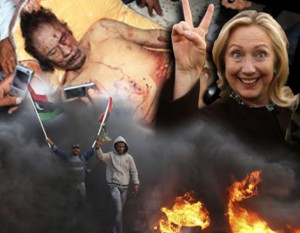
And then there’s Libya itself, which Clinton boasts is an example of “smart power at its best.” In 2011 she had egg on her face because she was on the wrong side of the Arab Spring, having defended Egypt’s military dictator, Hosni Mubarak, as a family friend and trusted world leader to the bitter end while throngs of aggrieved Egyptians were in the streets demanding his exit. Needing to clean up her image (perhaps in preparation for her quest for the presidency), she along with administration national-security VIPs Samantha Power and Susan Rice persuaded a reluctant Obama that the residents of Benghazi had to be saved from Col. Muammar Gaddafi’s alleged genocidal designs. The only problem was that Gaddafi had no genocidal designs. (Also see this and this.) And in a classic exhibition of mission-creep, the U.S.-led NATO air campaign went from protecting Benghazi to changing the regime in Tripoli, prompting Clinton to gloated, “We came. We saw. He died.” (Gaddafi was killed extrajudicially, reportedly in a most gruesome manner.)

Since the U.S. intervention, Libya has been wracked by sectarian civil war — even the Islamic State now holds territory there — prompting many Libyans to flee to Europe, which now has to contend with a growing refugee crisis. As noted, the Libyan power vacuum, featuring the unlocking of Gaddafi’s arsenal of heavy weapons, helped to boost the Islamist rebel militias in Syria, to the delight of U.S. allies Turkey (which fears the Kurds) and Saudi Arabia (which fears Iran and the Shi’ites). After the nightmare in Iraq, one has to wonder what Clinton was thinking. The closest thing we have to an answer is from then-Secretary of War Robert Gates, an opponent of the intervention, who said, “We were playing it by ear.” (And let’s not forget: destabilization itself can be an objective.)

Of course we could point to Iraq, George W. Bush’s invasion of which in 2003 set most of the aforementioned mayhem in motion, and Afghanistan, but the story is largely the same: innocent lives are sacrificed to the politicians’ grand agenda. Little people living small lives can’t be allowed to stand in the way.