We Have Met the Alien and He Is Us

73e633dab43437b78c926c0403c06bcc

By William Astore

Source: TomDispatch.com

We Are The Empire
Of U.S. Military Interventions, Alien Disaster Movies, and Star Wars
By William J. Astore

Perhaps you’ve heard the expression: “We have met the enemy and he is us.” Cartoonist Walt Kelly’s famed possum, Pogo, first uttered that cry. In light of alien disaster movies like the recent sequel Independence Day: Resurgence and America’s disastrous wars of the twenty-first century, I’d like to suggest a slight change in that classic phrase: we have met the alien and he is us.

Allow me to explain. I grew up reading and watching science fiction with a fascination that bordered on passion. In my youth, I also felt great admiration for the high-tech, futuristic nature of the U.S. military. When it came time for college, I majored in mechanical engineering and joined the U.S. Air Force. On graduating, I would immediately be assigned to one of the more high-tech, sci-fi-like (not to say apocalyptic) military settings possible: Air Force Space Command’s Cheyenne Mountain.

For those of you who don’t remember the looming, end-of-everything atmosphere of the Cold War era, Cheyenne Mountain was a nuclear missile command center tunneled out of solid granite inside an actual mountain in Colorado. In those days, I saw myself as one of the good guys, protecting America from “alien” invasions and the potential nuclear obliteration of the country at the hands of godless communists from the Soviet Union. The year was 1985 and back then my idea of an “alien” invasion movie was Red Dawn, a film in which the Soviets and their Cuban allies invade the U.S., only to be turned back by a group of wolverine-like all-American teen rebels. (Think: the Vietcong, American-style, since the Vietnam War was then just a decade past.)

Strange to say, though, as I progressed through the military, I found myself growing increasingly uneasy about my good-guy stature and about who exactly was doing what to whom. Why, for example, did we invade Iraq in 2003 when that country had nothing to do with the attacks of 9/11? Why were we so focused on dominating the Earth’s resources, especially its oil? Why, after declaring total victory over the “alien” commies in 1991 and putting the Cold War to bed for forever (or so it seemed then), did our military continue to strive for “global reach, global power” and what, with no sense of overreach or irony, it liked to call “full-spectrum dominance”?

Still, whatever was simmering away inside me, only when I retired from the Air Force in 2005 did I fully face what had been staring back at me all those years: I had met the alien, and he was me.

The Alien Nature of U.S. Military Interventions

The latest Independence Day movie, despite earning disastrous reviews, is probably still rumbling its way through a multiplex near you. The basic plot hasn’t changed: ruthless aliens from afar (yet again) invade, seeking to exploit our precious planet while annihilating humanity (something that, to the best of our knowledge, only we are actually capable of). But we humans, in such movies as in reality, are a resilient lot. Enough of the plucky and the lucky emerge from the rubble to organize a counterattack. Despite being outclassed by the aliens’ shockingly superior technology and awe-inspiring arsenal of firepower, humanity finds a way to save the Earth while — you won’t be surprised to know — thoroughly thrashing said aliens.

Remember the original Independence Day from two decades ago? Derivative and predictable it may have been, but it was also a campy spectacle — with Will Smith’s cigar-chomping military pilot, Bill Pullman’s kickass president in a cockpit, and the White House being blown to smithereens by those aliens. That was 1996. The Soviet Union was half-a-decade gone and the U.S. was the planet’s “sole superpower.” Still, who knew that seven years later, on the deck of an aircraft carrier, an all-too-real American president would climb out of a similar cockpit in a flight suit, having essentially just blown part of the Middle East to smithereens, and declare his very own “mission accomplished” moment?

In the aftermath of the invasion of Afghanistan and the “shock and awe” assault on Iraq, the never-ending destructiveness of the wars that followed, coupled with the U.S. government’s deployment of deadly robotic drones and special ops units across the globe, alien invasion movies aren’t — at least for me — the campy fun they once were, and not just because the latest of them is louder, dumber, and more cliché-ridden than ever. I suspect that there’s something else at work as well, something that’s barely risen to consciousness here: in these years, we’ve morphed into the planet’s invading aliens.

Think about it. Over the last half-century, whenever and wherever the U.S. military “deploys,” often to underdeveloped towns and villages in places like Vietnam, Afghanistan, or Iraq, it arrives very much in the spirit of those sci-fi aliens. After all, it brings with it dazzlingly destructive futuristic weaponry and high-tech gadgetry of all sorts (known in the military as “force-multipliers”). It then proceeds to build mothership-style bases that are often like American small towns plopped down in a new environment. Nowadays in such lands, American drones patrol the skies (think: the Terminator films), blast walls accented with razor wire and klieg lights provide “force protection” on the ground, and the usual attack helicopters, combat jets, and gunships hover overhead like so many alien craft. To designate targets to wipe out, U.S. forces even use lasers!

In the field, American military officers emerge from high-tech vehicles to bark out commands in a harsh “alien” tongue. (You know: English.) Even as American leaders offer reassuring words to the natives (and to the public in “the homeland”) about the U.S. military being a force for human liberation, the message couldn’t be more unmistakable if you happen to be living in such countries: the “aliens” are here, and they’re planning to take control, weapons loaded and ready to fire.

Other U.S. military officers have noticed this dynamic. In 2004, near Samarra in Iraq’s Salahuddin province, for instance, then-Major Guy Parmeter recalled asking a farmer if he’d “seen any foreign fighters” about. The farmer’s reply was as simple as it was telling: “Yes, you.” Parmeter noted, “You have a bunch of epiphanies over the course of your experience here [in Iraq], and it made me think: How are we perceived, who are we to them?”

Americans may see themselves as liberators, but to the Iraqis and so many other peoples Washington has targeted with its drones, jets, and high-tech weaponry, we are the invaders.

Do you recall what the aliens were after in the first Independence Day movie? Resources. In that film, they were compared to locusts, traveling from planet to planet, stripping them of their valuables while killing their inhabitants. These days, that narrative should sound a lot less alien to us. After all, would Washington have committed itself quite so fully to the Greater Middle East if it hadn’t possessed all that oil so vital to our consumption-driven way of life? That’s what the Carter Doctrine of 1980 was about: it defined the Persian Gulf as a U.S. “vital interest” precisely because, to quote former Deputy Secretary of Defense Paul Wolfowitz’s apt description of Iraq, it “floats on a sea of oil.”

Of Cold War Memories and Imperial Storm Troopers

Whether anyone notices or not, alien invasion flicks offer a telling analogy when it comes to the destructive reality of Washington’s global ambitions; so, too, do “space operas” like Star Wars. I’m a fan of George Lucas’s original trilogy, which appeared in my formative years. When I saw them in the midst of the Cold War, I never doubted that Darth Vader’s authoritarian Empire in a galaxy far, far away was the Soviet Union. Weren’t the Soviets, whom President Ronald Reagan would dub “the evil empire,” bent on imperial domination? Didn’t they have the equivalent of storm troopers, and wasn’t it our job to “contain” that threat?

Like most young Americans then, I saw myself as a plucky rebel, a mixture of the free-wheeling, wisecracking Han Solo and the fresh-faced, idealistic Luke Skywalker. Of course, George Lucas had a darker, more complex vision in mind, one in which President Richard Nixon, not some sclerotic Soviet premier, provided a model for the power-mad emperor, while the lovable Ewoks in The Return of the Jedi — with their simple if effective weaponry and their anti-imperial insurgent tactics — were clearly meant to evoke Vietnamese resistance forces in an American war that Lucas had loathed. But few enough Americans of the Cold War-era thought in such terms. (I didn’t.) It went without question that we weren’t the heartless evil empire. We were the Jedi! And metaphorically speaking, weren’t we the ones who, in the end, blew up the Soviet Death Star and won the Cold War?

How, then, did an increasingly gargantuan Pentagon become the Death Star of our moment? We even had our own Darth Vader in Dick Cheney, a vice president who actually took pride in the comparison.

Think for a moment, dear reader, about the optics of a typical twenty-first-century U.S. military intervention. As our troops deploy to places that for most Americans might as well be in a galaxy far, far away, with all their depersonalizing body armor and high-tech weaponry, they certainly have the look of imperial storm troopers.

I’m hardly the first person to notice this. As Iraq war veteran Roy Scranton recently wrote in the New York Times, “I was the faceless storm trooper, and the scrappy rebels were the Iraqis.” Ouch.

American troops in that country often moved about in huge MRAPs (mine-resistant, ambush-protected vehicles) described to me by an Army battalion commander as “ungainly” and “un-soldier like.” Along with M1 Abrams tanks and Bradley fighting vehicles, those MRAPs were the American equivalents of the Imperial Walkers in Star Wars. Such vehicles, my battalion commander friend noted drolly, were “not conducive to social engagements with Iraqis.”

It’s not the fault of the individual American soldier that, in these years, he’s been outfitted like a Star Wars storm trooper. His equipment is designed to be rugged and redundant, meaning difficult to break, but it comes at a cost. In Iraq, U.S. troops were often encased in 80 to 100 pounds of equipment, including a rifle, body armor, helmet, ammunition, water, radio, batteries, and night-vision goggles. And, light as they are, let’s not forget the ominous dark sunglasses meant to dim the glare of Iraq’s foreign sun.

Now, think how that soldier appeared to ordinary Iraqis — or Afghans, Yemenis, Libyans, or almost any other non-Western people. Wouldn’t he or she seem both intimidating and foreign, indeed, hostile and “alien,” especially while pointing a rifle at you and jabbering away in a foreign tongue? Of course, in Star Wars terms, it went both ways in Iraq. A colleague told me that during her time there, she heard American troops refer to Iraqis as “sand people,” the vicious desert raiders and scavengers of Star Wars. If “they” seem like vicious aliens to us, should we be surprised that we just might seem that way to them?

Meanwhile, consider the American enemy, whether the Taliban, al-Qaeda, or any of our other opponents of this era. Typically unburdened by heavy armor and loads of equipment, they move around in small bands, improvising as they go. Such “terrorists” — or “freedom fighters,” take your pick — more closely resemble (optically, at least) the plucky human survivors of Independence Day or the ragtag yet determined rebels of Star Wars than heavy patrols of U.S. troops do.

Now, think of the typical U.S. military response to the nimbleness and speed of such “rebels.” It usually involves deploying yet more and bigger technologies. The U.S. has even sent its version of Imperial Star Destroyers (we call them B-52s) to Syria and Iraq to take out “rebels” riding their version of Star Wars “speeders” (i.e. Toyota trucks).

To navigate and negotiate the complex “human terrain” (actual U.S. Army term) of “planets” like Iraq and Afghanistan, U.S. troops call on a range of space-age technologies, including direction-finding equipment, signal intercept, terrain modeling, and satellite navigation using GPS. The enemy, being part of that “human terrain,” has little need for such technology to “master” it. Since understanding alien cultures and their peculiar “human terrains” is not its forte, the U.S. military has been known to hire anthropologists to help it try to grasp the strange behaviors of the peoples of Planet Iraq and Planet Afghanistan.

Yet unlike the evil empire of Star Wars or the ruthless aliens of Independence Day, the U.S. military never claimed to be seeking total control (or destruction) of the lands it invaded, nor did it claim to desire the total annihilation of their populations (unless you count the “carpet bombing” fantasies of wannabe Sith Lord Ted Cruz). Instead, it promised to leave quickly once its liberating mission was accomplished, taking its troops, attack craft, and motherships with it.

After 15 years and counting on Planet Afghanistan and 13 on Planet Iraq, tell me again how those promises have played out.

In a Galaxy Far, Far Away

Consider it an irony of alien disaster movies that they manage to critique U.S. military ambitions vis-à-vis the “primitive” natives of far-off lands (even if none of us and few of the filmmakers know it). Like it or not, as the world’s sole superpower, dependent on advanced technology to implement its global ambitions, the U.S. provides a remarkably good model for the imperial and imperious aliens of our screen life.

We Americans, proud denizens of the land of the gun and of the only superpower left standing, don’t, of course, want to think of ourselves as aliens. Who does? We go to movies like Independence Day or Star Wars to identify with the outgunned rebels. Evidence to the contrary, we still think of ourselves as the underdogs, the rebels, the liberators. And so — I still believe — we once were, a long time ago in a galaxy far, far away.

We need to get back to that time and that galaxy. But we don’t need a high-tech time machine or sci-fi wormhole to do so. Instead, we need to take a long hard look at ourselves. Like Pogo, we need to be willing to see the evidence of our own invasive nature. Only then can we begin to become the kind of land we say we want to be.


A TomDispatch regular, William Astore is a retired lieutenant colonel (USAF) and history professor. He blogs at Bracing Views.
Neoliberalism and The Globalization of War: America’s Hegemonic Project

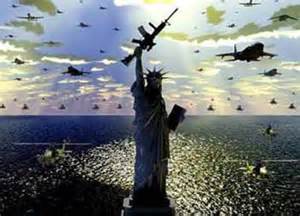
aa-American-Empire-statue-of-liberty-and-military

By Prof Michel Chossudovsky

Source: GlobalResearch.ca

The world is at a dangerous crossroads.  The United States and its allies have launched a military adventure which threatens the future of humanity. Major military and covert intelligence operations are being undertaken simultaneously in the Middle East, Eastern Europe, sub-Saharan Africa, Central Asia and the Far East. The US-NATO military agenda combines both major theater operations as well as covert actions geared towards destabilizing sovereign states.

America’s hegemonic project is to destabilize and destroy countries through acts of war, covert operations in support of terrorist organizations, regime change and economic warfare. The latter includes the imposition of deadly macro-economic reforms on indebted countries as well the manipulation of financial markets, the engineered  collapse of national currencies, the privatization of State property, the imposition of economic sanctions, the triggering of inflation and black markets.

The economic dimensions of  this military agenda must be clearly understood. War and Globalization are intimately related. These military and intelligence operations are implemented alongside a process of economic and political destabilization targeting specific countries in all major regions of World.

Neoliberalism is an integral part of this foreign policy agenda. It constitutes an all encompassing mechanism of  economic destabilization. Since the 1997 Asian crisis, the IMF-World Bank structural adjustment program (SAP) has evolved towards a broader framework which consists in ultimately undermining national governments’ ability to formulate and implement national economic and social policies.

In turn, the demise of national sovereignty was also facilitated by the instatement of the World Trade Organization (WTO) in 1995, evolving towards the global trading agreements (TTIP and TPP) which (if adopted) would essentially transfer state policy entirely into the hands of corporations. In recent years, neoliberalism has extend its grip from the so-called developing countries to the developed countries of both Eastern and Western Europe. Bankruptcy programs have been set in motion. Island, Portugal, Greece, Ireland, etc, have been the target of  sweeping austerity measures coupled with the privatization of key sectors of the national economy.

The global economic crisis is intimately related to America’s hegemonic agenda. In the US and the EU, a  spiralling defense budget backlashes on the civilian sectors of economic activity. “War is Good for Business”: the powerful financial groups which routinely manipulate stock markets, currency and commodity markets, are also promoting the continuation and escalation of the Middle East war. A worldwide process of impoverishment is an integral part of the New World Order agenda.

Beyond the Globalization of Poverty 

Historically, impoverishment of large sectors of the World population has been engineered through the imposition of IMF-style macro-economic reforms. Yet, in the course of the last 15 years, a new destructive phase has been set in motion. The World has moved beyond the “globalization of poverty”: countries are transformed in open territories,

State institutions collapse, schools and hospitals are closed down, the legal system disintegrates, borders are redefined, broad sectors of economic activity including agriculture and manufacturing are precipitated into bankruptcy,  all of which ultimately leads to a process of social collapse, exclusion and destruction of human life including the outbreak of famines, the displacement of entire populations (refugee crisis).

This “second stage” goes beyond the process of impoverishment instigated in the early 1980s by creditors and international financial institutions. In this regard, mass poverty resulting from macro-economic reform sets the stage of  a process of outright destruction of human life.

In turn, under conditions of widespread unemployment, the costs of labor in developing countries has plummeted. The driving force of the global economy is luxury consumption and the weapons industry.

The New World Order

Broadly speaking, the main corporate actors of the New World Order are

• Wall Street and the Western banking conglomerates including its offshore money laundering facilities, tax havens, hedge funds and secret accounts,

• the Military Industrial Complex regrouping major “defense contractors”, security and mercenary companies, intelligence outfits, on contract to the Pentagon;

• the Anglo-American Oil and Energy Giants,

• The Biotech Conglomerates, which increasingly control agriculture and the food chain;

• Big Pharma,

• The Communication Giants  and Media conglomerates, which constitute the propaganda arm of the New World Order.

There is of course overlap, between Big Pharma and the Weapons industry, the oil conglomerates and Wall Street, etc.

These various corporate entities interact with government bodies, international financial institutions, US intelligence.  The state structure has evolved towards what Peter Dale Scott calls the “Deep State”, integrated by covert intelligence bodies, think tanks, secret councils and consultative bodies, where important New World Order decisions are ultimately reached on behalf of powerful corporate interests.

In turn, intelligence operatives increasingly permeate the United Nations including its specialized agencies, nongovernmental organizations, trade unions, political parties.

What this means is that the executive and legislature constitute a smokescreen, a mechanism for providing political legitimacy to decisions taken by the corporate establishment behind closed doors.

Media Propaganda

The corporate  media, which constitutes the propaganda arm of the New World Order, has a long history whereby intelligence ops oversee the news chain. In turn, the corporate media serves the useful purpose of obfuscating war crimes, of presenting a humanitarian narrative which upholds the legitimacy of politicians in high office.

Acts of war and economic destabilization are granted legitimacy. War is presented as a peace-keeping undertaking.

Both the global economy as well as the political fabric of Western capitalism have become criminalized. The judicial apparatus at a national level as well the various international human rights tribunals and criminal courts serve the useful function of upholding the legitimacy of US-NATO led wars and human rights violations.

Destabilizing Competing Poles of Capitalist Development

There are of course significant divisions and capitalist rivalry within the corporate establishment. In the post Cold War era, the US hegemonic project consists in destabilizing competing poles of capitalist development including China, Russia and Iran as well as countries such as India, Brazil and Argentina.

In recent developments, the US has also exerted pressure on the capitalist structures of the member states of the European Union. Washington exerts influence in the election of heads of State including Germany and France, which are increasingly aligned with Washington.

The monetary dimensions are crucial. The international financial system established under Bretton Woods prevails. The global financial apparatus is dollarized. The powers of money creation are used as a mechanism to appropriate real economy assets. Speculative financial trade has become an instrument of enrichment at the expense of the real economy. Excess corporate profits and multibillion dollar speculative earnings (deposited in tax free corporate charities) are also recycled towards the corporate control of politicians, civil society organizations, not to mention scientists and intellectuals. It’s called corruption, co-optation, fraud.

Latin America: The Transition towards a “Democratic Dictatorship”

In Latin America, the military dictatorships of the 1960s and 1970s have in large part been replaced by US proxy regimes, i.e. a democratic dictatorship has been installed which ensures continuity. At the same time the ruling elites in Latin America have remoulded. They have become increasingly integrated into the logic of global capitalism, requiring an acceptance of the US hegemonic project.

Macro-economic reform has been conducive to the impoverishment of  the entire Latin america region.

In the course of the last 40 years, impoverishment has been triggered by hyperinflation, starting with the 1973 military coup in Chile and the devastating reforms of the 1980s and early 1990s.

The implementation of these deadly economic reforms including sweeping privatization, trade deregulation, etc. is coordinated in liaison with US intelligence ops, including the “Dirty war” and Operation Condor, the Contra insurrection in Nicaragua, etc.

The development of a new and privileged elite integrated into the structures of Western investment and consumerism has emerged. Regime change has been launched against a number of Latin American countries.

Any attempt to introduce reforms which departs from the neoliberal consensus is the object of “dirty tricks” including acts of infiltration, smear campaigns, political assassinations, interference in national elections and covert operations to foment social divisions. This process inevitably requires corruption and cooptation at the highest levels of government as well as within the corporate and financial establishment. In some countries of the region it hinges on the criminalization of the state, the legitimacy of money laundering and the protection of the drug trade.


The above text is an English summary of Prof. Michel Chossudovsky’s Presentation, National Autonomous University of Nicaragua, May 17, 2016. This presentation took place following the granting of a Doctor Honoris Causa in Humanities to Professor Chossudovsky by the National Autonomous University of Nicaragua (UNAN)

Saturday Matinee: In the Year of the Pig

in-the-year-of-the-pig1

“In the Year of the Pig” (1968) by Emile De Antonio (Point of Order, Underground, Rush to Judgement) was one of the earliest Vietnam War documentaries and was often greeted with hostility during its run in theaters by pro-war audiences. It combines interviews with a wide range of journalists, politicians, activists and key military personnel (including Harry Ashmore, Daniel Berrigan, Philippe Devillers, David Halberstam, Roger Hilsman, Jean Lacouture, Kenneth P. Landon, Paul Mus, Charlton Osburn, Harrison Salisbury, Ilya Todd, John Toller, David K. Tuck, David Werfel and John White), international newsreels and archival footage to create a scathing portrait of America’ escalating involvement in Vietnam. Horrific images speak for themselves in the most controversial film of de Antonio’s career.

http://www.dailymotion.com/video/xm7wme_in-the-year-of-the-pig_shortfilms

A Nonviolent Strategy to Liberate Syria

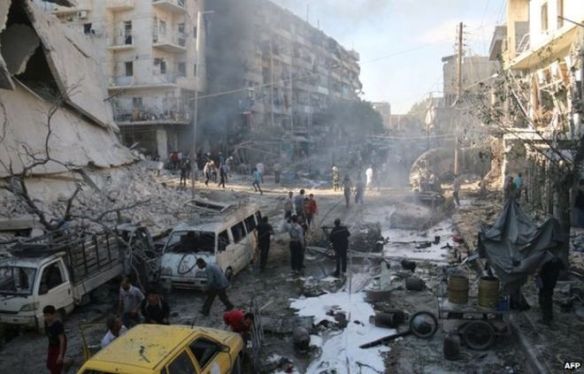
_74590478_00e0aa73-8303-4224-89de-0029b5e5eae1

Editor’s note: While we do not completely agree with the author’s analysis of factors leading to the strife in Syria, we share his desire for greater peace, freedom and stability in the region.

By Robert J. Burrowes

In early 2011, as the Arab Spring was moving across North Africa and the
Middle East, small groups of nonviolent activists in Syria, which has
been under martial law since 1963, started protesting against the brutal
dictatorship of Bashar al-Assad and demanding democratic reforms, the
release of political prisoners, an increase in freedoms, abolition of
the emergency law and an end to corruption.

By mid-March these protests, particularly in cities such as Damascus,
Aleppo and Daraa, had escalated and the ‘Day of Rage’ protest on 15
March 2011 is considered by many to mark the start of the nationwide
uprising against the Assad dictatorship. The dictatorship’s reaction to
the protests became violent on 16 March and on 18 March, after Friday
prayers, activists gathered at the al-Omari Mosque in Daraa were
attacked by security forces with water cannons and tear gas, followed by
live fire; four nonviolent activists were killed.

Within months, as the nonviolent protests expanded and spread, the
regime had killed hundreds of activists and arbitrarily arrested
thousands, subjecting many of them to brutal torture in detention. This
pattern has continued unchecked. For the earliest of a succession of
reports that document this regime violence against nonviolent activists,
see the Human Rights Watch report ‘”We’ve Never Seen Such Horror” Crimes
against Humanity by Syrian Security Forces‘.

For the most recent report, see the UN Human Rights Council report ‘Out
of Sight, Out of Mind: Deaths in Detention in the Syrian Arab Republic‘.

In recent commentaries on the war in Syria, both long-time solidarity
activist Terry Burke – see ‘U.S. Peace Activists Should Start Listening
to Progressive Syrian Voices
– and long-term Middle East scholar Professor Stephen Zunes have
encouraged the anti-war movement to listen to Syrian voices in framing
their response, particularly given the tendency within some sections of
it to support ‘the extraordinarily brutal Assad regime – a family
dictatorship rooted in the anti-leftist military wing of the Baath
Party’. See ‘Anti-war movement must listen to voices within Syria’s
civil war’.

One such Syrian voice is that of scholar and nonviolent activist
Professor Mohja Kahf. In her account of the Syrian uprising against the
Assad dictatorship – see ‘Then and Now: The Syrian Revolution to Date. A
young nonviolent resistance and the ensuing armed struggle
– Professor Kahf offers the following introductory paragraphs:

‘The Syrian uprising sprang from the country’s grassroots, especially
from youth in their teens, and adults in their twenties and thirties.
They, not seasoned oppositionists, began the uprising, and are its core
population. They share, rather than a particular ideology, a
generational experience of disenfranchisement and brutalization by a
corrupt, repressive, and massively armed ruling elite in Syria.

‘The uprising began nonviolently and the vast majority of its populace
maintained nonviolence as its path to pursue regime change and a
democratic Syria, until an armed flank emerged in August 2011.

‘The Syrian Revolution has morphed. From midsummer to autumn 2011, armed
resistance developed, political bodies formed to represent the
revolution outside Syria, and political Islamists of various sorts
entered the uprising scene. Since then, armed resistance has
overshadowed nonviolent resistance in Syria.

‘…political bodies and support groups for the revolution’s militarized
wing, have become venues for internal power struggles among opposition
factions and individuals, and entry-points for foreign powers attempting
to push their own agendas into a revolution sprung from Syrian
grievances, grown from the spilling of Syrian blood on Syrian soil.

‘Many in the global peace community can no longer discern the Syrian
uprising’s grassroots population through the smoke of armed conflict and
the troubling new actors on the scene. Further, some in the global left
or anti-imperialist camp understand the Syrian revolution only through
the endgame of geopolitics. In such a narrative, the uprising population
is nothing but the proxy of U.S. imperialism.

‘Such critics may acknowledge that the Assad regime is brutal, but
maintain from their armchairs that Syrians must bear this cost, because
this regime has its finger in the dike of U.S. imperialism, Zionism, and
Islamism. Or, perhaps they agree that a revolution against a brutal
dictator is not a bad idea, but wish for a nicer revolution, with better
players. Eyes riveted to their pencils and rulers and idées fixés, such
critics abandon a grassroots population of disenfranchised human beings
demanding basic human freedoms in Syria. This is a stunning and cruel
failure of vision.

‘The voices of the original grassroots revolution of Syria are
nonviolent, nonsectarian, noninterventionist, for the fall of the Assad
regime, and for the rise of a democratic, human rights upholding Syria
that is bound by the rule of law. They are still present in this
revolution. Who will hear them now, after so much dear blood has been
spilled, so much tender flesh crushed under blasted blocks of cement, so
much rightful anger unleashed?’

Other Syrian voices offer a similar account. See, for example, the
recent book by Robin Yassin-Kassab and Leila al-Shami titled ‘Burning
Country: Syrians in Revolution and War’
reviewed in ‘Book Review: Burning Country‘.

If Syrians and their solidarity allies are to develop and implement a
successful nonviolent grassroots strategy to end the war in/on Syria and
remove the Assad dictatorship, then we need a sound strategic framework
that guides the comprehensive planning of our strategy. Obviously, there
is no point designing a strategy that is incomplete or cannot be
successful.

A sound strategic framework simply enables us to think and plan
strategically so that once our strategy has been elaborated, it can be
widely shared and clearly understood by everyone involved. It also means
that nonviolent actions can then be implemented because they are known
to have strategic utility and that precise utility is understood in
advance. There is little point taking action at random, especially if
our opponent is powerful and committed (even if that ‘commitment’ is
insane, which is frequently the case).

There is a simple diagram presenting a 12-point strategic framework
illustrated here in the form of the ‘Nonviolent Strategy Wheel‘.

In order to think strategically about nonviolently resolving a violent
conflict, a clearly defined political purpose is needed; that is, a
simple summary statement of ‘what you want’. However, given the
complexity of the multifaceted conflict in the case of Syria, it is
strategically simpler to identify two political purposes. These might be
stated thus: 1. To end the war in/on Syria, and 2. To establish a
democratic form of government in Syria (which, obviously, requires
removal of the dictatorship).

Once the political purpose has been defined, the two strategic aims
(‘how you get what you want’) of the strategy acquire their meaning.
These two strategic aims (which are always the same whatever the
political purpose) are as follows: 1. To increase support for your
campaign by developing a network of groups who can assist you. 2. To
alter the will and undermine the power of those groups who support the
war/dictatorship.

While the two strategic aims are always the same, they are achieved via
a series of intermediate strategic goals which are always specific to
each struggle. To keep this article reasonably straightforward, I have
only identified a set of strategic goals that would be appropriate in
the context of ending the war in/on Syria below. For a basic set of
strategic goals appropriate for ending the dictatorship, see ‘Strategic
Aims‘.

Before listing the strategic goals for ending the war, I wish to
emphasize that I have only briefly discussed two aspects of a
comprehensive strategy to end the war in/on Syria: its political purpose
and its two strategic aims (with its many subsidiary strategic goals).
For the strategy to be effective, all twelve components of the strategic
framework should be planned (and then implemented). See Nonviolent
Defense/Liberation Strategy.
This will require, for example, that tactics that will achieve the
strategic goals must be carefully chosen and implemented bearing in mind
the vital distinction between the political objective and strategic goal
of any such tactic. See ‘The Political Objective and Strategic Goal of
Nonviolent Actions‘.

Strategic goals to end the war in/on Syria

I have outlined a basic list of strategic goals below although, it
should be noted, the list would be considerably longer as individual
organizations should be specified separately.

Many of these strategic goals would usually be tackled by action groups
working in solidarity with Syria campaigning within their own country.
Ideally they would be undertaken by activist groups with existing
expertise in the relevant area (for example, experience in campaigning
against a weapons corporation) but this is not essential.

Of course, individual activist groups would usually accept
responsibility for focusing their work on achieving just one or a few of
the strategic goals (which is why any single campaign within the overall
strategy is readily manageable).

It is the responsibility of the struggle’s strategic leadership to
ensure that each of the strategic goals, which should be identified and
prioritized according to their precise understanding of the
circumstances in Syria, (so, not necessarily precisely as identified
below) is being addressed (or to prioritize if resource limitations
require this).

So here is a set of strategic goals to end the war in/on Syria:

(1) To cause the women in [women’s organizations WO1, WO2, WO…] in Syria
to join the liberation strategy by participating in [your nominated
nonviolent action(s)/campaign(s) and/or constructive program
activities]. For example, simple nonviolent actions would be to wear a
national symbol (such as a badge of the Syrian revolutionary flag and/or
ribbons in the national colors) and/or to boycott all media outlets
supporting the war. For this item and many items hereafter, see the list
of possible actions that can be taken here: ‘198 Tactics of Nonviolent Action‘.

(2) To cause the workers in [trade unions T1, T2, T…] in Syria to join
the liberation strategy by participating in [your nominated nonviolent
action(s)/campaign(s) and/or constructive program activities]. For
example, this might include withdrawing their labor from occupations
that support the Syrian military forces.

(3) To cause young people in Syria to resist conscription into the
Syrian military forces.

(4) To cause young people in Syria to refuse recruitment into the Free
Syrian Army, al-Qaeda and its affiliates/allies, the Islamic State
(Daesh) and its allies.

(5) To cause the members of [religious denominations R1, R2, R…] in
Syria to join the liberation strategy by participating in [your
nominated nonviolent action(s)/campaign(s) and/or constructive program
activities].

(6) To cause the members of [ethnic communities EC1, EC2, EC…] in Syria
to join the liberation strategy by participating in [your nominated
nonviolent action(s)/campaign(s) and/or constructive program
activities].

(7) To cause the activists, artists, musicians, intellectuals and other
key social groups in [organizations O1, O2, O…] in Syria to join the
liberation strategy by participating in [your nominated nonviolent
action(s)/campaign(s) and/or constructive program activities].

(8) To cause the students in [student organizations S1, S2, S…] in Syria
to join the liberation strategy by participating in [your nominated
nonviolent action(s)/campaign(s) and/or constructive program
activities].

(9) To cause the soldiers in [military units M1, M2, M…] to refuse to
obey orders from the dictatorship to arrest, assault, torture and shoot
nonviolent activists and the other citizens of Syria.

(10) To cause the police in [police units P1, P2, P…] to refuse to obey
orders from the dictatorship to arrest, assault, torture and shoot
nonviolent activists and the other citizens of Syria.

(11) To cause young people in [the US, NATO countries, Russia and other
countries fighting in Syria] to refuse recruitment into their respective
military forces.

(12) To cause conscripts into the military forces of [NATO countries,
Russia and other countries fighting in Syria] that still use
conscription to conscientiously refuse to perform military duties.

(13) To cause military personnel in the military forces of [the US, NATO
countries, Russia and other countries fighting in Syria] to refuse
deployment to the war in/on Syria.

(14) To cause young people in [your country] to refuse recruitment into
the Free Syrian Army, al-Qaeda and its affiliates/allies, the Islamic
State (Daesh) and its allies.

(15) To cause former soldiers in [your country] to refuse recruitment as
mercenaries by corporations that supply ‘military contractors’ to fight
in Syria.

(16) To cause the activists in [peace groups P1, P2, P…] in [your
town/city/country] to resist the war on Syria by encouraging their
members to boycott [all/specified nonmilitary products] of [weapons
corporations W1, W2, W…]. For example, this might include boycotting all
commercial flights that use Boeing and Airbus passenger aircraft given
the heavy involvement of these corporations in the production of
military aircraft.

(17) To cause the activists in [environment groups E1, E2, E…] in [your
town/city/country] to resist the war on Syria by encouraging their
members to boycott [all/specified nonmilitary products] of [weapons
corporations W1, W2, W…]. For example, this might including boycotting
all commercial products of General Electric given the heavy involvement
of this corporation in the production of military engines, systems and
services.

(18) To cause the workers in [trade unions or labor organizations T1,
T2, T….] in [your town/city/country] to resist the war on Syria by
encouraging their members to boycott [all/specified nonmilitary
products] of [weapons corporations W1, W2, W…].

(19) To cause the women in [women’s organizations WO1, WO2, WO…] in
[your town/city/country] to resist the war on Syria by encouraging their
members to boycott [all/specified nonmilitary products] of [weapons
corporations W1, W2, W…].

(20) To cause the members of [religious denominations R1, R2, R…] in
[your town/city/country] to resist the war on Syria by encouraging their
members to boycott [all/specified nonmilitary products] of [weapons
corporations W1, W2, W…].

(21) To cause the members of [ethnic communities EC4, EC5, EC…] in [your
town/city/country] to resist the war on Syria by encouraging their
members to boycott [all/specified nonmilitary products] of [weapons
corporations W1, W2, W…].

(22) To cause the artists, musicians, intellectuals and other key social
groups in [organizations O4, O5, O…] in [your town/city/country] to
resist the war on Syria by encouraging their members to boycott
[all/specified nonmilitary products] of [weapons corporations W1, W2,
W…].

(23) To cause the students in [student organizations S1, S2, S…] in
[your town/city/country] to resist the war on Syria by encouraging their
members to boycott [all/specified nonmilitary products] of [weapons
corporations W1, W2, W…].

(24) To cause the consumers in [your town/city/country] to resist the
war on Syria by boycotting [all/specified nonmilitary products] of
[weapons corporations W1, W2, W…].

(25) To cause more individuals in [your town/city/country] to resist the
war on Syria by conscientiously resisting paying [part/all] of their
taxes for war.

(26) To cause more organizations in [your town/city/country] to resist
the war on Syria by conscientiously resisting paying [part/all] of their
taxes for war.

(27) To cause [weapons corporations W4, W5, W…] to convert from the
manufacture of military weapons to [the specified/negotiated
socially/environmentally beneficial products].

(28) To cause [banks B1, B2, B…] to cease financing the weapons
industry.

(29) To cause bank customers to shift their deposits to ethical banks
and credit unions that do not finance (or are otherwise involved in) the
weapons industry.

(30) To cause [religious organizations R4, R5, R…] to divest from the
weapons industry.

(31) To cause [superannuation funds S1, S2, S…] to divest from the
weapons industry.

(32) To cause superannuation fund customers to shift their money to
ethical funds that do not finance (or are otherwise involved in) the
weapons industry.

(33) To cause [insurance companies I1, I2, I…] to divest from the
weapons industry.

(34) To cause insurance customers to shift their policies to ethical
insurance companies that do not finance (or are otherwise involved in)
the weapons industry.

(35) To cause [corporations C1, C2, C…] that provide
[services/components] for [weapons corporations W1, W2, W…] to cease
doing so.

(36) To cause the workers in [trade unions or labor organizations T4,
T5, T…] to withdraw their labor from [weapons corporations W1, W2, W…]
[partially/wholly], [temporarily/permanently].

(37) To cause the workers in [trade unions or labor organizations T7,
T8, T…] to withdraw their labor from [corporations C1, C2, C…]
[partially/wholly], [temporarily/permanently].

(38) To cause [corporations C4, C5, C…] that provides
[services/supplies] to [military bases MB1, MB2, MB…] to cease doing so.

(39) To cause the workers in [trade unions or labor organizations T10,
T11, T…] who work in/supply [military bases MB1, MB2, MB…] to withdraw
their labor [partially/wholly], [temporarily/permanently].

(40) To cause the workers in [trade unions or labor organizations T13,
T14, T…] to withdraw their labor from [corporations C4, C5, C…]
[partially/wholly], [temporarily/permanently].

(41) To cause [corporations C7, C8, C…] that manufacture and supply spy
satellites for military purposes to cease doing so.

(42) To cause the workers in [trade unions or labor organizations T16,
T17, T…] to withdraw their labor from [corporations C7, C8, C…]
[partially/wholly], [temporarily/permanently].

(43) To cause [corporations C10, C11, C…] that provide
[services/components] for the militarization of space to cease doing so.

(44) To cause the workers in [trade unions or labor organizations T19,
T20, T…] to withdraw their labor from [corporations C10, C11, C…]
[partially/wholly], [temporarily/permanently].

(45) To cause [corporations C13, C14, C…] that provide private military
contractors (mercenaries) to fight in wars to cease doing so.

(46) To cause the private military contractors (mercenaries) who fight
in wars to withdraw their labor from [corporations C13, C14, C…].

(47) To cause the soldiers in [military units M1, M2, M…] in [your
town/city/country] to refuse to obey orders to [arrest, assault, torture
and shoot, depending on your local circumstances] nonviolent activists
campaigning against the war.

(48) To cause the police in [police units P1, P2, P…] in [your
town/city/country] to refuse to obey orders to [arrest, assault, torture
and shoot, depending on your local circumstances] nonviolent activists
campaigning against the war.

(49) To cause individual members of the military forces at [Military
Base MB1/Drone Base DB1/Navy Ship NS1/Air Force Base AFB1/Army unit
AU1/Marines unit MU1] in [your town/city/country] to resign.

(50) To cause individual members of those corporations that
employ/supply private military contractors (mercenaries) to resign.

As you can see, the two strategic aims are achieved via a series of
intermediate strategic goals.

Not all of the strategic goals will need to be achieved for the strategy
to be successful but each goal is focused in such a way that its
achievement functionally undermines the power of those conducting the
war.

The difference between success and failure in any struggle is the
soundness of the strategy.


Biodata: Robert J. Burrowes has a lifetime commitment to understanding and ending human violence. He has done extensive research since 1966 in an effort to understand why human beings are violent and has been a nonviolent activist since 1981. He is the author of ‘Why Violence?‘ His email address is flametree@riseup.netand his website is at http://robertjburrowes.wordpress.com

Robert J. Burrowes
P.O. Box 68
Daylesford
Victoria 3460
Australia
Email: flametree@riseup.net

Websites:
Nonviolence Charter
Flame Tree Project to Save Life on Earth
‘Why Violence?’
Nonviolent Campaign Strategy
Nonviolent Defense/Liberation Strategy
Anita: Songs of Nonviolence
Robert Burrowes
Global Nonviolence Network

Stop Trump! Stop Clinton! Stop the Madness (and Let Me Off)!

869b45d356923d7150751daa3504016c

Source: Stop Imerialism

“That’s the real issue this time,” he said. “Beating Nixon.  It’s hard to even guess how much damage those bastards will do if they get in for another four years.”

The argument was familiar, I had even made it myself, here and there, but I was beginning to sense something very depressing about it.  How many more of these goddamn elections are we going to have to write off as lame, but “regrettably necessary” holding actions?  And how many more of these stinking double-downer sideshows will we have to go through before we can get ourselves straight enough to put together some kind of national election that will give me and the at least 20 million people I tend to agree with a chance to vote for something, instead of always being faced with that old familiar choice between the lesser of two evils?

Now with another one of these big bogus showdowns looming down on us, I can already pick up the stench of another bummer.  I understand, along with a lot of other people, that the big thing this year is Beating Nixon.  But that was also the big thing, as I recall, twelve years ago in 1960 – and as far as I can tell, we’ve gone from bad to worse to rotten since then, and the outlook is for more of the same.

—Hunter S. Thompson, Fear and Loathing: On the Campaign Trail ’72


Another bummer indeed. It’s been nearly four and a half decades since His Majesty, Dr. Gonzo, wrote those words…and my oh my has the rot turned putrid, the stench overwhelming.

Were it only the fact that a corporate imperialist sociopath and a raving pseudo-fascist gasbag are competing to become the Murderer-in-Chief, one could simply retreat to the friendly confines of the Hobson’s Choice Inn.  There, among the carpets and curtains carrying the stains of elections past, one would watch the political circus in peace while doing the work of organizing against both Tweedle Bum and Tweedle Bummer.

But this time, there’s something even more sinister afoot, something far worse than mere cardboard cutouts in formal dress. No, this time it’s the pompous arrogance and vacuous prattling of “leftists,” “anti-imperialists,” and other assorted mental contortionists doing their damnedest to browbeat everyone within earshot (eyeshot?) that THIS TIME it’s important!

“How can you sit aside so smug and allow the fascist Trump to win? You’re being irresponsible,” they chirp.

“How can you attack Trump and let the Warmongering Witch of the West become President? You know what she’ll do,” they drone.

And the response to the denizens of both camps remains the same: If you’re not opposing both Janus faces of Dillary Crump while working to guillotine the many-headed hydra of the ruling class, then what the hell are you really doing?  Oh, right, I forgot – this is all “strategic,” it’s about avoiding a calamity by accepting a disaster.  I’m sure the children of Libya or Muslim-American and Mexican-American immigrants will understand as they are crushed under the bus beneath which they were thrown by a “progressive left” so quick to speak for them.

But perhaps it might be useful for the Left, of which I consider myself a part, to reflect on just what the sort of ‘sophisticated’ and ‘pragmatic’ politics of lesser evilism hath wrought: the continued evisceration of the working class by both the red team and blue team of the single ruling party, perpetual war for profit and Empire, an immutable rightward drift that makes Richard Nixon look like Eugene Debs, and a parasitical ruling class of finance capital whose greatest trick has been convincing the people that it doesn’t rule them.

And where are the victories?  What can we point to as the great breakthrough justifying the tactical vote?  [crickets]…[a single tumbleweed rolls along an empty desert landscape]

Have we seen anything but an acceleration of the worst aspects of imperialism and capitalism?  The climate is in crisis and we’re told by leftist royalty like the great Noam Chomsky that we should vote for Clinton because she at least recognizes the peril of climate change while Trump wants to put a lump of coal in Pachamama’s stockings.  But the obvious question then becomes: so what?

So what Clinton pays lip service to the global threat? She was an ardent supporter of the “All of the above” energy policy of Obama while promoting fracking around the world, taking massive campaign donations from energy industry lobbyists, and tacitly supporting the construction and expansion of the Keystone XL pipeline until it became politically untenable (thanks in no small part to the Bernie Sanders campaign).  And, of course, who could forget the votes she cast in support for expanded offshore oil drilling in the Gulf of Mexico, a shameful vote which directly contributed to the Deepwater Horizon spill in 2010.

I suppose the question should be asked of Chomsky: Is a begrudging vote for Hillary to be cast solely on the grounds of her having appropriately progressive and focus-grouped talking points?  It seems that’s just about the size of it. So then the inevitable follow-up question would be: Why f*cking bother rewarding her for knowing the importance of lying well?

And how about that pesky little World War III problem?  I can almost hear the “Oh, don’t exaggerate…Hillary doesn’t want to start a war with nuclear-armed Russia” cries from the tastemakers of the liberal unintelligentsia.  Well, let’s allow the Queen of Chaos to speak for herself.  In a raving, Strangelovian speech given before the mouth-breathing jingos of the American Legion, Clinton explained:

We need to respond to evolving threats, from states like Russia, China, Iran and North Korea…We need a military that is ready and agile so that it can meet the full range of threats — and operate on short notice across every domain — not just land, sea, air, and space, but also cyber space…You’ve seen reports — Russia has hacked into a lot of things, China has hacked into a lot of things — Russia even hacked into the Democratic National Committee! Maybe even some state election systems, so we’ve gotta step up our game…Make sure we are well defended and able to take the fight to those who go after us. As president I will make it clear that we will treat cyberattacks just like any other attack…We will be ready with serious political, economic, and military responses.

Did anyone else feel a shiver run down their spine, as I did?  Clinton literally advocates for war with Russia, arguing that a cyberattack which may, or may not, have originated in Russia be treated as an act of war.  Nuclear-armed Russia should expect a military response from the United States over allegations of hacking?  It’s sort of a pot calling the kettle black and trying to smash it with a goddamn sledgehammer kind of situation.

Now, of course, there are plenty of good people on the Left – Adolph Reed, Noam Chomsky, Arun Gupta, and many others – arguing that Clinton is a necessary evil to block Trump from bringing to fruition a full-fledged fascist movement that would have dire ramifications for social justice movements.  And there is undeniably an element of truth in that.

However, the wisdom of the logic relies on a false premise: Trump represents an existential threat while Hillary does not.  This basic assumption is undeniably flawed as global war with countries like Russia and China is indeed one of the great threats to humanity; this is precisely what Clinton’s belligerent foreign policy leads toward.  And there was a time when anti-war still was synonymous with Left activism.  What happened that we are now told that the pro-war position is necessary in order to stop, er, um, fascism?  How far we’ve fallen.

Trump: The Fascist “Anti-Imperialist”

In the unending search for the most imbecilic political logic, one comes across that rare breed of obtuse ignoramus who suggests that Trump is the anti-imperialist’s choice.  If that word has any meaning left today – something that is very much open for debate given recent developments – its application to Donald Trump is about as appropriate as referring to Clinton as the anti-fascist’s choice.

Trump doesn’t mean no more imperial wars; he simply means no more pretending our wars aren’t imperial.  He’s not for ending the wars, but rather fighting them with the nakedly neo-colonial intentions made overt that Clinton would only secretly share over candlelit dinners with Huma Abedin, Madeleine Albright, and Mephistopheles.  With people like Walid Phares, Michael Flynn, and Keith Kellogg as advisers, Trump will retain a pro-Israel imperial policy in the Middle East while advocating for NATO’s expanded mission of counter-terrorism.  Oh, excuse me, Trump wants Denmark to pay “it’s fair share” of NATO costs – pardon me while I release to the heavens a flight of doves in his honor.

What anti-imperialist isn’t enamored with a candidate who calls for a full military invasion of Syria and Iraq? And, of course, there’s no connection whatever between imperialism, colonialism and white supremacy, right?  Trump can spout the most virulently racist filth heard in US politics since George Wallace and Barry Goldwater went on a Tinder date to the Old Ebbitt Grill, and yet these anti-imperial mannequins swear up and down that Trump is an enemy of the Empire.  Even his complimentary reach-around to Bibi Netanyahu isn’t enough to shake the cobwebs from the faux anti-imperial noodleheads of the commentariat. Sigh.

And so, where does this leave us on the Left?  Everyone wants to bludgeon leftists into supporting Clinton to stop Trump using the familiar cudgel of “necessary evil”, while offering little to no additional direction other than “once the election is over we will…”  Yeaaaaaah, that’s worked out well for us thus far.

Others secretly root for Trump to upset the apple cart and open a space for the Left, conveniently forgetting that the Left remains a fractured and disunited bloc while the fascist right grows in strength and organization every day.  And commentators of the Left rush to tell their readers and fellow travelers that THIS or THAT is what they should do.

I’ve got an idea. How about we take a breath, drink/smoke/snort something nice and strong, close our eyes and listen close to hear the echoes of Dr. Gonzo reverberating off the walls of the Left echo chamber:

Life has become immeasurably better since I have been forced to stop taking it seriously.

Or, if that’s just too droll:

In a world of thieves, the only final sin is stupidity.

Obama Fears Backlash from Saudi 9/11 Bill — So What?

WarCrimesBushObama

By Klaus Marre

Source: Who.What.Why.

Only an idiot would sign an order triggering a process that ends up with them in court. President Barack Obama is not an idiot and that is why he vetoed the Justice Against Sponsors of Terrorism Act (JASTA).

The legislation, which allows victims of terror attacks on US soil to sue foreign governments, was very popular in Congress where lawmakers did not want to seem unpatriotic ahead of the election. That is why, to Obama’s great disappointment and consternation, Congress overrode the veto — and immediately showed buyer’s remorse.

Specifically, its purpose is as follows:

The purpose of this Act is to provide civil litigants with the broadest possible basis, consistent with the Constitution of the United States, to seek relief against persons, entities, and foreign countries, wherever acting and wherever they may be found, that have provided material support, directly or indirectly, to foreign organizations or persons that engage in terrorist activities against the United States.

What the legislators had apparently not considered, even though it was Obama’s main argument for not supporting the bill, were the unintended consequences of JASTA. Sure, allowing the families of 9/11 victims to sue the government of Saudi Arabia sounded like a great idea to lawmakers running for reelection.

Yet the law will also open up the United States, its military and intelligence services to the same kind of action abroad. That is something Obama wanted to avoid at all costs — and why the White House called the veto override the “single most embarrassing thing” the Senate has done in decades.

But why? Shouldn’t the United States conduct itself in a way that would prevent it from getting sued abroad? The president, who has access to more intelligence than anybody else, clearly didn’t think so.

If JASTA allows Saudi Arabia to be sued for whatever level of complicity in the 9/11 attacks a US court finds sufficient evidence of, just imagine what the United States government can be taken to court for.

There is already talk of Vietnam War veterans being particularly vulnerable to lawsuits. But that’s just the tip of the iceberg.

Could Pakistanis whose wedding got blown up by a drone take Obama to court? Can one of the many torture victims sue to get the names of their guards, torturers, etc. and then seek compensation from them? Or what about GITMO prisoners who were released without ever being charged? Finally, what about any citizen of a country that was plunged into turmoil as a result of CIA actions?

Maybe an easier challenge would be to figure out who couldn’t sue the United States once this precedent has been established.

But we ask again: Would that really be such a bad thing, especially going forward? It could serve as a deterrent and maybe the United States, as well as the other big players on the world stage, would think twice about intervening in the affairs of other countries if the threat of personal accountability would hang over their heads.

Gandhi: ‘My life is my message’

mahatma-gandhi


Robert J. Burrowes

As most of the world ignores or hypocritically celebrates the 147th birthday of Mohandas Karamchand Gandhi on the International Day of Nonviolence on 2 October, some of us will quietly acknowledge his life by continuing to build the world that he envisioned. When asked for his message for the world, Gandhi responded with the now famous line ‘My life is my message’ reflecting his lifelong struggle against violence.

Gandhi’s life was dotted with many memorable quotes but one that is less well known is this: ‘You may never know what results come of your actions but if you do nothing there will be no results’.

Fortunately, there are many committed people who have identified the importance of taking action to end the violence in our world – whether it occurs in the home or on the street, in wars, as a result of economic exploitation or ecological destruction – and this includes the courageous people below. These people have identified themselves as part of the worldwide network, now with participants in 96 countries, committed to ending violence in all of its forms. I would like to share their inspirational stories and invite you to join them.

Christophe Nyambatsi Mutaka is the key figure at the Groupe Martin Luther King which promotes active nonviolence, human rights and peace. The group is based in Goma in the eastern Democratic Republic of the Congo (DRC) in central Africa. They particularly work on reducing sexual and other violence against women.

Also based in Goma, the Association de Jeunes Visionnaires pour le Développement du Congo headed by Leon Simweragi is a youth peace group that works to rehabilitate child soldiers as well as offer meaningful opportunities for the sustainable involvement of young people in matters that affect their lives and those of their community.

Given the phenomenal suffering in the DRC, which has experienced the loss of six million lives and the displacement of eight million people due to the long war driven by Western corporations keen to exploit the country’s mineral wealth, Christophe, Leon and their colleagues are testimony to the fact that committed people strive in the most adverse of circumstances.

Tess Burrows in the UK is an adventurer (including parachutist, mountaineer, cyclist and marathon runner), peace activist, author, speaker, healer, and ‘most importantly a mother and grandmother’. In her words: ‘I am dedicated to the pursuit of World Peace and the healing of the Earth.’ Tess has written several books and, if you are looking for inspiration, I suggest you try these: ‘Cry from the Highest Mountain’ (describing a climb to the point furthest from the centre of the Earth), ‘Cold Hands, Warm Heart’ (describing a trek across the coldest, driest, windiest place on Earth: the Geographic South Pole), ‘Touch the Sky’ (describing her climb of Mt Kilimanjaro, in Africa’s heartland, pulling a car tyre which included peace messages from every nation on Earth and embodying their desire for everyone to pull together to promote peace) and her latest book ‘Soft Courage’. Her video ‘Climb For Tibet’ won’t bore you either! The funds raised from sales of the books and donations have, among other things, built six schools in Tibet and supported a Maasai community tree-planting project in Africa. Tess collects messages of peace from individuals and speaks them out from ‘far high places’. So far, this has included the North and South Poles, the Himalayas, Andes, Pacific and Africa. You can be part of her next Peace Climb in Australasia by writing your personal message on her website where you can also check out her books. Be warned however, this website will exhaust you!

Recently, on the International Day of Peace, the Afghan Peace Volunteers and Borderfree Street Kids in Kabul, mentored by Dr Teck Young Wee (Hakim), reached out to the visually impaired and blind students at Rayaab (Rehabilitation Services for the Blind Afghanistan). They brought MP3 players as gifts to 50 visually impaired students. The students will use the MP3 players to listen to recorded school lessons and educational programs. Rayaab is an Afghan non-governmental organization run by Mahdi Salami and his wife Banafsha, who are themselves visually impaired. If you want to see photos from this day, and to watch an extraordinary three minute video, you can do so at ‘To Touch a Colourful Afghanistan‘.

Kristin Christman in the USA continues her tireless efforts to make our world more peaceful by seeking to understand the deeper drivers of conflict while offering practical steps forward. She is currently working on a book based on her monumental ‘Taxonomy of Peace: A Comprehensive Classification of the Roots and Escalators of Violence and 650 Solutions for Peace‘. A recent rather personal article offers insight into her approach: ‘Make serving in war an option, not an order‘ and illustrates how violence is ‘built-into’ society.

Ghanaian Gifty A. Korankye has just developed a new website titled ‘Daughters of Africa‘. Explaining why, she writes: ‘Over the years I watched women go through unbearable pain …. Our daughters go through FGM in their puberty…. The humiliation we face when we lose our spouse, all in the name of customs and tradition.’ Determined to help address the issues that plague many African women she wants to give them the chance to be ‘a useful voice to our communities’, to share the success stories of African women and African-American women in business administration, the entertainment industry and elsewhere in order to share learning from their journeys and to ‘help mentor our young generation’. She invites African women to write to share their stories and work together to find solutions. ‘We
can do it because we are daughters of Africa.’

So what about you? Do you believe that ending human violence is possible? Even if you believe that it is not, do you believe that it is worth trying? As Gandhi noted: ‘The future depends on what we do in the present.’ What will you do?

In essence, working to end human violence and to create a world of peace, justice and ecological sustainability for all life on Earth might not be what gets you out of bed in the morning. But if it is or you would like it to be, you are welcome to join those of us who are committed to striving for this outcome by signing the online pledge of ‘The People’s Charter to Create a Nonviolent World’.

And if you subscribe to Gandhi’s belief that ‘Earth provides enough to satisfy every [person’s] needs, but not every [person’s] greed’, then you might consider participating in ‘The Flame Tree Project to Save Life on Earth‘ which he inspired as well.

Each of us has a choice. We can stand aside in the great fight for survival in which humanity is now engaged. Or we can be involved. What is your choice?

The bottom line is this: What will be the message of your life?


Biodata: Robert J. Burrowes has a lifetime commitment to understanding and ending human violence. He has done extensive research since 1966 in an effort to understand why human beings are violent and has been a nonviolent activist since 1981. He is the author of ‘Why Violence?‘.
His email address is flametree@riseup.net
and his website is at http://robertjburrowes.wordpress.com


Robert J. Burrowes
P.O. Box 68
Daylesford
Victoria 3460
Australia
Email: flametree@riseup.net

Websites:
Nonviolence Charter
Flame Tree Project to Save Life on Earth
‘Why Violence?’
Nonviolent Campaign Strategy
Nonviolent Defense/Liberation Strategy
Anita: Songs of Nonviolence
Robert Burrowes
Global Nonviolence Network

America’s War Party

war-criminals

By Steven Lendman

Source: SteveLendman Blog

America is a one-party state with two wings, each virtually identical to the other, differing only in style and rhetoric.

They’re in lockstep on issues mattering most – notably supporting endless wars at the expense of peace, equity and justice.

America’s so-called war of independence changed little, afforded no benefits for “we the people,” did nothing more than substitute new management for old.

Civil war had nothing to do with freeing slaves, everything to do with keeping the nation intact and serving dominant monied interests. War assures huge profits.

19th century wars were waged to steal land and resources from America’s native people, annex Texas, then half of Mexico, followed by Cuba, the Philippines, Guam, Samoa, Hawaii, Haiti, the Dominican Republic, Canal Zone, Puerto Rico and other territories.

Peace candidate Woodrow Wilson manipulated public sentiment in office, turned largely pacifist Americans into raging German haters and got the war he wanted.

Senator Robert La Follette/later 1924 Progressive Party presidential aspirant said at the time “(e)very nation has its war party.”

“It is not the party of democracy. It is the party of autocracy. It seeks to dominate absolutely.”

“It is commercial, imperialistic, ruthless. It tolerates no opposition. It is just as arrogant, just as despotic, in London, or in Washington, as in Berlin.”

“The American Jingo is twin to the German Junker. If there is no sufficient reason for war, the war party will make war on one pretext, then invent another.”

Yesteryear’s “Jingo” is today’s bipartisan neocon, the curse infesting Washington, waging endless wars on humanity at home and abroad – risking another global one with super-weapons able to extinguish life on earth.

Socialist leader Eugene Debs was imprisoned for opposing America’s involvement in WW I. Ahead of his ordeal, his Socialist Party called the war “a crime against the people of the United States.”

He said “(t)hey tell us that we live in a great free republic; that our institutions are democratic; that we are a free and self-governing people.”

“That is too much, even for a joke…Wars throughout history have been waged for conquest and plunder… And that is war in a nutshell. The master class has always declared the wars; the subject class has always fought the battles.”

During the war my dad was conscripted to fight in, about 900 people were imprisoned for opposing it. Tens of thousands declared themselves conscientious objectors and refused to serve.

True to its tradition, The New York Times supported America’s war party, urged its readers to inform authorities of “any evidence of sedition” instead of denouncing the great war preceding the greater one two decades later.

Endless others followed, raging today in multiple theaters, much more likely coming, possible nuclear war today more threatening than perhaps any previous time.

Monied interests support America’s war party – benefitting hugely at the expense of most others.

Resisting tyranny is a universal right and obligation. We have a choice – resist or perish.