Truth or Delusion?

By Robert J. Burrowes

One inevitable outcome of the phenomenal violence we all suffer as
children is that most of us live in a state of delusion throughout our
lives. This makes it extraordinarily difficult for accurate information,
including vital information about the endangered state of our world and
how to respond appropriately, to penetrate the typical human mind.

‘Phenomenal violence?’ you might ask. ‘All of us?’ you wonder. Yes,
although, tragically, most of this violence goes unrecognised because it
is not usually identified as such. For most people, it is a
straightforward task to identify the ‘visible’ violence that they have
suffered and, perhaps, still suffer. However, virtually no-one is able
to identify the profoundly more damaging impact of the ‘invisible’ and
‘utterly invisible’ violence that is inflicted on us mercilessly from
the day we are born.

So what is this ‘invisible’ and ‘utterly invisible’ violence?

‘Invisible’ violence is the ‘little things’ that adults do to children
every day, partly because they are just ‘too busy’. For example, when
adults do not allow time to listen to, and value, a child’s thoughts and
feelings, the child learns to not listen to themSelf thus destroying
their internal communication system. When adults do not let a child say
what they want (or ignore them when they do), the child develops
communication and behavioural dysfunctionalities as they keep trying to
meet their own needs (which, as a basic survival strategy, they are
genetically programmed to do).

When adults blame, condemn, insult, mock, embarrass, shame, humiliate,
taunt, goad, guilt-trip, deceive, lie to, bribe, blackmail, moralize
with and/or judge a child, they both undermine their sense of Self-worth
and teach them to blame, condemn, insult, mock, embarrass, shame,
humiliate, taunt, goad, guilt-trip, deceive, lie, bribe, blackmail,
moralize and/or judge.

The fundamental outcome of being bombarded throughout their childhood by
this ‘invisible’ violence is that the child is utterly overwhelmed by
feelings of fear, pain, anger and sadness (among many others). However,
parents, teachers, religious figures and other adults also actively
interfere with the expression of these feelings and the behavioural
responses that are naturally generated by them and it is this ‘utterly
invisible’ violence that explains why the dysfunctional behavioural
outcomes actually occur.

For example, by ignoring a child when they express their feelings, by
comforting, reassuring or distracting a child when they express their
feelings, by laughing at or ridiculing their feelings, by terrorizing a
child into not expressing their feelings (e.g. by screaming at them when
they cry or get angry), and/or by violently controlling a behaviour that
is generated by their feelings (e.g. by hitting them, restraining them
or locking them into a room), the child has no choice but to
unconsciously suppress their awareness of these feelings.

However, once a child has been terrorized into suppressing their
awareness of their feelings (rather than being allowed to have their
feelings and to act on them) the child has also unconsciously suppressed
their awareness of the reality that caused these feelings. In brief,
this means that the child now lives in a state of delusion. And because
this state was caused by terrorizing the child, the child is unable to
perceive the series of delusions in which they now live.

Moreover, unless the child (or, later, adult) consciously feels their
fear and terror, it will be extraordinarily difficult for them to
perceive anything beyond the delusions that they acquired during
childhood. This is simply because the various elements of the child’s
delusional state (the ‘values’, beliefs, attitudes, prejudices, biases)
were the ones approved by the key adults – parents, teachers, religious
figures – in the child’s life.

Needless to say, living in a delusional state has many outcomes that are
disastrous for the individual, for society and for nature because the
individual will now behave on the basis of their delusions rather than
in response to an accurate assessment of all available information
through appropriate sensory, emotional, intellectual and conscientious
scrutiny. For a full explanation of this process, see ‘Why Violence?‘ and ‘Fearless Psychology and Fearful Psychology: Principles and Practice‘.

In essence then, the typical human being lives in a delusional state and
this state is held in place by enormous, but unconscious, terror: the
unfelt and hence unreleased childhood terror of being endlessly
threatened and punished (for not complying with parental or other adult
‘authority’ throughout childhood).

And if you have ever tried to persuade someone, by argument of an
intellectual nature, that a belief they hold is inaccurate and wondered
why you couldn’t get anywhere, it is because you have run into their
unconscious terror. And sheer terror beats the best argument in the
world ‘hands down’.

So when you listen to people like Donald Trump and Marine Le Pen, or
ponder those politicians and military generals who conduct endless wars,
or watch those people on the street protesting against Muslims and
refugees, or watch police beating up another indigenous or black person,
or hear someone else deny the climate science, remember that you are
witness to a person or people living in a terrified and delusional state
that prevents them from perceiving and responding intelligently to
reality. And that, in the case of political and corporate leaders, they
only have the support to do what they do because a great many other
delusional individuals (including voters and employees) enable them.

Equally importantly, however, it is also necessary to recognise that a
delusional state afflicts many of those we like to regard as ‘on our
side’. It is just that their delusions work differently, perhaps, for
example, by making them believe that only token ‘make it up as you go
along’ responses (rather than comprehensive strategies) are necessary if
we are to work our way out of the multifaceted crisis in which human
society now finds itself. This is why many ‘leaders’ of liberation
struggles as well as activist movements concerned with ending war(s) and
the climate catastrophe, for example, are so unable to articulate
appropriately visionary and functional strategies. But the problem
afflicts many other ‘progressive’ social movements as well, which limp
along making only occasional or marginal impact, if they have any impact
at all.

So what are we to do? Well, the most important thing you can do is to
never consciously participate in a delusion, whether your own or that of
anyone else. I say ‘consciously’ of course because unless you identify
the delusion, you will not be able to avoid participating in it. And
there are probably few humans in history who have avoided all of the
delusions their culture threw at them. If they did, they were probably
outcast or killed. Christ, Gandhi and King are reasonably good examples
of people in this latter category. But, historically speaking, many
activists have been killed for refusing to participate in elite-promoted
delusions. And many others have been marginalised, one way or another,
depending on the culture.

The value of not participating in a delusion, whether someone’s personal
delusion or a widespread social one, arises from the impact you have on
those around you: some of these people will have the courage to reflect
on your behaviour and reconsider their own.

If you believe you are relatively free of delusion and are committed to
taking serious steps to tackle one or more aspects of our multifaceted
global crisis, then you are welcome to consider making ‘My Promise to
Children‘,  and to consider participating in ‘The Flame Tree Project to Save Life on
Earth‘, signing the online pledge of ‘The People’s Charter to Create a Nonviolent World
and/or considering using the strategic framework on one or the other of these two websites for your campaign or liberation struggle: Nonviolent Campaign Strategy
and Nonviolent Defense/Liberation Strategy.

Living the truth on a daily basis is a tough road. And it will never
come without cost. But living in the comfort of delusion, rather than
taking action, is the path of cowards.


Biodata: Robert J. Burrowes has a lifetime commitment to understanding and ending human violence. He has done extensive research since 1966 in an effort to understand why human beings are violent and has been a nonviolent activist since 1981. He is the author of ‘Why Violence?‘ His email address is flametree@riseup.net and his website is at http://robertjburrowes.wordpress.com


Robert J. Burrowes
P.O. Box 68
Daylesford
Victoria 3460
Australia
Email: flametree@riseup.net

Websites:
Nonviolence Charter
Flame Tree Project to Save Life on Earth
‘Why Violence?’
Nonviolent Campaign Strategy
Nonviolent Defense/Liberation Strategy
Anita: Songs of Nonviolence
Robert Burrowes
Global Nonviolence Network

The Price of Resistance

Statues at the Museum of Myths and Traditions. (León)

By Chris Hedges

Source: OpEdNews.com

In the conflicts I covered as a reporter in Latin America, Africa, the Middle East and the Balkans, I encountered singular individuals of varying creeds, religions, races and nationalities who majestically rose up to defy the oppressor on behalf of the oppressed. Some of them are dead. Some of them are forgotten. Most of them are unknown.

These individuals, despite their vast cultural differences, had common traits–a profound commitment to the truth, incorruptibility, courage, a distrust of power, a hatred of violence and a deep empathy that was extended to people who were different from them, even to people defined by the dominant culture as the enemy. They are the most remarkable men and women I met in my 20 years as a foreign correspondent. And to this day I set my life by the standards they set.

You have heard of some, such as Vaclav Havel, whom I and other foreign reporters met most evenings, during the 1989 Velvet Revolution in Czechoslovakia, in the Magic Lantern Theatre in Prague. Others, no less great, you probably do not know, such as the Jesuit priest Ignacio Ellacuria, who was assassinated in El Salvador in 1989. And then there are those “ordinary” people, although, as the writer V.S. Pritchett said, no people are ordinary, who risked their lives in wartime to shelter and protect those of an opposing religion or ethnicity being persecuted and hunted. And to some of these “ordinary” people I owe my own life.

To resist radical evil is to endure a life that by the standards of the wider society is a failure. It is to defy injustice at the cost of your career, your reputation, your financial solvency and at times your life. It is to be a lifelong heretic. And, perhaps this is the most important point, it is to accept that the dominant culture, even the liberal elites, will push you to the margins and attempt to discredit not only what you do, but your character. When I returned to the newsroom at The New York Times after being booed off a commencement stage in 2003 for denouncing the invasion of Iraq and being publicly reprimanded by the paper for my stance against the war, reporters and editors I had known and worked with for 15 years lowered their heads or turned away when I was nearby. They did not want to be contaminated by the same career-killing contagion.

Ruling institutions–the state, the press, the church, the courts, academia–mouth the language of morality, but they serve the structures of power, no matter how venal, which provide them with money, status and authority. In times of national distress–one has only to look at Nazi Germany–all of these institutions, including the academy, are complicit through their silence or their active collaboration with radical evil. And our own institutions, which have surrendered to corporate power and the utopian ideology of neoliberalism, are no different. The lonely individuals who defy tyrannical power within these institutions, as we saw with the thousands of academics who were fired from their jobs and blacklisted during the McCarthy era, are purged and turned into pariahs.

All institutions, including the church, Paul Tillich once wrote, are inherently demonic. And a life dedicated to resistance has to accept that a relationship with any institution is often temporary, because sooner or later that institution is going to demand acts of silence or obedience your conscience will not allow you to make. To be a rebel is to reject what it means to succeed in a capitalist, consumer culture, especially the idea that we should always come first.

The theologian James H. Cone in his book “The Cross and the Lynching Tree” writes that for oppressed blacks the cross was a “paradoxical religious symbol because it inverts the world’s value system with the news that hope comes by way of defeat, that suffering and death do not have the last word, that the last shall be first and the first last.”

Cone continues: “That God could ‘make a way out of no way’ in Jesus’ cross was truly absurd to the intellect, yet profoundly real in the souls of black folk. Enslaved blacks who first heard the gospel message seized on the power of the cross. Christ crucified manifested God’s loving and liberating presence in the contradictions of black life–that transcendent presence in the lives of black Christians that empowered them to believe that ultimately, in God’s eschatological future, they would not be defeated by the ‘troubles of this world,’ no matter how great and painful their suffering. Believing this paradox, this absurd claim of faith, was only possible in humility and repentance. There was no place for the proud and the mighty, for people who think that God called them to rule over others. The cross was God’s critique of power–white power–with powerless love, snatching victory out of defeat.”

Reinhold Niebuhr labeled this capacity to defy the forces of repression “a sublime madness in the soul.” Niebuhr wrote that “nothing but madness will do battle with malignant power and ‘spiritual wickedness in high places.’ ” This sublime madness, as Niebuhr understood, is dangerous, but it is vital. Without it, “truth is obscured.” And Niebuhr also knew that traditional liberalism was a useless force in moments of extremity. Liberalism, Niebuhr said, “lacks the spirit of enthusiasm, not to say fanaticism, which is so necessary to move the world out of its beaten tracks. It is too intellectual and too little emotional to be an efficient force in history.”

The prophets in the Hebrew Bible had this sublime madness. The words of the Hebrew prophets, as Abraham Heschel wrote, were “a scream in the night. While the world is at ease and asleep, the prophet feels the blast from heaven.” The prophet, because he saw and faced an unpleasant reality, was, as Heschel wrote, “compelled to proclaim the very opposite of what his heart expected.”

This sublime madness is the essential quality for a life of resistance. It is the acceptance that when you stand with the oppressed you get treated like the oppressed. It is the acceptance that, although empirically all that we struggled to achieve during our lifetime may be worse, our struggle validates itself.

Daniel Berrigan told me that faith is the belief that the good draws to it the good. The Buddhists call this karma. But he said for us as Christians we did not know where it went. We trusted that it went somewhere. But we did not know where. We are called to do the good, or at least the good so far as we can determinate it, and then let it go.

As Hannah Arendt wrote in “The Origins of Totalitarianism,” the only morally reliable people are not those who say “this is wrong” or “this should not be done,” but those who say “I can’t.” They know that as Immanuel Kant wrote: “If justice perishes, human life on earth has lost its meaning.” And this means that, like Socrates, we must come to a place where it is better to suffer wrong than to do wrong. We must at once see and act, and given what it means to see, this will require the surmounting of despair, not by reason, but by faith.

I saw in the conflicts I covered the power of this faith, which lies outside any religious or philosophical creed. This faith is what Havel called in his great essay “The Power of the Powerless” living in truth. Living in truth exposes the corruption, lies and deceit of the state. It is a refusal to be a part of the charade.

“You do not become a ‘dissident’ just because you decide one day to take up this most unusual career,” Havel wrote. “You are thrown into it by your personal sense of responsibility, combined with a complex set of external circumstances. You are cast out of the existing structures and placed in a position of conflict with them. It begins as an attempt to do your work well, and ends with being branded an enemy of society. … The dissident does not operate in the realm of genuine power at all. He is not seeking power. He has no desire for office and does not gather votes. He does not attempt to charm the public. He offers nothing and promises nothing. He can offer, if anything, only his own skin–and he offers it solely because he has no other way of affirming the truth he stands for. His actions simply articulate his dignity as a citizen, regardless of the cost.”

The long, long road of sacrifice and suffering that led to the collapse of the communist regimes stretched back decades. Those who made change possible were those who had discarded all notions of the practical. They did not try to reform the Communist Party. They did not attempt to work within the system. They did not even know what, if anything, their tiny protests, ignored by the state-controlled media, would accomplish. But through it all they held fast to moral imperatives. They did so because these values were right and just. They expected no reward for their virtue; indeed they got none. They were marginalized and persecuted. And yet these poets, playwrights, actors, singers and writers finally triumphed over state and military power. They drew the good to the good. They triumphed because, however cowed and broken the masses around them appeared, their message of defiance did not go unheard. It did not go unseen. The steady drumbeat of rebellion constantly exposed the dead hand of authority and the rot of the state.

I stood with hundreds of thousands of rebellious Czechoslovakians in 1989 on a cold winter night in Prague’s Wenceslas Square as the singer Marta Kubisova approached the balcony of the Melantrich building. Kubisova had been banished from the airwaves in 1968 after the Soviet invasion for her anthem of defiance “Prayer for Marta.” Her entire catalog, including more than 200 singles, had been confiscated and destroyed by the state. She had disappeared from public view. Her voice that night suddenly flooded the square. Pressing around me were throngs of students, most of whom had not been born when she vanished. They began to sing the words of the anthem. There were tears running down their faces. It was then that I understood the power of rebellion. It was then that I knew that no act of rebellion, however futile it appears in the moment, is wasted. It was then that I knew that the communist regime was finished.

“The people will once again decide their own fate,” the crowd sang in unison with Kubisova. [Editor’s note: To see YouTube photographs of the 1989 revolution and hear Kubisova sing the song in a studio recording, click here.]

The walls of Prague were covered that chilly winter with posters depicting Jan Palach. Palach, a university student, set himself on fire in Wenceslas Square on Jan. 16, 1969, in the middle of the day to protest the crushing of the country’s democracy movement. He died of his burns three days later. The state swiftly attempted to erase his act from national memory. There was no mention of it on state media. A funeral march by university students was broken up by police. Palach’s gravesite, which became a shrine, saw the communist authorities exhume his body, cremate his remains and ship them to his mother with the provision that his ashes could not be placed in a cemetery. But it did not work. His defiance remained a rallying cry. His sacrifice spurred the students in the winter of 1989 to act. Prague’s Red Army Square, shortly after I left for Bucharest to cover the uprising in Romania, was renamed Palach Square. Ten thousand people went to the dedication.

We, like those who opposed the long night of communism, no longer have any mechanisms within the formal structures of power that will protect or advance our rights. We too have undergone a coup d’e’tat carried out not by the stone-faced leaders of a monolithic Communist Party but by the corporate state.

We may feel, in the face of the ruthless corporate destruction of our nation, our culture and our ecosystem, powerless and weak. But we are not. We have a power that terrifies the corporate state. Any act of rebellion, no matter how few people show up or how heavily it is censored, chips away at corporate power. Any act of rebellion keeps alive the embers for larger movements that follow us. It passes on another narrative. It will, as the state consumes itself, attract wider and wider numbers. Perhaps this will not happen in our lifetimes. But if we persist, we will keep this possibility alive. If we do not, it will die.

Dr. Rieux in Albert Camus’ novel “The Plague” is not driven by ideology. He is driven by empathy, the duty to minister to suffering, no matter the cost. Empathy, or what the Russian novelist Vasily Grossman called “simple human kindness,” becomes in all despotisms a subversive act. To act on this empathy–the empathy for human beings locked in cages less than an hour from us [here in Princeton], the empathy for undocumented mothers and fathers being torn from their children on the streets of our cities, the empathy for Muslims who are demonized and banned from our shores, fleeing the wars we created, the empathy for poor people of color gunned down by police in our streets, the empathy for girls and women trafficked into prostitution, the empathy for all those who suffer at the hands of a state intent on militarization and imposing a harsh cruelty on the vulnerable, the empathy for the earth that gives us life and that is being contaminated and pillaged for profit–becomes political and even dangerous.

Evil is real. But so is love. And in war–especially when the heavy shells landed on crowds in Sarajevo, sights so gruesome that to this day I cannot eat a piece of meat–you could feel, as frantic family members desperately sought out loved ones among the wounded and dead, the concentric circles of death and love, death and love, like rings from the blast of a cosmic furnace.

Flannery O’Connor recognized that a life of faith is a life of confrontation: “St. Cyril of Jerusalem, in instructing catechumens, wrote: ‘The dragon sits by the side of the road, watching those who pass. Beware lest he devour you. We go to the Father of Souls, but it is necessary to pass by the dragon.’ No matter what form the dragon may take, it is of this mysterious passage past him, or into his jaws, that stories of any depth will always be concerned to tell, and this being the case, it requires considerable courage at any time, in any country, not to turn away from the storyteller.”

Accept sorrow–for who cannot be profoundly sorrowful at the state of our nation, the world and our ecosystem–but know that in resistance there is a balm that leads to wisdom and, if not joy, a strange, transcendent happiness. Know that if we resist we keep hope alive.

“My faith has been tempered in Hell,” wrote Vasily Grossman in his masterpiece “Life and Fate.” “My faith has emerged from the flames of the crematoria, from the concrete of the gas chamber. I have seen that it is not man who is impotent in the struggle against evil, but the power of evil that is impotent in the struggle against man. The powerlessness of kindness, of senseless kindness, is the secret of its immortality. It can never be conquered. The more stupid, the more senseless, the more helpless it may seem, the vaster it is. Evil is impotent before it. The prophets, religious leaders, reformers, social and political leaders are impotent before it. This dumb, blind love is man’s meaning. Human history is not the battle of good struggling to overcome evil. It is a battle fought by a great evil struggling to crush a small kernel of human kindness. But if what is human in human beings has not been destroyed even now, then evil will never conquer.”

Imperialism and the Logic Of Mass Destruction

By Carl Boggs

Source: CounterPunch

As throughout much of its war-obsessed history, the United States is currently engaged in military conflict – or threatening such action – across a broad contested terrain.   In the cases of Iraq, Afghanistan, and Syria, Washington has resorted to its familiar global modus operandi: sending off barrages of missiles and bombs, much of it hitting civilian populations and resources needed for their survival.   Death tolls mount, the largest numbers lately in the protracted battle for Mosul.   Heavier casualties are being visited upon non-combatants in Yemen, thanks to U.S.-backed Saudi aerial savagery.

We have been told by the media that President Trump has apparently relaxed the rules of warfare, thus allowing civilians to be more easily victimized the midst of armed conflict.   Innocent noncombatants are being made increasingly vulnerable to ravages of the largest and most aggressive war machine in history.  That, however, would be a serious misreading of the situation: Trump, like Obama, the Bushes, and Clinton before him, is simply operating within an historical pattern of imperial war making for which rules of engagement matter little, if at all.    There is no deviation from the norm.

In fact Pentagon elites insist nothing has changed in their methods of warfare – and they are right.   While the U.S. accuses, threatens, and attacks others for their (real or imputed) transgressions, its own apparatus of mass destruction continues with few legal or moral constraints.  In particular, Washington long ago turned aerial terrorism into a normalized mode of technowar that reduces civilians to dispensable objects.

In recent weeks U.S. aerial bombardments in Syria alone have reportedly killed several hundred people, mainly civilians.   Daily raids in Iraq, mostly targeting ISIS in Mosul, have accounted for more than 3000 civilian deaths, according to AirWars sources.    To believe this is a departure from the past – or that civilian casualties are simply an inevitable by-product of combat – is to ignore the American history of savage warfare, which since World War II has meant bringing horrendous death and destruction from the skies.

There is actually nothing “indiscriminate” about this savagery: all too often it has been planned, deliberate, systematic – and discriminate.    Moreover, the U.S. has far surpassed any other nation in the production, deployment, and use of WMD, its military doctrines now as in the past embracing the virtues of weaponry designed to bring mass destruction.  Consider that WMD comes in four distinct types: nuclear, biological, chemical, conventional (mainly saturation bombing).    We could add to this list economic sanctions of the sort the U.S. (through the United Nations) imposed on Iraq during the 1990s that killed hundreds of thousands of civilians.  As the U.S. resorted to sanctions continuously in the postwar era – targeting Iran, Cuba, Yugoslavia, North Korea, and Russia as well as Iraq – the civilian death toll (well past a million) has far exceeded that from nuclear, biological, and chemical weapons combined.

Yet it is conventional warfare that has brought the greatest destruction, for both combatants and civilians – and it remains the most imposing threat today.    The WMD threat arrives in the form of strategic (alternatively saturation, area, carpet, or scorched-earth) bombing, introduced by the British and Americans during World War II and refined across the decades.   Worth noting is that the U.S. is the only nation to have manufactured, stored, deployed, and used all five types of WMD.

In densely-populated centers like Mosul and Raqqa – and where hundreds of drone strikes are carried out – efforts to distinguish between combatants and civilians are virtually impossible; large numbers of civilian dead and wounded tolls are inevitable.   That has never deterred U.S. military decision-makers at the Pentagon or in the field, whatever “rules” are set forth in the Universal Code of Military Justice (UCMJ) or international statutes. From World War II to Korea, Indochina, Iraq, Yugoslavia, and beyond, this carnage is alternately blamed on mistakes, inescapable “collateral damage”, intelligence failures, enemy use of “human shields” – all while boasting of the latest “precision weaponry”.   Unfortunately, the U.S. military rarely conducts genuine investigations into the devastation it produces, and for good reason: it does want to come face-to-face with its flagrant war crimes.

Since late 2014 U.S. (or Coalition) planes have carried out more than 20,000 strikes in Iraq and Syria, resulting in an estimated 70,000 “militant” deaths – a number that surely includes civilian losses that will never be known and based on a calculus that is routinely understated.  According to AirWars, at least 3325 civilians were killed from a total of 566 air strikes in the region, but that is only where evidence is clearly available.  Meanwhile, recent non-combatant deaths in Mosul alone have reached more than 2500, as reported by AirWars.  Important civilian objects – residences, public buildings, markets, etc. – have been repeatedly hit with high-explosive weaponry.  The bombing raids have only intensified.

What is taking place in Iraq, Afghanistan, and Syria replicates a familiar disregard for long-established international law, as even the corporate media unwittingly acknowledges by attributing a “loosening of rules” to the out-of-control Trump.   California Representative Ted Lieu recently sent a letter to Defense Secretary James Mattis seeking clarification of American global behavior: “The substantial increases in civilian deaths caused by U.S. military force in Syria and Iraq brings into question whether the Trump administration is violating the Laws of War.”  Trump is indeed violating such laws – specifically the 1949 Geneva Protocol prohibiting wanton attacks on civilians – but, as noted, he is simply following deeply-entrenched American practices.

For more than a century American imperialism has been fueled by a combustible mixture of national exceptionalism, militarism, racism, and pursuit of global supremacy.  Civilian inhabitants and their necessary supports have never stood in the way of these powerful forces, even where it has meant resort to WMD.    Demonized Asian populations have been mercilessly targeted, with impunity – and unbelievably savage consequences.   Looking at the apparent willingness of the Trump administration to consider nuclear warfare on the Korean peninsula, with its unthinkable horrors, we can readily see that little has changed over the decades.

As Washington looks to reassert economic, political, and military leverage in the Asia-Pacific region – the so-called “Asian Pivot” to contain China – escalating U.S. threats should be taken seriously.   Whether conventional or nuclear, the Pentagon is poised to strike first against North Korea.  For several months, indeed years, the U.S. has done everything short of all-out war to intimidate and subvert the Kim Jung Un regime: large-scale military exercises, economic sanctions, cyberattacks, new troop deployments, constant threats of attack.   There is much talk in Washington and the media of “preemptive war”, including efforts to “decapitate” the regime.   A supposedly impenetrable missile-defense system (THAAD) is being installed across South Korea.

Koreans already know far more than they would prefer about the horrors of mass destruction emanating from the U.S.   What can only be called a war of annihilation, carried out by the U.S. to secure battlefield victory over endless stalemate, in the face of strong Chinese and North Korean forces, left a death toll on the peninsula with estimates reaching as high as five million, nearly 80 percent civilian.   Political, legal, and moral constraints were routinely tossed aside, as American military culture eagerly took up the World War II code that mass killing of civilians was legitimate – actually vital – to the kind of war of attrition the U.S. had waged against the Japanese.

When the U.S. Army was forced into a perilous retreat in fall 1950, General Douglas MacArthur ordered his air force to destroy “every means of communication, every installation, factory, city, town, and village” in Korea.   Food sources and water facilities were systematically targeted and obliterated.   Nonstop raids, employing napalm and other incendiary devices, left the main centers of human life (including the capital Pyongyang) in smoking ruins.   Stephen Endicott and Edward Hagerman, in their eye-opening book The United States and Biological Warfare, write: “As it had been in World War II, strategic bombing was extended to the mass destruction of civilian populations, and as in World War II the reservations that the U.S. had about saturation bombing of Europeans in that earlier war were not extended to Asians.”

In December of 1950 the Joint Chiefs of Staff endorsed President Truman’s readiness to use atomic bombs in Korea to avoid further stalemate or defeat.   This “option” was retained throughout the war, finally to be jettisoned by President Eisenhower in 1953.  White House and Pentagon officials also favored employing both chemical and biological weapons in a theater where mass destruction was already far advanced.

In fact the U.S. did launch a phase of biological warfare in Korea, a criminal project the warfare state has tried to keep secret.  Evidence uncovered by the Koreans and Chinese revealed a U.S. military campaign to disseminate a wide variety of deadly biological agents, hoping to create epidemics, panic, and social breakdown in the north.  In late 1950 large outbreaks of plague, cholera, smallpox, and encephalitis were reported in Pyongyang and several provinces, according to Endicott and Hagerman.   This was part of a scorched-earth policy U.S. troops employed as they retreated southward throughout 1950 and 1951.

Endicott and Hagerman add: “The U.S. had substantial stocks of biological weapons on hand.  Moral qualms about using biological or atomic weapons had been brushed aside by top leaders and biological warfare might dodge the political bullet of adverse public and world opinion if it were kept secret enough to make plausible denial of its use.”  Moreover, Washington had not signed the 1925 Geneva Protocol banning such weaponry.  Later investigations and reports found the U.S. guilty as charged, a finding naturally dismissed by Americans as “Communist propaganda”.

The Pentagon’s biological program was kept intact until early 1953.   Meanwhile, the U.S. Air Force was busy destroying every Korean target in sight, including agricultural fields and hydroelectric dams, dropping an endless supply of fragmentation bombs, napalm, and high-explosive devices.  In August 1952 Pyongyang was leveled by a series of saturation-bombing raids.  Still unable to break the military stalemate, the USAF transferred a large stock of atomic weapons to Okinawa as it prepared for a new phase of warfare that, fortunately, was never set in motion.

Embracing the great benefits of WMD, the U.S. military was able to revitalize its strategy of total war, understood by many at the summits of power as God’s work.   General Matthew Ridgway, Eighth Army commander, could say in 1951: “The real issues are whether the power of Western civilization, as God has permitted it to flower in our own beloved lands, shall defy and defeat Communism . . . [and] whether we are able to survive with God’s hand to guide and lead us, or to perish in the dead existence of a Godless world.”  Before Korea, the God of a privileged imperial nation had similarly blessed the American takeover of the Philippines at a cost of several hundred thousand lives – and before that the massacre of Indian tribes (by Andrew Jackson’s troops) at Horseshoe Bend and (by Colonel John Chivington’s marauders) at Sand Creek, among many other atrocities.

An imperialist ideology that embellished, even celebrated, warfare against civilians reached its first methodical expression during World War II.   In the Pacific, this meant a war of annihilation against the Japanese, who at that time stood for the “Asian masses” or “hordes”.    In such a war everything was permissible, starting with the deliberate and ruthless obliteration of entire cities, including those with little or no military significance. Saturation bombing launched by waves of the most technologically-developed warplanes raised barbarism to new levels.  Admiral William Halsey, U.S. Pacific Fleet commander, vowing revenge for Pearl Harbor, promised that Japanese would henceforth be spoken only in hell while ordering his personnel to “kill Japs, kill Japs, kill more Japs.”  (Worth noting: only military targets were hit at Pearl Harbor.)  The remarkable American hatred of Japanese was destined to produce, in John Dower’s words (War without Mercy “a spellbinding spectacle of brutality and death.”

On March 9-10, 1945, U.S. planes dropped 1,665 tons of incendiary bombs on Tokyo, with the aim of destroying the city; at least 100,000 civilians were instantly killed.   Aerial terrorism then turned to Osaka, Nagoya, Kobe, and more than 60 other cities, targeting mostly defenseless civilian areas with vengeful frenzy.   A few cities remained – Hiroshima and Nagasaki among them – until they were obliterated by the new superweapon developed at the Manhattan Project, leaving another 150,000 dead amid unimaginable mass destruction.

There could be no justification for such criminality.   A.J. Grayling, in his book All the Dead Cities, surveyed the history of strategic bombing and concluded that World War II pilots should have refused orders to carry out such raids.   (None in fact did.)  General Curtis LeMay, architect of the firebombing attacks on Japanese cities, later conceded: “If we had lost the war we would all have been prosecuted as war criminals.”   Allied prosecutors at the Nuremberg and Tokyo tribunals moved to exclude that very possibility, so aerial mass murder was exempted from wartime culpability.

World War II set in motion an elevated trajectory of imperial atrocities that would continue throughout the postwar years.   While nations were generally expected to follow international law and wartime rules of engagement, and the vast majority have chosen to do so, the U.S. simply took another path: contempt for the norms of universality.   To this day Washington steadfastly refuses participation in the International Criminal Court (ICC), understandably fearing prosecution of its own government and military personnel for war crimes.  The plain fact is that American elites can routinely launch wars against peace and target civilian populations without even the pretense of any legal rationale.

Less than a decade after the Korean War the U.S. commenced a new phase of barbarism in Vietnam, Laos, and Cambodia, dropping eight million tons of bombs compared to the two million tons dropped on all countries in World War II.   This was equivalent to 640 Hiroshimas.   Saturation bombing was perfected beyond its usage against Japan and Korea:  B-52s systematically carpet-bombed large zones, followed by a torrent of anti-personnel weapons including cluster bombs, white-phosphorous, and a specially-upgraded napalm.   By 1974, the U.S. military had dropped seven bombs for every person in Indochina.   As for napalm, a staggering 373,000 tons was unleashed in Vietnam, compared to 32,000 tons in Korea.

In Vietnam, the Pentagon relied heavily on chemical warfare:  roughly 6500 flights to spray Agent Orange and other toxic agents were carried out between 1962 and 1971, the intent being to destroy crops and foliage.   Operation Ranch Hand contaminated more than 31,000 square kilometers, poisoning at least four million people and leaving hundreds of thousands afflicted with cancer, lung diseases, and birth defects.  Such warfare could never distinguish combatants from civilians, nor did the U.S. military command make any real efforts to do so.

In more recent decades, civilian death tolls resulting from U.S. military operations in the Middle East and beyond have easily surpassed one million.   Harsh economic sanctions imposed on Iraq, Yugoslavia, Iran, Syria, Cuba, and others could have reached that same figure.   Aerial bombardments have devastated large, densely-populated areas of Iraq, Panama, Yugoslavia, Afghanistan, Libra, and Syria.    Weapons “upgraded” with depleted uranium (DU) have left a toxic legacy in Iraq and Serbia, overwhelmingly harming civilians.

Back to Korea:  the Trump administration says it has “lost all patience” with North Korean leaders and their “reckless behavior”, and has (again) “opened the door” to military attack while seemingly holding out prospects of diplomacy that, however, depend on rigid stipulations.   Secretary of State Rex Tillerson said that for any talks to occur North Korea would first have to “exhibit good faith commitment” by jettisoning its nuclear program – a complete non-starter.  Given such imperial arrogance, can mounting confrontation be avoided?

With all that is at stake – perhaps one million people killed within the first day or so of a new Korean War, vast urban centers decimated, a potential nuclear exchange – rational leadership might be expected to retreat from such a nightmarish scenario and consider a more peaceful modus vivendi.   (For the U.S., a peaceful option is exactly what is “off the table”.)     From the standpoint of Washington, “rational” pursuits are also imperial pursuits and imperial pursuits generally lead to military pursuits, as history demonstrates.   Technowar managers are not especially sensitive to the prospects of massive civilian losses.  Normal behavioral assumptions therefore do not apply to U.S. war calculations, whoever occupies the White House.

Carl Boggs is the author of The Hollywood War Machine, with Tom Pollard (second edition, forthcoming), and Drugs, Power, and Politics, both published by Paradigm.     

The West Is Becoming Irrelevant, The World Is Laughing

By Andre Vltchek

Source: TruePublica

I was recently told by an Asian friend of mine who is working in Paris: “Lately I stopped following almost all that is happening politically in the United States, in the UK and even here in France. It all feels suddenly so irrelevant, a waste of time.”

Statements like this would be unimaginable only one decade ago. In the past, what came from Washington and (to a smaller extent) from London was monitored with great attentiveness and fear, all over the world.

But all of a sudden, things have begun to change, rapidly. Despite the extremely violent nature of the Western-designed-and-manufactured global regime, which has been over-imposed on so many parts of the world for decades and centuries, increasing amounts of people in Asia, Latin America and Africa stopped worrying and went leisurely to the ‘barricades’, beginning to rebel against the perverseness of the ‘world order’.

Did it all really happen ‘all of a sudden’?

Or were there various catalysts at work, for already quite a substantial period of time?

It is a well-known fact that any deep-seated, chronic anxiety cannot disappear in just a short moment. People who are enslaved, humiliated, scared into obedience, people who are forced to feel uncertain and constantly frightened, cannot reverse their state of mind without some important external factor or set of factors.

It became obvious to me, as I have been working continuously on all continents and in almost all conflict zones of our Planet, that the renewed pride and courage which is now inspiring millions of oppressed human beings, actually came from the decisive and determined stand of just several brave and determined nations, big and small.

The myth about the omnipotence of the Empire has received a few significant blows.

The fable of invincibility has not completely disappeared yet, but at least it has got fractured and gravely injured.

The gate of the terrible prison began cracking. It has not collapsed, but the fractures were wide enough for at least some sunlight to enter the dark and dreadful cavities inhabited by billions of unfortunate and shattered beings.

Some victims stood up immediately; not many but at least some did. Others raised their heads in feeble hope, still lying down on the dirty ground, still chained, and still shaking. That weak light alone entering the dungeon was actually much brighter than what most people ever experienced in their entire life. It has been strong enough to provoke wonderful, brilliant sparks of hope

Except for some temporary setbacks (like in Brazil and Argentina), the anti-imperialist coalition is now steadier than ever; it is determined and constantly expanding.

And it is clearly winning!

It is truly a ‘rainbow coalition’ of countries, big and small, ‘red’ and ‘pink’, even ‘green’.

The only unifying factor is the shared determination not to be controlled by Western imperialism and neo-colonialism.

For decades, Cuba stood against the Empire, even after the Soviet block was broken to bits, even when all mutual agreements ceased to be honored by the criminal Yeltsin administration. The Cuban people never surrendered. It is because most of them always believed, from the bottom of their hearts, in socialism and internationalism. And also because they have been convinced that the Western Empire is a morally corrupt and illegitimate entity and therefore has to be resisted.

A small and relatively poor country – Cuba – demonstrated to the entire world that while the Empire is mighty, sadistic and brutal, it is not omnipotent, and it is possible to defy it. There is no reason why one should not dare, or one should not dream about a much better world, why one shouldn’t fight for true freedom, attempting to win.

Cuba inspired the world. Its daring Revolution took place just a few miles from the shores of the United States. Soon after, its teachers and doctors went to all parts of the earth, spreading optimism, solidarity and kindness. Its heroic revolutionaries went to fight against the most dreadful forms of colonialism, which were torturing people, is such places as Congo, Angola and Namibia.

After Obama’s attempts to water down the determination of the Cuban citizens, many enemies began to predict, cynically: “Now Cuba will compromise and sell its Revolution.”

It never did! I travelled to the Island last year, driving through the countryside, and speaking to people in Havana, Guantanamo and Santiago de Cuba. Almost no one was ready to compromise. A greatly educated nation, Cuba saw through the Empire’s tricks and deceptions.

Now almost nobody speaks about the “Cuban compromise”, anymore, simply because there isn’t any on the table.

China, one of the oldest and greatest civilizations on Earth, went through the terrible period of ‘humiliation’. Divided, occupied and plundered by the West, it has never forgotten nor forgiven.

Now the Chinese Communist state and its mixed economy are helping countries in virtually all parts of the world, from Oceania and Latin America, to the Middle East and especially Africa, to survive and to finally stand on their own feet. Despite all the vitriolic propaganda regurgitated by the West (those people in Europe or North America who know close to zero about Africa or China, habitually passing ‘confident’ and highly cynical ‘judgments’ about China’s involvement in the poor world; judgments based exclusively on the lies and fabrications produced by the Western media), China has been gaining great respect and trust in virtually all corners of the globe.

The Chinese people and their government are now standing firmly against Western imperialism. They will not allow any recurrence of the disgraceful and dreary past.

The West is provoking this mighty and optimistic nation, pushing it into a terrible confrontation. China doesn’t want any military conflict. It is the most peaceful, the most non-confrontational large nation on Earth. But it is becoming clear that if pushed against the wall, this time it will not compromise: it will fight.

In the last years I have spoken to many Chinese people, as I travelled to all corners of the country, and I’m convinced that by now the nation is ready to meet strength with strength.

Such determination gives hope to many other countries on our Planet. The message is clear: the West cannot do whatever it wants, anymore. If it tries, it will be stopped. By reason or by force!

Russia is ready again, too. It is standing next to China, enormous and indignant.

Go to Novosibirsk or Tomsk, to Khabarovsk, Vladivostok or Petropavlovsk in Kamchatka. Talk to Russian people and you will soon understand: almost nobody there believes or respects the West, anymore. Throughout history, Russia was attacked and ransacked from the West. Millions, tens of millions of its people were murdered, literally exterminated. And now, the nation is facing what some consider to be yet another imminent attack.

Like the Chinese people, Russians are unwilling to compromise, anymore. The old Russian forecast is once again alive, that very one professed by Alexander Nevsky:

Go tell all in foreign lands that Russia lives! Those who come to us in peace will be welcome as a guest. But those who come to us sword in hand will die by the sword! On that Russia stands and forever will we stand!

In Russia, as in China, and as in so many other nations that were devastated by the Western plunderers, nothing is forgotten and no one is forgotten. It only appeared for a while that the memory had fainted. It never does. You cannot burn down an entire land, ruin the cities, burn the fields, and still pose as one with the moral mandate. Or as we say in Chile: “Justice takes time, but it always comes!”

And the world is watching. It is suddenly clearly registering this determined and brave, epic stand of morally strong nations. Many of those who are watching are deeply impressed with what they are seeing. Perhaps not in London or in Paris, but go and ask those in Johannesburg or Beirut, or even in Calcutta, Cairo or Buenos Aires. Perhaps you suspect what answers you’d receive there!

Throughout modern history, not once has Iran invaded a foreign country. Yet its secular, progressive and democratic government (under the leadership of Mohammad Mosaddegh) was overthrown in 1953, in a CIA-backed coup. What followed was the monstrosity of the ‘pro-Western Shah’, and then a horrendous war, an invasion by Iraq, which was also fully backed by the West and which took hundreds of thousands of human lives. Since then, Iran has been suffering from targeted killings of its scientists (by the West and Israel), as well as terrorist attacks also backed from abroad.

Instead of falling on its knees and begging for mercy, Iran defied the West. On several occasions and when provoked, it sent its battleships to the neutral waters near the US coast, and it pledged to defend its land, in case it was to be attacked.

Iran also showed great solidarity towards Latin America, working closely with virtually all of the revolutionary governments there. It stood firmly by Venezuela in a time of great crises, building social housing in Caracas and supporting the Process by all other means.

In Latin America, no one will ever forget how former Iranian President Mahmoud Ahmadinejad came to Caracas to attend the funeral of Venezuelan leader Hugo Chavez, his dear friend. During the memorial, the aged mother of Chavez suddenly approached Ahmadinejad, in tears. Breaking all religious protocol of a Shi’a country that he was representing, the Iranian President embraced her, and held her against his heart, until she calmed down.

This moment was expressing one simple and powerful reality: all of us, the internationalists and anti-imperialists, are fighting for the survival of humanity and this planet. There is more that unites us than what is tearing us apart. Once we win, and we will win, the world will be able to find a common language. The West wants to divide us, by spreading hostilities and distrust, all through ‘false news’ and fabrications. But we understand its game. We will not break our ranks, anymore.

The West is clearly losing. It knows it. It is in panic.

Its nihilism, its propaganda and indoctrination tactics will soon be defeated.

I wrote a lot about the DPRK and how it joined the list of the ‘most hated nations on Earth’. It is a well known fact that North Korea was, for years and decades, much richer and more democratic than South Korea (ROK). But it embarked on one tremendous humanist ‘project’, and together with Cuba, the Soviet Union and to some extent China, it liberated almost the entire African continent, at great cost and sacrifice. And not only that: it sent its top educators and doctors to all corners of the most devastated continent on Earth. Its pilots also flew Egyptian MIGs against Israel, during the 1967 war. These facts have been silenced by Western propaganda, but they clearly explain why the DPRK has been ostracized, pushed to the corner, hit by senseless embargos, and forced to react the way it has been reacting for at least the last two decades.

North Korea has never surrendered either, and it never will.

Neither has Venezuela, for many years the great sentinel and engine of the Bolivarian Revolution, as well as of Latin Internationalism and solidarity. Surviving coups, embargos, plots and propaganda campaigns, surviving attacks, even terror, of the foreign-backed ‘opposition’, Venezuela has been injured but it is alive. Just a few days ago I spoke to an Italian Parliamentary delegation, consisting of  the“5-Star-Movement” MPs, which recently returned from Caracas. Their conclusion was simple: “The worst is over”.

The world knows it! Venezuela, DPRK, Cuba – they never fell. No matter how many knives penetrated their bodies, despite so much pain caused by the sanctions, coup attempts and direct acts of terrorism administered by the West and its monstrous Empire.

It is becoming clear and obvious: the West is helpless against determination, true courage and patriotic love. It is powerless when confronted with humanist ideologies, and with true loyalty!

And the world keeps watching, drawing its conclusions.

I wrote about Syria, comparing Aleppo to the 20th Century Stalingrad. This is where racism, terrorism, and the lowest forms of Western imperialism were decisively stopped. The price was terrible, but the message to the world extremely clear: The people who love their country with their entire hearts can fight and win against all odds, especially if by their side stand truly great and reliable friends and comrades!

One day the world will thank the Syrian people, profusely and properly. One day, everything will be understood. One day, perhaps soon.

This is one of the greatest moments in human history, perhaps the greatest.

It has arrived without big salvos announcing monumental revolutions.

Everything is happening fast, in an organized and determined manner.

The greatest minds of Russia, China, Latin America and the rest of the world, are feverishly, day and night, trying to determine what really brought our world, our civilization, to this ludicrous downfall.

The simplified and stripped-down answer is this: Western imperialism (military, economic and ‘intellectual’/ ’cultural’), colonialism and neo-colonialism, as well as that dreadful by-product of all the above combined – a set of unchecked and savage form of capitalism.

Simultaneously, new forms of government, of economy and social systems are being, once again, planned.

The military strategists of the countries that are refusing to kneel in front of the barbaric terror of the West, responsible for hundreds of millions of murders and billions of ruined lives, are planning how to defend their countries and the world.

Once again, the world is at work! It is building trenches, educating people, preparing them for the final showdown with the culture that has been tormenting our Planet for centuries.

It is the moment of great hope and renewed enthusiasm.

Of course, if seen from Western capitals, everything is bleak and depressing. There is no ‘hope’ at all.

I agree fully: there is no hope ‘for them’.

The logic, the ‘philosophy’ with which the Europeans and the North Americans have become accustomed to analyze the world, has arrived at a dead end.

Yes, it is ‘the end of philosophy’, or as they say, ‘the end of history’. I fully agree: it is the end of their philosophy and of their history.

That’s why, reading about their elections or statements produced by their politicians, is nothing less than a waste of time. The world realizes it, more and more.

Their ‘new tricks’ are actually very old. Their entire system is outdated. It should have been retired at least one hundred years ago. It survived only because of its savagery and cruelty. It will go soon, anyway.

These days, encountering people inhabiting the West is like encountering those zombies who were living in Nazi Germany during WWII. After the war was over, they were streetwalking for years, at least many of them, repeating the same refrains: “We didn’t know!” “We never realized”. The Nazi propaganda and the one, which has been used in the West and in the colonies (as Noam Chomsky and I defined in our book “On Western Terrorism”), are based on precisely the same roots, foundations and methods. Both are extremely effective, when it comes to the total brainwashing of the population.

To follow up the last chapter of the imperialist and turbo capitalist morass of the West is embarrassing and useless.

Both Europe and the United States are suffering from a series of devastating mental illnesses, as was defined by the great Swiss psychologist Carl Gustav Jung, right after WWII.

Getting too much involved in pathological behavior, constantly studying and analyzing it, could only break and deeply depress any healthy person’s mind.

There is nothing more to understand. Hundreds of millions of victims in all parts of the world are speaking for themselves.

The only rational issue here is this: how to stop this horror, as soon as possible? How to allow humanity to return to its natural development and evolution patterns?

I don’t believe in ‘punishments’ and ‘trials’ and other vehicles of intimidation and of spreading fear. I don’t care whether the West will ‘pay’ for all that it has done to the world. I only want it to be stopped, once and for all.

I work very hard for it to be stopped.

So are others.

And the world is watching, and all of a sudden enjoying what it sees.

Suddenly more and more people are daring to laugh at the global regime. Of course not in Paris, London or New York (here they are scared and obedient, even more than before). But outside, yes!

People on all continents want to see and hear about what ‘others do’, what ‘we do’, not what the Empire and its mental conditions are producing.

They are laughing and waiting impatiently for what a new day, a new year will bring. They are waiting for the true new beginning to arrive.


Andre Vltchek is a philosopher, novelist, filmmaker and investigative journalist. He has covered wars and conflicts in dozens of countries. Three of his latest books are revolutionary novel “Aurora” and two bestselling works of political non-fiction: “Exposing Lies Of The Empire” and  “Fighting Against Western Imperialism. View his other books here. Andre is making films for teleSUR and Al-Mayadeen. Watch Rwanda Gambit, his groundbreaking documentary about Rwanda and DRCongo. After having lived in Latin America, Africa and Oceania, Vltchek presently resides in East Asia and the Middle East, and continues to work around the world. He can be reached through his website and his Twitter

International Collaboration to End Violence


By Robert J. Burrowes

While much of the world is engulfed in violence of one sort or another
(whether violence in the home or on the street, exploitation, ecological
destruction or war), a global network of individuals and organizations
is committed to ending this violence in all of its manifestations.

With individual signatories in 100 countries and organizational
endorsements in 35 countries, each of these individuals and
organizations works on one or more manifestations of violence in their
locality and some of the organizations and networks have considerable
national or even international reach.

However, as you might understand, there is a great deal to be done and
the Charter network continues to expand as more people and organizations
are motivated to join this shared effort.

Here is an outline of what some of these individual signatories of ‘The
People’s Charter to Create a Nonviolent World‘ are doing. You are
welcome to join them.

A native of Iran, Professor Manijeh Navidnia was born in Tehran where
she attended school and university. She married in 1982 and had her
first child in 1985. Her original research interests were in social
science and sociology but after collaborating with the Islamic Azad
University, she became interested in strategic studies and most of her
research work and publications since then have focused on security. Her
first book in 2009 was particularly focused on ‘societal security’ and
her political engagements are designed to enhance international
cooperation across cultures.

Mahad Wasuge is a key figure at the Heritage Institute for Policy
Studies in Somalia. The Institute has recently published a shocking
report on ‘Somalia’s Drought Induced Crises: Immediate Action and Change
of Strategy Needed‘ in response to the ongoing drought in Somalia which threatens millions of people. ‘The ongoing drought in Somalia – referred to in the Somali
language as Sima, which means the leveler, ubiquitous or pervasive – has
enveloped the entire country. If rain does not arrive by mid April, and
if a massive humanitarian campaign is not mounted swiftly, the drought
could morph into an insidious famine that could devastate the country’:
hundreds of thousands of vulnerable men, women and children could starve
to death. Sadly, while awareness of the ongoing suffering and the
potential famine has been high, ‘the response of the international
community and the mitigation strategy by Somalia has been wholly
inadequate.’ Despite UN agencies raising over US$300 million, the
majority of the population across the country is not receiving basic
necessities. ‘Many pastoral communities have also lost 80 percent of
their livestock, escalating their vulnerability to an alarming and
perilous level.’

Ruth Phillips is the central figure in the initiative to create ‘an
ecological, co-housing village here on a fully restored, 17th century
chateau estate in rural France. The property lies in the heart of 30
acres of parklands and forests in the midst of quiet, deep-green nature,
surrounded by hills and mountains, forests and lakes. It is set in the
eastern Dordogne, one of most unspoilt regions of France’. They have
permission to create a permaculture village around the chateau for
residential and/or holiday use, with 23 houses blended into the natural
and historic landscape. Plans include the chateau ‘hub’ offering
education, leisure and cultural activities for residents and visitors; a
small restaurant; a multi-functional workshop space; the swimming pool;
a sauna and communal space, as well as large individual garden plots and
access to acres of forest and fields on the property. The site aims to
be a showcase for permaculture and sustainable living. Too good to be
true? Check out the Ecochateau website and email Ruth if you want to go there to stay for a while and help make their vision a more complete reality.

Burmese scholar and activist, Dr Maung Zarni has been indefatigable in
his efforts to raise awareness of the Burmese government’s genocidal
assault on the Rohingya Muslim population in Burma. He has also not
shied away from drawing attention to democracy icon Aung San Suu Kyi’s
complicity in this genocidal assault. While he has written many articles
on the subject, this two-minute video will give you a clearer sense of
Zarni, the compassionate scholar/activist: ‘Multiple Denials of
Myanmar’s Atrocity Crimes against Rohingyas prevent a peaceful
resolution’. For more, check out Zarni’s website.

In one of her public talks, Kathleen Macferran posed the question ‘Are we really safer when we put those who harm others behind bars and forget about them?‘ She explores
the idea of ‘turning our prisons into houses of healing and creating connections that lead to greater safety’ by having incarcerated men and women return to our communities as peacemakers.

Greg Kleven is a 68 year-old American living and teaching English in
Viet Nam. He was 18 years old when he went to Viet Nam as a soldier in
1967 ‘and thought that what I was doing was right. But after a few
months in country I realized that I had made a huge mistake. The war was
wrong and I should never have participated.’ After going home he had a
hard time adjusting back into society. ‘I couldn’t get the war out of my
mind.’ In 1988 he went back to Viet Nam as a tourist and realized he had
a chance ‘to make up for what I had done’. For the next two years he
helped organize ‘return trips for veterans who wanted to go back and see
Viet Nam as a country, not a war’. In 1990 he started teaching English
in Ho Chi Minh City and he has been doing it ever since. Greg shares the
passion to ‘some day put an end to all wars and violence in the world’.

Professor of Mathematical Analysis, Tarcisio Praciano-Pereira, reports
from Brazil that he is personally well but that living in Brazil is
‘very bad! I am 73 years old and I have suffered the dictatorship of
1964 when I was forced into exile. So I have a very clear picture of
what is going on here and this doesn’t make
me well because I know clearly the dangers we are facing. My life has
changed entirely, my intellectual production has dropped down because I
am all the time in the fight. I am seriously afraid! And I am not a
young boy anymore as I was in 1964.’ He advised the death of a judge of
the Supreme Court, who was overseeing a massive corruption investigation
into the state oil company, Petrobras, against the will of the ‘putsch
owners’ and conservative media outlet ‘Globo’. It is clear that the
possibility of crime in this death cannot be dismissed. Now they are
trying to replace the dead judge with the Justice Secretary ‘who is
nothing but a criminal. Please take a stand against this if you can.
Afraid is the right picture, friend! Yes, Fora Temer! Fora Temer, o
traira!’

Ending human violence requires courage, not to mention toughness and
determination, often in extraordinarily difficult circumstances.

For that reason, you might be sceptical about the prospects of achieving
it.

But if you wish to join the people above in working to create a world in
which peace, justice and ecological sustainability ultimately prevail
for all life on Earth, you can do so by signing the online pledge of
The People’s Charter to Create a Nonviolent World‘ and participating in
The Flame Tree Project to Save Life on Earth‘.

Can we do it? If we do not try, we will never know. And one day, fairly
soon now according to some climate scientists (and assuming we can avert
nuclear war in the meantime), homo sapiens sapiens will enter Earth’s
fossil record without even making a concerted effort to prevent it.


Biodata: Robert J. Burrowes has a lifetime commitment to understanding
and ending human violence. He has done extensive research since 1966 in
an effort to understand why human beings are violent and has been a
nonviolent activist since 1981. He is the author of ‘Why Violence?
His email address is flametree@riseup.net
and his website is at http://robertjburrowes.wordpress.com


Robert J. Burrowes
P.O. Box 68
Daylesford
Victoria 3460
Australia
Email: flametree@riseup.net

Websites:
Nonviolence Charter
Flame Tree Project to Save Life on Earth
‘Why Violence?’
Nonviolent Campaign Strategy
Nonviolent Defense/Liberation Strategy
Anita: Songs of Nonviolence
Robert Burrowes
Global Nonviolence Network

Airstrikes Without Justice

By John Wight

Source: CounterPunch

To describe the US attack on Syria as a serious development is to be guilty of understatement.

Without any recourse to international law or the United Nations, the Trump administration has embarked on an act of international aggression against yet another sovereign state in the Middle East, confirming that neocons have reasserted their dominance over US foreign policy in Washington. It is an act of aggression that ends any prospect of détente between Washington and Moscow in the foreseeable future, considerably increasing tensions between Russia and the US not only in the Middle East but also in Eastern Europe, where NATO troops have been conducting military exercises for some time in striking distance of Russian territory.

In the wake of the horrific images that emerged from Idlib after the alleged sarin gas attack, the clamour for regime change in Damascus has reached a crescendo in the West, with politicians and media outlets rushing to judgement in ascribing responsibility for the attack to the Syrian government. No one knows with any certainty what happened in Idlib, which is why an independent investigation should have been agreed and undertaken in pursuit of the truth and, with it, justice.

However only the most naïve among us could believe that this US airstrike against Syria was unleashed with justice in mind. How could it be when US bombs have been killing civilians, including children, in Mosul recently? And how could it be given the ineffable suffering of Yemeni children as a result of Saudi Arabia’s brutal military campaign there?

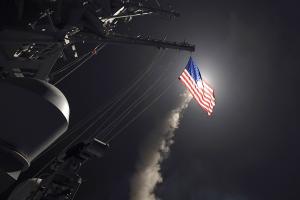
No, this US attack, reportedly involving 59 Tomahawk missiles being launched from ships in the eastern Mediterranean, was carried out with regime change in mind, setting a precedent that can only have serious ramifications for the entire region.

Regarding the attack in Idlib, what we can say with certainty is that a time when pro-government forces in Syria were in the ascendancy on the ground, and when the Syrian government was making significant progress on the diplomatic front, it would have constituted an act of ineffable self-harm to launch a chemical weapons attack of any kind, much less one of this magnitude. In fact it would have conformed to the actions of a government that was intent on bringing about its own demise. What also must be taken into consideration is the fact that the Organisation for the Prohibition of Chemical Weapons (OPCW), an organisation supported by the US, confirmed back in June 2014 that the process to destroy Syria’s entire stock of chemical weapons had been completed.

Moreover, the horrific images and eyewitness testimony that have emanated from Idlib in the wake of the attack have come from pro-opposition sources. No Western journalist or news crew would dare set foot in Idlib, or indeed any other part of opposition-held territory in Syria, knowing that as soon as they did they would be abducted and slaughtered.

Trump has proved with this unilateral military intervention that he can easily be dragged into conflict. Just a few days after his administration confirmed that regime change in Syria was off the table, that its focus was on defeating terrorism, he unleashes an airstrike that will only have emboldened the very forces of terrorism whose defeat he had stressed was the focus of his foreign policy previously.

So what now? Clearly, this military action places Russia in a very difficult position. Since joining the conflict in Syria at the end of September 2015, at the behest of the country’s government, Moscow had been working tirelessly to bring about a negotiated settlement, one involving opposition forces and parties deemed moderate relative to the Salafi-jihadi fanatics of ISIS and Nusra, etc. It is a diplomatic process that has just been dealt a shattering blow, with the opposition now undoubtedly convinced that regime change is in the offing via Washington and therefore encouraged to work towards this end.

Meanwhile, as for Washington’s regional allies – Israel, Saudi Arabia, Qatar, and Turkey (with Erdogan guaranteed to hitch his wagon to whoever appears to be in the driving seat) – they will most likely begin calling for more military action against Damascus now, viewing the US airstrike as the catalyst for open season on the country’s sovereignty.

As for Trump himself, having been under inordinate pressure since assuming office in January from the Washington media, political, and intelligence establishment, this action will earn him some much needed approval and, with it, respite. The signs with regard to his administration had been ominous for some time, starting with the forced resignation of Mike Flynn as his National Security Adviser in February, and continuing recent departure of Steve Bannon from the President’s National Security Council. It comes as further evidence that neocons have reasserted their dominance over the White House after a short and intense power struggle.

On a wider note, the lack of short-term memory in Washington is staggering to behold. Fourteen years after the disastrous US invasion of Iraq, which only succeeded in opening the gates of hell out of which ISIS and other Salfi-jihadi groups emerged, and six years after turning Libya into a failed state, in the process sparking a refugees crisis of biblical proportions, here we have yet another act of aggression against a sovereign state in the Middle East by the US.

Destroying countries in order to save them is the story of every empire there has been. But as history reveals, every empire carries within itself the seeds of its own destruction. Donald Trump is now on course to end up going down in history as a leader who rather than save the US from itself, may only have helped speed it down the path to its ultimate demise.

“Rome has grown since its humble beginning that it is now overwhelmed by its own greateness.” 

John Wight is the author of a politically incorrect and irreverent Hollywood memoir – Dreams That Die – published by Zero Books. He’s also written five novels, which are available as Kindle eBooks. You can follow him on Twitter at @JohnWight1

Syria: New U.S. Air Support On Request Scheme For Al-Qaeda

Source: Moon of Alabama

On this day one hundred years ago the U.S. joined World War I. Last night the U.S. attacked a Syrian government airport in an openly hostile and intentional manner. The strike established a mechanism by which al-Qaeda can “request” U.S. airstrikes on Syrian government targets. It severely damaged the main support base for Syria’s fight against the Islamic State in eastern Syria. The event will possibly lead to a much larger war.

On April 4 Syrian airplanes hit an al-Qaeda headquarter in Khan Sheikoun, Idleb governate. Idleb governate is under al-Qaeda control. After the air strike some chemical agent was released. The symptoms shown in videos from local aid stations point to a nerve-agent. The release probably killed between 50 and 90 people. It is unknown how the release happened.

It is unlikely that the Syrian government did this:

  • In 2013 the Syrian government had given up all its chemical weapons. UN inspectors verified this.
  • The target was militarily and strategically insignificant.
  • There was no immediate pressure on the Syrian military.
  • The international political atmosphere had recently turned positive for Syria.

Even if Syria had stashed away some last-resort weapon this would have been the totally wrong moment and totally wrong target for using it. Over the last six year of war the Syrian government army had followed a political and militarily logical path. It acted consistently. It did not act irrational. It is highly unlikely that it would have now take such an illogical step.

The chemical used, either Sarin or Soman, was not in a clean form. Multiple witnesses reported of a “rotten smell” and greenish color. While the color would point to a mixture with Chlorine the intense smell of Chlorine is easily identifiable, covers up most other odors and would have been recognized by witnesses. Both Sarin and Soman are in pure form colorless, tasteless and odorless. The Syrian government once produced nerve agents on a professional, large scale base. Amateurishly produced nerve-gases are not pure and can smell (example: Tokyo subway incident 1995). It is unlikely that the Syrian government experts would produce a “rotten smelling”, dirty, low quality stuff in an unprofessional and dangerous process.

The nerve agents in Khan Sheikoun, should they be confirmed, came either from stashed ammunition at the place attacked by the Syrian government or it was willfully released by the local ruling terrorist groups -al-Qaeda and Ahrar al-Sham- after the strike to implicate the Syrian government. The relatively low casualty numbers of mostly civilians point to the second variant.

Several reports over the years confirm that Al-Qaeda in Syria has the precursors and capabilities to produce and use Sarin as well as other chemical agents. This would not be their first use of such weapons. Al-Qaeda was under imminent pressure. It was losing the war. It is therefor highly likely that this was an intentional release by al-Qaeda to create public pressure on the Syrian government.

For a release incident of powerful chemical weapons the casualty numbers were low, lower than the casualty numbers of recent conventional U.S. air strikes in Syria and Iraq. Despite that fact a huge international media attack wave, seemingly prepared in advance, against the Syrian government was released. No evidence was presented that the incident was caused by the Syrian government. The only pictures and witness reports from the ground came from or through elements, like the White Helmets, who are known to by embedded with al-Qaeda and ISIS (video) and are acting as their propaganda arm.

Last night U.S. president Trump “responded” to the incident by ordering the launch of 59 cruise missiles on the Syrian military airport Al Syairat (vid). The cruise missiles were launched from sea in a volley designed to overwhelm air defenses. According to the Syrian and Russian military only 23 cruise missiles reached the airport. The others were shut down or failed. Six Syrian soldiers were Killed, nine civilians in a nearby village were killed or wounded and nine Syrian jets were destroyed. The airport infrastructure was severely damaged. The Syrian and Russian governments had been warned before the strikes hit and evacuated most men and critical equipment. (Was the warning part of a deal?) The air attack coincided with an Islamic State ground attack east of the airport.

The Pentagon alleges, without any evidence, that Sarin had been stored at the airport and a chemical attack launched from it. Both seems highly unlikely. The airport was accessible for UN inspectors. It is not as well covered by air defenses as other Syrian airports, for example in Latakia governate. Its ground approaches are not completely secured. Some medium range air defense system near al Syairat was recently used against Israeli planes attacking Syrian forces fighting ISIS near Palmyra.

Al Syairat lies in Homs governate, 150 km south of Khan Sheikoun in Idleb governate. It is the main support and supply airport for the besieged Syrian government enclave in Deir Ezzor which will now again be in even more serious trouble. It was also used to launch attacks on the Islamic State which fights the Syrian government troops in east Homs.

Al-Qaeda and its sidekick Ahra al-Sham welcomed the U.S. strikes and Abu Ivanka al Amriki on their side. The theocratic dictatorship of Saudi Arabia offered its full support as did its British creators.

The U.S. airstrike delivers a message to al-Qaeda. Whenever under military pressure al-Qaeda can now stage or fake a “chemical attack” and the U.S. will act to destroy its enemy, the Syrian government. Acts as the one last night are then direct military support by the U.S. on al-Qaeda’s request.

A similar scheme had earlier been established on the Golan heights. Al-Qaeda, fighting against Syrian government positions, would launch a mortar round that would land within Israeli controlled territory. Israel would then launch artillery strikes against Syrian government positions because “the Syrian government is responsible for what happens in the area”. Al-Qaeda then used the battle field advantage created by the Israeli strike. The scheme and the Israeli military “reasoning” was published several times in Israeli media:

A number of mortars have landed in Israeli territory as a result of spillover fighting over the last several years, raising fears among residents near the border.The IDF often responds to fire that crosses into Israel by striking Syrian army posts.

Israel maintains a policy of holding Damascus responsible for all fire from Syria into Israel regardless of the source of the fire.

The U.S. administration has now established a similar mechanism, on a larger scale, of direct military U.S. support for al-Qaeda and the Islamic State in Syria.

The Trump presidency had been held hostage by unfounded allegation of “Russian interference” in the U.S. elections in support of the Trump candidacy. The air strikes on Syria might have been the ransom that was demanded for the release of the hostage. His opponents are now gushing about him. The allegation of any Trump-Russia connections may now die down.

Yesterday major Democratic leaders in Congress supported strikes on Syria. Despite that they are also likely to attack Trump over them. The strikes are a “strong man” gamble. As Trump said when Obama ordered strikes such are a desperate move. Most parts of the State Department and the NSC were not consulted about them. The chances that these will “blow back” politically as well as strategically are high.

Trump is the third U.S. president in a row who promised less belligerence during his campaign only to deliver more after the election. The “democratic” veil of the U.S. oligarchic rule thus rips further apart.

Open U.S.-Russian cooperation in Syria will now cease. U.S. planes in Syrian airspace are from now on constantly under imminent danger. There will also be some larger revenge against the U.S. for last night’s strikes. Likely not in Syria but in Iraq, Afghanistan or at sea. A “message” will be send. The U.S. reaction to that “message” will be a decision over a much larger war.

Related Articles

US Missiles Strike Syrian Forces Fighting Al Qaeda

Syria’s alleged gas attack: An imperialist provocation

Putin believes US attack on Syria violates international law – spokesman

Top 10 Lies, Damn Lies, and Lies About Syria

Related Video:

Saturday Matinee: Battle Royale 2

“Battle Royale 2: Requiem” (2003) is an under-appreciated yet boldly provocative sequel taking place three years after the events of the first Battle Royale. The protagonists of the previous film have joined other survivors of past Battle Royales to form a terror cell known as Wild 7. After a major bomb attack, a new class of high-schoolers kidnapped by the government are forced to raid Wild 7’s island hideout and assassinate the group within 72 hours. Battle Royale 2 was director Kinji Fukasaku’s final project, who died of cancer shortly after filming began. The majority of the the film was directed by his son Kenta Fukasaku who wrote the screenplays for both films.

Watch the film with English subtitles here.