The Washington Post’s Case Against Democracy

By David Swanson

Source: Let’s Try Democracy

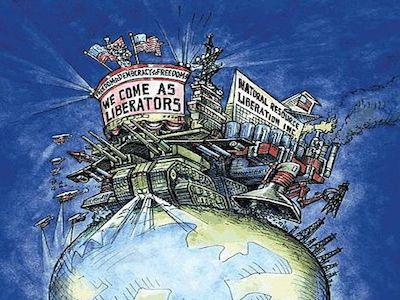
The Washington Post has been a leading promoter of the Rules Based Order, which some have confused with a pro-democracy initiative. The Post has, however, assembled a powerful case against democracy, that we all need to take seriously if we want to be, you know, serious.

I want to highlight just the most recent two additions to the anti-democracy argument that by now is quite overwhelmingly established.

On August 29th, a column appeared in the Washington Post by a very serious columnist who has seriously and consistently supported every war in recent decades, and done so with completely inconsistent but super serious arguments. The fault of the horrific deaths of 13 people in Afghanistan in recent days, this column argued, lies with the U.S. public, which may have (the column doesn’t really suggest this, but who knows) had some influence on the U.S. government.

The brilliance of this column may fade into the wallpaper, because some of it is now well-established practice. It is none the less worth noting that vastly more than 13 people have died in recent days in Afghanistan. The U.S. military is still sending in missiles to blow men, women, and little children into tiny bits and pieces. But they are not lives that matter. If they mattered, then it would also matter that the war has been killing people, almost certainly in the 2 to 4 million range over a period of 20 years. And if that mattered, then ending a war wouldn’t be understood as an act of violence, no matter how badly you ended it.

There’s something even more brilliant here, though. If you look back at the public opinion polls in the United States, the U.S. public has opposed the war for well over 18 years. Millions of us have not just said that but done everything we could to end it since the day it began. If you’re finally going to give us credit, it might be worth considering the likelihood that the ending would have been better 19 or 20 years ago than it was this past week. Only a very skilled and serious columnist could erase that line of thought by transforming credit into blame, peace into war, and missile victims into vapor.

The idea of democracy is subtly weakened while the wars for “democracy” are strengthened in the hands of a master — or of a brain-dead jackass paid big bucks for this swill; as a member of the public, I don’t feel qualified to say which it is.

Example number 2: On August 27th, the Washington Post published a column that lamented the possible influence of European public opinion on the participation of European governments in NATO. It seems that people in Europe are not fond of all the wars, much less of planning more of them. They believe some of the fearmongering lies about Russia, yet still strongly oppose the basic idea of NATO, which is the illegal commitment of each member to join in any crime committed by the military of another member. In particular they oppose stirring up a war on China, which is of course the number one project of the democracy-spreading Rules Based Order.

The Washington Post knows what matters, thank goodness, and is focused on making sure NATO can do what the weapons dealers demand, no matter what the pesky public may prefer in NATO member states.

The point that the Post really needs to develop further, and I have every confidence that it can, is how an antidemocratic institution waging unpopular and illegal wars that cause more destruction, death, and suffering than just about anything else happening in the world can be better sold as pro-democracy. The Rules Based Order is already crumbling as a piece of propaganda. It too obviously is a mask for the notion that who rules gives the orders. But the sacred word “democracy” is of too much value to the most serious project there is for it to be allowed to slip away without a struggle. That project is of course the critical work of bullshitting everyone.

Bring All the Troops Home: Stop Policing the Globe and Put an End to Endless Wars

By John W. Whitehead & Nisha Whitehead

Source: The Rutherford Institute

“Let us resolve that never again will we send the precious young blood of this country to die trying to prop up a corrupt military dictatorship abroad. This is also the time to turn away from excessive preoccupation overseas to the rebuilding of our own nation. America must be restored to a proper role in the world. But we can do that only through the recovery of confidence in ourselves…. together we will call America home to the ideals that nourished us from the beginning.”—George S. McGovern, former Senator and presidential candidate

It’s time to bring all our troops home.

Bring them home from Somalia, Iraq and Syria. Bring them home from Germany, South Korea and Japan. Bring them home from Saudi Arabia, Jordan and Oman. Bring them home from Niger, Chad and Mali. Bring them home from Turkey, the Philippines, and northern Australia.

It’s not enough to pull American troops out of Afghanistan, America’s longest, bloodiest and most expensive war to date.

It’s time that we stop policing the globe, stop occupying other countries, and stop waging endless wars.

That’s not what’s going to happen, of course.

The U.S. military reportedly has more than 1.3 million men and women on active duty, with more than 200,000 of them stationed overseas in nearly every country in the world.

Those numbers are likely significantly higher in keeping with the Pentagon’s policy of not fully disclosing where and how many troops are deployed for the sake of “operational security and denying the enemy any advantage.” As investigative journalist David Vine explains, “Although few Americans realize it, the United States likely has more bases in foreign lands than any other people, nation, or empire in history.”

Don’t fall for the propaganda, though.

America’s military forces aren’t being deployed abroad to protect our freedoms here at home. Rather, they’re being used to guard oil fields, build foreign infrastructure and protect the financial interests of the corporate elite. In fact, the United States military spends about $81 billion a year just to protect oil supplies around the world.

The reach of America’s military empire includes close to 800 bases in as many as 160 countries, operated at a cost of more than $156 billion annually. As Vine reports, “Even US military resorts and recreation areas in places like the Bavarian Alps and Seoul, South Korea, are bases of a kind. Worldwide, the military runs more than 170 golf courses.”

This is how a military empire occupies the globe.

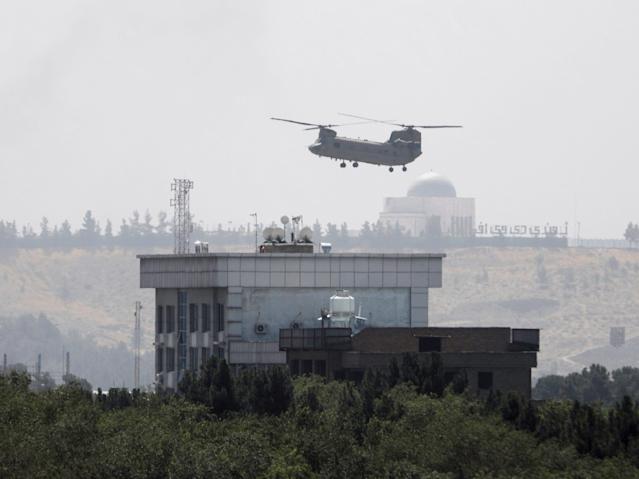
After 20 years of propping up Afghanistan to the tune of trillions of dollars and thousands of lives lost, the U.S. military may have finally been forced out, but those troops represent just a fraction of our military presence worldwide.

In an ongoing effort to police the globe, American military servicepeople continue to be deployed to far-flung places in the Middle East and elsewhere.

This is how the military industrial complex, aided and abetted by the likes of Joe Biden, Donald Trump, Barack Obama, George W. Bush, Bill Clinton and others, continues to get rich at taxpayer expense.

Yet while the rationale may keep changing for why American military forces are policing the globe, these wars abroad aren’t making America—or the rest of the world—any safer, are certainly not making America great again, and are undeniably digging the U.S. deeper into debt.

War spending is bankrupting America.

Although the U.S. constitutes only 5% of the world’s population, America boasts almost 50% of the world’s total military expenditure, spending more on the military than the next 19 biggest spending nations combined.

In fact, the Pentagon spends more on war than all 50 states combined spend on health, education, welfare, and safety.

The American military-industrial complex has erected an empire unsurpassed in history in its breadth and scope, one dedicated to conducting perpetual warfare throughout the earth.

Since 2001, the U.S. government has spent more than $4.7 trillion waging its endless wars.

Having been co-opted by greedy defense contractors, corrupt politicians and incompetent government officials, America’s expanding military empire is bleeding the country dry at a rate of more than $32 million per hour.

In fact, the U.S. government has spent more money every five seconds in Iraq than the average American earns in a year.

Future wars and military exercises waged around the globe are expected to push the total bill upwards of $12 trillion by 2053.

Talk about fiscally irresponsible: the U.S. government is spending money it doesn’t have on a military empire it can’t afford.

As investigative journalist Uri Friedman puts it, for more than 15 years now, the United States has been fighting terrorism with a credit card, “essentially bankrolling the wars with debt, in the form of purchases of U.S. Treasury bonds by U.S.-based entities like pension funds and state and local governments, and by countries like China and Japan.”

War is not cheap, but it becomes outrageously costly when you factor in government incompetence, fraud, and greedy contractors. Indeed, a leading accounting firm concluded that one of the Pentagon’s largest agencies “can’t account for hundreds of millions of dollars’ worth of spending.”

Unfortunately, the outlook isn’t much better for the spending that can be tracked.

A government audit found that defense contractor Boeing has been massively overcharging taxpayers for mundane parts, resulting in tens of millions of dollars in overspending. As the report noted, the American taxpayer paid:

$71 for a metal pin that should cost just 4 cents; $644.75 for a small gear smaller than a dime that sells for $12.51: more than a 5,100 percent increase in price. $1,678.61 for another tiny part, also smaller than a dime, that could have been bought within DoD for $7.71: a 21,000 percent increase. $71.01 for a straight, thin metal pin that DoD had on hand, unused by the tens of thousands, for 4 cents: an increase of over 177,000 percent.

That price gouging has become an accepted form of corruption within the American military empire is a sad statement on how little control “we the people” have over our runaway government.

Mind you, this isn’t just corrupt behavior. It’s deadly, downright immoral behavior.

Americans have thus far allowed themselves to be spoon-fed a steady diet of pro-war propaganda that keeps them content to wave flags with patriotic fervor and less inclined to look too closely at the mounting body counts, the ruined lives, the ravaged countries, the blowback arising from ill-advised targeted-drone killings and bombing campaigns in foreign lands, or the transformation of our own homeland into a warzone.

That needs to change.

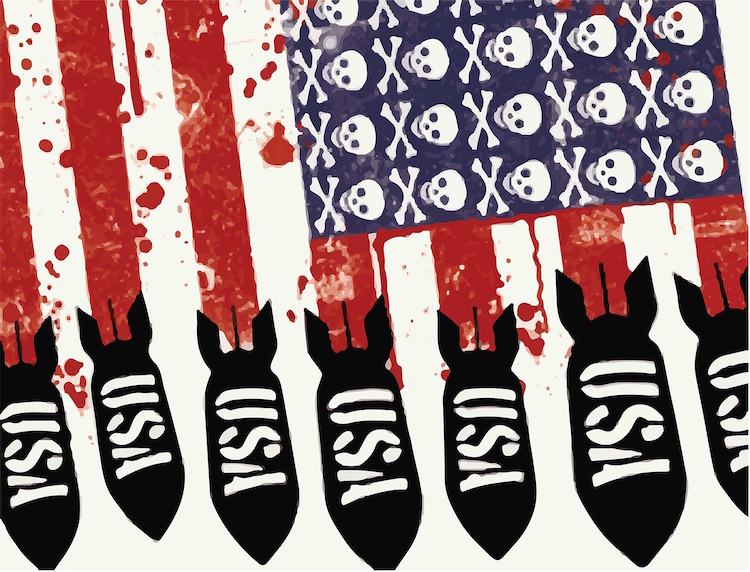
The U.S. government is not making the world any safer. It’s making the world more dangerous. It is estimated that the U.S. military drops a bomb somewhere in the world every 12 minutes. Since 9/11, the United States government has directly contributed to the deaths of around 500,000 human beings. Every one of those deaths was paid for with taxpayer funds.

The U.S. government is not making America any safer. It’s exposing American citizens to alarming levels of blowback, a CIA term referring to the unintended consequences of the U.S. government’s international activities. Chalmers Johnson, a former CIA consultant, repeatedly warned that America’s use of its military to gain power over the global economy would result in devastating blowback.

The 9/11 attacks were blowback. The Boston Marathon Bombing was blowback. The attempted Times Square bomber was blowback. The Fort Hood shooter, a major in the U.S. Army, was blowback.

The U.S. military’s ongoing drone strikes will, I fear, spur yet more blowback against the American people. The latest drone strike reportedly killed seven children, ages 2 to 10, in Afghanistan.

The war hawks’ militarization of America—bringing home the spoils of war (the military tanks, grenade launchers, Kevlar helmets, assault rifles, gas masks, ammunition, battering rams, night vision binoculars, etc.) and handing them over to local police, thereby turning America into a battlefield—is also blowback.

James Madison was right: “No nation could preserve its freedom in the midst of continual warfare.” As Madison explained, “Of all the enemies to public liberty war is, perhaps, the most to be dreaded because it comprises and develops the germ of every other. War is the parent of armies; from these proceed debts and taxes… known instruments for bringing the many under the domination of the few.”

We are seeing this play out before our eyes.

The government is destabilizing the economy, destroying the national infrastructure through neglect and a lack of resources, and turning taxpayer dollars into blood money with its endless wars, drone strikes and mounting death tolls.

Clearly, our national priorities are in desperate need of an overhauling.

At the height of its power, even the mighty Roman Empire could not stare down a collapsing economy and a burgeoning military. Prolonged periods of war and false economic prosperity largely led to its demise. As historian Chalmers Johnson predicts:

The fate of previous democratic empires suggests that such a conflict is unsustainable and will be resolved in one of two ways. Rome attempted to keep its empire and lost its democracy. Britain chose to remain democratic and in the process let go its empire. Intentionally or not, the people of the United States already are well embarked upon the course of non-democratic empire.

This is the “unwarranted influence, whether sought or unsought, by the military-industrial complex” that President Dwight Eisenhower warned us more than 50 years ago not to let endanger our liberties or democratic processes.

Eisenhower, who served as Supreme Commander of the Allied forces in Europe during World War II, was alarmed by the rise of the profit-driven war machine that emerged following the war—one that, in order to perpetuate itself, would have to keep waging war.

We failed to heed his warning.

As I make clear in my book Battlefield America: The War on the American People and in its fictional counterpart The Erik Blair Diaries, there’s not much time left before we reach the zero hour.

It’s time to stop policing the globe, end these wars-without-end, and bring the troops home.

Biden Could Have Spared Afghanistan and US 6 Months of Pointless War by Just Ending It

By Dave Lindorff

Source: This Can’t Be Happening!

There are two things I suppose everyone would agree are true about the remarkable events of the past several weeks in Afghanistan.

One is that we are witnessing the latest  major loss in a string of wars and “incursions” that the US has lost since the end of World War II. The other is that the entire  two-decade-long, $2.3-trillion US invasion, war and occupation of  one of the poorest countries in the world, was an abject failure from the beginning.

Officially, the US invaded Afghanistan because its ruling Taliban government had allegedly permitted Al Qaeda, a shadowy jihadist fighting organization founded by the Saudi Osama Bin Laden (with CIA assistance), to establish several training camps there where he purportedly plotted the 9-11 attacks on the World Trade Center, the Pentagon and perhaps the Capitol building or White House.

The attack, by some 20,000 US Special Forces troops backed by US air power, smashed the camps (and a lot of other things and people), but most of the Al Qaeda forces, including Bin Laden, escaped to the mountains of Tora Bora. The US had rejected a Taliban offer to surrender Bin Laden to a “third country”, a deal which could have eliminated the need for the ensuing war, but the Bush/Cheney administration would not accept the terms:  a halt to the bombing of the country, and  presentation of evidence that Bin Laden had been behind the attacks on the US.

In any event, once Bin Laden and his band were surrounded, trapped in caves on a mountain in eastern Afghanistan, the US pulled troops out and started sending many of them to Kuwait and other Persian Gulf countries in preparation for a second larger war against Iraq, which was portrayed fraudulently as having been involved in 9-11 and as having plans to develop “weapons of mass destruction.”   Bin Laden and his men were forgotten.

The US forces in Afghanistan were ordered to abandon the original mission of killing or capturing Bin Laden and destroying Al Qaeda, and instead proceeded to drive the Taliban out of the capital of Kabul and other Afghan cities into the countryside and neighboring Pakistan. At which point the war became the US vs. the Taliban, and the Taliban became, in US and complicit US media parlance, “insurgents.” From their own vantage point, they were patriots and Islamists battling the evil US occupier of the country and the puppet government the Great Satan”  had installed.

For the next 19 years, the US, with the most powerful military the world has ever known, has fought futilly against a  force of  tens of thousands of rag-tag Kalashnikov-toting Taliban fighters, gradually losing control of most of the rural parts of the vast country, and unable to protect the cities from bombings, assassinations of officials, and the occasional overrunning of various provincial cities.

For 20 years, top military brass and advisors with ties to the US arms industry, lied that the US was “winning” the war in Afghanistan, all the while knowing the whole thing was a fool’s errand that could only end with the Taliban eventually returning to power. For the military, the war was a way to earn battle credits, get promotions, and for higher officers, to end up on arms industry boards of directors. For the Arms industry, the war was a bottomless pot of money. For American troops it was a pointless hell-hole, and for the Afghan people an endless slaughter.

To his credit, President Biden did one thing right. He called an end to the bloody 20-year stalemate.  He for sure could have handled it better. Had he simply admitted upon taking office that the US had made a terrible mistake and immediately sued for peace with the Taliban, whom everyone involved knew would eventually be back in power in Kabul one way or another once the US left, more than half a year of bloody fighting and bombing could have been avoided entirely. Instead, Biden continued the war, making it his own, but announcing a pull-out that would be completed on the fake symbolic date of September 11. (Fake because no Taliban  or Afghan was involved in the 9-11 attacks!) Given that ridiculously long timetable and the continued US air strikes on the Taliban in the meantime, the Taliban opted to push the US out. Understandably, they did not believe that Biden was any more sincere about ending the war and leaving their country than were presidents Bush, Obama or Trump before him.

All kinds of justifications have been given over the years for the US staying in Afghanistan for two decades of war:   women would be oppressed under the Taliban; the Taliban would replace Afghanistan’s puppet “democratic” government with a theocratic autocracy; if the US left, Iran, or Russia or China would gain influence there; if the US left, Afghanistan would again be a haven for terrorists threatening the US; and of course that old standby when all else failed — that the US had to stand firm lest the world think the US was weak.

None of these excuses held up on inspection. Women were always oppressed in Afghanistan,  were oppressed even when the US was there in force, and would inevitably be oppressed as they are in most islamic countries that the US considers allies (think Saudi Arabia, Kuwait, Egypt, etc.). Afghanistan is bordered by Iran, China and Pakistan and by countries where Russia wields considerable influence. Of course those countries, as well as india, would compete for control in Afghanistan. As for becoming a haven for terrorists, there are plenty of those already, many created by the chaos sown by meddling US military forces as in Syria, Sudan, Somalia, Niger, Libya, Yemen and Colombia, for example.  And cutting and running in Afghanistan, which the US is doing now, as it did in Vietnam in 1975, would have been nothing new had the US done it sooner, instead of waiting to be shown the door. What would have been new would have been admitting the war was a mistake and leaving through negotiations instead of being humiliatingly driven out as now, yet again.

The American people should be outraged about this two-decade fiasco. Instead we’re being treated to all manner of nonsense in our supposedly free and independent media,  attacking Biden for “losing” Afghanistan. The focus of criticism is on how Biden handled the ending of the war, not as it should be, on who got the US involved in the first place (Bush, Cheney and virtually the entirety of Democrats and Republicans in Congress), and who kept us there (President Obama with the support of Democrats and Republicans in Congress, and  Trump, again with the support of Democrats and Republicans, and a media that played along with the charade that Afghanistan was an existential threat to America).

Will there be any effort to assign blame for those who caused this catastrophe? Any atonement or reparations to the people of Afghanistan for how we’ve tortured them and their country for decades (going back to when President Jimmy Carter began arming and training jihadi fighters to overthrow the country’s Russian-backed communist government (which was at least gave women equal rights and educated them)?

No of course not. The US doesn’t do soul searching, or historical re-examination,never admits it was wrong and certainly never pays reparations for its crimes.

Thankfully, the US puppet regime in Kabul collapsed like a house of cards, and so the Taliban won’t have to fight to enter that last unliberated city of five million. Now maybe Afghanis can have peace again. They may be stuck with a medieval  theocratic government again, but they’ve been there before. Life will go on, and they’ll have to work it out themselves.  It’s not our business, and our way of “fixing” things for other countries is generally to create a bloody mess and then leave,  and doesn’t work anyhow.

That is the lesson the world is gradually learning, even if the US and its people won’t.

Glen Ford: A Remarkable Revolutionary

By Danny Haiphong

Source: Black Agenda Report

Glen Ford was a revolutionary in all that he did.

The year was 2011. I was full to the brim with anger toward the United States for the deleterious impact of racism on my life and the lives of those closest to me. I was equally furious with liberal elitism and the class-blind racial politics that privileged “diversity” over the substantive material issues most critical to oppressed people everywhere. I marched with Occupy Wall Street and engaged in the labor movement but still felt alone. I frequently asked myself: “Why are all sides of the so-called American Left unable to fight race and class simultaneously?”

I then came across Glen Ford’s work from a simple online search and recall a similar reaction to that of Ho Chi Minh after he was introduced to Vladimir Lenin’s “Theses on the Colonial Question,”

What emotion, enthusiasm, clear-sightedness and confidence it instilled into me! I was overjoyed to tears. Though sitting alone in my room, I shouted out aloud as if addressing large crowds: “Dear martyrs compatriots! This is what we need, this is the path to our liberation!”

Reading and listening to Glen Ford’s analysis of the Obama administration placed a bright spotlight on a historical moment of intense darkness. At present, there are still too few others who have been able to coherently place the Obama era in its proper context of the U.S.’s ongoing counterinsurgency warfare against Black liberation and self-determination. While much of the American left equated the rise of Obama with “progress,” Glen Ford repeatedly warned us that the Obama administration rendered U.S. imperialism and white supremacy a more effective, and therefore more dangerous, evil.

That’s what revolutionaries do. They warn us through careful explanation and analysis of how oppressive systems work. They prepare us to make history through revolution; to replace the old decrepit order with a new one. But revolutionaries do not just champion any social order. Glen Ford was quite clear that any social transformation of the United States must satisfy the needs of humanity, especially the most terrorized and exploited among us. Socialism and self-determination were not antithetical principles but rather interconnected aims wholly consistent with the struggle for Black liberation.  

Glen Ford’s work convinced me in rapid fashion of the necessity of Black revolutionary leadership in the long struggle to build a socialist project in the United States. His grasp of theory and history was matched by few others. His talent behind the microphone and written word brought his analysis to life. From 2011 to 2013, I followed Black Agenda Report regularly and held it to the sky as a necessary source for anyone claiming interest in “social justice.” Glen Ford’s work on the U.S. war against the African country of Libya, an invasion led by the first Black President of the United States, laid the foundations for my own anti-imperialist approach to both activism and journalism.

In 2013, I took a leap and submitted my first article to Glen Ford analyzing Barack Obama’s presidency as a corporate brand. My writing was raw. I was schooled poorly in grammar and had only begun reading regularly over the last year. Clarity was not yet a strength that I possessed. Not to worry. Glen’s brief responses to my submissions over the next several months provided a basic education into concise analytical writing, and I owe much of my development as both a writer and political analyst to him.

From 2014 to 2016, I met Glen Ford in the flesh only in brief encounters at The Left Forum. In 2017, I moved to New York City. Glen and I would eventually convene at Molly Wee’s in Manhattan on a periodic basis and speak for hours about the political situation in the U.S. and abroad. Glen Ford was a communist who shared his experiences in the Black Panther Party and the Communist Party without hesitation to trusted comrades. He loved to tell a good story.

But it wasn’t just for the fun of it. Glen had expectations. He didn’t need to say it bluntly for me to know that he hoped his stories would be incorporated in my own work in service of the people. Everything with Glen was for the people. This didn’t mean he didn’t enjoy a good time, however. A good time for Glen Ford was defined both by the company he kept and his passion for analyzing the world and those struggling for power within it. A drink didn’t hurt, either.

Glen Ford always addressed me as a fellow revolutionary, a comrade. This was one of the greatest personal gifts that I have ever received. In the beginning of our relationship, I was intimidated. I was aware from his bio in Black Agenda Report and his personal stories just how significant he was as a pioneer in Black journalism. Glen had once held deep relationships with not only James Brown but also political officials such as the late John Conyers. He could have become a Black media mogul and raked in millions through loyalty to the powerful.

Instead, Glen Ford died a revolutionary mentoring people like myself in the theory and practice of revolutionary struggle. Instead of lucrative gigs, Glen was creating a new language for oppressed people to understand and change the world. We can attribute to him the term “Black misleadership class” to describe Black leaders such as Al Sharpton who have gained comfortable careers from service to the white capitalist class. In 2015, Glen Ford led the way in principled critiques of the Black Lives Matter Network’s (BLM) relationship with the Democratic Party. He took great pride in knowing Black Agenda Report played a large part in BLM’s refusal to endorse the DNC in the 2016 election.

On numerous occasions, Glen Ford advised me on how to navigate difficult political problems. There were some on the so-called “Left” who took issue with my contribution to Black Agenda Report and my criticisms of the Black Lives Matter Network. Glen Ford smiled when I brought the issue to him. His advice? Tell the naysayers that the best of the Black liberation movement has always been inclusive to the interests and movements of all oppressed people. And he was clear with me, and to anyone who questioned, that Black Agenda Report would remain firmly under radical Black leadership no matter who contributed.

Glen Ford was a remarkable revolutionary who encouraged others to develop and hone their skills for the movement. His commitment to the Black Radical Tradition’s anti-imperialist and socialist politics blazed a path forward in a historical period of intense reaction and crisis. Roberto Sirvent and I did not have to think twice about asking Glen Ford to contribute the afterword to our book on American exceptionalism. Glen’s influence, especially his cutting style and fearless takedowns of the American empire, was so influential to the project that it was only natural for him to have the last word.

We must continue to keep Glen’s spirit and work alive. We must apply all of his lessons about elite chicanery, imperialism, and the dangers of the Democratic Party to our efforts to develop revolutionary leadership in the citadel of oppression. We cannot thank Glen Ford enough for all of the sacrifices he made for the cause of liberation. His work lives on not only in Black Agenda Report, but also in political organizations such as The Black Alliance for Peace, the Black is Back Coalition, and the United National Anti-War Coalition (UNAC) to name just a few.

Personally, I am one of the luckiest humans on this earth for the opportunity to learn from his contributions up close and personal. His mentorship was, and will always be, invaluable. In truth, however, anyone who followed or knew Glen Ford was mentored by him. He is one of the few among us who lived by Amilcar Cabral’s iconic words,

“Tell no lies, claim no easy victories!”

Rise in Power, Glen Ford!

Saturday Matinee: The War on Journalism: The Case of Julian Assange

WATCH: The War on Journalism: The Case of Julian Assange

A new documentary by Juan Passarelli can be seen here on Consortium News, followed by a panel discussion with Passarelli, director Ken Loach and filmmaker Suzie Gilbert.

Source: Consortium News

Journalists are under attack globally for doing their jobs. Julian Assange is facing a 175 year sentence for publishing if extradited to the United States. The Trump administration has gone from denigrating journalists as ‘enemies of the people’ to now criminalizing common practices in journalism that have long served the public interest.

Imprisoned WikiLeaks founder and editor Assange’s extradition is being sought by the Trump administration, in a hearing to begin Sept. 7,  for publishing U.S. government documents, which exposed war crimes and human rights abuses. He is being held in maximum security HMP Belmarsh in London. There is a war on journalism and Julian Assange is at the centre of that war. If this precedent is set then what happens to Assange can happen to any journalist. Join director Ken Loach and film-maker Suzie Gilbert for a discussion with Juan Passarelli about his new documentary – The War on Journalism: The Case of Julian Assange.

Watch the replay here:

Killing Democracy in America

By William J. Astore

Source: Strategic Culture Foundation

The phrase “thinking about the unthinkable” has always been associated with the unthinkable cataclysm of a nuclear war, and rightly so. Lately, though, I’ve been pondering another kind of unthinkable scenario, nearly as nightmarish (at least for a democracy) as a thermonuclear Armageddon, but one that’s been rolling out in far slower motion: that America’s war on terror never ends because it’s far more convenient for America’s leaders to keep it going — until, that is, it tears apart anything we ever imagined as democracy.

I fear that it either can’t or won’t end because, as Martin Luther King, Jr., pointed out in 1967 during the Vietnam War, the United States remains the world’s greatest purveyor of violence — and nothing in this century, the one he didn’t live to see, has faintly proved him wrong. Considered another way, Washington should be classified as the planet’s most committed arsonist, regularly setting or fanning the flames of fires globally from Libya to Iraq, Somalia to Afghanistan, Syria to — dare I say it — in some quite imaginable future Iran, even as our leaders invariably boast of having the world’s greatest firefighters (also known as the U.S. military).

Scenarios of perpetual war haunt my thoughts. For a healthy democracy, there should be few things more unthinkable than never-ending conflict, that steady drip-drip of death and destruction that drives militarism, reinforces authoritarianism, and facilitates disaster capitalism. In 1795, James Madison warned Americans that war of that sort would presage the slow death of freedom and representative government. His prediction seems all too relevant in a world in which, year after year, this country continues to engage in needless wars that have nothing to do with national defense.

You Wage War Long, You Wage It Wrong

To cite one example of needless war from the last century, consider America’s horrendous years of fighting in Vietnam and a critical lesson drawn firsthand from that conflict by reporter Jonathan Schell. “In Vietnam,” he noted, “I learned about the capacity of the human mind to build a model of experience that screens out even very dramatic and obvious realities.” As a young journalist covering the war, Schell saw that the U.S. was losing, even as its military was destroying startlingly large areas of South Vietnam in the name of saving it from communism. Yet America’s leaders, the “best and brightest” of the era, almost to a man refused to see that all of what passed for realism in their world, when it came to that war, was nothing short of a first-class lie.

Why? Because believing is seeing and they desperately wanted to believe that they were the good guys, as well as the most powerful guys on the planet. America was winning, it practically went without saying, because it had to be. They were infected by their own version of an all-American victory culture, blinded by a sense of this country’s obvious destiny: to be the most exceptional and exceptionally triumphant nation on this planet.

As it happened, it was far more difficult for grunts on the ground to deny the reality of what was happening — that they were fighting and dying in a senseless war. As a result, especially after the shock of the enemy’s Tet Offensive early in 1968, escalating protests within the military (and among veterans at home) together with massive antiwar demonstrations finally helped put the brakes on that war. Not before, however, more than 58,000 American troops died, along with millions of Vietnamese, Cambodians, and Laotians.

In the end, the war in Indochina was arguably too costly, messy, and futile to continue. But never underestimate the military-industrial complex, especially when it comes to editing or denying reality, while being eternally over-funded for that very reality. It’s a trait the complex has shared with politicians of both parties. Don’t forget, for instance, the way President Ronald Reagan reedited that disastrous conflict into a “noble cause” in the 1980s. And give him credit! That was no small thing to sell to an American public that had already lived through such a war. By the way, tell me something about that Reaganesque moment doesn’t sound vaguely familiar almost four decades later when our very own “wartime president” long ago declared victory in the “war” on Covid-19, even as the death toll from that virus approaches 150,000 in the homeland.

In the meantime, the military-industrial complex has mastered the long con of the no-win forever war in a genuinely impressive fashion. Consider the war in Afghanistan. In 2021 it will enter its third decade without an end in sight. Even when President Trump makes noises about withdrawing troops from that country, Congress approves an amendment to another massive, record-setting military budget with broad bipartisan support that effectively obstructs any efforts to do so (while the Pentagon continues to bargain Trump down on the subject).

The Vietnam War, which was destroying the U.S. military, finally ended in an ignominious withdrawal. Almost two decades later, after the 2001 invasion, the war in Afghanistan can now be — the dream of the Vietnam era — fought in a “limited” fashion, at least from the point of view of Congress, the Pentagon, and most Americans (who ignore it), even if not the Afghans. The number of American troops being killed is, at this point, acceptably low, almost imperceptible in fact (even if not to Americans who have lost loved ones over there).

More and more, the U.S. military is relying on air power, unmanned drones, mercenaries, local militias, paramilitaries, and private contractors. Minimizing American casualties is an effective way of minimizing negative media coverage here; so, too, are efforts by the Trump administration to classify nearly everything related to that war while denying or downplaying “collateral damage” — that is, dead civilians — from it.

Their efforts boil down to a harsh truth: America just plain lies about its forever wars, so that it can keep on killing in lands far from home.

When we as Americans refuse to take in the destruction we cause, we come to passively accept the belief system of the ruling class that what’s still bizarrely called “defense” is a “must have” and that we collectively must spend significantly more than a trillion dollars a year on the Pentagon, the Department of Homeland Security, and a sprawling network of intelligence agencies, all justified as necessary defenders of America’s freedom. Rarely does the public put much thought into the dangers inherent in a sprawling “defense” network that increasingly invades and dominates our lives.

Meanwhile, it’s clear that low-cost wars, at least in terms of U.S. troops killed and wounded in action, can essentially be prolonged indefinitely, even when they never result in anything faintly like victory or fulfill any faintly useful American goal. The Afghan War remains the case in point. “Progress” is a concept that only ever fits the enemy — the Taliban continues to gain ground — yet, in these years, figures like retired general and former CIA director David Petraeus have continued to call for a “generational” commitment of troops and resources there, akin to U.S. support for South Korea.

Who says the Pentagon leadership learned nothing from Vietnam? They learned how to wage open-ended wars basically forever, which has proved useful indeed when it comes to justifying and sustaining epic military budgets and the political authority that goes with them. But here’s the thing: in a democracy, if you wage war long, you wage it wrong. Athens and the historian Thucydides learned this the hard way in the struggle against Sparta more than two millennia ago. Why do we insist on forgetting such an obvious lesson?

“We Have Met the Enemy and He Is Us”

World War II was arguably the last war Americans truly had to fight. My Uncle Freddie was in the Army and stationed at Pearl Harbor when it was attacked on December 7, 1941. The country then came together and won a global conflict (with lots of help) in 44 months, emerging as the planetary superpower to boot. Now, that superpower is very much on the wane, as Donald Trump recognized in running successfully as a declinist candidate for president in 2016. (Make America Great Again!) And yet, though he ran against this country’s forever wars and is now president, we’re approaching the third decade of a war on terror that has yielded little, spread radical Islamic terror outfits across an expanse of the planet, and still seemingly has no end.

“Great nations do not fight endless wars,” Trump himself claimed only last year. Yet that’s exactly what this country has been doing, regardless of which party ruled the roost in Washington. And here’s where, to give him credit, Trump actually had a certain insight. America is no longer great precisely because of the endless wars we wage and all the largely hidden but associated costs that go with them, including the recently much publicized militarization of the police here at home. Yet, in promising to make America great again, President Trump has failed to end those wars, even as he’s fed the military-industrial complex with even greater piles of cash.

There’s a twisted logic to all this. As the leading purveyor of violence and terror, with its leaders committed to fighting Islamic terrorism across the planet until the phenomenon is vanquished, the U.S. inevitably becomes its own opponent, conducting a perpetual war on itself. Of course, in the process, Afghans, Iraqis, Libyans, Syrians, Somalis, and Yemenis, among other peoples on this embattled planet of ours, pay big time, but Americans pay, too. (Have you even noticed that high-speed railroad that’s unbuilt, that dam in increasing disrepair, those bridges that need fixing, while money continues to pour into the national security state?) As the cartoon possum Pogo once so classically said, “We have met the enemy and he is us.”

Early in the Iraq War, General Petraeus asked a question that was relevant indeed: “Tell me how this [war] ends.” The answer, obvious to so many who had protested in the global streets over the invasion to come in 2003, was “not well.” Today, another answer should be obvious: never, if the Pentagon and America’s political and national security elite have anything to do with it. In thermodynamics class, I learned that a perpetual motion machine is impossible to create due to entropy. The Pentagon never took that in and has instead been hard at work proving that a perpetual military machine is possible… until, that is, the empire it feeds off of collapses and takes us with it.

America’s Military Complex as a Cytokine Storm

In the era of Covid-19, as cases and deaths from the pandemic continue to soar in America, it’s astonishing that military spending is also soaring to record levels despite a medical emergency and a major recession.

The reality is that, in the summer of 2020, America faces two deadly viruses. The first is Covid-19. With hard work and some luck, scientists may be able to mass-produce an effective vaccine for it, perhaps by as early as next spring. In the meantime, scientists do have a sense of how to control it, contain it, even neutralize it, as countries from South Korea and New Zealand to Denmark have shown, even if some Americans, encouraged by our president, insist on throwing all caution to the winds in the name of living free. The second virus, however, could prove even more difficult to control, contain, and neutralize: forever war, a pandemic that U.S. military forces, with their global strike missions, continue to spread across the globe.

Sadly, it’s a reasonable bet that in the long run, even with Donald Trump as president, America has a better chance of defeating Covid-19 than the virus of forever war. At least, the first is generally seen as a serious threat (even if not by a president blind to anything but his chances for reelection); the second is, however, still largely seen as evidence of our strength and exceptionalism. Indeed, Americans tend to imagine “our” military not as a dangerous virus but as a set of benevolent antibodies, defending us from global evildoers.

When it comes to America’s many wars, perhaps there’s something to be learned from the way certain people’s immune systems respond to Covid-19. In some cases, the virus sparks an exaggerated immune response that drives the body into a severe inflammatory state known as a cytokine storm. That “storm” can lead to multiple organ failure followed by death, yet it occurs in the cause of defending the body from a viral attack.

In a similar fashion, America’s exaggerated response to 19 hijackers on 9/11 and then to perceived threats around the globe, especially the nebulous threat of terror, has led to an analogous (if little noticed) cytokine storm in the American system. Military (and militarized police) antibodies have been sapping our resources, inflaming our body politic, and slowly strangling the vital organs of democracy. Left unchecked, this “storm” of inflammatory militarism will be the death of democracy in America.

To put this country right, what’s needed is not only an effective vaccine for Covid-19 but a way to control the “antibodies” produced by America’s forever wars abroad and, as the years have gone by, at home — and the ways they’ve attacked and inflamed the collective U.S. political, social, and economic body. Only when we find ways to vaccinate ourselves against the destructive violence of those wars, whether on foreign streets or our own, can we begin to heal as a democratic society.

To survive, the human body needs a healthy immune system, so when it goes haywire, becomes wildly inflamed, and ends up attacking and degrading our vital organs, we’re in trouble deep. It’s a reasonable guess that, in analogous terms, American democracy is already on a ventilator and beginning to feel the effects of multiple organ failure.

Unlike a human patient, doctors can’t put our democracy into a medically induced coma. But collectively we should be working to suppress our overactive immune system before it kills us. In other words, it’s truly time to defund that military machine of ours, as well as the militarized version of the police, and rethink how actual threats can be neutralized without turning every response into an endless war.

So many years later, it’s time to think the unthinkable. For the U.S. government that means — gasp! — peace. Such a peace would start with imperial retrenchment (bring our troops home!), much reduced military (and police) budgets, and complete withdrawal from Afghanistan and any other place associated with that “generational” war on terror. The alternative is a cytokine storm that will, in the end, tear us apart from within.


 

Hiroshima Denial is Terror

By Finian Cunningham

Source: Information Clearing House

Those who deny history, or who are oblivious, are apt to repeat it. That is the frightening, perhaps most disturbing aspect of the 75th anniversary this week of the American atomic bombing of Hiroshima and Nagasaki.

The indiscriminate mass murder of 200,000 people on August 6 and 9, 1945, is beyond words in its horror and moral depravity. But what is equally condemning is the ostensible lack of remorse and the obfuscation to conceal the scale of such evil.

For if there were any remorse or realization about the crime there would surely be a commitment to never repeat it. The most solemn manifestation of commitment would be the pursuance of nuclear disarmament.

Seventy-five years on, yes, American news media run so-called commemorative articles on the historic events. However, there is a sense of glibness about the calamity, a sort of dull duty to mark the occasion as if it is a yearly chore of “regret”. There is also a sneaking awe at the destructive power unleashed on those Japanese cities, as well as the usual inclusion of official justification about how US leaders at the time were allegedly motivated by ending the Pacific War quickly. There are even in some media coverage brief mentions of acknowledgement that the dropping of the A-bombs was “unnecessary”.

But it’s all delivered in an insidious way to obscure the shocking, barbaric truth that the United States dropped weapons of mass destruction on civilians. How about going further and acknowledging it was a deliberate act of mass terror for political purpose to establish American hegemony in the postwar order?

No proper humane or moral lessons, it seems, have been drawn about the genocide that took place at Hiroshima and Nagasaki. Neither by the people in US government and media establishments nor, lamentably, by the wider American population. If lessons were truly learned then there would be a sense of revulsion and outrage demanding immediate nuclear disarmament and the end to all war machinery.

Just last month, the US Congress passed an annual military budget of $740 billion, including for the development of weapons of mass destruction. This is while 30 million American workers and their families are suffering from unemployment and deprivation due to the coronavirus pandemic and the government shutting off pittance welfare payments.

The anniversary of Hiroshima and Nagasaki comes as the Trump administration issues ever-more provocative slander against China over the pandemic and other matters that are really not Washington’s business nor remit, especially the subjects of alleged human rights violations or government espionage against citizens.

Washington continues to provoke both Russia and China with ever-expanding plans to deploy intermediate-range missiles near their territories. This only one year after Washington scrapped the Intermediate-range Nuclear Forces (INF) treaty with Moscow.

It is the US side which is threatening to collapse the New START accord, the last-remaining nuclear arms-control treaty with Moscow.

It is the US side which is pushing recklessly ahead with weaponizing outer space while falsely, cynically, accusing Russia and China of doing so, even though the latter have both repeatedly called for a United Nations-backed moratorium on militarizing this domain.

It is the US side which reserves the unilateral “right to first nuclear strike” while Russia and China have declared to only use such weapons as defensive response to attack.

The militarization by Washington and its bellicose policies towards Moscow and Beijing are proof that the criminality of Hiroshima and Nagasaki has never been accounted for.

The criminality of that genocide remains unacknowledged and ignored by the US ruling system because, evidently, it wants to use that horror as a psychological weapon against others. The psychological weapon being: “We did it before, and we can do it again”. The ultimate “terror card” was played and continues to be played, albeit tacitly.

Contemporary developments and indicators of geopolitical tensions with China and Russia show that Washington is not willing or indeed capable of engaging for mutual peace. It is hellbent on stoking cold war confrontation, even if that confrontation results in hot war. A war with Russia or China would inevitably escalate into a catastrophic nuclear end.

On August 6 and 9, 1945, 75 years ago, the world witnessed two cities despatched to the hell of nuclear annihilation. It is utterly shameful that the nation that perpetrated such an absolute crime remains unapologetic and in denial. But more than that, it is utterly nefarious because the unapologetic logic means it could happen again.

Charlie Chaplin and Truly Modern Times

Still of Charlie Chaplin [b. April 16, 1889] from “Modern Times”

By Daniel Warner

Source: CounterPunch

Acrobat, musician, composer, clown, mime, movie star, director and producer, Academy Award winner for lifetime achievement, but still driven from the United States for his backing of the Soviet Union, Charlie Chaplin should need little introduction, except perhaps for Millennials and other late alphabet generations. He was the global star in the crossover from silent films to talkies, making an astonishing $10,000 a week during the Depression, with $150,000 in signing bonuses. Knighted by the Queen, Charlot was universally loved and admired.

But is he relevant today beyond his reputation as a comic icon?

During a recent visit to the magnificent Manoir de Ban near Lausanne, Switzerland, which was his home from 1952 until his death in 1977 and now houses a museum in his honor, I was impressed how his films were political, and how they speak to today’s human rights agenda.

In 1954 Chaplin was awarded the International Peace Prize by the World Peace Council for his outstanding contribution to the cause of peace and friendship among nations. Who can forget his mocking of Hitler in The Dictator when he spins a globe and dances with the world at his fingertips?)

Two examples from his classics show how his films relate to human rights:

The 1921 production The Kid is the story of an unwed, down-and-out mother who abandons her child because she cannot afford to look after him. She places him in an expensive car with a note to the owner to take care of him. After some intrigue, a tramp, Charlie Chaplin, finds the boy and raises and loves him like his own, cementing the idea of the kindness of the fellow impoverished. The tramp and the kid work together against the moneyed class; the kid breaking windows and the tramp repairing them.

The kid is eventually taken away from the tramp by the authorities – border police separating children from their loved ones on the U.S. southern border? – to be returned to his mother. In the end, the kid, the tramp and the mother are re-united.

The Kid was chosen to be preserved in the Library of Congress’s National Film Registry in 2011. It was praised as “an artful melding of touching drama, social commentary and inventive comedy.” The social commentary is what today we would call human rights: the right to a decent life for the mother when she is poor; the right for the mother to have minimum support to raise her boy and not to have to abandon him; the right of the tramp to have a decent wage for his job so he would be able to live properly without having to use illegal means to earn a living; the right to have proper housing for the tramp and the kid; the right to have affordable medical care; the right for the boy to stay with the tramp instead of being sent to an orphanage.

All of these we would call basic social, economic and cultural rights. They are at the heart of Chaplin’s advocacy; they are what make the film so endearing and why we are so relieved when the tramp, kid and mother unite at the end to live happily together. According to Chaplin, and The Kid, there is justice in this world. The good guys overcome injustices and the cruel indifference of the rich with their expensive cars (a foreboding of the 1%?). Although the mother became a rich actress, she takes in the tramp to form a supportive family for the kid, re-uniting him with her son (without the son’s losing the support of the foster father who had raised him, a win-win situation that no family judge could have better decided).

And how does Modern Times, Chaplin’s critique of industrialization, relate to human rights and our modern times of numeric technology? The tramp in Modern Times is a factory worker slaving away on mechanical assembly line. Is this different from today’s information workers tied to their computer screens, forced to work at accelerated speeds as the information flow gets faster and faster, like the quickening assembly line? The hero suffers a nervous breakdown after which he is unemployed, again suffering from having no unemployment insurance or other benefits to carry him over. He is mistakenly arrested with no legal recourse but wishes to stay in jail since he has had no vocational training and is living better in jail than in the street.

The remainder of the film deals with his romance with a fellow hobo who is fleeing punishment because she stole a single loaf of bread (proportional justice?). The film recounts the couple’s various adventures to escape poverty and the desperation of those with no guaranteed income, no right to food or right to housing. Whenever authorities are presented, they are unsympathetic. The poor have no recourse to representation and are left to their own devices to survive. The police – the authorities – are constantly trying to arrest the downtrodden who must seek refuge outside the authoritative system. There is no hope for them within the system; they are left to their own devices in a world with no guaranteed rights.

There is little justice in Modern Times in terms of a happy ending where the heroes overcome injustices. At the end, there is only the love between Chaplin and Ellen. But in the film, as in The Kid, struggles of the underclass represent all the injustices that the 99% of the world today must endure. While economic inequality continues to grow, Chaplin’s films have an important lesson of the struggles of the disenfranchised if one can view the horrors of industrialization and the Depression in our modern context. When 26 individuals are worth as much as 50% of the world’s population, Chaplin’s comic/tragic hero is a pertinent reminder of what it means to live in poverty.

The Manoir de Ban is a beautiful domaine with a lovely park and spectacular view of Lake Geneva. Chaplin died a very rich man. His vision of and advocacy for the poor should remain his greatest legacy. A visit to his museum is a reminder of the schism between the haves and have nots and how a talented, rich genius was able to give such a profound representation of all those who couldn’t afford to live in Vevey and to have the human rights he and many of us enjoy.