Two for Tuesday
Reply


By David Swanson
Source: War Is a Crime
The New York Times routinely tells bigger lies than the clumsy nonsense it published about weapons in Iraq. Here’s an example. This package of lies is called “Liberals Have a Blind Spot on Defense” but mentions nothing related to defense. It simply pretends that militarism is defensive by applying that word and by lying that “we face simultaneous and growing military threats from Russia and China.” Seriously? Where?
The U.S. military budget is more than those of most nations of the world combined. Only 29 nations, out of some 200 on Earth, spend even 1 percent what the U.S. does. Of those 29, a full 26 are U.S. weapons customers. Many of those receive free U.S. weapons and/or training and/or have U.S. bases in their countries. Only one non-ally, non-weapons customer (albeit a collaborator in bioweapons research labs) spends over 10% what the U.S. does, namely China, which was at 37% of U.S. spending in 2021 and likely about the same now despite the highly horrifying increases widely reported in the U.S. media and on the floor of Congress. (That’s not considering weapons for Ukraine and various other U.S. expenses.) While the U.S. has planted military bases around Russia and China, neither has a military base anywhere near the United States, and neither has threatened the United States.
Now, if you don’t want to fill the globe with U.S. weaponry and provoke Russia and China on their borders, the New York Times has some additional lies for you: “Defense spending is about as pure an application of a domestic industrial policy — with thousands of good-paying, high-skilled manufacturing jobs — as any other high-tech sector.”
No, it is not. Just about any other way of spending public dollars, or even not taxing them in the first place, produces more and better jobs.
Here’s a doozie:
“Liberals also used to be hostile to the military on the assumption that it skewed right wing, but that’s a harder argument to make when the right is complaining about a ‘woke military.’”
What in the world would it mean to oppose organized mass murder because it skews right wing? What the hell else could it skew? I oppose militarism because it kills, destroys, damages the Earth, drives homelessness and illness and poverty, prevents global cooperation, tears down the rule of law, prevents self-governance, produces the dumbest pages of the New York Times, fuels bigotry, and militarizes police, and because there are better ways to resolve disputes and to resist the militarism of others. I’m not going to start cheering for mass killings because some general doesn’t hate enough groups.
Then there’s this lie: “The Biden administration touts the size of its $842 billion budget request, and in nominal terms it’s the largest ever. But that fails to account for inflation.”
If you look at U.S. military spending according to SIPRI in constant 2021 dollars from 1949 to now (all the years they provide, with their calculation adjusting for inflation), Obama’s 2011 record will probably fall this year. If you look at actual numbers, not adjusting for inflation, Biden has set a new record each year. If you add in the free weapons for Ukraine, then, even adjusting for inflation, the record fell this past year and will probably be broken again in the coming year.
You’ll hear all sorts of different numbers, depending on what’s included. Most used is probably $886 billion for what Biden has proposed, which includes the military, the nuclear weapons, and some of “Homeland Security.” In the absence of massive public pressure on a topic the public hardly knows exists, we can count on an increase by Congress, plus major new piles of free weapons to Ukraine. For the first time, U.S. military spending (not counting various secret spending, veterans spending, etc.) will likely top $950 billion as predicted here.
War profiteer-funded stink tankers like to view military spending as a philanthropic project to be measured as a percentage of an “economy” or GDP, as if the more money a country has, the more it should spend on organized killing. There are two more sensible ways to look at it. Both can be seen at Mapping Militarism.
One is as simple amounts per nation. In these terms, the U.S. is at a historic high and soaring far, far over the rest of the world.
The other way to look at it is per capita. As with a comparison of absolute spending, one has to travel far down the list to find any of the designated enemies of the U.S. government. But here Russia jumps to the top of that list, spending a full 20% of what the U.S. does per person, while only spending less than 9% in total dollars. In contrast, China slides down the list, spending less than 9% per person what the United States does, while spending 37% in absolute dollars. Iran, meanwhile, spends 5% per capita what the U.S. does, compared to just over 1% in total spending.
Our New York Times friend writes that the U.S. needs to spend more to dominate four oceans, while China need worry only about one. But here the U.S. desire to treat economic competition as a form of war blinds the commentator to the fact that a lack of war facilitates economic success. As Jimmy Carter told Donald Trump, “Since 1979, do you know how many times China has been at war with anybody? None. And we have stayed at war. . . . China has not wasted a single penny on war, and that’s why they’re ahead of us. In almost every way.”
But you could drop the idiotic economic competition and still understand the benefits of investing in something other than death since tiny fractions of military spending could transform the United States and the rest of the world. Surely there would remain plenty of other things to lie about.
By Patrick Wood
Source: Technocracy News & Trends
As technology has disrupted key elements of society, Technocrats have taken advantage of the chaos to not only implement their own agenda but also to erect barriers to competition or resistance. If this had been recognized early enough, it could have been easily blocked. Now, the mere barriers have hardened into fortresses.⁃ TN Editor
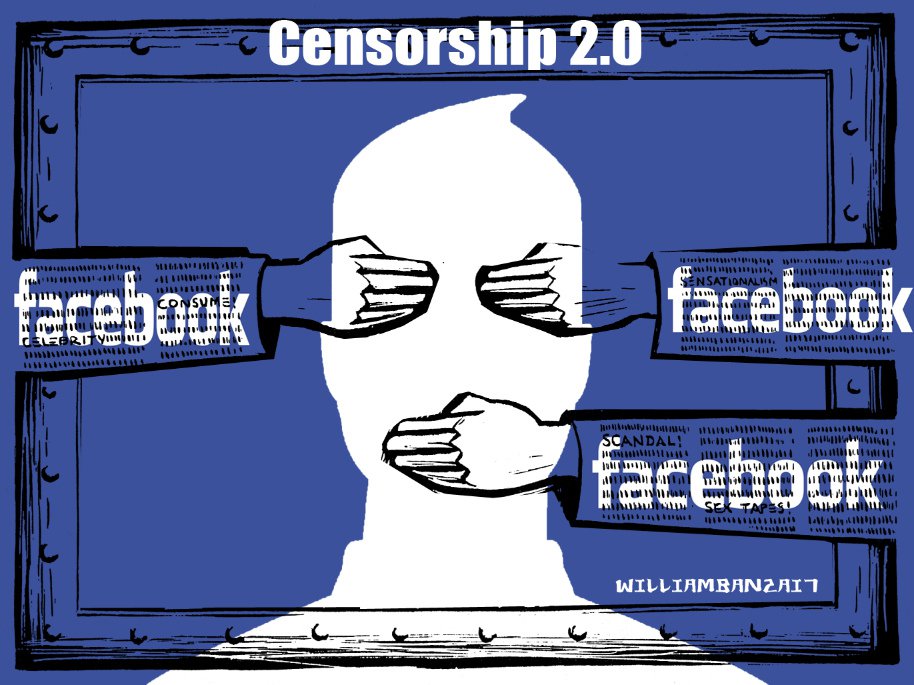
The First Amendment is at a critical juncture. Recent congressional hearings on the Twitter Files brought the matter into full public view. Freedom of speech and of the press are hanging by a precarious thread. Do we want a future in which information flows freely, or one in which an information elite controls those flows “for our own good?” The choices we make over the next few years will determine which of those futures we get.
It’s tragic that we have let the problem reach this dangerous state. What heightens the tragedy, however, is that the war against America’s most cherished freedoms was predictable and preventable. If those of us who value freedom want to win, we’re going to need a strategy grounded in a clear understanding of what’s happening and why.
The Twitter Files story is shocking. Allegations that big tech and social media manipulate information have been around for as long as we’ve had tech and social media companies. Allegations of bias among the mainstream media are even older. In recent years, however, both the allegations and the supporting evidence have ratcheted upward to unprecedented levels.
When Elon Musk acquired Twitter, he opened his company’s internal archives to scrutiny. He assembled a team of journalists with a curious pedigree: registered Democrats with a distaste for Donald Trump and his supporters, whose track records skewed considerably left of center, and whose recent work has demonstrated deep concern about the politicization of journalism.
Musk gave them unfettered access. They found a deep, broad, and disturbing pattern of collaboration between big government and big tech designed to promote “official stories” on multiple issues, throttle competing theories and arguments, and sanction those who dared to question government propaganda.
When two of those journalists – Matt Taibbi and Michael Shellenberger – testified before Congress, their Democratic inquisitors sought to belittle their credentials, question their motives, and tar them as part of some Republican-funded, far-right conspiracy. The still-left-leaning journalists are trying to absorb their shock at the depths to which the formerly civil-libertarian left has fallen.
Far from shocking, however, that fall was predictable – and predicted. In 2001, amidst the public disgust with tech companies following the collapse of the dotcom bubble, I set out to make sense of life during the transition from the late industrial age to the early information age. I analyzed what I called the first four front-page stories of the information age: the dotcom bubble, the Microsoft antitrust trial, the rise of open-source software, and the Napster-driven wars over digital music. Contrary to popular opinion of the time, I believed that these stories were far from distinct. I saw them as four manifestations of a single underlying phenomenon. My goal was to understand that phenomenon.
I found it. It appeared most clearly in the digital music arena, but it ran through all four stories – and through much that has happened since. It appears just as clearly in today’s war on free speech. It involves an entirely predictable pattern of opportunity, action, and reaction.
The starting point is digitization and quantification. The Internet changed the economics of information. Throughout human history, information was scarce, hard to acquire, and expensive to process. Skilled professionals – spies, scholars, lawyers, accountants, clerics, doctors – could command a premium for their knowledge. When the Internet went public, anything that could be digitized and quantified suddenly flowed freely. Information was there for the asking. The premium shifted to filtering – the ability to discard unwanted information and arrange what remained.
Economic shifts generate massive opportunities for creative, entrepreneurial people and bring glorious benefits to millions of consumers. The Internet was no exception in this regard, and neither was the predictable backlash against it. Anything that benefits new businesses and empowers consumers is a warning shot across the bow of powerful incumbents who’d grown accustomed to serving those consumers in a predictable, profitable, manner.
In the music industry, anything that let individual consumers share digital music files reduced the revenues, profits, power, and control of record labels. Pre-digitization, these powerful incumbents determined what music got recorded and how it was packaged, distributed, presented, and priced. It was a comfortable business model that gave us the music industry “as we knew it.” The Internet undermined it entirely.
Powerful incumbents never fade quietly into the night when challenged. They fight, using whatever weapons they can muster. In our society, the most effective ways to undermine new technological and economic opportunities tend to lie in law, regulation, and public policy. The record labels fought – largely successfully – to apply and reinterpret existing laws and to change laws in ways favorable to their interests.
There’s the pattern: Technology creates opportunities. New businesses exploit those opportunities. Consumers benefit. Powerful incumbents fear their loss of control. Threatened incumbents seek allies in government. Government changes laws and regulations to protect incumbent interests. Media campaigns “educate” the public on the merits of the new policies. The new laws ensure that the next wave of technological change runs largely through the powerful incumbents, rather than against them.
By 2003, I had distilled this pattern, showed numerous ways that it had already unfolded, predicted that it would soon hit parts of our economy and our lives far more significant than the music industry, and suggested some ways that we might prepare ourselves for the coming battles.
It took another two years to get my analysis published. It went largely unnoticed. Twelve years later, then-Senator Ben Sasse described the ways that this pattern had forever disrupted the dynamics of employment. This, too, went largely unnoticed.
Today, we see that disruptive pattern threatening the most basic of our civil liberties. Its manifestation in the arenas of speech, propaganda, and censorship is clear. Consider how each step in the process I identified above has played out here:
Technology creates opportunities. The Internet opened entirely new vistas for the creation and exchange of ideas, information, theories, opinions, propaganda, and outright lies.
New businesses exploit those opportunities. The companies founded since 1995 that created and control the world’s most important conduits for information have joined the ranks of history’s most powerful entities.
Consumers benefit. The centrality of these communication systems to our lives (for better or for worse) proves that they confer real value.
Powerful incumbents fear their loss of control. The twin political shocks of 2016 – Brexit and Donald Trump – highlighted the extent to which official channels had lost control of the narrative. With the entirety of elite media, government, big business, and the intelligentsia aligned behind Remain and Hillary, the newly empowered masses understood – for the first time – that there were viable alternatives to the official story.
Threatened incumbents seek allies in government. A coalition of elite forces assembled quickly, laser-focused on stomping out the populist threat. Masses empowered to conduct their own analyses, draw their own conclusions, and share their opinions among themselves threatened the stability of the power structure “as we know it.”
Government changes laws and regulations to protect incumbent interests. Prior to Musk’s Twitter, the entirety of Silicon Valley committed itself to “protecting” the public from “disinformation,” roughly defined as anything that threatened to undermine an official, sanctioned narrative. Allies throughout the administrative state, Congress, and the Biden White House are working to embed those “protections” in law.
Media campaigns “educate” the public on the merits of the new policies. The same mainstream media that vilified Napster, Grokster, and Peer-to-Peer (P2P) file sharing is now working to turn public opinion against the evil purveyors of alleged “disinformation.”
Will the information age be an era of informed, empowered citizens – or an era of a dominant, information-controlling elite? Stay tuned. That’s the question we need to answer.

By Erin Remblance
Source: resilience
As an Australian, it troubles me that if the whole world lived like us, we would need 4.5 planet Earths. Thanks to over-consuming nations like mine, worldwide we are living as if we have 1.75 planet Earths, a figure that has increased from 1 (that is, living within our means) since 1970. What this boils down to is that those of us in the global north are taking from both countries in the global south and future generations to fuel our lifestyles today. The ‘Earth Overshoot’ research is supported by the work of the late Earth System Scientist, Professor Will Steffen, who brought to our attention The Great Acceleration, whereby “[a]fter 1950 we can see that major Earth System changes became directly linked to changes largely related to the global economic system.” Steffen is referring to our growth-based economies, and while three percent economic growth each year might sound small, it means that within 24 years we will be consuming twice as many resources as today, and within 100 years 19 times as many. As economist Kenneth Boulding said: “[a]nyone who believes that exponential growth can go on forever in a finite world is either a madman or an economist.”
For this reason, I am a big proponent of degrowth in over-consuming nations in order to fit back within planetary boundaries. For anyone not familiar with the term, degrowth is a planned, democratic reduction in material and energy use in high-income nations while improving the well-being of people in those nations. It is more than this though. While very often the focus of degrowth is on how life can be better in a smaller economy, Federico Demaria and Serge Latouche argue that “[t]he point of degrowth is to escape from a society that is absorbed by the fetishism of growth…. It implies decolonization of the imaginary and the implementation of other possible worlds”. In this respect, the former definition of degrowth applies only to over-consuming nations, while the latter definition applies to all nations, and to all people. It is this second definition of degrowth to which this essay relates.
The concept of degrowth is powerful because it is clear that we need systemic change to avoid ecological collapse: business as usual with a “green tinge” isn’t going to be enough. It is also true that individual change drives cultural change which can be the key to unlocking political change leading to fundamental change. On this point, I find it fascinating to consider how “growth has entered our minds and souls”, and how an awareness of these “mental infrastructures of growth” might free us from growthism and help unlock the cultural changes that will bring about the necessary systemic changes.
With this in mind, here are a couple of points to consider in relation to how growth may be enshrined in the psychological structure of our collective minds, largely based on the work of Harald Welzer:
In various ways, these – and probably many more aspects of our modern day lives – relate back to the surpluses created by industrialisation (enabling the future to have more than today, a concept that is “historically quite recent”), the enclosure of the commons (the very foundation of growth-dependent capitalism) and the subsequent imperative to work to have our needs met (rather than simply being able to directly meet our needs). Our ability to recognise and unpick these ‘mental infrastructures’ – that is, the worldview that influences all of our actions – will be key to throwing off the shackles of growth and unlocking a culture of sufficiency, whereby we recognise when we have ‘enough’ in a material sense and from then on meet our “nonmaterial needs nonmaterially”, increasing our sense of wellbeing and contentment.
The work of Antonio Gramsci on cultural hegemony is relevant in unlocking a culture of sufficiency. Michael Mezz describes Gramsci’s theory on how the ruling class maintains power via a cultural form of dominance:
“…the ruling class creates an ideology in which its own values become common sense for the rest of society and Gramsci argued that the role of the state is to maintain institutions such as media and the education system that educate the masses on the cultural ideology of the ruling class. The goal of that education being that the working class develop a sense of freedom and a good life that serves the purposes of the people in power. In other words, the working class starts to value things like innovation and productivity and economic growth that doesn’t actually serve them.”
Gramsci tells us that the way to overcome cultural hegemony is by creating a new culture that is not based on the values of the ruling class. A counter-culture, if you like.
So, what are the counter-hegemonic narratives that we can begin to embrace? What would a mind and soul not infiltrated by growth look like? There is much to learn from indigenous cultures on this topic. As Jeff Sparrow highlights in his book, Crimes Against Nature, First Nation Australians found paid labour to be antithetical to their egalitarian lifestyles:
“Today, we take the wages system for granted. It appears normal, almost eternal, since we can barely conceive of an alternative. It did not seem normal to pre-colonial people. In Australia, as elsewhere in the world, they found capitalist practices utterly horrifying…. Indigenous people, accustomed to an egalitarian ethos and to work carried out for the collective good, saw the authority exerted by employers as tyranny. As late as 1888, a churchman complained of the difficulty he had in persuading Indigenous people that one man was innately better than another, that a certain individual, by virtue of his possessions, mandated obedience from his fellows…. Indigenous people did not despise wage labour primarily because of the effort that it entailed. Rather, they thought the work demanded by capitalists stripped life of its humanity.”
Furthermore, First Nations people lived with the rhythms of nature, not the industrial workday, and there was no private land ownership, they had the wisdom to know that “… you are undone if you once forget that the fruits of the earth belong to us all, and the earth itself to nobody” (Jean-Jacques Rousseau).
There are many examples of counter-hegemonic narratives arising more recently too. The following list is skewed more towards examples from the global North because the global North represents the vast majority of the over-consumption and is therefore where cultural change is most needed. Such examples include:
There are, of course, many other wonderful counter-culture examples beyond this short list – this is merely scratching the surface – but the point is that we need to advance these, and those of the same theme, until they become the leading narrative.
Unpicking the dominant, growth-based worldview will mean closely analysing the stories we have been told (and who those stories might serve), and bravely and courageously assessing whether all of this growth really does bring us ‘the good life’. We will likely find that we can achieve ‘a good life’ (that is, harmony with ourselves, our community, and the physical world) by living simpler but more meaningful lives. Perhaps we will even come to realise the very wise words of English writer, Alan Watts: “the meaning of life is just to be alive. It is so plain and so obvious and so simple. And yet, everybody rushes around in a great panic as if it were necessary to achieve something beyond themselves”. The way that growth manifests in our minds, our thoughts, our dreams, and our souls is important to consider because if we can create a culture of sufficiency, we will have found the key to systemic change and avoiding ecological catastrophe. I’m sure we can all agree that this is a worthy task indeed.

A sinister Big Conspiracy backs a presidential candidate in 2024 –“88”
By Roger Moore
Source: Movie Nation
In Oliver Stone’s 1991 film “JFK,” Donald Sutherland played a character only identified as “X,” the “explainer” who downloads most of the suspect government and government officials’ actions in the days surrounding the Kennedy Assassination in 1963.
It’s a strange and in retrospect amusing way of throwing everything behind Stone’s thesis in the film at the wall at once in a single mesmerizing third action monologue.
Imagine a whole movie of such monologues, with more than one version of such a connect-the-dots character.
“88” is a political thriller by the one-named Nigerian/British/American filmmaker Eromose (“Legacy”), a two hour sermon on white supremacy and dark money and how America got to where it is today. It’s never less than interesting, even as its dramatic urgency wanes due to the monotony of its message and the over-the-top “thrills” this thriller never bothers to provide.
Brandon Victor Jackson plays Femi, a numbers guy who works in accounting in the fundraising office of candidate Harold Roundtree, a pre-Iowa (oopsie) “front-runner” for the 2024 presidential nomination, mainly thanks to huge infusions of cash from assorted non-profit political action committees.
Femi spots an odd thing about these donations, their bizarre numeric amounts that add up to some incarnation of the number “88.”
As he passes this info on to his senior campaign staff bosses (Amy Sloan, Michael Harney), he continues to dig and brings in a Jewish pal (Thomas Sadoski) whose “investigative” skills he can tap into. And Ira sees something straight away. Those numbers, “88?” That’s white supremacist code for the eighth letter of the alphabet, repeated.
“HH…’Heil Hitler.’”
“88” takes these two, and Femi’s pregnant activist/wife Maria (Naturi Naughton) and that campaign through a round of digging and soul-searching over the latest “chosen one” candidate, a great communicator with all the right education and background and a sketchy tie to one big non-profit PAC, the one he ran right up to the day he announced, “One USA.”
We meet the candidate who inspires Femi and convinces the veteran political operatives on the staff that he’s a winner via a long interview Roundtree has with a tough-minded, challenging journalist.
Our writer-director lets us know how to write “names” into your low-budget film’s cast, by putting the movie’s two most famous actors onto basically a single TV interview set (no background, just darkness behind them) for a series of scenes intercut into the action, scenes that might have taken just a couple of days to shoot.
Orlando Jones (“Drumline”) is surprisingly affecting and Obama-esque as Roundtree, and William Fichtner (TV’s “Mom,” “The Perfect Storm”) gets to ask the uncomfortable questions as a bulldog TV interrogator who brings up “race,” a topic our candidate dodges, Big Money in politics and white supremacy, including Abraham Lincoln’s thoughts on the matter.
Femi’s quest takes on “Marathon Man” intrigues (without violence), “follow the money” “All the President’s Men” plotting and “JFK” warning phone calls and “visits” from those who either want to expose the truth, or want to ensure Femi doesn’t reveal it.
“There’s a storm coming, Mister Jackson! Stay out of the way!”
Eromose gives us primers on lynching and global racist politics and even an animated “Schoolhouse Rock” style explainer on how “rich people buy elections” thanks to the infamous Citizen’s United case.
“88” is informatively watchable, thanks to all these in-story tutorials. What it lacks is high drama and a sense of the stakes, which never feel as murderous as you might expect. All this backstory about Femi’s AA membership and wife Maria’s boycott-armed activism against her own bank’s lending policies and the “plantation owners” of the National Football League and debating Black Lives Matter vs. Stop Asian Hate clutters up the film and ignores the very basic lessons of “All the President’s Men.”
“Follow the money,” and “What did the (candidate for) President know, and when did he know it?”
It’s possible to be a bit awed by the “JFK” ambition of “88,” even if the execution waters down Eromose’s message to the point where we wonder if he’s simply lost his nerve.
____________________
Watch 88 on Hoopla here: https://www.hoopladigital.com/title/15769261
By Edward Curtin
Source: Behind the Curtain
It has been fifty-five years since Senator Robert F. Kennedy stepped onto the presidential nominating stage to try to mend the massive breach that had opened in American society. The country was torn asunder by the Vietnam War, racism, poverty, the assassination of President Kennedy and the soon-to-be assassination of Rev. Martin Luther King, Jr. Chaos reigned as Lyndon Johnson lied and Richard Nixon matched him in verbal and actual treachery. A war between Middle America and the elites running the government was breaking out across the country. A great divide between whites and blacks, rich and poor, the working class and the upper class was opening wide. The Tet Offensive had just ripped the face off the official lies about the course of the war in Vietnam and the emperor, Lyndon Jonson, stood naked and would soon announce that he would not run again.
On March 16, 1968, Senator Kennedy declared his candidacy with these words:
I do not run for the presidency merely to oppose any man but to propose new policies. I run because I am convinced that this country is on a perilous course and because I have such strong feelings about what must be done, and I feel that I’m obliged to do all that I can.
I run to seek new policies – policies to end the bloodshed in Vietnam and in our cities, policies to close the gaps that now exist between black and white, between rich and poor, between young and old, in this country and around the rest of the world.
By the end of 1968, a plague year if there ever were one, Richard Nixon, together with his goon squad, prepared to occupy the White House, Vietnam raged on, and everything King and Kennedy stood for seemed lost. Ignorance, vituperation, and the divide-and-conquer technique long practiced by the power elites set into the body politic like a deadly cancer. Something died, all hope seemed lost, and the perilous course RFK spoke of was never stopped. Jackals with polished faces have sat in the White House ever since.
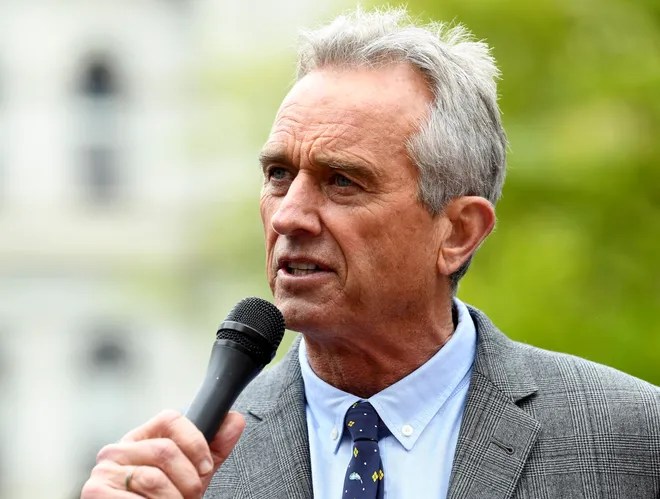
Today hope is resurrected. Enter Robert F. Kennedy, Jr. center stage who will declare his candidacy for the Democratic nomination for president on Wednesday, April 19, in Boston, Massachusetts.
The wheel of history has turned and 2023 resembles 1968 in many ways while getting worse in others. The divide in the country remains but has greatly widened. The CIA and the intelligence agencies totally control the mainstream media now. The Pentagon’s budget has increased exponentially. The U.S. wages a savage war against Russia in Ukraine under the blatant lie of defending freedom while supporting Nazis and greatly risking nuclear war. It provokes war with China. Permanent war is government policy with military bases and CIA and special forces all over the world, waging semi-clandestine wars, or maybe just wars that people don’t want to know about. The gap between the rich and the poor has widened while the elites mock working class people as moronic deplorables. The Department of Defense controls the development, manufacturing, clinical testing, supply, production, and distribution of the mRNA vaccines, while the criminal pharmaceutical companies reap obscene profits. Lies are piled upon lies in what amounts to an Orwellian nightmare. And while LBJ and Nixon have been replaced by Joe Biden, the warfare state roll on.
Some things have changed, of course. In 1968, liberals were turning against the U.S. war against Vietnam and were growing wary of the CIA. Today they support all the Democratic-led wars and love the CIA. They trust the obvious media lies and those of a proven liar such as Anthony Fauci. Nowhere is this sadly truer than with the extended Kennedy family, who in their support for Biden, Fauci, the CIA, etc. have betrayed JFK and RFK. Their smugness and support for Biden against their brother who is carrying on his uncle’s and father’s legacy is betrayal of the worst kind.
Despite a family actively opposed to his candidacy, despite all the media lies about him, and despite the odds makers giving him little chance, RFK, Jr. is entering the race. It is an act of supreme moral courage.
Like his father in ’68, he is the only candidate who can heal this nation’s great divide.
That he is opposed by a huge array of people who will lie about him because he is a truthteller does not deter him. Those lies immediately started up again as soon as word got out that he might run. It’s an old story.
Trash will be thrown at him. Every blemish of his nearly seventy years will be dredged up to paint him as a villain, a flawed man, a hypocrite – name all the negative terms you can think of and the real hypocrites, in their self-righteous rage, will use them against him. They will bounce off him. He is ready.
When Bobby, Jr. was young, his father handed him a book and said with urgency, “I want you to read this.” It was Albert Camus’s The Plague. He read it and it has informed his life ever since. Just as in 1968, we live in plague times, and the plague is US, it runs through all our institutions and, as in Camus’s books, the rats are running wild, devouring truth and the values that can redeem us. As he has written in his beautiful and important book, American Values: Lessons I Learned from My Family, Camus’s analysis of Sisyphus and the ancient Greeks has taught him an important lesson:
It is neither our position nor our circumstances that define us, according to the Stoics, but our response to those circumstance; when destiny crushes us, small heroic gestures of courage and service can bring us peace and fulfillment. In applying our shoulder to the stone, we give order to a chaotic universe. Of the many wonderful things my father left me, this philosophical truth was perhaps the most useful. In many ways, it has defined my life, and has allowed me to find serenity and purpose even in the most trying and tragic circumstances. (p.287)
Despite its brilliance, American Values (see this) was completely ignored by the mainstream press. Why? Because it revolves around “Chapter 9, Senator Robert F. Kennedy” and the long war between the Kennedys and the CIA that resulted in the deaths of JFK and RFK. In this chapter, RFK, Jr. brilliantly shows that he fully grasps the CIA’s evil history. All the other chapters, while very interesting personal and family history, pale in importance. No member of the Kennedy family since JFK or RFK has dared to say what RFK, Jr. does in this book. He indicts the CIA. This is probably not a small part of his extended family’s animosity toward him. Family taboos must be protected, as if they were state secrets.
But his indictment of the CIA is the fundamental reason why it and the media will at all costs try to prevent him from getting the nomination. The character assassination will be intense.
Kennedy knows he faces an uphill battle for the presidency, but no matter what forces are aligned against him, political and familial, he will not back down.
He will surprise all the pundits, for his appeal crosses party lines. He is tough and very smart. He has been so hated and falsely maligned by the mainstream media for so long that he is skilled at keeping to his message, which I think will be positive and inspirational, something that this country is desperate for after so many years of lies and treachery.
Even Biden’s supporters in the Democratic party know he is a flawed candidate on his last legs, laboring to keep his words straight and his steps solid. While he may have long served as the establishment’s war puppet, there are many nervous Democrats who want to finally cut their strings with him. And the Republicans are a party in disarray, internally torn and tired of the Trump saga which will not end.
Two clowns don’t make for a pretty picture running the country and the world into the ground. Biden and Trump and their predecessors are naked now and not just does one boy see it and shout it only to be ignored. There is a growing feeling throughout the country that truth and goodness spoken clearly are desperately needed to unite the country through common values. Bob Dylan got it right back a few years:
While preachers preach of evil fates
Teachers teach that knowledge waits
Can lead to hundred-dollar plates
Goodness hides behind its gates
But even the president of the United States
Sometimes must have to stand naked
Every day Americans are bombarded with bad news: the U.S. war against Russia via Ukraine, the lies about the “threats” from Russia and China, the collapsing economy, toxic spills, gun violence, corporate gangsters ripping off the average American and funneling those monies to the politicians who pimp for them, the egregious Covid-19 and “vaccine” lies that are daily being exposed as deadly frauds, the growing threat of nuclear war, etc.
Bad bad news, and with it a growing public sense of hopelessness. A pall of unacknowledged depression smothers the country. People are dying for hope, as they were in 1968. In their inner hearts there is this desperate yearning for one brave soul to stand up and tell Americans the truth about what has happened to their country. Bobby Kennedy, Jr. is the only one who can move Americans to hope again.
For years he has been telling harsh truths that many who profit from the lies do not want to hear. That our waters are polluted and the chemical companies are criminals; that the pharmaceutical companies are criminal enterprises polluting people’s bodies; that the CIA is organized crime polluting people’s minds and assassinating its anti-war leaders; that the Pentagon is a criminal enterprise not defending but risking American’s lives and their livelihood; that the U.S. government has joined with mega-corporations to run a Mob-like fleecing of the American people; that not one of Sirhan Sirhan’s bullets killed his father, Senator Robert Kennedy, who was shot from behind at close range by a CIA hit man; that the so-called Covid vaccines are very dangerous and have never been appropriately tested and many people are dying and being injured as a result; that Anthony Fauci is a liar and fraud who fronts for Big Pharma (see this) in the Covid-19 crisis that is an intelligence-run operation controlled by spooks working with medical technocrats; and that we are close to losing our country and any semblance of its democratic ideals.
These are not liberal or conservative positions. They are self-evident conclusions of a patriot, as they should be for everyone.
And because they have become such to more and more Americans who can think without reacting, Kennedy’s voice and his candidacy will grow in strength across the great divide.
The media attacks will be intense and simply full of lies. They love to call him an “anti-vaxxer,” when he is not opposed to all vaccines. But no matter how many times he has explained this, the media twist it to serve their masters.
For example, The New York Post recently published a slimy piece that could serve as a template for all the propaganda aimed at Kennedy. Let me quote:
Robert has said Sirhan did not actually participate in the murder of Sen. Robert F. Kennedy during a Los Angeles presidential campaign stop in 1968.
This of course is a lie. RFK, Jr. has said that Sirhan fired a pistol but none of his bullets hit the Senator. He has said a CIA hit man shot his father at close range from behind as the official autopsy clearly showed, while Sirhan was standing in front of the Senator.
Lie number two. The Post writes:
In it [a speech], he implied that those who oppose vaccines are being persecuted more severely than Anne Frank, the German teen who hid from the Nazis in Amsterdam before being sent to her death at Auschwitz.
He never implied that. His point was clear: that in the coming digital surveillance state there will be nowhere to hide, not even in an attic, because the surveillance technology will track everyone everywhere, day and night.
These are but a few examples. Look and you will find them everywhere now and in the coming days.
The hyenas with polished faces will try like hell to dismiss Robert f. Kennedy, Jr. as a flake, a fraud, and a conspiracy nut on an ego-trip. Too many people can now see through such propaganda. He is the real thing, our best hope to bridge the great divide that has been created by the elites to divide the American people.
He will not back down, and all people of good will who believe the U.S. can still find its way out of the morass we find ourselves in, should back him up. He has warned us, he has given us his voice, and his moral courage should be followed by all who hope to hope.
The pundits who dismiss his chances will then be shocked.
By Alastair Crooke
Source: Strategic Culture Foundation
Is the collective West nearing the end of a cycle? Or are we still in mid-cycle? And could it be an epochal point of inflection?
The question posed at this point is: Is the collective West nearing the end of a cycle? Or are we still in mid-cycle? And is this a four-generational mini-cycle, or an epochal point of inflection?
Is Russo-Chinese Entente and the global tectonic discontent with the ‘Rules Order’ – on the heels of a long trajectory of catastrophes from Viet Nam, through Iraq to Ukraine – sufficient to move the West on to the next stage of cyclical change from apex to disillusionment, retrenchment and eventual stabilisation? Or not?
A major inflection point is typically a period in history when all the negative components from the outgoing era ‘come into play’ – all at once, and all together; and when an anxious ruling class resorts to widespread repression.
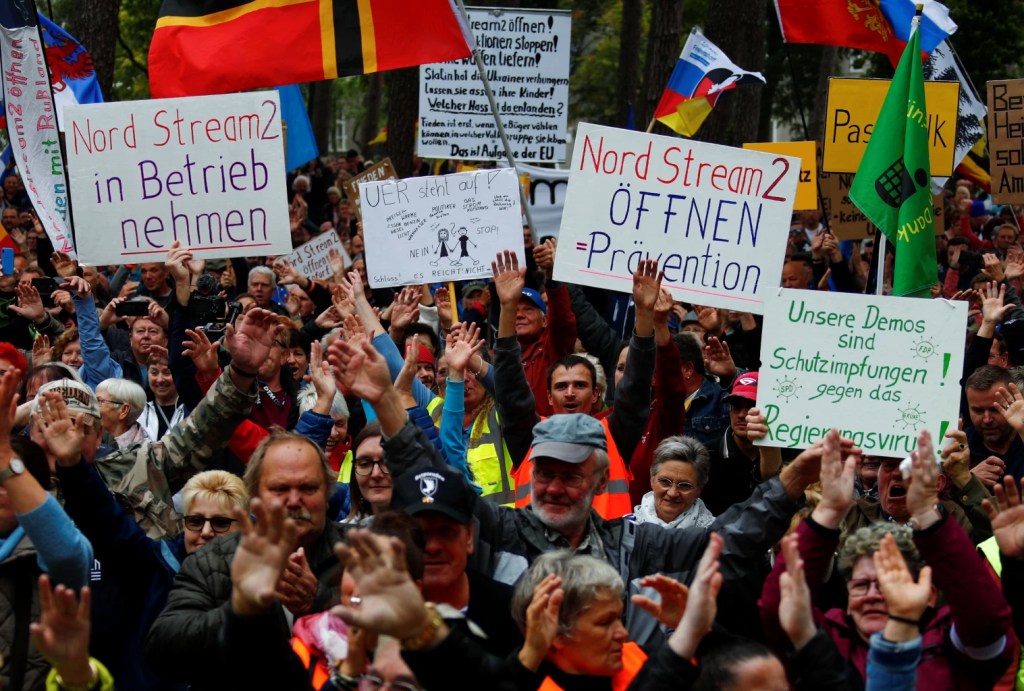
Elements of such crises of inflection are today everywhere present: Deep schism in the U.S.; mass protest in France, and across Europe. A crisis in Israel. Faltering economies; and the threat of some, as yet undefined, financial crisis chilling the air.
Yet, anger erupts at the very suggestion that the West is in difficulties; that its ‘moment in the sun’ must give place to others,and to other cultures’ ways of doing things. The consequence to such a moment of epochal ‘in-betweeness’ has been characterised historically by the irruption of disorder, the breakdown of ethical norms, and the loss of a grip on what is real: Black becomes white; right becomes wrong; up becomes down.
That’s where we are – in the grip of western élite anxiety and a desperation to keep the ‘old machinery’s’ wheels spinning; its ratchets loudly opening and closing, and its levers clanging into, and out of place – all to give the impression of forward motion when, in truth, practically all of western energy is consumed in simply keeping the mechanism noisily aloft, and not crashing to an irreversible, dysfunctional stop.
So, this is the paradigm that governs western politics today: Doubling-down on the Rules Order with no strategic blueprint of what it is supposed to achieve – in fact no blueprint at all, except for ‘fingers crossed’ that something beneficial for the West will emerge, ex machina. The various foreign policy ‘narratives’ (Taiwan, Ukraine, Iran, Israel) contain little of substance. They are all clever linguistics; appeals to emotion, and with no real substance.
All this is hard to assimilate for those living in the non-West. For they do not come face-to-face with western Europe’s repeat re-anactment of the French Revolution’s iconic secular, egalitarian reform of human society – with ‘the specific timbre, flavour and ideology’ shifting, according to prevailing historic conditions.
Other nations unafflicted by this ideology (i.e., effectively the non-West) find it perplexing. The West’s culture war barely touches cultures outside its own. Yet, paradoxically, it dominates global geo-politics – for now.
Today’s ‘flavour’ is termed ‘our’ liberal democracy – the ‘our’ signifying its link to a set of precepts that defies clear definition or nomenclature; but one, that from the 1970s, has drifted into a radical enmity towards the traditional European and American cultural legacy.
What is singular about the present re-enactment is that whereas the French Revolution was about achieving class equality;ending the division between aristocracy and their vassals, liberalism today represents a modification of ideology” that U.S. writer Christopher Rufo suggests, “says that we want to categorize people based on group identity and then equalize outcomes across every axis – predominantly the economic axis, health axis, employment axis, criminal justice axis—and then formalize and enforce a general levelling”.
They want absolute democratic levelling of every societal discrepancy – reaching even, back into history, to historic discrimination and inequalities; and to have history re-written to highlight such ancient practice so that they can be routed out through enforced reverse discrimination.
What has this to do with foreign policy? Well, pretty well everything (so long as ‘our’ liberalism) retains its capture of the western institutional framework.
Bear this background in mind when thinking of the western political class’s reaction to events, say, in the Middle East, or in Ukraine. Although the cognitive élite contends that they are tolerant, inclusive, and pluralistic, they will not accept the moral legitimacy of their opponents. That is why in the U.S. – where the Cultural War is most developed – the language deployed by its foreign policy practitioners is so intemperate and inflammatory towards non-compliant states.
The point here is that, as Professor Frank Furedi has emphasised, the contemporary ‘timbre’ is one no longer merely adversarial, but unremittingly hegemonic. It is not a ‘turn’. It is a rupture: The determination to displace other sets of values by a western inspired ‘Rules-Based Order’.
Being a ‘liberal’ (in this strictly narrow sense) isn’t something you ‘do’; it is what you ‘are’. You think ‘right thoughts’ and utter ‘right speak’. Persuasion and compromise reflect only moral weakness in this vision. Ask the U.S. neocons!
We are used to hearing western officials talk about the ‘Rules-Based Order’ and the Multi-Polar System as rivals in a new global framework of intense ‘competition’. That however, would be to misconceive the nature of the ‘liberal’ project. They are not rivals: There cannot be ‘rivals’; they can only be recalcitrant other societies that have refused the analysis and the need to root out all cultural and psychological structures of inequity from their own domains. (Hence, China is hounded on its alleged deficiency in respect to the Uyghurs).
The cognitive privilege of ‘awareness’ is what lies behind the western ‘doubling-down’ on imposing a global Rules-BasedOrder: No compromise. The moral enterprise is more intent on its elevated moral station than on coming to terms with or managing, say, a defeat in Ukraine.
Just yesterday, the Bank of America in London was forced to cut short a two-day, online conference on geopolitics; and apologised to attendees following the outrage expressed at a speaker’s comments that were deemed ‘pro-Russian’ by some attendees.
What was said? Professor Nicolai Petro’s remarks at the session where he said: “Under any scenario, Ukraine would be the overwhelming loser in the war: Its industrial capacity devastated … and its population shrunk as people departed to look for employment abroad. If this is what is meant by removing Ukraine’s capacity to wage war against Russia, then it [Russia] will have won”. Professor Petro added that the U.S. government had no interest in a ceasefire, as it had the most to gain from a prolonged conflict.
No compromise is allowed. To speak thus, to inhabit the western moral high ground creating ‘villains’, clearly is more important than coming to terms with reality. Professor Petro’s comments were condemned as “rolling through Moscow’s talking points”.
Yet, these cultural revolutionaries face a pitfall, Christopher Rufo writes,
“Theirs is actually, not an easy task. This is very difficult, and, in fact, I think is somewhat impossible. If you look at even the Chinese Cultural Revolution in the 1960s … They had a program of economic and social levelling that was more totalitarian and more drastic than anything that had ever happened in the past. [Yet] after the Revolution collapsed, after the period of retrenchment, social scientists looked at the data and discovered that a generation later, those initial inequalities had stabilized … The point is that forced levelling is very elusive. It’s very difficult to achieve, even when you are doing it at the tip of a spear or at the point of a gun.
The levelling project being essentially nihilistic becomes captured by the destructive side of the revolution – its authors so absorbed with dismantling structures that they do not attend to the need to think policies through, before launching into them. The latter are not adept at doing politics: at making politics ‘work’.
Thus, discontent at the welling string of western foreign policy flops grows. Crises multiply, both in number and across different societal dimensions. Perhaps, we are closening to a point of beginning to move through the cycle – toward disillusionment, retrenchment, and stabilization; the prerequisite step to catharsis and ultimate renewal. Yet, it would be a mistake to underestimate the longevity and tenacity of the western revolutionary impulse.
“The revolution does not operate as an explicit political movement. It operates laterally through the bureaucracy and it filters its revolutionary language through the language of the therapeutic, the language of the pedagogical, or the language of the corporate HR department”, Professor Furedi writes. “And then, it establishes power anti-democratically, bypassing the democratic structure: using this manipulative and soft language – to continue the revolution from within the institutions.”
By Robert J. Burrowes
As has been carefully documented, under cover of the ‘virus’/‘vaccine’ narrative, the Global Elite is implementing long-planned and profound changes to 200 areas of human life.
In essence, as documented elsewhere – see ‘We Are Being Smashed Politically, Economically, Medically and Technologically by the Elite’s “Great Reset”: Why? How Do We Fight Back Effectively?’ – this program will kill off a substantial proportion of humanity, imprison those left alive as transhuman slaves in their ‘smart cities’ subject to their fourth industrial revolution technologies (including 5G, digital ID, CBDCs, geofencing, AI policing & a robotized workforce), enclose the Commons forever and transfer all wealth to Elite hands.
Needless to say, with some people already resisting and more people likely to perceive the truth of what is happening and join the resistance with the passage of time, policing the imposition of this program will be a critical factor in ensuring its success.
As indicated then, just one area in which profound change will take place is policing.
Future policing will be done by a smaller number of militarily-equipped police, transhuman police and technocratic police supported by corporate private security technology. In this article, I will briefly outline the key changes to policing, in these three distinct categories, and also explain why these changes must be resisted and how we can do this most effectively.
Fewer and Militarized Police
Reflecting a longer term trend, in 2019 the International Association of Chiefs of Police reported that ‘Law enforcement agencies across the United States are struggling to recruit and hire police officers.’ While police killings of innocent civilians – see ‘Mapping Police Violence’ and ‘Not just “a few bad apples”: U.S. police kill civilians at much higher rates than other countries’ – failed to rate a mention in the report, it did at least acknowledge ‘Scrutiny of the police, cellphone recordings of interactions between the police and public, media coverage, and popular entertainment portrayals of police have led many young people to view police differently than their parents may have.’ See ‘The State of Recruitment: A Crisis for Law Enforcement’.
In late 2021, two years into policing the pandemic, US police reported a substantially increased rate of retirement and resignation among police officers, with more than five times as many police leaving the New York Police Department in 2021 as left in 2020. According to the report: ‘In the wake of a spasmodic year of protests and pandemic, plus an aftermath of violent crime, the profession may be fast approaching a generational and possibly historic reckoning.’ See ‘Law enforcement faces unprecedented challenges in hiring and keeping recruits’.
On the other side of the world, where the Victoria Police had suffered an image-battering following their violent policing of protests against Covid-19 lockdown measures – see ‘Australia: Harsh Police Response During Covid-19’ – the situation was the same: ‘Victoria Police is facing a staffing crisis with an extra 1500 frontline officers needed, secret modelling has warned.’ See ‘Secret Report Reveals Victoria Police Facing a Staffing Crisis’.
Of course other police forces around the world suffered image batterings in response to their violent response to those protesting ‘pandemic’ lockdowns and other restrictions. See, for example, ‘Serbia: Violent police crackdown against COVID-19 lockdown protesters must stop’.
But on top of long-standing issues in relation to police numbers exacerbated by political direction of policing behaviour while enforcing ‘pandemic’ lockdown measures, it is clear that the number of serving police has been reduced throughout the past three years by using two additional mechanisms: In many places, forcing those who resisted the ‘kill shot’ to resign from service – see, for example, ‘Victoria Police facing exodus due to draconian Covid rules’ – and, everywhere, by killing off a proportion of the police who were mandated to take the shot (which will continue to have impact in the years ahead).
Apart from this, the damaged reputation police suffered as a result of their role in enforcing the Elite program against those people willing to nonviolently protest the violation of their constitutional and human rights, has meant that the conscience-based resignation rate of police has risen – see, for example, ‘Conscientious Resignation of Police Officer in Australia’ – while recruitment has suffered in many places.
Separately from this, other resignations and retirements have probably occurred following official interference to thwart conscientious police officers asked or attempting to investigate deaths from Covid-19 injections – see one initiative by New Zealand doctors to have the issue investigated (‘Deaths Following C-19 Vaccination’) which ran into government obstruction (‘Jacinda Ardern Left Reeling As New Zealand Police Look at Investigating COVID Jab Deaths’) and a Canadian officer punished for conducting an investigation (‘Ottawa police officer charged for examining COVID-19 vaccine deaths’). Of course, any attempts to expose injection deaths among police colleagues have no doubt been ‘discouraged’ despite evidence of their occurrence.
In any case, two critical questions to ask are these: Were government policies that led to police violence during the pandemic designed to provoke public anger and induce police retirements and resignations as ways of reducing police numbers easily? And was official interference in police decisions about whether or not to investigate injection deaths partly designed to disenchant conscientious officers and induce further resignation/retirements?
Why would governments do this? Could it be part of a plan to facilitate the transformation of how policing is conducted? After all, the World Economic Forum has been clear about the Elite intention to robotize the workforce, with more than half of human workers projected to be replaced by robots within a few years. See ‘Machines Will Do More Tasks Than Humans by 2025 but Robot Revolution Will Still Create 58 Million Net New Jobs in Next Five Years’. So why should we expect police to be forced out of the workforce, one way or another, at a lesser rate than elsewhere?
Moreover, there is an additional problem: Any human police officer with a reasonably ‘normal’ psychological profile has a conscience. And these will not serve well in enforcing the coming technocratic order.
Separately from the numbers issue, the ongoing militarization of police forces around the world has been noted by many scholars. For a summary of some issues in relation to policing in the USA, see this article written in 2017: ‘Why are Police in the USA so Terrified?’
But it is clear that the trend to militarize policing has been accelerating for some years. In a recent article US constitutional attorney John Whitehead succinctly elaborates this trend as just one of the features to be expected from the US government in 2023:
‘Militarized police. Having transformed local law enforcement into extensions of the military, the Department of Homeland Security, the Justice Department and the FBI are moving into the next phase of the transformation, turning the nation’s police officers into techno-warriors, complete with iris scanners, body scanners, thermal imaging Doppler radar devices, facial recognition programs, license plate readers, cell phone extraction software, Stingray devices and so much more.’ See ‘What to Expect from the Government in 2023? More of the Same’ and ‘Stingray Tracking Devices: Who’s Got Them?’
So police numbers are being reduced and police are being militarized. But that is not all.
Transhuman Police
A critical component of the Elite program is to turn those not killed into transhuman slaves.
What is transhumanism?
In essence: Transhumanism is a set of beliefs based on the premise that human beings can be improved by genetic manipulation and/or implanting technologies into the brain and body to achieve enhanced capacities. See ‘Beware the Transhumanists: How “Being Human” is being Re-engineered by the Elite’s Covid-19 Coup’.
While many people involved in this field are concerned with treating disabilities to improve the life experience of those afflicted, and some are engaged in ongoing discussions to consider the ethical issues this raises, it is clear that this is the sanitized version of a program that has far more hideous implications. For a sanitized version, watch this video of a World Economic Forum discussion held on 24 January 2020: ‘When Humans Become Cyborgs’.
But, for the Elite, there is little point deploying these technologies unless they can be controlled by Elite agents. After all, as the World Economic Forum made clear in 2016, by 2030 ‘You’ll Own Nothing. And You’ll Be Happy.’ See ‘8 predictions for the world in 2030’.
Obviously, if you are to own nothing and be happy about it, either you have reached some exalted state of human consciousness in which possessions no longer matter or someone is messing with your mind so that you believe what is not true.
And the best way to mess with someone’s mind is to implant a microchip into their body that enables control of that mind by someone else.
After all, altering what people think, feel, believe and do – through genetic manipulation and implanting technologies – is the very essence of transhumanism. So, to reiterate, transhumanists don’t want individuals with free will, they want individuals whose thoughts, feelings and behaviour can be controlled; that is, they want slaves. While this is explained at some length in the article ‘Beware the Transhumanists’ above, it is also made emphatically clear by World Economic Forum spokesperson, Professor Yuval Noah Harrari, in a 3-minute video which includes these words:
COVID is critical because this is what convinces people to accept, to legitimize, total biometric surveillance.
We now see mass surveillance systems established, even in democratic countries which previously rejected them, and we also see a change in the nature of surveillance. Previously, surveillance was mainly above the skin, now it’s going under the skin….
… free will: That’s over. Watch ‘Mr. Harari has just revealed the Reason for the Plandemic’.
You can also watch a video demonstration of Elon Musk’s neuralink chip illustrating how this will work. Watch ‘This Is How Elon Musk’s Neuralink Microchip Will Be Put In Your Brain’.
In summary then, the technology now available after decades of effort enables receiver nanochips to be sprayed, injected or otherwise implanted into human bodies. With the ongoing deployment of 5G (which includes extensive space and ground-based technologies: see ‘Deadly Rainbow: Will 5G Precipitate the Extinction of All Life on Earth?’), just one outcome of these combined technologies is that it will be possible to direct the individual behaviour of each person so implanted with directions from an external source.
You can watch a description of how the Covid-19 shots have been used to inject nanotechnology into the bodies of people which, under the direction of other individuals via EMF signals, can be assembled to establish a permanent communication and control link between the transhuman and those responsible for controlling it. Watch Maria Zeee’s interview of Dr. David Nixon who shows real time video footage of the nanotechnology inside the Covid-19 injections assembling robotic arms that guide the nanotechnology development: ‘World First: Robotic Arms Assembling Via Nanotech Inside COVID-19 “Vaccines” – Filmed in Real Time’.
There is another excellent video interview by Dr. Faiez Kirsten of Dr. Ana Mihalcea discussing the transhumanist agenda. This includes consideration of how geoengineering – by spraying metal particulates (such as aluminium, barium and strontium) and synthetic biology into the atmosphere – is being used to modify all life on this planet (‘to modify every cell, every microbe, to digitize it and then to fuse it in its natural state with synthetic biology’), the role of electromagnetic frequencies (EMF) such as 5G in this scheme, and the purpose of nanotechnology ingredients in the injections. In essence, they conclude, besides killing vast numbers of people, they want to control the minds of those left alive. In summarizing, Mihalcea emphasised that her research demonstrates that the unvaccinated are not safe and they must take further action to defend their health from the synthetic biology attacks through atmospheric geoengineering and contaminated food.
‘We are running out of time as the human species and our planet is being destroyed via synthetic biology. If you want to survive and you want your children and grandchildren to have a chance of survival you must rise now and you must fight.’ Watch ‘A Discussion with Dr Ana Mihalcea on Transhumanism and EDTA Chelation’.
Moreover, given that the control technology of its transhuman slaves will be owned by corporate executives, this means that the Elite will be able to control everything from the launch of nuclear weapons (by using remote control to direct the chosen individual in a particular chain of command to order [or execute] the launch of one or more nuclear weapons at the target[s] nominated at the time[s] specified), deploy ‘cyborg soldiers’, ‘cyborg workers’ and ‘cyborg consumers’ to do as directed and, of course, ‘cyborg police’ to carry out the orders issued by those controlling the command technology.
In the case of transhuman police, this could range from duties resembling those now performed by police to any other task whatsoever to which they are assigned. And because the implanted chip will override free will, the transhuman individual will have no awareness of choice and will simply robotically perform the tasks delivered by an artificial intelligence program to the technological implants in its body and brain.
So whether programmed to issue a fine, kill a noncompliant individual, forcibly relocate one or more people from a rural area to the nearest ‘smart city’ or simply go home, the cyborg police officer will do as directed without thought or feeling of its own.
Technocratic Police and Corporate Private Security
In 2016, the World Bank published a report considering some of the consequences of robotization, including the problems that would be caused and how these might, theoretically, be addressed. See ‘The rise of the machines: Economic and social consequences of robotization’ with a summary here: ‘The economic and social consequences of robotization’.
Despite one highly sanitized World Economic Forum account of robots leading to an increased workforce – see ‘Here’s why robots are actually going to increase human employment’ – another World Economic Forum report candidly noted that inequality would worsen as ‘robots will do half of all work tasks by 2025’. See ‘The Future of Jobs Report 2020’ and ‘WEF: Inequality likely to worsen as robots set to do half of work by 2025’.
And this is clearly evident in relation to police work where, beyond even the measures outlined above, a substantial range of new technologies will robotize policing, particularly in relation to primary functions: surveillance and control.
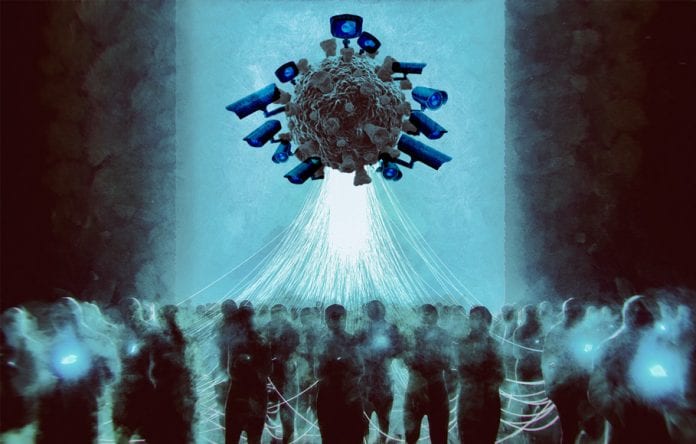
In essence, an increasing number of policing functions are being technologized to make policing more ruthlessly efficient. This involves use of a range of technologies such as 5G, the Internet of Things (IoT), the Internet of Bodies (IoB), the Internet of Places (IoP), artificial intelligence (AI), geofencing, digital identity, surveillance and facial recognition (3D) cameras, smart street poles and lights (which gather data via facial recognition cameras and environmental sensors, display digital signage and use speakers to instruct the immediate population how to behave), license plate readers and vehicle kill switches as well as autonomous and electromagnetic weapons.
But how these technologies are combined and deployed varies. To illustrate this, consider the Israeli private security company Gabriel Protects which offers a suite of surveillance and control services: ‘Preempt and contain physical threats in real time with smart technology. Billions are spent monitoring and recording security incidents. Gabriel detects and responds to them. Gabriel’s next generation security technology instantly detects and automates the response to violent threats, saving precious time and lives.’
As Whitney Webb explains: ‘much of the company’s future vision coincides with the vision of the intelligence agencies backing it – pre-crime, robotic policing and biometric surveillance.’ Hence, under the guise of stopping mass shootings ‘a surveillance system backed by top Mossad, CIA and FBI officials is being installed in schools, houses of worship, and other civilian locations’ throughout the USA. The Gabriel system includes the company’s ‘threat detection’ technology, which involves the use of ‘smart cameras’ that use AI as well as facial recognition and related technologies to detect weapons, ‘fights’ and ‘abnormal behavior’ in a particular area. The cameras throughout a facility, along with ‘smart shield’ panic buttons which can be activated both manually and remotely, are meant to act as ‘activation triggers’, with the triggering largely automated and managed by AI. When a trigger is set off, the Gabriel system enters the appropriate ‘alert mode’, which includes emergency, panic, silent panic and yellow (for minor incidents). Once activated, the panic button offers two-way communication, a live video feed and gunshot detection by acoustic means. See ‘CIA and Mossad-linked Surveillance System Quietly Being Installed Throughout the US’ and ‘Anonymous Philanthropist Gifts Israeli Life-Saving Tech to 500 US Synagogues and Schools’.
As one would expect, given the company is providing technologies that enable implementation of the Elite program to lock us all into their ‘smart cities’, Gabriel intends to expand far beyond schools and houses of worship to retail stores, warehouses, data centers and banks and is already heavily reliant on AI and machine learning while using drones and robots as security tools. Beyond this, it intends to develop predictive policing (‘pre-crime’) capabilities. See ‘Incident Response Solutions’ and ‘Disrupting Legacy Security’. Of course, ‘pre-crime’ protocols are designed to ‘eliminate public dissent’. See ‘CIA and Mossad-linked Surveillance System Quietly Being Installed Throughout the US’.
Gabriel is not the only corporation researching and providing technologies in these fields. Another prominent corporation is Palantir Technologies. There are others.
Needless to say, these corporations have close ties to the academy, the military and the intelligence community as well, all of which are also playing key roles in imposing the Elite program.
Obviously, these surveillance and control technologies are being widely deployed around the world with countries like China, Israel (including in Palestine) and the United States leading the way.
But to highlight precisely where this is headed, technocratic policing will include drones (used as aerial police) and robots equipped with electromagnetic weapons, such as those that tech guru Aman Jabbi calls ‘puke guns’ (to make the target individual vomit). See ‘Digitizing Your Identity is the Fast-Track to Slavery: How Can You Defend Your Freedom?’ And if you would like a taste of where this might go, see ‘Psychotronic and Electromagnetic Weapons: Remote Control of the Human Nervous System’.
Beyond this, police robots are being used to deploy chemical weapons – see ‘Special delivery: Using police robots to deploy chemical agents’ – and fire tasers. See ‘TASER-armed robots keep police out of harm’s way’.
But ‘explosive ordnance disposal robots’ have been used offensively since 1993 when a one-metre tall, 218-kilogram remote-controlled robot was sent into an apartment, used a television camera to locate a suspect hidden in a cupboard and then, under the remote-control direction of a technician, used a high-pressure water gun to knock the shotgun out of the suspected gunman’s hands, enabling the county police department’s version of a SWAT team to arrest him.
More dramatically, a police ‘killer robot’ has already been used to kill a suspected gunman. In 2016, police in Dallas in the USA crudely attached a bomb to a robot originally designed to investigate and safely discharge explosives and then deployed it near a suspect where it was detonated remotely. See ‘How the Dallas Police Used an Improvised Killer Robot to Take Down the Gunman’.
Other police forces are considering using robots to kill suspects. See, for example, ‘Oakland Cops Hope to Arm Robots with Lethal Shotguns’.
But the San Francisco Police Department has already developed a protocol for its use of robots to kill people: ‘Robots will only be used as a deadly force option when risk of loss of life to members of the public or officers are imminent and outweigh any other force option available to SFPD.’ See ‘Law Enforcement Equipment Policy: Inventory Acquired Prior to January 2022’ and ‘SFPD authorized to kill suspects using robots in draft policy’.
The fundamental point is that human police officers are being replaced by a series of technologies guided by artificial intelligence and ending with the use of autonomous weapons systems (AWS).
And these technologies are already being widely deployed and used as part of the ongoing Elite program to build a technocratic state that will subvert human identity, privacy, dignity, volition and freedom.
How Can We Resist this Technocratic Policing Model Effectively?
A long-planned, vast range and parallel sequence of measures is being rapidly implemented to capture political, social, economic, medical and technological control of the human population. The intention is to kill off a substantial proportion of humanity and imprison those left alive as transhuman slaves in the Elite’s technocratic (surveillance and control) ‘smart’ cities, which will be policed by a range of current and emerging technologies.
And, as I have explained previously – see ‘We Are Being Smashed Politically, Economically, Medically and Technologically by the Elite’s ‘Great Reset’: Why? How Do We Fight Back Effectively?’ – because the Global Elite controls conventional political, economic, financial, technological, medical, educational, media and other important levers of society, the Elite has control of how events unfold while simultaneously giving it control of the narrative about what is taking place. As a result, the truth about the Elite plan is easily concealed. Consequently, effective resistance to this complex and sophisticated program requires a response based on a full understanding of the Elite’s deeper agenda and that is equally sophisticated.
This means that we cannot rely on any conventional channel, political, legal or otherwise.
Hence, the most effective defence against any aspect, including the technocratic policing model, of the full program that Elite agents in the World Economic Forum and elsewhere are imposing on us is to take action now that prevents foundational components of their program from being put into place.
Obviously, this requires us to clearly identify the foundations on which the Elite program is being built and to then mobilize as many people as possible, in as many countries as possible, to nonviolently noncooperate with the building of these foundations or, to the extent they exist already, to disrupt them so that they cannot function effectively.
And the time to do this is now.
If we do this effectively, the technologies – including 5G, Artificial Intelligence (AI), digital ID, Central Bank Digital Currencies (CBDCs), geofencing, a plethora of ‘Smart’ devices, and the surveillance and facial recognition cameras – that will make the technocratic policing model possible will be stopped before they are fully deployed.
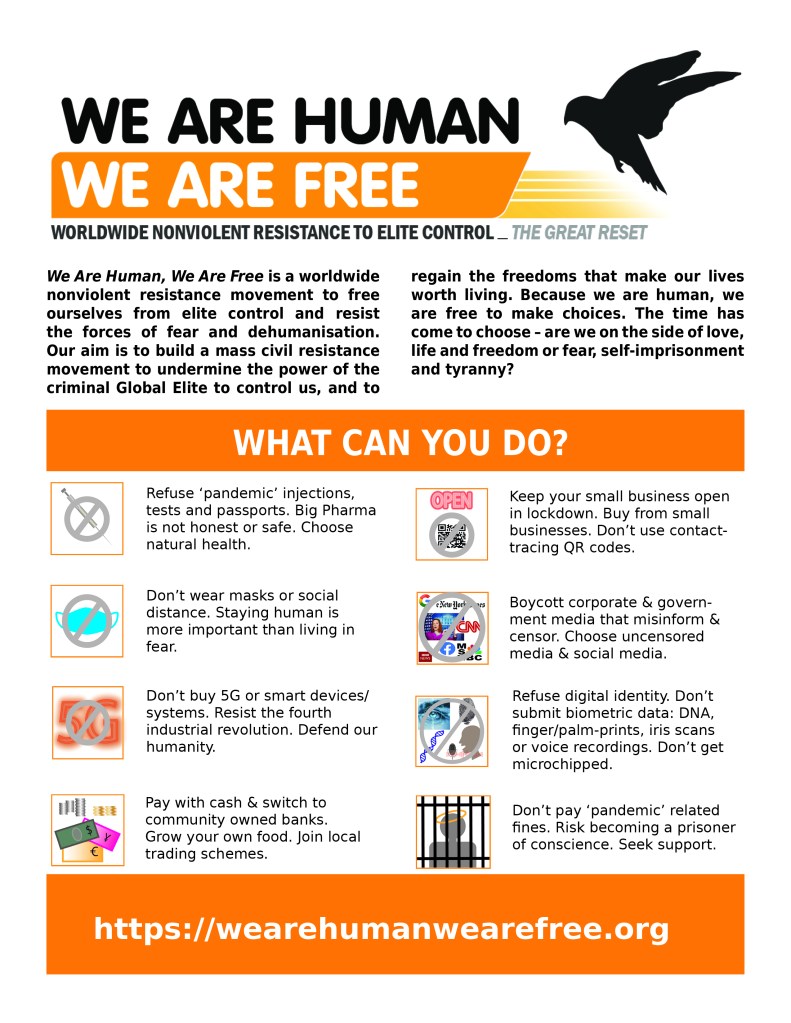
So if you are interested in being strategic in your resistance to the ‘Great Reset’ and its related agendas, you are welcome to participate in the ‘We Are Human, We Are Free’ campaign which identifies a list of 30 strategic goals for doing so.
One of these strategic goals reads as follows:
‘To cause the police and security personnel to resist the introduction and use of those surveillance and control technologies – including (among many others) 5G, 6G, the Internet of Things (IoT), artificial intelligence (AI), geofencing, smart street poles and lights (which gather data via facial recognition cameras and environmental sensors, display digital signage and use speakers to instruct the immediate population how to behave), digital identity, surveillance and facial recognition cameras, license plate readers, vehicle kill switches, drones (used as aerial police), robots (including as a ‘deadly force option’), autonomous and electromagnetic weapons – that are being used to transform policing to collect your data and control your behaviour as part of the ongoing Elite program to build a technocratic prison that will subvert human identity, human dignity, human volition, human privacy and/or human freedom.’
So one vital role that you can play is to talk to individual police officers that you know personally, inform them of the role they are slated to play in the coming technocratic order, and invite them to consider the implications of this for them and their loved ones, and then listen to them as they talk about it.
And you can visit your local police station or write them a letter to raise awareness of what is happening and ask them to consider whether this is a future they wish for themselves or their family.
In addition, you can download the ‘We Are Human, We Are Free’ one-page flyer that identifies a short series of crucial nonviolent actions that anyone can take. This flyer, now available in 23 languages (Chinese, Croatian, Czech, Danish, Dutch, English, Finnish, French, German, Greek, Hebrew, Hungarian, Italian, Japanese, Malay, Polish, Portuguese, Romanian, Russian, Serbian, Spanish, Slovak and Turkish) with several more languages in the pipeline, can be downloaded from here: ‘One-page Flyer’.
Moreover, if this strategic resistance to the ‘Great Reset’ (and related agendas) appeals to you, consider joining the ‘We Are Human, We Are Free’ Telegram group (with a link accessible from the website).
And if you want to organize a mass mobilization, such as a rally, at least make sure that one or more of any team of organizers and/or speakers is responsible for inviting people to participate in this campaign and that some people at the event are designated to hand out the one-page flyer about the campaign.
Ideally, prior to any such event, a liaison team should visit the police responsible for policing the event to discuss it but also raise awareness of how police are being used by the Elite in this context. See ‘Nonviolent Activism and the Police’ and ‘How To Do Police Liaison’.
At this point too, it is worth keeping in mind that in virtually all contexts, including when dealing with police, it is invaluable to listen, deeply. This should help you understand the other person better and might help open a door to greater awareness on their part in the future. In any case, it is a great gift, whatever its immediate outcome. See ‘Nisteling: The Art of Deep Listening’.
If you like, you can also watch, share and/or organize to show, a short video about the campaign here: ‘We Are Human, We Are Free’ video.
In parallel with our resistance, we must create the political, economic and social structures that serve our needs, not those of the Elite. That is why long-standing efforts to encourage and support people to grow their own biodynamic/organic food – see ‘23 Reasons You Should Start a Garden in 2023’ – participate in local trading schemes (involving the exchange of knowledge, skills, services and products with or without a local medium of exchange), such as Local Exchange Trading Systems and Community Exchange Systems, as well as develop structures for cooperation, governance, nonviolent defence and networking with other communities are so important.
Conclusion
To summarize very simply: human police officers are being militarily-equipped in the short term, to be rapidly replaced by transhuman police as well as ‘technocratic police’: artificial intelligence (AI) that will direct policing and involve transhuman police, drones, robots and autonomous & electromagnetic weapons systems (AWS). This is one small but vital part of the comprehensive Elite program to kill off most of us, enslave those left alive, enclose the Commons forever and capture all wealth.
Hence, one valuable function we can perform is to inform police of this and invite them to resist it.
Of course, it is not a message that will resonate with every police officer or every member of the community, for that matter. As you already know.
Many human beings, including police officers, are badly emotionally-damaged people. See ‘Why Violence?’ and ‘Fearless Psychology and Fearful Psychology: Principles and Practice’.
But it is crucial that we keep telling the truth and giving people chances to perceive the deeper Elite program and what it portends for humanity. Because it is not a future any human being, including police officer, should want to embrace if they value human identity, privacy, dignity, volition and freedom for themselves or their children.
Hence, our persistence in presenting the information, while listening well when appropriate, is crucial to mobilizing the resistance we need to succeed.
4/2023
Biodata: Robert J. Burrowes has a lifetime commitment to understanding and ending human violence. He has done extensive research since 1966 in an effort to understand why human beings are violent and has been a nonviolent activist since 1981. He is the author of ‘Why Violence?’ His email address is flametree@riseup.net and his website is here.
INDIAN COUNTRY NEWS
"It is the duty of every man, as far as his ability extends, to detect and expose delusion and error"..Thomas Paine
Human in Algorithms
From the Roof Top
I See This
blog of the post capitalist transition.. Read or download the novel here + latest relevant posts
अध्ययन-अनुसन्धानको सार
 After the Crash