Don’t Forget Why Marijuana Legalization Is Winning

index

By Maia Szalavitz

Source: Substance.com

When I first started writing about drugs in the mid-’80s—before I got into recovery in 1988—it was almost impossible to imagine an America where four states and DC have legalized recreational marijuana use, 58% of Florida midterm voters just cast their ballots in favor of legalizing medical use (the measure needed 60% to pass), and California passed a ballot initiative to lower drug and other nonviolent crime sentences. (Nineteen other states have legalized medical marijuana.)

The magnitude of the change is hard to understand without knowing a bit of recent history—and if we are going to continue to move toward rational drug policy, knowing where we’ve been and how it has changed is critical. I offer this perspective through the lens of my own experience covering the drug war for nearly 30 years.

My first national column was called, embarrassingly enough, “Piss Patrol.” I was assigned by High Times to write about corporate urine testing policies, starting around 1987, presumably as a service to stoned readers who were considering their employment options.

Over the next few years, the media would spill so much ink and airtime demonizing crack cocaine that by 1989, 64% of people polled by CBS News said that drugs were the country’s biggest problem—and Republicans and Democrats began tripping over one another to race to pass the harshest possible drug sentencing laws.

High Times itself was targeted by the DEA with frequent demands for its list of subscribers and raids on all of its biggest advertisers of growing supplies, nearly forcing the magazine to close.

Testifying before Congress, LAPD chief Daryl Gates said that casual drug users “ought to be taken out and shot,” and the DARE drug prevention program he founded saw nothing ominous in encouraging kids to turn their parents in to the police if they used drugs. Supreme Court Justice Thurgood Marshall warned in a prescient 1989 dissent in a urine testing case that “there is no drug exception to the Constitution,” although Congress and the rest of the legal establishment apparently begged to differ.

Even today, police can confiscate cash and property they suspect to be involved in drug crimes, without convicting the owners and with virtual impunity. The surveillance revelations about the NSA’s spying on American citizens include cases where that agency has shared information with the DEA that was gathered from phones and computers without a warrant. In fact, the DEA has an official policy of basically lying to defense attorneys—and sometimes even prosecutors and judges—about the source of this data.

Yet even before the rage to pass tough drug laws took off in the 1980s, law enforcement efforts like mandatory minimum sentences were known to be ineffective. The federal government had quietly overturned one set of mandatory drug sentences in the late ‘60s—since they had clearly failed to prevent the late ‘60s.

And New York City would never have been one of the capitals of crack if the 15-to-life “Rockefeller law” mandatory sentences for selling even powder cocaine, which had been in place here since the mid-‘70s, actually suppressed drug use.

As is clear from this brief summary, for most of my adult life, the idea of a rational drug policy seemed literally to be a pipe dream (a term, by the way, from opium dens). So how did we go, in just a few years, from seeing drug users as demon enemies in a war who must be locked up to having the drug czar drop the military language and even speak at last month’s National Harm Reduction Conference in Baltimore?

Many factors are clearly playing a role. Two of the most obvious are the sheer economic burden of having become the world’s most prolific jailer and the drop in violent crime that hasn’t been paralleled by a fall in addiction rates or a reduction in the availability of drugs like marijuana, heroin and cocaine. Some of the crime decrease may, of course, be linked to the 500% rise in the number of prisoners since 1980—but research shows that violent crime fell more in states that have lowered incarceration rates.

Other influences have also been important. One has been the increasing recognition—driven especially by Michelle Alexander’s 2011 bestseller The New Jim Crow—of the racist nature of the drug war. When you know this history of the drug laws it is very hard to justify supporting them.

Another factor is the rise of the Internet. Early adopters of the net tended to be hippies and libertarians: Steve Jobs famously said that his use of LSD was one of the most important experience of his life, for example, and pro-legalization views dominated online before the mainstream media began to realize the web was the future of its business.

This gave legalizers a loud voice—one that had been previously drowned out by a media that had so bought into the drug war that networks and newsmagazines thought nothing of taking government payments to place stories with the “correct” anti-drug slant in lieu of running paid anti-drug ads.

The Internet has also allowed critics—including me—to directly attack inaccurate coverage as it appeared, exposing readers to truthful information about drugs and drug users that was previously hard to find. It is much harder to start a panic when debunkers immediately offer alternative perspectives.

Three other important forces should also be mentioned. First, the Drug Policy Alliance—helped by large donations from billionaire George Soros—spurred activism and funded ballot initiative measures that brought marijuana policy reform out of the fringes and into the mainstream.

Second, the harm reduction movement spurred by the AIDS epidemic quietly racked up successes. As it became clear that needle exchange hadn’t resulted in a massive increase in IV drug use—but had helped halt the spread of HIV—resistance to measures like naloxone to reverse overdose was pre-empted.

In contrast to the fight over needle exchange, when conservative politicians, drug treatment providers and religious leaders actively opposed expansion and claimed, without data, that it would encourage drug use, it’s actually hard now to find anyone who will argue that drug users and their families should not have access to the OD antidote for fear that preventing the deaths of users “sends the wrong message.”

Third, recovery activists have played a role. While there are still reactionary forces like Patrick Kennedy, many people who have come out about their own recovery have made clear that the criminal justice approach has failed. By putting a real face on drug users—not a stereotyped image of a criminal—recovering people have begun to help fight against, rather than support, their own oppression.

Of course, historically, fights for drug law reform have often resulted in backlash—marijuana was almost legalized, for example, under President Jimmy Carter, but instead we got Ronald Reagan’s war on drugs. But the strength and variety of the forces working against that possibility—particularly the rapid access to accurate information—give me hope that we may finally be starting to get drug policy right.

Maia Szalavitz is one of the nation’s leading neuroscience and addiction journalists, and a columnist at Substance.com. She has contributed to Time, the New York Times, Scientific American Mind, the Washington Post and many other publications. She has also published five books, including Help at Any Cost: How the Troubled-Teen Industry Cons Parents and Hurts Kids (Riverhead, 2006), and is currently finishing her sixth, Unbroken Brain, which examines why seeing addiction as a developmental or learning disorder can help us better understand, prevent and treat it. Her last column for Substance.com was about why it is time to reclaim the concept of “recovery” from the abstinence-only establishment.

Saturday Matinee: JFK Documentary Archive

AMERICAN ROYALTY JFK DALLAS 03

Show notes by ConspiracyScope

The Men Who Killed Kennedy is a 9-part video documentary series about the John F. Kennedy assassination by Nigel Turner that began with two 50 minutes segments originally aired on 25 October 1988 in the United Kingdom, titled simply Part One and Part Two. The programmes were produced by Central Television for the ITV network, and were immediately followed by a studio discussion on the issues titled The Story Continues, chaired by broadcaster Peter Sissons. The United States corporation, Arts & Entertainment Company, purchased the rights to the original two segments. In 1989, the series was nominated for a Flaherty Documentary Award. The series was re-edited with additional material into three 50 minute programmes in 1991, which were again shown by ITV. A sixth episode appeared in 1995. The series typically aired in November every year, but also from time to time during the year as repeats. But in November, 2003, when three additional segments (“The Final Chapter”) were added by the History Channel, the consequences were so immense that the entire series is no longer aired, though the History Channel still sells DVD copies of the first six documentaries.

Fair Use:
“Copyright Disclaimer Under Section 107 of the Copyright Act 1976, allowance is made for “fair use” for purposes such as criticism, comment, news reporting, teaching, scholarship, and research. Fair use is a use permitted by copyright statute that might otherwise be infringing. Non-profit, educational or personal use tips the balance in favor of fair use.”

This is the mindblowing 6-part,10 hour, video documentary series Evidence of Revision whose purpose is to present the publicly unavailable and even suppressed historical audio, video and film recordings largely unseen by the American and world public relating to the assassination of the Kennedy brothers, the little known classified “Black Ops” actually used to intentionally create the massive war in Viet Nam, the CIA “mind control” programs and their involvement in the RFK assassination and the Jonestown massacre and other important truths of our post-modern time.

Playlist:
http://www.youtube.com/playlist?p=PL6…

http://conspiracyscope.blogspot.com/


US War on Iran Takes Bizarre Turn

mek

By Tony Cartalucci

Source: Land Destroyer Report

It is not merely hyperbole when it is said the US created terrorist organizations like Al Qaeda or the so-called “Islamic State.” It is documented fact. The current conflict in the Middle East may appear to be a chaotic conflagration beyond the control of the United States and its many eager allies, but in reality it is the intentional, engineered creation of regional fronts in a war against Iran and its powerful arc of influence.

It is not Western policy that indirectly spurs the creation and perpetuation of terrorist organizations, but in fact, direct, intentional, unmistakable support.

This support would manifest itself in perhaps the most overt and bizarre declaration of allegiance to terrorism to date, US Army General Hugh Shelton on stage before terrorists of the Mujahedeen-e-Khalq (MEK) and their Wahabist counterparts fighting in Syria, hysterically pledging American material, political, and strategic backing. MEK was listed for years by the US State Department as a foreign terrorist organization, but has received funding, arms, and safe haven by the United States for almost as long.

General Hugh’s speech titled, “Making Iranian mullahs fear, the MEK, come true,” was most likely never meant to be seen or fully understood by Americans. In titled alone, it is clear that US foreign policy intends to use the tool of terrorism to exact concessions from Tehran. If the true nature of America’s support for terrorist organizations like MEK were more widely known, the current narrative driving US intervention in Iraq and Syria would crumble.

MEK Has Killed US Servicemen, Contractors, and Iranian Civilians For Decades

MEK has carried out decades of brutal terrorist attacks, assassinations, and espionage against the Iranian government and its people, as well as targeting Americans including the attempted kidnapping of US Ambassador Douglas MacArthur II, the attempted assassination of USAF Brigadier General Harold Price, the successful assassination of Lieutenant Colonel Louis Lee Hawkins, the double assassinations of Colonel Paul Shaffer and Lieutenant Colonel Jack Turner, and the successful ambush and killing of American Rockwell International employees William Cottrell, Donald Smith, and Robert Krongard.

Admissions to the deaths of the Rockwell International employees can be found within a report written by former US State Department and Department of Defense official Lincoln Bloomfield Jr. on behalf of the lobbying firm Akin Gump in an attempt to dismiss concerns over MEK’s violent past and how it connects to its current campaign of armed terror – a testament to the depths of depravity from which Washington and London lobbyists operate.

To this day MEK terrorists have been carrying out attacks inside of Iran killing political opponents, attacking civilian targets, as well as carrying out the US-Israeli program of targeting and assassinating Iranian scientists. MEK terrorists are also suspected of handling patsies in recent false flag operations carried out in India, Georgia, and Thailand, which have been ham-handedly blamed on the Iranian government by the United States and Israel.

MEK is described by Council on Foreign Relations Senior Fellow Ray Takeyh as a “cult-like organization” with “totalitarian tendencies.” While Takeyh fails to expand on what he meant by “cult-like” and “totalitarian,” an interview with US State Department-run Radio Free Europe-Radio Liberty reported that a MEK Camp Ashraf escapee claimed the terrorist organization bans marriage, using radios, the Internet, and holds many members against their will with the threat of death if ever they are caught attempting to escape.

US Has Been Eagerly Supporting MEK Terrorists For Years

Besides providing MEK terrorists with now two former US military bases in Iraq as safe havens, the US has conspired to arm, fund, and back MEK for years in a proxy war against Iran.

Covert support for the US-listed terrorist group Mujahedeen e-Khalq (MEK) has been ongoing since at least 2008 under the Bush administration, when Seymour Hersh’s 2008 New Yorker article “Preparing the Battlefield,” reported that not only had MEK been considered for their role as a possible proxy, but that the US had already begun arming and financing them to wage war inside Iran:

The M.E.K. has been on the State Department’s terrorist list for more than a decade, yet in recent years the group has received arms and intelligence, directly or indirectly, from the United States. Some of the newly authorized covert funds, the Pentagon consultant told me, may well end up in M.E.K. coffers. “The new task force will work with the M.E.K. The Administration is desperate for results.” He added, “The M.E.K. has no C.P.A. auditing the books, and its leaders are thought to have been lining their pockets for years. If people only knew what the M.E.K. is getting, and how much is going to its bank accounts—and yet it is almost useless for the purposes the Administration intends.

Seymore Hersh in an NPR interview, also claims that select MEK members have already received trainingin the US.

More recently, the British Daily Mail published a stunning admission by “US officials” that Israel is currently funding, training, arming, and working directly with MEK. The Daily Mail article states:

U.S. officials confirmed today that Israel has been funding and training Iranian dissidents to assassinate nuclear scientists involved in Iran’s nuclear program. Washington insiders confirmed there is a close relationship between Mossad and MEK.

In 2009, an extensive conspiracy was formulated within US policy think-tank Brookings Institution’s 2009 “Which Path to Persia?” report, proposing to fully arm, train, and back MEK as it waged a campaign of armed terror against the Iranian people. In their report, they openly conspire to use what is an admitted terrorist organization as a “US proxy” (emphasis added):

“Perhaps the most prominent (and certainly the most controversial) opposition group that has attracted attention as a potential U.S. proxy is the NCRI (National Council of Resistance of Iran), the political movement established by the MEK (Mujahedin-e Khalq). Critics believe the group to be undemocratic and unpopular, and indeed anti-American.

In contrast, the group’s champions contend that the movement’s long-standing opposition to the Iranian regime and record of successful attacks on and intelligence-gathering operations against the regime make it worthy of U.S. support. They also argue that the group is no longer anti-American and question the merit of earlier accusations. Raymond Tanter, one of the group’s supporters in the United States, contends that the MEK and the NCRI are allies for regime change in Tehran and also act as a useful proxy for gathering intelligence. The MEK’s greatest intelligence coup was the provision of intelligence in 2002 that led to the discovery of a secret site in Iran for enriching uranium.

Despite its defenders’ claims, the MEK remains on the U.S. government list of foreign terrorist organizations. In the 1970s, the group killed three U.S. officers and three civilian contractors in Iran. During the 1979-1980 hostage crisis, the group praised the decision to take America hostages and Elaine Sciolino reported that while group leaders publicly condemned the 9/11 attacks, within the group celebrations were widespread.

Undeniably, the group has conducted terrorist attacks—often excused by the MEK’s advocates because they are directed against the Iranian government. For example, in 1981, the group bombed the headquarters of the Islamic Republic Party, which was then the clerical leadership’s main political organization, killing an estimated 70 senior officials. More recently, the group has claimed credit for over a dozen mortar attacks, assassinations, and other assaults on Iranian civilian and military targets between 1998 and 2001. At the very least, to work more closely with the group (at least in an overt manner), Washington would need to remove it from the list of foreign terrorist organizations.”

Besides US Army General Hugh Shelton, other prominent US politicians to literally stand before crowds of baying MEK terrorists and their supporters include former New York City Mayor Rudy Giuliani, Howard Dean, Tom Ridge, John Lewis, Ed Rendell, former ambassador John Bolton, former FBI Director Louis Freeh, retired General Wesley Clark, Lee Hamilton, former US Marine Corps Commandant General James Jones, and Alan Dershowitz. US Congresswoman Nancy Pelosi would also stand in front of MEK terrorists to deliver to them an Iranian New Year “greeting.”

Blind Lust for Global Hegemony is Leading America Over a Cliff 

What it says about American foreign policy, to trick US servicemen and women into dying in far off lands to “fight terrorism” when US politicians in the highest positions of power openly pledge support to terrorism – using it as a battering ram against its enemies abroad, and failing to topple them by proxy, using their own terrorist hordes as a pretext for direct military intervention to do so – is that such policy is underpinned by nothing more than blind lust for power, wealth, and influence in senseless pursuit of global hegemony. There is no guiding principles of peace, stability, democracy, freedom, or any confining principles of humanity that prohibit US foreign policy from exercising the most abhorrent practices in order to achieve its goals.

For America and the Western aligned nations and interests caught in its orbit, there is no future. Chasing hegemony for the sake of hegemony alone leaves no room for actual progress. When anything and everything obstructing the path to hegemony is seen as an “enemy” to be destroyed by any means necessary, that includes setting aside resources and attention to solving some of the most pressing issues of our time – health care, infrastructure, education, better jobs, peace, and prosperity. All of these are seen as obstacles toward hegemony, and the very same interests standing before MEK terrorists pledging America’s resources to their campaign of terrorism against Iran, are the same interests calling for and implementing austerity upon the American people to continuously fuel its foreign adventures.

Failure to identify these interests blindly chasing hegemony at the cost of global peace and prosperity leads not only America over a cliff into a ravine of madness, but the entire world as well. That a US general can stand before terrorists even as the US bombs two nations in the name of fighting terrorism, is but a glimpse into this madness.

Tony Cartalucci, Bangkok-based geopolitical researcher and writer, especially for the online magazine “New Eastern Outlook”.

Ebola News Gives Me a Guilty Thrill. Am I Crazy?

_76476153_76475767

By

Source: Pacific Standard

What it means to feel a little excited about the prospect of a horrific event.

Folks speak blithely about their guilty pleasures. But if you get a little thrill when you contemplate the worldwide obliteration of society in a horrific Armageddon, have you crossed a line from “person with a guilty pleasure” to “person who is a dangerous psychopath”?

This was a question that wrecked most of one afternoon following a discussion of Ebola with some co-workers. We were brainstorming ideas for stories about the awful pandemic, and the topic of American preparedness came up. Although Ebola seems decently isolated on our shores, public health officials are girding our infrastructure for worst-case scenarios.

I made the following confession: Although obviously the West African Ebola crisis sickens and saddens me, and although I of course don’t want Ebola to run rampant … whenever I hear about the idea of our nation crumbling in an apocalyptic plague, I get an amoral twinge of excitement. It’s a tiny but unavoidable rush, not unlike the burst one feels when a rollercoaster begins to crest a hill, or when Darth Vader flicks on his lightsaber for the climactic battle of The Empire Strikes Back. I feel a similar frisson when it seems like a geopolitical crisis is bringing us to the brink of World War III (all summer, every time I read about ISIS’s march, I felt a jolt). I’m not proud of the way I feel, but it never goes away.

“If it’s not in the hypothetical and you’re seeing the devastation and you’re more excited than distraught, then you’re in the psychopathic range.”

Surely, I thought, at least some of my journalist coworkers could relate. They could not. “Dude,” one muttered to me. “That’s kinda fucked up.” Red-faced, I took to Gchat and iMessage to see if any non-work friends felt a similar electricity when they considered a real-world apocalypse. “Not really,” said one. “I don’t get scared, but I don’t get excited, either,” said another. “I don’t even want to be homeless in America, much less experience The Road,” said one of my dearest pals.

My pondering had turned to mild panic. Was I crazy? Or at least, in the immortal words of Matchbox 20, just a little unwell? I sought journalists’ favorite kind of professional help: I called up some researchers, specifically, in this case, those who had studied humanity’s fixation on end-of-the-world scenarios. I began each interview by asking if I was crazy for having my shameful thrills about apocalyptic news.

“I have that, too!” exclaimed University of Minnesota neuroscientist Shmuel Lissek (to my great relief). The idea of Armageddon “wakens your autonomic nervous system,” he says. “Your heart starts beating faster, you start breathing faster, your sweat glands engage. There’s a certain exhilaration from that idea, and one can enjoy that kind of arousal, especially if there’s a part of you that knows it won’t happen.”

Lissek’s research on the human fear-response suggests that apocalyptic exhilaration is actually the product of useful evolutionary traits. “We’d rather have a false alarm than miss a potential threat,” he says. “Organisms endowed with brain circuitry leading them to take even minor threats”—such as the unlikely prospect of a worldwide Ebola outbreak—”seriously are more likely to pass on their genes.” Plus, he says, “Life gets boring with the in and out routine of our daily lives, so having something like [the apocalypse] be a possibility is exciting.”

Of course, cautions Lissek, some balance is in order here. “When the apocalypse is in the hypothetical, it’s normal for the excitement to be stronger than the fear,” he says. “If it’s not in the hypothetical and you’re seeing the devastation and you’re more excited than distraught, then you’re in the psychopathic range.”

But University of California-San Diego psychologist Nicholas Christenfeld has a slightly different take. He agrees that my feelings were in the normal range for humans, but said that those feelings were the result of an irrational aspect of human cognition.

“If you hear about a horrible tragedy that kills 1,200 people, there’s some part of us that thinks, Just 1,200? But 120,000 would be so much cooler!” Christenfeld says it’s part of a quirky divide in human thought when we experience or hear about any kind of massive event, be it a natural disaster or a well-executed air-show performance from the Blue Angels. On the one hand, we recognize the valence of our emotions—a judgment about whether the thing we’re experiencing is good or bad. But we also recognize the magnitude of the emotion—the degree to which it’s big or rare.

“In humans, to some extent, the valence is secondary,” Christenfeld says. “One could run up the magnitude and make things more exciting and engrossing, regardless of whether the thing you’re thinking about is good or bad.” He compares it to the experience of enjoying a tragic movie in which the protagonists die. “You’ll say, ‘It was so gripping! I wept!’ It’s not that you liked that they died, but you liked the intensity of the emotion,” he says. “These apocalypses are tapping into that same two-factor experience. The vast scale of the destruction would be awesome, in the literal definition of that word.”

Other experts suspected my excitement might have to do with contemplating the world that would come after a society-destroying plague. “We’re so stressed and overloaded, that you can start to think, Wouldn’t life be simpler if things just broke down?” says Jeff Greenberg, a social psychologist at the University of Arizona. “As long as we’re among the survivors, life gets simpler. In a world like ours right now, the idea of being heroic and doing the right thing is so complex that we don’t know what it might even be. But in a post-apocalyptic world, we’d have simpler ways to know what the right thing is.”

Along similar lines, University of California-Davis sociologist John R. Hall drew a parallel between my thinking and people’s endless fascination with the terrorist attacks of September 11, 2001. “When you have a phenomenon like 9/11, it’s literally a disclosure, which is the Greek meaning of the word,” he says. “It unveils an understanding of the world that is beyond what any of us possessed before or could’ve imagined having. Apocalyptic events seriously draw into question people’s taken-for-granted understanding of their worlds.” In other words, the end of the world as we know it can show the world as it always really was, beneath the veneer of stability.

These conversations put me somewhat at ease about my own mental health (at least in this particular matter). And all of the experts I spoke with emphasized that, as long as I don’t have a desire to bring about the end times (I don’t), I pose no threat to society.

But a new question popped up: If humans are predisposed to find apocalyptic scenarios exciting, couldn’t that numb our feelings of urgency about preventing the apocalypse? Even if we don’t want to speed it along, would my (and others’) desire for thrills subconsciously keep me from wanting to avert disaster? None of the experts I spoke with had a conclusive answer, though none of them seemed too worried about it. However, guilty creature that I am, I raced to the website of Doctors Without Borders and made a donation. I, like all sane people, continue to hope the crippling crisis in Liberia, Sierra Leone, and Guinea will come to an end soon.

Speaking of guilt, there’s one last tidbit I should mention. Greenberg, the social psychologist, pointed out that my choice of profession might also predispose me to my extremely guilty pleasure. “You’re in a business where bad news is exciting, right?” he asks. “The apocalypse would give you more stuff to write about.” Touché.

Paolo Bacigalupi’s “The Doubt Factory”

17516ca2d2a275f5973e5f4b86d3fe4c

By Cory Doctorow

Source: BoingBoing.net

Paolo Bacigalupi is one of science fiction’s most versatile writers. From his justly lauded dystopian debut novel The Windup Girl to his environmental YA thriller Ship Breaker to his ha-ha-only-serious zombies-apocalypse-as-allegory-for-race-in-America Zombie Baseball Beatdown, he’s never been shy about switching modes and moods. All his books have a two things in common: technical brilliance and nuanced, important treatments of social issues. It’s a killer combination.

His latest novel, a YA thriller called The Doubt Factory, is right in the Bacigalupi pocket in that its storytelling is utterly different from anything else he’s published, deals with a vital social issue, and is a technical marvel of the form. Specifically, it’s a thriller about corporate distortion of communications whose third act is so tense, so taut, and so fantastically turned that I didn’t move a muscle except to turn the page for an hour while I read straight through about 150 pages’ worth of buildup and climax.

The Doubt Factory‘s protagonist is a girl called Alix who attends an elite prep school that is paid for through her father’s high-flying PR clients. As the book opens, Alix is bored in class, watching out the window, when she spies a young black man who exudes calmness and mastery. When the school’s authoritarian principal comes out to chase the intruder off the school lawn, the guy lays the principal out with one punch, eases him to the ground, and makes his way calmly off campus before the slow-moving rent-a-cops even know what’s going on.

This is Alix’s first encounter with “2.0,” a guerrilla protest group about which almost nothing is known, except that they appear to be attacking her dad’s clients. But as 2.0 grows more audacious in its actions at Alix’s school, it quickly becomes apparent that their real target is Alix’s family — and possibly Alix herself. Alix’s life becomes a benign jail of private bodyguards who shadow her every step, punctuated by ninja-like visits from the young black man, who has the ability to alter his appearance and slip right through even the tightest security cordons. And now, Alix is asking questions about her dad’s line of work — questions she’s never asked before.

In The Doubt Factory, Bacigalupi expertly tells the tale of how FUD-generating “communications consultants” have distorted our public discourse on behalf of their fantastically profitable clients, for whom a little delay in regulatory action is worth billions, and for whom the occasional class-action payout is just part of the cost of doing business, expertly calibrated and factored into the bottom line.

Bacigalupi also explores modern protest tactics, dramatizing an incisive critique of hacktivism and leaking and pointing to ways of stirring up trouble that might have a deeper and longer impact than what has gone before.

But as good as The Doubt Factory is as polemic, it’s even better as a novel. There is just so much nail-biting tension, so many unexpected turns and twists in the caper plots that run throughout the book, and it’s so well done, that it’s certain to find a large and appreciative audience. The combination of a book with a conscience and a set of serious adrenal glands is unlikely and extremely effective.

Cynicism, Recession, and the Resurgence of Cyberpunk

books

By Marshall Sandoval

Source: PopMatters

Human nature might be augmented and highly channeled by technology, but human nature stays the same. And that tech might actually amplify all the worst things about us too.

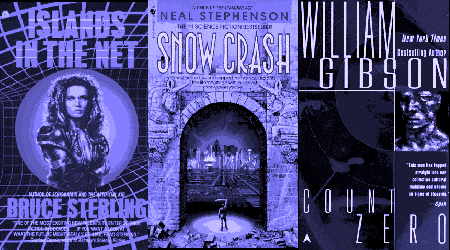
Cyberpunk has seen a recent resurgence in video games. Seemingly every game developer working today has a William Gibson book tucked under their arm or follows @swiftonsecurity (a satirical Twitter account that imagines a Taylor Swift consumed with cyber security). Cyberpunk video games are pervasive, including cyberpunk game jam projects on itch.io, Twine games, indie titles, and major AAA releases. All of these projects embrace cyberpunk themes and aesthetics. Observers credit the current trend to a number of cyclical and cultural factors. After talking to the indie developers behind a number of exciting cyberpunk titles at the center of this resurgence, I believe that the creators of these games are overwhelmingly inspired by the headlines in today’s newspapers.

It seems like no coincidence that these games have all appeared in a short time period following the economic recession. On the most basic level of analysis, it seems that these games may be providing a sense of escape from recent economic events. Last Life developer Sam Farmer notes, “I’m gonna go back to my film school class on Sci-Fi and Fantasy and say that it’s escapism. Horror, in general, and escapism, in particular, is often more popular in times of economic downturn, when you want to be somewhere else.”

Garrett Cooper’s Black Ice is an action game which casts the player as a hacker taking down corporate servers. Promoting the game, he’s found that cyberpunk narratives may be popular for reflecting reality as much as for providing an escape. He says, “I’ve talked to people about my game. I say, ‘All the corporations are evil.’ So they’re like, ‘Oh. So you’re talking about real life?’ I’m like, ‘No. Not exactly.’ That’s what people feel. The fantasy of being the one guy that can take something technological and turn it against the corporation.”

Games writer Austin Walker is an academic and cyberpunk superfan who sees the same throughline in these games and the literary roots of the genre. Walker says, “A key to traditional cyberpunk again and again is that there is economic inequality. We are positioning ourselves somewhere on that scale of how we feel about this stuff. Cyberpunk stories do that too. Usually they position the hero at the bottom of that; they’re usually in or near poverty.” In a time of extreme real-world inequality, cyberpunk stories locate players in a fantasy of rising up to subvert the system and taking down greedy corporations.

David Pittman’s indie project Neon Struct deals with a fictional near-future surveillance state. The game was heavily influenced by the recent leaks about actual domestic surveillance in the present day in the United States. Pittman says, “Edward Snowden’s release of NSA documents in 2013 was an essential part of the inception of Neon Struct (formerly Die Augen der Welt, or ‘The Eyes of the World’). I have strong feelings about the abuse of surveillance by the U.S. government, and I’ve known for close to a year that I wanted to make a game about it.” He’s quick to add, “Despite my own interest and leaning in the real world debate over mass surveillance, I am developing a way to introduce the story, which does not require the player character to actually leak any classified information. I don’t want to assume that the player shares my biases.” Nonetheless, it’s clear that the forthcoming project was informed by recent events.

Other examples of indie games providing commentary on and gaining inspiration from world events abound. Brigador is an isometric cyberpunk shooter with an extremely stylish trailer, and developer Jack Monahan lists a surprising influence. Monahan says, “While I’m not sure if the author would agree with the genre classification {of cyberpunk}, my brother and I both read and enjoyed (and were worried by) a book called Cities Under Siege: The New Military Urbanism by Stephen Graham. Like William Gibson said, the future caught up to all of his writing, more or less. We basically are living in a dystopic future”. Notably, Monahan made these statements before the recent military-style urban clashes in Ferguson, Missouri. The aforementioned Last Life is shaped by real world advances in medicine and philosophical debates about transhumanism. Matt Conn is seeking to expand LGBT representation in the games space with the cyberpunk RPG R.O.M. He says, “Because I did GaymerX and prior to that I did a startup that was very successful and then crashed. Seeing how all that happened, I feel like I have an interesting perspective of the tech scene and the LGBT rights scene.” These varied examples show the differing events influencing today’s cyberpunk boom.

As strongly as these games are influenced by the socio-political climate, it is reductionist to say this is the only thing bringing cyberpunk back into prominence. Again, Austin Walker says, “It’s tempting to just say, ‘Oh that’s happening again. We’re getting concerned again about things like privatization and inequality.’ I think that’s part of it. I don’t know if I’d be comfortable saying, ‘This is the one reason why’”. Many developers also noted the power of nostalgia as a reason for the influx of cyberpunk games. Alex Preston a developer behind Hyper Light Drifter says, “I think my generation is coming into its own, creatively, and we have a fondness for these themes and ideas. A lot of us grew up with books, films, and games that touched on these themes, and it bleeds through in our creative work. I think nostalgia is a powerful force.”

Likewise, Brendan Chung, creator of ‘90s-influenced hacker game Quadrilateral Cowboy has noticed the cyclical nature of cyberpunk themes. He says, “My guess is that the people who grew up fiddling with old PC tech are now at an age where they now have the skillset and financial means to make their own games. Now that we can make games, we’re making things that harken back to one of the things that got us interested in games in the first place.” Nostalgia for ‘80s and ‘90s cyberpunk is another likely force bringing these kinds of games back to the games market.

Additionally, I kept hearing indie developers suggest their own outlook about the state of the world today is extremely bleak. Conn says, “On a more philosophical note, this is a way of writing about the future we kind of want to see. Even if it’s dystopian or dark. I think that for a lot of us, it’s very scary going into the future.” A similarly grim outlook is shared by Monahan. He says, “I think the dystopic elements of cyberpunk point to a certain cynicism that things aren’t going to get any better. Human nature might be augmented and highly channeled by technology, but human nature stays the same. And that tech might actually amplify all the worst things about us too.” Monahan also sees this cynicism in the nostalgia that drives the cyberpunk resurgence. He adds, “So much great work from the ‘80s was in a similar vein. I think of Snake Plissken’s deadpan response to news that the president’s plane has gone down: ‘President of what?’. There’s a disillusionment from the classic era of cyberpunk that makes a revival now seem fairly natural, I think.” Natural or not, the revival is in full force, and it’s becoming a strong and subversive undercurrent in the indie games space.

Grooming Students for A Lifetime of Surveillance

index

The same technologists who protest against the NSA’s metadata collection programs are the ones profiting the most from the widespread surveillance of students.

By Jessy Irwin

Source: Model View Culture

Since 2011, billions of dollars of venture capital investment have poured into public education through private, for-profit technologies that promise to revolutionize education. Designed for the “21st century” classroom, these tools promise to remedy the many, many societal ills facing public education with artificial intelligence, machine learning, data mining, and other technological advancements.

They are also being used to track and record every move students make in the classroom, grooming students for a lifetime of surveillance and turning education into one of the most data-intensive industries on the face of the earth. The NSA has nothing on the monitoring tools that education technologists have developed in to “personalize” and “adapt” learning for students in public school districts across the United States.

(Mega)data Collection + Analysis

“Adaptive”, “personalized” learning platforms are one of the most heavily-funded verticals in education technology. By breaking down learning into a series of tasks, and further distilling those tasks down to a series of clicks that can be measured and analyzed, companies like Knewton (which has raised $105 million in venture capital), or the recently shuttered inBloom (which raised over $100 million from the Gates Foundation) gather immense amounts of information about students into a lengthy profile containing personal information, socioeconomic status and other data that is mined for patterns and insights to improve performance. For students, these clickstreams and data trails begin when they are 5 years old, barely able to read much less type in usernames and passwords required to access their online learning portals.

Data collection and number crunching aren’t the only technologies being explored to revolutionize education– technology billionaire and philanthropist Bill Gates funded a $1.1 million project to fit middle-school students with biometric sensors to monitor their response and engagement levels during lessons, and advocated a $5 billion program to install video cameras in every classroom to record teachers for evaluation.

The Family Educational Rights and Privacy Act, a law put in place in 1974 to protect student academic records, does nothing to protect student data when it is in the hands of education technology companies. Instead, FERPA threatens to take federal funding away from schools who are found to have breached student privacy while it fails to mandate bare minimum security standards for the storage and transmission of student data. In fact, a recent revision of FERPA increased the power that companies have to collect and mine student data.  Though lawmakers and privacy advocates are regularly outraged at the immense volume of student data freely floating through the web, the repeated failure to create legislation that protects student data from being used for profit is astounding.

One thing is clear: those who have the power to protect student privacy will not do so as long as they can continue to subsidize the cost of public education with student data.

Internet Censorship in Schools

In most educational institutions, the vast majority of IT operations are focused on monitoring, filtering and blocking web traffic instead of building secure networks that safeguard student records and sensitive behavioral data. Nowhere is this more apparent than in the widespread adoption of web filtering software tools in K-12 schools. Usage of these technologies is required for compliance with programs like E-Rate, which grant federal money to schools to fund internet access for their students.

To be eligible for funding from the E-Rate program, schools are required to comply with federal regulations that ban access to websites displaying pornography, graphic material, or any other that could otherwise be judged as immoral, improper or lewd. More often than not, this subjective criteria is determined by the opinions and belief systems of school administrators under political pressure to deny students access to content on controversial issues about topics like evolution, birth control and sex education. These decisions disproportionately affect young girls and LGBTQ students by denying them access to sites that provide important information about their rights, their developing bodies, their sexuality and their access to contraceptives. In the case of Securly, the first filtering tool designed for schools, the controls set by IT and administration for web access can extend far beyond the walls of the school and determine what content students can access while using school- issued machines from their home internet connections.

Despite the many positive contributions of the internet in the distribution and dissemination of knowledge across the planet, students are regularly denied access to valuable information that could positively impact their learning… all to safeguard a small percentage of federal budget money granted to their schools. The implications of this are particularly severe for low-income students who do not have access to the Internet at home; without the ability to freely access the web on their own terms, their digital literacy skills lag behind those of their affluent peers. Though teachers request better and broader internet access for students in their classrooms, administrator-imposed blocks and filters on school internet leave most students woefully unprepared to navigate the realities of the web. When students do find a way around the tools used to limit their access to the outside world (this happened with a group of students who were given iPads in the Los Angeles United School district last year), they’re labelled as “hackers” or miscreants, and disciplined for using Tor, a tool popular among students for anonymous web browsing and circumventing blacklists that ban websites from school networks.

Social Media Surveillance

Schools are adopting many other surveillance technologies with unprecedented reach into the private communications and lives of students and their families. In Lower Merion, PA, a suburb outside of Philadelphia, educators engaged remote administration tools on students’ laptops to regularly spy on their activities while at home. In a case that made its way into federal courts, one student was punished by administrators who mistook candy pictured through his laptop’s camera for drugs. While the full extent of the spying was never exposed, parents and students have expressed concern about educators having the ability to watch young girls undress in the privacy of their homes, unaware that they were being watched through their school-issued computers.

In 2013, the Glendale Unified School District in Glendale, CA took a move straight from the NSA surveillance handbook by seeking out a $40,000 contract with Geo Listening, a social media monitoring company that charges schools to eavesdrop on student social media chatter. While the company claims to only access posts that are public in the school districts they work with, and says it works closely with school districts to tailor their monitoring programs to prevent cyberbullying, suicide and active shooter incidents, it is very easy— too easy, in fact— to use such technologies to identify and target students who have been labeled deviant or delinquent within their communities, or who are otherwise outspoken and critical of their teachers and schools.

Schools are also demanding access to students’ social media communications in ways that severely harm their constitutionally protected rights to free speech. In Minnewaska, MN, a female student who complained about a hall monitor’s behavior in a Facebook post was questioned and given in-school suspension. Later, when a parent reported the student for “sexting” over Facebook with a classmate, she was removed from class again as a group of educators and a police officer armed with a taser demanded that the student hand over her password. They then read private communications that took place outside of school through her Facebook account. After being pulled from class multiple times, suspended from school, and barred from attending a school field trip (the same punishment was not doled out to the male student involved in the messaging), the ACLU stepped in to defend the student’s right to privacy and free speech in communications outside of school property. Though the ruling in the case upheld students’ protection under the 1st and 4th amendments, school districts around the country continue to demand access to students’ social media accounts and threaten to mark students’ academic records to make it difficult to get into a desired university or to seek other avenues for continued education.

Physical Surveillance

In addition to the online monitoring taking place in schools, there are many surveillance mechanisms in place to enforce physical security in public schools. Since the shootings that took place at Virginia Tech in 2007, and again after those that took place in Sandy Hook, CT in 2012, technology companies have launched myriad tools designed to minimize the potential loss of life in the next active shooting incident at a school. Some of these technologies include:

By preying on the absolute worst fears of administrators and parents across the country, technology companies are earning millions of dollars selling security “solutions” that do not accurately address the threat model these tools claim to dispel. School districts that purchase these systems further perpetuate the farce of security theater and infringe on students’ rights to privacy and individual freedom.

A Lifetime of Surveillance

When we develop and use educational technologies that monitor a student’s every moment in school and online, we groom that student for a lifetime of surveillance from the NSA, from data brokers, from advertisers, marketers, and even CCTV cameras. By watching every move that students make while learning, we model to students that we do not trust them– that ultimately, their every move will be under scrutiny from others. When students recognize that they are being watched, they begin to act differently– and from that very moment they begin to cede one small bit of freedom at a time.

Though the education technology revolution continually promises a silver bullet that will be a great democratizing force for all of society’s ills, it categorically disregards the patriarchal power structures and biases that both legitimate and perpetuate discrimination against minorities and marginalized groups. Despite it being well within the scope of educational technology tools to track, identify and expose biases towards groups of students, technologists avoid implementing small changes that monitor educator performance and correct for unconscious biases that negatively affect student learning. Because the surveillance taking place in schools is typically based on qualitative criteria like morality, appropriateness and good behavior, these technologies extend current practices and prejudices that perpetuate injustices against marginalized groups.

There are few to no safeguards built into the online and offline monitoring systems to protect students from the abuse of these tools. Young female students who are active on social media can be unfairly targeted, slut-shamed and disciplined for suggestive language that takes place outside of school, while their male counterparts are not held equally accountable for participating in sexually charged online conversations. Youth of color, a group that is disproportionately stereotyped as angry, aggressive, and unpredictable by educators, can easily be monitored, disciplined, and entered into the juvenile justice system for any outburst that could vaguely be misinterpreted as a threat to a homogeneous caucasian school culture. Any student grappling with issues of abuse, depression, disability, gender identity or sexuality could easily be discovered by online surveillance tools, stigmatized and outed to their teachers, parents and wider community.

Education technologists also continue to widen the digital divide between affluent and economically oppressed. Despite an industry-wide insistence that technology is not being developed to replace educators in the classroom, many poor school districts faced with massive budget cuts are implementing experimental blended learning programs reliant on “adaptive” and “personalized” software as a way to mitigate the effect of large class sizes on student learning. This means that students who attend costly private schools or live within rich school districts that can afford to employ more educators and maintain smaller class sizes receive much more personalized instruction from their teachers. Instead of receiving much-needed interaction and personalized learning directly from educators, poor students living in disadvantaged communities receive instruction from educational software that collects their data (which is likely to be sold), and have less individual instruction time from teachers than their affluent counterparts.

By developing technologies that collect, track, record, analyze every move a student makes both online and off, technologists and investors and educators are ensuring that today’s students will have less privacy than any other generation that came before them, threatening to make privacy and anonymity unattainable for future generations. Though the surveillance mechanisms at play in education technologies affect the privacy of millions of students who pass through the education system each year, this system is a profound, persistent threat to the privacy and individual liberty of LGBTQ students, low-income students, and students of color who have already been so severely failed by the status quo.

Ironically, the same technologists and investors who protest against the NSA’s metadata collection programs are the ones profiting the most from the widespread surveillance of students across the country, by building educational tools with the same function.