
Founder Of Skeptic’s Society Rattled After Witnessing A Paranormal Event (Michael Shermer)

Philips070Radio

By Joe Martino

Source: Collective Evolution

Michael Shermer is a well respected man amongst his community. He is the founding Publisher of Skeptic magazine, a monthly columnist for Scientific American, a regular contributor to Time.com, and Presidential Fellow at Chapman University. He is very skeptical and scientific by nature and until now had never had a supernatural or paranormal experience.

“I just witnessed an event so mysterious that it shook my skepticism.” Michael Shermer

A Shift In Perspective

In his 2006 TED talk, we see a very skeptical and almost condescending Shermer. Nonetheless his talk is certainly an interesting one and well worth watching. Although much of the time he pokes fun at “odd” theories, he makes some good points about how we choose to see and hear things and form beliefs as a result.

On an observational level it is still interesting to hear someone, who clearly has a bias towards certain subjects, call out others who have bias’ in an attempt to explain why we believe weird things. For example, he pokes fun at something like UFO’s and aliens stating “it’s very likely they are not real.” He does this in a manner that some skeptics do where they use words to divert from the evidence and call upon the more ridiculous claims in an attempt to debunk the entire phenomenon. Perhaps he hasn’t seen the abundant evidence that exists including declassified government documents on the subject?

Either way the point here is simply that from a standpoint of discovery, sticking true to the scientific method is important in all cases when we’re looking for external validation of an idea. Leaving bias or methodology to prove a point by finding the most obscene examples of a theory out of the equation is the best bet. Being skeptical is OK, but being a skeptic in true form does not mean being closed minded, it simply means being open to questioning and exploring new ideas without simply believing it.

From his talk I can see why so many skeptics are not humble in their beliefs and often feel superior to others who don’t share the same beliefs. It almost seems to be ‘skeptic culture.’ But given his latest experience, perhaps Michael will have an entirely different view towards some of the claims others have made during his career?

His Recent Supernatural Experience

Here’s his story as he wrote in an article entitled Infrequencies. It was also published in Scientific American.

“The event took place on June 25, 2014. On that day I married Jennifer Graf, from Köln, Germany. She had been raised by her mom; her grandfather, Walter, was the closest father figure she had growing up, but he died when she was 16. In shipping her belongings to my home before the wedding, most of the boxes were damaged and several precious heirlooms lost, including her grandfather’s binoculars. His 1978 Philips 070 transistor radio arrived safely, so I set out to bring it back to life after decades of muteness. I put in new batteries and opened it up to see if there were any loose connections to solder. I even tried “percussive maintenance,” said to work on such devices—smacking it sharply against a hard surface. Silence. We gave up and put it at the back of a desk drawer in our bedroom.

Three months later, after affixing the necessary signatures to our marriage license at the Beverly Hills courthouse, we returned home, and in the presence of my family said our vows and exchanged rings. Being 9,000 kilometers from family, friends and home, Jennifer was feeling amiss and lonely. She wished her grandfather were there to give her away. She whispered that she wanted to say something to me alone, so we excused ourselves to the back of the house where we could hear music playing in the bedroom. We don’t have a music system there, so we searched for laptops and iPhones and even opened the back door to check if the neighbors were playing music. We followed the sound to the printer on the desk, wondering—absurdly—if this combined printer/scanner/fax machine also included a radio. Nope.

At that moment Jennifer shot me a look I haven’t seen since the supernatural thriller The Exorcist startled audiences. “That can’t be what I think it is, can it?” she said. She opened the desk drawer and pulled out her grandfather’s transistor radio, out of which a romantic love song wafted. We sat in stunned silence for minutes. “My grandfather is here with us,” Jennifer said, tearfully. “I’m not alone.”

Shortly thereafter we returned to our guests with the radio playing as I recounted the backstory. My daughter, Devin, who came out of her bedroom just before the ceremony began, added, “I heard the music coming from your room just as you were about to start.” The odd thing is that we were there getting ready just minutes before that time, sans music.

Later that night we fell asleep to the sound of classical music emanating from Walter’s radio. Fittingly, it stopped working the next day and has remained silent ever since.”

How We Can Relate To Others

Given Michael can say he now has first hand experience of something supernatural that he cannot explain or simply set aside with some “logical” explanation, it’s quite possible he can now better relate to people who truly deeply and completely believe something unexplainable that they have experienced. Even in his latest 2010 TED talk, Michael still felt that believing in alien abductions was absurd, but what about those who claim to have experienced it? What would they say to that? Is it fair to say all who have claimed it are simply crazy?

It’s sometimes very easy for us to discredit, set aside or be skeptical of experiences we didn’t have yet others had. It’s almost become “cool” and “intelligent” to simply come up with a logical explanation even when it doesn’t truly explain what happened. Nonetheless, it’s OK to be skeptical, we simply need to keep our ego in check at the same time and keep an open mind to the fact that putting a logical explanation on something doesn’t prove it false or incorrect. When we do this we simply close off a lot of possibility vs truly exploring it.

I think it’s powerful that Michael has had this experience and I also feel it’s a timely one. I believe we are in the midst of something huge here on earth. I feel we are experiencing a shift in global consciousness that will transform the way we view many facets of our lives. Although this view has been somewhat perverted and misunderstood by belief systems and mismanaged movements (new-age), I feel it has a lot of validity and this can be seen both scientifically and through direct experience. I talk about this in my TEDx talk.

Interestingly, Shermer ended his piece off with something very important.

“The emotional interpretations of such anomalous events grant them significance regardless of their causal account. And if we are to take seriously the scientific credo to keep an open mind and remain agnostic when the evidence is indecisive or the riddle unsolved, we should not shut the doors of perception when they may be opened to us to marvel in the mysterious.”

Although it didn’t come with some backlash already form a commenter

“Michael,

I was embarrassed to read your concluding paragraph. What are we to keep an open mind about? That Jennifer’s dead grandfather maybe fixed the radio? Did he even know how to fix radios? Wouldn’t there be an easier way for the dead to communicate with the living? It would be mildly interesting to have an electronics expert determine exactly what is wrong with the radio.

Regards,

–Mark”

Embarrassed? Because suddenly one of the biggest skeptics in the world is open to the possibility that there is more to life than just what we can measure?

Sources:
http://www.michaelshermer.com/about-michael/

http://www.scientificamerican.com/article/anomalous-events-that-can-shake-one-s-skepticism-to-the-core/

Saturday Matinee: Black Mirror

bm1

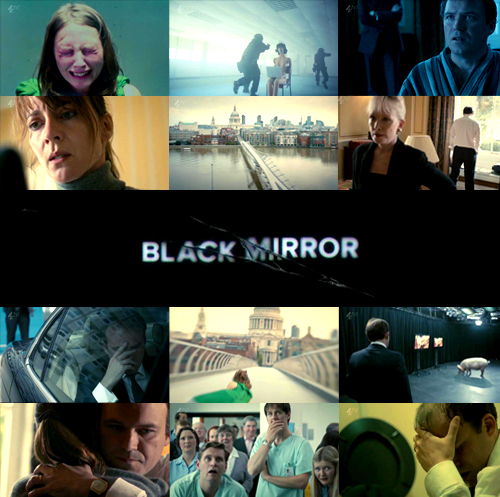
“Black Mirror” (2011 – ) is a British anthology series created by satirist Charlie Brooker exploring potential unintended social/psychological effects of technology. It’s sort of an updated and darker version of The Twilight Zone offering (often pessimistic) commentary on society, government, culture and relationships.

Season 1

The National Anthem

15 Million Merits
http://www.dailymotion.com/video/xyllhh_black-mirror-15-million-merits_shortfilms

The Entire History of You

Season 2

Be Right Back

White Bear

The Waldo Moment

White Christmas

Time and the Technological World

321e730d017aeaf2228d3217ae9abd77

Source: The Hipcrime Vocab

Check out this fascinating summary of  How We Got to Now: Six Innovations That Made the Modern World. This particular summary looks at the part of the book that documents how our perception of time has changed, and how that has affected the modern world.

The book talks about something called the “Hummingbird Effect,” which describes the way in which various inventions and technical discoveries change the world in unexpected ways. Some of you may recall James’ Burke’s excellent TV show Connections on BBC/PBS (These used to be available on YouTube, but JamesBurkeWeb appears to have disappeared. Still, some episodes can still be found) which covered the same ground:

Johnson points out that, much like the evolution of bees gave flowers their colors and the evolution of pollen altered the design of the hummingbird’s wings, the most remarkable thing about innovations is the way they precipitate unanticipated changes that reverberate far and wide beyond the field or discipline or problem at the epicenter of the particular innovation. Pointing to the Gutenberg press — itself already an example of the combinatorial nature of creative breakthroughs — Johnson writes:

    “Johannes Gutenberg’s printing press created a surge in demand for spectacles, as the new practice of reading made Europeans across the continent suddenly realize that they were farsighted; the market demand for spectacles encouraged a growing number of people to produce and experiment with lenses, which led to the invention of the microscope, which shortly thereafter enabled us to perceive that our bodies were made up of microscopic cells. You wouldn’t think that printing technology would have anything to do with the expansion of our vision down to the cellular scale, just as you wouldn’t have thought that the evolution of pollen would alter the design of a hummingbird’s wing. But that is the way change happens.”

It starts with Galileo’s observation that a pendulum always swings to-and-fro in a regular amount of time.

“But machines that could keep a reliable beat didn’t exist in Galileo’s age; the metronome wouldn’t be invented for another few centuries. So watching the altar lamp sway back and forth with such regularity planted the seed of an idea in Galileo’s young mind. As is so often the case, however, it would take decades before the seed would blossom into something useful.”

The ability to accurately measure time was a departure from before when:

    “Instead of fifteen minutes, time was described as how long it would take to milk the cow or nail soles to a new pair of shoes. Instead of being paid by the hour, craftsmen were conventionally paid by the piece produced — what was commonly called “taken-work” — and their daily schedules were almost comically unregulated.”

Once the regimentation of the clock was introduced, many things followed from that due to the Hummingbird Effect:

Over the century that followed, the pendulum clock, a hundred times more accurate than any preceding technology, became a staple of European life and forever changed our relationship with time. But the hummingbird’s wings continued to flap — accurate timekeeping became the imperceptible heartbeat beneath all technology of the Industrial Revolution, from scheduling the division of labor in factories to keeping steam-powered locomotives running on time. It was the invisible hand of the clock that first moved the market — a move toward unanticipated innovations in other fields. Without clocks, Johnson argues, the Industrial Revolution may have never taken off — or “at the very least, have taken much longer to reach escape velocity.” He explains:

    “Accurate clocks, thanks to their unrivaled ability to determine longitude at sea, greatly reduced the risks of global shipping networks, which gave the first industrialists a constant supply of raw materials and access to overseas markets. In the late 1600s and early 1700s, the most reliable watches in the world were manufactured in England, which created a pool of expertise with fine-tool manufacture that would prove to be incredibly handy when the demands of industrial innovation arrived, just as the glassmaking expertise producing spectacles opened the door for telescopes and microscopes. The watchmakers were the advance guard of what would become industrial engineering.”

Not mentioned is the introduction of public schools, designed to take farmers used to “cow milking time” and “discipline” them into a workforce able to sit still and obey and punch a clock, a system we are still living with today. Those of us who cannot or will not conform to this ruthless discipline are severely punished:

And yet, as with most innovations, the industrialization of time came with a dark side — one Bertrand Russell so eloquently lamented in the 1920s when he asked: “What will be the good of the conquest of leisure and health, if no one remembers how to use them?” Johnson writes:

    “The natural rhythms of tasks and leisure had to be forcibly replaced with an abstract grid. When you spend your whole life inside that grid, it seems like second nature, but when you are experiencing it for the first time, as the laborers of industrial England did in the second half of the eighteenth century, it arrives as a shock to the system. Timepieces were not just tools to help you coordinate the day’s events, but something more ominous: the “deadly statistical clock,” in Dickens’s Hard Times, “which measured every second with a beat like a rap upon a coffin lid.”

[…]

    “To be a Romantic at the turn of the nineteenth century was in part to break from the growing tyranny of clock time: to sleep late, ramble aimlessly through the city, refuse to live by the “statistical clocks” that governed economic life… The time discipline of the pendulum clock took the informal flow of experience and nailed it to a mathematical grid. If time is a river, the pendulum clock turned it into a canal of evenly spaced locks, engineered for the rhythms of industry.“

And as clocks became ever more precise and ubiquitous, things flowed from that – more regimentation, more standardization (village clocks used to be set by the sun’s position, but this introduced inaccuracies in railroad timetables – thus two inventions, one steam-powered and one not, are bound up together), and entirely new scientific discoveries which led to new inventions such as the computers that now rule over our lives:

Johnson goes on to trace the hummingbird flutterings to the emergence of pocket watches, the democratization of time through the implementation of Standard Time, and the invention of the first quartz clock in 1928, which boasted the unprecedented accuracy of losing or gaining only one thousandth of a second per day…But the most groundbreaking effect of the quartz clock — the most unpredictable manifestation of the hummingbird effect in the story of time — was that it gave rise to modern computing and the Information Age. Johnson writes:

    “Computer chips are masters of time discipline… Instead of thousands of operations per minute, the microprocessor is executing billions of calculations per second, while shuffling information in and out of other microchips on the circuit board. Those operations are all coordinated by a master clock, now almost without exception made of quartz… A modern computer is the assemblage of many different technologies and modes of knowledge: the symbolic logic of programming languages, the electrical engineering of the circuit board, the visual language of interface design. But without the microsecond accuracy of a quartz clock, modern computers would be useless.”

And once the computer is invented – note that it becomes the new mega-metaphor taking over from the steam engine – the brain as “neural network” that can be simulated, the economy as a perfect “information processing machine” via the price mechanism and humans as “rational utility maximizers”of Neoliberal economics, and recasting the analog world as binary one of ones and zeros – art, music, literature, etc. that can be simulated through sufficiently complex algorithms. All this flows from our view of the world, which in turn is dictated by our technology.

The Hummingbird Effect: How Galileo Invented Time and Gave Rise to the Modern Tyranny of the Clock (Brain Pickings)

More at the link. It’s worth noting that this entire thesis was laid out by Lewis Mumford as far back in the 1930’s in Technics and Society, and this book looks like it covers much the same ground.

Mumford’s these is that the Industrial Revolution did not spring forth fully-formed from nowhere, but came forth from changes in the human perception of the world and man’s relationship to nature that had been occurring for centuries beforehand. He called this the Eotechnic period, and points out that it needs to be understood to see how the modern world emerged. He classified the subsequent periods as Paleotechnic (centered around the stream engine, iron and coal), and the Neotechnic (centered around electricity and the scientific method). He stressed how much our perception of the natural world and human nature dictate the nature of our science and social organization.

Several intellectual revolutions had to take place in order to get us to the Industrial Revolution. One, as noted above and emphasized by Mumford, was the accurate measurement of time. Another was the increasing control over motive forces exemplified by the windmill and watermill. Another was individual perception, as indicated by the use of perspective in painting. Another was the increasing standardization, political centralization and bureaucracy. Another was the discovery of the New World of which the ancients had no knowledge or precedent. Another was the increasing use of the abstraction of money for trade. But perhaps the biggest one of all was recasting the natural world as a machine that could be analyzed and understood. These changes were all formative to the Industrial Revolution, which could not have come about without them.

Mumford writes extensively about the Medieval period, and how that period increasingly used technology to control the environment but in a genuinely humane way, one designed to enhance human needs and desires rather than control or eliminate them. Think of the medieval clock-making guild as opposed to the deskilled factory worker for example. The decentralized and localized nature of the Medieval period is what allowed technology to be used in this way.

But, beginning in the seventeenth century with the rise of the nation-state and the consolation of Europe’s kingdoms into large, centralized states with standards and bureaucracy (much of it due to the emergence of gunpowder and artillery, against which castles and mounted knights were useless), all that began to to change. Technology became increasingly tyrannical, and man was more and more forced into the “logic of the machine.” Consider the armies that emerged identical uniforms, identical weapons with interchangeable parts and drilled, regimented training designed to turn men into interchangeable parts themselves. Military training was the precursor to the disciplined workforce of the Industrial Revolution, which is why the connection between business and military discipline remains to this day (corporations today are run on the top-down hierarchical military model). Since battles were won by sheer numbers of “citizens” with rifles rather than an aristocratic warrior class who owned horses, the social relations changed, and the common man emerged with more importance. Population growth equaled national strength in the new order. Man’s rationality became celebrated, all other values were discounted. Productivity and technological “progress” became goals in the themselves rather than means to an end. Pursuit of growth and profit became all-consuming, human needs be damned.

In contrast to the Medieval period, today’s technology is dehumanizing, submitting man to centralized control, and seeing him as nothing more than a machine. Mumford envisioned a society where human values could once again take center stage instead of the productivist logic of “the myth of the machine” Thus Mumford was not anti-technology; rather he wanted a world in which technology served profoundly different values than in our present time. The brutal regulation of time, rather than the human time of being in the world – the difference between chronos and kairos, or the subjective and the objective – is one of the best illustrations of this difference. Just because we can measure time down to the nanosecond does not mean we have to be enslaved to it. That is a social choice, as Mumford would quickly remind us.


Christmas Grab Bag (holiday music edition)

Christmas_Reporting_800

As mentioned last Christmas, one of my least favorite Christmas songs is Do They Know It’s Christmas. Particularly callous were the words sung by Bono: “Tonight thank god it’s them instead of you”. Despite the removal of that line for a new version from Band Aid 30, it manages to retain an offensively patronizing tone. To give Band Aid the proper ribbing they deserve, Bland Aid has released Fleece the World (Charity Begins at Home):

Patton Oswald shares his thoughts on a couple of other notorious Christmas songs:

New Song’s “The Christmas Shoes”:

and Alvin and the Chipmunk’s “Christmas Don’t Be Late”:

The Onion AV Club recently did an interesting post on the surprisingly bleak origins of a well-known Christmas standard.

If you need to end a Christmas party but guests won’t leave, just play this at high volume:

A surprisingly traditional version of The Christmas Song from John Zorn and Mike Patton:

The Christmas Hope: A To-Do List for a Better World

peacesign

By John W. Whitehead

Source: The Rutherford Institute

As a child, my Christmas wish list came right out of the Sears and Roebuck catalogue—toys, board games, bikes, action figures, etc. My parents, like so many in their day, belonged to the working-class poor, so while I never lacked for the necessities of life, many of the items on my wish list never came to be. Even so, I was no worse off for it.

I wish the same could be said of those still unfulfilled items on my adult Christmas wish list. Each year, I wish for the same things—an end to war, poverty, hunger, violence and disease—and each year, I find the world relatively unchanged. Millions continue to die every year, casualties of a world that places greater value on war machines and profit margins than human life.

I’ve seen enough of the world in my 68 years to know that wishing is not enough. We need to be doing. It’s not possible to solve all of the world’s problems right away. For most people, putting an end to world hunger, poverty, disease and the police state may seem too insurmountable a task to even tackle. But as I point out in my book A Government of Wolves: The Emerging American Police State, there are practical steps each of us can take to move things in the right direction. Here’s what I would suggest for a start:

Tone down the partisan rhetoric, the “us” vs. “them” mentality. Instead of wasting time and resources on political infighting, which gets us nowhere, it’s time Americans learned to work together to solve the problems before us. The best place to start is in your own communities, neighbor to neighbor.

Turn off the TV and tune into what’s happening in your family, in your community and your world. Whatever you do, reduce your intake of mindless television and entertainment news. The only reality programming worth taking notice of is the one playing in your home and community.

Show compassion to those in need, be kind to those around you, forgive those who have wronged you, and teach your children to do the same. As author Robert Heinlein observed, “A dying culture invariably exhibits personal rudeness. Bad manners. Lack of consideration for others in minor matters. A loss of politeness, of gentle manners, is more significant than is a riot…”

Talk less, listen more. Take less, and give more. If people spent less time dwelling on and attending to their own needs and more time trying to help and understand those around them, many of the problems we currently face could be eliminated.

Stop acting entitled and start being empowered. We have moved into the Age of Entitlement, where more and more people feel entitled to certain benefits without having to work for them. There’s nothing wrong with helping those less fortunate, but as my parents taught me, there’s a lot to be said for an honest day’s work.

Remember that all people are endowed with inalienable rights. America cannot continue to lambast terrorist groups for their contempt for human life and dignity when our own nation violates these same principles time and again.

Stop being a hater. How can we ever hope to curb the hatred and animosity that have spurred global terrorism over the past few decades if we can’t even forgive the human failings of those in our immediate circles?

Learn tolerance in the true sense of the word. True tolerance stems from a basic respect for one’s fellow man or woman. And it should be taught to children from the time they can understand right from wrong.

Value your family. The traditional family, such that it is, is already in great disrepair, torn apart by divorce, infidelity, over-scheduling, overwork, materialism, and an absence of spirituality. Yet without the family, the true building block of our nation, there can be no freedom.

Feed the hungry, shelter the homeless and comfort the lonely and brokenhearted. Volunteer at a soup kitchen. Take part in local food drives. Take a meal to a needy family. “Adopt” an elderly person at a nursing home. Support the creation of local homeless shelters in your community.

Give peace a chance.  The military industrial complex has a lot to gain financially so long as America continues to wage its wars at home and abroad, but you can be sure that the American people will lose everything unless we find some way to give peace a chance. We can start by bringing all of our men and women in uniform home.

Start your own teaspoon brigade.  You don’t have to solve all the world’s problems single-handedly, nor do you have to solve them overnight. Little by little, you’ll get there, but you have to start somewhere. It is up to each of us to do our part to make this a better world for all. As the legendary singer, songwriter and activist Pete Seeger once remarked to me:

I tell everybody a little parable about the “teaspoon brigades.” Imagine a big seesaw. One end of the seesaw is on the ground because it has a big basket half full of rocks in it. The other end of the seesaw is up in the air because it’s got a basket one-quarter full of sand. Some of us have teaspoons, and we are trying to fill it up. Most people are scoffing at us. They say, “People like you have been trying for thousands of years, but it is leaking out of that basket as fast as you are putting it in.” Our answer is that we are getting more people with teaspoons every day. And we believe that one of these days or years—who knows—that basket of sand is going to be so full that you are going to see that whole seesaw going zoop! in the other direction. Then people are going to say, “How did it happen so suddenly?” And we answer, “Us and our little teaspoons over thousands of years.”

US escalates campaign against North Korea

cia_psyops_deception_william_colby_casey_james_angleton

By Patrick Martin

Source: WSWS.org

The Obama administration ratcheted up the pressure Friday on the isolated Stalinist regime in North Korea, with the FBI formally accusing North Korea of responsibility for the hacking attack on Sony Pictures Entertainment and Obama declaring that the US government would carry out an unspecified “proportionate response” against Pyongyang at “a time and place of our own choosing.”

Obama made no mention of the cyberattack or North Korea’s alleged responsibility in his opening statement at his end-of-the-year White House press conference, waiting until a suitable question was posed by the media to raise the issue.

The FBI offered no proof of a North Korean link to the hacking attack on Sony, which led to the studio’s cancellation of the planned December 25 release of the Seth Rogen film The Interview, a comedy whose premise is that two American journalists are contracted by the CIA to assassinate North Korean leader Kim Jong-un.

The FBI statement claimed several similarities between computer code used in the malware deployed against Sony and that used in previous attacks linked to North Korea, but these claims are unsubstantiated and computer security experts interviewed in the press have cast doubt on whether any definitive links can be established.

The American public is asked to take on faith the FBI’s declaration that it “now has enough information to conclude that the North Korean government is responsible for these actions.” The statement continued: “North Korea’s actions were intended to inflict significant harm on a US business and suppress the right of American citizens to express themselves.”

Such language is ironic coming from a federal agency that plays a central role in the build-up of a police state apparatus in America. A recent report in the Wall Street Journal, citing figures from the National Center for State Courts, found that the FBI has accumulated criminal record files on 80 million Americans—more than one-third of the adult population.

Obama likewise provided no evidence of North Korean involvement, merely citing the FBI statement as authoritative. He criticized Sony Pictures for withdrawing The Interview from circulation in response to threats from the hackers, who called themselves “Guardians of Peace.”

“We cannot have a society where some dictator someplace can start imposing censorship here in the United States,” Obama said, “because if somebody is able to intimidate folks out of releasing a satirical movie, imagine what they’ll do when they see a documentary that they don’t like, or news reports that they don’t like.”

He continued, “That’s not what America’s about. Again, I’m sympathetic that Sony as a private company was worried about liabilities and this and that and the other. I wish they’d spoken to me first. I would have told them, do not get into a pattern in which you’re intimidated by these kinds of criminal attacks.”

This pretense of alarm over the threat to the civil liberties of Americans is just as hypocritical coming from Obama as from the FBI. His administration has prosecuted more whistleblowers for leaking information about government crimes to the press than any other in American history. Obama has presided over dragnet surveillance of the telecommunications and email of every American by the National Security Agency, trampling on the Bill of Rights. And he has asserted the unprecedented “right” of the president to order the drone missile assassination of anyone in the world, including American citizens.

As for censorship, this is a government that doesn’t hesitate to demand that major newspapers and television networks withhold information from the public, including information on massive violations of the Constitution by the government itself, in the name of “national security.” The media routinely complies, allowing the government to vet and/or censor articles and news reports before they are aired.

The latest charges against North Korea have provided yet another example of the American press corps’ readiness to function as a de facto sounding board for state propaganda. There has been no pretense of critical independence in the vast bulk of reporting on the hacking attack on Sony and the alleged responsibility of the North Korean regime, which has denied any involvement. The government’s claims are simply reported as facts, whether by the television networks and cable channels or newspapers such as the New York Times and Washington Post.

The government’s record of lying, whether on Iraqi weapons of mass destruction, NSA spying, or, more recently, CIA torture, is simply ignored.

The daily newspapers and television networks have largely dropped any reporting on last week’s Senate Intelligence Committee report documenting systematic torture by the CIA of prisoners held in secret prisons overseas. Not a single question was raised about the torture report at Obama’s hour-long press conference.

Obama made it clear that the US government would retaliate against North Korea for the alleged hacking attack on Sony. “They caused a lot of damage, and we will respond,” he said. “We will respond proportionally, and we’ll respond in a place and time and manner that we choose.”

While the tone was matter-of-fact, Obama refused to rule out military action in response to a follow-up question by a reporter, saying only that he would not expand on his previous statement about an indeterminate future response.

White House, Pentagon and intelligence officials were holding daily meetings on North Korea, an Obama spokesman said. Before the FBI issued its finding, Gen. Martin Dempsey, the chairman of the Joint Chiefs of Staff, said he was “very concerned” about the US potentially concluding that a nation-state was behind the attack. “When and if that call is made, it will be a moment to confront that reality” of a state-supported cyberattack on a US corporation, Dempsey said.

The US military buildup in the Asia-Pacific region continues apace. Obama has just signed the 2015 National Defense Authorization Act, which provides for expanded efforts to establish a joint missile defense system in northeast Asia, involving South Korea and Japan. This would be directed against North Korea in the first instance, but ultimately against China, the main US target in the region.

On Thursday, Obama approved the sale of four US frigates to Taiwan, under the Naval Vessel Transfer Act, over the vociferous opposition of Beijing. The sale of the guided-missile frigates “blatantly interferes in China’s domestic affairs and undermines China’s sovereignty and security interests,” a Chinese defense ministry spokesman said.

While Obama said the FBI had not linked the Sony attack to any nation other than North Korea, other US officials pointed out that North Korea’s only connection to the World Wide Web is through China, an indication that further escalation of the Sony affair could involve charging China with at least a supporting role.

Meanwhile, evidence continues to surface that the entire Sony Pictures affair, going back to the original decision by the studio to make a film depicting the murder of Kim Jong-un, was a provocation inspired by the US military-intelligence apparatus.

Email communications obtained by the online publication Daily Beast and cited in many columns and commentaries Friday strongly suggest this. Sony Pictures co-chairman Michael Lynton is on the board of trustees of the Rand Corporation, a leading private consulting firm for the CIA and Pentagon, and it was Rand’s North Korea specialist, Bruce Bennett, who pushed hard for the Sony film to focus on the assassination of North Korea’s ruler.

According to one of these emails, Seth Rogen, the film’s co-director, had initially intended the film to target an unnamed leader of an unnamed country, and it was Lynton himself “that told them to not use a fictitious name, but to go with Kim Jong-un.” The same message, written by Marisa Liston, a Sony senior vice president, said that Rogen and co-director Evan Goldberg “mention that a former CIA agent and someone who used to work for Hillary Clinton looked at the script.”

An email from Bennett, the Rand analyst, to Lynton suggested that the film could actually help unseat the North Korean regime. “I have been clear that the assassination of Kim Jong Un is the most likely path to a collapse of the North Korean government,” Bennett wrote. “I believe that a story that talks about the removal of the Kim family regime and the creation of a new government by the North Korean people (well, at least the elites) will start some real thinking in South Korea and, I believe, in the North once the DVD leaks into the North (which it almost certainly will).”

Lynton responded, “Bruce—Spoke to someone very senior in State (confidentially). He agreed with everything you have been saying. Everything. I will fill you in when we speak.”

Other emails name two State Department officials—Assistant Secretary Daniel Russel and Ambassador Robert King, US special envoy for North Korea human-rights issues—as providing input to the film.

The CIA-engineered oil glut to bring down Putin and Maduro

Russian President Vladimir Putin shakes hands with his Venezuelan counterpart Nicolas Maduro during a signing ceremony at the Kremlin in Moscow

By Wayne Madsen

Source: Intrepid Report

John Brennan’s long familiarity with Saudi Arabia, owing to the time he spent there as the CIA station chief in Riyadh in the 1990s and his knowledge of Saudi oil operations, has paid off. WMR has learned that Brennan’s agents inside Saudi Aramco convinced the firm’s management and the Saudi Oil Ministry to begin fracking operations to stimulate production in Saudi Arabia’s oldest oil fields.

By pumping salt water into older wells, some at a depth of 3 to 6 thousand feet, an inordinate amount of pressure was built up. The CIA’s oil industry implants knew what would occur when the fracking operations began. Due to the dangerously high water pressure, the Saudis were forced continuously pump oil until the pressure became equalized. That process is continuing. If the Saudis ceased pumping oil, they would permanently lose the wells to salt water contamination. In the current “pump it or lose it” situation, the Saudis are forced to pump at a rate that may take up to 5 years before they can slow down production rates.

The net result of the CIA-inspired fracking operations, which the Saudis were warned not to pursue by petroleum engineers working for some foreign-based firms like Schlumberger, is that there will be an oil supply glut for the next 5 years. The glut will be followed by a reduction in Saudi oil production unless new oil fields are brought on line. There is now a major push by U.S. and Canadian oil companies to bring the Keystone XL pipeline from Canada to the United States to offset the expected sharp rise in oil prices in five years.

The CIA operation to frack Middle Eastern oil fields was not only limited to Saudi Arabia. WMR has learned from oil industry sources that similar fracking caused overproduction problems in Kuwait and Iraq.

The result of the sudden decline in oil prices has resulted in heavy damage to the economies of the CIA-targeted countries of Russia, Iran, and Venezuela. Brennan and his economic warfare operatives banked on the Saudi overproduction to harm the economies of all three countries and the CIA has not been disappointed. The CIA figures that the governments of Vladimir Putin in Russia, Ayatollah Ali Khamenei in Iran, and Nicolas Maduro in Venezuela will have long since collapsed and been replaced by pro-Western regimes within 5 years.

Already, from his base in Switzerland, exiled Russian tax evader billionaire Mikhail Khodorkovsky has called for Putin’s overthrow and even his assassination. Meanwhile, the U.S. Congress and the Obama administration have taken cues from the CIA to impose devastating economic sanctions on both Russia and Venezuela. Similar congressional legislation to increase sanctions on Iran is pending.

Russia has been harmed the most by the CIA’s Saudi oil production scheme. The Russian ruble fell 56 percent in value against the U.S. dollar while Russian interest rates climbed to 17 percent. The price of shares of Russia’s largest lending bank, Sberbank, fell 18 percent. Although the Russian economic collapse has resulted in financial ripples around the world, with Austrian and French banks losing their stock values and the value of the Polish zloty and Hungarian forint falling against the dollar, the Obama administration says that there will be no easing on economic sanctions imposed on Russia over Ukraine. Obama has put the investments of American holders of Russian bonds in dire jeopardy.

The Pacific Investment Management Company’s (PEBIX) Emerging Markets Bond Fund, which holds over $800 million in Russian bonds, has lost almost 8 percent in value in the past few weeks.

Russian Central Bank Vice Chairman Sergei Shvetsov said, “What is happening is a nightmare that we could not even have imagined a year ago.”

Meanwhile, basic staples in Venezuela, including cooking oil, rice, and corn flour, are becoming hard to obtain. The U.S. dollar has jumped 1,700 percent in value against the Venezuelan bolivar on the black market. The CIA is using the financial collapse to push for an undemocratic overthrow of the Venezuelan government.

Iran, which has been under punitive Western economic sanctions for a number of years over its nuclear power program, is probably best able to weather the storm. Iran has built up a rather impressive domestic food production, telecommunications, and oil industry infrastructure to survive the sanctions. However, Iranian President Hassan Rouhani appears very aware of the Saudi role in the conspiracy to drive down oil prices.

Rouhani recently said, “The main reason for [the oil price plunge] is [a] political conspiracy by certain countries against the interest of the region and the Islamic world and it is only in the interest of some other countries . . . Iran and people of the region will not forget such conspiracies, or in other words, treachery against the interests of the Muslim world.”

Brennan’s and the CIA’s industrial sabotage of the Saudi and other Middle East oil industries will continue to have far-reaching effects on the world economy. Oil industry insiders fear that the CIA has unleashed something that may deal a devastating blow to the global economy.