Shadows & Light: Understanding Our Archetypal Nature

73a

By Gary S. Bobroff

Source: Reality Sandwich

“I thought of Jung as a noetic archeologist, [he] provided maps of the unconscious.” – Terence McKenna

Most of us imagine that we know ourselves pretty well. But like a periscope that thinks it’s the whole submarine, our self-image makes no accommodation for the fact of the unconscious. Yet there are maps that can help us. If we are honest, we can come to discover how to orient ourselves in the tidal pathways of the unconscious; we may come to see that our shadows and strengths fall into archetypal patterns. If we are lucky, these maps may help us to come into possession of the greatest possible treasure–our inner gold.

In the 1920’s, after they had finished developing their ideas on Psychological Type – the root of today Myers-Briggs Type Indicator™ – Antonia “Toni” Wolff and Carl Gustav Jung discovered that they felt like something was still missing. Not fully satisfied, Toni soon identified larger psychological structures that were evident, yet hitherto unnamed. Calling them Structural Forms of the Feminine Psyche, she initiated the process of identifying the primordial forms of the human psyche, forms which we know today by the singular term, archetype.

She observed two poles, two axes, in our internal world. On the first, she saw displayed a natural split in how our energy flowed toward people: for some it moved toward people in a collective sense, toward the group, the family, the team, the tribe, society and the social group; for others it moved toward people in the one-on-one sense, with thought and concern primarily flowing toward individuals, friends and lovers. Toni saw this difference in what we were fascinated by and drawn to; what compelled us forward in life; in the differing pathways our libido took toward our fellow humankind. In her observations, she brought consciousness to an inherent dialectic tension in human nature.

This characteristic tension is highlighted in bright psychedelic neon in the last fifty years of American history. It is the divide between belonging and freedom from belonging; between a value system that is group-oriented and one that is individual-oriented; one emphasizes escape from society and other connection to it. It has provided us with two opposing views of goodness in American life: the redemption in community of Capra’s It’s a Wonderful Life versus the redemption in breaking away from community of Kerouac’s On The Road and Kesey’s Acid Test and Cuckoo’s Nest. Of course, this split goes back to our earliest days: we can see it in our ancient mythologies and philosophies. It is evident in perhaps the greatest of Shakespeare’s plays, Hamlet, wherein ‘to be or not be’ also has a lot to do with ‘to belong or not to belong.’

Our culture has many names for the first kind, the group-oriented, society-aware folks: patriarch or matriarch, father and mother type. This is the Queen or King archetype and the King can be a ‘my way or the highway’ kind of guy (and notice the pressurized conflict between belonging and freedom from belonging in his motto). However we lack names for the second kind, the non-group-oriented, individual-focused folks. Defined by their freedom from belonging this type has no positive definition in our language, but many negative ones: he or she is the Slacker who has failed to adapt to society; a Rolling Stone, a Peter Pan, an Eternal Boy, in the 1920’s they called him a Gadabout. Here a lack of language reveals the unconscious tension between these two forms and our hidden value judgments.

Yet Toni Wolff saw a universal home for the man and woman of this type in the combination of the Lover and the Eternal Child (puella/puer). He or she is about becoming, about furthering the process of becoming in themselves and others. The archetypal Child brings forward the new into consciousness, and these folks both gravitate to, and create, the original, novel, new quality that’s needed by the culture. The Lover is that part of us that is gifted at seeing and valuing the others around us for who they are and enjoying sexuality and love regardless of societal expectations. They find endless enjoyment in doing with others. At their best, the Seeker’s question of ‘Who am I?’ can flower into beautiful mystic-religious poetry in a thousand forms. It is this energy in us that seeks the ‘road less travelled’, invites us to ‘follow our bliss’ and knows reminds us to “all: to thine own self be true.” As one might expect, these folks tend to resist being categorized (they’re too original/ special/ pathologically anti-authoritarian for that!). And that’s why it’s partially their fault that our culture has no words for their archetype – they refuse to be put in a box and their rebelliousness is part of their strength and part of their shadow.

Each end of this spectrum becomes cartoony when we fall into identification with it. Being too much of a Seeker too long may mean never putting down roots and never settling into a community: ‘I took the road less travelled and now I don’t know where the hell I am.’ Jumping off the cliff and hoping for wings to form on the way down once too often, they can find themselves to have drifted too far from shore. The group-oriented person’s shadow can be equally unsatisfactory (none of these paths are inherently better than any other) and is equally well known to us. Seen in cartoon-like form in TV shows (King of the Hill, That 70’s Show, Archie Bunker), he is the Father who carries forward the values of the past (often unconsciously) and who may be resentful of those who break out of the mold. Finding genuine satisfaction in doing for others, a shadow quality in them may be desire for power over others. When unconsciously identified with the King, their right to power is taken for granted. This is vividly illustrated in the Frost-Nixon interviews, when Frost asks Nixon if it is sometimes okay for the President to do something illegal, he responds “when the President does it that means it’s not illegal.” However, at their best archetypal King or Queen “can deal with your gold without hating you for it. They can see you’re shining and not envy you” – Robert L. Moore. The King or Queen can bless us, knight us, and make us feel seen, valued and a part of the whole in a way that no other archetype can.

The other axis that Wolff observed shows the direction of our impersonal energy, our responses to the world: some people’s energy flows into the search for insight, answers, understanding and comprehension; for others their energy flows outward into action, prowess, achievement and autonomy. Where the Warrior seizes the day, is always up for a challenge (is in fact energized by competition), the Sage finds satisfaction in comprehension and pleasure in problem solving. Many Warriors knew their identity the first time they laced up their skates, paddled out on their boards, put on their ballet slippers or picked up a guitar. A Sage’s self-understanding can also come early in a passion for the world of knowledge and ideas and a wonder for how things work. Additionally, for those folks for whom knowledge comes through the unconscious, Toni saw the ancient tradition of the medial woman. This path was given it’s place in nearly every culture in human history except ours (we’re hooked on ‘rational’ reduction and the illusion that in our measuring of the world, we’ve mastered it). Toni gave the name Mediatrix to this archetype. By including it in her structure she not only honored her own path, she made a place for all women (and men) who recognize that they sometimes possess knowledge non-causally (through the unconscious). Despite our cultural prejudice against this way of knowing, the Mediatrix archetype reflects Nature’s deeper truth: right understanding can sometimes arrive in ways that can’t quite be explained rationally or directly.

Again, there is shadow in these archetypes too. The Warrior sometimes carries the burden of not understanding, of ‘knowing not what he does, but at least he or she know the truth of action–right or wrong. In contrast, the Sage sometimes fails to act, because conscience sometimes does make ‘cowards of us all.’ There is also an inherent between the two axes, between our need for other people and between the calling of action or insight; the personal axis pulls into relationship and the impersonal axis away from them. As master Sage Nikola Tesla describes: “originality thrives in seclusion . . . Be alone, that is the secret of invention; that is when ideas are born.” The genius is quick to serve his muse, but sometimes slow to respond to the warm heart beating right beside him. The Warrior might unconsciously avoid those spaces that make him or her feel vulnerable? Does our compulsive ingenuity or armored hardness keep us safely separated from the love reaching out for us?

Yet there is reassurance in understanding these qualities exist in human nature because they exist in Nature–throughout Nature: in army ants and nurse bees, even at biological and cellular levels. They are at play throughout the world, in everything but conspicuously displayed in our mythologies, philosophies and cosmologies (including and especially astrology – which is not a causal system of explanation, but a reflection of the way that all things in Nature are meaningfully intertwined); these archetypal energies have a life of their own!

“Called or uncalled the Gods are present.” – C. G. Jung

Most of us fall all too easily into the simplifying projection of imagining that everyone wants the same things out of life that we do. But seeing the reality of these other Gods in the psyche helps us to withdraw our projections from each other and accept that different folks are coming from different places and truly do want different things from the world and from us. By understanding this we become better able to see those around us for who they are and it offers us a route to better see ourselves.

Seeing ourselves in our archetypal nature and recognizing our timeless parts, allows us to both gain sight of some of our shadow and to better own our inner gold. In the compulsive ways that we overdo things, we see the shadow of our archetypal selves; we see a rabbit hole that we’re in danger of falling into. Many of us plunge headlong into tragedy throughout our lives because we fail to recognize the story that is playing out through our actions. Having a mythic sensibility about ourselves offers a clue to how we might be unconsciously acting out archetypal patterns and shadows and possession of that awareness is at least half the battle: ‘’knowledge is power, knowledge is safety and knowledge is happiness” – Thomas Jefferson.

But just as importantly, an archetypal self-understanding allows us to own our gifts. Your archetype is the thing that you find ‘flow’ in doing, that thing through which you live an experience of the timeless. How powerful it is to recognize “Hey! This is me giving my gold to the world right now!” Just remember that there are profoundly different paths of expression for that gold.

“There’s nothing you can do that’s more important than being fulfilled. You become a sign, you become a signal, transparent to transcendence; in this way, you will find, live, and become a realization of your own personal myth.” – Joseph Campbell

The moral challenge in the existence of the unconscious lies in the fact that it is unconscious. In other words, we don’t know that we don’t know, we’re missing qualities in the world and in ourselves and we have absolutely no idea that we are missing them. And so we are left to wonder: to which Gods do I never make a sacrifice? Which temples do I pray at and which do I avoid? In asking, you may find that you have begun a journey toward home.

* * *

Footnote re: Wolff & Jung’s authorship–it is impossible to know who contributed what to their individual works as their lives were deeply entwined. It is believed that Toni made direct contributions to Psychological Types. And while Toni presented the archetypal system on her own, it is fair to assume that Jung made a significant contribution to it. I believe that Jung’s psychology is, in fact, best understood as a work of his own and of the women around him.

* * *

Gary S. Bobroff, is the primary developer and facilitator of the Archetypal Nature workshop www.ArchetypalNature.com. He delivers the depth of Jungian approaches in an accessible, engaging, and visual-oriented form. He is hosting the inaugural webinar on Archetypal Nature via SynchCast beginning March 14th. He has an M.A. in Psychology from Pacifica Graduate Institute and his first book, Crop Circles, Jung & the Reemergence of the Archetypal Feminine, was published in August 2014 by North Atlantic Books – www.JungAndCropCircles.net.  You can follow his soulful in-depth Jungian writing on modern questions at www.GSBobroff.com.

Saturday Matinee: The Day the Fish Came Out

the-day-the-fish-came-out-movie-poster-1967-1020685028

“The Day the Fish Came Out” (1967) is a Greek/British co-production written and directed by Michael Cacoyannis (who also designed the film’s bizarre costumes). The film is a satirical sci-fi take on an actual incident in which two military aircraft collided over Spain causing four hydrogen bombs to rain down amongst the debris. Two of the bombs partly detonated similarly to a dirty bomb creating radioactive contamination in the area that persists to this day. In the film version, when a deadly payload called “Container Q” is dropped over a Greek resort island Americans disguised as tourists and real estate developers race against time to recover it in a dark comedy of errors reminiscent of Dr. Strangelove.

http://www.dailymotion.com/video/xmt7hc_the-day-the-fish-came-out_shortfilms

Feds Panic on Mass Common Core Test Refusals, Threaten Reprisals

Gates-HSLDA-Curriculum-aligned

By Alex Newman

Source: The New American

Public resistance to Common Core is exploding across America, and officials are not happy about it. The Obama administration’s Department of Education, along with pro-Common Core government officials across the country under pressure from the feds, appear to be in panic mode. Facing a growing nationwide “opt out” movement to refuse participation in the unconstitutional federally funded testing regime aligned with the Obama-backed national school standards, senior bureaucrats, including Education Secretary Arne Duncan, have actually started resorting to lawless threats against parents, teachers, students, and entire state governments. Some parents were threatened by officials with jail time. Even small children are being punished by the state for “opting out” of the deeply controversial tests, with one California mother telling The New American that her daughter was publicly denied ice cream in retaliation.

But so far, the threats are only emboldening the opposition.

Perhaps the most outrageous threat so far came from Obama’s education chief, Duncan, who boasted in recent years of using government schools to create “green citizens” with UNESCO (United Nations Educational, Scientific, and Cultural Organization) as a “global partner.” Late last month, Duncan, who was greeted by protesters urging him to “stop test bullying,” threatened federal intervention to force Americans to take the Common Core tests if states would not do the job. “We think most states will do that,” Duncan proclaimed at an Education Writers Association conference in Chicago. “If states don’t do that, then we [the federal government] have an obligation to step in.” In reality, of course, the federal government has an obligation under the U.S. Constitution to butt out. But despite swearing an oath to uphold and defend the Constitution, including the 10th Amendment, Duncan has led the charge in recent years to finish federalizing the government school system — and to use it as what he called a “weapon” to “change to world.”

Sounding oblivious to America’s federalist system of constitutional government, Duncan proclaimed that he expected state governments to hold “districts’ and schools’ feet to the fire on this,” as if state governments were mere administrative units to enforce decrees from the all-powerful federal executive branch. Hundreds of thousands of students in New York recently opted out. Almost nobody took the tests in some districts amid a full-scale uprising by teachers, students, and parents. In Chicago, where even the teachers’ union has blasted the federal takeover, school officials were threatened with the loss of more than $1 billion in state and federal “education aid” if not enough students were successfully coerced into taking the Common Core-aligned tests. Still, few details were provided on what it might look like to have the Obama administration “step in” and force students to take the controversial tests — an outrageous threat he also made in a discussion with Motoko Rich of the New York Times.

Critics, however, ridiculed the threat, daring the administration to try it. “Assuming that Duncan is not planning to call in the National Guard to haul off opt-outing 8 year olds, the only possible ‘sanction’ would be withholding funds,” observed Carol Burris, an award-winning New York principal who recently stepped down to fight back against what she sees as problems with the public education system. “That would surely lead to court challenges forcing the Education Department to justify penalizing schools when parents exercise their legitimate right to refuse the test — an impossible position to defend.” Noting that students of all races and backgrounds were opting out of the testing scheme, Burris pointed out that the rates “defy the stereotype that the movement is a rebellion of petulant ‘white suburban moms.’”

In a recent statement published by the Washington Post, the New York “2013 High School Principal of the Year” also highlighted a number of troubling government abuses targeting parents. Among other concerns, she said, citing activists and teachers, that administrators in some districts took advantage of non-English speaking parents by lying to them about the tests, saying they were mandatory or that children would be held back for refusal to take them. One critic called it “blatant discrimination at best.” Burris also lambasted the Common Core tests and noted that Duncan’s own children go to a non-Common Core school — as do the children of Common Core financier Bill Gates, and Common Core strongman Obama. She concluded the scathing commentary by noting that the movement to refuse the tests puts the entire “education reform” agenda in serious trouble.

Beyond targeting states and schools, education officials in some areas, responding to federal pressure, have strayed into the realm of potential criminal activity in seeking to boost participation in the tests. In one especially extreme case from Georgia, school officials, citing supposed “federal and state mandates” on the tests, said parents could not refuse to allow their children to take the tests. A meeting was scheduled for the parents to meet with the principal. However, when they arrived, they were met by a police officer, who reportedly warned them that they may be “trespassing” on school property due to their opposition to the testing regime. In the end, it was apparently sorted out without arrest, but the incident was deeply troubling to parents.

In South Carolina, education bureaucrats went even further. The officials reportedly warned parents that they could be imprisoned for 30 days for refusing to allow their children to participate in the national testing regime, which was mandated under the unconstitutional Bush-era No Child Left Behind scheme. According to news reports citing the group South Carolina Parents Involved in Education, South Carolina Education Department Chief Operating Officer Elizabeth Carpentier also threatened groups or organizations that encourage testing refusals with potential criminal charges of “aiding and abetting a crime.” School officials cited in media reports downplayed the threats, saying that parents and groups were merely threatened with existing statutes on “truancy” for not sending children to school for the testing.

In California, mother Amy Watson and her husband decided that their 10-year-old daughter would not be taking the unconstitutional federally funded Smarter Balanced Assessment Consortium (SBAC) test. She was placed in an alternate classroom each testing day with other “opt out” students. In response to the refusal, though, on the day after testing was finished, “the three girls who opted out again were identified, ‘called out,’ and given instructions to go to the same classrooms as during SBAC testing,” Watson told The New American. “The girls were sent out so the ‘test takers’ could have an ice cream party. My daughter returned to her classroom with the trashcan full of empty ice cream containers. There were three ‘left over’ containers. The three opt-out students were not permitted to have them. These three containers were given to teachers instead.” The same thing happened to opt-out students in other grades, she added, calling it an “egregious act.”

Now, Watson has filed a privacy law-violation complaint with the U.S. Department of Education after her daughter and other opt-out students were “intentionally targeted.” The 10-year old is now fearful of additional retaliation from school officials, and Watson is seeking counseling for her daughter due to the emotional and psychological impact the targeting had on her. “I described the situation to the representative at the federal Department of Education,” Watson said. “He verified that ‘yes, this is a violation of FERPA [federal privacy law to protect students].’” The outraged mother is also in contact with attorneys and vowed to continue pursuing the case. Since the scandal, school officials have tried to downplay the incident as a “misunderstanding,” Watson said. But she is not buying it.

As the rebellion against the unconstitutional Common Core testing regime continues to sweep across America like wildfire, the Obama administration is certain to continue doing everything possible to stop it — including lawlessly threatening the American people. But despite those threats, as awareness of Common Core spreads, opposition will keep spreading as well. The testing regime is crucial for enforcing Common Core, and for gathering vast amounts of private data on students for the federal government. Without it, the widely criticized standards regime foisted on America by taxpayer-funded bribes from the Obama administration may well crumble.

The education establishment is now in a serious bind. On one hand, it can rip off the mask and resort to more outright lawlessness and tyranny in an effort to enforce compliance with its deeply unpopular machinations. Such a reaction would almost certainly backfire and produce even more public outrage and resistance. Alternatively, the Obama administration and its backers can risk having the entire Common Core scheme come crashing down around them by ignoring the mushrooming national movement to refuse the tests. Either way, the American people can still win the battle for education in the long run, if the pressure stays on.

Overcoming the American Dream

george-carlin-american-dream

By Frank Castro

Source: The Hampton Institute

“Anyone who has ever struggled with poverty knows how extremely expensive it is to be poor.” – James Baldwin
My house sat tucked a mile deep, wrapped in 500 acres of sprawling oaks and towering pines. Dense thickets crisscrossed the land like formidable barricades protecting masses of forests from the intrusions of bored, yet curious children. They would leave you picking daggers from your sides and forearms if you journeyed too far. I grew up in a remote place called Farmhaven, the midway point between Canton and Carthage, Mississippi. Driving through you would never know you were somewhere with a name. Farmhaven is one of those places marked by only an intersection and a road that always goes somewhere else. It is here though, with my father and my brother, in the heart of the South, that I learned the most important lesson life could teach me.

When I was very young the world was a place of limitless potential. Like a naïve summer breeze still clinging to the fantasy that winter will never come, I was no different than most children who believe the world is theirs. You do not have to be rich to dream such dreams. A swift run and leap off the South end of our porch, where the ground was soft and the magnolia leaves puddled, was all it took. With my arms stretched wide I pretended to be a fighter pilot leaving the deck of an aircraft carrier. I never really knew or cared what fighter pilots do; I just wanted to see the world through a bird’s eyes. It was my own American Dream. And the further from the porch I landed, the more I believed I would someday soar.

It’s probably not an unfamiliar story. After all, in children imagination abounds. About this time we start being told to follow our dreams, as if the world were built in such a way that the realization of all our dreams is possible. Certainly that’s what I believed, that people just out to make the imagined real. Life is not without a cruel sense of irony though, and elders rarely mention to adolescents the kind of world in which we live. They shield us from it, understandably not wanting to damage the authenticity and fragility of our youthful ambition. But reality will come knocking. It always does. It will come to tell us that the world has been built in such a way that our dreams will be withheld from us, that the joys of making them real cannot be ours, but rather, with and atop our backs, they must be forfeited to erect someone else’s.

This is the price of poverty.
Knock, Knock

“Capitalism is cruel and heartless and tears people apart, mentally, physically and socially.”   - Susan Rosenthal

My father taught me the value of work. For all his faults, I could never question how hard he labored to provide for my brother and me, or how determined he was to instill in us a love for building with our own hands. He tried to teach us how to work the land. We plowed and planted. We built homes for our chickens, turkeys, and ducks. We constructed wooden and wire fences for rotating our goats and horses from one field to another. During the winter months when our grazing fields turned to tundra, I hoisted buckets of feed to the troughs I had built. My brother and I became so proficient with our hands that often my father would drop us off in the woods with supplies and expect a job to be done when he returned with lunch.

But neither our farm nor all the work we put into it was ever what kept a roof over our heads. Even after the fruits of our labor yielded plates for our table, we still needed money. I knew this all too well, even as a seven year old. My room was in the middle of our house. You could not get from the kitchen to the living room without first walking through it. Often a door was left cracked open, not intentionally, but because door frames shift with age and require a firm snug to be pulled completely shut. Through the years while I had a step-mother I heard my father and her argue about bills when the doors where ajar. Always more bills. They both worked in addition to our farm. She worked at a cigarette store. His job always changed. And still it was never enough. Sometimes they got loud. Her voice screeched. His slurred. And mine would make lists in my head of everything I was going to do the next day to make it all better.

I began doing my own laundry about that time because I wanted my step-mother to stay. My child’s mind thought it would make a difference. She left after a few more years though, and when it happened I really could not blame her. My father had begun turning to his bottles more often than he turned to her. When he got drunk enough one night to put a shotgun to my brother’s head, she lost all composure. Refrigerator doors flung open. Voices thundered. Walls shook. Glass bottles clanked and flew further off the porch than I ever had, exploding all over the lawn - just like my family, exploding. My screams were equal only to my tears. Every little list I had made in my head was useless. The gun landed in the yard too after my step-mother snatched it. My brother and I spent that night in the shadow of two people we loved parting ways forever. Soon we lost the farm… and our father too.

I never soared into those magnolia leaves again. In the years to come dreams of a family and a home where I belonged replaced all desire to fly.

Not till much later did I realize that nothing I did then would have made a significant difference. Neither my brother nor I held fault for our poverty and, despite his drinking, it was not entirely my father’s fault either. Addiction, I learned, is most often endemic of a society that generates addicts. Something bigger loomed, something far more pervasive and far-reaching than the lives of a few backwoods Mississippians. Reflecting on how expensive poverty had been for my family, asking why I was poor and why were we ripped apart, I found myself on an inescapable trajectory to discover the origins of inequality.
Their Gluttony Is Our Starvation

“The class which has the power to rob upon a large scale has also the power to control the government and legalize their robbery.”   - Eugene V. Debs

My family’s farm was bought by a group of wealthy men who wanted a hunting resort. For the majority of the year our old home sits empty and rotting. It is a reminder that in the halls of country clubs and on the decks of overpriced yachts, poverty is, in the most acute sense of the word, the abundant currency of the rich. Their very existence is predicated on the existence of the poor.

This is not a fact we like to grapple with in America. Here everybody believes they can get rich. We believe the realization of ALL of our dreams is possible. We call this belief the American Dream, and it has been incredibly successful at stifling plausible attempts at equality outside the capitalist framework. To paraphrase John Steinbeck, socialism never took root in America because the poor see themselves not as an exploited proletariat but as temporarily embarrassed millionaires. It is the worst sort of fabrication because it makes us believe the preposterous - my family could have our house, our farm, a decent living with ample food, and an environment where addiction would stymy, while simultaneously rich folks could use it all to shoot animals for sport.

If it sounds ridiculous, it’s because it is.

Under capitalism one party was always going to lose, and generally the party which loses is the one with significantly less money. Our socioeconomic realities are structured this way. “Losers” are a necessity for capitalism’s survival. My family’s misfortune was a microcosm of structured events that play out against billions of poor people in orchestrated symphony every day. They (we) find ourselves in battles with people, organizations, and nations who have enormous financial capabilities, and therefore power, and because our global political system was built around empowering the moneyed class, before the battle ever starts our circumstances are engineered for defeat. Scaled up or down, this predisposition between those with power and those without is consistent. It is why my family lacked the financial agency over our lives to survive. But it is also why entire poor communities are displaced and gentrified by wealthy developers, or entire swaths of the planet are exploited by wealthy nations and their corporations. Where ever we are, our struggles are connected.

The American Dream then has at least two primary functions. Its first is to generate a mythology around itself which can effectively negate the reality that within capitalism not everybody can realize their dreams, that there must be an oppressed class. Such a mythology atomizes people from collective struggle. It induces a form of hyper individualism often seen in the “Boot-Strap Myth,” or the idea that anybody of little means, with hard work and determination, can lift themselves to the highest rungs of bourgeoisie society (the richest of the rich). By focusing on individual stories of capitalist success, the Bill Gates and Sam Waltons of the world, the vast poverty and suffering required for the emergence of massive fortunes is left out of the picture. One can point to Gates and believe their own ascendance is possible without understanding its possibility is predicated on the systematic exploitation of tens of thousands of workers in mines and factories across the globe. And more importantly, focus on the few success stories of the super-rich invisibilizes the structure which keeps wealth within their hands at the direct expense of the poor and makes it beyond examination or reproach.

A second primary function of the American Dream is to facilitate an overpowering sense of entitlement through exploitive competition. It cleaves us from cooperative modes of thinking and existing by constantly pitting us against each other. Through competing with fellow human beings for the necessities of life - work, housing, education, affection, nourishment, social belonging, etc. - an individual is conditioned to accept that competition is the natural state of human existence, and therefore competition necessitates winners and losers. Here, belief of capitalist mythology graduates into acceptance of capitalist power structures, and then finally into the endorsement and full-fledged participation in them. The latter is crucial, for in order to amass a huge fortune a person has to endorse a sort self-maximizing choice which, in their minds, justifies widespread exploitation. At this point it is believed that “losers” (the exploited) are inevitable, thus the more losers, or the greater number of exploited, the richer (and fewer) the winners. If you play the game ruthlessly enough to win, or even thrive, the logic follows that you are entitled to all the rewards and privileges expropriated from the oppressed.

With little doubt, I imagine the men who bought our farm thought nothing of it. In their minds having the money for it was the only requisite needed, and since they had played by the rules of capitalism well enough to be rewarded with the money needed to purchase it, they were “entitled” to it. But it was never their home. They had never toiled in the fields for crops. They had never spent a birthday or Christmas Eve in the house. They had never fished the ponds. They had never run around the yard filling the trees with laughter, or fed the hummingbirds from the clotheslines. They had never made peace with the bees that burrowed into the oak joists beneath the porch. They had never labored with an axe to stock firewood or climbed beneath the house and wrapped the pipes for winter. They knew nothing of the land or the house but its acreage and price. And that was enough, because the memories of children don’t fetch power when money talks.
Poverty Is a Weapon of Mass Destruction

“You cannot call a society which has 3.5 million homeless and 18.5 million vacant homes civil. That’s violent and morally bankrupt.”   - Frank Castro

Poverty is a weapon of mass destruction. We just do not see it that way because we have a very limited understanding of what violence looks like. Statistics paint a broad picture, like the fact that 7.7 million people die of hunger every year (21,000 a day), or the fact that 3.5 Americans remain homeless despite 18.5 million vacant homes; but unless we know those individuals’ stories, and they resonate with us in some way, a culture of competition and entitlement keeps us preoccupied with trying to realize our own ambitions - or resolve our own problems. Whatever the reason, often we are concerned more with ourselves than our collective struggle.

Myths like the American Dream condition us to accept that an elite minority profiting off widespread misery is the way of the world. But remember, the hungry don’t choose to starve, and few houseless people choose homelessness. They are starved and put on the streets by a system which structurally denies them access to food and shelter. If we are to get a realistic picture of how destructive global capitalism is, it requires a broader and deeper understanding of violence.

In 2013, Peter Joseph tried reframing the parameters of violence:

“If I put a gun to someone’s head, say, a 30-year-old healthy male, pull the trigger, and kill him, assuming an average life expectancy of, say, 84, you can argue that possibly 54 years of life [were] stolen from that person in a direct act of violence.
However, if a person is born into poverty in the midst of an abundant society where it is statistically proven that it would hurt no one to facilitate meeting the basic needs of that person and yet they die at the age of 30 due to heart disease, which has been found to statistically relate to those who endure the stress and effects of low socioeconomic status, is that death, the removal of those 54 years once again, an act of violence? And the answer is “Yes, it is.” You see, our legal system has conditioned us to think that violence is a direct behavioral act. The truth is that violence is a process, not an act, and it can take many forms. You cannot separate any outcome from the system by which it is oriented.”

***Distributed equally, the grains produced throughout the world would provide each person 3,600 calories per day . The average person requires 2,000 calories a day to maintain a healthy diet.

If we can understand the scenario Peter explains as a process of violence multiplied by millions of starving and homeless people, then little more evidence is needed to indict and convict capitalism as the sadistic, murderous, and megalomaniacal system it is. Contrary to what the Boot Straps Myth and the American Dream tell us, poverty sits infinitely more on the shoulders of structures we are born into than it does personal choice, ambition, or determination. If more understood this, perhaps then finally the lie that billions like me were born into poverty because our parents were lazy, untalented, or lack the ambition to succeed, could die.
Dream Differently

“You have to act as if it were possible to radically transform the world. And you have to do it all the time.”   - Angela Davis

When poverty consumed my family it destroyed any understanding of unity I had. To this day my dream remains to rediscover what family means for me, what it will look and feel like; but through the pain and the loss this much has become clear: There is no room left for “America” in my dreams. I imagine a world where families are no longer faced with the looming pistol of starvation and homelessness. No borders, rules, or regulations will rip our homes from us. No person or institution will dangle over us the future we strive toward like a tree that grows inches with every stretch for fruit. Instead we will live in cooperation with each other, a cooperation which builds beyond blood and yields families the breadth of communities. I have survived this long by doing what most people with dreams do - by continuing to live every day to make them reality. And while I struggle every day to keep mine alive, I am inspired by the building happening all around me, and by the friends who have been my family.

My story is only one of billions across the globe though - one among a sea of poverty’s victims. Ensuring billions more are not to follow suit requires shedding America’s myths. When we tell children to follow their dreams without empowering them to envision a world beyond global capitalism, and beyond America, we limit them to the possibilities afforded through oppression. We preclude the possibility of starting our lives with visions of a world that centers liberation, cooperation, love, and justice.

As Wolfi Landstreicher once said, “If one loves life, if one wants to expand and flourish, it is absolutely necessary to free desire from the channels to constrain it, to let it flood our minds and hearts with passion that sparks the wildest dreams. Then one must grasp these dreams and from them hone a weapon with which to attack this reality, a passionate rebellious reason capable of formulating projects aimed at the destruction of that which exists and the realization of our most marvelous desires. For those of us who want to make our lives our own, anything less would be unrealistic.”

To us then has fallen the challenge of taking back the power of imagination, of dreaming beyond ourselves and beyond America.

When Drug Users Aren’t People

d90d9d221dc48be6739092bcee48b1c9

By Ryan Calhoun

Source: Center for a Stateless Society

Judge Katherine Forrest’s decision to lock up Ross Ulbricht for the rest of his life is a momentous tragedy. There were other tragic circumstances on display during Ulbricht’s trial, however. Submitted as evidence against the integrity of the Silk Road were stories of drug overdoses that were allegedly tied to products bought on the darknet drug market. The loss of life in these cases is something we should never look at as unimportant, but their use in condemning Ulbricht’s market are seriously problematic.

“I have no doubt in my mind, that if Preston had not taken that drug which one of his friends had purchased off the internet Silk Road, he would still be alive today,” wrote one grieving mother from Australia. Her son had jumped to his death after purchasing what he may have thought was LSD, but was actually a synthetic known as NBOMe. First please let us take note of where such synthetics come from, a need to produce new designer chemicals which are often more unstable, untested, and easily passed off as what we know to be much safer psychoactive chemicals. The parents and siblings grieving in these cases misplace their ire. What truly led to many people ingesting dangerous chemicals was in fact the laws that are now being used to send Ross Ulbricht to prison. Also worth recognizing is that at the time of ingestion, there was no federal ban on these substances and, at least in America, they could be found or sold discreetly in wholly legal forms of exchange.

Notice also the subtle dehumanization of drug users masquerading as compassion. When someone overdoses people do not recognize the choice of the individual. They do not talk about these people as individual agents, but as symptoms of the individual. In the Silk Road case, parents condemn what Ulbricht’s venue provided for their children — a safe and discreet way to obtain psychoactive chemicals. They would have never sought out these drugs had it not been for Silk Road. This is doubly dehumanizing. They characterize their son’s purchase as somehow inevitable, that he was too weak to help himself and too ignorant to know the dangers inherent in hard drug use. But what compounds the dehumanization of drug consumers in this treatment is that they declare that drug markets OUGHT to be unsafe, ought to be insecure. Their son is a mere exception to the scummy and disposable drug world, he was corrupted by looking through a window to a drug trade which didn’t pose enormous risk to his safety. Drug users, drug distributors, they don’t deserve safety to these people.

Many who are involved in drug subcultures aim to make consumption safer for those who choose freely to consume these substances. Along with being able to read customer reviews that keep merchants within these bazaars held accountable by reputation, there is frequent encouragement to buy test kits for these chemicals. Across the internet you will find no shortage of FAQs on how to prudently go into an experience with drugs, especially for psychedelic experiences which are often delicate and require a good deal of coaching to ensure the best set and setting. At raves across the country people are encouraged by their peers to consume judiciously, to stay hydrated, and most of all to enjoy their experience — which is a frame of mind directly hindered by drug laws and cultural taboos.

These are all voluntary, spontaneous modes of behavior, many born out of a genuine concern for one’s fellow drug users. They are treated as individuals, not addicts. They are met with care, compassion, and resources both physical and mental. What drove these markets underground, what made them more dangerous than they ever needed to be is the intention behind these laws and tragically behind the condemnation of Ulbricht and others as “psychopaths” from people who lost those they loved. It is this legislation, this judicial process, and these cultural norms that must change. We must recognize drug users not as inherently sick and lascivious, but as people who come from the same world as we do, who sought these chemicals not out of an alien urge that overtook them, but because drugs come with a great deal of reward to the user. We can’t let that reward go unchecked from the dangers that are there for those who choose willingly to accept it. We must abolish not only the laws, but the puritanical attitudes which make us see our neighbors and our loved ones as fraught with illness for wanting to get high. It’s time. We must step out of the shadows, break the back of the system that has kept us there, and bring this enormous wealth of human experience into its proper social context. Free Ross Ulbricht, free all drug criminals, and end this dehumanization campaign once and for all.

Assassination as Policy in Washington and How It Failed: 1990-2015

War on Drugs

By Andrew Cockburn

Source: Counterpunch

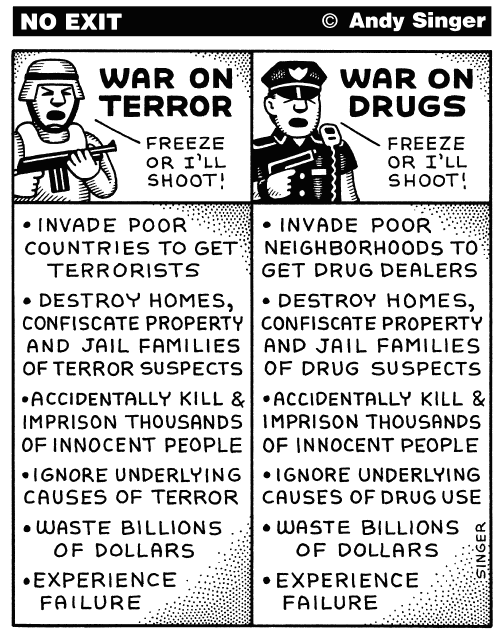
As the war on terror nears its 14th anniversary — a war we seem to be losing, given jihadist advances in Iraq, Syria, and Yemen — the U.S. sticks stolidly to its strategy of “high-value targeting,” our preferred euphemism for assassination.  Secretary of State John Kerry has proudly cited the elimination of “fifty percent” of the Islamic State’s “top commanders” as a recent indication of progress. Abu Bakr al-Baghdadi himself, “Caliph” of the Islamic State, was reportedly seriously wounded in a March airstrike and thereby removed from day-to-day control of the organization. In January, as the White House belatedly admitted, a strike targeting al-Qaeda leadership in Pakistan also managed to kill an American, Warren Weinstein, and his fellow hostage, Giovanni Lo Porto.

More recently in Yemen, even as al-Qaeda in the Arabian Peninsula took control of a key airport, an American drone strike killed Ibrahim Suleiman al-Rubaish, allegedly an important figure in the group’s hierarchy.  Meanwhile, the Saudi news channel al-Arabiya has featured a deck of cards bearing pictures of that country’s principal enemies in Yemen in emulation of the infamous cards issued by the U.S. military prior to the 2003 invasion of Iraq as an aid to targeting its leaders.  (Saddam Hussein was the ace of spades.)

Whatever the euphemism — the Israelis prefer to call it “focused prevention” — assassination has clearly been Washington’s favored strategy in the twenty-first century.   Methods of implementation, including drones, cruise missiles, and Special Operations forces hunter-killer teams, may vary, but the core notion that the path to success lies in directly attacking and taking out your enemy’s leadership has become deeply embedded.  As then-Secretary of State Hillary Clinton put it in 2010, “We believe that the use of intelligence-driven, precision-targeted operations against high-value insurgents and their networks is a key component” of U.S. strategy.

Analyses of this policy often refer, correctly, to the blood-drenched precedent of the CIA’s Vietnam-era Phoenix Program — at least 20,000 “neutralized.” But there was a more recent and far more direct, if less noted, source of inspiration for the contemporary American program of murder in the Greater Middle East and Africa, the “kingpin strategy” of Washington’s drug wars of the 1990s. As a former senior White House counterterrorism official confirmed to me in a 2013 interview, “The idea had its origins in the drug war.  So that precedent was already in the system as a shaper of our thinking.  We had a high degree of confidence in the utility of targeted killing. There was a strong sense that this was a tool to be used.”

Had that official known a little more about just how this feature of the drug wars actually played out, he might have had less confidence in the utility of his chosen instrument.  In fact, the strangest part of the story is that a strategy that failed utterly back then, achieving the very opposite of its intended goal, would later be applied full scale to the war on terror — with exactly the same results.

The Kingpin Strategy Arrives

At the beginning of the 1990s, the Drug Enforcement Administration (DEA) was the poor stepsister of federal law enforcement agencies.  Called into being by President Richard Nixon two decades earlier, it had languished in the shadow of more powerful siblings, notably the FBI.  But the future offered hope.  President George H.W. Bush had only recently re-launched the war on drugs first proclaimed by Nixon, and there were rich budgetary pickings in prospect.  Furthermore, in contrast to the shadowy drug trafficking groups of Nixon’s day, it was now possible to put a face, or faces, on the enemy.  The Colombian cocaine cartels were already infamous, their power and ruthless efficiency well covered in the media.

For Robert Bonner, a former prosecutor and federal judge appointed to head the DEA in 1990, the opportunity couldn’t have been clearer.  Although Nixon had nurtured fantasies of deploying his fledgling anti-drug force to assassinate traffickers, even soliciting anti-Castro Cuban leaders to provide the necessary killers, Bonner had something more systematic in mind.  He called it a “kingpin strategy,” whose aim would be the elimination either by death or capture of the “kingpins” dominating those cartels.

Implicit in the concept was the assumption that the United States faced a hierarchically structured threat that could be defeated by removing key leadership components.  In this, Bonner echoed a traditional U.S. Air Force doctrine: that any enemy system must contain “critical nodes,” the destruction of which would lead to the enemy’s collapse.

In a revealing address to a 2012 meeting of DEA veterans held to commemorate the 20th anniversary of the kingpin strategy’s inauguration, Bonner spoke of the corporate enemy they had confronted.  Major drug trafficking outfits, he said, “by any measure are large organizations. They operate by definition transnationally. They are vertically integrated in terms of production and distribution. They usually have, by the way, fairly smart albeit quite ruthless people at the top and they have a command and control structure. And they also have people with expertise that run certain essential functions of the organization such as logistics, sales and distribution, finances, and enforcement.”  It followed therefore that the removal of those smart people at the top, not to mention the experts in logistics, would render the cartel ineffective and so cut off the flow of narcotics to the United States.

Pursuit of the kingpins promised rich institutional rewards.  Aside from the overbearing presence of the FBI, Bonner had to contend with another carnivore in the Washington bureaucratic jungle eager to encroach on his agency’s territory. “DEA and CIA were butting heads,” recalled the former DEA chief in a 2013 interview. “There was real tension.” Artfully, he managed to negotiate peace with the powerful intelligence agency, “so now we had a very important ally. CIA could use DEA and vice versa.”

By this he meant that the senior agency could use the DEA’s legal powers for domestic operations to good advantage.  This burgeoning relationship brought additional potent allies. Not only was his agency now closer to the CIA, Bonner told me, but “through them, the NSA.” A new Special Operations Division created to work with these senior agencies was to oversee the assault on the kingpins, relying heavily on electronic intelligence.

This new direction would swiftly gain credibility after the successful elimination of the most famous cartel leader of all.  Pablo Escobar, the dominant figure of the Medellín cartel, was an object of obsessive interest to American law enforcement.  He had long evaded U.S.-assisted manhunts before negotiating an agreement with the Colombian government in 1991 under which he took up residence in a “prison” he himself had built in the hills above his home city. A year later, fearing that the government was going to welsh on its deal and turn him over to the Americans, Escobar walked out of that prison and went into hiding.

The subsequent search for the fugitive drug lord marked a turning point. The Cold War was over; Saddam Hussein was defeated in the first Gulf War in 1991; credible threats to the U.S. were scarce; and the danger of budget cuts was in the air. Now, however, the U.S. deployed the full panoply of surveillance technology originally developed to confront the Soviet foe against a single human target. The Air Force sent in an assortment of reconnaissance planes, including SR-71s, which were capable of flying at three times the speed of sound. The Navy sent its own spy planes; the CIA dispatched a helicopter drone.

At one point there were 17 of these surveillance aircraft simultaneously in the air over Medellín although, as it turned out, none of them were any help in tracking down Escobar.  Nor did the DEA make any crucial contribution. Instead, his deadly rivals from Cali, Colombia’s other major trafficking group, played the decisive role in the destruction of that drug lord’s power and support systems, combining well-funded intelligence with bloodthirsty ruthlessness.

His once all-powerful network of informers and bodyguards destroyed, Escobar was eventually located by homing in on his radio and gunned down as he fled across a rooftop on December 2, 1993.  Though the matter is open to debate, a former senior U.S. drug enforcement official assured me unequivocally that a sniper from the U.S. Army’s Special Operations Delta Force had fired the killing shot.

Following this triumph, the DEA turned its attention to the Cali cartel, pursuing it with every resource available: “We really developed the use of wiretaps,” Bonner told me.  Patience and the provision of enormous resources eventually yielded results. In June and July 1995, six of the seven heads of the Cali cartel were arrested, including the brothers Gilberto and Miguel Rodríguez-Orijuela, and the cartel’s cofounder, José “Chepe” Santacruz Londoño.  Although Londoño subsequently escaped from jail, he would in the end be hunted down and killed.  Continued U.S. pressure for the rest of the decade and beyond resulted in a steady flow of cartel bosses into prisons with life sentences or into coffins.

Cartel Heads Go Down and Drugs Go Up

The strategy, it appeared, had been an unqualified success.  “When Pablo Escobar was on the run, for all practical purposes, his organization started going down… ultimately it was destroyed.  And that’s the strategy we have called the kingpin strategy,” crowed Lee Brown, Bill Clinton’s “drug czar,” in 1994.

In public at least, no officials bothered to point out that if that strategy’s aim was to counter drug use among Americans, it had achieved precisely the opposite of its intended goal.  The giveaway to this failure lay in the on-the-street cost of cocaine in this country.  In those years, the DEA put enormous effort into monitoring its price, using undercover agents to make buys and then laboriously compiling and cross-referencing the amounts paid.

The drugs obtained by these surreptitious means, however, were of wildly varying purity, the cocaine itself often having been adulterated with some worthless substitute. That meant that the price of a gram of pure cocaine varied enormously, since a few bad deals of very low purity could cause wide swings in the average. Dealers tended to compensate for higher prices by reducing the purity of their product rather than charging more per gram. As a result, the agency’s price charts showed little movement and so gave no indication of what events were affecting the price and therefore the supply.

In 1994, however, a numbers-cruncher with the Institute for Defense Analysis, the Pentagon’s in-house think tank, began subjecting the data to more searching scrutiny. The analyst, a former Air Force fighter pilot named Rex Rivolo, had been tasked to take an independent look at the drug war at the request of Brian Sheridan, the hardheaded director of the Defense Department’s Office of Drug Control Policy who had developed a healthy disrespect for the DEA and its operations.

Having tartly informed DEA officials that their statistics were worthless, mere “random noise,” Rivolo set to work developing a statistical tool that would eliminate the effect of the swings in purity of the samples collected by the undercover agents. Once he had succeeded, some interesting conclusions began to emerge: the pursuit of the kingpins was most certainly having an effect on prices, and by extension supply, but not in the way advertised by the DEA. Far from impeding the flow of cocaine onto the street and up the nostrils of America, it was accelerating it. Eliminating kingpins actually increased supply.

It was a momentous revelation, running entirely counter to law enforcement cultural attitudes that reached back to the days of Eliot Ness’s war against bootleggers in the 1920s and that would become the basis for Washington’s twenty-first-century counterinsurgency wars. Such a verdict might have been reached intuitively, especially once the kingpin strategy in its most lethal form came to be applied to terrorists and insurgents, but on this rare occasion the conclusion was based on hard, undeniable data.

In the last month of 1993, for example, Pablo Escobar’s once massive cocaine smuggling organization was already in tatters and he was being hunted through the streets of Medellín. If the premise of the DEA strategy — that eliminating kingpins would cut drug supplies — had been correct, supply to the U.S. should by then have been disrupted.

In fact, the opposite occurred: in that period, the U.S. street price dropped from roughly $80 to $60 a gram because of a flood of new supplies coming into the U.S. market, and it would continue to drop after his death.  Similarly, when the top tier of the Cali cartel was swept up in mid-1995, cocaine prices, which had been rising sharply earlier that year, went into a precipitous decline that continued into 1996.

Confident that the price drop and the kingpin eliminations were linked, Rivolo went looking for an explanation and found it in an arcane economic theory he called monopolistic competition. “It hadn’t been heard of for years,” he explained. “It essentially says if you have two producers of something, there’s a certain price. If you double the number of producers, the price gets cut in half, because they share the market.

“So the question was,” he continued, “how many monopolies are there? We had three or four major monopolies, but if you split them into twenty and you believe in this monopolistic competition, you know the price is going to drop. And sure enough, through the nineties the price of cocaine was plummeting because competition was coming in and we were driving the competition. The best thing would have been to keep one cartel over which we had some control. If your goal is to lower consumption on the street, then that’s the mechanism. But if you’re a cop, then that’s not your goal. So we were constantly fighting the cop mentality in these provincial organizations like DEA.”

The Kingpin Strategy Joins the War on Terror

Deep in the jungles of southern Colombia, coca farmers didn’t need obscure economic theories to understand the consequences of the kingpin strategy. When the news arrived that Gilberto Rodríguez-Orijuela had been arrested, small traders in the remote settlement of Calamar erupted in cheers. “Thank the blessed virgin!” exclaimed one grandmother to a visiting American reporter.

“Wait till the United States figures out what it really means,” added another local resident. “Hell, maybe they’ll approve, since it’s really a victory for free enterprise. No more monopoly controlling the market and dictating what growers get paid. It’s just like when they shot Pablo Escobar: now money will flow to everybody.”

This assessment proved entirely correct. As the big cartels disappeared, the business reverted to smaller and even more ruthless groups that managed to maintain production and distribution quite satisfactorily, especially as they were closely linked either to Colombia’s Marxist FARC guerrillas or to the fascist anti-guerrilla paramilitary groups allied with the government and tacitly supported by the United States.

Much of Rivolo’s work on the subject remains classified. This is hardly surprising, given that it not only undercuts the official rationale for the kingpin strategy in the drug wars of the 1990s, but strikes a body blow at the doctrine of high-value targeting that so obsesses the Obama administration in its drone assassination campaigns across the Greater Middle East and parts of Africa today.

Rivolo was, in fact, able to monitor the application of the kingpin strategy in the following decade.  In 2007, he was assigned to a small but high-powered intelligence cell attached to the Baghdad headquarters of General Ray Odierno, who was, at the time, the operational U.S. commander in Iraq.  While there he made it his business to inquire into the ongoing targeting of “high-value individuals,” or HVIs.  Accordingly, he put together a list of 200 HVIs — local insurgent leaders — killed or captured between June and October 2007.  Then he looked to see what happened in their localities following their elimination.

The results, he discovered when he graphed them out, offered a simple, unequivocal message: the strategy was indeed making a difference, just not the one intended. It was, however, the very same message that the kingpin strategy had offered in the drug wars of the 1990s.  Hitting HVIs did not reduce attacks and save American lives; it increased them. Each killing quickly prompted mayhem. Within three kilometers of the target’s base of operation, attacks over the following 30 days shot up by 40%. Within a radius of five kilometers, a typical area of operations for an insurgent cell, they were still up 20%. Summarizing his findings for Odierno, Rivolo added an emphatic punch line: “Conclusion: HVI Strategy, our principal strategy in Iraq, is counter-productive and needs to be re-evaluated.”

As with the kingpin strategy, the causes of this apparently counter-intuitive result became obvious upon reflection.  Dead commanders were immediately replaced, and the newcomers were almost always younger and more aggressive than their predecessors, eager to “make their bones” and prove their worth.

Rivolo’s research and conclusions, though briefed at the highest levels, made no difference.  The kingpin strategy might have failed on the streets of American cities, but it had been a roaring success when it came to the prosperity of the DEA.  The agency budget, always the surest sign of an institution’s standing, soared by 240% during the 1990s, rising from $654 million in 1990 to over $1.5 billion a decade later.  In the same way, albeit on a vaster scale, high-value targeting failed in its stated goals in the Greater Middle East, where terror recruits grew and terror groups only multiplied under the shadow of the drone.  (The removal of al-Baghdadi from day-to-day control of the Islamic State, for instance, has apparently done nothing to retard its operations.)  The strategy has, however, been of inestimable benefit to a host of interested parties, ranging from drone manufacturers to the CIA counterterrorism officials who so signally failed to ward off 9/11 only to adopt assassination as their raison d’être.

No wonder the Saudis want to follow in our footsteps in Yemen. It’s a big world. Who’s next?

Andrew Cockburn is the Washington editor of Harper’s Magazine.  An Irishman, he has covered national security topics in this country for many years.  In addition to publishing numerous books, he co-produced the 1997 feature film The Peacemaker and the 2009 documentary on the financial crisis American Casino.  His latest book is Kill Chain: The Rise of the High-Tech Assassins (Henry Holt).


Liberation Is Unprofitable

c91b81d1dcb043acfb1eed41207da8b5

By Charles Hugh Smith

Source: Of Two Minds

12 examples of how liberation is not profitable and therefore it must be marginalized, outlawed, proscribed or ridiculed.

If we had to summarize the sickness of our economy and society, we could start by noting that liberation is unprofitable, and whatever is not profitable to vested interests is marginalized, outlawed, proscribed or ridiculed. Examples of this abound.

Liberation from digital communication servitude is not profitable. Don’t have a smart phone on 18 hours a day, every day? Loser! Luddite! Liberation from digital communication servitude is not profitable, therefore it is ridiculed.

Liberation from debt is not profitable. Only the wealthy can afford to buy a vehicle without debt, a home without debt or a university education without debt. For everyone else, liberation from debt is not an option, because debt is highly profitable to our financial Overlords and the politicos they buy/own.

This Is How Little It Cost Goldman To Bribe America’s Senators (Zero Hedge)

Liberation from political elites is not profitable. Dependence on the state for monthly payments binds the recipients to the political elites that control the money and payments, and to the financial elites who control the political elites.

Liberation from the staged, soap-opera political drama of elections is not profitable. Election advertising generates staggering profits for media companies, and the ceaseless nurturing of fear, resentment and indignation fuels acceptance of centralized power and control.

Vote all you want. The secret government won’t change.

Liberation from the consumerist mindset is not profitable. Aspirational purchases in the pursuit of appearances are the most profitable of all spending; re-use, repair and informal peer-to-peer sharing are all intrinsically unprofitable.

Narcissistic Consumerism and Self-Destruction (October 20, 2012)

Liberation from the tyranny of central banks is not profitable. Our entire financial system is built on the simple dynamic that everyone is forced to use money issued by the central bank (Federal Reserve) to its member banks and their financier cronies.

Money that is decentralized and not issued by central banks is not profitable.

Common-sense, minimal regulations are not profitable. Regulations feed government fiefdoms and the revolving-door spoils system between the state and private industry, and erect formidable barriers to new competitors. As a result, over-regulation is immensely profitable.

Regulation Run Amok—And How to Fight Back

The ability to think independently is not profitable. The control mechanisms that keep the various classes of serfs in permanent servitude all depend on a dumbed-down populace that has been stripped of the ability to think independently by propaganda, group-think, medications, the education industry and lifelong dependency on the state.

Anti-Intellectualism and the “Dumbing Down” of America

An economy/society without corruption is not profitable. Buying favors, cronyism and cartel control of pricing are the primary sources of corruption. Cartels and the auctioning of favors are highly profitable to politicos and the vested interests who control the tollways of finance, political influence and social mobility.

America’s Main Problem: Corruption

Degrowth is not profitable. Needing fewer, quality things that last for decades is not profitable. Reparing things for nearly-free is not profitable. Giving stuff away to others for free is not profitable. Making do with what you have is not profitable.

Degrowth, Anti-Consumerism and Peak Consumption (May 9, 2013)

A scarcity of stress and anxiety is not profitable. Stress, anxiety and financial insecurity are all highly profitable, as these drive profitably addictive behaviors such as going deep into debt, shopaholic binge buying, multiple anti-anxiety/anti-depression medications, costly therapy and various forms of self-medication.

The Silent Epidemic in a Broken, Deranged System: Stress (April 18, 2013)

Opting out is not profitable. Opting out of debt-serfdom and the burdens of being a tax donkey is not profitable to vested interests or the state. Adopting self-reliance and low-cost/low-impact living and opting out of the status quo culture of consumerism, debt and complicity with a parasitic, exploitive cartel-state Aristocracy/ Plutocracy/ Oligarchy/ Kleptocracy (take your pick–it’s still the same rapacious Elite whatever name you choose)–is not profitable.

Tune In, Turn On, Opt Out (May 17, 2013)