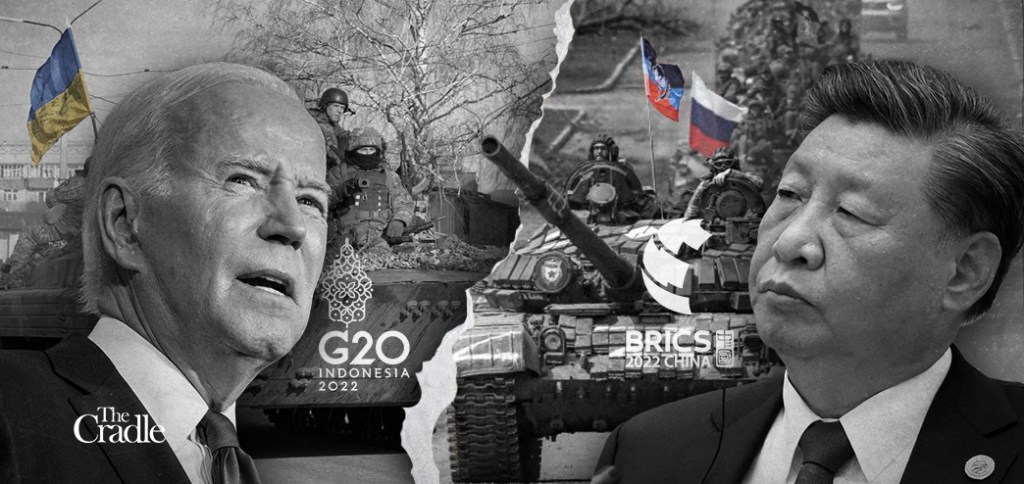

The 500 Years Old WESTERN HEGEMONY is Coming to an END and the World is about to ENTER a VERY DANGEROUS PERIOD

For 500 years the world has been run from Europe or the US: that’s about to change and nobody is sure what its replacement will look like

By Timofey Bordachev

Source: The 21st Century

The most dramatic and unique aspect of the current state of affairs in international politics is that we cannot count on the ability of a single state, or a group of sufficiently powerful countries, to play a leadership role in the future.

This means it is difficult for us to imagine who will be able to force states to comply with the rules of conduct in their foreign policy, and how such strictures can even be enforced.

Indeed, the question of why individuals, or in this case countries, should abide by regulations is the most fundamental one in political philosophy.

And despite all the imperfections of the power method, humanity has not yet invented any other way of achieving such goals, even in minimal amounts, other than by force.

Over the last 500 years, the rules of international communication have been created within the narrow community of Western countries, first in Europe, before in the 20th century the US joined in, providing the power needed to enforce the system.

At first, this was done through the balance of power of leading European states, joined by Russia in 1762.

After the international order that had emerged in the mid-17th century came under attack from revolutionary France, control of the rules became a matter for a small group of major empires.

They, led by Russia and Britain, defeated Napoleon and in 1815 created an order which had at its heart a general agreement that mutiny in international affairs was unacceptable.

By the end of the nineteenth century, politics had become global, but the European powers, including Russia, could still control the rest through brute force and their colossal military-industrial superiority.

The dramatic events of 1914-1945 brought the US to the forefront of global politics, as the leader of the Western community on a global scale.

International institutions, starting with the United Nations, were established with the primary objective of preserving the monopoly position of the West.

This, however, required the emergence of formal institutions of justice in the form of international law, or the participation in the highest UN body, the Security Council, of the Soviet Union and China, which were inherently hostile to US and Western European interests.

The institutional form of Western power dominance has become overbearing and the main question now is whether it can be preserved.

Therefore, the collapse of US and Western European power positions in international politics entails not just a change of leadership, but a revision of the existing institutions and rules at the global level.

In other words, the entire formal international order that has emerged after World War II (and in reality over the last few centuries) will cease to exist.

It was based on a special system of rights and privileges for a limited group of great powers, and later the illusion of fairness of which was created by international institutions led by the UN.

It was this system that played the role of the main legitimizing principle of the existing world order, although in practice it was often replaced by the West’s ability to exert a decisive influence on world affairs

Thus, the collapse of international political institutions will very probably prove to be a consequence of the disappearance of their power base, whose presence has been unchallenged for several centuries.

We are now witnessing the destruction of both the formal and the real basis of the international order. In all likelihood, this process can no longer be stopped.

The coming period will be a time of defining the new global power base, and it is difficult to say yet which players, and to what extent, will become part of it.

What is important is that the top states of the present time – the US, Russia, China and India – are not close to each other, especially in terms of values and understanding of the basic principles of international rules.

The greatest problem so far is the behaviour of the US and certain Western European countries, which, for internal reasons, are pursuing an aggressive policy towards the outside world.

These states have embarked on a very troubling path of qualitative changes in the basic things that make up the social, gender and, consequently, political structures of society. For most other civilizations, this path is a challenge and will be rejected.

We also do not know the extent to which the internal development of the West depends on the spread of its ideals, as it did in previous periods.

In the event that the trends emerging in the West will, like revolutionary France, the Bolshevik regime or Nazi Germany, demand not just recognition from others, but expansion globally, the future will become very worrying.

We can already see that the conflict between the values favored by the West and the foundations of domestic legitimacy in a number of countries, is becoming a ground for aggravated political relations.

It would, however, be a mistake to hope that the other great and middle powers confronting the West are completely united in their understanding of the foundations of justice at the domestic level.

Even if Russia, India, China or Brazil now demonstrate a common understanding of the basic principles of a “proper” world order, this does not mean that they have the same vision of a better domestic order.

This is all the more true of the states of the Islamic world and other major developing countries. Their conservative values are often in conflict with those of the West, but this does not mean that they can create unity between themselves.

In other words, the new international order will, for the first time, be without a reliable link with the domestic ambitions of the leading powers, and this is indeed a qualitative change compared to all the historical eras we discussed.

Such a phenomenon seems very important because we have no experience of understanding how relations between states will develop under such conditions.

Brute force could become the only relatively tangible basis to assert the order, but this may not be enough to make the conditions imposed by it sustainable, even in the short term.

Another unique feature of today’s revolutionary situation is that the revision of the international order is not being carried out by one or a few powers – it has now become the business of the world’s majority.

The countries that make up about 85% of the world’s population are in one way or another no longer prepared to live with conditions created without their direct involvement.

That said, their resistance is often expressed without direct intention and depends on the power capabilities of the particular power.

What from the point of view of Russia or Iran looks like lack of resolve in dealing with the US may seem like a great challenge for Kazakhstan or another young sovereign country – after all, their entire socio-economic system was created to exploit a liberal world order.

The fragile states of Africa, or the former Soviet space, are far less capable of behaving consistently than the prosperous monarchies of the Persian Gulf. China, though now the second most powerful economic power, is also aware of its weaknesses.

But all this does not change the most important thing – even if the destruction of the existing status quo takes the form of soft sabotage rather than decisive military action, it does not simply reflect a general discontent with Western authoritarianism, but creates a new order, and the basic features of this are as yet undetermined.

In the coming years, most countries in the world will seek to make the most of the weakening of the power base of international politics in their self-interest.

So far, these actions constitute a constructive conflict, since they objectively undermine a system based on fantastic injustice.

However, as time goes on the US-EU bloc will weaken and lock itself away, and Russia or China will never be strong enough to take their place.

And in the perspective of the next 10 to 15 years, the international community will face the problem of replacing the power monopoly of the West with new universal instruments of coercion, the nature and content of which are still unknown to us.

A war Russia set to win

The Europeans have been nicely played by the Americans

Breached: With the attack on the Crimean Bridge, Ukrainian President Zelenskyy has crossed a red line that Moscow had warned him against. Reuters

By MK Bhadrakumar

Source: The Tribune of India

Two massive terrorist strikes misfired spectacularly and a terrible beauty is born in the Ukraine war. These two carefully planned attacks in quick succession — on Nord Stream gas pipelines and Crimean Bridge — were intended as a knockout blow to Russia. According to President Vladimir Putin, people ‘who want to finally sever ties between Russia and the EU, weaken Europe’ are behind the Nord Stream blasts. He named the US, Ukraine and Poland as ‘beneficiaries’.

Last Wednesday, Russia’s domestic intelligence service FSB identified Ukraine’s military intelligence chief, Kyrylo Budanov, as the mastermind behind the Crimean attack. The New York Times and Washington Post also pointed fingers at Kiev, quoting ‘sources’. While Nord Stream-1 has been crippled, one of the strings of Nord Stream-2 remains intact. Putin said last week that the pipeline could be restored and Russia could deliver about 27 billion cubic metres of gas. ‘The ball is on the side of the European Union, if they want — let’s turn on the tap,’ he said.

But mum’s the word from Brussels. It is a profoundly embarrassing moment for the EU. The triumphalism has vanished as Europe is threatened by years of recession caused by the blowback from sanctions against Russia, where the US insisted on the cut off of energy ties with Moscow. The EU has now become a captive market for Big Oil and is left to buy LNG from the US at the asking price, which is six to seven times higher than the domestic price in the US. (Contracted price for long-term Russian supply for Germany used to be about $280 per 1,000 cubic metres as against the current market price hovering around $2,000.)

Plainly put, the Europeans have been nicely played by the Americans. India should take note of the US’ sense of entitlement. Basically, the Biden administration created a contrived energy crisis whose real aim is war profiteering.

The Crimean Bridge attack of October 8 is much more serious. Zelenskyy has crossed a red line that Moscow had repeatedly warned him against. Putin has disclosed that there have also been three terrorist attacks against the Kursk NPP. Russians will settle for nothing less than the ouster of the Zelenskyy regime.

Russia’s retaliation against Ukraine’s ‘critical infrastructure’, something Moscow refrained from so far, has serious implications. Since October 9, Russia has begun systematically targeting Ukraine’s power system and railways. Noted Russian military expert Vladislav Shurygin told Izvestia that if this tempo was kept up for a week or so, it ‘will disrupt the entire logistics of the Ukrainian military — system for transporting personnel, military equipment, ammunition, related cargo, as well as the functioning of military and repair plants.’

The Americans are cocooned in a surreal world of their self-serving narrative that Russia ‘lost’ the war. In the real world, though, Ivan Tertel, KGB chief in Belarus, who has an insider view of Moscow, said last Tuesday that with Russia boosting its troop strength in the war zone — 3 lakh troops who have been mobilised plus 70,000 volunteers — and the deployment of advanced weaponry, ‘the military operation will enter a key phase. According to our estimates, a turning point will come in the period from November of this year to February of next year.’

Policy-makers and strategists in Delhi should make a careful note of the timeline. The bottom line is, Russia is looking for an all-out victory and will not settle for anything less than a friendly government in Kiev. Western politicians, including Biden, understand that there is nothing stopping the Russians now. The US’ weapon kitty is running dry as Kiev keeps asking for more.

When asked whether he’d meet Biden at the G20 in Bali, Putin derisively remarked on Friday, ‘He (Biden) should be asked whether he is ready to hold such negotiations with me or not. To be honest, I don’t see any need, by and large. There is no platform for any negotiations for the time being.’

However, Washington has not yet thrown in the towel and the Biden administration remains obsessed with exhausting the Russian military — even at the cost of Ukraine’s destruction. And, for the Russians too, there is still much to be worked out on the battlefield: the oppressed Russian populations in Odessa (which suffered unspeakable atrocities from the neo-Nazis), Mykolaiv, Zaporizhya, Dnipropetrovsk, Kharkov are expecting ‘liberation’. It’s a highly emotive issue for Russia. Again, the overarching agenda of ‘demilitarisation’ and ‘denazification’ of Ukraine must be taken to its logical conclusion.

When all that is over, Putin knows Biden will not even want to meet him. Hungarian PM Viktor Orban said last week, ‘Anyone who seriously believes that the war can be ended through Russian-Ukrainian negotiations lives in another world. Reality looks different. In reality, such issues can only be discussed between Washington and Moscow. Today, Ukraine is able to fight only because it receives military assistance from the United States…

‘At the same time, I do not see President Biden as the person who would really be suitable for such serious negotiations. President Biden has gone too far. Suffice it to recall his statements to Russian President Putin.’

India should expect the defeat of the US and NATO, which completes the transition to a multipolar world order. Sadly, Indian elites are yet to purge their ‘unipolar predicament’. Europe, including Britain, is devastated and there is palpable discontent over the US’s ‘transatlantic leadership’. Indo-Pacific strategy is hopelessly adrift. New power centres are emerging in India’s extended neighbourhood, as the OPEC’s rebuff to Washington shows. A profound adjustment is needed in the Indian strategic calculus.

Emily Oster’s Plea Bargain

Shuck-and-jive from America’s broken thinking class, the people who pretend to know better than everybody else.

By James Howard Kunstler

Source: Kunstler.com

By now, everybody and his uncle has seen Emily Oster’s plea for “pandemic amnesty” in The Atlantic magazine, a house organ of the people in America who know better than you do about… really… everything. Emily’s wazoo is so stuffed with gold-plated credentials (BA, PhD, Harvard; economics prof at Brown U) it’s a wonder that she could sit down long enough to peck out her lame argument that “we need to forgive one another for what we did and said when we were in the dark about COVID.”

Emily wasn’t “in the dark.” She had access to the same information as the Americans who recognized that everything the public health authorities, the medical establishment, and many elected officials shoveled out about Covid and its putative remedies and preventatives was untrue, with a patina of bad faith and malice — especially when it was used to persecute their political adversaries.

These dissenters turned out to be “right for the wrong reasons,” she declared, the main reason being that they were not aligned in good-think with the Woke-Jacobinism of her fellow “progressives” at Brown U, and academics all across the land, who were righteously busy destroying the intellectual life of the nation, making it impossible for the thinking class to think.

Let’s face it: every society actually needs a thinking class, a cohort able to frame important issues-of-the-moment that require argument in the public arena to align our collective thoughts and deeds with reality. America used to have a pretty good thinking class, with a pretty good free press and many other platforms for opinion — all animated by respect for the first amendment to the Constitution.

The thinking class destroyed that by vigorously promoting a new censorship regime in every American institution, shutting down free speech and, more crucially, the necessary debate for aligning our politics with reality. Hence, America’s thinking class became the torchbearers of unreality, in step with the Party of Chaos which held the levers of power. This included the powers of life and death in the matter of Covid-19.

These were the people who militated against effective early treatment protocols (to cynically preserve the drug companies’ emergency use authorization (EUA) and thus their liability shields); the people who enforced the deadly remdesivir-and-ventilator combo in hospital treatment; the people who rolled out the harmful and ineffective “vaccines”; who fired and vilified doctors who disagreed with all that; and who engineered a long list of abusive policies that destroyed businesses, livelihoods, households, reputations, and futures.

How did it happen that the thinking class destroyed thinking and betrayed itself? Because the status competition for moral righteousness in the sick milieu of the campus became more important to them than the truth. In places like Brown U, what you saw was an escalating contest for status brownie-points, which is what virtue-signaling is all about. And the highest virtue was going along with whatever experts and people-in-authority said — the pathetic virtue of submission. Anything that got in the way of going along — such as differences of opinion — had to be crushed, stamped out, and with a vicious edge to teach the dissenters a lesson: dissent will not be tolerated!

Some thinking class. The case of Emily Oster should be particularly and painfully disturbing, since she affects to specialize, as an economist, on “pregnancy and parenting” (her own website declares), while the Covid regime of public health officialdom she supported instigated a horrendous pediatric health crisis that is ongoing — it was only days ago that the CDC added the harmful mRNA “vaccines” to its childhood immunization schedule for the purpose of conferring permanent legal immunity for the drug companies after the EUA ends, a dastardly act. Where’s Ms. Oster’s plea to the CDC to cease and desist trying to vaccinate kids with mRNA products?

The CDC is still running TV commercials (during World Series ballgames!) touting its “booster” shots when only weeks ago a top Pfizer executive, Janine Small (“Regional President for Vaccines of International Developed Markets”), revealed in testimony to the European Union Parliament that her company never tested its “vaccine” for preventing transmission of SARS CoV-2. The CDC under Director Rochelle Walensky is still extra-super-busy concealing or fudging its statistical data to obfuscate the emerging picture that MRNA “vaccines” are responsible for the shocking rise of “all-causes deaths” in the most heavily-vaxxed nations. In short, the authorities are to this minute still running their whole malign operation.

Notably, Ms. Oster’s plea for amnesty and forgiveness, showcased in The Atlantic, omits any discussion of accountability for what amounts to serious crimes against the public. A whole lot of people deserve to be indicted for killing and injuring millions of people. At the heart of her plea is the excuse that “we didn’t know” official Covid policy was so misguided. That’s just not true, of course, and is simply evidence of the thinking class’s recently-acquired allergy to truth. The part she left out of her petition for pandemic amnesty is: we were only following orders.

Pandemic? Great Reset? How about… a beginner’s mind?

By Mickey Z.

Source: Dissident Voice

“In the beginner’s mind there are many possibilities. In the expert’s, there are few.” 1

Has there ever been a more urgent time to embrace many possibilities? This age of pervasive uncertainty and division may well be very fertile ground for questioning our assumptions and interrogating our beliefs. In fact, we just might be living in the ideal time to accept that there are limitless ways to perceive even the most contentious issues.

Expert vs. Beginner

The expert’s mind is over-secure in its prowess. Such a mentality may promote shortsighted habits like confirmation bias. Many “authorities” will only seek out (read: cherry-pick) information that validates and justifies their behavior because expertise — real or imagined — causes us to grow less curious.

If we already feel well-versed in a topic, we tend to pay less attention to it. We ask fewer questions. This is a stifling choice even if we know 95 percent of what there is to know about a particular subject. Ideally, this is when we should be paying more attention to it in order to discern the nuances that remain to be learned.

Conversely, the beginner’s mind is ever-hungry for input — regardless of its source or its tendency to reinforce existing beliefs. In the beginner’s mind, there are fewer limits and fewer expectations. There is much more room for revelation and awe. Nothing is taken for granted and even the tiniest detail has the potential to inspire reverence.

The beginner’s mind is basically the polar opposite of today’s social media algorithms, mainstream news headlines, and popular political discourse.

3 (of the many) Benefits of a Beginner’s Mind

Creativity

Habits and structure can be incredibly useful. They can also become an obstacle to innovation. A beginner’s mind encourages us to approach familiar problems with a fresh perspective. This mindset often results in the exploration of avenues that an expert would casually dismiss as “been there, done that.”

Gratitude

A beginner’s mind awakens each morning, ready to wipe the slate clean and start anew. From this fresh perspective, it feels more natural to identify and appreciate your blessings.

Mindfulness

Seeing the world like a beginner prevents you from “going through the motions.” There is a clearer understanding that the present is all you have. The past is where guilt and regret dwell. In the future may lie apprehension and anxiety. Right here, right now, the moment is enough.

How to Rediscover a Beginner’s Mind

By its very definition, there are an infinite number of ways to occupy a beginner’s mind. To follow are some basic guidelines but think of them like Bruce Lee’s finger pointing a way to the moon. As Lee urged, “Don’t concentrate on the finger or you’ll miss all that heavenly glory.”2

1. Reject your ego’s need to be an expert

Eavesdrop on a conversation at the local supermarket. Even better, scroll (without reacting) through most threads on social media. You’ll see and hear so many people pretending they know“what’s really happening” and “what’s gonna happen.” Your ego craves the status of being right. The beginner in you would rather open-mindedly look for reality than be deemed an expert at anything.

2. Slow down

As touched on above, we must avoid going through the motions. Whenever possible, slow down to question and explore. Take your time to learn — even from the most unlikely of sources.

3. Channel your inner child

Re-introduce yourself to some of your closest childhood friends: wonder, mischief, and playfulness. Reject the cynical adult premise of “same shit, different day.”

4. See with new eyes

In the words of Marcel Proust: “The real voyage of discovery consists not in seeking new landscapes, but in having new eyes.”3 Practically speaking, your quest for new eyes can begin with simple exercises like treating your hometown as if you were a tourist and seeing what you can discover.

5. Embrace nonsense 

As Gary Zukav, author of Dancing Wu Li Masters: An Overview of the New Physics, (1979)posits: “Nonsense is nonsense only when we have not yet found that point of view from which it makes sense.”

6. Meditation

Perhaps the most time-worn path to a beginner’s mind is the practice of mindful meditation. Whether you choose a spiritual or secular approach, even ten minutes a day of meditation will expand your consciousness.

The child is in me still and sometimes not so still.4

There is no one right way to inhabit a beginner’s mind. After all, it is not a destination. It’s all about the process, the learning, and those moments of epiphany made possible by not closing off your options… so re-activate your inner child.

Keep re-evaluating what you believe before your perceptions can grow ossified. Don’t limit your explorations by choosing in advance what it is you wish to find. Turn your truth over and over, again and again. Avoid accumulating old answers. Instead, dedicate far more of your time to conjuring up new questions. Through it all, let compassion serve as your compass.

The experts [sic] have gotten us into this mess.

It’s time to give beginners their opportunity to shine.

  1. Shunryu Suzuki, Prologue Zen Mind, Beginner’s Mind, (1973). []
  2. Bruce Lee, Enter the Dragon, 1973. []
  3. The Captive. (La Prisonnière, the fifth volume of Remembrance of Things Past), 1923. []
  4. Fred Rogers, (2003). The World According to Mister Rogers: Important Things to Remember, p. 45, Hachette UK. []

Saturday Matinee: All About Lily Chou Chou

THE GRAY TRAGEDY OF YOUTH IN JAPAN: SHUNJI IWAI’S “ALL ABOUT LILY CHOU-CHOU”

By Luke Powell

Source: Sabukaru

Released in 2001, writer and director Shunji Iwai’s “All About Lily Chou-Chou” 「リリイ• シュシュのすべて」is a masterclass in complex and powerful storytelling, cinematography, and meta-textual messaging that puts on display the formative, introspective, and oftentimes malicious enigma that is the life of youth in Japan.

Set in the town of Ashikaga, the story centers around the relationship of two young boys, Shusuke Hoshino and Yuichi Hasumi, as they progress through junior high school. Hoshino is known to be one of the top students in their school and is harassed and ostracized by his classmates as a result, a commonplace occurrence for those caught outside the boundaries of conformity while growing up in Japan. Yuichi, in contrast, is shy and submissive to the societal structures that surround him, only paying attention and devoting all his personal time to the singer and songwriter Lily Chou-Chou.

In his free time, Yuichi manages an online BBS chatroom titled “Lilyholic,” which is completely dedicated to Lily and her music, and the messages sent between users of this website overlay much of the film. The mystery surrounding this chatroom and the messages between its users acts as a crucial plot point that slowly unravels in conjunction with the film’s events.

At one point, Yuichi, Hoshino, and their friends manage to secure a trip to Okinawa, during which Hoshino has a near-death experience that serves as the foundation for the cruel and unusual monster that he becomes, changing his and Yuichi’s relationship forever as he usurps his way into being the school’s bully the following school year.  Despite the title, this is not simply a story about a fictional songwriter and her music, but the disturbing and oftentimes glossed-over ways in which modern society corrupts the minds of youth, and the various ways those children attempt to cope against such odds. 

Yuichi’s love and devotion for Lily Chou-Chou is the emotional epicenter of this film, as it displays the profound ability for music to save and give meaning to young people’s lives, especially when surrounded by ignorant adults and inhumane peers. While the musician herself is fictional, Lily Chou-Chou’s mythical music expands over the course of the film, overlaying its imagery of lonesomeness, isolation, and absurdity with luscious, calming, and poignant bits of melancholic bliss; a reflection of Yuichi’s character and perspective on the world around him.

Users of the chatroom “Lilyholic” continuously exclaim their love for Lily and her ability to channel the “Ether,” an invisible yet omni-present force that connects all fans of Lily Chou-Chou together in their existence through Lily’s music. The “Ether” is an intrinsic aspect of the power her music has on those who listen to her, serving as the connective thread that weaves its way through the fabric of a fragile reality, allowing those lost in the tribulations of life to hold onto something organic, warm, and personal, an oasis among a desert of expectations, conformity, and isolation. 

It goes without saying that the music on display in this film is truly special and should be experienced firsthand, with the soundtrack growing organically as the audience learns more about Lily, her music, and the different characters in the film who become impacted by her compositions [for better or for worse].

Throughout the film, there are multiple references to the classical French composer Claude Debussy, whom users of Lilyholic cite as being one of Lily’s musical inspirations, as he was able to produce the “Ether” through his compositions. For example, the song that accompanies the opening scene of the film, titled 「アラベスク」[“Arabesuku”] is based off of Debussy’s “Arabesque No. 1.” Lily’s shrill yet comforting voice glides over synthesized piano chords, distanced hints of strained guitar, and a lo-fi drum beat that subjects the 19th-century classical work to a cybernetic restructuring – all of which results in one of the most captivating opening experiences in film.

Arranged and produced by Takeshi Kobayashi, the music of “All About Lily Chou-Chou” is a kaleidoscope of sonic captivity, melting between Lily’s somber yet grungy aesthetic as well as moments of clarity through the use of classical composers like Debussy, combining to create less of a soundtrack and more of an experience that will cling to you long after the credits have finished rolling.

The narrative direction and cinematography of “All About Lily Chou-Chou” are also aspects that cannot be ignored. The narrative’s timeline is fractured, starting chronologically from the middle of the story, eventually flashing back to the canonical beginning, and finally returning to the present to finish out the film. The script is adapted from an online novel that was written by director Shunji Iwai himself in the chatroom of a real-life version of the “Lilyholic” website, in which the director plays out the story of “All About Lily Chou-Chou” through the chat exchanges of two site users. A version of this website can still be accessed online today, and its existence is only the tip of the iceberg for the extensive material surrounding this film beyond its screen time. The narrative, in this sense, is multi-layered and meta-textual – an interactive and organic experience that not only goes beyond the medium of film but places a sense of participation and influence in the viewer, only to be powerless against the fierce, apathetic, and surreal scenes we witness.

The cinematography by Noboru Shinoda [“Hana and Alice,” “Love Letter”] is just as varied and complex as the film’s narrative, as it switches between ethereal, lush views of rice fields and angelic classroom settings in one shot, to the jarring use of hand-held cameras and disorienting angles in the next. Shinoda and Iwai were the first Japanese filmmakers to use the now discontinued Sony HDW-F900 digital video camera which was designed to reflect the look of 35mm film, further emphasizing the thematic imagery of nostalgia and dream-like isolation.

The camera work almost seems to be shot by a child at times, such as an unseen member of Yuichi’s friend group or class as they youthfully document the strange and disturbing events occurring in front of them, only focusing on the power a digital camera has without considering what they are actually recording. Or rather, Iwai may be intending for us, the viewer, to put ourselves behind the lens, acting as a silent observer to the events that unfold without the voice or power to do anything about it, which is strikingly similar to Yuichi’s character in the film itself. The combination of a fractal narrative structure and an abrasive yet realistic use of the camera encapsulates so much of the themes and messaging this film has to offer – mainly that being the confusing, frustrating, and unapologetic nature of growing up surrounded by unforgiving societal structures, while at the same time blindly attempting to hold onto and bask in the naiveté of youth. 

The subject of youth is the eye of Iwai’s proverbial hurricane of emotion and turmoil that is “All About Lily Chou-Chou.” Made in 2001, this film was produced at a time in Japan that saw a sharp increase in teenage crime and suicide following the economic collapse of 1991. In a country so wrought with societal and familial expectations, the bursting of their economic bubble proved disastrous for Japan’s teenage and young-adult population, as they were now tasked with bearing said expectations and cultural conformity against a historically low employment rate.

Commonly referred to as the “Lost Decade,” the 1990s in Japan was filled with headlines detailing the effect of the recession on the country’s young population, as teenage crime doubled in frequency, and reports of bullying and assault within schools skyrocketed. The rise in crime and disillusionment among the country’s youth resulted in many Japanese filmmakers attempting to grasp this idea of “teenage rage” through their films in the late 90s and early 2000s, such as in Takashi Miike’s “Fudoh: The New Generation” [1996] and Kinji Fukasaku’s “Battle Royale” [2000]. While these films painted a more dystopian and fantastical perspective of the violent phenomenon, Shunji Iwai wanted to represent this general angst and discontent in a more realistic manner that would directly connect with the audience it sought to portray. In one interview from 1995, Iwai reflects on his perspective towards the children who will be watching his stories: “We have to make movies that appeal to them and reflect the world they live in.” 

The characters within “All About Lily Chou-Chou” represent the cruel realities of the “Lost Decade.” They don’t conduct acts of headline-defining mass crime or comical absurdity, but instead are portrayed as unheard, misguided, and tragic children who are following in the steps of complicit adults as they attempt to find answers in a confusing world that they have no power in controlling. As shown in the film, some of these characters choose to find those answers in disturbing cruelty or abusive domination over their peers, while others try to be as passive or silent as humanly possible just to survive. And yet, while each character within this film leads a complex and difficult life that sometimes results in catastrophe, all of them are connected through the “Ether,” endlessly searching for a sense of comfort, acceptance, and understanding through the soundscape of Lily Chou-Chou. It could be said that the characters within this film are all living in, as Yuichi states in one monologue, “the age of Gray,” a liminal space of reality that seems to place their lives in a state of constant immobility and pain. Life is made void of color by the brutal violence and betrayal that these children either commit or fall victim to, and for some, Lily provides safety and guidance in that darkness, while she may also fuel the angry, merciless fire burning inside others. 

“All About Lily Chou-Chou” is dark, disturbing, and cruel in its presentation, but manages to be something so much more intimate, profound, and human in its substance. It discusses themes surrounding the troubles of youth in Japan, who are constantly cornered by cultural and familial expectations, conformity, and a social hierarchy that can be detrimental to those caught in its jaws. It portrays the fragility of youth, how easily corruptible a young mind can be, and how one source of bliss can be enough to hold onto the hope of a better tomorrow. Today, in a world dominated by online interactions, superficial connections, and an uncertain future, this film is more relevant than ever before – a true cyber hymn that anyone and everyone can find meaning within. 

We have attached the album that was released under the name “Lily Chou-Chou” after the movie was released so that you can get a better feel for the movie and the artist that is the titular character of the entire film. It features all of Lily’s music that is present in the film, and is titled “Kokyu” [or “Breathe” in English], which is in reference to the project that she released during the movie itself.

The entire thing can also be streamed on Spotify. In particular, the following songs are absolutely stunning and very representative of the movie itself:

  • Arabesque [アラベスク “Arabesuku”]
  • Flightless Wings [飛べない翼 “Tobenai Tsubasa”]
  • Glide [グライド “Guraido”] 

Watch All About Lily Chou Chou on Kanopy here: https://www.kanopy.com/en/product/5636535

The endless proxy war, by design

While privately conceding that its ally Ukraine is not “capable of winning the war,” the Biden administration keeps fueling it.

By Aaron Maté

Source: Aaron Maté Substack

Russia’s invasion of Ukraine has presented the White House with a geopolitical crisis that it played a critical role in creating. In February 2014, Victoria Nuland, a current senior State Department official and former Dick Cheney advisor, was caught on tape plotting the installation of a new Ukrainian government – a plan, she stressed, that would involve Biden and his then-top aide, and current National Security Advisor, Jake Sullivan. Weeks later, the democratically elected Ukrainian president Viktor Yanukovych was ousted and replaced by Washington-backed leaders – including a prime minister selected by Nuland.

The regime change in Kiev made Biden the most influential US political figure in Ukraine, as underscored by the lucrative Burisma board seat gifted to his son Hunter. While the Biden family and other well-connected players profited, Ukraine fell into civil war. In the eastern Donbas region, Kremlin-backed Ukrainian rebels took up arms against a fascist-infused coup government that cracked down on Russian culture and countenanced murderous assaults on dissidents. Rather than promote the 2015 Minsk II accords — the agreed-upon formula for ending the Donbas conflict – the US fueled the fight with a weapons and training program that turned Ukraine into a NATO proxy. Influential US politicians left no doubt about their intentions. As the Donbas war raged, lawmakers declared that they were using Ukraine to “fight Russia over there” (Adam Schiff) and vowed to “make Russia pay a heavier price,” (John McCain). In February of this year, Russia invaded to bring the eight-year fight to an end, leaving Ukraine to pay the heaviest price of all.

The Biden administration shunned multiple opportunities to prevent the Russian assault. When Russia submitted draft peace treaties in December 2021, the White House refused to even discuss the Kremlin’s core demands: a pledge of neutrality for Ukraine, and the rollback of NATO military forces in post-1997 member states that neighbor Russia. At the final round of talks on implementing Minsk II in early February, the “key obstacle,” the Washington Post reported, “was Kyiv’s opposition to negotiating with the pro-Russian separatists.” Siding with Ukraine’s far-right, which had threatened to overthrow Volodymyr Zelensky if he signed a peace deal, the US made no effort to encourage diplomacy. Emboldened to escalate its war on the Donbas, the Ukrainian government then massively increased shelling on rebel-held areas in the days immediately preceding Russa’s February 24th invasion.

Looking back at the pre-invasion period, Jack Matlock, the US ambassador to the Soviet Union under Bush I, now concludes that “if Ukraine had been willing to abide by the Minsk agreement, recognize the Donbas as an autonomous entity within Ukraine, avoid NATO military advisors, and pledge not to enter NATO,” then Russia’s war “probably would have been prevented.”

For Washington, preventing the war would have interfered with longstanding objectives. As US policymakers have openly recognized, Ukraine’s historical, geographical, and cultural links to Russia could be used as a tool to achieve regime change in Moscow, or, at minimum, leave it “weakened.”

As Ukraine enters another winter of war, this time facing an intensified Russian assault, the Biden administration is apparently in no mood to end a crisis that it helped start.

The US-Nazi Connection since World War II: From Inspiring the Third Reich to Supporting the Neo-Nazis of Ukraine

By Timothy Alexander Guzman

Source: Silent Crow News

The mafia in Washington, London, Brussels and Tel Aviv would do anything to keep their “Unipolar World Order” project in place, in fact, there are getting desperate to hold on to whatever remaining powers they have left even if it means collaborating with its worst enemies. There is a well-known ancient proverb “The enemy of my enemy is my friend” that rings true today especially since Washington, the CIA, the Military-Industrial Complex, along with Mossad and NATO have supported well-known terrorists including the Islamic State (ISIS), Al Qaeda, and other groups to overthrow governments they don’t approve of especially in the Middle East. However, their support of terrorists who were their enemies at one time or another did not start with their regime change wars against Syria or Libya, the idea of supporting its enemies began during and after World War II when the US government recruited Ukrainian Nazis to counter their new enemy, the Soviet Union. What a strange turn of events knowing that the Soviets who fought the Nazis with their American and European allies during the war were seen as a new threat. Washington and the rest of their mafia cohorts used the Nazis back then as they are now using jihadi terrorists today in their war for world domination no matter what the costs are in the long-term.

So who were the Nazis and why was Washington interested in recruiting them in the first place? For starters, the Nazis had members involved in several scientific and technological disciplines that the US government was interested in and would later utilize them to produce all sorts of weapons of war and psychological operations for its future military operations, but we will get into further details shortly. However, the Nazis did follow a far-right fascist ideology that was authoritarian that coincided with ultranationalist principals that rejected anarchy, communism, democracy, republicanism, socialism and other forms of government that was seen as a threat to their rising power. And as insane as this sounds, the Nazis also used scientific racism, or what we can call eugenics to manipulate human gene pools by separating certain groups of people between those who are considered inferior to advancing those who were deemed superior.  Then there is the element of antisemitism that was prevalent within the Third Reich. Nazism has led to genocide, torture, forced sterilizations, imprisonment of its opposition, deportations and other atrocities among those who did not fit the profile of being an ultra-nationalist especially if you did not have the racial qualities that they demanded for their movement. 

If we look back into the history of fascism, its roots were based in Europe as historians have claimed that Louis-Napoléon Bonaparte ‘aka’ Napoleon III who ruled France with an iron fist from 1848 to 1852 had the elements of a fascist/Nazi state. 

America’s Extermination of Red Savages was Adolf Hitler’s Inspiration 

Adolf Hitler, Germany’s new chancellor took the lead in imposing fascist policies in his country when he came to power. Hitler’s allies also known as the Axis Alliance, Benito Mussolini of Italy and Hirohito of Imperial Japan had similar policies.   

So, what inspired this sort of ideology?  Where did the Nazis get their inspiration from?  It’s a known fact that Adolf Hitler admired America’s ways of dealing with certain groups in their short history from the Jim Crow laws against African Americans to the indigenous populations who were sent to prison camps during the American Indian wars.  John Toland’s ‘Adolf Hitler: The Definitive Biography’ states that “Hitler’s concept of concentration camps as well as the practicality of genocide owed much, so he claimed, to his studies of English and United States history,” and that “He admired the camps for Boer prisoners in South Africa and for the Indians in the wild west; and often praised to his inner circle the efficiency of America’s extermination—by starvation and uneven combat—of the red savages who could not be tamed by captivity.”  So, when did the idea of a ‘concentration camp’ came into effect? It was under US President and Democrat, Andrew Jackson who introduced “emigration depots” as part of his Indian Removal Act of 1830 where tens of thousands of Indigenous peoples who were forced into what was called ‘prison camps’ and they included the Seminoles, Cherokee, Choctaw, Muscogee, and other tribal nations mainly in the Southern part of the United States and that included Alabama and Tennessee. 

One other element of how the US model of governance that influenced Nazi Germany was the Jim Crow Laws.  James Q. Whitman, a legal scholar and author of ‘Hitler’s American Model: The United States and the Making of Nazi Race Law’ wrote an introduction on how the Nazis viewed American race laws:

In the opening minutes, Justice Minister Gurtner presented a memo on American race law, which had been carefully prepared by officials of the ministry for purposes of the gathering; and the participants returned repeatedly to the American models of racist legislation in the course of their discussions.  It is particularly startling to discover that the most radical Nazis present were the most ardent champions of the lessons that American approaches held for Germany.  Not, as we shall see, in this transcript the only record of Nazi engagement with American race law.  In the late 1920’s and early 1930’s many Nazis, not least Hitler himself, took a serious in the racist legislation of the United States.  Indeed in Mein Kampf Hitler praised America as nothing less than “the one state” that had made progress toward the creation of a healthy racist order of the kind the Nuremberg Laws were intended to establish. 

My purpose is to chronicle this neglected history of Nazi efforts to mine American race law for inspiration during the making of the Nuremberg Laws, and to ask what it tells us about Nazi Germany, about the modern history of racism, and especially about America     

The Nazis saw US race laws as a suitable policy that they can implement on various groups such as the Jews who were a wealthy and powerful class of people which many Germans despised at the time, became non-citizens.  Native Americans, Filipinos, African Americans, and others were also considered non-citizens even if they lived in the US or its colonized territories.  But there was one aspect of US race laws that interested the Nazis and that was the anti-miscegenation laws that prohibited interracial marriages in about 30 US states where those who broke the law in the US received a severe criminal punishment.  US-inspired race laws were imposed on German society with the establishment of the Nuremberg laws that was passed on September 15th, 1935.  

Operation Paperclip: Why the US Government Recruited Nazis After WWII

The rumor of a nuclear war is more prevalent today more than ever before since Russia’s invasion of Ukraine has taken place.  Ukraine’s actor, oh, excuse me, I meant President, Volodymyr Zelensky has called for “preventive strikes” to deter Russia from using nuclear weapons although he backtracked the claims shortly after, but he did call for for the West to hit Russia with nuclear weapons for preventative measures which was extremely dangerous rhetoric coming out of his mouth.  Speaking of nuclear weapons, do you know who originally proposed the idea of placing nuclear bombs on ballistic missiles in the first place?  It was an idea that was derived from Nazi rocket scientists who was hired by the US government during World War II.  The original program was called Uranprojekt or the “Uranium Project” for the purpose of developing nuclear technology to build weapons and reactors.  

In the last years of World War II, US intelligence agencies and the Military-Industrial Complex secretly transferred more than 1,600 Nazi scientists and their families from Germany who were experts in various fields that included rocket science, aerodynamics, chemical weapons, and medicine in what was called Operation Paperclip.  There were Nazis working for the US military who also prepared intelligence briefs creating fear and panic that the Soviets were going to take over the world which was over-exaggerated.  But what the US government feared most was that the Soviet Union under Operation Osoaviakhim with more than 2,500 former Nazi scientists and engineers who were recruited in the Soviet occupation zone of Germany (SBZ) and the Soviet sector of Berlin would be one step ahead of the US government in weapons development and other areas. 

One important historical fact about America’s Nazi Scientists was the recruitment of Wernher von Braun or known by his full name as Wernher Magnus Maximilian Freiherr von Braun who was a member of the Nazi Party and the Allgemeine SS or the “General SS” which was a major branch of Nazi Germany’s paramilitary forces.  Wernher von Braun was also the head of developing rocket technology who is considered the pioneer of rocket and space technology in the US.  He was also the chief architect of the Saturn V super heavy-lift launch vehicle that allegedly helped launch the Apollo spacecraft to the Moon.  

Nazi scientists also helped the US government and the CIA develop chemical and biological weapons programs that included the use of sarin gas and other dangerous weapons of war including VX (nerve agent) and of course, the most used biological weapon during the Vietnam war, Agent Orange.  So, in other words, the US government hired Nazi scientists for their knowledge of creating weapons of mass destruction that has inflicted damage on various populations around the world since then.  During the Vietnam war, the US military unleashed Agent Orange on the Vietnamese population causing more than 3 million people to develop birth defects and other health related problems to this day.  The Nazi scientists were indeed evil geniuses when it came to developing advanced weapons of war and that was something that the US military and the intelligence community were solely interested in and that was and still is a scary thought.      

America’s Frankenstein: The Neo-Nazis of Ukraine

As we know from the valuable lessons of history that the US government and the CIA had supported and trained Ukrainian Nazis since 1946.  The CIA had organized “Stay Behind” operations with the OUN-B (neo-Nazi Organization of Ukrainian Nationalists) in Eastern Europe and other areas to assist Ukrainian nationalist who were sent to destabilize Soviet Ukraine with covert operations such as using commandos to assassinate Soviet officials, to sabotage infrastructure and to commit acts of terrorism. 

The history of the US government and its CIA operatives shows that it supported Ukrainian war criminal Stephan Bandera to advance the Ukrainian underground movement to destabilize Soviet Ukraine, so the CIA and their Office of Policy Coordination (OPC) and the Office of Special Operations (OSO) planned covert operations with the OUN-B and provided support to the anti-Soviet Ukraine Insurgent Army (UPA) for psychological warfare within the Soviet sphere of influence.   The CIA declassified their historical account of their association with Ukrainian Nationalists who collaborated with the Nazis during the Cold War in ‘Cold War Allies: The Origins of CIA’s Relationship with Ukrainian Nationalists’ by Kevin C Ruffner detailed how the “CIA reestablished and expanded its contacts with the Ukrainians and others for covert action against the Communists and as wartime assets to be used behind Red Army lines as guerrillas, saboteurs, and resistance leaders.”  The historical account went further and stated that “The sometimes brutal war record of many emigre groups became blurred as they became more critical to the CIA.”

Fast forward to November 2013 were there were large-scale protests which was known as the Euromaidan against the policies of President Victor Yanukovych who made the decision to have closer ties with Russia and the Eurasian Economic Union instead of proceeding with the idea of having a political and economic relationship with the European Union by rejecting their free-trade agreement.  Then in February 2014, what is known as the Maidan Revolution took place that ended up in violent clashes between the protesters and the government’s security forces in the Ukrainian capital, Kyiv which led to a coup against the democratically elected president, Viktor Yanukovych.  Soon after, the Russo-Ukrainian war began and the birth of the Neo-Nazi inspired Azov Battalion was established as they became the resistance against basically, anything Russian.   

On January 22nd of this year, Yahoo News who is part of the mainstream media published an article titled CIA-trained Ukrainian paramilitaries may take central role if Russia invades basically admitted that the CIA was secretly training Ukrainian forces since 2015:

While the covert program, run by paramilitaries working for the CIA’s Ground Branch — now officially known as Ground Department — was established by the Obama administration after Russia’s invasion and annexation of Crimea in 2014, and expanded under the Trump administration, the Biden administration has further augmented it, said a former senior intelligence official in touch with colleagues in government

According to Yahoo News, an unnamed former senior intelligence official said that “If the Russians invade, those [graduates of the CIA programs] are going to be your militia, your insurgent leaders,” and that “we’ve been training these guys now for eight years. They’re really good fighters. That’s where the agency’s program could have a serious impact.”  One must wonder how many were actually radicalized neo-Nazis. 

In 2018, Reuters published a commentary by Josh Cohen ‘Ukraine’s neo-Nazi problem’ that explains Ukraine’s problem with the Nazis filling the ranks of its National Militia.  Cohen said that in “a January 28 demonstration, in Kiev, by 600 members of the so-called “National Militia,” a newly-formed ultranationalist group that vows “to use force to establish order,” illustrates this threat.”  Cohen added that the National Militia has recruited members from the Nazi-affiliated Azov Battalion:

Many of the National Militia’s members come from the Azov movement, one of the 30-odd privately-funded “volunteer battalions” that, in the early days of the war, helped the regular army to defend Ukrainian territory against Russia’s separatist proxies. Although Azov uses Nazi-era symbolism and recruits neo-Nazis into its ranks, a recent article in Foreign Affairs downplayed any risks the group might pose, pointing out that, like other volunteer militias, Azov has been “reined in” through its integration into Ukraine’s armed forces. While it’s true that private militias no longer rule the battlefront, it’s the home front that Kiev needs to worry about now

Cohen obviously is following the mainstream media narrative when he said that Putin seized Crimea which in fact, it was the Russian-speaking Crimean people who voted in a referendum to reunite with the Russian federation.  But to his credit, Cohen does mention the fact that the Azov Battalion and the Right Sector are held in high-regards since they fought Russian-backed separatists.  Cohen also mentioned the Azov battalion’s children’s training camps:   

When Russian President Vladimir Putin’s seizure of Crimea four years ago first exposed the decrepit condition of Ukraine’s armed forces, right-wing militias such as Azov and Right Sector stepped into the breach, fending off the Russian-backed separatists while Ukraine’s regular military regrouped. Though, as a result, many Ukrainians continue to regard the militias with gratitude and admiration, the more extreme among these groups promote an intolerant and illiberal ideology that will endanger Ukraine in the long term. Since the Crimean crisis, the militias have been formally integrated into Ukraine’s armed forces, but some have resisted full integration: Azov, for example, runs its own children’s training camp, and the careers section instructs recruits who wish to transfer to Azov from a regular military unit

Although Cohen’s claims expose Ukraine’s Neo-Nazis, he also follows the Western establishment and the mainstream media’s narrative that “the Kremlin’s claims that Ukraine is a hornets’ nest of fascists are false: far-right parties performed poorly in Ukraine’s last parliamentary elections, and Ukrainians reacted with alarm to the National Militia’s demonstration in Kiev” which are all lies.  Cohen’s statement is false, in fact, it’s a contradiction when he wrote at the beginning of his article that the “National Militia’s members were recruited from the Azov movement” but not to worry because “Azov has been “reined in” through its integration into Ukraine’s armed forces” at least according to Cohen who sourced his misinformation from Foreign Affairs magazine which is a publication owned by the Council of Foreign Relations, a favorite of of the US political establishment. 

So, does the US government, the Military-Industrial Complex, and the CIA support Ukrainian Neo-Nazis in their ongoing war efforts against Russia today?  Well, the answer to that question should be obvious by now.