Did neocon cancel queen Bari Weiss stage her NY Times resignation to fuel her career?

A closer look at the events surrounding Bari Weiss’ resignation suggests she omitted some critical details about her toxic presence inside the paper, and may have staged her resignation to drum up publicity for her next move.

By Max Blumenthal and Ben Norton

Source: The Grayzone

Neoconservative New York Times columnist Bari Weiss quit the newspaper on July 14. In a resignation letter published on her personal website, the pundit lamented a supposed “illiberal environment” at the publication in which Weiss’ colleagues mocked her right-wing views, supposedly called her “a Nazi and a racist,” and branded her a “liar and a bigot.”

Weiss’ unexpected departure came days after the hawkish columnist signed a letter in Harper’s Magazine lamenting an “intolerance of opposing views” and demanding an “open debate” in the US media.

The signatories complaining of a “censoriousness” environment included architects of disastrous US military interventions, anti-Palestinian fanatics, and some of the most powerful people in the media, including many who have spent decades censoring anyone to the left of them – and even attempting to cancel entire countries.

But there may have been more to Weiss’ dramatic resignation than her revulsion with the “illiberal” culture of a paper that had recruited her and several neocon allies. A closer look at the events surrounding her departure suggests she likely omitted some critical details about her toxic presence inside the paper, and may have staged her resignation to drum up publicity for her next move.

A neocon network rises inside the Times, embarrassment and outrage ensues

Back on June 3, neoconservative Sen. Tom Cotton published an op-ed in the New York Times calling for the US military to crack down on Americans protesting lethal police violence. The decision to publish the editorial touched off outrage among Times staff, with many demanding to know how such a fascistic piece made it into print.

It turned out that the staffer who edited the piece, Adam Rubenstein, was a card-carrying neocon hired by the Times in early 2019. Rubenstein was a former editor for the now-defunct Weekly Standard founded by William Kristol – the neocon leader responsible for rustling up pro-Israel money to support Cotton’s electoral ambitions.

New York Times staff claimed that the Cotton op-ed “was edited” by Rubenstein and other staffers “had not been aware of the article before it was published.”

The editorial disaster prompted the dismissal of op-ed page editor James Bennet, who had initially defended running Cotton’s screed.

Before joining the Weekly Standard, Rubenstein was a pro-Israel activist at Kenyon College who once attempted to cancel an appearance by the Palestian poet Remi Kanazi on the grounds that Kanazi was “part of a focus-grouped and incubated hatred.”

Rubenstein’s hiring by the Times complimented its hiring of Bari Weiss and fellow anti-Palestinian bigot Bret Stephens in 2017. In her resignation letter, Weiss acknowledged, “I was hired with the goal of bringing in voices that would not otherwise appear in [the Times’] pages: first-time writers, centrists, conservatives.”

In 2018, Weiss and Stephens responded to a critic who had called them “Zionist fanatics of near-unhinged proportions.” The two retorted: “The word ‘near’ should not have been a part of the sentence. Otherwise, we happily plead guilty as charged.”

When Rubenstein joined them at the paper, he became Weiss’s personal editor. Both Weiss and Stephens had risen to prominence at the op-ed page of the Wall Street Journal, where Rubenstein had also worked as a Robert Bartley Fellow.

In August 2019, Stephens provoked embarrassment for himself and his employers when he fired off an angry email to the employer of a George Washington University professor, David Karpf, who had compared him on Twitter to a bedbug. As Twitter users bombarded Stephens with a wave of ridicule, the NY Times apparently compelled Stephens to delete his Twitter account – but not before he staged a public meltdown in which he compared Karpf to “totalitarian regimes” and Nazis seeking to exterminate Jews.

When the Cotton column calling for a military crackdown on Black Lives Matter ran less than a year later, the Times’ neocon problem finally came to a head.

This June 5, as 300 non-editorial staffers planned a virtual walkout, Times publisher A.G. Sulzberger convened an all-hands meeting. During the question-and-answer session, according to a report by Vice, employees demanded to know “whether Opinion staff editor and writer Bari Weiss would be fired for ‘openly bad mouth[ing] younger news colleagues on a platform where they, because of strict company policy, could not defend themselves’; whether the opinion section had suggested the topic of the op-ed to Cotton; and what the Times would do to help retain and support Black employees.”

Times staff seemed to be pointing a finger at Weiss and her neocon network for soliciting the Cotton op-ed.

When Weiss resigned on July 14, she complained that colleagues “have called me a Nazi and a racist… Several colleagues perceived to be friendly with me were badgered by coworkers.” Yet she failed to acknowledge her apparent role in the Cotton op-ed affair, which was clearly the source of her colleagues’ outrage, painting herself instead as a blameless victim of “illiberal” cancel culture.

On the day that Weiss staged her dramatic self-expulsion, Andrew Sullivan – a center-right political ally of Weiss who has vigorously supported her – resigned from New York Magazine.

Sullivan eventually revealed that he was moving to another publication, and possibly one that had not yet launched.

While Sullivan does not share the Likudnik politics of Weiss, he enjoys some notable institutional and personal links to her political network. As the former editor of The New Republic, Sullivan worked under the direction of the magazine’s fanatically pro-Israel former publisher, Marty Peretz, who has since relocated to Tel Aviv. Peretz’s daughter, Evgenia, published a fawning profile of Weiss in Vanity Fair in April 2019, portraying her as an inspiring new talent who was “genuinely fueled by curiosity, the desire to connect, to cross boundaries and try out new things.”

During the time Sullivan and Peretz ran The New Republic, the magazine was funded by the pro-Israel businessman Roger Hertog. Hertog also plowed his fortune into the Shalem Center to launch a training institute for young pro-Israel pundits in 2002.

Among the first interns to pass through the Shalem training school was a Columbia University student named Bari Weiss. (Weiss’ editor at the NY Times, Rubenstein, had also been involved in the Hertog Foundation).

Whether or not Weiss plans to join Sullivan at a new outlet for disgruntled anti-SJW centrists, the circumstances surrounding her self-expulsion reveal her resignation letter as an insincere whitewash.

Besides the possibility that Weiss’ departure was a PR stunt, there is the fact that she has spent a large portion of her adult life working to cancel Palestinian academics and left-wing politicians while howling about the rise of a totalitarian “cancel culture.”

A self-styled free thinker campaigns to silence left-wing dissenters

Before Bari Weiss branded herself as an avatar of free thought, she established herself as the queen of a particular kind of cancel culture. The 36-year-old pundit has dedicated a significant portion of her adult life to destroying the careers of critics of Israel, tarring them as anti-Semites, and carrying out the kind of defamation campaigns that would result in her targets losing their jobs.

The pundit has shown a particular obsession with Palestinian-American scholar Joseph Massad and the New York City-based Palestinian-American activist Linda Sarsour. Other targets have included Keith Ellison, the Minnesota Attorney General who was the first Muslim elected to Congress, and Rep. Tulsi Gabbard, an ardent opponent of US regime change wars.

There is also ample evidence that while at Columbia University, Weiss helped bring down the dean of Columbia’s School of International and Public Affairs, Lisa Anderson, for inviting Iran’s then-President Mahmoud Ahmadenijad to speak on campus. Anderson’s son has pointed to Weiss as a key factor in her resignation:

https://twitter.com/finds_you_well/status/971771300879458304

In her resignation letter, Weiss found space to castigate the Times for publishing an interview with renowned African-American author Alice Walker, whom she casually defamed as “a proud anti-Semite who believes in lizard Illuminati.”

Weiss also flexed her bona fides as a proud neoconservative activist, saying she was “honored” to have given the world’s most prestigious media platform to a slew of regime-change activists from countries targeted by the US national security for overthrow, including Venezuela, Iran, and Hong Kong, along with notorious Islamophobe Ayaan Hirsi Ali and Chloe Valdary – a fellow Israel lobby product who previously worked as an intern for Bret Stephens.

In her three-year career as an editor of the opinion section of the newspaper of record, Weiss devoted a significant chunk of her columns to attacking her left-wing critics, while complaining endlessly of the haters in her Twitter mentions (which is risible given her lamentation in her resignation letter that “Twitter has become [the Times’] ultimate editor”).

In her 2019 book, Weiss condemned the pro-Palestine left as a whole. She insisted the idea that Zionism is a colonialist and racist movement is an anti-Semitic “Soviet conspiracy;” that the UK Labour Party under leader Jeremy Corbyn was a “hub of Jew hatred,” and that “leftist anti-Semites” are “more insidious and perhaps existentially dangerous” than far-right “Hitlerian anti-Semites.”

It is worth reviewing this historical record to show how Cancel Queen Bari Weiss’ apparent change of heart on cancel culture might more appropriately be described as an opportunist career choice.

Bari Weiss’ campaigns to cancel Palestinians Joseph Massad and Linda Sarsour, and Muslim American politician Keith Ellison

In her 2019 book “How to Fight Anti-Semitism,” Weiss revived her condemnations of Massad, whom she first targeted at Columbia University after interning at the Hertog-funded Shalem Center.

Weiss also argued that New York University (NYU) was rife with anti-Semitism. Her proof? An individual student was told some stupid anti-Semitic comments, and — much more disconcertingly for Weiss – “In December 2018, the student government successfully passed a BDS resolution,” and “NYU gave the President’s Service Award, the school’s highest honor, to Students for Justice in Palestine.”

Massad was hardly the only victim of Bari Weiss’ compulsive cancel culture campaigns. The neoconservative pundit wrote an entire New York Times column in 2017 dedicated to trying to cancel Palestinian-American activist Linda Sarsour.

Rapping progressives over the knuckles for purportedly “embracing hate,” Weiss characterized Sarsour as an unhinged anti-Semite because of her criticism of the colonialist Zionist movement, and worked to disrupt the Women’s March, which Sarsour helped to found.

Then in a tag-team cancel campaign with feverishly pro-war CNN host Jake Tapper (who has his own questionable history with racial issues), they portrayed Sarsour as an extremist for expressing support for former Black Panther leader Assata Shakur, whom they jointly demonized as a “cop-killer fugitive in Cuba.”

Next, Weiss turned her sights on the Democratic Attorney General of Minnesota Keith Ellison, claiming in a 2017 column that he had a “long history of defending and working with anti-Semites.”

Bari Weiss attempts to cancel Tulsi Gabbard

Bari Weiss’ cancelation rampage continued without a moment of self-reflection.

In an interview with podcaster Joe Rogan in January 2019, the pundit tried to cancel Hawaii Representative Tulsi Gabbard because of her work advocating against the international proxy war on Syria.

When Rogan mentioned Gabbard’s name, Weiss scoffed that the congresswoman is “monstrous,” smearing her an “Assad toady,” in reference to the Syrian leader Bashar al-Assad. Confused, Rogan asked Weiss what exactly that meant. The bumbling New York Times pundit could not answer, unable to define or even spell the insult.

Bari Weiss claims “leftist anti-Semitism” is worse than “Hitlerian anti-Semitism”

Bari Weiss’ most extreme views on Israel-Palestine and the left can be seen in her 2019 book How to Fight Anti-Semitism. In this tome, the neoconservative writer set out to cancel the pro-Palestinian anti-racist left as a whole by arguing that supposed “leftist anti-Semitism” is more dangerous than “Hitlerian anti-Semitism.”

Weiss wrote:

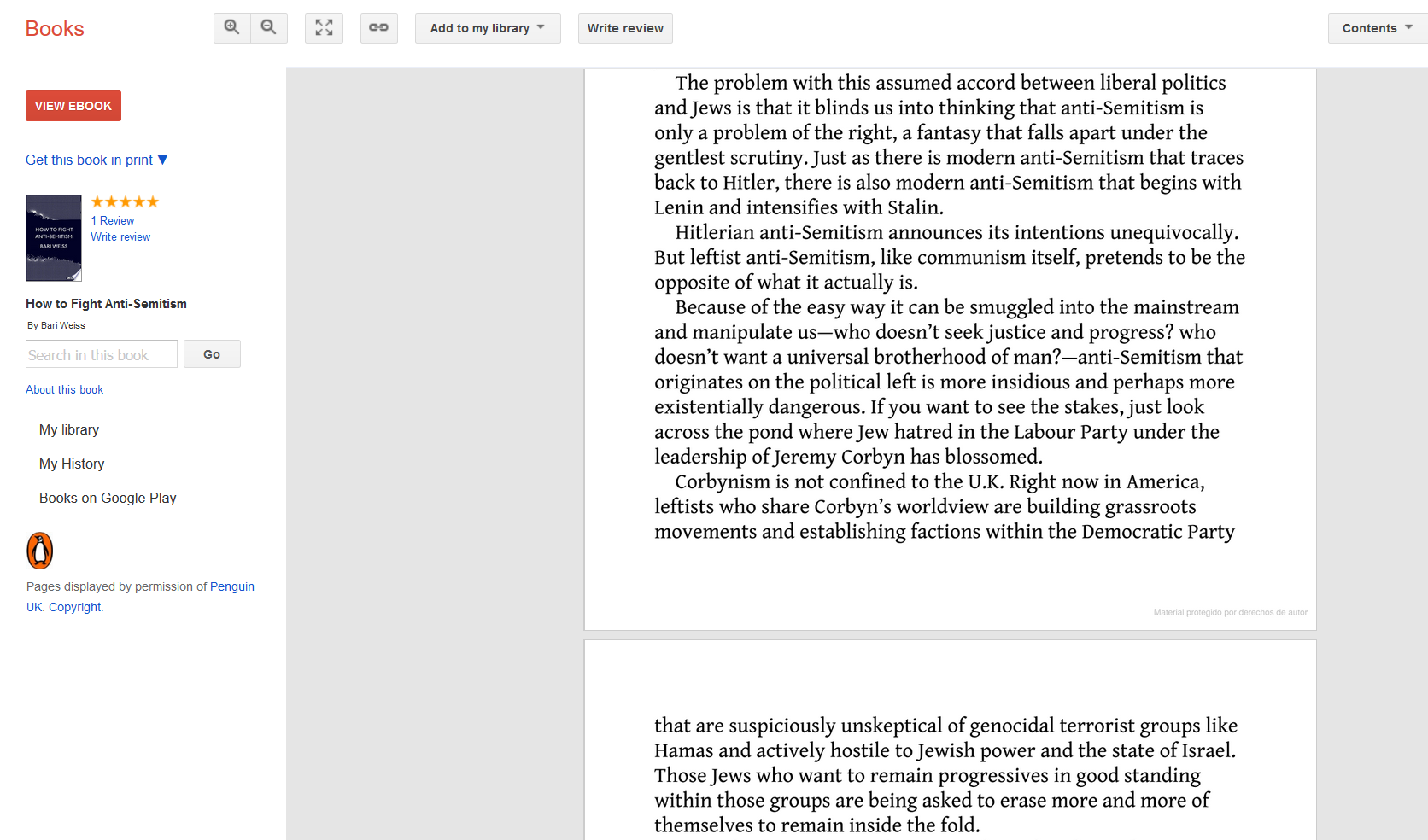
“Hitlerian anti-Semitism announces its intentions unequivocally. But leftist anti-Semitism, like communism itself, pretends to be the opposition of what it actually is.

“Because of the easy way it can be smuggled into the mainstream and manipulate us – who doesn’t seek justice and progress? who doesn’t want a universal brotherhood of man? – anti-Semitism that originates on the political left is more insidious and perhaps existentially dangerous [than on the right].”

When she says “leftist anti-Semitism,” Weiss almost invariably means progressive criticism of Israeli apartheid, racism, and brutality against the indigenous Palestinian population.

If that wasn’t already obvious, Weiss spelled it out:

“If you want to see the stakes, just look across the pond, where Jeremy Corbyn, an anti-Semite, has successfully transformed one of the country’s great parties into a hub of Jew hatred.

“Corbynism is not confided to the U.K. Right now in America, leftists who share Corbyn’s worldview are building grassroots movements and establishing factions with the Democratic Party that are suspiciously unskeptical of genocidal terrorist groups like Hamas and actively hostile to Jewish power and the state of Israel.”

In her book, Weiss insisted the idea that Zionism is a colonialist and racist movement is the product of a “Soviet conspiracy” spread by USSR in order to destroy Israel. She expressly ignored the words of the father of Zionism himself, Theodor Herzl, who wrote that Zionism “is a colonial idea” and requested help from British colonialists, including colonial master Cecil Rhodes.

“Progressives have, knowingly or unknowingly, embraced the Soviet lie that Israel is a colonialist outpost that should be opposed,” Weiss lamented.

“In the most elite spaces across the country, people declare, unthinkingly, that Israel is a racist state and that Zionism is racism, without realizing that they are participating in a Soviet conspiracy, without realizing that they are aligning themselves with the greatest mass murderers in modern history,” she bemoaned.

Not mincing her words, Weiss concluded, “When anti-Zionism becomes a normative political position, active anti-Semitism becomes the norm.”

With these passages, it became clear that her How to Fight Anti-Semitism was a book-length attempt to cancel anti-Zionists as a whole, by conflating their opposition to Israeli apartheid as anti-Semitism.

Anyone who disputes that Israel is “a political and historical miracle” is secretly a Jew hater, Weiss has argued. She effused, “That I can walk the streets of Tel Aviv today as a feminist woman in a tank top,” she marveled, “that it is a free and liberated society in the middle of the Middle East, is an achievement so great that it is often hard for many people to grasp.”

As with much of the content Weiss produces, her gushing praise for Israel’s supposedly “liberated society” could have been lifted from a propaganda pamphlet distributed on campus by a pro-Israel lobbying outfit. But it was never quality writing or original ideas that won Weiss the attention she sought, and which has virtually ensured she will be “cancelled” into a new, high-profile position in the mainstream commentariat.


Western Liberal Media Attacks Tanzania’s President John Magufuli For Exposing Covid-19 Tests and Population Control in Africa

By Timothy Alexander Guzman

Source: Silent Crow News

From the start of the Covid-19 pandemic, Tanzania’s President John ‘The Bulldozer’ Magufuli exposed the fraud behind the Covid-19 testing kits and criticized the mass hysteria in regards to the virus. Several mainstream media networks including Bloomberg News led an attack against Magufuli’s actions regarding how his government has responded to the pandemic. Bloomberg News reporter Antony Sguazzin published ‘Africa’s ‘Bulldozer’ Runs Into Covid-19, Claims God on His Side’, the title itself already mocks Magufuli for mentioning God when it comes to Covid-19, but Sguazzin conveniently bypasses what Magufuli actually said in his article and criticizes him to the point of hostility:

Tanzania’s maverick President John Magufuli has used his strong personality to cow corrupt civil servants and force foreign mining companies to pay millions of dollars in outstanding tax. The coronavirus may be less responsive

What a way for Antony Sguazzin to begin his propaganda piece by calling him the “maverick President”:

Last week, he became the first African leader to declare victory over the virus, even though health data haven’t been released for more than a month. He’s criticized the national laboratory for exaggerating the number of infections, dismissed health experts and discouraged the wearing of masks, all the while saying God will protect Tanzania. Restrictions on social gatherings such as weddings will be lifted from June 29, when schools can reopen

As Squazzin continued his attack by claiming that there were deaths and nighttime burials by health officials in a video published by Al Jazeera that neither confirms or denies the accusations. The video could have been filmed anywhere in the African continent where outbreaks like Ebola and other health crisis have emerged in the past. The US embassy had warned that contracting Covid-19 was “extremely high” in the main city of Dar es Salaam and that hospitals were overwhelmed despite the number of cases being reported by the Tanzanian government at 509 cases and with more than 21 deaths:

But the president’s optimism is belied by reports of deaths and nighttime burials by health officials wearing personal protective equipment. Dozens of Tanzanian truck drivers who had to undergo screening at border posts have tested positive. The U.S. Embassy warned last month that the risk of contracting the virus in the main city, Dar es Salaam, male was “extremely high” and that hospitals were overwhelmed

Sguazzin said that Magufuli’s response to activists who were detained because of their criticism towards his government of how he was handling Covid-19 pandemic was by intimidating the public:

Nicknamed “the bulldozer” for his no-nonsense approach when he was minister of works, Magufuli has made intimidation and bravado a feature of his presidency since assuming office in 2015. His campaign to fight graft — he often fired people while cameras were rolling — earned him widespread praise and elevated his authority within the ruling Chama Cha Mapinduzi party.

Crackdowns on the media and those who poke fun at the government mean that criticism of how Magufuli is handling the outbreak is mostly restricted to social media. Official information is limited and tightly controlled. At least 13 journalists, students and politicians have been detained since March 23 for distributing information about the virus, Tanzania’s Legal and Human Rights Centre said

The 13 journalists, students and politicians who are being held for distributing information about Covid-19 is a human rights issue and extreme to go that far if all allegations are true. Magufuli’s government’s stance on the LGBTQ community is also extreme since they jail people up to 30 years in prison if you are convicted, but unfortunately that’s happens all over Africa and many countries around the world including in the most brutal dictatorship on the planet who is also a friend to the US is Saudi Arabia, where they execute people from the LGBTQ community but that is rarely mentioned in the mainstream media.  Since Magufuli was elected, he has slashed his own salary from $15,000 a month to $4,000 and reduced his government from 30 to 11 ministries. He also cut excessive government spending in various areas including foreign travel by government officials and canceling the World’s AIDs Day in Tanzania and decided to use the funds for AIDS medications. Magufuli also suspended Independence Day in 2015 to declare a national cleanup day to reduce the spread of cholera and to improve the health system in the country. To increase domestic production, it was reported in 2017 that Tanzania banned exporting unprocessed ores for domestic smelting purposes.  Magufuli also amended laws to renegotiate mining contracts or even terminate them if fraud is suspected. It’s apparent that Magufuli is a nationalist. Magufuli has done some bad, but he also has done some good, especially when he exposed Covid-19 testing kits as a fraud. Now the Mainstream media is attacking his policies and what he says concerning the Covid-19 consensus. What angered the West and the mainstream media is not what Magufuli  is claiming about God, it is what he did to prove that the Covid-19 test kits were inaccurate and that’s what Sguazzin forgot to mention.  Magufuli has proved to the world that the covid-19 test kits are a fraud and what the World Health Organization (WHO) and the Centers for Disease Control (CDC) claims are on the dangers of the virus is basically false.  Magufuli explains how he tested the test takers by instructing his country’s security services to send various samples to the Covid-19 testing labs that were not human:

We took samples from goats, we took samples from sheeps, we took samples from Pawpaws, we even took samples from car oil and we took samples from other different things and we took samples to the laboratory without them knowing and we even named all the samples, like the sample from the car oil, we named it Jabil Hamza, 30 years old, male, the results came back negative. When we took the sample from a jackfruit (durian), we named it Sara Samuel, 45 years old, female. the results came back unconclusive. When we took the samples from a Pawpaw, we named it

Elizabeth Ane, 26 years, female, the results from the Pawpaw came back positive, that it has corona. That means the liquid from the pawpaw is positive.” We took samples from (a bird type) called Kware, the results came back positive. We took samples from a rabbit, the results came back undeterminent. We took samples from a goat and the results came back positive. We took samples from a sheep and it came back negative and so on and so on

This is where Magufuli made his point:

So now when you see this, you have taken the samples and say they are humans and the results come back positive that they have corona, that means all the pawpaws should be in isolation also and when you take goat samples and they are also positive, that means all the goats that we have here by assumption or maybe the goat with the sample which was taken should also should also be in isolation. and when you take jackfruit (durian) and it’s also positive that liquid from the jackfruit (durian) which we named it Elizabeth, meaning Elizabeth the Jackfruit (Durian) that means all the Jackfruits (Durian) should be in isolation also so when you notice something like this, you must know there is a dirty game played in these tests

Magufuli also said that the people who work in the laboratories are most likely bought and paid for by special interests:

That there unbelievable things happening in this country, either the laboratory workers in there are bought by people with money, either they are not well educated which isn’t true because this laboratory is used for other diseases, either the samples which are brought in because even the reagents are imported, because even the swambs are also imported, so it’s a must that something is actually going on

Magufuli earned instant criticism from US and European media networks on his leadership with allegations of corruption and human rights abuses considering the imprisonment of journalists, students and politicians who criticized his government. Whether corruption in the Tanzanian government is true or not, many countries in Africa are corrupt with dictatorships. There was also regime change operations backed by Western powers including the US when they gave the CIA the green light to set up the assassination of Zaire’s President Patrice Lamumba in 1961 and in 1966, the CIA overthrew Ghana’s first president under its new independence, Kwame Nkrumah, a pan-Africanist and an anti-imperialist who authored a book titled ‘Neo-Colonialism: The Last Stage of Imperialism’. We must also take into account the centuries old European colonialism since the Portuguese built its trading posts in the late 15th century, followed up by US interventions in Africa during the Cold War leading up to the United States Africa Command (AFRICOM) which was created under the George W. Bush regime in 2007.  The US military and intelligence apparatus currently have numerous military bases all over Africa in efforts to stop Chinese and Russian influence and to control the natural resources which has basically put the African continent at a disadvantage in comparison to the rest of the world.  In this case, Magufuli has actually stood up to the powers that be and took a stand for his people.

Western Imperialism Did Not End: Population Control, Birth Control to Experimenting with Dangerous Vaccines

In 2018, liberal media network, CNN headlined with ‘Don’t Use Birth Control, ‘Tanzania’s President Tells Women In The Country’ said that “Tanzania’s President John Magufuli has told women in the East African nation to stop taking birth control pills because the country needs more people, according to local media reports.” Magufuli was quoted in a local newspaper called The Citizen in a public rally saying that “those going for family planning are lazy … they are afraid they will not be able to feed their children. They do not want to work hard to feed a large family and that is why they opt for birth controls and end up with one or two children only.” According to CNN, “he was quoted in a local newspaper, The Citizen, as saying that those advocating for birth control were foreign and had sinister motives.” Which by all means is true.

Magufuli’s understands how the depopulation agenda works. CNN mentions Jacqueline Mahon the representative for Tanzania for the United Nations Population Fund (UNFPA) who was present at the time at least according to The Citizen quoted Magufuli saying that “I have traveled to Europe and I have seen the effects of birth control. In some countries they are now struggling with declining population. They have no labor force.” Then of course, in an old propaganda tactic which CNN loves to use, they criticized the President on other various issues including his stance on how women lawmakers should dress:

In another development, the speaker of the Tanzanian parliament banned female lawmakers from wearing fake nails and eyelashes in parliament.  “With the powers vested in me by the Constitution of the United Republic of Tanzania, I now ban all MPs with false eyelashes and false finger nails from stepping into Parliament,” Job Ndugai said, a day after Magufuli’s comments.  The new rules also ban women MPs from wearing short dresses and jeans. Female visitors to parliament are also expected to adhere to the dress code

In September 2018, the World Economic Forum (WEF) website headlined with ‘Bill Gates has a warning about population growth’ it began with “rapid population growth in some of Africa’s poorest countries could put at risk future progress towards reducing global poverty and improving health, according to a report by the philanthropic foundation of Bill Gates.” The site quoted what Gates had told reporters  “population growth in Africa is a challenge.” WEF article mentioned what the Bill and Melinda Gates foundation’s own report had discovered in their research and it “found that poverty in Africa is increasingly concentrated in a few countries, which also have among the fastest-growing populations in the world.” The report claimed that “by 2050, it projected, more than 40 percent of world’s extremely poor people will live in just two countries: Democratic Republic of the Congo and Nigeria.” Gates was asked about growing populations and an increase of poverty in Africa and he said that access to birth control combined with investments in health and education for the younger generation was necessary. Gates said that “the biggest things are the modern tools of contraception” and “If you have those things available then people have more control over being able to space their children.”

Forbes magazine recently published ‘Bill And Melinda Gates Have Sharp Words For U.S.’ Lack Of Leadership Role In Fighting Pandemic’ on a virtual Forbes philanthropy summit with the genocidal power couple, Melinda Gates spoke on who should get the vaccines first, and they are black and the indigenous people:

There are 60 million healthcare workers [around the world]. They deserve to get the vaccine first, they’re the ones dealing with this on the front lines, trying to keep us all safe. And then you have to start to tier from there, based on the countries and the populations. Here in the United States, it’s going to be Black people who really should get it first and many indigenous people, as well as people with underlying symptoms, and then elderly people 

In other words, black and the indigenous people will be guinea pigs once again. Forbes also reported that “The couple, whose Bill and Melinda Gates Foundation has committed more than $350 million to fight the coronavirus, plans to utilize two nonprofits—The Global Fund To Fight AIDS, Tuberculosis and Malaria, and Gavi, the Vaccine Alliance—to help equitably distribute therapeutics and vaccines to developing countries.”  There is good news in regards to Africa as Fox news reported about the Covid-19 vaccine trials in South Africa ‘Protest versus Africa’s 1st COVID-19 vaccine test shows fear’ said that “Protesters against Africa’s first COVID-19 vaccine trial burned their face masks Wednesday as experts note a worrying level of resistance and misinformation around testing on the continent” and that the “Anti-vaccine sentiment in Africa is “the worst I’ve ever seen,” the CEO of the GAVI vaccine alliance, Seth Berkley, told an African Union vaccine conference last week.” The Fox news report explains why the African people is concerned:

But the small band of demonstrators who gathered Wednesday at the University of the Witwatersrand, where the trial is based, reflect long-running fears among some in Africa over testing drugs on people who don’t understand the risks.

“The people chosen as volunteers for the vaccination, they look as if they’re from poor backgrounds, not qualified enough to understand” protest organizer Phapano Phasha told The Associated Press ahead of the event. “We believe they are manipulating the vulnerable”

The report also mentioned the controversial French doctor, Jean-Paul Mira, head of intensive care at Cochin hospital in Paris said “If I can be provocative, shouldn’t we be doing this study in Africa, where there are no masks, no treatments, no resuscitation?” comparing the corona virus to previous AIDS studies: “In prostitutes, we try things because we know that they are highly exposed and that they do not protect themselves.” The imperial mentality by the west to control Africa’s population growth and to test Africans with vaccines has been proven time and time again to be dangerous and problematic for the African people.  Tanzania’s president John Magufuli has helped expose Western intentions in Africa especially when it comes to the Covid-19 testing kits giving false positive results.  The mainstream media quickly criticizes those who do not follow Western instituted depopulation programs from the US and Europe such as Magufuli who actually did something right in the face of Covid-19 hysteria. Magufuli is now the subject of Western media criticism and mockery not because he mentioned God, it’s because he is not following the program, it’s pretty obvious at this point.

Remdesivir for Covid-19: $1.6 Billion for a “Modestly Beneficial” Drug?

By Elizabeth Woodworth

Source: Global Research

The U.S. Department of Health and Human Services has recently “bought” all of Gilead Science’s Remdesivir for $1.6 billion. “500,000 doses at $3,200 per patient – to be available to American hospitals but not for other countries”[6] 

That’s $1.6 billion tax dollars for a virtually untested drug showing only marginal efficacy in the hospital setting.

How could such a thing happen?

Introduction

If you believe an urgent call from the Yale School of Public Health that was recently published in the American Journal of Epidemiology— the top epidemiology journal in America — hydroxychloroquine (HCQ) + azithromycin is the quickest and most effective way to halt the Covid-19 pandemic.[1]

According to this Yale statement, hydroxychloroquine – a cheap, natural anti-malarial tree-bark known as quinine for 400 years – is highly effective during Phase 1 of Covid-19, while the virus is loading into the body.

As the first line of defense, it should be immediately, freely, and widely available to symptomatic high-risk patients – through doctors’ offices, outpatient clinics, and hospitals across the land.

Indeed, under the directorship of Dr. Anthony Fauci, a National Institute of Allergy and Infectious Diseases (NIAID) a clinical trial had been launched on May 14 to look into it.[2]

The HCQ + azithromycin protocol is being used successfully by France’s top, award-winning microbiologist, Dr. Didier Raoult.  He is director of the Infectious and Tropical Emergent Diseases Research Unit in Marseille (Institut Hospitalo-Universitaire) (IHU), with 200 staff.  Raoult, now almost a celebrity in France, has recently published his protocol and results, showing an overall 1.1% case fatality rate.[3]

The same protocol has also been highly successful in China, India, Senegal, and Brazil.[4]

So why suddenly is the U.S. government and the media ignoring recommendations from these top specialists,[5] and waiting, instead, until people get very sick and hospitalized to treat them with the relatively untested drug, Remdesivir, which is administered intravenously?

Why has the U.S. Department of Health and Human Services just bought up all the Remdesivir it could order – 500,000 doses at $3,200 per patient – to be available to American hospitals but not for other countries?[6]

To put Remdesivir’s cost in perspective, the CDC reports that the flu vaccine costs from $12-$18 a dose.[7]

The government, in order to justify its mind-boggling price, would need to show exceptional efficacy in saving lives. Efficacy, that is, once the disease has been allowed, through failure to use the HCQ + azithromycinearly preventive approach, to advance to Phase 2 (the dangerous inflammatory period) and Phase 3 (ICU ventilator intubation, often leading to death).[8]

What do studies say about the efficacy of remdesivir?

There are three main studies that have examined remdesivir as a treatment for Covid-19:

  1. The first, a study of seriously ill patients, was originally reported in the New England Journal of Medicine on April 10, 2020. Treated with “compassionate-use” remdesivir, clinical improvement was observed in 36 of 53 patients (68%).

The article was co-authored by 56 people, some of whom were on the staff of remdesivir’s producer, Gilead Sciences.[9] The study was funded by Gilead, and writing assistance was provided by David McNeel, also of Gilead.[10]

The following day, April 11, the Science Media Centre published expert reactions to the compassionate study from five British university professors. These assessments were not encouraging: “the research doesn’t prove anything at this point;” “the data is almost uninterpretable;” the research should be treated “with extreme caution.”[11]

  1. A Wuhan, China randomized, double-blind, placebo-controlled trial of 237 patients was accidentally leaked by the World Health Organization and published in The Lancet. It showed no statistically significant clinical benefits from remdesivir:

“The antiviral medicine remdesivir from Gilead Sciences failed to speed the improvement of patients with Covid-19 or prevent them from dying, according to results from a long-awaited clinical trial conducted in China.” [12]

This Lancet study also found that some 14% of patients in the treatment group died after 28 days, compared to 13% in the group that did not receive the treatment.

And it further reported that “remdesivir was stopped early because of adverse events in 18 (12%) patients versus four (5%) patients who stopped placebo early.”[13]

  1. The preliminary results of a NIAID remdesivir trial of 1063 patients showed a “modest” benefit in a controlled clinical trial:

“The infected people who received remdesivir, an experimental drug made by Gilead Sciences that cripples an enzyme several viruses use to copy their RNA, recovered in an average of 11 days versus 15 in patients who received a placebo. ‘Although a 31% improvement doesn’t seem like a knockout, 100% [success], it is a very important proof of concept,’ said Anthony Fauci, head of the National Institute of Allergy and Infectious Diseases (NIAID).”[14]

Health Policy Watch reported that “the death rate was 8% in the group that received remdesivir compared to 11.6% in the control group, although this result was not statistically significant.” Dr. Fauci told reporters that “what [this trial] has proven is that a drug can block the virus.”[15]

The excerpt below from a June 24 article in the British Medical Journal assesses the problems in the foregoing studies. (One of the four co-authors, Fiona Godlee, is the editor-in-chief of the BMJ):

“A serious imbalance in covid-19 research strongly favours the study of drug treatments over non-drug interventions, with many studies too small or too weak to produce reliable results.  Equally concerning is the release of partial or preliminary findings before peer review—often through commercial press releases—that is distorting public perceptions, ongoing evaluations efforts, and political responses to the pandemic.

Remdesivir is a key example. The antiviral drug, made by US company Gilead, was unapproved at the start of the pandemic, but in early April the New England Journal of Medicine published a small descriptive study of a compassionate use scheme for patients with covid-19. Gilead funded the study, a third of the authors were Gilead employees, and Gilead’s press release reported “clinical improvement in 68% of patients in this limited dataset.”  Despite being a non-randomised, uncontrolled, company funded study of just 53 patients, media headlines described “hopeful” signs and reported “two thirds” of patients showing improvement.[16]

Two weeks later, the Lancet published a randomised placebo controlled trial of remdesivir from China, finding no statistically significant clinical benefit in the primary outcome of time to clinical improvement. Twelve per cent of participants taking remdesivir stopped treatment early because of adverse events, compared with 5% taking placebo. The trial was stopped before meeting recruitment targets.”[17]

To summarize, the only study demonstrating even marginal efficacy for remdesivir shows it to reduce hospital recovery times 31%, from 15 days to 11 days.

What is the justification for spending $3,200 tax dollars per Covid-19 patient to save four days in hospital, unless it is to shorten hospital stays, thereby saving the average U.S. bed cost of approximately $2000 per day, while delaying hospital saturation that could leave some people untreated to die?

Leaving people untreated to die could cause civil unrest, which may be the covert political reason for spending the $1.6 billion.

None of the studies mention side effects of the drug. In the China study, kidney injury led to discontinuation for one patient, and in its use for ebola, liver risks were identified.[18]

How much does it cost to produce remdesivir?

The Institute for Clinical and Economic Review (ICER) is a non-profit organization seeking to improve healthcare value through clinical and cost-effective analyses.[19]

In a May 1, 2020 study, the ICER calculated that the cost of producing the remdesivir “final finished product,” including the pharmaceutical ingredients, formulation, packaging, and a small profit margin, was $9.32 US for a 10-day course of treatment.  They rounded this up to $10.[20]

Dr. Fauci’s NIAID Clinical Trial Evaluating Hydroxychloroquine and Azithromycin Closes Early

On June 20, 2020, nine days before the Department of Health and Human Services announced its $1.6 billion purchase of remdesivir on June 29, its NIAID branch closed a clinical trial that had been launched May 14 to investigate whether the inexpensive combination, hydroxychloroquine plus azithromycin, might be an effective treatment when given early in the course of the disease.[21]

The Department of Health and Human Services knew that hydroxychloroquine (aka chloroquine) was effective against coronavirus because chloroquine was tested against the SARS-1 virus during the outbreak in 2002. This work was written up in 2005, under the auspices of the U.S. Centers for Disease Control in Atlanta, which reports to the Department of Human Health and Services.[22]

Truth, as the saying goes, is stranger than fiction.

Who was responsible for this debacle?

Dr. Fauci has served in the National Institutes of Health under six presidents.

Were these bizarre decisions carried out under his authority? Or were they forced upon him from higher up?  Or has he become a victim of regulatory capture[23] by the drug industry?

Whatever the answer, this unprecedented fleecing of the American public should have been shouted from the rooftops, had there been a functioning US media.

*

Note to readers: please click the share buttons above or below. Forward this article to your email lists. Crosspost on your blog site, internet forums. etc.

Notes

[1] Harvey A. Risch, “Early Outpatient Treatment of Symptomatic, High-Risk Covid-19 Patients that Should be Ramped-Up Immediately as Key to the Pandemic Crisis,” Amer. J. Epid, 27 May 2020 (https://academic.oup.com/aje/advance-article/doi/10.1093/aje/kwaa093/5847586). Risch is Professor at the Yale Schools of both Medicine and Public Health.

[2] National Institute of Allergy and Infectious Diseases, “NIH Begins Clinical Trial of Hydroxychloroquine and Azithromycin to Treat COVID-19,” 14 May 2020 (https://www.niaid.nih.gov/news-events/nih-begins-clinical-trial-hydroxychloroquine-and-azithromycin-treat-covid-19).

[3] Jean-Christophe Lagier, et al, “Outcomes of 3,737 COVID-19 patients treated with hydroxychloroquine/azithromycin and other regimens in Marseille, France: A retrospective analysis,” Travel Medicine and Infectious Disease, 25 June 2020 (https://www.sciencedirect.com/science/article/pii/S1477893920302817). Rault has 2,300 indexed medical journals in print.

[4] The group “COVEXIT.com – News About Hydroxychloroquine & Other COVID-19 Treatments,” was founded March 29, 2020 by Jean-Pierre Kiekens. It keeps daily track of successful Covid treatments worldwide (https://www.facebook.com/groups/covexit)

[5] Elizabeth Woodworth, “The Media Sabotage of Hydroxychloroquine Use for COVID-19: Doctors Worldwide Protest the Disaster,” Global Research, 30 June 2020 (https://www.globalresearch.ca/media-sabotage-hydroxychloroquine-covid-19-doctors-worldwide-protest-disaster/5717382).

[6] US Department of Health and Human Services, “Trump Administration Secures New Supplies of Remdesivir for the United States,” June 29, 2010 (https://www.hhs.gov/about/news/2020/06/29/trump-administration-secures-new-supplies-remdesivir-united-states.html).

[7] Centers for Disease Control and Prevention, Vaccines for Children Program, “CDC Vaccine Price List,” updated 1 July 2020 (https://www.cdc.gov/vaccines/programs/vfc/awardees/vaccine-management/price-list/index.html#adflu).

[8] Dr. Raoult identified the three stages of Covid-19 while treating 3,737 patients with HCQ+azithromycin at his own clinic: “At the first viral stage, one must give medicines against the virus, in the second inflammatory phase, one needs to give medications against that [inflammatory] reaction, and then in the third phase, it’s work to be done in intensive care units.” Summarized from Didier Raoult, at: “The Marx Brothers are Doing Science: the Example of RECOVERY,” 9 June 2020 (http://covexit.com/professor-raoult-compares-the-oxford-recovery-trial-academics-to-the-marx-brothers/).

[9] Jonathan Grein, and 55 other authors, “Compassionate Use of Remdesivir for Patients with Severe Covid-19,” New England Journal of Medicine, 11 June 2020 (https://www.nejm.org/doi/full/10.1056/NEJMoa2007016), “Editor’s Note: This article was published on April 10, 2020, at NEJM.org.”

[10] Jason D. Goldman, et al., “Remdesivir for 5 or 10 days in Patients with Severe Covid,” New England Journal of Medicine, no date in header (https://www.nejm.org/doi/pdf/10.1056/NEJMoa2015301?articleTools=true). Sidebar:“This article was published on May 27, 2020, at NEJM.org.”

[11] Prof. Duncan Richards et al., “Expert reaction to a study about compassionate use of remdesivir for patients with severe COVID-19,” Science Media Centre, 11 April 2020 (https://www.sciencemediacentre.org/expert-reaction-to-a-study-about-compassionate-use-of-remdesivir-for-patients-with-severe-covid-19/).

[12] Ed Silverman, et al, “New data on Gilead’s remdesivir, released by accident, show no benefit for coronavirus patients. Company still sees reason for hope,” StatNews, 23 April 2020 (https://www.statnews.com/2020/04/23/data-on-gileads-remdesivir-released-by-accident-show-no-benefit-for-coronavirus-patients/).

[13] Yeming Wang, et al., “Remdesivir in adults with severe COVID-19: a randomised, double-blind, placebo-controlled, multicentre trial,” The Lancet, 16 May 2020 (original online publication 29 April 2020) (https://www.thelancet.com/journals/lancet/article/PIIS0140-6736(20)31022-9/fulltext).

[14] Jon Cohen, “Large trial yields strongest evidence yet that antiviral drug can help COVID-19 patients,” Science, 29 April 2020 (https://www.sciencemag.org/news/2020/04/large-trial-yields-strongest-evidence-yet-antiviral-drug-can-help-covid-19-patients).

[15] Grace Ren, “Conflicting Remdesivir Trial Results Released; Experts Urge More Research,” Health Policy Watch, 29 April 2020 (https://healthpolicy-watch.news/first-remdesivir-rct-shows-no-significant-clinical-benefit-for-severe-covid-19-patients-but-experts-urge-for-more-research/).

[16] Christopher Rowland, “Gilead’s experimental drug remdesivir shows ‘hopeful’ signs in small group of coronavirus patients,” Washington Post, 10 April 2020 (https://www.washingtonpost.com/business/2020/04/10/gileads-experimental-drug-remdesivir-shows-hopeful-signs-small-group-coronavirus-patients/).

[17] Ray Moynihan et al.,“Commercial influence and covid-19,” BMJ2020;369:m2456 (Published 24 June 2020) (https://www.bmj.com/content/369/bmj.m2456).

[18] Crystal Phend, “Remdesivir Safety Forecast: Watch the Liver, Kidneys,” Medpage Today, 19 May 2020 (https://www.medpagetoday.com/infectiousdisease/covid19/86582).

[19] https://en.wikipedia.org/wiki/Institute_for_Clinical_and_Economic_Review

[20] Melanie D. Whittington and Jonathan B. Campbell, “Alternative Pricing Models for Remdesivir and Other Potential Treatments for COVID-19,” Institute for Clinical and Economic Review, 1 May 2020 (https://icer-review.org/wp-content/uploads/2020/05/ICER-COVID_Initial_Abstract_05012020-3.pdf).

[21] National Institute of Allergy and Infectious Diseases, “BULLETIN—NIH Clinical Trial Evaluating Hydroxychloroquine and Azithromycin for COVID-19 Closes Early,” 20 June 2020 (https://www.niaid.nih.gov/news-events/bulletin-nih-clinical-trial-evaluating-hydroxychloroquine-and-azithromycin-covid-19).

[22] Martin J. Vincent et al., “Chloroquine is a potent inhibitor of SARS coronavirus infection and spread,” Journal of Virology, 22 August 2005 (https://www.ncbi.nlm.nih.gov/pmc/articles/PMC1232869/).

[23] “Regulatory capture is a theory that regulatory agencies may be dominated by the interests they regulate and not by the public interest.” In: Will Kenton, “Regulatory Capture,” Investopedia, 23 October 2019 (https://www.investopedia.com/terms/r/regulatory-capture.asp).

As Long As Mass Media Propaganda Exists, Democracy Is A Sham

By Caitlin Johnstone

Source: CaitlinJohnstone.com

A new Reuters/Ipsos poll has reportedly found that a majority of Americans believe the completely discredited narrative that the Russian government paid Taliban-linked fighters to kill the occupying forces of the US and its allies in Afghanistan.

“A majority of Americans believe that Russia paid the Taliban to kill U.S. soldiers in Afghanistan last year amid negotiations to end the war, and more than half want to respond with new economic sanctions against Moscow, according to a Reuters/Ipsos poll released on Wednesday,” Reuters reports.

“Overall, 60% of Americans said they found reports of Russian bounties on American soldiers to be ‘very’ or ‘somewhat’ believable, while 21% said they were not credible and the rest were unsure,” says Reuters.

https://twitter.com/Reuters/status/1280831503879016448

Those 21 percent are objectively correct: the story is not credible, and it’s not even close. Gareth Porter shows in The Grayzone how the “Bountygate” narrative is so utterly baseless that even US intelligence agencies have dismissed it, Joe Lauria of Consortium News explains how it doesn’t make any sense on its face, and FAIR’s Alan MacLeod breaks down the appalling journalistic malpractice that went into circulating this incredibly thinly sourced story to the mainstream public.

The story advances no solid facts or verified information. What it does advance is pre-existing imperialist agendas like remaining in Afghanistan, killing the last of the remaining nuclear deals with Moscow, and manufacturing public support for new Russia sanctions.

And yet a majority of people believed it, and still believe it. The narrative that Russia paid Taliban fighters to kill occupying forces is now regarded as an established fact in many key circles, despite being backed by literally zero facts.

If people were as objective and adept at critical thinking as we tend to believe we are, the mass media’s unconscionable facilitation of a brazen cold war psyop would by itself have killed off all public trust in the institution of mass news reporting. But people are not as objective and adept at critical thinking as we tend to believe we are. People have many cognitive biases which distort our ability to objectively process information and understand events, including one which causes us to believe something is true just because they’ve heard it said multiple times. This makes us easily susceptible to mass media propaganda, where our encounters with daily news headlines can shape our perception of what’s going on in the world regardless of whether or not those headlines are backed by actual facts.

https://twitter.com/GarethPorter/status/1280966373129281536

This latest poll is a perfect example of how the plutocrat-owned media manipulate public opinion in the interest of establishment agendas using brazen propaganda campaigns, but it is just the most recent example. Over and over and over again we see public perception of what’s going on distorted by lies inserted into their minds by the corporate news media, like when half a year after the invasion of Iraq seven in ten Americans believed Saddam Hussein was responsible for the 9/11 attacks. All it took to trick them into believing this and supporting the invasion was repeatedly mentioning 9/11 and Saddam in the same breath, despite there never being any evidence whatsoever for any such thing.

This kind of manipulation is not rare, it is ubiquitous and ongoing. Every single day the plutocratic media are putting ideas in people’s minds which favor the establishment upon which said plutocrats have built their kingdoms, normalizing the insane status quo and manufacturing support for agendas which bolster it. This is not some delusional conspiracy theory, it’s a well-documented fact to which many mainstream journalists have testified.

As long as this remains the case in our society, democracy cannot exist in any meaningful way. As long as a loose alliance of plutocrats and government operatives are able to consistently manipulate the way a critical mass of people think and vote, then you cannot rightly say that the people are in charge of the fate of their nation. If the majority is consistently in alignment with the plutocrats whose outsized media influence enables them to dominate the public narrative, then voting necessarily reflects the will of those plutocrats, not the people.

Even if you changed everything else that is wrong with the current system, nothing would change if the plutocratic class retained its ability to manipulate the way people think and vote. You can fix America’s garbage election integrity, end gerrymandering, even get money out of politics, but as long as the plutocratic class is still using its wealth to manipulate public thought in support of its interests, people would keep voting the way they’re manipulated to vote.

Manipulation is a key ingredient in any long-term abusive relationship, because people don’t tend to stay in abusive situations unless they are manipulated into doing so. This is true whether you’re talking about romantic partnerships, governments, or globe-spanning power structures. We don’t use the power of our numbers to end this abusive relationship where we are at the whim of crushing austerity, exploitative neoliberalism, endless war and rapacious ecocide, because we’re being manipulated into staying.

And, just like with any other abusive relationship, there comes a time to leave before it’s too late. That time is now. We can begin by expanding awareness of what’s really going on, both inwardly in ourselves and outwardly by sharing truthful information with others. In so doing, we stand a chance at making ourselves impossible to propagandize effectively and using our strength in numbers to force real change.

In An Insane World, Madness Looks Moderate And Sanity Looks Radical

By Caitlin Johnstone

Source: CaitlinJohnstone.com

There are no moderate, mainstream centrists in the US-centralized empire. They do not exist.

It’s not that moderate, mainstream centrism is an inherently impossible position. In a healthy world, that’s exactly what the predominant worldview would be. But we do not live in a healthy world.

There are no moderate, mainstream centrists anywhere in the tight alliance of nations which function as a single empire on foreign policy, because that functional empire is built upon murder, terrorism, exploitation, oppression, ecocide and the stockpiling of armageddon weapons.

People who support the status quo of this empire are called “moderates”, but, just like the so-called “moderate rebels” of Syria, they are in fact violent extremists.

This is the reality of living in a world that is profoundly psychologically unhealthy. If you make a career out of facilitating wars which cause explosives to be dropped from the sky on top of innocent human beings causing their bodies to be ripped to shreds and buried in rubble, then you are treated as an exemplar of ideal leadership and rewarded with prestigious positions in politics, punditry, book publishing and think tankery. If you oppose those same wars, you are marginalized and smeared as at best an extremist whack job and at worst a literal traitor conducting psyops for a foreign government.

Because the plutocratic class owns the political class which advances depraved plutocratic agendas and the media class which normalizes and justifies those agendas, a mainstream consensus has been forcibly manufactured that maintaining the oppressive, exploitative, omnicidal, ecocidal status quo is a good and sane thing to do. Voices which point out that this is bat shit crazy are marginalized and ignored when possible and smeared and demonized when necessary.

The ability of our plutocratic rulers and their lackeys to do this is the only reason why defenders of the status quo get to call themselves “centrists” and “moderates”. It’s not because their position is middle-of-the-road in any way whatsoever, it’s because they stand in alignment with the consensus that has been deliberately artificially manufactured and shoved into the mainstream by sheer force of narrative control.

This consensus manufacturing is then carried home by a glitch in human cognition known as status quo bias, which causes us to tend toward holding to the familiar as a default preference and perceive the risk of losing what we have as far less favorable than the reward gaining something better. Psychology Today explains:

Research from Kahneman and Tversky suggests that losses are twice as psychologically harmful as gains are beneficial. In other words, individuals feel twice as much psychological pain from losing $100 as pleasure from gaining $100. One interpretation is that in order for an individual to change course from their current state of affairs is that the alternative must be perceived as twice as beneficial. This highlights the challenges we may face when considering a change to our usual way of doing things.

When military members are considering their choices as their contract comes to an end, many consider re-enlisting simply because they are unaware of the many opportunities that exist for them. Even when we understand our current path is no longer beneficial or no longer makes us happy, we must still overcome the natural urge to stay on the path unless the alternative is sufficiently attractive. In order for us to readily pursue an alternate path, we must believe that the alternative is clearly superior to the current state of affairs.

The status quo effect is pervasive in both inconsequential and major decisions. Oftentimes we are held back by what we believe to be the safe option, simply because it is the default. Bearing in mind our natural propensity for the status quo will enable us to recognize the allure of inertia and more effectively overcome it.

Status quo bias is further exacerbated in our current predicament by the fact that so many people are now so close to the brink of financial ruin and so terrified of what can happen to them if things change in a sudden and unpredictable way. The result of this is that now you’ve got the majority of people in the most dominant country on earth supporting the “slow incremental change” philosophy of so-called centrism, which in practice has always ended up meaning no change whatsoever. Meanwhile our ecosystem is dying and the US is escalating nuclear tensions with Russia and China and everyone’s getting more and more crazy and miserable under the oppressive and exploitative status quo.

Did you ever climb a tree when you were a kid and get stuck because you were afraid to climb down? It’s a common experience for a lot of us. You get lost in the joy of the climb and so pleased with yourself in how well you’re doing, then suddenly you notice that the branches are getting a lot thinner and the wind is starting to sway you back and forth, and suddenly you look down and get terrified.

Maybe you called out for your mother and she came out and told you to climb down, calling up “Well you can’t stay up there!” And you knew she was right, but in that moment the idea of looking down and letting go of the thin branches you were clinging to felt so much scarier than just staying put in your precarious and unsustainable position.

That’s exactly where we’re at right now with status quo bias in our current predicament. People know things need to change, but they’re in such a precarious position that the risk of change feels far too scary to take the leap and force a deviation from our trajectory toward disaster.

But that is our only choice if we are to survive as a species. We know we were able to climb down from whatever trees we got stuck in as kids, and we know that our mother was as right then as that small inner voice inside us is now: we can’t stay here. We’ve got to wake up from the status quo narrative management and find a way to get down from our precarious and unsustainable position to the stable ground of sanity.


Saturday Matinee: British Folk Horror Double Feature

Fire Beneath the Fen: The Wyrd and the Modern in ‘Robin Redbreast’ and ‘Penda’s Fen’

By Mark Sheridan

Source: We Are the Mutants

The 1970s have always occupied a grim place in the British imagination. Sandwiched between Harold Wilson’s utopian “Swinging Sixties” and Thatcher’s anti-social eighties, the decade represents a time of tremendous turbulence and change. With the empire in ruins, anti-colonial backlash came home to roost as Northern Ireland descended into civil war and the IRA began its bombing campaign in Britain. The naked enthusiasm of the post-war consensus dissipated, and the battle between labor and industry heated up. Bombs, blackouts, and shortages recalled war-like conditions during a time of supposed peace. Modern scholarship has pointed to an eerie style in British cultural output from the period. From its cinema to its television to its public information films, there pervades a gothic sensibility commonly identified with Mark Fisher’s concept of “hauntology,” the idea that the present state of cultural paralysis is a function of a collective mourning for futures that never materialized.

The dark and mystic sensibility that emerged from this disruptive and paranoid milieu, now called “folk horror,” manifests a fear of sublimation—the absorption of the individual into the mass, the human into the environment, modernity into the unknown. While the horror of Hammer Films and Roger Corman that had dominated the ‘50s and ‘60s was preoccupied with endless combinations of 19th century gothic, folk horror steps outside time as we understand it, beyond the scope of the human. In the 2010 documentary series A History of Horror, Mark Gatiss outlined a rough canon for this folk horror tradition based on the unholy trilogy of Witchfinder General (1968), The Blood on Satan’s Claw (1971), and The Wicker Man (1973). Intense ideological conflict pervades these stories: Witchfinder General is set in and around the Battle of Naseby, where Cromwell’s revolutionary New Model Army destroyed the veteran feudal forces of King Charles, and tells the story of a soldier who pursues a charlatan witch-hunter across the English countryside. And in The Blood on Satan’s Claw, set around the same time, a secular magistrate must slay a demon summoned from “the forest, from the furrows, from the fields” by the local pagan cult.

These historical tales come at us from the dawn of modern time, in the midst of feudal collapse and the emergence of capitalism. Our heroes are rational, secular agents of the state; our villains the ancient forces of paganistic superstition that batter at the door of our burgeoning technological world. It’s telling that the only film in Gatiss’s trilogy set in contemporary times, The Wicker Man, advances a very different view of the battle between the rational modern and the primordial other. Here, the heroic agent of the state, in this case a police officer, dies alone in the flames of the titular effigy, while the villagers dance in rings around him. Christopher Lee would go on to insist that The Wicker Man was not actually a horror film, an assertion that hints at the sublimation of genre itself, and how this paranoid affect had settled over the British imagination like an eerie fog.

Well before The Wicker Man hit theaters, however, there was the television play Robin Redbreast (1970), which tells a similar story: middle-class metropolitan Norah Palmer (Anna Cropper) ventures into the English countryside only to find herself caught up in the fatal fertility rites of the polytheistic locals. Robin Redbreast is noteworthy for its appearance on Play for Today, a BBC anthology series typically reserved for kitchen-sink realist drama that has been described in posterity as everything from a “national theatre of the air” to an “[exercise] in viewer patronisation” (the latter quote coming from current Conservative Party MP and Boris Johnson ally, Michael Gove). Abrasive, polemical, socially conscious to a fault, its moral messaging embodied the paternalistic spirit of the ‘60s welfare state. If television was the medium of the masses, Play for Today was its conscience.

Set in the present day, Robin Redbreast inverts the conventional relationship between the modern and the un-modern, configuring our world as hopelessly encompassed by a dark architecture of the outside. From the moment Norah arrives in the village, she’s deprived of all agency. Everything she does is preempted, public and private spaces are intermeshed—the villagers always seem to know what she’s doing in advance, repeatedly wander onto her property without invitation, and even orchestrate events so that she ends up sleeping with Rob (Andy Bradford), an awkward local man who she first encounters practicing karate naked in the woods.

Norah can sense she’s being manipulated in some way but remains powerless to stop it. The menacing Mr. Fisher (Bernard Hepton), apparent leader of the community, even explains their sinister designs, albeit in elliptical language, at various junctures. Yet Norah is unable to resist literal and metaphorical seduction by the strange persuasions of the village folk. There’s a dark implication that in some respect Norah wants, or is at least allowing herself, to be trapped. The heightened emotions of country life contrast starkly against the bourgeois detachment of her conversations with city friends. To an extent, we get the impression that Norah’s volatile relationship with the villagers is a reaction to her own suppressed Dionysian impulses.

The shadowed social commentary is compounded when Fisher explains that the villagers are under no pretense of doing justice to the “old ways.” He admits the basis of the robin sacrifice could be Greek, Egyptian, even Mexican in origin. He mentions James George Frazer’s “The Golden Bough,” a largely discredited work of comparative mythology that serves as the basis for most popular representations of paganism. Historical authenticity is immaterial here. What scares us about paganism is what it tells us about ourselves, how it recalls our own innate strangeness.

After the ritual slaughter of Rob (short for Robin), a pregnant Norah flees the village, but her escape will never be complete. She knows that the same cycle will repeat itself when her baby, the new robin, comes of age. As she drives away, she looks back to find that the villagers, still watching from the cottage, have transformed into pagan deities. The fact that the villagers do nothing to stop her from returning to the city amplifies the play’s paranoid pessimism. As Fisher, having taken the form of Herne the Hunter, watches Norah disappear over the hill, the viewer is left with the horrible feeling that nothing Norah can do will have any impact on the ultimate fate of her unborn child. (The narrative is clearly inspired in part by Ira Levin’s Rosemary’s Baby).

Robin Redbreast’s horror is reactive, bird-brained—evoking the feeling of being cornered. The great fear is a lack of control, the feeling of being swept away by strange currents beyond the self. Even in her fleeing, Norah’s fate is ultimately foreclosed by forces that not only surround her but exist elementally within her. If Witchfinder General is set at the dawn of modernity, Robin Redbreast is set at modernity’s dusk, in a world that shrinks from itself as it feels the darkness loom ahead. The postponed reclamation of the robin proves a compelling metaphor for the hopeless uncertainty of a historical moment in which strange futures pounded on the door of the present, threatening to break in at any moment.

* * *

The first three years of the 1970s would see five states of emergency, each presided over by Ted Heath’s Conservative government following its surprise election in 1970, and each involving battles between Heath and what Thatcher would later refer to as “the enemy within”—the labor movement. Problems continued to pile up, each new disruption amplifying the last. The stock market crashed in January 1973, sending inflation soaring into double figures; then, in October, OPEC declared an oil embargo that set the western world reeling. Seeing an opportunity, the National Union of Mineworkers voted to go on strike in pursuit of fairer pay. Heath’s government responded by introducing the infamous Three-Day Week, in which consumption of electricity was to be limited to three non-consecutive days per week to conserve coal supplies. For two months, Britain was plunged into a cold, dark winter unlike anything it had seen since wartime.

Described by The Times as a “fight to the death between the government and the miners,” this was the second large-scale confrontation in as many years and one the government couldn’t afford to lose. Heath resolved to call an election to serve as a referendum on the issue of union power, with the Conservatives campaigning on the slogan “Who governs Britain?” The election of February 28, 1974 returned yet another dramatic development: despite the weight of the media and the state behind them, the Conservatives had in fact lost ground and handed the Labour Party a plurality in parliament. A settlement was soon reached in which the strikers secured a 35% pay-increase—the miners had won, at least for now.

Two weeks after the lifting of restrictions, millions of Britons tuned in to BBC1 to watch the latest installment of Play for Today. That evening’s episode was Penda’s Fen, a fittingly unsettling exploration of unsettling times, the most developed folk horror film to date, and a triumph of public programming in its own right. Writer David Rudkin gives voice to the dark song of the fields with a visionary script about a devout young Christian who must confront both the unseen forces that stir beneath the village where he lives and the “unnatural” desires that emerge contrary to his pious pretensions.

Stephen Franklin (Spencer Banks) is a boy possessed by the “new gods”—he is ordered, anal, orthodox, patriotic, loyal to the structures of church and state. He’s the kind of kid that almost deserves the vicious bullying he gets from his grammar school classmates. As Stephen matures into his eighteenth year, however, things fall apart as he discovers that he’s both gay and adopted. Through the mentorship of his heretical parson father, a politically radical local playwright, and a series of disturbing apparitions, he begins to come to terms with his inner “ungovernableness.”

Director Alan Clarke, Britain’s mirror-holder-in-chief behind such brutal portraits as Elephant (1989) and Made in Britain (1982), presents an image of Britishness that’s wild, diverse, almost ethereal. Clarke, typically known for his uncompromising realism, adopts a more hallucinogenic style to portray the metaphysical turbulence of Stephen’s new understandings. The haunted, shifting landscapes of Worcestershire work as a kind of demonic mutation of Situationist psychogeography. Whereas the students of May 1968 were implored to uncover “the beach beneath the streets,” Clarke and Rudkin invite us to discover the flames beneath the fen.

Penda’s Fen stands apart from other artifacts of the “wyrd” in its overt politicization of strangeness. Almost immediately we meet the playwright Arne (Ian Hogg) as he puts up a one-man defense of the strikers at a town hall debate, while naïve Little Englander Stephen huffs and puffs in the audience. As Stephen begins to lose, or rather relinquish, control of himself, his grades suffer and his mother warns him not to fall foul of “the machine,” the inhuman conveyor belt of modernity and its cult of productivity. Later, the Reverend Franklin (John Atkinson) expounds on Moloch as the sun sets behind him, explaining to Stephen how the new gods of industry and institutions are perversions that have disfigured the message of the “revolutionary” Jesus. The Reverend speculates that the people may “revolt from the monolith and come back to the village,” noting that “pagan” means “of the village,” contrasting with what it means to be “of the city”—”bourgeois.”

The provisional nature of modernity is a key theme. Arne speaks of the urban behemoth swelling to a great city that will “[choke] the globe from pole to pole” but that will also “bear the seed of its own destruction.” We might imagine Hobbes’s Leviathan, bloated and turgid, decomposing back into the earth. Elsewhere, Stephen and his father discuss King Penda, the last pagan ruler of Britain. The Reverend reimagines the heretic as a transcendent symbol of resistance, wondering aloud what secrets he took with him when he fell. “The machine,” like the meaty bodies of its busy multitudes, is imagined as just one combination among an infinite number, an entirely temporary arrangement destined for the dirt.

Landscape is a focal point of the play but, unlike in our other examples, here serves as a vector of elemental truth rather than a source of corruption. Rudkin draws on the Gothic and Romantic traditions to conjure up an English countryside pregnant with ancient histories that lie unknown, hidden or forgotten. It was here, after all, in the 16th century, that the machine first emerged out of the fields and the fens and separated the peasantry from the land—the original trauma that encloses the margins of modern Western history. What lies beyond that temporal boundary is the vanishing realm of nightmare, of un-modernity, where yawns the black abyss of the unknown, the domain of animal and reigning wilderness. But, paradoxically, that abyss is essential to our nature—it’s where billions of lives were lived, where our minds and bodies were wrought and cultivated. Penda’s Fen considers the abyss for all its hidden potentials and reconfigures rupture as opportunity. The horror of recognizing the self in the other, or vice versa, is imagined as a route to emancipation.

In perhaps the most famous scene, Stephen awakes from a homoerotic dream to discover a demonic entity straddling him in his bed, which then takes the shape of the local milkman (Ron Smerczak). What haunts him is not his sexuality but his dedication to the authoritarian norms of middle-class Protestant England. As Arne prophecies in a later scene, the only way to purge ourselves of these demons and reach salvation is by way of “chaos” and “disobedience,” to summon our basest selves.

When we first find Stephen, he’s alone in his room, listening to his favorite composer Edward Elgar’s The Dream of Gerontius and reflecting on the moment when the protagonist meets God. Stephen is isolated from the world, only able to theorize obliquely about transcendent experiences. By contrast, the final sequence sees him meet his maker on an open hillside—not God, per se, but King Penda himself, the half-real spirit of “ungovernableness,” who tells him to go forth and “be strange.”

Much like its predecessors, the play makes no attempt at an authentic depiction of pre-Christian spirituality—we have no idea what the titular King Penda might have believed, what his traditions were, what cosmologies were lost when he was defeated all those years ago. But this is precisely the point. The last pagan king functions as an empty vector of “possibilities” and “unknown elements,” much like Stephen himself. Despite being an apparition of a long-dead historical figure, King Penda represents a haunting from the future, that dark domain of the beyond with which we are in contact every moment of our lives, full of unthinkable potential and inherent strangeness.

Penda’s Fen advances itself as the spiritual resolution to the folk horror cycle, a psychic exorcism of the demons that haunted the ‘70s. Rudkin’s play summons the future from the past, reconstituting the volatility of its day as a rite of passage into a new world. Horror in this sense denotes contact with new terrain, communion between the self and the beyond. To be comfortable is to live in fear of the strange invasions that confront us at every moment and in every thought and experience—to flee from ourselves. In a time when people want change without having to confront the proverbial milkman, the play enjoys continued relevance long after its first life.

Both Robin Redbreast and Penda’s Fen were aired only once more on British television, in 1971 and 1990 respectively, lending these tales the ephemeral quality of weird dreams dreamt long ago—and raising the question of why they’ve now returned to haunt us. The villagers never came to reclaim the robin in the end, yet still we see their shapes in the window and hear strange knocks at the door. Will we ever face up to the horrors that guard the margins of our world? Or are we, like Norah Palmer, doomed to retreat further and further into the city, to delay the inevitable day when the outside closes in? In the closing scene of Rudkin’s play, King Penda prophesies exile as the sun sets behind him: “Night is falling; your land and mine goes down into a darkness now… but the flame still flickers in the fen.” The future promised by that strange flame lies lost somewhere in that expanse of night. Only by embracing the dark might we find it again.

America’s Revolutionary Founders Would Be Anti-Government Extremists Today

By John W. Whitehead

Source: The Rutherford Institute

“It is the duty of the patriot to protect his country from its government.”—Thomas Paine

“When the government violates the people’s rights, insurrection is, for the people and for each portion of the people, the most sacred of the rights and the most indispensable of duties.”—Marquis De Lafayette

Had the Declaration of Independence been written today, it would have rendered its signers extremists or terrorists, resulting in them being placed on a government watch list, targeted for surveillance of their activities and correspondence, and potentially arrested, held indefinitely, stripped of their rights and labeled enemy combatants.

This is no longer the stuff of speculation and warning.

In fact, Attorney General William Barr recently announced plans to target, track and surveil “anti-government extremists” and preemptively nip in the bud any “threats” to  public safety and the rule of law.

It doesn’t matter that the stated purpose of Barr’s anti-government extremist task force is to investigate dissidents on the far right (the “boogaloo” movement) and far left (antifa, a loosely organized anti-fascist group) who have been accused of instigating violence and disrupting peaceful protests.

Boogaloo and Antifa have given the government the perfect excuse for declaring war (with all that entails: surveillance, threat assessments, pre-crime, etc.) against so-called anti-government extremists.

Without a doubt, America’s revolutionary founders would have been at the top of Barr’s list.

After all, the people who fomented the American Revolution spoke out at rallies, distributed critical pamphlets, wrote scathing editorials and took to the streets in protest. They were rebelling against a government they saw as being excessive in its taxation and spending. For their efforts, they were demonized and painted as an angry mob, extremists akin to terrorists, by the ruler of the day, King George III.

Of course, it doesn’t take much to be considered an anti-government extremist (a.k.a. domestic terrorist) today.

If you believe in and exercise your rights under the Constitution (namely, your right to speak freely, worship freely, associate with like-minded individuals who share your political views, criticize the government, own a weapon, demand a warrant before being questioned or searched by the police, or any other activity viewed as potentially anti-government, racist, bigoted, anarchic or sovereign), you’re at the top of the government’s terrorism watch list.

Indeed, under Barr’s new task force, I and every other individual today who dares to speak truth to power could also be targeted for surveillance, because what we’re really dealing with is a government that wants to suppress dangerous words—words about its warring empire, words about its land grabs, words about its militarized police, words about its killing, its poisoning and its corruption—in order to keep its lies going.

This is how the government plans to snuff out any attempts by “we the people” to stand up to its tyranny: under the pretext of rooting out violent extremists, the government’s anti-extremism program will, in many cases, be utilized to render otherwise lawful, nonviolent activities as potentially extremist.

The danger is real.

Keep in mind that the government agencies involved in ferreting out American “extremists” will carry out their objectives—to identify and deter potential extremists—in concert with fusion centers, data collection agencies, behavioral scientists, corporations, social media, and community organizers and by relying on cutting-edge technology for surveillance, facial recognition, predictive policing, biometrics, and behavioral epigenetics (in which life experiences alter one’s genetic makeup).

This is pre-crime on an ideological scale and it’s been a long time coming.

For example, in 2009, the Department of Homeland Security (DHS) released two reports, one on “Rightwing Extremism,” which broadly defines rightwing extremists as individuals and groups “that are mainly antigovernment, rejecting federal authority in favor of state or local authority, or rejecting government authority entirely,” and one on “Leftwing Extremism,” which labeled environmental and animal rights activist groups as extremists

Incredibly, both reports use the words terrorist and extremist interchangeably

That same year, the DHS launched Operation Vigilant Eagle, which calls for surveillance of military veterans returning from Iraq, Afghanistan and other far-flung places, characterizing them as extremists and potential domestic terrorist threats because they may be “disgruntled, disillusioned or suffering from the psychological effects of war.

These reports indicate that for the government, anyone seen as opposing the government—whether they’re Left, Right or somewhere in between—can be labeled an extremist.

Fast forward a few years, and you have the National Defense Authorization Act (NDAA), which Congress has continually re-upped, that allows the military to take you out of your home, lock you up with no access to friends, family or the courts if you’re seen as an extremist.

Now connect the dots, from the 2009 Extremism reports to the NDAA, the National Security Agency’s far-reaching surveillance networks, and fusion centers that collect and share surveillance data between local, state and federal police agencies

Add in tens of thousands of armed, surveillance drones that are beginning to blanket American skies, facial recognition technology that will identify and track you wherever you go and whatever you do. And then to complete the circle, toss in the real-time crime centers being deployed in cities across the country, which will be attempting to “predict” crimes and identify criminals before they happen based on widespread surveillance, complex mathematical algorithms and prognostication programs.

Hopefully you’re getting the picture, which is how easy it is for the government to identify, label and target individuals as “extremist.”

And just like that, we’ve come full circle.

Imagine living in a country where armed soldiers crash through doors to arrest and imprison citizens merely for criticizing government officials. Imagine that in this very same country, you’re watched all the time, and if you look even a little bit suspicious, the police stop and frisk you or pull you over to search you on the off chance you’re doing something illegal.

Keep in mind that if you have a firearm of any kind (or anything that resembled a firearm) while in this country, it may get you arrested and, in some circumstances, shot by police.

If you’re thinking this sounds like America today, you wouldn’t be far wrong.

However, the scenario described above took place more than 200 years ago, when American colonists suffered under Great Britain’s version of an early police state. It was only when the colonists finally got fed up with being silenced, censored, searched, frisked, threatened, and arrested that they finally revolted against the tyrant’s fetters

No document better states their grievances than the Declaration of Independence, drafted by Thomas Jefferson.

A document seething with outrage over a government which had betrayed its citizens, the Declaration of Independence was signed on July 4, 1776, by 56 men who laid everything on the line, pledged it all—“our Lives, our Fortunes, and our sacred Honor”—because they believed in a radical idea: that all people are created to be free.

Labeled traitors, these men were charged with treason, a crime punishable by death. For some, their acts of rebellion would cost them their homes and their fortunes. For others, it would be the ultimate price—their lives.

Yet even knowing the heavy price they might have to pay, these men dared to speak up when silence could not be tolerated.

Read the Declaration of Independence again, and ask yourself if the list of complaints tallied by Jefferson don’t bear a startling resemblance to the abuses “we the people” are suffering at the hands of the American police state.

If you find the purple prose used by the Founders hard to decipher, here’s my translation of what the Declaration of Independence would look and sound like if it were written in the modern vernacular:

There comes a time when a populace must stand united and say “enough is enough” to the government’s abuses, even if it means getting rid of the political parties in power. Believing that “we the people” have a natural and divine right to direct our own lives, here are truths about the power of the people and how we arrived at the decision to sever our ties to the government:

All people are created equal. All people possess certain innate rights that no government or agency or individual can take away from them. Among these are the right to Life, Liberty and the pursuit of Happiness. The government’s job is to protect the people’s innate rights to Life, Liberty and the pursuit of Happiness. The government’s power comes from the will of the people.

Whenever any government abuses its power, it is the right of the people to alter or abolish that government and replace it with a new government that will respect and protect the rights of the people. It is not wise to get rid of a government for minor transgressions. In fact, as history has shown, people resist change and are inclined to suffer all manner of abuses to which they have become accustomed. However, when the people have been subjected to repeated abuses and power grabs, carried out with the purpose of establishing a tyrannical government, people have a right and duty to do away with that tyrannical Government and to replace it with a new government that will protect and preserve their innate rights for their future wellbeing.

This is exactly the state of affairs we are suffering under right now, which is why it is necessary that we change this imperial system of government. The history of the present Imperial Government is a history of repeated abuses and power grabs, carried out with the intention of establishing absolute Tyranny over the country.

To prove this, consider the following:

The government has, through its own negligence and arrogance, refused to adopt urgent and necessary laws for the good of the people. The government has threatened to hold up critical laws unless the people agree to relinquish their right to be fully represented in the Legislature.

In order to expand its power and bring about compliance with its dictates, the government has made it nearly impossible for the people to make their views and needs heard by their representatives. The government has repeatedly suppressed protests arising in response to its actions.

The government has obstructed justice by refusing to appoint judges who respect the Constitution and has instead made the Courts march in lockstep with the government’s dictates.

The government has allowed its agents to harass the people, steal from them, jail them and even execute them. The government has directed militarized government agents—a.k.a., a standing army—to police domestic affairs in peacetime. The government has turned the country into a militarized police state.

The government has conspired to undermine the rule of law and the Constitution in order to expand its own powers.

The government has allowed its militarized police to invade our homes and inflict violence on homeowners. The government has failed to hold its agents accountable for wrongdoing and murder under the guise of “qualified immunity.”

The government has jeopardized our international trade agreements. The government has overtaxed us without our permission.

The government has denied us due process and the right to a fair trial. The government has engaged in extraordinary rendition. The government has continued to expand its military empire in collusion with its corporate partners-in-crime and occupy foreign nations.

The government has eroded fundamental legal protections and destabilized the structure of government. The government has not only declared its federal powers superior to those of the states but has also asserted its sovereign power over the rights of “we the people.”

The government has ceased to protect the people and instead waged domestic war against the people. The government has plundered our seas, ravaged our Coasts, and destroyed the lives of the people.

The government has employed private contractors and mercenaries to carry out acts of death, desolation and tyranny against other nations, totally unworthy of a civilized nation. The government through its political propaganda has pitted its citizens against each other. The government has stirred up civil unrest and laid the groundwork for martial law.

Repeatedly, we have asked the government to cease its abuses. Each time, the government has responded with more abuse.

An Imperial Ruler who acts like a tyrant is not fit to govern a free people.

We have repeatedly sounded the alarm to our fellow citizens about the government’s abuses. We have warned them about the government’s power grabs. We have appealed to their sense of justice. We have reminded them of our common bonds. They have rejected our plea for justice and brotherhood. Thus, our fellow citizens are equally at fault for the injustices being carried out by the government.

Thus, for the reasons mentioned above, we the people of the united States of America declare ourselves free from the chains of an abusive government. Relying on the Creator’s protection, we pledge to stand by this Declaration of Independence with our lives, our fortunes and our honor.

See what I mean? The abuses meted out by an imperial government and endured by the American people have not ended. They have merely evolved.

Two hundred and forty-four years after a group of anti-government extremists declared their independence from tyranny, the American people have once again managed to work their way back under the tyrant’s thumb.

“We the people” are still being robbed blind by a government of thieves. We are still being taken advantage of by a government of scoundrels, idiots and monsters. We are still being locked up by a government of greedy jailers. We are still being spied on by a government of Peeping Toms. We are still being ravaged by a government of ruffians, rapists and killers.

We are still being forced to surrender our freedoms—and those of our children—to a government of extortionists, money launderers and corporate pirates. And we are still being held at gunpoint by a government of soldiers: a standing army in the form of a militarized police.

The bipartisan coup that laid siege to our nation did not happen overnight. It snuck in under our radar, hiding behind the guise of national security, the war on drugs, the war on terror, the war on immigration, political correctness, hate crimes and a host of other official-sounding programs aimed at expanding the government’s power at the expense of individual freedoms.

As I make clear in my book Battlefield America: The War on the American People, the building blocks for the bleak future we’re just now getting a foretaste of—police shootings of unarmed citizens, profit-driven prisons, weapons of compliance, a wall-to-wall surveillance state, pre-crime programs, a suspect society, school-to-prison pipelines, militarized police, overcriminalization, SWAT team raids, endless wars, etc.—were put in place by government officials we trusted to look out for our best interests and by American citizens who failed to heed James Madison’s warning to “take alarm at the first experiment on our liberties.”

For too long now, we have suffered the injustices of a government that has no regard for our rights or our humanity.

We’ve suffered in silence for too long.

Frankly, what this country desperately needs is more anti-government extremists willing to take the government to task for its excesses, abuses and power grabs that fly in the face of every principle for which America’s founders risked their lives.