
The Price of Resistance

Statues at the Museum of Myths and Traditions. (León)

By Chris Hedges

Source: OpEdNews.com

In the conflicts I covered as a reporter in Latin America, Africa, the Middle East and the Balkans, I encountered singular individuals of varying creeds, religions, races and nationalities who majestically rose up to defy the oppressor on behalf of the oppressed. Some of them are dead. Some of them are forgotten. Most of them are unknown.

These individuals, despite their vast cultural differences, had common traits–a profound commitment to the truth, incorruptibility, courage, a distrust of power, a hatred of violence and a deep empathy that was extended to people who were different from them, even to people defined by the dominant culture as the enemy. They are the most remarkable men and women I met in my 20 years as a foreign correspondent. And to this day I set my life by the standards they set.

You have heard of some, such as Vaclav Havel, whom I and other foreign reporters met most evenings, during the 1989 Velvet Revolution in Czechoslovakia, in the Magic Lantern Theatre in Prague. Others, no less great, you probably do not know, such as the Jesuit priest Ignacio Ellacuria, who was assassinated in El Salvador in 1989. And then there are those “ordinary” people, although, as the writer V.S. Pritchett said, no people are ordinary, who risked their lives in wartime to shelter and protect those of an opposing religion or ethnicity being persecuted and hunted. And to some of these “ordinary” people I owe my own life.

To resist radical evil is to endure a life that by the standards of the wider society is a failure. It is to defy injustice at the cost of your career, your reputation, your financial solvency and at times your life. It is to be a lifelong heretic. And, perhaps this is the most important point, it is to accept that the dominant culture, even the liberal elites, will push you to the margins and attempt to discredit not only what you do, but your character. When I returned to the newsroom at The New York Times after being booed off a commencement stage in 2003 for denouncing the invasion of Iraq and being publicly reprimanded by the paper for my stance against the war, reporters and editors I had known and worked with for 15 years lowered their heads or turned away when I was nearby. They did not want to be contaminated by the same career-killing contagion.

Ruling institutions–the state, the press, the church, the courts, academia–mouth the language of morality, but they serve the structures of power, no matter how venal, which provide them with money, status and authority. In times of national distress–one has only to look at Nazi Germany–all of these institutions, including the academy, are complicit through their silence or their active collaboration with radical evil. And our own institutions, which have surrendered to corporate power and the utopian ideology of neoliberalism, are no different. The lonely individuals who defy tyrannical power within these institutions, as we saw with the thousands of academics who were fired from their jobs and blacklisted during the McCarthy era, are purged and turned into pariahs.

All institutions, including the church, Paul Tillich once wrote, are inherently demonic. And a life dedicated to resistance has to accept that a relationship with any institution is often temporary, because sooner or later that institution is going to demand acts of silence or obedience your conscience will not allow you to make. To be a rebel is to reject what it means to succeed in a capitalist, consumer culture, especially the idea that we should always come first.

The theologian James H. Cone in his book “The Cross and the Lynching Tree” writes that for oppressed blacks the cross was a “paradoxical religious symbol because it inverts the world’s value system with the news that hope comes by way of defeat, that suffering and death do not have the last word, that the last shall be first and the first last.”

Cone continues: “That God could ‘make a way out of no way’ in Jesus’ cross was truly absurd to the intellect, yet profoundly real in the souls of black folk. Enslaved blacks who first heard the gospel message seized on the power of the cross. Christ crucified manifested God’s loving and liberating presence in the contradictions of black life–that transcendent presence in the lives of black Christians that empowered them to believe that ultimately, in God’s eschatological future, they would not be defeated by the ‘troubles of this world,’ no matter how great and painful their suffering. Believing this paradox, this absurd claim of faith, was only possible in humility and repentance. There was no place for the proud and the mighty, for people who think that God called them to rule over others. The cross was God’s critique of power–white power–with powerless love, snatching victory out of defeat.”

Reinhold Niebuhr labeled this capacity to defy the forces of repression “a sublime madness in the soul.” Niebuhr wrote that “nothing but madness will do battle with malignant power and ‘spiritual wickedness in high places.’ ” This sublime madness, as Niebuhr understood, is dangerous, but it is vital. Without it, “truth is obscured.” And Niebuhr also knew that traditional liberalism was a useless force in moments of extremity. Liberalism, Niebuhr said, “lacks the spirit of enthusiasm, not to say fanaticism, which is so necessary to move the world out of its beaten tracks. It is too intellectual and too little emotional to be an efficient force in history.”

The prophets in the Hebrew Bible had this sublime madness. The words of the Hebrew prophets, as Abraham Heschel wrote, were “a scream in the night. While the world is at ease and asleep, the prophet feels the blast from heaven.” The prophet, because he saw and faced an unpleasant reality, was, as Heschel wrote, “compelled to proclaim the very opposite of what his heart expected.”

This sublime madness is the essential quality for a life of resistance. It is the acceptance that when you stand with the oppressed you get treated like the oppressed. It is the acceptance that, although empirically all that we struggled to achieve during our lifetime may be worse, our struggle validates itself.

Daniel Berrigan told me that faith is the belief that the good draws to it the good. The Buddhists call this karma. But he said for us as Christians we did not know where it went. We trusted that it went somewhere. But we did not know where. We are called to do the good, or at least the good so far as we can determinate it, and then let it go.

As Hannah Arendt wrote in “The Origins of Totalitarianism,” the only morally reliable people are not those who say “this is wrong” or “this should not be done,” but those who say “I can’t.” They know that as Immanuel Kant wrote: “If justice perishes, human life on earth has lost its meaning.” And this means that, like Socrates, we must come to a place where it is better to suffer wrong than to do wrong. We must at once see and act, and given what it means to see, this will require the surmounting of despair, not by reason, but by faith.

I saw in the conflicts I covered the power of this faith, which lies outside any religious or philosophical creed. This faith is what Havel called in his great essay “The Power of the Powerless” living in truth. Living in truth exposes the corruption, lies and deceit of the state. It is a refusal to be a part of the charade.

“You do not become a ‘dissident’ just because you decide one day to take up this most unusual career,” Havel wrote. “You are thrown into it by your personal sense of responsibility, combined with a complex set of external circumstances. You are cast out of the existing structures and placed in a position of conflict with them. It begins as an attempt to do your work well, and ends with being branded an enemy of society. … The dissident does not operate in the realm of genuine power at all. He is not seeking power. He has no desire for office and does not gather votes. He does not attempt to charm the public. He offers nothing and promises nothing. He can offer, if anything, only his own skin–and he offers it solely because he has no other way of affirming the truth he stands for. His actions simply articulate his dignity as a citizen, regardless of the cost.”

The long, long road of sacrifice and suffering that led to the collapse of the communist regimes stretched back decades. Those who made change possible were those who had discarded all notions of the practical. They did not try to reform the Communist Party. They did not attempt to work within the system. They did not even know what, if anything, their tiny protests, ignored by the state-controlled media, would accomplish. But through it all they held fast to moral imperatives. They did so because these values were right and just. They expected no reward for their virtue; indeed they got none. They were marginalized and persecuted. And yet these poets, playwrights, actors, singers and writers finally triumphed over state and military power. They drew the good to the good. They triumphed because, however cowed and broken the masses around them appeared, their message of defiance did not go unheard. It did not go unseen. The steady drumbeat of rebellion constantly exposed the dead hand of authority and the rot of the state.

I stood with hundreds of thousands of rebellious Czechoslovakians in 1989 on a cold winter night in Prague’s Wenceslas Square as the singer Marta Kubisova approached the balcony of the Melantrich building. Kubisova had been banished from the airwaves in 1968 after the Soviet invasion for her anthem of defiance “Prayer for Marta.” Her entire catalog, including more than 200 singles, had been confiscated and destroyed by the state. She had disappeared from public view. Her voice that night suddenly flooded the square. Pressing around me were throngs of students, most of whom had not been born when she vanished. They began to sing the words of the anthem. There were tears running down their faces. It was then that I understood the power of rebellion. It was then that I knew that no act of rebellion, however futile it appears in the moment, is wasted. It was then that I knew that the communist regime was finished.

“The people will once again decide their own fate,” the crowd sang in unison with Kubisova. [Editor’s note: To see YouTube photographs of the 1989 revolution and hear Kubisova sing the song in a studio recording, click here.]

The walls of Prague were covered that chilly winter with posters depicting Jan Palach. Palach, a university student, set himself on fire in Wenceslas Square on Jan. 16, 1969, in the middle of the day to protest the crushing of the country’s democracy movement. He died of his burns three days later. The state swiftly attempted to erase his act from national memory. There was no mention of it on state media. A funeral march by university students was broken up by police. Palach’s gravesite, which became a shrine, saw the communist authorities exhume his body, cremate his remains and ship them to his mother with the provision that his ashes could not be placed in a cemetery. But it did not work. His defiance remained a rallying cry. His sacrifice spurred the students in the winter of 1989 to act. Prague’s Red Army Square, shortly after I left for Bucharest to cover the uprising in Romania, was renamed Palach Square. Ten thousand people went to the dedication.

We, like those who opposed the long night of communism, no longer have any mechanisms within the formal structures of power that will protect or advance our rights. We too have undergone a coup d’e’tat carried out not by the stone-faced leaders of a monolithic Communist Party but by the corporate state.

We may feel, in the face of the ruthless corporate destruction of our nation, our culture and our ecosystem, powerless and weak. But we are not. We have a power that terrifies the corporate state. Any act of rebellion, no matter how few people show up or how heavily it is censored, chips away at corporate power. Any act of rebellion keeps alive the embers for larger movements that follow us. It passes on another narrative. It will, as the state consumes itself, attract wider and wider numbers. Perhaps this will not happen in our lifetimes. But if we persist, we will keep this possibility alive. If we do not, it will die.

Dr. Rieux in Albert Camus’ novel “The Plague” is not driven by ideology. He is driven by empathy, the duty to minister to suffering, no matter the cost. Empathy, or what the Russian novelist Vasily Grossman called “simple human kindness,” becomes in all despotisms a subversive act. To act on this empathy–the empathy for human beings locked in cages less than an hour from us [here in Princeton], the empathy for undocumented mothers and fathers being torn from their children on the streets of our cities, the empathy for Muslims who are demonized and banned from our shores, fleeing the wars we created, the empathy for poor people of color gunned down by police in our streets, the empathy for girls and women trafficked into prostitution, the empathy for all those who suffer at the hands of a state intent on militarization and imposing a harsh cruelty on the vulnerable, the empathy for the earth that gives us life and that is being contaminated and pillaged for profit–becomes political and even dangerous.

Evil is real. But so is love. And in war–especially when the heavy shells landed on crowds in Sarajevo, sights so gruesome that to this day I cannot eat a piece of meat–you could feel, as frantic family members desperately sought out loved ones among the wounded and dead, the concentric circles of death and love, death and love, like rings from the blast of a cosmic furnace.

Flannery O’Connor recognized that a life of faith is a life of confrontation: “St. Cyril of Jerusalem, in instructing catechumens, wrote: ‘The dragon sits by the side of the road, watching those who pass. Beware lest he devour you. We go to the Father of Souls, but it is necessary to pass by the dragon.’ No matter what form the dragon may take, it is of this mysterious passage past him, or into his jaws, that stories of any depth will always be concerned to tell, and this being the case, it requires considerable courage at any time, in any country, not to turn away from the storyteller.”

Accept sorrow–for who cannot be profoundly sorrowful at the state of our nation, the world and our ecosystem–but know that in resistance there is a balm that leads to wisdom and, if not joy, a strange, transcendent happiness. Know that if we resist we keep hope alive.

“My faith has been tempered in Hell,” wrote Vasily Grossman in his masterpiece “Life and Fate.” “My faith has emerged from the flames of the crematoria, from the concrete of the gas chamber. I have seen that it is not man who is impotent in the struggle against evil, but the power of evil that is impotent in the struggle against man. The powerlessness of kindness, of senseless kindness, is the secret of its immortality. It can never be conquered. The more stupid, the more senseless, the more helpless it may seem, the vaster it is. Evil is impotent before it. The prophets, religious leaders, reformers, social and political leaders are impotent before it. This dumb, blind love is man’s meaning. Human history is not the battle of good struggling to overcome evil. It is a battle fought by a great evil struggling to crush a small kernel of human kindness. But if what is human in human beings has not been destroyed even now, then evil will never conquer.”
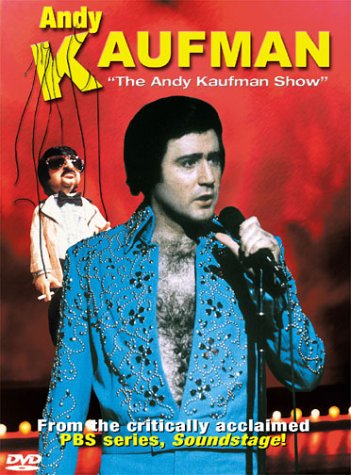
Saturday Matinee: The Andy Kaufman Show

SAVE PBS! AFTER ALL, IT RAN ANDY KAUFMAN’S BRILLIANT, DEMENTED ‘TALK SHOW’ IN 1983

By Martin Schneider

Source: Dangerous Minds

Holy moly! In 1983, just a year before his death of lung cancer—an event some people dispute ever happened—Andy Kaufman was given the bountiful gift of an hour of PBS programming time in the form of a segment of the music series Soundstage.

It’s a revelation.

Kaufman used his hour to create a mind-boggling critique of talk shows and the entertainment complex writ large. The show is presented out of phase: we see the inexplicable final, hysterical moments of the program, perhaps holding out the promise that we’ll find out what the fuck was going on at the very end. Kaufman sings an inane farewell song and credits roll—then the program starts up again.

One of the first things Kaufman does is ask the home viewer to go get a piece of cellophane from the kitchen—and then sits on the lip of the audience bleachers and waits 30 seconds in ballsy silence while that task is accomplished. (Just in case there are any stragglers, he then briefly jacks the volume and shouts at the home viewers to hurry up.)

You don’t need me to tell you all the gags in advance, but boy, they are beautiful. What’s sometimes forgotten about Kaufman is that for all of his daring experimentation, he was almost always very funny. Nobody had better mastery over the mirth that could be extracted from an awkward turn of phrase or an uncomfortable pause.

In Lost in the Funhouse: The Life and Mind of Andy Kaufman, Bill Zehme writes:

They gave him an installment of the PBS concert series Soundstage, for which he was invited to fill an hour as he saw fit and, since this was public television and no serious money was involved, he saw fit to contrive the most elliptical and surreal refraction of existential realities that he had ever attempted. He spent the better part of June working at the WTTW production facilities in Chicago, where the series was produced and where he plotted strategem as he went along, with George and Lynne Margulies and Elayne Boosler as his sounding board. He would begin the show at the end and start again near the middle and utilize ideas learned as a child from watching Winky-Dink and You, wherein viewers were instructed to put cellophane on the television screen and draw on it to help him out of jams. He would have himself arrested and thrown into television court (all with cartoon backdrop) and defend whatever broadcast transgressions he had so far commited on the program. He would have an interviewing desk that was now seven feet high (calling no attention to this) from which he would imperiously interview Elayne, wherein they (candidly, no, really) traversed what had gone wrong with their relationship—“Sometimes I would wake in the morning,” he told her, “and I’d think I’d like to tell you that we’re gonna break up. I’d say, Well, I gotta tell her tonight—we’re gonna break up!” The Clifton puppet would meanwhile stalk the desktop and serve as sidekick.

If you have any yen at all for the outer reaches of experimental comedy, this is a must-see.

Oh—since it’s Kaufman we’re talking about here, don’t take anything for granted. Make sure you watch the program to the very end.


Racket of Rackets

By Charles Hugh Smith

Source: Of Two Minds

If you thought banking in our time was a miserable racket — which it is, of course, and by “racket” I mean a criminal enterprise — then so-called health care has it beat by a country mile, with an added layer of sadism and cruelty built into its operations. Lots of people willingly sign onto mortgages and car loans they wouldn’t qualify for in an ethically sound society, but the interest rates and payments are generally spelled out on paper. They know what they’re signing on for, even if the contract is reckless and stupid on the parts of both borrower and lender. Pension funds and insurance companies foolishly bought bundled mortgage bonds of this crap concocted in the housing bubble. They did it out of greed and desperation, but a little due diligence would have clued them into the fraud being served up by the likes of Goldman Sachs.

Medicine is utterly opaque cost-wise, and that is the heart of the issue. Nobody in the system will say what anything costs and nobody wants to because it would break the spell that they work in an honest, legit business. There is no rational scheme for the cost of any service from one “provider” to the next or even one patient to the next. Anyway, the costs are obscenely inflated and concealed in so many deliberately deceptive coding schemes that even actuaries and professors of economics are confounded by their bills. The services are provided when the customer is under the utmost duress, often life-threatening, and the outcome even in a successful recovery from illness is financial ruin that leaves a lot of people better off dead.

It is a hostage racket, in plain English, a disgrace to the profession that has adopted it, and an insult to the nation. All the idiotic negotiations in congress around the role of insurance companies are a grand dodge to avoid acknowledging the essential racketeering of the “providers” — doctors and hospitals. We are never going to reform it in its current incarnation. For all his personality deformities, President Trump is right in saying that ObamaCare is going to implode. It is only a carbuncle on the gangrenous body of the US medical establishment. The whole system will go down with it.

The New York Times departed from its usual obsessions with Russian turpitude and transgender life last week to publish a valuable briefing on this aspect of the health care racket: Those Indecipherable Medical Bills? They’re One Reason Health Care Costs So Much by Elisabeth Rosenthal. Much of this covers ground exposed in the now famous March 4, 2013 Time Magazine cover story (it took up the whole issue): Bitter Pill: Why Medical Bills Are Killing Us, by Steven Brill. The American public and its government have been adequately informed about the gross and lawless chiseling rampant in every quarter of medicine. The system is one of engineered criminality. It is inflicting ruin on millions. It is really a wonder that the public has not stormed the hospitals with pitchforks and flaming brands to string up that gang in the parking lots high above their Beemers and Lexuses.

There are only two plausible arcs to this story. One is that the nation might face the facts and resort to the Single Payer system found in virtually every other nation that affects to be civilized. There is no other way to eliminate the deliberate racketeering. The other outcome would be the inevitable collapse of the system and its eventual re-set to a much less complex, cash-on-the-barrelhead, local clinic-based model with far less heroic high-tech interventions available for the broad public, but much more affordable basic care. Both outcomes would require jettisoning the immense overburden of administrative dross that clutters up the current model, with its absurd tug-of-war between the price-gouging hospital “Chargemaster” clerks and the sadistic insurance company monitors bent on denying treatment to their sick and hapless “customers” (hostages). Be warned: these represent tens of thousands of supposedly “good” jobs. Of course, they are “good” because they pay middle class wages, of which there are fewer and fewer elsewhere in the economy. But, they are well-paid because of the grotesquely profitable racket they serve. They’ve turned an entire generation of office workers into servants of criminal enterprise. Imagine the damage this does to the soul of our culture.

My suggestion for real reform of the medical racket looks to historical precedent:

In 1932 (before the election of FDR, by the way), the US Senate formed a commission to look into the causes of the 1929 Wall Street Crash and recommend corrections in banking regulation to obviate future episodes like it. It is known to history as the Pecora Commission, after its chief counsel Ferdinand Pecora, an assistant Manhattan DA, who performed gallantly in his role. The commission ran for two years. Its hearings led to prison terms for many bankers and ultimately to the Glass-Steagall Act of 1932, which kept banking relatively honest and stable until its nefarious repeal in 1999 under President Bill Clinton — which led rapidly to a new age of Wall Street malfeasance, still underway.

The US Senate needs to set up an equivalent of the Pecora Commission to thoroughly expose the cost racketeering in medicine, enable the prosecution of the people driving it, and propose a Single Payer remedy for flushing it away. The Department of Justice can certainly apply the RICO anti-racketeering statutes against the big health care conglomerates and their executives personally. I don’t know why it has not done so already — except for the obvious conclusion that our elected officials have been fully complicit in the medical rackets, which is surely the case of new Secretary of Health and Human Services, Tom Price, a former surgeon and congressman who trafficked in medical stocks during his years representing his suburban Atlanta district. A new commission could bypass this unprincipled clown altogether.

It is getting to the point where we have to ask ourselves if we are even capable of being a serious people anymore. Medicine is now a catastrophe every bit as pernicious as the illnesses it is supposed to treat, and a grave threat to a nation that we’re supposed to care about. What party, extant or waiting to be born, will get behind this cleanup operation?

Washington’s Chaoskeeping in Syria

By Martin Berger

Source: New Eastern Outlook

What is the US up to in Syria? – This question is not simply bugging the Arab world, as the whole international community has been trying to find an answer to this puzzle. This matter became especially relevant after the so-called “chemical attack” in the Syrian Governorate of Idlib that occurred on April 4 and the subsequent cruise missile strike against the Al-Shayrat air base that followed a few days later.

The initial false-flag attack, which immediately resulted in a stream of accusations against the Syrian army and the allied Russian troops, was abused by the so-called Syrian Observatory For Human Rights, which has repeatedly participated in spreading fake reports, along with unreasonable and unverified accusations against the Syrian authorities over the years. Then, in accordance with a clearly pre-planned scenario, the High Representative of the European Union for Foreign Affairs and Security Policy, Federica Mogherini along with France and Britain joined the action thriller, quickly switching the blame mode on. There can be no doubt that a stream of accusations being voiced against Damascus prior to any sort of preliminary investigation, let alone a thorough one, was what the Washington coalition was aiming at.

Why bother trying to provide any sort of evidence, when previously Washington managed to bring down an unwanted regime by simply handing over a tube filled with unknown substances that was handed over to Colin Powell for him to shake it in the air in front of the UN Security Council. Sure, it was a cheap trick but it worked due to the fact that nobody expected Washington to fall so low, using a dubious pretext to invade and destroy Iraq.

Once Washington, London, and Paris went under a wave of public outrage for their baseless acusations against Damascus, French Foreign Minister Jean-Marc Ayrault on April 26, acting in accordance with the instructions that Washington provided him with, rushed to present the world a “declassified report of the French secret services,” that were allegedly convinced that Damascus used sarin nerve agent to launch an attack against the town of Khan Shaykhun.

But one could remind Western powers and Jean-Marc Ayrault in particular that six days before the release of this so-called declassified report Australian doctors fell victims of sarin gas in Iraq. Should we hold Damascus responsible for that attack too? Or would we be better off admitting that ISIS militants have repeatedly used sarin and other nerve gas agents both Syria and Iraq, along with their own drones!

By the way, one would not be out of line by demanding how the blood thirsty ISIS radicals that are supposedly surrounded by the US coalition forces and cut off any outside forms of support are not simply continue using nerve agents from the warehouses that remain in their control, while Damascus has officially destroyed all of its chemical stockpiles which has been officially confirmed by the representatives of international community, but are building their own drones. Any drone production operation is something that can hardly be done in the field, especially under the nose of the vigilant French intelligence services, that chose to get engaged in a propaganda war against Damascus instead. As for their British counterparts, they are sending the so-called White Helmets in the contested areas of Syria without the slightest concern for the security of these propaganda heroes in territories occupied by ISIS.

In short, Washington’s actions and the steps taken by its loyal servants in Paris and London with a theatrical performance with “Assad’s chemical attack” and their unwillingness to conduct a thorough investigation of this incident bears a strong resemblance of the events of 2003 in Iraq, which resulted in in the complete destruction of the country and the emergence of ISIS that Washington is allegedly fighting today.

Therefore, it is hardly worth explaining once again what sort of dangerous developments on both the regional and international levels can be triggered by the repetition of the reckless scenario when Washington first makes a political decision, and then creates a political excuse to go along with it. This is how armed conflicts were started not only in Iraq in 2003, but Yugoslavia and Libya, with the so-called Western humanitarian intervention, and Afghanistan too.

Provocations like the one that occurred in Khan Sheikhoun, without a doubt, demand a professional investigation conducted under the supervision of the Organization for the Prohibition of Chemical Weapons (OPCW) by a team of international experts from various regions of the world. There can be no doubt that such an investigation must be open and transparent. The current attempts to block this approach only confirm the doubts about the sincerity of those who are trying to use the incident to push forward their own agenda, in a bid to bring down the UN Security Council Resolution 2254, going along with a time-tested regime change tactics instead.

As for the United States, it is still very difficult to say what plans Washington can try to pull out in Syria in a bid to bring Damascus down. However, Washington’s policies in the region conducted through the last two decades can be briefly described as #chaoskeeping.


Who Controls The Government?

By Scott Lazarowitz

Source: Activist Post

It is quite ironic that the previous Drone-Bomber-in-Chief, Barack H. Obama, has been given the “profile in courage” award, which is being presented to him this week by the JFK Library Foundation. But how much courage did it take for Obama to order the bombings of several different countries, killing mostly innocent civilians, when those countries were of no threat to us?

How insulting to President John F. Kennedy, who promoted peace after recognizing that the post-World War II Cold War and national security state were destructive and unnecessary, and who wanted to “splinter the CIA in a thousand pieces and scatter it to the winds.”

In a June, 1963 speech promoting peace, nuclear disarmament, and diplomacy, Kennedy stated, “No government or social system is so evil that its people must be considered as lacking in virtue. As Americans, we find Communism profoundly repugnant as a negation of personal freedom and dignity. But we can still hail the Russian people for their many achievements — in science and space, in economic and industrial growth, in culture, in acts of courage.”

The hard-core Cold Warriors probably didn’t like that. Their existence as “security” bureaucrats and their little fiefdoms in Washington were dependent on the fear and paranoia of those “commies,” just as the modern day bureaucrats are dependent on post-9/11 fear-mongering.

And the corporatist cronies back then also probably didn’t like Kennedy’s assertion that “the expenditure of billions of dollars every year on weapons acquired for the purpose of making sure we never need them is essential to the keeping of peace. But surely the acquisition of such idle stockpiles — which can only destroy and never create — is not the only, much less the most efficient, means of assuring peace.”

The hard-core Cold Warriors probably didn’t like that. Their existence as “security” bureaucrats and their little fiefdoms in Washington were dependent on the fear and paranoia of those “commies,” just as the modern day bureaucrats are dependent on post-9/11 fear-mongering.

And the corporatist cronies back then also probably didn’t like Kennedy’s assertion that “the expenditure of billions of dollars every year on weapons acquired for the purpose of making sure we never need them is essential to the keeping of peace. But surely the acquisition of such idle stockpiles — which can only destroy and never create — is not the only, much less the most efficient, means of assuring peace.”

The narcissistic arrogance could be seen in the military bureaucrats when they consciously and knowingly pursued continued aggressions in Vietnam despite their knowing by the mid-1960s that the war could not be won, as revealed by the Pentagon Papers. Those “leaders” contributed to the deaths of a million innocents and tens of thousands of American soldiers who died for no good reason but to serve the deranged egos of the military bureaucrats.

And Iraq in 1990-91, the decision by President George H.W. Bush to start a whole new war and bombing campaign against a country, Iraq, that didn’t attack us and was of no threat to us, was not just an act of incompetence, but a criminal act.

Bush approved of the U.S. military’s bombings of civilian water and sewage treatment centers and electric service facilities, followed by sanctions and no-fly zones that were continued by President Bill Clinton throughout the 1990s which led to the deaths of hundreds of thousands of innocent civilian Iraqis. It was an intentional policy of sadism and psychopathic cruelty, that perhaps involved more sinister long-term goals than just to do with oil.

Who would purposely cause a whole population to be vulnerable to disease and death? Who would do that?

But now we have President Donald Trump, who campaigned with anti-war, anti-imperialism rhetoric, but is now the Happy Warmonger. And Trump’s civilian cabinet advisors include military general graduates from West Point or other top military academies but they aren’t exactly trained in the ideas of restraint, diplomacy, the rule of law, and the U.S. Constitution.

No, post-World War II  military people are trained to suppress their consciences, their moral scruples, in order to rationalize their invasions of other territories and the deaths of innocents they cause.

And oh how happy the Trump-advising generals and the other higher-ups in the military must be that Donald Trump is so easily manipulable and spongy. Their psy-ops are working on him like a charm.

It used to be that psy-ops were used by the military and CIA on foreign agents, to manipulate the enemy’s emotions and their decisions. And then the military saw how useful such a technique had been on their own U.S. senators, as reported by the late Michael Hastings in Rolling Stone.

Which is apparently illegal, under U.S. law. Unless they view their own fellow Americans as the “enemy.” Hmm.

Foreign policy analyst Gareth Porter recently tweeted: “Military now seeking permanent US military presence in Iraq and Afghanistan. Time to say loud ‘No’ to permanent war.”

So it’s getting worse now.

Some theorists believe the zealous bureaucrats of the military need permanent war and occupation abroad in order to achieve such a takeover at home. (There may be other reasons, however.)

When the military controls the government, and then there is some kind of emergency or economic collapse, of course they will not think twice about imposing martial law, legal or not, constitutional or not. They will also not think twice about disarming law-abiding Americans.

In Revolutionary times, the early Americans were rightfully wary of militarism, because they knew that would lead to tyranny. But the immoral and incompetent bureaucrats of the modern U.S. government long ago abandoned any concern for the rule of law and the U.S. Constitution.


Scott Lazarowitz is a libertarian writer and commentator. please visit his blog.


The Russian Hacking Fiasco

By Mike Whitney

Source: CounterPunch

There’s no proof that Russia hacked the US elections.

There’s no proof that Russian officials or Russian agents colluded with members of the Trump campaign.

There’s no proof that Russia provided material support of any kind for the Trump campaign or that Russian agents hacked Hillary Clinton’s emails or that Russian officials provided Wikileaks with emails that were intended to sabotage Hillary’s chances to win the election.

So far, no one in any of the 17 US intelligence agencies has stepped forward and verified the claims of Russian meddling or produced a scintilla of hard evidence that Russia was in anyway involved in the 2016 elections.

No proof means no proof.  It means that the people and organizations that are making these uncorroborated claims have no basis for legal action, no presumption of wrongdoing, and no grounds for prosecution. They have nothing. Zilch.  Their claims, charges and accusations are like the soap bubbles we give to our children and grandchildren. The brightly-colored bubbles wobble across the sky for a minute or two and then, Poof, they vanish into the ether. The claims of Russia hacking are like these bubbles. They are empty, unsubstantiated rumors completely devoid of substance. Poof.

It has been eight months since the inception of this unprecedentedly-pathetic and infinitely-irritating propaganda campaign, and in those eight months neither the media nor the politicos nor the Intel agents who claim to be certain that Russia meddled in US elections, have produced anything that even remotely resembles evidence. Instead, they have trotted out the same lie over and over again ad nauseam from every newspaper, every tabloid and every televised news program in the country. Over and over and over again. The media’s persistence is nearly as impressive as its cynicism, which is the one quality that they seem to have mastered. The coverage has been relentless, ubiquitous, pernicious and mendacious. The only problem is that there’s not a grain of truth to any of it. It is all 100 percent, unalloyed baloney.

So it doesn’t matter how many Democratic senators and congressmen disgrace themselves by lighting their hair on fire and howling about “evil Putin” or the imaginary “threats to our precious democracy”. Nor does it matter how many hyperbolic articles appear in media alleging sinister activities and espionage by diabolical Moscow Central.  It doesn’t matter because there is have absolutely zero solid evidence to support their ludicrous and entirely politically-based claims.

Whether Russia was involved in the US elections or not, is a matter of pure speculation. But speculation is not sufficient grounds for appointing a special prosecutor, nor are the lies and misinformation that appear daily in our leading newspapers, like the dissembling New York Times, the dissembling Washington Post and the dissembling Wall Street Journal. The call for a special prosecutor is not based on evidence, it is based on politics, the politics of personal destruction. The Democrats and the media want this tool so they can rummage through whatever private information or paperwork anyone in the Trump administration might possess. So while they might not dig up anything relevant to the Russia hacking investigation, they will certainly gather enough sordid or suspicious information to annihilate the people in their crosshairs. And that’s precisely what the special prosecutor provision is designed to do; it provides the  administration’s rivals with the weapons they need to conduct a massive fishing expedition aimed at character assassination and, ultimately, impeachment.

But, why?

Because Donald Trump had the audacity to win an election that was earmarked for establishment favorite and globalist warmonger-in-chief, Hillary Clinton. That’s what this witch hunt is all about, sour grapes.

But why has Russia been chosen as the target in this deep state-media scam? What has Russia done to deserve all the negative press and unsupported claims of criminal meddling?

That’s easy. Just look at a map. For the last 16 years, the US has been rampaging across North Africa, the Middle East and Central Asia. Washington intends to control critical oil and natural gas reserves in the ME, establish military bases across Central Asia, and remain the dominant player in an area of that is set to become the most populous and prosperous region of the world. It’s the Great Game all over again, only this time-around, Uncle Sam is in the drivers seat not the Queen of England.

But one country has upset that plan, blocked that plan, derailed that plan.

Russia.

Russia has stopped Washington’s murderous marauding and genocidal depredations in Ukraine and Syria, which is why the US foreign policy establishment is so pissed-off.  US elites aren’t used to obstacles.

For the last quarter of a century– since the fall of the Berlin Wall and the dissolution of the Soviet Union– the world had been Washington’s oyster. If the president of the United States  wanted to invade a country in the Middle East, kill a million people, and leave the place in a smoldering pile of rubble, then who could stop him?

Nobody.  Because Washington owns this fu**ing planet and everyone else is just a visitor.

Capisce?

But now all that’s changed. Now evil Putin has thrown up a roadblock to US hegemony in Syria and Ukraine. Now Washington’s landbridge to Central Asia has been split in two, and its plan to control vital pipeline corridors from Qatar to the EU is no longer viable. Russia has stopped Washington dead-in-its tracks and Washington is furious.

The anti-Russia hysteria in the western media is equal to the pain the US foreign policy establishment is currently experiencing. And the reason the foreign policy establishment is in so much pain, is because they are not getting their way.  It’s that simple. Their global strategy is in a shambles because Russia will not let them topple the Syrian government, install their own puppet regime, redraw the map of the Middle East, run roughshod over international law, and tighten their grip on another battered war-torn part of the world.

So now Russia must pay. Putin must be demonized and derided. The American people must be taught to hate Russia and all-things Russian. And, most of all, Russia must be blamed for anything and everything under the sun, including the firing of a completely worthless sack of sh** FBI Director, James Comey, who– at various times in his career– “approved or defended some of the worst abuses of the Bush administration….including  torture, warrantless wiretapping, and indefinite detention.” (ACLU)

This is the low-down, good-for-nothing scalawag that the Democrats are now defending tooth in nail.

It’s pathetic.

Russia has become the all-purpose punching bag because Washington’s plans for global domination have gone up in smoke.

The truth is,  Putin’s done us all a big favor.


MIKE WHITNEY lives in Washington state. He is a contributor to Hopeless: Barack Obama and the Politics of Illusion (AK Press). Hopeless is also available in a Kindle edition. He can be reached at fergiewhitney@msn.com.

Forbidden Questions? 24 Key Issues That Neither the Washington Elite Nor the Media Consider Worth Their Bother

By Andrew J. Bacevich

Source: TomDispatch.com

Donald Trump’s election has elicited impassioned affirmations of a renewed commitment to unvarnished truth-telling from the prestige media.  The common theme:  you know you can’t trust him, but trust us to keep dogging him on your behalf.  The New York Times has even unveiled a portentous new promotional slogan: “The truth is now more important than ever.” For its part, the Washington Post grimly warns that “democracy dies in darkness,” and is offering itself as a source of illumination now that the rotund figure of the 45th president has produced the political equivalent of a total eclipse of the sun. Meanwhile, National Public Radio fundraising campaigns are sounding an increasingly panicky note: give, listener, lest you be personally responsible for the demise of the Republic that we are bravely fighting to save from extinction.

If only it were so.  How wonderful it would be if President Trump’s ascendancy had coincided with a revival of hard-hitting, deep-dive, no-holds-barred American journalism.  Alas, that’s hardly the case.  True, the big media outlets are demonstrating both energy and enterprise in exposing the ineptitude, inconsistency, and dubious ethical standards, as well as outright lies and fake news, that are already emerging as Trump era signatures.  That said, pointing out that the president has (again) uttered a falsehood, claimed credit for a nonexistent achievement, or abandoned some position to which he had previously sworn fealty requires something less than the sleuthing talents of a Sherlock Holmes.  As for beating up on poor Sean Spicer for his latest sequence of gaffes — well, that’s more akin to sadism than reporting.

Apart from a commendable determination to discomfit Trump and members of his inner circle (select military figures excepted, at least for now), journalism remains pretty much what it was prior to November 8th of last year: personalities built up only to be torn down; fads and novelties discovered, celebrated, then mocked; “extraordinary” stories of ordinary people granted 15 seconds of fame only to once again be consigned to oblivion — all served with a side dish of that day’s quota of suffering, devastation, and carnage.  These remain journalism’s stock-in-trade.  As practiced in the United States, with certain honorable (and hence unprofitable) exceptions, journalism remains superficial, voyeuristic, and governed by the attention span of a two year old.

As a result, all those editors, reporters, columnists, and talking heads who characterize their labors as “now more important than ever” ill-serve the public they profess to inform and enlighten.  Rather than clearing the air, they befog it further.  If anything, the media’s current obsession with Donald Trump — his every utterance or tweet treated as “breaking news!” — just provides one additional excuse for highlighting trivia, while slighting issues that deserve far more attention than they currently receive.

To illustrate the point, let me cite some examples of national security issues that presently receive short shrift or are ignored altogether by those parts of the Fourth Estate said to help set the nation’s political agenda. To put it another way: Hey, Big Media, here are two dozen matters to which you’re not giving faintly adequate thought and attention.

1. Accomplishing the “mission”: Since the immediate aftermath of World War II, the United States has been committed to defending key allies in Europe and East Asia.  Not long thereafter, U.S. security guarantees were extended to the Middle East as well.  Under what circumstances can Americans expect nations in these regions to assume responsibility for managing their own affairs?  To put it another way, when (if ever) might U.S. forces actually come home?  And if it is incumbent upon the United States to police vast swaths of the planet in perpetuity, how should momentous changes in the international order — the rise of China, for example, or accelerating climate change — affect the U.S. approach to doing so?

2. American military supremacy: The United States military is undoubtedly the world’s finest.  It’s also far and away the most generously funded, with policymakers offering U.S. troops no shortage of opportunities to practice their craft.  So why doesn’t this great military ever win anything?  Or put another way, why in recent decades have those forces been unable to accomplish Washington’s stated wartime objectives?  Why has the now 15-year-old war on terror failed to result in even a single real success anywhere in the Greater Middle East?  Could it be that we’ve taken the wrong approach?  What should we be doing differently?

3. America’s empire of bases: The U.S. military today garrisons the planet in a fashion without historical precedent.  Successive administrations, regardless of party, justify and perpetuate this policy by insisting that positioning U.S. forces in distant lands fosters peace, stability, and security.  In the present century, however, perpetuating this practice has visibly had the opposite effect.  In the eyes of many of those called upon to “host” American bases, the permanent presence of such forces smacks of occupation.  They resist.  Why should U.S. policymakers expect otherwise?

4. Supporting the troops: In present-day America, expressing reverence for those who serve in uniform is something akin to a religious obligation.  Everyone professes to cherish America’s “warriors.”  Yet such bountiful, if superficial, expressions of regard camouflage a growing gap between those who serve and those who applaud from the sidelines. Our present-day military system, based on the misnamed All-Volunteer Force, is neither democratic nor effective.  Why has discussion and debate about its deficiencies not found a place among the nation’s political priorities? 

5. Prerogatives of the commander-in-chief: Are there any military actions that the president of the United States may not order on his own authority?  If so, what are they?  Bit by bit, decade by decade, Congress has abdicated its assigned role in authorizing war. Today, it merely rubberstamps what presidents decide to do (or simply stays mum).  Who does this deference to an imperial presidency benefit?  Have U.S. policies thereby become more prudent, enlightened, and successful?

6. Assassin-in-chief: A policy of assassination, secretly implemented under the aegis of the CIA during the early Cold War, yielded few substantive successes.  When the secrets were revealed, however, the U.S. government suffered considerable embarrassment, so much so that presidents foreswore politically motivated murder. After 9/11, however, Washington returned to the assassination business in a big way and on a global scale, using drones.  Today, the only secret is the sequence of names on the current presidential hit list, euphemistically known as the White House “disposition matrix.” But does assassination actually advance U.S. interests (or does it merely recruit replacements for the terrorists it liquidates)?  How can we measure its costs, whether direct or indirect?  What dangers and vulnerabilities does this practice invite?

7. The war formerly known as the “Global War on Terrorism”: What precisely is Washington’s present strategy for defeating violent jihadism?  What sequence of planned actions or steps is expected to yield success? If no such strategy exists, why is that the case?  How is it that the absence of strategy — not to mention an agreed upon definition of “success” — doesn’t even qualify for discussion here?

8. The campaign formerly known as Operation Enduring Freedom: The conflict commonly referred to as the Afghanistan War is now the longest in U.S. history — having lasted longer than the Civil War, World War I, and World War II combined. What is the Pentagon’s plan for concluding that conflict?  When might Americans expect it to end?  On what terms?

9. The Gulf: Americans once believed that their prosperity and way of life depended on having assured access to Persian Gulf oil.  Today, that is no longer the case.  The United States is once more an oil exporter. Available and accessible reserves of oil and natural gas in North America are far greater than was once believed. Yet the assumption that the Persian Gulf still qualifies as crucial to American national security persists in Washington. Why?

10. Hyping terrorism: Each year terrorist attacks kill far fewer Americans than do auto accidents, drug overdoses, or even lightning strikes.  Yet in the allocation of government resources, preventing terrorist attacks takes precedence over preventing all three of the others combined. Why is that?

11. Deaths that matter and deaths that don’t: Why do terrorist attacks that kill a handful of Europeans command infinitely more American attention than do terrorist attacks that kill far larger numbers of Arabs? A terrorist attack that kills citizens of France or Belgium elicits from the United States heartfelt expressions of sympathy and solidarity.  A terrorist attack that kills Egyptians or Iraqis elicits shrugs.  Why the difference?  To what extent does race provide the answer to that question?

12. Israeli nukes: What purpose is served by indulging the pretense that Israel does not have nuclear weapons?

13. Peace in the Holy Land: What purpose is served by indulging illusions that a “two-state solution” offers a plausible resolution to the Israeli-Palestinian conflict?  As remorselessly as white settlers once encroached upon territory inhabited by Native American tribes, Israeli settlers expand their presence in the occupied territories year by year.  As they do, the likelihood of creating a viable Palestinian state becomes ever more improbable. To pretend otherwise is the equivalent of thinking that one day President Trump might prefer the rusticity of Camp David to the glitz of Mar-a-Lago.

14. Merchandizing death: When it comes to arms sales, there is no need to Make America Great Again.  The U.S. ranks number one by a comfortable margin, with long-time allies Saudi Arabia and Israel leading recipients of those arms.  Each year, the Saudis (per capita gross domestic product $20,000) purchase hundreds of millions of dollars of U.S. weapons.  Israel (per capita gross domestic product $38,000) gets several billion dollars worth of such weaponry annually courtesy of the American taxpayer.  If the Saudis pay for U.S. arms, why shouldn’t the Israelis? They can certainly afford to do so.

15. Our friends the Saudis (I): Fifteen of the 19 hijackers on September 11, 2001, were Saudis.  What does that fact signify?

16. Our friends the Saudis (II): If indeed Saudi Arabia and Iran are competing to determine which nation will enjoy the upper hand in the Persian Gulf, why should the United States favor Saudi Arabia?  In what sense do Saudi values align more closely with American values than do Iranian ones?

17. Our friends the Pakistanis: Pakistan behaves like a rogue state.  It is a nuclear weapons proliferator.  It supports the Taliban.  For years, it provided sanctuary to Osama bin Laden.  Yet U.S. policymakers treat Pakistan as if it were an ally.  Why?  In what ways do U.S. and Pakistani interests or values coincide?  If there are none, why not say so?

18. Free-loading Europeans: Why can’t Europe, “whole and free,” its population and economy considerably larger than Russia’s, defend itself?  It’s altogether commendable that U.S. policymakers should express support for Polish independence and root for the Baltic republics.  But how does it make sense for the United States to care more about the wellbeing of people living in Eastern Europe than do people living in Western Europe?

19. The mother of all “special relationships”: The United States and the United Kingdom have a “special relationship” dating from the days of Franklin Roosevelt and Winston Churchill.  Apart from keeping the Public Broadcasting Service supplied with costume dramas and stories featuring eccentric detectives, what is the rationale for that partnership today?  Why should U.S. relations with Great Britain, a fading power, be any more “special” than its relations with a rising power like India?  Why should the bonds connecting Americans and Britons be any more intimate than those connecting Americans and Mexicans?  Why does a republic now approaching the 241st anniversary of its independence still need a “mother country”?

20. The old nuclear disarmament razzmatazz: American presidents routinely cite their hope for the worldwide elimination of nuclear weapons.  Yet the U.S. maintains nuclear strike forces on full alert, has embarked on a costly and comprehensive trillion-dollar modernization of its nuclear arsenal, and even refuses to adopt a no-first-use posture when it comes to nuclear war.  The truth is that the United States will consider surrendering its nukes only after every other nation on the planet has done so first.  How does American nuclear hypocrisy affect the prospects for global nuclear disarmament or even simply for the non-proliferation of such weaponry?

21. Double standards (I): American policymakers take it for granted that their country’s sphere of influence is global, which, in turn, provides the rationale for the deployment of U.S. military forces to scores of countries.  Yet when it comes to nations like China, Russia, or Iran, Washington takes the position that spheres of influence are obsolete and a concept that should no longer be applicable to the practice of statecraft.  So Chinese, Russian, and Iranian forces should remain where they belong — in China, Russia, and Iran.  To stray beyond that constitutes a provocation, as well as a threat to global peace and order.  Why should these other nations play by American rules?  Why shouldn’t similar rules apply to the United States?

22. Double standards (II): Washington claims that it supports and upholds international law.  Yet when international law gets in the way of what American policymakers want to do, they disregard it.  They start wars, violate the sovereignty of other nations, and authorize agents of the United States to kidnap, imprison, torture, and kill.  They do these things with impunity, only forced to reverse their actions on the rare occasions when U.S. courts find them illegal.  Why should other powers treat international norms as sacrosanct since the United States does so only when convenient? 

23. Double standards (III): The United States condemns the indiscriminate killing of civilians in wartime.  Yet over the last three-quarters of a century, it killed civilians regularly and often on a massive scale.  By what logic, since the 1940s, has the killing of Germans, Japanese, Koreans, Vietnamese, Laotians, Cambodians, Afghans, and others by U.S. air power been any less reprehensible than the Syrian government’s use of “barrel bombs” to kill Syrians today?  On what basis should Americans accept Pentagon claims that, when civilians are killed these days by U.S. forces, the acts are invariably accidental, whereas Syrian forces kill civilians intentionally and out of malice?  Why exclude incompetence or the fog of war as explanations?  And why, for instance, does the United States regularly gloss over or ignore altogether the noncombatants that Saudi forces (with U.S. assistance) are routinely killing in Yemen?

24. Moral obligations: When confronted with some egregious violation of human rights, members of the chattering classes frequently express an urge for the United States to “do something.”  Holocaust analogies sprout like dandelions.  Newspaper columnists recycle copy first used when Cambodians were slaughtering other Cambodians en masse or whenever Hutus and Tutsis went at it.  Proponents of action — typically advocating military intervention — argue that the United States has a moral obligation to aid those victimized by injustice or cruelty anywhere on Earth.  But what determines the pecking order of such moral obligations?  Which comes first, a responsibility to redress the crimes of others or a responsibility to redress crimes committed by Americans?  Who has a greater claim to U.S. assistance, Syrians suffering today under the boot of Bashar al-Assad or Iraqis, their country shattered by the U.S. invasion of 2003?  Where do the Vietnamese fit into the queue?  How about the Filipinos, brutally denied independence and forcibly incorporated into an American empire as the nineteenth century ended?  Or African-Americans, whose ancestors were imported as slaves?  Or, for that matter, dispossessed and disinherited Native Americans?  Is there a statute of limitations that applies to moral obligations?  And if not, shouldn’t those who have waited longest for justice or reparations receive priority attention?

Let me suggest that any one of these two dozen issues — none seriously covered, discussed, or debated in the American media or in the political mainstream — bears more directly on the wellbeing of the United States and our prospects for avoiding global conflict than anything Donald Trump may have said or done during his first 100 days as president.  Collectively, they define the core of the national security challenges that presently confront this country, even as they languish on the periphery of American politics.

How much damage Donald Trump’s presidency wreaks before it ends remains to be seen.  Yet he himself is a transient phenomenon.  To allow his pratfalls and shenanigans to divert attention from matters sure to persist when he finally departs the stage is to make a grievous error.  It may well be that, as the Times insists, the truth is now more important than ever.  If so, finding the truth requires looking in the right places and asking the right questions.


Andrew J. Bacevich, a TomDispatch regular, is the author of America’s War for the Greater Middle East: A Military History, now out in paperback. His next book will be an interpretive history of the United States from the end of the Cold War to the election of Donald Trump.