Isms, Schisms and Post-Political Correctness

img_2330

By rahkyt

Source: MAR

I grew up in the 70s and came of age in the 80s. Pre-political correctness. Which means I’ve never been interested in glossing over what people really think with some false veneer of civility that obscures more than it reveals.

In my experience, that is dangerous.

I’ve experienced extreme forms of racism in my life. Have been called nigger countless times. Have been in physical fights in neighborhoods and on playgrounds. Heckled racially by entire classrooms in Oklahoma and Illinois in the 70s. Was on a diverse basketball team coming from a diverse, military school district and among the first live black people entire towns had ever seen in Washington State in HS. In the 80s.

I’ve been the first black American in university departments of Geography; subjected to drive-by racism, debates and arguments in the 90s during the fabled Flame Wars.  As a result of these experiences,  I’ve had to fight ignorance on the streets, in the classroom, boardroom and the academy, and I ain’t trying to pretend this world ain’t what it is in no way, shape or form.

I’d much rather someone hate to my face. Honestly.
Glaring at me through machines while working at an automobile factory, shooting at me with their index finger while racing me on a highway through Houston, giving me and my sometimes white girlfriends the evil eye in different cities and states in this beautiful, dangerous country of ours.

Don’t get me wrong.

All these folks were and are not just conservatives. There are liberal racists too, who prefer the “color-blindness” of white privilege and who couch their distaste in socioeconomic and cultural terms. Who hate rap and certain kinds of dances and call them degradations of culture and music, who hold stereotypes about and bemoan the situation of the inner-cities while proselytizing the prison-industrial complex and the welfare-state because “blacks and browns and reds can’t take care of themselves” and need a paternal, Eurocentric social system to take care of them.

There are many other examples of how ideological liberalism and conservatism are two sides of the same supremacy coin. The difference between them is in the intention. The intention to exclude or include.

Political correctness as an exercise in potentiality was high-minded in intention, low-brow in execution, demanding compliance and cooptation of individual experience and knowledge. While it’s aspirations toward a higher and more inclusive society during the era of the culture wars were laudable, the resentment and ignorance its cultural deployment bred are well in evidence now. It further exacerbated the divide between moderate whites, which has affected blacks and browns and reds in predictable ways.

Big “T” Truth always trumps little “t” truth.

Societal truths are subordinate to universal Truths. One such relevant comparison is the reality of the human race versus the perception of multiple races. Words are power. Rhetoric has created the reality we live in right now, where people believe in a black race, a white race, a yellow race. Where people generalize and stigmatize groups in order to maintain their political and economic supremacy.

This is a human problem, one of segregation rather than holism. A problem that cannot be “fixed” at the level of rhetoric. A problem that can be alleviated only through experiential learning. When dealing with the subconscious structures of societal and cultural indoctrination, surface attempts at changing the way that people act, talk and think can only be successful if people are open to learning in the first place. Religious and social stigmas based upon the inherent polarity of black versus white, good versus evil, affect too many at a level they are not aware of, which bounds thought, words and actions, constricting potentiality only to the limited known universe of responses.

So political correctness as a “soft” public policy was doomed from the start. Because people keep it real even when they don’t. Tone and silence speak as loudly as words. Body language, expressions and eyes reveal deeper communications.

We should rejoice in this new, collective choice to say what we mean and mean what we say. It makes things clearer and simpler. People no longer have to attempt to decode key words and dog whistle phrases. And ignorance can be confronted directly at its illogical roots.

Cognitive dissonance is an effective force for change and seeding the consciousness fields of our virtual and immediate physical environments should be the goal of our communication strategies. Telling and showing the truth, sharing it wIth those on the cusp of knowing, who will share it with their networks, remains a valid modality for effective engagement.

The Truth holds power.

It overcomes lies by virtual of its resonant and cohesive essence and compliance with logic and nature law. Resting in the Truth makes political correctness unnecessary. We should not bemoan the end of a false narrative that hid more than it revealed.

Claiming Truth is claiming the power of your convictions and this power is what Is rising now within multitudes intent upon continuing this Great Experiment and perfecting this union no matter what it takes.

Each word you write, each article and video you share is another volley in service of a diverse and inclusive America and world. Don’t back down, don’t give up and continue to shift hearts and minds. Every, single soul counts. Your loved ones, your family and friends are your responsibility.

We are indeed our sisters’ and brothers’ keepers. Because, in the end, we are all One. And what we think, say and do affects others far beyond our most fantastic speculations.

Saturday Matinee: Tokyo Blood

“Tokyo Blood” (1993) is an anthology film consisting of four experimental shorts directed by Gakuryû Ishii (formerly known as Sogo Ishii) thematically connected by the theme of entrapment in Tokyo’s urban landscape and desire to escape. The opening film, “Street Noise” is an impressionistic audio/visual collage depicting an anonymous salaryman’s state of mind as he breaks down from sensory overload. The second vignette, “Bicycle” follows the journey of two young strangers bonded by alienation who aimlessly explore the city by bike after a chance encounter. The third chapter begins as a parody of structuralist film theory (not unlike early works by Peter Greenaway) but soon descends into the hyper-kinetic chaos reminiscent of films by fellow Japanese avant-garde director Shinya Tsukamoto (The Tetsuo Trilogy). The concluding film, “Heart of Stone” is seemingly a transmission from a post-human feature combining the styles of Chris Marker’s essay films and Craig Baldwin’s found-footage narratives.

Syria: New U.S. Air Support On Request Scheme For Al-Qaeda

Source: Moon of Alabama

On this day one hundred years ago the U.S. joined World War I. Last night the U.S. attacked a Syrian government airport in an openly hostile and intentional manner. The strike established a mechanism by which al-Qaeda can “request” U.S. airstrikes on Syrian government targets. It severely damaged the main support base for Syria’s fight against the Islamic State in eastern Syria. The event will possibly lead to a much larger war.

On April 4 Syrian airplanes hit an al-Qaeda headquarter in Khan Sheikoun, Idleb governate. Idleb governate is under al-Qaeda control. After the air strike some chemical agent was released. The symptoms shown in videos from local aid stations point to a nerve-agent. The release probably killed between 50 and 90 people. It is unknown how the release happened.

It is unlikely that the Syrian government did this:

  • In 2013 the Syrian government had given up all its chemical weapons. UN inspectors verified this.
  • The target was militarily and strategically insignificant.
  • There was no immediate pressure on the Syrian military.
  • The international political atmosphere had recently turned positive for Syria.

Even if Syria had stashed away some last-resort weapon this would have been the totally wrong moment and totally wrong target for using it. Over the last six year of war the Syrian government army had followed a political and militarily logical path. It acted consistently. It did not act irrational. It is highly unlikely that it would have now take such an illogical step.

The chemical used, either Sarin or Soman, was not in a clean form. Multiple witnesses reported of a “rotten smell” and greenish color. While the color would point to a mixture with Chlorine the intense smell of Chlorine is easily identifiable, covers up most other odors and would have been recognized by witnesses. Both Sarin and Soman are in pure form colorless, tasteless and odorless. The Syrian government once produced nerve agents on a professional, large scale base. Amateurishly produced nerve-gases are not pure and can smell (example: Tokyo subway incident 1995). It is unlikely that the Syrian government experts would produce a “rotten smelling”, dirty, low quality stuff in an unprofessional and dangerous process.

The nerve agents in Khan Sheikoun, should they be confirmed, came either from stashed ammunition at the place attacked by the Syrian government or it was willfully released by the local ruling terrorist groups -al-Qaeda and Ahrar al-Sham- after the strike to implicate the Syrian government. The relatively low casualty numbers of mostly civilians point to the second variant.

Several reports over the years confirm that Al-Qaeda in Syria has the precursors and capabilities to produce and use Sarin as well as other chemical agents. This would not be their first use of such weapons. Al-Qaeda was under imminent pressure. It was losing the war. It is therefor highly likely that this was an intentional release by al-Qaeda to create public pressure on the Syrian government.

For a release incident of powerful chemical weapons the casualty numbers were low, lower than the casualty numbers of recent conventional U.S. air strikes in Syria and Iraq. Despite that fact a huge international media attack wave, seemingly prepared in advance, against the Syrian government was released. No evidence was presented that the incident was caused by the Syrian government. The only pictures and witness reports from the ground came from or through elements, like the White Helmets, who are known to by embedded with al-Qaeda and ISIS (video) and are acting as their propaganda arm.

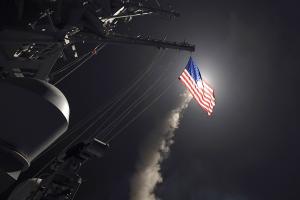
Last night U.S. president Trump “responded” to the incident by ordering the launch of 59 cruise missiles on the Syrian military airport Al Syairat (vid). The cruise missiles were launched from sea in a volley designed to overwhelm air defenses. According to the Syrian and Russian military only 23 cruise missiles reached the airport. The others were shut down or failed. Six Syrian soldiers were Killed, nine civilians in a nearby village were killed or wounded and nine Syrian jets were destroyed. The airport infrastructure was severely damaged. The Syrian and Russian governments had been warned before the strikes hit and evacuated most men and critical equipment. (Was the warning part of a deal?) The air attack coincided with an Islamic State ground attack east of the airport.

The Pentagon alleges, without any evidence, that Sarin had been stored at the airport and a chemical attack launched from it. Both seems highly unlikely. The airport was accessible for UN inspectors. It is not as well covered by air defenses as other Syrian airports, for example in Latakia governate. Its ground approaches are not completely secured. Some medium range air defense system near al Syairat was recently used against Israeli planes attacking Syrian forces fighting ISIS near Palmyra.

Al Syairat lies in Homs governate, 150 km south of Khan Sheikoun in Idleb governate. It is the main support and supply airport for the besieged Syrian government enclave in Deir Ezzor which will now again be in even more serious trouble. It was also used to launch attacks on the Islamic State which fights the Syrian government troops in east Homs.

Al-Qaeda and its sidekick Ahra al-Sham welcomed the U.S. strikes and Abu Ivanka al Amriki on their side. The theocratic dictatorship of Saudi Arabia offered its full support as did its British creators.

The U.S. airstrike delivers a message to al-Qaeda. Whenever under military pressure al-Qaeda can now stage or fake a “chemical attack” and the U.S. will act to destroy its enemy, the Syrian government. Acts as the one last night are then direct military support by the U.S. on al-Qaeda’s request.

A similar scheme had earlier been established on the Golan heights. Al-Qaeda, fighting against Syrian government positions, would launch a mortar round that would land within Israeli controlled territory. Israel would then launch artillery strikes against Syrian government positions because “the Syrian government is responsible for what happens in the area”. Al-Qaeda then used the battle field advantage created by the Israeli strike. The scheme and the Israeli military “reasoning” was published several times in Israeli media:

A number of mortars have landed in Israeli territory as a result of spillover fighting over the last several years, raising fears among residents near the border.The IDF often responds to fire that crosses into Israel by striking Syrian army posts.

Israel maintains a policy of holding Damascus responsible for all fire from Syria into Israel regardless of the source of the fire.

The U.S. administration has now established a similar mechanism, on a larger scale, of direct military U.S. support for al-Qaeda and the Islamic State in Syria.

The Trump presidency had been held hostage by unfounded allegation of “Russian interference” in the U.S. elections in support of the Trump candidacy. The air strikes on Syria might have been the ransom that was demanded for the release of the hostage. His opponents are now gushing about him. The allegation of any Trump-Russia connections may now die down.

Yesterday major Democratic leaders in Congress supported strikes on Syria. Despite that they are also likely to attack Trump over them. The strikes are a “strong man” gamble. As Trump said when Obama ordered strikes such are a desperate move. Most parts of the State Department and the NSC were not consulted about them. The chances that these will “blow back” politically as well as strategically are high.

Trump is the third U.S. president in a row who promised less belligerence during his campaign only to deliver more after the election. The “democratic” veil of the U.S. oligarchic rule thus rips further apart.

Open U.S.-Russian cooperation in Syria will now cease. U.S. planes in Syrian airspace are from now on constantly under imminent danger. There will also be some larger revenge against the U.S. for last night’s strikes. Likely not in Syria but in Iraq, Afghanistan or at sea. A “message” will be send. The U.S. reaction to that “message” will be a decision over a much larger war.

Related Articles

US Missiles Strike Syrian Forces Fighting Al Qaeda

Syria’s alleged gas attack: An imperialist provocation

Putin believes US attack on Syria violates international law – spokesman

Top 10 Lies, Damn Lies, and Lies About Syria

Related Video:

Disposable Americans: The Numbers are Growing

middle-class

By Paul Buchheit

Source: Information Clearing House

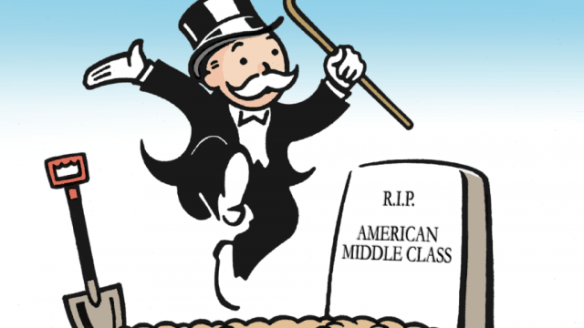
As often noted in the passionate writings of Henry Giroux, poor Americans are becoming increasingly ‘disposable’ in our winner-take-all society. After 35 years of wealth distribution to the super-rich, inequality has forced much of the middle class towards the bottom, to near-poverty levels, and to a state of helplessness in which they find themselves being blamed for their own misfortunes.

The evidence keeps accumulating: income and wealth — and health — are declining for middle-class America. As wealth at the top grows, the super-rich feel they have little need for the rest of society.

Income Plummets for the Middle Class

According to Pew Research, in 1970 three of every ten income dollars went to upper-income households. Now five of every ten dollars goes to them.

The Social Security Administration reports that over half of Americans make less than $30,000 per year. That’s less than an appropriate average living wage of $16.87 per hour, as calculated by Alliance for a Just Society.

Wealth Collapses for Half of Us

Numerous sources report that half or more of American families have virtually no savings, and would have to borrow money or sell possessions to cover an emergency expense. Between half and two-thirds of Americans have less than $1,000.

For every $100 owned by a middle-class household in 2001, that household now has just $72.

Not surprisingly, race plays a role in the diminishing of middle America. According to Pew Research, the typical black family has only enough liquid savings to last five days, compared to 12 days for the typical Hispanic household, and 30 days for a white household.

Our Deteriorating Health

In a disgraceful display of high-level disregard for vital health issues, House Republicans are attempting to cut back on lunches for over 3 million kids.

The evidence for the health-related disposability of poor Americans comes from a new study that finds nearly a 15 year difference in life expectancy for 40-year-olds among the richest 1% and poorest 1% (10 years for women). Much of the disparity has arisen in just the past 15 years.

It’s not hard to understand the dramatic decline in life expectancy, as numerous studies have documented the health problems resulting from the inequality-driven levels of stress and worry and anger that make Americans much less optimistic about the future. The growing disparities mean that our children will likely see less opportunities for their own futures.

It May Be Getting Worse

The sense derived from all this is that half of America is severely financially burdened, at risk of falling deeper into debt.

It may be more than half. The Wall Street Journal recently reported on a JP Morgan study’s conclusion that “the bottom 80% of households by income lack sufficient savings to cover the type of volatility observed in income and spending.” Fewer than one in three 25- to 34-year-olds live in their own homes, a 20 percent drop in just the past 15 years.

It may be even worse for renters. The number of families spending more than half their incomes on rent — the ‘severely’ cost-burdened renters — has increased by a stunning 50 percent in just ten years. Billionaire Steve Schwarzman, whose company Blackstone has been buying up tens of thousands of homes at rock-bottom prices and then renting them back while waiting out the housing market, finds the growing anger among voters “astonishing.”

What’s astonishing is the disregard that many of the super-rich have for struggling Americans.


Paul Buchheit is a college teacher, an active member of US Uncut Chicago, founder and developer of social justice and educational websites (UsAgainstGreed.org, PayUpNow.org, RappingHistory.org), and the editor and main author of “American Wars: Illusions and Realities” (Clarity Press). He can be reached at paul@UsAgainstGreed.org.

Fake News: The Unravelling of US Empire From Within

By Prof. John McMurtry

Source: Global Research

Setting the Stage of the Press-President War

US ruling ideology and Washington power have become unstuck as never before. A war of opposing certitudes and denunciations is waged day to day between the long-ruling US corporate media and the White House. Both continuously proclaim ringing recriminations of the other’s ‘fake news’. Over months they both portray each other as malevolent liars.

US bully pulpits are now beyond show disagreements and successful media inquisitions of the past. Slanderous accusations long confined to vilifying the designated Enemy have crept into accusations of the President himself. ‘The Russians are coming’ is returning as the final recourse of smear to stop deviations from the global program of hugely profitable enemy hate and perpetual preparations for foreign war.

The ruling big lies of the US money party and corporate globalization have divided into opposing camps. The Press and the President denounce each other non-stop on the public stage, while US dark state agents take sides behind the scenes.

Fake news is the medium of battle.

Tracking the Real Fake News Built into Corporate Globalization

Beneath the civil war of official narratives, cognitive space opens for truth long suffocated by ‘the Washington Consensus’. Even the US-led G-20 has recently agreed not to automatically condemn ‘protectionism’ as an economic evil. The battle slogan of transnational corporate rule over 30 years has been quietly withdrawn on the global stage.

Is the big lie of ‘free trade’ finally coming to ground? It has long led the hollowing out of societies and life support systems across the world in a false mass promotion as “freedom and prosperity for all”.  In fact beneath the pervasive fake news, a closed-door transnational corporate command system forces all enterprises across borders into a carbon-multiplying trade regime with thousands of rules to protect the transnational corporate looting and ruin of home economies and environments as the only rights enforced.

Propagandist names and fake freedoms are proclaimed everywhere to conceal the reality. The corporate-investor regime has stripped out almost all evolved protections of workers, ecologies and social infrastructures. Non-stop liquidations and roboticizations of local jobs and enterprises are reversed in meaning to ‘jobs, jobs, jobs’ and ‘higher living standards’, the very opposite of the facts. Destabilization and bombing wars attack resource-rich and air-defenceless societies outside the circle of treaty subjugation.

False news allows every step. Even the happy-face Trudeau regime is taken aback by the tidal shift to national priorities. Its ministers scuttle around the US in near panic to find common cause for restoring the unaccountable regime. Multiplying carbon, disemployment and ecological plunder are ignored throughout in the longest standing fake news of all –‘economic growth”.

In fact, there is no real economic growth in universal life necessities or reduction of waste. The only growth is of volumes and velocities of transnational money exchanges, foreign commodities, and private profits to the top.

‘More prosperity for nations and the world’ means, decoded, more transnational corporate-state treaties to deprive nations of their rights to organization and production for citizens’ real needs as well as organically regulated protection of environments and ecosystems.

The consequences covered over by pervasively false cover stories are speeded-up ecocidal extractions, permanent disemployments, and wastes hemorrhaging into cumulatively more polluted oceans, air, atmosphere and life habitats. Corporate-state solutions of carbon markets for pollution rights have nowhere reduced any of these life-and-death crises, but only further and selectively enriched transnational corporations.

As for the Obama solution, “we need more Canadas”, fake news again conceals the reality. Beneath the global celebrity hype covering empty and broken promises, Canada’s Trudeau  regime is essentially a brand change of PM rhetoric to advance transnational corporate dictates as ‘free trade’ and to ensure oil pipelines out of the most polluting oil basin in the world, Alberta’s tar-sands, are built through water basins and indigenous lands across Canada and the US. One cannot help but observe this is Trump’s plan too, and overrides Trudeau’s promises to protect Canada’s first peoples.

I recently sent a letter to my local MP requesting evidence for what PM Trudeau promises over months of repetition that “more free trade” means “a better life for those in the middle class and those wanting to join the middle class”. As always, there is no evidence to support the non-stop false news from the PMO. Revealingly, the “middle class” turns out to be people making $180,000 a year slated to get significant tax cuts.

Trump’s rogue elephant charge on Washington-led lies, war, and dispossession of the working class is no solution to life-blind corporate globalization. Trump in office is a US nationalist oligarch commanding policies even more blindly rapacious in despoliation of the environment and transferring far more public wealth to the rich.

The common ground of all our lives, collective life capital, does not exist for any government in ‘the free world’ or any policy of ‘globalization’.  The lies that must be promulgated to advance the private corporate agenda are built into its transnational command system from the beginning.

Out of the Ruling Memory Hole with the Internet Commons

Joining the dots shows that every step of US money-party ‘globalization’ has, in fact, been driven by fake news.

No corporate media tolerance has been given in a quarter of a century to any voice demanding accountability to the common life-ground of citizens. A new game of numbers has proceeded instead. At most, a euphemistic ‘climate change’ has been endlessly debated while the totalizing destabilization of human and planetary life cycles remains without a name or collective response. Only more profitable market panaceas which do not reduce any pollution continue to divert from the deepest degenerate trends destroying the planetary life host.

On the upside, the big lies of ‘free trade’ and ‘humanitarian wars’ have been called into official question for the first time by the Trump presidential campaign, and he has been elected against the official line. Yet opposing camps are still at each other’s throats. So the perpetual fallback on accusing the long-designated foreign enemy is triggered by the fallen establishment. The fake news chorus of Russia’s aggressions now includes collusion of the Trump administration with its officials to win the US election. This mainspring diversion from reality is called back from the dead witch-hunts of the past. As then tool, facts do not count, only accusations do. The official media line is almost predictable: Russia is behind Trump’s election victory. As always, reverse projection is the mass-psyche operation to blame an official Enemy to divert attention from the life-and-death facts. The Enemy is once again accused of doing what the US has always done worse as the reason for attacking It. Russia is the usual placeholder in this reverse-blame operation. The 2016 US election of Trump is the latest variation.

Meanwhile throughout the election and its aftermath, the new transnational internet commons including Wiki-leaks over a decade has increasingly laid bare the greatest propaganda machine in history now in many-leveled crisis. The long normalized half-truths, one-sided slanting of the facts, and non-stop fallacies of inference are coming out into the open as never before.  The pretexts and lies for US imperial bullying and war are exposed beyond any corporate-media gate.

This time the accusation is “interference and attack on the US presidential election” with no evidence of wrongdoing or vote manipulation whatsoever. Yet as in the long past, the method is smear with no evidence for the accusations. Ever more media repetition and shadowy insinuation does the job. It has always worked before, why not again since all the other media buttons pushed on taking down the Trump peace initiatives with Russia and opposition to globalization of US jobs have failed.

Having wondered during the election campaign whether we could be “friends with Russia” and promoted diplomatic relations into his administration, Trump can be named as the enemy in hiding to be rooted out. The real problem the fake news never mentions is that he threatens the cornerstone of the US war state over 70 years.

So when Trump won the election with his heresy still intact, the ever-ready accusation of evil-Russia connection moves into high gear although the target is the opposite of communist and an epitome of capitalist riches and connections. We see here the historical mind-lock compulsion to blame the Enemy Russia and smear whoever dissents from it, even if it is a bully-capitalist president. There are very big stakes in keeping the game going.

Yet the no-profit and unpaid analyses from the internet commons have no such ulterior motive and interest in false accusations. With more objectively informed analysts than the commercial press and unimpeachable facts like WikiLeaks going to tens of millions of readers across the world, the genie is out of the bottle. The official grand narrative and its normalized big lies are coming apart at the seams.

So blame as usual is diverted onto the accepted Enemy, now conniving with Trump to attack the 2016 US presidential election. Beneath the fake news, the fact is that positive diplomatic relations with Russia not only threaten to stop the highly profitable permanent war against it, but spike the longest pretext for US war and military domination now moving through Ukraine.

The free internet commons cannot be gagged for telling the truth. Freedom of speech in the US cannot be openly stopped without fatal loss of legitimacy of rule.

So the rest follows. All the non-corporate and non-profit messages from the critical sites on the internet commons which are speaking against the US war state inside are now vilified as ‘fake news’. A third, unofficial protagonist has entered the battle with no private profit or career motive or corporate boss to serve and a wealth of proven professional knowledge and talent at work. It has to be denounced to sustain the big lies of the ruling money-war game which is in deepening crises and conflicts all the way to the unprecedented US President-Press civil war.

The Harvard Proclamation of a New Memory Hole

The innermost fount of US ideology and war, Harvard University, has now stepped in. It is officially naming and denouncing US-critical internet sites for ‘fake news’.

Not even the medieval Church went so far in its Index Librorum Prohibitorum of prohibited writings. It was at least innocent of scientific method and openly declared its dogmas. Not Harvard.

Underneath notice, all the sites it attacks are internet commons, and none are financed by private corporate donors and captive institutions while Harvard and the corporate media are. This is the real battle agenda underneath, the long war  to privatize the news for profit as everything else with anti-establishment internet criticism now the target.

In the background, Harvard University has long propagated an unexamined academic method. It normally cuts off any faculty or learned source of opposition to the private corporate rule of America and the wars of aggression to impose it on the world.  Accordingly, the underling grand narrative equations of the US is Good and the designated Enemy is Evil is not questioned. It is presupposed. Malevolent motives are always assumed of the designated Enemy, down to Harvard-produced geostrategic economic and war models. So when a host of internet commons sites challenge the grand narrative framework, Harvard and satellites denounce them to stop people reading them. A long list of critical sites is accused without criteria, proof or evidence as all spreaders of ‘fake news’.

What is not recognised here is that only on the internet commons can the process of truth be free from ruling pressures to control message for external sponsors.

Here there is no commercial-profit condition to speak and write, and no livelihood dependence on private profit. There is no inducement to avoid life-and-death issues in academic obfuscation or ad-vehicle style. Internet authors not on the payroll can be free of the game of all games behind the scenes – enriching the rich further with no life-coherent criterion of truth.

These underlying conditions of the internet commons and free speech itself cannot be recognised by the academy or the corporate press without undercutting their proclaimed status as the only legitimate founts of truth. The internet commons is a new world of competitive capacities to research, understand and disseminate not bound by private money patronage (as over centuries in Harvard University).

When challenged in this way, Harvard (and the official press) are set back on their heels. They cannot think the facts through because their instituted presumptions have long been what they must presuppose and not question to acquire their credentials and pay for public speech. They must attack what calls all this into question if it effectively speaks truth to power to expose or de-legitimate the ruling system narrative as false. Harvard and the US press thus follow the reigning method of reverse projection. They accuse the effective opposition of ‘fake news’.

The most revealing fact here is that Harvard authority as other academic administrations proceed in name-calling without any valid argument or demonstration – the very basis of reasonable conclusion. Yet this is such a long tradition of presumptive accusation allowed against anyone designated as the Enemy, and anyone else exposing the falsehood of the ruling US story of moral superiority over all others and God’s blessing to lead the world by force or money.

This is why only dissenting sites from the official storyline of US freedom and rightness in all things are accused as ‘fake news’. Accusation of opposing positions is so well-worn into conditioned brains that endless repetition locks it in as self-evident. This is why attributions of vile motive are automatic from Harvard or the New York Times for any outside leader opposing US interference in their countries including elections. US hypocrisy here is staggering, but unreported. In fact, Harvard’s life-blind elite of war criminal geo-strategists, economic modellers and so on are fawned upon within the wider corporate rule they serve.

None can engage critical facts and thought challenging the US moral superiority assumptions because they have never been required to consider them. So they denounce them as once the Church denounced apostasy. In the end, US system worship is a war-state religion. It eliminates all enemies to its right to rule. Its globalizing system institutes the market laws of God. War crimes are God-blessed justice.

Freedom of Speech, the Process of Truth, and the US Constitution

Led by senior academics, journalists and technical expertise, the internet commons provide for the first time impartial witness and free speech open to public examination and circulation across borders. They are free from corporate-rank dictate and private copy-right control.

In consequence, the internet commons are liberated from private corporate profit as controlling goal. Those who know what they are talking about can speak truth to dogma and power without words to appease editors, business boards and ad revenues. Truth itself is not defined, but its principle of process is a more inclusively consistent taking into account towards life-coherent conclusion

Despite Google black-holing of radical legal facts, CIA penetration of Wikipedia, and so on, the internet commons’ freedom of speech is far beyond anything guaranteed in the US constitution. In fact, the ‘sacred US Constitution’ that all presidents give oath to “preserve, protect and defend” guarantees in the end only freedom of public speech to private money demand.

Long before the Supreme Court’s 2010 decision reverse-titled as “Citizens United”, the US constitution was structured to one overriding end –  to remove prior limits to private-money right over all else, including to begin, the rule of British law and  the lands of the first nations West of the Appalachians.

This is why no common life interest exists in the US Constitution from the start. People’s universal human life necessities of water, food, protection and liveable environment are ruled out a-priori.  This is why civil rights themselves were first federally enforced by the ‘commerce clause’ protecting freedom of commercial bus passengers including blacks to cross borders.

It is also why the Fourteenth Amendment to protect the equal rights of freed slaves ended up being the legal basis for private-profit corporations and wealthy funds to acquire the constitutional rights of living persons (e.g., to freedom of speech for big money to buy elections and to avoid government access to financial records).

Even the iconic rights of “life, liberty and happiness” turn out to be in fact only private market rights which allow corporate ‘fictive persons’ to unlimited money wealth, protection against public redistribution, and the freedom of private wealth alone to  speak to America by buying corporate self promotions and election attack ads.

The US Constitution fix goes all the way back to 1787. As professor of constitutional law at Chicago’s iconic Kent College of Law, Matthew Stanton, explains in personal correspondence:

“[The fix] goes all the way back to the 1787 coup where the 39 signatories to the Constitution sequestered themselves in a Philadelphia meeting house, with locked doors and shuttered windows, to ostensibly make adjustments to the Articles of Confederation, but instead delivered an entirely new document that enabled creating a federal system centralizing control of the economy by  propertied wealth”.

Russia the Enemy: the Deus ex Machina of Fake News

We may recall that the corporate-press and Wall-Street-enriched candidate for the presidency, Hillary Clinton, started the accusation of ‘fake news’ to explain her defeat. As establishment mask of the politically correct masses with the money-war party as her paymaster, Clinton blamed her fall in the 2016 US election on the new enemy she saw arising against the official story and herself. When the ‘glass mirror’ story line did not take, she joined forces with the corporate media on another plane. ‘Fake news’ misled Americans. The New York Times, the Washington Post, the TV Networks, and other establishment tale tellers saw pay-dirt far beyond Clinton’s failed bid for president.

In fact, the corporate mass media were losing marketability by the escalating appeal of free social media. The once all-powerful press propaganda system has been increasingly deserted. The ‘fake news’ story provided a media base to condemn free internet news and commentary as immoral. The 2016 election became the leverage for a big market grab back.

Very soon it was not just ‘fake news’ to spike news cycles and subscriptions. War as peace and corporate globalization as freedom found its long place of rule – the enemy of Russia to blame. Now the news can be that Russia hacked and attacked the lost 2016 election. Russia may be a hollowed-out shell by global corporate and oligarch dispossession. But it can still continue as pretext for US-NATO war crimes and aggression reverse-blamed on it. As the European breadbasket and newly discovered fossil-fuel rich nation, Ukraine is a very big prize. Now in Ukraine’s US-led coup aftermath and ethnic civil war, evil Russia can be an ace card again to accuse for attacking the US election.

Since Russia led by Putin is drawing the line as in Crimea to support the Russia-speaking region against US-led war crimes under international law (documented in previous articles), all roads connect. “Russia’s uncontrolled aggression” is  reverse-projected onto the victim again in  a glorious new use. Reverse blame it  for interference in the US election of Trump and kill Russia-US peace initiatives at the same time. No fact is required to verify the accusation, and no law broken is needed to insinuate treason of whoever relates with Russia’s officials in peace initiative. It can work even against an elected US president.

At the same time, the US’s own record attacking other nations’ elections and societies is thereby erased as well – continually orchestrating mass-murder and dictatorship to sabotage the electoral process from Vietnam and Chile to Ukraine in 2010 and Latin America social democracies since.

If it were a story of reverse projection by a mass-murderous psychopath, it would be too much to believe. Yet it now runs the US news cycle as the big story unfolding with no evidence of US illegality, force, or non-compliance with international law. The accusations run by themselves in US media culture and across the empire. So as 2017 Spring breaks, endless media insinuations of treason seep into the populace from corporate media sites across borders with backrooms and Congress setting up for another presidential inquisition.

It is interesting to observe two precedents. Past inquisitions were unfolded soon after Bill Clinton said in India, “it’s time to level up rather than down in global trade” and Richard Nixon founded the Environmental Protections Agency, stopped corporations from outsourcing US jobs, and made peace with China as Trump sought with Russia.

The ludicrous hypocrisy, factual vacuum, and war-drums of blame-the-enemy go into high-volume operation again, led by an attack-dog media against the elected US president whose only action has been to have business-like relations with Russia. Few observe the immense stakes of the US media and war establishments in this process. Cui bono? – who benefits? – is the question never asked.

What’s new?  The perpetual red herring of ‘Russia aggression’ takes everyone’s eyes off the ball – including the continuing US-drone mass murder and ecological wars built into the Trump agenda. Canada’s oil and mining corps and big banks sneak behind the pervasive fake news with a smiling Trudeau front. NATO demands more money behind Trump now fulsomely praising what he earlier campaigned on as “obsolete”, as he has done with the CIA he also condemned. Those hoping for a new departure under Trump from the big lies and war crimes as normalized operations watch in a combination of horror and hilarity.

Who connects the dots? Beneath official notice, the ruling goal of US empire is blind to its consequences of human and planetary life ruin. It has to cover itself in false news to carry on. This is why fake news is not a temporary phenomenon of the Trump era. It is the necessary veil of illusion of an eco-genocidal system. The symptoms and trends are everywhere. But a US-led prism of false inversions of reality regulates consciousness, perception and reaction to ‘steer the course’.

This is true of both sides of the Trump divide, and also in corporate Canada as the US’s largest trading partner, branch-plant and resource cornucopia. What is new is that the ruling illusions are divided against themselves at the top of the US political and ideological system. The Trump phenomenon reflects the rupture. The US empire is in deep crisis from its cumulative destruction of social and natural life support systems. Its carcinomic multiplication of private money demand with no tie to the production of means of life is the reality beneath all the false news.

Nothing is life secure. The ‘global security system’ protects only money values and sequences through life hosts. Peoples everywhere compete to make it go faster to survive. The ruling concept of ‘economy ‘inverts the systematic depletion, degradation and despoliation of the life capital of organic, social and ecological life. Universal necessities of human and fellow life are stripped, polluted and wasted as ‘efficiencies’.

President Trump has gone into the political ring to fight it out with the political establishment on a nationalist capitalist level. He is losing money in the short term. But his program in office is completely eco-blind, and the opposing mass media follow suit. All they can focus on is demonizing normal relations with the official Enemy Russia. Meanwhile Trump has all but abolished the EPA and cut off all federal funding for restoration of the Great Lakes, the most important source of fresh water heritage on the planet.

These supreme crimes under international law are recognised by none on stage. In Canada, a Nazi progeny and neo-Nazi supporter of the violent coup and civil war in Ukraine is made Foreign Affairs Minister and hustles her connections throughout the US to keep the attack-Russia juggernaut going as in the past under  a continuous barrage of ethnic prejudices and fake news.

The pattern is clear but unspoken. The Enemy Russia is the auto-pilot of fake news to divert from US and client leadership failure on almost every level. Relations of mutual respect with Russia’s ambassador are ‘collusion’ and taboo.

The Reality Beneath the Questions not Asked

How does disclosure of Hillary’s Clinton’s apparatus theft of the Democratic nomination from Bernie Sanders get blamed on Russia? The question is not asked. The Washington mass media and visible Congress focus instead on accused “collusion with Russia” with very big stakes in the new inquisition show. Suspicions without substance run free in the mass media once the designated Enemy is smeared onto the target, even if elected president.

Who knows that the US joined the armed forces of Britain, colonial Canada and Japan to crush the 1917 Russian Revolution on behalf of the Czarist autocracy and Western capitalism? More deeply, who names the governing objective behind all the shows of force and accusation over a century since? To be managed successfully, attention must be diverted from the facts of US-led war crimes and public looting within and without US empire proclaimed as ‘world freedom’.

The new President and his Exxon Secretary of State seek business-like relations with Russia. Very big powers are coming into conflict over business and war within the US empire. Big oil in both leviathan countries are pitted against the US Enemy-and-smear establishment which has long run the show with big oil formerly leading it. Now transnational big oil in the US and Russia are leading out of the blind alley of war against each other which has so totally failed to bring benefits to either side in the long term, and has almost reversed civilization.

The dots again are not joined. The completely counter-productive war against Russia to keep the US money-war state going is deepened by Wall Street. The falling price of oil is driven beneath notice by Wall Street which has successfully short-future-traded oil down to establish its money-printing powers by debt as supreme over its rival substitute, while diverting everybody’s attention from the greatest fraud in history still going. Observe that Wall Street remains untouched even from its multi-trillion dollar heist from public and pension coffers from 2007 on.

Blame Russia is the normal chorus which Wall Street benefits from as the ultimate leader of the ruinously anti-productive money-war system. It pays off so well to the money party in more public dollars appropriated by its control and issue of money debt for everything that exists; the pervasive military-industrial complex which never gets reversed even in the peace after the planned destruction of the ‘Evil Empire’; and the corporate mass media in front turning the fake news system over continuously to promote, idealize and divert from the global empire’s war and occupation powers. The neo-con and neo-liberal war strategists alike are built into the dark state as managers uniquely dependent on Russia as the Enemy.

So it is in all their self-maximizing interests to sustain perpetual accusations of some enemy’s evil as the great cover-up story of US empire and it inherited war-crime system. Joined to despotic local oligarchies, this axis dismantles ever more societies for corporate, bank and military plunder and jackal payoffs everywhere (including the academy). There is no limit or borders to the established system invasion, and all is at the expense of public treasuries and of life support systems across domains.

President Trump does not break the fatal ruling cycle. He demands that vassal states should pay for their US military protection, a new global extortion supporting new NATO oligarchies against change which accompanies his stripping of environmental protections to pay for more war powers. Trump behind his populist bluster is a paradigm example of instituted US capitalist greed and aggression. Yet the fact that hate of the Enemy is smeared even onto him for not hating Russia too reveals the ultimate pretext of the US-NATO war machine. Behind the US-led perpetual arms build-up, border threats and bombings of mostly innocents across the globe while blaming the terrorists for the horrors now built into the global ‘growth’ system is fake news as continuous cover story. The war-criminal drone mass murders continue on unnoticed. The bank looting of public wealth is instituted more broadly. The universities, health systems and public infrastructures are privatized for profit with no life criteria of outcomes.

Trump is dispossessing the American common wealth for big US money in line with the Reagan public-looting machine before him. It drained  public revenues into a black hole of US debt, blamed acid rain on trees, and portrayed orchestrated mass murderers of socialists in Afghanistan and Nicaragua as ‘freedom fighters’. What has changed in the corporate media’s fake-news today?

Trump in office is the opposite of the anti-establishment candidate he promised to be. He wars on the US Environmental Protection Agency (its only collective life protective organization). He fractions corporate taxes in a giveway to the rich beyond Reagan’s $500-billion tax cut. He privatizes the public’s falling infrastructure for speculators and developers’ long-term private tolls, profits and control for private profit at taxpayers’ expense.

Who in the corporate media or Congress questions any of it?

The Trudeau  regime to the north imitates the new massive scheme of privatizing public infrastructure. But it disguises it in terms of public investment in public goods. The big banks and speculators on both sides of the border are the winners whatever the corporate media and state cover story. The common wealth is sold off under pervasive fake news masquerading as responsible and for the public good. But the drive-wheel policy mechanisms for ever more dismantling of the living earth and redistribution of more public wealth upwards to the rich march on beneath conscious comprehension.

Trump does not hide the privatization for profit of America’s public infrastructure and stripping of public health and environmental protection policies once he has rising stockholder support in office. The Trudeau Liberal party masqueraded as the social democrat NDP in promising whopping public investment to win the election, but when in office lets the giant privatization boondoggle trickle out in sunny  avoidance of the facts.

The monumental schemes of robbing the commonwealth at every level are led by slanted and selective reports through every step across ever more domains. But a constant across US empire is Russia the Enemy to justify it all. In the deepening life support crises of this ruling axis, Russia’s projected ‘attacks’ still lead the show.

The Life-Blind Moral DNA of US Rule

With no common ground but belief in God’s blessing over all nations and the greatest killing machine in history to enforce it, US ideology may seem to be a psychopathic rationalization writ large.

Yet the US national morality tale governs perception so that the a-priori life-blindness is not recognised even by philosophers. The US continues to be ruled at home and abroad without life-value ground or compass. So as the US-led global market system multiplies its demands on organic, social and ecological life systems, it moves inexorably towards a few multibillionaires with more wealth than 99% of the population, steering planetary depredation to ruin as freedom and growth.

How else would a global cancer system behave? Yet almost none recognise that this system overrides life requirements at every level. The reformer Trump selects for even more wealth and power to the home rich. He attacks evolved environmental research and regulations with no better alternative. He seeks to repeal Obamacare with no public option considered. His nationalist and cost-cutting program is essentially life-blind.

The baseline of crisis goes all down to the moral DNA of the US project and its evolved economic, political and ideological system. The innermost value driver is long presupposed without question by even US moral philosophers and social scientists as the first principle of their models. Atomic self-maximization towards more private money-value without limit is the meta-program.

In consequence, the ‘global free market’ the US leads and imposes has no feedback loops to protect human or planetary life against hollowing them out for transient commodities, private profit and wastes on every level. The ruling system is structured only to ensure more money demand and commodities to those who have money to pay. Any accountability to universal life necessities is ruled out a-priori from the US Constitution, ruling market doctrine, and received theories.

As I have commented in articles prior to his presidency, “Trump is America come to meet itself”. But the US cover story has not yet been decoded in its master functions of legitimation and idealization. What makes the eco-genocidal system acceptable to human consciousness is an ultimate story line and moral syntax that transforms it into heroic liberty, individualism and moral supremacy.

This moral syntax has been imprinted into US empire since its original revolution against Britain to invade the America West to the Pacific Ocean to appropriate and  destroy all the life and life support systems of the developed first peoples there as ‘freedom’, ‘development’ and ‘self-defense’. What is required for the grand narrative’s success is to hide the reality of continuous eco-genocide by continuous false representations as the virtue and truth others fail to understand.

This first principle the justifying morality tale entails the second – that an alien Enemy must always be blamed for the system’s destructive attacks on barriers and resistance to it. Conversion of all life and life support systems to limitless self-maximization of the US system and its richest citizens then proceeds under cover of fake news with wars of acquisition and control represented as courageous and beneficent for all.

For-profit private corporations are the ever more empowered legal vehicles of this transnational system which is set to select for systematic self-maximization of the rich by all market, state and war means that can be constructed to enable it, starting with the US Constitution (as explained above). This set-point is built into the legislative, judicial and executive branches so that today the system outcome is a constitutionally ordered money-party control of all three branches of government as well as the funding systems of social sciences and philosophy.

Fake news in the widest sense provides a continuous cover story to mask and justify the underlying program which is not seen – the money-war party’s limitless take from life within and without the US that depends on a designated Enemy as perennial pretext to strip the US and global commonwealth against effective opposition or change.


Prof. John McMurtry FRSC is the author of The Cancer Stage of Capitalism: From Crisis to Solution  and the three-volume study, Philosophy and World Problems,  UNESCO Encyclopedia of Life Support Systems (EOLSS), Paris-Oxford. 

A valiant verbal warrior demythologizes the CIA

valentinecover-400x600

By Edward Curtin

Source: Intrepid Report

“Once there is a suspicion that a religion is a myth, its power has gone.”—Alan Watts, The Wisdom of Insecurity

Like Odysseus, Douglas Valentine is a wily warrior who managed to enter the enemy’s stronghold disguised as a gift. Not Troy, and not within a wooden horse, but in the guise of a nice young “Nobody,” he was able, thirty or so years ago, to breach the walls of the CIA through William Colby, a former director of the Central Intelligence Agency. The guileful thing he brought was his proposal to demystify the Phoenix program, “the controversial CIA assassination program that resulted in the deaths of thousands of civilians during the Vietnam War,” with which Colby was notably associated.

Colby naively assumed “demystify” meant justify, so he welcomed Valentine into his inner sanctum. As in days of yore, Colby, and the CIA officers he referred Valentine to, were so disarmed by the bright young trickster that they divulged their secrets without being asked, defeating themselves in the boastful ways of men drunk on their own youthful exploits. Wanting to be heroes in their own myths, they became unwitting accomplices in their own besmirchment. So much for intelligence.

When the Trojan Horse that became Valentine’s 1990 book, The Phoenix Program: America’s Use of Terror in Vietnam, was opened, and many truths rushed out to slay them, they reacted with shocked outrage that they had been double-crossed by an amateur counterspy.

Legends fall, of course, battles are lost, but when the self-anointed heroic warriors of the CIA fell, they summoned their acolytes and media scribes to silence the counterspy who did not love them. It was not the Valentine that these spurned lovers were expecting.

In this case, their defender was the media celebrity reporter, Morley Safer, who had reported from Vietnam and was friendly with William Colby. Safer owed Colby a favor. When he was in Vietnam, Safer had accepted Colby’s Mephistophelian offer to take a tour of the infamous Phoenix program’s interrogation centers and meet the counterterrorism teams, but with one stipulation. In Safer’s words, delivered to a conference in 2010: “I showed up and [Colby] said, ‘Okay, here are the rules. . . . You can’t take notes and you can’t report anything you hear. . . . to this day, I still feel constrained in terms of talking about’” (what he saw and heard).

Valentine: “And like Don Corleone dispensing favors in The Godfather, Colby knew that one day Safer would be obligated to return it. That is how the CIA, as the organized crime branch of the US government, functions like the Mafia through its old boy network of complicit media hacks.”

So The New York Times, which Valentine had criticized in his book for not reporting the truth about the CIA’s Phoenix program, had Safer write a book review of The Phoenix Program: America’s Use of Terror in Vietnam. He wrote a scathing review in which he said the book was “as turgid and dense and often incomprehensible book as I have ever had the misfortune to open.” Thus Valentine’s work was disappeared like the Vietnamese victims of the Phoenix program. (Safer’s “misfortune,” however, became our fortune when in 2014 Open Roads publishers announced a “Forbidden Bookshelves” series and resurrected Valentine’s exposé in a new edition.)

In his latest book, The CIA as Organized Crime: How Illegal Operations Corrupt America And The World, Valentine explains it thus: “But the left’s leadership is part of the CIA’s old boy network and like all American intellectuals, they look to the Times for direction and validation. So the word went out to ignore the book, not just because it revealed CIA secrets, but because it identified the media, and the Times in particular, as the reason why the public can’t see the CIA clearly for what it is: a criminal conspiracy on behalf of wealthy capitalists.”

But Valentine had been “neutralized,” and over the next quarter century the CIA, through its placement of its people throughout the media, including Hollywood and television, resurrected its mythic image—phoenix-like—from the fleeting and rarely examined ashes Valentine had reduced it to. Using what the CIA officer Frank Wisner called the agency’s “Mighty Wurlitzer”—its deep penetration of the news and cultural apparatus—it played the American people to a tune of CIA heroes defending the “homeland” from mad Muslim terrorists and evil drug dealers besieging the U.S. citadel through deception and direct attack. Movies, television shows, cognitive infiltration of the mainstream media across platforms repeated the message over and over again: We are the good guys in this mythic battle of good against evil. We are defenders of the “Homeland.”

But over these years Valentine had not disappeared, despite the CIA’s wish that he had. It took him fifteen years to recover from his “neutralization,” and then he wrote two books—The Strength of the Wolf and The Strength of the Pack—that examine the nexus between the CIA, the Federal Bureau of Narcotics, and the Drug Enforcement Administration in which he explains in documented detail how the CIA hijacked drug enforcement as it became a prime player in international drug trafficking. Joining hands with organized crime and corrupting law enforcement, the drug running and murder that was crucial to the CIA’s Phoenix program went international.

Most importantly, the Phoenix program’s organizational structure became the template for these world-wide bloody operations: among them, the Salvadoran Option, undertakings throughout South and Central America, the Middle-East, and later the war on terror, “the greatest covert op ever.” And the Phoenix became the conceptual model for The Department of Homeland Security, as “both are based on the principle that governments can manage societies through implicit and explicit terror.”

Valentine shows how the federal drug agencies protect the CIA’s drug running assets and operations, and spread addiction throughout the “homeland.” This is accomplished by CIA agents posing as federal narcotics agents. “The DEA has a public affairs branch staffed by creative writers who filter out anything bad and tell you only what the bosses want you to know. The media echoes what the DEA and the CIA PR people say. But it’s a big lie and it’s pervasive.”

But those important books had little effect on a drug addled population. They appeared in the midst of the dramatic rise in the use of “legal” pharmaceutical drugs (see Deadly Medicines and Organized Crime: How Big Pharma Has Corrupted Healthcare by Dr. Peter C. Gotzsche) and the epidemic of heroin (Greek, heros, hero + German chemical suffix, ine, coined in 1898 by the Bayer Company as a morphine substitute) that has reduced so many people to walking zombies, while minorities have long had their neighborhoods devastated by CIA facilitated crack cocaine. The zombie myth itself has become a staple of American culture—pure entertainment for a brain devouring and brain dead population—entertainment for dummies. It is no wonder. Because from 1990 when Valentine’s The Phoenix Program was trashed by the Times until today, the U.S. government and the scientific/media establishment have worked to convince Americans that all our lives revolve around our brains and that the answers to our problems lie with more brain research, drugs, genetic testing, etc. It’s been a quarter century deluge of propaganda of scientific materialism and biological determinism that we are not free but victims of our genes, neurotransmitters, brains/computers, and chemicals. Having lost our minds and fixated on our brains as instructed, we have chosen to be determined to be determined, not free. It is not coincidental that the U.S. government, beginning with ex-CIA Director and then President George H.W. Bush, declared the 1990s the decade of brain research, followed up with 2000–2010 as the decade of the behavior project, and our present decade being devoted to mapping the brain and artificial intelligence, organized by the Office of Science and Technology Project and the Defense Advanced Research Projects Agency. Brains and drugs, Big Pharma and the CIA, drug running and drug dealing, deaths at home and deaths abroad—a neat circle that has corrupted the country at the deepest levels.

This corruption is dependent on the creation of fictions that penetrate public consciousness to the level of myth. “The government,” Valentine writes, “is creating conditions across the board that are conducive to taking drugs. The pharmaceutical industry is part of the problem, along with its co-conspirators in the advertising industry; every time you turn on the TV there’s a commercial telling you to take a pill. The next commercial says don’t take that pill, take this pill. This is the free market at work, sucking the life out of people.”

But myths rise and fall, and recently the CIA’s invincibility has come under increased scrutiny. As the Greeks warned us long ago, hubris leads to humiliation. Today, more and more Americans are learning, through independent Internet sources and a growing list of books, how to deconstruct the ways the CIA “uses language and mythology to control political and social movements.” The fight is on.

Valentine, a warrior of astute knowledge from his wanderings in the CIA’s labyrinth, has reemerged with his new guidebook to the Minotaur’s deadly ways. The CIA As Organized Crime is a tour de force, a counterpuncher’s no-holds-barred passionate battle to reverse “the terrible truth . . . that a Cult of Death rules America and is hell-bent on world domination.” Unlike many writers, he holds back nothing. He names names. He is adamantine in his accusations against those he considers accomplices—in particular, “the compatible left”—“liberals and pseudo-intellectual status seekers who are easily influenced”—in the CIA/media/elite’s efforts at domination and mind-control. He claims that media celebrities of the left serve the function of pacifying the liberal bourgeoisie in these enterprises.

But knowing how leads on to way and one can easily get lost in a labyrinth, let me not tell the story of the man, Valentine, skilled in all ways of contending with such a formidable foe as the CIA. Better to give you a sampling of his words that explain what he has learned in his long wanderings in these strange and sick worlds.

“I have a very broad approach. . . . psychological, political, anthropological, sociological, historical, philosophical. When I look at a subject I look at it comprehensively from all those different points of view. Literary criticism teaches the power of symbolic transformation, or processing experience into ideas, into meaning. . . . one must, above all, understand the archetypal power of the myth of the hero. That way you can transform, through words, Joe the Plumber or even a mass murderer, into a national hero. When I decided to research and write about the CIA’s Phoenix program, that was how I went at it.”

“They [CIA] create the myths we believe. If we were allowed to understand the CIA, we’d realize it’s a criminal organization that is corrupting governments and societies around the world. It’s murdering civilians who haven’t done anything wrong.”

“Nowadays, the only way you can discern what’s going on is by studying and understanding the historical arc of these bureaucracies. Where did the CIA come from? Where is it going? If you look at it historically, you can see beyond the spin and it becomes demystified. And that is not a happy story. As power gets more concentrated in the security services, the media is no longer simply compliant, it’s functioning as their public relations arm. It simply ignores anything that contradicts the official line.”

“The most important fiction of all is the need for secrecy to preserve our national security.”

“If you want to understand the CIA, you have to understand how it’s organized. . . . The media organizes itself the way the CIA does.”

“Journalism in the US is a traditional cover for CIA officers. And when the owners of the media aren’t covering for the CIA, they’re selling commercial time slots to the multi-national corporations that in turn are selling you commodities made in sweatshops in foreign nations that have been subverted by the CIA. You could almost say there is no such thing as factual reporting. . . . The CIA and the media are part of the same criminal conspiracy. You’re never going to learn anything substantive by reading what mainstream reporters dish out about the CIA. You can’t take a journalism course in CIA Criminal Conspiracies 101.”

“I’m sure the anthrax scare after 9/11 was a CIA provocation designed to justify a mail intercept program codenamed HTLINGUAL.”

“The CIA and the military hire the smartest anthropologists, sociologists, and psychologists to figure out how to do this stuff [social engineering]. . . . That’s why you need a broad historical view. If you focus on just what’s happening now, you’re shocked every day by what you see.”

“When the United States took over drug law enforcement in Afghanistan, opium production increased dramatically. All of a sudden Afghan heroin is flooding the US and Europe. It still is. You can say it’s a coincidence, except all the opium warlords are on the CIA payroll. The DEA sends six hundred agents to Afghanistan to make sure nobody knows about it.”

“Phoenix is the conceptual model for the DHS [Department of Homeland Security]. Both are based on the principle that governments can manage societies through implicit and explicit terror. The strategic goal is to widen the gap between the elites and the mass of the citizenry, while expunging anyone who cannot be ideologically assimilated.”

“Through their control of the media, political and bureaucratic systems, America’s secret rulers engage in terrorism abroad and at home for economic purposes. . . . The objective is to maximize profits and concentrate wealth and political power in fewer and fewer hands. The global War on Terror and its domestic homeland security counterpart are flip sides of the same coin. They are the capitalist ideology applied to foreign and domestic security policy. And like the capitalist system it serves, an unstated national security policy is consolidated in fewer and fewer ideologically correct hands as the empire expands and its contradictions become more apparent.”

This sampling of Valentine’s insights should be enough to show the depth and breadth of his demythologization of this “religious” cult of death that is the CIA. Yet myths die hard. And even when they do, they often rise again, especially when one controls the levers of a society’s storytelling powers, as does the CIA to a great extent through its incestuous coupling with the mainstream corporate media. That is why it is so important for people to take the time to read Valentine’s work.

While The CIA As Organized Crime is filled with detailed information labyrinthine in its complexity, his primary goal is to help us grasp the big picture, to see how the myth and the mythmaking work and how we might break through these fictions. He repeatedly reminds us that we are truly caught in the belly of the whale, in the underworld that will overwhelm us if we do not make the sustained effort to get beyond the blur of daily events and understand how the illusionists who are deluding us create and structure their evil propaganda.

Perhaps the only way to heaven is through hell, as Dante told us. Virgil was his guide. The valiant Valentine can be ours, if we are willing to accompany him on the journey.

From Russia, with Panic

Cozy bears, unsourced hacks—and a Silicon Valley shakedown

By Yasha Levine

Source: The Baffler

The Russians hacked America.

After Donald Trump’s surprise victory in November, these four words reverberated across the nation. Democratic Party insiders, liberal pundits, economists, members of Congress, spies, Hollywood celebrities, and neocons of every stripe and classification level—all these worthy souls reeled in horror at the horribly compromised new American electoral order. In unison, the centers of responsible opinion concurred that Vladimir Putin carried off a brazen and successful plan to throw the most important election in the most powerful democracy in the world to a candidate of his choosing.

It seemed like a plotline from a vintage James Bond film. From his Moscow lair, Vladimir Putin struck up an alliance with Julian Assange to mount a massive cyber-offensive to discredit Hillary Clinton and her retinue of loyal Democratic Party operatives in the eyes of the American public.

The plot was full of twists and turns and hair-raising tangents, including tales of Russian-American retiree-agents sunning in Miami while collecting payoffs from Russia’s impoverished pension system. But the central ruse, it appears, was to enter the email server of the Democratic National Committee and then tap into the Gmail account belonging to John Podesta, founder of the Center for American Progress and premier D.C. Democratic insider.

As the long 2016 general election campaign unwound, WikiLeaks released a steady stream of embarrassing revelations from the DNC—though the disclosures were no more compromising than what you’d find in the correspondence of any mid-sized private-sector company: dumb boardroom gossip, petty press intrigues, and sleazy attempts to undermine a well-placed executive rival (namely Bernie Sanders). Truly, it would have been astonishing to learn that the DNC went about its business in any other way. But the sheer fact of the data breach was dispositive in the eyes of Democratic operatives and their many defenders in the liberal press. After all, WikiLeaks also reportedly collected data from the Republican National Committee, and did nothing with it. Clearly this was cyber-espionage of the most sophisticated variety.

On the Trump side of the ledger, things were murkier. Trump’s political advisers indeed had ties to Russia and Ukraine—but this was hardly surprising given the authoritarian-friendly lobbying climate within Washington. During the campaign the GOP nominee was disinclined to say anything critical about Putin. Indeed, breaking with decades of Republican tradition, Trump openly praised the Russian leader as a powerful, charismatic figure who got things done. But since the candidate also refused to disclose his tax returns, a commercial alliance with the Russian autocrat was necessarily a matter of conjecture. That didn’t stop theories from running wild, culminating in January with the titillating report from BuzzFeed that U.S. intelligence agencies believed that Putin had compromising footage of Trump cavorting with prostitutes at a Moscow hotel previously patronized by Barack and Michelle Obama. Not only was the Yank stooge defiling the very room where the first couple had stayed, but he allegedly had his rented amorous companions urinate in the bed. Behold, virtuous American republic, the degradation Vladimir Putin has in store for you!

Taking the Piss

The dossier published by BuzzFeed had been circulating for a while; on closer inspection, it appeared to be repurposed opposition research from the doomed Jeb Bush campaign. Its author was a former British intelligence operative apparently overeager to market salacious speculation. By the end of this latest lurid installment of the Russian hacking saga, no one knew anything more than they had when the heavy-breathing allegations first began to make their way through the political press. Nevertheless, the Obama White House had expelled Russian diplomats and expanded sanctions against Putin’s regime, while the FBI continued to investigate reported contacts between Trump campaign officials and Russian intelligence operatives during the campaign.

This latter development doesn’t exactly inspire confidence. As allegations of Russian responsibility for the DNC hack flew fast and furious, we learned that the FBI never actually carried out an independent investigation of the claims. Instead, agency officials carelessly signed off on the findings of CrowdStrike, a private cybersecurity firm retained by the Democratic National Committee. Far from establishing an airtight case for Russian espionage, CrowdStrike made a point of telling its DNC clients what it already knew they wanted to hear: after a cursory probe, it pronounced the Russians the culprits. Mainstream press outlets, primed for any faint whiff of great-power scandal and poorly versed in online threat detection, likewise treated the CrowdStrike report as all but incontrovertible.

Other intelligence players haven’t fared much better. The Director of National Intelligence produced a risible account of an alleged Russian disinformation campaign to disrupt the 2016 presidential process, which hinged on such revelations as the state-sponsored TV news outlet Russia Today airing uncomplimentary reports on the Clinton campaign and reporting critically on the controversial U.S. oil-industry practice of fracking as a diabolical plot to expand the market for Russian natural gas exports. In a frustratingly vague statement to Congress on the report, then-DNI director James Clapper hinted at deeper and more definitive findings that proved serious and rampant Russian interference in America’s presidential balloting—but insisted that all this underlying proof must remain classified. For observers of the D.C. intelligence scene, Clapper’s performance harkened back to his role in touting definitive proof of the imminent threat of Saddam Hussein’s WMD arsenal in the run-up to the U.S. invasion of Iraq.

It’s been easy, amid the accusations and counteraccusations, to lose sight of the underlying seriousness of the charges. If the hacking claims are true, we are looking at a truly dangerous crisis that puts America’s democratic system at risk.

The gravity of the allegation calls for a calm, measured, meticulously documented inquiry—pretty much the opposite of what we’ve seen so far. The level of wild assertion has gotten to the point that some of the most respected pro-Western voices in Russia’s opposition have expressed alarm. As much as they despise Putin, they don’t buy the bungled investigations. “In the real world outside of soap operas and spy novels . . . any conclusions concerning the hackers’ identity, motives and goals need to be based on solid, demonstrable evidence,” wrote Leonid Bershidsky. “At this point, it’s inadequate. This is particularly unfortunate given that the DNC hacks were among the defining events of the raging propaganda wars of 2016.”

The lack of credible evidence, the opaque nature of cyber attacks, the partisan squabbles and smears, and the national-security fearmongering have all made this particular scandal very difficult to navigate. It may be years before we find out what really happened. Meanwhile, I’d like to tell a cautionary tale. It’s a story about the last time American and European cyber experts accused Russia of launching an attack against another country—and nearly provoked a war with a nuclear power. The moral of the tale is that cyberwarfare is a fraught and high-stakes theater of conflict, in which the uncertain nature of cyber-attack attribution can be exploited to support any politicized version of events that one chooses.

All Georgians Now

On August 8, 2008, war broke out between Georgia and Russia. Backed up by heavy artillery, truck-mounted Grad rockets, and tanks, Georgia launched a surprise invasion of South Ossetia, a tiny mountainous breakaway republic on its northern flank that had been at the center of a long-simmering regional territorial dispute. A prolonged artillery barrage reduced parts of Tskhinvali, South Ossetia’s capital, to rubble. Civilians were given no warning—those not killed in the initial assault hid in basements or fled on foot. A Russian peacekeeping force, which had been stationed in South Ossetia under an Organization for Security and Cooperation in Europe agreement since 1992, was targeted in the attack. By the end of the first day, Georgian troops were on the verge of taking the whole city.

Mikheil Saakashvili, Georgia’s charismatic nationalist president, had campaigned on a nationalistic platform, promising to reabsorb the country’s breakaway regions. His initial success did not last long. Russian jets pounded Georgian military command posts and communications, while Russian troops streamed into South Ossetia. By the end of day two, the tide had turned: Georgian forces began retreating. By day five, Russian forces had control over South Ossetia and huge swaths of northern Georgia. Tanks and infantry entered several northern towns and moved around unimpeded just an hour away from Tbilisi, Georgia’s capital, where euphoria and jubilation turned to sickly fear. News footage showed Saakashvili cowering as Russian jets flew overhead. He appeared on television nervously chewing his tie, prompting the BBC to ask wryly: “The Georgian president chews over his next move. Is he weaker or stronger than before?”

Weaker, definitely. But in the war’s aftermath, Russia and Georgia were each determined to claim victim status. Russia pointed out that Georgia had started the war; Georgia blamed Russia for launching a full-scale invasion. President Saakashvili appealed to the United States, hoping it would intervene militarily on Georgia’s behalf.

The Bush White House was firmly aligned with Georgia. For years, Georgia had been an important neocon project in a grander scheme to peel away former Soviet Republics from Moscow’s influence. American NGOs and soft-power outfits like USAID backed Saakashvili’s rise to power during the country’s “Rose Revolution.” Since 2004, the Bush administration had lavished military aid on Saakashvili’s government, outfitted its army, and trained its soldiers. John McCain and Hillary Clinton jointly nominated Saakashvili for the Nobel Peace Prize in 2005. Support for Georgia was bipartisan and continued right up to Georgia’s attack on South Ossetia; more than a thousand American troops held a joint exercise with Georgia near the South Ossetian border in July.

As a complement to the Georgia PR offensive, the Bush White House continued to hammer away at its stable of anti-Putin talking points. For years, the United States had portrayed Vladimir Putin as a strongman leader bent on world domination. The invasion of Georgia seemed to confirm the official narrative: Russia would stop at nothing to crush the democratic aspirations of its neighbors.

It was a dangerous moment. Vice president Dick Cheney pushed for directly engaging the Russians in “limited military options”—including aerial bombardment to seal the Roki Tunnel linking North Ossetia and South Ossetia that was being used to transport reinforcements. Luckily, president George W. Bush, who had a street in Tbilisi named after him, wavered, sensibly fearing a real war with Russia.

The episode occurred during a U.S. presidential election. Senator John McCain used the conflict to showcase his hawkish foreign policy bona fides, arguing that America needed to intervene to protect Georgia’s budding democratic society from the authoritarian Putin. Claiming that “today, we are all Georgians,” McCain called for NATO forces to be deployed against Russia, which would have triggered a war with a nuclear power.

I was in Moscow at the time, reporting on the war. Those who had covered the region understood that Georgia was no innocent. The ethnic conflict between Ossetians and Georgians has old, festering roots—indeed, Georgia’s invasion of South Ossetia was centuries in the making. The Ossetians consider the territory of South Ossetia to be native lands they have occupied for centuries, while Georgians view Ossetians as relatively recent interlopers. When South Ossetia declared its independence after the breakup of the Soviet Union, Georgia’s ultra-nationalistic first president attempted to quash the independence movement by force. After a short war, South Ossetia stood its ground—and Georgia and South Ossetia squared off in an uneasy peace administered by Russian, Georgian, and South Ossetian peacekeepers. Two-thirds of the breakaway republic were ethnic Ossetians. They feared Georgia and favored Russia as a military bulwark. Russia handed out Russian passports to South Ossetians and provided military protection, making the territory a de facto member of the Russian Federation.

Seasoned observers of the region’s tangled geopolitics understood that Russia shared amply in the blame but that the fault lay primarily with President Saakashvili. When he came to power, he took on the mantle of a medieval Georgian king who had unified the country. “Today Georgia is split and humiliated. We should unite to restore Georgia’s territorial integrity. Georgia has existed and will exist. Georgia will become a united strong country,” he declared in 2004. With deteriorating political support at home, Saakashvili was itching for a popular war. Skirmishes increased along Georgia’s border with Abkhazia and South Ossetia; finally, Georgia fired the first shot.

Suddenly, America found itself at the edge of a precipice: a war over a complex sectarian conflict in a remote part of the world. American policymakers wanted a simple explanation, and conveniently, they were offered one: cyber-aggression.

The Sites Go Out in Georgia

When war broke out, a slew of Georgian websites came under attack. The Central Bank of Georgia was hacked, according to Russian reports. Its internal networks were not penetrated, but the hackers tinkered with the homepage to give the Georgian unit of currency, the lari, a less than favorable exchange rate, forcing the government to issue an order that suspended all electronic banking services. Georgia’s Ministry of Foreign Affairs was hacked, its homepage replaced with a slideshow depicting Mikhail Saakashvili as Hitler. “And he will suffer the same fate,” read an ominous message beside it.

A Russian-language forum called “Stop Georgia” suddenly came online, hosted in, of all places, the United States. Against a green camouflage-inspired background, its creators decried Georgia’s propaganda war against Russia. “We, as representatives of the Russian hacker-underground, will not tolerate provocations from Georgia.” The forum was crude and looked like it had been put together in a few hours. Its primary function was to distribute a simple, easily available program permitting anyone with a computer and an internet connection to become part of a denial-of-service attack swarm. The forum conveniently provided a list of Georgian target websites and helped organize and direct the cyber-mob action.

Georgian officials proclaimed these cyber attacks a strategic maneuver by the Russian military designed to take out the country’s communication system, facilitating the Russians’ armed invasion. The coordinated nature of the attacks, they insisted, showed that Russia had planned the invasion long in advance. “The opening shots of the Russian invasion of Georgia were fired over the Internet, proving Russian online aggression predated Georgian actions,” declared an official report by the Georgian government. The government called the people behind the attack “cyber terrorists.”

Cybersecurity experts came out of the woodwork to confirm and expand on Georgia’s allegations. Some implicated a shadowy cybercrime group from St. Petersburg that analysts had dubbed the “Russian Business Network” and linked it to the FSB, Russia’s secret police. Others claimed that Nashi, a Kremlin-backed young nationalist group, was involved. American military officials weighed in, agreeing that Russia had used cyber attacks to confuse and disorient the Georgian government. “The Russians just shot down the government command nets so they could cover their incursion,” Michael Wynne, former U.S. Air Force Secretary, told the AP on August 13.

One hack in particular became a sort of poster action for the sinister Russian cyber-offensive and conveniently doubled as a warning signal for greater Russian-authored threats ahead. In July, just after secretary of state Condoleezza Rice had visited Georgia and reaffirmed America’s support for the country’s desire to exit Russia’s sphere of influence, President Saakashvili’s site had been taken down by a stream of junk requests with a string of text that read: “win+love+in+Rusia.”

What did it all mean? The war had barely ended, but John Markoff, longtime technology reporter for the New York Times, offered an answer: “As it turns out, the July attack may have been a dress rehearsal for an all-out cyberwar once the shooting started between Georgia and Russia. According to Internet technical experts, it was the first time a known cyber attack had coincided with a shooting war.” Other journalists chimed in as well: the Wall Street Journal, CNN, the Washington Post. The consensus, according to cyber experts, was that Russia was indeed behind the attacks—and the rhetoric was getting more and more belligerent.

And so, within the space of a news cycle or two, internet analysts turned into warmongers and cyber-hawks, comparing rudimentary internet attacks to atomic weapons. “These attacks in effect had the same effect that a military attack would have. That suddenly means that in cyberspace anyone can build an A-bomb,” Rafal Rohozinski, a respected cyber analyst with Citizen Lab, told the Washington Post. The Financial Times concurred: “The crisis in Georgia has not only stoked fears of a belligerent Russia. It has also served as a reminder that a new style of warfare—potentially as devastating as those that terrified previous generations—is almost upon us: cyberwar.”

That’s right: defacing a government website with a repetitive string of crude slogans was now the twenty-first-century equivalent of a nuclear first strike. The hysteria sloshed around and spilled over into fears that America was defenseless against similar attacks from Russia. “It’s a grave concern be the same thing could happen here in America,” CNN host John Roberts exclaimed.

Point, Click, Panic

I began investigating the cyberwar as soon as it erupted. I knew something about the way computers, websites, and the internet worked, having spent two years studying computer science at UC Berkeley, and I had serious doubts about the cyber dimension of the Russia-Georgia War. The hacks and attacks all seemed rather crude and for the most part targeted non-critical cyber portals: ceremonial government websites, several news sites, the public-facing website of a central bank. This was hardly the ruinous infrastructure offensive that cybersecurity experts were warning people about. As I got deeper into the story—interrogating my contacts in Moscow, traveling to Georgia, interviewing hackers, politicians, and cyber experts in Europe, Russia, and the United States—the cyberwar battle cries sounded more and more like ideologically manufactured hysteria.

To be sure, the assaults were troubling. Hacks against Georgian websites took place, they were in some way connected to the war, and Russia’s cyber criminal world had ties to the country’s security establishment. But it was an enormous—and dangerous—leap to interpret these attacks as a pre-planned Russian intelligence operation, possibly justifying an American military response. What’s more, it seemed clear that most of the people doing the investigating were working backward. They started from the premise that Russia started the war and then proceeded to show that the cyber attacks were an element of this premeditated invasion.

Living in Moscow, I saw a striking split-screen effect taking hold around the Georgia crisis. America was freaking out about the danger of Russian cyber attacks, while people I talked to in Russia mocked the hysteria. Looking at my reporting notes from that time, I can’t find a single Russian source who took it seriously. Nikita Kislitsin, former editor of Russia’s Hacker magazine, laughed at Western cybersecurity experts who suggested that the Georgian attacks were the entering wedge of a sophisticated plan for complete Russian takeover, explaining that hackers can have all sorts of unconventional motives for taking part in a political web war. One regular contributor to his magazine’s how-to break-in section, for example, had hacked into a few Georgian sites just so he had something to write—and brag—about. Kris Kaspersky, a well-known Russian hacker and security expert, also ridiculed the notion that the Georgia hacks were hatched as part of a military intelligence campaign. “A prepubescent kid could have carried out the attacks,” Kaspersky told me. “A well-funded organization like the FSB can pull off much more effective Web site attacks.” Bringing down a few rinky-dink government and newspaper websites is a far cry from network warfare, Kaspersky argued. Indeed, it was at least as plausible that the hacks could have been self-inflicted: “In these kinds of conflicts, you have to look at who benefits,” he said. “If I was Georgia, I would attack myself.”

The Fog of the Data Log

There was a second, underreported side to the conflict: the cyber attacks went in both directions.

Even before the war broke out in August, South Ossetian websites came under attack. A few days before the shelling of South Ossetia began, someone skillfully broke into the website of the Republic’s television station, replacing news items on the number of Georgian troops killed in a shootout with South Ossetian troops with ones that claimed Russian mercenary fighters were among the casualties. As Georgian tanks rolled across the border, other South Ossetian news sites—some of which were hosted in Moscow—came under cyber attack. The website of South Ossetia’s Ministry of Information, a clearinghouse for South Ossetian news, buckled under a denial-of-service attack. At the same time, Russian news sites—including the Kremlin-funded Russia Today—were hit and suffered downtime during the war.

If you squinted at the conflict and looked at it from Russia’s and South Ossetia’s perspective, you could use the cyber attacks to prove the opposite of what Georgia and Western cyber experts were claiming: the cyber attacks proved that Georgia had planned its military invasion. And that was exactly what the South Ossetians were telling me. “They hoped that a media blackout of the atrocities they were committing against a civilian population would reduce resistance to the invasion, both locally and globally,” Yuri Beteyev, the founder and editor in chief of OsInform, South Ossetia’s only news agency, told me. He had been in Tskhinvali when Georgia’s heavy artillery rolled into town.

I traveled to Tbilisi, looking for evidence of the alleged Russian attack. I had scheduled interviews with newspapers, government agencies, and internet service providers. They all made grand claims about Russian cyber attacks, all of them short on specific evidence. Caucasus Online, one of Georgia’s largest ISPs, claimed the attacks started the day before the military action—which served in the company’s view as undeniable proof that the Russian government was coordinating them. But ISP officials could not provide any supporting data, and when I requested a sample of their logs from that day, company spokesmen claimed the data had been deleted.

I was shown a former Soviet government compound in the center of Tbilisi. The building was a modernist fortress: a slab of granite and concrete perched at the top of a steep hill. The seventh floor housed Georgia’s National Security Council, the coordinating body for the country’s military and intelligence agencies. In this ultrasecure location, Georgian officials spun a series of talking points about how the cyberwar proved Russian aggression. “For a small country like ours, information is the most powerful tool with which you can protect yourself. The Russians knew this,” Security Council director Alexander Lomaia told me. “One day, we find out that we are cut off from the world. All major websites—including government and media—were attacked. Their aim was to limit our ability to electronically communicate, and they succeeded.”

But Georgia is a poor, largely rural country with low internet connectivity outside the capital. Its level of cyber-activity ranked below that of countries like Nigeria, Bangladesh, Bolivia, and El Salvador. You could hardly launch a real cyber attack if you wanted too, since few Georgians outside Tbilisi used the internet at all, let alone for anything important. It was all hype and bluster—and very superficial.

Indeed, as in Moscow, critical journalists and techies in Georgia dismissed much of the hype. Yes, there were cyber attacks. Yes, they could have been directed by the Russian government. But they were so amateur and inconsequential that they had little effect. Their biggest contribution, in fact, was to bolster Georgian counter-propaganda claims, as each little hack was taken up by the Georgian government and broadcast as proof of Russian aggression. One journalist told me his colleagues had cheered news of Georgia-based cyber attacks against Russia. “A wave of jubilation spread through the forum when they managed to take down Russia Today for a few hours.” Patriotic hackers doing their part to fight Russia? This is exactly what cyber experts accused Russian security services of orchestrating against Georgia as part of the military invasion.

Following the Money

By the time I left Georgia in October, the cyberwar story was no longer obsessing political leaders and media producers in the West. Congress had voted to bail out Wall Street. The Georgia-Russia War dropped out of America’s collective memory almost as quickly as it had appeared, eclipsed by a scarier and much more direct threat to America: the meltdown of our financial system and the threat of a new Great Depression.

A year later, a European Union commission issued a detailed report that showed just how empty all the talk about cyber attacks and premeditated Russian war really was. The report put the blame for starting the war squarely on Georgia. But by then the Georgia-Russia War was ancient news. No one cared, and the report barely got a mention in the press. But Silicon Valley noticed.

While the financial industry was teetering on the brink of oblivion, another industry was being born: the cybersecurity complex. By now it is a multibillion-dollar boondoggle, employing shoddy forensic techniques and politicized investigations. But it is highly profitable. The boom has been driven by the grim leaky reality of our digital world. Not a month goes by without some huge corporation or government agency getting hacked, its data splattered across the internet or siphoned off for the exclusive use of scammers, corporate spies, and intelligence agencies.

Cybersecurity firms have stepped up to the challenge. They’ve attracted funding from the biggest and most powerful venture capital houses: Sequoia, Google Capital, and the like. Not surprisingly, the CIA’s in-house VC outfit, In-Q-Tel, has been a leading investor in this space. All these firms position themselves as objective forensic investigators, patiently sifting through the evidence to find the guilty party and then figuring out how to defend against it. They have been involved with diagnosing and attributing big hacks for shamefaced clients like Target, J.P. Morgan, and Sony Pictures. Investors and intelligence agencies sing the praises of the critical services these outfits offer in an online environment teeming with hostile threats.

But in private conversations, as well as little-noticed public discussions, security professionals take a dimmer view of the cybersecurity complex. And the more I’ve looked at the hysteria surrounding Russia’s supposed hacking of our elections, the more I’ve come to see it as a case study of everything wrong and dangerous about the cyber-attribution business.

Fancy Bears, Cozy Bears—Oh My!

Take CrowdStrike, the hottest cybersecurity firm operating today. Based in Irvine, California, CrowdStrike was launched in 2012 by two veterans of the cyber-attribution business: George Kurtz and Dmitri Alperovitch. Both previously worked for McAfee, an antivirus-turned-massive-cybersecurity firm now partially owned by Intel. But Kurtz and Alperovitch saw a market opportunity for a new boutique type of cyber-defense outfit and decided to strike out on their own. They also brought on board Shawn Henry, a top FBI official who had been in charge of running the agency’s worldwide cyber investigations.

CrowdStrike positioned itself as a next-generation full-service cybersecurity firm. Company officials argued that cybersecurity was no longer just about defense—there was too much data and too many ways of getting at it to protect everything all the time. You had to know your attacker. “Knowing their capabilities, objectives, and the way they go about executing on them is the missing piece of the puzzle in today’s defensive security technologies,” wrote CrowdStrike cofounder George Kurtz. “By identifying the adversary . . . we can hit them where it counts.”

CrowdStrike hit the big time in 2015 with a $100 million infusion from Google Capital (now Capital G), Google’s first-ever investment in a cybersecurity company. It was good timing, because CrowdStrike was about to be catapulted into the front ranks of cyber-threat assessors. Sometime in April or May, CrowdStrike got a call from the Democratic National Committee to investigate a possible intrusion into their servers. The company’s investigators worked with surprising efficiency. As one DNC insider explained to the New York Times, the company was able to make a definite attribution within a day. There was no doubt, CrowdStrike told its DNC clients—the Russian government did it.

The results of CrowdStrike’s investigation were first broken by the Washington Post and then followed up in greater detail by CrowdStrike itself. In a post entitled “Bears in the Midst,” Dmitri Alperovitch attributed the hack to two distinct and very nefarious “Russian espionage” groups: Cozy Bear and Fancy Bear, among the most sophisticated cyber-operators CrowdStrike had ever come across. “In fact, our team considers them some of the best adversaries out of all the numerous nation-state, criminal and hacktivist/terrorist groups we encounter on a daily basis,” he wrote. “Their tradecraft is superb, operational security second to none and the extensive usage of ‘living-off-the-land’ techniques enables them to easily bypass many security solutions they encounter.”

These cyberspooks were allegedly behind a string of recent attacks on American corporations and think tanks, as well as recent penetrations of the unclassified networks of the State Department, the White House, and the U.S. Joint Chiefs of Staff. According to CrowdStrike, Cozy Bear was most likely the FSB, while Fancy Bear was linked to the “GRU, Russia’s premier military intelligence service.”

Here, the cyber experts were telling us, was conclusive evidence that both the FSB and the GRU targeted the central apparatus of the Democratic Party. CrowdStrike’s findings didn’t just cause a sensation; they carpet-bombed the news cycle. Reports that Vladimir Putin had tried to hack America’s democratic process raced around the world, making newspaper front pages and setting off nonstop cable news chatter.

The story got even hotter after a hacker who called himself Guccifer 2.0 suddenly appeared. He took credit for the DNC hack, called CrowdStrike’s investigation a fraud, and began leaking select documents pilfered from the DNC—including a spreadsheet containing names and addresses of the DNC’s biggest donors. The story finally started going nuclear when WikiLeaks somehow got hold of the entire DNC email archive and began dribbling the data out to the public.

A Terrible System

CrowdStrike stuck to its guns, and other cybersecurity firms and experts likewise clamored to confirm its findings: Russia was behind the attack. Most journalists took these security savants at their word, not bothering to investigate or vet their forensic methods or look at the way CrowdStrike arrived at its conclusions. And how could they? They were the experts. If you couldn’t trust CrowdStrike and company, who could you trust?

Unfortunately, there were big problems with CrowdStrike’s account. For one thing, the names of the two Russian espionage groups that CrowdStrike supposedly caught, Cozy Bear and Fancy Bear, were a fiction. Cozy Bear and Fancy Bear are what cyber monitors call “Advanced Persistent Threats,” or APTs. When investigators analyze an intrusion, they look at the tools and methods that the hackers used to get inside: source code, language settings, compiler times, time zones, IP settings, and so on. They then compare all these things against a database of previously recorded hacks that is shared among cyber professionals. If the attack fits an old profile, they assign it to an existing APT. If they find something new, they create a group and give it an official name (say, APT911) and then a cooler moniker they can throw around in their reports (say, TrumpDump).

CrowdStrike followed the protocols for existing APTs. Its investigation of DNC servers turned up two known threat actor groups: APT28 and APT29. Depending on the cybersecurity firm doing the analysis, these two APTs have been called by all sorts of names: Pawn Storm, Sofacy, Sednit, CozyCar, The Dukes, CozyDuke, Office Monkeys. Neither of them has ever been linked by any cybersecurity firm to the Russian government with certainty. Some firms have tried—most notably FireEye, CrowdStrike’s bigger and wealthier competitor. But FireEye’s evidence was ridiculously thin and inferential—in nearly any other industry, it would have been an embarrassment. Consider, for example, FireEye’s report on APT29:

We suspect the Russian government sponsors the group because of the organizations it targets and the data it steals. Additionally, APT29 appeared to cease operations on Russian holidays, and their work hours seem to align with the UTC +3 time zone, which contains cities such as Moscow and St. Petersburg.

Or consider FireEye’s report on APT28—which, among other things, attributes this attack group to a Russian intelligence unit active in Russia’s “invasion of Georgia,” an invasion that we know never took place.

They compile malware samples with Russian language settings during working hours consistent with the time zone of Russia’s major cities, including Moscow and St. Petersburg.While we don’t have pictures of a building, personas to reveal, or a government agency to name, what we do have is evidence of long-standing, focused operations that indicate a government sponsor—specifically, a government based in Moscow.

So, FireEye knows that these two APTs are run by the Russian government because a few language settings are in Russian and because of the telltale timestamps on the hackers’ activity? First off, what kind of hacker—especially a sophisticated Russian spy hacker—keeps to standard 9-to-5 working hours and observes official state holidays? Second, just what other locations are in Moscow’s time zone and full of Russians? Let’s see: Israel, Belarus, Estonia, Latvia, Moldova, Romania, Lithuania, Ukraine. If non-Russian-speaking countries are included (after all, language settings could easily be switched as a decoy tactic), that list grows longer still: Greece, Finland, Turkey, Jordan, Lebanon, Syria, Iraq, Saudi Arabia, Somalia, Yemen, Ethiopia, Kenya—the countries go on and on.

The flimsiness of this evidence didn’t stop CrowdStrike. Its analysts matched some of the tools and methods used in the DNC hack to APT28 and APT29, slapped a couple of Russian-sounding names with “bear” in them on their report, and claimed that the FSB and GRU did it. And most journalists covering this beat ate it all up without gagging.

“You don’t know there is anybody there. It’s not like it’s a club and everyone has a membership card that says Fancy Bear on it. It’s just a made-up name for a group of attacks and techniques and technical indicators associated with these attacks,” author and cybersecurity expert Jeffrey Carr told me. “There is rarely if ever any confirmation that these groups even exist or that the claim was proven as correct.”

Carr has been in the industry a long time. During the Russia-Georgia war, he led an open-source intelligence effort—backed by Palantir—in an attempt to attribute and understand the actors behind the cyberwar. I read his reports on the conflict back then and, even though I disagreed with some of his conclusions, I found his analysis nuanced and informative. His findings at the time tracked with those of the general cybersecurity industry and bent toward implicating the Russian government in the cyber attacks on Georgia. But these days Carr has broken with the cyberworld consensus:

Any time a cyber attack occurs nowadays you have cybersecurity companies looking back and seeing a historical record and seeing assignments on responsibility and attribution and they just keep plowing ahead. Whether they are right or wrong, nobody knows, and probably will never know. That’s how it works. It’s a terrible system.

This is forensic science in reverse: first you decide on the guilty party, then you find the evidence that confirms your belief.

Not for Attribution

Over time, bad evidence was piled on top of unsubstantiated claims and giant inductive leaps of logic to the point that, if you tried to figure out what was actually happening, you’d lose all sense of direction.

Matt Tait, a former GCHQ analyst and founder of Capital Alpha Security who blogs under the influential Twitter handle @pwnallthethings, found a Word document pilfered from the DNC and leaked by Guccifer 2.0. As he examined its data signatures, he discovered that it had been edited by Felix Edmundovich—a.k.a. Felix Dzerzhinsky, founder of the Cheka. To him, it was proof that Guccifer 2.0 was part of the same Russian intelligence operation. He really believed that the super sophisticated spy group trying to hide its Russian ties would register its Microsoft Word processor in the name of the leader of the infamously brutal Soviet security service.

Meanwhile, Thomas Rid, a cyber expert based in London, drew a straight line from the DNC hacks to the attempted hacking of the Germans and TV5 to attacks on Georgia and Baltic States—even though on closer inspection none of those efforts had been linked to the Russian government.

John Podesta’s Gmail account was hacked with a rudimentary spear-phishing attack that tricked him into entering his password with a fake Google login page. His emails ended up on WikiLeaks, too. All sorts of people linked this to Russian military intelligence, with no concrete evidence to speak of.

Sensing its moment had arrived, CrowdStrike went into frenetic PR mode. The company released a series of cyber-attribution reports illustrated with sexy communist robots wearing fur hats, using visual marketing techniques in lieu of solid evidence.

After Donald Trump won the presidency, all these outlandish claims were accepted as unassailable truth. The “hacking” of the 2016 presidential election was the ultimate damning conclusion that cybersecurity experts were now working backward from. Just as Georgia’s compromised net infrastructure provided conclusive proof of Russia’s concerted plan to invade Georgia, Trump’s improbably successful presidential run demonstrated that Russian subterfuge, rather than the collapse of American political institutions, had elected a dangerous outsider president.

Watching this new round of cyber-attribution hysteria, I got a queasy feeling. Even Dmitri Alperovitch’s name sounded familiar. I looked through my notes and remembered why: he was one of the minor online voices supporting the idea that the cyber attacks against Georgia were some kind of Russian plot. Back then, he was in charge of intelligence analysis at Secure Computing Corporation, a cybersecurity company that also made censorship tools used by countries like Saudi Arabia. He was now not only running his own big shop, but also playing a central role in a dangerous geopolitical game.

In other words, the election-hacking panic was a stateside extension of the battle first joined on the ISP frontiers of the Georgia-Russia war. Impressionable journalists and Democratic party hacks who ignore this background do so at their peril—and ours.