Mainstream Media Stock Prices Collapsing as People Choose Internet Over TV

Dont-trust-the-corporate-media-426x240-300x162

By Nick Bernabe

Source: AntiMedia.org

The long-term decline in viewership for America’s big TV outlets is finally starting to catch up to their stock prices. Since 2009, media stocks have been some of the best performers in S&P 500, but the last few days have seen $50 billion wiped from these companies.

According to Bloomberg, “Ignited by a plunge in Walt Disney Co., shares tracked by the 15-company S&P 500 Media Index have tumbled 8.2 percent in two days, the biggest slump for the group since 2008…In just five stocks — Disney, Time Warner Inc., Fox, CBS and Comcast Corp. — almost $50 billion of value was erased in two days. Viacom slid 14 percent on Thursday alone, its biggest drop since October 2008.”

Stock analysts say the reason behind the drop is simple on the surface: many of the media companies missed their profit projections, prompting investors to drop their stocks. Disney has lowered its growth projections for its sports brand, ESPN, while Viacom reported lower revenues than expected, which triggered a sell-off.

However, there is a larger trend at play here—one that the mainstream media—which is owned by these very companies facing the stock beat-down—doesn’t want to talk about. People are simply outgrowing the old media paradigm, and instead, are turning to the internet for both their news and entertainment at a break-neck pace. As we reported last month, Netflix will have more viewers than ABC, CBS, NBC, or Fox by 2016.

Viewership of television media is dropping — and it’s left the old media scrambling for answers. According to the Huffington Post,

“Though overall video viewing is up thanks to a plethora of new online services, fewer people are sitting down in front of a television set and a growing number of households — roughly 2.6 million, or 2.8 percent — are becoming ‘broadband only,’ forgoing cable and broadcast signals altogether. In the third quarter of 2014, the average viewer watched 141 hours of TV a month, down 6 hours from the same time last year, and a full 12 minutes less per day.

Digital, on the other hand, has shown strong growth over the past year across all age groups, with viewership up 53 percent among people 18-49, up 62 percent among people 25-54, and up 55 percent among those 55 and older since the third quarter of 2013.”

In the past, TV news outlets relied on a virtual monopoly between the big six companies that own 90% of the media to make their numbers. This left viewers with no choice but to consume media from one of these companies if they watched TV.

But now, as people have multiple sources and choices of news thanks to the internet and independent media, the monopoly is coming under pressure. Aging generations, which will probably never break their TV habits, are now the only reliable audiences for the likes of CNN, Fox News, NBC, CBS, and the rest of the mainstream media. Members of the internet age would rather have choices and read or watch news from sources they both trust and believe in. This is major problem for the old media, as poll after poll has shown eroding trust in the big six. According to Gallup polling numbers, Americans’ confidence in the media’s ability to report “the news fully, accurately, and fairly” reached an all-time low of 40% in 2014.

RELATED: Six Non-Corporate News Outlets You Should Be Following

The reason for the falling ratings and trust in the media is not mentioned in the poll, but one could speculate that younger generations have become disillusioned by endless war mongering, partisanship, racial biaspolitician and police worship, reality TV, and celebrity media frenzies that have become the trademarks of TV news. However, one thing is clear: television media will soon suffer the same fate as the near-extinct newspaper industry—barring some unexpected miracle—and that is a positive development for the well being of the political and social conversation in America. America’s new media is becoming more like America as a whole: diverse.

The Poverty Machine: Student Debt, Class Society, and Securing Bonded Labor

StudentLoanDebt070313_0

By Jeremy Brunger

Source: The Hampton Institute

At the dawn of the 20th century, very few American students attended high school, as the demands of the heavy-industrial and the agricultural economies of that period were ill-suited to an extended education beyond the family sphere. In the middle of the 20th century, most Americans who either aspired to or had to work entered the full-time workforce immediately after high school, for such a postwar economy featured plenty of growth and comparably fair wage-compensation for the average worker. As the economy became more complex in its labor needs, its extending length of education complemented these requirements. The transformation of the agricultural economy into the technological economy after World War II, in turn, transformed the university, once the commune of the well-to-do, into a center for job training, an adjunct to industry, and one which continued to increase in enrollment as the technological necessities of an increasingly complex economy required further education. What was once the realm of the study of Christian religion, the Rennaissance humanists, and the Aufklärung became, for most students, the study of the technical labor necessary to produce and reproduce the new forms of capitalism and scientific production coming into existence. The growth of the American middle class became co-incident with the growth of the education industries which had hardly existed a century previous, when the middle class itself had hardly existed in any recognizable form. Where there was study, there was hope for economic success-the maxim “if a man falls in a field he is redeemed in a library” comes to mind-and the institution of the university became as integral to living well in the United States as the ownership of property and the propagation of the nuclear family.

However, in the 21st century, although attendance of university courses is at an all-time high as the millennial generation achieves the highest historical rate on record of college attendance, that same generation is forecast to experience a decline in standards of living comparative to their forebears. Not only this qualitative fact, but also the quantitative method of that attendance is worthy of critical analysis-for the funding of undergraduate and graduate educations comes largely from the borrowing of money from lenders with the Federal government playing its role as intermediary. As the declining middle class cannot pay for its children’s higher educations, it looks to the loan system to cover the ever-increasing costs of reproducing its standards of living over time. But such loans cannot be discharged in bankruptcy, and with the already saturated labor markets of the majority of the professions that could hope to pay off those loans, the economic situation comes to look much different: rather than the state intent on spreading enlightenment to the masses, the state appears to be securitizing a labor force that will simply have to perform whatever jobs are available, perhaps for decades on end, in order to pay off those loans.

That is, the students will have to do so if they want to qualify for home mortgages and otherwise live free from debt, which historically has always loomed over the subaltern and the serf alike. The parallels between the indebted student and the historical bond-laborer are strong enough to warrant comparison. One trend that especially deserves critical analysis is the outreach of the market to cover students from low-income backgrounds and whether or not such outreach is democratic-a Rawlsian lifting of the boats-or if it is merely predatory in nature and outcome. For, if the state and its lenders are merely financing higher education in order to secure a labor force that will not practice in the professions for which it trained but rather any job available by fiat of the debt-load, then a new reckoning is due of the state of affairs between the working-class young and their educations, the relationship between the state and the private sector, and the ongoing presence of class determinism in the free world.
Debt Corvee

According to The Institute for College Access and Success, statistics for the average student debt load from 2014 suggest that 71% of all students graduating from four-year colleges had student loan debt and the average level of this debt for public colleges was about $25,550, about $5000 higher than 2008. At the for-profit colleges the level was even higher, with students graduating with about $40,000 in debt. Most of this debt is mediated by government loan programs-about 80%-with the rest being covered by private lenders without mediation. The average student debt has increased, since 1993, about three-fold; given the rising cost of living and institutional funding in general, an increase in cost is not particularly surprising. What is surprising is how steep that increase in cost is. The cost of the aspirant apparatus of education increases beyond the market value of the professions on offer when viewed sociologically-the combination of public funding and private ambition allows tuition rates to soar even as student returns on investment plummet.

It appears the days when middle-class parents, a status declining in real terms since the 1970’s, directly financed their children’s college educations are largely over. While this may appear to be beneficial to the working class, in that the gatekeeping apparatus for entry into the professions-the colleges and universities-are more easily accessible than ever before, the debt that falls on the students is that much more of a burden. Students “who received Pell Grants, most of whom had family incomes under $40,000, were much more likely to borrow and to borrow more” than their more middle class peers, according to the Institute for College Access and Success. The debt load is thus geared to the children of the working class and the working poor who, no doubt seeking a better future for themselves, expend large sums of money-often more than a year’s wages, and sometimes two years’ worth-in accessing the portals of higher education. Given that student loans mediated by the government cannot be discharged in bankruptcy, students often have no choice but to live with that debt load for years and years if not forever: they have an education which cannot be repossessed, but they are also forced to work in professions for which they did not train in order to pay off that initial investment. This situation comes to resemble the historical institution of corvee labor, or other forms of debt-labor, in that the young, in being promised a better future, must nevertheless work for others as bonded servants in order to pay off their contracts. This is especially true for graduates in the non-scientific disciplines, as a Bachelor’s degree in a field other than business or the sciences becomes a mere shibboleth for entry into work that is not at the very bottom of the labor market, and even those “safe degrees” harbor little real safety for the student at the whim of capital. Having a Master’s degree in economics, the social science that ended The Great Depression, is yet no guarantee against waiting tables for tips for an indefinite period. The same can be said of the other disciplines.

The historical practice of corvee labor has much in common with the emergence of the indebted student. Corvee was a form of near-slavery, often linked to the military, that indentured laborers to a contract with an owner; nominally, the contract was entered into freely by the laborer, was guaranteed by the state, and was therefore not legally slavery, but due to the conditions of existence the laborer otherwise faced, the contract’s foundations were more reminiscent of the Hobbesian outlook than the Lockean. It was often the only viable option available for the children of the poor, and so, faced with hunger or hard labor, they chose labor on contract with the state. The structural difference between this practice and the practice of loaning to students are small, in that the state was involved in corvee as much as it is involved in student lending-for the student who may seek jobs after graduation is still in the economic red even as the student receives compensation for work. Corvee’s goals were to fill up a floating labor pool; the side effect, whether designed or accidental, of student lending winds up much the same. A student who accrued $30,000 in debt studying philosophy is likely to wind up working in the lower sectors of the labor market, unless they go back to school for a different or a higher degree-and so, in terms of base economics, their impersonal labor has been securitized by the public sector in favor of the private sector. Unless, that is, that student winds up working for the state in some other capacity than what they expected when they entered into their field of study, in which case the state has merely financed its own labor pool: and plenty of state jobs, like those in the sector of public secondary education, offer debt-manumission in reward for practicing in those fields for a period of several years. As such, the claim that only for-profit colleges are to blame for high student debt is false, for public universities contribute massively to rates of student debt and possess internal incentives for producing indebted students who might seek to dissolve their debt through public service.

The same may be said to apply to a pre-medical student who decides it is not prudent to enter into the “megaloans” required for medical school-at which point that student is already indebted for the undergraduate education and so, like the student of philosophy, winds up working for any institution that is hiring. This aleatory materialism may not have been intended by the state-the rhetoric behind opening access to higher education to as many people as possible was couched in democracy and enlightenment, to which every “Dream Big” sign on college campuses will attest-but its practical effects come to much the same result as corvee labor. The ideological state apparatus metamophoses into the financial state apparatus, yet focuses on the same people-the students, who, now indebted, represent a securitized labor force for private and public sectors alike. Most internships available to the graduate are unpaid internships-a relatively new development since the 1990s-thus leaving workng-class graduates desperate for income only non-professional career avenues. As the only broad field of economic growth under the last two presidential terms has occured in the service sector, educated working-class students can expect to enter the same service sectors in which their parents worked. Most interestingly, the etymological root of the word “service” stems from the word “serf.”
The Graeberian Insight

According to Dr. David Graeber’s 2011 book Debt: The First 5000 Years, the centralizing state has employed debt as its apparatus of growth for centuries. Debt, for Graeber, informs the very epistemology of Western people-we think in terms of credit and debit, of libertas and indebtedness, of squaring up our moral accounts. Debt is thus an all-pervasive category in how the Western world works, whether in the ancient world or in the contemporary 21st century. Graeber’s insight is useful beyond his idealist prescriptions for “everyday communism” and his moral philosophy, for the latent commodification of the ideals of democracy-education among them-is still a very real phenomenon. Education may have its necessary infrastructural costs, but it need not be a commodity traded between lenders, or traded between speculators, with unwitting students-especially students from non-professional backgrounds-used as its financial pawns. Given that the actually-existing professions cannot absorb these students, and that the state serves as mediator between lenders financing their educations, the surplus labor which the students provide can only be absorbed by sectors they did not intend on entering: the various service sectors, the only growing sectors in the economy, the only employers broadly willing to accept non-professionals.

Graeber writes that “presented with the prospect of its own eternity, capitalism-or anyway, financial capitalism-simply explodes. Because if there’s no end to it, there’s absolutely no reason not to generate credit-that is, future money-infinitely. Recent events would certainly seem to confirm this. The period leading up to [the financial crisis of] 2008 was one in which many began to believe that capitalism really was going to be around forever; at the very least, no one seemed any longer to be able to imagine an alternative. The immediate effect was a series of increasingly reckless bubbles that brought the whole apparatus crashing down” (360). Given that higher education has become an industry like any other, subject to the same laws of capital and labor, it also suffers the same proneness to instability endemic to any other capitalist endeavor. Consider the recent closure of Sweet Briar College, the glut of PhDs, or the models of infinite growth to which larger universities seem to adhere. The universities are awash in internal commentary that they are swiftly becoming corporatized, going from the internally-administed grove of academe to an organ of capital’s interest-just look at any critical article on The Chronicle of Higher Education, especially those written by educators and researchers already secure in their tenure, such as Terry Eagleton’s 2015 article “The Slow Death of the University.” With such extension of the sphere of capital and its models of development into academia, academia comes to suffer the same risks as capital, along with its students-or, according to the corporatized university, its customers.

The social form of capitalism, in synthesizing Louis Althusser’s social theory of economic reproduction and Graeber’s theory of debt, thus reproduces itself not only through relations of the commodity-form but also through relations of debt (Althusser 47). Capital has a tendency to perform its name-to capitalize, to penetrate into vulnerable markets-and what market is more vulnerable than youth? From ancient Greece to Africa it was not uncustomary for families to lend their children to the market in the form of pawnship or peonage, or in the early modern Western world with indentured servitude, according to the Historical Dictionary of Slavery and Abolition; and with corvee, the state guaranteed the trade-and within the structures of contemporary student lending these kinds of practices appear to have survived into the 21st century even in the liberal West (174, 229-30). The millennial cohort, massive as it is and funded into debt by the state, represents not a boon for the professions but a huge and exploitable labor pool for the industries.
The Re-proletarianization of Youth

In world-systems theory, as understood by the scholar Immanuel Wallerstein in his book Historical Capitalism, the spread of capitalist social relations produces two key processional phenomena: embourgeoisement and proletarianization. These historical processes act in tandem, as some become bourgeois through the labor of those who become proletarianized, and others, more unfortunate, reverse that process. Such a process, now that the university systems have co-opted the capitalist mode of financing, has been enacted in large swathes of the student population. In seeking embourgeoisement and standards of living that have been viable for only a very few for decades, many students actually become proletarianized-and perhaps moreso than had they not attended higher education with the help of the lending system in the first place. Now that higher education is a thoroughly penetrated market for historical capitalism, many of its students become proletarians as surely as if they had went to work in the nearest factory-only it is not the lonely capitalist who profits but rather the university institutions and the state. The funding models of higher education depend on a floating student body, just how labor-intensive industry depends on a floating labor pool; both groups of people come to resemble each other more and more in terms of base material economy in relation to overall American wealth.

The trappings of economic success-a diploma, the social capital of calling oneself educated-only signify the sort of well-being to which people aspire. Those trappings do not guarantee it. Indeed, even many of the teaching scholars who profess at America’s universities still have debt from their undergraduate years well into their careers that prevent them from attaining the truly middle class lifestyles their students expect to earn. The academic phenomenology of the indebted teacher becomes the capitalist yoke of the indebted student who, upon graduation, in all likelihood does not even know the definition of “liberal capitalism.” It is odd, given America’s general strain of individualism, that it has become a normative part of life to amass such large amounts of debt-that the insistence on neoliberal economics binds the citizenry that much more powerfully by debt-relations than by individualism. Such a process is bound to produce discontent not in isolated outliers but in a whole cohort of the population.

The cornerstone of proletarianization is that one expects, in resignation, to work for low wages in industry-any industry, at that. The structural similarity between the historical proletariat and the new student proletariat is profound enough to warrant its assertion; even if standards of living have increased for the working class since Karl Marx’s 19th century by vast leaps and bounds, the group of people graduating from universities with mortgage-sized loans fit into the same category of social utility as that historical proletariat. An indebted youth cohort is very good for capitalist endeavor-businesses, having already offloaded job-training responsibilities to the colleges, can expect an incoming workforce that is more desperate for employment because of the debt-burden-and it is very good for the state, since so many students attend public universities. Given that universities, once homesick spaces of learning and temporary poverty, have become profiteering enterprises of not only education but also entertainment akin to theme parks, they produce permanent poverty under the current administrative model of offering high loans to undergraduates.

Consider the critical theorist Theodor Adorno’s observations, in “The Culture Industry” section of Dialectic of Enlightenment, on “the original affinity between business and entertainment” which “reveals itself in the meaning of entertainment itself: as society’s apologia” (115). Even the studious and earnest student plays today and pays tomorrow in the contemporary university-the hardships of education are passed onto not the undergraduate of today but the graduate of tomorrow. The right to proletarian entertainment is not the “jazz-machines” of Adorno’s era, but the sites of higher education which only since the 1980s welcomes proletarians on their credit. Through a Kantian education that is supposed to free them from external determination, the young have become mere objects of financial speculation, as well as objects of exploitable and undifferentiated labor. The parallels in labor, in relation to the social totality, suggests that the average student body upon graduation becomes the reproduced proletarian body due to debt peonage, which has always been the chief exploitable force and method in industrial society.

In contrast, the medieval institution of journeymanship, by which a student learns gradually more and more from a teacher-worker, was not a relationship of bondage so much as a relationship of tutorship, but despite the modern university’s medieval roots in these practices, the emergence of student debt of such magnitude renders null those benign roots. The indebted student is, as a rule of thumb with its exceptions, rendered by the system of higher education the indebted servant to capital. Working-class 18 year olds ought not be the victims of financial speculation instruments wielded from above, nor should the narrative of enlightenment reproduce inequal relations of capitalism on their shoulders. Beyond this, it is perhaps symptomatic of general living conditions that so many working-class students are attending higher education in the first place-that being poor in a world-historically dynamic economy is that much more intolerable than in the past.

The most worrying facet of this indebting process is the public insistence that students from low-income families attend university on credit. Born into poverty, they can expect to continue enduring it even upon graduation, even if they amass the scholarships and grants that are geared to supporting them. Given the statistics on debt provided by The Institute for College Access and Success, this low-income cohort is the most vulnerable to predatory lending, and so becomes the most indebted relative to their wealthier peers. The class determinism inherent to this shifting of capital from private business to the educational sector all too often makes poor teenagers into poor students into poor working adults. The kinds of jobs these students were taught never to do, by their parents who worked those very jobs in order to keep food on the table, are the only kinds of jobs available to the majority of indebted students upon graduation. While standing debts that pose no possibility of discharge in bankrupty might be good for the speculators of the macro-economy, it represents a monumental burden for individuals and especially those individuals who compose the working class. The pedagogical theorist Henry Giroux suggests in his 2014 book Neoliberalism’s War on Higher Education that the funding mechanisms for American universities are abrasively neoliberal, in that they are extended to students only in the interest of maximum returns on investment-and not only does the funding mechanism support inequality, but also the class interests vested in university research that favors the wealthy over the interests of the poor: the aspirant young become as grist for the capitalist mill by the very institutions they were taught to trust since birth.

The sociology of student debt suggests that indebted working-class students will live in, in relation to society at large, the same socioeconomic position as their parents despite their higher educational attainments. According to findings in the economist Dr. Thomas Piketty’s Capital in the Twenty-First Century, “even with the considerable increase in the average level of education over the course of the twentieth century, earned income inequality did not increase,” and neither did “the intergenerational correlation of education and earned incomes, which measures the reproduction of the skill hierarchy over time” that “shows no trend toward greater [social] mobility over the long run” (484). The cycle of sociological immiseration thus continues unabated, no matter how loud the college yells of freedom and democracy resound, for someone-most likely not the student-profits off the exploited student body. The social utility of higher education transforms, under capitalism, into the private utility of the capitalist; the social affectation of education-as-commodity transforms into the relations between master and bondsman in the new feudalism. Cultures are changed not by the beliefs of the old but by the beliefs of the young. Where the forces of conservatism-not necessarily undesirable in themselves provided they are matched with creativity-over-reach their purview is in the debt-relations extended to the young, who alone amongst the age groups offer history an American future.

Youth is a time for creative experiment and creative destruction, for healthy questioning of the decadent status quo, for sane inquiry into our insane history; it is not a time to be enslaved to financial circumstance, the time clock, or the manager with delusions of grandeur. Such inexuscable waste now doubtless bears future repercussions. Education has always had its costs, and any prosperous society has paid them-but to what result? Creating a vast age group that, in coming to political and economic consciousness, despises the institutions that led it into servitude is not only damaging to the quality of life the students themselves experience. It is also damaging to the self-serving patriotism that conservative forces depend on, for student debt loads only foster distrust of hallowed institutions. “Mistreat the young,” the old adage goes, “and doom the old.” Not only this, but it is also destructive to middle-class capitalism itself, for a generation that pays student debt is a generation that does not buy homes-a high mark of complaint given that so many American cities are falling into infrastructural decay and personal poverty. The populist imperative to preserve a future worth living in need not clash with the profit motive, provided speculators find means other than the young to achieve their profits. The theory of higher education-its opening of access to a more democratic cross-cut of the classes-ought to inform its more predatory practices which, under the debt-relation, only reproduces poverty.

A Victorian patriarch despite himself, Marx despised the immiseration of proletarians most of all because their subordinate positions rendered them incapable of independence, as though by virtue of their servitude they became adult children permanently. Similar in his criticism was that the chief goal of the working class is self-abolition, that is, the working class’s aspiration is to no longer be working class. In seeking to escape the mire of poverty amidst splendor-for America remains the wealthiest country on the planet-working-class students all too often dig themselves deeper into the poverty trap, however adorned with diplomas its ever-heightening walls become. The only way out of the poverty trap for most of them is to become the very thing they were taught not to become by their parents and their professors: bonded servants, or, as the economist Frederic Lordon calls them,willing slaves of capital,” in his book of the same name.

It is not that state involvement in higher education is destructive to the common weal. Far from it-higher education is definitely an institution best left to public administration, for it is a valuable aspect of the commons and its democratic purview. The attendance of higher education may represent one area where the erosion of the commons, at first appearance, has not progressed. But the erosion of the commons occurs where capital privatizes public utility, whether or not it happens in land-grant universities or in private colleges. Where the danger lies is in the inter-relationships between the state and funding models that target the poor for the benefit of the wealthy, thereby fostering uneven development and the reproduction of the conditions of poverty for the working class. Were the attendance of university by the poor and the children of the poor not incumbent upon credit, and therefore upon their probable future immiseration, higher education in America would actually function in harmonious accordance with its original raison d’etre: the humane enlightenment of society no matter the class situations its members may have happened to inherit in the lottery of birth.

Works Cited

Adorno, Theodor & Horkheimer. “The Culture Industry.” Dialectic of Enlightenment. Stanford UP, 2002.

Althusser, Louis. “The Reproduction of the Conditions of Production.” On the Reproduction of Capitalism. Verso, 2014.

Eagleton, Terry. “The Slow Death of the University.The Chronicle of Higher Education. 2015.

Giroux, Henry. Neoliberalism’s War on Higher Education. Harmarket, 2014.

Graeber, David. Debt: The First 5000 Years. Melville House, 2012.

Klein, Martin. “Pawnship.” Historical Dictionary of Slavery and Abolition. Scarecrow Press, 2002.

Lordon, Frederic. Willing Slaves of Capital: Spinoza and Marx on Desire. Verso, 2014.

Piketty, Thomas. “Regulating Capital in the Twenty-First Century: Do Educational Institutions Foster Social Mobility?” Capital in the Twenty-First Century. Harvard UP, 2014.

TICAS.Quick Facts About Student Debt, March 2014. The Institute for College Access and Success. 2014.

Wallerstein, Immanuel. Historical Capitalism. Verso, 2011.

Uncle Sam’s Personal “Terror Factory”

manufactured-terror

• New book documents how FBI built vast informant network to infiltrate Muslim communities and cultivate phony terrorist plots.

By John Tiffany

Source: American Free Press

If someone believes that most, or all, “terrorists” are invented and created by government agents provocateurs, would, or should, they be considered a “conspiracy theorist”?

In fact, agencies such as the Federal Bureau of Investigation (FBI) have been busily creating terrorists out of what had been law-abiding individuals. The system features entrapment, sting operations, provocations and denial of due process, with anonymous juries, secret evidence and extensive pretrial detentions.

In the new book The Terror Factory: Inside the FBI’s Manufactured War on Terrorism, author Trevor Aaronson documents hundreds of Americans who have been hassled by the government as if they were terrorists. But how many actual terrorists have been caught by this grand effort? Aaronson was able to look at the data from 2001 to August 2011, a database of 508 defendants whom the government considered terrorists. Of the 508, 243 had been targeted due to an FBI informant. One hundred fifty-eight had been caught in sting operations, and 49 had been manipulated by an agent. The number of actual terrorists? Fewer than half a dozen.

In those scores of sting operations, almost every “terrorist” was uneducated, unsophisticated and economically strapped—hardly people likely to plan and launch terrorist operations without major help from the government. It’s called “creating crimes to solve crimes so they can claim a victory in the war on terror.”

The practice, started under President George W. Bush, has mushroomed under President Barack Hussein Obama, with more than 75 sting prosecutions in his first three years in office.

To catch a handful of dangerous hombres and a slew of patsies, the government has built the largest network of spies ever to exist in America, with 10 times as many “shoes on the street” today as during the heyday of J. Edgar Hoover. It spends $3 billion a year “fighting terrorism” and needs results to show to the media and Congress.

While the defendants may be broke, it’s not uncommon for informants to make $100,000 or more on a case—plus tens of thousands more if the case results in a conviction. Not surprisingly, the ranks of informants has grown explosively.

James J. Wedick, a retired FBI agent with 34 years of service, ventured to say that 90% of the cases seen in the last 10 years “are garbage,” and informants are unreliable sources and “the most dangerous individuals on the planet.”

He says it is not uncommon for the FBI to send well-heeled informants (with taxpayer money) into poor Muslim communities to try to trick cash-starved men into going along with their jihad-related entrapment schemes, knowing that these men are desperate for a job, a loan, free meals—anything that will help them support their families.

Writes Aaronson:

Congress allocates billions to the FBI to find terrorists and prevent the next attack. The FBI in turn focuses thousands of agents and informants on Muslim communities in sting operations that pull easily influenced fringe members of those communities into terrorist plots conceived and financed by the FBI. The Justice Department then labels those targets, who have no capacity on their own to commit terrorist acts and no connections to actual terrorists, as terrorists and includes them in data intended not only to justify how previous dollars were spent but also to justify the need for future counterterrorism funding.

Wu Wei, Flow States and the Art of Being a Lazy Fuck

hammock

By Mr. Furious

Source: Disinformation

“…It is when we act freely, for the sake of the action itself rather than for ulterior motives, that we learn to become more than what we were.”

“The psychic entropy peculiar to the human condition involves seeing more to do than one can actually accomplish and feeling able to accomplish more than what conditions allow.”

― Mihaly Csikszentmihalyi, Flow: The Psychology of Optimal Experience

I visibly waffled on several occasions when attempting to begin this article. Literally. I sat down on the couch with my laptop, ready to begin the process of typing this stupid, god-forsaken thing, and I physically shuddered. Each time. And, each time, Missus Furious would gaze at me cock-eyed and ask what the fuck my problem was.

“Nothing,” I’d mumble. “Nothing at all.”

“Ok?” She’d say, skeptically. “But why do you keep doing that?”

“Doing what?”

“Having seizures or whatever it is you’re doing over there. Are you alright?”

“I don’t know what you’re talking about.”

“YOU KEEP SHAKING.”

At that point I just shrugged and shook my head as if she were crazy.

This is what it’s like living with someone as mercilessly moronic as myself.

Anyhow, I did have several episodes of trembling. For a couple of reasons.

• • •

One: The thought of having to type Mihaly Csikszentmihaly’s name a half-dozen or so times made me ill. This sounds like such a minor inconvenience that I must be making it up. But I’m not. You’re reading the work of the type of person who, when trying to watch Rey Mysterio highlights on youtube and an ad pops up, and the button in the corner of the ad says “you can skip this ad in 13 seconds,” I usually just close up the entire browser, get off the computer and go make peanut butter sandwiches or something, instead of waiting the 13 seconds.

Two: There are enough subtleties and nuances to both Csikszentmihalyi’s ideas and my own arguments, that I’m worried a fair number of potential readers are going to miss them. And, as a writer, I feel that if people misunderstand and/or don’t fully comprehend what is going on, it’s my fault, not the reader’s. So I spend an inordinate and irrational amount of time in the midsts of a neurotic episode because I’m convinced I’m not a good enough writer (or thinker) to make some of my ideas clear.

Regardless of how I feel—and regardless of my concerns—here I am. And since I’ve already buried the lede this far, let me just come out and tell you what my thesis is for the rest of the article: that so-called “flow” states are much more easily accessed—and most commonly experienced—when one is being a lazy fuck.

• • •

First off, even though Csikszentmihalyi’s concept of Flow is one of the most popular and discussed ideas produced by psychology in the past 50 years or so, not everybody’s familiar with it. So we have to at least touch on what Flow is. Csikszentmihalyi himself describes the experience of flow as consisting of 6 components, which are:

  1. Intense and focused concentration on the present moment
  2. Merging of action and awareness
  3. A loss of reflective self-consciousness
  4. A sense of personal control or agency over the situation or activity
  5. A distortion of temporal experience, one’s subjective experience of time is altered
  6. Experience of the activity as intrinsically rewarding, also referred to as autotelic experience

All of which sounds incredibly reasonable and probably accurate. My issue is really with how Csikszentmihalyi argues we induce flow states, mostly because Csikszentmihalyi spends a good portion of the his book on the topic—inconceivably entitled Flow: The Psychology of Optimal Experiencediscussing his belief that Flow experiences must be stimulated by activities that provide just the right amount of challenge, i.e. not challenging to the point of making one frustrated, but not so devoid of challenge that one finds the activity boring.

Again, this assertion sounds rather reasonable. And it is. But Csikszentmihalyi then expounds on that idea to insist that one cannot be in a passive or lazy mind if one hopes to initiate states of Flow.

He states:

Contrary to what we usually believe, moments like these, the best moments in our lives, are not the passive, receptive, relaxing times—although such experiences can also be enjoyable, if we have worked hard to attain them. The best moments usually occur when a person’s body or mind is stretched to its limits in a voluntary effort to accomplish something difficult and worthwhile.” (emphasis mine)

He gives, as support to this idea, the example of a European woman who is a scholar and business magnate. She constantly travels, owns a number of homes around the world, is ceaselessly attending business meetings or conferences or concerts. She is so busy and opposed to leisure time that she expects her chauffeur to attend the local art museums in whatever town she finds herself in and give her a run-down of sorts on how the art museum was. To me she sounds insufferable and her life sounds exhausting. The importance of discussing this concept of Flow, as even Csikszentmihalyi admits, is that Flow states are supposed to make us happy. The inability to sit still and enjoy life for being life doesn’t sound like happiness to me. It sounds like distraction.

Either way, the philosopher and author Ed Slingerland agrees. In his book, Trying Not to Try, he takes the concept of Flow and expands and—in my opinion—improves on Csikszentmihalyi’s ideas. Slingerland makes the connection between Flow states and the Chinese philosophical concept of Wu Wei. Wu Wei is typically translated (with numerous, but less influential, exceptions) as “non-action,” “non-doing,” or “actionless action.” There is not really an English equivalent. Anyhow, Slingerland makes a rather convincing argument that Flow states are essentially states of Wu Wei.

This is important, because—even though I disagree with a number of assertions in Slingerland’s book—Slingerland is able to recognize that it’s not effort that is necessary to initiate episodes of Flow, it is a lack of effort that activates such states. Hence the title his book, Trying Not to Try.

Slingerland, though, still has his own aversion to coming out and saying that it’s a certain kind of laziness that induces Flow/Wu Wei states. Most writers who attempt to expound on the concept of Wu Wei exhibit this bizarre anxiety.

• • •

I’ve already written a bit about the virtues of laziness, and I want to emphasize that there’s a big difference between boredom and laziness, two concepts which I think a lot of people conflate. I also want to reiterate a major point from that initial essay of mine, which is: that a healthy laziness (as opposed to an unhealthy laziness, which does exist) is merely the spontaneous act of doing whatever seems most enjoyable to a person at a given moment. For example, a few people I know insist that I’m not lazy because I work 50-plus hours each week and yet I still find time to write and work-out and such things. But I genuinely enjoy writing and exercise. And typically when I am engaging in such activities, I am doing so at times when they’re so enjoyable that they are not taking much actual effort to complete. My 50 hours of work each week are really the only parts of my life that take any kind of effort — well, that and when my wife puts me to work doing some kind of tedious work around the house (for me, although many people like DIY projects). The opposite of laziness is “working hard.” But I think work only becomes hard when we’re not interested in doing it. I have to work hard at work because there are literally thousands of other things I’d rather spend my life doing.

This is my definition of laziness: the doing of things that are enjoyable at times when they are enjoyable. There were times when I was in school that writing was not enjoyable and was full of effort. Even in my series of essays for Disinfo, I believe a keen (or maybe not so keen in some instances) eye can spot those essays that weren’t all that enjoyable to write. They’re full of real effort. I’m the rare writer who believes that one should only write when inspired, and the fact that so many writers force themselves to write is why I find so many novels so unreadable.

All of which is sort of besides the point. The main idea here is that a healthy laziness is being spontaneous and doing enjoyable things at times when they are enjoyable. Sometimes activities we find to be enjoyable aren’t going to be enjoyable (for any of a myriad of reasons) and we shouldn’t do those usually enjoyable things at those times.

If we follow this advice, I believe we will find ourselves to be more often in states of Flow/Wu Wei. I know this is true for me when I write when I feel like writing, when I work-out when I feel like working out, when I socialize when I feel like socializing. I have Flow/Wu Wei watering my garden in cool summer evenings. I have felt it drinking green tea under a full moon while sitting on a rocking chair in my backyard. I have felt it on long walks after work with Missus Furious. I have even felt it lying on the couch and staring at the ceiling while daydreaming about being interviewed by Charlie Rose or about being able to eventually, one day, do a one-armed pull-up. And so on.

Most of those activities don’t meet Csikszentmihalyi’s requirement that flow states must present some kind of challenge, nor did I have to work hard to attain any of those states, contrary to his assertions. Believe me, for example, when I say that it literally takes no effort to imagine one’s self explaining pretentiously to Charlie Rose why one’s novel about drunk college kids puking on each other is really an analog for certain aspects of Taoist philosophy.

What those activities did meet, though, were my requirements: activities should be done when they feel enjoyable to do so.

• • •

Both Csikszentmihalyi and Slingerland recognized that Flow/Wu Wei states are instigated when we are doing things for their own sake. When we sew because we like the act of sewing, not because we’re all that interested in making a beautiful dress. When we cook because we enjoy the process of cooking, not because we’re all that interested in the resulting meal. When we play basketball not because we really want to win, but because playing basketball is fun.

The results of such activities may be rewarding too. Creating a beautiful dress, eating a tasty meal, and winning a basketball game certainly feel good. But there’s a difference, say, between Michael Jordan, who played basketball to feed his own ego, and a person who plays basketball because the activity of playing basketball is enjoyable in and of itself, regardless of outcome. Primarily, Michael Jordan’s efforts were effortful, whereas the other person’s was actually an act of spontaneity, or laziness, as I define it. And if you need proof that one form of playing basketball is superior to the other, all you need to do is look at Jordan or, say, Kobe Bryant, and observe how happy or fulfilled those two are, despite their numerous championships and accomplishments in the sport of basketball.

What Slingerland and Csikszentmihalyi neglect, though, is that the only way to do something for its own sake is to not give a shit about it, at least in the traditional ways we give a shit about things. What I’m talking about is being apathetic about results. If we don’t care about winning the basketball game, then our attention is focused only the joys of playing the game itself. If we’re not concerned about results, then we can focus on the joys of the process, which is where we can be lazy and in which we make ourselves available to Flow/Wu-Wei.

Note: It is inherent in the word “Flow” that a process is occurring. A river cannot flow, for example, once it has reached its end result of entering the ocean or of having been dried up. One can flow making a hamburger or eating a hamburger, but one cannot flow when the hamburger is simply sitting on the plate after the process of having been made, or when it is done being consumed. One can flow playing a game of basketball, but not when one has finished playing and has “won” or “lost” the game. One can flow when sewing a dress, but not when the dress is completed. If this is true for sewing and cooking and playing basketball, how much truer is it for the act (the process) of living life itself?

For if we work too hard, place too much effort in a search for results, instead of simply living life for life’s sake, we close ourselves off from opportunities for experiencing Flow/Wu Wei. And when we spend our lives struggling, striving, working, being effortful for some sort of ultimately meaningless result, we miss all that is enjoyable and worth experiencing… except when we’re in the mood to be effortful.

I’ll end this thing with a long-ish quote from Chuang Tzu via Slingerland that sums all of this up–even though Slingerland doesn’t seem to realize the depth and profundity of just what Chuang Tzu was saying, for Slingerland doesn’t quite recognize the connection between “spontaneity” and “laziness.”

Per Chuang Tzu:

When people are asleep, their spirits wander off; when they are awake, their bodies are like an open door, so that everything they touch becomes an entanglement. Day after day they use their minds to stir up trouble; they become boastful, sneaky, secretive. They are consumed with anxiety over trivial matters but remain arrogantly oblivious to the things truly worth fearing. Their words fly from their mouths like crossbow bolts, so sure are they that they know right from wrong. They cling to their positions as though they had sworn an oath, so sure are they of victory. Their gradual decline is like autumn fading into winter—this is how they dwindle day by day. They drown in what they do—you cannot make them turn back. They begin to suffocate, as though sealed up in a box—this is how they decline into senility. And as their minds approach death, nothing can cause them to turn back toward the light.

– See more at: http://disinfo.com/2015/05/wu-wei-flow-states-art-lazy-fuck/#sthash.g96cFrtS.dpuf

Saturday Matinee: Tribulation 99

movie_259187

Synopsis from Other Cinema:

Upon its release in 1991, Tribulation 99 became an instant counter-culture classic. Craig Baldwin‘s “pseudo-pseudo-documentary” presents a factual chronicle of US intervention in Latin America in the form of the ultimate far-right conspiracy theory, combining covert action, environmental catastrophe, space aliens, cattle mutilations, killer bees, religious prophecy, doomsday diatribes, and just about every other crackpot theory broadcast through the dentures of the modern paranoiac.

A delirious vortex of hard truths, deadpan irony, and archival mash-ups—industrials, graphs, cartoons, movies from Hollywood B to Mexican Z—Tribulation 99 constructs a truly perverse vision of American imperialism.

https://vimeo.com/36739141

They Live, We Sleep: A Dictatorship Disguised as a Democracy

leadtheylive1

By John W. Whitehead

Source: The Rutherford Institute

“You see them on the street. You watch them on TV. You might even vote for one this fall. You think they’re people just like you. You’re wrong. Dead wrong.”—They Live

We’re living in two worlds, you and I.

There’s the world we see (or are made to see) and then there’s the one we sense (and occasionally catch a glimpse of), the latter of which is a far cry from the propaganda-driven reality manufactured by the government and its corporate sponsors, including the media.

Indeed, what most Americans perceive as life in America—privileged, progressive and free—is a far cry from reality, where economic inequality is growing, real agendas and real power are buried beneath layers of Orwellian doublespeak and corporate obfuscation, and “freedom,” such that it is, is meted out in small, legalistic doses by militarized police armed to the teeth.

All is not as it seems.

This is the premise of John Carpenter’s film They Live (1988), in which two migrant workers discover that the world’s population is actually being controlled and exploited by aliens working in partnership with an oligarchic elite. All the while, the populace—blissfully unaware of the real agenda at work in their lives—has been lulled into complacency, indoctrinated into compliance, bombarded with media distractions, and hypnotized by subliminal messages beamed out of television and various electronic devices, billboards and the like.

It is only when homeless drifter John Nada (played to the hilt by the late Roddy Piper) discovers a pair of doctored sunglasses—Hoffman lenses—that Nada sees what lies beneath the elite’s fabricated reality: control and bondage.

When viewed through the lens of truth, the elite, who appear human until stripped of their disguises, are shown to be monsters who have enslaved the citizenry in order to prey on them. Likewise, billboards blare out hidden, authoritative messages: a bikini-clad woman in one ad is actually ordering viewers to “MARRY AND REPRODUCE.” Magazine racks scream “CONSUME” and “OBEY.” A wad of dollar bills in a vendor’s hand proclaims, “THIS IS YOUR GOD.”

When viewed through Nada’s Hoffman lenses, some of the other hidden messages being drummed into the people’s subconscious include: NO INDEPENDENT THOUGHT, CONFORM, SUBMIT, STAY ASLEEP, BUY, WATCH TV, NO IMAGINATION, and DO NOT QUESTION AUTHORITY.

This indoctrination campaign engineered by the elite in They Live is painfully familiar to anyone who has studied the decline of American culture. A citizenry that does not think for themselves, obeys without question, is submissive, does not challenge authority, does not think outside the box, and is content to sit back and be entertained is a citizenry that can be easily controlled.

In this way, the subtle message of They Live provides an apt analogy of our own distorted vision of life in the American police state, what philosopher Slavoj Žižek refers to as dictatorship in democracy, “the invisible order which sustains your apparent freedom.”

We’re being fed a series of carefully contrived fictions that bear no resemblance to reality. The powers-that-be want us to feel threatened by forces beyond our control (terrorists, shooters, bombers). They want us afraid and dependent on the government and its militarized armies for our safety and well-being. They want us distrustful of each other, divided by our prejudices, and at each other’s throats. Most of all, they want us to continue to march in lockstep with their dictates.

Tune out the government’s attempts to distract, divert and befuddle us and tune into what’s really going on in this country, and you’ll run headlong into an unmistakable, unpalatable truth: the moneyed elite who rule us view us as expendable resources to be used, abused and discarded.

In fact, a 2014 study conducted by Princeton and Northwestern University concluded that the U.S. government does not represent the majority of American citizens. Instead, the study found that the government is ruled by the rich and powerful, or the so-called “economic elite.” Moreover, the researchers concluded that policies enacted by this governmental elite nearly always favor special interests and lobbying groups.

In other words, we are being ruled by an oligarchy disguised as a democracy, and arguably on our way towards fascism—a form of government where private corporate interests rule, money calls the shots, and the people are seen as mere subjects to be controlled.

Consider this: it is estimated that the 2016 presidential election could cost as much as $5 billion, more than double what was spent getting Obama re-elected in 2012.

Not only do you have to be rich—or beholden to the rich—to get elected these days, but getting elected is also a surefire way to get rich. As CBS News reports, “Once in office, members of Congress enjoy access to connections and information they can use to increase their wealth, in ways that are unparalleled in the private sector. And once politicians leave office, their connections allow them to profit even further.”

In denouncing this blatant corruption of America’s political system, former president Jimmy Carter blasted the process of getting elected—to the White House, governor’s mansion, Congress or state legislatures—as “unlimited political bribery… a subversion of our political system as a payoff to major contributors, who want and expect, and sometimes get, favors for themselves after the election is over.”

Rest assured that when and if fascism finally takes hold in America, the basic forms of government will remain. As I point out in my book Battlefield America: The War on the American People, fascism will appear to be friendly. The legislators will be in session. There will be elections, and the news media will continue to cover the entertainment and political trivia. Consent of the governed, however, will no longer apply. Actual control will have finally passed to the oligarchic elite controlling the government behind the scenes.

By creating the illusion that it preserves democratic traditions, fascism creeps slowly until it consumes the political system. And in times of “crisis,” expediency is upheld as the central principle—that is, in order to keep us safe and secure, the government must militarize the police, strip us of basic constitutional rights, criminalize virtually every form of behavior, and build enough private prisons to house all of us nonviolent criminals.

Clearly, we are now ruled by an oligarchic elite of governmental and corporate interests. We have moved into “corporatism” (favored by Benito Mussolini), which is a halfway point on the road to full-blown fascism.

Vast sectors of the economy, government and politics are managed by private business concerns, otherwise referred to as “privatization” by various government politicians. Just study modern government policies. “Every industry is regulated. Every profession is classified and organized,” writes economic analyst Jeffrey Tucker. “Every good or service is taxed. Endless debt accumulation is preserved. Immense doesn’t begin to describe the bureaucracy. Military preparedness never stops, and war with some evil foreign foe, remains a daily prospect.”

In other words, the government in America today does whatever it wants.

Corporatism is where the few moneyed interests—not elected by the citizenry—rule over the many. In this way, it is not a democracy or a republican form of government, which is what the American government was established to be. It is a top-down form of government and one which has a terrifying history typified by the developments that occurred in totalitarian regimes of the past: police states where everyone is watched and spied on, rounded up for minor infractions by government agents, placed under police control, and placed in detention (a.k.a. concentration) camps.

For the final hammer of fascism to fall, it will require the most crucial ingredient: the majority of the people will have to agree that it’s not only expedient but necessary. But why would a people agree to such an oppressive regime? The answer is the same in every age: fear.

Fear makes people stupid.

Fear is the method most often used by politicians to increase the power of government. And, as most social commentators recognize, an atmosphere of fear permeates modern America: fear of terrorism, fear of the police, fear of our neighbors and so on.

The propaganda of fear has been used quite effectively by those who want to gain control, and it is working on the American populace.

Despite the fact that we are 17,600 times more likely to die from heart disease than from a terrorist attack; 11,000 times more likely to die from an airplane accident than from a terrorist plot involving an airplane; 1,048 times more likely to die from a car accident than a terrorist attack, and 8 times more likely to be killed by a police officer than by a terrorist, we have handed over control of our lives to government officials who treat us as a means to an end—the source of money and power.

We have allowed ourselves to become fearful, controlled, pacified zombies.

In this regard, we’re not so different from the oppressed citizens in They Live. Most everyone keeps their heads down these days while staring zombie-like into an electronic screen, even when they’re crossing the street. Families sit in restaurants with their heads down, separated by their screen devices and unaware of what’s going on around them. Young people especially seem dominated by the devices they hold in their hands, oblivious to the fact that they can simply push a button, turn the thing off and walk away.

Indeed, there is no larger group activity than that connected with those who watch screens—that is, television, lap tops, personal computers, cell phones and so on. In fact, a Nielsen study reports that American screen viewing is at an all-time high. For example, the average American watches approximately 151 hours of television per month.

The question, of course, is what effect does such screen consumption have on one’s mind?

Psychologically it is similar to drug addiction. Researchers found that “almost immediately after turning on the TV, subjects reported feeling more relaxed, and because this occurs so quickly and the tension returns so rapidly after the TV is turned off, people are conditioned to associate TV viewing with a lack of tension.” Research also shows that regardless of the programming, viewers’ brain waves slow down, thus transforming them into a more passive, nonresistant state.

Historically, television has been used by those in authority to quiet discontent and pacify disruptive people. “Faced with severe overcrowding and limited budgets for rehabilitation and counseling, more and more prison officials are using TV to keep inmates quiet,” according to Newsweek.

Given that the majority of what Americans watch on television is provided through channels controlled by six mega corporations, what we watch is now controlled by a corporate elite and, if that elite needs to foster a particular viewpoint or pacify its viewers, it can do so on a large scale.

If we’re watching, we’re not doing.

The powers-that-be understand this. As television journalist Edward R. Murrow warned in a 1958 speech:

We are currently wealthy, fat, comfortable and complacent. We have currently a built-in allergy to unpleasant or disturbing information. Our mass media reflect this. But unless we get up off our fat surpluses and recognize that television in the main is being used to distract, delude, amuse, and insulate us, then television and those who finance it, those who look at it, and those who work at it, may see a totally different picture too late.

This brings me back to They Live, in which the real zombies are not the aliens calling the shots but the populace who are content to remain controlled.

When all is said and done, the world of They Live is not so different from our own. As one of the characters points out, “The poor and the underclass are growing. Racial justice and human rights are nonexistent. They have created a repressive society and we are their unwitting accomplices. Their intention to rule rests with the annihilation of consciousness. We have been lulled into a trance. They have made us indifferent to ourselves, to others. We are focused only on our own gain.”

We, too, are focused only on our own pleasures, prejudices and gains. Our poor and underclasses are also growing. Racial injustice is growing. Human rights is nearly nonexistent. We too have been lulled into a trance, indifferent to others.

Oblivious to what lies ahead, we’ve been manipulated into believing that if we continue to consume, obey, and have faith, things will work out. But that’s never been true of emerging regimes. And by the time we feel the hammer coming down upon us, it will be too late.

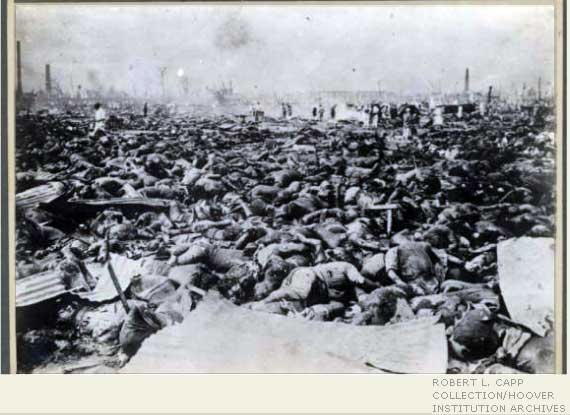
America’s Barbaric Logic of Hiroshima 70 Years On

Hiroshima_Capp

By Finnian Cunningham

Source: Strategic Culture Foundation

Even if we accept that there was a plausible military imperative to drop the atomic bombs on Hiroshima and Nagasaki – to bring about a swift defeat of Japan and thus an end to the Pacific War – the horror of civilian death toll from those two no-warning aerial attacks places a disturbing question over the supposed ends justifying the means.

But what if the official military rationale touted by US President Harry Truman and his administration turns out to be bogus? That is, the real reason for dropping the A-bombs on Hiroshima and Nagasaki 70 years ago on August 6 and 9, 1945, had little to do with defeating imperial Japan and saving the lives of American troops. What if the real reason was the deliberate and cold-blooded demonstration of raw military power by Washington in order to warn the Soviet Union of America’s postwar demarcation of global hegemony?

That leads to the most chilling conclusion – a conclusion far worse than the official American narrative would have us believe. For it means that the act of obliterating up to 200,000 Japanese civilians was an event of premeditated mass murder whose intent was solely political. Or, in other words, an ineffable act of state terrorism committed by the United States.

This conjecture about the ulterior motive for the American atomic bombing of Japan has been around for many years. In January 1995, the New York Times reported: «Indeed, some historians contend that the bombing was not aimed so much at the wartime enemy Japan as at the wartime ally Soviet Union, delivered as a warning against postwar rivalry».

With complacent equivocation, the New York Times did not follow through on the horrendous implications of its own partial admission for why the atomic bombs were dropped. If the official US calculation was indeed «a warning against postwar rivalry» to the Soviet Union, then that makes the act an indefensible political decision that had nothing to do with a moral imperative of promptly ending a war. It was, as noted, a supreme act of terrorism.

Professsor Gar Alperovitz – one of several American historians – has over the decades compiled a compelling case that the Truman administration did in fact make the decision to use the A-bombs as a political weapon against the Soviet Union.

The author of ‘The Decision to Use the Atomic Bomb’ wrote: «Though most Americans are unaware of the fact, increasing numbers of historians now recognise that the United States did not need to use the atomic bomb to end the war against Japan in 1945. Moreover, this essential judgment was expressed by the vast majority of top American military leaders in all three services in the years after the war ended: Army, Navy and Army Air Force».

Alperovitz cites then US Secretary of War Henry L Stimson and such military luminaries as General Dwight Eisenhower and Joint Chiefs of Staff Admiral William D Leahy who were explicitly opposed to using the A-bomb on Japan. Eisenhower said it was»completely unnecessary» while Leahy noted: «The use of this barbarous weapon at Hiroshima and Nagasaki was of no material assistance in our war against Japan. The Japanese were already defeated and ready to surrender».

This points to covert political decision-making during the critical three-week period between the Potsdam conference (July 17-August 2 1945) and the dropping of the A-bombs on Japan. During that period it appears that Truman and his aides decided in secret that the then Soviet wartime ally was to be henceforth made the postwar enemy. The Cold War was being formulated.

Bear in mind that for months before Potsdam, the US and Britain were appealing to Russian leader Josef Stalin to join the Pacific War soon after the defeat of Nazi Germany. Two months after the Third Reich was vanquished in May 1945, the Potsdam conference between the Big Three allies achieved the much-anticipated commitment from Stalin to redeploy the Red Army against Japan. The Soviet Union was scheduled to officially enter the Pacific War on August 15. As it turned out, Stalin ordered the Red Army into Manchuria on August 8, a week ahead of the scheduled offensive.

As Harry Truman gleefully wrote in a private letter during Potsdam this commitment from the Soviet Union meant that «the Japs were finished».

However, the successful testing of the first A-bomb by the United States in the desert of New Mexico on July 16 – only the day before begining the Potsdam summit – was a point of no return. With this awesome new weapon, US planners must have quickly realised that they could finish the war against Japan without the Soviet Union entering the Pacific theatre, by dropping the A-bomb.

But the primary US objective wasn’t to finish the Pacific War per se. American and British military chiefs and intelligence were convinced that the mere entry of Russia into the war against Japan would precipitate the latter’s surrender. And besides the American invasion of mainland Japan was not planned to take place until November 1945.

It seems clear then that the Truman administration rushed ahead to use its new atomic weapon on Japan because its concern was to circumscribe any advance by the Soviet Union in Asia-Pacific. Not only was the Red Army poised to take Manchuria and the Korean Peninsula but mainland Japan as well.

Hiroshima and Nagasaki – two civilian centres of no military value – were thus selected as the venues for demonstrating the most spellbinding act of terror, not to an all but defeated Japan, but to the Soviet Union. The atomic bombing of Japan was therefore not the last act of the Pacific War, as the official American narrative contends, but rather it was the first, brutal act of the nascent Cold War by the US towards Soviet Russia.

That puts the horrific events in an altogether different criminal light. Because the atomic bombings can then be seen as a deliberate act of mass murder for no other strategic reason other than to intimidate a perceived geopolitical rival – Moscow.

Seventy years on, history proves that this barbaric logic of the US ruling elite still holds. After the official end of the Cold War nearly a quarter of a century ago, Washington has evidently no intention of disarming its nuclear arsenal. In fact, the US government under President Barack Obama is planning to spend $355 billion over the next decade to upgrade its stockpile of some 5,000 nuclear warheads – each many times more powerful than the A-bombs that were originally dropped on Japan.

Furthermore, Washington has offiicially declared Russia, along with China, as its top strategic enemy, as recent as this month, according to senior Pentagon figures.

The unilateral withdrawal by the US from the Anti-Ballistic Missiles Treaty in 2002 and the ongoing expansion of US missile systems on Russia’s borders and in the Pacific with provocative reference to China are testimony to the inherent bellicose intent that resides in Washington.

As with the first and only use of nuclear weapons 70 years ago, the US logic that led to the holocaust at Hiroshima and Nagasaki is a barbaric logic than pertains to this day. It is still being aimed at Russia, as it was seven decades ago.

Only the full exposure and eradication of this uniquely American barbaric logic will lead to peaceful international relations.