Politicians Exploit School Shooting While Ignoring Bombing Victims

Ron_Paul_0723

By Ron Paul

Source: Ron Paul Institute

Following the recent Oregon school shooting, many politicians rushed to the microphones to call for new gun control laws. President Obama even called on gun control supporters to “politicize” the shooting, while some members of Congress worked to establish a special commission on gun violence.

The reaction to the shooting stands in stark contrast to the reaction to the US military’s bombing of an Afghanistan hospital run by the international humanitarian (and Nobel Peace Prize winning) group Doctors Without Borders.

Our Nobel Peace Prize winning president did apologize to his fellow Nobel laureate for the bombing. However, President Obama has not “politicized” this tragedy by using it to justify ending military involvement in Afghanistan. No one in Congress is pushing for a special commission to examine the human costs of US militarism, and the mainstream media has largely ignored Doctors Without Borders’ accusation that the bombing constitutes a war crime.

The reason for the different reactions to these two events is that politicians prefer to focus on events they can “politicize” to increase government power. In contrast, politicians ignore incidents that raise uncomfortable questions about US foreign policy.

If the political and media elites were really interested in preventing future mass shootings, they would repeal the federal “gun-free” schools law, for example. By letting shooters know that their intended victims are defenseless, the gun-free schools law turns schoolchildren into easy targets.

Even some who oppose gun control are using the shooting to justify expanding federal power instead of trying to repeal unconstitutional laws. Some opponents of new gun control laws say Congress should expand the federal role in identifying, tracking, and treating those with “mental health problems.” This ignores the fact that many shooters were using psychotropic drugs prescribed by a mental health professional when they committed the horrible acts. Furthermore, creating a system to identify and track anyone with a “mental health problem” could deny respect for individuals’ Second Amendment and other rights because they perhaps once sought counseling for depression while going through a divorce or coping with a loved one’s passing.

While our political and media elites are eager to debate how much liberty people must sacrifice for safety, they are desperate to avoid debating the morality of our foreign policy. To admit that the US military sometimes commits immoral acts is to admit that the US government is not an unalloyed force for good. Even many proponents of our recent wars support using the US military for “humanitarian” purposes. Thus they are as reluctant as the neoconservatives to question the fundamental goodness of US foreign policy.

Anyone who raises constitutional or moral objections to the US use of drones, bombs, indefinite detention, and torture risks being attacked as anti-American and soft on terrorism. The smear of “terrorist apologist” is also hurled at those who dare suggest that it is our interventionist foreign policy, not a hatred of freedom, that causes people in other countries to dislike the United States. Which is a more logical explanation for why someone would resent America — a family member killed in a drone attack launched by the US military or rage over our abundance of liberty?

The disparate reactions to the Oregon school shooting and the Afghanistan hospital bombing shows the political class is unwilling and unable to acknowledge that the US government cannot run the world, run our lives, or run the economy. Clearly, politicians will never stop expanding government and give us back our lost liberties unless and until the people demand it.

Why Hillary Won the Debate (Even though She Didn’t)

images

By Gary Leupp

Source: Dissident Voice

CNN and Facebook co-sponsored last week’s Democratic presidential frontrunners’ “debate.” After the event, CNN conducted a poll. “Who won the debate?” it asked. The result: 83% Bernie Sanders; 12% Hillary Clinton.

Facebook also took a poll. “Who do you think won?” Over 79% responded, “Bernie Sanders.”

The CNN editors’ take? “CLINTON’S CONFIDANT SWEEP.”

Slate conducted a poll. “Who won the presidential debate?” asked the magazine. 75% of respondents said Bernie Sanders; 18% gave it to Hillary Clinton.

“Hillary Clinton won,” reported Slate “senior writer” Josh Vorhees exuberantly. “She just needed to be solid in the debate. Instead, she was spectacular.”

Spectacular! with 18% of Slate’s own polling numbers. Go figure.

“Who do you think won?” asked Time Magazine. The response?  Bernie Sanders: 70%, Hillary Clinton 16%.

The Time headline:  “CLINTON IN CONTROL.”

Are you disgusted yet? This goes far beyond distortion, and far beyond the tampering with facts that characterized Soviet-style reporting in Izvestia and Pravda in the decade before the USSR collapsed. This is in-your-face rejection of empirical reality, to say nothing of an insult to the viewers polled. The entire mainstream news media is complicit.

Imagine if the “free” press—free to publish whatever its corporate editors want, including even the truth, at their discretion—had sought to spin this story differently.

“POLLS SHOW BIG WIN FOR SANDERS,” CNN might have proclaimed, between commercials.

“A great night for Sanders,” Slate might have announced.

“SANDERS TROUNCES CLINTON,” Time might have acknowledged.

But no, and this is par for the course. The TV cable news anchors took ages to concede that, well, yes, maybe Jed Bush—despite his solid RNC support and Wall Street’s firm endorsement—is not the inevitable GOP candidate. They’ve had to acknowledge that (for whatever reasons) Donald Trump’s actually striking a much deeper chord than warmonger Dubya’s little brother among likely voters.

But they’re stubbornly refusing to recognize some things they don’t want to see—things that don’t follow their script.

They don’t understand that people in their twenties who constitute the 75-year-old Sanders’ support base have no problem with “socialism” but rather have lots of problems with Wall Street. These “millenials” are even—horrors!—increasingly inclined to question the national god of capitalism itself. It has fewer positive connotations to them than it did for their parents who grew up during the Cold War and were subjected to its particular brainwashing agenda.

That’s the sort of brainwashing that allows Trump, a demagogue preying on the most abjectly ignorant to tell cheering crowds that he calls Sanders “a ‘socialist, slash, communist,’ okay? ‘Cause that’s what he is!”

‘Cause that’s what he is! Sanders is a communist. End of story. End of rational thought.

I myself am not a Sanders supporter. He’s nowhere nearly left enough for me. But then I’m not a supporter of the whole bogus, skewed, money-driven two-party electoral system itself, which seems designed to hoodwink people, channel their energies into itself, and then produce disillusionment soon after the election, as the elected official reneges on promises and proved to be anything other than a harbinger of “change.” The system is wired to then hoodwink people again, re-channel their energies (again back into itself), bouncing people back and forth between two hopelessly corrupt parties that are really two factions of a single corporate party.

The system tells us, “If you don’t vote, you have nothing to say” and reduces political involvement to endorsing one of its (safe) choices. It excludes from the debate stage even the discussion of needed radical change. The electoral process is designed to keep you out of the street (where history is really made) and lead you into a box, like a confessional booth or a porno video cubicle, a private space in which you’re touched by something greater than yourself and leave with a sense of gratification. You were a good citizen. You exercised your precious right to VOTE and did your part!

Casting that ballot in private is supposed to make you feel good about yourself, as a participant in the state. It’s supposed to make you think that, since you actually participated in the construction of the existing polity, when you talk about what it does, you can accept personal responsibility for its crimes.

For example, you might say: “We shouldn’t have invaded Iraq.” In doing so you implicitly include yourself—despite your disagreement—among those who actually did the vicious deed. I prefer to say, “Leave me out of that ‘we,’ since I had nothing to do with it. I fought against it, tooth and nail, attending every anti-war demonstration I could and railing against it to all who would listen.”

“Well, our government did it,” you might correct yourself. “We voted for it.” But I will reply I didn’t; I stayed at home on election day, 2000. It’s like I was invited to a party that day, and disliking all who’d be there, I politely declined to attend.

When you vote, you vote not so much for a person as for the system itself, validating it and the rules surrounding the procedure. Casting the ballot is the state’s highest ritual, the individual’s most intimate connection with the state. It makes you feel one with it. It’s rather like taking the Holy Communion at mass. You’re swallowing something, and making a statement of faith: I believe in this system!

This (corporate) system you vote for, every time you vote at all, commands the (corporate) media to such an extent that it can do what we see in the reportage cited above. It can turn reality on its head and get away with it, whether it’s shaping public opinion about Saddam’s weapons of mass destruction, a Russian invasion of Ukraine, U.S. successes against the Taliban in Afghanistan, Syrian “moderates” gaining against Assad, or victory in a farcical televised debate.

Whatever you think about Sanders, is it not outrageous that the mass media can obscure his plain victory in that exercise as a triumph for Hillary Clinton? Even a “spectacular” win? Isn’t it clear that she was pronounced the victor not because she actually won out over Sanders but because powerful people steering the “free” press needed her to do so?

As PR/disinformation master Karl Rove once put it (and this should be repeated as often as we repeat that wonderful quote from the imprisoned Goebbels at Nuremberg about using fear to build mass support for war): “We’re an empire now, and when we act, we create our own reality.”

It’s not a sentiment unique to Republicans. Recall how, during the 2012 Democratic national convention, the crowd clearly voted down the inclusion of a line supporting Jerusalem as the eternal, undivided capital of Israel in its platform. The change required a two-thirds majority of the vote, according to party rules. At least half the delegates voted against it.

Still, the convention chairman to the outrage of many present announced (after some hushed consultation) that the “Ayes” carried the day. So much for democracy at the “Democratic” Party’s convention.

The mainstream press, by and large, wants Hillary Clinton to be the Democratic nominee for president. Wall Street’s leading candidates are Jeb Bush and Clinton; both are beloved of big money and either one will do. Sanders (even though in office he would likely buckle to their will, the same way Greece’s “socialist” Alexis Tsipras buckled to the IMF and European Central Bank) is anathema to Wall Street. And the connections between Wall Street, the Washington power elite, and the press are—to use the Chinese expression—as close as lips and teeth.

Finance capital rules the world and will do so until the “millions and millions” Bernie keeps talking about find some way to effectively challenge it.

Thus Sanders could not win the debate, even though he did. And Hillary was destined to win the debate, even though she didn’t. Get it? And isn’t it great you have the right to vote for her?


Gary Leupp is a Professor of History at Tufts University, and author of numerous works on Japanese history. He can be reached at: gleupp@granite.tufts.edu. Read other articles by Gary.

The MH17 Big Lie: The Russians Did It

mh17-crash8-data

By Stephen Lendman

Source: Steve Lendman Blog

Downing MH17 was a classic false flag, the scheme likely cooked up in Washington, using its Kiev puppet regime to do its dirty work, then point fingers the wrong way.

The Russians DID NOT down MH17 – nor Donbass freedom fighters. No credible evidence suggests it. Only fools and liars believe it.

What could they possibly gain from downing a commercial airliner, unrelated to conflict on the ground, killing 298 passengers and crew members.

Washington and/or Kiev had motive and opportunity, gaining plenty by pointing fingers the wrong way, supported by the usual scoundrel media chorus, featuring Big Lies and innuendos.

The Dutch Safety Board (DSB) is a front for US imperial policy. Joint Investigation Team (JIT) countries include the Netherlands, Australia, Belgium and Ukraine – conspiratorially allied against Russia, Washington pulling the strings behind the scene.

DSB’s final report is out. It stopped short of naming perpetrators, suggested Russia and Donbass freedom fighters were responsible without saying so.

It claimed a (a no longer in use Soviet era) Russian-made Buk 9M38-series (surface-to-air) missile (used only by Ukraine, not Russia’s military) downed MH17 – refuting earlier reports based on high-resolution photos showing cockpit damage from likely 30 millimeter air-to-air cannon fire.

Eyewitnesses on the ground saw a Ukrainian warplane trailing MH17. Russian radar tracked a Ukrainian SU-25 jet fighter within three km of the fated aircraft.

An unsatisfactorily answered question is why Ukrainian air traffic control let MH17 overfly a war zone. Other commercial airliners avoided it for obvious reasons.

Did Kiev authorities deliberately put MH17 in harm’s way to down it and blame Russia and Donbass freedom fighters for their crime?

Did Washington and Ukrainian fascists jointly plan the incident? Further US and EU sanctions followed plus relentless, irresponsible Putin-bashing.

DSB’s September 9 preliminary report said MH17 “broke up in the air probably as the result of structural damage caused by a large number of high-energy objects that penetrated the aircraft from outside.”

Its final report claimed a missile was launched from an Eastern Ukraine 320 square km area without pinpointing the launch site.

Its chairman, Tjibbe Joustra, suggested it came from rebel-held territory without specifically saying so. He claimed “Flight MH17 crashed as a result of the detonation of a warhead outside the airplane against the left-hand side of the cockpit. This warhead fits the kind of missile that is installed in the BUK surface-to-air missile system.”

It was fired from “an area where the borders have fluctuated a lot, but it’s a territory where the pro-Russian rebels have laid down the law.”

A White House statement ludicrously called DSB’s report an “important milestone in the effort to hold accountable those responsible.”

A criminal investigation is underway. Dutch Prime Minister insultingly asked Russia for “complete cooperation.” The DSB ignored key Moscow supplied evidence.

Putin spokesman Dmitry Peskov stressed it, saying: “There are facts delivered by the Russian side that for unclear reasons are being apparently ignored.”

Moscow “repeatedly expressed its disappointment over the lack of proper level of cooperation and engagement of the Russian experts into the investigation.”

Russia’s Roasaviation deputy head Oleg Storchevoy accused the DSB of ignoring “comprehensive information” presented by Moscow, suggesting willful coverup – in a letter to the International Civil Aviation Association (ICAA).

Russian arms manufacturer Almaz-Antey presented its own findings, based on exhaustive study and sophisticated simulations of what likely happened, disputing DSB’s conclusions, saying MH17 wasn’t downed from rebel-held territory.

CEO Yan Novikov said an older, out-of-date Buk missile (last produced in 1986), no longer used by Russia, still used by Ukraine, downed MH17. DSB members ignored Almaz-Antey’s findings.

The incident occurred on July 17, 2014. The instant knee-jerk reaction from Washington, other Western capitals, and go-along media scoundrels (still unchanged) was “Russia did it” – despite no evidence suggesting it then or now.

A sampling of headlines following release of the DSB’s final report include the following:

New York Times: “Malaysia Airlines Flight 17 Most Likely Hit by Russian-Made Missile, Inquiry Says”

Washington Post: “The Latest: Ex-war crimes judge: Dutch report refutes Russia”

Wall Street Journal: “Dutch Investigators Say MH17 Was Downed by Russian-Made Missile”

Los Angeles Times: “Malaysia Airlines Flight 17: Report says Russian-made missile system downed jet”

Chicago Tribune: “Dutch Safety Board: Russian-made Buk missile downed MH17 in Ukraine”

BBC: “MH17 Ukraine disaster: Dutch Safety Board blames (Russian-made Buk) missile”

The disturbing innuendo from all these headlines implies Russian-made means Russian-launched.

It bears repeating what should be clear to everyone. Russia DID NOT down MH17 – nor Donbass freedom fighters. Kiev fascists, very likely complicit with Washington, were responsible, wanting Putin blamed for their crime.


Stephen Lendman lives in Chicago. He can be reached at lendmanstephen@sbcglobal.net.

His new book as editor and contributor is titled “Flashpoint in Ukraine: US Drive for Hegemony Risks WW III.”

http://www.claritypress.com/LendmanIII.html

Visit his blog site at sjlendman.blogspot.com.

Listen to cutting-edge discussions with distinguished guests on the Progressive Radio News Hour on the Progressive Radio Network.

Co-Creation and the Greater Reality

431233_10150711357695081_1179126980_n

By Rahkyt

Source: Sacred Space in Time

Life is a continuous process of creation and destruction. With every action and reaction, something new is birthed into being and something old undergoes the processes of destruction. From the thought processes we engage in during the course of the day, to the actions we take and reactions we make, we are creating and destroying our perception of reality. As a result, in each instance, we are truly remaking ourselves anew, in the only way that matters: the construction of our own, personal rendition of reality.

Memory serves the function of maintaining consistency. Without it, we become a new person in each instance. Memories ties us to the past and creates a stream of impressions which guide our present and future actions. We define ourselves by our memories and through them, we present a facade to the world comprised of impressions that may be factual or not, based upon our own emotional ties to events that have passed. The past itself, being dependent upon perception, is more illusory than real. Outside of mechanical means of perception, video and audio recordings, pictures, etcetera, our memories of the past are not at all reliable. Our emotional state of being at the moment of experience often determines how we perceive them and the mind fills in gaps with re-created scenes, making memory often more fantastical than reality-based.

When we hold on to stories of the past and use them to define our present we limit our options and outcomes. By stating to ourselves and others that we are this and that because we have experienced this or that we bind ourselves to the potentialities inherent in the probabilistic options arising from the present manifestation of effects caused by our experience of this and/or that. Logical determinism is the result. We see no other options available because our synaptic patterns of reality-formation dictate outcomes bounded by the past, when, in reality, there are no such boundaries truly in place. Only those we have placed upon ourselves.

We are thereby bound into preconditioned repetitions of past patterns from which there is seemingly no escape. Despair and depression result, limiting the outcomes of a life to a downward-spiraling reoccurrence pattern. Fear acts as the conditioning factor, pulling up past scenes of loathing that trap thought into conditioned pathways of expression. Again and again we dance the same dance, although the tune itself has changed. The ability to cognate at higher levels is a divine gift that allows us to shift those patterns out and to achieve a higher state of expression if we so choose to do so. We can change, no matter the thickness of our synaptic connections, the density of our neural nets, the pervasivity of fear-based patterns of call and response.

Removing these boundaries and experiencing the full gamut of experience is the challenge of a lifetime. Becoming open to the infinite expression of creative union with the ultimate requires the death of the past and the embrace of the present, thereby delimiting the possibilities of the future. It entails the conscious processing of future experience by the release of past experience resulting in the embrace of the Now experience. Each moment recreates itself anew, requiring new output in order to take full advantage of new input. While reality does seemingly proceed in cycles and we undergo certain types of experience again and again it is really a spiral and each new experience while appearing similar is a new iteration at a higher level of occurrence. Therefore, the same reaction is not always the best action.

Determining the difference between action and reaction takes a depth of understanding that must be based upon recognition of fundamental patterns inherent within our lived realities. A thorough recapitulation of our life experiences, whee every memory we can access has been ruminated upon and its lessons internalized and made accessible to conscious thought. Where our reactions become instead new actions based upon the present input which may be slightly different from past input in important and fundamental ways.

Life is purposeful and there are no accidents. Each perception, each interaction is meaningful and is connected to external realities in fundamental ways. Together, we co-create the Greater Reality and, despite the hype, we are all integrally connected at the base level of existence, beneath conscious perception and experience.  This web of continuous co-creation is beyond the conscious ability of most to perceive and yet, to be able to do so is not necessary. Trust in God, in the willful and deliberate manifestation of reality is required alongside the desire to act in harmonious resonation with the dictations of the Multiverse. This can be done by simply existing in the flow of creation and destruction, maintaining a perceptive ambivalence to societally-determined conceptions of value yet adhering to the internal sense of beingness within the continuous flow of change and evolution.

No matter how things seem, whether they are determined to be good or bad, all has purpose, all has reason. Accepting this truth of existence and working within one’s own flow of interaction at the personal and subjective level sends emanations of causality out into the greater creation, combining with the output of other souls to morph into stupendously complex manifestations that form the holographic context of the combined, material co-creation that we call the world.


The New American Order

natsec

1% Elections, The Privatization of the State, a Fourth Branch of Government, and the Demobilization of “We the People” 

By Tom Engelhardt

Source: TomDispatch.com

Have you ever undertaken some task you felt less than qualified for, but knew that someone needed to do? Consider this piece my version of that, and let me put what I do understand about it in a nutshell: based on developments in our post-9/11 world, we could be watching the birth of a new American political system and way of governing for which, as yet, we have no name.

And here’s what I find strange: the evidence of this, however inchoate, is all around us and yet it’s as if we can’t bear to take it in or make sense of it or even say that it might be so.

Let me make my case, however minimally, based on five areas in which at least the faint outlines of that new system seem to be emerging: political campaigns and elections; the privatization of Washington through the marriage of the corporation and the state; the de-legitimization of our traditional system of governance; the empowerment of the national security state as an untouchable fourth branch of government; and the demobilization of “we the people.”

Whatever this may add up to, it seems to be based, at least in part, on the increasing concentration of wealth and power in a new plutocratic class and in that ever-expanding national security state. Certainly, something out of the ordinary is underway, and yet its birth pangs, while widely reported, are generally categorized as aspects of an exceedingly familiar American system somewhat in disarray.

1. 1% Elections

Check out the news about the 2016 presidential election and you’ll quickly feel a sense of been-there, done-that. As a start, the two names most associated with it, Bush and Clinton, couldn’t be more familiar, highlighting as they do the curiously dynastic quality of recent presidential contests.  (If a Bush or Clinton should win in 2016 and again in 2020, a member of one of those families will have controlled the presidency for 28 of the last 36 years.)

Take, for instance, “Why 2016 Is Likely to Become a Close Race,” a recent piece Nate Cohn wrote for my hometown paper.  A noted election statistician, Cohn points out that, despite Hillary Clinton’s historically staggering lead in Democratic primary polls (and lack of serious challengers), she could lose the general election.  He bases this on what we know about her polling popularity from the Monica Lewinsky moment of the 1990s to the present.  Cohn assures readers that Hillary will not “be a Democratic Eisenhower, a popular, senior statesperson who cruises to an easy victory.”  It’s the sort of comparison that offers a certain implicit reassurance about the near future.  (No, Virginia, we haven’t left the world of politics in which former general and president Dwight D. Eisenhower can still be a touchstone.)

Cohn may be right when it comes to Hillary’s electability, but this is not Dwight D. Eisenhower’s or even Al Gore’s America. If you want a measure of that, consider this year’s primaries. I mean, of course, the 2015 ones. Once upon a time, the campaign season started with candidates flocking to Iowa and New Hampshire early in the election year to establish their bona fides among party voters. These days, however, those are already late primaries.

The early primaries, the ones that count, take place among a small group of millionaires and billionaires, a new caste flush with cash who will personally, or through complex networks of funders, pour multi-millions of dollars into the campaigns of candidates of their choice.  So the early primaries — this year mainly a Republican affair — are taking place in resort spots like Las Vegas, Rancho Mirage, California, and Sea Island, Georgia, as has been widely reported. These “contests” involve groveling politicians appearing at the beck and call of the rich and powerful, and so reflect our new 1% electoral system. (The main pro-Hillary super PAC, for instance, is aiming for a kitty of $500 million heading into 2016, while the Koch brothers network has already promised to drop almost $1 billion into the coming campaign season, doubling their efforts in the last presidential election year.)

Ever since the Supreme Court opened up the ultimate floodgates with its 2010 Citizens United decision, each subsequent election has seen record-breaking amounts of money donated and spent. The 2012 presidential campaign was the first $2 billion election; campaign 2016 is expected to hit the $5 billion mark without breaking a sweat.  By comparison, according to Burton Abrams and Russell Settle in their study, “The Effect of Broadcasting on Political Campaign Spending,” Republicans and Democrats spent just under $13 million combined in 1956 when Eisenhower won his second term.

In the meantime, it’s still true that the 2016 primaries will involve actual voters, as will the election that follows. The previous election season, the midterms of 2014, cost almost $4 billion, a record despite the number of small donors continuing to drop. It also represented the lowest midterm voter turnout since World War II. (See: demobilization of the public, below — and add in the demobilization of the Democrats as a real party, the breaking of organized labor, the fragmenting of the Republican Party, and the return of voter suppression laws visibly meant to limit the franchise.) It hardly matters just what the flood of new money does in such elections, when you can feel the weight of inequality bearing down on the whole process in a way that is pushing us somewhere new.

2. The Privatization of the State (or the U.S. as a Prospective Third-World Nation)

In the recent coverage of the Hillary Clinton email flap, you can find endless references to the Clintons of yore in wink-wink, you-know-how-they-are-style reporting; and yes, she did delete a lot of emails; and yes, it’s an election year coming and, as everyone points out, the Republicans are going to do their best to keep the email issue alive until hell freezes over, etc., etc.  Again, the coverage, while eyeball gluing, is in a you’ve-seen-it-all-before, you’ll-see-it-all-again-mode.

However, you haven’t seen it all before. The most striking aspect of this little brouhaha lies in what’s most obvious but least highlighted.  An American secretary of state chose to set up her own private, safeguarded email system for doing government work; that is, she chose to privatize her communications.  If this were Cairo, it might not warrant a second thought.  But it didn’t happen in some third-world state.  It was the act of a key official of the planet’s reigning (or thrashing) superpower, which — even if it wasn’t the first time such a thing had ever occurred — should be taken as a tiny symptom of something that couldn’t be larger or, in the long stretch of history, newer: the ongoing privatization of the American state, or at least the national security part of it.

Though the marriage of the state and the corporation has a pre-history, the full-scale arrival of the warrior corporation only occurred after 9/11.  Someday, that will undoubtedly be seen as a seminal moment in the formation of whatever may be coming in this country.  Only 13 years later, there is no part of the war state that has not experienced major forms of privatization.  The U.S. military could no longer go to war without its crony corporations doing KP and guard duty, delivering the mail, building the bases, and being involved in just about all of its activities, including training the militaries of foreign allies and even fighting.  Such warrior corporations are now involved in every aspect of the national security state, including torture, drone strikes, and — to the tune of hundreds of thousands of contract employees like Edward Snowden — intelligence gathering and spying.  You name it and, in these years, it’s been at least partly privatized.

All you have to do is read reporter James Risen’s recent book, Pay Any Price, on how the global war on terror was fought in Washington, and you know that privatization has brought something else with it: corruption, scams, and the gaming of the system for profits of a sort that might normally be associated with a typical third-world kleptocracy.  And all of this, a new world being born, was reflected in a tiny way in Hillary Clinton’s very personal decision about her emails.

Though it’s a subject I know so much less about, this kind of privatization (and the corruption that goes with it) is undoubtedly underway in the non-war-making, non-security-projecting part of the American state as well.

3. The De-legitimization of Congress and the Presidency

On a third front, American “confidence” in the three classic check-and-balance branches of government, as measured by polling outfits, continues to fall.  In 2014, Americans expressing a “great deal of confidence” in the Supreme Court hit a new low of 23%; in the presidency, it was 11%, and in Congress a bottom-scraping 5%.  (The military, on the other hand, registers at 50%.)  The figures for “hardly any confidence at all” are respectively 20%, 44%, and more than 50%.  All are in or near record-breaking territory for the last four decades.

It seems fair to say that in recent years Congress has been engaged in a process of delegitimizing itself.  Where that body once had the genuine power to declare war, for example, it is now “debating” in a desultory fashion an “authorization” for a war against the Islamic State in Syria, Iraq, and possibly elsewhere that has already been underway for eight months and whose course, it seems, will be essentially unaltered, whether Congress authorizes it or not.

What would President Harry Truman, who once famously ran a presidential campaign against a “do-nothing” Congress, have to say about a body that truly can do just about nothing?  Or rather, to give the Republican war hawks in that new Congress their due, not quite nothing.  They are proving capable of acting effectively to delegitimize the presidency as well.  House Majority Leader John Boehner’s invitation to Israeli Prime Minister Benjamin Netanyahu to undercut the president’s Iranian nuclear negotiations and the letter signed by 47 Republican senators and directed to the Iranian ayatollahs are striking examples of this.  They are visibly meant to tear down an “imperial presidency” that Republicans gloried in not so long ago.

The radical nature of that letter, not as an act of state but of its de-legitimization, was noted even in Iran, where fundamentalist Supreme Leader Ali Khamenei proclaimed it “a sign of a decline in political ethics and the destruction of the American establishment from within.” Here, however, the letter is either being covered as a singularly extreme one-off act (“treason!”) or, as Jon Stewart didon “The Daily Show,” as part of a repetitive tit-for-tat between Democrats and Republicans over who controls foreign policy.  It is, in fact, neither.  It represents part of a growing pattern in which Congress becomes an ever less effective body, except in its willingness to take on and potentially take out the presidency.

In the twenty-first century, all that “small government” Republicans and “big government” Democrats can agree on is offering essentially unconditional support to the military and the national security state.  The Republican Party — its various factions increasingly at each other’s throats almost as often as at those of the Democrats — seems reasonably united solely on issues of war-making and security.  As for the Democrats, an unpopular administration, facing constant attack by those who loath President Obama, has kept its footing in part by allying with and fusing with the national security state.  A president who came into office rejecting torture and promoting sunshine and transparency in government has, in the course of six-plus years, come to identify himself almost totally with the U.S. military, the CIA, the NSA, and the like.  While it has launched an unprecedented campaign against whistleblowers and leakers (as well as sunshine and transparency), the Obama White House has proved a powerful enabler of, but also remarkably dependent upon, that state-within-a-state, a strange fate for “the imperial presidency.”

4. The Rise of the National Security State as the Fourth Branch of Government

One “branch” of government is, however, visibly on the rise and rapidly gaining independence from just about any kind of oversight.  Its ability to enact its wishes with almost no opposition in Washington is a striking feature of our moment.  But while the symptoms of this process are regularly reported, the overall phenomenon — the creation of a de facto fourth branch of government — gets remarkably little attention.  In the war on terror era, the national security state has come into its own.  Its growth has been phenomenal.  Though it’s seldom pointed out, it should be considered remarkable that in this period we gained a second full-scale “defense department,” the Department of Homeland Security, and that it and the Pentagon have become even more entrenched, each surrounded by its own growing “complex” of private corporations, lobbyists, and allied politicians.  The militarization of the country has, in these years, proceeded apace.

Meanwhile, the duplication to be found in the U.S. Intelligence Community with its 17 major agencies and outfits is staggering.  Its growing ability to surveil and spy on a global scale, including on its own citizens, puts the totalitarian states of the twentieth century to shame.  That the various parts of the national security state can act in just about any fashion without fear of accountability in a court of law is by now too obvious to belabor.  As wealth has traveled upwards in American society in ways not seen since the first Gilded Age, so taxpayer dollars have migrated into the national security state in an almost plutocratic fashion.

New reports regularly surface about the further activities of parts of that state.  In recent weeks, for instance, we learned from Jeremy Scahill and Josh Begley of the Intercept that the CIA has spent years trying to break the encryption on Apple iPhones and iPads; it has, that is, been aggressively seeking to attack an all-American corporation (even if significant parts of its production process are actually in China).  Meanwhile, Devlin Barrett of the Wall Street Journal reported that the CIA, an agency barred from domestic spying operations of any sort, has been helping the U.S. Marshals Service (part of the Justice Department) create an airborne digital dragnet on American cell phones.  Planes flying out of five U.S. cities carry a form of technology that “mimics a cellphone tower.” This technology, developed and tested in distant American war zones and now brought to “the homeland,” is just part of the ongoing militarization of the country from its borders to its police forces.  And there’s hardly been a week since Edward Snowden first released crucial NSA documents in June 2013 when such “advances” haven’t been in the news.

News also regularly bubbles up about the further expansion, reorganization, and upgrading of parts of the intelligence world, the sorts of reports that have become the barely noticed background hum of our lives.  Recently, for instance, Director John Brennan announced a major reorganization of the CIA meant to break down the classic separation between spies and analysts at the Agency, while creating a new Directorate of Digital Innovation responsible for, among other things, cyberwarfare and cyberespionage.  At about the same time, according to the New York Times, the Center for Strategic Counterterrorism Communications, an obscure State Department agency, was given a new and expansive role in coordinating “all the existing attempts at countermessaging [against online propaganda by terror outfits like the Islamic State] by much larger federal departments, including the Pentagon, Homeland Security and intelligence agencies.”

This sort of thing is par for the course in an era in which the national security state has only grown stronger, endlessly elaborating, duplicating, and overlapping the various parts of its increasingly labyrinthine structure.  And keep in mind that, in a structure that has fought hard to keep what it’s doing cloaked in secrecy, there is so much more that we don’t know.  Still, we should know enough to realize that this ongoing process reflects something new in our American world (even if no one cares to notice).

5. The Demobilization of the American People

In The Age of Acquiescence, a new book about America’s two Gilded Ages, Steve Fraser asks why it was that, in the nineteenth century, another period of plutocratic excesses, concentration of wealth and inequality, buying of politicians, and attempts to demobilize the public, Americans took to the streets with such determination and in remarkable numbers over long periods of time to protest their treatment, and stayed there even when the brute power of the state was called out against them.  In our own moment, Fraser wonders, why has the silence of the public in the face of similar developments been so striking?

After all, a grim new American system is arising before our eyes.  Everything we once learned in the civics textbooks of our childhoods about how our government works now seems askew, while the growth of poverty, the flatlining of wages, the rise of the .01%, the collapse of labor, and the militarization of society are all evident.

The process of demobilizing the public certainly began with the military.  It was initially a response to the disruptive and rebellious draftees of the Vietnam-era.  In 1973, at the stroke of a presidential pen, the citizen’s army was declared no more, the raising of new recruits was turned over to advertising agencies (a preview of the privatization of the state to come), and the public was sent home, never again to meddle in military affairs.  Since 2001, that form of demobilization has been etched in stone and transformed into a way of life in the name of the “safety” and “security” of the public.

Since then, “we the people” have made ourselves felt in only three disparate ways: from the left in the Occupy movement, which, with its slogans about the 1% and the 99%, put the issue of growing economic inequality on the map of American consciousness; from the right, in the Tea Party movement, a complex expression of discontent backed and at least partially funded by right-wing operatives and billionaires, and aimed at the de-legitimization of the “nanny state”; and the recent round of post-Ferguson protests spurred at least in part by the militarization of the police in black and brown communities around the country.

The Birth of a New System

Otherwise, a moment of increasing extremity has also been a moment of — to use Fraser’s word — “acquiescence.”  Someday, we’ll assumedly understand far better how this all came to be.  In the meantime, let me be as clear as I can be about something that seems murky indeed: this period doesn’t represent a version, no matter how perverse or extreme, of politics as usual; nor is the 2016 campaign an election as usual; nor are we experiencing Washington as usual.  Put together our 1% elections, the privatization of our government, the de-legitimization of Congress and the presidency, as well as the empowerment of the national security state and the U.S. military, and add in the demobilization of the American public (in the name of protecting us from terrorism), and you have something like a new ballgame.

While significant planning has been involved in all of this, there may be no ruling pattern or design.  Much of it may be happening in a purely seat-of-the-pants fashion.  In response, there has been no urge to officially declare that something new is afoot, let alone convene a new constitutional convention.  Still, don’t for a second think that the American political system isn’t being rewritten on the run by interested parties in Congress, our present crop of billionaires, corporate interests, lobbyists, the Pentagon, and the officials of the national security state.

Out of the chaos of this prolonged moment and inside the shell of the old system, a new culture, a new kind of politics, a new kind of governance is being born right before our eyes. Call it what you want. But call it something. Stop pretending it’s not happening.

Tom Engelhardt is a co-founder of the American Empire Project and the author of The United States of Fear as well as a history of the Cold War, The End of Victory Culture. He is a fellow of the Nation Institute and runs TomDispatch.com. His latest book is Shadow Government: Surveillance, Secret Wars, and a Global Security State in a Single-Superpower World(Haymarket Books).

[Note: My special thanks go to my friend John Cobb, who talked me through this one.  Doing it would have been inconceivable without him.  Tom]

Follow TomDispatch on Twitter and join us on Facebook. Check out the newest Dispatch Book, Rebecca Solnit’s Men Explain Things to Me, and Tom Engelhardt’s latest book, Shadow Government: Surveillance, Secret Wars, and a Global Security State in a Single-Superpower World

Prisons Without Walls: We’re All Inmates in the American Police State

they-live

By John W. Whitehead

Source: The Rutherford Institute

“It is perfectly possible for a man to be out of prison and yet not free—to be under no physical constraint and yet be a psychological captive, compelled to think, feel and act as the representatives of the national state, or of some private interest within the nation wants him to think, feel and act. . . . To him the walls of his prison are invisible and he believes himself to be free.”—Aldous Huxley, A Brave New World Revisited

Free worlders” is prison slang for those who are not incarcerated behind prison walls.  Supposedly, those fortunate souls live in the “free world.” However, appearances can be deceiving.

“As I got closer to retiring from the Federal Bureau of Prisons,” writes former prison employee Marlon Brock, “it began to dawn on me that the security practices we used in the prison system were being implemented outside those walls.” In fact, if Brock is right, then we “free worlders” do live in a prison—albeit, one without visible walls.

In federal prisons, cameras are everywhere in order to maintain “security” and keep track of the prisoners. Likewise, the “free world” is populated with video surveillance and tracking devices. From surveillance cameras in stores and street corners to license plate readers (with the ability to log some 1,800 license plates per hour) on police cars, our movements are being tracked virtually everywhere. With this increasing use of iris scanners and facial recognition software—which drones are equipped with—there would seem to be nowhere to hide.

Detection and confiscation of weapons (or whatever the warden deems “dangerous”) in prison is routine. The inmates must be disarmed. Pat downs, checkpoints, and random searches are second nature in ferreting out contraband.

Sound familiar?

Metal detectors are now in virtually all government buildings. There are the TSA scanning devices and metal detectors we all have to go through in airports. Police road blocks and checkpoints are used to perform warrantless searches for contraband. Those searched at road blocks can be searched for contraband regardless of their objections—just like in prison. And there are federal road blocks on American roads in the southwestern United States. Many of them are permanent and located up to 100 miles from the border.

Stop and frisk searches are taking place daily across the country. Some of them even involve anal and/or vaginal searches. In fact, the U.S. Supreme Court has approved strip searches even if you are arrested for a misdemeanor—such as a traffic stop. Just like a prison inmate.

Prison officials open, search and read every piece of mail sent to inmates. This is true of those who reside outside prison walls, as well. In fact, “the United States Postal Service uses a ‘Mail Isolation Control and Tracking Program’ to create a permanent record of who is corresponding with each other via snail mail.” Believe it or not, each piece of physical mail received by the Postal Service is photographed and stored in a database. Approximately 160 billion pieces of mail sent out by average Americans are recorded each year and the police and other government agents have access to this information.

Prison officials also monitor outgoing phone calls made by inmates. This is similar to what the NSA, the telecommunication corporation, and various government agencies do continually to American citizens. The NSA also downloads our text messages, emails, Facebook posts, and so on while watching everything we do.

Then there are the crowd control tactics: helmets, face shields, batons, knee guards, tear gas, wedge formations, half steps, full steps, pinning tactics, armored vehicles, and assault weapons. Most of these phrases are associated with prison crowd control because they were perfected by prisons.

Finally, when a prison has its daily operations disturbed, often times it results in a lockdown. What we saw with the “free world” lockdowns following the 2013 Boston Marathon bombing and the melees in Ferguson, Missouri and Baltimore, Maryland, mirror a federal prison lockdown.

These are just some of the similarities between the worlds inhabited by locked-up inmates and those of us who roam about in the so-called “free world.”

Is there any real difference?

To those of us who see the prison that’s being erected around us, it’s a bit easier to realize what’s coming up ahead, and it’s not pretty. However, and this must be emphasized, what most Americans perceive as life in the United States of America is a far cry from reality. Real agendas and real power are always hidden.

As Author Frantz Fanon notes, “Sometimes people hold a core belief that is very strong. When they are presented with evidence that works against that belief, the new evidence cannot be accepted. It would create a feeling that is extremely uncomfortable, called cognitive dissonance. And because it is so important to protect the core belief, they will rationalize, ignore and even deny anything that doesn’t fit in with the core belief.”

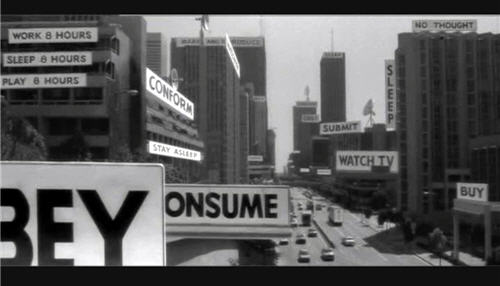
This state of denial and rejection of reality is the essential plot of John Carpenter’s 1988 film They Live, where a group of down-and-out homeless men discover that people have been, in effect, so hypnotized by media distractions that they do not see their prison environment and the real nature of those who control them—that is, an oligarchic elite.

Caught up in subliminal messages such as “obey” and “conform,” among others, beamed out of television and various electronic devices, billboards, and the like, people are unaware of the elite controlling their lives. As such, they exist, as media analyst Marshall McLuhan once wrote, in “prisons without walls.” And of course, any resistance is met with police aggression.

A key moment in the film occurs when John Nada, a homeless drifter, notices something strange about people hanging about a church near the homeless settlement where he lives. Nada decides to investigate. Entering the church, he sees graffiti on a door: They live, We sleep. Nada overhears two men, obviously resisters, talking about “robbing banks” and “manufacturing Hoffman lenses until we’re blue in the face.” Moments later, one of the resisters catches Nada fumbling in the church and tells him “it’s the revolution.” When Nada nervously backs off, the resister assures him, “You’ll be back.”

Rummaging through a box, Nada discovers a handful of cheap-looking sunglasses, referred to earlier as Hoffman lenses. Grabbing a pair and exiting the church, he starts walking down a busy urban street.

Sliding the sunglasses on his face, Nada is shocked to see a society bombarded and controlled on every side by subliminal messages beamed at them from every direction. Billboards are transformed into authoritative messages: a bikini-clad woman in one ad is replaced with the words “MARRY AND REPRODUCE.” Magazine racks scream “CONSUME” and “OBEY.” A wad of dollar bills in a vendor’s hand proclaims, “THIS IS YOUR GOD.”

What’s even more disturbing than the hidden messages, however, are the ghoulish-looking creatures—the elite—who appear human until viewed them through the lens of truth.

This is the subtle message of They Live, an apt analogy of our own distorted vision of life in the American police state. These things are in plain sight, but from the time we are born until the time we die, we are indoctrinated into believing that those who rule us do it for our good. The truth, far different, is that those who rule us don’t really see us as human beings with dignity and worth. They see us as if “we’re livestock.”

It’s only once Nada’s eyes have been opened that he is able to see the truth: “Maybe they’ve always been with us,” he says. “Maybe they love it—seeing us hate each other, watching us kill each other, feeding on our own cold f**in’ hearts.” Nada, disillusioned and fed up with the lies and distortions, is finally ready to fight back. “I got news for them. Gonna be hell to pay. Cause I ain’t daddy’s little boy no more.”

What about you?

As I point out in my book Battlefield America: The War on the American People, the warning signs have been cautioning us for decades. Oblivious to what lies ahead, most have ignored the obvious. We’ve been manipulated into believing that if we continue to consume, obey, and have faith, things will work out. But that’s never been true of emerging regimes. And by the time we feel the hammer coming down upon us, it will be too late.

As Rod Serling warned:

All the Dachaus must remain standing. The Dachaus, the Belsens, the Buchenwalds, the Auschwitzes—all of them. They must remain standing because they are a monument to a moment in time when some men decided to turn the earth into a graveyard, into it they shoveled all of their reason, their logic, their knowledge, but worst of all their conscience. And the moment we forget this, the moment we cease to be haunted by its remembrance. Then we become the grave diggers.

The message: stay alert.

Take the warning signs seriously. And take action because the paths to destruction are well disguised by those in control.

This is the lesson of history.