Social Schizophrenia, Social Depression: What does TV tell us about America?

wash_dees

By Charles Hugh Smith

Source: Dangerous Minds

The difference between what we experience and what we’re told we experience creates a social schizophrenia that leads to self-destructive attitudes and behaviors.

What can popular television programs tell us about the zeitgeist (spirit of the age) of our culture and economy?

It’s an interesting question, as all mass media both responds to and shapes our interpretations and explanations of changing times. It’s also an important question, as mass media trends crystallize and express new ways of understanding our era.

Those who shape our interpretation of events also shape our responses.  This of course is the goal of propaganda: Shape the interpretation, and the response predictably follows.

As a corporate enterprise, mass media’s goal is to make money—the more the better—and that requires finding entertainment products that attract and engage large audiences.  The products that change popular culture are typically new enough to fulfill our innate attraction to novelty—but this isn’t enough. The product must express an interpretation of our time that was nascent but that had not yet found expression.

We can understand this complex process of crystallizing and giving expression to new contexts as one facet of the politics of experience.

The Politics of Experience

It is not coincidental that the phrase politics of experience was coined by a psychiatrist, R.D. Laing, for the phrase unpacks the way our internalized interpretation of experience can be shaped to create uniform beliefs about our society and economy that then lead to norms of behavior that support the political/economic status quo.

Here’s how Laing described the social ramifications in Chapter Four of his 1967 book, The Politics of Experience:

“All those people who seek to control the behavior of large numbers of other people work on the experiences of those other people. Once people can be induced to experience a situation in a similar way, they can be expected to behave in similar ways. Induce people all to want the same thing, hate the same things, feel the same threat, then their behavior is already captive – you have acquired your consumers or your cannon-fodder.”

For Laing, the politics of experience is not just about influencing social behavior – it has an individual, inner consequence as well:

“Our behavior is a function of our experience. We act according to the way we see things. If our experience is destroyed, our behavior will be destructive. If our experience is destroyed, we have lost our own selves.”

How the media shapes our interpretation affects not just our beliefs and responses, but our perceptions of self and our role in society. If the media’s interpretation no longer aligns with our experience, the conflict can generate self-destructive behaviors.

In other words, mass media interpretations can create a social schizophrenia that can lead to self-destructive attitudes and behaviors.

Social Analysis of TV

By its very nature as a mass shared experience, popular entertainment is fertile ground for social analysis.

Here’s a common example: what does a child learn about conflict resolution if he’s seen a thousand TV programs in which the “hero” is compelled to kill the “bad guy” in a showdown? What does that pattern suggest, not just about the structure of drama, but about the society that creates that drama?

Analyzing entertainment has been popular in America since the 1950s, if not earlier.  The film noir of the 1950s, for example, was widely deemed to express the angst of the Cold War era.  Others held that the rising prosperity of the 1950s enabled the populace to explore its darker demons—something the hardships and anxieties of the Depression did not encourage.

Many believe the Depression gave rise to screwball comedies and light-hearted entertainment featuring the casually wealthy precisely because these were escapist antidotes to the grinding realities of the era.

Even television shows that were denigrated as superficial in their own time (for example, Bewitched in the 1960s) can be seen as politically inert but subconsciously potent expressions of profound social changes: the “witch” in Bewitched is a powerful young female who is constantly implored by her conventional husband to conform to all the bland niceties of a suburban housewife, but she finds ways to rebel against these strictures.

Laing saw the potential conflict between what we experience and how we’re told to interpret that experience not just in social terms but in psychiatric terms: such splits open a gulf that can lead to a form of schizophrenia.

Diagnosing Our Disease with TV

What can we make of the popular TV series of the present era? What do they say, beneath the surface, about American society?

I contend that popular TV expresses three key aspects of U.S. society and economy that are at odds with the core idealized values espoused in civic classes and the media. The three idealized values are:

1.  America is a meritocracy—selections, admissions, etc., are based on the candidates’ merits

2.  Anyone can get ahead if they get an education and work hard

3.  America is the wealthiest nation on earth in terms of opportunity, fairness and capital

TV expresses three aspects that confound these idealized values:

1.  Life is a game in which the winner takes all

2.  The opportunity to “get ahead” via conventional means—getting educated, working hard, etc.—is a joke; only those who skirt conventions and the law get rich

3.  Life is a tortuous endurance course where those in charge demand the cruel and the impossible

Winner-Take-All Talent Shows

Let’s start with the genre that has been a dominant force in American TV since the 2000s: the winner-take-all talent show (reality and game shows).

The long-running Survivor series, for example, was a winner-take-all contest of physical prowess and political guile, while the many programs staging singing/dancing contests (American Idol, etc.) put entertainment skills to the competitive test.  A wide range of other entries stage competitions in cooking, entrepreneurship, losing weight, negotiating obstacle courses, and so on.

What interpretations of our experience do these highly competitive winner-take-all reality shows promote?

We could start with the fact that the stars (other than the hosts/judges) are apparently ordinary “every man/woman” Americans, i.e. people not unlike us.  Watching them, it is not too much of a stretch to imagine ourselves on stage, in the kitchen, etc., trying to impress the judges with our talents. It’s easy to identify with the contestants.

These shows enable us to vicariously experience the fantasy that we, too, could be on national TV and could win the accolades of the judges and fans and be the winner who takes it all.

This natural empathy with the temporarily famous with whom we can vicariously share the thrill of victory and the agony of defeat is clearly tapping a deep cultural desire to taste celebrity and the implied financial rewards of winning in an increasing winner-take-all society/economy.

Could the financial/political marginalization of the average citizen and the widening gulf between the typical household and those at the top of the fame/wealth pyramid have something to do with this fascination for winner-take-all competitions on the public stage?

Since there have been game shows on TV for decades, it could be argued that this proliferation of winner-take-all contests is nothing new. But this fails to account for the difference between a game show in which the correct answer is a fact and the subjective votes of judges, other players and the audience that count in winner-take-all contests.

I would argue that this recent explosion of competitions (“modern gladiator,” anyone?) is an expression of deeply held shared cultural values: we accept that ours is a highly competitive society, and that it is becoming even more so as the top “winners” skim the vast majority of the winnings (media visibility, wealth, adulation, social status. etc.), leaving a few morsels for the top 5% and nothing but crumbs for the bottom 95%.

But these TV programs also project the fantasy that our fight-to-the-figurative-death society is still a meritocracy—the best guy/gal wins, as judged by “experts” (or celebrities claiming expertise; the judges’ expertise is structured to be unassailable, just like all the other “experts” in our society).

But if we can’t win it all on merit, there is an alternative way to win: display superior political guile or greater popularity with the audience. (Interestingly, this echoes the coliseum audiences of the late Roman era, who also had some sway over who lived to fight another day on the choreographed battlefield below.)

Perhaps this helps explain our collective obsession with celebrity and the many measures of popularity available to everyone now—Instagram, Facebook likes, Twitter followers (for sale in lots of 10,000), Klout scores, and so on.

In other words, as success in the real world grows increasingly distant, vicariously competing and “winning it all” becomes very compelling. Rather than deal with the vast injustices of our system, we cling to the idealized norm that meritocracy matters, even as “winning” in real life is increasingly a game of cronyism, guile, gaming the system, misrepresenting the truth, etc.

And so we thrill to these play-acting displays of meritocracy in action, as it confirms our cultural value system that that despite the predations of Wall Street and Washington, merit still counts.

And when all else fails, we have a fallback source of identity and “winning”—our popularity. And if we don’t have enough of our own, then we can share vicariously in the popularity of TV show winners and celebrities who have reached the pinnacle.

This is the core message of an interesting and erudite half-hour talk on celebrity given by Games of Thrones actor Jack Gleeson:

“During a recent visit to the Oxford Union, Gleeson took the opportunity to dismantle the ‘religious hysteria’ of celebrity worship with an appropriately epic rant, breaking down the economic, psychological, and sociological catalysts for public reverence of celebrities and their negative impact on society as a whole.”

Gleeson draws upon a number of intellectual sources (Weber, Baudrillard, et al.) in his discussion of the contemporary culture of celebrity, and concludes that celebrity fills the void left when development of an authentic self is stunted.

The parallel with Laing’s “lost self” is striking.

In effect, when the opportunities for developing an authentic self have been reduced to popularity, public visibility and the status that flows from these forms of recognition, then the worship of celebrity and the aching desire for a moment in the spotlight become rational substitutes for a True Self.

As these wispy contingencies can never form an authentic selfhood, even those who do “win” the competition for celebrity are ultimately dissatisfied and disillusioned.

My conclusion: the popularity of competitive winner-take-all TV programs reflects the paucity of opportunities for selfhood and the substitution of celebrity worship for the difficult task of forging an independent identity in a society that marginalizes all but the top players.

If this isn’t a form of cultural schizophrenia, then what exactly is it? The claim that this is all just good clean fun is absurd, as is the claim that it’s perfectly healthy to sacrifice one’s identity in a competition for recognition that 99.9% of us are sure to lose.

It Is Important To Honor Those Who Made Others Die For Our Freedom

640Source: Clickhole

As America continues to fight battles both at home and abroad, I am reminded of those who have served our country in previous armed conflicts. Courageous individuals who answered the call and fought to protect the American way of life. Regardless of whether or not we agree with our nation’s military actions, we must always remember to honor those who made others die for our freedom.

I’m talking about the brave men and women in political office who have dedicated their lives to sending American soldiers to die in distant and brutal wars. Legislators and Defense Department officials, CIA directors and the president. No matter how ferocious the enemy, no matter how daunting the battlefield, these patriots are consistently willing to do whatever it takes to defend our nation, even if it means putting individuals other than themselves in harm’s way.

For this, we must honor them.

…these patriots are consistently willing to do whatever it takes to defend our nation…

These are the true American heroes. Senators and state representatives throughout history who battled fearlessly to send thousands of troops to fight in ground invasions. Presidents who bypassed congressional approval to authorize airstrikes in hostile regions. Even when the battle seemed distant and avoidable, these brave politicians were willing to make the ultimate sacrifice for their country: other people’s lives.

And it’s not just legislators and White House officials who deserve our reverence. We must also honor the military strategists, weapons manufacturers, and thousands of lobbyists who have committed themselves to ensuring others perish on the field of battle. These brave individuals who fought valiantly to make other people’s mothers, fathers, daughters, and sons give their lives for our nation’s safety.

No matter our political beliefs, we must look back, from time to time, and remember that the reason we can feel safe as Americans is because of the battles the men and women of our governing bodies forced people other than themselves to die fighting in.

We cannot forget that freedom has a price, and we cannot forget the people who made sure others paid that price.

Zombies are us: The walking dead in the American police state

zombies2_300x250

By John W. Whitehead

Source: Intrepid Report

Fear is a primitive impulse, brainless as hunger, and because the aim of horror fiction is the production of the deepest kinds of fears, the genre tends to reinforce some remarkably uncivilized ideas about self-protection. In the current crop of zombie stories, the prevailing value for the beleaguered survivors is a sort of siege mentality, a vigilance so constant and unremitting that it’s indistinguishable from the purest paranoia.—Terrence Rafferty, New York Times

Fear and paranoia have become hallmarks of the modern American experience, impacting how we as a nation view the world around us, how we as citizens view each other, and most of all how our government views us.

Nowhere is this epidemic of fear and paranoia more aptly mirrored than in the culture’s fascination with zombies, exacerbated by the hit television series The Walking Dead, in which a small group of Americans attempt to survive in a zombie-ridden, post-apocalyptic world where they’re not only fighting off flesh-eating ghouls but cannibalistic humans.

Zombies have experienced such a surge in popularity in recent years that you don’t have to look very far anymore to find them lurking around every corner: wreaking havoc in movie blockbusters such as World War Z, running for their lives in 5K charity races, battling corsets in Pride and Prejudice and Zombies, and even putting government agents through their paces in mock military drills arranged by the Dept. of Defense (DOD) and the Center for Disease Control (CDC).

We’ve been so hounded in recent years with dire warnings about terrorist attacks, Ebola pandemics, economic collapse, environmental disasters, and militarized police, it’s no wonder millions of Americans have turned to zombie fiction as a means of escapism and a way to “envision how we and our own would thrive if everything went to hell and we lost all our societal supports.” As Time magazine reporter James Poniewozik phrases it, the “apocalyptic drama lets us face the end of the world once a week and live.”

Writing for the New York Times, Terrence Rafferty notes:

In the case of zombie fiction, you have to wonder whether our 21st-century fascination with these hungry hordes has something to do with a general anxiety, particularly in the West, about the planet’s dwindling resources: a sense that there are too many people out there, with too many urgent needs, and that eventually these encroaching masses, dimly understood but somehow ominous in their collective appetites, will simply consume us. At this awful, pinched moment of history we look into the future and see a tsunami of want bearing down on us, darkening the sky. The zombie is clearly the right monster for this glum mood, but it’s a little disturbing to think that these nonhuman creatures, with their slack, gaping maws, might be serving as metaphors for actual people—undocumented immigrants, say, or the entire populations of developing nations—whose only offense, in most cases, is that their mouths and bellies demand to be filled.

Here’s the curious thing: while zombies may be the personification of our darkest fears, they embody the government’s paranoia about the citizenry as potential threats that need to be monitored, tracked, surveilled, sequestered, deterred, vanquished and rendered impotent. Why else would the government feel the need to monitor our communications, track our movements, criminalize our every action, treat us like suspects, and strip us of any means of defense while equipping its own personnel with an amazing arsenal of weapons?

For years now, the government has been carrying out military training drills with zombies as the enemy. In 2011, the DOD created a 31-page instruction manual for how to protect America from a terrorist attack carried out by zombie forces. In 2012, the CDC released a guide for surviving a zombie plague. That was followed by training drills for members of the military, police officers and first responders. As journalist Andrea Peyser reports:

Coinciding with Halloween 2012, a five-day national conference was put on by the HALO Corp. in San Diego for more than 1,000 first responders, military personnel and law enforcement types. It included workshops produced by a Hollywood-affiliated firm in . . . overcoming a zombie invasion. Actors were made up to look like flesh-chomping monsters. The Department of Homeland Security even paid the $1,000 entry fees for an unknown number of participants . . .

“Zombie disaster” drills were held in October 2012 and ’13 at California’s Sutter Roseville Medical Center. The exercises allowed medical center staff “to test response to a deadly infectious disease, a mass-casualty event, terrorism event and security procedures” . . .

[In October 2014], REI outdoor-gear stores in Soho and around the country are to hold free classes in zombie preparedness, which the stores have been providing for about three years.

The zombie exercises appear to be kitschy and fun—government agents running around trying to put down a zombie rebellion—but what if the zombies in the exercises are us, the citizenry, viewed by those in power as mindless, voracious, zombie hordes?

Consider this: the government started playing around with the idea of using zombies as stand-ins for enemy combatants in its training drills right around the time the Army War College issued its 2008 report, warning that an economic crisis in the U.S. could lead to massive civil unrest that would require the military to intervene and restore order.

That same year, it was revealed that the government had amassed more than 8 million names of Americans considered a threat to national security, to be used “by the military in the event of a national catastrophe, a suspension of the Constitution or the imposition of martial law.” The program’s name, Main Core, refers to the fact that it contains “copies of the ‘main core’ or essence of each item of intelligence information on Americans produced by the FBI and the other agencies of the U.S. intelligence community.”

Also in 2008, the Pentagon launched the Minerva Initiative, a $75 million military-driven research project focused on studying social behavior in order to determine how best to cope with mass civil disobedience or uprisings. The Minerva Initiative has funded projects such as “Who Does Not Become a Terrorist, and Why?” which “conflates peaceful activists with ‘supporters of political violence’ who are different from terrorists only in that they do not embark on ‘armed militancy’ themselves.”

In 2009, the Dept. of Homeland Security issued its reports on Right-wing and Left-wing Extremism, in which the terms “extremist” and “terrorist” were used interchangeably to describe citizens who were disgruntled or anti-government. Meanwhile, a government campaign was underway to spy on Americans’ mail, email and cell phone communications. Recent reports indicate that the U.S. Postal Service has handled more than 150,000 requests by federal and state law enforcement agencies to monitor Americans’ mail, in addition to photographing every piece of mail sent through the postal system.

Noticing a pattern yet? “We the people” or, more appropriately, “we the zombies” are the enemy.

So when presented with the Defense Department’s battle plan for defeating an army of the walking dead, you might find yourself giggling over the fact that a taxpayer-funded government bureaucrat actually took the time to research and write about vegetarian zombies, evil magic zombies, chicken zombies, space zombies, bio-engineered weaponized zombies, radiation zombies, symbiant-induced zombies, and pathogenic zombies.

However, I would suggest that you take at face value the DOD’s strategy, outlined in “CONOP 8888,” recognizing that, in an age of extreme government paranoia, what you’re really perusing is a training manual for the government in how to put down a citizen uprising or at least an uprising of individuals “infected” with dangerous ideas about freedom. Military strategists seized upon the zombie ruse as a way to avoid upsetting the public should the “fictional training scenario” be mistaken for a real plan. Of course, the tactics and difficulties involved are all too real, beginning with martial law.

As the DOD training manual states: “zombies [read: “activists”] are horribly dangerous to all human life and zombie infections have the potential to seriously undermine national security and economic activities that sustain our way of life. Therefore having a population that is not composed of zombies or at risk from their malign influence is vital to U.S. and Allied national interests.”

So how does the military plan to put down a zombie (a.k.a. disgruntled citizen) uprising?

The strategy manual outlines five phases necessary for a counter-offensive: shape, deter, seize initiative, dominate, stabilize and restore civil authority. Here are a few details:

Phase 0 (Shape): Conduct general zombie awareness training. Monitor increased threats (i.e., surveillance). Carry out military drills. Synchronize contingency plans between federal and state agencies. Anticipate and prepare for a breakdown in law and order.

Phase 1 (Deter): Recognize that zombies cannot be deterred or reasoned with. Carry out training drills to discourage other countries from developing or deploying attack zombies and publicly reinforce the government’s ability to combat a zombie threat. Initiate intelligence sharing between federal and state agencies. Assist the Dept. of Homeland Security in identifying or discouraging immigrants from areas where zombie-related diseases originate.

Phase 2 (Seize initiative): Recall all military personal to their duty stations. Fortify all military outposts. Deploy air and ground forces for at least 35 days. Carry out confidence-building measures with nuclear-armed peers such as Russia and China to ensure they do not misinterpret the government’s zombie countermeasures as preparations for war. Establish quarantine zones. Distribute explosion-resistant protective equipment. Place the military on red alert. Begin limited scale military operations to combat zombie threats. Carry out combat operations against zombie populations within the United States that were “previously” U.S. citizens.

Phase 3 (Dominate): Lock down all military bases for 30 days. Shelter all essential government personnel for at least 40 days. Equip all government agents with military protective gear. Issue orders for military to kill all non-human life on sight. Initiate bomber and missile strikes against targeted sources of zombie infection, including the infrastructure. Burn all zombie corpses. Deploy military to lock down the beaches and waterways.

Phase 4 (Stabilize): Send out recon teams to check for remaining threats and survey the status of basic services (water, power, sewage infrastructure, air, and lines of communication). Execute a counter-zombie ISR plan to ID holdout pockets of zombie resistance. Use all military resources to target any remaining regions of zombie holdouts and influence. Continue all actions from the Dominate phase.

Phase 5 (Restore civil authority): Deploy military personnel to assist any surviving civil authorities in disaster zones. Reconstitute combat capabilities at various military bases. Prepare to redeploy military forces to attack surviving zombie holdouts. Restore basic services in disaster areas.

Notice the similarities? Surveillance. Military drills. Awareness training. Militarized police forces. Martial law. What’s amazing is that the government is not being covert about any of this. As I point out in my book, A Government of Wolves: The Emerging American Police State, it’s all out in the open, for all to see, read and learn from.

If there is any lesson to be learned, it is simply this: whether the threat to national security comes in the form of actual terrorists, imaginary zombies or disgruntled American citizens infected with dangerous ideas about freedom, the government’s response to such threats remains the same: detect, deter and annihilate.

It’s time to wake up, America, before you end up with a bullet to the head—the only proven means of killing a zombie.

Constitutional attorney and author John W. Whitehead is founder and president of The Rutherford Institute. His new book “The Freedom Wars” (TRI Press) is available online at www.amazon.com. Whitehead can be contacted at johnw@rutherford.org. Information about The Rutherford Institute is available at www.rutherford.org.

Money Woes and the Trials of Job

6

By Mark Anthony Rockeymoore

Source: Sacred Space in Time

Being broke seems to be endemic. Money woes, bills pilling up, creditors calling for blood and first born children. Money flowing in is gone before it is received and there seems to be no end in sight.

How can we focus on higher spiritual ideals when the daily grind calls for all our attention?

We can’t, as long as the two are separated.

By two, I mean, material concerns and spiritual concerns. Simply put, Divinity is not separate from the world. How we deal with our worldly concerns is directly related to how we deal with our spiritual concerns. If we diligently apply ourselves to becoming more accountable and responsible in our daily lives, carefully attending to the details of a normative life, then this concentration will similarly affect our pursuit of the higher goals. And vice versa, if balance is sought.

Money is energy. It greases the wheels of the mechanism of life, providing impetus to support our lifestyles. Money flows where energy goes. And our work, produces that energy. Labors of love produce value that result in success in life. If you do not care for what you do then your efforts are in vain and doomed to failure.

How hard are you working toward your goals? Or are you a debt slave, working toward someone else’s goals? Do you love what you do? If so, could you – in any conceivable way – get paid for it?

Whatever you are thinking about right this moment – that art, that writing, that building, that repairing, that knitting, that video game, that party you put together, the food you make – whatever it may be, if your passion is there then your joy is there as well. If you can get paid by doing what you love to do, then your success is guaranteed.

Money woes – being broke – are a transitory state, as money comes and goes. The idea of wealth itself is subjective and not necessarily even related to money. Health, family, friends are a form of wealth that are worth more than gold. Ask Job, of bible fame, who lost all – money, family, friends – but never disbelieved in the oneness of spirituality, thereafter receiving what he had lost and more as a result of his faith. For Job, there was no separation between his life and his relationship to his god. He saw all he experienced as expressive of his own failures, although the test of his faith through physical illness also challenged his understanding of the Greater Plan for his life. His humility in the face of total ruin is an exemplar of true faith, which is certain knowledge of the efficacy and necessity of each and every lesson we go through that we perceive as negative in nature. The appearance of God in the storm was all that was necessary for his faith to be restored, despite his continuing ignorance in the face of the Adversary’s enmity. It is funny, how, in life, so many things that appear bad, turn out good at some point.

As life shifts, perspectives shift. Life shifts as the mind and spirit undergo transformation. What occurs within, affects that which occurs without.

The trials of Job occurred because he was the best, not the worst. A faithful servant to his god. His faith and devotion were cast upon the flames of tribulation, resulting in the loss of his wealth, his health and his family. And yet, throughout his torment, Job’s confusion, misery and even anger reveal his pain and desperation and also his utter reliance upon his god as the ultimate salvation from his problems. Throughout his trials, his knowledge of the interwoven strands of body and soul remained intact. For him, there was no separation and, in the end, this knowing was his saving grace.

Hard times can be instructional if the lesson is internalized. As we undergo one or more of the trials of Job, realizing that, in the end, even though the workings of creation can be inscrutable and beyond our ability to understand, there is a reason for every iota of pain, suffering and heartache we experience. That the experience, no matter its intensity, is designed to lift us up, to make us stronger, and to bring us closer to the God that holds us in his arms, that loves, that is Love itself.

Building upon strong foundations can only lead to a solid structure. Living, then, within this structure – this house of many mansions – can be the realization of one’s highest dreams and aspirations, if the dream, the joy and the energy coincide.

Saturday Matinee: Heaven and Earth

Heaven_&_Earth

“Heaven and Earth” (1993) was released at the height of director Oliver Stone’s popularity (made between JFK and Natural Born Killers) and is considered the final film of his “Vietnam Trilogy” following Platoon and Born on the Fourth of July. While Heaven and Earth is just as powerful and provocative (if not more so) than Stone’s other films, it has never received the popular and critical recognition it deserves. Unlike the other films of the Vietnam Trilogy (and most films about war) Heaven and Earth tells the story of an innocent civilian of a war-torn nation as well as the psychological impact of war on soldiers and their post-war life. The film features a remarkable debut performance by Hiep Thi Le and a career-best performance by Tommy Lee Jones.


The Web Revolution That’s Changing How the World Gets High

ibdt-carousel

By Mike Power

Source: Disinfo.com

It is mainly the young who are suffering the consequences of society’s inability to update our drug laws effectively for the modern age. Almost one third of young people are searching for ways of getting legally high, according to the latest survey commissioned by the Angelus Foundation, a campaign group founded in 2009 by Maryon Stewart, whose twenty-one-year-old daughter Hester, a gifted medical student and keen athlete, died after taking GBL in 2009. (Gamma-butyrolactone, a paint stripper and industrial cleaner, can be used as an intoxicant and is poplar on the club scene. It is active at 1 ml, and causes euphoria and disinhibition, but overdoses, where users fall into a coma-like state, are commonplace since it is so potent. It was legal until late 2009.)

Two-thirds of the 1,011 sixteen-to-twenty-four-year-olds surveyed by the Angelus Foundation in October 2012 admitted they were not well-informed about the risks associated with the new drugs on the market.

Festivals since Woodstock have been linked with drug use, whatever message their PR machines might seed in the press, so events there can tell us much about current trends of use and the attendant problems. Dip your head under the canvas at a festival medical tent and you arrive at the intersection of the net, new drugs and young people. Monty Flinsch, who runs Shanti Camp, a non-profit aid organization providing drug crisis intervention at American festivals, says that in recent years instead of dealing with the psychological issues caused by LSD, psilocybin and MDMA, they have seen seizures, delirium, violence and deaths. ‘Even discounting the hyperbolic news coverage of face-eating zombies, the real situation is substantially worse with legal research chemicals than it ever was before. It is now easier for an American teenager to obtain a powerful psychedelic than it is to obtain alcohol. Today’s scene is much more complex with the influx of large numbers of research chemicals ranging from the more common bath salts (MDPV, methylone) to much more obscure chemicals such as 25C-NBOMe and methoxetamine,’ he said.

The reasons the drugs are taken are manifold, but he believes their legality is a major draw, along with cultural influences. ‘Kids feel they are exposing themselves to less risk by taking drugs that are not going to get them arrested, and drug use is highly subject to countercultural trends, and whatever the cool kids are taking quickly becomes popular. In many cases the legal consequences of drug use far outweigh the medical risks. Our drug laws in the US are forcing users to experiment with increasingly dangerous compounds in order to avoid having their lives ruined by a criminal conviction.’

Flinsch says he cannot see any likely improvements in the future. ‘New research chemicals are ubiquitous and the problems associated with them are growing. From the frontlines we see the situation getting worse rather than better. The new compounds are poorly understood and have little or no history of human use, and therefore the problems we see are harder to characterize and therefore treat. It is sad that what is currently legal is substantially more dangerous than what is illegal.’

The entire debate around drugs, which was already philosophically and practically complex, has been made yet more intractable by the emergence of these new drugs and distribution systems. Our insistence on overlaying anachronistic models of drug control onto this digital world might, in future years, be seen as a fatal flaw that we did not address when we had the chance.

The popularization of research chemicals presents legislators, policymakers and police with an almost existential dilemma. They are charged with protecting the health of populations and reducing crimes, and these new drugs pose health risks, but are legal. The Chinese factories that produce them operate with none of the quality control typical in most pharmaceutical manufacturing plants, but customer uptake is enthusiastic. Each new ban brings a newer, possibly more dangerous drug to the market, and it is impossible to predict what the next moves might be.

Legal responses seem not only not to work, but to exacerbate the issue. The American Analog Act did nothing to prevent the arrival in 2009–11 of the JWH chemicals, the cathinones found in bath salts, and the other synthetic cannabinoids that had hit the UK and Europe in 2008. And where the early vendors of synthetic cannabis substitutes had sold the drugs online, the US did it bigger and better, and even more publicly and commercially.

In the US, in October 2011 the DEA responded by adding several of the new drugs to the controlled-substances schedule, making them formally and specifically illegal. The Synthetic Drug Control Act of 2011 was finally signed into law in July 2012, banning dozens of research chemicals at a stroke. Soon after the bill was passed, Time magazine quoted a Tennessee medic, Dr Sullivan Smith, who said the state had been engulfed by the new drugs. ‘The problem is these drugs are changing and I’m sure they’re going to find some that are a little bit different chemically so they don’t fall under the law,’ he said. ‘Is it adequate to name five or ten or even twenty? The answer is no, they’re changing too fast.’

Within weeks of these laws being passed, there were dozens more new drugs available in the US. One category, known as the NBOME-series of chemicals, is composed of unscheduled analogues of the banned Shulgin psychedelics 2C-I, 2C-B, 2C-D, and so on. Where Shulgin’s chemicals were generally active between 10 mg and 20 mg, these new compounds, created in legitimate medical settings for experimental purposes, are more potent by a large order of magnitude, active at around 200 µg. Each gram of these new, unresearched drugs contains around 5,000 doses, and they cost fractions of a penny per dose. The compounds existed before the most recent bans, but it was the new laws that inspired their wider use; use that will only grow as talk of their effects is amplified online. They have already claimed victims. At the Voodoo Fest in New Orleans in October 2012, twenty-one-year-old Clayton Otwell died after taking one drop of an NBOME drug. The New Orleans Times Picayune newspaper spoke to festival goers who said many dealers were selling the drug 25I-NBOME as artificial LSD or mescaline at the event. ‘This weekend, it was everywhere,’ festivalgoer Jarod Brignac, who also was with Otwell at the festival, told the paper. ‘People had bottles and bottles of it; they were walking through the crowd, trying to make a dime off people at the festival.’

There have been at least six other fatalities in the US from 25I-NBOME, Erowid reported in late 2012. There are dozens of other NBOME-drugs, and their use is growing. The Bluelight bulletin board has three threads on 25I-NBOME, running to over seventy-five pages with more than 100,000 views. Search Google for it and there are suppliers on the first page. A kilo of it can be bought for a few thousand dollars from China.

We must now allow drug users to make safer choices, and that means a gradual, tested, evaluated but concerted roll-back of all existing drug laws; particularly those concerning MDMA, marijuana, magic mushrooms and mescaline, for these are the drugs that most research chemicals seek to emulate. Only then will dangerous innovation end. Simultaneously, drug awareness classes should be compulsory at all schools with credible, evidenced and honest discussions of each drug’s effects, good and bad, including alcohol and tobacco. This will not end the debate, or addiction, or reduce drug use. But it will mean those who choose to take drugs in the future will be better informed and safer, and the costs to society lower. Governments must now seize control of the market in new and old drugs from amateurs, criminals and gangsters.

Perhaps the web’s final and most dramatic effect will be to strip drug culture of its mystique, its cachet of countercultural cool, to reveal that behind the magic and madness, there lie only molecules. At the end of it all, drugs are just carbon, hydrogen and a few other elements. They have their meaning projected onto them by users and the culture more widely. Remove the thrill of social transgression that acting illegally provides and reframe drug use in a clinical context, as a health issue, and that might change. We know in detail what the route we have taken for the last century results in: greater and more dangerous use. We now need a new approach and new data to analyse. It is not this book’s argument that any drug is entirely safe; they demonstrably are not. But to persist in the digital age with this failed and arbitrary strategy of prohibition in the face of all the evidence that it increases harm is irresponsibly dangerous.

However, although some politicians are able to admit grudgingly to youthful experimentation with drugs, it seems few are willing to experiment even moderately with new approaches in policy now they have the power to effect positive change – even at a time when the people who vote for them are demanding exactly that, and when it is more urgent than ever before.

Mike Power is a freelance investigative journalist living in London. He has worked for The Guardian, the Mail on Sunday, the BBC, and Reuters. In 2014 he received the Best Investigative Journalism Award, awarded by the Association of British Science Writers, for his piece “The drug revolution that no one can stop,” which appeared in the online journal Matter. Drugs Unlimited is his first book.

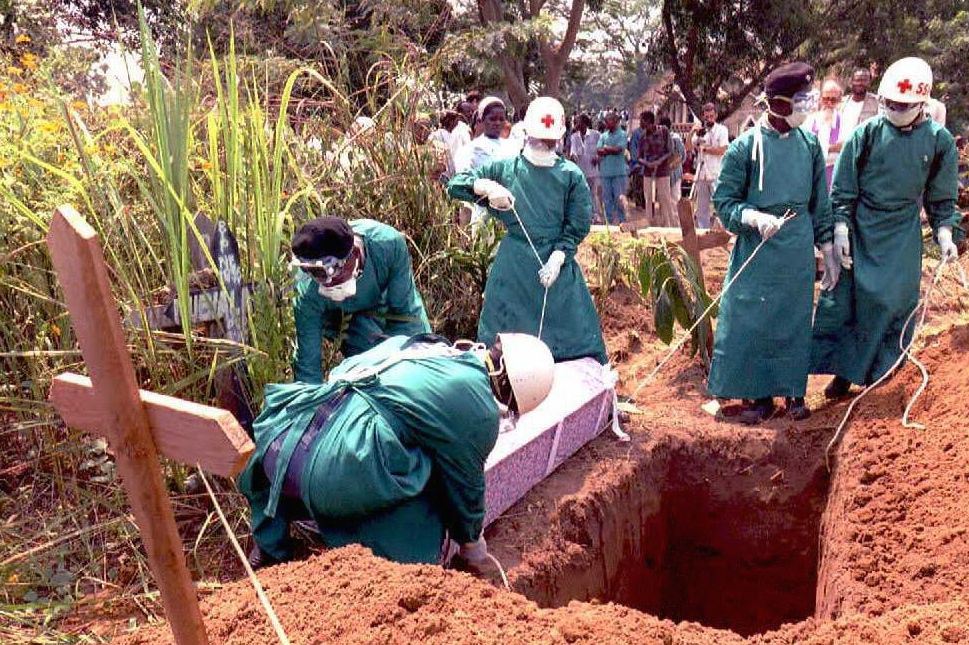
Privatized Ebola

Red Cross workers burry 14 May Italian nun Dinaros

By Margaret Kimberly

Source: Black Agenda Report

“The world of private dollars played a role in consigning thousands of people to death.”

Sierra Leone has waved the white flag in the face of Ebola Virus Disease (EVD). Its meager infrastructure has buckled under the onslaught of a disease which could have been curtailed. The announcement that infected patients will be treated at home because there is no longer the capacity to treat them in hospitals is a surrender which did not have to happen. Not only did Europe and the United States turn a blind eye to sick and dying Africans but they did so with the help of an unlikely perpetrator.

The World Health Organization is “the directing and coordinating authority for health within the United Nations system.” Its very name implies that it takes direction from and serves the needs of people all over the world but the truth is quite different. The largest contributor to the WHO budget is not a government. It is the Bill and Melinda Gates Foundation which provides more funding than either the United States or the United Kingdom. WHO actions and priorities are no longer the result of the consensus of the world’s people but top down decision making from wealthy philanthropists.

The Bill and Melinda Gates Foundation may appear to be a savior when it provides $300 million to the WHO budget, but those dollars come with strings attached. WHO director general Dr. Margaret Chan admitted as much when she said, “My budget [is] highly earmarked, so it is driven by what I call donor interests.” Instead of being on the front line when a communicable disease crisis appears, it spends its time administering what Gates and his team have determined is best.

The Ebola horror continues as it has for the last ten months in Guinea, Liberia and Sierra Leone. The cruelty of the world’s lack of concern for Africa and all Africans in the diaspora was evident by the inaction of nations and organizations that are supposed to respond in times of emergencies. While African governments and aid organizations sounded the alarm the WHO did little because its donor driven process militates against it. The world of private dollars played a role in consigning thousands of people to death.

Critics of the Gates Foundation appeared long before this current Ebola outbreak. In 2008 the WHO’s malaria chief, Dr. Arata Kochi, complained about the conflicts of interest created by the foundation. In an internal memo leaked to the New York Times he complained that the world’s top malaria researchers were “locked up in a ‘cartel’ with their own research funding being linked to those of others within the group.” In other words, the standards of independent peer reviewed research were cast aside in order to please the funder.

Private philanthropy is inherently undemocratic. It is a top down driven process in which the wealthy individual tells the recipient what they will and will not do. This is a problematic system for charities of all kinds and is disastrous where the health of world’s people is concerned. Health care should be a human right, not a charity, and the world’s governments should determine how funds to protect that right are spent. One critic put it very pointedly. “…the Gates Foundation, Bill & Melinda Gates, do not believe in the public sector, they do not believe in a democratic, publically owned, publically accountable system.”

There is little wonder why the Ebola outbreak caught the WHO so flat footed as they spent months making mealy mouthed statements but never coordinating an effective response. The Gates foundation is the WHO boss, not governments, and if they weren’t demanding action, then the desperate people affected by Ebola weren’t going to get any.

Privatization of public resources is a worldwide scourge. Education, pensions, water, and transportation are being taken out of the hands of the public and given to rich people and corporations. The Ebola crisis is symptomatic of so many others which go unaddressed or improperly addressed because no one wants to bite the hands that do the feeding.

The Bill and Melinda Gates Foundation has pledged an additional $50 million to fight the current Ebola epidemic but that too is problematic, as Director General Chan describes. “When there’s an event, we have money. Then after that, the money stops coming in, then all the staff you recruited to do the response, you have to terminate their contracts.” The WHO should not be lurching from crisis to crisis, SARS, MERS, or H1N1 influenza based on the whims of philanthropy. The principles of public health should be carried out by knowledgeable medical professionals who are not dependent upon rich people for their jobs.

The Gates are not alone in using their deep pockets to confound what should be publicly held responsibilities. Facebook founder Mark Zuckerberg announced that he was contributing $25 million to fight Ebola. His donation will go to the Centers for Disease Control Foundation. Most Americans are probably unaware that such a foundation even exists. Yet there it is, run by a mostly corporate board which will inevitably interfere with the public good. The WHO and its inability to coordinate the fight against Ebola tells us that public health is just that, public. If the CDC response to Ebola in the United States fails it may be because it falls prey to the false siren song of giving private interests control of the people’s resources and responsibilities.


Margaret Kimberley’s Freedom Rider column appears weekly in BAR, and is widely reprinted elsewhere. She maintains a frequently updated blog as well as at http://freedomrider.blogspot.com. Ms. Kimberley lives in New York City, and can be reached via e-Mail at Margaret.Kimberley(at)BlackAgendaReport.com.