

After the Crash

Dispatches From a Long Recovery (Est. 10/2024)

After the Crash

Mind control: Orwell, Huxley, and today’s reality

orwell-huxley

We are able to see the architecture – the structural patterns – of each kind of mind-control regime. This can help us recognize precursors – signs that such a future is coming our way.

by Richard K. Moore

Source: News Beacon Ireland

Dystopian predictions

In 1984, George Orwell paints a picture of a dark, gray world. People are afraid to say anything contrary to the official party line, and surveillance is universal. Even thinking contrary to the party is a crime, and thoughtcrimes may be treated by radical psychological intervention. Information is closely controlled by the party media, and the historical record is routinely edited, so as to conform to the latest party statements.

By contrast, in Brave New World, Aldous Huxley paints a colorful, superficially pleasant world. Personal freedom of all kinds is encouraged, even to the point of being a cultural imperative. In the book a young boy is referred to a therapist, because he doesn’t want to play sex games with a girl classmate. An adult character is considered aberrant, because he is drawn toward a monogamous relationship. Drugs and distractions are readily available for mood enhancement.

Central to Huxley’s world is the abolition of the family. Sex never results in pregnancy, and embryos are grown in a production process, based on selected seed material. As part of the production process, an embryo can be fed or starved, at various stages of its development, so as to create classes of people (alphas, betas, etc) with differing levels of intelligence and skills. Quotas are set, regarding how many people of each class are going to be needed, and should therefore be produced.

Various kinds of conditioning are then used on infants in order to get them to accept their class, along with its prerogatives and restrictions, as being best for them. Children are raised on a communal basis, with no concept of parents, siblings, or family. From embryo to adulthood, the state has fine-tuned control over the development of the person, and of their thinking. In the resulting society, people behave as they were programmed to behave, and can’t imagine things being any different.

In Orwell’s world, wrong-thought (thoughtcrime) is detected and suppressed. In Huxley’s world, wrong-thought is unlikely to arise. Orwell’s world suppresses the individual; Huxley’s world manufactures the individual. In both cases, mind control – control over what people are able to think – is the strategy of the regime, as its means of social control generally. Orwell explores a brute-force approach to mind control, while Huxley explores a scientific approach.

The novels are useful because they each take one of these basic approaches to mind control, and follow its consequences to the end. If you really want to suppress what people think, you’d need to do A, B, and C. If you really want to program people, you’ve got to start when they’re born and do X, Y, and Z. We are able to see the architecture – the structural patterns – of each kind of mind-control regime. This can help us recognize precursors – signs that such a future is coming our way.

Echoes of Orwell

Consider the world of mainstream journalists, in particular TV news anchors. There we have a world with echoes of 1984, where what is said must conform to the party line. Any thoughtcrime – such as an anchor commenting onscreen that he doesn’t buy the official story of 9/11, or he thinks Russia isn’t an aggressor – would be quickly punished by the equivalent of death – expulsion from the world of journalism.

Thus is maintained the Matrix, the story we are told about US benevolence, the existence of democracy, the sacredness of market forces, and all the rest. With control of major media in just a few hands, the party line can be always maintained, and current (or past) events can be interpreted within that framework. To do otherwise, for a news anchor, would be literally unthinkable. Huxley’s Ministry of Truth is at work in our world, but it is invisible, hiding away in the boardrooms of media conglomerates, and behind the doors of the White House press office.

The same kind thoughtcrime regime is operating in other arenas as well, where socially-sensitive topics are concerned. The peer-review process, and the editorial boards of the relevant journals, ensure that thoughtcrimes are suppressed, when it comes to concerns regarding genetic manipulation, pesticides, fracking, pharmaceuticals, radiation levels, etc. Again, the Ministry of Truth is invisible, residing high up in the chain of corporate boardrooms.

Even though our society doesn’t resemble Orwell’s dystopia, his mind control methods are operating in very critical places, where the population’s ‘information’ is generated. And of course we do have universal surveillance, courtesy of the NSA, omnipresent CATV cameras, and cell-phone tracking. Big Brother is with us, but he stays behind the scenes, he sees all, and he decides what stories we will be told about the world by the mainstream media.

Echoes of Huxley

Huxley wrote a review of 1984, where he talked about the two different future visions. He suggested that we might go through some kind of dark period, reminiscent of 1984, but he thinks such a regime would be unstable and transitional. He goes on to say that the scientific approach to mind control, based on programming people’s belief systems, would be the more sensible choice for a modern totalitarian society.

US Government research into scientific mind control began at least in the 1960’s, and has been ongoing. The first approach – the CIA’s Operation Mind Control – was heavy handed, reminiscent of 1984. This research involved giving people psychotropic drugs, along with post-hypnotic suggestions. Quite a bit could be (and has been) accomplished with these kinds of methods, along the lines of The Manchurian Candidate, but it didn’t provide a general solution: two much work was required to program people on an individual basis.

Research then shifted to cult creation. If people can be herded into cults of various kinds, cult dynamics themselves would serve the programming function. This provides a more wholesale approach to mind control, than the individual methods tried earlier. The CIA has never publicly claimed credit for this later research, but the experiments were very successful, including Reverend Jim Jones and the People’s Temple, and David Koresh and Waco.

In this kind of research, the first step is to identify a natural cult leader, who has already shown some success in gathering followers. Then the cult is given support of various kinds. Covert agents are sent in to join the cult, not only to observe and report, but also to provide organizational skills. Funds are channeled to the cult, and local police are warned off, so that the cult can grow unhampered.

In this way, researchers have been able to study how a skilled cult leader operates, how people are drawn into a cult, how loyalty is maintained, and how people can be pushed into extreme beliefs and actions. When everything had been learned that could be learned from a cult, the cult’s leader and members were then killed, so as to hide the evidence of what had really been going on in the experiment.

Cults and their uses

One of the first large-scale deployments of cult technology, informed by this research, was the creation of the Jihad movement by the CIA. The immediate purpose was to destabilize the Soviet regime, by tying it down in a quagmire in Afghanistan. This operation was quite successful. Since then, the Jihad cult movement – aka Taliban, Al Qaeda, Kosovo Liberation Army, ISIS, etc. – has proven to be an extremely useful tool for the purpose of destabilizing regimes, in pursuit of US geopolitical objectives. These destabilization operations in turn provide an excuse for direct US intervention, as we’ve seen recently in Libya and Iraq, and as we may soon see in Syria.

Cults generally have certain characteristics. There is usually a charismatic leader, who is able to inspire belief and loyalty in cult members. There is always a defining core belief system, that sets cult members off from outsiders, and which provides a strong sense of identity and purpose for members. There is typically an alleged ‘outside threat’ to the cult, which draws members together. There are actions and sacrifices required of members, which serve to bind them more tightly to the cult.  There are packaged arguments, that cult members are taught to employ, to repel attempts undermine the core belief system. These programming methods are very powerful, and typically intense deprogramming is needed to ply members away from a cult, once they have been thoroughly indoctrinated.

The society described in Brave New World is in fact a cult-based society. Each of the classes (alpha, beta, etc.) is a cult, and the programming begins at birth. No charismatic leader is needed, when so much control over programming is available. Each cult has its own core belief system, along with packaged arguments to maintain those beliefs. The required actions and sacrifices are simply the lifestyle which has been designed for each class. Such a society would tend to be stable, particularly since deprogramming efforts would be absent from the scene.

It is notable that Huxley’s world is not about a single cult, a uniform society, but rather about multiple cults. This makes for greater stability. Cult members have not only a model of what-to-be, they also have models of what-not-to-be. Each cult is more clearly defined, and drawn more into itself, by the existence of other cults. Being glad you’re not a beta is one of the reasons to be glad you are an alpha.

We see this same multi-cult dynamic operating in the US, in the divisiveness between liberals and conservatives. Liberals are kept in the fold by stories of conservative folly, and conservatives are kept in the fold by stories of liberal folly. In a propaganda-only system of control, there would be one party line for everyone. In this multi-cult system, there are two party lines, which we might characterize as CNN vs. FOX.

While the two party lines have many differences, in order to keep the two cults separated, they in fact share basic essentials in common. They both sustain the myth that state policy is a response to public sentiment, and they blame the other cult for providing support for the ‘bad’ policies. In fact US policy is made outside of government, by financial elites, and the state aims to control public sentiment, not respond to it. In this way we can see CNN and FOX as collaborators, sharing the common goal of hiding this fundamental truth from the people. The Democratic and Republican parties collaborate toward this same goal, using Congress as a stage, where they carry on a theater of divisiveness, providing the appearance of a democratic decision-making process.

The Barack Obama phenomenon provides an excellent example of cult tactics in action. Obama himself is obviously a natural cult leader, articulate and charismatic. He came onto the scene offering an inspiring core belief in deep reform, “The ground of politics has changed; Yes we Can!”. The dramatic effect was intense, as if we were witnessing the Second Coming. Campaign volunteers became the core of the budding Obama cult, and they were given lots of work to do, binding their identity to Obama and his professed mission. The McCain campaign was orchestrated to look like a dangerous threat by a rival cult, binding Obama supporters even more tightly.

The success of this mind-control operation was truly amazing. Obama in fact proceeded to carry on and expand everything Bush had been doing; the ground of politics hadn’t changed at all. But the cult binding was so strong that his support continued, by the very people who had hated Bush because of the same policies. Packaged arguments were put forward, to keep people in the cult, blaming Obama’s performance on Republican opposition – the standard divisiveness tactic. Even today there remain legions of Obama loyalists. Once bound to a cult, leaving becomes psychologically difficult.

Another example of mind control by means of cults is provided by global-warming hysteria. Al Gore played the role, at least temporarily, of cult leader, when he presented the core belief in CO2-caused climate crisis in his scientifically fraudulent, but very popular film,  An Inconvenient Truth. The growth of the cult was ensured by the fact that it then became a thoughtcrime in mainstream media and climate journals to question these core beliefs. Cult members are given things to do and sacrifices to make, like riding a bicycle and buying a Prius. They are given a packaged argument, that contrary views are nothing but the propaganda of an outside-threat: the evil petroleum industry.

This kind of mind control operation is much more effective than propaganda on its own. It’s not just that cult members believe in CO2-caused climate crisis, they believe they are fighting a battle against an enemy. They have been fully immunized against counter arguments to their core beliefs, and their only concern is to ‘save the planet’ by supporting anything that looks like it will reduce carbon emissions. Thus they are being led willingly down the garden path to a micro-managed society, as outlined in Agenda 21.

The ‘conspiracy theory’ meme

State control of public schools and mainstream media goes a long way towards programming people’s minds. But it is not enough, particularly in the era of the Internet. There are many sources available that thoroughly debunk mainstream propaganda, and by using those sources a large number of people have escaped, at least in part, from the mind-control regime. In Orwell’s world, the Internet would be banned. In our world, which is developing more along Huxley’s lines, other ways have been found to limit the ability of the Internet to undermine the mainstream narratives.

The ‘conspiracy theory’ meme was launched by the CIA in the wake of the JFK assassination. The official story was so full of holes that more and more people were beginning to doubt it. While the Warren Commission was busy writing its cover-up document, the public began to learn about the existence of ‘conspiracy theorists’. These are people, the story goes, who suffer from paranoid delusions, and sane people should pay no attention to anything they say. If someone even looks at any of those ideas, their own mental stability comes into question.

This mind-control tactic was very effective in marginalizing research into the truth behind the JFK assassination. Anyone who presented evidence contrary to the official story was automatically seen as ‘conspiracy theorist’. By scoffing at such evidence, without looking at it, you could demonstrate that you were mentally balanced. Thus logic and reasoning are banished from the scenario. Either you believe the official story, or your mental health is called into question.

Since then, the conspiracy-theory meme has been carefully nurtured and expanded by the mainstream party lines. This mind-control campaign has been very successful in immunizing the majority of the population against the revelations available on the Internet. Any story not appearing in the mainstream media must by definition be a conspiracy theory, and anything that sounds like a conspiracy theory should be scoffed at and ignored.

Thus for the majority of the population we have a tightly controlled, two-tier, mind-control regime. The thoughtcrime dynamic governs what the media says, and the conspiracy-theory dynamic immunizes people against other views. For the majority, the party line (either CNN or FOX) is ‘truth’, as in Orwell’s world, but without the need for Big Brother’s extreme methods.

By these mind-control methods, a bubble has been created, in which the majority does their thinking. Inside the bubble are the two party-line narratives, and outside the bubble the real world proceeds, invisible to those inside the bubble. It’s a very effective system. The more outrageous the real actions of the state, the more quickly the majority rejects revelations of those actions, as being outrageous conspiracy theories.

In some cases the FOX party line includes accurate revelations which would be thoughtcrimes in the CNN world. In such cases, the CNN world responds by classifying those revelations as  ‘right wing’ conspiracy theories. Unlike a propaganda-only system, where state crimes are always hidden, this multi-cult system enables the state to document its own crimes on conservative media, and know that the information will be disbelieved by the liberal cult. This system allows the truth to be hidden from some, through the act of revealing it to others. Very clever.

Mind control outside the bubble

While the majority may be inside the bubble, there is a large and growing number of people who don’t have faith in any mainstream party line, and who are open to considering the various ideas they find from Internet sources. The phrase ‘waking up’ is frequently used to describe the process of escaping from the bubble. More and more people are ‘waking up’ to the reality of false-flag events, routine government lies, the deep corruption of politics and the media, and the sociopathic central bankers who exercise the reins of power from behind the scenes.

However, the Internet is not being ignored by the state, and mind-control operations are underway there as well – designed for those who have ‘woken up’. Such operations are not aimed at moving people back into the bubble, rather they embrace the ‘awake’ ideas, aikido style, and then seek to direct the energy of the ‘awoken’ in ways that serve the state and its objectives.

An example of one of these outside-the-bubble mind-control operations, of the cult variety, is provided by the Zeitgeist Movement – which claims to be the “largest grassroots movement in the world with chapters in over 60 countries”. Peter Joseph is the charismatic leader of this cult, and he offers his set of core beliefs, backed up by persuasive evidence and arguments, in Zeitgeist: The Movie.

For those who are ‘awake’, the film is very powerful. It presents the essential truths about the world, without pulling punches, in a dramatic and compelling way. The film has gone through several versions over time, and the very first version went viral on the Internet as soon as it was released. To the ‘awoken’, it was a film of liberation, with the potential to wake everyone up and transform the world.

After the film was released, and after it gained a massive and enthusiastic audience, the Zeitgeist Movement was launched. Fans of the film flocked to join the movement, eager to ‘spread the gospel of truth’, and help ‘wake up the world’. They were joining an urgently-needed messianic cause, and this bound them to the movement, in the way cults always bind members. Peter Joseph was seen as a prophet figure, the articulator of the gospel, and the one who could lead the way to liberation – and this is more or less the textbook definition of a cult leader.

What these eager cult members fail to realize is that the very thing that attracts them to the movement also guarantees that the movement could never succeed in ‘waking up the world’. The core beliefs that are so liberating to the members are all seen as outrageous conspiracy theories inside the mainstream bubble. While members think they are pursuing a messianic cause, they are in fact a choir singing to itself, with Peter Joseph setting the tune.

The real purpose behind the cult is revealed in a press release on the movement website, entitled, ‘The Zeitgeist Movement defined: realizing a new train of thought’. Here Joseph expands the gospel, going beyond ‘revealing the truth’, and venturing into envisioning the transformed world that the movement aims to help create. Here are three key points from Prophet Joseph’s vision, with emphasis added:

2): The Scientific Worldview: The essay explores how the development of the scientific method has altered human perception and the critical importance of its recognition and larger order application, specifically with respect to the social system.
(5): The Case for Human Unity: This essay explores the reasoning for a unified global society along with tracing the source of national divisions and propensities for conflict. A relevant point is made regarding the advancement of technological warfare and how the dangers of keeping biased economic boundaries as we have could lead to rapid destruction as time moves forward.
(9): Market Efficiency vs Technical Efficiency: This essay argues the difference between true scientific (or technical) efficiency and the business practice of “market efficiency,” showing how the latter actually works against true economic optimization.

This is a prescription for a micro-managed global technocracy, under the control of a one-world government. Both the social system and the economic system are to be ‘scientifically optimized’ – which in fact means a world organized along whatever lines are set down by some technocratic bureaucracy, under the control of an enthroned global elite. In other words, Prophet Joseph is creating an enthusiastic constituency in support of the central bankers’ long-desired New World Order.

The Zeitgeist cult is an aikido masterstroke. It begins with the revelation that ‘evil bankers’ run the world, blending with the energy of the ‘awoken’, and then shifts that energy in a direction that serves the interests of those same ‘evil bankers’. Again, I must say very clever, very clever indeed.

Zeitgeist is only one example of a mind-control operation aimed at those who have achieved one degree or another of ‘awakening’. Numerous movements have been created, characterized by well-designed websites that tell some version of the truth, drawing in audiences with some specific focus of concerns, and which lead those audiences into useless or counter-productive activities.

In Huxley’s world, we see a scientifically designed society, tightly controlled by a full-spectrum mind-control regime, based on conditioning and cult dynamics. In today’s world, we see cult dynamics being used in a variety of mind-control operations, with cults customized for various constituencies both inside and outside the mainstream bubble. Huxley’s world has achieved stabilization by such means; in our world those means are being used to facilitate a transition – to a brave new world order that is likely to resemble Huxley’s in many of its essential features.

The demise of the family?

If the state can achieve full control over the raising of children, without parental interference, then quite obviously that would give the state the power to achieve a full-spectrum mind-control regime. Not only could the state design the society’s culture, it could tune that culture over time, by updating the conditioning process. If full-spectrum mind-control is the goal, then eliminating the family becomes a primary intermediate objective.

If eliminating the family is indeed an objective of the New World Order project, then it is by no means an easy objective to achieve. One would be hard-pressed to imagine an institution that would be more fiercely defended than the family, or to imagine a more painful experience than being separated from ones children or parents. Any campaign to achieve that objective would need to fly under false colors, not advertised as a campaign to eliminate the family, but rather as a campaign aimed at protecting the rights and welfare of the child.

It is in this light, I suggest, that we consider the many revelations that have emerged in recent years regarding child sexual abuse, and the existence of pedophile rings. In many of these cases we learn that the abusive activity have been going on for many, many years, as we see in the case of pedophile priests. Why is it that these longstanding activities have only recently been ‘discovered’?

If there is to be a strong campaign for the ‘rights and welfare of children’, there needs to be first a strong impression that their rights and welfare need protecting. Exposés of child sexual abuse serve that purpose very well. When you see a police drama, where abused children are rescued by noble cops from drug-addicted parents, you are are getting images of a benevolent state, and a social milieu that requires intervention. It becomes a template that can be expanded on as time goes on. And of course there are the interminable ads, where a neglected child sits alone at home (black and white film for effect), fearful and hungry, and you can donate $3 to some child-protection agency.

I don’t recall the link, but I came across a webpage from a UN agency, promoting the virtues of children raised ‘alternatively’. These are children raised as a group, sans parents, reminiscent of Huxley’s scenario. Supposedly these children were ‘more creative’, and showed other positive signs. How very nice. Another good-intention-stone along the garden path to the demise of the family.

Last year, 2013, in both Ireland and New Zealand, constitutional amendments were adopted, declaring that the rights and welfare of the child are paramount, trumping any rights that might be claimed by a child’s parents. In Ireland, a court challenge was immediately launched, based on the fact that the government had illegally campaigned for the referendum that approved the amendment, when by law the government should have been neutral. The challenge was, not surprisingly, rejected by the courts. There is no specific formula in these amendments as to what defines the rights and welfare of children, leaving it up to the discretion of the state, as to when intervention in the family might be appropriate.

As economic conditions worsen, under the screws of austerity, privatization, and eliminated social services, it will become a struggle for an increasing number of parents to feed, clothe, and house their families. It would be all too easy for the state to mandate a ‘minimum level of acceptable conditions’, and take children wholesale into care, based on ‘economic profiling’. That’s just one possible scenario, but it’s the kind of scenario it seems we are being prepared for.

Getting Inside the Mind of Mainstream Media

Is this the next step of the information war?

By Bernie Suarez

Source: TruthandArtTV.com

Mainstream media lies, deceit, and propaganda are being dramatically exposed in real-time at an alarming rate. Anyone following alternative media knows what I’m talking about. Is it me or does it seem like the MH17 false flag happened years ago? We can see that false flags that are quickly exposed and blown wide open end up dropping to the bottom of mainstream media news. We’re seeing the pattern over and over again, so isn’t it time we sharpen our skills and start predicting the mainstream media lies and propaganda before it happens? For those of us fully awakened, we have to be scratching our heads wondering, what else. What can we do to change and turbo-boost this information war for the better? What creative thing can we do to throw a monkey wrench into the globalist plans? Is it even possible? Let’s examine some ideas.

In all my writings I assert that we have an information and survival battle that is best described as ‘humanity versus the globalists’ or the ‘humanity versus the new world order’ (or other names such as the Illuminati or global elite). We can also call it humanity against the control system. Call it what you want, but understand that if you are not part of the control system, you are part of humanity. Humanity is everyone. We are human, we are on earth and we are not trying to control anyone. We are the pure expression of the species on earth innocently going about our daily lives trying to survive and make the most of it. The globalist control system however, lives and operates for a very different reason. The depth of this truth is gripping when you fully understand it. Imagine for a minute, there is actually a species amongst us who wishes to control you, inflict suffering on you and wishes to diminish or even eliminate your existence.

Many Libertarians and freedom lovers can appreciate this reality. It’s been said, there are two kinds of people on earth; those who want to control you and those who simply want to be left alone. This simple view of life is a very accurate portrayal of reality. Never before have we seen this manifest itself so clearly as it is now. Do you realize that the mainstream media globalist mouthpiece can just as easily encourage humanity, call for peace, reward truth, and honor integrity and what is right? They could do this every day if they wanted to. Even the thought of this seems to all of us as a pipe dream. Instead they (the mass media) take orders from their CFR/CIA masters, they lie, deceive, spread propaganda to promote more wars and condone war crimes in the name of a certain flag or political agenda. And yes, they do this every single day, meaning someone is brainstorming every day on new ways to enslave humanity and keep it oppressed. Think about this. Anyone who runs a website, like I do, knows how much work goes into generating new content every day. It takes work and resources.

These decisions (and the work required) are then being carried out every single day at mainstream media. In real-time the controlled media system gives the final stamp of approval on one lie after another. They say, so what if this next story will pave the road for more wars; So what if this next story is not true and perpetuates an idea that will justify mass murder and war crimes. The soldiers of the western mainstream media lying machine march on into a new day with new ideas on how to sabotage humanity and create more fear and hate. Try to picture their thought process as they implement their lies daily. Let’s get inside their mind for a second.

Is it possible for the rest of humanity to truly grasp the mindset behind this deliberate disinformation system which single-handedly is keeping humanity in slavery? Or is this too far-out of a concept for us to grasp? What if we could actually predict mainstream media narratives before they happen and post them online in a proper predictive forum? Will the so called truth/freedom movement or alternative media ever get to this point? Can we give it a shot?

Last week (from the time of this article) I correctly predicted that the mainstream media would spin the fatal shooting of Michael Brown in Ferguson Missouri as a racial shooting rather than a police state brutality shooting, and I was 100 percent correct. Here’s the thing, I have no background as a psychic or fortune teller. The mainstream media predictably played the race card, so I thought, what if we could do this more often? Naturally we often don’t have a way of predicting what new narrative they are going to spin on the American public (who saw MH370 or MH70 coming?) but we do have a few tools to consider:

a. When a story actually exposes the new world order gangsters, we can observe that the government-media complex often create a new story (or simply shift the attention to) elsewhere to get the attention off of the story that exposes their agenda. Identifying this classic diversion technique can become an effective tool if we focus on what is being said. Many truth seekers are already familiar with this tactic.

b. When something unusual happens (like the downing of MH17) which is related to a crime, we can expect the early formation of accusations and engineered evidence. The accusations will point to the next enemy that the United States wants to bring down, or a small group of villains usually if not always created by the U.S. government and it’s allies. These two scenarios alone account for almost every false mainstream media narrative thrown at the American people over the last 14 plus years (if not 100+ years). Many of us committed to truth and awakening are very familiar with the now common term ‘false flag’ operation. Thankfully over the last few years people all around the world have seen so many false flag examples that the term is known to most people now.

c. The third scenario or tool used by mainstream media is the ‘Wag the dog’ scenario where they suggest ‘preview-like’ accusations that are setting the stage for a future false flag or a future implementation of an agenda. Often they employ CIA “experts” who are invited to all the mainstream media channels to offer their “expert” intelligence advice.

These “experts” are quietly playing a vital role in the (now LEGAL) propaganda being spread by mainstream media and government. Notably, no one is challenging these “experts” and grilling them to expose their link back to CIA or even demonstrate to the world that they in fact are NOT experts at all. Just because someone writes a book doesn’t automatically make them an expert. Yet the status of “author” has been used by the CIA’s mainstream media as the mark of unquestioned “expertise” in almost every issue we can think of.

I’ve written about this specific issue before and many Americans especially conservatives, don’t realize how they are being bamboozled daily by so called “experts” which are nothing more than CIA operatives. These same Americans refuse to connect the dots and realize that CIA took over mainstream media news since at least the late 1940’s (Operation Mockingbird). They fail to realize that mass media was one of the most important things the control system felt it needed to control in order for them to have control of the people.

So while one segment of Americans live in a dream state, not putting thought into these easily verified mechanisms of control and the entities behind it, the other segment, those of us awake and watchful to the new world order plans, have a decent challenge in front of us based on what we know. What if we could predict each narrative the mainstream media puts out, before it actually happens? Yes, this is already happening, but what if we can find a way to make this more known, more glamorized, and more marketable in such a way that we can get inside the mind of mainstream media? What if you could call out a narrative, perhaps wage money on it and make a living guessing right? Would a ‘mainstream media lies prediction’ casino get everyone’s attention? (Pun intended) Okay, perhaps this is not realistic but you get the point. Truth seekers could still come up with a unique, entertaining and convincing platform for predicting mainstream media lies before they are generated.

In the end we’re reminded that we are caught in a dangerous and now predictable information war. The U.S./global government is now trying to exterminate the lives of billions of people world wide and launch World War 3 against Russia. They want to control all the resources on the planet by geoengineering every aspect of life to convert it into profit. From Ebola to GMO’s to chemtrails and engineered drought, they want it all. They also need we-the-people divided and they will do whatever it takes to divide us. (eg… Travon Martin, Ferguson, Bundy Ranch)

Until they get it all, we can expect more synthetic sectarian gangs to be created. The creation of these gangs will always be a secret and a mystery, but the agenda and the chase to terminate them won’t. Whether its Al Qaeda, ISIS or whoever the next group they will create, the process will always be the same- problem, reaction, solution. The solution will always be more war, more murders, more secret prisons and more illegal invasions. OMG, we get it! The script has played itself out too many times and humanity as a whole is primed to get inside the mind of mainstream media because we can.

The CIA/CFR and it’s mainstream media have likely run out of scenarios to fool humanity with. Let’s see this as an opportunity and instead of celebrating victory too soon, let’s see if we can come up with a new idea that involves the embarrassingly easy prediction of mainstream media news. Just an idea I wanted to share with other truth seekers. Do not put limitations on what we (humanity) are capable of. The predictions can be based on not only what we know about what really happened but most importantly based on what we know about how they think and about what their final goals are. It’s the manifestation of true information war. Let’s use all forms of media to play with them.

Finally, I assert that grasping the meaning of life comes from understanding the reality that surrounds us. This reality of the mainstream media and it’s overall goals, intentions, and agenda is as powerful a platform for anyone to focus on and get inside their mind. That is, get inside the mind of the control system if you want to call it that, and correctly predict every move they make in such a way that it waters down the intent of their stories and de-legitimizes everything they say.

I admit it, to some degree all of this is already happening. The information war rages on and as many people realize, truth is winning! Let’s remember, they are not mysterious, their script is limited, they lack creativity, and their agenda is against nature and humanity. That alone gives us an edge over them. Remember, no one ever “wakes up” to the mainstream media narratives but people regularly “wake up” to their lies. This is a function of human nature and everyone should realize that. We (truth seekers of humanity) have nature on our side! At this point in history we have all the weapons of human intuition, awareness, creativity, intelligence and survival instinct we need to get inside the mind of mainstream media predictable lying machine. The question is, can we shift our thinking to view this as a useful and effective paradigm? I can see it that way, is anyone with me?

The Working Class Is Underrepresented In Rap

Killer_Mike

By Eric Ducker

Source: The Believer

Killer Mike is always in command. The thirty-nine-year-old rapper and business owner is a forceful presence, and his dexterity and depth are further improved by the unexpected perspectives he often takes. In his verses, he’s mastered thickly detailed street narratives, big and beastly battle raps, hilarious punch lines, and fierce political exhortations.

It has been well over a decade since the MC left Morehouse College and gave up selling drugs to focus on his rap career. He was introduced to most listeners as a protégé of Outkast—particularly member Big Boi—the first Atlanta rap group to be shown respect by the national hip-hop audience. A member of their Dungeon Family crew, Killer Mike was given a showcase spot on “Snappin’ and Trappin’,” a song from Outkast’s Stankonia album, from 2000. Between that record and 2003’s Speakerboxxx/The Love Below, he had featured verses on the single “The Whole World” and “Land of a Million Drums,” from the live-action Scooby-Doo movie. His own 2003 album, Monster, and single “A.D.I.D.A.S.,” on Columbia Records, were moderate successes. After moving to Big Boi’s Purple Ribbon Records, the label’s issues with Sony Records prevented his follow-up, Ghetto Extraordinary, from receiving an official release. Between that album and his apparent resurrection these days, he kept developing his talents and his underground following with the street albums I Pledge Allegiance to the Grind, I Pledge Allegiance to the Grind II, and PL3DGE. From 2006 to 2008, he also worked on Frisky Dingo, an animated show cocreated by Archer’s Adam Reed, creating music and providing the voice for one of its characters, and beginning his relationship with Cartoon Network’s Adult Swim.

In 2012, Killer Mike released R.A.P. Music, a furious and emotionally raw record that paired the forceful Atlanta-based rapper with the malevolent beats of El-P, a longtime champion of New York City’s independent hip-hop. This on-the-surface odd couple teamed up again the next year for the Run the Jewels project, further united in an attempt to update the approach of late-’80s and early-’90s hip-hop artists like Ice Cube and EPMD. With these two impeccable releases, Killer Mike further established himself as a powerful and imposing voice in modern music.

Mike spoke to me on the phone from Graffitis SWAG Shop, the barbershop he owns in Atlanta, first from the main floor and then from somewhere much quieter. He had recently returned from a trip to New York, where he was working with El-P on Run the Jewels 2. Earlier, El-P had posted a list on Twitter of the amount of drugs that were consumed during those sessions: “2 ounces of sour, 1 ounce of shrooms and 4 grams of hash in 6 days…”

—Eric Ducker

THE BELIEVER: At what point in your life did you decide that being a rapper was going to be your life’s work?

KILLER MIKE: I decided that when I was nine years old; it just didn’t happen in a very linear way. I learned to fly planes at fifteen years old because one of my teachers thought I’d be a better pilot than rapper. I was in the arts program all through high school. I got a scholarship to Morehouse, where I went. My desire for higher learning has always been high, but I wanted to get out and really start chasing rap. I did some of the right things and some of the wrong things. Right when I had my first daughter, who is now seventeen years old, I said, I gotta do it, and I’ve gotta do it for real. I independently started pushing, Big Boi got wind of it, and he gave me an opportunity around 2000.

BLVR: At any stage between when you were nine years old and where you are now, did you think it might not work out?

KM: Yeah, you think that. Doubt has always fueled me. I get nervous before every show. To get onstage I have to fight through that doubt. When I was younger, because of the geography of where I lived, [being a rapper] wasn’t possible. I was in the South. And then later on it was less about geography and more about how I don’t make pop rap, I don’t make dance rap. That was the burden. I can’t tell you that I’m 100 percent sure that my career is totally on the path it should be and how everything is going to go after this. I know that a huge fear is going back to the place I was six, seven years ago, when I had “fallen off.” I don’t ever want to feel that again, so I work hard every day.

BLVR: When you were in that period when you had supposedly fallen off, were you thinking about cutting your losses?

KM: You think about cutting your losses, but I’ve lived my life fueled by a dream. What that time taught me was that even though I wasn’t going to give up rapping, I did have to figure out a financial way to support myself, which is why I’m sitting in the middle of a barbershop that I own, doing this interview.

BLVR: Tell me about that decision to start the barbershop. Was it a matter of having something to fall back on?

KM: You just need multiple sources of income. I like not having to depend on rap money, and the way I don’t have to depend on rap money is finding other endeavors, whether it’s merchandising T-shirts or merchandising the shop or developing a product to support, which we’re currently in the process of doing. For me, it’s always been about creating as many streams of revenue as I possibly can, so I can be free to rap the way I wanna rap.

If I wish to rap something like “Burn” or “That’s Life” or “Reagan,” I have to be more like Hosea Williams and less like other members of the civil rights movement. Hosea Williams was one of the most outspoken of Dr. King’s lieutenants. He was able to be defiant only because of who he was. I watched him my whole childhood; I went to see him speak in the seventh grade. I realized that he was able to be as outspoken as he was because he owned businesses. He was a chemistry major, and he owned businesses off of that. He owned property; he owned a bonding company in Atlanta. He was my example of what you should be as a leader. I knew that if I was ever given the opportunity to have lump sums of money again, I was going to invest directly in things that were accepted by the community and that didn’t have anything to do with music. The barbershop became one of those things.

BLVR: Do you think having multiple income streams legitimizes you in the eyes of others, so they will let you do what you want?

KM: The motivation to me is to make money and not be dependent upon the shallow pool called the entertainment world or the rap world or the hip-hop world. My value in hip-hop matters. My value in another field as a hip-hop guy matters more. Take Ted’s Montana Grill: Ted Turner is a hell of a guy. Ted Turner has a television station I grew up watching. Ted Turner is someone I may or may not ever meet, but I can go to his restaurant and get a piece of his vision for eating clean and being an outdoorsman, so I feel better connected to Ted Turner. The same works for the barbershop. I’m able to make money by brokering whatever celebrity I have into a shop. The shop looks beautiful. It’s more like a Hard Rock Cafe with haircuts than it is a regular barbershop, so I bring added value to the trade, but this is about creating a new stream of revenue. It’s revenue that sustains wealth, it sustains parts of our household, and I’m not dependent upon rapping and touring in the same capacity. I love rapping. I’m going to rap even if no one pays me to rap, but just in case people ever decide to stop paying me for rapping, I have to make sure that my four children and my wife are going to be well taken care of.

Another reason I wanted to open the barbershop is to provide jobs. I have six barbers working for me. I went and bought two new chairs today because two new barbers want to be hired. And I have two barbers moving in from out of town. So I’m capped off at ten barbers. Within the next few weeks, when those four chairs will be filled, we’re going to be looking for another location and opening another shop. First and foremost, I represent a group of men in this country who are doubly unemployed nationwide. Black men have double the unemployment rate [of white Americans], but no one seems to be alarmed by that.

BLVR: One of the things over the past couple years that has helped people connect with what you’re doing is that you’re rapping from the perspective of someone in their thirties rather than someone in their teens or twenties. Do you think that older perspective is missing or underrepresented in rap right now?

KM: I don’t know if it’s an age thing for me, but it is very much a class thing. The working class is underrepresented in rap. There is something valuable that the working class has to offer that doesn’t get honored in rap music in the way that it should be or could be. I don’t drink champagne that often; I drink whiskey every day I can. That’s the difference. So I tend not to rap about champagne-type things, I tend to rap about whiskey things, things that a workingman gets off his job and contemplates. Scarface was twenty-three years old when he wrote “I Seen a Man Die.” There are rappers who are forty-three years old who will never write anything with that type of depth.

BLVR: It seems like a lot of younger rappers feel the need to rap about the champagne-type things because they’re projecting a fantasy.

KM: Yeah, and I can’t criticize the fantasy; it’s just a fantasy, though. Kids have fantasies. Kids rap about Bentleys and diamonds because that’s what they want or that’s what they think you’re supposed to do to get rich. My job is to offer an alternative, because the people I saw who got rich, they did some diamond-y things, but they also did very practical things that I saw my grandparents do. When I think of rich rappers, I’m thinking less of the guys who I see on MTV every day and I’m thinking more of E-40, who independently became rich, got big checks from rap, then diverted that into community and businesses. It’s why I tell people that one of my favorite rappers is Rick Ross. The fact that he owns a Wingstop and is in negotiations to buy twenty-five more: when I hear that I go, Wow, he’s probably going to employ two hundred to two hundred and fifty people. That’s very significant to me. That’s a reason to congratulate and to support him.

BLVR: You’ve rapped about the culpability of rap artists in terms of the values and ideas that they spread and what they give back to the communities that they came from. When did this obligation begin? Did rappers always have this obligation, or was it when rap became a global and commercial force?

KM: It’s always been. I don’t place obligations on you because you’re a rapper; I place obligations on you because you’re a man. Most rappers are black men. If you’re a black man, you owe something to the community that you came from. If you’re rapping about the community that you came from, and you’re romanticizing parts of it for the entertainment of people who don’t look like you, you certainly owe something to the community. That’s why when people try to criticize a person like my good friend T.I., I remind them that all the shit you want to talk about him, one of the first things he ever did with his money was start a construction company, and they were building houses in the community. How many rappers have the gall to do that, to build a construction company to build houses in the inner city? To me that shows a lot of forethought.

I hold rappers just as accountable as I hold the 100 Black Men of Atlanta. I hold them just as accountable as I hold Herman Russell. I know they don’t have a hundred million dollars like Herman Russell, but you’ve got twenty-five thousand dollars to open a chicken-wing stand, and to make sure that the people working in that chicken-wing stand look like you, and to make sure you don’t have bulletproof glass and the people aren’t being served like animals in cages at the zoo. You can do that instead of buying a funky-ass gold chain.

BLVR: There’s an interesting dynamic in all music, but it’s particularly at the forefront in hip-hop, where the artist has to decide how much they want to differentiate between writing and rapping from the perspective of himself or from the perspective of a fictional character. How do you approach that issue? There are two interesting examples of storytelling raps on R.A.P. Music. On “JoJo’s Chillin’” you tell the story of a character you’ve created, but “Don’t Die” is a fictional story that incorporates actual autobiographical details, like your father being a cop.

KM: I sit down and think, I’m going to write a truth. Not, I’m going to write the truth. What I’m writing is going to be a real truth all across the board, or it’s going to be a truth that resonates with certain people for a certain reason. When I did “Don’t Die,” that certainly is a mesh of some autobiographical stuff, some historical stuff, and just some characterization. The autobiographical stuff is that my dad is a police officer. The historical stuff is Larry David and, in particular, Fred Hampton—Fred Hampton because he was a twenty-one-fucking-year-old man who was murdered by the Chicago police department, and the whole world now is like, “What do we do about Chicago?” We’re forgetting that Chicago and its establishment helped put us here by killing off the leaders of the community who were trying to make a radical change that revolved around poverty and violence. And it’s a characterization because I want to put people in a hyper-visualized violent place, to let them know what, at times, I feel this country is becoming. This country is becoming a place where police departments are being replaced by storm troopers. It’s a place where police departments are busting in on grandmothers and killing them because they assume they have a gun. It’s a way to give an audio movie to people to get them to think about their rights in a different way.

Now, with “JoJo’s Chillin’,” I just got to tell you, I’m a fan of the bad guy. I’ve always been enamored of villains in movies, because a lot of times villains have very noble causes. I wanted to tell a story that was like [Slick Rick’s] “Children’s Story,” but without the repercussions of people getting caught. JoJo is never really admittedly a criminal; JoJo just kind of got caught up in the mix. I thought it would be an entertaining story to do about a guy who doesn’t know if he’s on the run or not. JoJo is kind of crazy. You don’t know if it’s really his schizophrenia or paranoia. Nobody really knows why JoJo is running, as much as JoJo thinks the Feds are after him. Although I haven’t known that story to be true, bar for bar, I’ve known people who were like that in the neighborhood, slangin’, hustlin’. You meet all kinds of wild and weird people.

BLVR: “Don’t Die” is a good example of this, but how do you blend having a concept about a social issue you want to get across and telling a compelling story?

KM: I don’t feel the need to preach or dictate. Minister Farrakhan, the pope, the president—all those people do a great job at that. I mean that with no condescension. I’m trying to entertain you to think. I’m trying to “edutain” you, dare I say, like KRS-One did years ago. I want you to be entertained. I don’t want to prove a particular point as much as I want you to think about the point because I’ve forced you to come to the right conclusion. I trust that humans have the empathy to understand why police violence is wrong. The kids who are listening to “Don’t Die” are going to be graduating from college in two years. These children are going to work. Some of them are going to be police officers. I would like those children to have heard “Don’t Die.” My cousin, who is a police officer, listens to “Don’t Die.” I would like to think that he engages with the public in a different way than some of the officers I’ve known. I have empathy and sympathy, and, dare I say, love for men who put their lives on the line to serve our community, like my father and my two cousins. With that said, if you’re a police officer and you abuse that power, I feel that life imprisonment and the death penalty should be options, based on the fact that you’re abusing the public trust.

BLVR: Maybe it’s changing now with the greater availability of production software, but I’ve often found that when rappers are younger, they write out their rhymes without music, but as they get older and start getting into studios, they start writing to specific beats. At this point in your career, are you still writing first, or do you always write to the beat?

KM: I do both. I write without a beat, and some of those records you guys will never hear, because they’re all just thoughts. And then when I get into the studio, different beats tell me what to say. I don’t really pick up a pen anymore unless I’m at home, sort of practicing. In the studio I don’t use a pen or pad. I know a lot of people say that, and I don’t say that with any brag on it as much as I didn’t write R.A.P. Music, it just poured out of me. The beats will tell me what to do, or I’ll come in with thoughts and ideas, and the producers and I figure out the beat to give the emotion that I want.

BLVR: You have a point you want to get across or a feeling you want to get across?

KM: Sometimes. Sometimes it’s a whole concept. Sometimes it’s just an emotion. Like “Willie Burke Sherwood.” I always wanted to write a record that talked about the values that my grandfather had. A lot of times the values that are celebrated in some cultures, and are kind of looked down upon by others, are values that rappers have grown up with. We just haven’t had the freedom to express them. The only other rapper I’ve heard say “I fish,” besides me, is Young Buck. Both of us are from the South. My thing is, if you’re from the South, how could you grow up not fishing? If you grow up in Atlanta, maybe, but if you grow up anywhere else in Georgia, how could you grow up not being outdoors in some capacity? “Willie Burke Sherwood” is a song that gave me an opportunity to honor men like my grandfather. And I believe the vast majority of men in the South are like that. I used that opportunity to get that emotion across.

But I don’t always sit down, like: the concept is going to end here. I don’t know where it’s going to end when I start the record; I just start telling the story. I’m like everybody else: by the time I finish the last bar, I’m on the edge of my seat sometimes. I didn’t know I was going to end “Reagan” with “I’m glad Reagan’s dead.” Me and El were just in the studio and he was like, “It’s gotta be something like when Kris [KRS-One] said, ‘You know, I’m kind of glad Nixon died.’” It had to be a punch. It had to be an exclamation point at the end.

BLVR: Going into the business side of the music industry, we’re at this stage where no one knows what’s going to happen. R.A.P. Music was put out by Williams Street Records, which is the label of Cartoon Network’s Adult Swim, and Run the Jewels was originally put out as a free download through Fool’s Gold. By some measures, these are the two most successful releases of your career, and you didn’t put them out in traditional ways. Did those two models work because of the quality of the product, because of the following you already had, or because of the models themselves?

KM: I’ve been making quality records. I’m not one of those artists who doubts that they made dope-ass records. From the first record to now, each record has gotten better. I started dope, so I’ve just gotten doper and doper and dopest and super dope. The first record I did went to number ten on the Billboard chart and went gold and yada yada yada. That was cool, but I couldn’t tour that record, because at that time I was part of an industry machine that demanded that the lead guys were the main events and the side guys were satellites. So you have Nelly and the St. Lunatics, you have Jay Z and Roc-A-Fella. When I was getting on, Outkast was going through some differences in terms of where they were going. All the satellites around them had to figure other stuff out. In my figuring it out, Pledge 1, 2, and 3 really are the foundation that my current career is built on. Those are the advance ships and those are the supporters outside of the Outkast realm, outside of me tagging along, outside of “he came from the Dungeon Family.” These kids discovered Pledge 1, 2, and 3 on their own, and they trusted me to do R.A.P. Music, and when they got R.A.P. Music, they appreciated it. And they showed their appreciation by coming out and growing an audience.

I’m happy where I’ve ended up. There’s been hard days, I’ve been afraid some days that it wouldn’t work out, but I’m glad I kept my nose to the grindstone.

BLVR: Do you think hip-hop and the hip-hop community put too much stock in conspiracies?

KM: How can a black man not be paranoid? How can I look at any statistic that tells me that if you’re not an average reader by ten years old, you’re destined for prison? How can I say someone doesn’t have a vested interest in making sure the public-school systems stay fucked-up? How can I trust you when it was less than a hundred years ago that there was something called the Tuskegee experiment, which allowed black men to live with syphilis just to see the effects on the human body. As a rapper, how can I not believe in conspiracies?

That doesn’t mean I believe there’s some secret room of people who had a meeting about gangster rap, and that it was pushed. I’m talking about why public schools are truly fucked, why neighborhoods that never could get fixed, all of sudden when people start gentrifying them, we get public services like trash and regular police patrols. Why are churches getting money to shut up or push certain political campaigns through the community? Those are the real conspiracies I worry about, because those are things that are really affecting us.

I don’t have to think that there’s some grand satanic conspiracy for people to inject reptilian minds into mine; I don’t know about all that. But what I do know is that I don’t trust the church or the government, and anything the church or the government tells me I assume to be a lie or a conspiracy, until proven true.

BLVR: Are you optimistic about the future of America?

KM: Let me say that I am a very proud American. This is truly one of the greatest countries on Earth, and I think that we are severely off track with what we should be doing next. Honestly, my wife has already said that we’re going to retire out of the country. I don’t know where I’m going to end up, but I don’t think I’m going to end up here. I don’t like to see such a loss of power on behalf of people. I’m afraid that parts of the Civil Rights Act have been struck down. I’m very afraid of some of the justices who have been appointed in the last twenty to twenty-five years. I don’t have a lot of hope that individual rights are going to be the same in this country. As a person who represents a community of people who are only about fifty or sixty years into real freedom, if I can’t get it here, I’m definitely going to try to find it somewhere else.

BLVR: Is there anything in your life or any topic that you haven’t felt comfortable rapping about yet?

KM: Yeah, of course there is. Of course there are always dark parts of every writer that you’re afraid to expose. But the more personal I get, the more it seems to be therapeutic for me and the more it seems to be therapeutic for a greater community of people. I was going to do an album called 16 in the Kitchen that would be about the experiences of being a teenager growing up with a mom who was a major cocaine distributor and what that life was like. My mom asked me not to put that record out. It would have been a great album, but my mother didn’t want that out there. And who is going to go against their mother?

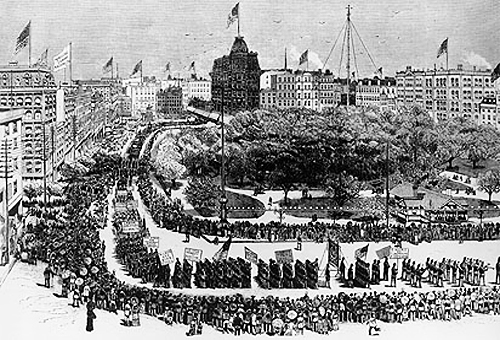
Remember the “Labor” in Labor Day

Labor_Day_New_York_1882

Source: Mickey Z.

With the relentless, ongoing demonization of unions, it’s no surprise that labor history remains obscured and misrepresented and thus, not accessible as a lesson for today’s challenges.

With that in mind, we can choose to view Labor Day as nothing more than the symbolic end of summer and an excuse for more shopping…or we can use it as inspiration to reflect upon some of the brave souls who forged a path of justice and solidarity.

The Lowell Mill Girls

Lowell, Massachusetts was named after the wealthy Lowell family. They owned numerous textile mills, in which the workers were primarily the daughters of New England farmers. These young girls worked in the mills and lived in supervised dormitories. On average, a Lowell Mill Girl worked for three years before leaving to marry. Living and working together often forged a camaraderie that would later find an unexpected outlet.

What had the potential to become a relatively agreeable system for all involved was predictably exploited for mill owners’ gain. The young workers toiled under poor conditions for long hours only to return to dormitories that offered strict dress codes, lousy meals, and were ruled by matrons with an iron fist.

In response, the Lowell mill workers—some as young as eleven—did something revolutionary: the tight-knit group of girls and women organized a union. They marched and demonstrated against a 15 percent cut in their wages and for better conditions…including the institution of a ten-hour workday. They started newspapers. They proclaimed: “Union is power.” They went on strike.

As the movement spread through other Massachusetts mill towns, some 500 workers united to form the Lowell Female Labor Reform Association (LFLRA) in 1844—the first organization of American working women to bargain collectively for better conditions and higher pay.

Sarah Bagley was named the LFLRA’s first president and she promptly led a petition-drive that forced the Massachusetts legislature to investigate conditions in the mills. Bagley not only fought to improve physical conditions, she argued that the female workers “lacked sufficient time to improve their minds,” something she considered “essential for laborers in a republic.”

As with many revolutionary notions, the LFLRA met much opposition in their efforts. Despite their inability to secure the specific changes they demanded, the Lowell Mill Girls laid a foundation for female involvement and leadership in the soon-to-explode American labor movement and must continue to inspire those who stand against injustice today.

Eugene V. Debs

This September 14 marks 96 years since Eugene V. Debs was sentenced to ten years in prison for opposing U.S. entry into World War I. Debs was one of the most prominent labor organizers and political activists of his time. He was also nominated as the Socialist Party’s candidate for president five times. His voting tallies over his first four campaigns effectively illustrate the remarkable growth of the party during that volatile time period:

1900: 94,768

1904: 402,400

1908: 402,820

1912: 897,011

America’s entrance into World War I, however, provoked a tightening of civil liberties, culminating with the passage of the Espionage and Sedition Acts of 1917 and 1918. This totalitarian salvo read in part: “Whoever, when the United States is at war, shall willfully cause or attempt to cause insubordination, disloyalty, mutiny, or refusal of duty in the military or naval forces of the United States, shall be punished by a fine of not more than $10,000 or imprisonment of not more than 20 years, or both.”

Not long after the Espionage and Sedition Acts was voted into law, Debs was in Canton, Ohio for a Socialist Party convention. He was arrested for making a speech deemed “anti-war” by the Canton district attorney. In that speech, Debs declared:

“They have always taught and trained you to believe it to be your patriotic duty to go to war and to have yourselves slaughtered at their command. But in all the history of the world you, the people, have never had a voice in declaring war, and strange as it certainly appears, no war by any nation in any age has ever been declared by the people … Do not worry over the charge of treason to your masters, but be concerned about the treason that involves yourselves. Be true to yourself and you cannot be a traitor to any good cause on earth.”

These words lead to a 10-year prison sentence and the stripping of his US citizenship. While serving his sentence in the federal penitentiary, Debs was nominated for the fifth time, campaigned from his jail cell, and remarkably garnered 917,799 votes.

At his sentencing in 1918, Debs famously told the judge:

“Your honor, years ago, I recognized my kinship with all living beings, and I made up my mind that I was not one bit better than the meanest on earth. I said then, and I say now, that while there is a lower class, I am in it; while there is a criminal element, I am of it; while there is a soul in prison, I am not free.”

To give you an idea of how much work remains for us today, consider that parts of the Espionage Act are still on the books today—just ask Chelsea Manning.

Cesar Chavez

In the late 1960s—thanks to Cesar Chavez and the United Farm Workers (UFW)—deciding whether or not to buy grapes was a political act. Three years after its establishment in 1962, the UFW struck against grape growers around Delano, California…a long, bitter, and frustrating struggle that appeared impossible to resolve until Chavez promoted the idea of a national boycott.

Trusting in the average person’s ability to connect with those in need, Chavez and the UFW brought their plight—and a lesson in social justice—into homes from coast-to-coast and Americans responded. The boycott was an unqualified success as grape growers won signed union contracts and a more livable wage.

Through hunger strikes, imprisonment, abject poverty for himself and his large family, racist and corrupt judges, exposure to dangerous pesticides, and even assassination plots, Chavez remained true to the cause…even if meant, uh…stretching the non-violent methods he espoused.

In 1966, when Teamster goons began to rough up Chavez’s picketers, a bit of labor solidarity solved the problem. William Kircher, the AFL-CIO director of organization, called Paul Hall, president of the International Seafarers Union.

“Within hours,” writes author David Goodwin, “Hall sent a carload of the biggest sailors that had ever put to sea to march with the strikers on the picket lines…There followed afterward no further physical harassment.”

This simple man never owned a house or earned more than $6,000 a year. He left no money for his family when he died yet more than 40,000 people marched behind his casket at his funeral to honor four decades spent improving the lives of farm workers.

The roots of Chavez’ effectiveness lay in his ability to connect on a human level. When asked: “What accounts for all the affection and respect so many farm workers show you in public?” Cesar replied: “The feeling is mutual.”

Today, we face a desperate need to downsize the global culture and economy. It’s never been more important to contemplate the value of small farms and of eating what we grow. Cesar Chavez’ fearless challenges to the industrial status quo and his tireless commitment to the working class stand as inspiration example of the power of solidarity.

I share the above stories as a way of reclaiming our folk tales—the episodes that can inspire us. The conditions and the battles and the urgency have all shifted dramatically, but there is still value in remembering those who stood up to tyranny in the past.

In a society as heavily conditioned as ours, keeping the labor in Labor Day is virtually an act of revolution.

#shifthappens

(Occupy this Book: Mickey Z. on Activism can be ordered here.)

Remember To Use Your Forgettery To Forget All the Trivia Meant To Divert Your Attention from Important Matters

yndwy

By Edward Curtin

Source: OpEdNews.com

What is the explanation for the brainwashing of so many Americans when it involves the nefarious, unspeakable deeds of their government? Why are so many so easily duped time and again? Why is there such a vast ignorance of the truth behind national and international affairs?

I would suggest that the answer lies not just with the specific issues themselves and the lies and propaganda used to befuddle the American people, but with the cultural and social background that frames Americans’ thinking. The latter serves to cut to the root people’s belief in their own power to think freely and clearly about the former. Invade people’s minds over many years with an ongoing series of interconnected memes, occupy their minds with alleged facts that induce a frenzied depression, and then fooling them on specific issues — e.g. Ukraine, Iraq, Syria, etc. – becomes much easier.

I am a sociology professor, and my students always laugh when during a discussion of memory, social and personal, I ask them about their forgetties (the actual word is forgetteries, but the shorter rhyme gets more laughs). They think I’m joking. Maybe you do, too. I’m not. But when I suggest that if they “possess” the faculty to remember, then they must “possess” the faculty to forget, they are astonished. You can’t forget, they reply, you just don’t remember; you can’t retrieve the memories that are stored in your brain. In other words, there are no forgottens, just temporarily unavailable memories. From there we are onto a discussion of retrieving (I think of dogs), processing (their word for thinking and mine for making American cheese), and all the computer lingo that has been the surround of their lives. Like fish in water, the mechanistic computer memes have been their environment since birth. They are shocked at the suggestion that there might be more outside the cultural water, and that they could go there.

And they have a lot of company.

This may sound flippant, but it’s crucial for understanding why so many Americans can’t comprehend and pay attention to the ways their minds are scrambled and confused about life and death issues, how their country has fallen victim to the military-industrial-intelligence apparatus that operates deep in the shadows, and oftentimes right in the open.

If we examine the social and cultural context of the last twenty-five years, we can see a number of issues that have dominated Americans’ “thinking.” These issues have been promulgated and repeated ad infinitum by the corporate media, professional classes, and schools at all levels. We have been swimming in these issues for years. I suggest the following five are key: the inability to concentrate or pay attention (ADD/ADHD), memory/forgetting (dementia, Alzheimer’s, technological memory devices), people’s lack of time and constant busyness (a recent email I received from a publisher read: “crazy-busy? use our power-point decks”), drugs legal or illegal as problems or solutions (over 4 billion prescriptions written in the U.S.A. yearly), and technology as our savior.

Together with shopping and the weather, these five topics have been the stuff of endless conversations and media chatter over the years.

When people are questioned about major issues of war and peace; political assassinations, such as those of JFK, MLK, or RFK; the alleged war on terror; the downing of Malaysian airlines; the overthrow of elected governments in the Ukraine or Egypt; the events of 9/11; government spying; economic robbery by the elites — the list is long, it’s common for people to echo the government/corporate media, or, if pressed, to say, I don’t know, I can’t remember, no one knows for sure, it’s impossible to know, we’ll never know, etc.. The confused responses are replete with an unacknowledged despair at ever arriving at clear and certain conclusions, not to say being able to do anything about them. On many issues they bounce between the twin absurdities of Democratic and Republican talking points, thinking they are being perceptive.

Why?

If we set aside the substantive issues, and examine the aforementioned cultural memes, the answers are not hard to find. Here most people speak as if they are certain. “Of course there isn’t a forgettery.” “Depression is caused by a chemical imbalance.” “Memories are all stored in the brain.” “I really am so busy all the time.” “Facts are just opinions.” Americans have internalized the ethos presented to them by the elites. At the core of this is the propaganda of scientific materialism and biological determinism that we are not free but are victims of our genes, neurotransmitters, brain/computers and chemicals, technology, etc. Having lost our minds and fixated on our brains, we have been taught to be determined to be determined, not free. And whether consciously or unconsciously, most have obliged. The linkages between memory, attention, distraction, drugs, technology all point to the brain and the obsessive cultural discussion of brain matters. We have been told interminably that our lives revolve around our brains (our bodies) and that the answers to our problems lie with more brain research, drugs, genetic testing, etc. It is not coincidental that the U. S. government declared the 1990s the decade of brain research, followed up with 2000-2010 as the decade of the behavior project, and our present decade being devoted to mapping the brain and artificial intelligence, organized by the Office of Science and Technology Project and the Defense Advanced Research Projects Agency. How convenient! George H. W. Bush, Clinton, George W. Bush, Obama — what a difference! But this is science and the welfare of the world.

For years we have been fed philosophical presuppositions smuggled in as fact. It’s an old trick, ever young. Tell people over and over and over again that life is in essence a mindless material/biological trap and over time they will believe it. Of course there are unspoken exceptions — those who are the masters of this con-game, the few, the elite, those who make and reinforce the case. And even some of them are too ignorant to comprehend their questionable presuppositions. They hoist themselves by their own petards while cashing in at the bank.

My students can’t forget because they don’t believe in it. But they can’t remember either. They don’t know why. So, like the older generation, they fall into the careless habit of inaccuracy, to turn Oscar Wilde on his head. They have downloaded their memories, uploaded their trifles, and been tranquilized by trivia.

As the great American sociologist C. Wright Mills wrote over fifty years ago, “Nowadays people often feel that their private lives are a series of traps.” That is truer today than then. A sense of entrapment and determinism pervades our culture. And it extends to public issues as well. We are told either to accept official explanations for public events or be dismissed as crazies.

I would suggest that for people to break through to a true understanding of the important public events of our time, they must also come to understand the false memes of their culture, the way they have been mindwashed to believe that at the most rudimentary level they are not free.

Maybe the first best step toward free thought and out of the propaganda trap would to accept that you “possess” a forgettery . Listen to the American philosopher Paul Simon sing, “When I think back to all the crap I learned in high school, it’s a wonder I can think at all.” Use your forgettery and forget the crap. Make haste slowly to question everything. Remember that the corporate media works hand in glove with the ruling elites on two levels of propaganda — cultural and political, and it is necessary to understand how they are intertwined. Freedom is indivisible.

That’s worth remembering.

Saturday Matinee: Panther

220px-Panther1995_movie_poster

“Panther” (1995) is an excellent yet underrated historical drama directed by Mario Van Peebles and written by his father Melvin Van Peebles. The film traces the founding of the organization and backlash from the FBI’s COINTELPRO program. Unlike many historical dramas, Panther is engaging, entertaining, and stays close to historical facts. It also features excellent performances from a great cast including Kadeem Hardison, Bokeem Woodbine, Marcus Chong, Angela Bassett, Chris Rock, Joe Don Baker and M. Emmet Walsh.

The Onion on the Racist Police State

BvYtivEIMAAgcpz

Inspired by the situation in Ferguson, satirists at The Onion have been on a roll with a series of posts which are simultaneously humorous, incisive and sadly true as commentary on the absurdity and psychopathy of what so many accept as normal and acceptable.

Source: The Onion

Report: 79% Of Minority Suspects Receive Miranda Rights While Unconscious

WASHINGTON—Shedding light on law enforcement practices across the country, a Department of Justice study released Friday revealed that more than three-fourths of minority suspects in police custody receive their Miranda rights while unconscious. “In 79 percent of arrests involving blacks or Latinos, suspects were administered their rights while prostrate on the concrete, collapsed against a police car, or blacking out in the midst of a chokehold,” stated the report, which examined 2,000 arrests made last year where minority suspects remained either conscious, unconscious, or slowly drifting in and out of consciousness. “The data also confirmed that among non-white arrests last year, most police officers made an effort to determine if the suspect had a pulse before reading from their warning card.” The report further concluded that 98 percent of African-American suspects had their Miranda rights administered in between blows of a police baton.

Unpopular Police Officer Thinking About Committing Racially Motivated Offense For A Little Support

INDIANAPOLIS—Tired of being overlooked by everyone in his precinct, unpopular Indianapolis Police Department officer Kyle Norris told reporters Wednesday he was considering committing a racially motivated offense to generate a little support. “To be honest, I’m not the most well-known or looked-up-to guy around here, but I’m thinking that if I get caught up in a controversy after shooting a minority resident under questionable circumstances, things would really change for me,” said Norris, who added that having his coworkers immediately rally around him after the incident, watching consecutive nights of public demonstrations defending his actions, and finally receiving praise directly from the chief of police would be a nice change of pace from his day-to-day life as an ignored and unappreciated member of the force. “Obviously, I’d take some heat from some citizens, but I think it would be worth it when just as many people respond by openly speaking about my exemplary record as an officer and calling me a pillar of the community. No one’s ever said that about me before. If this thing gets big enough, I might even see some people on Twitter and TV calling me a hero—that would feel good.” Norris added that it would probably also be a nice little boost when the 12 members of his jury take less than an hour to declare him not guilty.

The Pros And Cons Of Militarizing The Police

The ongoing clashes between residents of Ferguson, MO and heavily armed police forces—which are equipped with M16 rifles and armored vehicles—have drawn attention to the increasing militarization of police in the United States. Here are the cases for and against outfitting local law enforcement with military-grade weapons:

PROS

  • Same tactics used successfully in Afghanistan, Iraq
  • Modern law enforcement simply cannot do their job properly by relying on handguns, tasers, and tear gas alone
  • A real shot in arm for nation’s ailing weapons industry
  • Look on driver’s face when tank pulls up beside Mini Cooper always fun
  • Local photojournalists now able to capture fog of war at home
  • Nice surprise treat for veterans to see weapons they used in war pop up on their hometown streets
  • Never a bad idea to put a more powerful gun in someone’s hand
  • Actually going to seem pretty quaint when compared with police armaments 20 years from now

CONS

  • Most police officers have proven fully capable of violently subduing protesters without any military-grade weapons
  • It’s actually very hard to recite Miranda rights while holding 40-pound grenade launcher
  • There’s no longer any middle ground between community watch and military
  • Mine Resistant Ambush Protected Vehicles only get 5 miles per gallon
  • Jesus, just look at this shit
  • Military-style helmets limit peripheral vision while firing indiscriminately into crowd
  • Could potentially be abused if put in lesser hands than America’s historically honest and virtuous police departments
  • Takes away that personal touch of beating a suspect to death with bare hands

Tips For Being An Unarmed Black Teen

With riots raging in Ferguson, MO following the shooting death by police of an unarmed African-American youth, the nation has turned its eyes toward social injustice and the continuing crisis of race relations. Here are The Onion’s tips for being an unarmed black teen in America:

  • Shy away from dangerous, heavily policed areas.
  • Avoid swaggering or any other confident behavior that suggests you are not completely subjugated.
  • Be sure not to pick up any object that could be perceived by a police officer as a firearm, such as a cell phone, a food item, or nothing.
  • Explain in clear and logical terms that you do not enjoy being shot, and would prefer that it not happen.
  • Don’t let society stereotype you as a petty criminal. Remember that you can be seen as so much more, from an armed robbery suspect, to a rape suspect, to a murder suspect.
  • Try to see it from a police officer’s point of view: You may be unarmed, but you’re also black.
  • Avoid wearing clothing associated with the gang lifestyle, such as shirts and pants.
  • Revel in the fact that by simply existing, you exert a threatening presence over the nation’s police force.
  • Be as polite and straightforward as possible when police officers are kicking the shit out of you.
Lara Trace Hentz

INDIAN COUNTRY NEWS

In Saner Thought

"It is the duty of every man, as far as his ability extends, to detect and expose delusion and error"..Thomas Paine

ZEDJournAI

Human in Algorithms

Rooster Crows

From the Roof Top

Aisle C

I See This

The Free

blog of the post capitalist transition.. Read or download the novel here + latest relevant posts

अध्ययन-अनुसन्धान(Essential Knowledge of the Overall Subject)

अध्ययन-अनुसन्धानको सार