The Pentagon Budget as Corporate Welfare for Weapons Makers

By William Hartung (with introduction by TomDispatch)

Source: TomDispatch.com

What company gets the most money from the U.S. government? The answer: the weapons maker Lockheed Martin. As the Washington Post recently reported, of its $51 billion in sales in 2017, Lockheed took in $35.2 billion from the government, or close to what the Trump administration is proposing for the 2019 State Department budget. And which company is in second place when it comes to raking in the taxpayer dollars? The answer: Boeing with a mere $26.5 billion. And mind you, that’s before the good times even truly begin to roll, as TomDispatch regular and weapons industry expert William Hartung makes clear today in a deep dive into the (ir)realities of the Pentagon budget.  When it comes to the Department of Defense, though, perhaps we should retire the term “budget” altogether, given its connotation of restraint. Can’t we find another word entirely? Like the Pentagon cornucopia?

Sometimes, it’s hard to believe that perfectly sober reportage about Pentagon funding issues isn’t satire in the style of the New Yorker’s Andy Borowitz.  Take, for instance, a recent report in the Washington Examiner that Army Secretary Mark Esper and other Pentagon officials are now urging Congress to release them from a September 30th deadline for fully dispersing their operation and maintenance funds (about 40% of the department’s budget).  In translation, they’re telling Congress that they have more money than even they can spend in the time allotted.

It’s hard to be forced to spend vast sums in a rush when, for instance, you’re launching a nuclear arms “race” of one by “modernizing” what’s already the most advanced arsenal on the planet over the next 30 years for a mere trillion-plus dollars (a sum that, given the history of Pentagon budgeting, is sure to rise precipitously).  In that context, let Hartung usher you into the wondrous world of what, in the age of The Donald, might be thought of (with alliteration in mind) as the Plutocratic Pentagon. Tom

How the Pentagon Devours the Budget
Normalizing Budgetary Bloat
By William D. Hartung

Imagine for a moment a scheme in which American taxpayers were taken to the cleaners to the tune of hundreds of billions of dollars and there was barely a hint of criticism or outrage.  Imagine as well that the White House and a majority of the politicians in Washington, no matter the party, acquiesced in the arrangement.  In fact, the annual quest to boost Pentagon spending into the stratosphere regularly follows that very scenario, assisted by predictions of imminent doom from industry-funded hawks with a vested interest in increased military outlays.

Most Americans are probably aware that the Pentagon spends a lot of money, but it’s unlikely they grasp just how huge those sums really are.  All too often, astonishingly lavish military budgets are treated as if they were part of the natural order, like death or taxes.

The figures contained in the recent budget deal that kept Congress open, as well as in President Trump’s budget proposal for 2019, are a case in point: $700 billion for the Pentagon and related programs in 2018 and $716 billion the following year.  Remarkably, such numbers far exceeded even the Pentagon’s own expansive expectations.  According to Donald Trump, admittedly not the most reliable source in all cases, Secretary of Defense Jim Mattis reportedly said, “Wow, I can’t believe we got everything we wanted” — a rare admission from the head of an organization whose only response to virtually any budget proposal is to ask for more.

The public reaction to such staggering Pentagon budget hikes was muted, to put it mildly. Unlike last year’s tax giveaway to the rich, throwing near-record amounts of tax dollars at the Department of Defense generated no visible public outrage.  Yet those tax cuts and Pentagon increases are closely related.  The Trump administration’s pairing of the two mimics the failed approach of President Ronald Reagan in the 1980s — only more so.  It’s a phenomenon I’ve termed “Reaganomics on steroids.”  Reagan’s approach yielded oceans of red ink and a severe weakening of the social safety net.  It also provoked such a strong pushback that he later backtracked by raising taxes and set the stage for sharp reductions in nuclear weapons.

Donald Trump’s retrograde policies on immigration, women’s rights, racial justice, LGBT rights, and economic inequality have spawned an impressive and growing resistance.  It remains to be seen whether his generous treatment of the Pentagon at the expense of basic human needs will spur a similar backlash.

Of course, it’s hard to even get a bead on what’s being lavished on the Pentagon when much of the media coverage failed to drive home just how enormous these sums actually are. A rare exception was an Associated Press story headlined “Congress, Trump Give the Pentagon a Budget the Likes of Which It Has Never Seen.” This was certainly far closer to the truth than claims like that of Mackenzie Eaglen of the conservative American Enterprise Institute, which over the years has housed such uber-hawks as Dick Cheney and John Bolton.  She described the new budget as a “modest year-on-year increase.” If that’s the case, one shudders to think what an immodest increase might look like.

The Pentagon Wins Big

So let’s look at the money.

Though the Pentagon’s budget was already through the roof, it will get an extra $165 billion over the next two years, thanks to the congressional budget deal reached earlier this month.  To put that figure in context, it was tens of billions of dollars more than Donald Trump had asked for last spring to  “rebuild” the U.S. military (as he put it).  It even exceeded the figures, already higher than Trump’s, Congress had agreed to last December.  It brings total spending on the Pentagon and related programs for nuclear weapons to levels higher than those reached during the Korean and Vietnam wars in the 1950s and 1960s, or even at the height of Ronald Reagan’s vaunted military buildup of the 1980s. Only in two years of Barack Obama’s presidency, when there were roughly 150,000 U.S. troops in Iraq and Afghanistan, or about seven times current levels of personnel deployed there, was spending higher.

Ben Freeman of the Center for International Policy put the new Pentagon budget numbers in perspective when he pointed out that just the approximately $80 billion annual increase in the department’s top line between 2017 and 2019 will be double the current budget of the State Department; higher than the gross domestic products of more than 100 countries; and larger than the entire military budget of any country in the world, except China’s.

Democrats signed on to that congressional budget as part of a deal to blunt some of the most egregious Trump administration cuts proposed last spring.  The administration, for example, kept the State Department’s budget from being radically slashed and it reauthorized the imperiled Children’s Health Insurance Program (CHIP) for another 10 years.  In the process, however, the Democrats also threw millions of young immigrants under the bus by dropping an insistence that any new budget protect the Deferred Action for Childhood Arrivals, or “Dreamers,” program.  Meanwhile, the majority of Republican fiscal conservatives were thrilled to sign off on a Pentagon increase that, combined with the Trump tax cut for the rich, funds ballooning deficits as far as the eye can see — a total of $7.7 trillion worth of them over the next decade.

While domestic spending fared better in the recent congressional budget deal than it would have if Trump’s draconian plan for 2018 had been enacted, it still lags far behind what Congress is investing in the Pentagon.  And calculations by the National Priorities Project indicate that the Department of Defense is slated to be an even bigger winner in Trump’s 2019 budget blueprint. Its share of the discretionary budget, which includes virtually everything the government does other than programs like Medicare and Social Security, will mushroom to a once-unimaginable 61 cents on the dollar, a hefty boost from the already startling 54 cents on the dollar in the final year of the Obama administration.

The skewed priorities in Trump’s latest budget proposal are fueled in part by the administration’s decision to embrace the Pentagon increases Congress agreed to last month, while tossing that body’s latest decisions on non-military spending out the window.  Although Congress is likely to rein in the administration’s most extreme proposals, the figures are stark indeed — a proposed cut of $120 billion in the domestic spending levels both parties agreed to. The biggest reductions include a 41% cut in funding for diplomacy and foreign aid; a 36% cut in funding for energy and the environment; and a 35% cut in housing and community development.  And that’s just the beginning.  The Trump administration is also preparing to launch full-scale assaults on food stamps, Medicaid, and Medicare.  It’s war on everything except the U.S. military.

Corporate Welfare

The recent budget plans have brought joy to the hearts of one group of needy Americans: the top executives of major weapons contractors like Lockheed Martin, Boeing, Northrop Grumman, Raytheon, and General Dynamics. They expect a bonanza from the skyrocketing Pentagon expenditures. Don’t be surprised if the CEOs of these five firms give themselves nice salary boosts, something to truly justify their work, rather than the paltry $96 million they drew as a group in 2016 (the most recent year for which full statistics are available).

And keep in mind that, like all other U.S.-based corporations, those military-industrial behemoths will benefit richly from the Trump administration’s slashing of the corporate tax rate.  According to one respected industry analyst, a good portion of this windfall will go towards bonuses and increased dividends for company shareholders rather than investments in new and better ways to defend the United States.  In short, in the Trump era, Lockheed Martin and its cohorts are guaranteed to make money coming and going.

Items that snagged billions in new funding in Trump’s proposed 2019 budget included Lockheed Martin’s overpriced, underperforming F-35 aircraft, at $10.6 billion; Boeing’s F-18 “Super Hornet,” which was in the process of being phased out by the Obama administration but is now written in for $2.4 billion; Northrop Grumman’s B-21 nuclear bomber at $2.3 billion; General Dynamics’ Ohio-class ballistic missile submarine at $3.9 billion; and $12 billion for an array of missile-defense programs that will redound to the benefit of… you guessed it: Lockheed Martin, Raytheon, and Boeing, among other companies.  These are just a few of the dozens of weapons programs that will be feeding the bottom lines of such companies in the next two years and beyond.  For programs still in their early stages, like that new bomber and the new ballistic missile submarine, their banner budgetary years are yet to come.

In explaining the flood of funding that enables a company like Lockheed Martin to reap $35 billion per year in government dollars, defense analyst Richard Aboulafia of the Teal Group noted that “diplomacy is out; air strikes are in… In this sort of environment, it’s tough to keep a lid on costs. If demand goes up, prices don’t generally come down. And, of course, it’s virtually impossible to kill stuff. You don’t have to make any kind of tough choices when there’s such a rising tide.”

Pentagon Pork Versus Human Security

Loren Thompson is a consultant to many of those weapons contractors.  His think tank, the Lexington Institute, also gets contributions from the arms industry.  He caught the spirit of the moment when he praised the administration’s puffed-up Pentagon proposal for using the Defense Department budget as a jobs creator in key states, including the crucial swing state of Ohio, which helped propel Donald Trump to victory in 2016.  Thompson was particularly pleased with a plan to ramp up General Dynamics’s production of M-1 tanks in Lima, Ohio, in a factory whose production line the Army had tried to put on hold just a few years ago because it was already drowning in tanks and had no conceivable use for more of them.

Thompson argues that the new tanks are needed to keep up with Russia’s production of armored vehicles, a dubious assertion with a decidedly Cold War flavor to it.  His claim is backed up, of course, by the administration’s new National Security Strategy, which targets Russia and China as the most formidable threats to the United States.  Never mind that the likely challenges posed by these two powers — cyberattacks in the Russian case and economic expansion in the Chinese one — have nothing to do with how many tanks the U.S. Army possesses.

Trump wants to create jobs, jobs, jobs he can point to, and pumping up the military-industrial complex must seem like the path of least resistance to that end in present-day Washington.  Under the circumstances, what does it matter that virtually any other form of spending would create more jobs and not saddle Americans with weaponry we don’t need?

If past performance offers any indication, none of the new money slated to pour into the Pentagon will make anyone safer.  As Todd Harrison of the Center for Strategic and International Studies has noted, there is a danger that the Pentagon will just get “fatter not stronger” as its worst spending habits are reinforced by a new gusher of dollars that relieves its planners of making any reasonably hard choices at all.

The list of wasteful expenditures is already staggeringly long and early projections are that bureaucratic waste at the Pentagon will amount to $125 billion over the next five years.  Among other things, the Defense Department already employs a shadow work force of more than 600,000 private contractors whose responsibilities overlap significantly with work already being done by government employees.  Meanwhile, sloppy buying practices regularly result in stories like the recent ones on the Pentagon’s Defense Logistics Agency losing track of how it spent $800 million and how two American commands were unable to account for $500 million meant for the war on drugs in the Greater Middle East and Africa.

Add to this the $1.5 trillion slated to be spent on F-35s that the nonpartisan Project on Government Oversight has noted may never be ready for combat and the unnecessary “modernization” of the U.S. nuclear arsenal, including a new generation of nuclear-armed bombers, submarines, and missiles at a minimum cost of $1.2 trillion over the next three decades.  In other words, a large part of the Pentagon’s new funding will do much to fuel good times in the military-industrial complex but little to help the troops or defend the country.

Most important of all, this flood of new funding, which could crush a generation of Americans under a mountain of debt, will make it easier to sustain the seemingly endless seven wars that the United States is fighting in Afghanistan, Pakistan, Syria, Iraq, Libya, Somalia, and Yemen.  So call this one of the worst investments in history, ensuring as it does failed wars to the horizon.

It would be a welcome change in twenty-first-century America if the reckless decision to throw yet more unbelievable sums of money at a Pentagon already vastly overfunded sparked a serious discussion about America’s hyper-militarized foreign policy.  A national debate about such matters in the run-up to the 2018 and 2020 elections could determine whether it continues to be business-as-usual at the Pentagon or whether the largest agency in the federal government is finally reined in and relegated to an appropriately defensive posture.


William D. Hartung, a TomDispatch regular, is the director of the Arms and Security Project at the Center for International Policy and the author of Prophets of War: Lockheed Martin and the Making of the Military-Industrial Complex.


America’s Enemies, Who’s On the List?

Prospects and Perspectives

By Prof. James Petras

Source: Global Research

For almost 2 decades, the US pursued a list of ‘enemy countries’ to confront, attack, weaken and overthrow. 

This imperial quest to overthrow ‘enemy countries’ operated at various levels of intensity, depending on two considerations:  the level of priority and the degree of vulnerability for a ‘regime change’ operation.

The criteria for determining an ‘enemy country’ and its place on the list of priority targets in the US quest for greater global dominance, as well as its vulnerability to a ‘successfully’ regime change will be the focus of this essay.

We will conclude by discussing the realistic perspectives of future imperial options.

Prioritizing US Adversaries

Imperial strategists consider military, economic and political criteria in identifying high priority adversaries.

The following are high on the US ‘enemy list’:

1) Russia, because of its military power, is a nuclear counterweight to US global domination.  It has a huge, well-equipped armed force with a European, Asian and Middle East presence.  Its global oil and gas resources shield it from US economic blackmail and its growing geo-political alliances limit US expansion.

2) China, because of its global economic power and the growing scope of its trade, investment and technological networks.  China’s growing defensive military capability, particularly with regard to protecting its interests in the South China Sea serve to counter US domination in Asia.

3) North Korea, because of its nuclear and ballistic missile capability, its fierce independent foreign policies and its strategic geo-political location, is seen as a threat to the US military bases in Asia and Washington’s regional allies and proxies.

4) Venezuela, because of its oil resources and socio-political policies, challenge the US centered neo-liberal model in Latin America.

5) Iran, because of its oil resources, political independence and geo-political alliances in the Middle East, challenge US, Israeli and Saudi Arabia domination of the region and present an independent alternative.

6) Syria, because of its strategic position in the Middle East, its secular nationalist ruling party and its alliances with Iran, Palestine, Iraq and Russia, is a counterweight to US-Israeli plans to balkanize the Middle East into warring ethno-tribal states.

US  Middle-level Adversaries :

1)  Cuba, because of its independent foreign policies and its alternative socio-economic system stands in contrast to the US-centered neo-liberal regimes in the Caribbean, Central and South America.

2) Lebanon, because of its strategic location on the Mediterranean and the coalition government’s power sharing arrangement with the political party, Hezbollah, which is increasingly influential in Lebanese civil society in part because of its militia’s proven capacity to protect Lebanese national sovereignty by expelling the invading Israeli army and helping to defeat the ISIS/al Queda mercenaries in neighboring Syria.

3) Yemen, because of its independent, nationalist Houthi-led movement opposed to the Saudi-imposed puppet government as well as its relations with Iran.

Low Level Adversaries

1) Bolivia, because of its independent foreign policy, support for the Chavista government in Venezuela and advocacy of a mixed economy;  mining wealth and  defense of indigenous people’s territorial claims.

2) Nicaragua, because of its independent foreign policy and criticism of US aggression toward Cuba and Venezuela.

US hostility to high priority adversaries is expressed through economic sanctions military encirclement, provocations and intense propaganda wars toward North Korea, Russia, Venezuela, Iran and Syria.

Because of China’s powerful global market linkages, the US has applied few sanctions.  Instead, the US relies on military encirclement, separatist provocations and intense hostile propaganda when dealing with China.

Priority Adversaries, Low Vulnerability and Unreal Expectations

With the exception of Venezuela, Washington’s ‘high priority targets’ have limited strategic vulnerabilities. Venezuela is the most vulnerable because of its high dependence on oil revenues with its major refineries located in the US, and its high levels of indebtedness, verging on default.   In addition, there are the domestic opposition groups, all acting as US clients and Caracas’ growing isolation within Latin America due to orchestrated hostility by important US clients, Argentina, Brazil, Colombia and Mexico.

Iran is far less vulnerable: It is a strong strategic regional military power linked to neighboring countries and similar religious-nationalist movements.  Despite its dependence on oil exports, Iran has developed alternative markets, like China, free from US blackmail and is relatively safe from US or EU initiated creditor attacks.

North Korea, despite the crippling economic sanctions imposed on its regime and civilian population, has ‘the bomb’ as a deterrent to a US military attack and has shown no reluctance to defend itself.  Unlike Venezuela, neither Iran nor North Korea face significant internal attacks from US-funded or armed domestic opposition.

Russia has full military capacity – nuclear weapons, ICBM and a huge, well-trained armed force – to deter any direct US military threat.  Moscow is politically vulnerable to US-backed propaganda, opposition political parties and Western-funded NGO’s.  Russian oligarch-billionaires, linked to London and Wall Street, exercise some pressure against independent economic initiatives.

To a limited degree, US sanctions exploited Russia’s earlier dependence on Western markets, butsince the imposition of draconian sanctions by the Obama regime, Moscow has effectively counteredWashington’s offensive by diversifying its markets to Asia and strengthening domestic self-reliance in its agriculture, industry and high technology.

China has a world-class economy and is on course to become the world’s economic leader.  Feeble threats to ‘sanction’ China have merely exposed Washington’s weakness rather intimidating Beijing.  China has countered US military provocations and threats by expanding its economic market power, increasing its strategic military capacity and shedding dependence on the dollar.

Washington’s high priority targets are not vulnerable to frontal attack: They retain or are increasing their domestic cohesion and economic networks, while upgrading their military capacity to impose completely unacceptable costs on the US for any direct assault.

As a result, the US leaders are forced to rely on incremental, peripheral and proxy attacks with limited results against its high priority adversaries.

Washington will tighten sanctions on North Korea and Venezuela, with dubious prospects of success in the former and a possible pyrrhic victory in the case of Caracas. Iran and Russia can easily overcome proxy interventions.  US allies, like Saudi Arabia and Israel, can badger, propagandize and rail the Persians, but their fears that an out-and-out war against Iran, could quickly destroy Riyadh and Tel Aviv forces them to work in tandem to induce the corrupt US political establishment to push for war over the objections of a war-weary US military and population. Saudi and Israelis can bomb and starve the populations of Yemen and Gaza, which lack any capacity to reply in kind, but Teheran is another matter.

The politicians and propagandists in Washington can blather about Russia’s interference in the US’s corrupt electoral theater and scuttle moves to improve diplomatic ties, but they cannot counter Russia’s growing influence in the Middle East and its expanding trade with Asia, especially China.

In summary, at the global level, the US ‘priority’ targets are unattainable and invulnerable.  In the midst of the on-going inter-elite dogfight within the US, it may be too much to hope for the emergence of any rational policymakers in Washington who could rethink strategic priorities and calibrate policies of mutual accommodation to fit in with global realities.

Medium and Low Priorities, Vulnerabilities and Expectations

Washington can intervene and perhaps inflict severe damage on middle and low priority countries.  However, there are several drawbacks to a full-scale attack.

Yemen, Cuba, Lebanon, Bolivia and Syria are not nations capable of shaping global political and economic alignments.  The most the US can secure in these vulnerable countries are destructive regime changes with massive loss of life, infrastructure and millions of desperate refugees . . . but at great political cost, with prolonged instability and with severe economic losses.

Yemen

The US can push for a total Saudi Royal victory over the starving, cholera-stricken people of Yemen.  But who benefits?  Saudi Arabia is in the midst of a palace upheaval and has no ability to exercise hegemony, despite hundreds of billions of  dollars of US/NATO arms, trainers and bases.  Colonial occupations are costly and yield few, if any, economic benefits, especially from a poor, geographically isolated devastated nation like Yemen.

Cuba

Cuba has a powerful highly professional military backed by a million-member militia.  They are capable of prolonged resistance and can count on international support.  A US invasion of Cuba would require a prolonged occupation and heavy losses.  Decades of economic sanctions haven’t worked and their re-imposition by Trump have not affected the key tourist growth sectors.

President Trump’s ‘symbolic hostility’ does not cut any ice with the major US agro-business groups, which saw Cuba as a market. Over half of the so-called ‘overseas Cubans’ now oppose direct US intervention.

US-funded NGOs can provide some marginal propaganda points but they cannot reverse popular support for Cuba’s mixed ‘socialized’ economy, its excellent public education and health care and its independent foreign policy.

Lebanon

A joint US-Saudi economic blockade and Israeli bombs can destabilize Lebanon.  However, a full-scale prolonged Israeli invasion will cost Jewish lives and foment domestic unrest.  Hezbollah has missiles to counter Israeli bombs.  The Saudi economic blockade will radicalize Lebanese nationalists, especially among the Shia and the Christian populations.  The Washington’s ‘invasion’ of Libya, which did not lose a single US soldier, demonstrates that destructive invasions result in long-term, continent-wide chaos.

A US-Israeli-Saudi war would totally destroy Lebanon but it will destabilize the region and exacerbate conflicts in neighboring countries – Syria, Iran and possibly Iraq.  And Europe will be flooded with millions more desperate refugees.

Syria

The US-Saudi proxy war in Syria suffered serious defeats and the loss of political assets.  Russia gained influence, bases and allies.  Syria retained its sovereignty and forged a battle-hardened national armed force.  Washington can sanction Syria, grab some bases in a few phony ‘Kurdish enclaves’ but it will not advance beyond a stalemate and will be widely viewed as an occupying invader.

Syria is vulnerable and continues to be a middle-range target on the US enemy list but it offers few prospects of advancing US imperial power, beyond some limited ties with an unstable Kurd enclave, susceptible to internecine warfare, and risking major Turkish retaliation.

Bolivia and Nicaragua

Bolivia and Nicaragua are minor irritants on the US enemy list. US regional policymakers recognize that neither country exercises global or even regional power.  Moreover, both regimes rejected radical politics in practice and co-exist with powerful and influential local oligarchs and international MNC’s linked to the US.

Their foreign policy critiques, which are mostly for domestic consumption, are neutralized by the near total US influence in the OAS and the major neo-liberal regimes in Latin America.  It appears that the US will accommodate these marginalized rhetorical adversaries rather than risk provoking any revival of radical nationalist or socialist mass movements erupting in La Paz or Managua.

Conclusion

A brief examination of Washington’s ‘list of enemies’ reveals that the limited chances of success even among vulnerable targets.  Clearly, in this evolving world power configuration, US money and markets will not alter the power equation.

US allies, like Saudi Arabia, spend enormous amounts of money attacking a devastated nation, but they destroy markets while losing wars.  Powerful adversaries, like China, Russia and Iran, are not vulnerable and offer the Pentagon few prospects of military conquest in the foreseeable future.

Sanctions, or economic wars have failed to subdue adversaries in North Korea, Russia, Cuba and Iran.  The ‘enemy list’ has cost the US prestige, money and markets – a very peculiar imperialist balance sheet.  Russia now exceeds the US in wheat production and exports.  Gone are the days when US agro-exports dominated world trade including trade with Moscow.

Enemy lists are easy to compose, but effective policies are difficult to implement against rivals with dynamic economies and powerful military preparedness.

The US would regain some of its credibility if it operated within the contexts of global realities and pursued a win-win agenda instead of remaining a consistent loser in a zero-sum game.

Rational leaders could negotiate reciprocal trade agreements with China, which would develop high tech, finance and agro-commercial ties with manufacturers and services.  Rational leaders could develop joint Middle East economic and peace agreements, recognizing the reality of a Russian-Iranian-Lebanese Hezbollah and Syrian alliance.

As it stands, Washington’s ‘enemy list’ continues to be composed and imposed by its own irrational leaders, pro-Israel maniacs and Russophobes in the Democratic Party – with no acknowledgement of current realities.

For Americans, the list of domestic enemies is long and well known, what we lack is a civilian political leadership to replace these serial mis-leaders.

The Simulacra Democracy

By John Steppling

Source: CounterPunch

… a nation in which 87 percent of eighteen- to twenty-four year olds (according to a 2002 National Geographic Society/Roper Poll survey) cannot locate Iran or Iraq on a world map and 11 percent cannot locate the United States (!) is not merely “intellectually sluggish.” It would be more accurate to call it moronic, capable of being fooled into believing anything …”

— Morris Berman

I cannot remember U.S. culture ever being quite so compromised by ruling class control. Hollywood turns out one jingoistic and militaristic and racist film and TV show after another. Corporate news is completely controlled by the same forces that run Hollywood. It is the complete capitulation of the liberal class to the interests of the increasingly fascistic U.S. elite. And this didn’t start with Donald Trump. Certainly in its current incarnation it goes back at least to Bill Clinton, and really it goes back to the end of World War Two. The ideological trajectory was formed under the Dulles brothers and military industrial complex — representing U.S. business interests and exhibiting a demand for global hegemony. But once the Soviet Union collapsed, the project was accelerated and intensified.

Another starting point might well be the 1960 Bay of Pigs fiasco, or the 1961 CIA (and MI6) assassination of Patrice Lumumba. Or Kennedy’s 1962 speech at American University calling for the end of Pax Americana. We know what happened to Kennedy soon after that. Pick any of these incidents. But it was the fall of the U.S.S.R. that signaled to the governing class, the proprietor class, that the last real obstacle to global domination had been removed. In the interim, one finds the Iran/Contra affair, and the invasion of Iraq. The real and the symbolic meaning of the Soviet Union is forgotten today, I think. Its meaning for the developing world, especially.

The next conscious trial balloon was Clinton’s attack on the former Yugoslavia. A test run for expanding NATO. And it worked. The propaganda machine has never been as successful as it was when it demonized the Serbs and Milosevic. Then came 9/11. And the well honed PR machine spewed an endless barrage of hyper-patriotic rhetoric and disinformation. American exceptionalism was given full credibility. And remember Colin Powell and his cartoon visual teaching aids at the UN? Nobody was going to argue. Certainly not the white liberal class. And Hollywood upped its game in churning out military fantasies. And in just churning out fantasies. A genre that lent itself to obvious neo-colonial messages. By 2007, when Barack Obama announces he will run for President, the master narrative for America was firmly entrenched. The biggest hit from Hollywood in this period is Avatar (2009), a neo-colonial fable that fit seamlessly with Obama’s reconquest of Africa.

Dan Glazebrook recently wrote:

The year 2009, two years before Gaddafi’s murder, was a pivotal one for US-African relations. First, because China surpassed the US as the continent’s largest trading partner; and second, because Gaddafi was elected President of the African Union. The significance of both for the decline of US influence on the continent could not be clearer. Whilst Gaddafi was spearheading attempts to unite Africa politically, committing serious amounts of Libyan oil wealth to make this dream a reality, China was quietly smashing the West’s monopoly over export markets and investment finance. Africa no longer had to go cap-in-hand to the IMF for loans, agreeing to whatever self-defeating terms were on offer, but could turn to China – or indeed Libya – for investment. And if the US threatened to cut them off from their markets, China would happily buy up whatever was on offer. Western economic domination of Africa was under threat as never before.

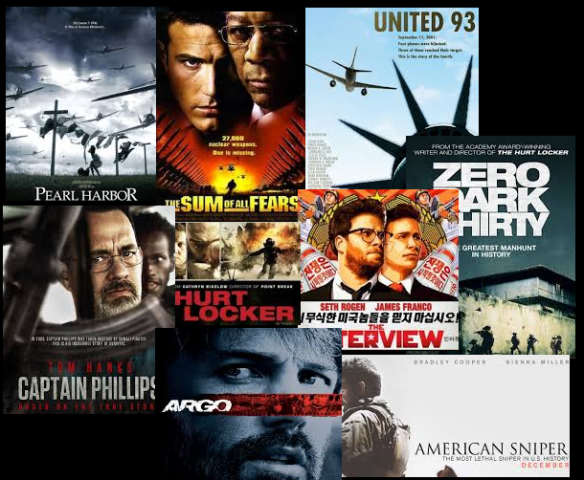
The US response was to increase base building, upgrade AFRICOM, and then murder Gadaffi. Hollywood hits from this period include The Hurt Locker and The Dark Knight. Meanwhile domestically Obama was giving the OK for militarizing of police departments across the country. On another front….Danny Haiphong wrote…

What isn’t discussed often enough is how Obama has worked tirelessly to protect and fulfill the interests of the corporate healthcare system. In 2009, he collaborated with the monopoly health insurance industry and its pharmaceutical counterparts to repress the demand for single payer healthcare. The conditions at the time appeared ripe for a single payer system. Popular discontent with Republican Party rule was at its highest point. A relatively organized movement for single payer care was represented by organizations such as Healthcare Now. The Democratic Party possessed a majority in both the House and Senate.

Obama came to power as Wall Street went into meltdown, 2008. But instead of hope and change we got almost 5 trillion dollars moving to the top 1% of the financial elite. Poverty increased every year under Obama, as did inequality. Social Network came out in 2010 and Wolf of Wall Street in 2013. Both were big hits. The message from Hollywood never changed. And part of that message is that wealth is its own justification and a symbol of virtue. Hollywood, and U.S. liberals just naturally gravitate toward the rich.

Obama attacked Afghanistan, Iraq, Syria, Libya, Sudan, Somalia, and Yemen. And it is perhaps that last venture that will prove to be his most significant. Arming, training, and coordinating the Saudi aggression (and now that has escalated to boots on the ground) against the helpless Yemen has resulted in the largest humanitarian catastrophe in five decades.

The U.S. now has all but formally criminalized dissent, especially if that dissent is aimed at Israel.

None of this is to create exact corollaries between political action and studio product. But rather that the overriding message of Hollywood in both film and TV is to validate U.S. exceptionalism. And to hedge criticism with faint token protest. But its not just Hollywood, its theatre and fiction and all the rest of the arts. The erasure of the working class is the most pronounced truth in American culture today. There are no Clifford Odets (a high school drop out) anymore; they have been replaced by a steady stream of well groomed compliant MFA grads. Mostly from elite and expensive schools. Hemingway and James Baldwin were not college grads, nor was Tennessee Williams, the son of a traveling shoe salesman. Even more recent authors such as Thomas Pynchon were college drop outs (to join the Navy), but the point is that today mass culture is carefully controlled. Dreiser was a college drop out, and Twain was a typesetters apprentice. Others like Faulkner, went to University, but also worked. In Faulkner’s case as a postman. Same profession as Henry Miller and Charles Bukowski. Stephen Crane and Hemingway worked as journalists, when that was an honorable profession.

The decision makers in mass culture are mostly firmly entrenched in the Democratic Party ethos (witness stuff like House of Cards, Madame Secretary, or Veep). If one only gets one’s news from MSNBC or FOX or CNN then one will take away mostly pure propaganda. Rachel Maddow has a career based on craven parroting of DNC approved talking points and conclusions. Bill Maher, whose show is on HBO, is of late pimping for war. Sunday news talk shows do not invite radical voices, not ever. Michael Parenti isn’t on those shows, nor  are Ajamu Baraka or Glen Ford Mike Whitney or Ed Curtin or Dan Glazebrook or Stephen Gowans. No, but there are plenty of retired generals and politicians. This is a media that exerts absolute control of message.

The loss of the working class, of class diversity, has been a far bigger blow to the health of the culture than anything else. One might argue that culture has always been, in the modern era, a province of the bourgeoisie, and that’s true. But there is still a rather pronounced change that has taken place. But Americans are discouraged from thinking in terms of class. They see individualism and identity. Get me more women directors they cry….which would give us more versions of Zero Dark Thirty, I guess. Gender equality matters, something every single socialist country in history has emphasized. Something Chavez saw fit to write into the Bolivarian constitution on day one. Chavez, who liberal avatar Bernie Sanders dismissed as a “dead communist dictator”. Chavez, who feminist avatar Hillary Clinton worked overtime to oust from power.

People are shocked…shocked I say…that US soldiers are killed in Niger. Darn that Donald Trump. When it is pointed out that it was Obama who sent troops there in his pivot to Africa, one is met with blank stares. The concern over U.S. soldiers dying is simply mind numbing in its hypocrisy and blinkered exceptionalism. I mean just count the numbers of dead civilians due to U.S. drone strikes from just one year. Pick any year you like.

Under Obama, the US African Command (AFRICOM) has penetrated every African country but Zimbabwe and Eritrea. AFRICOM has locked African nations into military subservience. In 2014, the US conducted 674 military operations in Africa . According to a recent Freedom of Information Act request by Intercept, the US currently has Special Forces deployed in more than twenty African nations.

Danny Haiphong

People are terrified today lest they be called conspiracy theorists. No single pejorative term has exercised such disproportionate power. There is a subterranean subject position associated with this, too. A masculine identity that connects with the presentation of those accepting of the official version of things. It is ‘no nonsense, mature, and sort of tough guy’ pose. Only weak and muddled (feminine you see!) would bother to question official narratives of…well, anything. It is staggering, really, why so few ask why is it OK to assassinate people without due process? Why is it whistleblowers, truth tellers, are being locked away and shunned? Why are there 900 plus US military bases around the world. Why, given the growing poverty in the U.S. do we need an updated nuclear arsenal that will cost trillions? In fact why is the defense budget over 4 billion a day? The liberal educated class seem not to ask such questions. Let alone ask is the U.S. arming takfiri jihadists in Syria? Most of what people call conspiracy is just perfectly reasonable skepticism. Given a history that includes COINTELPRO, Operation Northwoods, Gladio, MKUltra, and Operation AJAX. This is also relevant in terms of the coming war on *fake news*. An idea put forward by Obama and now in enthusiastic Orwellian operation by Facebook, YouTube, and Google. In the U.K. Theresa May proudly announces the government SHOULD control what one can see on the internet. Censorship is pitched as protection.

And then we come to NATO and Europe. Why does NATO even exist one might ask? I mean the USSR doesn’t exist anymore. Well, the answer has been under construction for a few years now, and that answer is the extraordinary anti Putin propaganda of the U.S. The “Russian Threat” is now an accepted trope in public discourse. Or the anti Iranian disinformation. In fact Iran is far more democratic and less a global threat (actually its NO global threat) than U.S. boon allies Israel and Saudi Arabia. Which brings us back to Yemen. The utter destruction of Yemen, poorest Arab country in the world, and now one with the largest Cholera outbreak in history, posed no threat to ANYONE. Certainly not to the United States. Are we to believe the House of Saud is worth supporting? They behead homosexuals and witches in Saudi Arabia. The leader of KSA is a 32 year old psychopath named Mohammed Bin Salman. Someone please explain the U.S. support for this country?

Or Venezuela. The U.S. has waged various campaigns against this sovereign nation for over a decade now. A democracy. But a disobedient one. Where is the outcry? When people are going on about Harvey Weinstein, a troglodyte movie producer that literally everyone knew was a serial abuser, I wonder that the women of Venezuela seem not to count. Or of Libya, or Haiti, or Puerto Rico, or hell, the women of Houston right now. Poor women. Ah, but that is class again. Now perhaps the Weinstein affair will yield good results and some form of collective protection and maybe even unionizing will take place to limit the power of rich white men. I doubt it, but maybe. Still, given that the liberal class today applaud the idea of making it OK for women to bomb defenseless villages in Afghanistan or Iraq or Yemen, just like men, and given that most of these horrified by Weinstein were and are solidly behind Hillary Clinton and the DNC, and laud adulation on figures like Maddie Albright, it seems hard to imagine.

David Rosen:

Sexual abuse and violence in the U.S. is as old as the country. America’s patriarchal culture long legitimized sexual abuse and violence toward women — and children — whether conducted at the workplace, at home, a nightclub or on a deserted street. During the nation’s earliest days, the custom of sexual abuse and violence was legitimized through the notion of “chastisement.” This was a feature of Anglo-American common law that recognized the husband as master of “his” household and, thus, permitted him to subject “his” wife to corporal punishment, including rape, so long as he did not inflict permanent injury upon her. Sexual abuse was institutionalized in the rape of African and later African-American female slaves. As the legal scholar Adrienne Davis notes, “U.S. slavery compelled enslaved black women to labor in three markets – productive, reproductive, and slavery – crucial to the political economy.”

One need only note the sexual violence that takes place in the U.S. military (See Kirby Dick’s The Invisible War). But that is not the military you see in this season’s TV shows such as SEAL Team or Valor or The Brave. The current Tom Cruise film American Made is a sort of comedy about Barry Seal who worked as a pilot for the CIA, and with various cartels in South America. Yeah, nothing funnier than squashing a socialist government like in Nicaragua. There is not a single Spanish speaking character who is not either a drunk, a sadist, or just incompetent. This stunningly racist revisionism was called “jaunty and bouncy” by the Hollywood Reporter.

The liberal class will always side with the status quo. Always. They do not care if the status quo is fascist. And its suits them much more to lay out bromides about male abuse of women, as long as this doesn’t mean having to untangle the complexity of women in unfamiliar non tourist visited nations like Yemen or Libya or Honduras. Just like the fact that U.S. domestic police departments murdered over a thousand black men in 2015. And continue to do so, along with increasing numbers of black women. That’s just not a jaunty bouncy story, I guess. Obama has never been comfortable talking about or to black people. He did manage to scold Colin Kaepernick recently though, about the pain he, Kaepernick, might be causing. The pain of white billionaire sports team owners I guess. The Uncle Tomism of what Glen Ford called black misleadership has never been greater. And that’s another crime we can lay, largely, at the feet of Barack Obama.

The U.S. House voted unanimously to sanction Iran and North Korea, an absurdity and a crime, and yet one that barely registered on the media Richter scale. What has Iran or North Korea ever done to hurt anyone in the United States? It is Saudi Arabia and Israel that fear a democratic nation like Iran and the influence they wield in the region. Iran is accused of fomenting instability but evidence is never given. Russia is said to control U.S. public opinion, but evidence is never given. The U.S. doesn’t even bother to really try and make claims about Venzeuela, because its just part of inherited wisdom that they are *bad*. Like Castro was bad, like Gadaffi, like Aristide, like anyone exhibiting independence. The world according to media entertainment is made up of bad guys and good guys. Mike Pompeo, head of the CIA, recently stated that his agency would become a “much more vicious agency” in fighting its enemies. Its actually hard to imagine what that might look like given CIA history. More vicious than rendition, drone killing and black site torture? Remember it was the U.S. and its School of the Americas that trained those death squads in Central America. Hollywood makes comedies about this.

In any event nobody in Hollywood complains. Just as none of the actresses assaulted by Weinstein (and countless others) said anything lest they lose career opportunities. Just as nobody complains about the racism and demonizing of Muslims or Serbs or North Koreans or Russians lest they not get the job. Coercion is silent and a given. It is also absolute. Most actors and directors simply don’t think about it, and most know little beyond what they hear on corporate news or read in the NYTimes. But I understand. People have to eat, have to feed their families. The real problem is that power is ever more consolidated. Distribution of films is monopolized. And for most Americans, foreign policy remains a giant black hole about which they know very little. Tell someone Milosovic was actually a good guy and they will laugh at you (this still happens on the left, too, rather depressingly). Tell them Russia is not threatening the U.S. or Europe, and they will laugh at you. Try to explain what Imperialism is and means, and you get that bored look of irritation. A good rule of thumb is if the U.S. targets a country or leader, then its worth questioning the western generated propagated propaganda in mainstream media about said country or leader (think Syria, Gadaffi, Aristide, Milosovic, Iran, North Korea). The U.S. does not go after countries who welcome western capital.

One of the things I’ve noticed about Hollywood film is the extraordinary amount of self pity from most characters. Self pity, entitlement, and sarcasm. The people who produce and make film and TV today, by and large, tacitly censor themselves. Some don’t have to, of course. But there is a general group think at work. And it extends to the way characters are written. The problems of affluent white people is the template here. Few examine the wider world, and mostly when they do it is seen as a world of threat and menace. An uncivilized place in need of guidance from the civilized white West (The Lost City of Z comes to mind, which made all the approved anti colonial notes while still creating a colonial narrative anyway.). But it is even more narrow than that. Everything resembles a studio; political discussions, even if they take place in outer space, resemble studio executives discussing opening weekend profits, or Neilson ratings. And since Hollywood itself ever more resembles Wall Street, or some corporate headquarters, that is increasingly what the world looks like. It is a profound loss of imagination. Westerns look and sound the same as melodramas set in Santa Monica or New York. Fantasy worlds resemble corporate headquarters or corporate motivational weekends. It is a world created by writers under thirty, largely, and certainly under forty. These are worlds created by people who themselves know very little of the world. They know even less about having to work for a living. The entire universe of film is absent any class awareness. History is simplified the better to appeal to a wider audience. Everything feels and sounds the same. And it is stultifying. There are films and TV from Europe, even from the U.K. that have merit, have heterogeneous sensibilities, but not from Hollywood. Like White House press conferences, the idea is to stay on message. Black characters sound white (or are given caricature *black* dialect and dialogue), brown characters sound white (or are given caricature barrio dialects), and Muslims sound dangerous and devious. Asians seem lifted from Fu Manchu serials or Charlie Chan. Strange when I hear people make fun of ethnic cliches from the 1940s, because it is really no different today (and check the recent TV incarnation of the venerable Star Trek franchise where the Klingon villains are very dark, live in dark spaceships and utter a guttural invented language all of which suggests something oddly racist and like nothing so much as colonial portraits of savages from darkest Africa).

Fixation on Trump’s crimes distracts from a system in which crime is a built-in factor. Clinton, Bush, Obama, and Trump. They are only the figureheads that carry water for the system. And the system is the property of the ruling class. People vote as if it crucially matters, and they vote for who they like. Not for policy because mostly they have no idea of policy. Trump is an obvious target, but that’s the problem in a sense. America didn’t become racist and violent overnight. The forces of social unrest have been building for decades. Trump was inevitable. His lack of basic literacy mirrors the nation he nominally heads, and his vulgarity mirrors the vulgarity of America, as does his misogyny and racism. The same advisors are in place and if Hillary had won, those openly fascist thugs applauding Trump would still be committing hate crimes. Has Trump empowered them? To a degree, yes. But an HRC win would likely have provided motivation of a different sort and the same violence would be taking place. You cannot sustain, as a country, this level of inequality. And as more super hurricanes descend on us, as the bio-sphere collapses, none of this may end up mattering. There is something disturbing, actually, about the relentless attacks on Trump. Its like beating up a special needs kid. Where was this hatred and outrage before? I mean Trump’s America, a term I hear a lot, is just America. We have over 2 million people in prison in the U.S. Far and away leaders in the world. Infant mortality however puts the U.S. between 26th and 51st, depending on who is counting. There is no Universal Heath Care, no union protection for workers, no maternity leave, no free education. What is there to feel so special about, exactly? Trump was very popular on his moronic reality TV show. I’m guessing more than few now outraged by this buffoonish reactionary watched that show. I mean it did last fifteen years I believe. Who did they think he was? There is nothing wrong with identifying the crimes of Trump’s administration. But there is something deeply wrong in not recognizing it as a continuation of prevailing policy. Yes, it is worse in many areas. The environment for one. But then again, 47% of the world’s pollution is caused by the military. And the U.S. has a military bigger than the next ten largest militaries in the world. And every president since the first  Bush has increased the military budget. The nightmare did not begin with the swearing in of Donald Trump. But nobody likes him. They liked Obama. And that is why he was able to do so much harm. Trump is dangerous not because of what he thinks (he mostly doesn’t) but because of his ignorance and weakness (and fear). And that weakness generated his welcoming hand to the Pentagon. Foreign policy is really in the hands of a man nicknamed ‘Mad Dog’. One cannot blame this catastrophic situation on one man. This is the creation of American history.

George W. Bush and Barack Obama: Kings of Pain

Giggling Mass-Murderers

By Cindy Sheehan

Source: Cindy Sheehan’s Soapbox

The facts don’t lie.

Under the regimes of George W. Bush and Barack Obama, millions of civilians in places such as Iraq, Afghanistan, Libya, Syria, and Yemen have been slaughtered, wounded, displaced and made desperately ill with the effects of toxins such as depleted uranium: the “gift” that never ends, literally—it has a half-life of 4.5 billion years.

Now, “because Trump,” the image of George W. Bush has been rehabilitated and (if one can believe polls) now enjoys a 59% approval rating. He left office with ratings in the mid-20’s, which I thought were far too generous, at the time.

Since the imperial agenda of W. Bush murdered my son in Iraq on April 04, 2004, my personal grief has expanded to become global in nature and I can’t stomach any of this Bush-lite just because he has been critical of someone with whom his family has personal issues. Remember when Trump humiliated Jeb? Jeb, whom I believe was the next crown prince of the Bush Crime Family?

This is not a defense of Trump. I am sure given one or two full-terms, his regime will equal that of his predecessors in gore and pain, but he has a way to go if he wants to catch up with them. I also know, that when his term ends, whenever that is, whichever presidents are still alive will laugh it up with him, no matter what political points they seem to be scoring today.
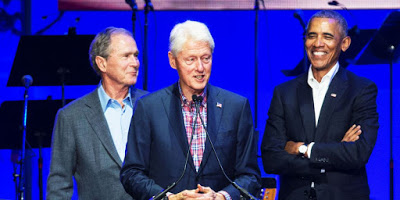
Recently, when The Five Former Presidents™ were on their “hurricane relief” tour (god help those poor people who have already been through so much), Bill Clinton was speaking with George and Barack standing behind him. George Bush apparently said something that “cracked” up Barack Obama. Of course, whenever one killer is making another laugh, the joke is usually on us. However, what disheartens me, is how many are raving about those two mass-murderers giggling just like 7th graders at a school assembly when so many are suffering because of their allegiance to empire.
Of course, the presidencies of Carter, Bush Sr. (perv and self-pro-claimed, “David Cop-a-Feel”) and Clinton (W. Bush destroyed Iraq, but Clinton “softened” it up with regular bombing raids and a decade of crippling sanctions that killed around 2 million) were blood-soaked, but Obama and W. Bush seem to radiate a certain kind of sleazy vibrancy.

To see these killers who have caused so much lingering pain have so much delightful fun (at taxpayer’s expense, by the way), is heartrending.

Even when I am at my happiest with my grandchildren and I feel my heart is filled with joy, it isn’t, quite. There is always a black hole of anguish that can never be filled. At any moment, without warning, I can be plunged back into despair, but, hey, at least The Five Former Presidents™ are still able to yuck it up and garner millions for speeches and public appearances. Who am I to deny all these war criminals a renewed lease on life?

They are not good humans and they ALL (yes even Carter) deserve to be incarcerated for life at The Hague, never to bother anyone again. Just because they all left office unfettered by shackles doesn’t mean they should be able to live long lives of peace and profit.

The people of the United States need to be deprogrammed from their cultish devotion to these mass-murderers: Absent incarceration in The Hague, they should be shunned and ridiculed at every opportunity.

I intend to make it my life’s work to hold them accountable.

Gaslighting: State Mind Control and Abusive Narcissism

By Vanessa Beeley

Source: 21st Century Wire

Exceptionalism: the condition of being different from the norm; also:  a theory expounding the exceptionalism especially of a nation or region.

There are many theories surrounding the origin of American exceptionalism. The most popular in US folklore, being that it describes America’s unique character as a “free” nation founded on democratic ideals and civil liberties. The Declaration of Independence from British colonial rule is the foundation of this theory and has persevered throughout the often violent history of the US since its birth as a free nation.

Over time, exceptionalism has come to represent superiority in the minds and hearts of Americans. Belief in their economic, military and ideological supremacy is what has motivated successive US governments to invest in shaping the world in their superior image with little or no regard for the destruction left in the wake of their exceptional hegemony.

In considering itself, exceptional, the US has extricated itself from any legal obligation to adhere to either International law or even the common moral laws that should govern Humanity.  The US has become exceptionally lawless and authoritarian particularly in its intolerant neo-colonialist foreign policy.  The colonized have become the colonialists, concealing their brutal savagery behind a veneer of missionary zeal that they are converting the world to their form of exceptionalist Utopia.

Such is the media & marketing apparatus that supports this superiority complex, the majority of US congress exist within its echo chamber and are willing victims of its indoctrination. The power of the propaganda vortex pulls them in and then radiates outwards, infecting all in its path.  Self-extraction from this oligarchical perspective is perceived as a revolutionary act that challenges the core of US security so exceptionalism becomes the modus vivendi.

Just as Israel considers itself ‘the chosen people’ from a religious perspective, the US considers itself the chosen nation to impose its version of Democratic reform and capitalist hegemony the world over. One can see why Israel and the US make such symbiotic bedfellows.

“The fatal war for humanity is the war with Russia and China toward which Washington is driving the US and Washington’s NATO and Asian puppet states.  The bigotry of the US power elite is rooted in its self-righteous doctrine that stipulates America as the “indispensable country” ~ Paul Craig Roberts: Washington Drives the World Towards War.

So why do the American people accept US criminal hegemony, domestic and foreign brutal tyranny & neo-colonialist blood-letting with scant protest? Why do the European vassal states not rise up against this authoritarian regime that flaunts international law and drags its NATO allies down the path to complete lawlessness and diplomatic ignominy?

What is Gaslighting?

The psychological term “Gaslighting” comes from a 1944 Hollywood classic movie called Gaslight.  Gaslighting describes the abuse employed by a narcissist to instil in their victim’s mind, an extreme anxiety and confusion to the extent where they no longer have faith in their own powers of logic, reason and judgement. These gaslighting techniques were adopted by central intelligence agencies in the US and Europe as part of their psychological warfare methods, used primarily during torture or interrogation.

Gaslighting as an abuser’s modus operandi, involves, specifically, the withholding of factual information and its replacement with false or fictional information designed to confuse and disorientate. This subtle and Machiavellian process eventually undermines the mental stability of its victims reducing them to such a depth of insecurity and identity crisis that they become entirely dependent upon their abuser for their sense of reality and even identity.

Gaslighting involves a step by step psychological process to manipulate and destabilize its victim.  It is built up over time and consists of repetitive information feeds that enter the victim’s subconscious over a period of time, until it is fully registered on the subconscious “hard disk” and cannot be overridden by the conscious floppy disk.  Put more simply, it is brainwashing.

Overall, the main reason for gaslighting is to create a dynamic where the abuser has complete control over their victim so that they are so weak that they are very easy to manipulate.” ~ Alex Myles

Three Stages of Gaslighting: Stage One

The first stage depends upon trust in the integrity and unimpeachable intentions of the abuser, a state of reliance that has been engendered by the abuser’s artful self-promotion and ingratiating propaganda.  Once this trust is gained, the abuser will begin to subtly undermine it, creating situations and environments where the victim will begin to doubt their own judgement.  Eventually the victim will rely entirely upon the abuser to alleviate their uncertainty and to restore their sense of reality which is in fact that of the abuser.

Stage Two

The second stage, defence, is a process by which the abuser isolates the victim, not only from their own sense of identity but from the validation of their peers.  They are made to feel that their opinion is worthless, discredited, down-right weird.  In political circles they would be labelled a conspiracy theorist, a dissident, a terror apologist.  As a consequence, the victim will withdraw from society and cease to express themselves for fear of ridicule, judgement or punishment.

This stage can also be compared to Stockholm Syndrome where a hostage or captive is reduced,by psychological mind games, back to infantile dependency upon their captor.  Narcissistic abuse bonds the victim to the aggressor via trauma.  Stockholm Syndrome bonds the victim to the aggressor via regression to an infantile state where the abuser/aggressor becomes the “parent” who will rescue the victim from imminent annihilation.  Both methods tap into the victim’s survival mechanisms to gain and maintain control.

Stage Three

The final stage is depression.  A life under the tyrannical rule of a narcissist drives the victim into a state of extreme confusion.  They are stripped of dignity & self-reliance.  They, ultimately exist in an information vacuum which is only filled by that which the abuser deems suitable or relevant.  This can eventually invoke symptoms of PTSD [Post Traumatic Stress Disorder]. Flashbacks, constant apprehension, hyper vigilance, mind paralysis, rage and even violence.  The process is complete and the victim has been reduced to a willing accomplice in the abusers creation of a very distorted reality.

Exceptionalism or Narcissism?

We are currently seeing the transformation of US exceptionalism into an abusive Narcissism.

The gargantuan apparatus of mind bending and controlling is being put into hyper drive by the ruling elite.  We are inundated with propaganda that challenges our sense of reality but only after being “tenderized” by the fear factor.  Fear of “terror”, fear of war, fear of financial insecurity, fear of gun violence, fear of our own shadow.  Once we are suitably quaking in our boots, in comes the rendition of reality that relieves our anxiety.  If we challenge this version of events we are labelled a conspiracy theorist, a threat to security. We are hounded, discredited, slandered and ridiculed.  We are isolated and threatened.

Wars are started in the same way.  Despite the hindsight that should enable us to see it coming, the process swings into motion with resounding success. The ubiquitous dictator, the oligarch who threatens to destroy all that the US and her allies represent which of course is, freedom, equality & civil liberty all wrapped up in the Democracy shiny paper and tied with the exceptionalist ribbon.

Next the false flag to engender fear, terror and to foment sectarian strife. The support of a “legitimate” organic, indigenous “revolution” conveniently emerging in tandem with US ambitions for imposing their model of governance upon a target nation. The arming of “freedom fighters”, the securing of mercenary additions to these manufactured proxy forces.  All this is sold in the name of freedom and democracy to a public that is already in a state of anxiety and insecurity, lacking in judgement or insight into any other reality but that of their “abuser”.

The NGO Complex Deployment

Finally, the Humanitarians are deployed.  The forces for “good”, the vanguard of integrity and ethical intervention.  The power that offers all lost souls a stake-holding in the salvation of sovereign nations that have lost their way and need rescuing.  A balm for a damaged soul, to know they can leave their doubts and fears in such trustworthy hands as HRW, Amnesty International, they can assuage their deep sense of guilt at the suffering being endured by the people of far flung nations because they can depend upon the NGOs to provide absolution with minimal effort on their part.  They don’t realise that NGOs are an integral part of their abuser’s apparatus, operating on the leash of neo-colonialist financing and influence.  NGOs provide the optic through which the abuser will allow the victim to perceive their world and once absorbed into this flawed prism the victim’s own cognitive dissonance will ensure they do not attempt a jail break.

In this state of oppressed consciousness the victim accepts what they are told.  They accept that the US can sell cluster bombs to Saudi Arabia that obliterate human beings and lay waste to essential civilian infrastructure in Yemen.  They accept that the US financially, ideologically & militarily supports the illegal state of Israel and provides the arsenal of experimental weapons that maim and mutilate children and civilians on a scale that is unimaginable.  They accept that a crippling blockade of the already impoverished and starving nation of Yemen is “necessary” to resolve the issues of sectarian divisions that only exist in the minds of their Congressional abusers.

The majority of Americans accept mass murder under the pretext of the right to protect, because their ability to form rational and reasoned opinions has been engineered out of them.  This is now the definition of US exceptionalism.  It is their ability to manipulate the world into accepting their lawlessness and global hegemony agenda.  In seeking to impose its own image upon our world the US has drifted so far from its founding principles, one wonders how they will ever return to them.  They have employed a recognised form of torture to ensure capitulation to their mission of world domination which entails the mental, physical and spiritual torture of target civilian populations.

In conclusion, the US has indeed achieved exceptionalism.  The US has become an exceptional global executioner and persecutor of Humanity.  Imperialism is a euphemism for the depths of abuse the US is inflicting upon the people of this world.

Our only hope is to break the cycle of abuse with empathy for the victim and with appreciation for the years of brainwashing that precedes their agonizing passive-aggressive apathy towards crimes being committed in “their name”.

This was an email I received recently from one courageous young American girl whose epiphany is testament to the resilience and survival instinct of the human spirit.

My name is Caroline and I am a 22 year old US citizen. I only fairly recently discovered the truth about Empire/NATO’s activities in Syria and Libya and so many other countries (thanks to writers like Andre Vltchek, Cory Morningstar, Forrest Palmer). I am sickened when I remember that I signed some of those Avaaz petitions and I feel horrified at knowing that I have Syrian and Libyan blood on my hands. I want to believe that I’m not “really” guilty because I really thought (as I had been told) that I was not doing something bad at the time, but still, what I did contributed to the suffering of those people and I want to do something to atone in at least some small way, even though I probably can’t “make up” for what I did or erase my crime.

If it’s not too much trouble, could you please tell me what you think I should do, if there is anything?” 

She deserves an answer…


***

Author Vanessa Beeley is a contributor to 21WIRE, and since 2011, she has spent most of her time in the Middle East reporting on events there – as a independent researcher, writer, photographer and peace activist. She is also a member of the Steering Committee of the Syria Solidarity Movement, and a volunteer with the Global Campaign to Return to Palestine. See more of her work at her blog The Wall Will Fall.


Related Podcast:

Resisting Donald Trump’s Violence Strategically

american-empire

(Editor’s note: we realize the issues addressed by the article are hardly unique to Trump and his administration but as they are the puppets currently in power, their actions and those of their controllers should be of primary concern.)

By Robert J. Burrowes

It is already clearly apparent, as many predicted, that Donald Trump’s
election as president of the United States would signal the start of
what might be the final monumental assault on much of what is good in
our world. Whatever our collective gains to date to create a world in
which peace, social justice and environmental sustainability ultimately
prevail for all of Earth’s inhabitants, we stand to lose it all in the
catastrophic sequence of events that Trump is now initiating with those
who share his delusional worldview.

Starting with the appointment to his administration of individuals, such
as Steve Bannon, Rex Tillerson and Scott Pruitt, who share his warped
view of the world, and continuing with the policy decisions he is now
implementing via executive orders, Trump threatens our biosphere with
ecological catastrophe (through climate/environment-destroying decisions
and perhaps through nuclear war) – see ‘US election: Climate scientists
react to Donald Trump’s victory’ and ‘It is two and a half minutes to midnight: 2017 Doomsday Clock Statement‘ as well as ‘Trump pledges “greatest military build-up in American history“‘ – exacerbates military violence in existing war zones – see ‘Obama
Killed a 16-Year-Old American in Yemen. Trump Just Killed His 8-Year-Old
Sister’ – increases regional geopolitical tensions in ways that inflame the
possibility of political unrest and military violence in new theatres –
see ‘Worried Over Trump, China Tries to Catch up With U.S. Navy‘ – supports violent and repressive regimes against those who struggle for liberation – see ‘The Middle East “peace process” was a myth. Donald Trump ended it‘ – and is generally implementing decisions that reverse progressive outcomes from years of peace, social justice and environmental
struggles. See, for example, ‘Trump’s Immigration Crackdown Is Likely to
Bring a Flood of Lawsuits‘ and ‘One of Donald Trump’s first moves in the White House strips women of abortion rights‘ as well as ‘President Trump Breaks a Promise on Transgender Rights‘.

Moreover, Trump, and those like him, further criminalize our right to
dissent. See ‘North Dakota Senate passes bills criminalizing Dakota
Access Pipeline protests‘.

Why does Trump ignore overwhelming scientific evidence (for example, in
relation to the climate) and want to ‘lock out’ people who are desperate
to improve their lives? Why does he want to prepare for and threaten
more war and even nuclear war?

Is Donald Trump sane?

According to Dr John D. Gartner, a practising psychotherapist who taught
psychiatric residents at Johns Hopkins University Medical School,
‘Donald Trump is dangerously mentally ill and temperamentally incapable
of being president’. See ‘Temperament Tantrum: Some say President Donald
Trump’s personality isn’t just flawed, it’s dangerous‘.

Moreover, Chris Hedges argues, Trump is dangerously violent. See ‘Trump
Will Crush Dissent With Even Greater Violence and Savagery‘.

But why is Trump ‘dangerously mentally ill’ and violent?

For the same reason that any person, whether in the Trump administration
or not, ends up in this state: it is an outcome of the ‘visible’,
‘invisible’ and ‘utterly invisible’ violence that they suffered during
childhood and which unconsciously determines virtually everything they
now do. In brief, Trump is utterly terrified and full of self-hatred but
projects this as terror and hatred of women, migrants, Muslims… and this
makes him behave insanely. For a brief explanation, see ‘The Global
Elite is Insane‘. For a more comprehensive explanation of why many human beings are violent, see ‘Why Violence?‘ and ‘Fearless Psychology and Fearful Psychology: Principles and Practice‘.

So what are we to do? Well, if you are inclined to resist the diabolical
actions of Donald Trump (and his insane and violent equivalents in the
United States and other countries around the world), I invite you to
respond powerfully. This includes maintaining a large measure of empathy
for the emotionally damaged individual who is now president of the US
(and his many equivalents). It also includes recognizing that this
individual and his equivalents are the current ‘face’ of a global system
of violence and exploitation built on many long-standing structures that
we must systematically dismantle.

Here are some options for resisting and rebuilding, depending on your
circumstances.

If you wish to strike at the core of human violence, consider modifying
your treatment of children in accordance with the suggestions in the
article ‘My Promise to Children‘.

If you wish to simultaneously tackle all military, climate and
environmental threats to human existence while rebuilding human
societies in ways that enhance individual empowerment and community
self-reliance, consider joining those participating in ‘The Flame Tree
Project to Save Life on Earth‘.

If you wish to resist particular elite initiatives that threaten peace,
justice and environmental sustainability, consider planning, organizing
and implementing nonviolent strategies to do so. But I wish to emphasize
the word ‘strategies’. There is no point taking piecemeal measures or
organizing one-off events, no matter how big, to express your concern.
If you don’t plan, organize and act strategically, you will have wasted
your time and effort on something that has no impact. Remember 15
February 2003? Up to thirty million people in over 600 cities around the
world participated in rallies against the war on Iraq in what some
labeled ‘the largest protest event in human history’. Did it stop the
war?

So if you are inclined to respond powerfully by planning a nonviolent
strategy for your campaign, you might be interested in the Nonviolent
Strategy Wheel and other strategic thinking on this website – Nonviolent
Campaign Strategy – or the parallel one: Nonviolent Defense/Liberation Strategy.

And if you wish to join the worldwide movement to end violence in all of
its forms, you might also be interested in signing the online pledge of
The People’s Charter to Create a Nonviolent World‘.

Donald Trump has formidable institutional power at his disposal and he
and his officials will use it to inflict enormous damage on us and our
world in the months ahead.

What most people do not realize is that we have vastly greater power at
our disposal to stop him and the elite and their institutions he
represents. But we need to deploy our power strategically if we are to
put this world on a renewed trajectory to peace, justice and
sustainability.


Biodata: Robert J. Burrowes has a lifetime commitment to understanding and ending human violence. He has done extensive research since 1966 in an effort to understand why human beings are violent and has been a nonviolent activist since 1981. He is the author of ‘Why Violence?‘ His email address is flametree@riseup.netand his website is at http://robertjburrowes.wordpress.com

Robert J. Burrowes
P.O. Box 68
Daylesford
Victoria 3460
Australia
Email: flametree@riseup.net

Websites:
Nonviolence Charter
Flame Tree Project to Save Life on Earth
‘Why Violence?’
Nonviolent Campaign Strategy
Nonviolent Defense/Liberation Strategy
Anita: Songs of Nonviolence
Robert Burrowes
Global Nonviolence Network

If Americans Truly Cared About Muslims, They Would Stop Killing Them by the Millions

index

By Glen Ford

Source: Black Agenda Report

In the most dramatic expression of insider opposition to a sitting administration’s policies in generations, over 1,000 U.S. State Department employees signed on to a memo protesting President Donald Trump’s temporary ban on people from seven predominantly Muslim countries setting foot on U.S. soil. Another recent high point in dissent among the State Department’s 18,000 worldwide employees occurred in June of last year, when 51 diplomats called for U.S. air strikes against the Syrian government of President Bashar al Assad.

Neither outburst of dissent was directed against the U.S. wars and economic sanctions that have killed and displaced millions of people in the affected countries: Iran, Iraq, Libya, Somalia, Sudan, Syria and Yemen. Rather, the diplomatic “rebellion” of last summer sought to pressure the Obama administration to join with Hillary Clinton and her “Big Tent” full of war hawks to confront Russia in the skies over Syria, while the memo currently making the rounds of State Department employees claims to uphold “core American and constitutional values,” preserve “good will towards Americans” and prevent “potential damage to the U.S. economy from the loss of revenue from foreign travelers and students.”

In neither memo is there a word of support for world peace, nor a hint of respect for the national sovereignty of other peoples — which is probably appropriate, since these are not, and never have been, “core American and constitutional values.”

Ironically, the State Department “dissent channel” was established during one of those rare moments in U.S. history when “peace” was popular: 1971, when a defeated U.S. war machine was very reluctantly winding down support for its puppet regime in South Vietnam. Back then, lots of Americans, including denizens of the U.S. government, wanted to take credit for the “peace” that was on the verge of being won by the Vietnamese, at a cost of at least four million Southeast Asian dead. But, those days are long gone. Since 2001, war has been normalized in the U.S. — especially war against Muslims, which now ranks at the top of actual “core American values.” Indeed, so much American hatred is directed at Muslims that Democrats and establishment Republicans must struggle to keep the Russians in the “hate zone” of the American popular psyche. The two premiere, officially-sanctioned hatreds are, of course, inter-related, particularly since the Kremlin stands in the way of a U.S. blitzkrieg in Syria, wrecking Washington’s decades-long strategy to deploy Islamic jihadists as foot soldiers of U.S. empire.

The United States has always been a project of empire-building. George Washington called it a “nascent empire,” Thomas Jefferson bought the Louisiana Territory from France in pursuit of an “extensive empire,” and the real Alexander Hamilton, contrary to the Broadway version, considered the U.S. to be the “most interesting empire in the world.” The colonial outpost of two million white settlers (and half a million African slaves) severed ties with Britain in order to forge its own, limitless dominion, to rival the other white European empires of the world. Today, the U.S. is the Mother of All (Neo)Colonialists, under whose armored skirts are gathered all the aged, shriveled, junior imperialists of the previous era.

In order to reconcile the massive contradiction between America’s predatory nature and its mythical self-image, however, the mega-hyper-empire must masquerade as its opposite: a benevolent, “exceptional” and “indispensible” bulwark against global barbarism. Barbarians must, therefore, be invented and nurtured, as did the U.S. and the Saudis in 1980s Afghanistan with their creation of the world’s first international jihadist network, for subsequent deployment against the secular “barbarian” states of Libya and Syria.

In modern American bureaucratese, worrisome barbarian states are referred to as “countries or areas of concern” — the language used to designate the seven nations targeted under the Terrorist Travel Prevention Act of 2015 signed by President Obama. President Donald Trump used the existing legislation as the basis for his executive order banning travelers from those states, while specifically naming only Syria. Thus, the current abomination is a perfect example of the continuity of U.S. imperial policy in the region, and emphatically not something new under the sun (a sun that, as with old Britannia, never sets on U.S. empire).

The empire preserves itself, and strives relentlessly to expand, through force of arms and coercive economic sanctions backed up by the threat of annihilation. It kills people by the millions, while allowing a tiny fraction of its victims to seek sanctuary within U.S. borders, based on their individual value to the empire.

Donald Trump’s racist executive order directly affects about 20,000 people, according to the United Nations High Commissioner on Refugees. President Obama killed an estimated 50,000 Libyans in 2011, although the U.S. officially does not admit it snuffed out the life of a single civilian. The First Black President is responsible for each of the half-million Syrians that have died since he launched his jihadist-based war against that country, the same year. Total casualties inflicted on the populations of the seven targeted nations since the U.S. backed Iraq in its 1980s war against Iran number at least four million — a bigger holocaust than the U.S. inflicted on Southeast Asia, two generations ago — when the U.S. State Department first established its “dissent channel.”

But, where is the peace movement? Instead of demanding a halt to the carnage that creates tidal waves of refugees, self-styled “progressives” join in the macabre ritual of demonizing the “countries of concern” that have been targeted for attack, a process that U.S. history has color-coded with racism and Islamophobia. These imperial citizens then congratulate themselves on being the world’s one and only “exceptional” people, because they deign to accept the presence of a tiny portion of the populations the U.S. has mauled.

The rest of humanity, however, sees the real face of America — and there will be a reckoning.


We Have Met the Alien and He Is Us

73e633dab43437b78c926c0403c06bcc

By William Astore

Source: TomDispatch.com

We Are The Empire
Of U.S. Military Interventions, Alien Disaster Movies, and Star Wars
By William J. Astore

Perhaps you’ve heard the expression: “We have met the enemy and he is us.” Cartoonist Walt Kelly’s famed possum, Pogo, first uttered that cry. In light of alien disaster movies like the recent sequel Independence Day: Resurgence and America’s disastrous wars of the twenty-first century, I’d like to suggest a slight change in that classic phrase: we have met the alien and he is us.

Allow me to explain. I grew up reading and watching science fiction with a fascination that bordered on passion. In my youth, I also felt great admiration for the high-tech, futuristic nature of the U.S. military. When it came time for college, I majored in mechanical engineering and joined the U.S. Air Force. On graduating, I would immediately be assigned to one of the more high-tech, sci-fi-like (not to say apocalyptic) military settings possible: Air Force Space Command’s Cheyenne Mountain.

For those of you who don’t remember the looming, end-of-everything atmosphere of the Cold War era, Cheyenne Mountain was a nuclear missile command center tunneled out of solid granite inside an actual mountain in Colorado. In those days, I saw myself as one of the good guys, protecting America from “alien” invasions and the potential nuclear obliteration of the country at the hands of godless communists from the Soviet Union. The year was 1985 and back then my idea of an “alien” invasion movie was Red Dawn, a film in which the Soviets and their Cuban allies invade the U.S., only to be turned back by a group of wolverine-like all-American teen rebels. (Think: the Vietcong, American-style, since the Vietnam War was then just a decade past.)

Strange to say, though, as I progressed through the military, I found myself growing increasingly uneasy about my good-guy stature and about who exactly was doing what to whom. Why, for example, did we invade Iraq in 2003 when that country had nothing to do with the attacks of 9/11? Why were we so focused on dominating the Earth’s resources, especially its oil? Why, after declaring total victory over the “alien” commies in 1991 and putting the Cold War to bed for forever (or so it seemed then), did our military continue to strive for “global reach, global power” and what, with no sense of overreach or irony, it liked to call “full-spectrum dominance”?

Still, whatever was simmering away inside me, only when I retired from the Air Force in 2005 did I fully face what had been staring back at me all those years: I had met the alien, and he was me.

The Alien Nature of U.S. Military Interventions

The latest Independence Day movie, despite earning disastrous reviews, is probably still rumbling its way through a multiplex near you. The basic plot hasn’t changed: ruthless aliens from afar (yet again) invade, seeking to exploit our precious planet while annihilating humanity (something that, to the best of our knowledge, only we are actually capable of). But we humans, in such movies as in reality, are a resilient lot. Enough of the plucky and the lucky emerge from the rubble to organize a counterattack. Despite being outclassed by the aliens’ shockingly superior technology and awe-inspiring arsenal of firepower, humanity finds a way to save the Earth while — you won’t be surprised to know — thoroughly thrashing said aliens.

Remember the original Independence Day from two decades ago? Derivative and predictable it may have been, but it was also a campy spectacle — with Will Smith’s cigar-chomping military pilot, Bill Pullman’s kickass president in a cockpit, and the White House being blown to smithereens by those aliens. That was 1996. The Soviet Union was half-a-decade gone and the U.S. was the planet’s “sole superpower.” Still, who knew that seven years later, on the deck of an aircraft carrier, an all-too-real American president would climb out of a similar cockpit in a flight suit, having essentially just blown part of the Middle East to smithereens, and declare his very own “mission accomplished” moment?

In the aftermath of the invasion of Afghanistan and the “shock and awe” assault on Iraq, the never-ending destructiveness of the wars that followed, coupled with the U.S. government’s deployment of deadly robotic drones and special ops units across the globe, alien invasion movies aren’t — at least for me — the campy fun they once were, and not just because the latest of them is louder, dumber, and more cliché-ridden than ever. I suspect that there’s something else at work as well, something that’s barely risen to consciousness here: in these years, we’ve morphed into the planet’s invading aliens.

Think about it. Over the last half-century, whenever and wherever the U.S. military “deploys,” often to underdeveloped towns and villages in places like Vietnam, Afghanistan, or Iraq, it arrives very much in the spirit of those sci-fi aliens. After all, it brings with it dazzlingly destructive futuristic weaponry and high-tech gadgetry of all sorts (known in the military as “force-multipliers”). It then proceeds to build mothership-style bases that are often like American small towns plopped down in a new environment. Nowadays in such lands, American drones patrol the skies (think: the Terminator films), blast walls accented with razor wire and klieg lights provide “force protection” on the ground, and the usual attack helicopters, combat jets, and gunships hover overhead like so many alien craft. To designate targets to wipe out, U.S. forces even use lasers!

In the field, American military officers emerge from high-tech vehicles to bark out commands in a harsh “alien” tongue. (You know: English.) Even as American leaders offer reassuring words to the natives (and to the public in “the homeland”) about the U.S. military being a force for human liberation, the message couldn’t be more unmistakable if you happen to be living in such countries: the “aliens” are here, and they’re planning to take control, weapons loaded and ready to fire.

Other U.S. military officers have noticed this dynamic. In 2004, near Samarra in Iraq’s Salahuddin province, for instance, then-Major Guy Parmeter recalled asking a farmer if he’d “seen any foreign fighters” about. The farmer’s reply was as simple as it was telling: “Yes, you.” Parmeter noted, “You have a bunch of epiphanies over the course of your experience here [in Iraq], and it made me think: How are we perceived, who are we to them?”

Americans may see themselves as liberators, but to the Iraqis and so many other peoples Washington has targeted with its drones, jets, and high-tech weaponry, we are the invaders.

Do you recall what the aliens were after in the first Independence Day movie? Resources. In that film, they were compared to locusts, traveling from planet to planet, stripping them of their valuables while killing their inhabitants. These days, that narrative should sound a lot less alien to us. After all, would Washington have committed itself quite so fully to the Greater Middle East if it hadn’t possessed all that oil so vital to our consumption-driven way of life? That’s what the Carter Doctrine of 1980 was about: it defined the Persian Gulf as a U.S. “vital interest” precisely because, to quote former Deputy Secretary of Defense Paul Wolfowitz’s apt description of Iraq, it “floats on a sea of oil.”

Of Cold War Memories and Imperial Storm Troopers

Whether anyone notices or not, alien invasion flicks offer a telling analogy when it comes to the destructive reality of Washington’s global ambitions; so, too, do “space operas” like Star Wars. I’m a fan of George Lucas’s original trilogy, which appeared in my formative years. When I saw them in the midst of the Cold War, I never doubted that Darth Vader’s authoritarian Empire in a galaxy far, far away was the Soviet Union. Weren’t the Soviets, whom President Ronald Reagan would dub “the evil empire,” bent on imperial domination? Didn’t they have the equivalent of storm troopers, and wasn’t it our job to “contain” that threat?

Like most young Americans then, I saw myself as a plucky rebel, a mixture of the free-wheeling, wisecracking Han Solo and the fresh-faced, idealistic Luke Skywalker. Of course, George Lucas had a darker, more complex vision in mind, one in which President Richard Nixon, not some sclerotic Soviet premier, provided a model for the power-mad emperor, while the lovable Ewoks in The Return of the Jedi — with their simple if effective weaponry and their anti-imperial insurgent tactics — were clearly meant to evoke Vietnamese resistance forces in an American war that Lucas had loathed. But few enough Americans of the Cold War-era thought in such terms. (I didn’t.) It went without question that we weren’t the heartless evil empire. We were the Jedi! And metaphorically speaking, weren’t we the ones who, in the end, blew up the Soviet Death Star and won the Cold War?

How, then, did an increasingly gargantuan Pentagon become the Death Star of our moment? We even had our own Darth Vader in Dick Cheney, a vice president who actually took pride in the comparison.

Think for a moment, dear reader, about the optics of a typical twenty-first-century U.S. military intervention. As our troops deploy to places that for most Americans might as well be in a galaxy far, far away, with all their depersonalizing body armor and high-tech weaponry, they certainly have the look of imperial storm troopers.

I’m hardly the first person to notice this. As Iraq war veteran Roy Scranton recently wrote in the New York Times, “I was the faceless storm trooper, and the scrappy rebels were the Iraqis.” Ouch.

American troops in that country often moved about in huge MRAPs (mine-resistant, ambush-protected vehicles) described to me by an Army battalion commander as “ungainly” and “un-soldier like.” Along with M1 Abrams tanks and Bradley fighting vehicles, those MRAPs were the American equivalents of the Imperial Walkers in Star Wars. Such vehicles, my battalion commander friend noted drolly, were “not conducive to social engagements with Iraqis.”

It’s not the fault of the individual American soldier that, in these years, he’s been outfitted like a Star Wars storm trooper. His equipment is designed to be rugged and redundant, meaning difficult to break, but it comes at a cost. In Iraq, U.S. troops were often encased in 80 to 100 pounds of equipment, including a rifle, body armor, helmet, ammunition, water, radio, batteries, and night-vision goggles. And, light as they are, let’s not forget the ominous dark sunglasses meant to dim the glare of Iraq’s foreign sun.

Now, think how that soldier appeared to ordinary Iraqis — or Afghans, Yemenis, Libyans, or almost any other non-Western people. Wouldn’t he or she seem both intimidating and foreign, indeed, hostile and “alien,” especially while pointing a rifle at you and jabbering away in a foreign tongue? Of course, in Star Wars terms, it went both ways in Iraq. A colleague told me that during her time there, she heard American troops refer to Iraqis as “sand people,” the vicious desert raiders and scavengers of Star Wars. If “they” seem like vicious aliens to us, should we be surprised that we just might seem that way to them?

Meanwhile, consider the American enemy, whether the Taliban, al-Qaeda, or any of our other opponents of this era. Typically unburdened by heavy armor and loads of equipment, they move around in small bands, improvising as they go. Such “terrorists” — or “freedom fighters,” take your pick — more closely resemble (optically, at least) the plucky human survivors of Independence Day or the ragtag yet determined rebels of Star Wars than heavy patrols of U.S. troops do.

Now, think of the typical U.S. military response to the nimbleness and speed of such “rebels.” It usually involves deploying yet more and bigger technologies. The U.S. has even sent its version of Imperial Star Destroyers (we call them B-52s) to Syria and Iraq to take out “rebels” riding their version of Star Wars “speeders” (i.e. Toyota trucks).

To navigate and negotiate the complex “human terrain” (actual U.S. Army term) of “planets” like Iraq and Afghanistan, U.S. troops call on a range of space-age technologies, including direction-finding equipment, signal intercept, terrain modeling, and satellite navigation using GPS. The enemy, being part of that “human terrain,” has little need for such technology to “master” it. Since understanding alien cultures and their peculiar “human terrains” is not its forte, the U.S. military has been known to hire anthropologists to help it try to grasp the strange behaviors of the peoples of Planet Iraq and Planet Afghanistan.

Yet unlike the evil empire of Star Wars or the ruthless aliens of Independence Day, the U.S. military never claimed to be seeking total control (or destruction) of the lands it invaded, nor did it claim to desire the total annihilation of their populations (unless you count the “carpet bombing” fantasies of wannabe Sith Lord Ted Cruz). Instead, it promised to leave quickly once its liberating mission was accomplished, taking its troops, attack craft, and motherships with it.

After 15 years and counting on Planet Afghanistan and 13 on Planet Iraq, tell me again how those promises have played out.

In a Galaxy Far, Far Away

Consider it an irony of alien disaster movies that they manage to critique U.S. military ambitions vis-à-vis the “primitive” natives of far-off lands (even if none of us and few of the filmmakers know it). Like it or not, as the world’s sole superpower, dependent on advanced technology to implement its global ambitions, the U.S. provides a remarkably good model for the imperial and imperious aliens of our screen life.

We Americans, proud denizens of the land of the gun and of the only superpower left standing, don’t, of course, want to think of ourselves as aliens. Who does? We go to movies like Independence Day or Star Wars to identify with the outgunned rebels. Evidence to the contrary, we still think of ourselves as the underdogs, the rebels, the liberators. And so — I still believe — we once were, a long time ago in a galaxy far, far away.

We need to get back to that time and that galaxy. But we don’t need a high-tech time machine or sci-fi wormhole to do so. Instead, we need to take a long hard look at ourselves. Like Pogo, we need to be willing to see the evidence of our own invasive nature. Only then can we begin to become the kind of land we say we want to be.


A TomDispatch regular, William Astore is a retired lieutenant colonel (USAF) and history professor. He blogs at Bracing Views.